
How Culture Got to the Point Where Saturday Night Live is Promoting Abortion in a Clown Outfit
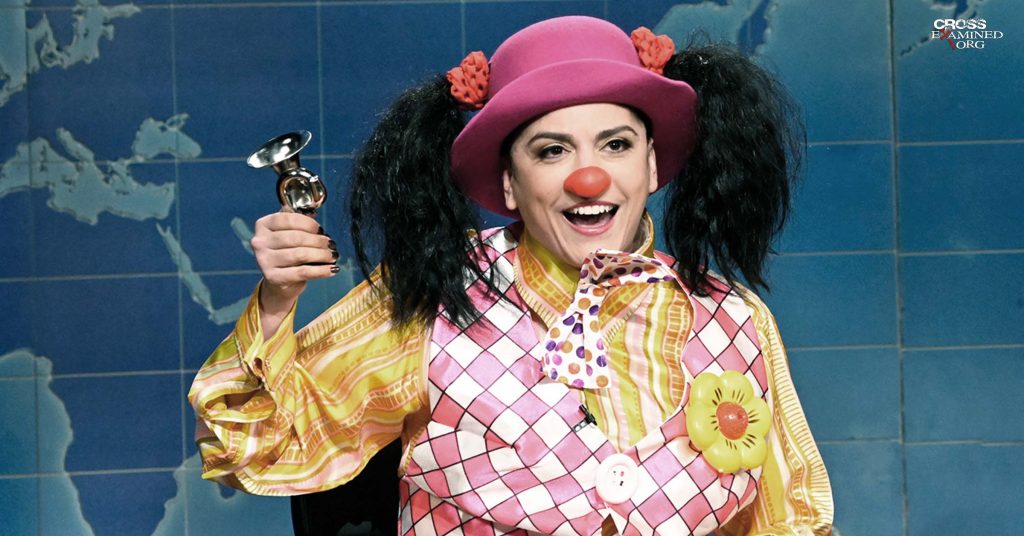
This weekend, Saturday Night Live cast member Cecily Strong played a character called Goober the Clown who had an abortion when she was 23 and now talks to people about how normal abortion is in between clown jokes.
Goober explains that it’s a “rough” subject, so she does fun clown stuff to make it more “palatable.” In the context of her skit, saying that it’s a rough subject wasn’t a tacit admission that abortion is in some way wrong; it was a condemnation of those who make it rough to talk about because they have a problem with it.
If you can stomach it, you can watch the 4 minute clip here.
Yes, the intentional killing of preborn babies has become fodder for a comedy skit—something literally worth clowning around about.
Every single one of us should be asking how on earth we, as a culture, have arrived at such a moment.
If we’re not asking that question, we’ve become completely desensitized to evil.
In one sense, the question of how we got “here” is a complex one worth hundreds of pages of historical, philosophical, political, and theological history. (And if you’re looking for something of that nature, I can think of no better resource than Carl Trueman’s The Rise and Triumph of the Modern Self: Cultural Amnesia, Expressive Individualism, and the Road to Sexual Revolution.)
But in another sense, the question is far more straightforward when you understand the nature of the secular worldview that dominates our culture.
In Chapter 8 of my upcoming book Faithfully Different: Regaining Biblical Clarity in a Secular Culture, I talk about “Reaffirming Biblical Morality (Under the Pressure of Secular Virtue Signaling).” As I explain in that chapter, there are a lot of nuances to what people popularly call “virtue signaling,” but my objective was quite simple: to take the moral statements people and institutions publicly make at face value and assume 1) they truly believe the position they’re stating is the morally good position to have, and 2) they believe there’s some kind of value in stating that position publicly (otherwise they wouldn’t have bothered to say anything at all).
What I show is that these bare bones aspects of virtue signaling play an important role in promoting the secular moral consensus over and against a biblical view of morality.
To do that, I break down the psychological process of moral buy-in that secular culture must go through to gain acceptance of a changed moral position: awareness, normalization, then celebration.
While in the chapter I take a more detailed look at each stage, for my current purpose I just want to highlight key points for understanding the normalization part of the process. Goober the Clown clearly wanted us to all feel just how normal abortion is with her skit, and it’s important to understand just how culturally strategic—and predictable—that is.
The focus on portraying abortion as normal and therefore good is no accident.
Why is normalization in particular so important for gaining secular moral buy-in?
As I explain in chapter 8, “To understand why, we need to return to three of our secular worldview foundations [discussed earlier in Faithfully Different]: Feelings are the ultimate guide, happiness is the ultimate goal, and judging is the ultimate sin. On the one hand, secularism is all about the individual defining their own journey. On the other hand, if there’s a negative prevailing societal judgment about the morality of certain choices, it can make people question the validity of their journey…whether they want that gut check or not. Yes, the secular ideal is to live in a self-contained judgment-free zone, but when the reality is that there’s a holy God who defines morality and gives humankind an inner sense of right and wrong, there will be a battle fought with the conscience.
Through virtue signaling—publicly proclaiming the moral good of an action—people are fighting this inner battle in the public sphere.
The battle commonly takes three steps.
1. Publicly proclaim that the action leads to the holy secular grail of happiness (if it makes you happy, how could it possibly be wrong?). For those who believe that happiness is the ultimate goal, it makes a powerful statement to juxtapose a morally questionable action with the achievement of secularism’s greatest good. Abortion, for example, is commonly portrayed as the means through which a woman became free to happily pursue the life she wanted and the goals she had.
2. Proclaim it with as many people as possible to demonstrate that there’s no shame in the action (if everyone’s willing to tell the world they’ve done it, clearly there’s nothing to be ashamed of). Here’s perhaps the most important thing you can take away from this article: Given that secularism doesn’t defer to an objective higher authority, the closest thing it has to a moral standard is the popular consensus. Read that again multiple times—it’s the key to understanding a vast array of activism we see today. Increasing the number of people who share a positive moral judgment of an action is a proxy for transforming that action into a moral good for those who otherwise have no objective, external standard. Goober the Clown talks about how once a woman goes out on a limb in a social group to say she’s had an abortion, several more will say, “Me too!” The message is clear, and it sounds like something out of a bad 1980’s commercial portraying peer pressure to do drugs: “Everybody’s doing it, so it’s fine if you do, too.”
3. Remind everyone that life is all about self-authority anyway. Sure, you’ve shown it’s possible to justify your moral choice in steps 1 and 2, but this reminds people you never really had to anyway. Goober the Clown says right up front that it should all just be part of her “clown business,” but people keep talking about it, so she has to as well.
Normalization is ultimately a process of publicly signaling to society that an action is so commonplace, it’s unnecessarily taboo. Normal is the social validation secularism needs to minimize conflict with the conscience.
Perhaps nowhere has that been so on display as in this skit. If we can show that a subject is so unnecessarily taboo that we can discuss it in a clown outfit, surely it must not be a bad thing… right?
Christians, don’t be surprised. Secular culture will undoubtedly continue to “clown around” with evil. It’s actually quite predictable.
It’s the modus operandi for suppressing truth in unrighteousness.
Recommended resources related to the topic:
The Case for Christian Activism (MP3 Set), (DVD Set), and (mp4 Download Set) by Frank Turek
Legislating Morality: Is it Wise? Is it Legal? Is it Possible? by Frank Turek (Book)
Defending Absolutes in a Relativistic World (Mp3) by Frank Turek
__________________________________________________________________________________________________________________________________________________
Natasha Crain is a blogger, author, and national speaker who is passionate about equipping Christian parents to raise their kids with an understanding of how to make a case for and defend their faith in an increasingly secular world. She is the author of two apologetics books for parents: Talking with Your Kids about God (2017) and Keeping Your Kids on God’s Side (2016). Natasha has an MBA in marketing and statistics from UCLA and a certificate in Christian apologetics from Biola University. A former marketing executive and adjunct professor, she lives in Southern California with her husband and three children.
Original Blog Source: https://bit.ly/3DxEvht