McCain or Obama?  What principles should Christians use to make their decision?  What issues comprise the “weighter matters of the law” (Mt. 23:23-34)?

That’s what I cover in this program called “Would Jesus Vote for That?”  It will air this Sunday at  6 pm ET and Monday at 2 am and 8 pm ET on DirecTV channel 378.  (A side-by-side comparision of McCain and Obama begins at minute 33.)

http://vimeo.com/2094724&sec=2094724

Frank Turek – Would Jesus Vote for That from Andrew on Vimeo.

My new book Correct, Not Politically Correct: How Same-Sex Marriage Will Hurt Everyone is now available as an e-book by clicking on the link.  The paperback is coming soon.  Here is the writeup from the back cover:

Why not legalize same-sex marriage? Who could it possibly hurt?

Using sound reasoning and evidence—not religion—award-winning author Frank Turek shows that everyone will be hurt including children, the nation, and even homosexuals themselves. Turek provides concise answers to objections about equal rights, discrimination, and being born a certain way, and he exposes the real reason gay activists are trying to impose same-sex marriage on the country without a single vote from the people.Turek’s message is direct but respectful. It is correct, not politically correct. And it is a message that we must not ignore.

The following is from Christian Philosopher William Lane Craig’s recent article “God is not Dead Yet” in Christianity Today.   I encourage you to read the entire article.  I include this section on the moral argument because of our recent discussion here about how the existence of objective morality requires God– a claim that atheists have yet to refute.

The moral argument. A number of ethicists, such as Robert Adams, William Alston, Mark Linville, Paul Copan, John Hare, Stephen Evans, and others have defended “divine command” theories of ethics, which support various moral arguments for God’s existence.

One such argument:

1. If God does not exist, objective moral values and duties do not exist.
2. Objective moral values and duties do exist.
3. Therefore, God exists.

By objective values and duties, one means values and duties that are valid and binding independent of human opinion. A good many atheists and theists alike concur with premise (1). For given a naturalistic worldview, human beings are just animals, and activity that we count as murder, torture, and rape is natural and morally neutral in the animal kingdom. Moreover, if there is no one to command or prohibit certain actions, how can we have moral obligations or prohibitions?

Premise (2) might seem more disputable, but it will probably come as a surprise to most laypeople to learn that (2) is widely accepted among philosophers. For any argument against objective morals will tend to be based on premises that are less evident than the reality of moral values themselves, as apprehended in our moral experience. Most philosophers therefore do recognize objective moral distinctions.

Nontheists will typically counter the moral argument with a dilemma: Is something good because God wills it, or does God will something because it is good? The first alternative makes good and evil arbitrary, whereas the second makes the good independent of God. Fortunately, the dilemma is a false one. Theists have traditionally taken a third alternative: God wills something because he is good. That is to say, what Plato called “the Good” is the moral nature of God himself. God is by nature loving, kind, impartial, and so on. He is the paradigm of goodness. Therefore, the good is not independent of God.

Moreover, God’s commandments are a necessary expression of his nature. His commands to us are therefore not arbitrary but are necessary reflections of his character. This gives us an adequate foundation for the affirmation of objective moral values and duties.

Some atheists, such as Richard Dawkins and Christopher Hitchens, insist that morality is simply the product of evolution.  Common moral sensibilities (Don’t murder, rape, steal, etc.) help ensure our evolutionary survival.  There are number of problems with this view:

  1. Rape may enhance the survival of the species, but does that make rape good?  Should we rape?
  2. Killing the weak and handicapped may help improve the species and its survival (Hitler’s plan).  Does that mean the Holocaust was a good thing?
  3. Evolution provides no stable foundation for morality.  If evolution is the source of morality, then what’s to stop morals from evolving (changing) to the point that one day rape, theft and murder are considered moral?
  4. Dawkins and Hitchens confuse epistemology with ontology (how we know something exists with that and what exists).  So even if natural selection or some other chemical process is responsible for us knowing right from wrong, that would not explain why something is right or wrong.  How does a chemical process (natural selection) yield an immaterial moral law?  And why does anyone have a moral obligation to obey a chemical process?  You only have a moral obligation to obey an ultimate personal being (God) who has the authority to put moral obligations on you.  You don’t have a moral obligation to chemistry.

As I mentioned in an earlier post (Atheists Have No Basis for Morality), several atheists at a recent I Don’t Have Enough Faith to Be an Atheist event at UNC Wilmington struggled greatly when I asked them to offer some objective basis for morality from their atheistic worldview.  They kept trying to give tests for how we know something is moral rather than why something is moral.  One atheist said “not harming people” is the standard.  But why is harming people wrong if there is no God?  And what if harming people enhances your survival and that of most others?

Another said, “happiness” is the basis for morality.  After I asked him, “Happiness according to who, Mother Teresa or Hitler?,”  he said, “I need to think about this more,” and then sat down.  This says nothing about the intelligence of these people– there just is no good answer to the question.   Without God there is no basis for objective morals.  It’s just Mother Teresa’s opinion against Hitler’s.

See also Neil’s post: Does our Morality come from our DNA?


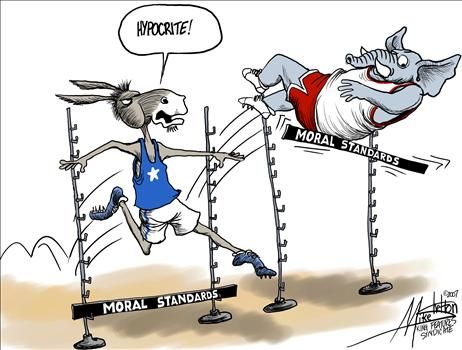
Both political parties have their problems, but I thought this was brilliant. http://www.townhall.com/funnies/cartoonist/MikeShelton/2007/09/1

Are Atheists really just as Moral as Christians?

One of the complaints that I often hear is that “Atheists are just as moral as Christians are”. The response is usually made when I present the Moral Argument. Well I always try to clarify that I never said or meant that atheists ARE immoral, just that they have no rational basis for their morality. And this is partly because we can always argue that expedience is always better, e.g. killing all the weak is actually better for society; stealing when no one will ever find out, will help preserve your genes; lying when you can’t get caught will help you make headway in society (and if YOU are better FOR society than all those other fools, then it will be good for society if YOU get ahead) etc.

On the contrary, Christians say character is based on “What you do when you know that you will never be found out,” regardless of the expediency.

But now suddenly there’s a glitch. Researchers in 4 independent and separate studies have found that conservatives are indeed much more “honest” and “moral” than “progressives.”

In the San Francisco Examiner Commentary – Peter Schweizer claims that “Conservatives are more honest than liberals”. –

He actually phrases it as a question, but the conclusion is that conservatives ARE more honest. (click on the link).

Now as you read it you’ll realize that he’s not talking about atheists or Christians specifically, but if you are out there and are an atheist and not a liberal/progressive, I want to talk to you. I’d be very interested in picking your brain. I don’t run into too many of those (I did once, i.e. a conservative atheist, but he became a Christian within 6 months of me meeting with him on a regular basis and giving him “The Case for Christ”).

As I see it, atheists are a subset of the superset of secular progressives. And while Christians are indeed a subset of conservatives, we all know that they are a majority of them in the United States where these surveys were taken. (Correct me if I am wrong).

Now don’t get me wrong. This doesn’t mean that I will stop trusting my atheist friends. I know them too well. I just had lunch with one of them last week and he’s a guy I’d trust with my life and fortune. I say this lest you think I actually think all atheists are not moral.

But point 1 is that:

It does seem to indicate that there may now be some statistical validity to the fact that if there really is no rational basis for your morality, one tends to be less moral. What say you?

Is this a valid conclusion?

This also lends itself to the second point/question:

  1. If it is true that morality is “good,” for society (and I surmise this from even the atheists’ vehement claim that they are also moral – so presumably morality is a plus for society even in their eyes)
  2. And it is true that conservatives and Christians are much much more moral than atheists and liberals

Does this not mean that the more GENUINE (and I emphasize that on purpose), the more genuine conservatives and Christians we have, the better for ALL of society?

In which case, shouldn’t even atheists encourage the Christians to continue what they are doing (including evangelizing) so they improve society for all of us?

Just wondering. Naturally next week a new study could come out that refutes these 4 studies, but since that hasn’t happened and we are scientists and philosophers that work with the facts that we have at the moment (and not hope for a future “revelation”), if these studies are true what does this mean? I could be wrong but it does seem to imply something along the lines of the two conclusions I’ve argued for.

Neil Mammen

In a lame attempt to justify same-sex marriage, Google News linked to this story from an LA Times blog.   According to the story, some female albatrosses may be coupling and caring for offspring together after the dead-beat daddy albatross has left.   This animals-do-it argument is seriously put forth by homosexual activists. Yes, some animals engage in homosexual behavior and perhaps even parenting on occasion.  But some animals eat their young too.  Should we do that as well?

When homosexual activists extol animals as their moral examples, they are looking down rather than up.  The argument is an albatross around their necks.

This is my column that is running today at TownHall.com. I’ll post more on this later because 800 words is not enough to cover this very controversial topic.

Why not legalize same-sex marriage? Who could it possibly hurt? Children and the rest of society. That’s the conclusion of David Blankenhorn, who is anything but an anti-gay “bigot.” He is a life-long, pro-gay, liberal democrat who disagrees with the Bible’s prohibitions against homosexual behavior. Despite this, Blankenhorn makes a powerful case against Same-Sex marriage in his book, The Future of Marriage.

He writes, “Across history and cultures . . . marriage’s single most fundamental idea is that every child needs a mother and a father. Changing marriage to accommodate same-sex couples would nullify this principle in culture and in law.”

How so? The law is a great teacher, and same sex marriage will teach future generations that marriage is not about children but about coupling. When marriage becomes nothing more than coupling, fewer people will get married to have children.

So what? People will still have children, of course, but many more of them out-of wedlock. That’s a disaster for everyone. Children will be hurt because illegitimate parents (there are no illegitimate children) often never form a family, and those that “shack up” break up at a rate two to three times that of married parents. Society will be hurt because illegitimacy starts a chain of negative effects that fall like dominoes—illegitimacy leads to poverty, crime, and higher welfare costs which lead to bigger government, higher taxes, and a slower economy.

Are these just the hysterical cries of an alarmist? No. We can see the connection between same-sex marriage and illegitimacy in Scandinavian countries. Norway, for example, has had de-facto same-sex marriage since the early nineties. In Nordland, the most liberal county of Norway, where they fly “gay” rainbow flags over their churches, out-of-wedlock births have soared—more than 80 percent of women giving birth for the first time, and nearly 70 percent of all children, are born out of wedlock! Across all of Norway, illegitimacy rose from 39 percent to 50 percent in the first decade of same-sex marriage.

Anthropologist Stanley Kurtz writes, “When we look at Nordland and Nord-Troendelag — the Vermont and Massachusetts of Norway — we are peering as far as we can into the future of marriage in a world where gay marriage is almost totally accepted. What we see is a place where marriage itself has almost totally disappeared.” He asserts that “Scandinavian gay marriage has driven home the message that marriage itself is outdated, and that virtually any family form, including out-of-wedlock parenthood, is acceptable.” But it’s not just Norway. Blankenhorn reports this same trend in other countries. International surveys show that same-sex marriage and the erosion of traditional marriage tend to go together. Traditional marriage is weakest and illegitimacy strongest wherever same-sex marriage is legal.

You might say, “Correlation doesn’t always indicate causation!” Yes, but often it does. Is there any doubt that liberalizing marriage laws impacts society for the worse? You need look no further than the last 40 years of no-fault divorce laws in the United States (family disintegration destroys lives and now costs tax payers $112 billion per year!).

No-fault divorce laws began in one state, California, and then spread to rest of the country. Those liberalized divorce laws helped change our attitudes and behaviors about the permanence of marriage. There’s no question that liberalized marriage laws will help change our attitudes and behaviors about the purpose of marriage. The law is a great teacher, and if same-sex marriage advocates have their way, children will be expelled from the lesson on marriage.

This leads Blankenhorn to assert, “One can believe in same-sex marriage. One can believe that every child deserves a mother and a father. One cannot believe both.”

Blankenhorn is amazed how indifferent homosexual activists are about the negative effects of same-sex marriage on children. Many of them, he documents, say that marriage isn’t about children.

Well, if marriage isn’t about children, what institution is about children? And if we’re going to redefine marriage into mere coupling, then why should the state endorse same-sex marriage at all?

Contrary to what homosexual activists assume, the state doesn’t endorse marriage because people have feelings for one another. The state endorses marriage primarily because of what marriage does for children and in turn society. Society gets no benefit by redefining marriage to include homosexual relationships, only harm as the connection to illegitimacy shows. But the very future of children and a civilized society depends on stable marriages between men and women. That’s why, regardless of what you think about homosexuality, the two types of relationships should never be legally equated.

That conclusion has nothing to do with bigotry and everything to do with what’s best for children and society. Just ask pro-gay, liberal democrat David Blankenhorn.

 

Following the California Supreme Court decision last week, I posed four questions about Same-Sex Marriage that have generated quite a lot of discussion.  It seems many people are operating on emotion rather than reason on this issue.  Most of us know and like homosexuals, and that can cloud our reasoning.

One of the cloudy areas is the purpose the state endorses marriage. Contrary to what homosexual activists assume, the state doesn’t endorse marriage because people have feelings for one another. The state endorses marriage primarily because of what marriage does for children and in turn society. Society gets nothing positive, and actually gets additional negatives (I’ll explain in another post), by recognizing the relationship of two homosexuals. But the very future of the state and a civilized society depends on committed relationships between heterosexuals. That’s why, regardless of what you think about homosexuality, the two types of relationships should never be legally equated.

I am completing a book on this topic right now, and these short posts may raise more questions than answers.  So for a more detailed response, I thought you might like to hear from a very sound thinker on this topic, Greg Koukl, President of Stand to Reason.  (Greg will be an instructor at our CrossExamined Instructor Academy in August.)  Click here to read his article Same-Sex Marriage:  Challenges and Responses.  I appreciate your feedback on his points.

Now that the California Supreme Court has usurped the will of the people by striking down their democratically-decided law,  there is sure to be a debate over the next few months about the merits of Same-Sex Marriage.   The issue may even make it to the ballot box in November in the form of a California Constitutional Amendment.

Political process aside, I’d like for you to weigh in on the following four questions:

1.  For what secular purpose does the state endorse traditional marriage (i.e. what benefits does the state experience from traditional marriage)?

2.  What would be the results to society if every adult lived faithfully in traditional marriage?

3.  What would be the results to society if every adult lived faithfully in same-sex marriage?

4.  In light of your answers above, should the state legally equate heterosexual and homosexual relationships by endorsing same sex marriage?

Sorry if this sounds like a test.  I just want to see how much people have thought through this very controversial issue.