
The Fine-Grained Historicity of Acts – Part 2
Last year, I published a lengthy essay titled “The Book of Acts is High-Resolution Reportage,” in which I documented and discussed no less than forty undesigned coincidences between Acts and the first four epistles found in our New Testament – i.e., Romans, the Corinthian letters, and Galatians. Cumulatively, this class of evidence supports the historicity of Acts down to the granular detail. In this article, I will strengthen this case still further by adducing an additional set of undesigned coincidences drawn between Acts and the remaining Pauline epistles.
Here, [in this 3-part series] I lay out a total of twenty-two examples of interlocking correspondences between Acts and Paul’s epistles. There is one overlap (#9 below) with those covered in my earlier article, since the epistle to the Philippians was of relevance to a coincidence described in my earlier essay. Moreover, #8 and #12 are not independent of one another. Thus, the total number of examples adduced in this article that are both unique and independent is twenty. This brings the total number of undesigned coincidences between Acts and the Pauline corpus to approximately sixty. I am indebted to William Paley for all of the examples adduced in this article.[1]
[. . . . In part 1 of this series, I surveyed undesigned coincidences in Ephesians and Colossians. I also argued] that the author of Acts and the epistles of Paul are independent of one another – that is to say, the author of Acts was not using Paul’s letters as a source, nor vice versa. Since 2 Thessalonians, Philemon and Titus are the only Pauline epistles that do not [yet appear to] contain any undesigned coincidences with Acts, I will not include either of those letters in this discussion.
* * * *
The Undesigned Coincidences in Philippians
- The Same Conflict That You Saw I Had
In Philippians 1:29-2:2, Paul writes,
29 For it has been granted to you that for the sake of Christ you should not only believe in him but also suffer for his sake, 30 engaged in the same conflict that you saw I had and now hear that I still have. 1 So if there is any encouragement in Christ, any comfort from love, any participation in the Spirit, any affection and sympathy, 2 complete my joy by being of the same mind, having the same love, being in full accord and of one mind.
We may compare these remarks with the account in Acts 16:22-24:
22 The crowd joined in attacking them, and the magistrates tore the garments off them and gave orders to beat them with rods. 23 And when they had inflicted many blows upon them, they threw them into prison, ordering the jailer to keep them safely. 24 Having received this order, he put them into the inner prison and fastened their feet in the stocks.
According to this account, Paul and Silas were publicly beaten, stripped, and imprisoned in Philippi. Notably, Paul does not recount the details of the public beating in the letter. He simply assumes that the Philippians remember the episode. The remarks in the letter rings with the authentic voice of a warm, affectionate mind addressing friends who had witnessed his humiliation when he was in Philippi.
This connection between Acts and Philippians is further supported by the evidence, discussed previously, that Acts and Philippians are independent of one another.
- You Know Timothy’s Proven Worth
In Philippians 2:19-22, we read,
19 I hope in the Lord Jesus to send Timothy to you soon, so that I too may be cheered by news of you. 20 For I have no one like him, who will be genuinely concerned for your welfare. 21 For they all seek their own interests, not those of Jesus Christ. 22 But you know Timothy’s proven worth, how as a son with a father he has served with me in the gospel.
Apparently, therefore, the Philippians knew Timothy and had first-hand experience of his faithful contribution to Paul’s ministry while in Philippi.
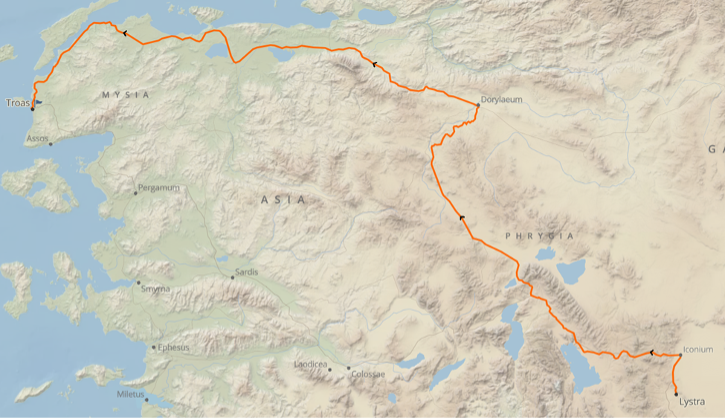
Turning to Acts 16:1-3, we read of Paul encountering Timothy and having Timothy accompany him on his subsequent travels. Following the beginning of the journey, there is no further explicit allusion to Timothy. Paul’s journeys, however, are described in detail, indicating that Paul travelled across Asia Minor to Troas, as shown on the map below.
From Troas, Paul travelled on to the province of Macedonia, as shown on the map below.
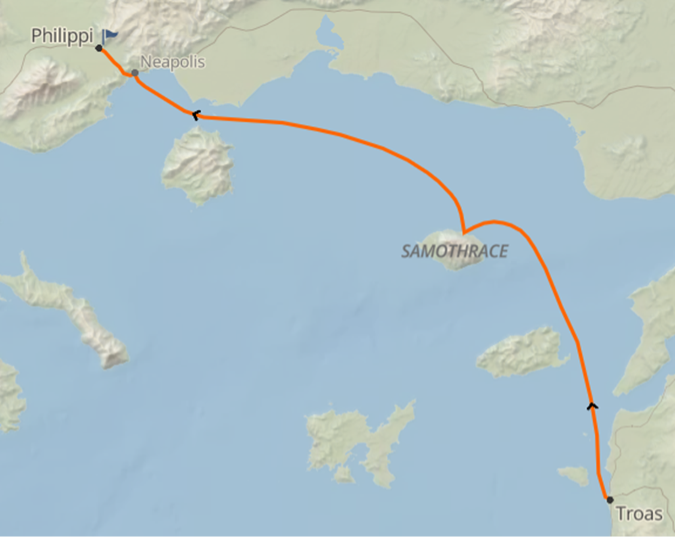
When Paul arrived at Philippi, the narrative gives an account of Paul’s ministry there in some detail, including the persecution he endured there. Acts 17 indicates that Paul’s next port of call, after leaving Philippi, is Thessalonica. Following a riot, he was forced to move on to Berea. The Jewish mob followed him to Berea, agitating the crowds there as well. Acts 17:14 indicates that “the brothers immediately sent Paul off on his way to the sea, but Silas and Timothy remained there.” This implies that, in fact, Timothy had been with Paul throughout all of these travels from the time that Paul first had him accompany him.
Now, Acts 16:1 does suggest to the reader that Paul’s intention was that Timothy join him in his ministry for a significant time. It appears that Timothy accompanied Paul from this time, though his presence is never explicitly stated for a considerable time in Acts, until the incidental reference in 17:14. Thus, apparently Timothy was in fact present with Paul during his ministry in Philippi. In turn, this dovetails with the allusion in Philippians 2:22 to the Philippians knowing first-hand of Timothy’s proven worth and their having witnessed Timothy laboring with Paul as a son with a father. But this is a highly indirect connection.
- Supplying for Paul’s Need
There is an undesigned coincidence relating to Paul’s time in Corinth (Acts 18:1-5):
After this Paul left Athens and went to Corinth. 2 And he found a Jew named Aquila, a native of Pontus, recently come from Italy with his wife Priscilla, because Claudius had commanded all the Jews to leave Rome. And he went to see them, 3 and because he was of the same trade he stayed with them and worked, for they were tentmakers by trade. 4 And he reasoned in the synagogue every Sabbath, and tried to persuade Jews and Greeks. 5 When Silas and Timothy arrived from Macedonia, Paul was occupied with the word, testifying to the Jews that the Christ was Jesus.
Paul encounters Aquila and Priscilla in Corinth, who had been exiled from Rome at the instigation of the emperor Claudius. The Roman biographer Suetonius also mentions this episode: “He [Claudius] banished from Rome all the Jews, who were continually making disturbances at the instigation of one Chrestus,” (Life of Claudius 25).[2] Our text in Acts indicates that Paul worked with them as a tentmaker to earn his keep during the week, and that he engaged in his evangelistic work on the Sabbath day, when he went into the synagogue and tried to persuade Jews and Greeks that Jesus is the Christ.
Unfortunately, the ESV translation of Acts 18:5 does not do justice to the nuance of the Greek. The Greek text says that Paul συνείχετο τῷ λόγῳ. The NIV rendering is more precise: “When Silas and Timothy came from Macedonia, Paul devoted himself exclusively to preaching, testifying to the Jews that Jesus was the Messiah.” The relevant verb is συνέχω. According to A Greek-English Lexicon of the New Testament and Other Early Christian Literature (BDAG), one of the verb’s senses (and the most appropriate for this context), is,
to occupy someone’s attention intensely, συνέχομαί τινι I am occupied with or absorbed in someth. (Herodian 1, 17, 9 ἡδοναῖς; Diog. L. 7, 185 γέλωτι; Wsd 17:19) συνείχετο τῷ λόγῳ (Paul) was wholly absorbed in preaching Ac 18:5 (EHenschel, Theologia Viatorum 2, ’50, 213–15; cp. Arrian, Anab. 7, 21, 5 ἐν τῷδε τῷ πόνῳ ξυνείχοντο=they were intensively engaged in this difficult task) in contrast to the activity cited in vs. 3.[3]
This Lexicon even uses Acts 18:5 as an example of this usage of the verb. The New English Translation notes, citing the same Lexicon, concurs:
The imperfect συνείχετο (suneicheto) has been translated as an ingressive imperfect (“became wholly absorbed …”), stressing the change in Paul’s activity once Silas and Timothy arrived. At this point Paul apparently began to work less and preach more.[4]
Thus apparently, in response to the arrival of Silas and Timothy from Macedonia, Paul changed his ministry model such that he devoted himself entirely to the work of the ministry. What prompted this change? Acts does not inform us. However, we read in 2 Corinthians 11:7-9:
7 Or did I commit a sin in humbling myself so that you might be exalted, because I preached God’s gospel to you free of charge? 8 I robbed other churches by accepting support from them in order to serve you. 9 And when I was with you and was in need, I did not burden anyone, for the brothers who came from Macedonia supplied my need. So I refrained and will refrain from burdening you in any way.
Apparently the brothers who came from Macedonia (whom we learn from Acts included Silas and Timothy) brought financial aid to Paul, which enabled him to devote himself entirely to the ministry. This detail, however, is not supplied by Acts. This is further corroborated by Philippians 4:14-16, in which we read (in a letter addressed to one of the churches in Macedonia),
14 Yet it was kind of you to share my trouble. 15 And you Philippians yourselves know that in the beginning of the gospel, when I left Macedonia, no church entered into partnership with me in giving and receiving, except you only. 16 Even in Thessalonica you sent me help for my needs once and again.
This, once again, serves to confirm the account in Acts — which reveals that Paul was willing to work for his keep as a tentmaker. In other words, he was evidently not in ministry for the purpose of extorting people for money. Moreover, the account in Acts continues with a note about another episode of opposition against Paul: “And when they opposed and reviled him, he shook out his garments and said to them, ‘Your blood be on your own heads! I am innocent. From now on I will go to the Gentiles,’” (Acts 18:6). This coincidence is all the more striking given the independence of Acts and 2 Corinthians, as demonstrated earlier in this article.
- The Beginning of the Gospel
In the text discussed in the previous example, Paul refers to the Philippians’ supplying for Paul’s need “in the beginning of the gospel,” (Phil 4:15). This phrase naturally distinguishes the earlier phase of his ministry among them from what followed. Although the expression does not explicitly require later visits, it suggests an ongoing relationship with the Philippians rather than a single encounter. Moreover, this is consistent with the broader tone of the epistle, which reflects Paul’s familiarity and his warmth towards the Philippians, recalling their long partnership in the gospel (Phil 1:3-8; 4:10-20). This implication is independently confirmed by Acts, which records that Paul, after his first visit to Philippi (recorded in Acts 16), returned to Philippi on a second occasion prior to his writing Philippians (Acts 20:6).
- The Duration of Paul’s Imprisonment
Various clues in the epistle to the Philippians indicate that the letter was written towards the end of Paul’s imprisonment in Rome, after a significant period of time as a prisoner there. For example, Paul notes that his prolonged bonds have served to advanced the gospel, and that it has “become known throughout the whole imperial guard and to all the rest that my imprisonment is for Christ,” (Phil 1:12-13). Moreover, “most of the brothers, having become confident in the Lord by my imprisonment, are much more bold to speak the word without fear,” (Phil 1:14). Furthermore, a significant passage of time is necessarily implied by the exchange of news concerning Epaphroditus’ illness – his sickness in Rome, the concern of the Philippians upon learning of it, and Paul’s own knowledge of their reaction (Phil 1:25-30). Paul also seems to suggest that he senses that the resolution of his case is approaching, whether through martyrdom (2:17) or release (2:23-24).
This internal consistency in the epistle aligns with the account in Acts, which records that Paul “lived there two whole years at his own expense, and welcomed all who came to him, proclaiming the kingdom of God and teaching about the Lord Jesus Christ with all boldness and without hindrance,” (Acts 28:30-31).
References:
[1] William Paley, Horae Paulinæ; or, The Truth of the Scripture History of St. Paul Evinced by a Comparison of the Epistles Which Bear His Name, with the Acts of the Apostles, and with One Another (London: R. Faulder, 1790).
[2] C. Suetonius Tranquillus, Suetonius: The Lives of the Twelve Caesars; An English Translation, Augmented with the Biographies of Contemporary Statesmen, Orators, Poets, and Other Associates, ed. Alexander Thomson (Medford, MA: Gebbie & Co., 1889).
[3] William Arndt et al., A Greek-English Lexicon of the New Testament and Other Early Christian Literature (Chicago: University of Chicago Press, 2000), 971.
[4] Biblical Studies Press, The NET Bible First Edition Notes (Biblical Studies Press, 2006), Ac 18:5.
Recommended Resources:
Why We Know the New Testament Writers Told the Truth by Frank Turek (mp4 Download)
The Top Ten Reasons We Know the NT Writers Told the Truth mp3 by Frank Turek
Counter Culture Christian: Is the Bible True? by Frank Turek (Mp3), (Mp4)
The New Testament: Too Embarrassing to Be False by Frank Turek (Mp3, and Mp4)
Dr. Jonathan McLatchie is a Christian writer, international speaker, and debater. He holds a Bachelor’s degree (with Honors) in forensic biology, a Masters’s (M.Res) degree in evolutionary biology, a second Master’s degree in medical and molecular bioscience, and a Ph.D. in evolutionary biology. Currently, he is an assistant professor of biology at Sattler College in Boston, Massachusetts. Dr. McLatchie is a contributor to various apologetics websites and is the founder of the Apologetics Academy (Apologetics-Academy.org), a ministry that seeks to equip and train Christians to persuasively defend the faith through regular online webinars, as well as assist Christians who are wrestling with doubts. Dr. McLatchie has participated in more than thirty moderated debates around the world with representatives of atheism, Islam, and other alternative worldview perspectives. He has spoken internationally in Europe, North America, and South Africa promoting an intelligent, reflective, and evidence-based Christian faith.
Originally Posted: https://bit.ly/4s4F6BF