
Tag Archive for: theology

By Luke Nix

Introduction

Those who follow this blog are aware that I not only defend “mere” Christianity, but I also defend specifics in the Christian worldview. As I have written before, I believe that if a Christian is defending an incorrect detail of their worldview to a skeptic, that skeptic can easily use that incorrect detail as an excuse to reject the entire worldview (even though this is not logically reasonable). Over the last few years of interacting with fellow Christians regarding the details of our worldview, one of the doctrines that are not discussed explicitly very often, but other debates directly affect, is the doctrine of the Image of God. I have noticed that some positions in the other debates imply different views of the Image of God, and these different views of the Image of God can be used to test the positions in the other debates. But before I get into those debates, we need to know why this Judeo-Christian doctrine is so important in the first place.

What Is At Stake?

The Image of God provides the grounding for several essential characteristics of humans that set us apart from the animal kingdom. Without appropriate grounding for these characteristics, a worldview cannot explain these characteristics, thus it is forced to deny that they even exist…with dire consequences, as we shall see. What are these characteristics, though? While the Image of God grounds several characteristics, I want to examine four of them today:

  • Intrinsic Value
  • Free Will
  • Moral Responsibility
  • The Ability to Reason
 Intrinsic Value

It is common today to think that a person’s value is based upon their race, sex, age, religion, intelligence, economic status, physical ability, entertainment ability, or a whole host of other “useful” things to a society. All of these, though, are relative and fleeting. Anytime that one of those are different (between persons or even in the same person at different times in their lives) their value goes up, down, or disappears. Intrinsic value is value that is not based on any of those accidental characteristics. Intrinsic value is value that is objective, found outside the societies, groups, or other individuals who are judging a person’s worth. This is an objective value that people possess simply in virtue of being human.

No human is intrinsically more or less valuable than another. This concept provides the ground for the idea of “equal rights” regardless of sex, race, age, ability, or status. If you are a human, you are intrinsically valuable, period. Since animals do not possess the Image of God, they do not possess such intrinsic value; they are valuable based upon whatever someone else needs them to accomplish. Animal value is relative and subjective, but human value is objective. If someone violates (harms) an intrinsically valuable thing, it is a moral evil. Specifically, an attack on a possessor of the Image of God is a direct attack on God Himself. If humans do not possess the Image of God, no act against us for any reason is evil. In fact, if humans do not possess the Image of God, it is permissible (if not obligatory) that humans be treated no different than any other animal (and vice versa). Just as a house fly may be killed because it is irritating us, so may a human be killed because he or she is irritating us, and if a human’s life is to be protected by the law, then so should the life of every animal be protected by the law also.

Free Will

When I say “free will” I am talking about the ability to choose to do something other than what we actually do, given the same circumstances (called “libertarian” free will). For instance, you have a choice to continue reading this post or not. Sure, some things will influence that choice, but ultimately you are choosing whether to accept those influences and act upon them or not; the circumstances (or your desires) do not determine your choice, though they do influence your choice. What allows us to do this is the fact that we are “agents” or “souls.” These (and we) are beings that exist independent of physical reality, thus we are not 100% governed by its laws (though our bodies are, which many of our decisions require us to take into account). Because an agent is not physical, it must have a non-physical source- the Image of God provides that source for humans. If humans do not possess the Image of God, then we do not possess free will and all our “choices” are determined by something else, not us.

The animals do not possess the Image of God, thus they do not possess free will. They are beholden to their environment for their behavior. Their surroundings are what determine how they act. The fact that humans have free will means that humans are capable of choosing how to act towards one another, nothing or no one else makes the choice for us, we are responsible.

Moral Responsibility

Taking the two previous characteristics provided by the Image of God, we discover that humans have moral responsibility. If humans are not intrinsically valuable, then no act committed against them is evil. If humans do not have the ability to choose to do otherwise, then they cannot be held responsible for such an evil act. Thus both intrinsic value AND free will are necessary for moral responsibility. This makes us moral beings. Something that animals are not. If an animal kills another animal, we do not call it “murder” because “murder” is “killing” plus a moral element. Animals do not possess intrinsic value (so the killing is not a violation of God’s Image) and animals are not morally responsible beings. On the other hand, man is both intrinsically valuable AND a moral being, so if a human kills another human it is a moral act based on the Image of God in both the victim and the killer. And the morality of that act must be justified by the Moral Law that God has written on the hearts of every human (via His Image) and in His further revelation of Scripture.

This means that if humans wish to hold other humans morally responsible for their actions, the Image of God is necessary on two accounts. Without the Image of God, there is no ground for moral responsibility, no ground for reward or punishment. In fact, if either intrinsic value or free will are missing from the equation, moral responsibility (and reward and punishment) cannot do not make sense; they are meaningless.

The Ability to Reason

Often times it is difficult to distinguish between what is true and what is practical because the two do not always seem to align. What is practical is derived from what allows us to survive and thrive in any given environment. We act and react, according to what stimulates our senses, with those two purposes as the end goal. This is the mode of operation of a creature that not only does not possess free will but also one that does not possess reliable reasoning faculties. If our ability to reason is grounded in a process or object that is focused on survival, then that is exactly what it will do, and the misalignments between what is practical and what is true will never be detected. We are forced to conflate truth with practicality, on this view, because as the environment changes, what is necessary for survival also changes (think of living in Saudi Arabia vs. living in the United States).

On the other hand, if our reasoning faculties are grounded in something that is essentially concerned with what is true, then that faculty can be trusted to be able to detect the difference between a belief that is merely practical for an environment and one that is true (independent of the environment). The Image of God provides this grounding in the Creator, who IS omniscient and desires that humans come to know what is true and not just what is practical for their given environment. In being made in the Image of God, humans not only possess the ability to freely choose among options, we have a reliable tool to identify which option is the correct option. Thus this makes our moral responsibility even more binding.*

The Origin and Current Status of the Image of God

Because all four of those characteristics are tied to the Image of God, it is important that in our defense of the Christian worldview, and specifics within the worldview, that we consistently hold and defend a specific view regarding its origin and status.

Testing Origins Views Via The Image of God

Regarding its origin, some people believe that the Image of God came about by natural processes- it is a functional distinction between us and the animals based upon our evolution from the lower species. This view is most commonly found in the origin position called “theistic evolution” or “evolutionary creationism” (but not all of them hold this view of the Image of God; I’ll address that important distinction in a minute). This cannot be the way the Image of God appeared because it is merely a difference in degree of development between animal and human rather than a difference in ontological essence (“kind”). A difference in degree is not an ontological difference, but the Image of God, in order to be an ontological ground for the four characteristics I described above (and the many others I didn’t), must be an ontological difference. If one holds that the Image of God is not a difference in kind, then all the implications of the above-described characteristics’ absences are actually the reality- human intrinsic value does not exist, free will does not exist, moral responsibility does not exist, and the ability to reason does not exist.

While I do not defend common descent of humans with any animal (I’m not an evolutionary creationist), I must understand that not every evolutionary creationist holds to this view of the Image of God because of its dire philosophical and theological (biblical) implications. These theistic evolutionists hold, just as much as any creationist (young-earth or old-earth), that the Image of God appeared suddenly in history (as a special creative work of God) and that sudden appearance is evident in the fossil and archaeological record.

Where things get difficult, though, is that many naturalists insist that all features of humans appear gradually in the fossil and archaeological records. If that is true, then even the Image of God appears gradually. That would imply that the Image of God is merely a difference in degree and not in kind. So, if a Christian theistic evolutionist wishes to maintain common descent of humans with prior animals (and they wish to avoid the implications of merely a functional Image of God), then they must reject the interpretation of the historical records that naturalists offer regarding the Image’s features appearing gradually (descending from “lower” species).

What is really interesting is that the more that the data is reinterpreted to be consistent with an ontological Image of God (a sudden appearance), the more the line is blurred for the theistic evolutionist between the sudden appearance of the Image of God and the sudden appearance of humans. Perhaps a persuasive case for the rejection of common descent between humans and animals (and the acceptance of humans as a special creation of God independent of His other creations) is found in our defense of the proper view of the Image of God and its endowments (e.g. intrinsic value, free will, moral responsibility, and the ability to reason) upon humans. Our maintaining the proper view of the Image of God helps us to test and guide our view of human origins. If this has intrigued you, I highly recommend reading the book “Who Was Adam” by biochemist Dr. Fazale Rana to see the scientific evidence for the sudden appearance of the Image of God (and humans) in the scientific record.

One More Thing- Abortion and Active Euthanasia
Before I leave the origins debate, though, I do want to bring up one more implication for holding that the Image of God is merely a difference in the degree of development. If you are familiar with some of the more common defenses for abortion, you will know that one of the reasons offered to deny the unborn intrinsic value (and the intrinsic right to life) is the degree of their development. (Now, I have to be extremely careful not to equivocate on the term “degree of development,” because if the terms do mean the same thing in both the common descent view and the abortion view, then we have a serious problem.) Simply put, the argument for abortion from the degree of development points to the lack of certain features in the unborn that a fully developed human being possesses. The pro-abortion advocate uses this lack of development to conclude that the unborn are not really human, thus do not possess intrinsic value (which means that killing the unborn is perfectly acceptable).

In the book “The Case For Life,” pro-life apologist Scott Klusendorf points out that the “degree of development” argument, applied consistently, also removes intrinsic value (thus justifies intentionally killing) from those living with health issues, including physical handicaps, degenerative diseases, mental disorders and others. If the Image of God is merely a matter of degree of development, then any human who manifests cognitive, creative, or physical limitations akin to those of our pre-human ancestors (on the theistic evolutionary view), they too necessarily lack the Image of God. This would include the unborn (abortion would be morally permissible) and the born (active euthanasia would be morally permissible).

This is one more way that we can use the proper view of the Image of God to test our view of human origins. Unfortunately, it can also be used in the opposite direction to justify abortion and active euthanasia- which is one more reason why maintaining the proper view of the Image of God is so important. We must hold to the proper view of the Image of God to guard against such logically fallacious and morally reprehensible (sinful) views from entering our worldview (even if we insist on maintaining the belief in the common descent of the physical human body).

Testing The Current Status of the Image of God

In the on-going debate about how God’s sovereignty and man’s free will work together, some Christians have opted to deny that man has free will at all by positing that the Image of God was destroyed at the Fall of Adam and Eve. However, when the implications I described above are explained, the Christian usually quickly changes their position, but in many cases the change holds that the Image of God was damaged specifically in a way to destroy human free will but maintain the other traits. While this may seem like an acceptable position, it poses a severe problem.

If intrinsic value does exist, but free will does not, then punishment is a moral evil because it is a violation of (attack against) the intrinsically valuable human, created in the Image of God, who did not have a choice to not commit the crime against another intrinsically valuable human, created in the Image of God. This means that if free will does not exist, God’s punishment of those who commit sin is His attacking Himself- a moral evil. However, we know from the Bible that God cannot sin, that He cannot deny Himself, that a house brought against itself cannot stand, and that God does punish the wicked. If a Christian is to maintain the doctrine of eternal conscious punishment (or even the heterodox view of annihilationism), yet deny free will, then they are saying that God is sinning in virtue of His immoral attack against a creature created in His Image.

Some have attempted to say that God can do whatever He wants. However, this then enters into the debate about God and morality. A common objection to God’s existence comes in the form of the Euthyphro dilemma. This poses the question, “Is God good because He says what is good, or because He is subject to good.” The dilemma is that if the first option is selected then morality is subjective and arbitrary (not objective) because God could simply change His mind about what is good, while if the second option is selected then God is not the highest being, thus He cannot be God. If it is not obvious, the attempted escape from the implication of denying free will but affirming intrinsic value fails because it is the first option of the dilemma- morality is then arbitrary and subjective, thus there is no objective standard by which God can judge, which adds another level of problems because without objective morality, nothing is evil, even an act that attacks a bearer of the Image of God (so, murder, abortion, rape, and every other “sin” is not objectively evil- it is merely God’s opinion at the moment that they are or are not)- moral responsibility essentially was destroyed if free will was also.

The only way to avoid this implication is to affirm that man’s free will is still intact regardless of how we view the effects of the Fall of Adam and Eve. Because of that, we can use the proper view of the current status of the Image of God (intact) to test our views regarding the coexistence of God’s sovereignty and man’s free will.

Conclusion

The Image of God is an important doctrine of Christianity. It provides the ontological grounding for intrinsic value, free will, moral responsibility, and the ability to reason. Without these characteristics in place in humans, Christianity is, at worst, false, and at best unknowable and indefensible. So, it is important that as we defend the truth of the Christian worldview that we do not also defend a scientific or theological position that either asserts or implies that the Image of God is not ontological or was damaged in a way to destroy free will. If we do, then we are defending contradictory claims, and the unbeliever can use that as a reason (because they are made in the Image of God) to freely choose to reject the truth of the Christian worldview.

Recommended Books for More on this Topic

*Of course, mere observation of reality and reason do not always lead to the correct conclusion. The Image of God also provides the Moral Law that is written on all humans’ hearts (since all humans are made in the Image of God). Further, God has given us His special revelation that gives us explicit moral codes. But He did not just give us a book without establishing that it was divinely inspired by the Source of the Image of God. The Bible contains numerous claims about reality, and especially history when no human was present to observe the events (thus eliminating any reasonable natural explanation [e.g. that the author saw it or guessed it). Dr. Hugh Ross explains these in his numerous books on the scientific evidence for the inspiration and authority of the Bible. So, there are two additional tools that solidify man’s moral responsibility and the fact that all men “are without excuse” (Romans 1:20).

Original Blog Source: http://bit.ly/2q1OxlG

God is Omnibenevolent! Simply put, God is perfectly good and all-loving. Not only does the Bible make this clear (Psalm 100:5; Psalm 145:17; John 3:16), but logicians have also deductively concluded this apart from the Bible through the Moral Argument and the Ontological Argument.

Now, if God were simply omnipotent (all-powerful) and omniscient (all-knowing), but not perfectly good and all-loving, then we would have reason to be frightened. In fact, this is how Muslims view Allah. According to Islam, God is not all-loving, and whatever Allah does is simply called “good,” even if it is really hateful. As a result, Muslims have no assurance of salvation (unless they die in Jihad).

The Original Sin?

Some Christians fall into a similar trap and incorrectly think of God this way. Indeed, the church has been infected with a low view of God for ages. A.W. Tozer, in his book The Knowledge of the Holy, says, “What comes into our minds when we think about God is the most important thing about us.” In the preface of this same book Tozer writes:

The Church has surrendered her once lofty concept of God and has substituted for it one so low, so ignoble, as to be utterly unworthy of thinking, worshipping men. . . The low view of God entertained almost universally among Christians is the cause of a hundred lesser evils everywhere among us.

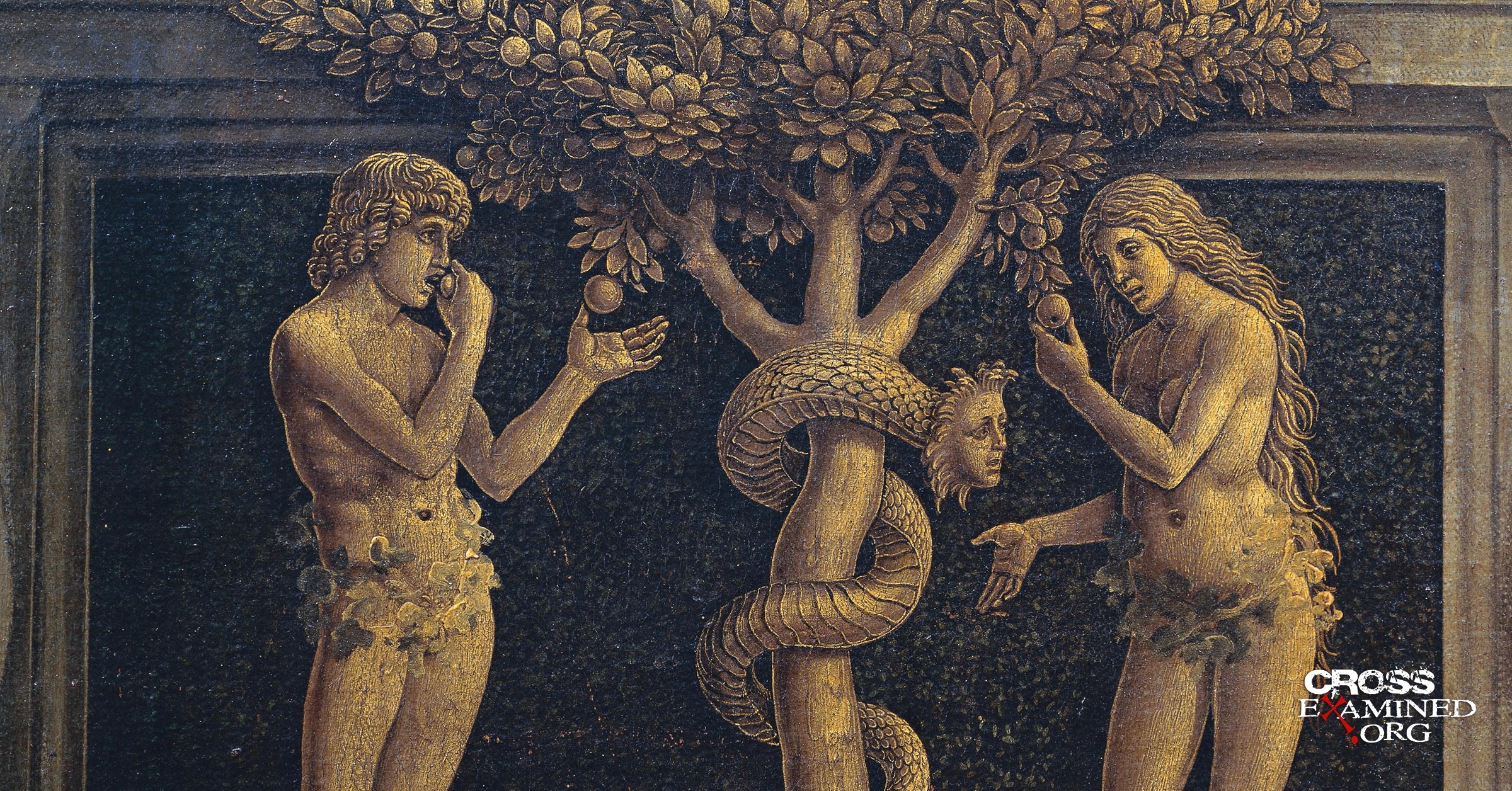
This low view of God has infected the minds of most Christians today, but I believe its roots can be found in the very beginning. The original sin was not eating of a forbidden fruit, but rather, doubting the omnibenevolence of God. This was the trap Satan lured Eve into in the Garden of Eden (Genesis 3):

“Did God really say…?”

Satan convinces Eve to consider the idea that God is not really interested in her ultimate flourishing. The fact of the matter, however, is that God does desire the ultimate flourishing for each and every human being. This is supported by scripture such as John 3:16, 1 Tim 2:4, 1 Tim 4:10, and 2 Peter 3:9. It is also supported in the first book of the Bible. Consider this counterfactual:

IF Adam and Eve would have kept God’s commands (and all of their offspring followed suit), then every single human WOULD experience ultimate flourishing and not experience any suffering.

Thus, God created a world in which it was logically possible for all people to flourish. However, Eve doubted that God was omnibenevolent and desired the best for her. This doubt led to the fall of man and terrible suffering has followed in its wake.

Many people continue to doubt the perfect goodness and love of God. Some Calvinistic theologians (like Arthur Pink) actually teach that God does not love all people or desire the best for all people! This is a horrible mistake — a sin — that leads to weak faith.

Additionally, some Christians hold to a view called “Divine Determinism” and think that God controls all thoughts and beliefs. If this is the case, then God forces most people to believe lies. If God forces some to believe truth and others to believe lies, then how can you be certain that God is not forcing you to believe false things too (including your view of divine determinism)? This low view of God ultimately leads to many in the church doubting their salvation just as Muslims do (both views of God are wrong).

Indeed, this low view of God influenced the Canons and Dogmatic Decrees of the Council of Trent. A.D. 1563. They incorrectly affirm that one should doubt their salvation in Chapter XII:

No one, moreover, so long as he is in this mortal life, ought so far to presume as regards the secret mystery of divine predestination, as to determine for certain that he is assuredly in the number of the predestinate; as if it were true, that he that is justified, either can not sin any more, or, if he do sin, that he ought to promise himself an assured repentance; for except by special revelation, it can not be known whom God hath chosen unto himself.

When one doubts or rejects the fact that God is omnibenevolent then major problems arise. The primary problem is that their presupposition of God — a low view of God — was incorrect in the first place. They follow in the footsteps of Adam and Eve.

A Maximally Great God

Consider the perfect goodness of God: Because God is perfectly good He is perfectly holy. When humans freely choose to do good things, then we approximate to the perfect standard of God, and we do holy things! Worshipping God is holy. Loving your neighbor is holy. Loving your enemy is holy!

We are not perfectly holy, but we should make every effort to approximate to the One who is! The Bible says this:

“And the Lord said, you shall be holy; for I the Lord your God am holy” (Leviticus19:1-2).

God is the standard of goodness and therefore, we can always trust the commands he has given to be perfectly good. Moreover, since God is perfectly intelligent, then His commands are always the most intelligent thing to do. Therefore, it is just plain stupid and wrong not to obey the commands of God!

How do we know God’s commands? Through Jesus’ declarations validated by His resurrection! Consider Matthew 5:44; 22:37-39:

1- Love God first!
2- Everybody love everybody (from your neighbors to your enemies)!

Christians ought to be the most loving people on the face of the planet!

Next, consider God’s perfect love and what it means to be all-loving which is part of omnibenevolence. The Bible makes it clear: “God is love” (1 John 4:16).

So, if God is love, then God’s very nature is loving. As William Lane Craig wrote in his children’s book, God is ALL-Loving:

“He is loving as He is holy. And God’s love is a very special kind of love; He doesn’t love you because you’re good. His love is unconditional!”

This is a perfect Daddy, right? I am not a perfect dad by any means and do not require my son, Ethan, to be perfect either. I know he will make mistakes, he will sin, he will disappoint me, and he will be anything other than perfect. But even though I know these things about Ethan, it does not mean that I do not love him with all of my heart. I am still willing to die for my imperfect son! If that is how imperfect dads are, imagine a perfectly good, intelligent, and loving Heavenly Father! God does not love you based on your actions – He just loves you and desires you to love Him in return. But He will not force you into a relationship with Him; you must make the choice to enter that love relationship or not.

That is what a saving relationship is: when a human freely chooses to love God in return, then a true love marriage occurs – a saving relationship with God. Because God first loved us, when we respond to His love and freely choose to love God back, we are saved! This is demonstrated by Jesus when he tells the Parable of the Prodigal Son found in Luke 15:11-32.  Jesus is telling this fictional story of a dad – a great dad – who is loving his son the way God loves all humans (John 3:16; 1 Timothy 2:4; 2 Peter 3:9). Jesus is telling this story of a great and loving father so that those listening to this story will begin to understand the way God loves all humans.

You see, the father’s love was always available to his son. The father’s love never went anywhere. The dad never stopped loving his son with all of his heart. However, the son made some choices – free choices – which separated him from the love of his father. It was not until the son made the choice – the free choice – to come back to his father’s love and to love his father in return, that their relationship was restored.

If the son would have never made the free choice to return to his father, then their relationship would have never been restored.

This is representative of God’s love for YOU. God loves you unconditionally, just as the father in the parable, and His love is always there for you. With that said, however, you and I are responsible for our own decisions, and we can make horrible choices that separate us from God’s perfect love.

Eternal Divorce

Some people freely choose to separate from God for eternity (this is called hell)! Since it is logically impossible for God to force a person to freely choose to love Him (that is on the same incoherent level as married bachelors or triangles with four corners), then some will freely choose to divorce themselves from God forever — but it does not have to be this way!

Jesus did all the work for you, but now the ball is in your court. You have a real choice to make and are now responsible for your eternity!

Do you want perfect love with your Creator? It is available through the atoning power of Jesus Christ. You have a perfect Father – a Daddy – who loves you with his entire essence! You are worth more than the entire universe to Him! He desires an eternal true love relationship with everyone — including YOU.

Conclusion

You might feel like the prodigal son. You might be in a place right now that you know you are not supposed to be. The prodigal son had to make a choice – a free choice – and swallow his pride and come back to his father. If you are in a place that is far from God right now, then I encourage you to make the same choice – swallow your pride and come back to your Daddy. He is a perfect Father and His love is waiting for you!

Stay reasonable (Philippians 4:5),

Tim Stratton


Notes

A special thank you to Shannon Eugene Byrd for finding the Council of Trent quote!

Original Blog Source: http://bit.ly/2n2J1l1


By Brian Chilton

Throughout the New Testament, one will find early creeds, formulations, and hymns that predate the New Testament itself. These texts are often called “proto-New Testament texts.” Proto-New Testament texts date back to the earliest church from those who were eyewitnesses of Jesus himself. 1 Corinthians 15:3-8 is perhaps the most popular of the proto-New Testament texts as it bears heavily on the post-resurrection appearances of Jesus. Concerning 1 Corinthians 15:3-8, Roy Ciampa and Brian Rosner write,

Early church in Turkey attributed to St. Peter.

Paul had used the language of “receiving” and “passing on” traditions in 11:23 with respect to the Lord’s Supper. The information about the gospel had been passed on as being of first importance. While the expression could mean “at first” (and Paul undoubtedly shared this with the Corinthians very early on in his ministry among them), the nearly unanimous preference of English translations (first in importance) is probably correct.

The fact that he had received this information about Christ does not contradict his point in Galatians 1:12 that he received his gospel “by revelation from Jesus Christ.” While the basic gospel message was received by revelation from the Lord, the formulation he used in preaching the gospel included elements that had been passed on to him by those who were Christians before him, perhaps including the fact that Christ died for our sins and that it was according to the Scriptures, that his resurrection took place on the third day and that that was also according to the Scriptures, and the information about the witnesses to Christ’s resurrection.[1]

So, what can we learn about the earliest church from the proto-New Testament texts? In the next two sections, I will provide a listing of the more popular—and generally accepted—proto-New Testament creeds and hymns. In conclusion, I will examine the implications of these texts as it pertains to the beliefs of the earliest church.

Creeds

  1. Romans 1:3-4 “concerning his Son, Jesus Christ our Lord, who was a descendant of David according to the flesh and was appointed to be the powerful Son of God according to the Spirit of holiness by the resurrection of the dead.”[2]
  2. Romans 10:9 “If you confess with your mouth, ‘Jesus is Lord,’ and believe in your heart that God raised him from the dead, you will be saved.”
  3. 1 Corinthians 11:23-29 “For I received from the Lord what I also passed on to you: On the night when he was betrayed, the Lord Jesus took bread, and when he had given thanks, broke it, and said, ‘This is my body, which is for you. Do this in remembrance of me.’ In the same way, also he took the cup, after supper, and said, ‘This cup is the new covenant in my blood. Do this, as often as you drink it, in remembrance of me.’ For as often as you eat this bread and drink the cup, you proclaim the Lord’s death until he comes.”
  4. 1 Corinthians 15:3-8 “For I passed on to you as most important what I also received: that Christ died for our sins according to the Scriptures and that he appeared to Cephas, then to the Twelve. Then he appeared to over five hundred brothers and sisters at one time; most of them are still alive, but some have fallen asleep. Then he appeared to James, then to all the apostles. Last of all, as to one born at the wrong time, he also appeared to me.”
  5. 2 Corinthians 4:5 “For we are not proclaiming ourselves but Jesus Christ as Lord, and ourselves as your servants for Jesus’s sake.”
  6. 1 Timothy 3:16 “And most certainly, the mystery of godliness is great: He was manifested in the flesh, vindicated in the Spirit, seen by angels, preached among the nations, believed on in the world, taken up in glory.”
  7. 2 Timothy 2:8 “Remember Jesus Christ, risen from the dead and descended from David, according to my gospel.”
  8. 2 Timothy 2:11-13 “This saying is trustworthy: For if we died with him, we will also live with him; if we endure, we will also reign with him; if we deny him, he will also deny us; if we are faithless, he remains faithful, for he cannot deny himself.”
  9. 1 John 4:2-3 “This is how you know the Spirit of God: Every spirit that confesses that Jesus is Lord has come in the flesh is from God, but every spirit that does not confess Jesus is not from God. This is the spirit of the antichrist, which you have heard is coming; even now it is already in the world.”

Hymns

  1. Philippians 2:5-11 “Adopt the same attitude as that of Christ Jesus, who, existing in the form of God, did not consider equality with God as something to be exploited. Instead, he emptied himself by assuming the form of a servant, taking on the likeness of humanity. And when he had come as a man, he humbled himself by becoming obedient to the point of death—even to death on a cross. For this reason, God highly exalted him and gave him the name that is above every name, so that at the name of Jesus every knee will bow—in heaven and on earth—and every tongue will confess that Jesus Christ is Lord, to the glory of God the Father.”
  2. Colossians 1:15-20 “He is the image of the invisible God, the firstborn over all creation. For everything was created by him, in heaven and on earth, the visible and the invisible, whether thrones or dominions or rulers or authorities—all things have been created through him and for him. He is before all things, and by him, all things hold together. He is the head of the body, the church; he is the beginning, the firstborn from the dead so that he might come to have first place in everything. For God was pleased to have all his fullness dwell in him, and through him to reconcile everything to himself, whether things on earth or things in heaven, by making peace through his blood, shed on the cross.”
    (c) Telegraph. Archaeologists at possibly one of the oldest Christian churches in Jordan, possibly dating just past the time of Christ.


  3. Hebrews 1:1-3 “Long ago God spoke to the fathers by the prophets at different times and in different ways. In these last days, he has spoken to us by his Son. God has appointed him heir of all things and made the universe through him. The Son is the radiance of God’s glory and the exact expression of his nature, sustaining all things by his powerful word. After making purification for sins, he sat down at the right hand of the Majesty on high.”
  4. 1 Peter 2:21-25 “For you were called to this, because Christ also suffered for you, leaving you an example, that you should follow in his steps. He did not commit sin, and no deceit was found in his mouth; when he was insulted, he did not insult in return; when he suffered, he did not threaten but entrusted himself to the one who judges justly. He himself bore our sins in his body on the tree; so that, having died to sins, we might live for righteousness. By his wounds, you have been healed. For you were like sheep going astray, but you have now returned to the Shepherd and Overseer of your souls.”

Conclusion

What can one gather from the aforementioned proto-New Testament texts? In stark contrast to what many liberal theologians purport—that is, that the divinity and miracles of Jesus were late inventions, the following three observations are made. Frankly, it is startling how much emphasis the church placed on these three truths.

  1. From the earliest times of the church, Jesus was believed to have physically risen from the dead. The resurrection of Jesus comprised one of the more important aspects of the early church. There was no doubt in the earliest church that Jesus had in fact risen physically from the dead. The acceptance of Jesus’ resurrection was made as an essential aspect of a disciple’s faith in Jesus. Thus, the resurrection was not a late invention. Rather, it was an accepted and established the fact by the earliest Christians.
  2. From the earliest times of the church, Jesus was believed to be the divine Son of God. Just as the resurrection was not a late invention, neither was the accepted divine nature of Jesus as the Son of God. I was quite startled at the force behind the statements found in the hymns of Colossians 1:15-20 and Hebrews 1:1-3. Even the statement “Jesus is Lord” points to the divine nature of Jesus. The Septuagint translated the personal name of God (“YHWH”) as the Greek equivalent to “adonai,” which was “kurios.” To proclaim “Iesous es kurion” (“Jesus is Lord”) was to equivocate Jesus’ identity with that of the Father. Jesus’ divine nature was not a late invention. It was one of the earliest accepted tenants of the church.
  3. From the earliest times of the church, Jesus was believed to be the exclusive way to salvation. The earliest church did not promote universalism—the idea that everyone would eventually be in heaven. Neither was the earliest church inclusivists—the idea that there are multiple ways to heaven. Rather, the earliest church accepted the fact that since Jesus was the Messiah, the Son of the Living God; then, he was the exclusive way to the Father.

Historians, apologists, theologians, and laity alike can learn a great deal from the proto-New Testament texts. This article has provided only a sample of the early texts found in the New Testament. The article has not even considered the great wealth of proto-New Testament texts found in the four canonical Gospels. Our New Testament is a trustworthy source for information about Jesus of Nazareth as its basis is found in the earliest church, whom had been given their message from Jesus himself.


Brian G. Chilton is the founder of BellatorChristi.com and is the host of The Bellator Christi Podcast. He received his Master of Divinity in Theology from Liberty University (with high distinction); his Bachelor of Science in Religious Studies and Philosophy from Gardner-Webb University (with honors); and received certification in Christian Apologetics from Biola University. Brian is currently enrolled in the Ph.D. program in Theology and Apologetics at Liberty University. Brian has been in the ministry for over 15 years and serves as a pastor in northwestern North Carolina.

Original Blog Source: http://bit.ly/2mN1KRy

By Natasha Crain

The other day, I received the following comment on an old blog post about hell:


The belief in hell is sown into the hearts of many children which this blog advocates and this belief can reap major consequences. Children grow into adults. Millions of adults are on the edge of a belief in [G]od [and] needlessly suffer with the shadow of hell.  They live [in] fear…What a waste…a tragedy. 

Hell is one of the bedrocks of the Christian faith. I absolutely reject Christ.  I work and pay taxes. I am charitable. I am [a] good father and husband. I am kind, forgiving. I like looking at the stars. Yet, without a doubt under the rules of Christianity I am doomed to be tortured for millions…billions of years. In fact, trillion[s of] years of endless agonizing pain wrap[ped] around for trillions of more years.  What is my misstep?  I reasoned that earth was old and books suggesting otherwise unfounded.


There are a lot of misunderstandings about Christianity and hell embedded in this comment—and those misunderstandings are quite common. Because there are so many wrong ideas about hell floating around, we as Christian parents must proactively ensure that our kids gain an accurate understanding of this difficult topic. When young people lack that understanding, they’re often quick to dismiss hell based on simple “gut reaction.” But hell is too serious a topic to leave to the discretion of our kids’ feelings. We need to guide their understanding from a biblical perspective.

In chapter 4 of my book, Keeping Your Kids on God’s Side: 40 Conversations to Help Them Build a Lasting Faith, I explain that people often unknowingly roll three layers of questions into one big objection about hell. We can help our kids understand hell much more meaningfully when we address those questions individually and sequentially:


1. Why does God need to punish anyone?

2. Who should be punished?

3. What should the nature of punishment be?


Like many people, the commenter above implicitly has objections to hell from each of these categories. In this post, we’ll look at answers to the questions using his concerns. For anonymity, we’ll call him Mr. C.


Why Does God Need to Punish Anyone?

When Mr. C says, “Millions of adults are on the edge of a belief in God and needlessly suffer with the shadow of hell,” he is assuming that Christianity isn’t true. If Christianity is true, then people should be warned about the reality of hell and have an appropriate level of concern about it. But Mr. C seems to believe that the whole idea of hell can’t possibly make sense.

A major reason he can’t make sense of hell, however, is because he misunderstands why God would need to punish someone. He believes that, in his case, it would be because he “reasoned the earth was old and books suggesting otherwise [are] unfounded.”

Rejecting the Bible is not why God punishes people. (And, as an aside, plenty of Christians believe the Earth is old.)

God punishes people because of sin.

It’s critical that our kids understand this! As I explained in chapter 4:

“The reality and seriousness of sin is ignored when we suggest there’s no need for God to punish people. To see why that’s such a problem, we need to better understand what sin is. The Bible tells us that God is perfectly good, and that He has written His moral laws on the human heart (Psalm 18:30; 1 John 1:5; Romans 2:14-15). Sin is a transgression against those laws. If God didn’t exist, there would be no sin, because there would be no moral laws to sin against. But if a perfectly good God exists, and humans violate His moral laws, we have to ask, What should God do about it? We expect a penalty for breaking human laws, so why wouldn’t we expect a penalty for breaking divine laws?”

Furthermore, God is both perfectly loving and perfectly just (Deuteronomy 32:4; Psalm 9:7-8; Psalm 33:5; Isaiah 61:8). Justness is the quality of fairly conferring deserved rewards and punishments against a standard of right and wrong. God’s justness and lovingness go hand-in-hand. Just as an earthly judge wouldn’t be loving for setting free those who break human laws, God as a heavenly judge wouldn’t be loving for setting free those who break divine laws.

If sin is real, and God is just, there must be some kind of penalty for that sin.


Who Should Be Punished?

If we’re honest, most of us can get our heads around this idea of necessary punishment—for really bad people. But garden-variety sinners? People who lie, lose their temper, and live more selfishly than they should? We think these people deserve something more like an extended time-out, not hell. In other words, it’s not that we don’t think God should punish people, but that we don’t think He should punish people like us.

Mr. C certainly feels this way, as he listed his qualifications for escaping God’s judgment: “I work and pay taxes. I am charitable. I am [a] good father and husband. I am kind, forgiving. I like looking at the stars.”

Interestingly, many murderers could even fit this description (yes, even a murderer can have moments of kindness and forgiveness—where do you draw the line?). But pretty much everyone agrees murderers deserve punishment (see point 1). So it’s clear we have to take a more objective look at who should be punished.

Romans 3:23 answers that question: “All have sinned and fall short of the glory of God.”

All.

Not one human is morally worthy of being in God’s presence. Romans 6:23 goes on to say that God has set the penalty for sin as death—which, as the law giver, He has the right to do. The combined picture of these verses is really quite simple, even if we don’t like it: Every single person is guilty of breaking God’s moral laws and He has set the penalty as death.

That’s true even if you like looking at the stars like Mr. C.


What Should the Nature of Punishment Be?

If hell only involved 100 years in jail, we’d spend a lot less time talking about it. But the traditional view that hell is an eternity spent suffering in flames? That’s where many people draw their line of “reasonableness.” In fact, most people have never thought through the logic of the first two questions in this post (why God would need to punish anyone and who should be punished) because they jump straight to the assumed nature of punishment. Those first two questions, however, are critical to understand before you can even consider the nature of hell.

The problem is, our human idea of what’s reasonable has no necessary bearing on what’s true. We simply do not have God’s perspective (Isaiah 55:8). We do know, however, that God is perfect, so His punishment is necessarily completely fair—even if we don’t have the full perspective to understand it. Because we can’t use our own idea of what’s reasonable to determine what’s true about hell, we have to look at what God has revealed about it in the Bible.

Jesus referred to hell as a terrible place to be avoided at all costs (Mark 9:48-49; Matthew 8:12; 10:28; 22:13; 13:42). The severity of hell is something all Christians agree on. There are different views, however, on what exactly the nature of hell is and how long it will last:

  • Those who hold the literal view believe hell is a place of actual fire where those who reject Jesus will spend eternity. This is what Mr. C referenced in his comment.
  • Those who hold the metaphorical view believe hell is an everlasting punishment of some kind, but not a literal fire. They say fire is a biblical symbol for judgment.
  • Those who hold the conditionalist view believe those who reject Jesus will cease to exist. They say the many biblical references to eternal punishment refer to the punishment’sfinality, not duration.

For more on the varied Christian views of hell, I recommend the book, Four Views on Hell.


The Often Overlooked Ending

Breaking our discussions about hell into these three component questions gives kids an important framework for understanding logical and biblical connections. But we can’t overlook the critically important ending to the story—God has made a way for people to avoid hell if we accept Jesus’ sacrifice on the cross as payment for our sins! That’s the crucial other half of the picture. (For help with the rest of this conversation, see chapter 20: Why did Jesus need to die on the cross for our sins?)

As author C.S. Lewis famously said, “There are only two kinds of people in the end: those who say to God, ‘Thy will be done’ and those to whom God says, in the end, ‘Thy will be done.’”

Visit Natasha’s Blog @ ChristianMomThoughts.com


Resources for Greater Impact:

By Brian Chilton.

The Bible attributes several attributes to God. Many of the more popular attributes are God’s love, holiness, and grace. Any serious theologian will know the four core “omni” attributes: omniscience (all-knowing), omnipotence (all-powerful), omnipresence (all-presence), and omnibenevolence (all-loving). While these attributes are all positive, many critics pinpoint another attribute of God as being greatly problematic: God’s jealousy.

Critics charge that jealousy is a bad trait to hold. Famed atheist Richard Dawkins claims that God breaks “into a monumental rage whenever his chosen people flirted with a rival god.”[1]Paul Copan notes that “Oprah Winfrey said that she was turned off to the Christian faith when she heard a preacher affirm that God is jealous.”[2] Jealousy is condemned for the human being. One of the Ten Commandments states that a person should not “covet your neighbor’s wife, or his male servant, or his female servant, or his ox, or his donkey, or anything that is your neighbor’s” (Exodus 20:17).[3] Thus, jealousy seems to be a negative trait. But wait! Doesn’t the Bible claim that God is jealous? It does.

The Bible states at least 13 times that God is jealous for His people. For instance, Moses notes that “the LORD your God is a consuming fire, a jealous God” (Deuteronomy 4:24). Later in Deuteronomy, God says, “They have made me jealous with what is no god; they have provoked me to anger with their idols. So I will make them jealous with those who are no people; I will provoke them to anger with a foolish nation” (Deuteronomy 32:21).

What do we make of this? Jealousy seems to be a negative trait. The Bible presents God as jealous. Therefore, it would seem that God holds negative traits. One is left with three options: 1) One could claim that God holds negative attributes meaning that He is not completely perfect; 2) One could claim that the Bible is erred in its presentation of God; 3) One could claim that our understanding of God’s jealousy could be misunderstood.

The first option demerits the Bible’s presentation of God as valid. If God exists, then God must be a maximally great Being. If the God of the Bible is not a maximally great Being, then the God of the Bible is not really the God of the universe at all.

The second option devalues the Bible, the Word of God. The New Testament writers extracted their understanding of God from the Old Testament. Therefore, if the Old Testament is erred in its presentation of God, then that would carry over into the New Testament. This causes a serious problem for the believer. If we cannot accept the presentation of God in the Bible, then can we accept the God of the Bible?

The third option is best. Our understanding of God’s jealousy must be defined. There must be some misunderstanding that we hold as it pertains to the idea of divine jealousy. In fact, the third option is the only real valid option on the table. When one honestly evaluates God’s jealousy, the person comes to the understanding that God’s jealousy is actually rooted in love. Thus, God’s jealousy becomes a positive trait for three reasons.

God’s jealousy over His people is positive as it relates to God’s passion.

God has a passion for His people. Let’s go back to the passage in Deuteronomy. We all know that Scripture is often taken out of context. Placing Deuteronomy 4:24 in context, one will find that Moses was addressing the issue of the peoples’ covenant with God. God had already blessed the people immensely. God brought them out of slavery. God was about to bring them to a special place prepared for them. God was going to build a great nation out of them. However, the people kept cheating on God. God poured out His love to the nation. He was eventually going to bring the Chosen Messiah, the Savior of the world, in their midst. But they kept cheating on God. Moses says in Deuteronomy 4:23, “Take care, lest you forget the covenant of the LORD your God, which he made with you.”

The marriage analogy is often used to describe God’s jealous passion for His people. Paul Copan rightly notes that “A wife who doesn’t get jealous and angry when another woman is flirting with her husband isn’t really all that committed to the marriage relationship. A marriage without the potential for jealousy when an intruder threatens isn’t much of a marriage.”[4] God had a passion for His people. While Dawkins may think that God’s jealousy is a negative attribute due to the peoples’ “flirting with other gods,” it should be remembered that idolatry is adultery against God.[5] Thus, God’s jealousy is rooted in His love.

God’s jealousy over His people is positive because it relates to God’s purpose.

God’s jealousy is also rooted in His purpose. Wayne Grudem defines God’s jealousy by “God continually seeks to protect his own honor.”[6] Critics may charge, “See! God only concerns Himself with His own glory and elevated role. This means that God is not humble.” But not so fast. Let’s put this in perspective.

Human jealousy is wrong because one covets something that he/she holds no claim in holding. It is wrong for me to covet my neighbor’s car because I hold no claim to the car. In like manner, human pride is bad because it elevates a person’s position higher than what the person possesses. I can think all day that I am the President of the United States. I can walk around like a peacock telling everyone about my successful presidency. The reality is, however, that I am not the President and will most likely never be. But what if someone who holds the office claims to be President? Right now, the President of the United States of America is Barack Obama. Regardless of your thoughts of him and his presidency, let’s ask: is it wrong for Obama to claim to be President? Is it wrong for him to demand respect for his position? Is it wrong for him to do presidential things? No. Why? It is because he is the President. Is it, therefore, wrong for God to call Himself God and to expect to be treated like God? No. Why? It is because He is God. Paul Copan rightly notes, “Is God proud? No, he has a realistic view of himself, not a false or exaggerated one. God, by definition, is the greatest conceivable being, which makes him worthy of worship.”[7]

Simply put: it is not wrong for God to be jealous over His purpose and glory. Such purpose and glory belongs to God and God alone.

God’s jealousy over His people is positive because it relates to the human protection.

I am a big brother. My sister is about 7-years-younger than I. Big brothers normally have a protective instinct. I most certainly do. My sister is a loving, free-spirited woman who always sees the good. I, in contrast, see the world the way it really is. My son is much like my sister. I find that my protective juices flow overtime being a parent. Without guidance, it would be easy for my son to take the wrong path as the first shiny, attractive thing gets his attention. As a parent, it is my job to help keep him on the right track. I have a jealous love for my son because I want what’s best for him.

God’s jealousy works in much the same way. God’s jealous love is actually for the benefit, not the detriment, of human protection. God is omniscient. That means that God knows all things. God is also omnisapient, meaning that God possesses all wisdom. Going back to Copan, he notes, “God seeks to protect his creatures from profound self-harm. We can deeply damage ourselves by running after gods made in our own image. God’s jealousy is other-centered.”[8] I agree wholeheartedly with Copan’s assessment. God’s jealousy is actually for the greater human good.

Conclusion

God’s jealousy is not the same as human jealousy. The difference primarily lies in authority. It is wrong for people to be jealous over something that someone else holds because they hold no true claim to such thing. God, in contrast, having the greatest, supreme authority and power is completely justified in being jealous over His people. His jealousy is actually rooted in His love, purpose, and even human protection. Thus, God’s jealousy is not a negative attribute. It is actually a gloriously positive one.

© August 22, 2016. Brian Chilton.

Sources Cited

[1] Richard Dawkins, The God Delusion (Boston: Houghton Mifflin, 2006), 243.

[2] Paul Copan, Is God a Moral Monster? Making Sense of the Old Testament God (Grand Rapids: Baker Books, 2011), 34.

[3] Unless otherwise noted, all Scripture comes from theEnglish Standard Version (Wheaton: Crossway, 2001).

[4] Copan, Is God a Moral Monster?, 35.

[5] See the book of Hosea for a full treatment of this analogy.

[6] Wayne Grudem, Systematic Theology: An Introduction to Biblical Doctrine (Grand Rapids: Zondervan, 1994), 205.

[7] Copan, Is God a Moral Monster?, 28.

[8] Ibid., 40.


Resources for Greater Impact:

By Brian Chilton

For the previous couple of weeks, we have looked into the veritability of the empty tomb hypothesis; that is, that the tomb of Jesus was literally found empty on the first Easter Sunday morning. We have already confirmed historically that the tomb was found empty due to the burial practices of the first-century Jews and also due to the numerous times that Romans allowed clemency for the families to bury the victims of crucifixion especially during the days of Emperor Tiberius (things radically changed in this regard with Emperor Caligula). We have also noted the failure of alternate viewpoints in explaining away the empty tomb. In this article, we will conclude our research as we investigate the biblical and theological arguments for the empty tomb. The biblical argument will ask the question, “Did the early church really believe that the tomb was found empty the first Easter Sunday?” The theological argument will weigh how much Christian theology revolves around the empty tomb hypothesis. Why would the early church value these important attributes of Jesus if the tomb still held the body of Jesus?

The Biblical Argument for Accepting the Empty Tomb Hypothesis

Did the early church believe that the tomb was empty? Scholars hold that strewn throughout the pages of the New Testament are ancient traditions. These ancient traditions predate the writing of the New Testament and represent the beliefs of the earliest church. Gary Habermas notes that some of the passages considered to be ancient traditions in addition to 1 Corinthians 15:3-7 “receiving scholarly attention are 1 Corinthians 11:26…Acts, especially 2:22-36, 4:8-10, 5:29-32, 10:39-43, 13:28-31, 17:1-3, 30-31; Romans 4:25; Philippians 2:8; 1 Timothy 2:6; [and] 1 Peter 3:18.”[1] In addition to these passages, Habermas also notes that “Matthew 27:26-56; Mark 15:20-47; Luke 23:26-56; [and] John 19:16-42”[2] represent ancient traditions that date to the time of the earliest church. Licona adds Romans 6:4 to the forum.[3] Of the numerous traditions listed, the paper will evaluate only two that pertain most directly to the empty tomb: the original ending of Mark’s Gospel (Mark 16:1-8),[4] and 1 Corinthians 15:3-7.

Scholarly consensus along with evidence in the earliest manuscripts indicates that Mark’s Gospel ended at Mark 16:8. Whereas Mark 16:1-8 does not enjoy the consensus that some of the other traditions hold, Licona notes that there “appear to be close similarities between the four-line formula in 1 Corinthians 15:3-5 and other passages such as Mark 15:37-16:7 and Acts 13:28-31.”[5] If Licona is correct, then one can argue that Mark 16:1-7 holds nearly the same force, being an early tradition, that 1 Corinthians 15:3-7 seemingly enjoys. Seeing 1 Corinthians 15:3-7 enjoys strong consensus that the text relates a tradition that dates back to the earliest church, a fact that will be addressed later in this section.

Nevertheless, Mark 16:1-7 provides evidence that Mark believed that Jesus’ tomb was found empty on the first Easter Sunday. Mark notes that the women “went to the tomb” (Mark 16:2). The women wondered who would roll away the large stone from the tomb (Mark 16:3). The women noticed that “the stone had been rolled back—it was very large” (Mark 16:4). The women “entered the tomb” (Mark 16:5). The women had an angelophany where an angel announced they sought “Jesus of Nazareth, who was crucified. He has risen; he is not here. See the place where they laid him” (Mark 16:6). The women left the tomb with great fear (Mark 16:7). Review the information provided in the text. The women came to the tomb, acknowledging that Jesus was indeed buried in a tomb. The women entered the tomb expecting to see the body of Jesus. The women had an angelophany in the tomb where it was announced that Jesus had risen, noting that the tomb was empty. The women left with great fear because the tomb was empty. Thus, Mark’s original ending demands the existence of an empty tomb. It was noted earlier that 1 Corinthians 15:3-7 holds universal scholarly consensus as being an ancient tradition. Does 1 Corinthians 15:3-7 afford any insight to the existence of an empty tomb?

1 Corinthians 15:3-7 is a tradition that Paul received from the church “within five years of Jesus’ crucifixion and from the disciples themselves.”[6] Thus, 1 Corinthians 15:3-7 is of great historical value. The tradition also allows for the empty tomb hypothesis. The tradition notes that “Christ died for our sins in accordance with the Scriptures, that he was buried, that he was raised on the third day in accordance with the Scriptures, and that he appeared to Cephas, then to the twelve” (1 Corinthians 15:3b-5). The structure of the tradition assumes that the tomb of Jesus was empty. Craig notes that the reference to the burial of Jesus in 1 Corinthians 15:3-7 makes “it very difficult to regard Jesus’ burial in the tomb as unhistorical, given the age of the tradition (AD 30-6), for there was not sufficient time for legend concerning the burial to significantly accrue.”[7] It notes that Jesus physically died. Jesus was physically buried. Jesus physically raised from death. Jesus physically appeared to the disciples, demanding that the previous place of burial was left empty. Therefore, the empty tomb holds biblical support with early church traditions demonstrating that the early church believed that Jesus’ tomb was empty. So, what theological value does this hold?

The Theological Argument for Accepting the Empty Tomb Hypothesis

Thus far, the paper has evaluated the evidence for the empty tomb hypothesis. William Lane Craig notes that the evidence for the empty tomb “is so compelling that even a number of Jewish scholars, such as Pinchas Lapide and Geza Vermes, have declared themselves convinced on the basis of the evidence that Jesus’ tomb was found empty.”[8]However, one must ask, what value does the empty tomb hypothesis hold for the overall scope of Christian theology?

First, the empty tomb serves to demonstrate the divine nature of Christ. The empty tomb serves as evidence for the resurrection. The resurrection serves as evidence of Jesus’ deity. Millard Erickson denotes that “to Jews of Jesus’ time, his resurrection would have signified divinity, we must ask about the evidence for it.”[9] Norman Geisler states that “while the empty tomb in and of itself is not proof of the resurrection, it is an indispensable prerequisite to the evidences (the physical appearances of Jesus).”[10]

Also, the empty tomb provides evidence that God will fulfill the teachings and promises given through Christ, especially that Christ will one day return. Perhaps Paul says it best when he notes that “if Christ has not been raised, your faith is futile and you are still in your sins” (1 Corinthians 15:17).

Theologically, the entire basis of the Christian faith rests upon the resurrection of Christ. If Christ has been raised from the dead, then the Christian faith is verified. Furthermore, if Christ was raised from the dead, then obviously one clearly concludes that the tomb which housed his body was emptied of his physical presence.

Conclusion

The empty tomb hypothesis holds great weight historically, biblically, and theologically. Secular naturalism does not offer any appropriate alternatives. If one is to follow the evidence where it leads, one must note that the disciples encountered an empty tomb on the first Easter Sunday. While it is impossible to know anything with absolute certainty, it is highly probable that Jesus’ tomb was found empty on the first Easter Sunday. Yet, the empty tomb did not transform the disciples. The encounters the disciples had with the risen Jesus empowered the disciples with great courage and boldness. The empty tomb serves as a reminder that Christ has been raised from death and that each person can have an encounter with the risen Jesus by simply calling upon his name. The empty tomb also reminds humanity that Jesus came, Jesus left, and one day Jesus will return.

Visit Brian’s Website: BellatorChristi.com

 Copyright, March 28, 2016. Brian Chilton.


  Notes

[1] Gary Habermas, The Risen Jesus & Future Hope (Lanham, MD: Rowman & Littlefield, 2003), 39, 65n.

[2] Ibid., 39, 66n.

[3] Licona, The Resurrection of Jesus: A New Historiographical Approach, 222.

[4] While the ending of Mark is not listed among the early traditions, scholars generally hold to the primacy of Mark’s Gospel as it represents the earliest of the Gospels. Thus Mark represents the earliest tradition in the Gospel narratives.

[5] Licona, The Resurrection of Jesus: A New Historiographical Approach, 321.

[6] Gary R. Habermas and Michael R. Licona, The Case for the Resurrection of Jesus (Grand Rapids: Kregel, 2004), 53.

[7] Davis, Kendall, and O’Collins, eds. The Resurrection, 253.

[8] William Lane Craig, Reasonable Faith: Christian Truth and Apologetics, 3rd ed (Wheaton: Crossway, 2008), 371.

[9] Millard J. Erickson, Christian Theology, 2nd ed (Grand Rapids: Baker Academic, 1998), 710.

[10] Norman L. Geisler, Systematic Theology: In One Volume (Minneapolis: Bethany House, 2011), 1512.

Bibliography

Bird, Michael, F., et. al. How God Became Jesus: The Real Origins of Belief in Jesus’ Divine Nature—A Response to Bart Ehrman. Grand Rapids: Zondervan, 2014.

Craig, William Lane. Reasonable Faith: Christian Truth and Apologetics, 3rd Edition. Wheaton: Crossway, 2008.

Davis, Stephen; Daniel Kendall, SJ; and Gerald O’Collins, SJ, eds. The Resurrection. Oxford, UK: Oxford University Press, 2004.

Ehrman, Bart. How Jesus Became God: The Exaltation of a Jewish Preacher from Galilee. New York: HarperOne, 2014.

Erickson, Millard J. Christian Theology. Second Edition. Grand Rapids: Baker Academic, 1998.

Elwell, Walter A., and Barry J. Beitzel. Baker Encyclopedia of the Bible. Grand Rapids: Baker Book House, 1988.

Geisler, Norman L. Baker Encyclopedia of Christian Apologetics. Baker Reference Library. Grand Rapids: Baker Books, 1999.

_______________., and Frank Turek. I Don’t Have Enough Faith to Be an Atheist. Wheaton: Crossway, 2004.

_______________. Systematic Theology: In One Volume. Minneapolis: Bethany House, 2011.

Habermas, Gary R. The Historical Jesus: Ancient Evidence for the Life of Christ. Joplin, MO: College Press, 2011.

_______________., and Michael R. Licona. The Case for the Resurrection of Jesus. Grand Rapids: Kregel, 2004.

_______________. The Risen Jesus & Future Hope. Lanham, MD: Rowman & Littlefield, 2003.

Kreeft, Peter, and Ronald K. Tacelli. Handbook of Christian Apologetics: Hundreds of Answers to Crucial Questions. Downers Grove: IVP Academic, 1994.

Licona, Michael R. The Resurrection of Jesus: A New Historiographical Approach. Downers Grove: IVP Academic, 2010.

Meyers, Eric M. “Secondary Burials in Palestine.” The Biblical Archaeologist 33 (1970): 2-29. In N. T. Wright. The Resurrection of the Son of God. Volume 3. Christian Origins and the Question of God. Minneapolis: Fortress Press, 2003.

Miller, Richard C. “Mark’s Empty Tomb and Other Translation Fables in Classical Antiquity.” Journal Of Biblical Literature 129, 4 (2010): 759-776. Accessed November 6, 2015. ATLA Religion Database with ATLASerials, EBSCOhost.

Smith, Daniel A. “Revisiting the Empty Tomb: The Post-mortem Vindication of Jesus in Mark and Q.” Novum Testamentum 45, 2 (2003): 123-137. Accessed November 6, 2015. ATLA Religion Database with ATLASerials, EBSCOhost.

Wallace, J. Warner. Cold-case Christianity: A Homicide Detective Investigates the Claims of the Gospels. Colorado Springs: David C. Cook, 2013.

Wright, N. T. The Resurrection of the Son of God. Volume 3. Christian Origins and the Question of God. Minneapolis: Fortress Press, 2003.


By Jonathan Thompson

“I only need the Bible, not man’s philosophy!”, “We don’t need to use philosophy since we have the Holy Spirit!”, “My beliefs are exegetically driven, yours are philosophical!” Many statements like the ones just mentioned sound reverential and benign to the religious ear, but these statements need to be refined. Often when one presses these types of statements for technical precision one will find in them the pervasive attitude of anti-intellectualism, more specifically, the unconscious implication that one can engage in good theological practices having divorced any antecedent philosophical commitments, or else, having no need to understand the underlying philosophical assumptions or implications that these religious doctrines are imbued with.

What the proponents of these “Philosophy-Free” views primarily fail to grasp is that philosophy is an indispensable feature underpinning virtually all rational practice. The cosmologist, for example, won’t be able to infer an era of inflation without making certain philosophical assumptions (e.g., that the world is a rational place susceptible to discovery, that our best cosmogonic theories actually approximate reality, etc.) . Similarly, the theologian simply cannot make any type of rational theological inferences without being first committed to certain ancillary beliefs which enable them to do theology in the first place. At least five difficulties with the “Philosophy-Free” view immediately come to mind:

What Are Some Of The Problems With “Philosophy-Free” Theology? – Five Difficulties

1. “Philosophy-Free” theology is self-refuting. What “Philosophy-Free” proponents fail to realize is that the belief that one can engage in theological practice having divorced all of their philosophical presuppositions is itself a philosophical presupposition, namely, an interpretive philosophy. How is it, that we know, for example, that when we see God saying “Let there be light” that the author isn’t teaching that, lay aside the incarnation, God is actually a biological organism? It is through a philosophy of interpretation through which these conclusions are to be arrived at. In short, without philosophy it is simply impossible to come to these types of theological conclusions.

2. “Philosophy-Free” theology is, by definition, irrational. This becomes most evident when one realizes that the word“philosophy” is just an academic locution for reasoning. To say that we should do our theology without philosophy, really just is to say that we should interpret scripture without reasoning about it or else having not reasoned about how we are to apply the interpretation ascribed to it. But to do theology without thinking about it just is, by definition, to give oneself to irrationality. Instead, the relevant question before us which needs to be addressed is this: what is the criteria to which we can determine the truth-value of a given theological proposition?

3. “Philosophy-Free” theology cannot help to adjudicate between competing theological viewpoints. If we are aiming at truth, then it won’t be enough to just point to a set of teachings that are, in fact, exemplified in scripture and automatically assume their truth by virtue of them being in the Bible – that only begs the question. Rather, if truth is our end goal, we still need to exercise our God-given cognitive abilities to determine whether or not these various theological teachings are, in fact, coherent. Look at it this way, if our reasoning tells us that a particular doctrine taught in scripture is actually false, we shouldn’t jettison our reasoning in favor scripture since, that is, by definition, to prefer irrationality – surely that isn’t God-honoring! Instead, if such were the case, as uncomfortable as it might make some of us, we should actually derelict our own views with respect to inerrancy, at least so far as we are to remain rational. That in mind, given the preclusion of philosophy that the “Philosophy-Free” view assumes, there simply remains no other resources available to the theologian, inferential or otherwise, that can be used to evaluate the truth-value of a theological claim since any resource given to the theologian will be, at it’s root, philosophical. So even if it were the case that one could exegete a text divorced from any type of philosophical presuppositions, it would still be the case that you couldn’t derive any theological truths, much less adjudicate between competing theories.

4. “Philosophy-Free” theology leaves one apt to be fooled by false doctrines. William Lane Craig has, I think, quite rightly pointed out that “the man who claims to have no need for philosophy is the one most apt to be fooled by it”.[1] Given this, it’s not surprising then that we will often find these introspectively callow ilk being drawn in to false beliefs themselves or else objecting to other viewpoints in such a way that suggests that they don’t even really understand the the view that they’re criticizing. Quite simply, it is through reflection upon the antecedent philosophical commitments underpinning a doctrine that helps serve to weigh its plausibility. To do theology without this feature leaves one at an epistemic standoff, that is, it leaves a symmetry of ignorance regarding competing viewpoints. For the interlocutor this means preferring one doctrine over another, not as a result of rational reflection, but of subjective feelings or perhaps, even blind faith. Thus, the individual that is sensitive to their own presuppositions has a considerable advantage over the person who does not, with respect to coming to true beliefs.

5. “Philosophy-Free” theology further perpetuates the stereotype that Christians are uncritical of their own beliefs. American culture has already become post-Christian. In media it’s not uncommon to see Christians caricatured as intellectually uninformed persons who believe what they do blindly. Now, you may ask yourself, why can’t we Christians just ignore what the culture believes about us at large? The answer is, because a culture that sees Christians as a group of intellectually thoughtful people, sensitive to their own assumptions, will be open to their beliefs in such a way that a culture influenced by stereotypes will not be. If Christians exemplified more thoughtfulness in their beliefs in terms of being able to recognize ones own presuppositions, the cultural perception of them will change.

What Are Some of the Problems With “Philosophy-Free” Theology? – Informing Christians may help ameliorate their hostility towards philosophy

So why do so many Christians seem to make statements implying they believe in “Philosophy-Free” theology? One possibility, which, perhaps, is the most charitable is that these Christians really are just speaking colloquially, lacking in technical precision and as a result of this they inevitably end up making statements that entail beliefs they don’t actually hold to. In cases like these we should simply gently press these folks for technical precision. Another possible explanation is that these Christians simply lack the appropriate philosophical training necessary for them to realize the implications of what they are actually saying; phrases like “I only need the Holy Spirit”, “I don’t need man’s philosophy”, “I’m a Bible guy”, and so forth sound like pious statements, have rhetorical force, and so are uncritically espoused to by otherwise well-meaning people. The solution? Inform them about the ubiquity of philosophy and hope they will eventually come to embrace it.

Visit Jonathan’s Website: FreeThinkingMinistries.com

NOTES

[1] http://www.reasonablefaith.org/hawking-and-mlodinow-philosophical-undertakers

By Tim Stratton

Does objective truth apply to morality? This question has major ramifications depending on how you answer it, because it ultimately asks, “DOES GOD EXIST?” We can see this demonstrated through the use of logic in a deductive syllogism known as “The Moral Argument.”[1] Here it is:

1- If God does not exist, objective moral values and duties do not exist.

2- Objective moral values and duties exist.

3- Therefore, God exists.

To avoid this theistic conclusion, those committed to their atheistic presuppositions desperately seek to find a way to refute at least one of these premises. Many wind up stating that objective moral values and duties do not exist. By making this move, however, they affirm that there is nothing reallywrong with Hitler’s Holocaust, the molestation of young boys in the Penn State locker room by Jerry Sandusky, or the murderous actions of ISIS. Since rejecting premise (2) tacitly affirms the atrocities of these evil men, they feel the pressure to either find another way to ground objective morality, or become theists. Some atheists, such as Sam Harris, have attempted to find a logical way to ground objective morality in the “science of human flourishing,”[2] stating: “Whatever advances the flourishing of humanity is objectively good and whatever hinders human flourishing is objectively bad.”

Harris has failed on several accounts. For instance, even if (and that’s a very big “IF”) moral values could be grounded via this “science of human flourishing,” it would be powerless to explain why the flourishing of humans is objectively good. After all, in the movie, “The Matrix,” Agent Smith referred to the flourishing of humanity as a “virus,” and a “cancer of the planet.”[3] Is Agent Smith objectively wrong, or do we simply have differing subjective opinions? It would be circular reasoning to argue that the flourishing of humanity is objectively good because one assumes it is objectively good when humanity flourishes.

I’ve also heard it said that human flourishing is objectively bad for the earth and all other forms of life. A fellow human actually argued, “If all insects on earth disappeared, within fifty years all life on earth would end. If all human beings disappeared from the earth, within fifty years all (other) forms of life would flourish.”[4] So perhaps it is objectively bad for humans to flourish, at least from the perspective of “all other forms of life.” The question then becomes, why is it good for humanity to flourish, even if human flourishing hinders other forms of life?

Atheism cannot answer why the flourishing of humanity is objectively good. All the atheist can do is simply presuppose and assume it is. On the other hand, if God exists and created humanity on purpose and for the specific purpose to know, love, and enjoy a relationship with God for eternity, then it is objectively true (independent from human opinion) that it is objectively good (and right) for humanity to flourish.

Moreover, atheism is impotent to explain why we are obligated to fulfill or align our lives with any of these moral values that lead to human flourishing. If one were not to carry out any of these moral codes leading to human flourishing, and instead devoted their lives to kidnapping, rape, murder, etc., the worst they could be accused of is merely acting unfashionably, nothing more![5] The last time I checked, no one has made a case that it is objectively wrong to be considered “uncool,” or a “nerd” by the subjective opinion of the majority. Although it seems implausible that objective moral values can exist apart from God, it is logically impossible to ground objective moral duties if atheism is true.

On top of all of this, to make matters worse, this atheistic philosophy is ultimately self-refuting! Harris, as a naturalist (the view that only nature exists), holds to “scientific determinism,” which means he believes our thoughts and actions are causally determined by natural forces like physics, chemistry, and the initial conditions of the big bang. All of these things are outside of human control. Harris makes his view clear:

Free will is an illusion. Our wills are simply not of our own making. Thoughts and intentions emerge from background causes of which we are unaware and over which we exert no conscious control. We do not have the freedom we think we have. Free will is actually more than an illusion (or less), in that it cannot be made conceptually coherent. Either our wills are determined by prior causes and we are not responsible for them, or they are the product of chance and we are not responsible for them.[6]

Therefore, humans could never freely choose any action, including actions with supposed moral properties. Given these objections to the idea of a scientific foundation for an epistemology of objective morality, we must come to the conclusion that science cannot derive an ought from an is, and therefore, cannot tell us anything about how we must conduct our lives in any ethical or moral sense. If naturalistic atheism is true, we have no logical grounds of objective moral values, no logical grounds of objective duty to align our lives with any set of subjective code of ethics, and no ability to do otherwise since all would be determined by outside causal forces. Since ought implies can, and there is no ability to do otherwise in a cause and effect/determined universe (on atheistic naturalism), it follows that it is completely nonsensical for the naturalist to talk about how we ought to think, act, or behave.

Bottom line: If moral values and duties are objective, God must exist!

Stay reasonable my friends (Phil 4:5 ESV),

Tim Stratton

Visit Tim’s Website: Free Thinking Ministries

Click here to see the source site of this article


Notes:
[1] The Moral Argument: http://www.reasonablefaith.org/moral

[2] Sam Harris vs. William Lane Craig debate: https://youtu.be/yqaHXKLRKzg

[3] The Matrix, https://youtu.be/L5foZIKuEWQ

[4] This quote was attributed to Jonas Salk; however, I cannot find the source. Be that as it may, some people actually believe it is better for insects to flourish than it is for humans to flourish.

[5] William Lane Craig, http://www.reasonablefaith.org/navigating-sam-harris-the-moral-landscape

[6] Sam Harris, Free Will, (Free Press, New York, 2012), Page 5

Much of the book of Acts — about 50% — is comprised of speeches, discourses and letters. Among them, a total of eight speeches are given by Peter; a total of nine speeches delivered by Paul; there is Stephen’s famous address before the Sanhedrin (Acts 7:2-53); a brief address at the Jerusalem Council by James (Acts 15:13-21); the advice given to Paul by James and the Jerusalem elders (Acts 21:20-25); in addition to the letter to the Gentile churches from the Jerusalem Council (Acts 15:23-29) and the letter to Governor Felix from Claudius Lysias (Acts 23:27-30).

An interesting question that we can investigate pertains to whether these speeches and other addresses are historically authentic, or whether they instead represent the invention of Luke, the author of Acts. It is this question with which this essay is concerned.

We have an indication that Luke himself accompanied Paul for a significant portion of his trip. This is implied by Luke’s use of the pronoun “we”, beginning in Acts 16. This means that Luke was present during Paul’s speech in Athens (Acts 17), his address to the elders of Ephesus (Acts 20), his speech in Jerusalem (Acts 22), and his defense before Felix, Festus, and Agrippa (Acts 24-25). Since Luke was a close companion of Paul, it is entirely plausible that Paul gave Luke the wording of his other sermons. He may have even given Luke information pertaining to Stephen’s address to the Sanhedrin, at which Paul was present (Acts 7:58). Luke likely received material from Peter regarding his speeches. James may also have provided material regarding the Jerusalem Council.

Now, it is clear that these speeches are presented by Luke only in summary form (see Acts 2:40). But the question that concerns us here is whether these speeches are truthfully represented by Luke or whether he falsely attributes those words to the speakers. For the sake of brevity, this article will focus on the speeches of Stephen, Peter, and Paul.

Stephen’s speech, given in Acts 7:2-53, makes extensive allusion to the Old Testament Scriptures, drawing out the history of the Jews from Abrahamic times to the time of Solomon’s temple. In all, the book of Acts quotes the Old Testament a total of 40 times. 15 of those quotations appear in Stephen’s speech. This repeated quotation of the Old Testament does not resemble Luke’s literary style but instead suggests that its origin lies with a theologian of Stephen’s caliber. Moreover, there are at least 23 words that are never to be found in the book of Acts (or for that matter throughout the rest of the New Testament) apart from Stephen’s speech. Stephen’s particular way of talking about the temple and Moses is also not found anywhere except in this speech of Stephen. Further, the words affliction and promise take on a special significance in this particular discourse that does not reflect the way in which these words are used throughout the rest of Acts.

Peter’s speeches in Acts utilize similar word choice and ideas to his epistles. For example, consider the following striking parallels (in terms of both word choice and concepts) between the speeches of Peter in Acts and Peter’s first epistle:

“…by God’s deliberate plan and foreknowledge…” (Acts 2:23) //  “…chosen according to the foreknowledge of God…” (1 Peter 1:2)

  • “Silver or gold I do not have…” (Acts 3:6) // “…it was not with perishable things such as silver or gold that you were redeemed…” (1 Peter 1:18)
  • “…the faith that comes through him…” (Acts 3:16) // “Through him you believe in God…” (1 Peter 1:21)
  • “Repent, then, and turn to God, so that your sins may be wiped out, that times of refreshing may come from the Lord, and that he may send the Messiah, who has been appointed for you—even Jesus. Heaven must receive him until the time comes for God to restore everything, as he promised long ago through his holy prophets.” (Acts 3:19-21) // “Since everything will be destroyed in this way, what kind of people ought you to be? You ought to live holy and godly lives as you look forward to the day of God and speed its coming.” (1 Peter 3:11-12)
  • “I now realize how true it is that God does not show favoritism…” (Acts 10:34) // “Since you call on a Father who judges each person’s work impartially…” (1 Peter 1:17)
  • “…whom God appointed as judge of the living and the dead…” (Acts 10:42) // “But they will have to give account to him who is ready to judge the living and the dead.” (1 Peter 4:5)

When taken as a cumulative case, the evidence points uniformly to the Petrian origin of the sermons attributed to him in Acts.

As for the sermons of Paul, there is also a clear connection between the speeches and epistles of Paul. For example, in Acts 13:39, when preaching in the synagogue in Antioch, Paul states, “Through him, everyone who believes is set free from every sin, a justification you were not able to obtain under the law of Moses.” This doctrine of justification is a common and characteristic theme throughout Paul’s epistles. In Paul’s sermon in Athens, he declares, “In the past, God overlooked such ignorance, but now he commands all people everywhere to repent,” (Acts 17:30). This sentence bears resemblance to the statement in Romans 3:5: “He did this to demonstrate his righteousness because in his forbearance he had left the sins committed beforehand unpunished.” Also in common with Paul’s Acts 17 sermon in Athens, Paul’s letter to the Romans indicates that God has revealed Himself through creation (Romans 1:19-21) and that there will come a “day when God judges people’s secrets through Jesus Christ,” (Acts 2:16).

Furthermore, consider the following parallels between Paul’s address to the Ephesian elders  and his epistles:

  • “I served the Lord with great humility…”  (Acts 20:19) // “Never be lacking in zeal, but keep your spiritual fervor, serving the Lord.” (Romans 12:11) // “…with great humility…” (Ephesians 4:2)
  • “I consider my life worth nothing to me; my only aim is to finish the race…” (Acts 20:24a) // “I have fought the good fight, I have finished the race, I have kept the faith.” (2 Timothy 4:7)
  • …and complete the task the Lord Jesus has given me…” (Acts 20:24b) // “See to it that you complete the ministry you have received in the Lord.” (Colossians 4:17)

In conclusion, although the speeches in Acts are presented in summary form, there is a good reason to think that the sermons recorded by Luke do not, in fact, originate with the pen of Luke but are indeed authentic sermons presented by the individuals to whom they are attributed. If this is so, then we have source material underlying the Acts of the Apostles that dates back exceedingly early and provides us with a unique insight into the primitive beliefs of the early Christian movement.

The historicity of Adam and Eve is a question which strikes at the heart of the Christian faith. If the primordial pair did not exist, then the historical and Biblical doctrine of the fall becomes extremely difficult to maintain. The apostle Paul clearly linked God’s redemptive plan and Christ’s atonement for sin with the fall described in Genesis (e.g., see Romans 5:12-21). We read in Romans 5:12-14,


12 Therefore, just as sin entered the world through one man, and death through sin, and in this way death came to all people, because all sinned— 13 To be sure, sin was in the world before the law was given, but sin is not charged against anyone’s account where there is no law. 14 Nevertheless, death reigned from the time of Adam to the time of Moses, even over those who did not sin by breaking a command, as did Adam, who is a pattern of the one to come.

In 1 Corinthians 15:20-22, we similarly read,

20 But Christ has indeed been raised from the dead, the firstfruits of those who have fallen asleep. 21 For since death came through a man, the resurrection of the dead comes also through a man. 22 For as in Adam all die, so in Christ all will be made alive.

Further evidence that Paul took Adam as a literal historical figure can be found in 1 Timothy 2:11-14 where he appeals to this doctrine in order to make an argument concerning the role of women in the church with respect to men. Paul writes,

11 A woman should learn in quietness and full submission. 12 I do not permit a woman to teach or to assume authority over a man; she must be quiet. 13 For Adam was formed first, then Eve. 14 And Adam was not the one deceived; it was the woman who was deceived and became a sinner.

Indeed, Jesus Himself clearly understood Adam and Eve to have been historical figures. In response to questioning from the Pharisees about marriage and divorce, Jesus declared (Matthew 19:4-6),

4 “Haven’t you read,” he replied, “that at the beginning the Creator ‘made them male and female,’ 5 and said, ‘For this reason a man will leave his father and mother and be united to his wife, and the two will become one flesh’? 6 So they are no longer two, but one flesh. Therefore what God has joined together, let no one separate.”

As if that wasn’t enough, the genealogies recorded in 1 Chronicles 1 and Luke 3 treat Adam as a historical figure. The literature associated with second temple Judaism also recognized Adam as a historical individual. The context and genre of the book of Genesis does not give any indication whatsoever that it is intended to be non-literal or ahistorical in the sense that much of apocalyptic literature (e.g., the book of Revelation) is. If we read the book of Genesis as metaphorical, at which point do we stop? The life of Abraham (to whom we are first introduced in Genesis 12) is clearly connected to the history that came before him, going all the way back to Adam. Those who discard Genesis 1-11 as metaphorical but understand Genesis 12 onwards to be historical are being inconsistent. The narrative simply does not allow for this interpretation.

Christians may have disagreements about peripheral matters such as the age of the earth. As I have discussed before, I don’t think that Genesis commits one to accepting a young earth position. However, the historical existence of Adam and Eve is another matter — it is a Gospel issue. Without a historical Adam and Eve, and without a historical fall, the doctrine of the atonement and redemption makes very little sense.

Having presented some Biblical reasons for thinking that Adam and Eve were literal historical individuals, I want to turn my attention to some of the common scientific arguments which are advanced against the notion of a historical Adam and Eve.

Minimum Effective Population Size

It is argued by many that coalescence theory and analysis of single nucleotide polymorphisms/linkage disequilibrium (SNP/LD) show that the mean effective population size for the hominid lineage is 100,000 individuals over the course of the last 30 million years. According to some theories, a genetic bottleneck occurred in the hominid lineage during the Middle Pleistocene with, according to one recent study, a mean effective population size of only 14,000 individuals. A range of values for the most recent common ancestor (TMRCA) is given as “450,000-2,400,000 years for the autosomes, and 380,000-2,000,000 for the X chromosome,” (Blum and Jakobsson, 2011).

The trouble with such attempts to estimate the effective population size and times of most recent common ancestors is the number of simplifying assumptions which are involved in the calculation. These include:

  • Fixed population size.
  • No migration.
  • Random mating.
  • Non-overlapping generations.
  • Constant mutation rates.
  • No selection.

The problem is that human populations change in size, migration in and out of the population does occur, humans selectively mate, mutation rates are often not constant, and selection does occur. Indeed, rates of recombination are also known to differ with respect to a location on the chromosome. Attempts at estimating effective population sizes and coalescent times, therefore, are rendered difficult by their high dependency on the assumptions made and the constancy of the pertinent variables. This makes it extremely hard to make dogmatic claims in this regard.

Let’s take an example to illustrate this point. One research paper examined 377 short tandem repeat (STR) loci pertinent to 1,056 individuals from 52 different populations (Zhivotovsky et al., 2003). The study inferred that modern humanity arose from a common ancestral population living between 71 and 142 thousand years ago from a relatively small population size (less than 2000 individuals). A previous study estimated this ancestral population size to be comprised roughly of 500 individuals (Zhivotovsky et al., 2000). This non-congruity was apparently resultant from the use of varying number of loci by the two studies as well as use of different sample sizes.

The Y-Chromosomal Adam Paradox

It is widely known that molecular dating based on the male-specific Y-chromosomal DNA tends to give somewhat more recent dates for the most recent common ancestors of modern humans than does molecular dating based on the maternally inherited mitochondrial DNA. This has been argued by some to show that Adam and Eve lived tends of thousands of years apart from one another. Though there are obviously alternative explanations for this phenomenon, one interesting hypothesis relates to the genetic bottleneck pertinent to the great flood described in Genesis. In that case, the most recent male common ancestor would be Noah (Noah’s three sons Shem, Ham, and Japheth, boarded the ark along with their respective wives). The most recent female common ancestor, however, would be Eve. This would quite readily account for the discrepancy between the data yielded from the Y-chromosomal and mitochondrial DNA sequences.

Where Did Cain Get His Wife?

The first thing to take notice of is that Adam and Eve had other sons and daughters besides Cain, Abel, and Seth. According to Genesis 5:4, “After Seth was born, Adam lived 800 years and had other sons and daughters.” It is also noteworthy that Genesis 5 records very long life spans, with people living up to an age of 900 years. Given this, Dr. Hugh Ross argues that “the possibility existed for a veritable population explosion. In fact, the world’s population could have approached a few billion by the time of Adam’s death at the age of 930.” There is some Biblical support for thinking that there was a reasonable population size following Cain’s murder of Abel. According to Genesis 4, Cain is given a mark “so that no one who found him would kill him.” This presupposes that there was a population size sufficient such that (a) there were people who might find Cain in the wilderness, and (b) Cain might be mistaken for someone else.

The possibility that Cain may have married his sister raises the old question of incest. It is not until the book of Leviticus, however, that laws are given against marriage between siblings. Adam and Eve were probably created genetically pure. It is, therefore, likely that the genetic defects resulting from the marriage between siblings would not present an issue for the first couple of dozen generations.

Summary and Conclusion

In conclusion, attempts to estimate coalescent times and effective population sizes are fraught with problems and require that we make a number of unrealistic assumptions. Perhaps it is possible that some of these estimates pertain to the human population sometime after the creation of Adam and Eve. The question of Cain’s wife is effectively resolved if we suppose that genetic defects resulting from the marriage between siblings was a later development. The existence of a historical Adam and Eve, however, is foundational to a full and proper understanding of the Gospel and Christ’s role as the “second Adam.” “For as in Adam all die, so in Christ, all will be made alive,” (1 Corinthians 15:22).