Tag Archive for: theology

By Luke Nix

Introduction

A couple of years ago the documentary “Is Genesis History?” was released. This documentary aims to defend the truth of the Christian worldview by defending the historicity of the early chapters of the Bible from a scientific perspective. The documentary attempts to accomplish this by demonstrating evidence in support of intelligent design and a young (~6000 years old) creation. As those who follow this blog know, I do not hold to the view that the universe is 6000 years old, as Del Tackett and the other contributors to “Is Genesis History?” do, yet I affirm the historicity and scientific accuracy of the Genesis accounts of origins.

Because many people (including those in this documentary) believe that the historicity of these early chapters and a young earth interpretation of them cannot be separated, a friend has asked me to offer some comments in the way of clarifying this common misunderstanding and some other concerns in the movie. There is much unnecessary confusion and heat in the Church concerning the debate over origins, so I am hoping to provide a charitable critique in the context of Christian unity and love.

Areas Of Agreement

Since this post will focus primarily on some points of disagreement, I do want to start with what I agree with that was presented in the documentary. First, obviously, we agree that the Christian worldview accurately describes reality (is true). That alone means that our agreements outnumber our disagreements dramatically; we are brothers and sisters in Christ, part of one Body, neither greater nor lesser in the Kingdom or more or less useful in the Kingdom (1 Corinthians 12).

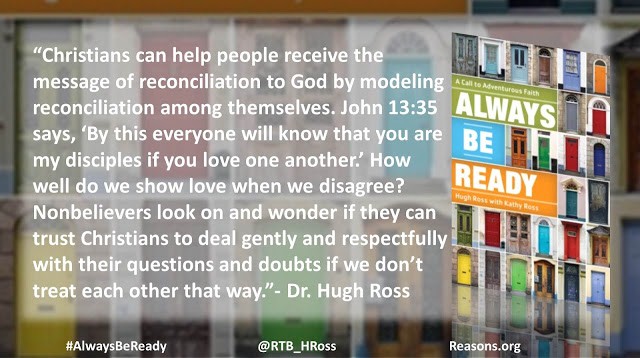
Second, there are actually numerous areas specifically related to origins that we do agree upon. A couple of years ago I wrote a post that lists out 40 of these points of agreement on origins: What Do Young Earth and Old Earth Creationists Agree Upon Regarding Origins? It is important to keep these points of agreement in mind so that as unbelievers view our behavior towards one another in the midst of disagreement, they will see love and reconciliation in Christ modeled. As Dr. Hugh Ross states in his latest book “Always Be Ready: A Call to Adventurous Faith“:
Is Genesis History 1

Third, we agree on the inerrancy of Scripture. It is God-breathed (2 Timothy 3:16-17); thus it is true in all that it affirms. We also agree upon the authority of Scripture. All disagreements are not regarding what Scripture is or its authority in our lives but rather on what it means in the particular areas of disagreement (disagreement on meaning in one area does not necessitate disagreement on meaning in another).
Is Genesis History 2

Fourth, there were many things explicitly said throughout the documentary that I also find strong agreement with. These agreements range from agreements about the failure of high criticism to the denial of common ancestry. As I was taking notes while watching, I kept a running list of these agreements, and here it is (with links to my reviews of books that dive deeper into a defense of the particular item):

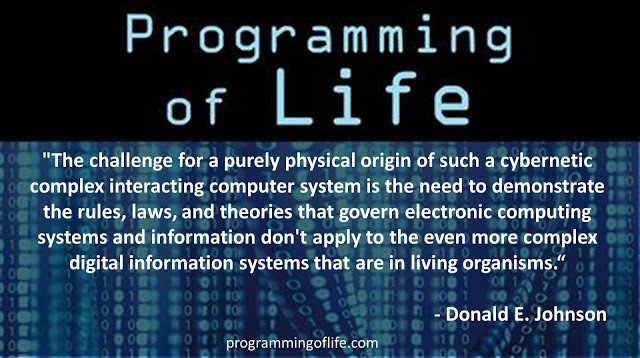
Finally, as a computer technologist, I was excited to hear that Del Tackett’s formal training was as a computer scientist. I really was hoping that he was going to bring our field into the documentary in support of God as the Intelligent Creator (there are many areas where computer science can be appealed to argue for a beginner, a designer, free agency, and the validity of cumulative cases, just to name a few). Unfortunately, he did not, but I do hope that he does in a future documentary. Check out “The Programming of Life” for an example of one of these arguments.
Is Genesis History 3

Now, as I mentioned in the introduction, there are several areas regarding origins which I believe “Is Genesis History” got wrong. I am going to attempt to keep my explanations short in this post because there are quite a few, so the case that I present for each inaccuracy is not meant to be comprehensive, but it is still meant to be sound. I will include links to articles and/or books throughout for further investigation. I have categorized the disagreements into three different categories for easy location later if you want to refer to this post in the future. Let’s begin with the philosophical issues.

Philosophical Issues

False Dichotomy

At the very beginning of the documentary, it is proposed that only two options exist regarding origins: either naturalism or a young-earth creationist view. Because of the fact that they intend to investigate an important historical event, it is important that they do not preclude any options before their investigation even begins. If an investigation reveals that neither option is viable, then what is the Christian to do? Because of this drastic philosophical mistake from the beginning of the film, if a Christian is ever convinced that the universe is ancient, then it is implied (if not explicit) that the creators of the film believe that the logically consistent person must reject Christ as well. However, other views do exist, so when a Christian sees the compelling evidence from God’s creation that it testifies to an ancient universe, there is no need to jettison Christ or even the historicity of the early chapters of Genesis.

Old earth creationism as proposed by Reasons to Believe holds firmly to the historicity of the Gospels and the historicity of the early chapters of Genesis and does not fall by the fatal critiques against either naturalism or young earth creationism. Contrary to what is implied at the beginning of “Is Genesis History,” rejection of young-earth creationism does not logically necessitate rejection of the historicity of the life, death, and bodily Resurrection of Jesus Christ (see “Origin Science: A Proposal For The Creation/Evolution Controversy“), and a rejection of young-earth creationism is not a compromise of truth but a compromise of falsehood, which is precisely our goal- reject falsehood and follow the evidence from God’s creation exactly where it leads. If you are interested in the evidence for a historical reading of Genesis and the gospels, check out these awesome books:

Is Genesis History 4

Logical Fallacy- Hasty Generalization

In the documentary, Tackett and the contributors make the logical mistake of arguing that since quick processes created a few things (some geologic formations) that they created all things (all geologic formations). This is problematic for two reasons. First, it is a logical fallacy, so it invalidates their conclusion that the Flood of Noah is responsible for the formation of the Grand Canyon (and all other geological features). Second, in this argument, they assume that old earth creation models allow for only slow processes, when in fact they allow both slow and quick processes. If the young earth creationist finds solid evidence for a quick process, that evidence is perfectly compatible with an ancient earth. The task before the young earth creationist is to provide solid evidence that the other formations also came about by a geographically global flood. In fact, when the evidence of these long processes is examined in the context of each other, we see powerful evidence of a grand orchestrated project culminating in a home for humanity (see “Improbable Planet; How Earth Became Humanity’s Home“).

Logical Fallacy- Conflation

Perhaps the first issue described above is the result of the fallacy of conflation. Naturalism and an ancient universe are not the same. Naturalism is a philosophical position that denies the existence of anything outside this universe. An ancient universe simply is a measurement of the amount of time that has passed since the creation event. Through the use of this conflation, the argument is made that since naturalism is false so must any view that holds that the universe is ancient. Because the argument employs the use of a fallacy, its conclusion is invalid. Naturalism can be false while the universe is ancient, and the same evidence that has forced scientists to concede a finite (but ancient) universe is the same evidence that argues powerfully for God as Creator and Designer. See these three books:

Is Genesis History 5

Philosophy of Science- Investigating the Past

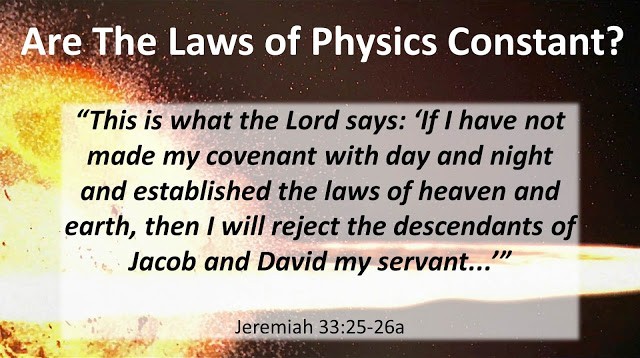
It is quite common for young-earth creationists to claim that the past cannot be known with any level of certainty like the present can be. According to “Is Genesis History” present processes cannot be used to figure out what happened in the past. If they affirm Jeremiah 33:25-26, then they affirm that the laws of physics are as unchanging as God is. This is important because the past can be known by observing the present and using this “principle of uniformity” (not uniformitarianism- they are different), we can deductively conclude what has happened in the past. By working our way backward in time, using God’s actions (current observations) and God’s words (Jeremiah 33:25-26), we discover that the universe did not reach its point of creation 6000 or even 10,000 years ago. Rather it goes all the way back to roughly 13.8 billion years ago. God’s creation testifies powerfully of its creation out of nothing (affirming the historicity of Genesis 1:1, and the rest of Genesis along the way). See these articles and book for more on this philosophy of science:

Philosophy of Science- Changed Laws of Physics

In the above section, I mentioned that the incorrect philosophy of science may be corrected by simply affirming Jeremiah 33:25-26 (unchanging laws of physics). However, several times throughout the film, changing laws of physics were affirmed (specifically at the Fall of Adam and Eve). This is problematic for numerous theological and philosophical reasons, the least of which is the unknowability of the past (thus they cannot even critique alternative views based on evidence from the creation) and possibly the worst of which is denying God’s unchanging nature that He explicitly compared to the laws of physics (and in turn, denying the doctrine of biblical inerrancy). For more on the details of this issue see the book “Peril in Paradise.”
Is Genesis History 6

Since that last issue addresses both a philosophical and a theological issue, it provides a good segue into the second category of issues.

Theological Issues

Nature Cannot Interpret Scripture

This issue can also be seen as both philosophical and theological. When it is restated, the theological implications become more apparent: “God’s actions cannot be used to interpret God’s words.” This is the result of denying Jeremiah 33:25-26 (affirming changed laws of physics). For changed laws of physics means that the creation does not reflect God’s actions. However, since God has told us that the current observations of the universe do reflect His original creation (Jeremiah 33:25-26, Psalm 19, and Romans 1), we cannot deny that God’s actions can be used to interpret His words. Affirming that God’s actions (the creation) can be used to interpret God’s words (Scripture) is not a matter of “man’s fallible ideas versus God’s infallible Word,” rather it is a matter of affirming that God’s infallible actions are necessarily consistent with God infallible Word. And when God’s actions unequivocally reveal an ancient universe, we need to change our interpretation of what God’s Word in Genesis means to reflect His actions and not our fallible ideas. See the following three articles that go deeper into the relationship between God’s Word and God’s actions:

Is Genesis History 7

Christians Who Disagree With Young-Earth Creationism Are Denying Genesis Is Historical

By using God’s creation to help us interpret His words (thus concluding an ancient universe), we are not denying the historicity of the Genesis account; we are affirming its historic and scientific accuracy and our own fallibility in interpreting the words and actions of an infallible God. In fact, when Genesis 1 is interpreted from the proper perspective (the surface of the planet, according to Genesis 1:2), we discover perfect alignment between the events described in Genesis 1 and what scientists have discovered about the history of our planet and life. This is far from denying historical accuracy; this is providing solid scientific evidence of the historical accuracy of the account. For more on this, see these books:

Is Genesis History 8

A Global Flood and the Judgment of Sin

In “Is Genesis History” the contributors asserted that the only way that God’s judgment (the whole purpose of Noah’s Flood) is that it be global in extent. The purpose was to judge humanity for its evil, so its geographical extent need only be to everywhere that humans had inhabited. The debate about the geographical extent of the flood comes down to the extent to which humans had migrated around the globe. If they had not migrated far from the place of Adam’s and Eve’s creation, then God could still accomplish His purpose 100% by merely flooding that geographical area. Given the strong evidence for the lack of migration of early humans (see Who Was Adam) and the fact that no geological evidence exists for a worldwide flood (see the Hasty Generalization above), the interpretation of the Flood as a universal event (affected all humanity but not the whole globe) affirms both the historicity of the Flood account (God’s words) and the accuracy of the record of nature (God’s actions). See “Navigating Genesis” for more on this.

Scientific Issues

Evolution Can Take Place in Billions of Years

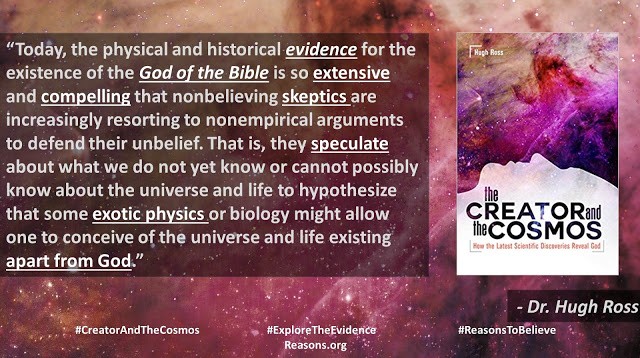
The first scientific issue that I want to describe with is the idea that naturalistic evolution can produce the origin (and diversity) of life we see today in just billion years. As more and more research is conducted into the cosmic, galactic, planetary, geological, and chemical conditions required just for life to originate, 13.8 billion years is actually numerous orders of magnitude too young! This is one of the reasons why the big bang (establishes that the universe began merely 14 billion years ago) was so vociferously opposed. Since the evidence is so strong for the universe’s beginning (ex nihilo) in the finite past (see “Creator and the Cosmos“), naturalists have attempted to exponentially increase their chronological resources by positing a multiverse (which includes a near-infinite number of universes) to accommodate the necessity for amounts of time orders of magnitude more than 13.8 billion years.
Is Genesis History 9

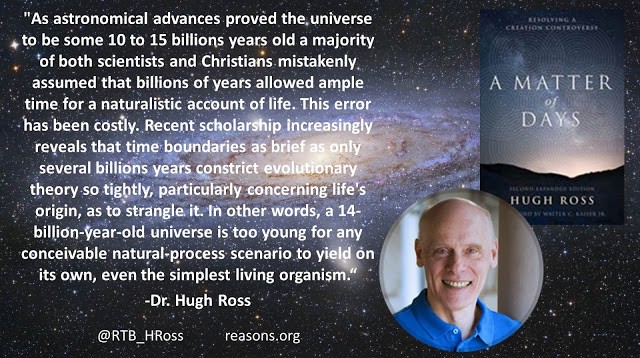
Young earth creationists (including those in “Is Genesis History”) constantly accuse scientists and other Christians, who hold to an ancient universe, of needing 13.8 billion years to accommodate evolutionary processes. The reality is that that is simply not the reason. The evolutionary process is simply not that efficient by many orders of magnitude. It is not feasible by any stretch of the imagination! The only reason naturalists have accepted that the universe is only 13.8 billion years old is because the evidence from God’s creation (Romans 1) is so strong that they can no longer deny it logically or scientifically (again, see “Creator and the Cosmos“). If anyone tells you that the old earth creationist needs or is trying to force 13.8 billion years into the Bible to accommodate evolution, please understand that they really do not understand just how inefficient the evolutionary process is. See “A Matter of Days: Resolving A Creation Controversy” for more on this chronological impossibility for evolution.
Is Genesis History 10

Affirmation of Macro-Evolution

One of the major problems with the global flood hypothesis is Noah fitting all the different animals on the ark. The diversity we see today could not be represented if there was a one to one representation. Global flood proponents, including in “Is Genesis History” have posited that all animals descended from a collection of ancestral “kinds” that were on the ark. They believe this process was either fully naturalistic or could have been theistic (preloaded into the genes at original creation). Several problems exist.

First, “kind” can be roughly comparative to either “genus” or “family.” While creationists (old earth and young earth) believe that micro-evolution (adaptation within a species) does happen and speciation (evolution from one species to another) is possible, they believe that evolution beyond this level crosses into macro-evolution (evolution from genus to genus or family to family) and either does not happen or is impossible. Young earth creationists (including those in “Is Genesis History”) are quite critical of both naturalistic and theistic macro-evolutionary models for numerous reasons. These same reasons serve to falsify their own affirmation of macro-evolution.

Second, even naturalists and theistic evolutionists understand that the macro-evolutionary process would be slow and not as quick as the global flood proponent would need to explain today’s observed diversity. The global flood proponent would have to posit not just a mechanism that they already claim to have falsified but one that works at orders of magnitude more quickly. If a process is not possible, speeding it up does not make it more possible. It would also be akin to punctuated equilibrium- one of the evolutionary answers to sudden appearances of animals in the Cambrian and Avalon explosions. The proposed solution to the diversity problem will not work by any standard. See “Navigating Genesis” and “Peril in Paradise” for more on this issue with the necessity of global flood proponents to affirm macro-evolution.

Is Genesis History 11

Dinosaur Soft Tissue Affirm A Young Earth

In “Is Genesis History” one of the proposed evidences to defeat an ancient universe and earth (and cause doubt about other dating methods) is the discovery of dinosaur soft tissue. This is a really cool discovery that has been in the news for a few years now and has spurred on much more scientific inquiry. The idea behind this evidence is that, by current understandings of soft tissue degradation, the dinosaur soft tissue should have decayed a long time ago, if they had been dead for 60+ million years. The discovery of dinosaur soft tissue adds a huge question mark behind two beliefs: the date of the dinosaurs’ death and the current understanding of soft tissue decay processes. In “Is Genesis History,” they posit that the current understanding of soft tissue decay processes is complete and that scientists should rather doubt the ancient date for the death of the dinosaurs (and affirm a young earth).

The problem is that this is only one piece of evidence that seems inconsistent with current dating (among many pieces of evidence that falsify a young creation), so scientists have opened up more research into decay processes for soft tissue. These have been quite fruitful in producing discoveries of multiple conditions that would result in longer decay times. As biochemist Fazale Rana describes in his book “Dinosaur Blood and the Age of the Earth,” these newly discovered conditions defeat the claim that soft tissue is incompatible with an ancient date for the death of the dinosaurs. So, this evidence, contrary to what those in “Is Genesis History” claim, it does not provide evidence against an ancient universe or earth. But again, as described above, this does not mean that Genesis is not history; it just means that the young earth interpretation is not accurate.

Conclusion

So, is Genesis history? Yes! But the history recorded in Genesis does not teach that the universe is only 6000 years old. While the answer to the title question of the documentary is in the affirmative, one does not have to accept the scientific, biblical, theological, and philosophical inaccuracies in the “Is Genesis History” documentary to believe that Genesis is history. In fact, when investigated, we find that the historical record in Genesis is perfectly compatible with modern scientific discoveries of God’s creation. What secular scientists are discovering about God’s actions is revealing more details of the general events that Moses recorded thousands of years ago. Moses had no way to know such things (especially since he was in the middle of an ancient near eastern culture that held to the eternal past of the universe and its lack of design and purpose [see “The Bible Among The Myths“]). This provides powerful evidence that the Bible was inspired by the Creator of the universe, and consequently, such evidence points directly to the truth of biblical claims about our sinfulness and need for a Savior. The reality of the antiquity of the universe (and big bang cosmology, properly understood) does not undermine Christianity; it provides solid evidence, from God’s own actions (creation) for the truth of the Bible, that no Christian should fear or be reluctant to affirm.

If you are ready to explore God’s creation and see how, as Romans 1:20 proclaims, God’s attributes are so evident in His work that skeptical scientists cannot escape public acknowledgment of them, definitely pick up any of the many books linked to in this post or check out these excellent ministries:
Is Genesis History 12


Luke Nix holds a bachelor’s degree in Computer Science and works as a Desktop Support Manager for a local precious metal exchange company in Oklahoma.

Original Blog Source: http://bit.ly/2DTwnfz
By Evan Minton 

Some well-meaning but very misinformed Christians discourage the study of philosophy on the basis of a verse in Colossians chapter 2. In Colossians 2:8, the apostle Paul wrote: “See to it that no one takes you captive by philosophy and empty deceit, according to human tradition, according to the elemental spirits[a] of the world, and not according to Christ.” This verse has become the chief proof-text for anti-philosophy Christians. In fact, even the famous reformed preacher John MacArthur argued against philosophy using this text. In The MacArthur Study Bible, he wrote “You know what philosophers are? They’re doodlers with words instead of pencils. They just make a whole lot of verbal squiggles. Colossians 2:8 says this: ‘Beware lest any man spoil you through philosophy.’” Unfortunately, this verse has been majorly misinterpreted.

Keep The Text In Its Context

When you look at the verse in context, what you find is that Paul wasn’t saying “Philosophy is bad”, but rather, he was warning his readers to be on the lookout for bad philosophies.

To really understand what Paul is talking about in this verse, one needs to move beyond the verse itself. One needs to read it in context. That means both the immediate context (the verses before and after it) and its cultural context. Moyer Hubbard of Equip.org writes “Looking now at Colossians and the specific context of chapter 2, we find Paul addressing a local assembly that had been infiltrated by a form of false teaching that threatened to undermine the gospel he preached. Paul does not give us enough information to identify precisely what sect or ‘philosophy’ he is describing. There are some clues, however, that suggest that it was perhaps a syncretistic hybrid of Jewish mystical practices and popular pagan folk-belief: he mentions the observance of special days, including the Sabbath (v.16); visionary experience and the worship of angels (v.18); submission to the “elemental spirits of the world” (v.20);6 and abstinence (vv.21,23). Paul clearly is attacking a peculiar form of religious speculation, but it is impossible to identify it with any of the major schools of philosophy known to us from the Greco-Roman world. In fact, it is important to keep in mind that the Greek word philosophia (and its Latin cognate) had a variety of meanings in this period, and, depending on the context, might be translated ‘religion,’ ‘speculation,’ or ‘investigation.'”[1]

We gain more information on this incorrect philosophy by taking into account how Paul describes it in the 8th verse of Colossians 2: Paul says that it’s founded on “human traditions and the elemental powers of the world, and not on Christ.” The key phrase here is “[based] not on Christ.” Paul was targeting “philosophical” speculations that oppose the truths of Christ.

Moreover, I think the phrase “human traditions,” gives us a clue that this ungodly speculation was Jewish in nature. The phrase “human traditions” appears in only one other place; Mark 7:8, where Jesus condemns the Pharisees as those who reject “the commands of God and hold to human traditions” (cf. Galatians 1:14). Paul uses the term “elemental spirits of the world” similarly in referring to the Galatians’ doing the Torah stuff in Galatians 4:3. As Hubbard commented, “That Paul could refer to this syncretistic Jewish speculation as a ‘philosophy’ is in keeping with how Hellenistic Jews of the period sometimes referred to their faith.”[2] He said that because extra-biblical Jewish writers of the time called their theological beliefs “philosophies”. For example, the Jewish historian Flavius Josephus calls Judaism and its multiple sects as “philosophies”[3] (those sects being the Essenes, Sadducees, and Pharisees)[4]

4 Maccabees refers to Judaism as “our philosophy…teaching temperance, self-control, courage” (5.22‑23). Therefore, it very well could be the case that Colossians 2:8 is referring to Judaism and the Judaisers, employing their terminology when referring to their beliefs. If that is the case, then one cannot use Colossians 2:8 to condemn the study of philosophy as a whole, for Paul is merely warning against philosophical systems that oppose the gospel, in this case; the philosophy of the Judaisers.

Dissing Philosophy Is Logically Self-Refuting

Besides the exegetical fallacies in taking Colossians 2:8, there is a logical problem as well; namely, it’s self-refuting. In any attempt you make to formulate arguments against philosophy, you will be reasoning philosophically about philosophy. Yet if you’re reasoning philosophically about philosophy, you’re engaging in the very thing Paul (allegedly) told us not to do; philosophy! This is why Christians who say “I don’t need philosophy” are frequently met with the retort “Really? That’s a nice philosophy.” and “You shouldn’t do philosophy” with “Is that your philosophy?” Are we to believe that The Holy Spirit would inspire Paul to teach self-refuting…. philosophies?

Conclusion
The Apostle Paul was not anti-philosophy. Those who argue that he was, do so by ripping Colossians 2:8 out of context. Moreover, to say you shouldn’t do philosophy and then proceed to give any arguments for it is self-refuting, as you’re doing philosophy.

I’ll end this blog post with a quote from Dr. William Lane Craig: “the man who claims to have no need for philosophy is the one most apt to be fooled by it”[5]

Notes

[1] “Is Colossians 2:8 A Warning Against Philosophy?” – by Moyer Hubbard, http://www.equip.org/article/is-colossians-28-a-warning-against-philosophy/

[2] ibid.

[3] Flavius Josephus Against Apion 2.47.

[4] Flavius Josephus Antiquities 18.11.

[5] https://www.reasonablefaith.org/writings/question-answer/hawking-and-mlodinow-philosophical-undertakers


Original Blog Source: http://bit.ly/2RFw7oL

By Brian Chilton

The Gospel of John has been one of my favorite Gospels since I first started studying the Bible. The Gospel of John is theologically rich as well as historically accurate. One of the important sections of John’s Gospel is found in its opening chapter. John says,

“In the beginning was the Word, and the Word was with God, and the Word was God. He was with God in the beginning. All things were created through him, and apart from him, not one thing was created that has been created. In him was life, and that life was the light of men. That light shines in the darkness, and yet the darkness did not overcome it … He was in the world, and the world was created through him, and yet the world did not recognize him. He came to his own, and his own people did not receive him. But to all who did receive him, he gave them the right to be the children of God, to those who believe in his name, who were born, not of natural descent, or of the will of the flesh, or of the will of man, but of God. The Word became flesh and dwelt among us” (John 1:1-5, 10-14a)[1].

The best evidence suggests that John the apostle wrote these words. John bar Zebedee is confirmed as the author both by internal and external evidence (especially by Irenaeus, Tertullian, Origen, Polycarp, Clement of Alexandria, and later Eusebius).

John also confirms an additional segment of information in his first letter. He writes, “This one is the antichrist: the one who denies the Father and the Son. No one who denies the Son has the Father; he who confesses the Son has the Father as well” (1 John 2:22-23). That is to say; the truth is that Jesus is the Word as described in John chapter 1. If one denies this truth, then one denies a core fundamental of the faith.

Such information is important to know because John chapter 1 combats three modern forms of theology that must be eschewed by the believer who seeks to accept the truth of God’s word. These three false modern doctrines will be described in this article. Note, however, that I realize that there are many good people in the groups I will discuss. Their problem is theological and not necessarily moral. Good people can hold bad theological views.

John 1 Combats Jehovah Witness/Arian Theology. The Jehovah Witness movement was started by one Charles Taze Russell. Their theology is not that original in scope as they borrow from an ancient heresy known as Arianism. Arius of Alexandria (256-336 AD) was a presbyter who formulated the idea that Jesus was not really God, but rather an archangel. Jesus was the first created being according to Arian theology. Arianism was successfully combated by Athanasius of Alexandria (296-373 AD) who stood for the orthodox Christian view that Jesus was God come in the flesh. Athanasius’s victory was not without cost. He was exiled at least three times until it was finally resolved that Athanasius’s view corresponded with biblical truth.

Unfortunately, in today’s fragmented ecclesiastical structure, there is not as much church authority to combat false doctrines such as Arianism. For that reason, Charles Taze Russell’s theology was able to succeed. He developed a very similar doctrine as Arius’s and formulated the Jehovah Witness movement. Yet, John 1 stands opposed to any claim that Jesus was merely an angel. Jesus was God (Jn. 1:1) and not a mere angelic entity. Thus, the Jehovah Witness doctrine finds itself falling short from biblical orthodoxy just as Arius’s view did.

John 1 Combats Mormon Theology. Joseph Smith was born in Sharon, Vermont on December 23, 1805. Smith claimed to have seen an angel by the name of Moroni who supposedly gave Smith a newer testament called the Book of Mormon which describes how the risen Jesus purportedly visited a group of Native Americans known as the Nephites. According to Mormon theology, Jesus was the first spirit-child originating from the Heavenly Father and the Heavenly Mother. However, John 1 greatly combats that idea. Jesus is presented as being co-eternal with the Father. Thus, Jesus was not the first spirit-child. Rather, Jesus was God who existed since from before the beginning of all creation and who came in flesh “and dwelt among us” (Jn. 1:14a).

John 1 Combats New Age Theology. New Age theology holds that each person is his/her own god. Ironically, it seems that false doctrines deescalate the person of Jesus and elevate the human being, whereas orthodoxy elevates the persona of Jesus and deescalates humanity. Nevertheless, John 1 teaches that “all things were created through [Jesus], and apart from him not one thing was created that has been created” (Jn. 1:3). Thus, if “all things” (Gk. panta) really means “all things,” then human beings cannot claim to be any form of god much less their own.

Each Christian must test truth each doctrine they come across philosophically and theologically by God’s word. While we need to remember that we must love each person with whom we come into contact, we cannot accept false doctrines. Stay true to God’s word and the theological power found within its pages. Leave everything else by the wayside.

Notes

[1] Unless otherwise noted, all quoted Scripture comes from the Christian Standard Bible (Nashville: Holman, 2017).


Brian G. Chilton is the founder of BellatorChristi.com and is the host of The Bellator Christi Podcast. He received his Master of Divinity in Theology from Liberty University (with high distinction); his Bachelor of Science in Religious Studies and Philosophy from Gardner-Webb University (with honors); and received certification in Christian Apologetics from Biola University. Brian is currently enrolled in the Ph.D. program in Theology and Apologetics at Liberty University. Brian has been in the ministry for over 15 years and serves as a pastor in northwestern North Carolina.

Original Blog Source: http://bit.ly/2zrCe9e

By J. Brian Huffling

I sat down with some Jehovah’s Witnesses who were visiting with me. The elder who was leading our study stated that Jesus never claimed to be God. Jehovah’s Witnesses argue that Jesus is a created being. Liberal “Christians” argue that Jesus never claimed to be God. Many other groups say the same. If such is the case, then Christians have some explaining to do as they teach that Jesus is God. But did he ever claim this title for himself? Let’s look at what he actually said.

I am going to argue that, yes, Jesus, in fact, did claim to be God. This can be seen by the fact that he claimed to be identical with God in various ways.

Jesus Claimed to Be Identical with God

Jesus made statements about himself that were expressly made of Yahweh in the Old Testament. Let’s look at the OT claims and then Jesus’ claims.

“I AM”

One of the clearest passages of Jesus claiming to be God is his claiming to be Yahweh as being the great I AM of Exodus 3:14.

OT Claim: “God said to Moses, ‘I am who I am.’” The designation “I am” was solely reserved for Yahweh and was recognizes by the Jews as such. (Exodus 3:14)

Jesus Claim: “Jesus said to them, ‘Truly, truly, I say to you, before Abraham was, I am.‘ 59 So they picked up stones to throw at him, but Jesus hid himself and went out of the temple” (John 8:58-58). Clearly, the Jews understood Jesus to be making himself equal with God. That’s why they wanted to kill him.

First and the Last

OT Claim: “Thus says the Lord, the King of Israel and his Redeemer, the Lord of hosts: ‘I am the first and I am the last; besides me, there is no god.’” (Isaiah 44:6)

Jesus’ Claim: “When I saw him, I fell at his feet as though dead. But he laid his right hand on me, saying, ‘Fear not, I am the first and the last18 and the living one. I died, and behold I am alive forevermore, and I have the keys of Death and Hades.’” (Note for Jehovah’s Witnesses: This can’t be Jehovah since for them Jehovah never died.)

Having the Glory of God

Jesus claimed to have the glory that only God had.

OT Claim: “I am the Lord; that is my name; my glory I give to no other, nor my praise to carved idols.”

Jesus’ Claim: “And now, Father, glorify me in your own presence with the glory that I had with you before the world existed.”

His Acceptance of Worship

The OT and NT also forbade the worship of any other being, idol or otherwise (Exodus 20:1-4; Deut. 5:6-9; Acts 14:15; Rev. 22:8-9). However, Jesus accepted worship on several occasions and never reprimanded anyone else for it (Matt. 14:33; Matt. 20:28; John 9:38; John 20:28). In this last example, Thomas explicitly calls Jesus God and Jesus didn’t correct him.

He Claimed to Have Authority and Equality with God

Throughout Matthew 5 Jesus claims his words have the same authority as God. Repeatedly he says regarding the OT, “You have heard it said, but I say to you . . .” (See 5:22, 28, 32)

In the baptismal formula he gave at the Great Commission, he claimed equality with the Father and Spirit: “All authority in heaven and on earth has been given to me. 19 Go therefore and make disciples of all nations, baptizing them in the name of the Father and of the Son and of the Holy Spirit, 20 teaching them to observe all that I have commanded you. And behold, I am with you always, to the end of the age.” (Matt. 28:18-20)

He claimed to be able to forgive sins, which only God could do: “And when Jesus saw their faith, he said to the paralytic, ‘Son, your sins are forgiven.’ Now some of the scribes were sitting there, questioning in their hearts, 7 ‘Why does this man speak like that? He is blaspheming! Who can forgive sins but God alone?’” (Mark 2:5-7)

Perhaps the clearest passage is John 10:30-33: Jesus claimed to be one with the Father. “I and the Father are one.” 31 The Jews picked up stones again to stone him. 32 Jesus answered them, “I have shown you many good works from the Father; for which of them are you going to stone me?” 33 The Jews answered him, “It is not for a good work that we are going to stone you but for blasphemy, because you, being a man, make yourself God.”

Objections to Jesus Being God

Objection: Some will object that Jesus can’t be God. God, they say, is infinite and unlimited; however, Jesus claimed to be limited in various ways. For example, in Matthew 24:36 Jesus said, referring to his second coming, “But concerning that day and hour no one knows, not even the angels of heaven, nor the Son, but the Father only.”

Response: We have to understand that Jesus did in fact claim (and prove) to be God. The traditional Christian teaching is that Jesus had two natures even though he was just one person. One nature was his divine nature that he shares with the Father and Spirit. The other is his human nature. Sometimes he refers to his divine nature, such as having glory with God, being the first and the last, etc. However, sometimes he refers to his human nature. When we ask questions about his ability to do something or know something we have to be clear as to whether we are talking about his divine or human nature. In this verse, Jesus is referring to his limited human nature. This does not deny his divine nature.

Objection: Jesus also said “The Father is greater than I.” (John 14:28)

Response: The same basic answer is used here. The Father is greater in office while not being greater in nature, that is, in Jesus’ divine nature. Of course, the Father is greater than Jesus’ human nature. An illustration may make this clearer. The President of the United States is greater than me. However, he is only greater in office. We are both of the same nature.

Objection: in Matthew 19:17 we read: “And behold, a man came up to him, saying, ‘Teacher, what good deed must I do to have eternal life?’ 17 And he said to him, ‘Why do you ask me about what is good? There is only one who is good.’” In other words, only God is good, so why are you calling me good?

Response: Notice there is no explicit denial of his deity. He is likely saying, “Do you realize that in calling me good you are calling me God?” However, even if this is not what he is saying, there is no explicit denial of being God, and we have already seen several (select) examples of him claiming to be God.

Conclusion

Above are a few of the many passages where Jesus claims to be equal with God in various ways. The notion that he didn’t claim to be God is simply false. He was also understood to be God by his followers and the Church. Objections to this idea fail when properly examined. Jesus, in fact, claimed to be God.

*I am indebted as a student of Dr. Norman L. Geisler for the above connections and general thought. See for example his Christian Apologetics.


Original Blog Source: http://bit.ly/2QiYEzE

By Rajkumar Richard

No one is spared of evil. We either reel under the effects of evil or feel the impact of evil upon our relatives, friends, and society at large. Some question God’s goodness on account of evil and a few others dispute God’s presence.

Evil is real. Evil is not an illusion. Any sane human being would affirm this position. Terrorism or human trafficking is an act of evil, and the pain felt by those hurt by this evil is indeed real.

If evil is real, then it should have a source, and that source has to be real. (If Satan is not real, then was Christ hallucinating while HE was tempted by Satan and while HE drove away the demons?)

The Bible terms Satan as the source of all evil (John 8: 44). Christians believe in God as a maximally great being; HE is supreme over all that has been, is and ever will be. If God is supreme, then HE should have created Satan. Isn’t it?

Before we explore the Bible to learn about Satan, we should discard the following concepts:

  1. That Satan and his demonic entourage are merely a mythological conception drawn from the culture of the day. This is German theologian Rudolf Bultmann’s program of demythologization of Satan.
  1. That Satan and evil do not stem from a personal source but are woven in the fabric of our social reality as a part of the very structure of reality. This is Christian existentialist theologian Paul Tilich’s depersonalization of Satan.
  1. That demons are simply nothingness in their dynamic, not created by God but a threat to God’s creation. This is reformed theologian Karl Barth’s conception. This conception of evil denies the concreteness of evil; hence we disagree.

So to begin with, we agree with the Bible that evil is real, Satan is real, and God is also real. Did God then create Satan? The answer is an unequivocal yes.

But the bigger question is, “Did God create Satan as a source of evil?” The answer to this question is an unequivocal no, for God, as a good being, cannot be the creator of evil.

This then is Bible’s teaching about Satan:

Isaiah 14: 12-17 and Ezekiel 28: 12-19 are often termed as conjectures of the Satanic fall. This may or may not be so, for these passages could refer to human kings of Babylon and Tyre. Hence it would be profitable for us to explore the Bible from outside these references to learn more about Satan.

  1. God created everything, which includes angels and demons (Colossians 1: 15-16).
  2. Everything God created was originally good (Genesis 1: 31; 1 Timothy 4: 4)
  3. Some angels sinned and are doomed for eternal destruction (1 John 3: 8; 2 Peter 2: 4; Jude 6). If some angels sinned, then they were created with a potential to sin i.e. they had the free will to sin.
  4. Satan is an angel who is subordinate to God (Job 1: 6-7).
  5. Satan is a demon (Luke 10: 17-20) – casting out of demons implies the defeat of Satan.
  6. Satan is the prince of demons (Matthew 12: 22-32; Mark 3: 22-30; Luke 11: 14-23).
  7. Those who are demon possessed are under the influence of the devil (Acts 10: 38; cf. Luke 13: 16).
  8. Satan is the evil one (Matthew 13: 19; 1 John 2: 13, 3: 12, 5: 18).

These passages undoubtedly teach us that God created Satan and his demons originally as good beings. But Satan and some of his fellow angels sinned against God and are in the business of enabling mankind’s rebellion and disobedience against God.

Significantly, God did not create an evil Satan. God created a good angel, who used his free will to reject God and become evil.

If God had not created angels, then Satan would not exist. So why did God create angels? The Bible reveals the purpose behind God’s creation of angels. Angels were created to…

  1. …reveal and communicate God’s message to humans (Acts 7: 53; Hebrews 2: 2).
  2. …minister to believers (Acts 5: 19; Hebrews 1: 14).
  3. …execute judgment on the enemies of God (2 Kings 19: 35).
  4. …praise and glorify God (Psalm 103: 20, 148: 2).
  5. …be involved in Christ’s second coming (Matthew 25: 31)

A variant of the bigger question is, ‘why did God create Satan knowing that he will cause evil in this world?’

First, did God know that Satan would cause evil? Yes, God would have known all about Satan. God is all-knowing (Job 37:16; Psalm 139:2–4, 147:5; Proverbs 5:21; Isaiah 46:9-10; 1 John 3:19–20), so God would have definitely known that Satan would cause evil and disaster in this world.

Second, could not have God created a world without Satan? Wouldn’t a world without Satan and evil be a better world than ours? In other words, is our world the best of all possible worlds?

One of the great thinkers of 17th and 18th century is Gottfried Wilhelm Leibniz. He proposed that our world is the best of all possible worlds. Leibniz’s proposition was that since God knew all of the infinite possibilities, this world should be the best of all possible worlds, for God has actualized this world over the other possible worlds.

Christian analytic philosopher, Alvin Plantinga differed from Leibniz by positing that there cannot be a best world, for one more palm tree or one more morally righteous person can make any world better. So Plantinga concluded that there is no such thing as the best world. [Even if God does not create anything, HE alone will exist as the greatest good (Summum bonum)]. Therefore, God is merely obligated to create a good world and not a best world.

This world is a good world since God has offered freedom to his creation. God has offered freedom to man to love HIM freely. The same freedom was offered to the angels as well. Some angels a.k.a. Satan and his demonic entourage abused this freedom and rebelled against God.

A world without freedom is not a good world. Therefore, as C.S Lewis wrote in ‘Problem of Pain,’ God has created a good world in such a way that the goodness of this world could be perverted into evil upon mankind’s rebellion or when creation is distorted.

In other words, free beings, i.e., man could use their freedom to perform evil deeds by rejecting God, which in effect would destroy the goodness of God’s creation. Similarly, man can tamper with nature to bring about evil, e.g., destruction of coral reefs would bring about hunger, poverty, and political instability.

As long as God offers freedom to his creation, the free moral agents (e.g., man) would possess the ability to do good or evil. So the question is not about Satan’s existence whereas the question should be about the presence of freedom.

A world without freedom would be a world full of puppets or automata albeit in the form of human beings, which in essence is not a good world at all. Creating human beings with freedom is wiser than creating humans in an antiseptic environment from whom the logical possibility of desiring anything contrary to God’s will is excluded. Therefore, a world without free will and Satan would any day be a terrible world to live in than a world with free will and Satan.

Could God have created a world with free will and without Satan? A world with freewill will entail evil, and a world with evil will posit a source, namely Satan. Even if angelic beings were not created, and as long as free will exists, evil would exist.

Evil would exist because God in HIS nature is good. So anyone opposing or rejecting a good God would do evil. So a world with free will and without Satan would still contain evil.

Satan and his cohorts are busy causing evil in this world. Although we reel under the effects of evil both directly and indirectly, God has offered us eternal life through the Lord Jesus Christ, and God has promised to care for and protect those who believe and seek HIM. May we believe in Christ, gain life eternal, and protection against evil. Amen.


Rajkumar Richard is passionate to strengthen the faith of fellow Christians, especially the young Christians. He has a Masters in Religion (Southern Evangelical Seminary, NC, USA) and Masters in Biology (School of Biological Sciences, Madurai Kamaraj University, India). He is a Christian blogger, itinerant speaker, social evangelist, and a mentor to young Christians.

Original Blog Source: http://bit.ly/2N2TV6q

By J. Brian Huffling

Is God in time? This is a popular question. Does it matter? What does it mean for God to be in time or not? In this article, I will argue that the answer to this question is terribly important in maintaining a biblical and orthodox view of God. In order to answer this question, we must first ask, “What is time?”

“Are you an A-theorist or a B-theorist?” I’m often asked. A-theory and B-theory have been two major views of time since the early 20thcentury. The A-theory states that the past, present, and future exists in some way. We are moving “through” time in a sense. Some views of this theory hold that the past is getting bigger with each passing moment; others hold that the future is getting smaller. The commonality is that time is moving from future to past. Since this view holds that there are different tenses, it is considered a “tensed” theory of time.

The B-theory holds that there are no tenses and that all events exist either simultaneously, before, or after one another, because time doesn’t “pass” through one moment to the next. Thus, it is considered a “tenseless” theory of time. Instead of saying event A is past in relation to event B, the B-theorist would say that event A is before event B. For example, George Washington exists before Abraham Lincoln, but not in some temporal existence called “the past.” In both of these theories, time is said to “exist” in some way. Thus, time is not moving in any way, but we can describe events temporally by saying one event is before or after another event without using tenses such as “past” or “future.”

An oft-forgotten view says that time doesn’t “exist” at all. The A and B theories “reify” time (from the Latin res meaning “thing”). That is, they make time into an existing thing. Rather than saying time is a thing, those who follow Aristotle say that time doesn’t exist; rather, things exist and time is a measurement of how those things change. For example, there is no such thing as a year. A year is simply the measurement of how long it takes the Earth to revolve around the sun. It is a measurement of the Earth’s change. In my view, this view has more explanatory power and creates fewer problems. This discussion gets very technical very fast, but this is the gist of it. So how does this relate to God?

Methods of Inquiry

There are two basic ways to ask, “Is God a temporal being?” One is to look at all of the problems that arise with one view or the other and take the opposite position. Such a method has become par for the course in issues of metaphysics and philosophy of religion. The other way is systematic. Instead of simply seeing which view has fewer problems, a systematic view first deduces what God’s nature is like and then looks at how to answer such questions as to how does he relate to creation? Such a method is less ad hoc (that is, one doesn’t just make God up as he goes in an effort to solve problems), but rather tries to gain an understanding of what God is like before even asking secondary or tertiary questions. God’s nature thus becomes primary and such questions become secondary.

In keeping with the first method (of solving problems before first seeing what God is like), many contemporary thinkers on this issue believe that God must be temporal. Several arguments are marshaled for this conclusion. One common one is God’s knowledge. It is generally conceded that God knows what is going on in the world. But things in the world are changing. If what God knows changes, then God’s knowledge changes. But if God’s knowledge changes then God changes. And if God changes then he is temporal. It is argued that if his knowledge does not change, then he can’t have knowledge of the changing world. However, if he doesn’t have knowledge of the changing world, then his knowledge is limited. His knowledge is not limited. Therefore, he knows the changing world and is thus temporal.

This type of argument suffers from blurring the Creator/creature distinction. It unduly anthropomorphizes God. A Thomistic (following Thomas Aquinas) response to this argument is to point out that God is not a human and does not know the way humans know. We know through our senses. God does not have senses, so he can’t know that way. This is not a limitation on his part, for he knows his creation in a more perfect way. Rather than having to “look outside” of himself in the way we do, since God is the creator and sustainer of creation, he knows the universe by simply knowing himself since he is the perfect and complete cause of it. He is an eternal cause of a temporal effect. He has complete and perfect knowledge of his creation simultaneously. He is not reactive; he is pure act. He does not have to wait and see what is going on. Thus, his knowledge is timeless.

Defenders of divine temporality may retort that since the future isn’t a thing to be known as it does not exist and only existing things can be known. However, this unnecessarily reifies time (makes it into a thing). It further begs the question by saying God necessarily knows by some temporal means. If he does not, God does not need to “wait” for the future to happen, as he doesn’t learn in that way anyway. This reply also seems unbiblical as it is clear God has “foreknown” or ordained things “prior” to his creating the universe (Eph. 1:4). He does not need to wait and see what happens.

An example of a systematic approach is that of Thomas Aquinas. He first argues that God is pure act (existence), and is thus simple. Divine simplicity means that he has no parts (physical or metaphysical). (If you want to know more about divine simplicity read this article. This article deals with objections to the theory.) If he has no parts, then he cannot change, since change requires at least two parts: a state of existence and a state of possible existence that becomes actual. If God has no such metaphysical parts, then he can’t change. Further, if time is the measurement of change, then God is not measured by time. He is thus not temporal, but atemporal or eternal. Such states are philosophically different from ‘everlasting’ as the latter means always existing with no end. A temporal being like humans are everlasting, but this state of existence is different from an atemporal being that has no succession of moments or change.

Problems With Thinking God Is Temporal

Many problems arise if we say God is temporal. Ultimately we will again be blurring the Creator/creature distinction. If God is temporal, then he is changing, reactive (not active), and passive. If he changes, then he is composed of act and potency (existence with the possibility to change, which are different metaphysical parts). If he is composed, then he needs a composer, and he is not God. Further, if his knowledge changes, then he is not infinite since his knowledge would be increasing (an actual infinite cannot increase or be added to as it would not be infinite, to begin with, if more can be added to it). He also would not be perfect. What would he be changing from imperfection to perfection, perfection to perfection (this is not possible), or perfection to imperfection? The first option would seem to be the case since he would be learning something he did not know to begin with.

The difference with such a picture of God is that it rejects the classical picture of God as taught in the creeds, by the church fathers, and what Scripture and reason dictate. It replaces classical theism with process theology. Process theology teaches that God is in a process of becoming (becoming actual). He in a way learns, grows, and becomes. This picture of God is very passive, and often makes God part of his creation. Mainline Christians reject such a notion of God explicitly, but many implicitly endorse such a notion when they say God is temporal. For, if he really is temporal, then he is changing. And to be in a state of change is to be in a process. Thus, process theology rears its ugly head, even if in a nicer outfit. We are also left with this “God” being finite for the above reason that his being is added to in terms of knowledge and possibly other areas.

But What About the Bible?

The Bible describes God as being active in the world, changing in certain ways, and seemingly not knowing things, such as what was going on in Sodom and Gomorrah: “I will go down to see whether they have done altogether according to the outcry that has come to me. And if not, I will know” (Gen. 18:21). The Bible also describes God in various metaphorical ways, such as having physical body parts. Such descriptions are figures of speech. When trying to discover what God is like we need to describe him in literal ways. We know him through creation, as Paul says in Rom. 1:18-21. This means that we don’t make metaphors literal, metaphysical expressions of the divine nature. If God is spirit (John 4:4), then he can’t have body parts. The Bible is not contradicting itself; it is sometimes using metaphorical language and sometimes using metaphysical (literal) language. There are truths in metaphorical expressions, however. For example, when the Bible says that God is a rock, it means that like a rock he is strong and provides protection. Further, the Bible is not a systematic theology book. It does contain theology, but it is primarily a series of books and letters written to convey God’s relationship with Israel in the Old Testament, and the gospel and how it relates to believers and unbelievers in the New Testament. But it is not a systematic theology or philosophy book. Again, as Paul says, God’s “divine nature and eternal power” are known through creation. We know what God is like in a more literal way by studying him through his creation.

Conclusion

Questions like the one we have been considering are not just for professional philosophers. The way we answer this question will determine what we think about God and his relation to time and about his nature and his relation to creation in general. The answer to such questions should not arise out of simply trying to solve problems one by one; but rather discovering what God is like from his creation and then answering questions after we have a systematic view of God’s nature and attributes. This is an incredibly important issue that requires much consideration. It is part of being an intellectual and informed Christian. It is also one way we can worship God with our minds.


Original Blog Source: http://bit.ly/2PukGPQ

By Luke Nix

The debate about the proper interaction of science and theology is raging as much as it has ever been. Hot tempers fly that result in ice-cold relationships. For as much discussion and debate that takes place, it seems that nothing is being accomplished. For those caught in the middle, questions still remain unanswered:

  • What do we do when science contradicts our theology, or our theology contradicts science?
  • Are they allowed to contradict?
  • If not, which should I choose?
  • Can’t they just agree to disagree?

These are all questions that shaped my spiritual struggle several years ago. I was constantly told that I could not trust science because it contradicted my theology, and at the same time I was told that I could not trust theology because it denied science. I felt like I had a choice: live a double life allowing one source of truth (religion) in one area of reality, but not allowing it relevance in the other areas. Or I could completely deny one of them as a valid source of truth, giving up my theology completely, or giving up science completely.

How could I live what I do not believe, and how could I deny what I know to be true? These further haunting questions demanded answers yet seemed unanswerable. Neither hypocrisy nor denial are very appealing traits. Unfortunately, these are often presented as the only options available in our search for the true worldview. In this post, my goal is to present a compelling alternative that grants that science and theology are valid sources of truth that often overlap in the aspects of reality that they claim to explain. I will also put forth a method for dealing with conflicts in the overlapping areas and explain the liabilities of not dealing with such conflicts.

The Overlap

I believe that science and theology are fully compatible with one another. Both often speak about the same features of reality, but because we are not omniscient, we often find that our science and our theology contradict one another. If we wish for our theology to inform our understandings of creation (scientific models) and behavior towards each other and the rest of creation (ethics- 2 Timothy 3:16), overlap is necessary. Likewise, if we wish for our science to inform our theology (Romans 1:20), overlap is necessary. If we are to believe that overlap is necessary, then contradictions cannot exist between science and theology. This will be the starting point for this alternative view. The next step is to make an important distinction.

Interpretation and Raw Data

The next step to this view is the distinction between raw data and the interpretation of the raw data. When we are attempting to reconcile science and theology, we are attempting to reconcile the raw data that each one interprets. For science that raw data is nature, and for theology that raw data is the scriptures (original language, where possible). Every piece of raw data must be interpreted. By interpretation, I mean that we examine the raw data and explain it in light of the other raw data that we have. It is common, and incorrect, for someone to confuse nature (the raw data) with science (the interpretation) and/or scripture (the raw data) with theology (the interpretation). The raw data is what is necessarily infallible (to use the religious term), while our interpretation (in virtue of our lack of omniscience) is necessarily fallible, but not necessarily false. The processes described below will help our interpretation of nature (science), and our interpretation of scripture (theology) reflect the full, true understanding of each.

Nature and Science

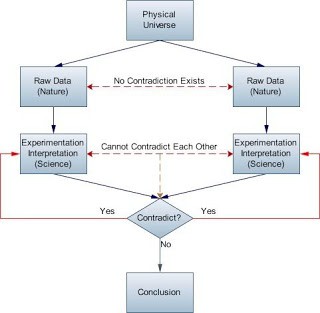
Science is very dependent upon the assumption that the universe is consistent. No two features of reality will contradict one another, and under the same circumstances, observations will be repeatable. If experiments or studies are conducted in the same way, but they yield data that can only be interpreted to conflict with current science (interpretation of other data), the scientists will repeat again to find data that can be interpreted as consistent with current science and look for the unique factor in each instance of the experiment that yielded the data with the conflicting interpretation. All data that is found is interpreted in light of the rest of the data already yielded. If an experiment or observation (after repeated and thoroughly investigated multiple times) still yields data that demands an interpretation contrary to science, a reinterpretation of past data is necessary (a change in the science results). The process repeats for any and all new data that comes. Here is a flowchart to give a visual of this process:

Are Nature and Scripture Compatible? 1

Even though it is common for data to come that is compatible with current science, there is rarely a single interpretation that is compatible. Multiple compatible interpretations leads to the creation of multiple models of a phenomenon. Each one takes interpretations that are still “on the table” (since they have not been eliminated by other data yet), and use possibilities to make predictions about future data. As more data become available, models that predicted conflicting results are adjusted (interpretations are changed) to accommodate the only possible interpretations of the new data (if multiple interpretations exist, this can spawn variations of the model) or are abandoned completely because the conflict cannot be reconciled with the possible interpretations of the other data that are compatible with the model. While models are weeded out as accurately explaining reality, more detailed models are proposed, and the process starts all over again. Put plainly, nature interprets nature to eliminate incorrect scientific view and highlight possibly correct ones.

Scripture and Theology

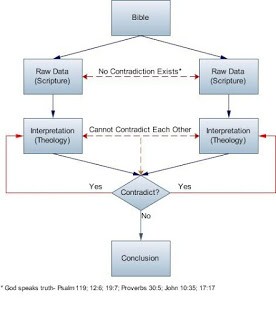
Dealing with scripture (the Bible) is very similar to the process of dealing with nature described above. Many theologians begin by accepting that scripture is the inerrant word of God, who cannot lie. This means that the same consistency that allows for testing of scientific models exists to test theological views. No two scriptures contradict one another, so no correct interpretations of two scriptures can contradict one another. If it is found that a theological view holds an interpretation of a scripture that contradicts an interpretation of another, the interpretation of one of them (if not both) is incorrect, and reinterpretation is required. In the development of a correct theological interpretation of scripture, this process continues. Here is the flow chart (notice how similar it is to the one above):

Are Nature and Scripture Compatible? 2

Just like with science, multiple interpretations of scripture do abound, and even after going through this process to make certain that all scripture is taken into consideration and no contradictions exist in the view, several possible interpretations of scripture may still be valid. These are all considered compatible with scripture. Since there are multiple views compatible with the raw data of scripture, many different theological views exist within Christianity. As more archaeological artifacts are recovered and analyzed and more historical and linguistic studies are conducted regarding the original content of scripture, possible interpretations of scriptures can be ruled out or ruled in. This allows for adjustment or abandonment of theological views (if possible interpretations are ruled out), and allows for the recognition of compatibility of other theological views (if possible interpretations are ruled in). As more theological systems are weeded out as accurately reflecting scripture, more detailed interpretations are offered and tested against still more scholarship. Simply put, scripture interprets scripture to eliminate incorrect theological views and highlight possibly correct ones.

Worldviews and Reality

Both systems depend upon ontological consistency (nature does not contradict nature and scripture does not contradict scripture) that demands epistemology consistency (interpretations of nature cannot contradict other interpretations of nature and interpretations of scriptures cannot contradict interpretations of other scriptures). However, neither of these systems are complete.

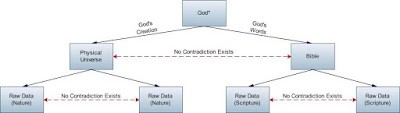
While science may point to metaphysical reality, it cannot directly observe it. While theology may speak broadly about nature, it lacks much minute details. Both science and theology on their own have many views that are evidentially, equally valid. As a Christian, I believe that God created the universe and inspired scripture. I believe that God is not deceptive; thus his works (nature) do not contradict (the ontological foundation for science’s presupposition that nature is consistent) and his words (scripture) do not contradict one another (the ontological foundation for Biblical inerrancy). Here’s the simple flow chart:

Are Nature and Scripture Compatible? 3

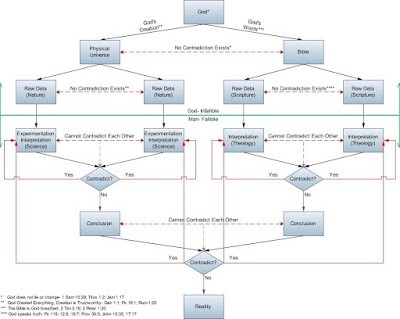
Since both nature and scripture come from God, the two of them do not contradict. If we come to an interpretation of nature that contradicts an interpretation of scripture, one of the interpretations (if not both) is incorrect. We must reevaluate our interpretation of both in light of the other raw data to find the proper interpretation of reality. If all the data in science can be interpreted consistently in, say, ten different ways, but seven are incompatible with any compatible interpretation of scripture, the Christian must throw away those seven interpretations of nature. Likewise, if we have eight consistent interpretations of scripture, yet only three of those interpretations are compatible with nature, we must remove the other five (otherwise biblically compatible) interpretations from the table of accurately explaining reality. That would leave us with three possible interpretations of reality between nature and scripture. Now we have four points of interpretive interaction with nature and scripture:

  • Nature interprets nature
  • Scripture interprets scripture
  • Scripture interprets nature
  • Nature interprets scripture

Ultimately, this results in “reality interprets reality” to yield a correct worldview. Here is the completed flowchart that visually details the process:

Are Nature and Scripture Compatible? 4

This is certainly a rigorous and challenging but rewarding process. As scholarship in the sciences and humanities are constantly making new discoveries that provide more insight into the proper interpretation of both nature and scripture, the Christian is provided with more information; some of which fits easily into the Christians interpretations of nature and scripture. However, it is common that data will arise that challenges interpretations of nature and interpretations of scripture. The Christian must not ignore the data by refusing to reinterpret their views of nature or scripture.

The Dangers of Denial

When we hold an interpretation of nature (science) that does not reflect reality, we will be challenged by the raw data of scripture. When we hold an interpretation of scripture (theology) that does not reflect reality, we will be challenged by the raw data of nature. An unwillingness to reinterpret raw data of either nature or scripture, in light of no compatible interpretation from the other betrays our commitment, not to truth, but to tradition. Tradition is based on interpretation, which is necessarily fallible because we are not omniscient. This is dangerous to both evangelism and discipleship.

Dangers to Evangelism

When skeptics see that we hold fast to tradition (even though they may be doing the same thing) between nature and scripture (while we also claim that both come from the same honest God), it is no surprise that they are skeptical of our views. Reality has no contradiction in it, and they know that. If a worldview has even one internal contradiction, it cannot be the correct view of reality.

Those who read this blog often know that I interact with many internal discussions to Christianity because I believe it is important that we are defending a correct worldview, not just generally, but specifically. If people are looking for a reason to reject a general worldview, they will look at the details of certain views within that worldview to find contradictions with reality. When those contradictions are discovered, they become a stumbling block to the skeptic. And the Christian who promotes such contradictions (despite their noble intentions) become a liability to completion of the Great Commission. A willingness to reinterpret raw data of nature and scripture allows skeptics to understand that we are committed to discovering the truth and that if a challenge is valid, it will be addressed in a way that contradiction is removed from our worldview. When contradiction with reality does not exist in our presented worldview, there is no logical reason to deny its truth. Rather the truth must be suppressed.

Dangers to Discipleship

Of course, the dangers do not only end with evangelism. Our own relationship with God is limited when we refuse to acknowledge contradiction in our worldview. I want to be clear: I am NOT saying that a Christian without a perfect worldview cannot know God correctly, we can. However, every detail that we have wrong about God and what He has done places a limit on our ability to worship Him in spirit and in truth. Our willingness to recognize and abandon incorrect views within our worldview will be rewarded with a deeper understanding of more of God’s attributes and His works. This results in a more profound and rewarding worship of our Creator. A worship of our Creator that is based on a false idea of who He is or what He has not done, is not true worship.

These Dangers Plague Us All (Conclusion)

Since no person is omniscient, I am speaking to all of us (including myself). If we refuse to reinterpret when all attempts to find logical consistency fail, our dedication to a false view of reality will limit our effectiveness for the Kingdom and will limit our relationship with our Creator. God has given us multiple sources of revelation (nature and scripture) and has endowed us with minds capable of using logic to bring both revelations together to discover the truth of reality. God is brought glory when we commit to discovering truth — when we refuse to allow dearly held traditions to stand between our knowing who God truly is and our accurate representation of Him to the world.


Original Blog Source: http://bit.ly/2OAjkS9

By Natasha Crain 

Hell is probably not at the top of your list of things to talk about with your kids.

On the surface, it seems to contradict all the messages about God’s love that we share with them. We worry about confusing them or having them follow Jesus out of fear. We want them to focus on the joy of Jesus and how we should live in this life. I dare say that we sometimes don’t know quite what to make of hell ourselves. Therefore, we just avoid the topic.

But it shouldn’t be ignored.

We frequently talk about the need for salvation and the fact that Jesus died so we can be forgiven and reconciled to God. But saved from what? Reconciled for what? Hell is the assumed other side of the coin that we outright avoid acknowledging much of the time.

So what should we teach our kids? “If you believe in Jesus, you go to heaven, if you don’t, you go to the big fiery pit called hell where you suffer forever. The end.” Pass the dinner rolls.

There is much more we can and should teach about hell than this simple “heaven and hell are opposites” concept! Given how many people struggle with the notion of hell as adults, it should be well worth our while to address this (admittedly difficult) topic more thoroughly.

Here is a framework of key topics to consider. This is detailed! But you won’t regret taking the time to consider these points.

I highly recommend Francis Chan’s book “Erasing Hell” as an excellent and much more complete treatment of this subject.

  1. The Bible speaks of hell in many places.

If you read your Bible regularly, you might think this one is a no-brainer. But Bible literacy is at an all-time low according to many surveys, and many Christians are not highly knowledgeable of what is and isn’t in the Bible.

With this in mind, let’s start with making sure our children know that hell is, in fact, spoken of in the Bible many times. There are 162 references to hell in the New Testament, and 70 of those references were made by Jesus himself.

The extent of hell references is actually quite an important point to understand; the notion of hell doesn’t come from a vague handful of statements. With 162 references, there is no getting around the fact that the New Testament talks extensively about hell.

  1. Hell is a state of punishment after the final judgment (not a status in this life).

In an effort to soften the concept of hell, I’ve heard many well-meaning people suggest the notion that hell is separation from God on earth (“hell on earth”). This is simply unfounded. The Biblical concept of hell very specifically refers to the punishment of the unrighteous after the final judgment (at the end of history).  Every person will be held accountable for this life.  Those who believed in Jesus will be reconciled to God and will be with him forever; those who did not will be separated from God in hell.

Matthew 25:31-46 is the longest and most detailed account of that judgment day in the gospels. Though the word hell is not actually used here, the concept is clearly conveyed.

“When the Son of Man comes in his glory, and all the angels with him, then he will sit on his glorious throne. Before him will be gathered all the nations, and he will separate people one from another as a shepherd separates the sheep from the goats…then he (God) will say to those on his left, ‘Depart from me, you who are cursed, into the eternal fire prepared for the devil and his angels…then they (the unrighteous) will go away to eternal punishment, but the righteous to eternal life.”

Paul never used the word hell in his 13 letters but described the fate of the unrighteous with words such as “perish, destroy, wrath and punish” more than 80 times.

It is clear that hell is a final punishment at the end of time for the choices made in this life, not a reference to a status in this life.

  1. Hell is described with imagery of fire and darkness, but those may not be literal descriptions.

In reading some books about hell, I have to admit I was surprised to learn that the vast majority of Christian pastors and scholars do not believe that hell is a literal fire, even though that’s what most of us traditionally associate with it. However, when you really look at the descriptions of hell, it certainly appears they are metaphorical rather than literal, physical descriptions. Take these examples:

  • Jesus refers to hell as a “fiery furnace” and “eternal fire” (Matthew 13:30-40; 49-50). The Book of Revelation also refers to the “lake of fire” (Revelation 20:10).
  • At the same time, Jesus refers to hell as “outer darkness” (Matthew 8:11-12; Matthew 22:13; Matthew 25:30).

Though it’s possible to conceive that God can create a way for there to be fire AND darkness at the same time, most theologians look at these opposing descriptions as metaphorical rather than literal. Fire is often used throughout the Bible in nonliteral ways (e.g., Luke 12:49, Rev. 1:14, James 3:6, 1 Corinthians 3:15).

The bottom line is that we don’t know exactly what hell will be like. We know its purpose (see number 2), but to teach that hell is simply a big fire pit where non-believers go probably assumes more than the Bible tells us. Whatever it literally is, however, we do know that hell will be eternal separation from God.

  1. There may be degrees of punishment in hell.

This was also a new concept to me. There are three scriptural references that hint at there being degrees of punishment in hell:

  • In Matthew 11:24, Jesus said, “It will be more tolerable on the day of judgment for the land of Sodom than for you” (“you” referring to those who witnessed Jesus’ life first-hand).
  • In Luke 12, Jesus tells a parable about slaves who receive differing levels of punishment (this is thought to represent final judgment).
  • Paul suggests that unbelievers are “storing up wrath” for themselves on judgment day.

Though the Bible is far from clear on this concept, it is an interesting insight to discuss.

  1. Hell is a place of annihilation or never-ending punishment.

Something else Christian Biblical scholars battle over is the duration of hell. Most of us have learned exclusively that the wicked will suffer “forever and ever” … and that may indeed be the case. But there are very valid reasons for believing that the Bible speaks alternatively of annihilation (permanent destruction rather than everlasting punishment).

In almost every passage where Jesus mentions hell, He doesn’t explicitly say that it will last forever. Most biblical references to hellfire say “eternal fire” – but does that mean the fire or the suffering is eternal?

In Mathew 10:28, Jesus says, “Fear him who can destroy both soul and body in hell.” Destruction has a very different connotation than eternal suffering. The language of destruction specifically is common throughout Paul’s letters as well. John 3:16 itself says that those who believe in Him “shall not perish.” Again, perishing is different than eternal suffering.

Matthew 25:45-47 are the key verses that support the notion of never-ending punishment: “…and these will go away into everlasting punishment, but the righteous into everlasting life.” These are the same Greek words Jesus used to describe the fire “prepared for the devil and his angels,” so Jesus is saying unbelievers share the same fate as the devil.

We don’t know for certain what the duration of suffering will be. The interpretation based on the original words continues to be the subject of extensive debate.

  1. No passage in the Bible says that there will be a second chance after death to turn to Jesus before the final judgment of hell.

While we can hope and hypothesize all day long about the possibilities of people having a second chance to turn to Jesus (and many people do), the fact remains that there is no evidence of this in the Bible.

  1. The existence of hell doesn’t imply Christians are in any position to determine who or who will not be going there.

While the Bible tells us in general why people go to hell (for not believing in Jesus), we are not in a position to judge individuals. I’ve been asked several times by non-believers if, as a Christian, I think they are going to hell. I always reply with what the Bible says about believing in Jesus for salvation, and that only God knows their heart. We need to make sure a knowledge of heaven and hell doesn’t lead to our kids becoming judgmental of individuals themselves.

  1. Hell is hard to understand.

Theoretically and theologically speaking, I understand and can “justify” to myself why a good God sends people to hell. But from a very practical perspective, does it make “sense” to me that friends or family members – people I know and love – will suffer forever and ever for not having faith?

No.

Hell is hard to understand. If for some reason hell is not hard for you to understand, please know that hell is hard for the vast majority of people to understand, probably including your kids. To not acknowledge this when talking about hell almost trivializes the matter.

I will readily tell my kids that hell IS hard to understand, but that truth is not dependent on whether or not it makes sense to our human minds. If we accept all of the “joyful” parts of Christianity that we learn from the Bible, we have to accept the existence of hell as well – even if it is a very, very difficult thing to grasp. 


Original Blog Source: http://bit.ly/2Md4S62

By J. Brian Huffling

My last post on God and morality brought up the issue of if and how God is moral. My main point was to reject the notion that God is moral in the sense that humans are moral. But I did mention that God is good, just not morally good. That is, he isn’t good because he lives up to some standard of goodness. I even rejected the notion that he is his own standard since that seems to be indistinguishable from being arbitrary. In thinking about this topic over the years, it seems to me that many Christians believe that God is good because of something he did for them, such as Jesus dying on the cross, healing someone, providing in a time of need, etc. But is this really what makes God good? Would God still be good if he never saved anyone, didn’t heal and didn’t provide? God’s goodness is not grounded in his actions but in his perfect being.

What Does It Mean for God to Be Good?

The classical notion of God’s goodness is that God is good because his being is perfect and lacks nothing. This is seen in the thinking of theologians like Augustine, Anselm, and Aquinas. Aquinas, following the thought of Augustine, thought that ‘being’ is basically synonymous with ‘goodness.’ To be good is to have the fullness of being. It may help to contrast this with evil. The traditional Christian view of evil is that it is a privation of good. In other words, something is evil if it lacks some good or is corrupted in some way. A standard example is an apple that has rotted. The apple itself is good, but the rot is where the apple has been corrupted. That corrupted part of the apple should be good (i.e., not rotten) for it to be what an apple is supposed to be. Thus, the rot of the apple is said to be an evil. It should be fairly obvious that this notion of evil has to do with being or existence and not morality, for apples aren’t moral beings. In short, the apple is good insofar as it has the proper being of an apple and doesn’t lack any good or perfection.

Since God is perfect being as such, he is perfect goodness. He lacks nothing and is not corrupted in any way. He is simply perfect. He is infinite, unlimited being. Thus, he is infinite, unlimited goodness. He doesn’t have good; he is goodness as such. Again, this is not a moral goodness but a metaphysical goodness. (Here is a classic description of God’s perfectiongoodness in general, and God’s goodness.)

So What Does This Mean?

God does not have to do anything to be good. He is pure infinite goodness just by existing. If he never did anything for his creatures, even make them, he would be just as good as he was without them. In other words, our existence doesn’t add any good to him. His actions towards us, even his actions that lead to our salvation, do not add any good to him. Since God is (qualitatively not quantitatively) good, nothing can add to it, since one can’t add to an infinite (again, think in terms of quality, not quantity). He is simply pure goodness, and we don’t contribute anything to that.

Our existence is the expression of his goodness, not the cause or contributor of it.

God does not need us in order for him to be good. Further, we should not think of his goodness as being grounded in what he does for us. Of course, he is rich in mercy towards us, he loves us, and he is good to us. I am not denying this. But unlike man, his goodness is not measured by his actions. While man is good metaphysically because he has existence, man is also good (or not) in a moral sense. This latter sense is a fulfillment of good due to whether or not he does good things and measures up to what it means to be a good person.

A Right View of Worship

It is certainly not wrong to worship God or thank him for his blessings. We should. But our view of God’s goodness should not rise and fall with what he does to or for us. As I have said before, Christians tend to make God in the image of man. We often think that if things are going well and God is blessing us, then God is good. If not, he isn’t, or at least something is wrong. This is not a proper view of God or a proper foundation for worship (think of Job). While we should worship and thank God for his blessings, a right view of worship should be centered around the fact that God is infinite, perfect being and goodness. He does not have goodness like us. He is Goodness. He does not merit our worship and adoration. The fact that we are his creation means that he demands our worship and adoration. Let us be ever mindful that God is God. He is not like us. We are the creatures. He is the creator.


Original Blog Source: http://bit.ly/2I4APX0

By Evan Minton

Recently, I read Michael Heiser’s book The Unseen Realm: Recovering The Supernatural Worldview Of The Bible.  I mentally wrestled with his prospect of “the divine council”. Heiser talks about this in this lecture as well btw.

Sometimes I do a soliloquy or write out my thought process when there is subject matter or information that I need to digest, especially if I find that subject matter new or troubling. That is what this blog post is all about.

In the first chapter, Heiser introduces us to “The Divine Council” worldview of The Bible, which is what he based his doctoral dissertation on. The key passage examined is Psalm 82. Heiser’s proposal seems to be that the Jews viewed angels and demons as lesser “gods” (lowercase g) which were subservient to the supreme God; Yahweh. Heiser rightly points out that Psalm 82 must be referring to angelic beings because all other interpretations have fatal flaws. To interpret the second usage of elohim (the Hebrew translated as God and gods) as referring to other persons of the Trinity entails that God The Father is judging the Son and The Holy Spirit for corruption. This is blasphemy. To interpret them as being Jewish leaders doesn’t work either as there is no biblical or extra-biblical evidence that the Jews ever ruled nations outside of Israel (which is what Psalm 82 says the “gods/elohim” did, and did so in a corrupt manner). The only alternative candidates are other supernatural entities.

First of all, I really have no issue with the word “god(s)” being referred to super powerful, supernatural entities. After all, it has traditionally been understood that 2 Corinthians 4:4 is referring to Satan (“The god of this world has blinded the minds of unbelievers”). Elohim, according to Heiser simply refers to some supernatural spirits. Yahweh is an Elohim, but not all Elohim are YWWH. There’s only one Maximally Great Being. For the ancient Israelite, Elohim was like our modern term “Spirit”. We would say God is a “Spirit”, but not all “spirits” are God. There’s The HOLY Spirit, and then there are evil spirits. But certainly, Satan is not on the same level as God. He’s not as powerful as God, not as knowledgeable, and he’s not everywhere present.

To refer to angels and demons as elohim (i.e supernatural, immaterial entities) isn’t theologically objectionable. Just as I wouldn’t object to saying “God is a spirit” and “Satan is a spirit”. If the Hebrew term “elohim” simply carried the same connotations as “spirit”, then to say that there are many gods wouldn’t violate traditional monotheism anymore than saying there are many spirits. There’s only one God (capital G) even though there are many gods (lower case g). There are many spirits, even though there’s only one Great Spirit.

Should “god” Be Taken As A Metaphor?

On the other hand, Heiser’s position seems to open the door for Mormonism. As he himself pointed out, Elohim was applied to Samuel in 1 Samuel 28 when Saul had the medium call upon Samuel’s spirit. If Elohim even applies to the souls of deceased humans, doesn’t that mean that humans become divine upon death? Perhaps angels and demons could be considered “gods” with a lowercase g, but only in a metaphorical sense and divinity proper should not be ascribed to them. Doesn’t it open the door to the Mormon contention that we become gods after we die, that we become divine if the lesser elohim literally posess the property of divinity. There’s only one supernatural entity that literally possesses the attribute of divinity, and that’s YHWH: The Father, Son, and Holy Spirit. There can be many elohim (gods), but there can only be one divine Elohim (God). There are many spirits, but there is only one Great Spirit (YHWH).

Perhaps, then, Psalm 82:1 should be properly translated as “God presides in the great assembly; he renders judgment among the spirits.” or we can take the text at its face value meaning and ascribe the term “gods” as a metaphor. This could possibly be the reason why the NIV places the second rendering of elohim in quotation marks.

What About The Mockery Of Idols?

In the book of Isaiah, Yahweh mocks the idols that people bow to. In the book of Isaiah is where we find the most repeated assertions from God that He is the only God that there is.

“This is what the LORD says— Israel’s King and Redeemer, the LORD Almighty: I am the first and I am the last; apart from me there is no God. Who then is like me? Let him proclaim it. Let him declare and lay out before me what has happened since I established my ancient people, and what is yet to come— yes, let him foretell what will come. Do not tremble, do not be afraid. Did I not proclaim this and foretell it long ago? You are my witnesses. Is there any God beside me? No, there is no other Rock; I know not one.” (Isaiah 44:6–8, NIV)

After proclaiming the glory, and majesty and power of the Lord Almighty, the prophet turns his attention toward the idols that Israel is so prone to worship. He reminds them of the shame of idol worship.

“All who make idols are nothing, and the things they treasure are worthless. Those who would speak up for them are blind; they are ignorant, to their own shame. Who shapes a god and casts an idol, which can profit nothing? People who do that will be put to shame; such craftsmen are only human beings. Let them all come together and take their stand; they will be brought down to terror and shame. The blacksmith takes a tool and works with it in the coals; he shapes an idol with hammers, he forges it with the might of his arm. He gets hungry and loses his strength; he drinks no water and grows faint. The carpenter measures with a line and makes an outline with a marker; he roughs it out with chisels and marks it with compasses. He shapes it in human form, human form in all its glory, that it may dwell in a shrine. He cut down cedars or perhaps took a cypress or oak. He let it grow among the trees of the forest, or planted a pine, and the rain made it grow. It is used as fuel for burning; some of it he takes and warms himself, he kindles a fire and bakes bread. But he also fashions a god and worships it; he makes an idol and bows down to it. Half of the wood he burns in the fire; over it he prepares his meal, he roasts his meat and eats his fill. He also warms himself and says, ‘Ah! I am warm; I see the fire.’ From the rest he makes a god, his idol; he bows down to it and worships. He prays to it and says, ‘Save me! You are my god!’ They know nothing, they understand nothing; their eyes are plastered over so they cannot see, and their minds closed so they cannot understand. No one stops to think, no one has the knowledge or understanding to say, ‘Half of it I used for fuel; I even baked bread over its coals, I roasted meat and I ate. Shall I make a detestable thing from what is left? Shall I bow down to a block of wood?” Such a person feeds on ashes; a deluded heart misleads him; he cannot save himself, or say, ‘Is not this thing in my right hand a lie?'” – Isaiah 44:9-20

The implication of Yahweh’s mockery is that the reason it is supremely stupid to make idols and worship them is that they are nothing but man-made objects. God essentially says “Look, you chop down a tree, use part of the wood to warm yourself and cook food, and you use what’s left to make yourself a deity? How stupid could you possibly be?” In Isaiah 46, God says of the idols “They [humans) lift it to their shoulders and carry it;  they set it [the idol] up in its place, and there it stands. From that spot, it cannot move. Even though someone cries out to it, it cannot answer;  it cannot save them from their troubles.” (verse 7). Now, I could perhaps understand it if we say that behind every idol, there is a demon, or perhaps that every idol of wood and stone is inhabited by some demonic spirit. But here, God seems to be denying the idols of any real existence or power at all! He says they cannot move. He says they cannot speak. He says they cannot answer when spoken to, or save people from their troubles. If demon spirits were really behind the idols, Yahweh’s mockery here makes no sense. Certainly, a demon could answer back when spoken to. Demons can certainly move. After all, the book of Job says that when Satan stood before God and God asked him where he had been, he responded “From roaming about the Earth. From going back and forth on it” (see Job 1:6-7).

I don’t know how to reconcile Michael Heiser’s divine council view with the text of Isaiah. It’s one thing to say that demons are, in some sense “gods” and that they are lesser gods than Yahweh, and that they are the ones worshipped by idolaters, but how do we account for the fact that in Isaiah 44-46, Yahweh treats the idols like they don’t even exist? As though they are simply man-made objects and figments of man’s imagination?

The apostle Paul seemed to have been divided on this issue himself, for in 1 Corinthians 8:4 he says that an idol is really nothing at all, using a proclamation of monotheism to justify his claim “For we know that there is no God but one”, so the Corinthians shouldn’t worry about eating meat sacrificed to one. But elsewhere, he seems to say that behind every idol is a demonic spirit, which obviously wouldn’t be “nothing”, (see 1 Corinthians 10:20).

So is an idol a non-existent entity or a demonic one? Either would be consistent with monotheism (there is only one Maximally Great Being). Deuteronomy 32:16-17 also seems to imply that demonic spirits are behind idols. Deuteronomy 32:16–17 states, “They stirred him to jealousy with strange gods; with abominations, they provoked him to anger. They sacrificed to demons that were no gods, to gods they had never known, to new gods that had come recently, whom your fathers had never dreaded” (ESV).

Perhaps Paul meant that they are “nothing at all” in a hyperbolic term, to denote the powerlessness demons have in comparison with the power Yahweh has. It would be like saying to someone who lost a position of great influence or fame “You are nothing now”. It’s possible that this is what Yahweh was doing in Isaiah 44-46. Not that they are literally nothing or powerless, but that they are in comparison to Yawheh. You can’t even begin to compare finite power with infinite power.

It could also be the case that some idols are inhabited by demonic spirits while others aren’t inhabited at all, and it’s these latter that Isaiah 44-46 and 1 Corinthians 8:4 refer to.

CONCLUSION 

This blog post was written immediately after I read the first two chapters of Heiser’s book.

This concluding section, however, was written a week after the fact.

After wrestling with this concept in my mind for a week, I’ve come to this conclusion. I think Heiser’s proposal is a powerful one, and it explains much. It doesn’t threaten monotheism as I first thought. It might entail Henotheism at worst. However, although Heiser never explains it like this (these are my own words), it appears that for the ancients “elohim” carried the same meaning as what we might call “a spirit” to be an “elohim” simply meant to be a powerful, immaterial, supernatural entity. Certainly, Yahweh, angels, demons, and even deceased humans would fall under this definition. We would consider all four categories “spirits”. The ancients would consider all four “elohim”. There is only one Ultimate Supreme Elohim. There is only one Maximally Great Spirit. That is Yahweh (The Father, Son, and Holy Spirit). All others are lesser elohim/gods/spirits.

Michael Heiser’s proposal explains much of The Bible’s teaching on the unseen realm.
I think the idea of the pagan gods being demons is very credible. Not only does 1 Corinthians 8, 1 Corinthians 10:14-22, and Deuteronomy 32 say that (and the nearly universal agreement that 2 Corinthians 4:4 is referring to Satan), but when you think about why the angels rebelled against God in the first place, it makes sense. Satan wanted to be God, and part of being God is receiving worship. When tempting Jesus in the wilderness in Matthew 4, Satan said he would give him all the kingdoms of the Earth if only He would worship him. It’s plausible to think that demons would desire worship, and ergo, plant it in the minds of human beings to build statues dedicated to them and then bow. It is part of the demonic mindset to get what properly belongs to God alone.

Isaiah 44 and 1 Corinthians 8:4 appear to be denying that the “gods” have any real existence at all at face value, but when you interpret these passages in light of the rest of scripture, this interpretation fails. The Bible is quite clear that false gods/idols are demonic entities. So what do we make of the denial passages? I think the most plausible interpretation is that of hyperbolic language. Even today, when we want to belittle someone to the most severe extent possible, we would say “You are nothing! NOTHING! You’re nobody!” Of course, the one who says this doesn’t think he’s talking to an imaginary person. Rather, he’s speaking as though he’s making an ontological denial in order to demote that person’s status or worth. If someone is a nobody, they are of no significance. It makes sense to call the gods/demons/idols “nothing at all” since all of their great-making properties are pitiful when compared to the Maximally Great Being (i.e Yahweh). God and Paul are simply belittling the demons. Compared to Him, they are nothing.


Original Blog Source: http://bit.ly/2EIhcU2