Tag Archive for: theology

By Brian Chilton

Some have claimed that Jesus was not a theologian. Granted, he did not sit down and write out a systematic theology book. However, the teachings of Jesus denote a deep theology that resonated with his understanding of God, Jesus’s own identity, God’s judgment, and of God’s salvific plan. In addition, one can see Jesus’s understanding of humanity and its relationship to God.

One such example of the latter is found in the Gospel of Luke 17:1–4. Jesus emphasizes the importance of rebuking those who offend while also maintaining a forgiving spirit when repentance is sought (Luke 17:3). In verse 1, Jesus implicitly reveals his understanding of humanity. He states, “Offenses will certainly come, but woe to the one through whom they come! It would be better for him if a millstone were hung around his neck and he were thrown into the sea than for him to cause one of these little ones to stumble” (Luke 17:1–2, CSB). In these statements of Jesus, three theological truths pertaining to the sinfulness of human nature and its effects can be found.

  1. Humans are imperfect until eternity. One must ask, why is it certain that offenses should come? To answer this question; first, Jesus knew that on this side of eternity that people are imperfect people. Offenses will come because people are broken souls who cannot live up to the standards of God’s law. Millard Erickson notes concerning sin that “A common element running through all the various ways of characterizing sin is the idea that the sinner has failed to fulfill God’s law” (Erickson, Christian Theology, 528). Everyone has a sinful nature which means that everyone does wrong. Even Christians, though they are saved, are prone to sinful behaviors. The difference is that Christians are saved by God’s grace. Paul, the apostle, noted, “For I do not do the good that I want to do, but I practice the evil that I do not want to do” (Rom. 7:19, CSB). Why? Paul says that it is the “sin that lives in me” (Rom. 7:20, CSB). Therefore, if all of us are sinful by nature, then we will eventually offend someone, whether it be intentional or not, and will suffer from offenses, whether it is intentional or not. Thus, in this world, we cannot live without the presence of any offenses. The question is, how do we deal with offenses when they come.
  2. Humans are inclined to rebellion. Second, Jesus knew that people are inclined to rebellion against God. Erickson notes that the “essence of sin is simply a failure to let God be God” (Erickson, Christian Theology, 530). Human beings want to be in control of their own domain. For that reason, people generally don’t like the idea that something, or rather Someone, exists that is higher than their own perceived sense of authority. Think about it. If God exists, then God is higher than any human position in business or government. Even Presidents and dictators are under the authority of this Supreme Being. Rather than accepting God’s authority, people rebel against it. Because of that rebellion, people commit evil acts against God and others. That brings us to our last assessment of Jesus’s teaching on human nature.
  3. Humans are ill-fated for destruction. Third, Jesus observes that human beings are headed for destruction due to their rebellious path. Offenses bring judgment. Jesus argues that a person who willfully hurts another person or leads a person to sin would be better off to jump into the ocean with a millstone tied around one’s neck than to face the day of judgment. Millstones were used to grind grain. They were circular stones that were attached to animals that guided the stones around and around as they ground the grain placed under the stone. Millstones could weigh around a ton or more! Can you imagine? To put a modern spin on the illustration, a person who abuses and hurts others would be better tied up by the mafia and thrown in the Hudson Bay rather than facing God on Judgment Day. Al Capone has nothing on God. All kidding aside, human beings are self-destructive. Societies destroy other societies. Nations rise up against other nations. In our modern state, we have weapons now that could obliterate life on earth. The only salvific means for humanity is found in God.

While only a couple of verses and a couple of statements in length, Jesus unveils a deep theology pertaining to the sinful nature of humanity and the certain destruction that comes by one’s rebellion against God. Hope is found. Forgiveness with God and with others is possible. Jesus teaches that a person should be willing to rebuke an offender but be willing to forgive just as God forgives them. As we look at our world with all the shootings, all the killings, and all the hate, we wonder how it is that we can bring peace. The answer is found in God. We will never see complete peace on this earth. Having the peace of God does not even indicate that all conflicts will cease. But it does denote that a person can have the peace and serenity of God in one’s life despite the chaotic circumstances that abound.

Sources

Erickson, Millard J. Christian Theology. Third Edition. Grand Rapids: Baker Academic, 2013.

Recommended resources related to the topic:

Is Original Sin Unfair? by Frank Turek (DVD, Mp3 and Mp4)

Was Jesus Intolerant? by Frank Turek (DVD and Mp4)


Brian G. Chilton is the founder of BellatorChristi.com, the host of The Bellator Christi Podcast, and the author of the soon to be released book The Layman’s Manual on Christian Apologetics. He received his Master of Divinity in Theology from Liberty University (with high distinction); his Bachelor of Science in Religious Studies and Philosophy from Gardner-Webb University (with honors); and received certification in Christian Apologetics from Biola University. Brian is currently enrolled in the Ph.D. program in Theology and Apologetics at Liberty University and is a member of the Evangelical Theological Society and the Evangelical Philosophical Society. Brian has been in the ministry for nearly 20 years and serves as the Senior Pastor of Westfield Baptist Church in northwestern North Carolina.

Original Blog Source: http://bit.ly/2kdNdOI

By Ryan Leasure

There’s a common refrain among liberal scholars that says the church suppressed dozens of Gospels. The reason they say? It’s because those books share scandalous information about Jesus that the church wanted to hide. They didn’t want the world to know sketchy details like Jesus tortured other kids as a child or that he had a wife.

Of all these “suppressed” Gospels, far and away the poster child is the Gospel of Thomas. Liberal scholars such as John Dominic Crossan and Elaine Pagels faun over this work. The Jesus Seminar even published a book titled The Five Gospels, which includes the canonical four-plus Thomas.

Yet there’s a bit of irony here. If these scholars would treat the canonical Gospels with half the amount of charity they give to Thomas, they’d all be Christians! Instead, they date Thomas very early and the canonical Gospels late. They claim Thomas’ view of Jesus is reliable, while the canonical Gospels contain myths and legends.

By contrast, I’m going to demonstrate, in the remaining pace, that the Gospel of Thomas is unreliable, was never considered as Scripture by the early church, and thus shouldn’t be included in our canon.

The Gospel of Thomas

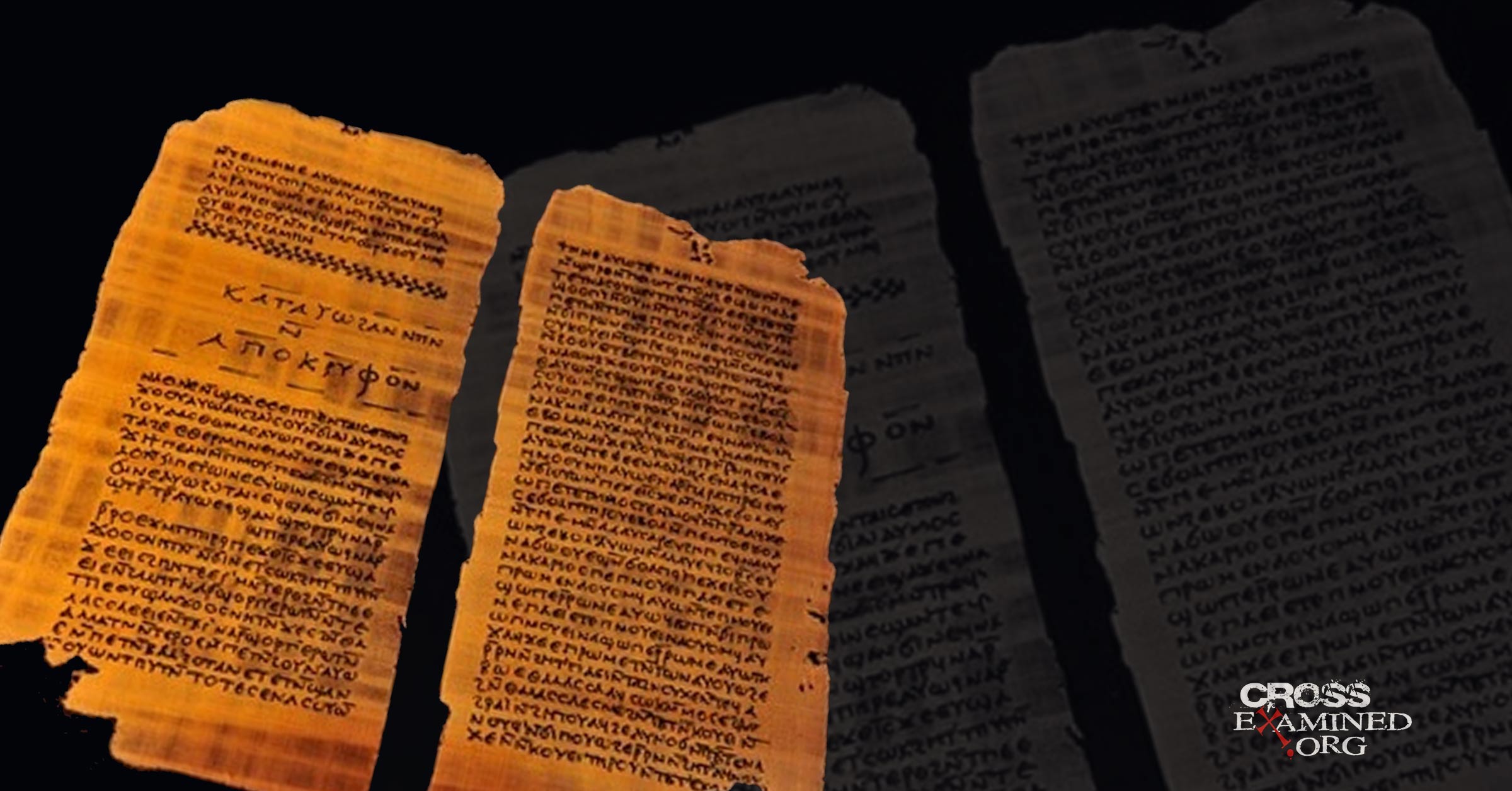
In 1945, some farmers in Nag Hammadi Egypt were digging and came across an earthenware jar in the ground. The farmers, hoping to find treasure, were deeply disappointed when they found a bunch of texts instead. Little did they know those texts would be more valuable than any treasure they could hope to find.

Among the cache of texts was one that begins, “These are the secret sayings which the living Jesus spoke and which Didymos Judas Thomas wrote down,” and ends with “The Gospel According to Thomas.”

Unlike the canonical Gospels, Thomas doesn’t follow a narrative structure. It doesn’t report major parts of Jesus’ life — his birth, death, and resurrection. Instead, Thomas contains 114 esoteric sayings of Jesus, purporting to record the secrets Jesus taught to his disciples.

Canonical Attributes

Before we can answer why Thomas doesn’t belong in the canon, we need to know what the early church looked for in a canonical book. In sum, the church looked for three different attributes — apostolic authority, divine qualities, and corporate reception.1 These three attributes formed a type of canonical grid by which to test a book.

By apostolic authority, the church only received books that could be traced to apostolic eye-witness testimony. This would include books written by both apostles and their close associates. For example, the church obviously received John’s writings because he was one of the apostles. But they also received Mark, based on the fact that he was Peter’s close associate.

By divine qualities, the church looked for books that gave evidence of God’s fingerprints. One such piece of evidence was consistency with other authoritative books. Since Christians believe the Holy Spirit inspired all the biblical texts, they knew none of them would contradict each other.

By corporate reception, the church only received books that the universal church also received as authoritative. In other words, if only one pocket of Christianity affirmed the authority of a book, that book was rejected. The reception had to stretch across all of Christendom.

So does the Gospel of Thomas possess these canonical attributes? Let’s test it by putting it through the canonical grid.

Apostolic Authority?

Did an apostle or close associate write the Gospel of Thomas? In a word, no. In fact, the consensus among scholarship is that the book dates to the middle of the second century — long after the apostles had died out. That is to say, Jesus’ disciple Thomas did not write this book.

A few reasons exist for dating this work late into the second century. First, the text reflects a type of Gnosticism (more on that in a minute) that wasn’t prevalent until the middle second century.2

Additionally, the Gospel of Thomas demonstrates a deep dependance on large parts of the New Testament. It quotes or alludes to all four Gospels, Acts, most of Paul’s letters, and Revelation.3 Only someone who had access to all these works could pen this work, and we know that it took time for these works to circulate the Roman Empire.

Even more, some scholars suggest that Thomas relied heavily on the Diatessaron — a four Gospel harmony produced by Tatian around AD 170.4 If that’s the case, Thomas dates even later.

Even if Thomas is independent of the Diatessaron, it’s mid-second century dating would have ruled it out for canonical consideration. Take the Shepherd of Hermas — a mid-second century work — for example. The early church loved this book. But as the Muratorian Fragment states, the church rejected its canonical authority because it was written “quite recently, in our own times,” and thus not backed by apostolic authority.5

Strike one for Thomas.

Divine Qualities?

What about divine qualities? Does Thomas show God’s fingerprints and align with other authoritative books? Again, the answer is no. Thomas was one of several Gnostic texts in the Nag Hammadi discovery.

Gnosticism was polytheistic. It taught that the god who created the world was evil, and by extension, his entire creation was evil too. Salvation, then, was the liberation of the soul from the physical realm into a spiritual realm. One can achieve this salvation only through a secret knowledge (gnosis in Greek).

This secret knowledge, according to the Gnostics, comes from Jesus. Of course, Jesus was radically different from the god of the Old Testament. Jesus was a warm and inviting god while the one of the Old Testament was hostile and angry.

Furthermore, since everything physical is evil, Jesus didn’t really have a physical body. He only appeared to have a human body, and thus he didn’t die on the cross — a view known as Docetism.

The Gospel of Thomas makes no qualms about its Gnostic leanings with all its emphasis on learning the secrets of Jesus. The prologue begins, “These are the secret sayings that the living Jesus spoke.” Moreover, the first saying states, “Whoever discovers the interpretation of these sayings will not taste death.” Again, the Gnostic salvation came through obtaining a secret knowledge.

Of course, the early church rejected Gnosticism as heretical. Orthodoxy taught salvation by faith. Thomas taught salvation came through knowledge of secret information.

Thomas also veers away from orthodoxy in how it views women. At the close of the book, Jesus states, “Look, I will guide her (Mary) to make her male, so that she too may become a living spirit resembling you males. For every female who makes herself male will enter the kingdom of Heaven.”

This statement clearly contradicts how Jesus views women in the canonical Gospels. Furthermore, it contradicts Genesis 1, which declares that God made both men and women in his image. Thus, women are not inferior, as the Gospel of Thomas suggests.

Strike two for Thomas.

Corporate Reception?

Did the universal church affirm the authority of Thomas? There’s not a shred of evidence to suggest that it did. If you think about it, since Thomas lacks the first two attributes — apostolic authority and divine qualities — the early church had no motivation to think it was Scripture.

Their rejection of this book is evidenced in two ways. First, the early church never includes Thomas in any of its early canonical lists. In all the lists, we have four, and only four, Gospels.

Second, the church specifically rejected Thomas as heretical. Meaning, it didn’t even come close. This rejection is contrasted with other books, like the Shepherd of Hermas or the Didache, that at least gained a hearing. The church enjoyed these books as they promoted Christian orthodoxy, but as I alluded to earlier, the church didn’t receive them as Scripture because they lacked apostolic authority.

Thomas was so far out in left field that it wasn’t even up for discussion. Eusebius, for example, includes Thomas in the “heretical books” section and suggests that it “ought not to be reckoned even among the spurious books but discarded as impious and absurd.”6

Strike three for Thomas.

The Gospel of Thomas Rejected

Despite the best efforts of some, Thomas doesn’t even come close to Scripture. It wasn’t backed by apostolic authority. Its contents contradict the orthodox texts. And the church never even came close to considering it as authoritative.

Unlike the real Thomas, we have good reasons to doubt here.

Recommended resources related to the topic:

Cold-Case Christianity: A Homicide Detective Investigates the Claims of the Gospels by J. Warner Wallace (Book)

The New Testament: Too Embarrassing to Be False by Frank Turek (MP3) and (DVD)

Why We Know the New Testament Writers Told the Truth by Frank Turek (mp4 Download)

The Top Ten Reasons We Know the NT Writers Told the Truth mp3 by Frank Turek

Counter Culture Christian: Is the Bible True? by Frank Turek (DVD)


Ryan Leasure holds a Master of Arts from Furman University and a Masters of Divinity from the Southern Baptist Theological Seminary. He currently serves as a pastor at Grace Bible Church in Moore, SC.

Original Blog Source: 


By J. Brian Huffling

In a NY Times article titled “A God Problem: Perfect. All-powerful. All-knowing. The idea of the deity most Westerners accept is actually not coherent,” Peter Atterton argues, well, that the concept of God is not coherent. Atterton describes God in the classical sense as his subtitle suggests. He argues that such a view of God is logically incoherent because assuming one attribute, a problem seemingly arises with the others. I will briefly summarize his arguments and respond to them, focusing on his arguments about omniscience.

Atterton’s Argument

Atterton wants to “first consider the attribute of omnipotence.” After considering the cliché question, “Can God make a rock bigger than he can move,” he points to the way Thomas Aquinas’ would answer this question, namely, that such a thing would be a contradiction and even God can’t do what is contradictory (such as making a square circle).

Atterton then moves to question whether it is contradictory for God to create a world in which there was no evil. He avers that it should be possible to do so. So why didn’t God do that? This is basically where he leaves it and moves on to God’s omniscience.

He states,

“Philosophically, this presents us with no less of a conundrum. Leaving aside the highly implausible idea that God knows all the facts in the universe [yes you read that right], no matter how trivial or useless (Saint Jerome thought it was beneath the dignity of God to concern Himself with such base questions as how many fleas are born or die every moment), if God knows all there is to know, then He knows at least as much as we know.”

Atterton believes that if God does, in fact, know what we know; this is a problem. This is the case because we know what lust and envy are; thus, God must know what lust and envy are. However, he says, “one cannot know lust and envy unless one has experienced them. But to have had feelings of lust and envy is to have sinned, in which case, God cannot be morally perfect.” Such can’t be the case, he claims, if God is morally perfect. So God does not know what we know. But then he is not omniscient, “and the concept of God is contradictory. God cannot be both omniscient and morally perfect. Hence, God could not exist.”

Atterton ends his article by referencing Blaise Pascal’s rejection of philosophy and taking God’s existence on faith alone. It is not clear to me from this article whether Atterton believes in the existence of God or whether he merely thinks that “the God of the philosophers” doesn’t exist or can’t be proven to exist. It is to the alleged incoherence that I wish to respond.

Response

Atterton does not make too much about God’s omnipotence other than casting doubt on it, so I’m going to focus on his objection to God’s knowledge, which is what he seems to think is a stronger point. My overall critique is that Atterton over-anthropomorphizes God. This is very typical of how people think of God. We usually think that because we do things a certain way, like know, then God must do them the same way too.

For Atterton, if God knows something, then the way in which he knows it must be similar, or the same, with how we know it. We know things passively through experience, such as a thing’s existence. For example, we know of a flea’s existence because we experience fleas and can sense them. We are creatures just like fleas. But should we think God knows in the same way as us?

Atterton references Aquinas regarding God’s omnipotence but doesn’t cite what Aquinas says about the way he believes God knows the world. This either betrays ignorance or negligence. Historically, classical theism (that teaches that God is all-knowing, powerful, etc.) has taught that God is impassible and yet all-knowing, infinite, and perfect. This means that God is not affected in any way, does not learn, for an infinite amount of knowledge cannot be added to, and he cannot gain in perfection.

It also means that God is not passive in his knowledge. As Aquinas teaches in Summa Theologiae part 1 question 14, God’s knowledge is not like ours. And why should it be, he’s not a limited, passible, changeable, material, temporal, finite, contingent human. Rather, he is the unlimited, impassible, unchangeable, immaterial, eternal, infinite, necessary Creator. How this detail escapes Atterton and others who over anthropomorphize God is nothing short of perplexing?

Rather than God’s knowledge being reactive and passive like ours, it is active and causative. We know imperfectly and through the effects of nature. God knows perfectly; not through effects, but through the cause of those effects. Such is surely a more perfect and complete knowledge. God does not have to “look at” something to know it as if the thing exists apart from God’s knowledge or sustaining power. God actively causes all things to exist and sustains those things for as long as they exist. So, contrary to Atterton and Saint Jerome, God not only has knowledge of seemingly trivial things like fleas, God upholds those fleas in existence as their cause of being. They, as contingent being, cannot account even for their own present existence without an efficient cause. God thus knows all of the universe simply by knowing himself as their cause.

Atterton’s “God” is more akin to a view of deism rather than classical theism. Many holds to such a view of God. This view of God that makes him dependent, passible, changeable, etc., sees God more as a creature rather than the Creator.

When it comes to imperfections such as lust, Atterton doesn’t even ask the question if it is possible for God to do such things. (He leaves the question of the incarnation of Jesus out of his discussion.) Rather, God must know lust since he knows what we do, and since we know lust, God must as well. However, we know lust through experience and because we have the capability to be imperfect. Lust is something that humans can do, which is imperfection. However, God is not human. Historically it has been held that such passions as lust are tied to a physical body. Since God does not have a physical body, he can’t lust. Further, lusting would require a change. If God is unchangeable and eternal, then he can’t lust. Further, such would require God to have the potency to lust; however, if such classical attributes of God as simplicity, then he has no potency to become anything other than he is. Finally, again, God does not know via experience, but by being the perfect cause of all contingent being. He thus knows his effects (i.e., the universe) by knowing himself as their perfect cause.

Rather than the concept of the classical view of God being incoherent, Atterton’s own view demonstrates either a complete lack of familiarity with classical theism or simply neglects to inform his readers of such views.

While Atterton’s attempt at killing the traditional concept of God is DOA, the God of the philosophers lives on.


J. Brian Huffling, PH.D. has a BA in History from Lee University, an MA in (3 majors) Apologetics, Philosophy, and Biblical Studies from Southern Evangelical Seminary (SES), and a Ph.D. in Philosophy of Religion from SES. He is the Director of the Ph.D. Program and Associate Professor of Philosophy and Theology at SES. He also teaches courses for Apologia Online Academy. He has previously taught at The Art Institute of Charlotte. He has served in the Marines, Navy, and is currently a reserve chaplain in the Air Force at Maxwell Air Force Base. His hobbies include golf, backyard astronomy, martial arts, and guitar.

Original Blog Source: http://bit.ly/2Oy0ShT

By Mikel Del Rosario

Rules of Engagement

1 Peter 3 is about Apologetics and Cultural Engagement

What should our interactions with people look like as ambassadors of Jesus? Peter talks about both apologetics and cultural engagement in 1 Peter 3—the chapter where you find that famous apologetics memory verse, 1 Peter 3:15 (ESV):

But in your hearts honor Christ the Lord as holy, always being prepared to make a defense to anyone who asks you for a reason for the hope that is in you; yet do it with gentleness and respect.

We need to know what we believe and be prepared to respectfully explain our faith and the hope that we have in Jesus. Peter says this because our faith isn’t just about philosophical ideas. It’s about hope. What’s this hope about? It’s about how people can discover a loving relationship with the God who made everything that exists.

But even apologists can miss the context of this famous Bible verse. And it’s that context that shows us what our engagement should look like as ambassadors of Jesus. What every apologist needs to know about 1 Peter 3:15 is that it appears in a text that is not only about defending the faith. It’s also about the way God wants us to engage. In this post, I’ll share seven key lessons from this passage that should inform the way we operate as ambassadors of Jesus [1].

1. Expect Suffering and Blessing

Apologists talk about an objective standard of goodness, a moral “oughtness” that points us to God. In 1 Peter 3:13, Peter alludes to that outghtness—how the world should work. People should love each other, not hurt each other: “Now who is there to harm you if you are zealous for what is good?” Of course, people don’t always choose to do the right thing. That’s why Peter says, “But even if you should suffer for righteousness’ sake, you will be blessed…” (14a).

That’s the first part of the lead-up to our famous apologetics verse—knowing that we’re going to suffer for doing the right thing as ambassadors of Jesus. Jesus was very real about this: “In the world, you will have tribulation” (John 16:33) and “If they persecuted me, they will also persecute you” (John 15:20). So the push-back comes with the territory. But we’re blessed anyway because God sees when we’re being faithful in the midst of the tension. And we care more about his approval than other people think. This idea goes back even to Psalm 1. You also see it in the outcome of Paul’s engagement with the people in Athens (Acts 17).

2. Have No Fear

The second part of the lead-up to our famous apologetics verse says, “Have no fear of them, nor be troubled” (14). People you follow on social media probably show you how troubled Christians respond to what’s going on in the public square. When we’re overwhelmed with fear, we can say things that aren’t helpful and are tough to take back. It’s easy to feel pressure when our faith is challenged. Still, we don’t need to be afraid if our hope and identity are linked to God’s sovereignty in this world[2].

3. Make a Defense

This is where 1 Peter 3:15 comes in. We need to be prepared to engage the culture, make the case for Christianity, and defend the faith. Our ultimate message is a positive one about our hope in Jesus. But there’s a tension between how the gospel challenges our beliefs and actions on the one hand, and the invitation to know and experience God on the other.

Unfortunately, sometimes the “hope” part gets lots in the “challenge” part. New apologists can tend to emphasize what is wrong with society or various belief systems to the virtual exclusion of our hope in Christ. Others seem to portray our hope as only a future thing rather than explaining how that hope can be present in our lives today. Let’s never lose the message of hope in the midst of defending the faith. After all, the faith we defend is good news. And yes, truth matters. But tone matters, too.

4. Be Gentle and Respectful

The rest of Peter’s command tells us how we must defend the faith: “with gentleness and respect.” Not with fear, anger, or resentment. Part of the evidence for our hope should be the way we engage—not like people who feel threatened or get all defensive. There’s a good kind of meekness and humility that goes along with actually loving the people we challenge with Christian truth claims. Before walking into a spiritual conversation, ask God to help you care about the person and minister to them.

5. Prepare to be Slandered

Paul goes on to say, “…having a good conscience, so that, when you are slandered, those who revile your good behavior in Christ may be put to shame” (1 Peter 3:16). It’s no surprise that good behavior bolsters our case, while behaving badly undermines it. This is why holy living is key. Even when we engage with a clear conscience, though, we’re still going to get push-back. People don’t like to question their beliefs. But the challenge is an unavoidable part of our message. Still, the challenge should never drown out the very message of hope we are trying to defend. When they are rude to us, God sees it. When we respond with kindness, God sees it, too. And this is one reason we don’t need to be afraid.

6. Rise Above Evil

In verse 17, Paul says: “For it is better to suffer for doing good if that should be God’s will, than for doing evil.” The character we display when we are being treated unfairly matters. Spiritual conversations aren’t very productive when either participant gets mad. Rather than harbor evil thoughts or respond in anger, Christian apologists must rise above evil and show a different way of relating to people who reject our message.

7. Follow Jesus’ Example

All of these lessons are based on the example Jesus gave us. Paul says, “For Christ also suffered once for sins, the righteous for the unrighteous, that he might bring us to God, being put to death in the flesh but made alive in the spirit.” When we suffer, let’s suffer with Jesus’ example in mind. Don’t ever forget how God took the initiative to reach out to us while we had our backs turned to him. Even in this verse, Paul mentions the resurrection.

Conclusion

What every apologist needs to know about 1 Peter 3:15 is that it appears in a text that is not only about defending the faith. 1 Peter 3 is an important cultural engagement text, too. Let’s engage the culture, make the case for Christianity, and defend the faith while remembering the gracious way God treated us before we embraced him and his message.

Notes

[1] I’m indebted to my mentor, Darrell Bock, who helped me think through the context of 1 Peter 3:15 as it applies to dialogical apologetics and cultural engagement.

[2] And, in fact, in all possible worlds.


Mikel Del Rosario helps Christians explain their faith with courage and compassion. He is a doctoral student in the New Testament department at Dallas Theological Seminary. Mikel teaches Christian Apologetics and World Religion at William Jessup University. He is the author of Accessible Apologetics and has published over 20 journal articles on apologetics and cultural engagement with his mentor, Dr. Darrell Bock. Mikel holds an M.A. in Christian Apologetics with highest honors from Biola University and a Master of Theology (Th.M) from Dallas Theological Seminary where he serves as Cultural Engagement Manager at the Hendricks Center and a host of the Table Podcast. Visit his Web site at ApologeticsGuy.com

Original Blog Source: http://bit.ly/2YvQLd3

By J. Brian Huffling

When one thinks about apologetics, he usually thinks about such disciplines as philosophy, history, archaeology, etc. There is one area; however, that is relatively undeveloped in the practice of apologetics, and yet it is ripe for the work: literary studies. I am not talking about what genre the gospels happen to be, or if the saints in Matthew 27 were literally raised, or any such argument that has been popular as of late. I am talking about theories in English and literature that dramatically influence the field of hermeneutics (how we study the Bible). One of my majors in grad school was Biblical Studies, and I have taught Bible Study Methods at the BA level, and Hermeneutics and Advanced Hermeneutics at the grad level. In doing so, I have read many books on the issue of biblical interpretation and have scoured many resources for my classes. While there are many issues I could talk about, such as deconstructivism, postmodernism, etc., the issue that seems to come up a lot in standard textbooks is the role of the interpreter and how he either uncovers or imparts meaning to the biblical texts. In this article, I will talk about two books that are standard for evangelical studies on biblical interpretation, and why I think they are undermining the objective meaning of the text.

The Books and Their Claims

The first book is Introduction to Biblical Interpretation, revised  and updated edition, by William W. Klein, Craig L. Blomberg, and Robert L. Hubbard Jr. (There is a newer 3rd edition.) In general, this is a very good book, which is why it is used by many Bible colleges and seminaries. I even use it. Many pastors have been taught using this book. The principles that the authors teach that we should use for interpreting our Bibles are very good. So what’s the problem?

The problem is what they say about the role of the interpreter and the nature of bias, presuppositions, and preunderstanding (the body of knowledge the reader brings to the text). They state:

“No one interprets anything without a set of underlying assumptions. When we presume to explain the meaning of the Bible, we do so with a set of preconceived ideas or presuppositions. These presuppositions may be examined and stated, or simply embraced unconsciously. But anyone who says that he or she has discarded all presuppositions and will only study the text objectively and inductively is either deceived or naïve.” (143)

It is certainly true that we all have biases, etc. However, the startling claim these authors make is since we have biases, we can’t study the Bible objectively. Unfortunately, and per usual for these kinds of books, the notion of “objectivity” is left undefined and unclear. They later deny that such biases leave the reader bereft of objectivity; however, they do not explain how he can be objective since they have seemingly taken it away via the role of biases and presuppositions. Such is especially the case given this statement:

“The preunderstanding and presuppositions of the interpreter contribute enormously to the results of the interpretive process. We might even say they determine the results.” (197)

If the preunderstanding and presuppositions determine the interpretive results, then it is not clear at all how the reader can be objective. We wouldn’t discover the truth or meaning of the text; we would determine it.

The other book is The Hermeneutical Spiral, revised and expanded, by Grant Osborne. Like the previous work, this book is generally very good when it comes to interpreting the Bible. However, in the appendix, Osborne espouses a dangerous view, namely, the sociology of knowledge. He states:

“The sociology of knowledge recognizes the influence of societal values on all perceptions of reality. This is a critical factor in coming to grips with the place of preunderstanding in the interpretive process. Basically, sociology of knowledge states that no act of coming to understanding can escape the formative power of the background and the paradigm community to which an interpreter belongs.” (505)

Basically, what this means is that one’s culture is “formative” in how one knows, and it influences one’s “perceptions of reality.” In other words, the way in which one knows is at least somewhat determined by his culture. Different cultures will produce different perceptions of reality. What does this mean for the biblical interpreter? He answers this question clearly:

“A close reading of the text cannot be done without a perspective provided by one’s preunderstanding as identified by a “sociology of knowledge” perspective. Reflection itself demands mental categories, and these are built on one’s presupposed worldview and by the faith or reading community to which one belongs. Since neutral exegesis is impossible, no necessarily ‘true’ or final interpretation is possible.” (516, emphasis added)

Some people will find this shocking while others will express agreement. Evangelicals who hold to the idea that we can (and must) be able to know absolute truth should find this kind of assertion by a leading evangelical very scary. If true, we would not be able to claim to know the truth or the meaning of the biblical text, if there even is any.

Evaluation

One wonders how the authors of these books think that their meaning can be grasped. If what they say is true, we could never know the meaning of their books! Such claims made by these authors are hopelessly self-defeating. Further, it is simply an assumption that biases are always necessarily wrong, or that subjectivity entails falsehood. But this has never been demonstrated. Presuppositions are not inherently bad or wrong, as the authors of Introduction to Biblical Interpretation seem to imply when they argue for a certain set of presuppositions in order to interpret the Bible, such as believing in the supernatural.

Introduction to Biblical Interpretation claims that we can still have an objective understanding of the text, but they don’t offer a method for giving that objectivity to the reader after they took it away in the name of bias, presuppositions, and preunderstandings. We are thus left in subjectivity. Or are we? While the above authors do not tell us how to overcome the interpretive problems brought on by the interpreter, there are ways of explaining how an interpreter can simultaneously be biased and objective. After all, aren’t the authors of the above books biased and yet trying to pass off their text as objective? Surely. So how can they do that?

In his Objectivity and Biblical Interpretation, Thomas A. Howe explains how this is possible. (See also my article on objectivity and historical knowledge.) As mentioned earlier, authors like those above rarely define what they mean by “objective.” I am in agreement with Howe that a proposition is objective if it can be verified or falsified by external, mind-independent evidence that is also based on (objective) first principles. In other words, something is objective when it is based on extra-mental evidence that by definition, is not subjective, or merely in one’s mind. Further, propositions can be evaluated by the use of first principles, such as the principles of non-contradiction, identity, and excluded middle. (For more discussion on these, see my article on logic.) Such laws of logic are based in the being/existence of things in the external world. For example, the principle of non-contradiction says that something can’t simultaneously be and not-be. In other words, something can’t be a tree and not a tree at the same time and in the same sense. Such laws are not just made up. They are not just rational constructs. They are metaphysical and based in and reducible to existent things in reality. These principles are objective because they are based on objectively existing things in the world.

These principles can be applied to everyday issues, such as interpreting a written text. It is obvious that the authors of the cited works think that their readers can read books objectively. Otherwise, why write them? And why have principles to follow if there is really no use since we can’t be objective or know the true meaning of the text? Being an objective interpreter of the Bible is possible. We simply use language and interpretive principles according to our everyday, commonsense way. There is no great barrier to objectivity, whether it be bias, presuppositions, preunderstandings, or a sociology of knowledge. The very knowing process built into our human nature and the way we use language ensures that an objective understanding of the Bible is indeed possible.


J. Brian Huffling, PH.D. have a BA in History from Lee University, an MA in (3 majors) Apologetics, Philosophy, and Biblical Studies from Southern Evangelical Seminary (SES), and a Ph.D. in Philosophy of Religion from SES. He is the Director of the Ph.D. Program and Associate Professor of Philosophy and Theology at SES. He also teaches courses for Apologia Online Academy. He has previously taught at The Art Institute of Charlotte. He has served in the Marines, Navy, and is currently a reserve chaplain in the Air Force at Maxwell Air Force Base. His hobbies include golf, backyard astronomy, martial arts, and guitar.

Original Blog Source: http://bit.ly/2NuvG2F

By Robby Hall

The backlash against Lauren Daigle for her comments on homosexuality sparked debate amongst Christians who both defend and critique her.

John Crist, a Christian comedian, recently posted a video on his Instagram feed condemning those who judged her for her comments. Crist seemed to be unaware that he himself was judging other Christians for their behavior.   The thing is the church should make judgments on truth.  The New Testament constantly warns us of false prophets and teachers.  The apostle Paul tells us that “We destroy arguments and every lofty opinion raised against the knowledge of God, and take every thought captive to obey Christ.”  If a brother errs, we take them aside lovingly to correct them.  But what about someone like Daigle or Crist?  Do Christian celebrities have a larger responsibility to adhere to sound teaching or to speak the truth?  First, we should make a sober judgment against ourselves to see if we were in the same position, would we do any different.  Secondly, we shouldn’t confuse the act with someone’s salvation.  Each of us is a work in progress, and the point of the Gospel is that we as human beings, are constantly missing the mark.  This is why Christ came and died on a cross.

That being said, we can rightly judge actions that have larger impacts on public perception of the Gospel and the Church and correct those actions if need be.  When Jesus warned us “not to judge lest you be judged,” He wanted us to not judge hypocritically.  Paul put it this way in Romans “Therefore you have no excuse, O man, every one of you who judges. For in passing judgment on another, you condemn yourself, because you, the judge, practice the very same things.  We know that the judgment of God rightly falls on those who practice such things. 3 Do you suppose, O man—you who judge those who practice such things and yet do them yourself—that you will escape the judgment of God?… While you preach against stealing, do you steal? 22 You who say that one must not commit adultery, do you commit adultery? You who abhor idols, do you rob temples?” Romans 2:2-3, 21&22

We tend to look to the famous for our theological marching orders.  However, this is a mistake.  Those like Daigle should be careful to place themselves under authoritative teachers, but we should be doing the same.  Celebrities can fall into the popularity trap and so begin to follow the path of Progressive Christianity[1]

We must strive as the Church to read the Bible, understand it’s history, proper hermeneutics, orthodox theology, and a good apologetic.  We also must not set up celebrities to fulfill a role they never were meant to.  If we show a brother their error, it is out of love and their edification and shouldn’t be to tear someone down.  But we shouldn’t look to a celebrity for our biblical instruction as they are in the entertainment business which is always a dangerous road for anyone to navigate and it shouldn’t surprise us when one fails in some fashion, but rather we should respond in prayer, grace, and truth.  Not every so-called Christian celebrity fails in this fashion as there are many who have a solid biblical understanding.  But we should be able to rightly divide the truth for ourselves by delving into God’s word and putting ourselves under solid, orthodox teachers and allow the truth to change us through the power of the Holy Spirit.

Note

[1] 5 Signs Your Church Might be Heading Toward Progressive Christianity http://bit.ly/2X1Kntn


Robby Hall is in the Secure Access industry for Information Technology. He has been married for 3 years and has just welcomed his first child, Bridget. He is graduate of the Cross Examined Instructor’s Academy and leads apologetics small groups at his local church.

Original Blog Source: http://bit.ly/2ITkhoL

By Erik Manning

Critics of Christianity love to compile long lists of alleged contradictions in the gospels to shake the faith of unsuspecting church-goers. One of the more famous of these critics is Dr. Bart Ehrman. Ehrman studied at Princeton under Dr. Bruce Metzger, a respected intellectual heavyweight, and a devout Christian. Sadly, Bart later lost his faith and has since written five best-selling books that are critical of Christianity. Bart’s a force to be reckoned with and is viewed by the media as an authority on the NT and the historical Jesus.

According to Ehrman, the gospels don’t just have minor variations but are “hopelessly contradictory.” But is Bart’s verdict on the gospels warranted?

First of all, how do we define a contradiction?

A real contradiction would occur when two claims contradict each other when one of them must be false, and the other true. For example, the Quran says that Jesus was not really crucified. The four gospels say otherwise, and both can’t be right. The Quran and the Gospels are hopelessly contradictory.

But we know that sometimes the truth is stranger than fiction. We have cases in history where two events have appeared to be contradictory, but those contradictions were only apparent.

For example, who made the public proclamation of the Declaration of Independence in the old State House in Boston on the morning of July 18, 1776? Many accounts said that this proclamation was made by William Greenleaf, while others said that it was by Col. Thomas Crafts. But history now tells us that Mr. Greenleaf suffered from a weak voice. He first read the Declaration while Col. Crafts repeated it in a loud voice for all the crowd to hear. The seeming conflict disappears.

The more historical approach is that you can often resolve apparent contradictions through unstrained harmonization. That’s not a hopelessly unresolvable contradiction. Moreover, what if there is a contradiction that’s inconsequential to the main details of the story related?

Historical examples of this sort can be multiplied. To give one example: There was an embassy of the Jews sent to oppose the execution of Claudian’s order to place his statue in their temple. Philo says this happened in the fall. Josephus says it happened during spring. Both were contemporaries, yet no serious historian doubts that an embassy was sent or that the order was given.

It would take an entire series of posts to address all of Bart’s complaints of contradictions, but let’s pick on a few and see if they are as damning as Ehrman makes them out to be.

Jairus Daughter – Dead Already or Very Sick?

When asked on his blog if there was a “slam-dunk” contradiction that would be impossible to defend, Bart’s reply was this: “I don’t have one that is a slam-dunk. But there are dozens that are pretty good. Here’s one: Jairus came to Jesus to ask him to help his daughter: was the girl dead already and he wanted Jesus to do something about it? Or was she very sick and he wanted him to heal her before she died? (See Mark 5:21-43 and Matthew 9:18-26) I don’t see how it could be both!”

If you read those passages side-by-side, Bart looks like he has a point. But if we look deeper at Matthew’s account compared to Mark’s, we notice that it’s a lot shorter. Matthew tells us the story in just 8 verses, Mark takes 22. Here’s a list of omissions in Matthew’s version:

  1. Jairus is a ruler of the synagogue. Matthew calls him a ‘ruler.’
  2. The crowd following Jesus and pressing him.
  3. The second stage of the story where someone comes and tells him that his daughter is dead.
  4. Jesus takes Peter, James, and John with him.
  5. Jesus takes the girls’ parents into the room with him to raise her.
  6. Jesus’ direction to give her something to eat.
  7. Jesus’ command to keep silent.

That’s a lot of details left out, but Matthew does include the most important parts of the story: Jairus’ daughter died, Jesus said she was sleeping, people laughed Jesus to scorn, and Jesus raised her.

Reducing a piece of literature in terms of time or length to include only its necessary elements is a literary device called compression. Ancient writers used it all the time. As do many modern authors. Matthew has to intimate somewhere that the daughter is dead and not just sick. He shows this in the short summary of Jairus’s interaction with Jesus’ intentions, rather using his exact words.

Furthermore, according to Bible commentator G.A. Chadwick, Matthew’s phrase “has died even now” (ἄρτι ἐτελεύτησεν) is very close in meaning to Mark’s “at the point of death” (ἐσχάτως ἔχει).

A worried dad of a sick daughter might say “she’s dead by now” and mean what we’d convey by saying, “she’s at the point of death.” Jairus knew that his daughter was at death’s door when he went looking for Jesus. He may have used words to express that his worst fears already came to pass. Both explanations are plausible.

So after taking a deeper look, this isn’t a hopeless contradiction at all. This was supposed to be Bart’s go-to, and it’s pretty weak sauce.

Was Mary alone at the empty tomb, or were other women with her?

Let’s give Bart another shot. Here’s a quote from his debate on the resurrection with William Lane Craig:

“Who went to the tomb on the third day? Was it Mary alone, or was it Mary with other women?”

Here’s the text in John that Bart is referring to: “On the first day of the week, Mary Magdalene came to the tomb early, while it was still dark. She saw that the stone had been removed from the tomb.” (John 20:1)

The other three gospels all include other women (Mt. 28:1, Mk 16:1, Lk 24:1,10).

John said that Mary Magdalene came to the tomb, but he doesn’t say others were not present. All we need to do is read the next verse, and we see that she had company. “So she went running to Simon Peter and to the other disciple, the one Jesus loved, and said to them, “They’ve taken the Lord out of the tomb, and we don’t know where they’ve put him!” (John 20:2)

Wait for a second! Where did “we” come from? Mary Magdalene’s words say that there were others present. John reporting this implies that he’s well aware that there were other women at the tomb. As Greg Koukl says, “never read a Bible verse.” This feels like some hoodwinkery is going on here. But let’s give Bart another shot.

Did John contradict himself about the order of Jesus’ miracles?

Quoting Ehrman: “In John’s Gospel, Jesus performs his 1st miracle in ch 2. When he turns water into wine, (a favorite miracle on college campuses) and we’re told that ‘this was the first sign Jesus did’ (John 2:11) Later in the chapter we’re told that Jesus did ‘many signs in Jerusalem.’ (John 2:23) And then, in chapter 4, he heals the son of the centurion, and the author says, “This was the second sign that Jesus did. (John 4:54) Huh? One sign, many signs, and then a second sign?” (Jesus, Interrupted pp. 8-9).

Bart apparently thinks John can’t count. But Dr. Ehrman selectively cut off the last part of the passage in John 2. Let’s quote it in more detail: “this, the first of his signs, Jesus did at Cana in Galilee…” Now let’s read John 4:54 for ourselves: “This was now the second sign that Jesus did when he had come from Judea to Galilee.

Jesus did one sign in Galilee, then many signs in Jerusalem and then the second sign in Galilee. This is not a contradiction at all. It feels like Bart is trying to fleece an unsuspecting audience.

Reading with charity or suspicion?

If you’re a historian, you ought to not adopt a hermeneutic of suspicion, but rather use the principle of charity. According to literary theorist Rita Felski, a hermeneutic of suspicion is “a distinctively modern style of interpretation that circumvents obvious or self-evident meanings in order to draw out less visible and less flattering truths.”

That’s a nice way of saying you’re looking for trouble in the text. As a writer of 5 best-sellers, you’d expect Ehrman to understand what compression is. As a former seminarian who has studied at Princeton under Metzger, you’d think that he’d know better than to quote verses out of context seemingly order to score rhetorical points. But that’s what these contradiction lists are often mostly made up of.

They sound impressive, but when you actually read the text for yourself and use a little charity towards the text, they’re not all that hard to resolve by using a little common sense. There’s nothing hopelessly contradictory happening here.

Alleged contradictions in the gospels don’t have to be the boogeyman that Christians go out of their way to avoid. If anything, studying them out for yourself should increase your confidence in the gospels. You’ll often find that the critics have to resort to apparent dishonesty and glossing over obvious explanations in order to make their case.

Now that doesn’t mean that there are not some apparent contradictions that might be more challenging. This is why I purposely went after Bart’s favorite one first. If you’re willing to do your homework and tap into some resources out there, you’ll find that there are some very good explanations available if there is one that’s been troubling you.

Let me point you to a great resource: I’m indebted to Dr. Tim McGrew for much of the examples and explanations shared here. Tim has a 2-part series on YouTube where he addresses many more alleged contradictions in the gospels. He goes over many more in great detail. Just consider this post an opening act and Tim’s videos the main attraction. These examples, when examined in detail, show that the gospels are not even close to being hopelessly contradictory.

Alleged Contradictions in the Gospels by Dr. Timothy McGrew

Alleged Contradictions in the Gospels (part 2) by Dr. Timothy McGrew


Erik Manning is a former atheist turned Christian after an experience with the Holy Spirit. He’s a freelance baseball writer and digital marketing specialist who is passionate about the intersection of evangelism and apologetics.

By Wintery Knight

I’ve been listening to this FREE two-volume series on the book of Esther featuring pastor Alistair Begg. A whole bunch of interesting things stuck out to me, so I’ll write about one of them today.

First, Esther is a Jewish woman whose father or mother died when she was young. She was adopted by Mordecai, another Jew. She was very beautiful, so she was picked to be part of the Persian King’s harem. In fact, she is so beautiful that the King chooses her to be the Queen.

Now there is an enemy of the Jews in the King’s court named Haman, and he manages to get the King to create an edict that says that all the Jews will be killed. Mordecai calls Esther to tell her that she has to stop the King from ordering this edict.

But Esther is out of favor with the King and hasn’t been asked to come in to visit him for some time. To go in and see the King without being summoned is a capital offense. Unless the King gives permission, she would be killed for intruding on the King. But in the end, she agrees to speak up and say something.

It all gets resolved in Esther, chapter 4.

Esther 4:1-17:

1 When Mordecai learned all that had been done, he tore his clothes, put on sackcloth and ashes, and went out into the midst of the city and wailed loudly and bitterly.

2 He went as far as the king’s gate, for no one was to enter the king’s gate clothed in sackcloth.

3 In each and every province where the command and decree of the king came, there was great mourning among the Jews, with fasting, weeping and wailing; and many lay on sackcloth and ashes.

4 Then Esther’s maidens and her eunuchs came and told her, and the queen writhed in great anguish. And she sent garments to clothe Mordecai that he might remove his sackcloth from him, but he did not accept them.

5 Then Esther summoned Hathach from the king’s eunuchs, whom the king had appointed to attend her, and ordered him to go to Mordecai to learn what this was and why it was.

6 So Hathach went out to Mordecai to the city square in front of the king’s gate.

7 Mordecai told him all that had happened to him, and the exact amount of money that Haman had promised to pay to the king’s treasuries for the destruction of the Jews.

8 He also gave him a copy of the text of the edict which had been issued in Susa for their destruction, that he might show Esther and inform her, and to order her to go into the king to implore his favor and to plead with him for her people.

9 Hathach came back and related Mordecai’s words to Esther.

10 Then Esther spoke to Hathach and ordered him to reply to Mordecai:

11 “All the king’s servants and the people of the king’s provinces know that for any man or woman who comes to the king to the inner court who is not summoned, he has but one law, that he be put to death, unless the king holds out to him the golden scepter so that he may live. And I have not been summoned to come to the king for these thirty days.”

12 They related Esther’s words to Mordecai.

13 Then Mordecai told them to reply to Esther, “Do not imagine that you in the king’s palace can escape any more than all the Jews.

14 For if you remain silent at this time, relief and deliverance will arise for the Jews from another place, and you and your father’s house will perish. And who knows whether you have not attained royalty for such a time as this?”

15 Then Esther told them to reply to Mordecai,

16 “Go, assemble all the Jews who are found in Susa, and fast for me; do not eat or drink for three days, night or day. I and my maidens also will fast in the same way. And thus I will go into the king, which is not according to the law; and if I perish, I perish.”

17 So Mordecai went away and did just as Esther had commanded him.

What Mordecai is saying here is that God is sovereign over the events that are taking place, and that even if Esther makes a free decision to not intercede to save her people, then God will do something else. Somehow, telling her that makes her agree to take the risk and go in to see the King. Even though it is illegal to go in to see the King, she is going to risk her life and do it. And the message there is that God made her beautiful, and placed her in the palace, for exactly this purpose. Her beauty has a purpose.

Before then, she may not have been the most morally pure Jew, nor the most faithful Jew, nor some great authority on theology or apologetics. She was probably keeping her faith pretty hidden. But in that one moment, she rises above being an orphan, above being a harem girl, and above being just a pretty face. God can use anyone – even a silly girl who spends all day in front of a mirror playing with cosmetics – to achieve his ends. She is not Daniel. But today she is getting the call, anyway. It’s on her.

What is the lesson here? God can use anybody. It doesn’t mean that you shouldn’t be moral, study theology, and study apologetics, and keep your character clean so you have self-control. It means that any believer is just one step away from glory, no matter what they did in the past. That’s how God rolls.

Further study

If you are interested in the story of Esther, then you should listen to the entire series by Alistair Begg.

The point I am making in this post is in this lecture.

Esther is about two themes: 1) how should a believer in God live in a society where believers are a minority? And 2) even when things look really out of control, God is in control and is never more than one step away from saving his people.

I have a lot of Christian apologist friends who struggle to go to church and struggle to read the Bible. The links above will take you to some great preaching on one of the most interesting books of the Bible. Go there, grab the MP3s, and listen to them with no distractions.


Original Blog Source: http://bit.ly/2WV31HD

By Robby Hall

Often, I see other Christians objecting to the use of apologetics altogether.  They will usually say that faith doesn’t require evidence, or it’s not faith.

But is that the case?  If we look at the word “faith” itself, we can get a clearer picture of what the Bible is actually talking about.

First, faith comes from the Latin “fides,” which means “good trust.”  But the Greek word used in the New Testament is “pisteuo,” which means to have confidence in or to credit the thing believed in.  The other greek word used for faith is “pistis,” which means “conviction of the truth of anything”[1].

So faith is trust, and trust is object centered.  You put your trust in something.  But does God require a blind trust or has He given evidence that we can put our trust in?  As always, we must consult scripture.

First, Jesus says in John 10:24-26

“So the Jews gathered around him and said to him, “How long will you keep us in suspense? If you are the Christ, tell us plainly.” 25 Jesus answered them, “I told you, and you do not believe. The works that I do in my Father’s name bear witness about me, 26 but you do not believe because you are not among my sheep.”
And again in vs. 36-38, Jesus says

“do you say of him whom the Father consecrated and sent into the world, ‘You are blaspheming,’ because I said, ‘I am the Son of God’? 37 If I am not doing the works of my Father, then do not believe me; 38 but if I do them, even though you do not believe me, believe the works, that you may know and understand that the Father is in me and I am in the Father.”

What about Thomas? Jesus told him blessed are those who have not seen and yet believed — but not seen what? The resurrected Jesus.  But, what did Thomas see in the time he spent with Jesus? Healing of the sick, raising of the dead, casting out of demons, feeding of 4k and 5k, etc. Shouldn’t then, Thomas have believed when Jesus told the disciples ahead of time that he would suffer, die, and on the 3rd day rise again? Jesus gave evidence.

What about John the Baptist? In Matthew 11, we see the following:

“Now when John heard in prison about the deeds of the Christ, he sent word by his disciples 3 and said to him, “Are you the one who is to come, or shall we look for another?” 4 And Jesus answered them, “Go and tell John what you hear and see: 5 the blind receives their sight and the lame walk, lepers are cleansed, and the deaf hear, and the dead are raised up, and the poor have good news preached to them. 6 And blessed is the one who is not offended by me.”

The apostle Paul wrote to the Philippian Christians:

“7 It is right for me to feel this way about you all, because I hold you in my heart, for you are all partakers with me of grace, both in my imprisonment and in the defense and confirmation of the gospel.” Phil 1:7

There are many more passages in the NT that admonish us to offer a defense (apologia) for the Gospel we preach. But the one that gives us the direct command is 1 Peter 3:15:

“but in your hearts honor Christ the Lord as holy, always being prepared to make a defense(apologia) to anyone who asks you for a reason for the hope that is in you; yet do it with gentleness and respect.”

In John 20, the apostle writes ” Now Jesus did many other signs in the presence of the disciples, which are not written in this book; 31 but these are written so that you may believe that Jesus is the Christ, the Son of God and that by believing you may have life in his name.”

Acts 1:3 tells us, “He presented himself alive to them after his suffering by many proofs, appearing to them during forty days and speaking about the kingdom of God.”
God has not left us without evidence of the truth.  It becomes clear that we as Christians need to know what we believe, why we believe it, and how to articulate that truth.

 “For what can be known about God is plain to them, because God has shown it to them. 20 For his invisible attributes, namely, his eternal power and divine nature, have been clearly perceived, ever since the creation of the world, in the things that have been made. So they are without excuse.” Romans 1:19-20


Original Blog Source: http://bit.ly/2KePWBR

By Ryan Leasure

It’s not uncommon to hear those in the non-Reformed tradition make the claim that Reformed belief necessarily makes God blameworthy for evil. After all, if God has sovereignly decreed everything whatsoever to come to pass — including evil — how is he not morally culpable for it? It’s certainly a good question, but as I’ll try to point out, it’s one that misunderstands the Reformed view.

I believe that when we evaluate Scripture, we find a God who is meticulously sovereign over every detail. At the same time, though, he is praiseworthy for the good and not blameworthy for the bad. Allow me to explain.

God’s Meticulous Sovereignty

When I say “meticulous sovereignty,” I mean two things: 1) God has decreed before the foundation of the world everything that will happen, and 2) he actively works in his creation to ensure that his sovereign decrees are carried out. This is even true with respect to human free will.

Who can speak and have it happen if the LORD has not decreed it? — Lamentations 3:37

In his heart a man plans his course, but the LORD determines his steps. — Proverbs 16:9

Many are the plans in a man’s heart, but it is the LORD’s purpose that prevails. — Proverbs 19:21

It seems clear from these texts, that we can only do what God has decreed. We can make plans, the proverb says, but ultimately God determines our steps. No one can act outside the bounds of God’s sovereign will.

Furthermore, nobody can frustrate God’s plans. That is, his plan is always what happens. Consider these texts:

I know you can do all things; no plan of yours can be thwarted. — Job 42:2

I make known the end from the beginning, from ancient times, what is still to come. I say: My purpose will stand, and I will do all that I please. — Isaiah 46:10

In him we were also chosen, having been predestined according to the plan of him who works out everything in conformity with the purpose of his will. — Ephesians 1:11

Nothing can thwart God’s sovereign plan. Everything he decrees will happen, and when he acts, no one can reverse it.

God Sovereignty over Good and Evil

It’s not uncommon to hear people say things like: “In God’s good providence, I met my spouse.” Or, “God providentially provided a job for me.” It’s highly unusual for people to make comments like: “In God’s providence, I got cancer.” You see, we’re quick to acknowledge God’s role in good circumstances. We’re hesitant to do so during the bad ones. Yet the Bible says God is in control of both.

When times are good, be happy; but when times are bad, consider: God has made the one as well as the other. — Ecclesiastes 7:14

I form the light and create darkness, I bring prosperity and create disaster; I, the LORD, do all these things. — Isaiah 45:7

Is it not from the mouth of the Most High that both calamities and good things come? — Lamentations 3:38

Many Christians work diligently to get God off the hook for evil. The Biblical authors, however, don’t seem to share that same concern.

God’s Good Nature

Before we can explain how God should be praiseworthy for the good and not blameworthy for the evil, we need to address a couple more issues. The first issue is God’s character. The Bible unequivocally affirms that God is morally pure and good in every way. Consider these texts:

This is the message we have heard from him and proclaim to you, that God is light, and in him there is no darkness at all. — 1 John 1:5

For you are not a God who delights in wickedness; evil may not dwell with you. — Psalm 5:4

Let no one say when he is tempted, “I am being tempted by God.” For God cannot be tempted with evil, and he himself tempts no one. — James 1:13

So while God controls both good and evil, he does not delight in wickedness. Nor does evil dwell in him, nor does he cause or tempt anyone to sin. In short, God is good and not evil, though he controls both good and evil.

God’s Asymmetrical Relationship to Good and Evil

Building off the previous section, we must now ask ourselves an important question. If God is, indeed, meticulously sovereign over both good and evil, what is his relationship to the two respectively? Is his sovereignty over good and evil equally ultimate? Or is his relationship to both different? I submit that his role in both is different. And because it’s different, we should view his relationship to good and evil as asymmetrical.

God’s Role in Good

In the case of the good, we can say that God’s good nature actively causes all the good that happens. Nothing good in the world occurs apart from God’s good nature breathing it into existence. As James 1:17 tells us, “Every good gift and perfect gift is from above, coming down from the Father of lights.” Notice James says that every good gift is from God. Not just some or most, but every.

We can call God’s control of the good direct-causative.1 That is, God directly causes every good act, and every good act is an extension of his good character. This is why Jesus says in Matthew 5:16, “Let your light shine before others, so they may see your good works and give glory to your Father who is in heaven.” God rightly deserves the credit for all the good because he actively brings it about by his grace.

God’s Role in Evil

When respect to evil, we must affirm that God sovereignly controls it as we read above in Isaiah 45:7, Lamentations 3:38, and Ecclesiastes 7:14. We must, however, say that God’s relationship to it is different than his relationship to good. As we just saw, all the good in the world is a direct extension of God’s good character. Evil, however, does not flow from God’s character as it stands opposed to his goodness.

Since evil does not flow from God’s character, and he doesn’t actively cause it to happen like he does the good, we can refer to his control over evil as indirect-permissive.2 Unlike the active role God plays to bring about good; he merely allows evil to occur that will accomplish his ultimate purposes.

The idea that God doesn’t actively cause evil but merely allows it is found in Scripture.

Whoever strikes a man so that he dies shall be put to death. But if he did not lie in wait for him, but God let him fall into his hand, then I will appoint for you a place to which he may flee. — Exodus 21:12-13

In past generations he allowed all the nations to walk in their own ways. — Acts 14:16

Let me reiterate that God permits only the evils that serve his ultimate purposes. This implies that God could stop any evil from occurring if he deemed in his good wisdom to do so. Thus, all evil occurs under his watch, but he doesn’t cause any of it to happen.

What About Free Will?

If God does meticulously control all things, how does that square with human freedom? I believe the two are compatible if we hold to the right definition of freedom. One popular view of freedom — known as Libertarian Freedom — argues that we are only free if we have the ability to do otherwise. That is, we must possess the freedom of contrary choice if we’re to be considered truly free.

I don’t think this view of freedom squares with the meticulous sovereignty of God outlined in the previous sections. There’s another view of freedom; however, that fits nicely with God’s sovereignty. This view is known as the Freedom of Inclination. It states that humans are free if they choose what they most want to choose in the moment of choice. That is, they choose from the desires of their hearts.

Paul tells us in Romans 8:7-8, “For the mind that is set on the flesh is hostile to God, for it does not submit to God’s law; indeed, it cannot. Those who are in the flesh cannot please God.” The picture Paul gives us here is of someone without the Spirit of God who is unable to please God. In other words, they don’t have the ability to do otherwise.

My contention is that the person in the flesh freely chooses not to please God. The reason? They don’t want to in their fallen state. As Jesus tells us elsewhere, a bad tree will only produce bad fruit (Matt. 7:17). If God’s sovereignty over this person’s actions in the flesh is indirect-permissive, as I’ve previously argued, we can, therefore, lay the blame at the person’s feet because they’re simply doing what they want to do.

For the person who does good, the Freedom of Inclination view argues that they only do good because God has sovereignly worked in that person’s heart (Phil. 2:12-13; Jn. 15:5). In other words, God’s sovereignty is direct-causative in softening a person’s heart so that they freely want to do good. And because of this, God, not humans, gets all the glory for the good (Matt. 5:16).

God’s Middle Knowledge and Evil

Perhaps you’re wondering how can God guarantee that people freely choose to do the evil that is part of his ultimate plan if he doesn’t actively bring it about himself?

Here is where I think an understanding of God’s Middle Knowledge is really helpful. Theologians dating back to Luis Molina (1535-1600) have argued that God not only knows what will happen (Free Knowledge), he also knows what could happen (Natural Knowledge), and he knows what would happen if the circumstances were different (Middle Knowledge). It’s this last category that is especially applicable to our topic.

The Bible speaks of God’s Middle Knowledge in several places. Let me give you a couple of examples:

Woe to you, Chorazin! Woe to you, Bethsaida! For if the mighty works done in you had been done in Tyre and Sidon, they would have repented long ago in sackcloth and ashes. — Matthew 11:21

When Pharaoh let the people go, God did not lead them by the way of the land of the Philistines, although that was near. For God said, “Lest the people change their minds when they see war and return to Egypt.” — Exodus 13:17

In both instances, God knew how people would respond if the circumstances were different. With respect to Tyre and Sidon, Jesus knew that they would have repented if they would have received the same amount of revelation as Chorazin and Bethsaida. In the case of Israel, God knew they would have turned back to Egypt if he had led them by the land of the Philistines.

Since God knows exactly how we will respond in every situation, he is able to guarantee that free creatures will do the evil that accomplishes his greater purposes without directly causing them to do it.

Consider a sting operation as an example. When done properly, law enforcement orchestrates a situation so that a person who wants to sell drugs freely does so. The law enforcement doesn’t have to coerce him to do it. They simply set up certain “factors” so that the drug dealer chooses to do what he most wants to do, and therefore, he is held morally responsible for his actions. All the while, this person did exactly as the law enforcement planned for him to do.

While many of my Libertarian friends also affirm God’s Middle Knowledge, I believe it makes the most sense within the Freedom of Inclination framework. After all, how can God truly know what free creatures would do in a hypothetical situation if they had the power of contrary choice? But if people choose according to their strongest desires, God can know exactly what evil choices people will make because he knows their heart’s desires (1 Sam. 16:7).

What you Meant for Evil, God Meant for Good

Let’s apply God’s Middle Knowledge to the story of Joseph. All sorts of evil occurred in that story, especially Joseph’s brothers selling him into slavery. At the end of the story, Joseph declares to his brothers “you meant evil against me, but God meant it for good, to bring it about that many people should be kept alive” (Gen. 50:20).

As we think back through the story, we can see how God orchestrated the circumstances in such a way to guarantee that Joseph made it to Egypt. He made Joseph the favorite child and gave him certain dreams. He had him sent out to check on his brothers, made sure Reuben was there, so Joseph wasn’t killed, and had Reuben conveniently missing when the slave traders came traveling by. You see, God knew that Joseph’s brothers would sell Joseph into slavery when all of these “factors” were present.

God’s good purpose of getting Joseph to Egypt was so he could save the nation of Israel from extinction. Yet he worked through the evil choices of Joseph’s brothers — choices they wanted to make, and choices God knew they would make if the circumstances were just right. As Joseph stated in the end, his brothers were morally responsible for their evil despite the fact that they carried out God’s good sovereign plan.

With Joseph, my hope is that we’ll all be able to see that even though God has sovereignly ordained evil, he isn’t evil for doing so. He merely allows humans to do the evil that is in their hearts in ways that accomplish his greater purposes.


Ryan Leasure holds a M.A. from Furman University and a M.Div. from the Southern Baptist Theological Seminary. He currently serves as a pastor at Grace Bible Church in Moore, SC.

Original Blog Source: http://bit.ly/2YsJyev