Tag Archive for: theology

By Terrell Clemmons

Nancy Pearcey knows the captivating power of secular ideas because she used to hold them herself. As a teenager, she rejected the religion of her childhood and embraced a host of “isms,” from moral relativism to scientific determinism to New Age spiritualism.

But she persisted in her quest for truth, only to find that the biblical worldview offers far better and more complete answers to the real-world questions those philosophies attempted to address. For those of us who lack such intellectual stamina, her books serve as a tour of the long and winding journey by which she arrived at that conclusion.

The Soul of Science, which she co-authored with Charles Thaxton in 1994, defied the deeply embedded cultural myth which said that faith and science occupy mutually exclusive intellectual camps, and showed how, quite to the contrary, scientific progress grew specifically out of Christian culture.

How Now Shall We Live? a joint effort with Charles Colson in 2004, fully developed the concept of worldview as an explanatory system that must fit all of reality. A worldview must therefore satisfactorily answer three foundational life questions: (1) Who am I and where did I come from?, i.e., the question of origins; (2) What’s wrong with the world?; and (3) How can it be fixed? Pearcey and Colson argued persuasively that the biblical metanarrative of Creation/Fall/Redemption provides the most excellent answers to all three.

Total Truth, Pearcey’s first solo work, built upon the core insight of Francis Schaeffer, under whom she studied as a young adult. Schaeffer had observed that modernity has erected a “two-story” view of reality, wherein objective “facts” occupy the lower story and subjective “values” occupy the upper. Total Truth showed how secularists use this fact/value split to banish biblical principles from public discourse, not by disproving them but by dismissing them out of hand.

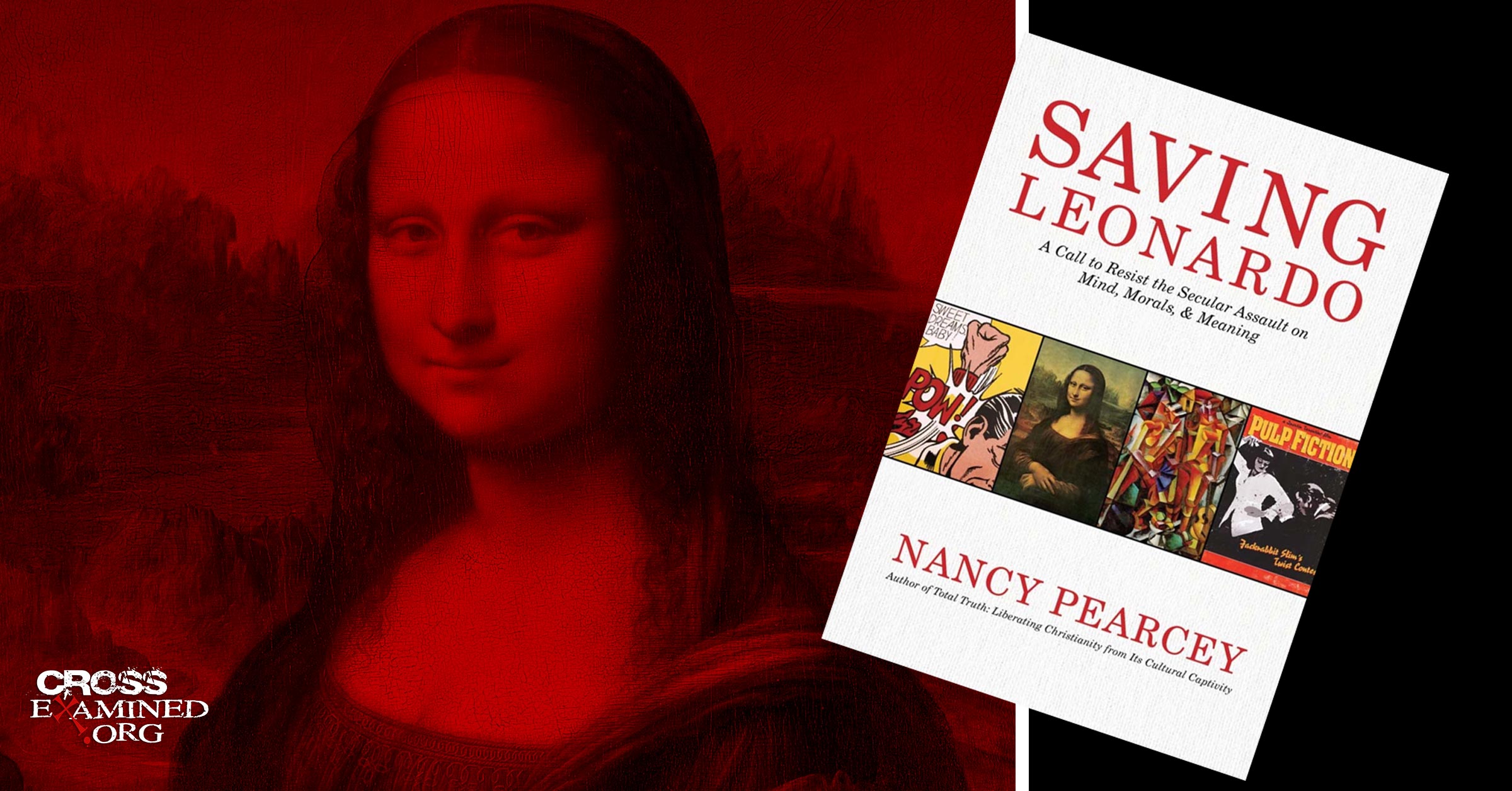
In Saving Leonardo, Pearcey has turned her attention to the arts, and she analyzes how the fact/value split has fragmented modern thought and therefore compromised modern art. Most people view art as simply personal expression, but Pearcey says that it is much more than that: “Artists always select, arrange, and order their materials to offer an interpretation or perspective.” Art conveys ideas.

Saving Leonardo sets out to train us as consumers to thoughtfully “read” the art we take in, to analyze and interpret it. Not to make us art critics, but to make us wise and effective “change agents,” equipped “to engage in discussion with real people seeking livable answers in a world that is falling apart.”

Secular Devolution

Part One of the book examines the emerging global secularism and the toll it is exacting in human lives and dignity. Secularism is generally defined as the view that religious considerations and any beliefs based on the supernatural should be excluded from civil and public affairs. Today, secular ideologies control what our schools teach, how states govern, how economies are managed, and how (and what) news is reported. Secularism is sold on the premise that it provides a more enlightened ordering principle for social arrangements, but in reality, it works to degrade, rather than advance, a society. It leads to:

Dehumanization. The idea that human rights are universal and inherent to individuals is a uniquely Judeo-Christian concept. It rests on the understanding that human beings were created by God and bear his image. Without this foundation, grounded in a transcendent reality, human rights and human dignity are demoted to just another competing interest.

To illustrate how far out on this precipice, we already stand, Pearcey paraphrases pragmatist philosopher Richard Rorty: “Because of Darwin, we no longer accept creation. And therefore, we no longer need to maintain that everyone who is biologically human has equal value. We are free to revert to the pre-Christian attitude that only certain groups qualify for human rights.” What this translates into is a social order in which the strong can oppress, enslave, or exterminate the weak at will. This is how we got such twentieth-century horrors as the Nazi Holocaust and the Soviet gulag.

Tyranny. Secularism preaches tolerance but practices tyranny. The biblical worldview unabashedly states that there is such a thing as an objective standard of right and wrong. The secular tenet of moral relativism is the direct converse of that principle. Simple logic says that both principles cannot be true, but secularizers try to have it both ways anyway. “If moral knowledge is impossible,” Pearcey points out, “then we are left with only political and legal measures to coerce people into compliance.” This explains why homosexual activists call their opponents bigots and homophobes (usually in highly moralistic tones), rather than sitting down with them for a good-faith discussion over the risks of ditching policies like “Don’t Ask, Don’t Tell.”

In fact, secularism makes its advances, not through good-faith reasoning and persuasion, but by brute hubris. Its relativistic approach to religion derives from a certain set of beliefs that are just as exclusive as the claims of any religion; the secularizers just aren’t “honest” about it. This setup enables them to dismiss opposing views, not by marshaling sound arguments against them, but by baldly excluding them or by categorizing them as private values, which are then declared irrelevant.

Double-mindedness. Secularism not only imposes a certain ideology; it also effectively changes the definition of truth by dictating what kinds of information even qualify as truth. The fact/value split, Pearcey says, is “the key to unlocking the history of the Western mind.” It has fostered a kind of double-mindedness, both for individuals and among societies. It’s reflected in the 2008 comments of a Newsweek editor: “Reason defines one kind of reality (what we know); faith defines another (what we don’t know)”; and in the words of Albert Einstein: “Science yields facts but not ‘value judgments’; religion expresses values but cannot ‘speak facts.'”

It’s alive and well in the churches, too. Tim Sweetman, a teen blogger, noted that many of his peers seem like “double agents.” They “are Christians in church…but have a completely secular mind view. It’s as if they have a split personality.”

Logos: Truth in Toto

In the face of this pervasive yet fragmented view of truth, Pearcey puts forward a game-changing alternative view: The nature of truth is holistic, comprehensive, and coherent. “Because all things were created by a single divine mind, all truth forms a single, coherent, mutually consistent system. Truth is unified and universal.”

This is not new. It was the predominant view in Western culture for over two millennia. The ancient Greeks had a term for the underlying principle that unifies the world into an orderly cosmos, as opposed to randomness and chaos. They called it the Logos. And well into the 1900s, American universities were committed to the unity of truth. Even the word university suggests the pursuit of the whole, integrating truth. But the crack-up has so fractured modern thought that the idea of the “unity of truth” presents a radically reoriented perspective.

This “whole truth” perspective is what Pearcey is urging us to bring to the arts.

Secularism: Truth Fragmented

Part Two of Saving Leonardo begins with a crash course on how to discern worldview themes in a work of art. Using over one hundred reproductions and other images to illustrate, Pearcey traces the intellectual currents that guided modern thought and shows how the two-story recasting of truth has manifested itself in the arts, from visual arts to music to literature to architecture.

In the wake of the scientific revolution, philosophy—and therefore art—split into two opposing streams of thought. Occupying one camp was philosophical naturalism, or the materialist stream, which accepted scientism’s exclusive claim to the realm of knowledge. In the other camp coalesced Romanticism, which rebelled against science and sought to protect everything else—theology, literature, ethics, philosophy, and the arts and humanities.

The materialistic view is reflected in such styles as Picasso’s intersecting lines, arcs, and geometric shapes and Jack London’s “tooth and claw” narratives of Darwinian survival of the fittest. Meanwhile, the Romantics produced such styles as Expressionism, the goal of which was the pure expression of the artist’s “inner self,” indifferent to any outer reality. Consider Van Gogh’s dreamlike paintings, or composer John Cage’s piano piece titled 4’33”, which is “performed” by playing absolutely nothing for four minutes and thirty-three seconds. Both streams deny the existence of any transcendent reality or truth beyond the artist or the work itself. If art is whatever you deem it to be, “nothing” qualifies.

But the definition of art as personal expression was a historical novelty. The traditional purpose of art, Pearcey stresses, was to convey “some deeper vision of the human condition.” Modern art has become disconnected from this purpose, and we must fill in the missing elements that can restore the vision of transcendent reality.

Can These Bones Live?

Doing that can take many forms. Here’s an example taken from Fox TV’s crime drama, Bones. Dr. Temperance Brennan, a forensic anthropologist, is the quintessential scientific rationalist. She’s called “Bones” because she solves murders by examining human remains. Her colleague, FBI Special Agent Seeley Booth, possesses all the social finesse she lacks, believes in God, and mistrusts science. As a father, he values relationships, and as a former army sniper, he’s haunted by guilt—two emotions utterly foreign to a materialist.

The relationship between Bones and Booth dances along a perpetual impasse because the two characters operate from completely different—in fact, mutually exclusive—philosophical and intellectual universes. They are an excellent example of the dichotomized understanding of human existence. Their ongoing worldview clashes make for good TV drama, but real humans do not fall into one category or the other. More important, we don’t have to choose one or the other. We are both. “The biblical worldview fulfills both the requirements of human reason and the yearnings of the human spirit,” Pearcey writes, supplying the truth that’s missing from the Bones-style depiction of humanity.

In the modern era, ideological idols have led to dictatorships and death camps. Beliefs shape history, Pearcey says, and worldview questions are a matter of life and death. Saving Leonardo calls us to be prepared with worldview answers that preserve life and human dignity for all and that restore art as a means of conveying truth. Integrated truth that can even make dry bones live.

Recommended resources related to the topic:

Is Morality Absolute or Relative? by Dr. Frank Turek DVD, Mp3 and Mp4

Right From Wrong by Josh McDowell Mp3

Counter Culture Christian: Is There Truth in Religion? (DVD) by Frank Turek

Deconstructing Liberal Tolerance: Relativism as Orthodoxy (Mp3) by Francis Beckwith

Defending Absolutes in a Relativistic World (Mp3) by Frank Turek

Is Morality Absolute or Relative? (Mp3), (Mp4), and (DVD) by Frank Turek


Terrell Clemmons is a freelance writer and blogger on apologetics and matters of faith.

This article was originally published at salvomag.com: http://bit.ly/2CHT2t7
By Mikel Del Rosario

Jesus: The Essential Works

What are the essential truths Christians believing about the things Jesus did? As defenders of the faith, we need to know which beliefs about Jesus’ deeds are essential and why we should believe them.

I had a conversation with my mentor Darrell Bock about this on an episode of the Table Podcast focusing on the works of Jesus mentioned in the Nicene Creed—a collaborative statement of essential Christian beliefs crafted in 325 AD. This creed was based on the Apostle’s Creed and various Scriptures. Early creeds are a good reminder that the essentials of the Christian faith were not just made up recently but actually go back to the earliest memories of Jesus and the teachings of his official spokespeople.

Let me share a couple of things we mentioned while talking about a line that that mentions Jesus’ historic death and burial:

“For our sake, he was crucified under Pontius Pilate; he suffered death and was buried.”

The Nicene Creed makes historical claims about Jesus but also includes theological interpretations of the facts. In this post, I’ll define what Christians mean when we say Jesus died “for us.” Then, I’ll touch on the historical evidence for Jesus’ crucifixion and burial. At the end of this post, you can check out the complete podcast to hear our full conversation on the works of Jesus described in the Nicene Creed. So what’s it means to say Jesus “was crucified for us?”

The Nicene Creed says Jesus was crucified for us

First, the Nicene Creed highlights a kind of substitution where Jesus bears the penalty for human sin. As Anselm of Canterbury explained, Jesus paid an infinite debt no mere human being could pay.

Second, understanding the Jewish context of the earliest Christian thought brings a couple of pictures to mind: The suffering servant of Isaiah 53 who “bears our reproach” and the way Jews understood an animal suffering in the place of a sinner. In some cases, Jews put their hands on the sacrifice to symbolize a transfer of responsibility in the sacrificial system. When you wonder about the significance of something Jesus said or did, remember that themes from the Hebrew Scriptures are often the background, and it pays to see Jesus in his cultural context.

So that’s a theological interpretation of Jesus’ death. But what about the event itself? The Nicene Creed mentions Jesus’ suffering on the cross. What’s the historical evidence for Jesus’ death on the cross?

The Nicene Creed says Jesus died on the cross

Jesus’ death by crucifixion is well-attested: It’s mentioned not only in the Gospels but in a snippet of something the Jewish historian Josephus wrote in his Antiquities, which verifies Jesus’ death under Pontius Pilate. The Roman historian Tacitus alludes to Jesus’ crucifixion as well in The Annals. As even a rather skeptical scholar like John Dominic Crossan recognizes, “That [Jesus] was crucified is as sure as anything historical can ever be.” [1]

“That [Jesus] was crucified is as sure as anything historical can ever be.”

But what happened to Jesus’ body? The Nicene Creed says Jesus was buried, just like we read about in Mark 15 and Luke 23. But what about this?

The Nicene Creed says Jesus was buried in a tomb

Some skeptics ask, “Weren’t crucifixion victims thrown into shallow graves? How do we know Jesus was put in a tomb?” First, we have reports of Jesus’ burial from the time when people who knew about it were still alive. Second, ancient Jewish sources never say Jesus’ body was thrown to the dogs in a shallow grave. There are good reasons to believe Jesus was really buried in a location that was known and that he was buried in a way that by sensitive to Jewish culture.

For example, convicted felons weren’t buried in family tombs. That’s why Jesus wasn’t buried in a family tomb. He was buried in the tomb of a fellow Jew: Joseph of Arimathea. So Jesus’ burial honored what Jewish tradition says about the way a Jewish crucifixion victim should be buried.

So Christian belief operates on two levels: The historical and the theological. As Christians, we believe historical things about Jesus—events you can actually look into like other events in ancient history. But Christians also believe theological things about Jesus—the stuff that makes historical things really matter in our lives.

Like many Christians, I affirm my belief in both the historical and theological truths of the Nicene Creed as I recite it along with my brothers and sisters in the church.

The Works of Jesus in the Nicene Creed

For us and for our salvation he came down from heaven,

was incarnate from the Holy Spirit and the Virgin Mary

and was made man.

For our sake he was crucified under Pontius Pilate;

he suffered death and was buried.

On the third day, he rose again

in accordance with the Scriptures;

he ascended into heaven

and is seated at the right hand of the Father.

He will come again in glory to judge the living and the dead,

and his kingdom will have no end.

Watch the Table Podcast

We cover a lot more about the works of Jesus in the Nicene Creed during our conversation. What are the essential Christian beliefs? Why should we believe this stuff? Check out the complete podcast:

Recommended resources related to the topic:

Jesus, You and the Essentials of Christianity – Episode 14 Video DOWNLOAD by Frank Turek (DVD)

Early Evidence for the Resurrection by Dr. Gary Habermas (DVD), (Mp3) and (Mp4)

Cold Case Resurrection Set by J. Warner Wallace (books)

Did Jesus Rise from the Dead? By Dr. Gary Habermas (book)


Mikel Del Rosario helps Christians explain their faith with courage and compassion. He is a doctoral student in the New Testament department at Dallas Theological Seminary. Mikel teaches Christian Apologetics and World Religion at William Jessup University. He is the author of Accessible Apologetics and has published over 20 journal articles on apologetics and cultural engagement with his mentor, Dr. Darrell Bock. Mikel holds an M.A. in Christian Apologetics with highest honors from Biola University and a Master of Theology (Th.M) from Dallas Theological Seminary, where he serves as Cultural Engagement Manager at the Hendricks Center and a host of the Table Podcast. Visit his Web site at ApologeticsGuy.com.

Original Blog Source: http://bit.ly/2WNb3zN

By Brian Chilton

Atlanta native Jeff Foxworthy made a name for himself as a stand-up comedian doing a routine called “You might be a redneck.” Some of these classic one-liners include, “If you have a set of salad bowls and they all say Cool Whip on the side, you might be a redneck … If you have ever been accused of lying through your tooth, you might be a redneck … If you ever use your ironing board as a buffet table, you might be a redneck.” Foxworthy is a masterful comedian.

A theological system known as deism is no laughing matter. Deists hold that God is transcendent but is impersonal and has no dealings with the world. Therefore, deists deny such things as special revelation (that God can communicate with human beings) and miracles. Problematically, it seems as if many professing Christian theists are practicing deists. The following are three ways in which modern Christianity seems to be drifting towards a form of deism.

  1. You might be a deist if you reject divine communication. Undoubtedly, many people abuse and misuse the phrase, “The Lord told me.” Some have claimed that the Lord told them that they needed to raise so many millions of dollars for a new jet or for a new building. While many of those claims are greatly suspect, the reaction to the extreme charismatic movement tends to move too far in the other direction. For instance, John MacArthur notes that “The truth is, there is no fresher or more intimate revelation than Scripture. God does not need to give private revelation to help us in our walk with Him” (quoted in Buettel, “The Lord Told Me,” GTY.org, https://www.gty.org/library/blog/B160122/the-lord-told-me). The problem with MacArthur’s response is that he is gravitating towards an implicit deism. John Morrison warns that modern theology has greatly been influenced by a cosmological dualism which tends to shut God out of the world from all “spatio-historical action and objective self-declaration” (Morrison, Has God Said, 2). Is it not then possible, at least, that God could communicate with individuals on a personal level? I think so. Furthermore, I think God communicates with us often, although not in an audible voice necessarily. Yet, I would caution that we do need to check everything by Scripture as God does not lie and, thereby, would not contradict what he has said in his word (Titus 1:2).
  2. You might be a deist if you reject divine miracles. While it would be difficult to imagine that any Christian would dismiss God’s ability to perform miracles, the anticipation that God could work a miracle has seemingly declined in a modern rationalistic belief-system. This, too, comes from a philosophical ideology that holds that God cannot interact with space and time. However, is God not the one who created and developed the laws of nature that govern the universal system? If God is the one who created all things, including the laws that bind things together, then one could certainly hold that God continues to perform miracles as God sees fit. The rejection of God’s ability to perform miracles in the current age shows a bent towards deism rather than classical Christian theism.
  3. You might be a deist if you reject divine relationships. Finally, it seems that some writers and scholars (and I use general language intentionally) have popularized a notion that divine relationships are not biblical. That is, a person should simply accept a theological truth and not pursue an intimate relationship with a holy God. However, that again leans towards a deistic understanding of God. Jesus says, “On that day you will know that I am in my Father, you are in me, and I am in you” (John 14:20, CSB) before saying, “Remain in me, and I in you” (John 15:4, CSB). Paul writes, “The Spirit himself testifies together with our spirit that we are God’s children, and if children, also heirs—heirs of God and coheirs with Christ—if we suffer with him so that we may also be glorified with him” (Rom. 8:16–17, CSB). A covenantal relationship with God is deeply personal. Thus, we should not think that our journey is one that is walked alone. Rather, the believer has the promise that God will be with them until the very end (Matt. 28:20).

This article is not to badmouth any theologian or writer. Certainly, the individuals who wrote against certain practices did so with a concern that certain people were abusing the name of God. Nothing could be worse than that. Yet, the history of humanity reveals that individuals typically have the uncanny ability to take issues to its extreme end. My concern is that by guarding individuals from New Age philosophies and radical forms of Christianity—some which have become quite cult-like—many are leading individuals into a form of deistic theology. Throughout the pages of Scripture, individuals have encountered God personally and radically. Their walk with God was quite personal and relational. While God is mighty and awesome, he is also tender, compassionate, and near to all of us. May we never forget that.

Recommended resources related to the topic:

Letters to a Young Progressive by Mike Adams (Book)

What is God Really Like? A View from the Parables by Dr. Frank Turek (DVD, Mp3, and Mp4)

What is God Like? Look to the Heavens by Dr. Frank Turek (DVD and Mp4)

How Philosophy Can Help Your Theology by Richard Howe (DVD Set, Mp3, and Mp4)

Defending the Faith on Campus by Frank Turek DVD and Mp4

Miracles: The Evidence by Frank Turek DVD and Mp4

The Case for Miracles: A Journalist Investigates Evidence for the Supernatural by Lee Strobel Kindle Edition

Jesus, You and the Essentials of Christianity – Episode 14 Video DOWNLOAD by Frank Turek (DVD)


Brian G. Chilton is the founder of BellatorChristi.com, the host of The Bellator Christi Podcast, and the author of the soon to be released book The Layman’s Manual on Christian Apologetics. He received his Master of Divinity in Theology from Liberty University (with high distinction), his Bachelor of Science in Religious Studies and Philosophy from Gardner-Webb University (with honors), and received certification in Christian Apologetics from Biola University. Brian is currently enrolled in the Ph.D. program in Theology and Apologetics at Liberty University and is a member of the Evangelical Theological Society and the Evangelical Philosophical Society. Brian has been in the ministry for nearly 20 years and serves as the Senior Pastor of Westfield Baptist Church in northwestern North Carolina.

Original Blog Source: http://bit.ly/2CgDM6v

By Erik Manning

There are dozens of arguments for the existence of God. To rattle off just a few: there’s the moral argument, ontological, religious experience, miracles, consciousness, reason, desire, and the families of cosmological arguments and design arguments.

Some Christians say that while these arguments are good for building up the faithful, they’re useless for apologetics and evangelism. After all, we’re not trying to make generic theists. Even the demons believe in God, but that doesn’t give them a saving relationship with Him! (James 2:20) Apologists using these arguments in conversations or debates are barking up the wrong tree at best, and at worst, are being unfaithful to God.

To make the point, these critics will often point to the case of Antony Flew. Flew was a notable philosopher of religion who argued against the existence of God for decades. Near the end of his life, Flew changed his tune. He became a believer in God because of the philosophical and scientific arguments for God. He even wrote a book about it. Here’s a quote that sums up Flew’s conversion:

“I now believe that the universe was brought into existence by an infinite Intelligence. I believe that this universe’s intricate laws manifest what scientists have called the Mind of God. I believe that life and reproduction originate in a divine Source. Why do I believe this, given that I expounded and defended atheism for more than a half-century? The short answer is this: this is the world picture, as I see it, that has emerged from modern science.” There is a God.

Flew’s turnabout sent shockwaves through academic circles and a lot of Christian apologists claimed it as a victory for scientific and philosophical apologetics.

Here’s the rub: Flew never became a Christian. He declared himself to be a deist. Deists, if you don’t know, reject direct revelation and miracles. If this is what successful apologetics looks like, then what’s the point?

Here’s the thing though — For every Antony Flew, you have dozens of people like me. Quick background story: During my teenage years, I was an atheist. But along the course of time, I gradually became convinced God existed. But I wasn’t satisfied with the idea of deism or a generic God. Why?

There are a couple of reasons for that: If God exists, it would be weird if God never communicated with us. And if God was going to communicate with us, he’s not probably going to do it only privately.

The problem with Deism and mysticism

Let’s think about it for a second: Why would a Supreme Being create intelligent beings with the ability for communication and then never speak to them? Not even a ”howdy”? Wouldn’t we expect this God to offer a few words of advice or the occasional helping hand? Deism might explain why there’s a cosmos, consciousness, or the moral law. But it doesn’t offer much of an explanation of God’s silence.

There’s also the problem of God speaking only through private revelation. Anyone could claim that God’s speaking to them, how do we parse that out and see who’s right? It would be spiritual anarchy.

As human beings, we all have the same basic needs and problems in life. It would make more practical sense for God to speak to us about these things publicly and collectively. An all-wise being would talk to us a way that anyone could access and understand. Scripture, or something like it, makes a lot of sense.

It’s this commonsense reasoning that led me to dig up a Bible and start reading. Even though I had issues with the idea of miracles at first, I eventually had an experience with the Holy Spirit and became a Christian. You might say this is just anecdotal, but I’m not the only person to make the jump from ‘generic theism’ to Christianity.

How Natural theology helped lead three former atheists to Jesus

A philosopher’s Journey

Ed Feser taught philosophy of religion for years as a college professor. After going through the arguments semester after semester, he eventually became a philosophical theist. Says Feser:

“I don’t know exactly when everything clicked. There was no single event, but a gradual transformation. As I taught and thought about the arguments for God’s existence, and in particular the cosmological argument, I went from thinking “These arguments are no good” to thinking “These arguments are a little better than they are given credit for” and then to “These arguments are actually kind of interesting.” Eventually, it hit me: “Oh my goodness, these arguments are right after all!” The Road From Atheism

Edward C. Feser is an American philosopher. He is an Associate Professor of Philosophy at Pasadena City College in Pasadena, California

But that’s not where the story ends. Feser eventually became a Christian. He didn’t remain a mere philosophical theist. Not content merely knowing that the God of the philosophers existed, Feser continued his journey and eventually met Jesus.

A scientist’s story

Physicist Frank Tipler is another example of someone who became a Christian after looking at different proofs for God. While Feser was impressed with the philosophical reasons for the existence of God, Tipler became a believer based on the evidence from cosmology and physics, his specialty. While many atheists argue that science and reason will lead someone to reject faith, Tipler found the opposite was true. In the intro of his book The Physics of Immortality, he wrote:

“When I began my career as a cosmologist some twenty years ago, I was a convinced atheist. I never in my wildest dreams imagined that one day I would be writing a book purporting to show that the central claims of Judeo-Christian theology are in fact true, that these claims are straightforward deductions of the laws of physics as we now understand them. I have been forced into these conclusions by the inexorable logic of my own special branch of physics.”

Frank Tipler is a mathematical physicist and cosmologist, holding a joint appointment in the Departments of Mathematics and Physics at Tulane University.

So obviously Tipler didn’t stay in the camp of belief in a deistic or generic deity. His discovery left him wanting to know who this Creator and Designer was.

An Oxford Student’s testimony

I could multiply examples, but for the sake of space, I’ll offer just one more. Sarah-Irving Stonebraker is a history professor in Australia. In an article entitled, ‘How Oxford and Peter Singer Drove Me From Atheism to Jesus‘, Sarah outlines her journey.

“I grew up in Australia, in a loving, secular home, and arrived at Sydney University as a critic of “religion.” I didn’t need faith to ground my identity or my values. I knew from the age of eight that I wanted to study history at Cambridge and become a historian. My identity lay in academic achievement, and my secular humanism was based on self-evident truths…

After Cambridge, I was elected to a Junior Research Fellowship at Oxford. There, I attended three guest lectures by world-class philosopher and atheist public intellectual, Peter Singer. Singer recognized that philosophy faces a vexing problem in relation to the issue of human worth. The natural world yields no egalitarian picture of human capacities. What about the child whose disabilities or illness compromises her abilities to reason? Yet, without reference to some set of capacities as the basis of human worth, the intrinsic value of all human beings becomes an ungrounded assertion; a premise which needs to be agreed upon before any conversation can take place.

I remember leaving Singer’s lectures with a strange intellectual vertigo; I was committed to believing that universal human value was more than just a well-meaning conceit of liberalism. But I knew from my own research in the history of European empires and their encounters with indigenous cultures, that societies have always had different conceptions of human worth or lack thereof. The premise of human equality is not a self-evident truth: it is profoundly historically contingent. I began to realize that the implications of my atheism were incompatible with almost every value I held dear … One Sunday, shortly before my 28th birthday, I walked into a church for the first time as someone earnestly seeking God.

Before long I found myself overwhelmed. At last, I was fully known and seen and, I realized, unconditionally loved – perhaps I had a sense of relief from no longer running from God. A friend gave me C.S. Lewis’s Mere Christianity, and one night, after a couple months of attending church, I knelt in my closet in my apartment and asked Jesus to save me, and to become the Lord of my life”

Dr. Sarah Irving-Stonebraker is Senior Lecturer (in Australia, this is a tenured professor position) in Modern European History at Western Sydney University in Australia, where she teaches in the History and Political Thought major.

So after learning that God existed through the moral argument, Irving-Stonebraker didn’t stop there. She wasn’t content knowing that a generic God existed. The moral argument made her want to find just who this Moral Lawgiver is.

Arguing for God’s existence isn’t fruitless

So what’s my point?

While Antony Flew’s non-conversion might feel like a failure, there are many people like Feser, Tipler, Irving-Stonebraker, and myself who didn’t stop at generic theism. And the writer of Hebrews tells us that belief in God is a necessary precondition to pleasing God. (Hebrews 11:6) The next part is seeking Him. So when someone like William Lane Craig argues for the existence of God, they’re laying some foundational groundwork and we’re wrong to think little of that.

Once you become convinced God is real, then unless you’re apathetic, you’ll want to get to know him personally. And it’s not as if Craig or others like him stop after offering the arguments for God, they almost always then argue for the resurrection.

And as I said before, intuition and common sense tell us that if God exists, he’s not going to remain silent and stand aloof. And if he’s as smart as design arguments show, he’s going to communicate with us in an accessible way. God can and has used these arguments to get past someone’s intellectual hang-ups or blind spots and to take a step towards him. How could that possibly be a bad thing?

Recommended resources related to the topic:

So the Next Generation will Know by J. Warner Wallace (Book and Participant’s Guide)

Reaching Atheists for Christ by Greg Koukl (Mp3)

Living Loud: Defending Your Faith by Norman Geisler (Book)

Fearless Faith by Mike Adams, Frank Turek and J. Warner Wallace (Complete DVD Series)

Defending the Faith on Campus by Frank Turek (DVD Set, mp4 Download set and Complete Package)

Can All Religions Be True? mp3 by Frank Turek

Counter Culture Christian: Is There Truth in Religion? (DVD) by Frank Turek


Erik Manning is a former atheist turned Christian after an experience with the Holy Spirit. He’s a former freelance baseball writer and digital marketing specialist who is passionate about the intersection of evangelism and apologetics.

Original Blog Source: http://bit.ly/2JrVQOU

By Bob Perry

“You can’t put God in a box.” It’s a popular saying within the Christian community. And it seems reasonable to say. After all, God can do anything He wants to do. Who would question that? I submit that every thinking Christian should question that … because it’s not true. God’s character does put him in a box. And our failure to recognize that creates a false — and therefore dangerous — picture of God. There is a box God needs to be in. And his character defines it.

God Cannot Do Whatever He Wants

God cannot do whatever he wants to do. If you think that sounds sacrilegious, you first have to understand that God cannot do things that are contrary to his nature. Before we can determine if God can do anything he wants to do, we have to first understand what that nature is. There are several elements to God’s nature but here are a few to consider.

God is Logical

God made an orderly universe. He built the laws of logic into our world and made it predictable. This is why we can communicate with one another. It’s the reason we can use science to understand how the world works. If God made the universe that way, it means that he must also be logical. It means that logic is an extension of his character. And that means God cannot do illogical things.

He can’t make a square circle, a married bachelor, or “a rock so big he can’t lift it.” This is an important point to understand as it relates to the rest of his character traits.

God is Omnipotent

God is all-powerful. But having supreme power doesn’t mean God can do anything. It means he can do anything that power can do. Being immeasurably powerful is what allows God to do miracles or create a universe as immense and complex as the one we see around us. But power does not allow God to do illogical, sinful, hateful, or unjust things. That’s an important distinction to make.

God is Goodness

God is pure goodness. He is “the final standard of good and all that God is and does is worthy of approval.” Because he is good, God is willing and able to demonstrate love in all its forms through mercy, patience, and grace. God loves everything he created. And since human beings are the pinnacle of that creation, God loves humanity in a way that we are incapable of comprehending.

God is Just

Justice occurs when someone gets exactly what they deserve. This can be positive or negative. We know that good acts deserve a reward and evil acts deserve punishment. And we know this intuitively. No one had to teach this to us. Even little babies demonstrate that they know it. All of us inherently value — and seek — justice. God is the source and embodiment of that idea. His character demands it. And since his character is morally perfect, any act of rebellion against that moral perfection — no matter how small — deserves to be punished.

God is Eternal and Self-Existent

God is not the type of being who needs a cause for His existence. The fact that anything exists at all means there must be a permanent, unmovable foundation that sustains it. That’s God. He is the foundation of all being. This is why the question, “Who made God?” is such a silly one. God isn’t the type of thing that you make. He upholds all reality at every instant but does not need to be upheld himself.

God is Omnipresent

The fact that God upholds all reality at every instant means that he is present everywhere. Always. He is not limited by time or space. Don’t get this confused with the ideas that God is everything. That’s pantheism. God’s omnipresence means that he is present everywhere in his creation but also distinct from it.

Putting Them All Together

There are plenty of other character traits that theologians use to describe God. If you are interested in digging more deeply into these kinds of topics, I suggest investing in a book on Systematic Theology. But considering the definitions I’ve briefly mentioned here, I doubt that anyone who takes God seriously would find them to be controversial in themselves. Our problems arise when we forget that God exhibits all these character traits simultaneously. All facets of his nature have to work together. He can’t exercise one if it violates another.

Theological Inconsistencies

Focusing on one aspect of God while ignoring another invites us to accept a false view of him. And many Christians unwittingly do this all the time.

“God showed up!”

When they have an emotional experience in worship, it is common to hear some proclaim that “God showed up today!” But God doesn’t “show up” anywhere. He is always everywhere. Don’t confuse the issue. God doesn’t need our praise to show himself. We need to praise him to remind ourselves of our dependence on him.

“God is so good!”

This is a common refrain to hear from someone who has just received good news of some kind. And while it’s great to acknowledge God’s blessings, it’s wrong-thinking to acknowledge them only when things are going our way. God is good regardless of our personal circumstances. It’s easy to express our love for him when things are good. But it’s imperative that we do the same when things are bad.

“Where was God when …?”

On the flip side, we seem to think God has gone missing when catastrophes occur. We assume that God’s omnipotence means he can and should destroy evil forever. But God made the loving decision to create us as free-will beings. He willingly limits his own power to give us the freedom to choose to follow him. And that means that no matter how powerful he is, God has created a world that allows us to make bad choices. The moral evil we witness all around us depends on our actions, not on God’s absence.

“God is love”

This idea is absolutely true. But contrary to the claims of the universalists and inclusivists among us, God is not just love. The idea that “God is love” is true as far as it goes, but there is more to the story. Ultimate goodness and love are different ways of describing God’s moral perfection. Being pure love and goodness means he cannot sin and he cannot lie. And that means he cannot allow moral imperfection into his presence. When our actions violate his moral law, his justice requires that there be consequences for our decisions. God’s character won’t allow him to accept whatever moral choices we make. This is a reality that often gets ignored by those who insist that a loving God would never allow us to be separated from him. The fact that God loves us does not mean he condones anything we do.

The Box God Needs to Be In

These are just a few examples of how our failure to keep God in the proper box leads not only to theological inconsistencies but to a corrupted view of reality itself. That’s what I mean when I say that we have to put God in a box. It’s a box defined by the sum total of all the elements of his character. Isolating our favorite trait is a bad idea because it doesn’t tell the whole story. And, as is always the case, accepting bad ideas leads to bad real-world consequences.

It turns out that we better keep God in a box. And we better understand how that box is defined. It helps us avoid most of the silly, false, and even dangerous ideas that have become all too common among Christians these days. It’s not always an easy thing to do. But being clear-thinking Christian demands that we acknowledge that God puts himself in a box. And we would do well to keep him there.

Recommended resources related to the topic:

What is God Really Like? A View from the Parables by Dr. Frank Turek (DVD, Mp3, and Mp4)

What is God Like? Look to the Heavens by Dr. Frank Turek (DVD and Mp4)

How Philosophy Can Help Your Theology by Richard Howe (DVD Set, Mp3, and Mp4)


Bob Perry is a Christian apologetics writer, teacher, and speaker who blogs about Christianity and the culture at truehorizon.org. He is a Contributing Writer for the Christian Research Journal and has also been published in Touchstone, and Salvo. Bob is a professional aviator with 37 years of military and commercial flying experience. He has a B.S., Aerospace Engineering from the U. S. Naval Academy, and an M.A., Christian Apologetics from Biola University. He has been married to his high school sweetheart since 1985. They have five grown sons.

Original Blog Source: http://bit.ly/3694taO

By Ryan Leasure

We’re told by skeptics that eye-witnesses didn’t write the Gospels. Not only that, they say the authors wrote from distant lands like Rome, Egypt, Asia Minor, or Greece. They merely heard the stories of Jesus from others who heard the stories of Jesus from others who heard the stories of Jesus — much like the game telephone.

And as so often happens in the game of telephone, the stories got mixed up along the way. So by the time the writers penned the Gospels, they had a distorted view of Jesus, and thus we can’t know what the real Jesus said or did. Or so the argument goes.

But is that really what happened? A little thought experiment might help us answer this question. Pretend you were given the task of writing a biography on a traveling woman from Bolivia named Carla. Yet you weren’t allowed to visit Bolivia. Furthermore, you couldn’t use the internet, encyclopedias, or maps for research. Your resources would be a couple of Americans who had never met Carla themselves but had heard stories about her travels.

As you undertake this project, how accurately do you think you could convey the geography and landscape of her travels? Would you really be able to give precise locations and distances? Would you know which towns had higher or lower elevations? How accurately could you describe the bodies of water she encountered? Chances are, you’d make a lot of mistakes with these details.

Well, as we think about these so-called authors from distant lands, they wouldn’t have had access to sources that could give them specific details of the Israeli landscape. So as they wrote their stories about Jesus, we would expect them to make lots of geographic blunders, much like your story on Carla. But this isn’t what we find.

Geography of Towns and Regions

The Gospel writers display an incredible familiarity with Palestinian geography. And they don’t just get most of the geography right; they get it all right. This would be truly remarkable if they lived in faraway regions and had only heard of Jesus through secondary sources. But it would be expected for eye-witnesses who followed Jesus from town to town.

Consider this list of towns the Gospel writers mention:1

Ryan blog 1

In total, the Gospel authors list twenty-six different towns. Some are prominent like Jerusalem, while others are obscure like Cana.

Not only do the Gospels include towns, they reference general regions as well. Consider this list:2

Ryan blog 2

In total, the Gospels list thirteen different regions. Compare these lists with some of the apocryphal Gospels, which give us almost no geographical details.

The Gospel of Thomas, for example, mentions Judaea once and no other locations. The Gospel of Judas doesn’t even list a single location, and The Gospel of Philip names just Jerusalem, Nazareth, and Jordan.

Of course, the lack of geographical detail is to be expected in these apocryphal works. After all, non-eye-witnesses wrote them from distant regions some 150 years after Jesus. Naturally, people would have heard of Jerusalem (the capital of Israel), Nazareth (Jesus’ hometown), and Jordan (the river where Jesus was baptized). One wouldn’t need to be an eye-witness to have knowledge of these regions. But Cana, Bethany, and Salim? One would have to have special knowledge to know about these places.

Geography of Bodies of Water

Since the writers had an in-depth knowledge of the towns and regions, it should come as no surprise to learn they also knew about the bodies of water. Consider this list:3

Ryan blog 3

It’s interesting to note the numerous references to “the Sea” of Galilee. For a body of water that’s a mere thirteen miles long, it’s odd that an Egyptian or Roman author would call it “the sea.” For them, the Mediterranean qualifies as a sea, not this tiny body of water that’s less than 1/300th the size of Lake Michigan.

Yet we would expect Galilean fishermen — who spent their entire careers on the body of water — to call it “the sea.” What’s even more interesting is that while the three Jewish authors of the Gospels refer to it as “the sea,” the one non-Jewish author (Luke) does not. Instead, he refers to it as “the lake” (Lk. 5:1, 2; 8:22, 23, 33). This makes sense because from a broader gentile perspective, “lake” was a more accurate description.

The authors also know that Bethsaida and Capernaum are close by the Sea of Galilee and that you can go directly from the Sea of Galilee into the hill country. Furthermore, John knew of a small stream called the Kidron and of two pools in Jerusalem. One pool he describes as having five colonnades, which has been verified by archeological evidence. Again, all of these details would be quite remarkable coming from non-eye-witnesses in distant regions.

Geography of Roads

In the parable of the Good Samaritan, Jesus tells the story of a man “going down” from Jerusalem (750 meters above sea level) to Jericho (250 meters below sea level). This was a descent of approximately one kilometer. The writer knew enough to know both Jerusalem and Jericho’s elevations. In fact, all four Gospels describe people “going up” to Jerusalem and “going down” as they left Jerusalem.

In John 2 and 4, leaving Cana (200 meters above sea level) for Capernaum (200 meters below sea level) is described as “going down.” Similarly, Luke describes the travel from Nazareth (350 meters above sea level) to Capernaum (200 meters below sea level) as “going down.”

More impressively, the authors knew the location of a tiny village called Chorazin. In Luke 10:13-15, Jesus chides Chorazin along with Bethsaida and Capernaum for their lack of belief. According to New Testament scholar Peter Williams,

The little-known village of Chorazin is, in fact, on the road to Bethsaida and just a couple of miles north of Capernaum. As far as we know, there was not a single literary source that could have provided this information to a Gospel author.4

The authors also knew that multiple routes existed between Judaea and Galilee — one to avoid Samaria and one right through it. Furthermore, they knew it was short travel from the small villages of Bethany and Bethphage to Jerusalem.

Who Could Know All These Geographical Details?

How could one get all of these obscure details correct? If it’s as the skeptics say, and non-eye-witnesses wrote these accounts from distant places, they got extremely lucky. A more reasonable conclusion, however, is that the writers received detailed information from eye-witnesses or were eye-witnesses themselves. As Peter Williams concludes,

No known sources hold together the particular set of information they (Gospel writers) have, and besides, we would have to suppose that they undertook a level of literary research quite unparalleled in ancient history. If these pieces of information result from hearing, then the reports they heard must have been fairly precise — concerned with stories not merely for their message but also for specific details. Thus it seems that the authors received the information either from their experience or from detailed hearing.5

*For more on this topic, check out Peter Williams’ book Can We Trust the Gospels?

Recommended resources related to the topic:

The New Testament: Too Embarrassing to Be False by Frank Turek (DVD, Mp3, and Mp4)

Why We Know the New Testament Writers Told the Truth by Frank Turek (DVD, Mp3 and Mp4)

The Top Ten Reasons We Know the NT Writers Told the Truth by Frank Turek (Mp3)

Counter Culture Christian: Is the Bible True? by Frank Turek (DVD)

Cold-Case Christianity: A Homicide Detective Investigates the Claims of the Gospels by J. Warner Wallace (Book)


Ryan Leasure holds a Master of Arts from Furman University and a Masters of Divinity from the Southern Baptist Theological Seminary. He currently serves as a pastor at Grace Bible Church in Moore, SC.

Original Blog Source: http://bit.ly/31MPuzV

By Natasha Crain

As Christians, we have all kinds of pithy sayings that make their way through churches and establish themselves as generally accepted truths. Some end up on bumper stickers, some on wall decals, and some just get repeated so many times that people think they’re actually in the Bible.

There’s a popular one among parents that I keep hearing lately, and each time I hear it, I cringe. Not only is it false, but it’s particularly damaging to the discipleship of the next generation.

It’s the idea that “Faith is caught, not taught.”

When people say this, they’re usually trying to emphasize that faith is a matter of the heart, not a cold belief in a set of facts that someone has taught them. And of course, there’s truth to that sentiment. But nine times out of ten that someone relays this saying to me, there’s an implication that our kids’ spiritual development has little to do with the “intellectual stuff” of apologetics, but rather everything to do with how well we live our faith in front of them (apologetics is the study of why there’s good reason to believe Christianity is true).

This belief is desperately wrong. At best, it results in a passive approach to discipleship. At worst, it’s an excuse for intellectual laziness.

Let’s look at why.

First, we have to clearly understand what faith is.

Faith, in its most basic sense, is trust.

A blind faith is a trust that has little or no justification. For example, imagine that I claimed there’s an invisible unicorn living outside my house. When you ask me what reasons I have for that belief, I tell you, “I don’t need reasons. I just have faith.” In this case, I would be acknowledging that I hold a blind faith in my invisible unicorn—it’s a faith without reason.

At the other end of the faith, spectrum is a person trusting in something they have good reason to believe is true. For example, I’m willing to get on an airplane because I have faith that it will safely get me to where I need to be. I can’t be certain, but I know there is a good reason to place my trust in the process.

Importantly, this means that faith is not a way of knowing something. It’s how you respond to what you know. This is such an important distinction. Atheists often suggest that faith is inferior to science as a way of knowing about the world, but faith isn’t a way of knowing about the world at all. It’s trust that we place in Jesus in response to what we know about the world (and that knowledge comes from many sources).

In short, biblical faith is not blind faith. Biblical faith is trusting in what we have good reason to believe is true, based on the extensive evidence God has given us.

Now that we’ve established an accurate understanding of what faith is, we can see two major problems with the idea that “faith is caught, not taught.”

  1. It emphasizes passing on our trust rather than the reasons for our trust.

If faith is trust, then what this saying effectively states is that our trust is something that should rub off on our kids as they see how we live our lives.

Our trust in Jesus may or may not rub off on our kids, but regardless, that shouldn’t be our primary goal in discipleship.

Instead, we need to pass on the good reasons that should lead to our kids’ trust in Jesus. Otherwise, they’re just borrowing our own trust without knowing the justification for it. That’s a faith that’s waiting to crumble as soon as it’s significantly challenged.

It’s worth a side note here that parents shouldn’t assume a well-lived Christian faith is even desirable to their kids. There are numerous kids who grow up in loving Christian homes, with parents who truly “walk the walk,” but abandon their faith. Why? Those kids might admire the sincerity of their parents’ convictions but feel no desire to “catch” that same faith because they don’t believe it’s built on good reason. Once again, this points back to the need to pass on the reasons for the hope we have (1 Peter 3:15), not simply our own trust.

  1. A deep understanding of the reasons for faith is not something that’s simply “caught.”

Even if we restate the saying as “Reasons for faith are caught, not taught,” it still doesn’t work.

Here are just a few major concepts that will never be passively caught based on how you live out your Christian faith:

What objective evidence is there for the existence of God?

Do science and God contradict one another?

Can all religions point to the same truth?

What historical evidence is there for the resurrection?

Was Christianity copied from pagan religions?

How do we know that the Gospels are based on reliable eye witness testimony?

How do we know that the Bible we have today hasn’t been corrupted in the copying process over hundreds of years?

How can a good God permit so much evil and suffering?

Between my two books, I cover 70 of these critical questions that kids need to understand today. My new book, coming in March, focuses on 30 more questions specifically about Jesus (Talking with Your Kids about Jesus: 30 Conversations Every Christian Parent Must Have). That’s one hundred important questions kids need to understand given the challenges today…and that’s one hundred important questions they won’t grasp deeply just by watching how you live your faith.

These things are taught.

And the need to proactively teach is woven throughout Scripture:

“Only be careful, and watch yourselves closely so that you do not forget the things your eyes have seen or let them fade from your heart as long as you live. Teach them to your children and to their children after them” (Deuteronomy 4:9).

“…he commanded our ancestors to teach their children, so the next generation would know them, even the children yet to be born, and they, in turn, would tell their children” (Psalm 78:5-6).

“Listen, my son, to your father’s instruction and do not forsake your mother’s teaching” (Proverbs 1:8).

“Fathers, do not exasperate your children; instead, bring them up in the training and instruction of the Lord” (Ephesians 6:4).

There’s good reason the Bible tells us to teach and train and not just keep walking with the Lord while kids look on. Those eyes can’t physically see all that needs to be mentally learned. And as long as Christian parents think all they need to do is model what it looks like to put their trust in Jesus, kids will keep struggling when challenged on the justification for such a life.

Does passing on an understanding of all the good reasons for faith means a child will necessarily follow Jesus? Not at all. But when we’re obedient in our calling to be teachers (not just walkers!), we can be confident that we have given our kids the opportunity to develop their own trust in Jesus and didn’t simply encourage them to borrow our convictions.

A borrowed faith is readily handed back.

Recommended resources related to the topic:

Talking with Your Kids about God: 30 Conversations Every Christian Parent Must Have by Natasha Crain (Book)

Keeping Your Kids on God’s Side: 40 Conversations to Help Them Build a Lasting Faith by Natasha Crain (Book)

Courageous Parenting by Jack and Deb Graham (Book)

Proverbs: Making Your Paths Straight Complete 9-part Series by Frank Turek DVD and Download

Forensic Faith for Kids by J. Warner Wallace and Susie Wallace (Book)

God’s Crime Scene for Kids by J. Warner Wallace and Susie Wallace (Book)


Natasha Crain is a blogger, author, and national speaker who is passionate about equipping Christian parents to raise their kids with an understanding of how to make a case for and defend their faith in an increasingly secular world. She is the author of two apologetics books for parents: Talking with Your Kids about God (2017) and Keeping Your Kids on God’s Side (2016). Natasha has an MBA in marketing and statistics from UCLA and a certificate in Christian apologetics from Biola University. A former marketing executive and adjunct professor, she lives in Southern California with her husband and three children.

Original Blog Source: http://bit.ly/35ASDpQ

By J. Brian Huffling

“There are some Jehovah’s Witnesses in the neighborhood if you want to talk them,” my wife said. I was excited. I have had numerous and long-standing discussions with Mormons, but never anything meaningful with Jehovah’s Witnesses. After a while, they finally came to my door. While I couldn’t talk to them at the time, we scheduled a meeting for them to come back. I have been meeting with them for about a month now. It has been great! I have studied their teachings for a while, but I have never had the chance to get it from the horse’s mouth and really ask questions to help me better understand their belief system. It really has been a lot of fun, and I would like to share my experiences with you, including their beliefs and the questions I have asked them.

The Name of Jehovah

The first teaching they shared with me was the importance of the name “Jehovah.” In Hebrew (the original language of the Old Testament) God’s personal name is Yahweh. The original Hebrew did not contain vowels, and so this name was spelled YHWH. It was thought to be sacred, and so the Hebrew scribes did not want to pronounce the divine name. Instead, they added the letters of Adonai, which means “Master” or “Lord.” Thus, we get the English spelling “Yahoveh.” Rumor has it that “Jehovah” came about because the Germans had a hard time pronouncing the “Y” and instead made a “J” sound, hence, Jehovah.

However, this name Jehovah came about; Jehovah’s’ Witnesses are adamant that we should call him by his divine name. They teach that English translations have lost this teaching, and it is important to get it right. This is one reason they have their own version of the Bible, which is called the “New World Translation.” Translating words like YHWH as Jehovah is just one difference, and relatively minor in comparison to other teachings that drastically change the text.

Jesus Is “a” God, Not God Almighty

I was surprised that they threw this one at me right out of the gate, but on the second meeting, they brought an elder who admitted that in their view, Jesus is not God. I had known this teaching for years but was not sure exactly how open they would be about it. Happily, for me, they were very open about it. After some general teaching through a pamphlet that they gave me, the elder and I agreed to focus on the topic of Jesus’ deity on our next meeting. I did some preparation, so I could try to prove to them that Jesus did, in fact claim to be God.

He ended up coming by himself on this particular visit, and we went over two passages of Scripture from which he wanted to demonstrate that Jesus was a created being and thus not God. One passage was Proverbs 8:22-23, which says: “The Lord possessed me at the beginning of his work, the first of his acts of old. 23 Ages ago, I was set up, at the first, before the beginning of the earth” (ESV). His point was that “Wisdom” refers to Jesus. I do not remember getting a very clear answer as to why he thought this, but I pointed out that as wisdom literature, “Wisdom” is personified often, and even as a woman. In fact, verse twelve says, “I, wisdom, dwell with prudence, and I find knowledge and discretion.” I asked, “If Wisdom is Jesus, then who is Prudence?” There was no real answer.

His second, and more well-known passage cited by them on this topic, was Colossians 1:15, which says, “He [Jesus] is the image of the invisible God, the firstborn of all creation.” Since Jesus is “the firstborn of all creation,” Jehovah’s Witnesses argue that he is the first created being. However, the Greek word for ‘firstborn’ actually means “preeminent”, not the first in a series of things. In fact, the Greek translation of Psalm 89:27 uses the exact word for David: “And I will make him the firstborn, the highest of the kings of the earth.” However, David was not only not the firstborn, he was the last born. So I argued these two passages are not teaching that Jesus was created. The first was simply a personification of wisdom, which happens all the time in Hebrew wisdom literature. And the second simply doesn’t mean what they say it means. The elder was not convinced, and even said that we can’t go by what the dictionary says. I could not knock him off his script on this point. He simply refused to concede what the word means.

I offered several lines of argument that Jesus claimed to be God. For example, Isaiah 44:6 says, “I am the first and I am the last; besides me there is no god.” However, in Revelation 1:17-18 Jesus claimed, “I am the first and the last, 18 and the living one. I died, and behold I am alive forevermore, and I have the keys of Death and Hades.” This is Jesus talking and not Jehovah (Jehovah never died according to Jehovah’s Witnesses). That Jesus was the one speaking was agreed upon by the elder. My point was that if Jehovah was claiming to be the first and the last and so was Jesus, then Jesus was claiming to be Jehovah. The reply was that Jesus merely was thinking like Jehovah, not claiming to be Jehovah. However, as I pointed out, this is not what the text says. (See this post for more material on Jesus’ claims to deity.)

After making several connections like the one above, I asked the elder what would make him believe Jesus was God if such clear identity claims did not serve as evidence. His answer was that God would not allow himself to be put to death by men. (To be clear, Christians don’t believe God was put to death; rather, the human nature of Jesus was put to death. His deity can not be touched by death.) We never agreed on the deity of Jesus.

Jesus Was Raised from the Dead Spiritually, Not Physically

The elder brought another Jehovah’s Witnesses for this meeting where we further discussed Jesus’ deity and the resurrection. They believe that Jesus pre-existed his human life as the archangel Michael. His life was transferred to the virgin Mary, and he became a human. The elder said that after Jesus’ death he was raised, but spiritually, not physically. He argued that flesh and blood cannot enter the kingdom of God, and since Jesus is in Heaven, he must be spiritual. He also pointed to Scriptures where those who talked to him on the road to Emmaus did not recognize Jesus after his resurrection. Thus, he was not in his former body. For example, Luke 24:13-16 reads, “That very day two of them were going to a village named Emmaus, about seven miles from Jerusalem, 14 and they were talking with each other about all these things that had happened. 15 While they were talking and discussing together, Jesus himself drew near and went with them. 16 But their eyes were kept from recognizing him.” As I pointed out, the text does not say he looked different, but “their eyes were kept from recognizing him.” Further, Scripture teaches that Jesus was raised in his same physical body he had.

Luke 24:39-43 states: “See my hands and my feet, that it is I myself. Touch me, and see. For a spirit does not have flesh and bones as you see that I have.” 40 And when he had said this, he showed them his hands and his feet. 41 And while they still disbelieved for joy and were marveling, he said to them, “Have you anything here to eat?” 42 They gave him a piece of broiled fish, 43 and he took it and ate before them.” Clearly, Jesus was claiming to be a physical being. This was not contested by the elder. However, his response was simply that Jesus materialized in the way angels could in the Old Testament.

I pointed out that John 2:19-21 says, “Jesus answered them, ‘Destroy this temple, and in three days I will raise it up.’ 20 The Jews then said, ‘It has taken forty-six years to build this temple, and will you raise it up in three days?’ 21 But he was speaking about the temple of his body.” So, the same body that was killed would be raised up after death. It is also important to note that in Acts 2:24 Peter says that God raised up Jesus: “God raised him up, loosing the pangs of death because it was not possible for him to be held by it.” This is another claim to Jesus’ deity since he said, “I will raise” my body, and here Peter says, “God raised up Jesus.”

In the end, I asked them what evidence would count for the physical resurrection, even in principle, since Jesus saying that the same body that was killed was the same one raised, and he demonstrated his body to be physical in many ways and on many occasions. But if showing his physical body after his resurrection doesn’t count as evidence (in conjunction with the claim that the same body would be raised), then it seems like nothing in principle could ever be used as evidence for a physical resurrection. The younger Jehovah’s Witness tried to change the subject, but I politely asked for an answer. There really wasn’t one.

The New World Translation, The Trinity, and Jesus

We will be discussing the Trinity next time, although it came up in our last meeting. Jehovah’s Witnesses deny the Trinity. They teach it is a pagan lie and that Christianity stole the idea from other religions that also had trinities; however, such is false. Other religions had a triad of beings but nothing like the Christian view of the Trinity. But Jehovah’s Witnesses cannot hold to the Trinity since they deny Jesus is God. They further teach that the Holy Spirit is not a person but rather God’s active force. In their own translation of the Bible, the New World Translation, “Holy Spirit” is actually translated “active force.” In the NWT, Genesis 1:2 actually says, “…and God’s active force was moving about over the surface of the waters.” This is a gross mistranslation that betrays the NWT‘s bias. The Hebrew is accurately translated in the ESV: “And the Spirit of God was hovering over the face of the waters.” There is simply no justification for translating “spirit” as “active force.”

Another, perhaps the most famous, example of bias in the NWT is John 1:1. The ESV reads, “In the beginning was the Word, and the Word was with God, and the Word was God.” The NWT adds the word “a” to make the text read: “In the beginning was the Word, and the Word was with God, and the Word was a god.” The reason they give is that in Greek the word “God” does not have the word “the” (the definite article) in front of it, which would make it definite. (Greek sometimes has the definite article before nouns even though English doesn’t always translate it. Greek can read “the God” which is merely translated “God.”) They claim that without the definite article, “God” should be translated indefinitely as “a god.” However, as one scholar has pointed out, the NWT only follows this principle 6% of the time. In fact, in John 1:6 the word “God” appears in Greek without the article and the NWT still translates it “God” as referring to Jehovah. This is clear bias. Without going into Greek grammar suffice it to say that a word can be definite even without the article in front of it. In Greek the article has a very rich and broad way of functioning. In Daniel Wallace’s Greek Grammar Beyond the Basics, over 100 pages are dedicated to how the article functions (and by the way he argues against the NWT‘s translation here—which incidentally is where my earlier 6% came from). In short, Greek scholars are not impressed with the NWT, to put it nicely.

Conclusion

I hope that this brief article has helped make you more aware of the teachings of the Jehovah’s Witnesses. For direct info regarding their beliefs see their website. An excellent resource to explain and counter their views is Ron Rhodes’ Reasoning from the Scriptures with the Jehovah’s Witnesses. Robert Bowman, Jr also has excellent material, such as Jehovah’s Witnesses.

Recommended resources related to the topic:

Jesus Among Other Gods: The Absolute Claims of the Christian Message (book) by Ravi Zacharias

Counter Culture Christian: Is There Truth in Religion? (DVD) by Frank Turek

World Religions: What Makes Jesus Unique? mp3 by Ron Carlson

Jehovah’s Witnesses & the Trinity (mp3) by Ed Havaich

Can All Religions Be True? mp3 by Frank Turek


J. Brian Huffling, PH.D. have a BA in History from Lee University, an MA in (3 majors) Apologetics, Philosophy, and Biblical Studies from Southern Evangelical Seminary (SES), and a Ph.D. in Philosophy of Religion from SES. He is the Director of the Ph.D. Program and Associate Professor of Philosophy and Theology at SES. He also teaches courses for Apologia Online Academy. He has previously taught at The Art Institute of Charlotte. He has served in the Marines, Navy, and is currently a reserve chaplain in the Air Force at Maxwell Air Force Base. His hobbies include golf, backyard astronomy, martial arts, and guitar.

Original Blog Source: http://bit.ly/2num9My

By Luke Nix

Introduction

Whether humans possess intrinsic value or instrumental value is a debate that often runs parallel to discussions about the true worldview. This debate also often fuels the passion behind worldview discussions because it has implications for ethics and morality, which are directly tied to how people ought to live and how people ought to hold each other responsible to those expectations. Such accountability can take a range of forms from personal and private conversations to legal and very public repercussions. And because one’s politics are an extension of their ethics, the passion associated with politics is also added to the mix.

Because all the emotions that accompany ethical and political discussions can easily cloud the issue, it is important that it is approached more objectively and philosophically, if we are to have a calm and reasonable discussion. Today, I want to take a few minutes to examine the philosophical implications and examine some scientific evidence for one side to assist with bringing calm to this important debate.

Intrinsic Value

If humans are intrinsically valuable, then there are a set of objective (and even absolute) duties that cannot be violated. This view holds that humans possess objective value regardless of their situation, condition, social or economic status, skin color, sex, location, beliefs, or any host of other characteristics that people try to judge others’ value. This allows for objective condemnation and consequences of particular choices and behaviors, which many people do not appreciate, especially if they are accused of committing the atrocities. This view also makes even government and governmental officials responsible to the greater reality of this moral law, which justifies political reform- something that certain rulers and politicians do not appreciate.

Instrumental Value

On the other hand, if humans are merely instrumentally valuable, then treatment of them (regardless of the particular treatment- including murder, rape, torture, or any host of traditionally unthinkable treatments) can only be judged based on their utility towards a particular goal. This view permits the affirmation of the “goodness” of even the most egregious behaviors if a “greater” goal is in view. This view allows for anyone to be able to justify any behavior if they can make their goal sound good or acceptable. There is no objective standard by which to judge the morality of a behavior, only to judge its utility. There is also no objective standard by which to judge a particular goal. Since the goal is subjective, so is the behavior, and no moral judgment is actually permitted. This ultimately reduces to “might makes right:” whoever holds the power to punish holds the power to dictate what is “right” and what is “wrong.” Political reform has no justification other than a differing opinion of someone who may be able to challenge the power of those currently in power. If one holds to this view, they often confuse legality with morality.

The Christian worldview traditionally has held that humans possess intrinsic value in virtue of being created in the Image of God. If this is true, then the first set of implications described above are features of reality that all humans are subject to. Any worldview that cannot justify intrinsic human value is left with the second set of implications described. And, by necessary logical implication, if one wishes to appeal to intrinsic human value, they must justify that appeal by grounding intrinsic human value outside the human race.

Origins of The Image of God

If humans have intrinsic value, it had to come from somewhere (or Someone) outside of the human race. Otherwise, the value that is ascribed to humans is merely subjective and instrumental. As I have described in a previous post (Why Is The Image of God So Important), this discussion is tied to one’s view of human origins. If someone wishes to appeal to intrinsic human value, they must accept some type of connection between humans and an eternally existing, absolute reality that is outside of (and is not) this universe. The only thing that fits this description is the Creator God of the Bible.

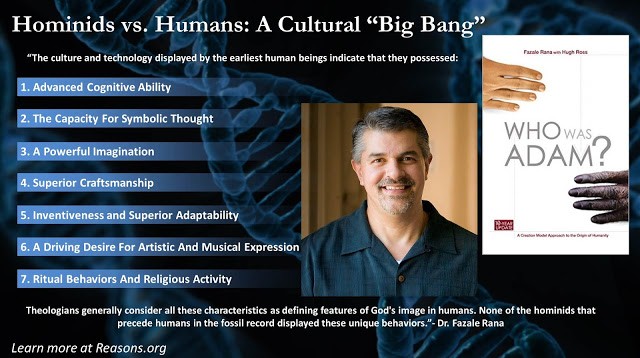
In order to argue for the intrinsic value of humans, Dr. Fazale Rana offers several lines of evidence for the sudden appearance of the Image of God in life’s history (which happens to coincide with the sudden appearance of humans on the scene). He calls this sudden appearance a “cultural big bang”:

luke nix graphic 1

These pieces of evidence include:

Advanced cognitive ability

The capacity for symbolic thought

A powerful imagination

Superior craftsmanship

Inventiveness and superior adaptability

A driving desire for artistic and musical expression

He goes into great detail about the anthropological discoveries of scientists over the years in his book “Who Was Adam.” In the third section of the book, he addresses modern challenges to his conclusions and brings in the latest discoveries over the past decade. The cumulative, scientific case presented in the book for the Image of God coinciding with the appearance of the human race, by extension, is a powerful evidential case for humans possessing intrinsic value.

Conclusion

It is vital to a proper theory of ethics (and even politics) that we know whether humans possess intrinsic value or not. Ultimately, if humans are created in the Image of God, as argued by Dr. Rana, then the idea that humans possess intrinsic value accurately describes the reality of our species. If humans are intrinsically valuable, that serves as the foundation for how we ought to treat one another (ethics) and that further guides how we should govern one another. If humans are not created in the Image of God (do not possess intrinsic value), then all sorts of heinous treatment of them are permissible even by those who wield the most power (governments and politicians).

Recommended resources related to the topic:

Stealing From God by Dr. Frank Turek (Book, 10-Part DVD Set, STUDENT Study Guide, TEACHER Study Guide)

Legislating Morality: Is it Wise? Is it Legal? Is it Possible? by Frank Turek (Book, DVD, Mp3, Mp4, PowerPoint download, PowerPoint CD)

Do Ethics Need God? by Francis Beckwith (Mp3)


Luke Nix holds a bachelor’s degree in Computer Science and works as a Desktop Support Manager for a local precious metal exchange company in Oklahoma.

Original Blog Source: http://bit.ly/2mvkci2

By Erik Manning

2 Timothy 3:16 says that all Scripture is “God-breathed.” Of course for Christians, this would include 2 Timothy, as well as the rest of the pastoral epistles. Skeptics find this verse to be ironic because many biblical critics think that the pastoral epistles were forgeries.

These letters claim to be written by the Apostle Paul, but they allegedly were really written sometime in the early 2nd-century, long after Paul was dead. Apparently, the forger wanted to address some doctrinal issues, and their own name wasn’t authoritative enough, so they borrowed Paul’s. So the “God-breathed” New Testament apparently contains some pious lies.

But are the critical arguments against the Pauline authorship of the Pastoral Epistles really an open and shut case? Not really. In fact, there’s some very good evidence that Paul did write these letters, and the arguments of the critics aren’t really all that strong.

This will be a 2-part series. First, we’ll first look at the positive case for Pauline authorship before digging into the critics’ objections in the next post.

The witness of the early church fathers

If there was anyone in a spot to know who wrote 1st and 2nd Timothy, it would have been the church father, Polycarp. In his letter to the Philippian church written in about 110 AD, Polycarp quoted 1 Timothy 3:8, 6:7, 6:10, and 2 Timothy 2:12. He also mentions Paul by name four times in his letter, including some indications that he was familiar with the apostle’s martyrdom.

On the significance of these early patristic quotes, here’s Biblical scholar Kenneth Berding. He makes two main observations in regards to Polycarp’s use of 1 and 2 Timothy:

“Observation #1:  The first is that Polycarp clusters allusions to Paul’s writings around each of the three times that he mentions Paul’s name explicitly (in chapters 3, 9, and 11).  You see, Polycarp is like some elderly Christians you may have met in your life who are so immersed in the Bible that they almost talk like the Bible.  Polycarp had huge sections of the Old and New Testaments committed to memory.  His letter could almost be described as a pastiche of allusions to various writings, about half of which are originally Paul’s.  (His connection to Paul in this letter makes sense, of course, since he is writing his letter to a Pauline congregation….the Philippians!)  Polycarp pretty randomly mixes allusions to Paul’s writings (half of his total allusions) with allusions to other writings (e.g., Psalms, Matthew, 1 Peter, 1 John).  But there is one significant exception:  when he mentions “Paul,” he clusters allusions to Paul right after the mention of his name.  He does this all three times he mentions Paul, showing that this is a pattern.

Observation #2:  In the first “cluster” of Pauline allusions are two clear allusions to 1 Timothy (1 Tim. 6:10 and 6:7 found in Pol. Phil. 4.1) and in the second “cluster” is one clear allusion to 2 Timothy (2 Tim. 4:10 found in Pol. Phil. 9.2).  There are none from the Pastoral Letters in the third cluster.

The implication of the first observation is that Polycarp considers the phrases in each cluster to be Pauline.  The implication of the second observation is that Polycarp considers the phrases which he quotes from 1 and 2 Timothy also to be from Paul.

This, of course, doesn’t prove that Polycarp is correct in his assessment.  But, as Koester writes, Polycarp was “doubtlessly the most significant ecclesiastical leader of the first half of II C. E.”

Critics say that the writer of the Pastorals was addressing Gnostic heresies of the late first and early second-century, so they were written around 110. But Polycarp was writing around the same time and seems convinced Paul wrote the letters. Irenaeus of Lyons tells us that Polycarp knew some of the apostles, in particular, John, whom Paul met. (Galatians 2:9). And he was familiar with Paul’s death, so this theory that the pastorals were written in the early 2nd-century is pretty strained.

Writing some 40-50 years later, Irenaeus explicitly mentions that Paul is the author of the Pastoral Letters. In his work Against Heresies, Irenaeus writes regarding heretics and says: “Paul commands us, ‘after a first and second admonition, to avoid” (Titus 3:10). Irenaeus also writes that Paul says to avoid those who use “novelties of words of false knowledge” (1 Tim 6:20).

Furthermore, the author of the Didache (a very early Christian writing dated to the late 1st-century) clearly quotes 1 Timothy 3:4. The Pastorals are also quoted by Clement of Alexandria (180 AD), Tertullian (220 AD) and Origen (230 AD). The witness of the early church is pretty clear. They quoted the pastorals as authoritative, and they believed the letters genuinely be from the Apostle Paul.

Undesigned Coincidences

If you’re forging a letter from someone and you want to make it believable, you’re going to color it with some overt connections with their previous letters and life-details. Some critics say this exists when the writer of Timothy talks about Paul’s former life as a church persecutor. (1 Tim. 1:13-16) But there are some less obvious interconnections in the pastorals that seem very unlikely to be intentional. These point to Paul being the genuine author of the letters.

These come in the form of undesigned coincidences. What the heck is an undesigned coincidence anyway? An undesigned coincidence (named by J.J. Blunt and first popularized by William Paley) happens when one account of an event leaves out a piece of info which is incidentally filled in by a different account, which helps to answer some natural questions raised by the first. You can read more about them here.

Lydia McGrew has recently revived and updated this older argument in her fantastic book Hidden in Plain View. It’s a must-read for anyone interested in defending the reliability of the New Testament.  For our purposes, we’ll look at three undesigned coincidences where Acts and 1 and 2 Timothy seem to incidentally interlock.

Timothy’s Upbringing

The first is about Timothy himself. 2 Timothy 1:5 says “I am reminded of your sincere faith, a faith that dwelt first in your grandmother Lois and your mother Eunice, and now, I am sure, dwells in you as well.”. 2 Timothy 3:15 gives us some more details about Timothy’s upbringing: “and how from childhood you have been acquainted with the sacred writings, which are able to make you wise for salvation through faith in Christ Jesus.” 

So Timothy was steeped in the Jewish scriptures and in the faith. These details fit well together with what we read in Acts 16:1-3: “Paul came also to Derbe and to Lystra. A disciple was there, named Timothy, the son of a Jewish woman who was a believer, but his father was a Greek. He was well spoken of by the brothers at Lystra and Iconium. Paul wanted Timothy to accompany him, and he took him and circumcised him because of the Jews who were in those places, for they all knew that his father was a Greek.”

In Acts, we learned Timothy’s father was Greek and apparently drew the line at circumcision, but his mother was a Jewish convert to Christianity. That’s why he would’ve been familiar with the scriptures since he was a child. 2 Timothy mentions his grandmother but not his father. Neither group of details seems to be in connection with the other. McGrew concludes that “this undesigned coincidence has the ring of truth. Timothy’s father was a Greek, and his mother was Jewish, he was raised from childhood in the knowledge of the Old Testament Scriptures, and both the author of 2 Timothy and the author of Acts knew about him and described him accurately.” (HIPV, 200) 

Timothy’s familiarity with Paul’s trials

2 Timothy 3:10-11 says: “You, however, have followed my teaching, my conduct, my aim in life, my faith, my patience, my love, my steadfastness, my persecutions and sufferings that happened to me at Antioch, at Iconium, and at Lystra—which persecutions I endured; yet from them all the Lord rescued me.” This raises an interesting question. Paul went through a lot of persecutions, so why mention Antioch, Iconium, and Lystra as ones that Timothy would be familiar with?

In Acts 16:1, we read that Timothy was known as a believer when Paul came to Derbe and Lystra. Both cities are near Iconium, so Timothy must have been from one of them.

In the run-up to these verses, Acts gives us the rundown on the persecution of Paul experienced during his first missionary journey in Antioch (13:44–52), Iconium (14:5), and then Lystra (14:19). Paul was stoned and thought dead in Lystra in particular, so surely word got around about this event. It must’ve made quite an impression on a young believer like Timothy. Furthermore, Paul calls Timothy his “beloved child” (2 Timothy 1:2), suggesting he played a role in him becoming a Christian.

McGrew sums up this undesigned coincidence as follows: “Notice how indirect all of this is. One infers from II Timothy that Paul had some special reason to mention those persecutions to Timothy and to say that they were known to Timothy. One notes the point in Acts 13–14, where the narrative describes persecutions in those towns. One then infers from Acts 16 that Timothy was already a disciple from that region and had been converted during Paul’s previous visit to the region, described in Acts 13–14, during which the persecutions took place.” (HIPV, 203)

The Roster of Widows

For our last undesigned coincidence, we notice that in 1 Timothy 5:9-10 there are some instructions on how to help widows: “Let a widow be enrolled if she is not less than sixty years of age, having been the wife of one husband, and having a reputation for good works: if she has brought up children, has shown hospitality, has washed the feet of the saints, has cared for the afflicted, and has devoted herself to every good work.” 

The conservative dating of 1 Timothy is in the early 60s, three decades after some of the stories related in Acts, which includes details of a ministry devoted to assisting widows. With that in mind, check out Acts 6:1-4: “Now in these days when the disciples were increasing in number, a complaint by the Hellenists arose against the Hebrews because their widows were being neglected in the daily distribution. And the twelve summoned the full number of the disciples and said, “It is not right that we should give up preaching the word of God to serve tables. Therefore, brothers, pick out from among you seven men of good repute, full of the Spirit and of wisdom, whom we will appoint to this duty. But we will devote ourselves to prayer and to the ministry of the word.”

So Paul implies that this listing of widows has been a tradition that’s been well-established, and he’s laying out some specifics how Timothy is to carry it out in his neck of the woods. We’d expect this kind of clarification if this practice had been carried out for a while and there needed to be some further practical instructions given since some women were abusing the system. (1 Tim 5:13-14)

Here’s William Paley’s summary on this particular undesigned coincidence: “Now this is the way a man writers, who is conscious that he is writing to persons already acquainted with the subject of his letter; and who, he knows, will readily apprehend and apply what he says by virtue of their being so acquainted: but it is not the way in which a man writes upon any other occasion” (Horae Paulinae, pp 300-301)

Personal References

There are a lot of personal references made in the pastorals. The writer mentions a lot of individuals that he had a connection with during his missionary journeys. In 1 Timothy 1:20, he names Hymenaeus and Alexander as false teachers.

In 2 Timothy, he not only mentions Eunice and Lois by name (which we touched on earlier) but he also blesses Onesiphorus for his kindness that he showed him at Rome and Ephesus (2 Tim 1:16-18) He talks about a number of disciples forsaking him during his trials, such as Demas, Crescens and Titus.  (v. 4:10-11) He mentions Mark and Luke and asks Timothy to bring him his scrolls. (v11-13) He then asks Timothy to greet Priscilla and Aquila. He mentions Erastus and says he left Trophimus sick in Miletus. (v. 19-20)

In Titus 3:12, he asks Titus to join him once Artemas or Tychicus arrive to replace him. He also mentions some fellow workers, like Apollos and Zenas the lawyer (Titus 3:12-13)

If such allusions to people and circumstances were spun out of thin air by a forger pretending to be Paul, you’d think that such a sham would be easily exposed. But as we said earlier, none of the church fathers doubted the letters’ genuineness.

Paul wrote the Pastorals

There’s some very good evidence for the genuineness of Paul’s letters to Timothy that seems to go ignored by critics. They tend to focus on more granular internal inconsistencies and quibbles about grammar, which we’ll discuss in my next post. But as we’ve seen, the witness of the early church strongly favors that Paul wrote these letters based on their statements and use of the letters. And the internal evidence of undesigned coincidences between Acts and the pastoral letters is another strong argument in favor of the genuineness of the letters. The claim that Paul wrote these letters stands on solid ground.

Recommended resources related to the topic:

The New Testament: Too Embarrassing to Be False by Frank Turek (DVD, Mp3 and Mp4)

Why We Know the New Testament Writers Told the Truth by Frank Turek (DVD, Mp3 and Mp4)

The Top Ten Reasons We Know the NT Writers Told the Truth by Frank Turek (Mp3)


Erik Manning is a former atheist turned Christian after an experience with the Holy Spirit. He’s a freelance baseball writer and digital marketing specialist who is passionate about the intersection of evangelism and apologetics.