
Tag Archive for: theology

By Bob Perry

Every year at Thanksgiving, we can count on seeing lists of things people are thankful for. I understand the desire to be grateful for all our blessings. There is no doubt about the fact that too many of us take those kinds of things for granted. It is also understandable that the religious origins of Thanksgiving compel us to tie our thankfulness to God. But being grateful seems to come with a parallel assumption that being “blessed” means being healthy, wealthy, and happy. God wants us to have our “best life now.”

When Culture Invades The Church

Being one that has his antennae up to detect cultural assumptions that find their way into the church, it occurred to me that this might be one of them. After all, we are called to have “the mind of Christ.” Everyone agrees on that. But it was Christ who said, “In this world, you will have trouble. But take heart! I have overcome the world.” (John 16:33)

So, if Jesus promised us we would have trouble:

I’m wondering why we would expect the Christian life to be without it …

I’m wondering why we think we deserve “our best life now”…

I’m wondering why we would think the words we speak have the power to make things turn out the way we desire them to be when Jesus never said any such thing…

Why does our thankfulness always seem to depend on our happiness? And why is it that it is only when we are happy that we attach the heartfelt announcement that “God is so good!” to the Thanksgiving lists we make?

What About The Unpleasant Things?

One of the biggest objections to the existence of God is that there is evil and suffering in the world. Critics of Christianity wonder how a good God could allow us to experience these if he claims to love us so much?

It’s a good question. And, to be consistent, we ought to be able to answer it. So, I decided to make a Thanksgiving list of my own.

  • I’m thankful for separation from family and friends. It makes me cherish the time they’re with me even more…
  • I’m thankful for suffering. It challenges those who witness it to show compassion to the sufferers…
  • I’m thankful for poverty. It pleads with us to be charitable to those who are less fortunate than we are…
  • I’m thankful for fear. It teaches us courage…
  • I’m thankful for unanswered prayer.  It requires us to be patient…
  • I’m thankful for sickness. It exposes how helpless we really are…
  • I’m thankful for loneliness. It forces us to realize that we are not the center of the universe…

Rousing A Deaf World

This may seem like a weird list but I made it for a reason. You see, I believe Joni Eareckson Tada who says that the accident that broke her neck and has left her a quadriplegic since she was a teenager, “was the best thing that ever happened to her.” The suffering she has experienced forced her to question the purpose of her life. And in her search for purpose, she sought and found God.

I believe C. S. Lewis when he says that

“God whispers to us in our pleasures, speaks in our consciences but shouts in our pains. It is his megaphone to rouse a deaf world.”

I believe that if James, the brother of Jesus can be beaten, taken to the top of the Jerusalem Temple and thrown off, then stoned to death because he survived the fall; if Peter can endure the sufferings we learn of in his epistles and then die crucified upside down; if Paul can be beaten, tortured and left for dead in a ditch outside Lystra, then stoned, imprisoned and beheaded on a Roman street, I believe him when he writes that, “we rejoice in our sufferings, knowing that suffering produces endurance, and endurance produces character, and character produces hope …” (Romans 5:3-4)

The early church spread and grew because it was being persecuted. If suffering was good enough for the apostles, I’m not sure why it isn’t good enough for me.

Preaching What We May Practice

Of course, all of this is easy to say sitting here in my home office in my suburban American neighborhood. But sooner or later I may be forced to practice what it is so very easy for me to preach. I believe these are the kinds of things we ought to be thinking about now. Because if the suffering starts, that is not the time to start wrestling with its purpose. It’s hard to understand why your life is in turmoil when you’re looking at it from inside the storm.

Jesus Christ sweated blood. He was flogged and beaten mercilessly and then nailed to a cross to hang there until he died. If being sanctified means being made more like Christ, I think we should stop thinking that suffering is not for us. Maybe we should start thinking about what it really means to be sanctified.

The Purpose Of Pain

No one likes pain. But we should be contemplating its purpose before we have to experience it. And that means trusting that God created this world to annihilate evil, suffering, and pain forever. His purpose for this life centers on him, not us. Getting sanctified means developing eternal virtues like charity, compassion, patience, courage, and humility.

Happiness is not a virtue.

So this Thanksgiving, I say we start telling the truth. Instead of just expecting the pleasure, let’s start anticipating the pain. And let’s start looking to show more compassion for those who already are experiencing it. Let’s do so with full knowledge of the reason we are all called to endure it — because it leads to our transformation into someone better.

As a good friend of mine recently pointed out, when you raise your hands in praise and thanksgiving, you form a “greater-than sign” that puts God in his proper place, and you in yours.

Let’s remember that regardless of our circumstances, we have an eternal purpose. It is bigger than us. And God is good whether we’re doing well at the moment or not. Let’s raise our hands with gratitude. But let’s be thankful for that too.

Recommended resources related to the topic:

Jesus, You and the Essentials of Christianity – Episode 14 Video DOWNLOAD by Frank Turek (DVD)

How Philosophy Can Help Your Theology by Richard Howe (DVD Set, Mp3, and Mp4)   


Bob Perry is a Christian apologetics writer, teacher, and speaker who blogs about Christianity and the culture at truehorizon.org. He is a Contributing Writer for the Christian Research Journal and has also been published in Touchstone, and Salvo. Bob is a professional aviator with 37 years of military and commercial flying experience. He has a B.S., Aerospace Engineering from the U. S. Naval Academy, and an M.A., Christian Apologetics from Biola University. He has been married to his high school sweetheart since 1985. They have five grown sons.

Original Blog Source: https://cutt.ly/vgCEtCs

By Bernard Mauser

Do not be anxious about anything, but in every situation, by prayer and petition, with thanksgiving, present your requests to God. Philippians 4:6

Thanksgiving means different things to different people. Some say it is about food, family, and football. Others, that it’s a break from work or a time to stand outside of your favorite store to get Christmas gifts for a great price. Tied up with this celebration in history is the religious element of giving thanks to God for His blessings.

There are two things to keep in mind about Thanksgiving. First, there is the holiday that people celebrate around the world. Second, there is the command that Christians are to be people who constantly give thanks in every situation. Although the history of the holiday is interesting, the more important is the second. Christians recognize, as did our founders, Thanksgiving should be a time to thank the true Ruler of the nations. Let’s look at both the historical and the Christian background.

First, when you ask kids what they know about Thanksgiving they’ll talk about turkey and Pilgrims. The first Thanksgiving in the New World was celebrated with the Pilgrims in 1621. There are only two original sources that mention this celebration. We discover this report (using modern spelling) from Edward Winslow:

“our harvest being gotten in, our governor sent four men on fowling, that so we might after a special manner rejoice together, after we had gathered the fruits of our labors; they four in one day killed as much fowl, as with a little help beside, served the Company almost a week, at which time amongst other Recreations, we exercised our Arms, many of the Indians coming amongst us, and amongst the rest their greatest king Massasoit, with some ninety men, whom for three days we entertained and feasted, and they went out and killed five Deer, which they brought to the Plantation and bestowed on our Governor, and upon the Captain and others. And although it be not always so plentiful, as it was at this time with us, yet by the goodness of God, we are so far from want, that we often wish you partakers of our plenty.”[1]

William Bradford adds, “besides waterfowl there was a great store of wild turkeys, of which they took many.”[2] We find the original celebration lasted three days and the menu included deer, fowl, and turkey.

George Washington issued the following proclamation of Thanksgiving on October 3, 1789 to God for his protection and the blessings God has conferred upon us as a nation:

By the President of the United States of America. a Proclamation.

Whereas it is the duty of all Nations to acknowledge the providence of Almighty God, to obey his will, to be grateful for his benefits, and humbly to implore his protection and favor—and whereas both Houses of Congress have by their joint Committee requested me “to recommend to the People of the United States a day of public thanksgiving and prayer to be observed by acknowledging with grateful hearts the many signal favors of Almighty God especially by affording them an opportunity peaceably to establish a form of government for their safety and happiness.”

Now therefore I do recommend and assign Thursday the 26th day of November next to be devoted by the People of these States to the service of that great and glorious Being, who is the beneficent Author of all the good that was, that is, or that will be—That we may then all unite in rendering unto him our sincere and humble thanks—for his kind care and protection of the People of this Country previous to their becoming a Nation—for the signal and manifold mercies, and the favorable interpositions of his Providence which we experienced in the course and conclusion of the late war—for the great degree of tranquillity, union, and plenty, which we have since enjoyed—for the peaceable and rational manner, in which we have been enabled to establish constitutions of government for our safety and happiness, and particularly the national One now lately instituted—for the civil and religious liberty with which we are blessed; and the means we have of acquiring and diffusing useful knowledge; and in general for all the great and various favors which he hath been pleased to confer upon us.

and also that we may then unite in most humbly offering our prayers and supplications to the great Lord and Ruler of Nations and beseech him to pardon our national and other transgressions—to enable us all, whether in public or private stations, to perform our several and relative duties properly and punctually—to render our national government a blessing to all the people, by constantly being a Government of wise, just, and constitutional laws, discreetly and faithfully executed and obeyed—to protect and guide all Sovereigns and Nations (especially such as have shewn kindness unto us) and to bless them with good government, peace, and concord—To promote the knowledge and practice of true religion and virtue, and the increase of science among them and us—and generally to grant unto all Mankind such a degree of temporal prosperity as he alone knows to be best.

Given under my hand at the City of New-York the third day of October in the year of our Lord 1789.

Go: Washington[3]

After this time, various leaders in America proclaimed different days of Thanksgiving to be held throughout the United States. Yet there was no fixed day upon which all the nation would devote to such an observance until a woman named Sarah Josepha Hale wrote a letter to Lincoln which implored him to make “Thanksgiving a National and fixed Union Festival…. To become permanently an American custom and institution.”[4] On October 3, 1863, Lincoln declared a national day of “Thanksgiving and Praise to our beneficent Father who dwelleth in the Heavens” to be held the last Thursday of November. It has been held on this day in America ever since.

Long before any of these celebrations in America, the Israelites had instituted peace offerings to God as a way of giving thanks. Moses instructed the Israelites in Leviticus 7 about these peace offerings in order to maintain fellowship with God. This practice continued throughout history in many nations as men have recognized both that God is the ruler of all the nations and that every good and perfect gift comes from Him. (James 1:17) The Thanksgiving holiday is an excellent time to remind us of this important outflow of thanksgiving that should be sewn into every part of every day. Let us never go a day without giving our Maker and Ruler both thanks and praise.

Notes

[1] https://www.pilgrimhall.org/pdf/TG_What_Happened_in_1621.pdf

[2] Ibid.

[3] https://founders.archives.gov/documents/Washington/05-04-02-0091

[4] http://www.abrahamlincolnonline.org/lincoln/speeches/thanks.htm

Recommended resources related to the topic:

Jesus, You and the Essentials of Christianity – Episode 14 Video DOWNLOAD by Frank Turek (DVD)

How Philosophy Can Help Your Theology by Richard Howe (DVD Set, Mp3, and Mp4)   


Bernard Mauser became a Christian in 1999 after trying to refute Christianity. Upon finding out Christianity is true, I went on for my first Masters at Southern Evangelical Seminary (in Christian Apologetics) and completed my second Masters and Ph.D. (in Philosophy) at Marquette University. His professional publications are in the areas of natural law ethics, religious pluralism, and Biblical hermeneutics.

Original Blog Source: https://cutt.ly/7gXs6D6

By Brian Huffling

Several of my previous blogs have dealt with divine simplicity and some objections to the doctrine. As I have written, it is the most important divine attribute, even if it is hotly debated.

Those who accept simplicity are on a completely different theological trajectory from those who reject it.

I would argue that its acceptance puts one on the trajectory to classical theism while its denial puts one on the trajectory to process theology since its rejection implies or outright states that God changes and is thus in a process. If simplicity is true, then God is without potency, or the potential to change. If he is without the potential to change, then by definition he cannot change—it is impossible. He is thus immutable. He is in a state of being, not in a state of becoming.

This leads to another important doctrine, and almost as disputed as divine simplicity: divine impassibility. If God cannot change, then he cannot be affected by anything in a passive way. We cannot make God any different than he is. We don’t make him happy, sad, upset, etc. We don’t add or take away from him in any way. In other words, he is impassible.

In short, this doctrine denies there are passions in God that are changed by his creation. God does not have human emotions. Stating this doctrine, especially to those who have never heard it, usually upsets people. They tend to get emotional about it. After all, doesn’t the Bible teach that God gets angry, jealous, pleased, and the like? Yes, it does. It also teaches that God has a body if we take it literally. God “went down” to Sodom and Gomorrah to see what they were doing (Gen. 19). God is said to have nostrils (Ex. 15:8), ears (2 Sam. 22:7), fingers (Ps. 8:3), and many other body parts. However, orthodox Christians do not believe that the Bible is literal when it says this. After all, John 4:24 says “God is Spirit.” So, if the Bible uses such figurative terms for God having a body, why wouldn’t we take the emotional language to be just as figurative? Historically passions have been tied to physical bodies.

Since God is not physical, he has no passions.

But how do we know that the passages that talk about God being physical aren’t literal, and the passages that talk about him being spiritual aren’t figurative? The answer is in one word: philosophy. We use our philosophical views to interpret Scripture. Since we have arguments and reasons to believe that God is immaterial, eternal, immutable, omnipresent, etc., Scriptures that describe God in contradictory ways to these attributes must be figurative. This should not be surprising given the fact that the Bible tells us that we can know God’s “invisible attributes, namely, his eternal power and divine nature, [which] have been clearly perceived ever since the creation of the world, in the things that have been made” (Rom. 1: 20).

So, what does the Bible mean when it says things like God is angry or jealous? It is using figurative language to express a literal truth about God. God is described as angry because he brings about effects and results in a similar way that angry people do, such as wrath, judgment, and destruction. He is said to be jealous since he is against his people going after other gods. This is similar to describing God as a fortress. It should be obvious that God is not made of brick and mortar, but he is similar to a fortress in that he is immovable and stable.

Since the Bible is not a philosophy or theology textbook but rather a collection of letters to his people, it is not surprising that it describes God in such figurative ways. This is really not avoidable. Most people don’t have the time or inclination to study God on a metaphysical level. Thus, the writers of the Bible wrote it so that the words would resonate with its readers. They could have written a dissertation on God being immutable, or they could just say that God is a fortress or a rock. These figurative descriptions resonate with people since figurative language is so highly used. The same is the case with God being angry about sin. We all know what that means. It means that God is against sin and he takes action against it. Even if one didn’t have the metaphysical background to recognize the figurative use of the language, he would still be right in knowing that in some way God is against sin.

Let me say a word about the incarnation as it usually comes up in discussions on divine impassibility. Divine impassibility has only been attributed to the divine nature. It does not hold that Jesus’ human nature is without passions or is immutable. The one person of Jesus has two natures: divine and human. They are not confused (do not overlap). The divine nature is wholly divine while the human nature is wholly human (without sin). So, while it is true that Jesus is God, his human nature is still a human nature, passible, and changeable, while his divine nature remains untouched by human passions or changes in any way.

Like divine simplicity, divine impassibility has fallen on hard times. Many today hold that a being that cannot be affected by our plights, fears, problems, etc. is not a person, not the God of the Bible, and not worthy of worship. Such a God is often compared to the Unmoved Mover of Aristotle that did not care about the world but only contemplated himself. Such is the view of thinkers like William Lane Craig. Consider his answer to a question asked on his website:

“The view that God is in no way affected by creatures is called the impassibility of God. . . . God cannot suffer emotional pain. Divine impassibility was thought by medieval Christian theologians to be one of the attributes of God. So you would find many Christians historically who would agree with [this] view. But on the contemporary scene, there are very few theologians who would defend such a doctrine. There seems to be no good reason for taking the biblical descriptions of God’s emotions non-literally. Far from seeing susceptibility to emotional pain as a weakness, most contemporary Christian philosophers and theologians would say quite the opposite: that it is a weakness for a person to be unmoved by human suffering and a strength to feel emotions, including pain, indignation, compassion, etc. In fact, think of the etymology of the word ‘compassion’: to suffer along with. As the greatest conceivable being, God must be compassionate and share our sorrows and joys. Impassibility is actually a weakness, whereas compassion redounds to God’s greatness.”

This is a fairly typical response from those who hold that God is passible. Notice that there is no philosophical or theological argument here, simply an emotional appeal. It is indeed a weakness for humans to be “unmoved by human suffering,” but we are not talking about a human. We are talking about God. Such blurring of the Creator/creature distinction occurs when we reject divine simplicity.

Having said all that, it is not the case that God as an impassible being is uncaring toward our suffering. This is a mischaracterization of the God of classical theism and the God of the Bible. Being impassible does not equate to being uncaring or unloving. It simply means that given the kind of being God is (based on philosophical investigation that is legitimate even according to the Bible) he is not the kind of being to be affected. He is perfect in himself without any addition or subtraction to his being.

To be the kind of being to be affected he would have to be changeable, temporal, and composed (by whom?). But to be changeable and temporal is to be in a process of change, or just simply in a process. Thus, to agree that God is passible, changeable, and temporal would to agree on some level with process theology. How can God change and suffer along with us without being in a process? Again, either classical theism is true, or process theology is true. There is no third option as attributes like simplicity, immutability, impassibility, and eternality (in the classical sense) are contradictory with their opposites. In other words, either they are true or not.

To modify these attributes is to deny them.

Would we really want God to be moved or suffer along with us like other humans do? Surely he knows of our happiness and sorrows, but does that mean he must be sorrowful with us to understand or care about us? (Again I am speaking of the divine essence, not the human nature of Jesus.) Should we not want a God of stability who cannot be moved or changed by anything? Such would seem to be a God more worthy of worship as we can always count on him being the same. Such also seems to be closer to the God of the Bible.

It should be clear that the acceptance or rejection of simplicity and other classical doctrines such as immutability and impassibility are vital for classical theism, and their rejection leads one to the only other option: process theology.

Recommended resources related to the topic:

What is God Really Like? A View from the Parables by Dr. Frank Turek (DVD, Mp3, and Mp4)

What is God Like? Look to the Heavens by Dr. Frank Turek (DVD and Mp4

How Philosophy Can Help Your Theology by Richard Howe (DVD Set, Mp3, and Mp4)  


J. Brian Huffling, PH.D. has a BA in History from Lee University, an MA in (3 majors) Apologetics, Philosophy, and Biblical Studies from Southern Evangelical Seminary (SES), and a Ph.D. in Philosophy of Religion from SES. He is the Director of the Ph.D. Program and Associate Professor of Philosophy and Theology at SES. He also teaches courses for Apologia Online Academy. He has previously taught at The Art Institute of Charlotte. He has served in the Marines, Navy and is currently a reserve chaplain in the Air Force at Maxwell Air Force Base. His hobbies include golf, backyard astronomy, martial arts, and guitar.

Original Blog Source: https://cutt.ly/MgPDZpX

By Brian Chilton

This past Sunday, my family and I stopped by a local antique store after church. We were there for no reason but to check out their merchandise to see, as my wife says, “if there was anything that we couldn’t live without.” As we navigated our way through the aisles of the store, a sign appeared before me with a message that I needed to hear. The sign read, “Never be afraid to trust an unknown future to a known God.” I have heard people asking God for a sign. I have asked God for the same. Nevertheless, God gave me a literal sign for the moment.

As a bit of a backdrop, my family and I had just attended the last service where I served as pastor. I am about to embark on a new phase of ministry. As such, our lives are in a state of transition. Change is often difficult for us all. Yet this sign served as a reminder that God is not only over all places, God is over time itself which means that we can trust the knowable God with our unknown future. Here are a few reasons why we can believe the sign’s statement.

God is Transcendent. God’s transcendence indicates that God is not restricted by creation. This is something that truly baffles my mind. As a stargazer, I found myself lying on the ground last night looking up at the stars. I found myself lost in the beauty of the Large Magellanic Cloud band of the Milky Way galaxy. I was in awe of the intensity of the glow of Jupiter, Saturn, and Mars. And then it hit me. As immense as the universe is with its numerous stars, planets, and galaxies; the universe and all its parts still do not compare to the transcendent majesty of God. God is not restricted by creation, but rather creation is subdued under the transcendent Creator’s authority. With this in mind, believers can face an unknown future with the confidence that God is able to come through for them in ways that no other being has the capacity to do. God’s sphere of transcendence places him on a level that no other being could attain. God is the highest and greatest of all possible beings.

God is Omnipresent. Omnipresence is God’s attribute that describes God’s ability to be in all places at all times. God is not restricted by space. Therefore, God can always transcend locations enabling God to be near to all people. Paul had this idea in mind when he said to the Athenians that God is “not far from each one of us” (Acts 17:27). God reveals that he fills both heaven and earth through his prophet Jeremiah, saying, “Do I not fill the heavens and the earth” (Jer. 23:24)? While we may not know what tomorrow brings, we can face the future with confidence knowing that God’s presence is always with us.

God is Omnitemporal. God’s omnitemporality indicates that God is the Lord of time. Isaiah writes, “Do you not know? Have you not heard? The Lord is the everlasting God, the Creator of the whole earth. He never becomes faint or weary; there is no limit to his understanding” (Isa. 40:28). Alan Padgett contends that God is the Lord of time. Time flows from the being of God. Padgett writes,

“To say that God is the Lord of time would include the fact that he is not limited by any amount of time, either in the actions he can perform or the length of his life. While humans can fear the passage of time, because it brings them closer to the end of their life, God is everliving. He cannot die, and has nothing to fear from the future” (Padgett, GEATNOT, 123).

Since God is the everliving and everlasting God, then God’s children have nothing to fear from the unknown future because God is already in the future, as such. Even death cannot intimidate the believer as the everliving God has granted eternal life to those who trust in him.

God is Omnisapient. Finally, God is omnisapient. Omnisapience refers to the all-wise God. Omnisapience (all-wisdom) differs from omniscience (all-knowledge) in the sense that while knowledge understands certain data, wisdom knows how to make the best decisions with the data available. Wisdom references good decision making. God, being the all-wise God, makes the best decisions for our lives even when those decisions do not make sense to us. Since God is the only being who is self-existent, self-sustaining, omnipresent, and transcendent; God then has access to information that none of us could ever possess. God is love (1 John 4:8). As such, God desires the very best for us, especially God’s children. Therefore, people can trust their lives and their future to the all-wise God.

I am certain that I am not the only person who faces uncertainty in life. With society in turmoil and the world facing a pandemic, nearly everyone has been impacted by the tensions of uncertainty. Nevertheless, we do not need to fret if we trust God. Oswald Chambers rightly holds that our fears arise when we place our trust in humanity or in our own abilities. Chambers notes,

“Our Lord trusted no man; yet He was never suspicious, never bitter, never in despair about any man because He put God first in trust; He trusted absolutely in what God’s grace could do for any man. If I put my trust in human beings first, I will end in despairing everyone; I will become bitter, because I have insisted on man being what no man can ever be—absolutely right. Never trust anything but the grace of God in yourself or in anyone else” (Chambers, MUFHH, 152).

Rather than placing your trust in your abilities or the abilities of other people, trust God with your future. While our future may be unknown to us, the future is fully and completely known by the known God.

Sources

Chambers, Oswald. My Utmost for His Highest. The Classic Edition. Uhrichsville, OH: Barbour, 1935.

Padgett, Alan G. God, Eternity, and the Nature of Time. Eugene, OR: Wipf & Stock, 1992.

Recommended resources related to the topic:

Jesus, You and the Essentials of Christianity – Episode 14 Video DOWNLOAD by Frank Turek (DVD)

What is God Really Like? A View from the Parables by Dr. Frank Turek (DVD, Mp3, and Mp4)

What is God Like? Look to the Heavens by Dr. Frank Turek (DVD and Mp4

How Philosophy Can Help Your Theology by Richard Howe (DVD Set, Mp3, and Mp4)  


Brian G. Chilton is the founder of BellatorChristi.com, the host of The Bellator Christi Podcast, and the author of the Layman’s Manual on Christian Apologetics. He received his Master of Divinity in Theology from Liberty University (with high distinction); his Bachelor of Science in Religious Studies and Philosophy from Gardner-Webb University (with honors); and received certification in Christian Apologetics from Biola University. Brian is enrolled in the Ph.D. program in Theology and Apologetics at Liberty University and is a member of the Evangelical Theological Society and the Evangelical Philosophical Society. Brian formerly served as a pastor for nearly 20 years.

Original Blog Source: https://bit.ly/3l0RLlk


By Ry Leasure

If you’ve read through the gospels, you’ve probably noticed that they share much in common. In some places, the wording is exactly the same. In other places, they’re so different it looks like they might contradict. These similarities and differences are often dubbed the synoptic problem. The word synoptic means “to see together.” The synoptic problem has led scholars to ask, why are there similarities in the gospels? And also, why are there differences?

The prevailing theory amongst scholars is that the similarities in the synoptic gospels (Matthew, Mark, and Luke) can be explained by the authors’ use of the same sources. Most believe Mark wrote his gospel first, and that both Matthew and Luke used Mark to compile their gospels. They’ve reached this conclusion because roughly 90% of Mark is found in Matthew, and about 60% is contained in Luke. Additionally, both Matthew and Luke shared another common source known as a “Q” – taken from the German word Quelle, meaning “source.” This sayings source explains Matthew and Luke’s common material not found in Mark. And then, both Matthew and Luke had their separate individual sources – sometimes referred to as M and L – which explains their own unique material. Luke’s prologue gives us a bit of a sneak peek into this process (Lk. 1:1-4).

In sum, these different sources explain both the similarities as well as the differences. Some, however, have tripped up over the differences. In fact, many go so far as to suggest that the gospels contradict one another. One such example is found in Jesus’ genealogies, to which we now turn our attention.

Jesus’ Genealogies

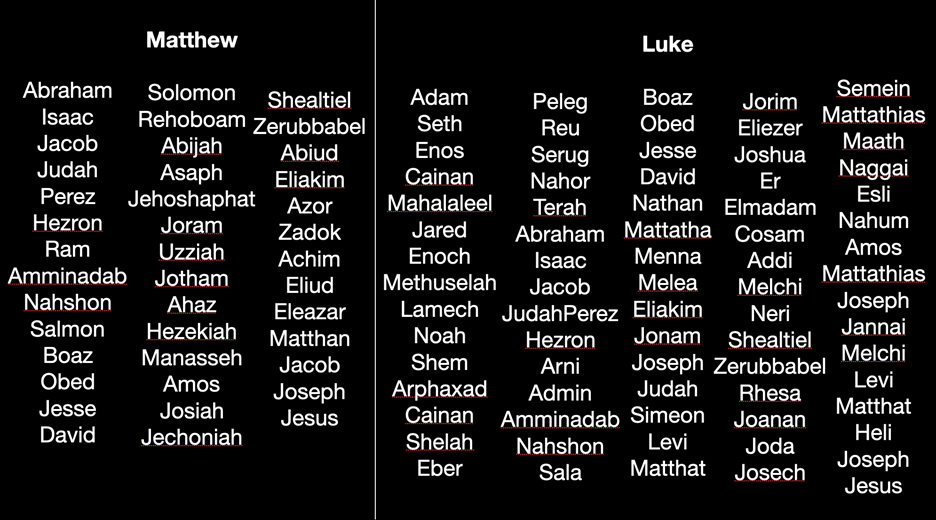
Only Matthew and Luke contain Jesus’ genealogy. And one side-by-side comparison reveals that the genealogies are radically different. So much so, that skeptics believe they’re irreconcilable. I’ve listed the genealogies from Matthew 1:1-18 and Luke 3:23-38 below for your convenience. Take a quick look at them so you can better understand the skeptic’s complaint:

Jesus’ Genealogies

At first glance, one glaring difference exists – Luke’s genealogy is much longer than Matthew’s. The reason? Luke traces Jesus’ genealogy all the way back to Adam while Matthew stops at Abraham. In both genealogies, the line from Abraham to David is roughly the same. But once we move past David, the genealogies diverge. Matthew traces Jesus’ genealogy through David’s son Solomon, while Luke traces the line through David’s son Nathan. Also, notice that Joseph has a different father in each account – Jacob in Matthew, Heli in Luke. How can we reconcile these differences? Lest we be tempted to think this is anything new, the church has dealt with this issue for almost two thousand years. And throughout that time, three different explanations have been given to explain the differences.

Option 1: Joseph vs. Mary’s Genealogy

One of the more popular explanations for the differences is to suggest that Matthew traces Joseph’s genealogy while Luke traces Mary’s. If this is true, the difference in genealogies makes sense. Think about your own genealogy for a moment. If you were to trace your father’s line and your mother’s line, you would get radically different family trees. Your father’s father and your mother’s father have different names. In Jesus’ case, his father’s father is Jacob while his mother’s father is Heli.

The reason some take this approach is because Matthew focuses his attention on Joseph in the birth narratives while Luke focuses more on Mary. In Luke, he describes Gabriel’s conversation with Mary, Mary’s Magnificat, and Mary’s visit to her cousin Elizabeth. Moreover, even though Luke doesn’t mention Mary in the genealogy, he couches Jesus’ sonship to Joseph by saying “as it was supposed” (Lk. 3:23). Each of these clues indicates that Luke didn’t intend to give us Joseph’s ancestry but Mary’s. 

Option 2: Royal vs. Biological Genealogy

Another explanation for the differences is that Matthew traces Jesus’ royal line with an emphasis on his Messianic claim to the throne while Luke traces Jesus’ biological line. According to this view, Matthew gives us several clues to suggest that he’s giving us a theological genealogy with an emphasis on King David, not a strict biological line. 

For starters, Matthew begins the genealogy by stating, “The book of the genealogy of Jesus Christ, the son of David, the son of Abraham” (Mt. 1:1). It’s well-known that Matthew writes to a primarily Jewish-Christian audience who would have understood the expectation that the Messiah would come through the line of David (2 Sam. 7:12-16; Isa. 9:6-7; 11:1-5; Jer. 23:5-6). Therefore, from the outset, he tips off his readers to where he’s going with this genealogy. 

Second, the mention of “Christ” alongside the name of Jesus in verse 1 also indicates Matthew’s intentions. While many may think of “Christ” as Jesus’ last name, it’s actually a title. It’s the Greek title for the Messiah. So, when Matthew prefaces his genealogy by stating that it’s the genealogy of Jesus Christ, he’s giving further evidence to his readers that his intention is to demonstrate that Jesus comes in the kingly line of David.

A third indicator that Matthew isn’t giving us a biological line but a royal one is his breakdown of the genealogy into groups of fourteen. In verse 17 we read, “So all the generations from Abraham to David were fourteen generations, and from David to the deportation to Babylon fourteen generations, and from the deportation to Babylon to the Christ fourteen generations.” 

A couple of points are worth noting here. Biblical scholars agree that the refrain “father of” or “son of” in genealogies don’t necessarily mean one generation after the next. Often times, genealogies will skip several generations. The language simply means that one is the ancestor of the next person in the line. Another point worth noting is the significance of the number fourteen and the Hebrew concept of Gematria. Gematria was the practice of ascribing a numerical number to a Hebrew letter – the first letter of the Hebrew alphabet (Aleph) has the numeral value of one and so on. Interestingly, the numerical value of David is fourteen. D(4) V(6) D(4) – 4 + 6 + 4 = 14.

It’s as if Matthew has a giant neon sign flashing “Son of David!” Luke doesn’t use any of these literary devices. He simply records the biological line of Jesus. And while Americans may be unfamiliar with the concept of royal lines, our British friends know that the line doesn’t always pass down neatly from father to son. In fact, the current queen of England inherited the throne from her father who inherited it from his brother. And the next king will probably be the queen’s grandson. All that to say, the royal line often diverges from the biological line.

Option 3: Levirate Marriage

A third explanation for the differences is the use of Levirate marriage. Levirate marriage is detailed in Deuteronomy 25:5-10 and states that if a married man dies without a male heir, his brother or closest relative must marry and seek to propagate with the widow in order to carry on the name of his deceased brother. This practice explains the Sadducees’ question to Jesus about which man would be a woman’s husband in heaven after going through seven brothers who all died (Mt. 22:24-28). 

On this theory, something like the following scenario plays out: Jacob (Joseph’s father in Matthew’s genealogy) died before producing a male heir with his wife. Then, in order to fulfill the Levirate laws, Heli (a close relative of Jacob’s), marries Jacob’s widow and then conceives with his new wife which brings about Joseph. If this type of scenario played out, Joseph would be the legal son of Jacob and the biological son of Heli. Then Matthew traces Jacob’s line backwards to Abraham while Luke traces Heli’s line back to Adam. Scholars have listed several of these scenarios where something like this happened.

What’s the Best Explanation?

As I consider the three options, one of the options seems the least tenable. And that is option 1. While many have employed this option to explain the differences, Luke specifically states Joseph as the next person in Jesus’ genealogy, not Mary. He couches this relationship by stating “as it was supposed” because of his knowledge of the virgin birth. More than that, ancient Jewish genealogies always passed through the male’s line, not the female’s. Luke would have understood Jesus as Joseph’s adopted son.

This leaves options 2 and 3 as viable explanations, and my personal opinion is that a combination of the two best explains the differences in genealogies. Matthew clearly isn’t trying to give us a strict chronology with how he groups the names into lists of fourteen. Moreover, by tracing the line through king Solomon instead of Nathan like Luke, Matthew seeks to emphasize the royal nature of Jesus’ line. The levirate marriages could also help explain why different names exist in the genealogy as well.

In the end, we can’t be entirely certain which option is right. But one thing is for certain: we have viable explanations for why the genealogies are different in Matthew and Luke. 

Recommended resources related to the topic:

The New Testament: Too Embarrassing to Be False by Frank Turek (DVD, Mp3, and Mp4)

Why We Know the New Testament Writers Told the Truth by Frank Turek (DVD, Mp3 and Mp4)


Ryan Leasure holds a Master of Arts from Furman University and a Masters of Divinity from the Southern Baptist Theological Seminary. Currently, he’s a Doctor of Ministry candidate at the Southern Baptist Theological Seminary. He also serves as a pastor at Grace Bible Church in Moore, SC.

By Brian Huffling

What do these questions have in common: Does God exist? Can God change? Does God know our future? How can a good God allow evil? How do humans know? What does it mean to know? What does it mean to be good? Can we objectively interpret the Bible? The answer: all of these questions are inherently philosophical.

With the recent decision by a very prominent evangelical institution to remove their philosophy department, why should anyone at all care about philosophy? Some would argue that Christians shouldn’t care about philosophy because, as Luther so colorfully put it, philosophy “is the devil’s whore.” In other words, man’s (autonomous) reason cannot be trusted. We only need to preach the gospel and not worry about worldly philosophy. Many in our culture argue that philosophy is mere opinion, worthless, impractical, and a waste of time. The study of philosophy is often seen as useless and a waste of a good education that could have otherwise been helpful in finding a good-paying job. Ironically, the reasons given for such positions are necessarily philosophical. Why? Because philosophy is unavoidable.

I personally found this out when I enrolled at Southern Evangelical Seminary in the fall of 2004. I initially enrolled at SES to study apologetics. I had no idea the impact philosophy would have on me. My first three courses were Intro to Apologetics, Old Testament Survey, and Hamartiology, and Soteriology (Sin and Salvation). None of these courses were inherently philosophical, at least so I thought. Dr. Tom Howe taught Old Testament Survey, and Dr. Norman Geisler taught the other two courses. As it turned out, all these courses were loaded with philosophy.

For example, Dr. Howe demonstrated the role philosophical presuppositions play in arguments marshalled against Mosaic authorship of the Pentateuch (the first five books of the Old Testament). Such presuppositions were the product of rationalist thinkers like Descartes, Spinoza, and Hume. Dr. Geisler demonstrated the role philosophy plays in talking about the nature of truth, God’s existence, and miracles. He even showed how our philosophy of man determines our view of the soul and its relationship to the body (which is important for sin and salvation). Later, Dr. Howe demonstrated how integral philosophy is to hermeneutics (interpreting and understanding a text).

I found out that a philosophy course called Metaphysics (the study of being as such) was being offered in January of 2005. I asked Dr. Doug Potter, the SES Registrar if I should take that class. “Yes,” he said, “it’s the foundation of all that we do.” I really didn’t know what that meant, but I took it. As it turns out, from a philosophical standpoint, it really is the foundation for all that we do, whether in biblical studies, language studies, hermeneutics, etc. Philosophy really is unavoidable.

Recommended resources related to the topic:

How Philosophy Can Help Your Theology by Richard Howe (DVD Set, Mp3, and Mp4)   


Dr. Brian Huffling’s research interests include Philosophy of Religion, Philosophical Theology, Philosophical Hermeneutics, and general issues in Apologetics and Biblical studies. 

Original Blog Source: https://bit.ly/2DHtfWo 

By Brian Chilton

Pelagius was a fifth-century British monk who caused a stir during his time. He denied the doctrine of original sin. As such, he believed that no one was truly impacted by sin, but rather chose to do evil rather than good by one’s own free will. Concerning salvation, Pelagius believed that Christ served as a salvific example. Therefore, God’s grace was not necessary to save a person, and neither was the atoning work of the cross. Rather, a person was saved by choosing God. Pelagius held to a doctrine that focused on man rather than God. A derivative of the doctrine is found in what is called semi-Pelagianism, the belief that God bestows grace after a person chooses God. Many have erroneously credited Wesleyanism and Arminianism as adhering to this viewpoint. Both John Wesley and Jacob Arminius believed that God’s grace first moved on a person before the person was given the opportunity to embrace or reject that grace. Semi-Pelagianism held that the person first chose God before God’s grace was granted. There is a nuanced difference between the two perspectives. While the nuance seems small, it holds major implications. Nonetheless, I digress.

Augustine of Hippo confronted Pelagius’s beliefs and noted that the grace of God was essential to overcome a person’s sinful inclinations. While still accepting the person’s freedom of the will, he noted that the grace of God was necessary to bring about a person’s salvation. Rather than emphasizing humanity as did Pelagius, Augustine rested the emphasis on God. In matters of trouble, God’s grace was needed. Augustine writes, “Therefore, also, does grace aid, good men, in the midst of present calamities, so that they are enabled to endure them with a constancy proportioned to their faith” (Augustine, City of God 22.22.4, 501). Even in matters of adopting a true philosophy, God’s grace was required. Augustine notes, “So that even those against whom we are disputing have been compelled to acknowledge, in some fashion, that the grace of God is necessary for the acquisition, not, indeed, of any philosophy, but of the true philosophy” (Augustine, City of God 22.22.4, 501). In Augustinian thought, God’s grace was necessary to overcome the sinful inclinations of human beings. As such, salvation was truly God’s gracious gift to humanity.

The Church recognized the errors of Pelagianism and condemned the view as heretical in 415 at the synod of Jerusalem. It is important to note that despite their differences, Augustine always treated Pelagius with the utmost respect, something from which modern believers could learn. (For a fuller treatment on the issue, see Wyatt Graham’s article “Augustine’s Surprising Treatment of Pelagius” at the Gospel Coalition. It can be found here)

Far too often, people think that they must do things or accomplish certain tasks to earn God’s favor. They think that their efforts politically, socially, or otherwise determine their standing with God, siding with the idea that a person must be x, y, or z to be a Christian. However, such thinking illustrates the adoption of a modern form of the Pelagian heresy. The apostle Paul reminds us, “For you are saved by grace through faith, and this is not from yourselves; it is God’s gift—not from works so that no one can boast. For we are his workmanship, created in Christ Jesus for good works, which God prepared ahead of time for us to do” (Eph. 2:8–10). Relish in the grace that God has afforded to you. Allow that grace to shine in your life so that others can see Jesus in you. Finally, trust in God’s sovereign plan. For me, the latter is the most difficult, as faith does not come easy to this cynical mind.

Source

Augustine of Hippo. “The City of God.” In St. Augustine’s City of God and Christian Doctrine. A Select Library of the Nicene and Post-Nicene Fathers of the Christian Church. Volume Two. Edited by Philip Schaff. Translated by Marcus Dods. Buffalo, NY: Christian Literature Company, 1887.

Postlude

Concerning human freedom, one example of Augustine’s acceptance of human freedom is found in the following quote.

“It is He who, when He foreknew that man would in his turn sin by abandoning God and breaking His law, did not deprive him of the power of free-will, because He at the same time foresaw what good He Himself would bring out of the evil, and how from this mortal race, deservedly and justly condemned, He would by His grace collect, as now He does, a people so numerous, that He thus fills up and repairs the blank made by the fallen angels, and that thus that beloved and heavenly city is not defrauded of the full number of its citizens, but perhaps may even rejoice in a still more overflowing population” (Augustine, City of God 22.1.2, 480).

Recommended resources related to the topic:

Is Original Sin Unfair? (DVD Set), (mp4 Download Set), and (MP3 Set) by Dr. Frank Turek

Jesus, You and the Essentials of Christianity – Episode 14 Video DOWNLOAD by Frank Turek (DVD)

How Can Jesus Be the Only Way? (mp4 Download) by Frank Turek


Brian G. Chilton is the founder of BellatorChristi.com, the host of The Bellator Christi Podcast, and the author of the Layman’s Manual on Christian Apologetics. He received his Master of Divinity in Theology from Liberty University (with high distinction); his Bachelor of Science in Religious Studies and Philosophy from Gardner-Webb University (with honors); and received certification in Christian Apologetics from Biola University. Brian is enrolled in the Ph.D. program in Theology and Apologetics at Liberty University and is a member of the Evangelical Theological Society and the Evangelical Philosophical Society. Brian has been in the ministry for nearly 20 years and serves as the Senior Pastor of Westfield Baptist Church in northwestern North Carolina.

Original Blog Source: https://bit.ly/3ly6dSN 

By Alex McElroy

The reality of a moral law as well as the implications of immoral decisions is all too apparent. History is rife with the fallout from moral disagreement and disengagement. Embedded within the realm of moral epistemology is the problem of evil. Not only does the problem of evil loom large, but also cannot be reduced to a unilateral issue. Feinberg writes, “There is a final respect in which there is no such thing as the problem of evil. In recent years, philosophers have distinguished between a logical form of the problem of evil and an evidential form. Problems about moral evil, natural evil, the quantity of evil, evil’s intensity, apparently gratuitous evil, animal pain, and the problem of hell can all be posed in either a logical or an evidential form.”[1] Both the Christian and the naturalist must attend to the multifaceted problem of evil. The question is who has more warrant for affirming and addressing the reality of some instance of moral evil? The ontological reality of what is morally right or wrong must be validated without gaps in the epistemic chain of how one comes to know what is truly right or wrong. Additionally, the viability of a worldview must be able to justify the moral facts, knowledge, transformation, and the rationality of morality, by which good and evil are evaluated. Naturalism is incapable of meeting this standard on all fronts but here the focus will be solely on moral transformation. It seems that Christian theism provides a more coherent explanation for achieving moral transformation than naturalism.

Moral Transformation

The Apostle John wrote, “Beloved, now we are children of God; and it has not yet been revealed what we shall be, but we know that when He is revealed, we shall be like Him, for we shall see Him as He is” (1 John 3:2, NKJV). The Apostle Paul wrote, “Not that I have already attained, or am already perfected; but I press on, that I may lay hold of that for which Christ Jesus has also laid hold of me” (Phil. 3:12). Scripture is rife with the notion that man is imperfect and in need of a process of perfection. This process is a felt reality by men and women of all worldviews. What is equally felt is the understanding that one cannot complete this process of perfection with the faculties present within himself. This is one of several problems with a naturalistic defense of moral transformation. Naturalism also fails to provide a target by which one could determine if transformation has been achieved. Finally, the deterministic nature of naturalism cannot sustain the mechanisms necessary for moral transformation.

Moral Telos

Not only does naturalism lack the means to ground a moral law, it cannot fulfill the desire one has to grow or become more moral. If transformation is the goal there must be a telos, or purpose. Whether transformation has taken place cannot be accurately assessed unless there is a target for one to aim at. Naturalism cannot tell a man where to direct his moral growth; therefore he never knows if he arrives. Baggett and Walls write, “Despite the prodigious efforts of some secularists to retain the category of a human telos, Daniel Dennett assumes that, on naturalism, all ultimate explanations must be mechanistic, so that the teleological, where it occurs, must be explained in mechanistic terms. This is potentially question-begging on his part, but it is also just where the theist would demur and reverse the order.”[2]

Without a goal, naturalistic moral transformation is reduced to moral pragmatism. A constantly shifting goalpost further impacts any process of moral transformation. What some people used to consider morally acceptable two hundred years ago (i.e. slavery) is no longer deemed morally acceptable. While this is a valid and life affirming change, it demonstrates that the moral code written by men and nations is anything but objective. This brings new life to the saying that you cannot hit a moving target. However, Christianity provides a static target and therefore a consistent and unchanging measure by which to judge one’s moral transformation. God Himself is the ontic point of reference for what one means by the term “good”. Therefore, to be more like Him becomes the goal achieved through a lifelong process of sanctification. Malachi 3:6 and Hebrews 13:8 affirm that God the Father and Jesus are unchanging and co-eternal. The Apostle Peter writes, “but as He who called you is holy, you also be holy in all your conduct, because it is written, ‘Be holy, for I am holy’” (1 Peter 1:15-16). Throughout Scripture, the reality of man’s imperfection is reiterated. However, just as often, the notion that man needs to engage in the lifelong process of submitting to the perfecting presence of God is repeated as well.

Removing God, as the ontic point of reference, by whom and to whom humanity is directed has severe implications. The atheist Friedrich Nietzsche who wrote the parable of the madman, where he proclaimed the “Death of God”, which is to say, the death of the idea of God captures this well. Entailed within this belief is the idea that God is no longer a necessary entity for the existence of a moral code. He wrote:

Where has God gone?’ he cried. “I shall tell you. We have killed him – you and I. We are his murderers. But how have we done this? How were we able to drink up the sea? Who gave us the sponge to wipe away the entire horizon? What did we do when we unchained the earth from its sun? Whither is it moving now? Whither are we moving now? Away from all suns? Are we not perpetually falling? Backward, sideward, forward, in all directions? Is there any up or down left?[3]

Nietzsche recognized that removing God would remove all barriers, which previously contained man’s moral capabilities. Nietzsche asks, “Whither are we moving now?…Are we not perpetually falling? Backward, sideward, forward, in all directions? Is there any up or down left?” In other words, where does humanity find purpose and through what means can morality remain objective? Without a goal, the game becomes aimless. Therefore, moral transformation can never take place, because without an objective the quest for moral transformation becomes a moral hamster wheel. There is no way to affirm progress even if it does take place.

Means for Moral Transformation

Bertrand Russell wrote:

That man is the product of causes which had no prevision of the end they were achieving; that his origin, his growth, his hopes and fears, his loves and his beliefs are but the outcome of accidental collocations of atoms; that no fire, no heroism, no intensity of thought and feeling, can preserve an individual life beyond the grave; that all the labors of the ages, all the devotion, all the inspiration, all the noonday brightness of human genius, are destined to extinction in the vast death of the solar system, and that the whole temple of man’s achievement must inevitably be buried beneath the debris of a universe in ruins—all these things, if not quite beyond dispute, are yet so nearly certain that no philosophy which rejects them can hope to stand. Only within the scaffolding of these truths, only on the firm foundation of unyielding despair, can the soul’s habitation henceforth be safely built.[4]

The lovely portrait Russell paints notwithstanding, an “accidental collocation of atoms” does not provide the foundation for eventual appeals to objective morality. Accidents cannot produce intent. However, moral values and their counterparts remain steadfast in spite of any one individuals knowledge of them. Additionally, pure naturalism is also pure determinism. Libertarian free will is a necessary prerequisite for making moral decisions.

The free will necessary for human beings to make moral choices is well founded in Christian theism, but the deterministic components of naturalism do not provide an epistemically sound pathway for humans to arrive at moral transformation. Baggett and Walls write,

Meaningful agency is a central piece of the human puzzle, distinguishing us from both animals driven by instinct alone and automatons following their programming. Genuine free will requires, at a minimum, the sort of agency enabling morally significant decisions for which we can be properly ascribed blame or praise. In a naturalistic world, such freedom, we think, is hard to come by.[5]

Naturalism forces humans to rely purely on the aptitudes present within him or herself. What becomes clear as one progresses through life is that in order to achieve moral perfection one would need to have access to someone that exemplified such a standard and has the capability to endue her with the capacity not currently present within herself. Christianity posits such an individual in the person of Jesus Christ. Through faith in Christ, the Holy Spirit is deposited into the life of the Christian, thereby allowing him to be transformed into something that he is not. God does not lock humans into static states of deterministic behavior, but through free will allows individuals to acquiesce to His nature and moral standard. Christianity provides the means for moral transformation.

Conclusion

Most people can identify with the longing to be more moral than one was last year. Christianity provides a purpose for that longing as well as the means through which it may be achieved. Without God, this longing becomes very peculiar and even worth denying. For this reason, Christian theism provides a more coherent explanation for moral knowledge, facts and rationality, as well as for achieving moral transformation than naturalism. Lewis wrote, “If I find in myself a desire which no experience in this world can satisfy, the most probable explanation is that I was made for another world.”[6] To this one could add, if moral transformation is the goal and no one in this world can achieve it of his or her own volition, then perhaps something or someone otherworldly is needed.

Notes

[1] John Feinberg, The Many Faces of Evil: Theological Systems and the Problems of Evil. (Wheaton, IL: Crossway, 2004), 24.

[2] David Baggett and Jerry Walls, God and Cosmos: Moral Truth and Human Meaning. (New York: Oxford University Press, 2016), 269.

[3] Friedrich Nietzsche (translated with commentary by Walter Kaufmann), The Gay Science: With a Prelude in Rhymes. (New York, NY: Vintage Books, 1974), 181.

[4] Bertrand Russell, Mysticism and Logic. (New York: Barnes & Noble, 1917), pp. 47–48.

[5] Baggett, God and Cosmos, 277.

[6] C.S. Lewis, Mere Christianity. (New York, NY: Harper Collins, 1952), 136.

Recommended resources related to the topic:

Legislating Morality (mp4 download),  (DVD Set), (MP3 Set), (PowerPoint download), and (PowerPoint CD) by Frank Turek

Legislating Morality: Is it Wise? Is it Legal? Is it Possible? by Frank Turek (Book, DVD, Mp3, Mp4, PowerPoint download, PowerPoint CD)

Is Morality Absolute or Relative? by Dr. Frank Turek DVD, Mp3 and Mp4


Alex McElroy is an international speaker, apologist, leadership advisor, author of the book “Blueprint for Bible Basics” and writer for the blog “Relentless Pursuit of Purpose.” He is one of the founding Pastor’s of at Engage Community Church and formerly the Pastor of Education at New Life Covenant Southeast Church, led by Pastor John F. Hannah with 20,000 members. For over 14 years Alex has served in both youth and adult teaching ministries. Alex has also trained hundreds of teachers and ministers so they are equipped to deliver lessons in Biblical study, purpose, leadership and Apologetics in order to maximize their effectiveness in and for the Kingdom of God. He is a firm believer that everyone is born on purpose with a purpose. He teaches people all over the world to find the purpose God has placed inside of them and to deliver it to the world.

By Doug Potter

In my earliest days of attempting to do apologetics, I was confronted in the church with the objection that relying on philosophy, particularly arguments for the existence of God, was not only unwise, it was unbiblical. Upon inquiring why, they attempted to persuade by pointing me to the Apostle Paul, who seems to discourage the use of philosophy. In I Corinthians, Paul wrote:

And when I came to you, brethren, I did not come with superiority of speech or of wisdom, proclaiming to you the testimony of God. For I determined to know nothing among you except Jesus Christ, and Him crucified…and my message and my preaching were not in persuasive words of wisdom, but in demonstration of the Spirit and of power, so that your faith would not rest on the wisdom of men but on the power of God. (1 Corinthians 2:1-5)

Hence, well-meaning believers expected me to toss out my human arguments for God’s existence and focus on the truths of Scripture, even if we must just presuppose them to be true. At least then, they reasoned, you will have the confidence that the Holy Spirit’s power is in your teaching and gospel presentation. Furthermore, they thought it wise, like Paul, to avoid the weak human reason relied on by the so-called wise men of his day which are like the philosophers of our day. After all, he wrote in Colossians:

See to it that no one takes you captive through philosophy and empty deception, according to the tradition of men, according to the elementary principles of the world, rather than according to Christ. (Colossians 2:8)

Rhetorically these well-meaning believers asked, does that not close the case on using philosophy in ministry?

I have since learned, to the contrary, this often-spoken objection fails in three ways.

First, it not only misses the mark of correct biblical interpretation but approaches the kind of sophistry the apostle Paul was trying to avoid in Corinth. Second, it reveals an inadequate understanding of the Apostles’ overall apologetic method found in Scripture, which allows and anticipates the use of good philosophy. Third, it fails to see that while no one in the Bible gives a deductive argument for the existence of God, it does anticipate their use by providing reasons for the existence of God.

Biblical Interpretation

To properly understand any text, one must understand the context. For any ancient text that means learning about the history, culture, language, words, and grammar of the text. When it comes to the above passage in First Corinthians, just knowing the historical context fixes the above misinterpretation.

The apostle Paul arrived in Corinth in 49 BC, just after the Isthmian games had concluded. He would have observed a Roman colony steeped in the second sophistry movement (1st Cent. AD). The first sophistry movement (5th Cent. BC) grew out of classic Greek philosophy, relied on rhetoric, arguments of persuasion, effective communication, and regardless of success, at least considered the pursuit of truth a worthy endeavor. This first movement declined over the next three centuries. The second movement never revived what the first movement held dear and instead degenerated to persuasion to win admiration and disciples for their schools in hopes of taking down their competition.[1] The truth, for them, was irrelevant. Dio Chrysostom (c. 40 – c. 115 AD) arrived in Corinth about 40 years after Paul and observed:

So, when the time of the Isthmian games arrived, and everybody was at the Isthmus…That was the time when one could hear crowds of wretched sophists around Poseidon’s temple shouting and reviling one another, and their disciples, as they were called, fighting with one another, many writers reading aloud their stupid works, many poets reciting their poems while others applauded them, many jugglers showing their tricks, many fortunetellers interpreting fortunes, lawyers innumerable perverting judgment, and peddlers not a few peddling whatever they happened to have. (Discourses 8.5-10)

Paul was observant of the culture in which he reasoned and preached the gospel (Acts 17:22). He likely decided to lay aside his rhetorical skills and persuasiveness of speech (all of which he used in his letters) so as not to confuse the messenger and message with the “debaters of this age” (1 Corinthians 1:20). This way, he might be heard, the power of the gospel clear, and the signs of a true apostle (2 Corinthians 12:12) evident. In doing so, Paul in no way discounted or denied the existence of a good philosophy that allows arguments and persuasion to precede the truth of the gospel.

To suggest that Paul would permanently jettison good reason and argument is to approach the stupidity of the sophists of his day.

The passage from Colossians, likewise, has a context of dealing with some “one.” This is a term Paul uses for specific false teachers (Galatians 1:7) even though the false teacher is unnamed. Paul also is using the two parallel substantives “[the] philosophy and empty deception” which most likely suggests some close association between the words. Hence, Paul is not discounting all philosophy, but “philosophy” that is deceitful or runs counter to Christ. Indeed, Paul affirms earlier in this letter that in Christ is “all the treasures of wisdom and knowledge” (Colossians 2:3). Paul’s use of the term “philosophy” like others in his day, is broader (then it is used today) and can be applied to any system of thought including religion and division within.[2] Hence, Paul cannot be refereeing to all philosophy, but a philosophy from a false teacher that is according to the tradition of men which is against Christ. In other words, bad philosophy.

As C.S. Lewis persuasively preached in a 1939 sermon on the brink of a second world war: “To be ignorant and simple now — not to be able to meet the enemies on their own ground — would be to throw down our weapons, and the betray our uneducated brethren who have, under God, no defense but us against the intellectual attacks of the heathen. Good philosophy must exist, if for no other reason, because bad philosophy needs to be answered.”

The Apostle Paul’s Apologetic Method

Paul was a first-century apostle fixed on the proclamation of the gospel (1 Corinthians 2:2; 15:3-7). But such, many times was preceded or followed up by intense argumentation, reason, and evidence. Most who Paul met to preach the gospel either believed that there was one and only one God (the Jews) or believed there were many gods (the Greco-Roman Pagans). To the Jews he could appeal to the Hebrew Scripture to argue and reason from fulfilled prophecy that Jesus was the Christ and His appearances that proved the one true God raised him from the dead. Indeed, Acts is replete with descriptions of Paul’s defense (apologetic) of the gospel that involved “reasoning” (Acts 17:2, 17; 18:4, 19; 19:8, 9; 26:23) and “persuasion” (Acts 17:4; 19:26; 18:24). To the Pagans he could appeal to creation as to why there was only one God and the claim of Christ to be the Son of God, his death, burial, and appearances as evidence and proof for the miracle of the resurrection (Acts 14:15-17; 17:22-34). Paul lays out in Romans his understanding of Pagans: why they know the true God from creation (not Scripture) but because of their sin have exchanged this truth for a lie:

For the wrath of God is revealed from heaven against all ungodliness and unrighteousness of men who suppress the truth in unrighteousness, because that which is known about God is evident within them; for God made it evident to them. For since the creation of the world His invisible attributes, His eternal power and divine nature, have been clearly seen, being understood through what has been made, so that they are without excuse. For even though they knew God, they did not honor Him as God or give thanks, but they became futile in their speculations, and their foolish heart was darkened…Therefore God gave them over in the lusts of their hearts to impurity, so that their bodies would be dishonored among them. For they exchanged the truth of God for a lie, and worshiped and served the creature rather than the Creator. (Romans 1:18-25)

Even though Paul held that Pagans had exchanged knowledge of the true God for a lie, he still appealed to the reason for the true God from creation (Acts 14:15-17; 17:22-34) before giving the gospel to them.

Biblical Reasons for the Existence of God

I read a book that said nowhere does the Bible give reasons for God’s existence. His existence is just assumed everywhere. While I agreed that there are no deductive arguments for God’s existence to be found in Scripture, I do not agree that the Bible merely assumes His existence everywhere. Indeed, the fact that the Bible and Jesus say creation had a beginning (Genesis 1:1; Mark 10:6), implicitly entails a cosmological reason for there to be a Beginner of Creation. The Psalmist poetically declares a teleological reason for God to be, “The heavens are telling of the glory of God; And their expanse is declaring the work of His hands” (Psalm 19:1f). And the apostle Paul implies a moral law Writer if every human has a “law written in their hearts” (Romans 2:14-15). Rhetorically I ask, does this not open the case to use reasons for God’s existence?

As shown above, the Apostle Paul does not negate the application of reason in philosophy. Therefore, such can be done in at least two ways. First, to use philosophy for proving the existence and nature of God. Second, to illustrate the consistency of revealed doctrines in Scripture and argue against false doctrine. Hence, human reason and evidence can support faith and the preaching of the gospel. No passage illustrates this better than First Peter 3:15:

Sanctify Christ as Lord in your hearts, always being ready to make a defense [apologetic] to everyone who asks you to give an account for the hope that is in you, yet with gentleness and reverence.

Luke explains to the faithful his method and reason for writing his Gospel,

Inasmuch as many have undertaken to compile an account of the things accomplished among us, just as they were handed down to us by those who from the beginning were eyewitnesses and servants of the word, it seemed fitting for me as well, having investigated everything carefully from the beginning, to write it out for you in consecutive order, most excellent Theophilus; so that you may know the exact truth about the things you have been taught. (Luke 1:2-4)

Indeed, we must acknowledge that faith is more certain than human reason when the authority is God himself since there is no higher authority. Hence, faith can be supported by reason and evidence, but it is never based on reason and evidence. As the professor, Norman Geisler, often taught, “apologetics can show that Christianity is true, but it can never be the basis for anyone to believe in Jesus Christ.” This must be left to the internal work of the Holy Spirit in a person’s life.

Hence, I agree that anywhere the Bible prohibits the use of philosophy, I will be the first to stop and obey. However, I am certain that the Bible nowhere prohibits Christians from using any valid and sound demonstration for God’s existence and any other truth that is evident to us or established apart from Scripture. As God not only inspired the Bible as His word, he also created the world, including rational human beings, who know, judge, and reason, and therefore can be persuaded by the truth. For anyone to limit you or me in ministry to the truth that is only found in the Bible, is to be cut off from all the truth God has revealed in and through and by creation.

Reference

[1] Bruce W. Winter, After Paul Left Corinth (Eerdmans, 2001), chapter 2.

[2] Douglas J. Moo, The Letter to the Colossians and to Philemon (Eerdmans, 2008), 185f.

Recommended resources related to the topic:

I Don’t Have Enough Faith to Be an Atheist (Paperback), and (Sermon) by Norman Geisler and Frank Turek 

Defending the Faith on Campus by Frank Turek (DVD Set, mp4 Download set and Complete Package)

Tactics: A Game Plan for Discussing Your Christian Convictions by Greg Koukl (Book)

So the Next Generation will Know by J. Warner Wallace (Book and Participant’s Guide)

Fearless Faith by Mike Adams, Frank Turek and J. Warner Wallace (Complete DVD Series)

Stealing From God by Dr. Frank Turek (Book)


Doug Potter is an Assistant Professor of Apologetics and Theology, Director of D.Min. Program, Registrar (B.S., 1991, M.A., 1992; M.A., 1998; D.Min., 2005). A writer, teacher, and speaker on Christian theology and apologetics, Dr. Potter is committed to maximizing every opportunity to prepare the next generation of believers to know what they believe and most importantly, why it is true. He is the author of Developing a Christian Apologetics Educational Program (Wipf & Stock, 2010) and co-author (with Dr. Norman Geisler) of the Teacher’s Guide for Twelve points that Show Christianity is True (NGIM, 2015). He has written and published articles in the Christian Apologetics Journal, The Homeschool Digest, as well as the Christian Research Journal. Currently, Dr. Potter writes popular books on Theology and Christian Apologetics.

Original Blog Source: https://bit.ly/2YMVf29

By Natasha Crain 

In my last article, Christian Naivety is Harming the Church’s Engagement with Today’s Culture; I identified four ways that I’ve seen many Christians respond with naivety to calls for discernment in today’s world. At the end, I asked, “How do we fix this?” and said my answer would be the subject of my next article. This is that article. Since this is a follow-up, please be sure to read my last post before this one for context.

Let me start by saying that the title of this article is a rather sweeping proposition. Obviously, this is a single article, the issues are complex, and I’m not claiming that what I write here is a complete answer to all the problems we have. But I want to offer what I see as some key levers needed to drive change in how Christians engage with today’s culture.

In my years as a marketing executive, I came to deeply appreciate one particular model that people in the marketing field have used for over one hundred years (in various shapes and forms). It’s a simple funnel that describes the psychological stages people go through before committing to an action:

AIDA model

Though this originates in marketing, I’ve noticed many times in the last few years how this model applies to so much in the area of ministry as well. As such, I’m going to use it as a framework for my current subject. If we want to move more Christians to the bottom of the funnel—the action point of being more discerning, less naïve, and better culturally engaged—here are the key levers I see at the awarenessinterest, and desire points leading there.

  1. Grow awareness of worldview differences by addressing biblical illiteracy.

Every time there’s a heated discussion on social media about some issue of discernment (calling out sin, the intersection of morality and politics, etc.), you can count about 5 seconds before a Christian drops a comment reminding everyone involved that Jesus says not to judge.

Or that Christians just need to “love” people (however, the person defines that).

Nothing to me represents a bigger lack of biblical literacy than when people make those two culturally popular comments, completely lacking in context and understanding of what the Bible says on these subjects.

Now, if research showed that Christians read their Bibles consistently and deeply and we were still seeing pervasive comments that suggest a lack of understanding, I would be writing here about the need for more guidance in Bible study. Guidance is surely important too, but the research shows many Christians aren’t even reading the Bible in the first place.

A study by LifeWay Research, for example, found that only 45 percent of those who regularly attend church read the Bible more than once a week. Almost 1 in 5 churchgoers say they never read the Bible, and that’s about the same number who read it every day.

If a person doesn’t realize that their understanding of the Bible lacks appropriate context and depth, they end up navigating the stormy cultural waters in whatever way happens to make sense to them based on what they think the Bible says. Ironically, without an accurate biblical anchor, their Christian views get completely watered down by the cultural waves…and discernment no longer functions effectively. They’re less able to engage effectively with culture because they aren’t even fully aware of how a biblical and secular worldview really differ.

A less naïve, more discerning church must start with deeper biblical literacy. This should be a top priority for churches everywhere.

  1. Grow interest in cultural engagement by addressing (lack of) conviction.

Even if a person gains a better understanding of what the Bible says on relevant cultural topics (the awareness I just addressed), it doesn’t mean they’ll be interested enough to become culturally engaged. There could be many reasons for that, but there’s one that’s especially problematic: a lack of conviction that Christianity is objectively (and exclusively) true.

Pew Research shows that 65 percent of Christians believe many religions can lead to eternal life. This, of course, is another example of pervasive biblical illiteracy; the Bible clearly claims that only through Jesus is there eternal life (see Chapter 7, “Did Jesus Teach That He’s the Only Way to God?” in Talking with Your Kids about Jesus for more on this). If a person believes that Christianity is one of many worldviews that ultimately leads to the same truth, they aren’t going to be all that interested in standing up for what they perceive to be just one of those so-called “truths.”

A church filled with Christians who lack conviction that Christianity is the one true worldview is a church filled with Christians who will never care enough to challenge a non-Christian culture.

This is why there’s a desperate need for apologetics in the church today (apologetics is the study of why there’s good reason to believe Christianity is true and how to defend the faith against various challenges). Christians need to understand: 1) the evidence for God’s existence (see chapters 1-6 in Talking with Your Kids about God); 2) why multiple religions cannot be true (see chapter 10 in Keeping Your Kids on God’s Side); 3) the evidence for the resurrection (i.e., the truth test for Christianity as the one true religion—see part 4 of Talking with Your Kids about Jesus); and 4) the evidence for the reliability of the Bible (see part 4 in Keeping Your Kids on God’s Side).

Knowing why there’s good reason to believe Christianity is objectively true—and why that truth makes an eternal difference—is a critically important step toward building a church that cares enough to stand for truth.

  1. Grow desired or engagement by destigmatizing the relationship between politics and religion.

Let’s now say that we have a person who is aware of what the Bible says on today’s hot topics, and they’re interested in engaging culture because they’re convicted that the Bible offers the one true picture of reality.

That doesn’t mean they’ll actually do something.

Marketers are well aware that awareness and interest do not always lead to a strong desire to do something because there’s often some kind of barrier. There are a lot of barriers I could list here with respect to cultural engagement, but a major one I’ve seen is the prevailing stigma about mixing politics and religion.

Just saying the words “politics” and “religion” in the same sentence immediately puts people on the defensive. Unfortunately, many pastors and Christian leaders have emphasized a generic dichotomy between the two areas, and over time the stigma of mixing them has grown. Consequently, when important cultural concerns arise—such as the ideology of the Black Lives Matter organization (which I discussed in the last couple of posts)—many Christians automatically bucket those questions into the “don’t touch this” category of “politics and religion,” as if it’s their Christian duty to stay out of it. Meanwhile, people start burning Bibles as part of BLM protests, and Christians are surprised! If you paid attention to their underlying ideology in weeks leading up to this, it’s not surprising at all.

We need to be able to think in more nuanced ways about the interaction of politics and religion if we’re ever going to have a more culturally engaged church that isn’t taken by naive surprise as hostility to Christianity increases.

Here are a few quick things I think we should be able to all agree on:

  • While some “political” issues are worldview neutral (e.g., local zoning laws), many are not (e.g., abortion or religious freedom laws).
  • When we’re talking about issues where biblical morality conflicts with secular morality, someone’s morality will be legislated; legislation based on a secular worldview isn’t the “neutral” option.
  • Acknowledging that there are political issues that involve the moral direction of our country and that Christians should care enough to be engaged in such areas, is not the same as saying one political party or the other represents Christianity. It’s also not the same as saying that we’re looking to a political leader to be our savior, or that we think we’ll eventually build an earthly utopia. These are often the strawmen people try to knock down when claiming Christians shouldn’t mix their faith with politics.
  • There are also many political areas where Christians can legitimately disagree. For example, we should all agree that God cares for would-be immigrants, but we may have very different policy opinions on how best to process immigration in this country. Identifying where grey exists is important for maintaining charitable conversation among Christians while uniting on issues that should be more black-and-white for anyone with a Christian worldview.

In short, we need to quit ending culturally relevant conversations before they begin by perpetuating the idea that politics and religion shouldn’t mix. Of course, they should, in some cases.

In all three of these areas, there is much that any pastor could do in a church through sermons, groups, studies, initiatives, and more. But that doesn’t mean others can’t make a significant impact as well. For example, you can:

  • Use social media to share biblically-sound articles that educate others about cultural issues from a Christian worldview. (I do my best to share a variety of such articles from my author Facebook page—you can follow me there if you don’t already.)
  • Take the time to engage in a thoughtful dialog when you see Christians make comments online that lack biblical understanding. It’s worth the time even if the person you initially respond to doesn’t seem to appreciate it—remember that others are reading too. If a comment is best addressed privately, do it that way. But resist the urge to just be silent because that’s the easy thing to do.
  • Lead a Bible study (online or in person, through your church or on your own).
  • Lead a book study that addresses current cultural questions from a biblical worldview.
  • Start a group to learn apologetics. (If you’re interested in starting a group specifically for parents and grandparents, we give you all you need to get going with Grassroots Apologetics for Parents. You can start an in-person or online chapter!)
  • Encourage your pastor to address more of these questions in sermons.
  • Work with your church to invite subject matter experts to provide training. Many of these experts are currently offering training online. For example, the Life Training Institute a 4-day Zoom event next week that anyone can sign up for: How to Survive Being Pro-Life on Campus in a Cancel Culture. Many apologetics speakers are also offering remote sessions right now. The Center for Biblical Unity is offering trainings on a biblical approach to current racial questions. So much is available!
  • Commit to the serious discipleship of your kids. They are literally the future. Training them in the same ways I’ve mentioned here for adults is just as important.

With more discernment from biblical literacy, more interest from conviction, and more willingness to engage by removing the “politics vs. religion” barrier, we can shape a better culturally engaged church. Perhaps one of the positives that will come from the chaos of this year will be a wider recognition that these things are so desperately needed in the body of Christ.

Recommended resources related to the topic:

American Apocalypse MP3, and DVD by Frank Turek

Correct, NOT Politically Correct: How Same-Sex Marriage Hurts Everyone (Updated/Expanded) downloadable pdf, Book, DVD Set, Mp4 Download by Frank Turek

The Case for Christian Activism MP3 Set, DVD Set, mp4 Download Set by Frank Turek

You Can’t NOT Legislate Morality mp3 by Frank Turek

Fearless Generation – Complete DVD Series, Complete mp4 Series (download) by Mike Adams, Frank Turek, and J. Warner Wallace


Natasha Crain is a blogger, author, and national speaker who is passionate about equipping Christian parents to raise their kids with an understanding of how to make a case for and defend their faith in an increasingly secular world. She is the author of two apologetics books for parents: Talking with Your Kids about God (2017) and Keeping Your Kids on God’s Side (2016). Natasha has an MBA in marketing and statistics from UCLA and a certificate in Christian apologetics from Biola University. A former marketing executive and adjunct professor, she lives in Southern California with her husband and three children.

Original Blog Source: https://bit.ly/30RAGmC