Tag Archive for: theology

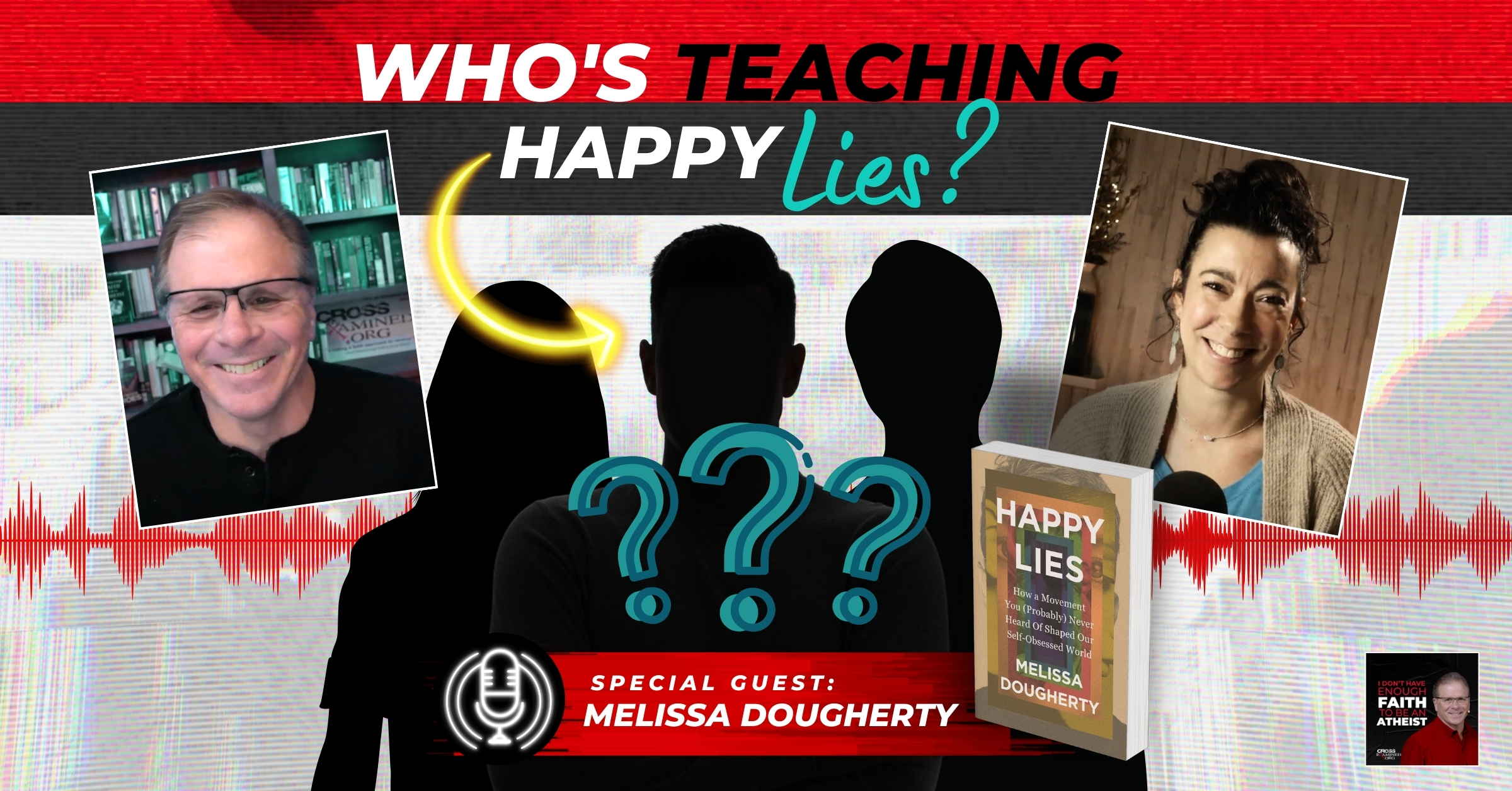
In last week’s episode, Melissa Dougherty, author of the brand-new book, ‘Happy Lies‘, joined Frank to discuss the foundational beliefs of the New Thought movement and how its theology has misled many well-meaning Christians. This week, Melissa is back to dig even deeper into the surprising and troubling connections between New Thought and the Word of Faith movement and to share names of specific teachers of this false doctrine. Tune in as they answer questions like:

  • How did the “seeker-friendly” church model begin and why doesn’t it work long-term?
  • Does Joel Osteen believe that we’re “little gods”?
  • Is it ok to name false teachers?
  • How can New Thought and Word of Faith potentially shipwreck your faith?
  • Would Jesus and the Apostles agree with these teachings?

You definitely don’t want to miss this eye-opening discussion about the origins of the so-called “Health, Wealth, and Prosperity Gospel”. Be sure to pre-order your copy of Melissa’s brand-new book, ‘Happy Lies: How a Movement You (Probably) Never Heard Of Shaped Our Self-Obsessed World‘ and listen to the previous podcast episode if you missed it last week!

If you enjoyed this podcast episode PLEASE HELP US SPREAD THE TRUTH OF CHRISTIANITY BY SUPPORTING OUR MINISTRY HERE. 100% of your donation goes to ministry, 0% to buildings!

Resources mentioned during the episode:

Are You Believing Happy Lies? (Part 1): https://bit.ly/4aihP69

Melissa’s Book – ‘Happy Lies’: https://a.co/d/igzRfqQ

Melissa’s Website: https://www.melissadougherty.co/

Melissa’s YouTube channel: https://www.youtube.com/c/MelissaDougherty/

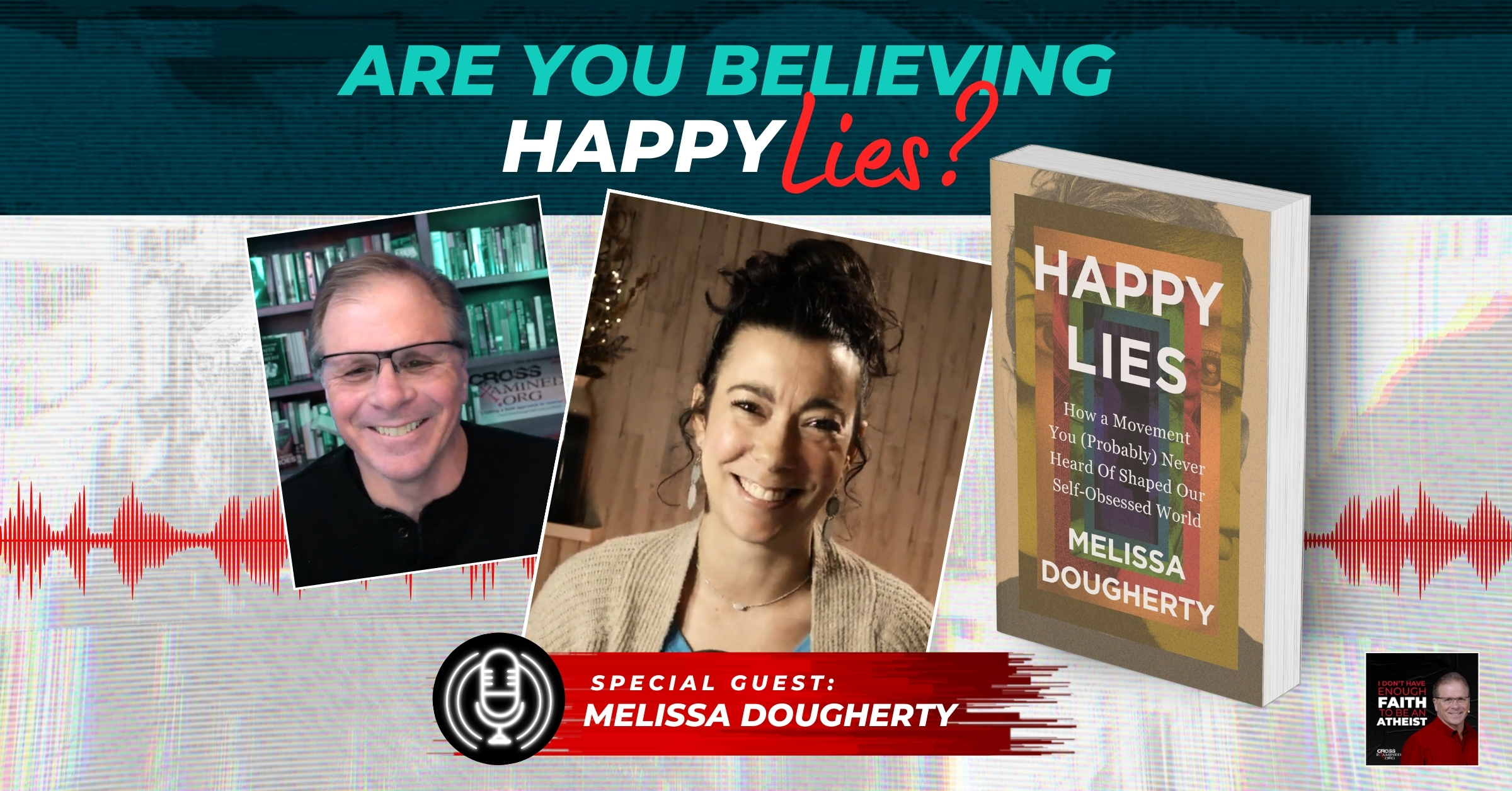
Is the Bible just about encouragement, living “your truth,” seeking personal happiness, finding your identity, and manifesting your desires? This self-centered perspective has quietly crept into the minds of many well-meaning Christians who are influenced by cultural lies that have been disguised as spiritual truths. But what are some of these “happy lies” you might unknowingly believe as a Christian and how can you correct them?

In this week’s podcast, Frank welcomes our good friend, author, and Christian YouTuberMelissa Dougherty, to discuss her brand new book, ‘Happy Lies: How a Movement You (Probably) Never Heard Of Shaped Our Self-Obsessed World‘. Together, they’ll dive into the beliefs of the New Thought movement and its profound (yet often unnoticed) impact on the modern Church. During their conversation, Frank and Melissa will tackle questions like:

  • What is the purpose of life according to the New Thought movement?
  • What’s the difference between New Thought and New Age?
  • Is there a connection between New Thought and the Word of Faith movement?
  • Should Christians recite affirmations?
  • What do adherents of New Thought mean by “Christ Consciousness”?
  • What are some of the key verses that are used in the New Thought movement and how are they twisted to deceive Christians?

If you’ve never heard of New Thought, this episode will uncover how its teachings deceptively infiltrate Christian culture, distort Scripture, and subtly influence your worldview. Could some of the most well-known pastors be peddling New Thought in the pulpits of America today? Tune in next week for the surprising answer in the midweek podcast and make sure you pre-order a copy of Melissa’s book, ‘Happy Lies‘!

If you enjoyed this podcast episode PLEASE HELP US SPREAD THE TRUTH OF CHRISTIANITY BY SUPPORTING OUR MINISTRY HERE. 100% of your donation goes to ministry, 0% to buildings!

Resources mentioned during the episode:

Melissa’s Book – ‘Happy Lies’: https://a.co/d/igzRfqQ

Melissa’s Website: https://www.melissadougherty.co/

Melissa’s YouTube channel: https://www.youtube.com/c/MelissaDougherty/

Are you following the truth or are you following incentives that may cause you to turn your back on Christianity and throw Jesus under the bus? On this midweek podcast episode, Frank continues the conversation on the powerful incentives that often prevent us from denying ourselves and picking up our cross for Christ as we go through our daily lives. He’ll answer questions like:

  • What does FOMO (the fear of missing out) reveal about our underlying motivations?
  • Why does the question, “If Christianity were true, would you be a Christian?” often reveal a non-believer’s true intentions and desires?
  • What did Norman Geisler mean when he said, “Fraternity will almost always overcome theology.”?
  • What are some examples from the Bible when people follow incentives instead of following Christ?

Near the end of the program, Frank addresses two listener questions related to this topic–one from an Indian American who is struggling to commit to Christianity because his family wants him to embrace his Hindu roots, and the second from a Muslim seeking clarification on some differences between the Quran and the Bible. There’s no doubt that following Christ is ever an easy decision to make, and even Christians are susceptible to falling off the rails for the sake of convenience and not ruffling any feathers. But we hope this episode will encourage you no matter where you are on your journey with Jesus!


If you enjoyed this podcast episode PLEASE HELP US SPREAD THE TRUTH OF CHRISTIANITY BY SUPPORTING OUR MINISTRY HERE. 100% of your donation goes to ministry, 0% to buildings!


Resources mentioned during the episode:

Truth or Incentives? Part 1 – https://bit.ly/408gz0K

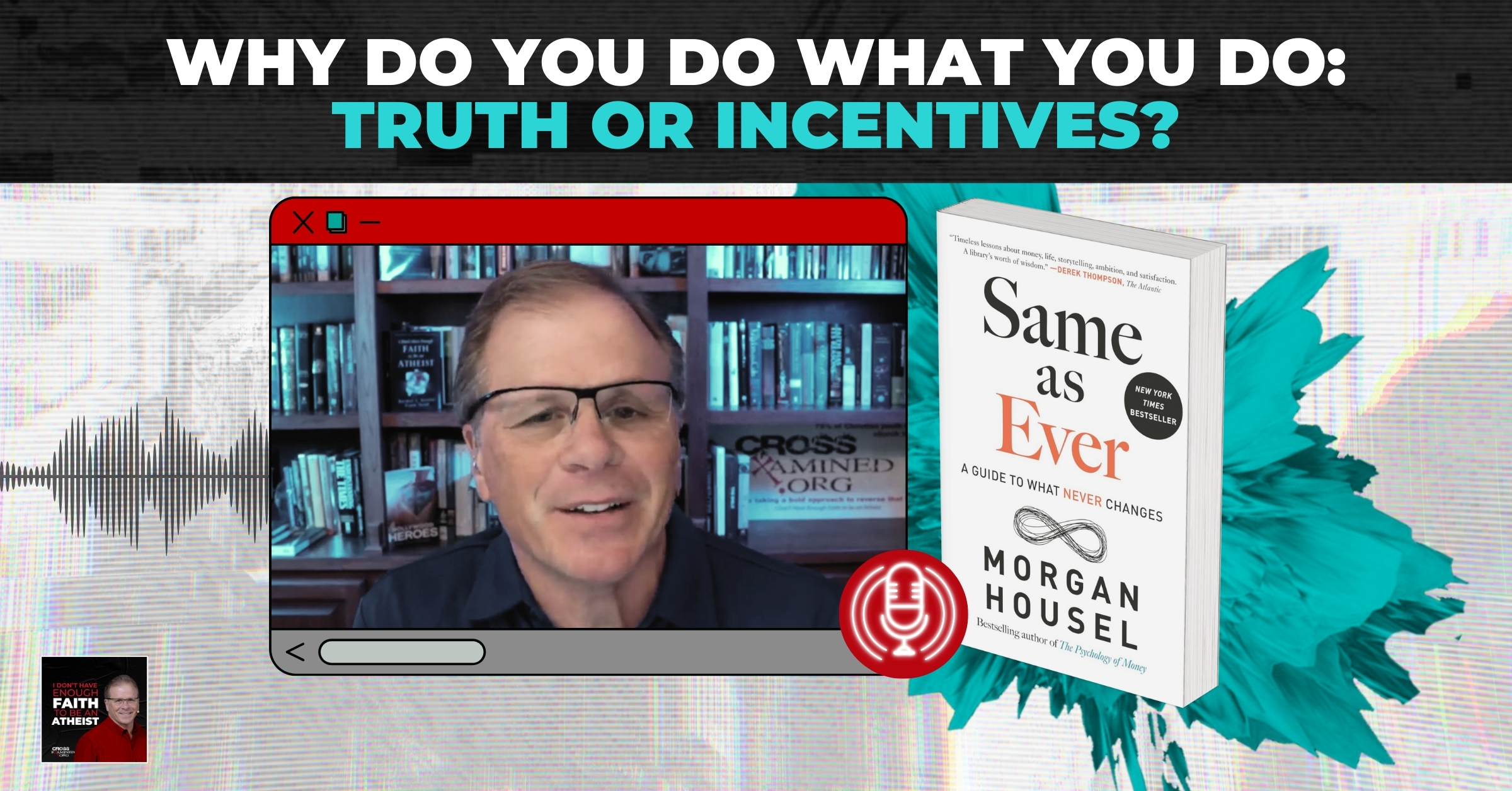
Book – ‘Same as Ever: A Guide to What Never Changes’ – https://a.co/d/1dANcEz

Online Course – ‘How to Interpret Your Bible’ – https://bit.ly/3BoEhxD

Book – ‘The Anxious Generation’ – https://a.co/d/b08gb1p

Blog Post – ‘The Anxious Generation’ – https://bit.ly/3zW4ySM

Watchman Fellowship – https://www.watchman.org/

Blaise Pascal, once said, “People almost invariably arrive at their beliefs not on the basis of proof, but on the basis of what they find attractive.” Have you ever taken the time to reflect on what it is that primarily motivates all of us to make decisions? Is it based on what’s objectively true or what we find attractive? Are we following facts or are we more inclined to follow our desires and self-preservation?

It’s a brand-new year, and since many of us set goals for 2025, Frank is kicking things off with an investigation into how incentives can often lead both Christians and non-Christians away from the truth; how to recognize when we’re being influenced by cultural peer pressure; and how incentives have historically led the masses to do the unthinkable. Listen as Frank answers questions like:

  • Is it possible to pursue your self-interests and reason at the same time?
  • What are the 3 incentives that cause people to sin and what makes them so powerful?
  • Are incentives inherently wrong?
  • How do “normal” people become proponents and active participants of genocide?
  • Where do we see examples of incentives in our schools, workplace, and health care system?
  • What is the root cause of bad economic policy here in the United States and all over the world?
  • What’s the 2nd most important truth in the Bible for our culture today?
  • Why do many pastors avoid talking about controversial issues?
  • What’s the driving force on social media that often causes both kids and adults to throw Jesus and Christianity under the bus?

Let’s face it, we’re all tempted to do the wrong thing for what we tell ourselves are good reasons, but in reality we are incentivized to lie to ourselves. When incentives push you to lie or follow what you find attractive, will you be committed to denying yourself and following Christ? Or will you conform to the cultural norms, compromising the truth for comfort and acceptance like so many people of the past and present? Tough question that even Peter failed to answer rightly. Pray and choose wisely!

If you enjoyed this podcast episode PLEASE HELP US SPREAD THE TRUTH OF CHRISTIANITY BY SUPPORTING OUR MINISTRY HERE. 100% of your donation goes to ministry, 0% to buildings!

Resources mentioned during the episode:

Book – ‘Same as Ever: A Guide to What Never Changes’ – https://a.co/d/1dANcEz

Dr. Robert W. Malone on X: https://x.com/RWMaloneMD

Dr. Peter A. McCullough on X: https://x.com/P_McCulloughMD

Online Course – ‘Why Does God Allow Evil?’ – https://bit.ly/4gYjT5v

Online Course – ‘How to Interpret Your Bible’ – https://bit.ly/3BoEhxD

Blog Post – Sex at Work? https://crossexamined.org/sex-at-work

Book – ‘The Anxious Generation’ – https://a.co/d/b08gb1p

Blog Post – ‘The Anxious Generation’ – https://bit.ly/3zW4ySM


Download Transcript


Introduction

One of my favorite passages in the gospels is the prologue of John (1:1-18). I particularly find the first three verses, John 1:1-3, and the use of the “Word”, or Logos in Greek, interesting.

In those three verses, a type of creation narrative arises, revolving around Logos, in which Logos is described as being divine, eternal, and the creator. Later in the prologue, in John 1:17, Logos is revealed to be Jesus Christ, thus applying the description of Logos as divine, eternal, and the creator to Jesus Christ. John 1:1-3 states,

“In the beginning was the Word [Logos], and the Word was with God, and the Word was God. He was in the beginning with God. All things were made through him, and without him was not any thing made that was made” (ESV).

But what is the background of Logos, and what in John 1:1-3 describes Logos as divine, eternal, and the creator?

Wisdom and Logos

To understand the meaning of Logos, we must understand what it is and where that term comes from. There are several options for where Logos came from, but the Jewish view of Wisdom is the most likely background. By giving a close look at the character Wisdom found in the Old Testament, and other Jewish writings, several similarities between itself and Logos are found. One similarity is the source of Wisdom, which Jewish thought places as the Most High, and that Wisdom was there before the world began, like Logos.[1] Like Logos, Wisdom took part in creation, was sent from heaven to dwell on earth, is the source of life, and is rejected by man.[2] Wisdom is also the tool by which God speaks to man and reveals himself. [3] These are all characteristics and actions that are similarly attached to Logos in John 1:1-18. Wisdom is frequently described in Proverbs, with one example found in Proverbs 8:22-30. This passage describes Wisdom as a helper of God in creation. [4] Another example is Proverbs 8:35 which states,

“For whoever finds me [Wisdom] finds life and obtains favor from the Lord.”

Like Logos, Wisdom is the giver, the source, of life. Another surprising parallel is that Wisdom is thought to be the daughter of God.[5] This is a close connection to our thoughts on Logos, or the Messiah, who we see as the son of God. Whether or not Jews believe that Wisdom is an actual being, the literary connection between Wisdom and Logos is undeniable.

Verse 1-2: Logos as God

Note the opening phrase in, in John 1:1-2:

“In the beginning was the Word, and the Word was with God, and the Word was God. He was in the beginning with God.”

Here John exegetes the phrase “in the beginning” from Genesis 1:1 to mean before creation. In comparing the two passages, the origin of the mirrored phrase “in the beginning” in John 1:1-2 is obvious. [6] However, though John 1:1-2 pulls from Genesis 1:1, the purposes behind the passages are different. Genesis 1:1 is focused on creation, and God as creator. John 1:1-2 is focused on eternity and deity.[7] The whole purpose is to proclaim and affirm the eternal and divine nature of Logos.

Eternity and deity are intertwined in John 1:1-2, as Logos is described as being with God, from the beginning, and being God. He WAS in the beginning with God, he WAS there with God, and he WAS God. [8] In this first section, Logos is variously associated with God. Thus, the affirmation of the divinity of Logos. But there is special care to show a distinction between Logos and God. On one hand, Logos is described as God, but Logos is also shown to be distinct from God. [9] Logos being given a different name from God implies a distinction somewhere.[10] This is clarified in John 1:14 when Logos is revealed to be the Son, or the one, from the Father.

Verse 3: Logos as the Creator

Moving to verse three, we see another parallel between the prologue of John and the creation story in Genesis. John 1:3 mirrors Genesis 1:1 with the creation of the heavens and the earth. What is different in John 1:3, is the odd phrasing John used. Genesis 1:1 says,

“In the beginning, God created the heavens and the earth.” Meanwhile, John 1:3 says, “All things were made through him, and without him was not any thing made that was made.” This “creator” aspect is reappears in John 1:10, “the world was made through him.”

Looking closer at John 1:3, Meier makes a note of the usage of “was” in the first few verses of the prologue. Meier writes that John only used “was” for the eternal and divine. The Greek word eimi,  here translated as “was,” means “to be” or “to exist.” John did not use eimi to describe creation, he only used eimi to describe God and Logos. John used the Greek word ginomai which is translated as “was”, but it means “to become”.[11] Eimi implies an eternal nature that creation does not have, whereas ginomai implies something coming into being. John is telling his readers that all things came into being through Logos and that Logos did not come into being, but always existed.[12]

This explains the awkward phrasing found in John 1:3 and teaches, in part, that the universe has a beginning and that it is created, unlike Logos. The purpose of John 1:3 is that Logos had a role in creation; specifically, that God acted through Logos to create the world. Logos does not play a passive role, but an active role in creation, and could be described as the mediator of the creation act. [13]

Conclusion

Thus, we are given another reason as to why the gospel of John is widely known for having the most obvious claims of the divinity of Jesus. The prologue of John, especially John 1:1-3, plays no small role in proclaiming the divine nature of Jesus. Even if one only looks at the surface of John 1:1-3, a beautiful picture of Logos being with God, and being God, before the beginning is presented. However, so much depth, and beauty, is missed if one does not look into the Jewish background of Logos. Either way, it is impossible to miss the power and divine nature of our Lord Jesus Christ and the role he has played in the creation of all things.

Bibliography

Borgen, Peder. “Creation, Logos, and the Son: Observations On John 1:1-18 and 5:17-18.” Ex Auditu, 1987: 88-97.

Brown, Raymond. “The Prologue of the Gospel of John: John 1:1-18.” Review & Expositor, 1965: 429-439.

Burge, Gary, Lynn Cohick, and Gene Green. The New Testament In Antiquity: A Survey Of The New Testament Within Its Cultural Contexts. Grand Rapids: Zondervan, 2009.

Kelber, Werner. “The Birth of a Beginning: John 1:1-18.” Semeia, 1990: 121-144.

Meier, John. “Biblical Reflection: John 1:1-18.” Mid-Stream, 1996: 391-394.

Pilcher, Charles. “Note: the Jewish background of the prologue of the Fourth Gospel.” The Reformed Theological Review, 1947: 30-31.

Rissi, Mathias. “John 1:1-18 (The Eternal Word).” Interpretation, 1977: 394-401.

References:

[1] Werner Kelber. “The Birth of a Beginning: John 1:1-18.” Semeia, 1990: 122; Brown, 430.

[2] Kelber, 122.

[3] Charles Pilcher. “Note: the Jewish background of the prologue of the Fourth Gospel.” The Reformed Theological Review, 1947: 30.

[4] Ibid.

[5] Ibid.

[6] Borgen, 92.

[7] Brown 430-431.

[8] John Meier. “Biblical Reflection: John 1:1-18.” Mid-Stream, 1996: 392.

[9] Mathias Rissi. “John 1:1-18 (The Eternal Word).” Interpretation, 1977: 397.

[10] To be clear, the use of distinction is not meant to make Logos a completely separate divine being from God, but that Logos is a separate divine personality within God. It is to separate the person that is Logos from the person that is the Father.

[11] Meier, 392.

[12] Ibid.

[13] Rissi, 397.

Recommended Resources:

Jesus, You and the Essentials of Christianity by Frank Turek (INSTRUCTOR Study Guide), (STUDENT Study Guide), and (DVD)      

How to Interpret Your Bible by Dr. Frank Turek DVD Complete Series, INSTRUCTOR Study Guide, and STUDENT Study Guide

How Can Jesus be the Only Way? Mp4, Mp3, and DVD by Frank Turek

Reflecting Jesus into a Dark World by Dr. Frank Turek – DVD Complete Series, Video mp4 DOWNLOAD Complete Series, and mp3 audio DOWNLOAD Complete Series


Thomas Moller began studying astrophysics at the University of Nebraska-Kearney, specifically in Cosmology. Through the study of the universe and the laws that guide it, a passion for understanding the Creator and Fine-Tuner of the universe provided the catalyst for Thomas diving deeply into theology. He then left the study of astrophysics to pursue a theology degree. Now graduated from Trinity College of the Bible and Theological Seminary, he is pursuing a master’s degree in theological studies at Houston Christian University. With a love of biblical theology, Thomas wants to help educate believers in how to study the Bible in its proper context. He also will tackle a multitude of topics in Christian living, culture, and literature. Though he no longer studies astrophysics at an academic institution, he still has a love for science and scientific arguments for God.

Originally posted at: https://bit.ly/3BylxvH



In our final podcast episode of 2024, Dr. Jay Richards returns to discuss three essential topics that often cause confusion and dissent among both Christians and non-Christians in America today: the history and purpose of government, macroevolutionary theory vs. intelligent design, and the root cause of chronic disease. Together, Frank and Jay address questions like:

  • What is the biblical purpose of government?
  • Where do our rights come from?
  • How should we define American exceptionalism?
  • Was America founded on Christianity or something else?
  • What did Thomas Jefferson mean by “separation of church and state” and how has the term been misused and misunderstood?
  • What is macroevolutionary theory and why does it fail to explain the origin of life and new life forms?
  • How should Christians respond to the “God of the gaps” objection?
  • Is Darwinism consistent with what we can observe in biology?
  • Why is America sicker than ever despite our ultra-advanced health care system and will RFK Jr. solve the problem?

From politics to science to health, Frank and Jay will cover a lot of essential truths in this year-end episode of ‘I Don’t Have Enough Faith to Be an Atheist’ that will still be relevant in the decades to come! If you want to learn more about any of these topics, be sure to check out our list of recommended resources below. Let’s continue standing for truth, defending the faith, and boldly living out the biblical worldview in every area of life in 2025!

If you enjoyed this podcast episode PLEASE HELP US SPREAD THE TRUTH OF CHRISTIANITY BY SUPPORTING OUR MINISTRY HERE. 100% of your donation goes to ministry, 0% to buildings!

Resources mentioned during the episode:

Jay’s work at The Heritage Foundation: https://www.heritage.org/staff/jay-w-richards-phd

Follow Jay on X: https://x.com/DrJayRichards

Stephen Meyer at the Discovery Institute: https://www.discovery.org/p/meyer/

Society for Evidence-Based Gender Medicine: https://segm.org/

Biological Integrity: https://biologicalintegrity.org/

The Privileged Planet – https://privilegedplanet.com/

Book – ‘Money, Greed, and God’ by Dr. Jay Richards: https://a.co/d/46pGwlS

Book – ‘Return of the God Hypothesis’: https://a.co/d/hI6RmYt

Book – ‘Undeniable’: https://a.co/d/5w0aCby

Book – ‘Eat, Fast, and Feast’: https://a.co/d/7zVgxmg

Book – ‘Good Energy’: https://a.co/d/igUjom0


Download Transcript


Charles Spurgeon once said that discernment is knowing the difference between right and “almost right”. But when there’s so much noise and confusion happening in the news and on social media these days, how can we tell the difference?

As we approach the end of 2024, our friend Dr. Jay Richards returns to unpack some of the essentials of economics, the Christian worldview, and social trends so that you can be informed when it comes to the issues that matter the most. Join Frank and Jay as they discuss the importance of understanding the basics of economics and how it can help Christians think clearly about government policies, healthcare, and how it can equip believers to protect the most vulnerable populations in our society. Tune in as Frank and Jay answer questions like:

  • Does the Bible advocate for a specific economic system?
  • How did the government become so bloated, and why did it get involved in housing and education?
  • What’s the difference between socialism and free-market capitalism?
  • What’s the best way to help those in poverty and how do people end up trapped in the welfare system?
  • What did economist and philosopher Adam Smith mean by “the invisible hand”?

During the second half of the program, they’ll shift gears to examine the economic and cultural factors that are specifically driving the transgender movement. From the profit motives behind gender-affirming care to the resurgence of ancient Gnostic ideas, this thought-provoking conversation will shed light on how transgenderism became politicized, what’s causing the major spike in gender dysphoria, and how to end child transitioning for good!

Don’t miss this thought-provoking, year-end episode, and please consider making a tax-deductible donation to CrossExamined so that we can continue to help Christians defend the faith and do our part to make Christ known across the globe! 100% of your donation goes to ministry, 0% to buildings!

Resources mentioned during the episode:

Book – ‘Money, Greed, and God’ by Dr. Jay Richards: https://a.co/d/46pGwlS

Jay’s work at The Heritage Foundation: https://www.heritage.org/staff/jay-w-richards-phd

Society for Evidence-Based Gender Medicine: https://segm.org/

Biological Integrity: https://biologicalintegrity.org/

Previous podcast – ‘Money, Greed, and God’ with Dr. Jay Richards: https://bit.ly/3DvSZn7


Download Transcript


Why is December 25th celebrated as the birth of Jesus? Was it a date chosen to overshadow pagan festivals like Saturnalia or Sol Invictus, or does it have deeper Christian roots? While the Bible doesn’t provide a specific birthdate for Christ, it may offer more clues than you think!

Just in time for the holiday season, historian and author Bill Federer returns to unpack the fascinating origins of the Christmas story and its rich Christian heritage. One of our most popular topics, this episode dives deeper into the history, theology, and traditions surrounding the incarnation of Christ—a moment that forever changed the course of human history. Join Frank and Bill as they explore questions like:

  • How do the Dead Sea Scrolls provide evidence for Jesus’ actual birthday?
  • Why do some Christians celebrate Christmas on Jan. 6th?
  • When did Christians start celebrating Dec. 25th as the birthday of Jesus?
  • What is one of the most overlooked pro-life passages in the Bible?
  • What’s the story of King Herod and was he really capable of being a baby killer?
  • Why was there strife between the Pharisees and Sadducees, and how did Rome get involved in Jewish politics?
  • How many wise men brought gifts to Jesus and when did they visit Him?
  • Why are the Old Testament prophecies about Jesus so vague?
  • What’s the origin of the “12 days of Christmas”?
  • How does the history of the entire world center on the birth of Christ?

Tune in as Bill dispels some of the common myths surrounding the Christmas holiday and uses his gift of storytelling to connect the historical and biblical pieces together. This episode will be both enlightening and entertaining as it also lays out the message of the Gospel, so be sure to share it with a friend! Merry Christmas from the CrossExamined team and please check out our earlier conversation with Bill where he shares even MORE history behind some of today’s most beloved Christmas traditions with visuals included!

Did you enjoy this episode? HELP US SPREAD THE TRUTH OF CHRISTIANITY BY SUPPORTING THE PODCAST HERE.

Resources mentioned during the episode:

VIDEO PODCAST: Is There Any CHRISTIAN Truth to Our CHRISTMAS Traditions? – CEevents.org
BILL’S WEBSITE: https://americanminute.com/
BILL’S BOOK: ‘There Really is a Santa Claus


Download Transcript


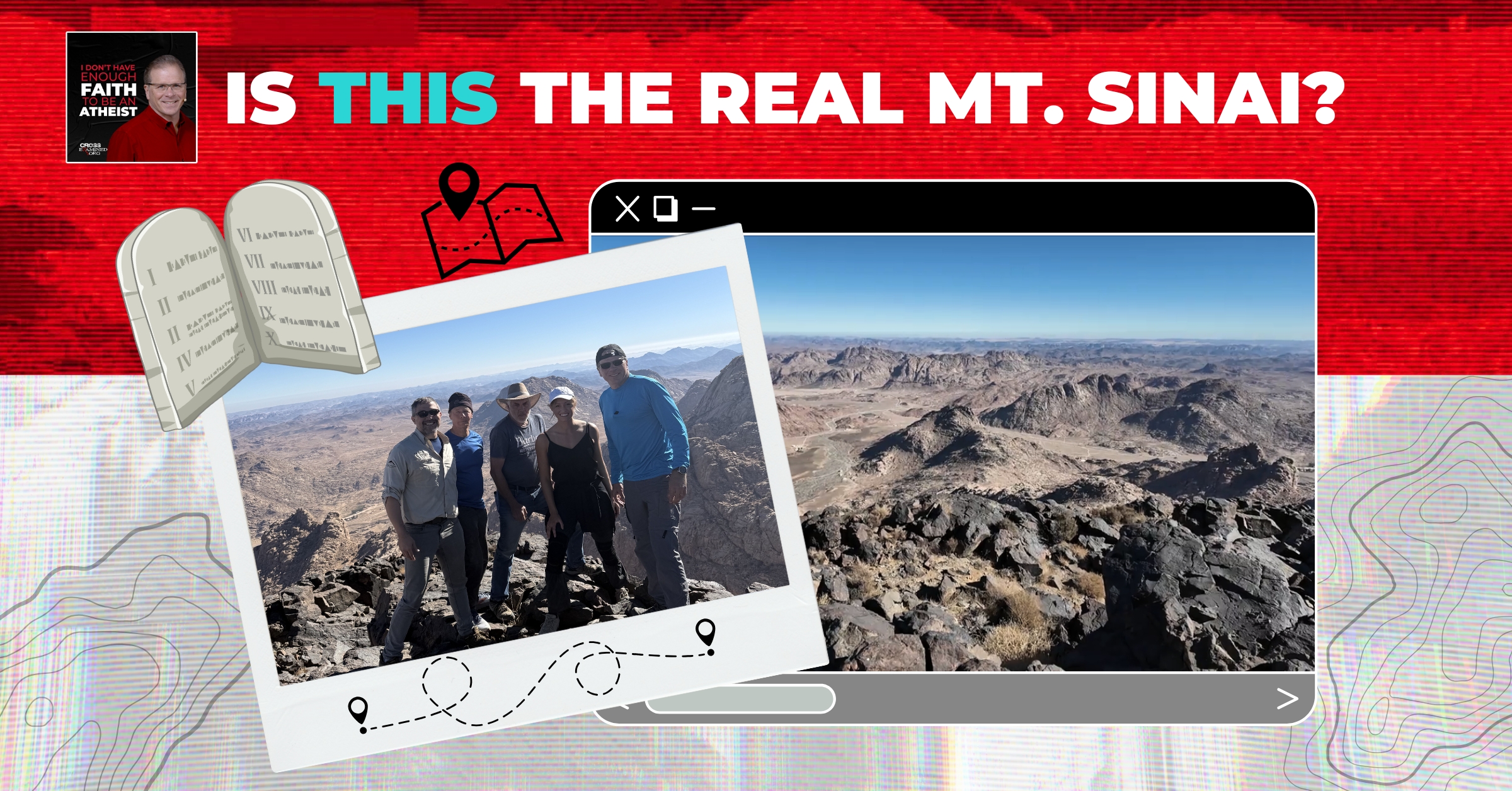
What would you expect to find at the REAL Mount Sinai? Could its true location be in Saudi Arabia rather than the traditional site in the Sinai Peninsula? Recent discoveries have reignited interest in Jabal al-Lawz as a possible candidate for the biblical Mount Sinai, and this week, you’ll have the chance to examine the evidence for yourself!

In this podcast episode, Frank unpacks some of the details of his recent trip to Saudi Arabia, including what he and the group saw as they climbed the mountain at Jabal al-Lawz. He’ll also discuss what fascinating markers distinguish this mountain as a great contender for Mount Sinai and why it’s more important than ever for trained archaeologists to continue exploring the site. During the episode, Frank will answer questions like:

  • Why was the Sinai Peninsula originally selected as Mount Sinai?
  • How long did it take Frank and the group to get up the mountain?
  • Why have there been so few excavations at Jabal al-Lawz?
  • Who is Hathor and what’s a possible explanation for all the cow drawings found on the mountain?
  • What evidence exists suggesting that Jabal al-Lawz is the true Mount Sinai?
  • What were Frank and the group AMAZED to see once they reached the top of Jabal al-Lawz?
  • What’s so special about the Split Rock of Horeb? And how many people were involved in the Exodus?

While it’s still too early to make a concrete conclusion on Jabal al-Lawz, the circumstantial evidence discussed in the podcast episode may cause you to seriously consider it to be the REAL Mount Sinai. To catch some of this exclusive footage for yourself, be sure to follow us on all our social media platforms and subscribe to the CrossExamined YouTube channel. And stay tuned for MUCH more exciting news about what Frank and the group were able to dig up in Egypt and Saudi Arabia!

Did you enjoy this episode? HELP US SPREAD THE TRUTH OF CHRISTIANITY BY SUPPORTING OUR MINISTRY HERE. 100% of your donation goes to ministry, 0% to buildings!

Resources mentioned during the episode:

Living Passages Unveils the True Mount Sinai in Saudi Arabia: http://youtu.be/JBaY–L5NPY
Frank Visits the Merneptah Stele in Egypt: https://www.youtube.com/shorts/gy-RanSnzik
Preaching the Good News at the Giza Pyramids: https://www.youtube.com/shorts/Cf4JjuRFA0Q
Moses and the Split Rock of Horeb: https://www.youtube.com/shorts/HLgzLDXFCB8
Was the Golden Calf HERE? https://www.youtube.com/shorts/h5yAwssDU5Y


Download Transcript


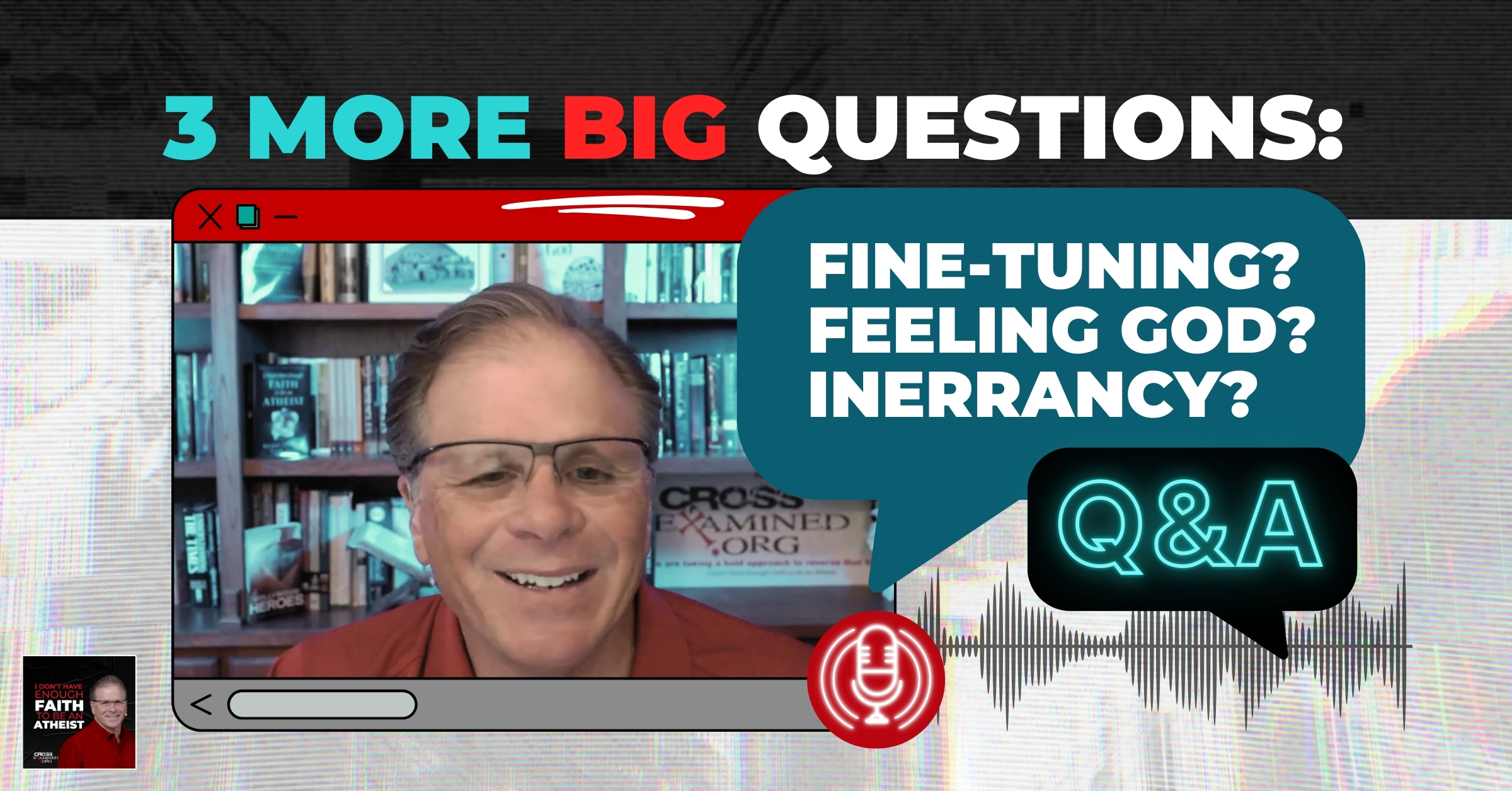
Does the scientific evidence fall short of proving the fine-tuning of the universe? Should Christians regularly “feel God’s presence”? And since there are minor differences in the Gospels, does that disprove biblical inerrancy? In this midweek podcast episode, Frank tackles three more BIG questions from our listening audience along with questions like:

  • What are the 3 levels of fine-tuning and does it only occur here on planet Earth?
  • Can the fine-tuning argument alone actually prove Christianity is true? And can all truth be explained through science?
  • Where exactly are Heaven and Hell?
  • What’s the true meaning of Christmas?
  • Is loving God an emotion, a feeling, or a decision?
  • If God chooses not to reveal Himself to us is that proof that He doesn’t exist?
  • What’s a great question to ask your skeptic friends?

Have a question you’d like Frank to address in a future episode? Send it to hello[at]crossexamined.org, and stay tuned for Friday’s podcast to hear more about his recent trip to Egypt and Saudi Arabia!

Did you enjoy this episode? HELP US SPREAD THE TRUTH OF CHRISTIANITY BY SUPPORTING THE PODCAST HERE.

Resources mentioned during the episode:

BOOK: Hollywood Heroes – https://bit.ly/3Or82Ax
BOOK: Stealing From God – https://bit.ly/41hLt91
BOOK: Decision Making and the Will of God – https://a.co/d/gQhMD3m
OCC Course: How to Interpret Your Bible – https://bit.ly/3BoEhxD
ARTICLE: Does God Whisper? Part 1 – https://bit.ly/3P0KW47
ARTICLE: Does God Whisper? Part 2 – https://bit.ly/3ZY3hVJ
ARTICLE: Does God Whisper? Part 3 – https://bit.ly/3ZzqOe8