

Tag Archive for: Sovereignty of God

By Bob Perry

The world is an unpredictable place. But we pretend it isn’t. We like to envision our future and plan our steps, pretending we know how we’ll get there. But the stories we write for ourselves rest on assumptions about how the world works and our place in it. And those assumptions tend to be cheery ones. Most of us never include suffering or vulnerability in our forecasts, especially if we believe that “God is in control.” But when it all goes to hell, our illusions fade to black. The smiling facade vanishes quickly when life unveils our real gods. Our lives are changing rapidly and permanently right before our eyes. But the Church needs to take the lead in influencing the world we will face on the other side of this pandemic.

The World Descends

Between Sunday and Thursday of last week, I saw my own home state shut down all bars and restaurants. Inconvenient? Sure. But then I went to work.

I spent the next three days in hotels in Boston and San Francisco. Boston was a dark, rainy ghost town. There were empty streets and closed businesses in the city by the bay. No trolley cars in sight. You could hear birds singing in the eerie air downtown.

I met a British man in an elevator whose flight to London had been canceled. He had no earthly idea when, or how, he would be able to get home. And no one from his airline would communicate with him.

Salt Lake City, one of my airline’s major hubs, was rocked by an earthquake that closed the airport and caused massive flight diversions.

During the descent on our final leg home, we were informed that the eastern half of the Indianapolis Air Traffic Control Center was shutdown. Two air traffic controllers had tested positive for Coronavirus.

On Tuesday, my airline announced that it would park 300 airplanes and cut flying by 40%. By the time I got home, those numbers had changed to 600 airplanes and 70%.

In short, every time I landed somewhere, I was afraid to turn on my phone. In the space of three and a half days, I felt like I had become a character in a Stephen King novel. And as I write this, the details of this pandemic have only gotten worse.

Paradigm Shifts

In the space of just a few hours on the morning of September 11, 2001, we had a massive paradigm shift in this country. It led to economic calamity, war, and distrust. It’s hard to remember what life was like before that day. Today’s crisis may be happening at a little slower pace, but the consequences will be more severe. And some of them will be permanent.

Welcome to the new reality. The post-Coronavirus world is something few of us could have imagined even a few weeks ago. We’re still not sure what that world will look like. But we’re getting a glimpse.

New Reality?

The stock market is plummeting. The value of our retirement accounts have been cut by more than a third. Leaders are issuing edicts and manipulating “rescue” bills to gain a political advantage. Neighbors hoard food and supplies, depriving their neighbors of the same. “Preppers” are feeling vindicated. Opportunists are trying to sell vital products for obscene profits.

In each of these cases, we see the fruits of the gods who some folks really worship: selfishness, panic, fear, power, greed, and control.

It is an unfortunate reality that challenging times tend to bring out the worst in us. And it is a sad fact that some of that fruit comes from people we sit next to in church every week.

But it doesn’t have to be this way.

Children of a Greater God

We are free-will beings. And that means nothing is inevitable. We don’t have to accept the rotten fruit of the lower gods.

” … for God gave us a spirit not of fear but of power and love and self-control.” 2 Timothy 1:7

The God of the Bible is a reasonable God. A selfless, loving, compassionate God. A God of mercy and justice.

We are made in His image.

The Church has faced catastrophes before. But instead of languishing with the lunatics of the lesser gods, it made the choice to reflect the character of its King. Here are some ways I can think of to do that. Feel free to add some more if you have them…

Empathize With the Younger Generation

If you’re older than 35 or so, think about the world you grew up in as a kid. It was carefree and mostly serene. You didn’t have to think about “adult things.” And your parents weren’t bombarded with outrage, politics, and flamethrowing 24/7/365 from the news. All you had to do was be a kid.

Now think about those who are under 30 years old. Realize that their lives have been bookended by catastrophes like 9/11 and the Coronavirus pandemic. Their view of the world is different than those of us who are older. Look at it through their eyes and have some compassion. You don’t have to be Pollyanna. Just give them something to be optimistic about … or at least try to understand why they’re not.

Serve Our Neighbors

Christianity exploded during the plagues and persecutions in the ancient world. And it did so precisely because Christians served those who most needed it. They comforted and cared for the sick and dying. This isn’t just a job for healthcare professionals. It’s a duty for us all.

We need to quit being the “takers” our culture encourages us to be. We need to be givers of whatever it is we are able to give.

And let’s be smart about this. Preparing to care for those in need includes caching medical supplies and equipment for future outbreaks like this that will come — instead of fighting each other to hoard things now. And it means retooling our country to produce our own medicine and other medical equipment here where we need it, not overseas where it’s cheap.

Demand Economic Restraint

The economic expectations we have come to accept as normal are reckless, selfish, and short-sighted. We borrow and spend too much. We save too little. Our leaders are more worried about the next election than the next generation. But they are like that because we demand comfort and security from them now. We have mortgaged the future so we can indulge ourselves in the present. And we do it on a national, congregational, and personal scale.

Imagine how different this crisis would be if businesses, churches, and families had conserved the financial means to weather this storm. And imagine what kind of world we will be leaving for our kids and grandkids if we don’t change our ways.

The World On The Other Side

The changes we are facing will be dramatic and long-lasting. There are things we will never do the same way. There are ways we will think about things that have been forever altered. But, since that’s the case, let’s make the world on the other side of this a better one. The circumstances will be challenging. But our response should be far different from the world around us.

If you believe Christianity is true, that means it applies to every aspect of our lives and to every situation in which we find ourselves. Economics and pandemics are no exception. Let’s use the rational minds God gave us to be smart, savvy, and sacrificial.

This kind of thing will happen again. If anybody should be ready to deal with it the next time, it’s the Church.

Recommended resources related to the topic:

If God, Why Evil? (DVD Set), (MP3 Set), and (mp4 Download Set) by Frank Turek 

If God Why Evil. Why Natural Disasters (PowerPoint download) by Frank Turek

Why Doesn’t God Intervene More? (DVD Set), (MP3 Set), and (mp4 Download Set) by Frank Turek

Why does God allow Bad Things to Happen to Good People? (DVD) and (mp4 Download) by Frank Turek 


Bob Perry is a Christian apologetics writer, teacher, and speaker who blogs about Christianity and the culture at truehorizon.org. He is a Contributing Writer for the Christian Research Journal and has also been published in Touchstone and Salvo. Bob is a professional aviator with 37 years of military and commercial flying experience. He has a B.S., Aerospace Engineering from the U. S. Naval Academy, and an M.A., Christian Apologetics from Biola University. He has been married to his high school sweetheart since 1985. They have five grown sons.

Original Blog Source: https://bit.ly/2x23Gfp
By Rajkumar Richard

No one is spared of evil. We either reel under the effects of evil or feel the impact of evil upon our relatives, friends, and society at large. Some question God’s goodness on account of evil and a few others dispute God’s presence.

Evil is real. Evil is not an illusion. Any sane human being would affirm this position. Terrorism or human trafficking is an act of evil, and the pain felt by those hurt by this evil is indeed real.

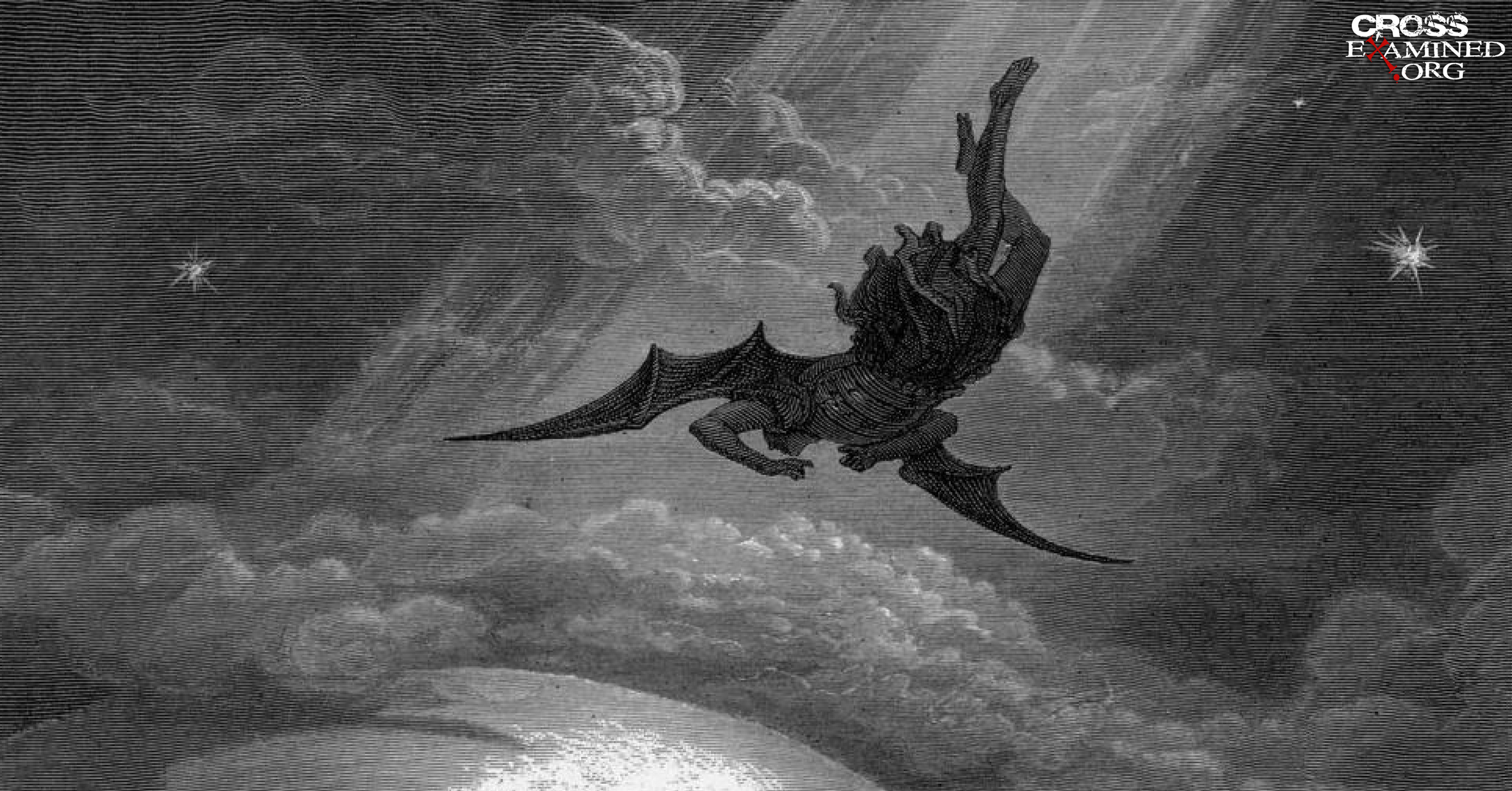
If evil is real, then it should have a source, and that source has to be real. (If Satan is not real, then was Christ hallucinating while HE was tempted by Satan and while HE drove away the demons?)

The Bible terms Satan as the source of all evil (John 8: 44). Christians believe in God as a maximally great being; HE is supreme over all that has been, is and ever will be. If God is supreme, then HE should have created Satan. Isn’t it?

Before we explore the Bible to learn about Satan, we should discard the following concepts:

  1. That Satan and his demonic entourage are merely a mythological conception drawn from the culture of the day. This is German theologian Rudolf Bultmann’s program of demythologization of Satan.
  1. That Satan and evil do not stem from a personal source but are woven in the fabric of our social reality as a part of the very structure of reality. This is Christian existentialist theologian Paul Tilich’s depersonalization of Satan.
  1. That demons are simply nothingness in their dynamic, not created by God but a threat to God’s creation. This is reformed theologian Karl Barth’s conception. This conception of evil denies the concreteness of evil; hence we disagree.

So to begin with, we agree with the Bible that evil is real, Satan is real, and God is also real. Did God then create Satan? The answer is an unequivocal yes.

But the bigger question is, “Did God create Satan as a source of evil?” The answer to this question is an unequivocal no, for God, as a good being, cannot be the creator of evil.

This then is Bible’s teaching about Satan:

Isaiah 14: 12-17 and Ezekiel 28: 12-19 are often termed as conjectures of the Satanic fall. This may or may not be so, for these passages could refer to human kings of Babylon and Tyre. Hence it would be profitable for us to explore the Bible from outside these references to learn more about Satan.

  1. God created everything, which includes angels and demons (Colossians 1: 15-16).
  2. Everything God created was originally good (Genesis 1: 31; 1 Timothy 4: 4)
  3. Some angels sinned and are doomed for eternal destruction (1 John 3: 8; 2 Peter 2: 4; Jude 6). If some angels sinned, then they were created with a potential to sin i.e. they had the free will to sin.
  4. Satan is an angel who is subordinate to God (Job 1: 6-7).
  5. Satan is a demon (Luke 10: 17-20) – casting out of demons implies the defeat of Satan.
  6. Satan is the prince of demons (Matthew 12: 22-32; Mark 3: 22-30; Luke 11: 14-23).
  7. Those who are demon possessed are under the influence of the devil (Acts 10: 38; cf. Luke 13: 16).
  8. Satan is the evil one (Matthew 13: 19; 1 John 2: 13, 3: 12, 5: 18).

These passages undoubtedly teach us that God created Satan and his demons originally as good beings. But Satan and some of his fellow angels sinned against God and are in the business of enabling mankind’s rebellion and disobedience against God.

Significantly, God did not create an evil Satan. God created a good angel, who used his free will to reject God and become evil.

If God had not created angels, then Satan would not exist. So why did God create angels? The Bible reveals the purpose behind God’s creation of angels. Angels were created to…

  1. …reveal and communicate God’s message to humans (Acts 7: 53; Hebrews 2: 2).
  2. …minister to believers (Acts 5: 19; Hebrews 1: 14).
  3. …execute judgment on the enemies of God (2 Kings 19: 35).
  4. …praise and glorify God (Psalm 103: 20, 148: 2).
  5. …be involved in Christ’s second coming (Matthew 25: 31)

A variant of the bigger question is, ‘why did God create Satan knowing that he will cause evil in this world?’

First, did God know that Satan would cause evil? Yes, God would have known all about Satan. God is all-knowing (Job 37:16; Psalm 139:2–4, 147:5; Proverbs 5:21; Isaiah 46:9-10; 1 John 3:19–20), so God would have definitely known that Satan would cause evil and disaster in this world.

Second, could not have God created a world without Satan? Wouldn’t a world without Satan and evil be a better world than ours? In other words, is our world the best of all possible worlds?

One of the great thinkers of 17th and 18th century is Gottfried Wilhelm Leibniz. He proposed that our world is the best of all possible worlds. Leibniz’s proposition was that since God knew all of the infinite possibilities, this world should be the best of all possible worlds, for God has actualized this world over the other possible worlds.

Christian analytic philosopher, Alvin Plantinga differed from Leibniz by positing that there cannot be a best world, for one more palm tree or one more morally righteous person can make any world better. So Plantinga concluded that there is no such thing as the best world. [Even if God does not create anything, HE alone will exist as the greatest good (Summum bonum)]. Therefore, God is merely obligated to create a good world and not a best world.

This world is a good world since God has offered freedom to his creation. God has offered freedom to man to love HIM freely. The same freedom was offered to the angels as well. Some angels a.k.a. Satan and his demonic entourage abused this freedom and rebelled against God.

A world without freedom is not a good world. Therefore, as C.S Lewis wrote in ‘Problem of Pain,’ God has created a good world in such a way that the goodness of this world could be perverted into evil upon mankind’s rebellion or when creation is distorted.

In other words, free beings, i.e., man could use their freedom to perform evil deeds by rejecting God, which in effect would destroy the goodness of God’s creation. Similarly, man can tamper with nature to bring about evil, e.g., destruction of coral reefs would bring about hunger, poverty, and political instability.

As long as God offers freedom to his creation, the free moral agents (e.g., man) would possess the ability to do good or evil. So the question is not about Satan’s existence whereas the question should be about the presence of freedom.

A world without freedom would be a world full of puppets or automata albeit in the form of human beings, which in essence is not a good world at all. Creating human beings with freedom is wiser than creating humans in an antiseptic environment from whom the logical possibility of desiring anything contrary to God’s will is excluded. Therefore, a world without free will and Satan would any day be a terrible world to live in than a world with free will and Satan.

Could God have created a world with free will and without Satan? A world with freewill will entail evil, and a world with evil will posit a source, namely Satan. Even if angelic beings were not created, and as long as free will exists, evil would exist.

Evil would exist because God in HIS nature is good. So anyone opposing or rejecting a good God would do evil. So a world with free will and without Satan would still contain evil.

Satan and his cohorts are busy causing evil in this world. Although we reel under the effects of evil both directly and indirectly, God has offered us eternal life through the Lord Jesus Christ, and God has promised to care for and protect those who believe and seek HIM. May we believe in Christ, gain life eternal, and protection against evil. Amen.


Rajkumar Richard is passionate to strengthen the faith of fellow Christians, especially the young Christians. He has a Masters in Religion (Southern Evangelical Seminary, NC, USA) and Masters in Biology (School of Biological Sciences, Madurai Kamaraj University, India). He is a Christian blogger, itinerant speaker, social evangelist, and a mentor to young Christians.

Original Blog Source: http://bit.ly/2N2TV6q

Christians claim God is “all-powerful”. Does this mean He can accomplish anything? Skeptics often test this notion by offering the following challenge: “Can the all-powerful Christian God create a stone so heavy he cannot lift it?” The question highlights an apparent dilemma: If God cannot create such a stone (or cannot lift what He has created), He is not all-powerful. Does this apparent paradox prove an all-powerful Being cannot exist in the first place?

It’s true the Bible describes God as an all-powerful Being and often uses language that suggests that “nothing” is impossible for Him (as in Luke 1:37). At the same time, there are many places in Scripture where certain behaviors or conditions are described as “impossible” for God to accomplish. This apparent contradiction is inexplicable until we examine the nature of the activities (or behaviors) described as “impossible” for God:

Moral “Impossibilities”
The Bible clearly indicates there are many things that God cannot do. Most of these are “moral” in nature. For example, it is impossible for God to sin (James 1:13). According to the Bible, God always acts and behaves with certain moral considerations in mind and it is impossible for Him to do otherwise. Our moral laws are not simply the decrees of God (as if He could have chosen otherwise) but are, instead, a reflection of his unchanging moral nature. God cannot violate His nature. For this reason, it is impossible for God to sin.

Logical “Impossibilities”
The Bible also clearly indicates that there are a number of things that God cannot accomplish based on logical necessity. For example, it is impossible for God to change (Malachi 3:6, James 1:17) or to deny himself (2 Timothy 2:13). According to the Bible, God always acts and behaves with certain logical considerations in mind and it is impossible for Him to do otherwise. The laws of logic are, once again, a reflection of God’s unchanging nature.

These “Divine Impossibilities” provide us with insight into God’s character and power. Objective moral truths and transcendent laws of logic are simply a reflection of God’s eternal being. They are not rules or laws God has created (and could therefore alter recklessly), but are instead immutable, dependable qualities of his nature reflected in our universe. They exist because God exists (not because God created them). In addition, the Bible describes God as omnipotent and capable of doing anything he sets out to do. God’s choices, however, are always consistent with His moral and logical nature; He never sets out to do something contrary to who He is as God.

When someone asks, “Can the all-powerful Christian God create a stone so heavy he cannot lift it?” they are asking a logically incoherent question. It is the equivalent of asking, “Can God create a ‘square circle’?” Circles and squares are mutually exclusive by their very definition. As a result, the question nonsensically queries the creation of something similarly nonsensical. God cannot create square circles for the same reason He cannot sin; He acts dependably in a manner consistent with His moral and logical nature, and our universe is the beneficiary of God’s dependable nature. Those who ask logically incoherent questions of this kind are requiring God to violate His nature (His logical coherency) in order to demonstrate His nature (His power).

J. Warner Wallace is a Cold-Case Detective, Christian Case Maker, Senior Fellow at the Colson Center for Christian Worldview, and the author of Cold-Case Christianity, Cold-Case Christianity for Kids, God’s Crime Scene, God’s Crime Scene for Kids, and Forensic Faith.

Comment or Subscribe to J. Warner’s Daily Email