Tag Archive for: Ryan Leasure

By Ryan Leasure

Modern critics doubt that eyewitnesses stand behind the four Gospels. In fact, they argue that the first followers of Jesus told others about Jesus who told others about Jesus who told others about Jesus, and eventually someone wrote all those stories down—much like the game of telephone. According to this theory, anonymous figures wrote the Gospels in places like Turkey, Greece, and Rome.

Biblical scholar Richard Bauckham begs to differ. One of the more brilliant ways Bauckham pushed back against the form criticism of the early twentieth century was to highlight that the names in the Gospels correspond to the names in the broader Palestinian record. In other words, one would expect a slew of unrealistic Palestinian names (like Marcus or Gaius) if someone was merely writing hearsay from across the Roman Empire. This point is especially true when one considers that the Jewish names across the Empire were radically different from the Palestinian Jewish names. The fact that the Gospels give realistic names suggests that the accounts can be traced back to Palestine itself.

But Bauckham also looks at the names from a different angle to provide further support for eyewitness testimony. He argues that the presence of certain names seems highly unusual unless they were the eyewitness sources behind their stories.

Anonymous by Default

Most of the people in the Gospels are anonymous. Besides the disciples, government officials, and a few key figures, just about everyone else remains anonymous. Allow me to give you some samples from Luke:

  • Luke 5:12 — “While he was in one of the cities, there came a man full of leprosy.”
  • Luke 6:6 — “On another Sabbath, he entered the synagogue and was teaching, and a man was there whose right hand was withered.”
  • Luke 7:2 — “Now a centurion had a servant who was sick and at the point of death, who was highly valued by him.”
  • Luke 8:43 — “And there was a woman who had had a discharge of blood for twelve years, and though she had spent all her living on physicians, she could not be healed by anyone.”
  • Luke 10:25 — “And behold, a lawyer stood up to put him to the test, saying, ‘Teacher, what shall I do to inherit eternal life?’”
  • Luke 13:14 — “But the ruler of the synagogue, indignant because Jesus had healed on the Sabbath, said to the people, ‘There are six days in which work ought to be done. Come on those days and be healed, and not on the Sabbath day.’”

I could list more. By my count fifty-one anonymous characters appear in Luke. This does not count large groups such as the five thousand or the seventy-two. Nor does this list include generic statements where Jesus heals “many” or interacts with a crowd.

Since obscure characters are usually anonymous, we should take notice when one of them gets mentioned.

Simon of Cyrene

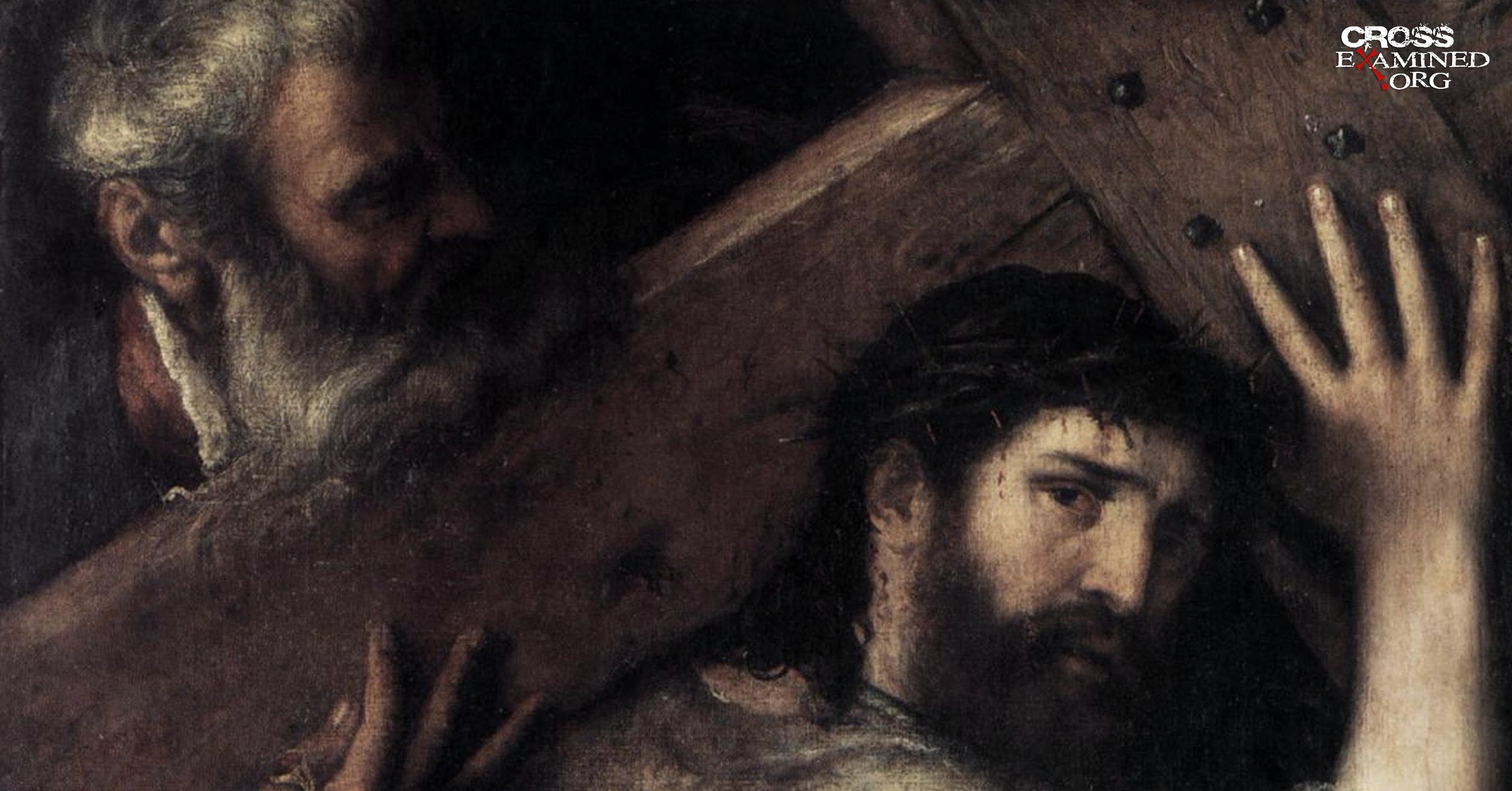
Mark mentions three obscure figures in Mark 15:21. He notes, “And they compelled a passerby, Simon of Cyrene, who was coming in from the country, the father of Alexander and Rufus, to carry his cross.” It’s noteworthy that none of these three figures show up anywhere else in the narrative. Moreover, while Matthew and Luke also mention Simon of Cyrene, they leave out his two sons. What best explains this phenomena?

Church tradition suggests that Mark’s Gospel is more or less Peter’s account of things. Yet, Peter wasn’t in all places at all times. In fact, he drops out of the narrative in the previous chapter. He’s presumably in hiding after Jesus’ arrest. So how would Peter or Mark know that Simon carried Jesus’ cross? Who’s testimony stands behind this story?

It most certainly has to be Simon of Cyrene. Furthermore, the mention of his two sons Alexander and Rufus suggests that Mark expected his readers to know who they were. In fact, if Mark wrote his Gospel in Rome (as tradition suggests), it’s reasonable to believe that the church heard this story from Alexander and Rufus themselves. Think about it. Alexander and Rufus must have heard the story dozens of times from their dad. And now as they relayed this same story to the church in Rome, imagine how proud they must have felt. That’s our dad! He carried Jesus’ cross! Since neither Matthew nor Luke mention these two sons, we can assume that their audiences (places other than Rome) would not have been familiar with them.

Cleopas

After his resurrection from the dead, Jesus appears to two individuals on the road to Emmaus — Cleopas and an anonymous figure. Why mention Cleopas and not the other? The story obviously does not require him to be named.

The most reasonable explanation is that Cleopas must be the source for this specific account. Again, none of the disciples were present. Luke himself was not present. But as Luke mentioned in his prologue, he spoke with different eyewitnesses before compiling his Gospel account (Luke 1:1-3). Cleopas was one such eyewitness.

Also worth noting is that Cleopas was probably Jesus’ uncle. Elsewhere, John reports, “but standing by the cross of Jesus were his mother and his mother’s sister, Mary the wife of Clopas, and Mary Magdalene” (John 19:25). While the spelling is different in John, Bauckham argues that “Clopas is a very rare Semitic form of the Greek name Cleopas, so rare that we can be certain this is the Clopas who, according to Hegesippus, was the brother of Jesus’ father Joseph.”[1]

Writing in the early fourth century, church historian Eusebius references Hegesippus’ quote on Clopas. He writes:

After the martyrdom of James and the conquest of Jerusalem which immediately followed, it is said that those of the apostles and disciples of the Lord that were still living came together from all directions with those that were related to the Lord according to the flesh (for the majority of them also were still alive) to take counsel as to who was worthy to succeed James. They all with one consent pronounced Symeon, the son of Clopas, of whom the Gospel also makes mention; to be worthy of the episcopal throne of that parish. He was a cousin, as they say, of the Saviour. For Hegesippus records that Clopas was a brother of Joseph.[2]

According to church tradition, Clopas’ son, Symeon, the cousin of Jesus and James, became the overseer of the church in Jerusalem after James’ martyrdom in AD 62. Thus, we can see why Clopas’ testimony might carry some significant weight in the early church. He was the uncle of Jesus, and his son was a prominent leader in the Jerusalem church.

Names and Eyewitnesses

A few other names also fit this same description (Jairus, Bartimaeus, and Zacchaeus to name a few). By looking at the general pattern in the Gospels, these obscure figures should have remained anonymous. Therefore, their names seem rather significant. I believe Bauckham is correct when he suggests “that many of these named characters were eyewitnesses who not only originated the traditions to which their names are attached but also continued to tell these stories as authoritative guarantors of their traditions.”[3]

Notes

[1] Richard Bauckham, Jesus, and the Eyewitnesses, 47.

[2] Eusebius, Hist. Eccl. 3.11.

[3] Richard Bauckham, Jesus, and the Eyewitnesses, 39.

Recommended resources related to the topic:

Cold-Case Christianity: A Homicide Detective Investigates the Claims of the Gospels by J. Warner Wallace (Book)

The New Testament: Too Embarrassing to Be False by Frank Turek (MP3) and (DVD)

Why We Know the New Testament Writers Told the Truth by Frank Turek (mp4 Download)

The Top Ten Reasons We Know the NT Writers Told the Truth mp3 by Frank Turek

Counter Culture Christian: Is the Bible True? by Frank Turek (Mp3), (Mp4), and (DVD)      

__________________________________________________________________________________________________________________________________________________

Ryan Leasure holds a Master of Arts from Furman University and a Master of Divinity from the Southern Baptist Theological Seminary. Currently, he’s a Doctor of Ministry candidate at the Southern Baptist Theological Seminary. He also serves as a pastor at Grace Bible Church in Moore, SC.

Original Blog Source: https://cutt.ly/avG9mjt


By Ryan Leasure

Perhaps the most scathing statement ever made about the God of the Old Testament came from the pen of Richard Dawkins. He famously snarled:

The God of the Old Testament is arguably the most unpleasant character in all fiction: jealous and proud of it; a petty, unjust, unforgiving control-freak; a vindictive, bloodthirsty ethnic cleanser; a misogynistic, homophobic, racist, infanticidal, genocidal, filicidal, pestilential, megalomaniacal, sadomasochistic, capriciously malevolent bully.”[1]

Dawkins and his fellow New Atheists have successfully persuaded the masses into believing that God is a moral monster.

Sadly, Christians have not been immune to these attacks either. Dating back to the second-century heretic Marcion, people within the church have succumbed to the notion that the God of the Old Testament is radically different from Jesus in the New. Commenting on Marcion’s views, Michael Kruger notes that his “theology was shaped by what he regarded as an insurmountable problem with the Old Testament. He viewed the God of the Old Testament as vengeful and wrathful; and viewed the God of Jesus, as described in the writings of Paul, as peaceable, merciful, and loving.”[2]

Among other complaints, one of the more powerful critiques leveled against the God of the Old Testament is that he is anti-women. Some go so far to suggest that God places women on par with chattel. This critique is especially powerful considering the contemporary feminist movement. But is this critique warranted? Does the Old Testament portray God as negatively as some would like us to believe?

In this article, I will argue that a close examination of the Old Testament vindicates God’s morality with respect to women. I will substantiate this claim in two steps. First, I will demonstrate that the skeptic’s objections are largely based on poor hermeneutics. And second, I will examine some of the most popular “problem” texts used to advance the false narrative that God is misogynistic and establish that they do not portray God in a negative light.

Hermeneutical Principles

A surface reading of a few Old Testament texts may lead some to believe that God thinks women are inferior to men. One reason detractors have reached this conclusion is because they fail to use basic hermeneutical principles when interpreting biblical text. Specifically, critics ignore historical context, overlook the distinction between case laws and God’s ideals, and assume a mere description of an event means God’s prescription of it.

Historical Context

“The first stage in serious Bible study,” notes Grant Osborne, “is to consider the larger context within which a passage is found.”[3] He goes on to note, “Since Christianity is a historical religion, the interpreter must recognize that an understanding of the history and culture within which the passage was produced is an indispensable tool for uncovering the meaning of that passage.”[4] Osborne’s advice is especially pertinent considering the wide chasm that exists between the Ancient Near East (ANE) and twenty-first century America.

If we are to understand what Moses meant in the Penteteuch, we must have some understanding of his millieu. Moreoever, we must remember that Israel was birthed out of the ANE where partriarchy, primogeniture, polygamy, and slavery were accepted norms.[5] That is to say, Israel did not exist in a vacuum, isolated from its neighboring nations. This close proximity explains why many of those less than ideal structures existed in ancient Israel.

With this context established, one readily observes that God does not endorse the broken structures of patriarchy, polygamy, slavery and so forth. Rather, we observe that God worked within those already existing structures, seeking to make incremental moral improvements on established practices.[6] This strategy is not too different from a new pastor who aims to take his church in a new direction, but he does so gradually lest he leave others behind.

A good example of this approach comes from Jesus when talking about divorce. He notes in Matthew 19:8, “Because of your hardness of heart Moses allowed you to divorce your wives, but from the beginning it was not so.” In other words, divorce was not God’s ideal. As Jesus mentions, “from the beginning it was not so.” However, Israel existed in a fallen context where people abused their marriages. In an attempt to mitigate against divorcing one’s spouse for any reason or not being able to get a divorce even though the spouse was habitually unfaithful, Moses permitted it under certain circumstances. In this way, God’s aim was to move the needle closer towards his ideals outlined in Genesis 1-2.

Case Laws vs. God’s Ideals

Detractors also make a mistake by confusing case laws with God’s universal ideals. Unlike God’s ideals, case laws were not universal in scope. Rather, they were given in the Mosaic Law to address specific situations where people had disregarded God’s ideals. One can spot a case law because it usually begins with the words “if” or “when” and goes on to describe a certain less than ideal situation with some concluding judgments or provisions.[7]

A clear example of a case law is found in Exodus 22:1. The law states, “If a man steals an ox or a sheep, and kills it or sells it, he shall repay five oxen for an ox, and four sheep for a sheep.” Notice that this case law does not endorse theft. Instead, it recognizes that moral concessions have been made against God’s ideals (Exod 20:15). As a result, this law aimed to make the best out of a bad situation by prescribing the appropriate amount of restitution for stolen property.

With respect to women, consider Exodus 21:7-11. This case law states:

When a man sells his daughter as a slave, she shall not go out as the male slaves do. If she does not please her master, who has designated her for himself, then he shall let her be redeemed. He shall have no right to sell her to a foreign people, since he has broken faith with her. If he designates her for his son, he shall deal with her as with a daughter. If he takes another wife to himself, he shall not diminish her food, her clothing, or her marital rights. And if he does not do these three things for her, she shall go out for nothing, without payment of money.

Notice that the text begins with the word “when,” indicating that God is not prescribing slavery or misogamy. Rather, this case law assumes that the described situation is less than ideal. In this particular case, a father attempts to arrange for his daughter to marry a man with means, thus providing long-term security for her. The difficulty with the text revolves around why a man would want to buy a woman who functioned as both a servant and a wife at the same time.

What we can discern from this text is that the master had been previously married, given that he has a son. And since the son is of marriageable age, the master must be older. Therefore, the most likely explanation is that he is a widower, although divorce is a possibility. Therefore, in an attempt to protect the inheritance for his existing children from his first wife, he makes a special agreement with the woman’s family in what amounts to an ancient prenuptial agreement.

With the special considerations aside, the man was still to treat this woman as his legal wife. Biblical scholar Douglas Stuart remarks, “The original Hebrew text brings out that a woman whose service contract is purchased along with her bride price is still a real wife, with all the protections that would accrue to anyone’s daughter given in marriage in Israel under the provisions of the covenant.”[8] Meaning, if the man married the woman, he had to protect her and love her as his own wife.

The text goes on to provide additional provisions for the woman. First, if the master did not follow through with marriage, then the woman could be redeemed. This provision implies that the original agreement assumed marriage, not simply servitude. He cannot, however, sell her to foreigners.

Another viable option was that the woman could marry the master’s son. If this situation were to transpire, then the father must treat her like his own daughter.

But, if the son marries someone else, and no other suitor redeems the woman, then the father is to provide for her as if she had married into the family. Because most women could not provide for themselves in the patriarchal world of the Ancient Near East (ANE), women relied on marriage as a means of survival. Again, this sample case law does not provide a universal norm. It merely seeks to make the best out of a less than ideal situation.

God’s ideals, on the other hand, refer to his heart on the matter and are universal in scope. Meaning, God’s ideals are his desires for all people at all times. And a quick examination of these ideals reveals that God is actually for not against women. Consider Genesis 1:27 which claims, “So God created man in his own image, in the image of God he created him; male and female he created them.” As a result of being made in God’s image, both men and women are equally valuable to him.

Also consider Genesis 2:24 which asserts, “a man shall leave his father and mother, and be joined to his wife; and they shall become one flesh.” According to biblical scholar Gordon Wenham, it is easy for us to miss the significance of this transition in relationships. He remarks, “In modern Western societies where filial duties are often ignored, this may seem a minor point to make, but in traditional societies like Israel where honoring parents is the highest human obligation next to honoring God, this remark about forsaking them is very striking.”[9] In other words, God placed such a high value on the new wife, that he commanded man to make her his highest priority, even higher than his parents.

In these two passages alone, we discover God’s heart for women. He values them just as much as he values men.

Prescriptive vs. Descriptive

A third hermeneutical principle critics ignore is the distinction between prescriptive and descriptive texts. Prescriptive texts are clear commands or prohibitions from Scripture. For example, God forbids murder (Exod 20:13). At the same time, Scripture describes murder (Gen 4:8). What should be plainly obvious is that Scripture’s description of an event does not imply God’s approval of it. Certainly, God did not approve of how the men treated the concubine in Judges 19 despite Scripture’s description of the horrific event.

If someone fails to grasp these hermeneutical principles, they will misinterpret the Old Testament.

“Problem” Texts

In this section, we will consider three types of texts that skeptics claim portray God as misogynistic. Specifically, we will consider texts dealing with polygamy, the bride-price, and women POWs.

Polygamy

The practice of polygamy is well established in the Old Testament. Be that as it may, God never prescribes polygamy. On the contrary, he asserts that a man should “be joined to his wife; and they shall become one flesh” (Gen 2:24). Moreover, Leviticus 18:18 forbids polygamy when it declares, “And you shall not take a woman as a rival wife to her sister, uncovering her nakedness while her sister is still alive.” While some argue that this text-only forbids incestuous relationships, a good case can be made that it forbids polygamy altogether. As Paul Copan argues, “This phrase ‘a woman to her sister’ and its counterpart, ‘a man to his brother,’ are used twenty times in the Hebrew Scriptures, and never do they refer to a literal sister or brother.”[10] Finally, God specifically forbade the kings of Israel to take multiple wives (Deut 17:17).

At the same time, the Old Testament describes several polygamous situations. One thinks of David and Solomon who disregarded God’s prescribed ideal (Deut 17:17). When it came to Israel’s rulers, however, taking multiple wives and concubines was typically for political purposes, not sexual advances.[11] But again, a mere description of polygamy in no way suggests that God endorsed it. In fact, where polygamy is described, discord and strife quickly follow.[12]

Consider the case law found in Deuteronomy 21:15-17. It reads:

If a man has two wives, the one loved and the other unloved, and both the loved and the unloved have borne him children, and if the firstborn son belongs to the unloved, then on the day when he assigns his possessions as an inheritance to his sons, he may not treat the son of the loved as the firstborn in preference to the son of the unloved, who is the firstborn, but he shall acknowledge the firstborn, the son of the unloved, by giving him a double portion of all that he has, for he is the firstfruits of his strength. The right of the firstborn is his.

This case law refers to a polygamous situation which is already under way—a clear violation of God’s ideals (Gen 2:24). Now that the deed is done, how should the Israelites make the best out of this messy situation?

Some might be tempted to think that the man should divorce one of his wives. But taking that route would actually do more harm than good. After all, it was extremely difficult for a non-virgin woman to get married in that culture. More than that, women had difficulty fending for themselves and relied heavily on men. For these reasons, the law does not encourage divorce.

Moreover, polygamy is not even the point of the law. As Eugene Merrell notes, “The matter of law that is pertinent here is the proper bestowal of inheritance rights.”[13] In other words, this law ensured that the husband followed the proper customs by giving the firstborn son the inheritance, irrespective of who his mother was. Yes, the case law assumes polygamy occurred; but that is a far cry from God’s endorsement.

Bride-Price

In addition to polygamy, many of the same skeptics suggest that bride-price laws treated women like chattel. A closer examination of the law, however, reveals that it existed to protect woman and express the solemnity of the marriage covenant. As Paul Copan notes, “the bride-price was the way a man showed his serious intentions toward his bride-to-be, and it was a way of bringing two families together to discuss a serious, holy, and lifelong matter.”[14]

The bride-price also provided compensation to the woman’s father for the work she would have otherwise contributed to her family and served as a financial safety net for the women in the case of divorce or the husband’s early death.[15]

Consider Exodus 22:16-17. This case law reads, “If a man seduces a virgin who is not betrothed and lies with her, he shall give the bride-price for her and make her his wife. If her father utterly refuses to give her to him, he shall pay money equal to the bride-price for virgins.”

In this particular case, a man seduced a virgin whom he had no intentions of marrying. His act showed complete disregard for the value of the woman, jeopardizing her future prospects of marriage. Therefore, in an attempt to hold him accountable for his sexual advances, the law mandates that he pay the bride-price and marry the woman, provided that her father agrees. Douglas Stuart suggests, “Since it would be much harder to marry her to someone else once she had been sexually compromised, [the father] was still owed the bride price for her, lest no bride price ever be paid in the case that she was never, in fact, married thereafter.”[16]

While the arrangement may not find its way into a Hallmark movie, it presents the best-case scenario for the woman in ancient Israel. It protected her from unwanted sexual advances, and it provided her with long-term financial security. At the same time, though, the father of the woman had the right to refuse the suitor while simultaneously keeping the bride-price. One can assume that the father and the daughter usually made a joint-decision in situations like this one (Gen 24).

In sum, the bride-price protected women against sexual advances, expressed the seriousness of the marriage covenant, strengthened relations between the two families, and offered financial security for the woman. It did not imply that women were mere property.

Women POWs

Finally, critics also claim that Israelite men were allowed to capture and rape foreign woman POWs. Yet, a closer examination of key texts refutes this assertion. Deuteronomy 21:10-14 declares:

When you go out to war against your enemies, and the LORD your God gives them into your hand and you take them captive, and you see among the captives a beautiful woman, and you desire to take her to be your wife, and you bring her home to your house, she shall shave her head and pare her nails. And she shall take off the clothes in which she was captured and shall remain in your house and lament her father and her mother a full month. After that you may go in to her and be her husband, and she shall be your wife. But if you no longer delight in her, you shall let her go where she wants. But you shall not sell her for money, nor shall you treat her as a slave, since you have humiliated her. 

Notice how this case law actually offers protection for women. Instead of instantly raping the women—which was normal procedure among other ANE cultures[17]—the law ordered Israelite men to wait at least a month before getting married and engaging sexually with the woman.

This waiting period served multiple purposes. First, it prevented the Israelite soldier from entering into marriage too hastily in uncontrolled lust like one might see in Las Vegas. In fact, we can assume that this allotted time period prevented scores of unhappy marriages since the law assumes that Israelite soldiers often lost desire for the woman after the month’s end. If this change in feeling occurred, the soldier was to let the woman go. In no circumstances was her allowed to treat her as a slave.

A second reason for the waiting period was to allow the woman time to mourn her family and reflect on the prospect of integrating into the Israelite community. As Eugene Merrill argues, “The idea behind all these procedures seems to be that of cutting off all ties to the former life in order to enter fully and unreservedly into the new one. This presupposes a degree of willingness on the part of the maiden to forsake the past and to embrace a new and different way of life, for one can hardly conceive of all this taking place coercively.”[18]

In the end, this law forbade rape of any kind by prescribing a one-month waiting period for women POWs. At month’s end, the Israelite soldier could choose to marry the woman (if she acquiesced) and then have sexual relations with her.

Another difficult text related to women POWs is Numbers 31:17-18. When referring to the Midianite women, Moses ordered the Israelite officers to “kill every woman who has known man by lying with him. But all the young girls who have not known man by lying with him keep alive for yourselves.” Admittedly, this text looks damning on the surface. The context, however, provides explanation.

In Numbers 25 we read that the Midianite women seduced the Israelite men and compelled them to worship Baal. Baal worship, it must be noted, was not simply bowing to an idol. Rather, it included temple prostitution, bestiality, and a whole littany of other sexual sins. This pagan worship involving sexual immorality was the motivation behind God’s command to destroy the Midianite women while sparing the virgins.

The virgins, after all, had not seduced the Israelite men. It was the non-virgin women who participated with the Israelite men in pagan sexual immorality.[19] And lest we think God did not hold the men accountable for their action, Numbers 25 tells us that God sent a plague and wiped out twenty-four thousand of them for their sin. After sparing the virgins, then, the Israelite men would have then followed protocal from Deuteronomy 21:10-14, waiting at least one month before marrying the virgin and engaging sexually with her.

Conclusion

As this article indicates, a close examination of the Old Testament vindicates God’s morality with respect to women. I substantiated this claim in two steps. First, I established that most critics reach their negative conclusions using faulty hermeneutics. And second, I examined several “problem” texts and demonstrated that they do not portray a misogynistic attitude on God’s part.

Certainly, the ancient patriarchal society was far from ideal. But Israel’s treatment of women was a vast improvement over their Canaanite neighbors. And while we might wish that the Israelites had progressed, even more, they laid the groundwork for even more female advancement in the New Testament. Eventually, it was the church, following the example of Jesus, who dramatically raised the status of woman worldwide. Therefore, it is not an exaggeration to state that modern-day feminists have Christians to thank for the advancement of women in our society.

Footnotes

[1] Richard Dawkins, The God Delusion (New York: Houghton Mifflin, 2006), 51.

[2] Michael J. Kruger, Christianity at the Crossroads: How the Second Century Shaped the Future of the Church (Downers Grove, IL: IVP Press, 2018), 117.

[3] Grant R. Osborne, The Hermeneutical Spiral: A Comprehensive Introduction to Biblical Interpretation (Downers Grove, IVP Press, 2006), 37.

[4] Grant R. Osborne, The Hermeneutical Spiral, 158.

[5] Paul Copan, Is God a Moral Monster? Making Sense of The Old Testament God (Grand Rapids: Baker Books, 2011), 60.

[6] Paul Copan, Is God a Moral Monster? 61.

[7] Christopher J. H. Wright, Old Testament Ethics for the People of God (Downers Grove, IL: IVP Press, 2004), 292.

[8] Douglas K. Stuart, Exodus, The New American Commentary (Nashville, B&H Publishing, 2006), 483.

[9] Gordon J. Wenham, Genesis 1-15: Word Biblical Commentary (Mexico City: Thomas Nelson, 1987), 71.

[10] Paul Copan, Is God a Moral Monster? Making Sense of The Old Testament God (Grand Rapids: Baker, 2011), 113.

[11] Christopher J. H. Wright, Old Testament Ethics for the People of God, 330.

[12] Christopher J. H. Wright, Old Testament Ethics for the People of God, 331.

[13] Eugene H. Merrill, Deuteronomy: The New American Commentary (Nashville, B&H Publishing, 1994), 292.

[14] Paul Copan, Is God a Moral Monster? 117.

[15] Paul Copan, Is God a Moral Monster? 117.

[16] Douglas K. Stuart, Exodus, 510.

[17] Paul Copan, Is God a Moral Monster? 120.

[18] Eugene H. Merrill, Deuteronomy, 291.

[19] Gordon J. Wenham, Numbers: An Introduction and Commentary (Downers Grove, IL: IVP Press, 1981), 211.

Recommended resources related to the topic:

LifeGivers Apologetics: Women Designed and Equipped to Share Reasons for the Hope Within (Book/ Study Guide – Teacher’s Version and Student’s Version) by Tricia Scribner

Major Truths from the Minor Prophets (Book) by Edna Ellison, Kimberly Sowell & Tricia Scribner 

Woman to Woman: Preparing Yourself to Mentor (Book) by Edna Ellison & Tricia Scribner


________________________________________________________________________________________________________________________________________________

Ryan Leasure holds a Master of Arts from Furman University and a Master of Divinity from the Southern Baptist Theological Seminary. Currently, he’s a Doctor of Ministry candidate at the Southern Baptist Theological Seminary. He also serves as a pastor at Grace Bible Church in Moore, SC.

Original Blog Source: https://cutt.ly/9xZOg9j

 

By Ryan Leasure

Critics of Christianity like to suggest that a crucified victim like Jesus never would have received a proper burial. They point to cases where the Romans left victims on the cross for days while birds ate away at their flesh to serve as a reminder to everyone who walked by not mess with Rome. What’s more, the Romans usually tossed the remains into a common grave. The theory goes, in no case would Rome give permission for a crucified victim to receive a proper burial.

It’s no secret that crucifixion was a horrendous experience. It was so terrible, that ancients made up a new word to describe the agony of crucifixion — excruciating. Furthermore, Rome only crucified non-Romans guilty of the worst of crimes. When you consider this, it seems plausible that the Romans would have forbidden Jesus’ burial in a tomb. But just because something is plausible doesn’t mean that’s what actually happened.

Let me illustrate my point. A few years ago, the U.S. Navy Seals carried out a secret mission to capture and kill Osama Bin Laden. It’s standard procedure for United States special forces to capture the enemy and bring them back to a high security prison for interrogation. In this instance, however, they killed Bin Laden on the spot and dumped his body in the ocean. Now let me ask you this: Should future Americans one hundred years from now be skeptical that the U.S. Navy Seals killed Bin Laden since it was implausible — not an ordinary occurrence? No, of course not, because history is filled with implausible events.

Politics and Jewish Customs

So is it inconceivable that Jesus received a proper burial in a tomb? I don’t think so for a few of reasons. First, Pontius Pilate was a politician who wanted to keep his post. As the Roman governor, it was his responsibility to keep the peace in the region — the Pax Romana. Thus, it was in Pilate’s best interest to cooperate with the Jewish leadership  and be considerate of their customs lest he instigate the masses. Jewish historian Josephus writes that emperor Tiberius had previously chastised Pilate for being insensitive to the Jewish culture when he placed pagan symbols inside the temple. This act, of course, led to a mob, which ultimately subsided when Pilate removed the artifacts. Pilate was down to his final strike; therefore, he had extra motivation to cooperate with Jewish leadership.

Now John’s gospel tells us why the Jews wanted to take Jesus’ body down from the cross instead of leaving it up indefinitely. We read in John 19:31, “Now it was the day of Preparation, and the next day was to be a special Sabbath. Because the Jewish leaders did not want the bodies left on the crosses during the Sabbath, they asked Pilate to have the legs broken and the bodies taken down.” In other words, Pilate needed to honor the Sabbath, and the text indicates that he did just that — although the soldiers didn’t need to break Jesus’ legs. Remember, Emperor Tiberius had already rebuked him once. Pilate needed to navigate this situation carefully.

Archeological Evidence

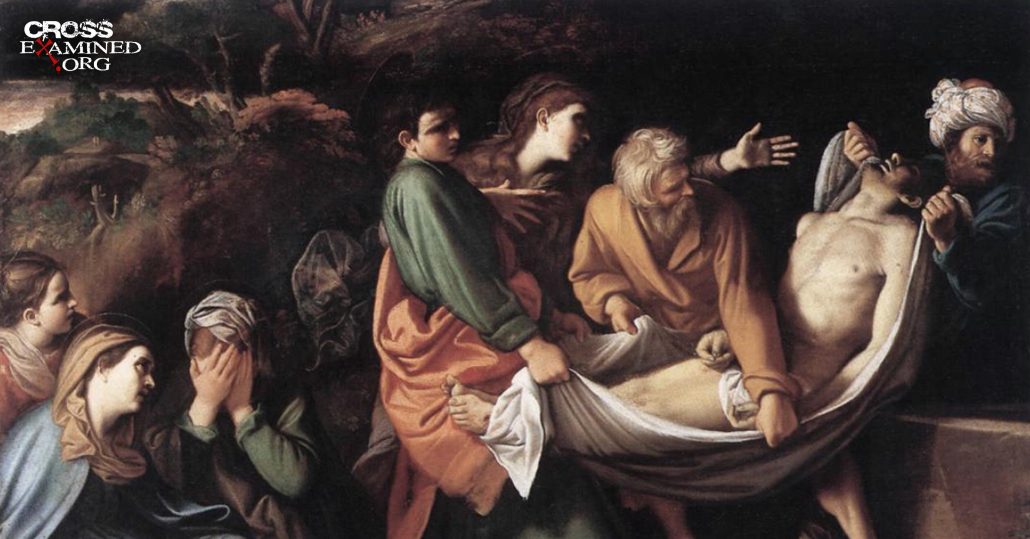
Second, we have archeological evidence that Pilate allowed crucified victims to receive a proper burial. Before I disclose what that evidence is, let me first describe ancient Jewish burial practices. When a Jewish loved one died, they were wrapped in a cloth, adorned with perfumes and spices, and placed in a tomb. After one year, the family members would return to the tomb to collect the bones of their deceased relative and place them in a smaller box called an ossuary. This allowed for more space in the tombs so that all the deceased family members could be near each other.

Amazingly, in 1968, archaeologists discovered an ossuary of a Jewish man named Yehohanan in the north-eastern quadrant of Jerusalem. This young man noticeably had been crucified. I say noticeably, because a six-inch iron spike was still attached to his heel bone with wood fragments from a cross still attached to the spike (see image above). Experts date the bones to the late 20’s — less than a decade before Jesus’ death and still during Pilate’s rule1. Here is evidence that Pilate permitted Jewish crucifixion victims to receive a proper burial. It seems, then, that Jesus’ burial in a tomb isn’t without precedent.

Joseph Of Arimathea

Third, each of the Gospel writers indicate that Joseph of Arimathea buried Jesus’ body in his tomb. This meets the criteria of multiple attestation which states that if multiple, independent sources report an event, it’s more probable that it happened.

More than that, it also meets the criteria of embarrassment because it makes a Jewish council member look more compassionate than Jesus’ disciples. If the gospel writers lied, why would they go out of their way to make themselves look bad? To be sure, they indicate that Joseph was a believer, but why give credit to a member of the council that was responsible for most Christianity’s early persecution? It’s hard to imagine that the early Christians wanted to give credit to the Jewish leaders for anything.

Furthermore, it makes no sense to credit a prominent member of Jewish society whom everyone knew and could be talked to — someone who could debunk the story if it was false. If the disciples lied about the story, it would have been more prudent to give themselves credit for the burial or invent a character that no one could question. The only reason, therefore, the early Christians had for giving credit to Joseph of Arimathea is that he must have, in fact, buried Jesus in his tomb.

Was Jesus Buried in A Tomb?

On the surface, the claim that Jesus wouldn’t have received a proper burial sounds compelling. Yet, when you dig a little deeper and understand more of the context, Jesus’ burial in a tomb makes the most sense of all the data. Therefore, I think we can confidently say that Jesus’ burial is not fake news.

Recommended resources related to the topic:

Early Evidence for the Resurrection by Dr. Gary Habermas (DVD), (Mp3) and (Mp4)

Cold Case Resurrection Set by J. Warner Wallace (books)

Jesus, You and the Essentials of Christianity – Episode 14 Video DOWNLOAD by Frank Turek (DVD)

The Footsteps of the Apostle Paul (mp4 Download), (DVD) by Dr. Frank Turek


Ryan Leasure holds a Master of Arts from Furman University and a Masters of Divinity from the Southern Baptist Theological Seminary. Currently, he’s a Doctor of Ministry candidate at the Southern Baptist Theological Seminary. He also serves as a pastor at Grace Bible Church in Moore, SC.

Original Blog Source: https://cutt.ly/CkgzPcT

By Ryan Leasure

Historic Christianity affirms that Jesus Christ, though fully human, is also fully divine. He is the Alpha and Omega, the beginning and the end (Rev. 22:13) — the eternal creator of all things (Jn. 1:3). The Nicene Creed (AD 325) declares of Jesus that he is:

With Jesus’ deity established, can we honestly say Jesus could experience genuine temptations? After all, James 1:13 declares that “God cannot be tempted by evil.” Doesn’t this present a bit of a dilemma for the biblical Christian? If Jesus was impeccable, that is, he was unable to sin, to what extent can we say that his temptations really affected him?

On the surface, it seems that Christians can’t take much comfort from Hebrews 4:15, which reads, “For we do not have a high priest who is unable to empathize with our weaknesses, but we have one who has been tempted in every way, just as we are — yet he did not sin.”

Can we really say he was tempted in every way as we are? I experience temptation all the time and give in to those temptations more than I’d like to admit. That wasn’t a problem for Jesus, though. He couldn’t give in to his temptations. Doesn’t this seem like apples and oranges to you?

While I affirm that Jesus was unable to sin due to being fully divine, in the remaining space, I want to demonstrate that he experienced genuine temptations as a human. And I want to show that we can believe in both truths simultaneously.

A Spirit-Filled Human

I contend that the reason Jesus could not sin and the reason he did not sin are for different reasons. I believe Jesus could not sin because he is the second person of the Triune God who is incapable of sinning (Js. 1:13). The reason he didn’t sin, however, was because, as a human, he was filled and empowered by the Spirit. That is, Jesus lived his life on earth fundamentally as a human and relied on the Spirit to perfectly obey his Father. Let me give you a few texts of Scripture to support this claim:

And the Spirit of the LORD shall rest upon [the Messiah], the Spirit of wisdom and understanding, the Spirit of counsel and might, the Spirit of knowledge and the fear of the LORD (Isa. 11:2).

The Spirit of the Lord GOD is upon me (the Messiah) because the LORD has anointed me to bring good news to the poor; he has sent me to bind up the brokenhearted, to proclaim liberty to the captives, and the opening of the prison to those who are bound (Isa. 61:1).

And Jesus returned in the power of the Spirit to Galilee, and a report about him went out through all the surrounding country (Lk. 4:14).

But if it is by the Spirit of God that I (Jesus) cast out demons, then the kingdom of God has come upon you (Mt. 12:28).

How God anointed Jesus of Nazareth with the Holy Spirit and with power. He went about doing good and healing all who were oppressed by the devil, for God was with him (Acts 10:38).

I believe this small sample size of texts demonstrates that Jesus lived his earthly life fundamentally as a human. If, in the incarnation, Jesus lived primarily as deity, the filling of the Holy Spirit would have been both redundant and unnecessary for his mission.

Jesus’ Sinlessness Illustrated

A few years back, daredevil Nik Wallenda tightrope across Niagara Falls on national television. As I watched Wallenda make the successful 1,800-foot journey across the falls, I remember feeling nervous for him, but I wasn’t worried he was going to die. Why? Because the television producers forced him to wear a safety harness to ensure he wouldn’t fall to his death while the entire world watched.

Now, could Wallenda have died on his walk across the tightrope? No, the safety harness protected him from falling. But, how did Wallenda make it across the tightrope? He balanced himself and walked across. The harness didn’t help him one bit. You see, the reason he could not have died and the reason he made it across are for two completely different reasons.

In the same way, Jesus could not have sinned because he was fully divine. This was his safety harness if you will. But Jesus didn’t sin because he perfectly obeyed the Father as a human in the power of the Holy Spirit. That is to say, he experienced genuine temptations, but never once did he give into them.

The Extent Of Jesus’ Temptations

Some still object and say Jesus’ temptations were of a lesser nature than ours. After all, he didn’t have a sin nature. He didn’t battle the same kind of internal temptations we do. This much is true. But it doesn’t mean his temptations were less severe than ours.

Think about it. Whatever internal temptations Jesus didn’t experience, he more than made for up it by going toe-to-toe with Satan. Satan gave Jesus his best shot. He knew what was at stake during Jesus’ life. If he could get Jesus to sin, he wins. Game over. You and I probably won’t ever get Satan’s full onslaught like Jesus did.

Also, consider the fact that you and I often break in the face of temptation. Whether we’re tempted to lust, lash out in anger, or grow impatient, we typically can only handle so much before we eventually give in. The temptation builds and builds until we can’t withstand any longer, and we snap. Jesus, on the other hand, saw temptations all the way through to the very end, and even as the pressure built, he never once sinned. He stood firm in the face of the most intense feelings of temptation — something we often don’t get to because we cave earlier.

Consider, as an illustration, the world’s strongest man. He picks up a twig, holds it by both ends, and snaps it with ease. Next, he picks up an iron bar and attempts to do the same. He bends with every bit of force he can muster for a few minutes, but the bar remains unscathed. As you think about twig and the iron bar, which of the two-faced more intense pressure from the world’s strongest man? The iron bar, of course.

Well, we’re like the twig, and Jesus is like the bar. We snap before we can feel the full force of the temptation. Jesus, however, experiences the full force of the temptation and never once snaps. It seems naive, therefore, to suggest that we face more difficult temptations than he did.

Why This Is Important

When God the Son took on human flesh — or emptied himself according to Philippians 2 — he set out to live as much like a human as was possible for him to do. This means he couldn’t conjure his divine powers every time he got himself in a quandary. For example, when Satan tempted Jesus to turn the stones into bread, he tempted him to rely on his deity instead of his humanity in that situation.

Think about the problem we’d have if every time Jesus faced a difficult situation, he simply performed a miracle to make his life easier. If he healed himself every time he got sick, or if he teleported to Jerusalem instead of taking the long journey just like everyone else, in no real sense could he be one of us and represent us as our high priest before the Father (Heb. 4:15). Jesus, however, can be our faithful high priest because he lived his life on earth fundamentally as a human (Heb. 2:17-18). And as a human, he perfectly obeyed his Father because he was filled completely with the Spirit.

So, could Jesus have sinned? No. He was God. But did he experience genuine temptations as a human? Yes. Both are true at the same time.

Recommended resources related to the topic:

How Can Jesus Be the Only Way? (mp4 Download) by Frank Turek

Cold Case Resurrection Set by J. Warner Wallace (books)

Jesus, You and the Essentials of Christianity – Episode 14 Video DOWNLOAD by Frank Turek (DVD)


Ryan Leasure holds a Master of Arts from Furman University and a Masters of Divinity from the Southern Baptist Theological Seminary. Currently, he’s a Doctor of Ministry candidate at the Southern Baptist Theological Seminary. He also serves as a pastor at Grace Bible Church in Moore, SC.

Original Blog Source: https://cutt.ly/2hb3hrr

By Ryan Leasure

Moral atrocities litter the historical landscape. And this ought to make us sad. People do bad things. And they’ve been doing bad things ever since Genesis 3. It doesn’t take long for the fall to rear its ugly head in the Bible for in the very next chapter — Genesis 4 — Cain violently kills his brother. Unfortunately, these kinds of events have been occurring ever since.

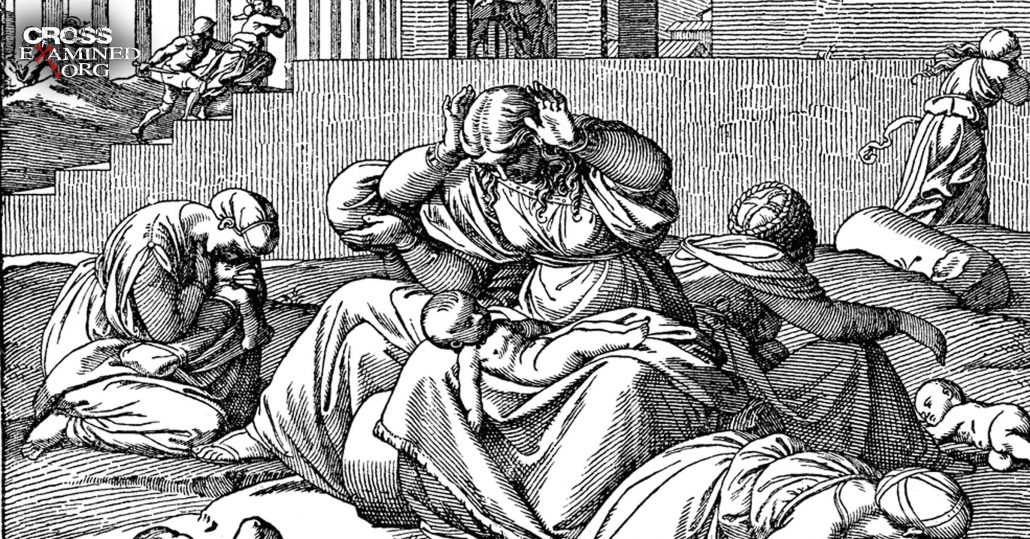
One thinks of the Holocaust, the genocides in Rwanda, or the untold millions dead from the Russian Gulag camps. Or if you’re a student of the Bible, you might think of the Bethlehem genocide orchestrated by King Herod the Great.

If you’re unfamiliar with this event, in Matthew 2, the Magi traveled to Jerusalem in search of this newborn king of the Jews. When Herod heard that these wise men were looking for a king other than himself, he became disturbed. Matthew tells us that Herod “was troubled, and all Jerusalem with him” (Mt 2:2).

Not one to share his throne, Herod eventually orders the execution of all the boys in Bethlehem who were two-years-old or under (Mt 2:16). Everyone would agree that Herod acted egregiously here. No morally sane person could justify Herod’s swift action. But did it actually happen?

No Historical Record of the Genocide

Skeptics are quick to point out that we don’t have any other ancient sources testifying to this awful event. Not even the other Gospels report it! But doesn’t this seem odd? If Herod really did order the execution of all those little boys, why didn’t Philo or Josephus report it? After all, Josephus wrote a great deal about first-century Palestine — more than anyone else. Yet, he is silent on the matter.

Does this give us reason to reject Matthew’s claim? Certainly, if the President of the United States ordered the execution of all the baby boys in Greenville, SC, we would expect at least two different news sources to cover the event. We can certainly sympathize with the skeptic’s concerns, but I still believe we still have good reason to believe that the genocide occurred.

Herod the Great

While Josephus doesn’t report on this specific event, he tells us a great deal about Herod the Great. Herod was born from noble stock, though he wasn’t technically Jewish. He was an Idumean — a descendent of Esau (something that the Jewish people always held against him). After Pompey conquered Judea, Julius Caesar appointed Herod’s father — Antipater II — as procurator of the region in 47 BC.[1] Antipater subsequently appointed Herod as governor of Galilee at the ripe young age of twenty-five. Less than ten years later, Herod was appointed king of Judea by Caesar Augustus after his dad died by poisoning.

After claiming his throne, Herod quickly married Mariamne I to solidify relations with his Jewish counterparts. But he couldn’t shake the suspicion that she sought to bring him down. This constant paranoia led him to order her execution. Mariamne’s death profoundly affected Herod. He became extremely ill. And though he didn’t die, he remained obsessively paranoid for the rest of his life that others were trying to sabotage his reign.[2]

Known for Two Things

King Herod is known for two things. First, he is known for his building projects. Most notably, Herod orchestrated the rebuilding of the Jewish temple. The building itself towered fifteen stories high, and the temple precincts covered the width of thirty-five football fields. Rabbinic tradition stated, “whoever has not beheld Herod’s building has not yet seen anything beautiful in his life.”[3] In addition to the temple, Herod constructed a number of palaces. He also built a number of theaters, arenas, and amphitheaters for the Greek Games. He established an entirely new city which he named Sebaste in honor of Augustus and even fashioned a temple for the sole purpose of emperor worship. Furthermore, he’s credited with creating the port city of Caesarea Maritima — a marvel of the ancient world.[4]

More relevant, though, Herod was known for his paranoia. Not known for chastity, Herod married ten women who gave him a number of sons.[5] As Herod aged, he became increasingly skeptical of his sons’ devotion. He was so utterly convinced that they meant to overthrow him that he executed three of them (Alexander, Aristobulus, and Antipater III).[6] After a series of executions and imprisonments of his close relatives, Caesar Augustus is reported to have remarked that he would rather be Herod’s pig (hus) than his son (huios).[7] Of course, Herod wasn’t allowed to touch pigs being a Jew. Upon his death bed, Herod ordered the execution of a number of high-ranking officials so that people would mourn at the time of his death rather than rejoice. Thankfully, that order was overturned by his sister after his death. To sum up Herod, Josephus notes, “He was a man who was cruel to all alike and one who easily gave in to anger and was contemptuous of justice.”[8]

Back to Bethlehem

Knowing what we know about Herod, doesn’t his execution order of the young boys in Bethlehem make sense? Knowing how paranoid he was about losing his kingship, it seems almost historically certain that he would have acted this way if he felt his throne was threatened. The Magi were, after all, looking for the one who was “king of the Jews.” If Herod was willing to execute his favorite sons because he thought they were plotting his demise, we can certainly see him ordering the death of his potential replacements.

But why doesn’t Josephus mention this event? I think we have two good explanations. First, Bethlehem was a small town consisting of roughly five hundred people. This means the population of young boys would have been anywhere from 10-20. A sad course of events, yes, but not something that might make it into Josephus’ history books like the execution of the king’s sons.

Second, Josephus’ history books, while extremely helpful for learning about first-century Palestine, are limited in what they report. Case in point, Josephus uses a total of 15,764 words in Antiquities book 18 which covers the span of thirty-two years (AD 6-38). That works out to less than five hundred words per year.[9] By comparison, Matthew uses 18,347 words in his Gospel which only spans three years (about six thousand words per year). This blog post alone is about twelve hundred words. I can’t imagine trying to squeeze the events of this year (especially the kind of year we’ve had) into 500 words. In sum, Josephus had to be selective in what he included in his works.

Conclusion

While we can appreciate the skeptic’s concerns, we don’t need to reject Matthew’s claim that Herod ordered the execution of the Bethlehem boys. Based on what we know of Herod, this execution is consistent with his constant paranoia and subpar character. Additionally, because the execution would have included at most 10-20 boys, Josephus didn’t feel it necessary to include this event in his works since he was limited in space.

Reference

[1] Josephus, Antiquities, 14.8.1-5.

[2] Michael J. Wilkins, “Matthew” in Zondervan Illustrated Bible Backgrounds Commentary: Matthew, Mark, Luke, ed. by Clint E Arnold (Grand Rapids: Zondervan, 2002), 18.

[3] Bava Basra, 4a.

[4] Wilkins, Matthew, 18.

[5] Josephus, Antiquities, 17.1.3.

[6] Josephus, Antiquities, 16.10.5-16.11.8, 17.10.1.

[7] Macrobius, Saturnalia, 2.f.11.

[8] Josephus, Antiquities, 17.8.1.

[9] Peter Williams, Twitter Post March 28, 2019.

Recommended resources related to the topic:

The New Testament: Too Embarrassing to Be False by Frank Turek (DVD, Mp3, and Mp4)

Why We Know the New Testament Writers Told the Truth by Frank Turek (DVD, Mp3 and Mp4)

Cold-Case Christianity: A Homicide Detective Investigates the Claims of the Gospels by J. Warner Wallace (Book)


Ryan Leasure holds a Master of Arts from Furman University and a Masters of Divinity from the Southern Baptist Theological Seminary. Currently, he’s a Doctor of Ministry candidate at the Southern Baptist Theological Seminary. He also serves as a pastor at Grace Bible Church in Moore, SC.

By Ryan Leasure

One of the more challenging texts in the Gospels is Luke’s reference to the census. We read in Luke 2:1-5:

In those days a decree went out from Caesar Augustus that all the world should be registered. This was the first registration when Quirinius was governor of Syria. And all went to be registered, each to his own town. And Joseph also went up from Galilee, from the town of Nazareth to Judea, to the city of David, which was called Bethlehem, because he was of the house and lineage of David, to be registered with Mary, his betrothed, who was with child.

So, why is this text difficult? It’s difficult because Luke places Quirinius’ census at the time of Jesus’ birth prior to King Herod’s death in 4 BC (Mt 2:1; Lk 1:5). Historical records, however, date Quirinius’ Syrian governorship from AD 6-9. This alleged historical discrepancy has led to objections of various kinds. These objections can be summarized into five main points:[1]

  1. Nothing is known of an empire-wide census during Augustus.
  2. No census would require Joseph to travel to Bethlehem.
  3. No census would have happened in Palestine during the reign of King Herod.
  4. Josephus only knows of Quirinius’ census in AD 6.
  5. Quirinius was not the governor of Syria during the time of Jesus’ birth.

Do these five objections prove that Luke was wrong about the census? Let’s consider each of them in turn.

Nothing is known of an empire-wide census during Augustus

This claim simply isn’t true. According to historical records, Augustus instituted at least three censuses.[2] We also know of other cyclical censuses that transpired across in the empire during this time period in places such as Syria, Gaul, and Spain.[3] If this is true, why couldn’t Augustus issue a census in Palestine for taxation purposes?

No Census would Require Joseph to Travel to Bethlehem

This objection assumes that Rome did not allow local regions to operate according to their own customs. We know, however, that Rome often allowed Israel to operate according to their own customs provided they didn’t cause too trouble for the Romans. For example, they were allowed to observe the Sabbath, maintain their temple, and opt-out of activities that violated their Jewish consciences.[4] With this in mind, it seems perfectly reasonable to think that Rome would allow the Jewish people to conduct an ancestral census per their customs (2 Sam 24).

Additionally, Joseph’s journey to Bethlehem coincides with the time period of Herod the Great’s reign. For if this census occurred in AD 6, Joseph never would have left Herod Antipas’ territory (Nazareth) to Archelaus’ territory (Bethlehem). A journey from Nazareth to Bethlehem for registration purposes only makes sense during an era when both towns were part of one jurisdiction. After Herod died, these territories were split up.

No Census would have happened in Palestine during the Reign of King Herod

This claim overexaggerates Herod’s power. After all, Herod was a puppet king for the Romans. Yes, he’s historically referred to as King Herod the Great, but let’s not forget that Caesar could have deposed him at any moment. Herod simply rose to power through some politically calculated moves on his part.

Furthermore, The Romans frequently conducted censuses in vassal kingdoms across the empire.[5] Palestine wouldn’t have been any different.

We also know that after Herod’s death, Roman taxes were slashed by 25% in Samaria under the rule of Archelaus, indicating that regular taxes existed in Palestine during the time of Jesus’ birth.

Josephus only knows of Quirinius’ census in AD 6

Josephus dates the Quirinian census to thirty-seven years after Octavian defeated Mark Antony at Actium in 31 BC. Thirty-seven years later places the census in AD 6.[6] Josephus also tells us that this census caused a significant revolt. Those who deny that a census took place during the birth of Jesus suggest that the AD 6 revolt was due to the fact that Rome had never conducted a census in Palestine such as this. But as has already been discussed, we have good reasons to reject that view.

Others suggest that the revolt occurred because Rome ignored the Jewish customs during the AD 6 census. Meaning, previous censuses were conducted in a way that satisfied the Jewish people. If this hypothesis is true, Josephus would have and no reason to comment on the Luke 2 census since it occurred without controversy. As with most historians, Josephus only writes about “newsworthy” events.

We must also note that just because Luke is the only one who testifies to this earlier census doesn’t mean that it didn’t occur. We have thousands of singularly attested events in ancient literature. Additional sources would certainly give us more confidence that those events occurred, but not having additional sources in no way proves those events didn’t happen. Let’s also bear in mind that Luke has proven himself to be meticulously accurate in his handling of facts that can be checked.[7]

Quirinius was not the Governor of Syria During the Time of Jesus’ Birth

If Jesus was born in 4 BC, and Quirinius wasn’t governor of Syria until AD 6, how can Luke be right about the timing of the census? Three solutions have been offered to this challenging objection.

First, many have suggested that Quirinius served as the Syrian governor twice. In fact, historical data leaves a governorship gap between 4-1 BC. Which means, we don’t know who served as governor of Syria during that time. The challenge with this particular view is that even if Quirinius filled the historical gap, his rule most likely would have come after Herod’s death. Yet this explanation could still work. Censuses were known to take several years. If the census began while Herod still reigned over Judea, the results might not have emerged until Quirinius’ reign so that his name was attached to the census.

Second, others argue that Quirinius was not the governor Syria during the Luke 2 census. Rather, he served in some administrative capacity – perhaps an overseer for the Syrian census. After all, Luke does not use the technical Greek word for “governor” in the text. Rather, he uses a verb which means “to rule, command, or lead.” In other words, Luke indicates that Quirinius was ruling in some kind of leadership capacity during this census. And since a census was a big job, it makes sense that someone would be appointed to oversee the project.

Third, some have proposed a different solution altogether. Instead of arguing from history, many have gone down the textual route by suggesting that the Greek word prote should not be translated “first” but “before.” If this is true, Luke is saying that the census took place before Quirinius was governor of Syria. But without getting too technical, this view is a stretch. It also seems odd for Luke to tell us that this event occurred before someone was governor. Why not tell us who the governor was at the time? Most scholars agree that “first” is the better translation.

Solution

Based on the above discussion, we don’t need to adopt the view that Luke committed a historical blunder on the Luke 2 census. We know that Rome conducted censuses somewhat frequently, and Jewish customs would have required Joseph to return to his native homeland.

Luke also indicates in Luke 2 that this was the “first” census. Meaning, he knew of a later census. And it just so happens he refers to that later census from AD 6 in Acts 5:31 – the one which led to a Jewish revolt.

But how do we reconcile a census during the rule of both Herod and Quirinius? It seems to me that the best explanation is that Quirinius was appointed as administrator of this earlier census. After all, Luke did not indicate that Quirinius was the “governor” of Syria, despite our English translations. He merely indicated that he “ruled” at that time. We know that he later became the official governor of Syria in AD 6. But as is the case with most people in political power, they usually have other positions along the way as they climb their way up the ladder.

While we can’t be historically certain on this hypothesis, we don’t need adopt the view that Luke made a mistake.

Notes

[1] Darrell Bock, Luke 1:1-9:50. Baker Exegetical Commentary on the New Testament (Grand Rapids: Baker, 1994), 903.

[2] Tacitus, Annals 1.11; Dio Cassius, Roman History 53.30.2

[3] Bock, Luke 1:1-9:50. 904.

[4] Josephus, Antiquities. 14.10.6, 20.

[5] Hoehner, H. W., Chronological Aspects of the Life of Christ cites 16 examples. Tacitus, Annals 2.42; 6.41

[6] Josephus, Antiquities. 17.13.5; 18.1.1.

[7] See Colin Hemer, The Book of Acts in the Setting of Hellenistic History.

Recommended resources related to the topic:

How Can Jesus be the Only Way? (mp4 Download) by Frank Turek

Jesus, You and the Essentials of Christianity – Episode 14 Video DOWNLOAD by Frank Turek (DVD)

Cold-Case Christianity: A Homicide Detective Investigates the Claims of the Gospels by J. Warner Wallace (Book)

The New Testament: Too Embarrassing to Be False by Frank Turek (MP3) and (DVD)

Why We Know the New Testament Writers Told the Truth by Frank Turek (mp4 Download)

The Top Ten Reasons We Know the NT Writers Told the Truth mp3 by Frank Turek

Counter Culture Christian: Is the Bible True? by Frank Turek (DVD)


Ryan Leasure holds a Master of Arts from Furman University and a Masters of Divinity from the Southern Baptist Theological Seminary. Currently, he’s a Doctor of Ministry candidate at the Southern Baptist Theological Seminary. He also serves as a pastor at Grace Bible Church in Moore, SC.

By Ry Leasure

If you’ve read through the gospels, you’ve probably noticed that they share much in common. In some places, the wording is exactly the same. In other places, they’re so different it looks like they might contradict. These similarities and differences are often dubbed the synoptic problem. The word synoptic means “to see together.” The synoptic problem has led scholars to ask, why are there similarities in the gospels? And also, why are there differences?

The prevailing theory amongst scholars is that the similarities in the synoptic gospels (Matthew, Mark, and Luke) can be explained by the authors’ use of the same sources. Most believe Mark wrote his gospel first, and that both Matthew and Luke used Mark to compile their gospels. They’ve reached this conclusion because roughly 90% of Mark is found in Matthew, and about 60% is contained in Luke. Additionally, both Matthew and Luke shared another common source known as a “Q” – taken from the German word Quelle, meaning “source.” This sayings source explains Matthew and Luke’s common material not found in Mark. And then, both Matthew and Luke had their separate individual sources – sometimes referred to as M and L – which explains their own unique material. Luke’s prologue gives us a bit of a sneak peek into this process (Lk. 1:1-4).

In sum, these different sources explain both the similarities as well as the differences. Some, however, have tripped up over the differences. In fact, many go so far as to suggest that the gospels contradict one another. One such example is found in Jesus’ genealogies, to which we now turn our attention.

Jesus’ Genealogies

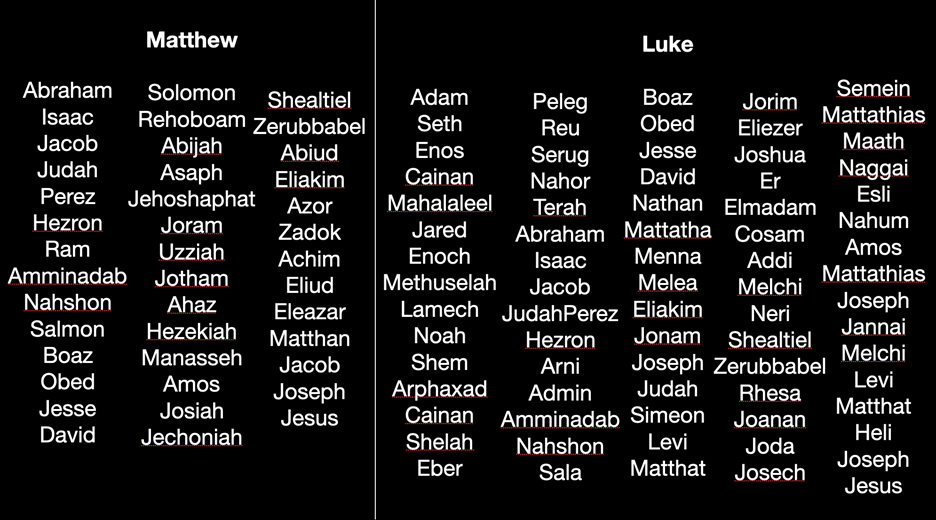
Only Matthew and Luke contain Jesus’ genealogy. And one side-by-side comparison reveals that the genealogies are radically different. So much so, that skeptics believe they’re irreconcilable. I’ve listed the genealogies from Matthew 1:1-18 and Luke 3:23-38 below for your convenience. Take a quick look at them so you can better understand the skeptic’s complaint:

Jesus’ Genealogies

At first glance, one glaring difference exists – Luke’s genealogy is much longer than Matthew’s. The reason? Luke traces Jesus’ genealogy all the way back to Adam while Matthew stops at Abraham. In both genealogies, the line from Abraham to David is roughly the same. But once we move past David, the genealogies diverge. Matthew traces Jesus’ genealogy through David’s son Solomon, while Luke traces the line through David’s son Nathan. Also, notice that Joseph has a different father in each account – Jacob in Matthew, Heli in Luke. How can we reconcile these differences? Lest we be tempted to think this is anything new, the church has dealt with this issue for almost two thousand years. And throughout that time, three different explanations have been given to explain the differences.

Option 1: Joseph vs. Mary’s Genealogy

One of the more popular explanations for the differences is to suggest that Matthew traces Joseph’s genealogy while Luke traces Mary’s. If this is true, the difference in genealogies makes sense. Think about your own genealogy for a moment. If you were to trace your father’s line and your mother’s line, you would get radically different family trees. Your father’s father and your mother’s father have different names. In Jesus’ case, his father’s father is Jacob while his mother’s father is Heli.

The reason some take this approach is because Matthew focuses his attention on Joseph in the birth narratives while Luke focuses more on Mary. In Luke, he describes Gabriel’s conversation with Mary, Mary’s Magnificat, and Mary’s visit to her cousin Elizabeth. Moreover, even though Luke doesn’t mention Mary in the genealogy, he couches Jesus’ sonship to Joseph by saying “as it was supposed” (Lk. 3:23). Each of these clues indicates that Luke didn’t intend to give us Joseph’s ancestry but Mary’s. 

Option 2: Royal vs. Biological Genealogy

Another explanation for the differences is that Matthew traces Jesus’ royal line with an emphasis on his Messianic claim to the throne while Luke traces Jesus’ biological line. According to this view, Matthew gives us several clues to suggest that he’s giving us a theological genealogy with an emphasis on King David, not a strict biological line. 

For starters, Matthew begins the genealogy by stating, “The book of the genealogy of Jesus Christ, the son of David, the son of Abraham” (Mt. 1:1). It’s well-known that Matthew writes to a primarily Jewish-Christian audience who would have understood the expectation that the Messiah would come through the line of David (2 Sam. 7:12-16; Isa. 9:6-7; 11:1-5; Jer. 23:5-6). Therefore, from the outset, he tips off his readers to where he’s going with this genealogy. 

Second, the mention of “Christ” alongside the name of Jesus in verse 1 also indicates Matthew’s intentions. While many may think of “Christ” as Jesus’ last name, it’s actually a title. It’s the Greek title for the Messiah. So, when Matthew prefaces his genealogy by stating that it’s the genealogy of Jesus Christ, he’s giving further evidence to his readers that his intention is to demonstrate that Jesus comes in the kingly line of David.

A third indicator that Matthew isn’t giving us a biological line but a royal one is his breakdown of the genealogy into groups of fourteen. In verse 17 we read, “So all the generations from Abraham to David were fourteen generations, and from David to the deportation to Babylon fourteen generations, and from the deportation to Babylon to the Christ fourteen generations.” 

A couple of points are worth noting here. Biblical scholars agree that the refrain “father of” or “son of” in genealogies don’t necessarily mean one generation after the next. Often times, genealogies will skip several generations. The language simply means that one is the ancestor of the next person in the line. Another point worth noting is the significance of the number fourteen and the Hebrew concept of Gematria. Gematria was the practice of ascribing a numerical number to a Hebrew letter – the first letter of the Hebrew alphabet (Aleph) has the numeral value of one and so on. Interestingly, the numerical value of David is fourteen. D(4) V(6) D(4) – 4 + 6 + 4 = 14.

It’s as if Matthew has a giant neon sign flashing “Son of David!” Luke doesn’t use any of these literary devices. He simply records the biological line of Jesus. And while Americans may be unfamiliar with the concept of royal lines, our British friends know that the line doesn’t always pass down neatly from father to son. In fact, the current queen of England inherited the throne from her father who inherited it from his brother. And the next king will probably be the queen’s grandson. All that to say, the royal line often diverges from the biological line.

Option 3: Levirate Marriage

A third explanation for the differences is the use of Levirate marriage. Levirate marriage is detailed in Deuteronomy 25:5-10 and states that if a married man dies without a male heir, his brother or closest relative must marry and seek to propagate with the widow in order to carry on the name of his deceased brother. This practice explains the Sadducees’ question to Jesus about which man would be a woman’s husband in heaven after going through seven brothers who all died (Mt. 22:24-28). 

On this theory, something like the following scenario plays out: Jacob (Joseph’s father in Matthew’s genealogy) died before producing a male heir with his wife. Then, in order to fulfill the Levirate laws, Heli (a close relative of Jacob’s), marries Jacob’s widow and then conceives with his new wife which brings about Joseph. If this type of scenario played out, Joseph would be the legal son of Jacob and the biological son of Heli. Then Matthew traces Jacob’s line backwards to Abraham while Luke traces Heli’s line back to Adam. Scholars have listed several of these scenarios where something like this happened.

What’s the Best Explanation?

As I consider the three options, one of the options seems the least tenable. And that is option 1. While many have employed this option to explain the differences, Luke specifically states Joseph as the next person in Jesus’ genealogy, not Mary. He couches this relationship by stating “as it was supposed” because of his knowledge of the virgin birth. More than that, ancient Jewish genealogies always passed through the male’s line, not the female’s. Luke would have understood Jesus as Joseph’s adopted son.

This leaves options 2 and 3 as viable explanations, and my personal opinion is that a combination of the two best explains the differences in genealogies. Matthew clearly isn’t trying to give us a strict chronology with how he groups the names into lists of fourteen. Moreover, by tracing the line through king Solomon instead of Nathan like Luke, Matthew seeks to emphasize the royal nature of Jesus’ line. The levirate marriages could also help explain why different names exist in the genealogy as well.

In the end, we can’t be entirely certain which option is right. But one thing is for certain: we have viable explanations for why the genealogies are different in Matthew and Luke. 

Recommended resources related to the topic:

The New Testament: Too Embarrassing to Be False by Frank Turek (DVD, Mp3, and Mp4)

Why We Know the New Testament Writers Told the Truth by Frank Turek (DVD, Mp3 and Mp4)


Ryan Leasure holds a Master of Arts from Furman University and a Masters of Divinity from the Southern Baptist Theological Seminary. Currently, he’s a Doctor of Ministry candidate at the Southern Baptist Theological Seminary. He also serves as a pastor at Grace Bible Church in Moore, SC.

By Ryan Leasure

How should the church engage those who experience same-sex attraction or gender dysphoria? In response, I want to highlight seven basic principles that the church must embrace.

Affirm The Divine Image

Genesis 1 is clear that everyone, without qualification, is made in God’s’s image. That is to say; whether someone is attracted to the opposite sex or the same sex, they are equally image-bearers of God. The same goes for individuals who experience gender dysphoria. One’s’s feelings or attractions in no way mitigates against this universal status.

As Christians, we should enthusiastically embrace this truth. Nobody — not the government, the church, or anyone else — can bestow a higher status on each person than God already has. Moreover, not only did God create all people in his image, he thought so much of his people that he paid a steep price for their redemption by shedding his own blood for their sins.

Acknowledge Our Collective Sinfulness

While God created everything good, we all possess a sin nature because of the fall. David acknowledges that he inherited this sin nature from the time of his birth (Ps. 51:5). Romans 3:23, likewise, affirms that we have all sinned and fallen short of God’s glory. And lest we think we’re just a little sinful, Scripture paints a much gloomier picture than this. Sin pervades our entire being (Rom. 8:7-8).

One of the ramifications of our fallenness is that we have a tendency to minimize our own sins while maximizing the sins of others. Yet, Jesus clearly condemns this hypocrisy (Mt. 7:1-5). Instead, we must take a realistic assessment of our own hearts. And when we do, we realize that if it weren’t for the grace of God, we would all die in our sins.

All that to say, just because we may not experience homosexual or transgender temptations doesn’t mean that our sin isn’t just as wicked. Lusting after other women, harboring bitterness, lashing out in anger, and spreading gossip are all acts of rebellion against God. It’s’s unbiblical to treat others as if they have a log in their eye and pretend we only have a speck. When we do this, we’re being judgmental hypocrites.

Know Jesus’s Universal Expectation

Jesus preached “Repent and believe the gospel” (Mk. 1:15). To claim Christ as Lord, one must abide by these words. Unfortunately, many have watered down this message by excluding repentance.

Yet, Jesus never suggested that we could follow him without turning from our sins. Elsewhere, he states, “Whoever wants to be my disciple must deny themselves and take up their cross and follow me” (Mk. 8:34). In other words, whether you self-identify as gay, transgender, or as straight, Jesus demands that you deny yourself daily. And the reason we are called to deny ourselves is because we don’t actually own ourselves. We belong to Jesus. Not only did he make us, he bought us with his blood.

The very message of repentance and denying oneself daily implies that ongoing temptations and struggles will persist throughout the Christian life. But the true sign of a Christian is that they recognize their temptations as contrary to the will of God, repent if they succumb to those temptations, and seek to obey Jesus moving forward.

Recognize That Holiness Is The Goal

First, Peter 1:16 states, “You shall be holy, for I (God) am holy.” Holiness is the calling for all believers. But this raises the question: “What does holiness look life for those with same-sex attraction or gender dysphoria?” Does holiness mean they will stop being attracted to members of the same sex or that their gender dysphoria will disappear?

I believe holiness can manifest itself in different ways for people with these struggles. One way is living a celibate lifestyle. British pastor Sam Allbery, and author of Is God Anti-Gay? Has chosen this path. Even though Allberry continues to experience same-sex attraction, he knows that pursuing those attractions would be sinful and so chooses to remain celibate. It’s noteworthy that Jesus indicated that celibacy was the only alternative to marriage (Mt. 19:10-12).

Others have chosen to marry persons of the opposite sex and start families despite ongoing same-sex attractions. Rebecca McLaughlin, author of Confronting Christianity, has chosen this path. In her book, Rebecca acknowledges she still experiences same-sex attractions but knows that pursuing those attractions would be disobedience. She even admits to still dealing with temptations towards members of the same sex. But she has chosen to deny herself to follow Jesus.

And sometimes, people stop being attracted to members of the same-sex altogether. We must acknowledge that this doesn’t happen in most cases, but for people like Rosaria Butterfield, it has. Rosaria details this transformation in her book Secret Thoughts of an Unlikely Convert.

In 1 Corinthians 6:9-11, Paul lists several lifestyles that will not inherit the kingdom of God — one of which was “men who practice homosexuality.” But in verse 11, he asserts, “And such were some of you. But you were washed, you were sanctified, you were justified in the name of the Lord Jesus Christ by the Spirit of our God.” I take this to mean that there were people in the Corinthian church who used to practice homosexuality but turned from that lifestyle upon conversion.

I don’t believe this means that the struggles and temptations completely go away. Anyone with a half-decent understanding of biblical theology knows that Christians continue to struggle as we await future glory (Rom. 8:20-23). This is certainly true of me. So we should have realistic expectations that those who experience same-sex attractions and gender dysphoria will often continue to struggle as they face temptations the rest of their lives.

Therefore, the goal for the same-sex attracted person isn’t that they become “straight.” The goal is that they be holy as God is holy. And we should have enough room in our understanding of sanctification to know that this will look different for different people.

Be People Of Love

One of the surest signs of a Christian is their love for others (Jn. 13:35). It is never appropriate for us to be condescending or harsh (Prov. 15:1). Unfortunately, many of us have really missed the mark on this one. While not all the criticism is fair, we haven’t always been known as people who demonstrate the love of Christ towards the LGBTQ community.

As we think about Christ, he was the most loving person to ever live. And we’re told that he was full of both grace and truth (Jn. 1:14). Biblical love perfectly balances these two.

We read in 1 Corinthians 13:6 that love “does not rejoice in wrongdoing, but rejoices with the truth.” Therefore, it is not loving to affirm homosexuality or transgenderism in the same way that it’s not loving to affirm a woman’s anorexia and encourage her to get liposuction because she feels overweight. The loving thing to do is to gently speak the truth to her and remind her that her feelings are deceiving her. In the same way, Christians must speak the truth in love to those who experience same-sex attraction or gender dysphoria (Eph. 4:15). It is not loving to encourage a lifestyle that does not promote spiritual flourishing.

But while we speak the truth, we must do so with a spirit of gentleness. Paul reminds us in Galatians 6:1-2, “Brothers, if anyone is caught in any transgression, you who are spiritual should restore him in a spirit of gentleness. . . . Bear one another’s burdens, and so fulfill the law of Christ.” No one should beat anyone over the head with a Bible. No one should “come down hard” on another. Doing so contradicts the clear commands of Scripture.

Bearing one another’s burdens requires a great deal of empathy. It requires putting oneself in someone else’s shoes in an attempt to understand the challenges they face. It requires having conversations with those who experience different temptations than us and seeing that person as a fellow human being who bears God’s image.

And if we approach people with a spirit of gentleness, we will make it easier for them to share their struggles with us. Imagine how hard it must be for people to open up about their same-sex attraction when people in the church speak about their struggle so harshly. Empathizing doesn’t mean accepting sin. But it does mean being gentle. After all, Jesus was “gentle and lowly in heart” (Mt. 11:29).

Be Like Their Family

For many who experience same-sex attraction or gender dysphoria, celibacy may seem like the only real option for them. While God has changed people’s orientation, and while many have gotten married despite ongoing same-sex attraction, celibacy is the most realistic option for many. But with singleness, comes the fear of loneliness. And we must understand that loneliness is one of the greatest struggles single people deal with — same-sex attracted or not.

But this shouldn’t be. If the church lived out its mission, nobody would ever be lonely. Unfortunately, we have idolized the family with the minivan at the expense of our single brothers and sisters. This is wrong. The church should champion singleness. After all, Jesus himself was single. Paul champions singleness in 1 Corinthians 7. He goes so far as to say that singles are an incredible gift to the church.

Jesus declared in Mark 10:29-30, “Truly I tell you, no one who has left home or brothers or sisters or mother or father or children or fields for me and the gospel will fail to receive a hundred times as much as this present age.”

Sam Allberry writes, “The gospel can be relationally costly. But it is also relationally generous. What we leave behind does not compare to what we receive back from Jesus.” 1

As churches, we must do a better job of inviting singles into our families. No single should be alone on holidays. No single should eat Sunday lunches by themselves. If we say we want to help same-sex attracted people, we need to do everything we can to make sure they feel like they’re part of our family.

Find Our Identity In Christ

You’ll notice I haven’t labeled anyone as “gay” or “lesbian” in this blog series. Instead, I use the phrase “same-sex attracted.” It’s a bit tedious, but I want to make it clear that nobody is defined by their sexuality. This message, though, runs counter to our sexed-up culture. The culture says you are your sexuality. And that not expressing yourself sexually is unhealthy.

Of course, when we buy the narrative that our identity is wrapped up in our sexuality, then not embracing one’s sexual desires seems untenable. Celibacy seems so “old-fashioned.” But when we understand that our identity is rooted much deeper than our physical attractions, we realize that we don’t have to embrace those attractions to live a fulfilling life.

Our relationship with Christ supersedes everything. And because I am in Christ, and Christ is in me, then no matter what earthly relationships I experience, my identity remains unshakeable. Jesus is clear that our familial relationships will pass away in eternity (Mt. 22:30). But our relationship with Christ remains forever.

Concluding Thoughts

My hope is that God has used these articles in your life for good. If you’re someone who experiences same-sex attraction or gender dysphoria, I hope you will see that Jesus offers you so much more than this world has to offer. He is so much more fulfilling and satisfying than any earthly relationship. People will disappoint. Jesus will never let you down. I also hope you will see that your attractions or feelings don’t disqualify you from faithful Christianity. More important is how you respond to those feelings. And my prayer is that you will find a healthy local church that will be your family and encourage you in your daily walk with Jesus.

If you’re someone who agrees with me that God has designed marriage and sexuality to exist within a heterosexual marriage, I hope you will see there are good reasons for believing what you believe. I also hope that you’ll see yourself as a fellow sinner who daily relies on the grace of God.

Recommended resources related to the topic:

Correct, NOT Politically Correct: How Same-Sex Marriage Hurts Everyone (Updated/Expanded) downloadable pdf, Book, DVD Set, Mp4 Download by Frank Turek

American Apocalypse MP3, and DVD by Frank Turek

The Case for Christian Activism MP3 Set, DVD Set, mp4 Download Set by Frank Turek

You Can’t NOT Legislate Morality mp3 by Frank Turek.

Fearless Generation – Complete DVD Series, Complete mp4 Series (download) by Mike Adams, Frank Turek, and J. Warner Wallace

Legislating Morality: Is it Wise? Is it Legal? Is it Possible? by Frank Turek (Book, DVD, Mp3, Mp4, PowerPoint download, PowerPoint CD)


Ryan Leasure holds a Master of Arts from Furman University and a Masters of Divinity from the Southern Baptist Theological Seminary. Currently, he’s a Doctor of Ministry candidate at the Southern Baptist Theological Seminary. He also serves as a pastor at Grace Bible Church in Moore, SC.

Original Blog Source: https://bit.ly/3hklV1f 

By Ryan Leasure

In this post, we’re asking the question: What does Paul say about homosexuality? To find out, we need to investigate Romans 1:26-27, 1 Corinthians 6:9-10, and 1 Timothy 1:9-10. Let’s consider each text in turn.

Romans 1:26-27

This passage is probably the most significant biblical text addressing homosexuality. In the broader context, we read that God reveals his wrath from heaven against all ungodliness. Even though people know God exists through natural revelation, they have suppressed the truth and worshipped idols instead. Therefore, God hands them over to their depraved minds. Verses 26-27 give us an example of this depravity:

For this reason, God gave them up to dishonorable passions. For their women exchanged natural relations for those that are contrary to nature (para physin); and the men likewise gave up natural relations with women and were consumed with passion for one another, men committing shameless acts with men and receiving in themselves the due penalty for their error.

So what exactly does Paul condemn here? Matthew Vines, author of God and the Gay Christian notes, “Paul wasn’t condemning the expression of same-sex orientation as opposed to the expression of an opposite-sex orientation. He was condemning excess as opposed to moderation.1 Elsewhere he states that Paul “explicitly described the behavior he condemned as lustful. He made no mention of love, fidelity, monogamy, or commitment.”2

That is to say, and Paul doesn’t condemn homosexuality in general. He merely condemns the excesses or abuses that were common in the ancient world. These excesses included pederasty, master/slave rape, or prostitution. If Paul, according to Vines, would have seen examples of committed, monogamous same-sex partners, he would have celebrated them.

In response to Vines, I simply note that nowhere does Paul limit his condemnation to specific types of homosexuality like master/slave relations, pederasty, or prostitution. Rather, he condemns homosexuality in general terms.

If he wanted to condemn pederasty, for example, he could have simply used the Greek word paiderastes. If he meant to condemn a master appeasing his sexual desire with his male slave, then why state that they were “consumed with passion for one another?” Doesn’t that sound like two consenting adults? Furthermore, why mention the women engaging with one another when we have no record of female master/slave or pedophilia relations from the ancient world?

Contrary to Vines, Paul condemns homosexuality in general (not limited to specific abuses) and roots his condemnation in creation itself. This explains why he writes that homosexual activity is an “exchange of natural relations that are “contrary to nature” (para physin in the Greek). Other revisionists (not Vines) take this to mean that some men’s sexual appetites were so insatiable, that they went against their heterosexual nature to have sexual relations with other men. In other words, “going against nature” simply means going against one’s heterosexual orientation. Thus, the text doesn’t condemn those with a homosexual orientation engaging in sexual activity.

But this explanation fails on multiple fronts. Not only do ancient authors repeatedly use the phrase “para physin” to refer to homosexual activity (not going against one’s orientation), Paul goes to great lengths to state that his position is rooted in the creation narrative of Genesis 1-3. In the surrounding context, he uses phrases such as “creation of the world” (1:20), “creator” (1:25), “birds and animals and creeping things” (1:23), “women” and “men” (1:26-27), “image” (1:23), “lie” (1:25), “shame” (1:27), and “death” (1:32). These allusions to the creation narrative indicate that Paul sees homosexuality as an affront to God’s design for marriage as outlined in Genesis 1-2.

Self-professed lesbian Bernadette Brooten writes in her scholarly book Love between Women:

I believe that Paul used the word “exchanged” to indicate that people knew the natural sexual order of the universe and left it behind. . . . I see Paul as condemning all forms of homoeroticism as the unnatural acts of people who had turned away from God.”3

Romans 1:26-27 doesn’t merely condemn excesses. It condemns homosexual activity in general as an affront to God’s design for sexuality.

1 Corinthians 6:9-10 And 1 Timothy 1:9-10

I lump these two together because they are similar in nature.

Or do you not know that the unrighteous will not inherit the kingdom of God? Do not be deceived: neither the sexually immoral, nor idolaters, nor adulterers, nor men who practice homosexuality (malakoi and arsenokoitai), nor thieves, nor the greedy, nor drunkards, nor revilers, nor swindlers will inherit the kingdom of God. — 1 Corinthians 6:9-10

Understanding this, that the law is not laid down for the just but for the lawless and disobedient, for the ungodly and sinners, for the unholy and profane, for those who strike their fathers and mothers, for murderers, the sexually immoral, men who practice homosexuality (arsenokoitai), enslavers, liars, perjurers, and whatever else is contrary to sound doctrine. — 1 Timothy 1:9-10

Paul’s use of arsenokoitai is the first known use of this word in the ancient world. It’s a compound word of man (arsen) and bed (koite). The word literally means “bedders of men.” It’s a term that conveys action, which is why the NIV translation of the word “men who have sex with men” is preferable to one like the NASB’s which simply reads “homosexuals.” Scholars are in agreement that Paul coined this term using the Septuagint translation of Leviticus 20:13:

If a man lies with a male (arsenos koiten) as with a woman, both of them have committed an abomination; they shall surely be put to death; their blood is upon them.

This text clearly condemns both partners for participating in homosexual activity. It says that “both of them have committed an abomination.” In the same way, 1 Corinthians 1:9-10 appears to condemn both partners as well. Not only does Paul condemn arsenokoitai (bedders of men), right before that he condemns malakoi (soft ones).

The Greek word malakoi has a broad range of meaning. It can refer to men who have long hair, wear makeup, have a fondness for expensive clothing, gluttons, the lazy who avoid manual labor, or the acceptance of being penetrated by other men. So which of these does Paul condemn here?

It’s noteworthy that the Jewish philosopher Philo twice uses the word malakoi to refer to passive homosexual partners. It’s also noteworthy where Paul places this word in his list of vices. He places it right between moikoi (adulterers) and arsenokoitai. When a word has a broad range of definitions, context usually is the strongest determiner of the author’s meaning. Considering malakoi’s placement in the sentence, it’s likely that Paul’s referring to a passive male partner in homosexual sex. After all, it’s hard to imagine that Paul would say that men who like designer clothing or a good chick flick will not inherit the kingdom of God. He must be referring to something more blatant.

Was There Really No Concept Of Homosexual Orientation In The Ancient World?

As I’ve alluded to numerous times in this blog series, revisionists argue that when the Bible condemns homosexuality, it condemns abuses — not lifelong, monogamous relationships. Revisionists argue that homosexual orientation and committed homosexual relationships were completely foreign in the ancient world. Therefore, the biblical authors didn’t condemn them. But is this an accurate assessment?

Louis Crompton, a gay man and scholar of queer studies states in his book Homosexuality and Civilization:

Some interpreters, seeking to mitigate Paul’s harshness, have read the passage [in Romans 1] as condemning not homosexuals generally but only heterosexual men and women who experimented with homosexuality. According to this interpretation, Paul’s words were not directed at “bona fide” homosexuals in committed relationships. But such a reading, however well-intentioned, seems strained and unhistorical. Nowhere does Paul or any other Jewish writer of this period imply the least acceptance of same-sex relations under any circumstances. The idea that homosexuals might be redeemed by mutual devotion would have been wholly foreign to Paul or any Jew or early Christian.”4

In other words, while Crompton supports homosexuality, he says the revisionists’ arguments don’t work. It’s a massive leap in logic to think that Paul would have embraced homosexual relationships if he had only seen good examples of them.

Furthermore, the idea of homosexual orientation wasn’t completely foreign to the ancient world. Thomas K. Hubbard, a non-Christian classical scholar notes in Homosexuality in Greece and Rome:

“Homosexuality in this era may have ceased to be merely another practice of personal pleasure and began to be viewed as an essential and central category of personal identityexclusive of an antithetical to heterosexual orientation.5

Notice what Hubbard says here. He argues that people in the ancient world experienced homosexual orientation and self-identified as homosexuals.

In Plato’s Symposium, a philosophical text depicting a contest of extemporaneous speeches by notable men, speaks to the reality of homosexual orientation. Consider these excerpts from two of the speeches:6

“For they fall in love with boys only at the point when they begin to have in their possession a mind; and this moment approximates the time when they begin to get a beard. For, I think, those who begin from that moment to fall in love with them are prepared to love in the expectation that they will be with them all their life and will share their lives in common.” — Pausanias

In other words, he speaks of a loving, life-long commitment between homosexual partners. Or consider this other speech:

“So of course when he also happens upon that very person who is his half, whether the lover of boys or any other, then they are wonderfully struck with affectionate regard and a sense of kinship and love, almost not wanting to be divided even for a short time. And these are they who continue with one another throughout life. . . . Each desiring to join together and to be fused into a single entity with his beloved and to become one person from two.” — Aristophanes

Here, again, is another example of life-long homosexual commitments. Commenting further on this subject, N. T. Wright argues:7

“As a classicist, I have to say that when I read Plato’s Symposium, or when I read the accounts from the early Roman Empire of the practice of homosexuality, then it seems to me they knew just as much about it as we do. In particular, a point which is often missed, they knew a great deal about what people today would regard as longer-term, reasonably stable relations between two people of the same gender. This is not a modern invention; it’s already there in Plato. The idea that in Paul’s day it was always a matter of exploitation of younger men by older men or whatever . . . of course there was plenty of that then, as there is today, but it was by no means the only thing. They knew about the whole range of options there.”

In the end, the revisionist arguments fall short. Nowhere does Paul limit his condemnation to homosexual abuses. Furthermore, we have no reason to believe that Paul was ignorant of homosexual orientation.

Concluding Thoughts

Based on the above evidence, Paul condemns homosexual behavior in general — not just abuses. He condemns both men and women in Romans 1, and both the active and passive partners in 1 Corinthians 6. The revisionist arguments that Paul had no concept of homosexual orientation, and therefore, couldn’t have condemned it lacks historical backing.

Recommended resources related to the topic:

Five Questions No One Ever Asks About Gay Rights (DVD Set), (Mp4 Download), and (Mp3 Set) by Dr. Frank Turek 

Correct, NOT Politically Correct: How Same-Sex Marriage Hurts Everyone (Updated/Expanded) downloadable pdf, PowerPoint by Dr. Frank Turek 


Ryan Leasure holds a Master of Arts from Furman University and a Masters of Divinity from the Southern Baptist Theological Seminary. Currently, he’s a Doctor of Ministry candidate at the Southern Baptist Theological Seminary. He also serves as a pastor at Grace Bible Church in Moore, SC.

Original Blog Source: https://bit.ly/307D1ta

By Ryan Leasure

Few biblical texts receive as much attention as Philippians 2:5-8. It reads:

Have this mind among yourselves, which is yours in Christ Jesus, who, though he was in the form of God, did not count equality with God a thing to be grasped, but emptied himself, by taking the form of a servant, being born in the likeness of men. And being found in human form, he humbled himself by becoming obedient to the point of death, even death on a cross.

Theologians have spilt much ink over this text. After all, it’s a rich Christological text which proclaims significant truths about the nature of Christ. But far and away, the most controversial part is the phrase “but emptied himself.” What does this statement mean?

The Dilemma

Does this mean that Jesus emptied himself of his deity, thus ceasing to be God during his incarnation? After all, if he was fully God, how could he also be a human at the same time? This seems like a logical contradiction.

Or, perhaps the phrase means that he set aside certain divine attributes while maintaining others. In other words, he still kept some of his divine nature — holiness, love, wisdom — but willingly set aside other parts of his divinity — omnipresence, omnipotence, omniscience — in order to be human. This view has attracted many supporters because it seeks to reconcile how an all-powerful, all-knowing, and present everywhere God could also possess qualities such as limited wisdom and limited spatial presence.

Or, does this phrase mean something else entirely? In fact, I do believe it means something else entirely, and I think I have good reasons for believing this. Allow me to explain.

The Deity Of Christ

There’s little doubt that this text proclaims Jesus as the pre-existent God of the universe. This text gives us two reasons for reaching this conclusion.

First, it states that Jesus was “in the form of God.” The word for “form” in the Greek is morphe, which denotes the exact substance or nature of something. Therefore, by declaring that Jesus was “in the form of God,” Paul emphatically states that Jesus shares the exact same nature as God. He is eternal, self-existent, all-powerful, all-knowing, holy, love, and so forth.

Second, Paul tells us that Jesus was equal with God when he wrote, “though he was in the form of God, did not count equality with God something to be grasped.” Nothing, however, is equal to God except God. God even declares in Isaiah 46:9, “I am God, and there is no other; I am God, and there is none like me.” If what God says in Isaiah is true, how then could Paul make Jesus out to be God’s equal? It must be that Jesus himself is also God.

The Meaning Of “Emptied Himself”

We now come to the most controversial part of the text. What does Paul mean when he says Jesus emptied himself? I believe he tells us in the next part of the text when he asserts, “[Jesus] emptied himself, by taking the form of a servant, being born in the likeness of men.” Here, Paul indicates that the emptying of Christ doesn’t include losing any of his deity. Rather, the emptying includes adding a human nature to himself. In other words, it’s the formula of subtraction by addition.1

Notice the text doesn’t state that Jesus emptied “part of himself.” That would indicate that he set aside portions of his divine nature in order to become a human. No, it simply states that he “emptied himself” by taking on the nature of a human.

Paul expresses that, even though Jesus had a divine nature and an exulted status in glory, he willingly chose to “empty himself” by coming to earth to experience all the limitations and sufferings of a human, ultimately culminating in his death on the cross.

This view is consistent with the historic orthodox view of the nature of Christ. At the Council at Chalcedon (AD 451), the church declared that Jesus was one unique person who possessed both a human and divine nature. That is to say; he was fully God and fully human, not part God part man. And for clarification, he wasn’t two persons. Rather, he was one person who had an eternal divine nature and an added human nature in the incarnation. Again, subtraction by addition.

“Emptied Himself” Illustrated

Let me give you an illustration to explain how adding something could look like subtraction.2 Imagine that one day you decided to go to a luxury car dealership to test drive the nicest car in the showroom. The salesman gave you permission, so you took the shiny car out for a spin.

As you were driving down the road on that rainy day, you noticed a field off to your right and decided to take the car off-roading to see how well it could do donuts. After about fifteen minutes of spinning around in the field, sufficiently caking the car in mud, you took the car back to the dealership, handed the keys to the salesman, and thanked him for allowing you to test drive the car.

As you can imagine, the salesman demanded an explanation for why you plastered his new shiny car with mud. To which you responded, “hey buddy, why are you so upset? Did I take anything away from the car? No, I only added to it. I added mud!”

You see, even after the fifteen-minute test drive, the new luxurious car was still a new luxurious car. The full coating of mud, however, disguised its glory, so it wasn’t as obvious as before. In the same way, as Jesus added a human nature — much like mud in our illustration — he didn’t cease being God. Instead, the human nature merely disguised his glory like the mud disguised the glory of the new luxurious car.

As you read through the Gospels, you will find that Jesus’ humanity made it difficult to see his divinity. We even read of times where Jesus became hungry or tired or didn’t know certain details about future events. In a sense, this is the mud disguising his glory. It doesn’t mean he ceased being glorious, it simply means his human nature veiled his divine nature during the incarnation.

Why It Matters

Jesus adding a human nature has massive implications. After all, Paul tells us that Jesus emptied himself to become “obedient to the point of death, even death on a cross.” If he only had a divine nature, he could not have died for our sins, because God cannot die. The reason Jesus could die was because he possessed a human nature.

Thus, without his added human nature, we would still be lost in our sins. Thank God Jesus emptied himself.

Recommended resources related to the topic:

How Can Jesus Be the Only Way? (mp4 Download) by Frank Turek

Cold Case Resurrection Set by J. Warner Wallace (books)


Ryan Leasure holds a Master of Arts from Furman University and a Masters of Divinity from the Southern Baptist Theological Seminary. Currently, he’s a Doctor of Ministry candidate at the Southern Baptist Theological Seminary. He also serves as a pastor at Grace Bible Church in Moore, SC.

Original Blog Source: https://bit.ly/3iMOshm