Tag Archive for: Ryan Leasure

By Ryan Leasure

Is it hateful or arrogant to claim that Jesus is the only way of salvation? Charles Templeton thought so. He argued:

Christians are a small minority in the world. Approximately four out of every five people on the face of the earth believe in gods other than the Christian God. The more than five billion people who live on earth revere or worship more than three hundred gods. If one includes the animist or tribal religions, the number rises to more than three thousand. Are we to believe that only Christians are right?”[1]

What are we to make of Templeton’s claims? Is it presumptuous to say that Jesus is the one true way of salvation? Or even worse, are Christians guilty of committing “absurd religious chauvinism” as some put it?[2] These common refrains are the fundamental tenets of religious pluralism — the belief that all religions are essentially the same and lead to God.

In a culture that abhors dogmatic truth claims, should Christians heed the warnings of the religious pluralists and stop teaching that Jesus is the only way of salvation? I don’t think so for a couple of reasons. First, religious pluralism is a self-defeating proposition. It crumbles in the face of logical scrutiny. And second, pluralism ignores scientific and historical finding. Let’s explore both in turn.

Religious Pluralism is Self-Defeating

To support their claim, religious pluralists share the parable of the blind men and the elephant. The parable goes something like this:

There were five blind men who all encountered an elephant in a field. The first man grabbed the tail and said, “oh it’s a rope.” The second blind man touched a leg and asserted, “no, it’s a tree.” The third blind man grabbed the trunk and declared, “no, it’s a snake.” The fourth blind man grabbed a tusk and cried, “no, it’s a spear.” The fifth blind man touched its side and exclaimed, “no, it’s a wall.”

The pluralist argues that the blind men are like the different world religions. Each belief system naively thinks their view of reality is the correct one, but, in the end, they’re all misguided. Rather, all the religions are fundamentally the same and will ultimately lead to the same place. No single “right way” exists according to the pluralist.

The Religions Contradict Each Other

While pluralists like to mention that all religions teach essentially the same thing, nothing could be further from the truth. Let’s take, for example, the nature of God in each major religion. Hinduism acknowledges multitudes of gods that are one with creation. Buddhism, while extremely spiritual, does not worship a god. New Age spirituality teaches that each person should see themselves as god. Islam believes in one God, named Allah, who is transcendent above creation. Judaism believes in a transcendent God named Jehovah. Christianity teaches that God is triune in nature, and is both transcendent and immanent in his creation.

Let’s look at one more example — how each religion views Jesus of Nazareth. Hinduism, Buddhism, and New Age all say he was a wise, moral teacher. Islam teaches that he was a prophet, though not divine, and that he didn’t die on a cross. Judaism teaches that he was a false prophet who led many astray and was crucified for blasphemy. Christianity teaches that Jesus was divine, he died on a cross, and he rose again from the dead.

If space permitted me, I could also explain how each of these religions differ on creation, scripture, the nature of humanity, sin, salvation, and eternal life. In other words, these religions have almost nothing in common.

Pluralism Defies Logic

To say all religions teach the same thing commits all kinds of logical fallacies. For example, Christianity teaches that God is a Trinity. God, however, cannot be both a Trinity (Christianity) and not a Trinity (Hinduism, Buddhism, New Age, Islam, and Judaism) at the same time and in the same way.

This would violate the Law of Noncontradiction which teaches that a thing cannot be both A and non-A at the same time and in the same respect. To suggest, therefore, that all religions can be true about the nature of God violates one of the most fundamental laws of logic.

Or consider the nature of Jesus. It cannot be true that Jesus is God (Christianity) and not God (Hinduism, Buddhism, New Age, Islam, and Judaism) at the same time and in the same way. Again, this would violate the Law of Noncontradiction.

Pluralism Makes Exclusive Claims Too

Ironically, pluralists make exclusive claims themselves. In effect, they’re saying that pluralism is true, while all contrary religious claims are false. That is to say, pluralists are guilty of doing the very same thing that they chastise the other religions for doing.

Now that the shoe is on the other foot, should we say the pluralists are hateful for saying their view of reality is the right one while all of us naive religious folk are wrong?

Pluralism Ignores Scientific and Historical Facts

Now it’s one thing to say that all the different religions can’t be right. It’s another to claim that one of them is the truth. Strong evidence, though, points in the direction of Christianity.

Scientific Evidence

Consider the origin of the universe. All the scientific data suggests that space, time, and matter, all came into existence simultaneously a finite time ago. Meaning the cause of the universe must be spaceless, timeless, and immaterial.

This fits nicely with the Christian belief that God created the world out of nothing, but it contradicts pantheistic religions such as Hinduism which teach that god is one with the universe — bound by space, time, and material. Additionally, the scientific data that the universe came into existence a finite time ago contradicts Buddhism’s belief in an eternal/cyclical universe.

The scientific evidence leaves the theistic religions (Christianity, Judaism, Islam, and Deism) as possibilities. Yet when we turn our attention to Jesus of Nazareth, Christianity quickly rises to the top.

Historical Evidence

For example, ancient historians are unanimous that Jesus of Nazareth died by crucifixion in the first century. Islam, however, denies that Jesus — a prophet from God — was crucified. Since dozens of independent historical sources confirm Jesus’ death by crucifixion, we can be confident that Islam doesn’t pass the historical test as the one true religion. In fact, Jesus’ crucifixion is so certain that prominent skeptic scholar John Dominic Crossan admits, “Jesus’ death by crucifixion under Pontius Pilate is as sure as anything historical can ever be.”[3]

With only three viable options remaining, we turn our focus to the resurrection. Did Jesus rise again from the dead? If he did, Christianity is true, while Judaism and Deism are not. And we have lots of reasons to believe Jesus did, in fact, rise again. Let me give you two quick examples.

First, Christians claim that women were the first eye-witnesses to this incredible event. In a culture where nobody took a woman’s word seriously, it’s hard to imagine that Christians would have made up this detail. Since the early Christians would have had no motivation to make up this embarrassing fact, we have good reason to believe that this detail accurately portrays what really happened.

Additionally, Jesus’ closest followers were all willing to die for their belief that he rose again. Don’t you think, at some point, at least one of them would have caved under the threat of crucifixion or beheading and said the entire thing was a hoax? Yet not one of them did. This is telling, especially since those same disciples acted like cowards during Jesus’ arrest and crucifixion.

If Jesus rose again from the dead, that means what he claimed about himself has been vindicated — namely that he is God, and that he is the one true way of salvation.

Is it Hateful to Say Jesus Is the Only Way?

I don’t know anyone who would say that Jesus of Nazareth was hateful. Most actually affirm the exact opposite, he was incredibly moral and loving. Yet it’s this same Jesus who makes the claim that he is “the way, the truth, and the life. No one comes to the Father except through me” (John 14:6).

As we ponder the question at hand, consider the following statement by outspoken atheist and famed illusionist Penn Jillette:

“I’ve always said that I don’t respect people who don’t proselytize. I don’t respect that at all. If you believe that there’s a heaven and a hell, and people could be going to hell or not getting eternal life, and you think that it’s not really worth telling them this because it would make it socially awkward—and atheists who think people shouldn’t proselytize and who say just leave me alone and keep your religion to yourself—how much do you have to hate somebody to not proselytize? How much do you have to hate somebody to believe everlasting life is possible and not tell them that? I mean, if I believed, beyond the shadow of a doubt, that a truck was coming at you, and you didn’t believe that truck was bearing down on you, there is a certain point where I tackle you. And this is more important than that.”[4]

So is it hateful to tell people Jesus is the only way? I submit to you that it’s the loving thing to do.

Footnotes

[1] Charles Templeton, Farewell to God (Toronto, Ontario: McClelland & Stewart), 27
[2] John Hick and Paul Knitter, eds., The Myth of Christian Uniqueness, (Eugene, OR: Wipf & Stock), 141
[3] John Dominic Crossan, Jesus: A Revolutionary Biography (San Francisco: HarperCollins, 1991), 145.
[4] Quoted in, Justin Taylor, “How Much Do You Have to Hate Someone to Not Proselytize?” TheGospelCoalition.org, 18 Nov 2009, accessed 20 March 2023 at: https://www.thegospelcoalition.org/blogs/justin-taylor/how-much-do-you-have-to-hate-somebody-to-not-proselytize/

Recommended Resources Related to This Topic

Is Original Sin Unfair? (DVD Set), (mp4 Download Set), and (MP3 Set) by Dr. Frank Turek
Jesus, You and the Essentials of Christianity by Frank Turek (INSTRUCTOR Study Guide), (STUDENT Study Guide), and (DVD)
Is Original Sin Unfair? by Frank Turek (DVD, Mp3 and Mp4)
How Can Jesus Be the Only Way? (mp4 Download) by Frank Turek
____________________________________________________________________________________________________________________________________________________

Ryan Leasure holds a Master of Arts from Furman University and a Masters of Divinity from the Southern Baptist Theological Seminary. Currently, he’s a Doctor of Ministry candidate at the Southern Baptist Theological Seminary. He also serves as a pastor at Grace Bible Church in Moore, SC.

Original Blog Source: http://bit.ly/3JF54Wf

By RYAN LEASURE

At Grace Bible Church, we have a statement of faith that all members must affirm. It’s a fine statement of faith (though a little long if you ask me). And it provides a nice summary of basic Christian belief. That said, not all doctrines are created equal. Some doctrines are absolutely essential while others are less important. How, then, should Christians “contend for the faith that was once for all delivered to the saints” (Jude 3) without contending for too much or too little?

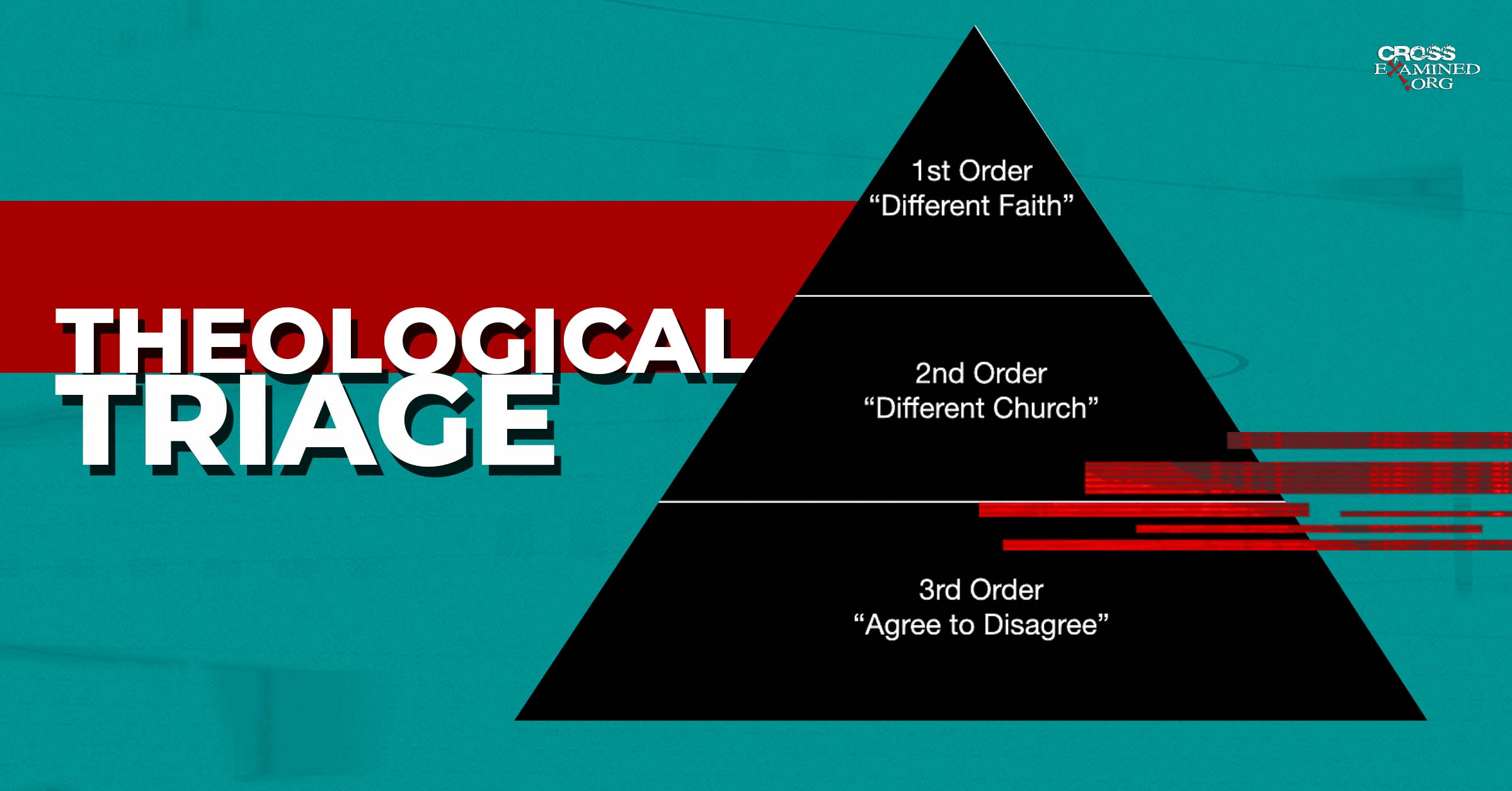
In other words, how do we know which doctrines are worth fighting for and which ones are not? To help with these matters, we have adopted what Al Mohler once dubbed a “Theological Triage.”

Theological Triage

The word “triage” comes from a French word which means “to sort.” And if you’ve ever been to an emergency room, you’re familiar with the sorting process that takes place. If someone shows up with the sniffles, they’re most likely put at the back of the line. If someone shows up holding their decapitated leg, they’re put up front.

Doing theological triage follows a similar principle. As Christians, we must think through doctrine and decide which doctrines get sorted to the front (first-order issues) and which ones get pushed to the back (third-order issues).

At every membership class, I explain this concept and teach newcomers which doctrines are essential and which ones we can agree to disagree on. Let’s consider the three categories in turn.

First-Order Doctrines

First-order doctrines are the absolute essential doctrines to the Christian faith. These are doctrines that every true believer should affirm without hesitation. These doctrines include:

  • God is a Trinity
  • God is the creator of all things
  • Jesus Christ is the Son of God
  • Jesus is both God and man
  • Humans are made in God’s image
  • All humans are sinners and they must repent of their sin
  • Jesus died on a cross for our sins and rose again from the dead
  • People are saved by grace alone through faith alone in Christ alone
  • The Bible is God’s inspired word
  • Jesus is coming back to judge the living and the dead

You get the idea. These beliefs are so fundamental to the faith that if someone were to deny them, we would say that person belongs to a different faith system altogether.

Second-Order Doctrines

Second-order doctrines are not essential doctrines of the Christian faith, but they are essential for church membership. That is to say, even though people may disagree with us on these issues, we would not call into question their standing with God. We may think they’re wrong and think they should reconsider their views. But we would not question their faith altogether. That said, if people are going to be part of the same church, they need to agree on these second-order issues:

  • The recipients of baptism
  • Women Pastors
  • Revelatory gifts (speaking in tongues or prophecy)

Our statement of faith is clear on the first two points. We baptize believers and believe God has ordained for qualified men to serve as pastors. Our statement of faith doesn’t speak to revelatory gifts in the same way. So one could technically classify it as a third-order doctrine. But I suspect if someone felt strongly about publicly prophesying or speaking in tongues before the church, they would feel compelled to go to a different church where those types of practices were more accepted.

Third-Order Doctrines

Third-order doctrines are not essential to the Christian faith, nor are they essential for church membership. That is to say, church members are free to disagree on these matters. This does not mean, however, that these doctrines are unimportant (we can think of less important beliefs). It does not mean that we should not study the Scriptures to try and make sense of them as best as we can. What it does mean is that we are not going to divide over these issues.

Now sadly, it’s these third-order issues that have led to more church splits than anything else. But at Grace Bible Church, we are committed to remaining unified around the main things while allowing charitable disagreement around the not-so-main things. These third-tier doctrines include:

  • Calvinism vs. Arminianism
  • Age of the Earth
  • Millennial or tribulation views

Our statement of faith does not take a hard stand on any of these issues. Therefore, one does not need to affirm Calvinism or Arminianism in order to be a member in good standing at Grace Bible Church. In fact, our church leadership has disagreements on these matters! The same goes for one’s understanding of the age of the earth and the millennium. Good faithful Christians throughout history have disagreed on these matters which leads us to believe the issues aren’t as clear as the first and second-order doctrines.

What we encourage, then, is for each member to act charitably towards others with whom they disagree. We should never ridicule someone or call their faith into question because they land in a different place on one of these third-tier issues. We can agree to disagree or even study the topic together with the hopes of learning from one another. Let’s remember, though we’re all trying to get it right, none of us are infallible.

Dividing Over Doctrine

Placing doctrines in their proper tiers allows the church “to contend for the faith that was once for all delivered to the saints” (Jude 3). It protects the church from contending too much or too little.

Liberals have historically contended for too little. They have tended to press first-tier doctrines down to the third tier. They’ve adopted an “agree to disagree” mentality when it comes to important matters such as Christ’s bodily resurrection from the dead! On the flip side, fundamentalists have historically contended for too much. They have pushed third-tier issues up to the first tier and have divided over less-than-critical matters.

Doing theological triage protects us from both of these errors.

Recommended resources related to the topic:

Legislating Morality (mp4 download),  (DVD Set), (MP3 Set), (PowerPoint download), and (PowerPoint CD) by Frank Turek

Legislating Morality: Is it Wise? Is it Legal? Is it Possible? by Frank Turek (Book)

____________________________________________________________________________________________________________________________________________________

Ryan Leasure holds a Master of Arts from Furman University and a Masters of Divinity from the Southern Baptist Theological Seminary. Currently, he’s a Doctor of Ministry candidate at the Southern Baptist Theological Seminary. He also serves as a pastor at Grace Bible Church in Moore, SC.


By Ryan Leasure

 “Away in a manger no crib for a bed, the little Lord Jesus laid down his sweet head. The stars in the sky looked down where he lay, the little Lord Jesus asleep on the hay. The cattle are lowing, the baby awakes. But little Lord Jesus no crying he makes. . .”

What a peaceful scene. It’s as every Christmas card portrays it. Sweet baby Jesus cooing softly in his manger with smiles all around. The only problem is that it doesn’t portray reality. Aside from the point that Jesus most certainly would have been crying as any normal baby would, Revelation 12 describes the Christmas story as a dangerous event, loaded with spiritual warfare.

The Dragon Fights

Chapter 12 is a prime example that Revelation does not record history chronologically. As I’ve argued previously,[i] Revelation provides several complementary, parallel visions. In this way, several of the visions recapitulate, or retell, the same story from slightly different angles. I made this point specifically with the seven seals, trumpets, and bowls.[ii]

Chapter 12 stands as a unique chapter in that it speaks of the incarnation. In verse 1, John describes a vision of a woman dressed in the sun, standing on the moon, and wearing a crown of twelve stars on her head. Scholars debate the identity of the woman. I think one can make a good case that she represents the people of God, though some argue for Mary. The cosmic images demonstrate the exalted status of this figure, especially the crown of twelve stars on her head. We read elsewhere in Revelation that God made his people rulers (Rev 1:6; 5:10; 20:6). And the number twelve symbolically represents the people of God (twelve tribes and twelve apostles).[iii]

Verse 2 notes that the woman was pregnant and in labor. Repeatedly throughout the OT, we read that Israel suffers labor pains before their Messianic salvation comes (Isa 26:17-18; 66:7-10; Mic 4:10). At the same time, a great red Dragon with seven heads, ten horns, and seven diadems on its heads swept down a third of the stars of heaven to the earth. The dragon is a clear reference to Satan (Rev 12:9; 20:2).

The dragon attempts to mimic Jesus who also has horns and diadems (Rev 5:6; 19:12). We read later in Revelation 17:12 that the ten horns represent ten earthly kings. In other words, the Dragon accomplishes his evil schemes through earthly kingdoms and rulers.[iv] And though many think the stars represent angels, most likely the stars represent people as they did in Daniel 8:10 when Antiochus Epiphanes also threw down “stars.” In other words, John appears to making the same point Daniel was making: the enemy will persecute God’s people.

Meanwhile, the woman gives birth to a son. And not just any son, but a son who will rule the nations with an iron staff. This language most certainly refers to Psalm 2:9: “You shall break them with a rod of iron.” This Psalm, which speaks of the Lord’s “anointed” (the Messiah), also says of the anointed, “You are my Son; today I have begotten you” (Ps 2:7). This son is none other Jesus of Nazareth who would bring blessing to the nations (Gen 12:3).

And how would he bring blessing? Verse 5 says that the child was “caught up to God and to his throne.” That is to say, even though the dragon sought to devour this male child, he would triumph over the dragon by means of his resurrection and ascension to the right hand of the Father.

And though Christ defeated Satan, the dragon continues to fight against God’s people while he still can. We read in verse 6 that the woman flees into the wilderness for 1,260 days (3.5 years). There in the wilderness, God nourishes his people, just as he did ancient Israel.

While scholars differ on their interpretation of the 1,260 days, I believe they represent the time span between Christ’s resurrection and eventual return. The time of 1,260 days most likely comes from Daniel 9:27 which prophesies that sacrifices will end for “half of a week.” A week in that context referred to seven years. So half of a week refers to forty-two months or 1,260 days.

Daniel, it seems, was prophesying that Christ’s future death would bring sacrifices to an end for the final 1,260 days which symbolically represents the time between Christ’s two comings. In chapter 11, we read that enemies will trample the people of God for forty-two months (1,260 days). And it’s during this 1,260 days that the two witnesses (the church) will prophesy to the world. Each of these texts supports the idea that 1,260 days refers to the present church age.

The Dragon Falls

While some want to locate the fall of Satan and his angels from heaven before the dawn of the human race, the context goes against this position. True to apocalyptic form, this vision pulls back the curtain to give us a glimpse of a cosmic battle between the dragon and Michael. Michael represents the people of God and overpowers the dragon, casting him down to the earth.

Verse 9 notes that “the great dragon was thrown down, that ancient serpent, who is called the devil and Satan, the deceiver of the whole world.” Certainly, these images allude back to the serpent in the garden (Gen 3), the Leviathan (Job 41:1; Isa 27:1), Rahab (Job 26:12), and the sea monster (Ps 74:13; Ezek 29:3). Each of these serpent creatures (snakes and sea monsters) represent Satan’s opposition to God’s people.

We read that the dragon and his angels are expelled from heaven because of “the blood of the Lamb and by the word of their testimony.” It seems, then, that Satan used to stand before God and accuse people of their sin (Job 1:9; Zech 3:1). But Christ’s substitutionary death silenced the accuser![v] Satan, therefore, is cast out of heaven, and is further defeated by the proclamation of the gospel. God’s people continue to proclaim the message, even though they suffer for it.

Though the dragon has been defeated, he doesn’t just lay down. He takes down as many as he can with him.

The Dragon Flails

Though Satan fell to earth, he continues to wage war on the woman and her “offspring.” While some may want to distinguish between these two, I think its best to read them as referring to the same entity—the people of God. If one wants to parse them out, one could possibly think of the woman as the church and the offspring as individuals of the church.

As the dragon seeks to attack the church, we read that God delivers them on the wings of eagles into the wilderness, just as he did at the exodus (Exod 19:4). Again, we read that God nourishes his people in the wilderness for “a time, times, and half a time.” This phrase is just another way of saying 3.5 years or 1,260 days. As I already stated earlier, this time frame represents the span of time from Jesus’ resurrection[vi] till his return. That is to say, it’s during this current church age that God is protecting his people from Satan’s attacks.

At the same time, Satan continues to attack the church. He continues to accuse, though he cannot accuse legitimately now that Christ has died. His only recourse is to lie. It’s imperative, therefore, that believers constantly remind themselves of the gospel as to fight off Satan’s accusations. Though Satan continues to wage war, God will ultimately protect his people and bring them safely home.

The Dragon-Slayer

The story of the Bible, then, proclaims that Jesus came as the seed of the woman to crush the head of the serpent.[vii] All throughout Scripture, we see hints of the dragon’s opposition through individuals like Pharaoh, Goliath, King Herod, and the Jewish leaders. But as we see here in Revelation 12, it was really the great serpent pulling the strings. And while this dragon may be a fierce enemy, he is no match for the great dragon-slayer Jesus.

We read of the dragon’s ultimate demise in Revelation 20:2-10, “And he seized the dragon, that ancient serpent, who is the devil and Satan, and bound him for a thousand years, and threw him into the pit, and shut it and sealed it over him so that he might not deceive the nations any longer, until the thousand years were ended. . . . And the devil who had deceived them was thrown into the lake of fire and sulfur where the beast and the false prophet were, and they will be tormented day and night forever and ever.”

Footnotes

[i] https://ryanleasure.com/reading-revelation/

[ii] https://ryanleasure.com/seals-trumpets-and-bowls-oh-my/

[iii] https://ryanleasure.com/who-are-the-144000-in-revelation/

[iv] https://ryanleasure.com/the-seven-churches-in-revelation/

[v] https://ryanleasure.com/what-did-the-cross-accomplish/

[vi] https://ryanleasure.com/jesus-brother-james-and-the-resurrection/

[vii] https://ryanleasure.com/serpents-dragons-and-the-bible/

Recommended resources related to the topic:

Early Evidence for the Resurrection by Dr. Gary Habermas (DVD), (Mp3) and (Mp4)

Cold Case Resurrection Set by J. Warner Wallace (books)  

_____________________________________________________________________________________________________________________________________________________

Ryan Leasure holds a Master of Arts from Furman University and a Masters of Divinity from the Southern Baptist Theological Seminary. Currently, he’s a Doctor of Ministry candidate at the Southern Baptist Theological Seminary. He also serves as a pastor at Grace Bible Church in Moore, SC.

Original Blog Source: https://bit.ly/3VKGTtY


By Ryan Leasure 

Do objective morals exist? That is to say, are certain actions right or wrong irrespective of what people think? Philosphers and moral scientists have wrestled over the question of objective morality for centuries. Prior to the Enlightenment, objective morality was a given. The foundation for which was the nature of God himself.

Since the Enlightenment, however, brilliant minds have sought to find other explanations for objective morals using only the natural world, and this pursuit has proven to be quite difficult. As a result, naturalism — the belief which denies any supernatural or spiritual realities — has bred scores of moral nihilists. Contemporary atheist Richard Dawkins sums up this view nicely when he writes, “The universe we observe has precisely the properties we should expect if there is, at bottom, no design, no purpose, no evil and no good, nothing but blind, pitiless indifference.”[i]

Many skeptics, on the other hand, wish to avoid such a depressing outlook. After all, human experience seems to suggest that some actions are objectively good or evil. Therefore, instead of adopting moral nihilism, other naturalists adopt the view known as moral realism seeking to maintain objective moral values and duties.[ii] But can this view hold up to scrutiny? Have philosophers and scientists been able to ground morality in some place other than God?

In this article, I will demonstrate that theism provides the only basis for objective morality. I will support this thesis in two ways. First, I will evaluate the different explanations naturalists have used to ground morality and show them to be wanting. Second, I will substantiate the claim that theism accounts for objective morals despite skeptics’ objections.

Naturalism and Morality

In Letter to a Christian Nation, Sam Harris remarks, “Questions of morality are questions about happiness and suffering… To the degree that our actions can affect the experience of other creatures positively or negatively, questions of morality apply.”[iii] A self-described atheist, Harris adopts a totalitarian approach which argues that we can ground morality in the pleasure or misery of individuals.

In his more critiqued book, The Moral Landscape, he defines the “good” as that which supports the well-being of “conscious creatures.”[iv] But why, given atheism, should we think that the flourishing of human beings is objectively good? Where, exactly, in the natural world do we learn this objective truth? Harris fails to provide an explanation for this assertion. He simply equates “good” with “human flourishing” without any justification in what amounts to equivocation and circular reasoning.

Is/Ought Fallacy

Harris’s attempt to ground morality in human flourishing fails on at least two additional fronts. First, Harris is guilty of committing the is/ought fallacy. Generally speaking, someone commits the is/ought fallacy when they attempt to make value judgments using science.[v] Science, after all, only explains what “is,” not how things “ought” to be. For example, science tells us how us how to make an atomic bomb. It cannot, however, tell us whether we ought to use it. Harris believes he can prove his point by demonstrating that science tells us how to make life more conducive. But what exactly does this prove?

Of course advancements in science have aided in human flourishing. Science also tells us how to make life more conducive for corn and rabbits. But that does not mean it is morally evil to prohibit the flourishing of corn. Because Harris cannot ground objective morality as the term is philosophically understood, his only recourse is a semantic sleight of hand in which he redifines the word “good” to mean human flourishing. Even still, though science tells us how to promote human flourishing, it does not tell us that we “ought” to promote human flourishing.

Naturalistic Determinism

The second fatal error to Harris’s argument is his commitment to naturalistic determinism. As someone who affirms objective morality, Harris affirms that we “ought” to act a certain way. Yet he rejects the notion of free will at the same time.[vi] He goes so far as to state that free will is merely an “illusion.”[vii] As a naturalistic determinist, Harris holds to the view that every event is the result of a chain reaction which has been causally determined by the laws of physics and chemistry. In essense, humans act in robotic fashion and possess no volitional control over of their actions.

This position is paramount to agreeing with Richard Dawkins when he states, “DNA neither knows nor cares. DNA just is. And we dance to its music.”[viii]  We expect Dawkins to make a statement like this since he denies objective morality. We would not, however, expect Harris to affirm determinism since it undercuts his moral argument. After all, he notoriously condemns religious people for their agregious actions. But given Harris’s determinism, can he really blame them? Does he not believe that their actions were spring loaded at the Big Bang and carried out by the inflexible laws of physics and chemistry?

Naturalistic Reasoning?

The problem for Harris’s determinism runs even deeper. For if naturalism is correct, and human beings are mere matter and nothing else, then rational thought becomes impossible. Rationality is, after all, the ability to adjudicate between arguments and evidence. But how do atoms, molecules, and physical laws make concious decisions? Years ago, C. S. Lewis recoginzed this fatal flaw. He remarks, “A theory which explained everything else in the whole universe but which made it impossible to believe our thinking was valid, would be utterly out of court. For that theory would itself have been reached by thinking, and if thinking is not valid, that theory would, of course, be itself demolished.”[ix] In other words, if Harris is right on naturalistic determinism, it follows that we have no grounds for even knowing if naturalism is true.[x]

In the end, while Harris’s desire to affirm objective morality is commendable, he simply has no rational basis for his claims. He not only commits the is/out fallacy, he also undercuts his position by categorically denying free will of any kind. For these reasons, Harris’s view has failed to attract many suitors. Naturalists, though, have not bailed on the enterprise altogether. Most naturalists aim to ground morality another way — through evolutionary biology.

Morality from Evolution?

Standard Darwinian evolution asserts descent with modification. This process of natural selection acting on random mutations has been the standard view among naturalists for quite some time. And on the surface, this model seems to contradict our modern understanding of morality. For if Darwin was right, then for millions of years, creatures scratched and clawed their way to the top, sometimes killing and eating each other. We can understand, then, how natural selection explains features such as sexual drive, hunger, and fear since these qualities aided in preservation. But how does natural selection explain the phenomenon of altruism? How does sacrificing one’s self for the good of others aid in survival?

Naturalists typically offer two explanations — kin selection and reciprocal altruism. Kin selection theory suggests that species behave altruistically in ways that benefit the rest of their families at their own expense. For example, a monkey might cry out a warning to her relatives if she sees a leapord coming. This cry results in the leapord focusing its attention on her, decreasing her survivability. This sacrifice, however, ensures that the family genes — the same genes shared by the altruistic monkey — will survive and pass on to the next generation.[xi]

Naturalists also argue that altruism arose through reciprical relationships. In what amounts to “you scratch my back and I will scratch yours,” reciprical altruism is similar to bartering where assymetrical species help each other out by providing services that the other cannot provide for themselves. Bees need nectar and flowers need polinating. Or in some cases, animals need bugs and dirt removed from their fur, so another animal will do it for them when they could be out searching for food or a mate. Natural selection, therefore, favors the species that provide services for other species.

Evolution’s Failure

Even if we granted that evolution explains the rise of altruism, that does not solve the naturalist’s problem for a few reasons. First, as one considers the evolutionary rise of altruism, it becomes clear that altruism — especially on the reciprical model — is performed for selfish reasons. In other words, the theory suggests that species do “nice” things for other creatures only because it benefits them in the long run. But now we are talking about self-centeredness — the exact opposite of altruism.

A second critique of the evolutionary model is that it makes morality arbitrary. That is to say, it reaches ad hoc conclusions about the value of human beings. For if Darwin’s theory is correct, all living species descended from a single-celled organism and now form the different branches on Darwin’s tree of life. With this model in mind, who is to say that humans should be treated differently than crickets, rats, or cows? William Lane Craig refers to this inconsistency as “specie-ism,” in that people are showing unjustified bias towards their own species.[xii]  Craig is right on this. Given naturalism and the Darwinian model, humans are just one branch of many. Nothing about Darwinism tells us that we ought to act differently from the other species in the animal kindgom.

Take the black widow, for example, who often eats her male counterpart during the mating process. Or consider male sharks who forcibly copulate with female sharks. Do either of these creatures commit moral evils? If not, why would these same actions be wrong for humans since we all belong to the same tree of life? We can certainly appreciate the secular humanists who wish to maintain that humans are intrinsically valuable, but they have no way of grounding this position given their naturalism. Atheist philosopher Michael Ruse admits as much when he writes, “I appreciate that when somebody says, ‘Love thy neighbor as thyself,’ they think they are referring above and beyond themselves… Nevertheless… such reference is truly without foundation.”[xiii]

Evolutionary morality is on even shakier ground when we consider that evolution is, by definition, the unguided process of natural selection. Meaning, if we were to rewind back the time to the very beginning and start over, morality could have evolved quite differently. Human morality could have evolved like black widows and sharks and we would not know any difference.

A third and most damning critique of the evolutiony model is that it cannot even begin to explain why anything is objectively right or wrong. Even if we granted that evolution adaquately explains how species began to act morally, it does not begin to explain why acting in those ways is objectively good. Similarly, naturalists also think that because they can discern morality means that they have solved the problem. Again, William Lane Craig points out this fatal flaw when he exclaims, “I have been astonished at the confusion of moral ontology with moral epistemology on the part of prominent moral philosophers.”[xiv]

In the end, naturalists who attempt to ground objective morals in the natural world fail in their attempt. They might be able to explain the origins of altruism. And they might even know objective morals. But they cannot account for the existence of the moral standard itself and why humans ought to follow it.

Based on the above observations, naturalism cannot ground objective morality. At the same time, however, humans experience a certain “oughtness.” They feel like they ought to love rather than hate, and that they ought to show courage rather than cowardice. These “oughts” are epistemically surprising given naturalism. Yet, they correspond nicely with another worldview.

Theism and Morality

The “oughtness” humans experience fits nicely with a theistic worldview. And while the argument does not hinge on which theistic worldview one embraces, this section will approach the argument from a Christian worldview.

Christians maintain that objective morality is grounded in God himself. Seeing the failings of naturalists to ground morality in the natural world further substantiates the Christian’s claim that the moral law must derive from a different source — namely, a supernatural one.

Dealing with Euthyphro

One popular objection to the Christian position is commonly referred to as the Euthyphro Dilemma. This dilemma was first raised in Plato’s dialogue and goes like this: either something is good because God willed it or else God wills something because it is good.

Notice the dilemma these alternatives raise for the theistic view. For if something is good because God willed it, then it follows that the whatever is good is arbitrary. On the other hand, if God wills something because it is good, then the moral standard exists independent of God.

The problem with this objection, however, is that the skeptic presents the theist with a false dilemma. Meaning, a third option exists which asserts that God wills because he is good. This view argues that far from God’s commands being arbitrary, they are rooted in his perfectly good nature. Or to put it another way, God’s commands are “necessary expressions of his just and loving nature.”[xv] C. S. Lewis was also insightful in this regard. He declared, “God’s will is determined by His wisdom which always perceives, and His goodness which always embraces, the intrinsically good.”[xvi] In the end, the Euthyphro Dilemma is not much of a dilemma after all.

Relativism

Another popular objection to the theist view is that moral truths are relative. Relativists agree that naturalism cannot ground objective morality, but they go one step farther by suggesting that objective morality does not exist at all. To support this claim, relativists point to what they perceive as different moral standards in different cultures. Yet the relativist position fails on multiple fronts.

First, relativists often confuse objective morality with changing behavior. For example, they argue that since Western culture used to think slavery was acceptable, but now it does not, morality then must have changed. This argument, though, is not too different from the is/out fallacy Sam Harris committed. Merely describing the change in human behavior in no way demonstrates that objective morality changed. This view is tantamount to suggesting that the laws of physics changed after Newton because we now have a more enlightened view.

A second objection revolves around moral disagreements. As the argument goes, if there is such a thing as a moral law, why is there so much disagreement on moral issues? Again, the relativists objection is weak here.

Consider the modern debate over abortion. One view believes it is a moral crime since it believes aborition is the murder of an innocent child. On the other hand, those who are pro-choice think abortion is acceptable if that is what the mother chooses. The pro-choice tactic, however, is to redefine what exists in the mother’s womb. They use euphemistic phrases such as “clump of cells” rather than “baby” to justify killing it. What this change in terminology suggests is that both sides agree on the basic moral principle that murder is wrong. One position, though, has changed terminology to justify their view.

This change in terminology is not so different from how the Nazis justified the Holocaust or how Colonial Americans justified slavery. In both cases, they convinced themselves that they were not dealing with human beings of equal value in an attempt to assuage their consciences. So, while on the surface it appears that wide moral disagreements exist among people and cultures, a closer examination shows that root moral issues are pretty similar. Lewis remarks, “If anyone will take the trouble to compare the moral teaching of, say, the ancient Egyptians, Babylonians, Hindus, Chinese, Greeks and Romans, what will really strike him will be how very like they are to each other and to our own.”[xvii] This common understood morality explains why legal codes and religious codes share much in common across all times and cultures.

Image Bearers and Free Will

Given the Christian position, how does one explain this common sense of morality? The answer is rooted in God’s creation of human beings. In the first chapter of the Bible, we read that God made human beings in his image as the peak of his creation (Gen 1:26-27). As image-bearers of God, humans share certain characteristics in common with the Divine. Since Classical Theism asserts that God is a maximally great being, and part of his maximal greatness is his perfect goodness, we are not surprised that humans desire to do good.

Additionally, the perpetual wrestling over ethical issues also coincides with theism. For example, if naturalism is true, humans would simply act upon their strongest impulse brought about by the laws of chemistry in their brain. But humans do not do act this way — or at least they know they should not. Even naturalists recognize we should not act on our strongest impulses when those impulses would lead us to murder, rape, or steal. Yet, this ability to refrain from acting on one’s strongest impulses would be impossible given naturalism. But if God made people as both material and immaterial, it follows that they could adjudicate between competing desires.

While contemplating this very issue, C. S. Lewis suggested, “If two instincts are in conflict, and there is nothing in a creature’s mind except those two instincts, obviously the stronger of the two must win. But at those moments when we are most conscious of the Moral Law, it usually seems to be telling us to side with the weaker of the two impulses. You probably want to be safe more than you want to help the man who is drowning: but the Moral Law tells you to help him all the same.”[xviii]

Lewis recognized that there is more to people than mere physical chemistry. People possess the ability to make volitional decisions contrary to their strongest impulses. And as Lewis suggests, people do so because they are inherantly aware of the moral law. For him, the feeling that we ought to behave a certain way along with the guilt that follows when we fail to meet that moral standard suggests that both a moral law exists, and we were hardwired to live in light of that law.[xix]

Moral Law

These feelings are shared by all people, because all people are made in the image of God, irrespective of their faith. The apostle Paul recognizes as much when he wrote, “For when Gentiles, who do not have the law, by nature do what the law requires, they are a law to themselves, even though they do not have the law. They show that the work of the law is written on their hearts, while their conscience also bears witness, and their conflicting thoughts accuse or even excuse them” (Rom 2:14-15).

According to Paul, Gentiles — those without the written law — are still accountable for their sin for two distinct reasons. First, God has implanted his moral law within them. And second, he has given everyone a conscience by which they can discern if they are living in accordance with that moral law. It is crucial to distinguish between the two. With respect to the moral law, New Testament scholar Douglas Moo contends, “Paul is almost certainly pressing into service a widespread Greek tradition to the effect that all human beings possess an ‘unwritten’ or ‘natural’ law — an innate moral sense of ‘right and wrong.’”[xx] In other words, the moral law is not a Christian invention, but a concept that was easily discernable by Greek philosophers.

Moo goes on to argue that the conscience is the “a reflective mechanism by which people can measure their conformity to a norm.”[xxi] Thomas Schreiner agrees with this assessment. He argues that to “identify the conscience and law, so that both are understood as the source of moral norms, is mistaken. The conscience is not the origin of moral norms but passes judgement on whether one has abided by those norms.”[xxii] Therefore, the reason people experience “oughtness” is twofold. First, God has implanted his moral law within all people. And second, he has instilled in everyone a conscience which either accuses or excuses their actions.

Therefore, theism gives us a sound foundation for objective moral values. It explains the objective moral standard which exists in our universe — rape is evil — and it explains why people feel as if they ought to act a certain way.

Conclusion

As this article demonstrates, theism provides the only basis for objective morality. Since naturalism fails to provide an objective foundation for morality, the only options remaining are moral nihilism or belief that God grounds morality. Atheists who wish to deny God’s existence, therefore, must resort to radical nihilistic positions, even denying the objective evil of events such as the Holocaust.

Experience tells us, though, that this perspective is unliveable. For if those same relativists had been forced into those gas chambers, they would quickly embrace objective morality. In fact, people can usually discern objective morals based on how others treat them. If someone rapes their daughter or burns down their house, they will say things like, “that’s not right” or “that’s not fair” without thinking through the worldview implications of those statements. While many skeptics assert that our perception of reality is merely an illusion, the best recourse is to adopt the worldview that best explains our experiences.

Footnotes

[i] Richard Dawkins, River Out of Eden (New York: Basic Boosk, 1995), 133.

[ii] J. P. Moreland and William Lane Craig, Philosophical Foundations for a Christian Worldview (Downers Grove, IL: IVP Press, 2003), 492.

[iii] Sam Harris, Letter to a Christian Nation (New York: Vintage Books, 2008), 8.

[iv] Sam Harris, The Moral Landscape: How Science Can Determine Human Values (New York: Free Press, 2010), 12.

[v] James Davison Hunter and Paul Nedelisky, Science and the Good: The Tragic Quest for the Foundations of Morality (New Haven, CT: Yale University Press, 2018), 18.

[vi] Sam Harris, The Moral Landscape, 104.

[vii] Sam Harris, The Moral Landscape, 112.

[viii] Richard Dawkins, River Out of Eden, 133

[ix] C. S. Lewis, Miracles (), 21-22.

[x] See a more recent development of this argument in Alvin Plantinga, Warranted Christian Belief (New York: Oxford University Press, 2000), 227-240.

[xi] Richard Dawkins, The God Delusion (New York: Mariner Books, 2008), 247.

[xii] William Lane Craig, Reasonable Faith: Christian Truth and Apologetics, 3rd ed. (Wheaton, IL: Crossway, 2008), 175.

[xiii] Michael Ruse, “Evolutionary Theory and Christian Ethics,” in The Darwin Paradigm (London: Routledge, 1989), 268-269.

[xiv] William Lane Craig, Reasonable Faith, 176.

[xv] William Lane Craig, Reasonable Faith, 182.

[xvi] C. S. Lewis, The Problem of Pain, 100.

[xvii] C. S. Lewis, Mere Christianity, 5-6.

[xviii] C. S. Lewis, Mere Christianity (New York: Harper One, 1952), 10.

[xix] C. S. Lewis, Mere Christianity, 8.

[xx] Moo, Douglas, The Epistle to the Romans: The New International Commentary on the New Testament (Grand Rapids: Eerdmans, 1996), 150.

[xxi] Moo, Douglas, The Epistle to the Romans, 152-153.

[xxii] Schreiner, Thomas R. Romans: Baker Exegetical Guide on the New Testament (Grand Rapids: Baker, 1998), 123.

Recommended resources related to the topic:

Is Morality Absolute or Relative? by Frank Turek (DVD/ Mp3/ Mp4)

Was Jesus Intolerant? (DVD) and (Mp4 Download) by Dr. Frank Turek 

Jesus vs. The Culture by Dr. Frank Turek DVD, Mp4 Download, and Mp3

_____________________________________________________________________________________________________________________________________________________

Ryan Leasure holds a Master of Arts from Furman University and a Masters of Divinity from the Southern Baptist Theological Seminary. Currently, he’s a Doctor of Ministry candidate at the Southern Baptist Theological Seminary. He also serves as a pastor at Grace Bible Church in Moore, SC.

Original Blog Source: https://bit.ly/3f7ToQE 

 

By Ryan Leasure

This final post will consider the short-comings of the King James (KJV) Only Movement.

Nothing New Under The Sun

In many respects, the KJV Only Movement is hardly novel. People have been propping up certain Bible translations since the time of Jesus.

One early translation that received this exalted status was the Septuagint (LXX). After the Jewish people went into exile, many remained outside of Israel, even after they were granted permission to return and rebuild. Over the course of centuries, the Jewish people no longer had a grasp on the Hebrew language. Therefore, to make the Old Testament accessible to more people, Jewish scholars translated the Hebrew text into Greek. This translation happened sometime between the third and second centuries BC.

Legend has it that seventy-two scholars all translated the text independently. Yet when they convened to compare their translations, they discovered that they all created the exact same translation! It’s the stuff of legends. But the story stuck, and people revered it.

Therefore, when it came time for Jerome to create the Latin Vulgate, his friend St. Augustine scolded him for using the original Hebrew text and not the inspired LXX. Augustine complained that people had become so accustomed to the readings of the LXX, that Jerome’s text was causing too much controversy in places where the Hebrew did not agree with the Greek translation. In other words, tradition trumped accuracy.

Fast forward a thousand years, and Jerome’s Vulgate was now on the receiving end of being pushed out by a modern translation. The Greek scholar Erasmus created the first critical New Testament in 1516 and raised more than a few eye brows in the process. Fortunately for Erasmus, the Pope didn’t order his execution. Erasmus, after all, dedicated his new translation to Pope Leo X with the hopes of gaining his approval.

That said, many disliked Erasmus’ work because he “tampered” with God’s Word. Not only did he create a critical Greek New Testament, he used that Greek to update the Latin Bible! Erasmus’ desire to be as accurate to the original text as possible frustrated the churchmen because the original text differed from their beloved Latin Vulgate.

Now five hundred years later, those within the KJV Only Movement condemn others who prefer modern English translations for the same reasons that the church condemned Erasmus. Ironically, it was Erasmus’ text that was the base text for the King James Bible in 1611.

Not an Attack on the KJV Bible

Let me be clear. I am not attacking the King James Bible. I grew up using the KJV. The translation, as far as it goes, was a fine translation for a few hundred years. I believe that when people read the KJV, they are reading the Word of God.

Nor am I attacking those who prefer the KJV to other translations (though I think modern translations are superior).

Instead, this article critiques the position that the KJV translators were inspired, and that all other translations are corruptions of God’s Word.

The KJV Translators

It is my strong opinion, that if the KJV translators were alive today, they would reject the KJV Only Movement. None of the forty-seven Anglican scholars ever thought they were inspired by God as they created the translation. In the preface to the 1611 KJV, the translators defended their use of marginal notes when they wrote:

Doth not a margin do well to admonish the Reader to seek further, and not to conclude or dogmatize upon this or that peremptorily? . . . Therefore, as S. Augustine saith, that variety of Translations is profitable for the finding out of the sense of the Scriptures. So diversity of signification  and sense in the margin, where the text is not so clear, must needs do good, yeah, is necessary, as we are persuaded.

Of course, none of the modern KJV Bibles retain the over 8,000 marginal notes from the original KJV 1611. But the translators felt it necessary to include these marginal notes because they were less than certain of their translation in several places. In fact, they explicitly state that they weren’t perfect translators! Read carefully their own words in the preface:

To those who point out the defects in [the translators’ works], they answer that perfection is never attainable by man.

And if anyone needs proof that the KJV translators weren’t inspired, the original 1611 version underwent about 100,000 updates and changes before the 1769 edition—the edition people use today.

The KJV translators also wanted to give the people a Bible that was both faithful to the text but also readable at the same time. They say elsewhere in the preface:

Translation it is that openeth the window, to let in the light; . . . that putteth aside the curtain, that we may look into the most Holy place; . . . Indeed, without translation into the vulgar tongue, the unlearned are but like children at Jacob’s well without a bucket or something to draw with; . . . Now what can be more available thereto, than to deliver God’s book unto god’s people in a tongue which they can understand?

It was the goal of the KJV translators to give the people an understandable translation. Therefore, if they were alive today, they most certainly would encourage people to read a translation that doesn’t use words like “churl” (Isa 32:7), “cockatrice” (Isa 11:8), “sackbut” (Dan 3:5), or “crookbackt” (Lev 21:20). Those words made sense in 1611. In 2021, they’re gibberish.

The Greek Text

As previously mentioned, the KJV translators used Erasmus’ various editions of the Greek NT for their translation. Although, more technically, they relied heavily on William Tyndale’s English translation which they copied about 90% of the time.

That said, Erasmus’ Greek text was based on a handful (less than ten) of medieval texts. And none of these texts had the final section of Revelation. So Erasmus created his own Greek text for the ending of Revelation using the Latin text! Erasmus’ text has come to be known as the Textus Receptus (TR) and became the basis for the KJV.

Modern translations, however, make use of over 5,000 Greek NT manuscripts—many of which date to the second-fourth centuries. Modern scholars have access to P66 (2nd-3rd century text of John), P75 (2nd-3rd century text of Luke and John), P46 (2nd-3rd century text of Paul’s letters), Codex Sinaiticus (4th century complete NT), and Codex Vaticunus (4th century almost complete NT).

And Biblical scholars have discovered that while Erasmus’ text was quite good, his NT reflects later readings in several places that were not present in the earliest manuscripts.

Different Texts

Most modern Bibles are based off of the Nestle-Aland (NA) and the United Bible Societies (UBS). As mentioned previously, these critical texts are based off of thousands of Greek manuscripts—many of which date to the earliest centuries of the Christian Church. While there is strong uniformity between these texts and the TR, they diverge in several places. Allow me to share a few of them.

1 John 5:71

The KJV reads, “For there are three that bear record in heaven, the Father, the Word, and the Holy Ghost: and these three are one.” The ESV reads, “For there are three that testify.” KJV Only proponents believe the absence of this clear Trinitarian reference in modern translations is a weakness. The problem is that the words “the Father, the Word, and the Holy Ghost” are most certainly not original to John.

When Erasmus made his Greek text in 1516, he left out this phrase which is now dubbed the “Johannine comma.” This omission upset many because the Latin Vulgate contained it. Again, people get upset when changes are made to their precious Bible translations. Erasmus left out the phrase because he couldn’t find it in a single Greek manuscript. Erasmus took heat for trying to be as accurate as possible. He even promised that if he found it in a single Greek manuscript, he would include it in a later edition.

It just so “happened” that a Greek manuscript was produced that contained the phrase. Hardly anyone disputes that this manuscript was created by one of Erasmus’ contemporaries. And being true to his word, Erasmus included the phrase in his third edition in 1522. That said, no manuscript before the sixteenth century contains this phrase. For this reason, modern translations leave it out.

Mark 16:9-202

Another significant change between the TR and the NA and UBS is the ending of Mark. Modern translations bracket this text and indicate that earliest manuscripts do not include this section.

Why do modern translations bracket the text? First, both Codex Sinaiticus and Vaticanus omit it. These are the earliest manuscripts we have on Mark. Furthermore, the long ending is missing from other early Syriac, Coptic, Armenian, and Georgian translations.

Additionally, several manuscripts which do include the long ending place an asterisk beside it, indicating its suspect nature. It’s also worth noting that some manuscripts contain a different ending altogether. And this condensed ending is sometimes added to the longer ending, creating an even longer ending than verses 9-20.

And if that’s not enough, some manuscripts only include verses 9-11 as an ending, leaving off verses 12-20. And one manuscript adds an entire paragraph to the long ending between verses 14 and 15.

Why do the manuscripts have so many different endings to Mark?

It seems as if early Christian scribes thought that Mark ended rather abruptly, especially compared to the other Gospels. Over time, different endings were added on to Mark’s original work. Only if Mark originally ended at verse 8 can one explain the existence of all the different endings. In other words, if Mark truly did include verses 9-20, one has a difficult time explaining how the other shorter endings made their way into the manuscript tradition.

John 7:53-8:113

The woman caught in adultery was most likely not written by John. Early manuscripts such as P66, P75, Codex Sinaiticus, and Codex Sinaiticus each omit this story. Moreover, several early translations in Latin and Syriac omit the story as well. Some manuscripts which include it do with an asterisk demonstrating its questionable nature.

Another indicator that this text was not original is that while most manuscripts include the story following John 7:52, some manuscripts includes it after 7:36, others have it after 7:44, some have it at the end of the book after 21:25, and some put it in Luke’s Gospel!

Moreover, if these verses were removed from John’s Gospel, one would see that John 7:52 and John 8:12 fit together neatly. In other words, the story of the woman caught in adultery actually interrupts a larger story of Jesus in Jerusalem.

So how did this pericope make its way into the text? Probably, a scribe somewhere down the line included this story in the margins of the text and a later scribe thought the original scribe believed the story was part of the original text. While the story is most likely a true story about Jesus that was part of the oral tradition, it most definitely was not part of John’s Gospel.

Concluding Thoughts

Space permits me from looking at several other textual and linguistic issues (like the KJV saying that Jesus, instead of Joshua, failed to give people rest in Hebrews 4:8). That said, I believe I’ve provided enough evidence to refute the notion that the KJV translation is an inspired translation. It’s a fine translation. It was a great translation for its time. Modern translation, however, like the NIV, NASB, ESV, CSB, and NLT are based on a better Greek text and present the text in a more readable way

Footnotes

1. James White, The King James Only Controversy, 99-104.

2. James White, The King James Only Controversy, 316-320.

3. James White, The King James Only Controversy, 328-329.

Recommended resources related to the topic:

Counter Culture Christian: Is There Truth in Religion? (DVD) by Frank Turek

Defending the Faith on Campus by Frank Turek (DVD Set, mp4 Download set, and Complete Package)

_____________________________________________________________________________________________________________________________________________________

Ryan Leasure holds a Master of Arts from Furman University and a Masters of Divinity from the Southern Baptist Theological Seminary. Currently, he’s a Doctor of Ministry candidate at the Southern Baptist Theological Seminary. He also serves as a pastor at Grace Bible Church in Moore, SC.


By Ryan Leasure

This article will consider the differences among the modern translations.

Translation Theory

Have you ever wondered why Bible translations differ from one another? For example, some say “brothers” while others say “brothers and sisters.” Or some say “he knew her” while others say “he had sexual relations with her.” Why the differences? Two factors explain why.

The first factor is textual. Which Greek or Hebrew text is the base text for the English translation? The TR or the NA? And which textual variant most likely represents the original? Because I already dealt with textual criticism in article six of this series, I’ll simply refer you to that article.

The second factor which explains the differences among the translations is linguistic. Bible translators must ask themselves how they can best transfer the words and ideas from the original languages into English. Should they seek a translation that is more literal word-for-word? Or should they seek a translation that irons out the meaning in a more readable way? Or should they land somewhere in between?

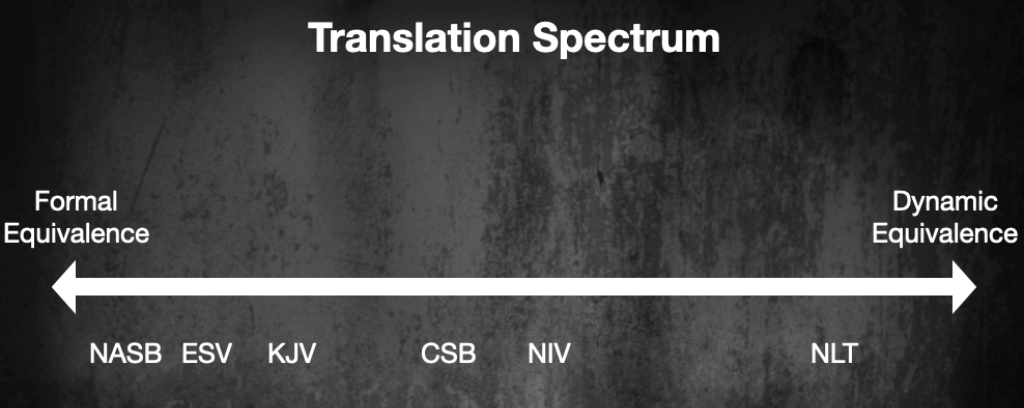
Translations ultimately land somewhere on the spectrum between a more literal word-for-word translation (formal equivalence) and a meaning-for-meaning translation (dynamic equivalence). Formal equivalent translations will give a more literal rendering “Adam knew Eve” (ESV), while dynamic equivalent translations will give the meaning “Adam had sexual relations with his wife, Eve” (NLT). If you’re wondering where your favorite translation lands on the spectrum, I’ve listed some of the more popular translations below:

Linguistic Issues

Currency, Weights, and Measures

Translating currency, weights, and measures is a difficult task. Consider the Parable of the Unforgiving Servant. Matthew 18:24 reads:

“One was brought to him who owed him ten thousand talents” (ESV).

“A man who owed him ten thousand bags of gold was brought to him” (NIV).

“One of his debtors was brought in who owed him millions of dollars” (NLT).

The difficulty in translating “talents” (which is the more literal translation) is immediately obvious. The word talent means something completely different in our modern vernacular. The ESV decided to stick with the literal rendering, but at what expense? (no pun intended) Even if someone were to realize talent refers to a currency, they still have no idea how much a talent was worth.

The NIV decided that a literal rendering would not be helpful. But they also decided that giving a literal amount was impossible. Therefore, they went with “ten thousand bags of gold.” How much is ten thousand bags of gold worth? A whole lot! Though no specific amount is given.

The NLT went in an even different direction. While they are similar to the NIV in that they don’t list a specific amount, they decided to translate the currency into American dollars. This decision, however, suggests that they are thinking primarily of an American audience. Why not the British pound?

Another example is Isaiah 5:10.

“For ten acres of vineyard shall yield but one bath, and a homer of seed shall yield but an ephah” (ESV).

“A ten acre vineyard will produce only a bath of wine; a homer of seed will yield only an ephah of grain
(NIV).

“Ten acres of vineyard will not produce even six gallons of wine. Ten baskets of seed will yield only one basket of grain” (NLT).

You can see that both the ESV and the NIV translated the measures in a literal way. In doing so, they tell us exactly what the Hebrew text says. But who knows what a “homer of seed” or an “ephah” is? The NLT, again, attempts to give the meaning by using understandable terms such as “gallons” and “baskets.”

Euphemisms

Every culture has its own euphemisms. “That one bit the dust” or “He’s not the sharpest tool in the shed” would confuse anyone trying to learn English for the first time. If someone were to translate those phrases into another language, should they translate them word-for-word like above, or give the meaning of the phrases?

We find scores of Hebrews and Greek euphemisms in the Bible. Consider Rachel’s words to her father Laban in Genesis 31:35.

“Let it not displease my lord that I cannot rise up before thee; for the custom of women is upon me” (KJV).

“Let not my lord be angry that I cannot rise before you, for the manner of women is upon me” (NASB).

“Don’t be angry, my lord, that I cannot stand up in your presence; I’m having my period” (NIV).

The KJV and the NASB give a more literal rendering of the Hebrew text while the NIV gives the meaning of the euphemism.

Another word, though technically not a euphemism, that Bible translators wrestle over is the word “flesh.” Consider Paul’s words in Romans 7:18.

“For I know that nothing good dwells in me, that is, in my flesh” (ESV).

“For I know that good itself does not dwell in me, that is, in my sinful nature” (NIV).

“For I know that nothing good lives in me, that is, in my flesh” (CSB).

I grew up in church, so I am familiar with the term “flesh.” That said, someone picking up a Bible for the first time might be confused by this term. In Romans 7:18, both the ESV and the CSB give the literal rendering of the Greek, while the NIV gives Paul’s meaning.

Grammar and Syntax

Every language has a unique structure. Greek and Hebrew have different structures from English. That said, a literal wooden word-for-word translation would be so unreadable and unhelpful, that even the most formal equivalent translations like the NASB smooth out the sentences into English.

One grammatical issue that Bible translators wrestle with revolves around the genitive case. The genitive is often thought of as the “possessive case” in cases such as “my dog” or “Billy’s house.” Yet, many times, the genitive does not convey possession but functions more like an adjective. The formal translations, however, still tend to translate these genitives as possessives by giving the literal rendering “of.” Speaking of God the Son, Hebrews 1:3 states:

“he upholds the universe by the word of his power” (ESV).

“upholds all things by the word of His power” (NASB).

“sustaining all things by his powerful word” (NIV).

Both the ESV and the NASB give the wooden genitive “of” reading while the NIV smooths out the meaning and shows that power is not a possessive but an adjective modifying “word.”

Gender Pronouns

The final issue we will consider deals with gender inclusion. Hebrew and Greek both used masculine pronouns to describe humans in general. The Greek word anthropos functions this way. And to an extent, we still do this today when we say things like “mankind.” That said, English translations wrestle through translating the masculine pronouns so as to not exclude the female gender. Some translations stay with the literal rendering, while others attempt to give the meaning. Consider Psalm 1:1.

“Blessed is the man” (ESV).

“Blessed is the man” (NASB).

“Blessed is the one” (NIV).

“Oh, the joys of those” (NLT).

“How happy is the one” (CSB).

The more literal reading is “man.” That said, the meaning is gender inclusive.

Different Translations

So, which Bible translation should you use? Well, it all depends on your goal. If you’re looking to give a Bible to a young child, you may consider a Bible on the dynamic equivalence end of the spectrum. If you’re wanting a Bible to read consistently throughout the year, I’d recommend multiple Bibles. The NIV and CSB are nice options as they strike a nice balance between formal and dynamic equivalencies. That said, it’s also nice to have a Bible that gives you a more literal rendering so that you can get a better idea of what the original languages say.

Personally, I consult at least three Bibles when I’m studying a text. I look at both a formal and dynamic translation, as well as one somewhere in-between.

Recommended resources related to the topic:

Counter Culture Christian: Is There Truth in Religion? (DVD) by Frank Turek

Defending the Faith on Campus by Frank Turek (DVD Set, mp4 Download set, and Complete Package)

_____________________________________________________________________________________________________________________________________________________

Ryan Leasure holds a Master of Arts from Furman University and a Masters of Divinity from the Southern Baptist Theological Seminary. Currently, he’s a Doctor of Ministry candidate at the Southern Baptist Theological Seminary. He also serves as a pastor at Grace Bible Church in Moore, SC.

Original blog: https://bit.ly/3S36ZGY

By Ryan Leasure

In this post, we will consider the history of the English Bible. The Bible, after all, wasn’t written in English but in Hebrew, Aramaic, and Greek. In fact, English didn’t even exist when the Bible was written! So how did the Bible end up in our language? That’s what I hope to explain in this article

The Latin Bible

Since the start of the fifth century, the Latin Vulgate was the official Bible translation for the church in the West. The problem was that by the Middle Ages, almost nobody knew Latin, including much of the clergy! Large chunks of Scripture, therefore, had never been read nor heard. While some desired to translate the Bible into native languages, the church forbade this activity. Translating a Bible into a language other than the approved Latin version could land you in prison or the chopping block.

Keeping the laity away from Scripture was one of the problems which led to the Reformation. The Reformation doctrine of the priesthood of the believer would never stand for only clergy having access to Scripture. But even though the Reformation was still 150 years away, the Morningstar of the Reformation began to shine bright in the fourteenth century.

John Wycliffe

Wycliffe was a Reformer before there were Reformers. He believed that ultimate authority resided in the Bible, not the Pope. As one of the most brilliant scholars in England during his time, Wycliffe gathered quite a following. His followers were derogatorily known as “Lollards.” Wycliffe sent these lower-class preachers out to villages around England where they preached in English. Wycliffe noted, “Christ and his apostles taught the people in the language best known to them. . . . Therefore, the doctrine should be not only in Latin but also in the [common] tongue.” [1].

Following the influence of their leader, the Lollards translated the Bible from the Latin into English in 1382. Each Wycliffe Bible was copied by hand since the printing press would not be invented by Gutenberg for another seventy years. As you can imagine, the ecclesiastical powers frowned upon the Lollard’s work. The archbishop of Canterbury remarked, “That pestilent and most wretched John Wycliffe, of damnable memory, a child of the old devil, and himself a child or pupil of Antichrist . . . crowned his wickedness by translating the Scriptures into the mother tongue.” [2].

One detractor even complained, “Christ gave his Gospel to the clergy and the learned doctors of the Church so that they might give it to the laypeople. . . . But this Master John Wycliffe translated the Gospel from Latin into the English. . . . And Wycliffe, by thus translating the bible, made it . . . common to all, . . . even to women!”[3].

Lollards were repeatedly burned at the stake with their Bibles tied around their necks. Wycliffe, however, was able to escape the death penalty because of friends in high places. In 1384, however, he suffered a stroke while taking the Lord’s Supper. He died a few days later.

Thirty years later, in 1415, the Council of Constance condemned Wycliffe and his Bible. So they dug up his corpse, burned his remains, and threw his ashes in the River Swift.

Erasmus and the Greek New Testament

The Lollards translated from the Latin into English because hardly anybody knew Greek in the Western world at the time. All of that changed, however, in the fifteenth century when the Muslim Ottomans conquered the Eastern Roman Empire. As a result, Greek scholars migrated west and brought their Greek with them. This led to a renaissance of interest in the ancient languages. Within just a few short years, universities started offering Greek.

One person who was especially interested in learning Greek was a young Dutch scholar named Desiderius Erasmus. He is famously quoted as saying, “I have turned my entire attention to Greek. The first thing I shall do, as soon as money arrives, is to buy some Greek authors; after that, I shall buy clothes.”[4].

In 1516, he became the first person to publish a critical edition of the Greek New Testament. Erasmus used about ten Greek manuscripts, all which dated to the medieval period. Until this time, the Greek New Testament only survived in hand-copied manuscripts that were often incomplete. Since Gutenburg had previously invented the printing press sixty years earlier, Erasmus was able to produce an entire Greek New Testament and distribute thousands of copies.

Biblical scholars refer to Erasmus’ critical New Testament as the Textus Receptus (“the received text”). His multiple editions became the basis for the King James Bible.

William Tyndale

Shortly after Erasmus’ Greek New Testament was published, a young scholar named William Tyndale requested a reversal to the policy against English Bible translations. His request was denied. Certainly, if someone was ever going to translate the Bible into English from the original languages, Tyndale was the guy. He trained at both Oxford and Cambridge and was fluent in 6-7 languages. Yet, his peers did not share his same passion. One such priest chided Tyndale’s desire to get God’s word to the people. He went so far as to say that it was more important for the people to know the Pope’s decrees than God’s. Tyndale responded, “If God spares my life, I will cause a boy that driveth the plow to know more of the Scripture than you do.” [5]. Tyndale would eventually succeed.

Yet, Tyndale had to flee England for Reformation-friendly Germany where he could translate in safety. In 1526, Tyndale finished translating the Greek New Testament into English. This was the first English Bible based off the original languages. A German printer produced 6,000 copies. These Bibles were smuggled into England inside boxes of wine and sacks of flour and sold on the black market. English bishops bought as many copies as they could, often at inflated prices, just so they could burn them. Tyndale wasn’t bothered by their actions. He used the added proceeds to update and improve his New Testament.

Tyndale’s Bible underwent several updates. His third edition of 1534 is the most significant. He is also responsible for shaping much of the English language. Linguists argue that Tyndale and William Shakespeare shaped the English language more than anyone else. Tyndale introduced new words such as “fisherman, seashore, scapegoat, beautiful, and peacemaker.”

Henry VIII

Even though Henry VIII led England out of the Roman Catholic Church, he still did not approve of Tyndale’s Bible. The reason? Because Tyndale wrote a tract condemning Henry’s unlawful divorce of his wife Catherine so he could marry Anne Boleyn. The year after this tract, Henry issued an edict, “the translation of Scripture corrupted by William Tyndale . . . should be utterly expelled, rejected, and put away.”[6].

In 1535, the English bribed Henry Philips to betray Tyndale over to the authorities. Philips succeeded and Tyndale was thrown into prison for over a year. While in prison, he determined to translate the Old Testament from the Hebrew. He never finished. In 1536, he was tied to a post, strangled to death, and burned. His final words that he cried out for all the bystanders to hear were, “Lord! Open the king of England’s eyes!”[7].

Tyndale’s prayer was answered. Around that time, Henry VIII approved the Matthew’s Version of the Bible. “Matthew” was a pseudonym for Tyndale’s friend John Rogers. In fact, the letters “WT” were printed between the Old and New Testaments as a covert tribute to William Tyndale.

English Bibles Before KJV

After the first English translation was approved, several immediately followed:

The Coverdale Bible

In 1535, Miles Coverdale (Tyndale’s assistant) produced a complete Bible. This became the first complete Bible printed in English. That said, he didn’t translate directly from the original languages. He used Tyndale’s text, the Latin, and even Luther’s German Bible.

The Matthew’s Bible

In 1537, John Rogers—whose pen name was Thomas Matthew—brought together Tyndale’s published and unpublished translations along with Coverdale’s translation of the prophets and apocrypha. Rogers added over 2,000 notes to his translation. His Bible is sometimes called the “Wife-Beater’s Bible” because a marginal note at 1 Peter 3:7 reads, “If the wife be not obedient and helpful to her husband, he should endeavor to beat the fear of God into her.” Ironically, Rogers became the first martyr to be burned at the stake during Bloody Mary’s reign in 1555. I guess she read the footnote.

The Great Bible

In 1538, the king ordered that an English Bible be placed in every church. And not just any Bible, but the biggest Bible available. Therefore, the Church commissioned Coverdale to publish a new Bible that was even larger than the Matthew’s Bible. Thus, it was called the “Great Bible,” not because of its quality but because of its size. This Bible was based largely on Matthew’s Bible. It was different in two ways though. First, it was larger. And second, it left out all the marginal notes.

The Geneva Bible

During the reign of Bloody Mary, many Protestants fled for the mainland. One landing spot was the Reformation hub Geneva—home of John Calvin. Here, Reformers produced a new translation of the Bible in 1560. This Bible quickly became the most popular English Bible among Protestants—Puritans in particular because of the Calvinistic marginal notes. This was the first Bible translated entirely from the Greek and Hebrew and by a committee. That said, its New Testament relied heavily on Tyndale. It was also the first Bible with verse divisions.

The Bishop’s Bible

Based on the success of the Geneva Bible, the English clergy needed to create a new Bible devoid of Calvin’s influence that could be used in the churches. In 1568, the Church created the Bishop’s Bible. Even though it was used in the pulpits, it was wildly unpopular. It never caught on due to its wooden translation.

The King James Bible

In 1603, King James VI of Scotland became King James I of England. Shortly after his installment, a petition signed by a thousand Puritan pastors led to a conference at Hampton Court in 1604. The king summoned church leaders from all across England to discuss crucial ecclesiastical matters. The most important issue discussed was the desire for a single English translation to be used in the churches—and one without any marginal notes. At the time, the Bishop’s Bible was unpopular, while the unofficial Geneva Bible was used by the masses.

King James was uncomfortable with the Geneva Bible for a couple of reasons. First, he disliked the Calvinistic notes. And second, he disliked that some notes called into question the absolute power of his kingdom. One marginal note justified the Hebrew midwives’ disobedience of Pharaoh’s decree.

In 1611, James commissioned forty-seven scholars to translate a new English Bible. The KJV translators relied heavily on Erasmus’ third edition of the Greek New Testament. After several revisions, the KJV translators ended up copying about 90% of Tyndale’s English New Testament. They also drew heavily from the Geneva Bible’s Old Testament. They even follow the Rheims-Douai translation which was taken from the Latin Vulgate in a hundred places! In other words, the KJV was not brand new translation, but a revision of earlier works.

The KJV endured several revisions and alterations. In fact, about 100,000 changes were made from the original 1611 text to the current version which was completed in 1769—most of which were spelling changes.

Notable KJV Flubs

After the publication of the KJV, it went through several printings. On occasion, printer’s errors occurred, many of which are quite comical. Here are a few:

The Party Bible
A 1716 version has Jesus say in John 5:14 “sin on more” instead of “sin no more.”

The Vinegar Bible
A 1717 version includes the heading “The Parable of the Vinegar” instead of “The Parable of the Vineyard.”

The Murderer’s Bible
A 1795 version has Jesus saying “Let the children first be killed” instead of “Let the children first be filled.”

The Fashion Bible
A 1964 version has Paul saying that “women should adorn themselves with modern apparel” instead of “women should adorn themselves with modest apparel.”

The Unrighteous Bible
A 1653 version has Paul saying that “the unrighteous will inherit the kingdom of God” instead of “the unrighteous will not inherit the kingdom of God.”

The Wicked Bible
This Bible is the most notorious of them all. A 1631 version has the seventh commandment saying “thou shalt commit adultery” instead of “thou shalt not commit adultery.” After this printing went out, the archbishop ordered that all copies be burned and he fined the printer three hundred pounds. The printer died in debtors’ prison.

Footnotes

[1] Dyson Hague, The Life and Work of John Wycliffe, 94

[2] Dove, The First English Bible, 6; Matthew Spinka, John Hus’ Concept of the Church, 296-297.

[3] Timothy Paul Jones, How We Got the Bible, 130

[4] Desiderius Erasmus, The Correspondence of Erasmus: Letters 1 to 141, 1484-1500, 252.

[5] John Foxe, The Book of Martyrs, 1857, 258-259.

[6] Andrew Edgar, The Bibles of London, 59-60.

[7] John Foxe, The Book of Martyrs, 264.

Recommended resources related to the topic:

How to Interpret Your Bible by Dr. Frank Turek DVD Complete Series, INSTRUCTOR Study Guide, and STUDENT Study Guide

Oh, Why Didn’t I Say That? Is the Bible Historically Reliable? by Dr. Frank Turek DVD, Mp4, Mp3 Download.

_____________________________________________________________________________________________________________________________________________________

Ryan Leasure holds a Master of Arts from Furman University and a Masters of Divinity from the Southern Baptist Theological Seminary. Currently, he’s a Doctor of Ministry candidate at the Southern Baptist Theological Seminary. He also serves as a pastor at Grace Bible Church in Moore, SC.

Por Ryan Leasure 

¿Es verdad que los documentos del Nuevo Testamento no fueron Escrituras hasta el siglo IV? Es decir, ¿los libros no tenían autoridad hasta que los concilios de la iglesia se la otorgaron? Los eruditos liberales hacen esta sugerencia debido a que elimina cualquier explicación sobrenatural para el canon del Nuevo Testamento. Para ellos, una autoridad bíblica puede ser explicada únicamente en términos humanos.

Algunos de nuestros amigos católicos también argumentan a favor del siglo IV, pero por otras razones. Para ellos, la máxima autoridad reside en la iglesia. Por lo tanto, sin el sello de aprobación de la iglesia, el Nuevo Testamento no tendría ninguna autoridad.

Pero, ¿es ésta una representación exacta de los documentos del Nuevo Testamento? ¿No eran Escrituras hasta que la Iglesia se pronunció sobre ellos en el siglo IV? Para responder a esta pregunta, necesitamos ver cómo la Iglesia primitiva consideraba estos documentos.

Concilios de la Iglesia del siglo IV

Para empezar, permítanme decir que ningún concilio del siglo IV dio autoridad a los documentos del Nuevo Testamento. El Código Da Vinci se equivocó al decir que el Concilio de Nicea (325 d. C.), bajo la dirección de Constantino, formó el canon del Nuevo Testamento. El Concilio de Nicea no tuvo nada que ver con el canon.

De hecho, no tenemos ningún concilio eclesiástico del siglo IV que determine cuáles libros debían incluirse en el canon del Nuevo Testamento. Lo que tenemos son, en cambio, concilios eclesiásticos regionales que afirman los libros que ya habían funcionado como Escritura para la iglesia. En otras palabras, estos concilios eclesiásticos no otorgan autoridad a ningún libro del Nuevo Testamento. Más bien, se limitan a reconocer los libros que ya tenían esa autoridad. Esta distinción es crucial.

¿Quizás te estés preguntando por qué tardaron tanto tiempo? ¿Por qué la iglesia no hizo una lista mucho antes? Una explicación es que durante los primeros tres siglos, el cristianismo fue, en su mayor parte, una religión ilegal que enfrentó una persecución continua. De hecho, en el año 303 d.C., el emperador Diocleciano ordenó a todos los cristianos hacer sacrificios a los dioses paganos o de lo contrario tendrían que enfrentar el encarcelamiento o el exterminio. Además, les ordenó entregar todas sus Escrituras para que fueran quemadas.

Por estas razones, la iglesia no podía organizar concilios en todo el imperio para ratificar el canon del Nuevo Testamento. Además, no podían hacer circular sus libros ya que podrían ser confiscados por los funcionarios romanos. Una vez que Constantino legalizó el cristianismo en el siglo IV, la iglesia pudo dispersar sus libros libremente. En esta coyuntura, todas las iglesias tuvieron conocimiento de los distintos documentos y, por tanto, afirmaron la autoridad de los veintisiete libros.

Líderes de la Iglesia del siglo II

Sin embargo, la afirmación del canon del Nuevo Testamento por parte de la Iglesia en el siglo IV no venía de la nada. Los cristianos consideraban desde hacía tiempo que estos libros tenían autoridad. De hecho, varios líderes del siglo II afirman la autoridad del Nuevo Testamento en sus escritos.

Ireneo (180 d.C.)

Más que ningún otro padre de la Iglesia, Ireneo aborda cuestiones canónicas. Por ejemplo, declara que entre los muchos llamados evangelios, sólo cuatro de ellos tienen autoridad. Escribe:

“No es posible que los evangelios sean más o menos que el número que son. Así como que hay cuatro zonas del mundo en las que vivimos y cuatro vientos principales”2

Ireneo indica en otra parte por qué estos cuatro evangelios, y ningún otro, son canónicos. Confirma los cuatro evangelios porque sólo ellos están respaldados por la autoridad apostólica, mientras que los demás fueron escritos por gnósticos del siglo II. Dado que era un discípulo de Policarpo que conocía personalmente al apóstol Juan, su conocimiento de la autoría de los mismos tiene un peso importante.

Teófilo de Antioquía (177 d.C.)

Como obispo de Antioquía, Teófilo equipara compara en sus escritos a los profetas del Antiguo Testamento con los Evangelios.

“En cuanto a la justicia que la ley exigía, se encuentran declaraciones confirmatorias tanto en los profetas como en los Evangelios, porque todos hablaron inspirados por un mismo Espíritu de Dios.”3

No sólo eleva los Evangelios a la par con las Escrituras del Antiguo Testamento, sino que Teófilo afirma la inspiración divina para los Evangelios.

Justino Mártir (150-160 d.C)

Justino Mártir, que escribe antes que Ireneo y Teófilo, aborda los Evangelios o las “memorias” de los apóstoles en varias ocasiones. En una ocasión, aborda su papel en el culto.

“Y en el día llamado domingo, todos los que viven en las ciudades o en el campo se reúnen en un lugar, y se leen las memorias de los apóstoles o los escritos de los profetas, mientras el tiempo lo permita; luego, cuando el lector ha cesado, quien preside instruye verbalmente, y exhorta a la imitación de estas cosas buenas.”4

Esta cita lo dice todo. Justino indica que la iglesia primitiva tenía tan buena opinión de los Evangelios que los incluía en su servicio de culto junto con las Escrituras del Antiguo Testamento.

Policarpo (110 d.C)

Policarpo fue alumno y compañero del apóstol Juan. En uno de sus escritos, designa explícitamente los escritos de Pablo como Escritura cuando afirma:

Como está escrito en estas Escrituras: “Airaos, pero no pequéis; no se ponga el sol sobre vuestro enojo”.

Escribiendo a principios del siglo II, Policarpo cita Efesios 4:26 y lo llama Escritura – mucho antes de los concilios del siglo IV.

Otras fuentes tempranas – Ignacio, Clemente de Roma, y la Epístola de Bernabé – también discuten el canon del Nuevo Testamento.

Los escritores del Nuevo Testamento

Hasta ahora, hemos determinado que la iglesia del siglo II consideraba los escritos del Nuevo Testamento como Escritura con autoridad  . Pero, ¿podemos retroceder aún más? Creo que podemos hacerlo observando los propios escritos del Nuevo Testamento.

2 Pedro 3:15-16

“y considerad la paciencia de nuestro Señor como salvación, tal como os escribió también nuestro amado hermano Pablo, según la sabiduría que le fue dada.  Asimismo en todas sus cartas habla en ellas de esto; en las cuales hay algunas cosas difíciles de entender, que los ignorantes e inestables tuercen—como también tuercen el resto de las Escrituras—para su propia perdición”

En este texto, Pedro compara  los escritos de Pablo con las Escrituras del Antiguo Testamento.

1 Timoteo 5:18

“Porque la Escritura dice: No pondrás bozal al buey cuando trilla, y: El obrero es digno de su salario.”

En este pasaje, Pablo cita Deuteronomio 25:4 “No pondrás bozal al buey mientras trilla”, y Lucas 10:7 “el obrero es digno de su salario”, y los califica a ambos de Escritura. En otras palabras, el Evangelio de Lucas estaba al mismo nivel de autoridad que el Antiguo Testamento.

1 Tesalonicenses 2:13

En esta carta, Pablo da la impresión de que es consciente de que sus escritos llevan la autoridad de Dios.

“Por esto también nosotros sin cesar damos gracias a Dios de que cuando recibisteis la palabra de Dios, que oísteis de nosotros la aceptasteis no como la palabra de hombres, sino como lo que realmente es, la palabra de Dios, la cual también hace su obra en vosotros los que creéis.”

Escritura desde el principio

Contrariamente al punto de vista escéptico y católico, los escritos del Nuevo Testamento llevaron la autoridad Bíblica desde el momento de su composición. El erudito del Nuevo Testamento, N. T. Wright, sostiene que los autores “eran conscientes de una vocación única de escribir libros con la forma de Jesús, la guía del Espíritu y que dieran forma a la Iglesia, como parte de su extraña vocación de primera generación”5 Puesto que estos libros eran tenían autoridad desde el principio, los concilios del siglo cuarto de ninguna manera les concedieron autoridad. Más bien, simplemente reconocieron su autoridad ya existente – una autoridad que tenían desde el primer siglo.

Ryan Leasure tiene una maestría en Artes de la Universidad Furman y una maestría en Divinidades del Seminario Teológico Bautista del Sur. También sirve como pastor en: Grace Bible Church en Moore, SC.

Recursos recomendados en Español: 

Robándole a Dios (tapa blanda), (Guía de estudio para el profesor) y (Guía de estudio del estudiante) por el Dr. Frank Turek

Por qué no tengo suficiente fe para ser un ateo (serie de DVD completa), (Manual de trabajo del profesor) y (Manual del estudiante) del Dr. Frank Turek  

_____________________________________________________________________________________________________________________________________________________

Fuente Original del blog: https://bit.ly/3RR6oJd  

Traducido por Monica Pirateque

Editado por Jennifer Chavez 


Por Ryan Leasure

Este es el segundo de una serie de nueve artículos que abordan la cuestión de cómo obtuvimos nuestra Biblia. El último artículo trató la cuestión de la inspiración y la inerrancia. Esta semana nos centramos en la formación del Antiguo Testamento.

Cuestiones de introducción

A finales del siglo II, Tertuliano acuñó el término “Antiguo Testamento” para distinguir las Escrituras hebreas de las griegas. La palabra “testamento” significa simplemente “pacto”. El Antiguo Testamento, en su forma actual, consta de treinta y nueve libros y fue escrito por decenas de autores a lo largo de mil años.

En los primeros tiempos, los autores bíblicos utilizaron diferentes superficies de escritura. Grabaron sobre piedras (Éxodo 34:1; Josué 8:32), escribieron sobre  yeso (Dt 27:2-3), grabaron sobre metal (Éxodo 28:36) y rayaron en tablillas enceradas (Isa 30:8; Hab 2:2). Para grabar en estas superficies, utilizaban plumas de hierro (Job 19:24; Jer 17:1) y otros estiletes.

Afortunadamente, los egipcios ya habían inventado un producto similar al papel utilizando plantas de papiro mucho antes de que Moisés escribiera la ley. Los autores bíblicos adoptaron esta tecnología de escritura con fines prácticos (Jer 36:23). Cuando el papiro no estaba disponible, los autores escribían en pieles de animales estiradas y secas llamadas pergaminos. Los escritores utilizaban cañas de tallo fino (Jer 8:8) que sumergían en tinta, que solía ser una mezcla de hollín y savia de árbol o aceite. Los escribas solían llevar estuches de tinta en el cinturón (Ez 9:2-3).

La primera escritura

El primer texto bíblico fue escrito por el propio Dios. Leemos en Éxodo 31:18: “Y cuando terminó de hablar con Moisés sobre el monte Sinaí, le dio las dos tablas del testimonio, tablas de piedra, escritas por el dedo de Dios“(LBLA). Esas mismas tablas se guardaron luego en el Arca de la Alianza junto con una vasija con maná y la vara de Aarón (Dt 10:5; Hb 9:4).

Más tarde, Moisés recopilaría los escritos de Dios en el Pentateuco junto con sus otros escritos. Tenemos indicios de que Moisés escribió el Pentateuco por etapas y no todo a la vez. En Éxodo 24:4 se lee: ” Y Moisés escribió todas las palabras del Señor.(LBLA)”. En Éxodo 17:14 se lee: “  Entonces dijo el Señor a Moisés: Escribe esto en un libro para que sirva de memorial, y haz saber a Josué que yo borraré por completo la memoria de Amalec de debajo del cielo.” (LBLA)

Los académicos debaten cómo aprendió Moisés el contenido del Génesis. Algunos sugieren que lo aprendió en el Monte Sinaí a través de una revelación divina. Otros creen que se transmitió a través de la tradición oral. Y otros creen que fue una combinación de ambos.

Etapas de la escritura

Como se ha señalado anteriormente, el Antiguo Testamento no se escribió de una sola vez, sino a lo largo de mil años. Puede ser útil pensar en el desarrollo del Antiguo Testamento en cuatro etapas.

La primera etapa fue en el Monte Sinaí, cuando Moisés escribió la Ley. Al principio, el Pentateuco funcionaba como el canon judío de las Escrituras. De hecho, Moisés ordena ” No añadiréis nada a la palabra que yo os mando, ni quitaréis nada de ella, para que guardéis los mandamientos del Señor vuestro Dios que yo os mando.” Dt 4:2 (LBLA). A lo largo de cientos de años se escribieron otros libros, pero su inclusión en el canon tardó algún tiempo. Los libros de Moisés, sin embargo, tuvieron autoridad desde el principio.

La segunda etapa de los depósitos de revelación se produjo durante la transición de la teocracia a la monarquía. Durante esa época, los autores escribieron varios libros históricos (Josué, Jueces, Rut, Samuel), poesía (Salmos) y literatura de sabiduría (Proverbios, Eclesiastés, Cantar de los Cantares).

La tercera etapa fue en la época del exilio babilónico. Varios profetas escribieron durante este período (Isaías, Miqueas, Oseas, Jonás, Amós, Joel, etc.).

La cuarta y última etapa fue el regreso del exilio. Siguieron escribiendo más profetas (Zacarías y Malaquías) e historiadores (Crónicas, Esdras, Nehemías, Ester).

Citando la Ley

Dado que el Antiguo Testamento se desarrolló por etapas, los escritores posteriores del Antiguo Testamento se remitieron a menudo a los libros de Moisés. Quizá el texto más citado de Moisés sea Éxodo 34:6. El texto declara: ” El Señor, el Señor, Dios compasivo y clemente, lento para la ira y abundante en misericordia y fidelidad”(LBLA).

Considera cómo estos textos posteriores del Antiguo Testamento citan a Moisés:

“Pero tú eres un Dios de perdón, clemente y compasivo, lento para la ira y abundante en misericordia, y no los abandonaste”. (Neh. 9:17 LBLA)

“Mas tú, Señor, eres un Dios compasivo y lleno de piedad, lento para la ira y abundante en misericordia y fidelidad”. (Salmos 86:1 LBLA)

“Por eso me anticipé a huir a Tarsis, porque sabía yo que tú eres un Dios clemente y compasivo lento para la ira y rico en misericordia, y que te arrepientes del mal con que amenazas”. (Jonás 4:2 LBLA)

Sometiéndose a la Ley

Los escritores posteriores del Antiguo Testamento no sólo citaron a Moisés, sino que afirmaron explícitamente su autoridad.

“Solamente sé fuerte y muy valiente; cuídate de cumplir toda la ley que Moisés mi siervo te mandó; no te desvíes de ella ni a la derecha ni a la izquierda, para que tengas éxito dondequiera que vayas. Este libro de la ley no se apartará de tu boca, sino que meditarás en él día y noche, para que cuides de hacer todo lo que en él está escrito”. (Jos. 1:7-8 LBLA).

“Y acercándose los días de la muerte de David, dio órdenes a su hijo Salomón, diciendo: Yo voy por el camino de todos en la tierra. Sé, pues, fuerte y sé hombre.  Guarda los mandatos del Señor tu Dios, andando en sus caminos, guardando sus estatutos, sus mandamientos, sus ordenanzas y sus testimonios, conforme a lo que está escrito en la ley de Moisés”. (1 Reyes 2:1-3 LBLA)

“pidieron al escriba Esdras que trajera el libro de la ley de Moisés que el Señor había dado a Israel. Entonces el sacerdote Esdras trajo la ley delante de la asamblea de hombres y mujeres y de todos los que podían entender lo que oían… en presencia de hombres y mujeres y de los que podían entender; y los oídos de todo el pueblo estaban atentos al libro de la ley”. (Neh 8:1-3 LBLA)

Los profetas citan a los profetas

Dado que el Pentateuco tuvo autoridad desde el principio, encontramos muchas más referencias a Moisés que a cualquier otro autor del Antiguo Testamento. Dicho esto, los profetas seguían reconociendo la autoridad de otros profetas que vivieron más cerca de su época. Consideremos las palabras de Daniel:

“en el año primero de su reinado, yo, Daniel, pude entender en los libros el número de los años en que, por palabra del Señor que fue revelada al profeta Jeremías, debían cumplirse las desolaciones de Jerusalén: setenta años”. (Dan 9:2 LBLA)

Aunque Jeremías escribió sólo unas décadas antes, Daniel seguía reconociendo su autoridad divina.

Zacarías también reconoce la autoridad divina de sus predecesores proféticos. Escribe:

“Entonces vino a mí la palabra del Señor de los ejércitos, diciendo: Habla a todo el pueblo de la tierra y a los sacerdotes, y di: «Cuando ayunabais y os lamentabais en el quinto y el séptimo mes durante estos setenta años, ¿ayunabais en verdad por mí? ¿No son estas las palabras que el SEÑOR proclamó por medio de los antiguos profetas, cuando Jerusalén estaba habitada y próspera”? (Zac 7:4-7 LBLA)

Autores y fechas

Es cierto que no podemos ser demasiado precisos en cuanto a los autores y las fechas de los libros del Antiguo Testamento, especialmente de algunas obras históricas. Dicho esto, considere el siguiente cuadro que detalla los autores y las fechas de cada libro del Antiguo Testamento[1].

Tabla Cómo obtuvimos nuestra biblia: la formación del Antiguo Testamento

Uso de las fuentes

La inspiración no implica un dictado mecánico. Aunque los autores bíblicos dictaron la palabra de Dios de vez en cuando, también emplearon otros métodos, como la investigación de fuentes históricas. Considere los siguientes ejemplos:

“Por tanto se dice en el Libro de las Guerras del Señor”. (Núm. 21:14 LBLA)

“Y el sol se detuvo, y la luna se paró, hasta que la nación se vengó de sus enemigos. ¿No está esto escrito en el libro de Jaser?”. (Jos 10:13 LBLA)

“Los demás hechos de Salomón, todo lo que hizo y su sabiduría, ¿no están escritos en el libro de los hechos de Salomón?”. (1 Reyes 11:41 LBLA)

“Los demás hechos que Amón hizo, ¿no están escritos en el libro de las Crónicas de los reyes de Judá?” (2 Reyes 21:25 LBLA)

Lo que demuestran estos textos es que los autores bíblicos no inventaron estas cosas. Hicieron una cuidadosa investigación antes de compilar sus obras.

Editores

La inspiración no excluye la edición. En otras palabras, Dios no sólo inspiró a los autores, sino que también inspiró a los editores para que modificaran y reorganizaran el texto. Sin excepción, los escritores del Nuevo Testamento, e incluso el propio Jesús, afirman la autoría mosaica del Pentateuco (Mateo 8:4; 19:8; Marcos 7:10; 12:26; Lucas 16:31; 20:37; 24:44; Hechos 3:22; 15:1; 26:22; 28:23; 1 Cor 9:9; Heb 9:19). Dicho esto, tenemos claros indicios de una edición posterior por parte de los escribas judíos. Consideremos los siguientes textos:

Moisés era un hombre muy humilde, más que cualquier otro hombre sobre la faz de la tierra”. (Num. 12:3 LBLA)

“Y allí murió Moisés, siervo del Señor, en la tierra de Moab, conforme a la palabra del Señor. Y Él lo enterró en el valle, en la tierra de Moab, frente a Bet-peor; pero nadie sabe hasta hoy el lugar de su sepultura”. (Deut 34:5-6 LBLA)

Desde entonces no ha vuelto a surgir en Israel un profeta como Moisés, a quien el Señor conocía cara a cara”. (Deut 34:10 LBLA)

¿Se autodenominó Moisés la persona más mansa de la tierra e informó de su propia muerte y entierro? Y después de su muerte, ¿informó de que no había surgido ningún profeta semejante desde los tiempos de Moisés? ¿No supone esta última afirmación que ha pasado algún tiempo desde su muerte? En resumen, mientras que Moisés escribió el Pentateuco, los escribas posteriores editaron su obra en su forma actual.

Preservación

Sabiendo que se tardó mil años en escribir el Antiguo Testamento (1400-400 a.C.), ¿qué confianza podemos tener en su preservación? Al fin y al cabo, sabemos que hubo un periodo de tiempo en el que parece que el texto se había perdido y estaba fuera de uso (2 Reyes 22-23).

Al parecer, en la época del Antiguo Testamento existían “clanes de escribas” que copiaron y conservaban la Biblia hebrea (1 Crón 2:55). Desde entonces, los escribas judíos han copiado meticulosamente los textos con los mismos fines. Quizá los más famosos de estos escribas sean los masoretas y la familia Ben Asher del siglo V d.C.. Estos copistas profesionales contaban el número de palabras de cada página y conocían el número de palabras de cada libro, así como la palabra y letra central exactas de cada libro para asegurarse de que copiaban con precisión.

Además, los masoretas añadieron marcas vocales al texto, que de otro modo carecería de ellas. Hasta la década de 1940, los textos hebreos más antiguos que poseíamos eran textos masoréticos de los siglos IX y X.

Manuscritos del Mar Muerto

En 1947, un pastor llamado Muhammed edh-Dhib salió a buscar algunas de sus ovejas por la costa del Mar Muerto. Al pasar por una cueva, lanzó una piedra al interior con la esperanza de oír el balido de las ovejas. En lugar de eso, escuchó cerámica rompiéndose. Esa vasija destrozada dio lugar a uno de los hallazgos arqueológicos más importantes del siglo XX.

Desde entonces, los arqueólogos han descubierto más de un millar de documentos judíos antiguos en docenas de cuevas cercanas que datan del año 250 a.C. al 65 d.C. Estos textos pertenecían a la comunidad de Qumrán, también conocida como los esenios. Esta gente funcionaba como los monjes judíos, aislados de la mayor parte de la sociedad. Lo más probable es que la comunidad de Qumrán escondiera sus textos sagrados en estas cuevas durante la guerra con Roma (68-70 d.C.) con la esperanza de volver a ellos una vez que se asentara el polvo. Por desgracia, todos murieron durante la guerra, por lo que sus textos permanecieron ocultos durante dos mil años.

Entre estos documentos se encuentran todos los libros del Antiguo Testamento, excepto Ester. Quizá el texto más significativo sea un rollo completo de Isaías, que consta de veintisiete hojas de pergamino cosidas de extremo a extremo. Mide seis metros de largo. El pergamino data del año 120 a.C., es decir, es mil años más antiguo que el anterior texto más antiguo. Lo más significativo es que el rollo de Isaías difiere muy poco del texto masorético del siglo X, lo que demuestra que los escribas judíos conservaron cuidadosamente el texto original.

Canon del Antiguo Testamento

En el próximo artículo se examinarán la Septuaginta, los apócrifos y el canon del Antiguo Testamento.

*Para saber más sobre este tema, lea el útil libro de Timothy Paul Jone How We Got the Bible.

Referencias:

[1] Este gráfico es una modificación del de Timothy Paul Jones, How We Got the Bible, 31-33.

Recursos recomendados en Español: 

Robándole a Dios (tapa blanda), (Guía de estudio para el profesor) y (Guía de estudio del estudiante) por el Dr. Frank Turek

Por qué no tengo suficiente fe para ser un ateo (serie de DVD completa), (Manual de trabajo del profesor) y (Manual del estudiante) del Dr. Frank Turek

_____________________________________________________________________________________________________________________________________________________


Ryan Leasure tiene un Máster en Artes por la Universidad de Furman y un Máster en Divinidad por el Southern Baptist Theological Seminary. Actualmente, es candidato a Doctor en Ministerio en el Southern Baptist Theological Seminary. También sirve como pastor en Grace Bible Church en Moore, SC.

Fuente original del blog: https://bit.ly/3Nnm8jP

Traducido por Jennifer Chavez

Editado por Elenita Romero


By Ryan Leasure 

This article is part 6 in a nine-part series on how we got our Bible. Part 1 dealt with inspiration and inerrancy. Part 2  looked at Old Testament development. Part 3 investigate the Old Testament canon and the Apocrypha. Part 4 considered attributes of the New Testament Canon. And Part 5 inquired into the early church’s reception of the New Testament Canon. This post will consider the manuscript tradition and preservation of the New Testament text.

No Original Autographs

Sadly, none of the original autographs remain. Most likely, they wore out after constant usage and copying. Now, all that we possess are copies of copies of copies—a lot of them actually. Yet these copies differ in lots of different places. But do these differences render our Bible unreliable? Bart Ehrman thinks so. He asks:

How does it help us to say that the Bible is the inerrant Word of God if in fact we do not have the words that God inerrantly inspired, but only the words copied by scribes—sometimes correctly but sometimes(many times!) incorrectly?[1]

In response to Ehrman’s objection, I’d like to quote the Chicago Statement on Biblical Inerrancy. Article X reads:

We affirm that inspiration, strictly speaking, applies only to the autographic text of Scripture, which in the providence of God can be ascertained from available manuscripts with great accuracy. We affirm that copies and translations of Scripture are the Word of God to the extent that they faithfully represent the original.

In other words, through the manuscript tradition, we can recreate the original texts with a high degree of accuracy. The reason for this accuracy is that we have 5,000+ extant Greek NT manuscripts (and thousands more in other languages).

Important Early Manuscripts

While listing all the manuscripts would be an impossible task, allow me to highlight some of the more prominent ones:

P52

P stands for “papyri” taken from a reed-like plant in the marshes of Egypt. All the oldest NT manuscripts are on papyri. P52 is probably the oldest surviving manuscript and most likely dates to the second century. The manuscript is extremely small (about the size of a credit card), and contains portions of John 18:31-33, 37-38 on a two-sided fragment. It was discovered in 1934 and is currently housed in the John Rylands Library in Manchester, England.

P66

This manuscript contains almost a complete copy of John’s Gospel. The manuscript contains 104 in tact leaves and fragments from forty other leaves. This manuscript dates to somewhere between the late second and early third centuries. It is currently housed in the Bodmer Library in Cologny, just outside Geneva, Switzerland.

P75

This manuscript contains most of Luke and John’s Gospels and dates somewhere between the late second and early third centuries. Discovered in the 1950s, this manuscript made a significant splash in the text criticism world as it closely resembles the fourth century Codex Vaticanus, demonstrating that the copying of early scribes wasn’t as uncontrolled and inaccurate as many previously thought. This manuscript is housed in the Vatican Library.

P45

This manuscript is a highly fragmented portion of a four-Gospel and Acts codex (book with pages) and dates to somewhere between the late second and early third centuries. It was originally 220 pages, but only thirty survive. This codex, along with others like P46 demonstrate that the early church started collecting their canonical texts into single book forms. No early codex, for example, contains the canonical Gospels and the Gospel of Peter or Thomas. This manuscript was discovered in the 1930s and is housed in the Chester Beatty Museum in Dublin, Ireland.

P46

This manuscript contains eight of Paul’s letters and Hebrews. Many in the early church thought Hebrews was Pauline, so it was often lumped in with his other letters. This manuscript is very early and probably dates to the second century, though third century is a possibility. It was discovered in the 1920s in the ruins of an old monastery in Egypt. Fifty-six leaves are housed in the Chester Beatty Museum in Dublin, Ireland, and thirty are at the University of Michigan.

Codex Sinaiticus

Unlike the previous manuscripts, this one is on parchment (stretched and dried animal skins) and is extremely elegant. It dates to the fourth century. The manuscript includes about half of the OT, Apocryphal texts, the entire NT, the Shepherd of Hermes, and the Epistle of Barnabas. It contains over four hundred leaves of parchment measuring 13 x 14 inches in size. In 1844, Constantine Tischendorf supposedly discovered it in a waste basket that was set to be burned in a fire to keep the monks warm. Along with Vaticanus, this manuscript is the best one in our possession. It is currently housed in the British Library in London.

Codex Vaticanus

Similar to Sinaiticus, Vaticanus dates to around the middle of the fourth century. It contains almost the entire OT, Apocryphal texts, and almost the entire NT (parts of Hebrews and Revelation are missing). Most text scholars regard Vaticanus as the most trustworthy manuscript of the NT. As mentioned previously, it relates closely to P75. This manuscript has been housed in the Vatican Library since the 15th century.

Texual Variants

With thousands of manuscripts comes thousands of textual variants (about 500,000 in total). A variant is simply a different reading in the text. And as Bart Ehrman likes to point out, “There are more variations among our manuscripts than there are words in the New Testament.”[2] While there are only about 138,000 words in the New Testament, Ehrman’s quote is misleading. First off, we wouldn’t have any variants if we only had one manuscript. With 5,000+, we’re bound to have thousands upon thousands of variants. And second, Ehrman wrongly compares the total number of variants in ALL the manuscripts to the total number of words in only ONE complete manuscript.

Peter Gurry has calculated that when you add up all the words in the 5,000+ manuscripts, and divide it by the total number of variants, you come out to “just one distinct variant per 434 words copied.”[3] That’s a far cry from having far more variants than words in the NT.

Types of Variants[4]

With all the variants in the manuscript tradition, how do scholars determine which readings represent the original text? To help you make sense of this process, I think it will be helpful to place the types of variants into four different categories:

1. Neither Meaningful nor Viable

This category represent variants that don’t change the meaning of the text and obviously don’t reflect the original reading. For example spelling errors are easy to detect and aren’t original to the text. Or, occasionally a scribe got careless and repeated a word like the scribe who copied Galatians 1:11: “For I would have you know, brethren, that the gospel the gospel that was preached by me is not man’s gospel.” These types of variants make up about 75% of all variants (roughly 400,000 variants).

Even Ehrman admits, “To be sure, of all the hundreds of thousands of textual changes found among our manuscripts, most of them are completely insignificant, immaterial, of no real importance for anything other than showing that scribes could not spell or keep focused any better than the rest of us.”[5]

2. Viable but not Meaningful

These variants could reflect the original, but they don’t affect the meaning of the text. Variants of this sort include synonyms, different spellings, changes in word order, and the like. Allow me to offer you a few examples:

  • John 1:6 either reads, “There came a man sent from God.” Or it reads, “There came a man sent from the Lord.” Either could reflect the original, but meaning remains the same.
  • The movable nu is either present or absent in several instances. This variant is equivalent to the English use of the article “a” or “an.” No translation is affected.
  • Sometimes John has two n’s and sometimes it has one n. It can be spelled either way. This could be equivalent to spelling it “color” or “colour.” Technically, both are acceptable. But again, the spelling of Ἰωάννηςdoesn’t affect translation.
  • One popular group of synonyms are words translated as “and” (καὶ, δέ, τέ). The variants could reflect the original, but the translation and meaning are not affected.
  • Word order changes don’t affect meaning either because Greek is an inflected language. Meaning, the form of the word determines its place in the sentence. For example, I can write “God loves you” twelve different ways in Greek (θεός ἀγαπᾷ σε / θεός σε ἀγαπᾷ / σε ἀγαπᾷ θεός / σε θεός ἀγαπᾷ / ἀγαπᾷ θεός σε / ἀγαπᾷ σε θεός / ὁ θεός ἀγαπᾷ σε / ὁ θεός σε ἀγαπᾷ / σε ἀγαπᾷ ὁ θεός / σε ὁ θεός ἀγαπᾷ / ἀγαπᾷ ὁ θεός σε / ἀγαπᾷ σε ὁ θεός). That is to say, changes of word order don’t affect translation.

3. Meaningful but not Viable

These variants would change the meaning of the text, but they obviously don’t reflect the original. For example, most John 1:30 manuscripts reads, “after me comes a man.” One manuscript, however, reads, “after me comes air.” And I don’t think John the Baptist was talking about some bad locusts he ate. This variant would change the meaning, but it obviously does not reflect the original. The copyists simply left out a letter (ἀήρ vs. ἀνήρ).

Again, Erhman remarks, “Most of the changes found in our early Christian manuscripts have nothing to do with theology or ideology. Far and away the most changes are the results of mistakes, pure and simple — slips of the pen, accidental omissions, inadvertent additions, misspelled words, blunders of one sort or another.”[6]

Of all textual variants, 99% of them fall into these first three categories. The remaining 1% fall into the final category.

4. Meaningful and Viable

These variants would change the meaning of the text and they very possibly could reflect the original. Furthermore, most Bibles include these variants in their footnotes. Let me give you a few examples of what these variants look like and the process that textual scholars go through in making their decisions:

Mark 1:2

Either it reads: (A) “as it is written in Isaiah the prophet” or, (B) “as it is written in the prophets.”

Most of the early manuscripts (Sinaiticus, Vaticanus, Bezae) support reading A. Later Byzantine texts support B. This one seems pretty straight forward to me. A is the more difficult reading because the following quotation comes from both Isaiah and Micah. Therefore, it’s easy to see how a later scribe would try to smooth this out by changing “Isaiah” to “the prophets” because of a perceived mistake in the manuscript he was copying. Since it’s the more difficult reading, and since it is well represented among the earliest manuscripts, reading A is to be preferred.

Luke 22:43-44

Either: (A) it includes Jesus agonizing and sweating drops of blood in the garden, or (B) it omits it.

The manuscript evidence is somewhat divided on this issue. Good manuscripts support both A and B, although church father quotations support A. Moreover, its difficult to understand why a scribe would insert this scene if it wasn’t original to the text. On the flip side, it’s easier to make sense of why a scribe would omit the scene because it makes Jesus look weak compared to other Christian martyrs who boldly went to their deaths. Option A seems like the better reading in my opinion.

Romans 5:1

Either it reads: (A) “Therefore, since we have been justified by faith, we have peace with God through our Lord Jesus Christ” or, (B) “let us have peace with God through our Lord Jesus Christ.”

Most of the early and better manuscripts favor reading B. That said, the context of Romans 5 suggests that A would be a better reading. In other words, Paul doesn’t seem to be exhorting the believers to pursue peace with God, but declaring that they already have peace with God. The difference is one letter (ἔχομεν or ἔχωμεν), and they would have sounded almost identical as they were read aloud. It’s easy to see how a copyist mistakenly heard the wrong word as someone read it aloud to him as he copied the text. Therefore, A seems like the better reading.

A Reliable Text

I hope these examples give you a little idea of what the process of textual criticism looks like. I should also note that none of the meaningful and viable variants leave any Christian doctrine hanging in the balance. That is to say, the Trinity isn’t up in the air if a Bible translator chose the wrong variant. God’s word is redundant (in a good way) so that every major Christian belief is well-represented across a wide spectrum of texts. Thus, while biblical scholars are less than 100% certain in a few places, you can have confidence that God’s word has been reliably preserved.

The next post will look into the history of the English Bible.

Notes

[1] Bart Ehrman, Misquoting Jesus, 7.

[2] Bart Ehrman, Misquoting Jesus, 90.

[3] Peter Gurry, Myths and Mistakes, 196.

[4] These categories come from Dan Wallace.

[5] Bart Ehrman, Misquoting Jesus, 207.

[6] Bart Ehrman, Misquoting Jesus, 55.

Recommended resources related to the topic:

Why We Know the New Testament Writers Told the Truth by Frank Turek (DVD, Mp3 and Mp4)

The Footsteps of the Apostle Paul (mp4 Download), (DVD) by Dr. Frank Turek

Cold-Case Christianity: A Homicide Detective Investigates the Claims of the Gospels by J. Warner Wallace (Book)

_____________________________________________________________________________________________________________________________________________________

Ryan Leasure holds a Master of Arts from Furman University and a Masters of Divinity from the Southern Baptist Theological Seminary. Currently, he’s a Doctor of Ministry candidate at the Southern Baptist Theological Seminary. He also serves as a pastor at Grace Bible Church in Moore, SC

Original Blog Source: https://bit.ly/3KPYR8v