
Tag Archive for: How We Got Our Bible

By Ryan Leasure

This article is part four in a nine-part series on how we got the Bible. Part 1 looked at biblical inspiration and inerrancy. Part 2 considered the development of the Old Testament. And Part 3 investigated the Old Testament canon and the Apocrypha.

In this article, we transition to the New Testament canon. Specifically, I want to answer two questions. First, would the first-century Christians have expected new Scripture in addition to the Old Testament? And second, what attributes did the church look for in canonical texts?

Would the First-Century Church have Expected New Scripture?

Biblical scholar Harry Gamble once remarked, “There is no intimation at all that the early church entertained the idea of Christian scriptures… Therefore, the NT as we think of it was utterly remote from the minds of the first generation of Christian believers.”1. What are we to make of Gamble’s assertion? Was he right? Did the early church assume that God was done inspiring Scripture after the close of the Old Testament? I believe we have good reason to reject Gamble’s claims. Let me give you three reasons why.2

1. First-century Jews regarded the Old Testament story as Incomplete

Several texts from the Gospels and Acts demonstrate that first-century Jews expected God to do something in their generation. Not only were they on the look-out for the Messiah (Luke 2:38; 2:25; John 1:41; 4:25), they expected God to usher in his kingdom and overthrow their oppressors (Acts 1:6; see Dan 2:31-45). Second Temple period (intertestamental) texts also confirm this same expectation (Tob 14:5-7; Bar 3:6-8). As N. T. Wright notes, “The great story of the Hebrew scriptures was therefore inevitably read in the Second Temple period as a story in search of a conclusion.”3

The close of the Old Testament also gives the impression that the Jews expected a Davidic King to rise up among their ranks. Keep in mind, according to Jewish ordering, Chronicles was the final book of the Old Testament. And that book starts off with a lengthy genealogy centered around King David (1 Chron 1-3). It’s no coincidence that the start of the New Testament picks up right where the Old Testament left off with a genealogy focusing on the Son of David (Matt 1). It’s as if the Gospel of Matthew brings the story of the Old Testament to its necessary fulfillment.

2. God’s Pattern of Bringing New Word-Revelation after his Acts of Redemption

According to the Old Testament pattern, God typically gives revelation deposits after his redemptive acts. We see this sequential pattern most clearly in the Exodus. God redeemed his people out of Egypt. He then followed up that redemption with Scriptural installments at Sinai to interpret his saving acts. Given this history, it’s not inconceivable that the early church would have expected more written revelation following Jesus’ act of redemption.

3. The Old Testament Predicted that the Future Messianic Age would Include Verbal Communication

Not only did the Old Testament predict a future messianic age, it predicted that communication would accompany the Messiah. Deuteronomy 18:18 predicts “I will raise up for them a prophet like you from among their brothers. And I will put my words in his mouth, and he shall speak to them all that I command him.” Isaiah 61:1-2  says of the Messiah that “The Spirit of the LORD God . . . has anointed me to bring good news to the poor . . . to proclaim liberty to the captives . . . to proclaim the year of the Lord’s favor.” And of this Messianic age, we read, “out of Zion shall go the law, and the word of the LORD from Jerusalem” (Isa 2:2-3).

In sum, those living after the close of the Old Testament recognized that the story was incomplete, that God typically gave word-revelation following his redemptive acts, and that the Old Testament anticipated a verbal Messianic age.

What Attributes did the Early Church Look for in a Canonical Text?

Now that we’ve established the early church’s expectation for more biblical texts, we must now ask what attributes they would have looked for in those new biblical texts. In the remaining space, I will consider three of these attributes—apostolic authority, marks of inspiration, and universal reception.4 Let’s consider each canonical attribute in turn.

Apostolic Authority

Going back to the New Testament, the apostles recognized that they were “ministers of the New Covenant” (2 Cor 3:6), and that the church was “built on the foundation of the apostles and prophets (Eph 2:20). They also recognized that Jesus had sent them out as the guarantors and transmitters of his message to the world (John 20:21). For these reasons, the early church only received texts that could be traced back to an apostle.

Therefore, from an early time, the church received the four Gospels, Acts, and Paul’s letters. Of course, Paul makes his apostolic authority known in his letters, but the Gospels make no such claim. How then did they receive apostolic status at such an early stage in the church?

Critics argue that since the authors don’t mention their names in the body of the text, the Gospels must have been originally anonymous. It was only after some time that the church added titles to give these anonymous works some needed credibility. Yet, the critics’ assertions lack evidence. All the earliest manuscripts with titles list Matthew, Mark, Luke, and John as the authors. Additionally, numerous church fathers state unequivocally that Mark wrote his Gospel based on Peter’s eyewitness testimony, and that Matthew, Luke, and John all wrote their respective Gospels.

That said, why did the church receive Mark and Luke if they weren’t apostles themselves? It’s because of their close association with the apostles. That is to say, books with apostolic authority were not limited to books that were written by the apostles. Rather, books that came from apostolic circles also came with apostolic authority. Notice Tertullian’s comment about Gospel authorship: “Of the apostles, therefore, John and Matthew first install faith into us; whilst of apostolic men, Luke and Mark renew it afterwards.”5 Tertullian affirms that Mark and Luke were “apostolic men” by nature of their close association with the apostles Peter and Paul.

This close proximity to the apostles also explain why Hebrews made its way into the canon. The author indicates he knew Timothy (Heb 13:23) and that the Gospel message “was declared at first by the Lord, and it was attested to us by those who heard” (Heb 2:3). These two texts combined indicate that the author walked in apostolic circles (probably Pauline), and therefore, his book was apostolic.

Jesus’ family (James and Jude) also received quasi-apostolic status as well based on their relationship to the Lord. We don’t know as much about Jude, but we know James became a prominent leader in the Jerusalem church and later martyr for his Christian faith.

At the same time, the church rejected books from non-apostolic sources. Commenting on the so-called Gospel of Peter, church father Serapion declared, “We receive both Peter and the other apostles as Christ, but the writers which falsely bear their names we reject.6 Serapion asserted that the church should reject the heretical Gospel of Peter and all others that falsely bear the apostles’ names (Thomas, Philip, etc.).

The Muratorian Fragment makes a similar comment around AD 180. It notes, “There is said to be another letter in Paul’s name to the Laodiceans, and another to the Alexandrines, both forged in accordance with Marcion’s heresy, and many others which cannot be received into the catholic church, since it is not fitting that poison should be mixed with honey.”7 Again, the church rejected all forgeries. The fragment also notes that the beloved Shepherd of Hermes should not receive canonical status because it was written “quite recently, in our own times.” In other words, someone wrote this book after all the apostles had died out.

Marks of Inspiration

Second, the church looked for books that possessed marks of inspiration. If a book came from God, one would expect it to reflect God’s nature and other previously inspired texts. The text, therefore, should reflect the beauty and excellence of God (Psalm 19:7-10). As Jerome once remarked about a New Testament text, it is a “document which has in it so much the beauty of the Gospel,” which is the “mark of its inspiration.”8

Moreover, the text will be accompanied with transformative power. In other words, the text isn’t just words on a page. The text is “living and active” (Heb 4:12). Justin Martyr remarked, “For they possess a terrible power in themselves, and are sufficient to inspire those who turn aside from the path of rectitude with awe; while the sweetest rest is afforded to those who make a diligent practice of them.”9 Irenaeus also asserted that the Gospels are always “breathing out immortality on every side and vivifying men afresh.”10 That is to say, the early church recognized that certain texts brought about salvation and good works in the life of the church.

Not only will the text possess a certain beauty and power, it will be harmonious with other authoritative Scripture. For this reason, the church rejected books like 2 Maccabees which suggests we can offer sacrifices and prayers for the dead (2 Macc 12:43-46). They also rejected gnostic texts (Gospel of Philip, Gospel of Truth, Gospel of Peter, etc.) because they undermined the entire Old Testament altogether. And they rejected the Gospel of Thomas which has Jesus saying, “Look, I will guide her (Mary) to make her male, so that she too may become a living spirit resembling you males. For every female who makes herself male will enter the kingdom of Heaven”—a clear repudiation of Genesis 1-2.

Thus, as Irenaeus remarked, “All Scripture, which has been given to us by God, shall be found by us perfectly consistent.”11. And as Justin Martyr declared, “I am entirely convinced that no Scripture contradicts another.”12

In short, the church only received texts which bore the marks of divine inspiration. These marks included a certain beauty, power, and harmony, indicating that God was their ultimate author.

Universal Reception

Finally, only books that were universally received by the church obtained canonical status. This means that books like 1 Enoch, which only a few small churches received, did not receive authoritative status. After all, Jesus says, “My sheep hear my voice, and I know them, and they follow me” (John 10:27). Therefore, we could expect the universal church to come to some sort of consensus when it came to their Scriptural texts. And this is exactly what we find in the early church.

From as early as the second century, the church recognized a core group of canonical books which included the four Gospels, Acts, Paul’s letters, Hebrews, 1 John, 1 Peter, and Revelation. This consensus is reflected in several church Fathers (Irenaeus, Origen, Clement of Alexandria, Tertullian) as well as the Muratorian Canon. By the fourth century, the remaining fringes of the canon were universally recognizes as reflected in Eusebius (AD 325), Athanasius (AD 367), and the Councils of Hippo (AD 393) and Carthage (AD 397).

A Canonical Grid

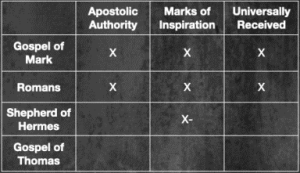
As one considers the three canonical attributes, it becomes clear that the early church filtered books through a sort of canonical grid to help them recognize authoritative texts. Only books possessing all three attributes achieved canonical status. Consider the following chart. Notice how both Mark and Romans possess all three attributes while the Gospel of Thomas possesses none. Also notice that the Shepherd of Hermes partially possesses one of the attributes insofar that it is an orthodox text. That said, it lacks the other two attributes:
Recommended resources related to the topic:

Cold-Case Christianity: A Homicide Detective Investigates the Claims of the Gospels by J. Warner Wallace (Book)

Why We Know the New Testament Writers Told the Truth by Frank Turek (mp4 Download)

The Top Ten Reasons We Know the NT Writers Told the Truth mp3 by Frank Turek

Counter Culture Christian: Is the Bible True? by Frank Turek (Mp3), (Mp4), and (DVD)

______________________________________________________________________________________________________________________________________________

Ryan Leasure holds a Master of Arts from Furman University and a Masters of Divinity from the Southern Baptist Theological Seminary. Currently, he’s a Doctor of Ministry candidate at the Southern Baptist Theological Seminary. He also serves as a pastor at Grace Bible Church in Moore, SC.

Original Blog Source: https://cutt.ly/1Ouq929
 

By Ryan Leasure

This is part three of a nine-part series on how we got our Bible. Part one addressed the inspiration and inerrancy of Scripture. Part two explained the formation and preservation of the Old Testament text. This post will address issues surrounding the Old Testament canon and the Apocrypha.

Canon

Before going any further, we must first establish what we mean when we say “canon.” We are not, of course, referring to the weapons of bygone eras. Rather, canon refers to an ancient measuring stick cut from a reed-like plant which was used as an infallible standard—much like a yardstick. The term was later applied to the biblical texts that the church received in its collection of authoritative books.

The Tanakh

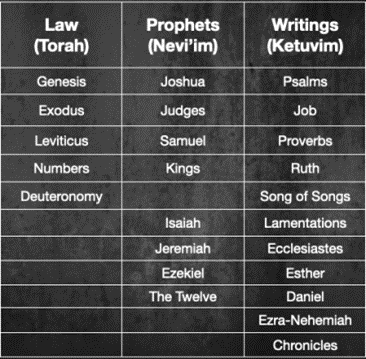
The Jewish order of the Old Testament was and is radically different from how we typically order our books. From an early time, it appears that the Jews had a threefold division of the Hebrew canon. This threefold division is often referred to as the Tanakh based on the three divisions—Torah (Law), Nevi’im (Prophets), and Ketuvim (Writings). This final division could sometimes be called “the Psalms” since Psalms was the first and largest book among the writings and was often representative of the whole. Also, note that Jews combined several books. So while their canon contains the same content as our protestant Bibles, their Bible only has twenty-four books instead of thirty-nine. Consider the breakdown below from Genesis to Chronicles:

Bible table

The Septuagint (250-150 BC)

After Alexander the Great Hellenized the known world, Jewish scholars realized they needed to translate the Hebrew scriptures into Greek so that more people could read them. Legend has it that seventy-two Jewish translators (six from each of the twelve tribes), over the course of seventy-two days, each translated the text from Hebrew to Greek independently, and all seventy-two translations came out the exact same. The translation, therefore, came to be known as the Septuagint (from the Latin septuaginta meaning “seventy”) and is often represented by the Roman numerals LXX.

A couple of points are worth noting about the Septuagint. First, this translation changed the order of the books to the order that we are more familiar with today. That is to say, it changed from the threefold division of the Tenakh to our current order of law, history, poetry, major prophets, and minor prophets. Furthermore, the Septuagint also included the Apocrypha.

The Apocrypha

The Apocrypha consists of a dozen or so Jewish books written during the intertestamental period. These books contain history, poetry, wisdom literature, and prophecy. Probably most famous among the Apocrypha are the first and Second Maccabees. These books detail the Jewish rebellions and reclamation of the temple from the Syrians. While these works contain much historical value, they also contain disputable material. This is especially true of second Maccabees which teaches that saints in heaven intercede for people on earth (15:11-16) and that prayers and sacrifices can be offered for the dead (12:39-46). Roman Catholics us this last text to justify belief in purgatory and the practice of indulgences.

Tobit, another Apocryphal book, contains a fanciful story about a devout Jewish man in exile who is blinded by bird droppings in his sleep. His wife Sarah, also had troubles of her own. A demon had killed seven of her previous husbands on her wedding night. So God sent the angel Raphael to help Tobit and Sarah conquer the demon. Ultimately, they use a fish heart and liver to drive out the demon from the wedding chamber. Finally, Tobit’s son rubs fish gall on Tobit’s eyes to heal his blindness. This story is entirely fanciful.

Another book, known as Judith, describes God’s deliverance of the Jewish people. In this story, Judith seduces an Assyrian king only to cut off his head during his drunken stupor. We have no evidence that this story ever occurred. Moreover, this book erroneously states that Nebuchadnezzar was king of Assyria, not Babylon.

Other Apocryphal books include Sirach (wisdom literature similar to Proverbs), Baruch (not written by Baruch), Wisdom of Solomon (not written by Solomon), and additions to Daniel (Susanna and Bel and the Dragon).

Why The Bible should not Include the Apocrypha

You are probably familiar with the Protestant/Catholic/Orthodox debates over whether the Apocrypha belongs in our modern Bibles. In the remaining space, I’d like to offer five reasons why I don’t believe the Bible should include the Apocrypha.

1. The Apocrypha Acknowledges that Prophets Weren’t Speaking during its Time

Consider the following texts from 1 Maccabees:

So there was great distress in Israel, the worst since the time when the prophets ceased to appear among them (1 Macc. 9:27).

The Jews and their priests have resolved that Simon should be their leader and high priest forever, until a trustworthy prophet should arise (1 Macc. 14:41).

And laid up the stones in the mountain of the temple in a convenient place, until there should come a prophet to show what should be done with them (1 Macc. 4:46).

Notice how all three of these verses indicate God was not speaking through prophets during their time.

2. Jews Never Accepted the Apocrypha as Scripture

Consider the following quotation from first-century Jewish historian Josephus:

From the death of Moses to the time of Artaxerxes, who was king of Persia after Xerxes, the prophets who followed Moses have written down in thirteen books the things that were done in their days. The remaining four books contain hymns to God and principles of life for human beings. From Artaxerxes to our own time a detailed record has been made, but this has not been thought worthy of equal credit with the earlier records because there has not been since then the exact succession of prophets.1

Josephus indicates that after the time of Artaxerxes (465-424 BC), Jews continued to write books (the Apocrypha), but these books were not on par with Scripture, because the prophets had stopped speaking.

Moreover, the Babylonian Talmud, which is a sacred collection of Rabbinical traditions, notes that “after the latter prophets Haggai, Zechariah, and Malachi had died, the Holy Spirit departed from Israel” (Yoma 98). In other words, special revelation ceased after the time of these prophets. Therefore, we should not consider the Apocrypha as Scripture since it followed after these prophets.

Finally, around the year AD 90, a council of Jewish leaders gathered at Jamnia to figure out how to reconstruct Judaism after the fall of Jerusalem and the temple. As they discussed their sacred books, they merely reaffirmed the universal practice of all Jews that the Apocrypha did not belong in their Bible.

3. The New Testament Never Refers to the Apocrypha as Scripture

The New Testament authors quote from the Old Testament hundreds of times. Often they preface their quotes with phrases such as “it is written” or “Scripture says.” Consider the following examples:

As it is written: None is righteous, no, not one (Rom 3:10).

Scripture says, They will look on him whom they have pierced (John 19:37).”

Therefore, as the Holy Spirit says, Today, if you hear his voice, do not harden your hearts as in the rebellion (Heb 3:7-8).

Never once do the New Testament authors do something similar with an Apocryphal text. This omission is telling considering the fact that the New Testament authors usually quoted from the Septuagint which contained the Apocrypha. Meaning, the New Testament authors were well aware of the Apocryphal texts. They simply never refer to them as Scripture.

4. Jesus Affirmed the Three-Fold Division of the Tanakh

Two quotations from Luke indicate that Jesus believed in a closed Old Testament Canon that did not include the Apocrypha. Consider Luke 24:44:

Then he said to them, ‘These are my words that I spoke to you while I was still with you, that everything written about me in the Law of Moses and the Prophets and the Psalms must be fulfilled.

In this text, Jesus makes a clear affirmation of the threefold division of the Old Testament—Apocrypha not included. Also consider Luke 11:51:

From the blood of Abel to the blood of Zechariah, who perished between the altar and the sanctuary. Yes, I tell you, it will be required of this generation.

By speaking of Abel (the first biblical martyr) and Zechariah (the last biblical martyr), Jesus indicates that the Old Testament canon concluded with Chronicles (traditional order of the Tanakh). It is worth noting that several martyrs died in the Maccabees. Jesus doesn’t mention them because he didn’t consider Maccabees as part of his Bible.

5. The Catholic Church didn’t Grant Authority to the Apocrypha until Later

The earliest Old Testament canonical list from a Christian comes from Melito of Sardis (AD 170). His canon leaves out the Apocrypha. Origen’s canonical list in the mid-third century also leaves out the Apocrypha. Additionally, Athanasius, Cyril of Jerusalem, Gregory of Nazianzus, and the Council of Laodicea leave the Apocrypha out of their canon.

Sometime in the fourth century though, the Apocrypha started to gain acceptance in some circles as demonstrated by some of the canonical lists (St. Augustine and the Council of Hippo) and biblical manuscripts (Codex Sinaiticus and Vaticanus). Of course, St. Augustine also persuaded his friend Jerome to include the Apocrypha in the Latin Vulgate in AD 404. That said, Jerome prefaced the Apocryphal writings by stating:

Therefore as the church indeed reads Judith, Tobit, and the books of Maccabees, but does not receive them among the canonical books, so let it also read these two volumes for the edification of the people but not for establishing the authority of ecclesiastical dogmas.2

Jerome made a clear delineation between Scriptural texts and the Apocrypha. Scripture established church doctrine. The Apocrypha was for mere edification alone.

For the next thousand years, the Catholic Church was hardly unified on the Apocrypha. William of Ockham, influential medieval theologian, echoed Jerome’s sentiments when he wrote that apocryphal texts “are read for the edification of the people, but not for the establishment of doctrine.3 Even Cardinal Cajetan, a chief opponent of the Protestant Reformers and appointee of Pope Leo remarked:

The Latin church is greatly indebted to Jerome on account of his separation of the canonical from the uncanonical books. . . . those books and any others there may be like them in the Canon of the Bible are not canonical in the sense of establishing point of faith; yet they can be called canonical for the edification of the faithful.4

Despite being far from unified, the Council of Trent official granted canonical status to the Apocryphal text in what can only be seen as a counter-Reformation move.

Moving On to the New

The next post will transition to the New Testament. Specifically, the post will address two key question. First, would the early church have expected more Scriptural books? And second, what clues tipped off the early church that certain books were authoritative Scripture while others were not?

Recommended resources related to the topic:

Cold-Case Christianity: A Homicide Detective Investigates the Claims of the Gospels by J. Warner Wallace (Book)

Why We Know the New Testament Writers Told the Truth by Frank Turek (mp4 Download)

The Top Ten Reasons We Know the NT Writers Told the Truth mp3 by Frank Turek

Counter Culture Christian: Is the Bible True? by Frank Turek (Mp3), (Mp4), and (DVD)

______________________________________________________________________________________________________________________________________________

Ryan Leasure holds a Master of Arts from Furman University and a Masters of Divinity from the Southern Baptist Theological Seminary. Currently, he’s a Doctor of Ministry candidate at the Southern Baptist Theological Seminary. He also serves as a pastor at Grace Bible Church in Moore, SC.

Original Blog Source: https://cutt.ly/NY40j0n


By Ryan Leasure

This article is the first in a series of nine blog posts that will unpack the story of how we got our Bible. That is to say, the Bible didn’t just fall from heaven into our laps. Rather, the Bible is the result of a long process that starts from the mind of God and ends with to our modern English translations.

The process involves inspiration of texts, collecting certain booksrejecting other books, copying of manuscripts, evaluating thousands of manuscripts to recreate the originals as much as possibletranslating the Hebrew and Greek texts into English, and then creating translations that are readable in our modern vernacular.

As you may have guessed, this series will deal with some of the more crucial issues surrounding the Bible—issues such as canon, the apocryphathe Dead Sea Scrolls, pseudopigraphical Gospels, textual criticism, the King James only movement, and so much more. I hope you will follow along with me as we trace the fascinating history of the Bible. If you’re not already a subscriber, click subscribe so you can get updates on future posts.

That said, we begin with Inspiration.

Verbal-Plenary Inspiration

Paul writes, “All Scripture is breathed out by God and profitable for teaching, for reproof, for correction, and for training in righteousness, that the man of God may be complete, equipped for every good work” (2 Tim 3:16-17). A few concepts are worth noting here.

First, Paul says that Scripture is “breathed out by God” (from the Greek word “theopneustos“). Technically, God “exhales” rather than “inspires” the text. In other words, he is the source behind all Scripture.

Second, notice that God inspires Scripture, not the authors themselves. This necessary distinction means that God’s inspiration extends to the final product of Scripture itself, not the human author’s day-to-day life. Meaning, the authors were fallible while their God-breathed Scripture was not.

Third, Paul notes that ALL Scripture is inspired, not just parts of it. Some have erroneously taught that inspiration only extends to the parts that touch of faith and morals. But that is not what Paul writes. When Paul says “all,” he includes the Canaanite conquests, a talking donkey, and the Levitical Code.

Biblical Authors Affirmed Inspiration

Several times throughout the Old Testament, authors acknowledged that they were writing God’s words. Consider these examples:

“Then the LORD said to Moses, “Write this as a memorial in a book and recite it in the ears of Joshua”(Exod 17:14).

“Then the LORD put out his hand and touched my mouth. And the LORD said to me, “Behold I have put my words in your mouth” (Jer 1:9).

“The word of the LORD that came to Hosea, the son of Beeri, in the days of Uzziah” (Hos 1:1).

“On the fifth day of the month . . . the word of the LORD came to Ezekiel the priest, the son of Buzi . . . and the hand of the LORD was upon him there” (Ezek 1:2-3).

Furthermore, New Testament authors affirmed the Old Testament’s inspiration:

“And this took place to fulfill what the Lord had spoken by the prophet . . .” (Matt 1:22).

“Brothers, the Scripture had to be fulfilled, which the Holy Spirit spoke beforehand by the mouth of David concerning Judas” (Acts 1:16).

“But what God foretold by the mouth of all the prophets, that his Christ would suffer, he thus fulfilled.” (Acts 3:18).

“David himself, in the Holy Spirit, declared, The Lord said to my Lord, Sit at my right hand, until I put your enemies under your feet” (Mark 12:36).

This last quotation is from Jesus’ lips himself. That is to say, Jesus affirmed the Old Testament’s inspiration.

What About the New Testament?

When Paul writes that “All Scripture is breathed out by God,” he was most likely referring to the Old Testament since the word for Scripture (“graphe“) refers to the Old Testament when it’s used in the New Testament. We must also remember that when Paul wrote this letter, portions of the New Testament had yet to be written. Was inspiration, then, limited to the Old Testament? No it wasn’t.

Notice how Peter speaks of Paul’s letters in 2 Peter 3:15-16: “Just as our beloved brother Paul also wrote to you according to the wisdom given him, as he does in all his letters when he speaks in them of these matters. There are some things in them that are hard to understand, which the ignorant and unstable twist to their own destruction, as they do the other Scriptures.” Peter appears to be lumping in Paul’s letters with the Old Testament and granting them equal authority.

First Timothy 5:18 is another crucial text on this matter. Paul writes, “For the Scripture says, ‘You shall not muzzle an ox when it treads out the grain,’ and, ‘The laborer deserves his wages.’” Paul quotes two passages in this verse and refers to both of them as Scripture. The first text comes from Deuteronomy 25:4. The second comes from Luke 10:7. That is to say, Paul thought the Gospel of Luke was Scripture on par with the Old Testament.

We even have some clues that suggest the apostles knew they were writing God’s Word. Paul writes in 1 Corinthians 14:37, “If anyone thinks that he is a prophet, or spiritual, he should acknowledge that the things I am writing to you are a command of the Lord.” Additionally, Paul declares in 1 Thessalonians 2:13, “And we also thank God constantly for this, that when you received the word of God, which you heard from us, you accepted it not as the word of men but as what it really is, the word of God.”

Peter also remarks, “You should remember the predictions of the holy prophets and the commandment of the Lord and Savior through your apostles” (2 Peter 3:2). The apostles, then, believed that they spoke authoritatively from God. And they could do this because Jesus promised them that the Holy Spirit would guide them in the process (John 14:26; 16:13).

Mechanical Dictation?

Peter notes, “Knowing this first of all, that no prophecy of Scripture comes from someone’s own interpretation. For no prophecy was ever produced by the will of man, but men spoke from God as they were carried along by the Holy Spirit” (2 Pet 1:20-21). Some suggest that the Holy Spirit’s activity sounds an awful lot like mechanical dictation. But this would be a mistake. As I alluded to earlier, inspiration extends only to the final product of Scripture. Meaning, God worked within and through the human authors’ skills, personalities, and experiences as they wrote their various works. In short, the dozens of biblical authors produced their Scripture in different ways.

The author of Hebrews makes this point when he begins, “Long ago, at many times and in many ways, God spoke to our fathers by the prophets” (Heb 1:1). Notice how he affirms that the prophets spoke “in many ways.” And Scripture makes these different ways abundantly clear. Consider a few examples:

  • Investigation/Interpretation: “Concerning this salvation, the prophets who prophesied about the grace that was to be yours searched and inquired carefully, inquiring what person or time the Spirit of Christ in them was indicating when he predicted the sufferings of Christ and the subsequent glories” (1 Pet 1:10-11).
  • Dictation: “To the angel of the church in Ephesus write . . .” (Rev 2:1)
  • Research: “Inasmuch as many have undertaken to compile a narrative of the things that have been accomplished among us, just as those who from the beginning were eyewitnesses and ministers of the word have delivered them to us, it seemed good to me also, having followed all things closely for some time past, to write an orderly account for you, most excellent Theophilus” (Luke 1:1-3).

Additionally, biblical authors wrote poetry, wisdom literature, letters, and prophecy. And in doing so, God worked through them in such a way as to not override their unique perspective. At the same time, he superintended the process to guarantee that his exact message was communicated. As the Chicago Statement on Biblical Inerrancy remarks, “We affirm that God in His Work of inspiration utilized the distinctive personalities and literary styles of the writers whom He had chosen and prepared. We deny that God, in causing these writers to use the very words that He chose, overrode their personalities.”1

Evidence of Inspiration

Some argue that inspiration appeals to circular reasoning because we must appeal to Scripture itself to affirm inspiration. While that’s a fair critique, Christians are right to appeal to Scripture because it is our highest authority. If we appeal to, say human reasoning, then we elevate human reasoning to a higher authority than Scripture.

That said, we have good evidence for inspiration in fulfilled prophecy. I could list dozens of fulfilled prophecies, but I will only mention two briefly. First, Isaiah 53 correctly predicts Christ’s crucifixion. Of note is the fact that Isaiah says that he will “pierced for our transgression” (Isa 53:5). This method of death is significant because at the time, Jewish methods of execution were stoning or hanging. How could Isaiah rightly predict the kind of death Jesus would suffer seven hundred years in advance?

Another example is Daniel 9. While I won’t go into detail, Daniel predicts the exact timing of Christ’s arrival. More than that, Daniel says that the Messiah will be “cut off” (killed) just prior to the destruction of Jerusalem and the temple. Jesus was crucified in AD 30. The Romans destroyed Jerusalem and the temple in AD 70.

Inerrancy

Inerrancy naturally follows from inspiration. In other words, if God is the author behind the entire Bible, it must all be true because God always speaks truth. Consider the following texts

“It is impossible for God to lie” (Heb 6:18).

“You are God, and your words are true” (2 Sam 7:28).

“Every word of God proves true” (Prov 30:5).

“Sanctify them in the truth; your word is truth” (John 17:17).

Notice that Jesus doesn’t just say that God’s word is true, but it is TRUTH. It is the absolute standard of truth. And lest anyone thinks this idea of inerrancy is a modern invention, listen to a few of the church fathers:

“You have searched the Scriptures, which are true and given by the Holy Spirit. You know that nothing unrighteous or counterfeit is written in them.” — Clement of Rome, 1st century

“The statements of Holy Scripture will never contradict the truth.” — Tertullian, 3rd century

“It is the opinion of some that the Scriptures do not agree or that the God who gave them is false. But there is no disagreement at all. Far from it! The Father, who is truth, cannot lie.” — Athanasius, 4th century

In short, while Scripture does not give us exhaustive knowledge of all things (how to change a tire for example), it does not affirm anything that is contrary to fact.

The Next Post

The next post will consider how the Old Testament came to be. Specifically, it will address the unfolding nature of the Old Testament, its authors and editors, as well as its preservation.

Recommended resources related to the topic:

Why We Know the New Testament Writers Told the Truth by Frank Turek (DVD, Mp3 and Mp4)

Oh, Why Didn’t I Say That? Is the Bible Historically Reliable? by Dr. Frank Turek DVD, Mp4, Mp3 Download.

Cold-Case Christianity: A Homicide Detective Investigates the Claims of the Gospels by J. Warner Wallace (Book)

__________________________________________________________________________________________________________________________________________________

Ryan Leasure holds a Master of Arts from Furman University and a Masters of Divinity from the Southern Baptist Theological Seminary. Currently, he’s a Doctor of Ministry candidate at the Southern Baptist Theological Seminary. He also serves as a pastor at Grace Bible Church in Moore, SC.

Original Blog Source:  https://bit.ly/3BXULYy