Tag Archive for: Evidence

By Ryan Leasure

Bart Ehrman is the most popular skeptic in America today. Writing at super-sonic rates, his books seem to find their way on the New York Times Bestseller list about every other year. Because of his rapid output and wide popularity, his views are spreading like gangrene across the American landscape (and beyond).

Additionally, Ehrman is a professor of religion at UNC-Chapel Hill where he works to cripple the faith of every young Christian who enters his classroom. He shares one of his faith-crippling tactics in his book How Jesus Became God.

Ehrman tells the story of beginning his class by sharing this description of a famous man from the ancient world.

“Before he was born, his mother had a visitor from heaven who told her that her son would not be a mere mortal but in fact would be divine. His birth was accompanied by unusual divine signs in heaven. As an adult, he left his home to engage on an itinerant preaching ministry. He gathered a number of followers around him who became convinced that he was no ordinary human, but that he was the Son of God.

And he did miracles to confirm them in their beliefs: he could heal the sick, cast out demons, and raise the dead. At the end of his life, he aroused opposition among the ruling authorities of Rome and was put on trial. But they could not kill his soul. He ascended to heaven and continues to live there till this day.

To prove that he lived on after leaving his earthly orb, he appeared again to at least one of his doubting followers, who became convinced that in fact, he remains with us even now. Later, some of his followers wrote books about him, and we can still read about him today.1

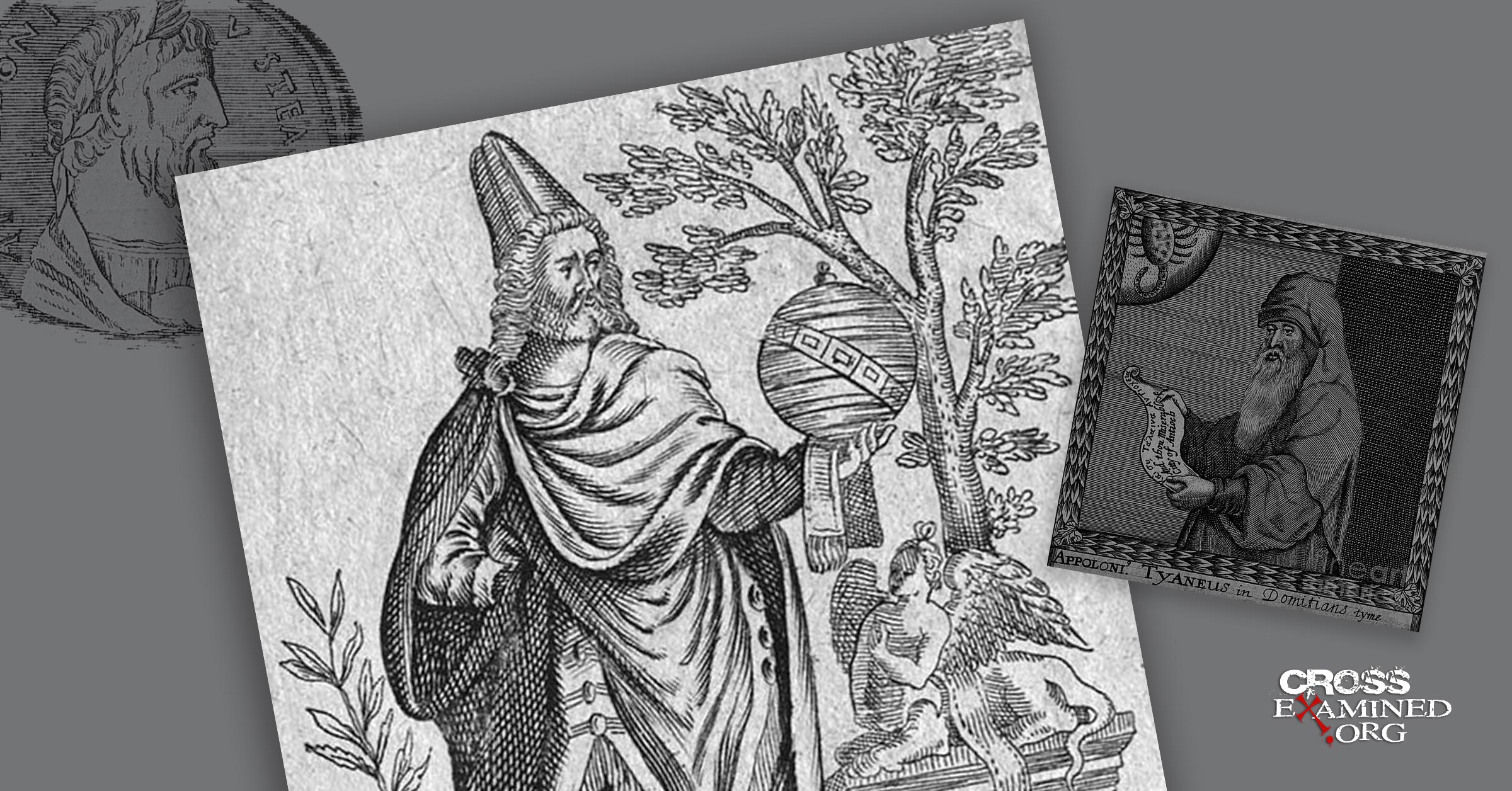
Ehrman, of course, wants everyone in his class to thinks he’s talking about Jesus. But alas, he reveals the shocking news that he wasn’t talking about Jesus at all. Instead, he’s referring to Apollonius of Tyana.

This revelation is intended to rattle whatever remaining faith his Christian students might have. For if he can demonstrate that Jesus’ story isn’t any different from Apollonius of Tyana, well then Jesus must not be the unique Son of God after all.

Apollonius of Tyana — The Skeptics’ Best Parallel

As demonstrated in the story above, skeptics think that if they can show parallels of Jesus from the ancient world, they can prove that Jesus was just one more in a long line of myth stories.

And Ehrman isn’t the only skeptic using this tactic. In fact, if you listen to debates on the historical Jesus, Apollonius of Tyana is mentioned far more than any other ancient “parallel.” In other words, Apollonius is the best parallel the skeptic has to offer.

So, should Christians be worried? Does Christianity crumble in light of Apollonius of Tyana? Was Apollonius even remotely similar to Jesus? No, no, and no. Allow me to elaborate.

The Problem of Dating

Apollonius supposedly lived between AD 15-96. That is, his life comes shortly after the life of Jesus. Yet the only source we have for his life comes from Philostratus in the third century (AD 225). In other words, there is virtual silence about this man for about 150 years prior to Philostratus’ work.

If Apolonnius had been a Jesus-like figure, how come nothing is said about him for such a long period of time?

Sources for Jesus, on the other hand, all date within the first century when eye-witnesses to his ministry would have still been around. The Gospels come about 30-50 years after his life, and Paul writes his letters even earlier (20-30 years after Jesus). Moreover, Paul quotes or references traditional material that predates his work by decades. All that to say, Jesus’ fame understandably spread shortly after his death and resurrection.

Yet we have crickets with respect to Apollonius. This is hard to believe if he truly was the Son of God who performed miracles and rose again from the dead.

The Problem of Motive

What did Jesus’ followers have to gain for spreading the message of Christianity? Ostracism at best, and death at worst. In other words, they had no motive (money, sex, or power) to make up these stories in a hostile environment. In the end, most of them faced severe persecution for their faith.

What about Philostratus? Well, it just so happens that he was paid by the empress Julia Domna to write a laudatory account of Apollonius’ life in order to improve Apollonius’ reputation amongst the Romans and diminish Jesus’ importance.

Living during a time when Christianity was spreading rapidly across the Roman Empire, the pagan empress needed to do something to restore cultic worship amongst the citizens. Funding this project seems to be her attempt to minimize Jesus’ fame.

Philostratus Was Skeptical of Apollonius’ Miracles

Philostratus, though, couched miracle claims with phrases such as “it is reported that” or “some believe.” Case in point. Reporting on Apollonius of Tyana’s most famous miracle (raising a dead girl to life), Philostratus reports that the girl probably wasn’t dead at all, and even states that only some believed she was. He indicates that this girl had some kind of mist coming out of her mouth prior to Apollonius “healing” her.

The Gospels are nothing like this. They make no qualms about Jesus’ miraculous activity. Furthermore, non-Christian sources also indicate that Jesus was a miracle-worker.

The Problem of Historical Errors

The Gospels provide all kinds of evidence for their historical reliability. Non-Christian corroborating sources, eye-witness testimony, an understanding of local customs, and embarrassing material all suggest that these sources are trustworthy.

Since not many people will take the time to read through Philostratus’ five hundred page work on Apollonius, they will miss out on the fact that Philostratus made all sorts of historical errors — mostly anachronisms.

The blunders are so bad that historian H. C. Kee reports, “what Philostratus reports tells us a great deal about the author and his time — that is, at the turn of the third century — but provides no unassailable evidence about Apollonius and his epoch.”2

While Philostratus attempts to give us a biography, many scholars acknowledge that his work reads more like a romance novel. As Boyd and Eddy remark, “while few have gone so far as to reject a historical Apollonius altogether, most scholars are rather skeptical about the historicity of major aspects of the image offered by this one source written well over a century after the figure it depicts.”3

The Alleged Resurrection

Jesus’ resurrection is the single-most-important fact about Christianity. If he didn’t rise, Paul says, we’re still in our sins. Fortunately, Jesus did die and rise again as the Gospels report, and there’s ample evidence to back this up this claim.

But what about Apollonius of Tyana? Did he rise again as Ehrman suggests? Simply put, no he did not. The only hint in Philostratus’ work that gets remotely close to a resurrection is when one doubting disciple has a dream about the spirit of Apollonius after his death.

A Parallel? Really?

Scholars have systematically debunked every line from the Erhman quote above. At best, he’s misleading. At worst, he’s downright deceitful.

No heavenly messenger announced Apollonius’ birth and said he would be divine. That messenger actually came from Egypt and never said Apollonius would be divine. He wasn’t so much an itinerant preacher as he was a visitor of foreign sages. Furthermore, he took a vow of silence for several years as he began his journey. His miracles were dubious, and he wasn’t killed by Roman authorities. Nor did he rise from the dead and appear to his followers. And none of his followers wrote books about him either.

Be that as it may, what if Philostratus had reported exact parallels? What would that prove? For starters, Jesus predates Apollonius. So any parallel would be evidence against Apollonius of Tyana and not Jesus.

Additionally, even if these so-called parallels did exist, it wouldn’t do anything to diminish the historical Jesus.

Taking this line of thought, you could prove I’m a myth because of the parallels between my life and Bart Ehrman’s. Both of us went to Bible college and later seminary. We both write about the historical Jesus and teach others about the Bible. Both of us live in the Carolinas. We’re both white males. And on and on.

The point is you can find parallels anywhere. Many have shown parallels between Abraham Lincoln and John F. Kennedy. Does that mean Kennedy was a legend? Absolutely not.

In the end, it’s not the parallels that matter, but the differences. So while the story of Apollonius of Tyana is interesting, it does nothing to disprove the historicity of Jesus Christ.

Recommended resources related to the topic:

Early Evidence for the Resurrection by Dr. Gary Habermas (DVD), (Mp3) and (Mp4)

Cold Case Resurrection Set by J. Warner Wallace (books)

Did Jesus Rise from the Dead? By Dr. Gary Habermas (book)

Jesus, You and the Essentials of Christianity – Episode 14 Video DOWNLOAD by Frank Turek (DVD)

The New Testament: Too Embarrassing to Be False by Frank Turek (MP3) and (DVD)

Cold-Case Christianity: A Homicide Detective Investigates the Claims of the Gospels by J. Warner Wallace (Book)

The Top Ten Reasons We Know the NT Writers Told the Truth mp3 by Frank Turek


Ryan Leasure holds a Master of Arts from Furman University and a Masters of Divinity from the Southern Baptist Theological Seminary. He currently serves as a pastor at Grace Bible Church in Moore, SC.

Original Blog Source: http://bit.ly/33XD6Pq
By Mikel Del Rosario

Jesus: The Essential Works

What are the essential truths Christians believing about the things Jesus did? As defenders of the faith, we need to know which beliefs about Jesus’ deeds are essential and why we should believe them.

I had a conversation with my mentor Darrell Bock about this on an episode of the Table Podcast focusing on the works of Jesus mentioned in the Nicene Creed—a collaborative statement of essential Christian beliefs crafted in 325 AD. This creed was based on the Apostle’s Creed and various Scriptures. Early creeds are a good reminder that the essentials of the Christian faith were not just made up recently but actually go back to the earliest memories of Jesus and the teachings of his official spokespeople.

Let me share a couple of things we mentioned while talking about a line that that mentions Jesus’ historic death and burial:

“For our sake, he was crucified under Pontius Pilate; he suffered death and was buried.”

The Nicene Creed makes historical claims about Jesus but also includes theological interpretations of the facts. In this post, I’ll define what Christians mean when we say Jesus died “for us.” Then, I’ll touch on the historical evidence for Jesus’ crucifixion and burial. At the end of this post, you can check out the complete podcast to hear our full conversation on the works of Jesus described in the Nicene Creed. So what’s it means to say Jesus “was crucified for us?”

The Nicene Creed says Jesus was crucified for us

First, the Nicene Creed highlights a kind of substitution where Jesus bears the penalty for human sin. As Anselm of Canterbury explained, Jesus paid an infinite debt no mere human being could pay.

Second, understanding the Jewish context of the earliest Christian thought brings a couple of pictures to mind: The suffering servant of Isaiah 53 who “bears our reproach” and the way Jews understood an animal suffering in the place of a sinner. In some cases, Jews put their hands on the sacrifice to symbolize a transfer of responsibility in the sacrificial system. When you wonder about the significance of something Jesus said or did, remember that themes from the Hebrew Scriptures are often the background, and it pays to see Jesus in his cultural context.

So that’s a theological interpretation of Jesus’ death. But what about the event itself? The Nicene Creed mentions Jesus’ suffering on the cross. What’s the historical evidence for Jesus’ death on the cross?

The Nicene Creed says Jesus died on the cross

Jesus’ death by crucifixion is well-attested: It’s mentioned not only in the Gospels but in a snippet of something the Jewish historian Josephus wrote in his Antiquities, which verifies Jesus’ death under Pontius Pilate. The Roman historian Tacitus alludes to Jesus’ crucifixion as well in The Annals. As even a rather skeptical scholar like John Dominic Crossan recognizes, “That [Jesus] was crucified is as sure as anything historical can ever be.” [1]

“That [Jesus] was crucified is as sure as anything historical can ever be.”

But what happened to Jesus’ body? The Nicene Creed says Jesus was buried, just like we read about in Mark 15 and Luke 23. But what about this?

The Nicene Creed says Jesus was buried in a tomb

Some skeptics ask, “Weren’t crucifixion victims thrown into shallow graves? How do we know Jesus was put in a tomb?” First, we have reports of Jesus’ burial from the time when people who knew about it were still alive. Second, ancient Jewish sources never say Jesus’ body was thrown to the dogs in a shallow grave. There are good reasons to believe Jesus was really buried in a location that was known and that he was buried in a way that by sensitive to Jewish culture.

For example, convicted felons weren’t buried in family tombs. That’s why Jesus wasn’t buried in a family tomb. He was buried in the tomb of a fellow Jew: Joseph of Arimathea. So Jesus’ burial honored what Jewish tradition says about the way a Jewish crucifixion victim should be buried.

So Christian belief operates on two levels: The historical and the theological. As Christians, we believe historical things about Jesus—events you can actually look into like other events in ancient history. But Christians also believe theological things about Jesus—the stuff that makes historical things really matter in our lives.

Like many Christians, I affirm my belief in both the historical and theological truths of the Nicene Creed as I recite it along with my brothers and sisters in the church.

The Works of Jesus in the Nicene Creed

For us and for our salvation he came down from heaven,

was incarnate from the Holy Spirit and the Virgin Mary

and was made man.

For our sake he was crucified under Pontius Pilate;

he suffered death and was buried.

On the third day, he rose again

in accordance with the Scriptures;

he ascended into heaven

and is seated at the right hand of the Father.

He will come again in glory to judge the living and the dead,

and his kingdom will have no end.

Watch the Table Podcast

We cover a lot more about the works of Jesus in the Nicene Creed during our conversation. What are the essential Christian beliefs? Why should we believe this stuff? Check out the complete podcast:

Recommended resources related to the topic:

Jesus, You and the Essentials of Christianity – Episode 14 Video DOWNLOAD by Frank Turek (DVD)

Early Evidence for the Resurrection by Dr. Gary Habermas (DVD), (Mp3) and (Mp4)

Cold Case Resurrection Set by J. Warner Wallace (books)

Did Jesus Rise from the Dead? By Dr. Gary Habermas (book)


Mikel Del Rosario helps Christians explain their faith with courage and compassion. He is a doctoral student in the New Testament department at Dallas Theological Seminary. Mikel teaches Christian Apologetics and World Religion at William Jessup University. He is the author of Accessible Apologetics and has published over 20 journal articles on apologetics and cultural engagement with his mentor, Dr. Darrell Bock. Mikel holds an M.A. in Christian Apologetics with highest honors from Biola University and a Master of Theology (Th.M) from Dallas Theological Seminary, where he serves as Cultural Engagement Manager at the Hendricks Center and a host of the Table Podcast. Visit his Web site at ApologeticsGuy.com.

Original Blog Source: http://bit.ly/2WNb3zN

By Luke Nix

Introduction

Time for Truth: Living Free In A World of Lies, Hype, and Spin” by Os Guinness has been on my reading list for several years now. It is a relatively short book, so I popped it in my bag to read during downtime on a trip to see family. By the time I had made it through the first chapter, I wished that I had made time to read it sooner!

In today’s cultural and political climate that seems to twist and spin reality to fit certain narratives, it is vital that people be able to distinguish between truth from falsehood. The history of the East demonstrates the implications of denying truth as an accurate reflection of reality. In “Time for Truth,” sociologist Os Guinness takes the reader through the philosophies and events that led to the fall of the East and compares them to current philosophies and events in the West. He warns that if the West continues on its current trajectory, it is headed for a similar collapse.

As usual, this review will take the form of a chapter-by-chapter summary and conclude with my thoughts and recommendation.

Book Introduction: But Not Through Me

Guinness opens his book by recalling the revolutionary event of the fall of communism in eastern Europe and Russia in the late 1980s and early 1990s. The significance of this at the time was that under communist rule, propaganda was taught instead of truth so much so that the populace believed what was false to be true. But it was only when some members of the populace pointed out that what was being taught by their government were lies told in order to maintain power and control. The taste of and for truth grew and grew until finally, the purveyors of false narratives were overthrown, and the truth set these nations free from the lies and tyranny.
Ironically, at the same time, this revolution of truth took place in the East, the West was busy relativizing truth the way the communists already did in the East. Guinness sets up the rest of his book by pointing out that such a postmodern view of truth violates reality and morality (why it was overthrown in the East), and the West is on the road to accepting the same view of truth. However, if the West does not recognize the mistakes of the past (in the East), then it will suffer a similar fate. But it is not enough to merely make observations about the past; the people of the West must take action now and become “people of truth” to prevent a repeat of history.

Chapter 1: Back to The Moral Stone Age

In order to show that the West is, in fact, on this same path, Guinness takes a look at the change in students’ reactions to the morally repugnant practice described in the story “The Lottery.” The 70s, 80s, and 90s saw a dramatic shift in the schools regarding moral judgments. The 70s and 80s saw students gradually shift their focus from outrage over the most heinous human behaviors (human sacrifice, in the case of “The Lottery”) to focusing on the more trivial aspects of the same tale. Fewer moral judgment were made, and more stylistic critiques became the main focus. In the 90s, this shift seemed almost complete, to where students were allergic to giving moral judgments about another’s cultural practices, no matter how heinous the action.

Guinness observes too that ethical training in today’s higher academy has also shifted from making any moral judgments to merely providing information about cultures and how to avoid punishments if one does not agree and wishes to participate in prohibited practices. On this new view, no one is truly deviating from any objective standard; they just act differently from others. Guinness ties this to the writings of Friedrich Nietzsche. These writings take the idea that “God is dead” and vehemently attacked the very concepts of knowledge and morality- stating that nothing can be known or trusted, and nothing is as it seems. Nietzsche supports a radical skepticism and distrust about everything and everyone, and thus, a meaningless and purposeless existence is all that any individual has.

Chapter 2: We’re All Spinmeisters Now

With Nietzsche’s idea that with God’s death comes the death of all knowledge and truth about anything, people are free to tell whatever stories they wish that will accomplish their personal goals (or a “greater truth”)- whether the stories are true or not. As multiple people tell their own contradicting stories and these lies are discovered, others’ trust in these people and those who support them dwindles. This causes a vicious cycle of skepticism that self-perpetuates. The singular truth stands alone in a multitude of lies promoted by their own multitude of untrustworthy sources. In this sea of “spin,” the truth ultimately becomes unidentifiable by the individual and even outside their grasp. The individual has nothing solid to grab onto to ground themselves in reality, so they are forced to make up stories of their own and live their own lie of a life.

Guinness illustrates this in practice with the very public figures of Mark Twain and Rigoberta Menchu. The stories that were told by both (Samuel Clemens, in the case of “Mark Twain”) were false, but they each acted as if they were true, and the culture responded accordingly. Clemens’ false story had more pop-cultural effects, while Menchu’s lies had political and educational ramifications. Even after the lies were discovered, both held firm saying that these were “their truths.” Guinness makes the point that when knowledge is not attainable, lies can perpetuate like this easily in a culture, and the culture is eager to accept them even if the stories are discovered to be false. On this postmodern view of truth, everyone is free to make up their own truth from moment to moment, all depending on their feelings at the moment or whatever they feel will accomplish their goal at that moment.

Chapter 3: The West Versus Itself

Quite often, this battle for the concept of truth has been seen as an “East vs. West” battle. Where the eastern philosophies held to relative and subjective views of truth and western philosophies held to the objective view of truth. Guinness observes that Geoge Washington and the other Founding Fathers saw their newly formed country as an experiment with “ordered liberty”- freedom exercised within the confines of objective truth. But postmodern views of truth have sneaked their way into western culture, not unlike a Trojan horse. This attack has been so successful since the formation of America that even the President of the United States in the 1990s saw and exercised the liberty to attempt to adjust truth to fit his own desires.
Guinness takes the time to demonstrate how seven unique characteristics of a postmodern mind were exhibited in President Bill Clinton during his sex scandal. Because of Clinton’s public face and the respect of Americans for the office of the President of the United States, his postmodern actions shifted western thinking more permanently toward postmodern views of truth. This view of truth has become so ingrained in western thought now that the battle is now the older western though versus, the newer western thought. The west is engaged in a war against itself for itself.

Chapter 4: Differences Make A Difference

Unfortunately, many people do not see why it makes a difference in what view of truth one holds. Guinness explains that the way one views truth can have great implications. He takes the atheist survivor of Auschwitz, Primo Levi, and the theist Russian revolutionary, Aleksandr Solzhenitsyn, to compare and contrast the views’ implications. Levi held that no God exists to ground truth. He tasked himself with ensuring that Auschwitz was never forgotten or repeated, but the weight of such a task, without any ultimate purpose or truth to ground his claims in, ultimately led to his suicide. On the other hand, Solzhenitsyn merely publically promoted his view of truth to release Russia from the shackles of the communist regime, that made a habit of presenting falsehood to its people as truth in order to subjugate them. Solzhenitsyn had an ultimate purpose and objective truth behind his actions that made them meaningful. Levi had no purpose and only relative truth behind his actions that made them meaningless.

These differences are not trivial; rather, they are impactful. Guinness offers that the West has become so hypnotized by the supposed “freedom” that having no objective truth brings, that it has not been able to experience true freedom. True freedom requires identity and limits. But if there is neither (what relative views of truth assert), then the individual must endlessly wrestle with their identity and what limits exist before they can even begin to experience true freedom. Because there is no objective truth about identity or limits, there is no end to their wrestling; thus they never will experience true freedom, and their pursuit becomes a prison. It is only when one recognizes that objective truth exists and the Foundation of Truth (God) that objective identity and objective limits can be discovered and freedom is even possible to experience.

Chapter 5: Turning The Tables

So far, Guinness has argued against relativistic views of truth by demonstrating the implications of such a view. But that is not always the most effective way to argue. It tends to be more effective if one argues on the skeptic’s own grounds. Guinness proposes two strategies for argumentation: one negative and one positive. The negative approach takes the relativist’s own relativism and follows it to its logical implications until it violates something of great value to the relativist. This usually doesn’t take long since the relativist values their own objectivity. While they desire that everyone else be a relativist, they do not apply such a requirement and fate to themselves. Seeing that their own views may be thought but not lived may be enough to jerk their thinking about truth back to reality.

Guinness argues that it is often not until a person is brought face-to-face with the dire implications and emptiness of their view of truth that they are willing to entertain an alternative. Ironically, when an individual or even a nation is at its philosophical and ethical breaking point, is when the opportunity to argue for the alternative is most effective. This opens the door to the positive approach. It also appeals to what the relativist values. With the inability for relativism to produce what the relativist values now in place, the positive approach shows how the objective view of truth genuinely provides what the relativist values. Guinness encourages the reader to consider that while it may seem that darkness has overtaken the individual relativist or a relativistic culture, that darkness may actually be an indicator that a new day is coming.

Chapter 6: On Record Against Ourselves

In Guinness’ final chapter, he encourages the reader to be a seeker of truth. As one is seeking objective truth, though, it is important to realize that there are subjective perspectives that do cause people to come to different conclusions about reality. While this is no excuse for seeing things inaccurately, it is an explanation for such and a beginning point to recognize in our own search for truth to guard against. One more thing can keep people from seeing reality as it is.
The biblical worldview holds that by nature, we are not just truth-seekers; we are truth-twisters. It is a sin in our lives that pushes us towards false narratives and rationalizations. Interestingly enough, it is the dual nature of man that explains both the successes and failures of modern and post-modern views of truth. Guinness explains that is it only the biblical worldview that can provide a foundation for not just the pursuit of truth but also how and why such a pursuit can go wrong. He encourages the reader to accept, because of its explanatory power, the biblical worldview of our sinfulness and our need for the Savior, Jesus Christ. Christ is the truth; thus it is in accepting Him that will allow us to truly be “people of truth,” and it is only as true “people of truth” that we can experience real freedom.

Reviewer’s Thoughts

“Time for Truth” was a fascinating read. I have to admit that I had picked up the book a couple of times in the past and (re)started before I was able to make it through this time. The introduction was a little slow, but once I passed that, it picked right up, and I was hooked! I really enjoyed how Guinness took the reader through several events in recent history that have led to the crisis of truth in American culture. I found myself stopping many times to reflect on events in my own lifetime that Guinness described and older events’ effects on what I experience today. The way that Guinness connects modern events with the crisis of truth that he speaks against is what will draw the reader in. This is not merely a theoretical treatise on truth; it is an analysis of events in our lifetimes and a warning of what will come if the West follows in the footsteps of the East regarding the ideas of truth.

Post-modernism has saturated our culture, and its effects are being played out before our eyes and in ways that are so subtle that we may not even recognize it. For anyone who is concerned about modern western culture’s treatment of truth, this book is highly recommended. For anyone who is fed up with the claims of “fake news,” this book is highly recommended. For anyone who is tired of seeing politicians change the truth for their own agendas, this book is highly recommended. For anyone who is concerned with history, this book is highly recommended. For anyone who is concerned with their children’s future, this book is highly recommended. Needless to say, this book is highly recommended for all serious readers and those who are fascinated by politics and modern culture. It will enhance your perspective on what is taking place today and give you not only an explanation for what is taking place but also provide a solution. Go get this book!

Recommended resources related to the topic:

Digging for the Truth: Archaeology, Apologetics & the Bible by Ted Wright DVD and Mp4

Is Morality Absolute or Relative? by Dr. Frank Turek DVD, Mp3 and Mp4

When Reason Isn’t the Reason for Unbelief by Dr. Frank Turek DVD and Mp4

Right From Wrong by Josh McDowell Mp3

Can All Religions Be True? mp3 by Frank Turek

Counter Culture Christian: Is There Truth in Religion? (DVD) by Frank Turek


Luke Nix holds a bachelor’s degree in Computer Science and works as a Desktop Support Manager for a local precious metal exchange company in Oklahoma.

Original Blog Source: http://bit.ly/36EJugg

By Terrell Clemmons

Douglas Ell became an atheist as a youth because of misinformation handed down to him in the name of science. It took him thirty years “to climb out of the atheist hole.” Sadly, Cosmos: A Spacetime Odyssey, the 2014 series brought to you by Neil deGrasse Tyson, Family Guy’s Seth MacFarlane, and a host of like-minded celebrity atheists, served up thirteen dazzling episodes containing similar misinformation. The series mixed, quoting Jay W. Richards, “one-part illuminating discussion of scientific discoveries, one part fanciful, highly speculative narrative, and one-part rigid ideology disguised as the assured results of scientific research.”

If you like science—science done well, that is—you’ll find invaluable help making sense out of Cosmos with The Unofficial Guide to Cosmos: Fact and Fiction in Neil deGrasse Tyson’s Landmark Science Series, an easily readable volume co-authored by Ell, Richards, David Klinghoffer, and Casey Luskin. The Unofficial Guide to Cosmos sorts out, episode by episode, the legitimate science from the liberal doses of materialist philosophy, revised history, and brazen ideology the makers of the series have carelessly (or intentionally?) stirred into the mix. Here’s a sampling:

Materialist Philosophy. Without acknowledging it, Cosmos presupposes a priori the materialist worldview. This should come no surprise. But the makers deceive themselves if they think they’ve dispensed with the religious. Scientific thought, according to Tyson, is the “light” that has “set us free.” And discovering our “long lost cousins” (organisms with similar DNA sequences) can be a “spiritual experience.”

Science History. With respect to history, there are errors of commission, a deceptive retelling of the Giordano Bruno affair, for example, clearly designed to paint Christianity as a mortal enemy of science. And there are errors of omission, such as the utter desacralization of many revered fathers of science (Newton, Faraday, Maxwell, and more), who were men of open Christian piety.

Ideology. In later episodes, Tyson lectures viewers about a dire need to save the planet, and he casts climate dissenters, who are “in the grip of denial,” as either ignorant or evil—this against a backdrop of cheering Nazis, to round out the propaganda package.

An especially insidious error of omission involves the makers’ failure to even hint that a vigorous debate rages today among scientists. “Cosmos has done a wonderful job of recalling how old mistaken ideas were overturned—ideas about geocentrism, stellar composition, continental drift…and more,” writes Luskin. “However, these are all tales from the annals of scientific history. Cosmos presents current scientific thinking as if it were all correct, with everything figured out…Tyson never discusses evidence that challenges the prevailing evolutionary view.” This is inexcusable.

Even scientists sympathetic to the makers’ agenda have pointed out serious flaws. “Cosmos is a fantastic artifact of scientific myth making,” wrote science historian Joseph Martin of Michigan State University. Yet, he defends the series, including the myth making. Why? Luskin parses Martin’s defense: because Martin thinks it’s permissible to lie if the lie helps “promote greater public trust in science.” Martin calls this kind of useful lie a “taradiddle.”

Luskin furthermore puts his finger on the million-dollar question the thinking public should be asking: If the science academy is condoning telling us ‘taradiddles’ to curry our trust in science, why should we blindly trust them when they claim that only their “science” can explain the origin of life and the cosmos?

Recommended resources related to the topic:

Why Science Needs God by Dr. Frank Turek (DVD and Mp4)

Science Doesn’t Say Anything, Scientists Do by Dr. Frank Turek (DVD, Mp3 and Mp4)

Oh, Why Didn’t I Say That? Does Science Disprove God? by Dr. Frank Turek (DVD and Mp4)

Stealing From God by Dr. Frank Turek (Book)


Terrell Clemmons is a freelance writer and blogger on apologetics and matters of faith.

This article was originally published at salvomag.com: http://bit.ly/2ISmala

By Ryan Leasure

Most of what happened in the ancient world went unrecorded. Think about it. People from bygone eras didn’t have technology like YouTube, TV, or the internet — much less the printing press. It’s sad, really. We’ll never know about 99.99% of what happened back then. The less than 1% we do know is because a few literate historians covered the highlights.

We know about famous military commanders and epic battles. Emperors and politicians of powerful kingdoms also make the cut. But most events and people have vanished off the historical landscape.

With Jesus of Nazareth, though, we have four biographies on his life all dating within the lifetime of eye-witnesses. We also have a slew of letters by some of his other followers, making him one of the best-attested individuals in the history of the ancient world. It’s quite remarkable considering he came from a backwoods section of Galilee far removed from prominent Roman locations.

Historians normally gush over this amount of material. The amount and quality of sources towers just about everyone else. Yet some skeptics cry foul. They don’t accept the Gospels or New Testament letters for the reason that they’re Christian documents.

Well, as it turns out, we have other, non-Christian sources also testifying to Jesus. One such source comes from the pen of an early Roman historian named Tacitus. As you’ll see, Tacitus corroborates significant events from the New Testament.

Tacitus, the Greatest Roman Historian

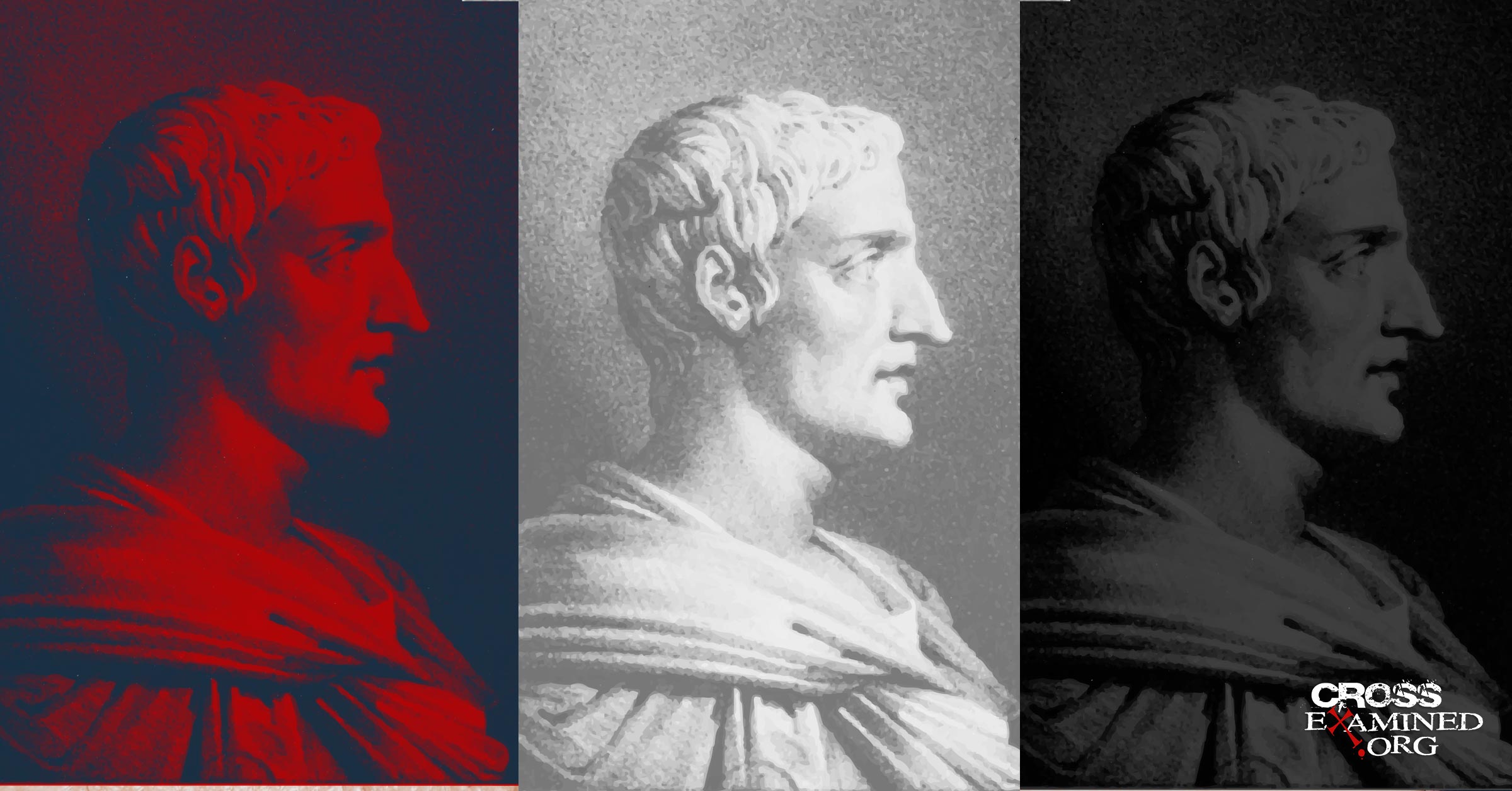
Cornelius Tacitus (AD 55-120) is often called the “greatest historian” of ancient Rome. He authored two large works — the Annals and the Histories.

Much of what he wrote is now lost to us. Fortunately, there’s one remaining portion which is of interest to this discussion. The portion describes Nero blaming the Christians for the great fire of Rome (AD 64). It reports:

Therefore, to stop the rumor, Nero substituted as culprits and punished in the utmost refinements of cruelty, a class of men, loathed for their vices, whom the crowd styled Christians. Christus, the founder of the name, had undergone the death penalty in the reign of Tiberius, by sentence of the procurator Pontius Pilatus, and the pernicious superstition was checked for a moment, only to break out once more, not merely in Judea, the home of the disease, but in the capital itself, where all things horrible or shameful in the world collect and find a vogue.1

What do we learn from Tacitus’ work?

  1. Christians are named after their founder, Christus.
  2. Christus died by the death penalty during Emperor Tiberius’ reign (AD 14-37).
  3. Pontius Pilatus, procurator (AD 26-36), sentenced Christus to death.
  4. Christus’ death ended the “pernicious superstition” for only a short time.
  5. The “pernicious superstition” broke out once more in Judea, the “home of the disease.”
  6. The “disease” spread all the way to Rome and had a large enough following to receive blame for the great fire.

Doubting Tacitus?

As is abundantly obvious, Tacitus’ quote provides a significant amount of corroboration for the New Testament. Jesus died by crucifixion during the reign of Tiberius while Pilatus was procurator of Judea. Moreover, the movement was only “checked for a moment, only to break out once more.”

The implications for this last quote are massive, to say the least. As J.N.D. Anderson remarks:

It is scarcely fanciful to suggest that when he adds that “a most mischievous superstition, thus checked for the moment, again broke out” he is bearing indirect and unconscious testimony to the conviction of the early church that the Christ who had been crucified had risen from the grave.2

On the face of it, Tacitus makes massive claims in support of the New Testament, which is why skeptics try to dismiss it. And they usually give four reasons for doing so.

“It’s a Christian Interpolation”

Skeptics argue that Christians inserted this portion of the text at a later date, but there is no compelling reason for believing this. First and foremost, it’s difficult to imagine a Christian describing his movement as a “pernicious superstition” and a “disease.” As a general rule, people don’t usually label themselves this way.

Furthermore, if Christians really inserted this text into Tacitus’ work, they certainly could have been more clear about Jesus’ resurrection. While the claim that the “superstition broke out again in Judea” implies a resurrection, it’s not entirely clear.

It seems that if Christians had the opportunity to insert a paragraph here, they would have said something more explicit.

“It’s Anachronistic”

A second argument skeptics make against this quote is that it refers to Pilatus as “procurator” — the title during Tacitus’ day — instead of “prefect” — the title during Jesus’ day. That is, it’s anachronistic, and therefore, unreliable.

Again, as a reminder, Tacitus’ reputation as an accurate historian is without question.3 Be that as it may, what should we make of the skeptics’ claim?

First, we should note that Tacitus may have intentionally used the term his readers would have been familiar with for clarity sake. For example, I might write about a “bishop” from the second century, but call him a “pastor” for a contemporary audience because that’s a term readers are familiar with. There’s no reason why Tacitus couldn’t have employed this tactic.

Second, we should also note that other Jewish historians of the first century — Philo and Josephus — both refer to Pilate as a “procurator.” While the term “prefect” was legitimate, it appears that both “procurator” and “prefect” are used interchangeably.

“It’s Hearsay”

Third, skeptics reject this as an original source and claim that Tacitus was simply repeating hearsay from Christians. One line of evidence they suggest is that Tacitus uses Jesus’ title “Christus” rather than his legal name “Jesus.”

This argument doesn’t hold water either. In response, we need to remember that Tacitus was writing about Christians and the origin of their name, so his use of “Christus” instead of “Jesus” seems logical.

Second, it’s difficult to imagine that a great historian like Tacitus, who elsewhere carefully investigated sources, would simply jot down hearsay from a group of Christians. Moreover, I wonder why Tacitus would blindly trust this group he refers to as a “pernicious superstition” and a “disease” and include their fables about Jesus in his history if he didn’t have any other source to substantiate his claim.

While making a substantial claim about a Roman official condemning someone to death, Tacitus would have been especially motivated to get his facts straight.

“It’s Unofficial”

Finally, skeptics argue that Tacitus wouldn’t have had access to any official records that would record Jesus’ death. But I find this terribly unpersuasive.

For starters, Tacitus himself held high government positions (proconsul of Asia). Additionally, he had close connections with others in power, such as Pliny the Younger and his wife, who happened to be the daughter of Julius Agricola, the governor of Britain. It seems silly to suggest he wouldn’t have had access to government records.

Furthermore, we know he had access to the Acta Senatus (archives of the Roman Senate’s activities) as he cites it multiple times in his works. Jesus’ crucifixion may very well have appeared in these archives or in others similar to it.

Knowing the kind of historian Tacitus was, if he didn’t have iron-clad proof that Pontius Pilate sanctioned Jesus’ crucifixion, he would have couched his statement with “Christians report that…” rather than making an unequivocal claim.

Good Corroborating Evidence

In the end, the Tacitus text stands up to scrutiny and provides solid corroborating evidence for the New Testament. While he views Christians in a negative light, he proves to be a reliable non-Christian source for major events in Jesus’ life.

Recommended resources related to the topic:

Cold-Case Christianity: A Homicide Detective Investigates the Claims of the Gospels by J. Warner Wallace (Book)

The New Testament: Too Embarrassing to Be False by Frank Turek (MP3) and (DVD)

Why We Know the New Testament Writers Told the Truth by Frank Turek (mp4 Download)

The Top Ten Reasons We Know the NT Writers Told the Truth mp3 by Frank Turek


Ryan Leasure holds a Master of Arts from Furman University and a Masters of Divinity from the Southern Baptist Theological Seminary. He currently serves as a pastor at Grace Bible Church in Moore, SC.

Original Blog Source: http://bit.ly/2mHGbT0

By Luke Nix

Introduction

Is biblical faith blind or reasonable? This is one of the most hotly debated questions between believers and unbelievers. While most who say that faith is blind are unbelievers, I have also heard many Christians claim this as well. The claim is that faith and reason are at odds with one another and that the more evidence or reason that you have to believe something, the less faith that you need.

Is Faith Blind or Evidential?

In his book “Forensic Faith: A Homicide Detective Makes The Case For A More Reasonable Evidential Faith,” J. Warner Wallace emphasizes the evidential nature of Jesus’ ministry on earth. Jesus never asked people to believe His claims without a good reason to: the miracles that He performed. He performed miracles to demonstrate that His claims to be God (such as is found in His claim to be able to forgive sins in Matthew 9). Based on His followers’ witnessing His miracles (eyewitness evidence), He asked them to have faith in Him. This was not a request for blind faith, but an evidentially-based faith.

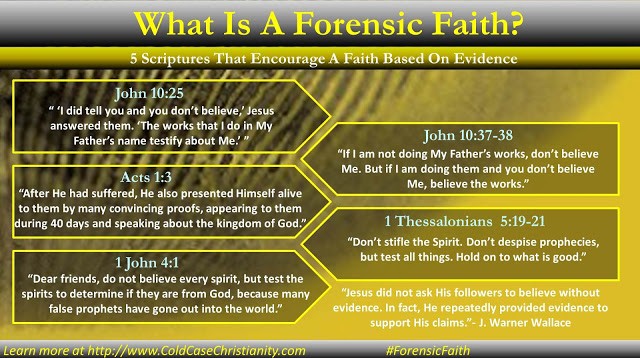
In the book, Wallace not only appeals to the entire ministry of Christ on earth but also to specific passages of Scripture where Jesus explicitly identifies this specific purpose for His miracles and where other New Testament authors also encouraged their readers to test claims:

What is Forensic Faith

John 10:25- “‘I did tell you, and you don’t believe,’ Jesus answered them. ‘The works that I do in My Father’s name testify about Me.'”

John 10:37-38- “If I am not doing My Father’s works, don’t believe Me. But if I am doing them and you don’t believe Me, believe the works.”

Acts 1:3- “After He had suffered, He also prested Himself alive to them by many convincing proofs, appearing to them during 40 days and speaking about the kingdom of God.”

1 Thessalonians 5:19-21- “Don’t stifle the Spirit. Don’t despise prophecies, but test all things. Hold on to what is good.”

1 John 4:1- “Dear friends, do not believe every spirit, but test the spirits to determine if they are from God because many false prophets have gone out into the world.”

These passages do not ask for someone to believe just anything based simply on the word of the person making the claim (“…because I said!”- a blind faith) but based on the actions of the person making the claim. Notice, too, that in the 1 Thessalonians and 1 John passages, the authors are so confident that the claims will pass evidential tests that they openly invite testing! None of these passages ask for blind faith; in fact, they encourage the exact opposite: a faith that is not blind rather a faith that is grounded in evidence and reason.

A Biblical Faith and The Resurrection

Biblical faith, correctly understood from Scripture, is not blind; it is tested and firmly grounded. In fact, today, we can test the central claim of Christianity: that Jesus rose bodily from the dead (1 Corinthians 15). As we investigate the evidence, based on tried and true investigative methods (as outlined in J. Warner Wallace‘s book “Cold-Case Christianity“) and historiographical methods (as outlined in Gary Habermas‘ books “The Historical Jesus” and “The Risen Jesus and Future Hope“), we discover that the only explanation that consistently explains all the evidence is that Jesus rose from the grave, as is claimed in the gospels.

Conclusion

Because this central claim passes the evidential test, faith in Christ is not blind or because “the Bible tells me so;” it is firmly grounded in proven methods used for discovering the truth of claimed events of the past. There simply is no reasonable reason to reject the Resurrection. While we certainly are free to reject the conclusion of the evidence and arguments, we should not fool ourselves into believing that the rejection is anything more than an emotional leap of blind faith despite evidence to the contrary.

Recommended resources related to the topic:

I Don’t Have Enough Faith to Be an Atheist by Frank Turek: book, MP3 and DVD.

Forensic Faith: A Homicide Detective Makes the Case for a More Reasonable, Evidential Christian Faith by J. Warner Wallace: https://amzn.to/2U8wxWi

God’s Crime Scene: Cold-Case… Evidence for a Divinely Created Universe by J. Warner Wallace: book, MP4 and DVD.


Luke Nix holds a bachelor’s degree in Computer Science and works as a Desktop Support Manager for a local precious metal exchange company in Oklahoma.

Original Blog Source: http://bit.ly/30FWO0D

By Alex McElroy

As an apologist, the most common joke I hear from Christians unfamiliar with Apologetics is, “do you go around apologizing to everyone?” In case you are wondering too, no, I don’t. In fact, I believe having a Christian worldview is nothing to apologize for. So, what does an apologist do? We provide credible answers to some of life’s most difficult questions and seek to uphold the Christian worldview through scientific, historical, archaeological, and philosophical evidence.

If you are unfamiliar with the term apologetics or have never heard of an apologist, that is understandable as we constitute a small portion of the total church. That being said, if you want to get your feet wet go read or listen to some of the most notable apologists – Ravi Zacharias, John Lennox, Dr. William Lane Craig, Dr. Frank Turek, Dr. Sean McDowell or Jim Warner Wallace. I’m always blessed and enlightened by their robust and well-prepared thoughts and teachings.

Sometimes I do meet Christians who seem to feel as though they have something to apologize for because they are not equipped to answer questions their critics raise. This doesn’t mean an answer doesn’t exist. It just means they haven’t fully thought through the question. This is where apologetics comes in. Furthermore, the questions cannot simply be laid at the feet of the Christian as though they are the only one who needs to provide an answer. Everyone, whether they are Christian, atheist, or pluralist, needs to have a coherent answer to some foundational questions.

Let’s look at 3 of them.

Are There Reasons to Believe That God Exists?

Scientists largely agree that the universe had a definite beginning – meaning it is not eternal. For example, Einstein’s theory of general relativity, the second law of thermodynamics and the radiation afterglow discovered in the early universe are all evidence that the universe had an uncaused first cause. This is also supported by general logic – something cannot come from nothing.

That being the case, there are two options: either something came from nothing or something came from someone. The issue is that there has never been an observed instance where something sprang forth from nothing. Aristotle defined ‘nothing’ as “what rocks dream about”. This leaves us with the other option: something came from someone. This is also supported by general logic – every creation has a creator. If the universe didn’t come from nothing, it had to have a creator, someone that pre-existed the universe and exists outside of the universe…that sounds a lot like God to me.

Is There an Objective Moral Standard?

I’ve talked with many people from many different worldviews. I’ve found that this line of argument seems to be the most overlooked by those that don’t believe in the God of the Bible. I know many atheists, most of whom are great, morally upright people. The issue isn’t that disbelief in God makes you evil, or that belief in God makes someone good. The issue is that in purely naturalistic worldview terms like good and evil are meaningless and at best, purely subjective.

C.S. Lewis, who called himself England’s most reluctant convert wrote, “My argument against God was that the universe seemed so cruel and unjust. But how had I got this idea of just and unjust? A man does not call a line crooked unless he has some idea of a straight line. What was I comparing this universe with when I called it unjust?” Likewise, if objective evil exists, then an objective moral law must exist in order to have a basis upon which to differentiate between good and evil. In order for that law to remain objective, it must originate from a source that transcends those (us) that it governs. The only option here is God. There is no way to arrive at objective moral values from a naturalistic worldview. In the case for morality, it seems there is no reason to apologize for having a Christian worldview.

Does Life Have Meaning?

I like to play basketball. The shoes that I find work best for me are the “Kobe’s” (named for Kobe Bryant). If I go to the store and they have them for $100, I’ll probably buy them if I’m in the market for new shoes. However, if they were to tell me that the cost was $1,000, I would decline because that would not be an accurate assessment of their value. Only two people determine the value of an object – the creator or the purchaser. Value can never objectively be self-determined. If we apply this concept to humans, then the Christian worldview is wholly unique. Only in a Christian worldview are the purchaser and the Creator the same person. We have been redeemed (bought back) by our Creator. In an atheistic framework, we are the culmination of a random, unguided assortment of molecules. How can there be any value in that? This also means that only in a Christian worldview can we even begin to discuss concepts such as intrinsic value and inherent worth.

This understanding of our value is pivotal because without value, there can never be meaning. In other words, if something is of no value or no legitimate value can be attributed to it, then it in effect becomes a meaningless item. So, the fact that humans are given value by a Creator and a purchaser (redeemer) who is in the legitimate position to impute value to us is of utmost importance. Therefore, there is no need to apologize for adherence to a Christian worldview because only in this worldview does life have meaning because we are eternally connected to the One who gives meaning to all things.


Alex McElroy is an international speaker, author, blogger, leadership advisor, and the Pastor of Education at New Life Covenant Southeast Church, with over 20,000 members led by Pastor John F. Hannah.  Alex has been serving in both youth and teaching ministries at New Life for over 12 years. In his role, he teaches Discipleship class designed for adults to learn, fellowship, and grow in their faith within a small group setting. Alex also trains hundreds of teachers and ministers to deliver lessons in proper lifestyle, Biblical study, focused preparation, and Apologetics in order to maximize their effectiveness in and for the Kingdom of God.

By Erik Manning

Is the argument from miracles full of fallacies? Popular atheist YouTuber ‘Rationality Rules’ argues that’s the case. Rather than examining miracles on a report-by-report basis, he opts to say that the case for miracles is doomed from the start. This reasoning follows the tradition of the famous 18th-century philosopher David Hume.

For those of you who aren’t into YouTube, Rationality Rules has had his channel since March of 2017. In that short time, he’s gained over 200k subscribers and has had nearly 15 million views.

There’s a cottage industry of channels similar to his and we shouldn’t underestimate their influence. These are sharp skeptics making entertaining and digestible videos packed with thought-provoking content. As believers, we’d be lazy not to respond to their arguments.

Here’s his video on miracles in full. Here I’ll focus on his main points:

Does the argument from miracles fail to support Theism?

Here’s Rationality Rules first objection to the argument from miracles:

“The vast majority of miracles wouldn’t prove the existence of a god, even if they were indeed true. Or in other words, they don’t support theism. For example, even if it were unimpeachably true that a man called Jesus resurrected, this would not, in the slightest, prove that the universe had a creator! Nor would prove that Jesus turned water into wine; that he healed the blind; that he walked on water; or that he was born of a virgin… all it would prove is that a man called Jesus respawned and that he had terrible lag because it took him three days!…”

While I appreciate the video game reference, this argument against miracles is hardly a “game over” for the Christian. Jesus’ resurrection absolutely supports theism and fits poorly in a naturalistic worldview. For starters, the gospels report that Jesus said that the resurrection would prove his message:

“Then some of the Pharisees and teachers of the law said to him, “Teacher, we want to see a sign from you.” He answered, “A wicked and adulterous generation asks for a sign! But none will be given it except the sign of the prophet Jonah. For as Jonah was three days and three nights in the belly of a huge fish, so the Son of Man will be three days and three nights in the heart of the earth.” (Matthew 12:38-40)

Secondly, the resurrection didn’t happen in a vacuum. Jesus’ preached the kingdom of God and called himself the Son of Man. The Jewish expectation at that time was the Messiah was coming and bringing his kingdom. That’s a historical fact.

The Roman historian Suetonius says this regarding the Jewish revolt against Rome “There had spread over the Orient an old and established belief, that it was fated at that time for men coming from Judea to rule the world.” 

Tacitus also picks up on this prophetic expectation: “…in most, there was a firm persuasion, that in the ancient records of their priests was contained how at this very time the East was to grow powerful, and rules, coming from Judea, were to acquire universal empire…”

The 1st-century Jewish historian Josephus also mentions this hope: “But now, what did most elevate them in undertaking this war was an ambiguous oracle that was also found in their sacred writings, how “about that time, one from their country should become governor of the habitable earth.” 

All three of these ancient historians applied these Jewish predictions to the Roman Emperor Vespasian, including even Josephus, oddly enough. He was, after all, a turncoat from the Jewish side to Rome.

So where did this expectation come from? If you read the prophecies from Daniel 2, 7, and 9, there was an understanding that there would be four great kingdoms before the kingdom of God would come.

Those kingdoms were believed to be Babylon, Medo-Persia, Greece, and Rome. During the time of the Roman kingdom, the Son of Man would bring his kingdom and reign over the whole earth. (Daniel 7:13-14) The Messiah would come some 490 years after the rebuilding of Jerusalem, which had been destroyed by the Babylonian Empire.

You can also see this expectation in the New Testament writings. Even John the Baptist had to deny that he was the Christ. (John 1:20) Luke 3:15 says “Everyone was expecting the Messiah to come soon, and eager to know whether or not John was he.” (TLB)

This is also why Paul said things like: “At the right time, Christ died for the ungodly, or “…when the time had fully come, God sent his Son….” (Romans 5:6, Galatians 4:4) And the gospel writers have Jesus repeatedly referring to his appointed hour. (John 2:4, 7:30, 8:20, 12:23-24, Mark 14:41)

These prophecies are extremely fascinating and it would take another blog post to fully unpack their importance, but here’s the point: Jesus’ resurrection wasn’t some anomalous event devoid of spiritual significance. While it wasn’t the way many Jews expected the Messiah to come, the resurrection reportedly happened in an atmosphere charged historical and religious meaning.

Furthermore, his closest followers boldly proclaimed that God raised him. And they didn’t say the resurrection was the work of some generic god, but the God of Israel who performed this amazing sign. (Acts 2:22-24) Jesus’ disciples had the best vantage point to interpret the significance of this event. The one that was raised must have said that it was God who raised him. This is hardly some random miracle.

Let’s turn to Rationality Rule’s second objection:

Is the argument from miracles an argument from personal incredulity?

“The second and perhaps most obvious flaw with miracles is that they almost always commit either an Argument from Ignorance or a Personal Incredulity Fallacy.

To illustrate this, consider the following: Throughout history, there have been numerous accounts of flightless animals raining from the sky – and needless to say, on just about every occasion, someone somewhere has asserted that a miracle has occurred, because, “there’s no other explanation”. 

Now, of course, it’s fair to say that flightless animals don’t just fall from the sky, but one can’t simply assert that a miracle has occurred simply because there’s “no other explanation”… that would be, and is an outrageous Argument from Ignorance! 

It is, in essence, “we don’t know, therefore god”. Anyhow, as it turns out, we now actually do have an adequate explanation (which, by the way, perfectly demonstrates why Arguments from Ignorance are flawed). 

This explanation is, quite simply, a tornado that’s formed over a body of water (otherwise known as a waterspout), that’s then hurled water and aquatic animals over land… it’s is a bizarre phenomenon, incredible even, but it’s not a miracle, because it doesn’t violate the laws of nature. 

Yet, despite the fact that we now know exactly how flightless animals can rain from the sky, many people still assert that the only explanation is divine intervention, because they either don’t personally know about waterspouts, or they don’t understand them, which…is a Personal Incredulity Fallacy.”

Rationality Rules is right about one thing: Nature does some weird things sometimes and we’re not justified in attributing miracles to every gap in our understanding. That would be an argument from ignorance.

But let’s think about it for a moment: When it comes to the resurrection of Jesus, will there ever be a time when scientists discover a law shows that dead people do not stay dead after three days?

Given everything we know, that seems just as likely as discovering new laws that overturn the law of gravity. While there is some personal incredulity that’s unwarranted  — like why flightless animals can at times rain from the sky — some things stubbornly resist our current framework of science. This has caused us to revise our framework when needed, but why can’t there be a case that’s so obstinate that it would resist scientific explanation altogether?

If atheists want to say that that can never possibly happen, that would be an extreme example of begging the question.

This is why many skeptical New Testament scholars (like Gerd Lüdemann and Michael Goulder, for instance) opt to naturalistically explain the specific evidence we have for the resurrection.

In fact, many of Rationality Rules’ fellow skeptical YouTube colleagues would seem to rather put forward arguments against the existence of the historical Jesus altogether. They clearly understand the theistic implications of the resurrection!

The argument from miracles: Not Debunked

Jesus’ resurrection was either natural or supernatural. Based on what we scientifically know today, natural causes isn’t a live option.Therefore, given that Jesus claimed to be divine and those who saw him after his resurrection claimed God raised him, the supernatural explanation is the most plausible one. This is especially true when we consider how poorly naturalistic explanations fare in comparison.

This isn’t an argument from ignorance, it’s just abductive logic — inference to the best explanation. We use this type of reasoning all the time, especially in science, history and in cases of law.

So unless we beg the question against the existence of God, we can’t just rule out miracles from the get-go. Now, Rationality Rules could try and debunk the evidence for the resurrection, but if he does that, he repudiates his second argument against miracles.

But Rationality Rules has two more objections to the argument from miracles. In my next post, we’ll look at them and see if those arguments stick better than his first couple. So far, he’s not off to a promising start.


Erik Manning is a former atheist turned Christian after an experience with the Holy Spirit. He’s a freelance baseball writer and digital marketing specialist who is passionate about the intersection of evangelism and apologetics.

By Luke Nix

Introduction- Why Is God’s Existence So Important?

One of the most heated debates in any setting is the existence of God. If God exists, then He is the foundation for objective morality. One’s view of morality governs their thinking in everything from politics to workplace interactions, from scientific research to everyday behavior. If God exists, then there are objective behavioral boundaries which should never be crossed. If God does not exist, then no such objective boundaries exist, and anyone may behave however they wish in any situation without concern for the violation of some objective standard (that is not to say that relative/cultural/legal standards cannot be violated- but that is a topic for another time). If we do not examine this question carefully, we risk believing what is false about reality and morality, and such false beliefs will necessarily lead to behaviors that are not in keeping with reality and morality. This means that many of the political and ethic debates opposing people have come down to whether or not God exists.

Presenting A Cumulative Case for God’s Existence

Numerous lines of evidence and philosophical arguments have been presented over the centuries for God’s existence. All of them come together to create a powerful cumulative case. Much like a detective’s case for the guilt of an accused murderer, multiple independent lines of evidence are presented that all point to the guilt of the accused. If such a method is valid for discovering the truth behind the claim that a murder took place and for the specific identity of the murdered, then the same method is also valid in determining the truth behind the claim that God exists and the identity of this God.

God’s Crime Scene

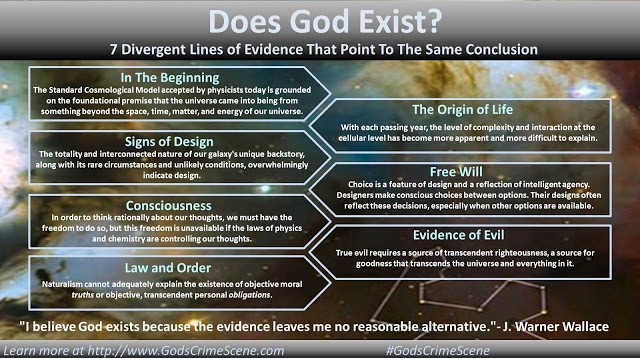
One of my favorite books that takes some of these arguments and presents the cumulative case comes from cold-case homicide detective J. Warner Wallace. In his book “God’s Crime Scene: A Cold-Case Detective Examines The Evidence For A Divinely Created Universe.” Wallace presents seven independent lines of evidence that all point to God’s existence in the same way that he would present multiple lines of evidence to a jury for the guilt of an accused murderer. The lines of evidence he presents are summarized in these quotes from the book:

Does God Exist

  1. The Beginning– “The Standard Cosmological Model, accepted by physicists today is grounded on the foundational premise that the universe came into being from something beyond the space, time, matter, and energy of our universe.”
  2. Signs of Design– “The totality and interconnected nature of our galaxy’s unique backstory, along with its rare circumstances and unlikely conditions, overwhelmingly indicate design.”
  3. Consciousness– “In order to think rationally about our thoughts, we must have the freedom to do so, but this freedom is unavailable if the laws of physics and chemistry are controlling our thoughts.”
  4. Law and Order (Morality)– “Naturalism cannot adequately explain the existence of objective moral truths or objective, transcendent personal obligations.”
  5. The Origin of Life– “With each passing year, the level of complexity and interaction at the cellular level has become more apparent and more difficult to explain.”
  6. Free Will– “Choice is a feature of design and a reflection of intelligent agency. Designers make conscious choices between options. Their designs often reflect these decisions, especially when other options are available.”
  7. Evidence of Evil– “True evil requires a source of transcendent righteousness, a source for goodness that transcends the universe and everything in it.”

Wallace concludes by stating that as a detective, who must follow the evidence where it leads, “I believe God exists because the evidence leaves me no reasonable alternative.” If the objective standard of morality exists (God), then that standard is what must be used to judge ethical and political positions.

Conclusion- Prepare for Your Ethical Discussions With Objective Evidence For God’s Existence

If you find yourself involved in discussions of an ethical or political nature or just want to be able to more critically evaluate the political and ethical claims of others, I highly recommend that you pick up a copy of Wallace’s book to help establish a foundational point on which to begin evaluation and discussion. While not comprehensive on the case for God’s existence, it is one of the most accessible and engaging books on this topic, and it should not be passed up by anyone serious about investigating the truth of reality and morality.
For more great books on God’s existence, check out the many books that I have reviewed on this blog, and for the topic of ethics and politics, specifically, please check out my Top 5 Recommended Books for diving into those details.


Luke Nix holds a bachelor’s degree in Computer Science and works as a Desktop Support Manager for a local precious metal exchange company in Oklahoma.

Original Blog Source: http://bit.ly/2Xz6qvS

By Brian Chilton

In 2000, I made the difficult decision to step away from my faith. I entered into what I call theistic-leaning agnosticism, one step removed from pantheism. I believed that some kind of God could possibly exist. However, I didn’t know that a person could know if that God really did exist and most certainly could not know anything about the historical Jesus of Nazareth. These doubts were brought on the claims of the Jesus Seminar who held that less than 14% of the sayings attributed to Jesus were actually his own. The Seminar claimed that the rest of the sayings were inventions from the apostles. Couple the Seminar with PBS’s show From Jesus to Christ, which claimed that the Christ of faith evolved over time from the Jesus of history, then one could see why I needed some serious answers. When I asked Christian leaders about how I could know if Jesus was accurately portrayed in the Gospels, I was met with scorn and hostility. Add to that the nepotistic hypocrisy I often saw, then stepping away from the faith was pretty easy.

However, everything changed in 2005. I was introduced to the writings of Lee Strobel, Josh McDowell, William Lane Craig, and Gary Habermas. This past week, my journey came full circle. I had the honor to have one of my apologetic heroes, Gary Habermas, once again as a professor. The class investigated the New Testament creeds, which is the material in the New Testament that predates the New Testament writings. It is thought even by skeptical scholars that many of these creeds date to no later than 35 AD when Paul met Peter and James in Jerusalem (Gal. 1:18-20). The NT creeds tell us much about the historical Jesus because this information is located at ground zero. The creeds tell us about the message of the earliest church, which in turn came from the historical Jesus of Nazareth. So, what can we know about the historical Jesus of Nazareth from these creeds?

Creeds Tell Us about the Nature of the Historical Jesus. As fascinating as it is, the creeds provide us with high Christology. In fact, the earliest church had the highest Christology. This decimates the claims that the church evolved the nature of Jesus from a prophet to a divine God-man over time. For instance, consider the Philippians hymn. The Philippians hymn notes that Christ Jesus “existing in the form of God, did not consider equality with God as something to be exploited. Instead, he emptied himself by assuming the form of a servant, taking on the likeness of humanity” (Php. 2:6-7a, CSB). The sermon summaries of Acts, all thought to be extremely early, denote the deity of Jesus as one who “has been exalted to the right hand of God” (Acts 2:33, CSB). Don’t forget about the Colossian’s creed where Christ is said to be the “invisible God, the firstborn over all creation” (Col. 1:15, CSB and see following Col. 1:16-20). One may say, “Okay, but this shows the church’s theology, not the historical Jesus of Nazareth.” In response, one must note that there is no historical presence of evolutionary development, not even legendary development. The earliest church held an extremely high view of Jesus. Therefore, Jesus of Nazareth must have taught something about his divine nature, backing them up with miraculous works.

Creeds Tell Us about the Life of the Historical Jesus. While the majority of the creeds focus on the death, burial, and resurrection of Jesus, the creeds do provide details pertaining to the life and ministry of Jesus of Nazareth. The creeds note that Jesus was born a descendant of David (Acts 13:23; Rom. 1:3). Jesus was noted to have been a Nazarene (Acts 2:22; 4:10; 5:38). Jesus of Nazareth performed numerous miracles (Acts 2:22; 10:38) and fulfilled several Messianic prophecies (Acts 2:25-31; 3:21-25; 4:11; 10:43). From the creeds, the researcher begins to see a similar pattern of Jesus of Nazareth’s life that is portrayed in the biblical narratives concerning him.

Creeds Tell Us about the Death and Resurrection of the Historical Jesus. The majority of the creeds are based around the earliest kerygma of the church—that is, the death, burial, and resurrection of Jesus. Most notably, 1 Corinthians 15:3-7 denotes the resurrection appearances of Jesus, even stating that 500 people witnessed the risen Jesus at one time (1 Cor. 15:6). The sermon summaries of Acts also provide the same formula in that Jesus lived, died, and rose again. The Acts 13 sermon summary even gives a nod to the empty tomb. For Paul’s early message stated that “When they had carried out all that had been written about him, they took him down from the tree and put him in a tomb. But God raised him from the dead, and he appeared for many days to those who came up with him from Galilee to Jerusalem, who are now his witnesses to the people” (Acts 13:29-31, CSB). The creeds denote the numerous witnesses who saw the risen Jesus. They sometimes provide details that other sources do not, such as Simon Peter’s private interaction with the risen Jesus (Lk. 24:34; 1 Cor. 15:5) and James’ private meeting with the risen Jesus (1 Cor. 15:7).

The early creeds are impressive in what they tell us about the historical Jesus of Nazareth. Some will skeptically hold that since the creeds speak of the miraculous and the divine that they must be thrown out. However, such attitudes show more of an anti-supernatural bias than they do a quest for historical truth. At the very least, these early creeds tell us what the earliest church believed about Jesus. At the most, the early creeds give a fascinating description of whom Jesus was, is, and forever will be. Even if we did not have the New Testament, the creeds would tell us everything we needed to know about the historical Jesus of Nazareth, who is the Christ of faith! The creeds tell the life-changing truth that Jesus has risen. Will you allow this truth to transform you?


Brian G. Chilton is the founder of BellatorChristi.com and is the host of The Bellator Christi Podcast. He received his Master of Divinity in Theology from Liberty University (with high distinction); his Bachelor of Science in Religious Studies and Philosophy from Gardner-Webb University (with honors); and received certification in Christian Apologetics from Biola University. Brian is currently enrolled in the Ph.D. program in Theology and Apologetics at Liberty University and is a member of the Evangelical Theological Society and the Evangelical Philosophical Society. Brian has been in the ministry for close to 20 years and serves as the Senior Pastor of Westfield Baptist Church in northwestern, North Carolina.

Original Blog Source: http://bit.ly/2ZALSAi