Tag Archive for: Christianity

By Wintery Knight

Here is the video of the debate:

TOPIC: DOES GOD EXIST?

MY NOTES ON THE DEBATE: (WC = William Lane Craig, CH = Christopher Hitchens)

WC opening speech:

Introduction:

WC makes two contentions:

– there are no good arguments for atheism

– there are good arguments for theism

These topics are IRRELEVANT tonight:

– the social impact of Christianity

– the morality of Old Testament passages

– biblical inerrancy

– the debate is whether God (a creator and designer of the universe) exists

  1. cosmological argument

– an actually infinite number of past events is impossible

– number of past events must be finite

– therefore the universe has a beginning

– the beginning of the universe is confirmed by science – the universe began to exist from nothing

– space, time, matter, energy began at the big bang

– the creation of the universe requires a cause

– the cause is uncaused, timeless, spaceless, powerful

– the cause must be beyond space and time because it created space and time

– the cause is not physical because it created all matter and energy

– but there are only two kinds of non-physical cause: abstract objects or minds

– abstract objects don’t cause effects

– therefore must be mind

  1. teleological argument

– fine-tuned constants and ratios

– constants not determined by laws of nature

– also, there are arbitrary quantities

– constants and quantities are in a narrow range of life-permitting values

– an example: if the weak force were different by 1 in 10 to the 100, then no life

– there are 3 explanations: physical law or chance or design

– not due to law: because constants and quantities are independent of the laws

– not due to chance: the odds are too high for chance

– therefore, due to design

– the atheist response is the world ensemble (multiverse)

– but world ensemble has unobservable universes, no evidence that they exist

– and world ensemble contradicts scientific observations we have today

  1. moral argument

– objective moral values are values that exist regardless of what human’s think

– objective values are not personal preferences

– objective values are not evolved standards that cultures have depending on time and place

– objective moral values and duties exist

– objective moral values and duties require a moral lawgiver

  1. argument from resurrection miracle

– resurrection implies miracle

– miracle implies God

– 3 minimal facts pass the historical tests (early attestation, eyewitness testimony, multiple attestation, etc.)

– minimal fact 1: empty tomb

– minimal fact 2: appearances

– minimal fact 3: early belief in the resurrection

– Jewish theology prohibits a dying Messiah – Messiah is not supposed to die

– Jewish theology has a general resurrection of everybody, there is not supposed to be a resurrection of one person

– Jewish theology certainly does not predict a single resurrection of the Messiah after he dies

– therefore, the belief in the resurrection is unlikely to have been invented

– disciples were willing to die for that belief in the resurrection

– naturalistic explanations don’t work for the 3 minimal facts

  1. properly basic belief in God

– religious experience is properly basic

– it’s just like the belief in the external world, grounded in experience

– in the absence of defeaters, those experiences are valid

Conclusion: What CH must do:

– destroy all 5 of WC’s arguments

– erect his own case in its place

CH opening speech:

  1. evolution disproves biological design argument

– evolution disproves Paley’s argument for a watchmaker

  1. God wouldn’t have done it that way

– God wouldn’t have waited that long before the incarnation

– mass extinction and death before Jesus

– God wouldn’t have allowed humans to have almost gone extinct a while back in Africa

– why insist that this wasteful and incompetent history of life is for us, that’s a bad design

– the universe is so vast, why would God need so much space, that’s a bad design

– there is too much destruction in the universe, like exploding stars – that’s a bad design
– the heat death of the universe is a bad design

– too many of the other planets don’t support life, that’s a bad design

– the sun is going to become a red giant and incinerate us, that’s a bad design

  1. Hitchens’ burden of proof

– there is no good reason that supports the existence of God

– all arguments for God can be explained without God

– atheists can’t prove there is no God

– but they can prove there is no good argument for God

  1. Craig’s scientific arguments don’t go far enough, they only prove deism, not theism

– the scientific arguments don’t prove prayer works

– the scientific arguments don’t prove specific moral teachings of Christianity

  1. if the laws of physics are so great then miracles shouldn’t be allowed

– good laws and miracles seem to be in contradiction

  1. extraordinary claims need extraordinary evidence

– none of Craig’s evidence was extraordinary

  1. science can change, so Craig can’t use the progress of science

– it’s too early for Craig to use the big bang and fine-tuning

– the big bang and fine-tuning evidences are too new

– they could be overturned by the progress of science

  1. Craig wrote in his book that the internal conviction of God’s existence should trump contradicting evidence

– but then he isn’t forming his view based on evidence

– he refuses to let evidence disprove his view

– but then how can atheists be to blame if they don’t believe

– so evidence is not really relevant to accepting theism

  1. the progress of science has disproved religion

– Christianity taught that earth was center of the universe

– but then cosmology disproved that

Response to the big bang and fine-tuning arguments:

– was there pre-existing material?

– who designed the designer?

WC first rebuttal:

Reiterates his 2 basic contentions

CH agrees that there is no good argument for atheism

– then all you’ve got is agnosticism

– because CH did not claim to know there is no God

– and he gave no arguments that there is no God

CH’s evolution argument

– irrelevant to Christianity

– Genesis 1 allows for evolution to have occurred

– Christianity is not committed to young earth creationism

– the origin of biological diversity is not central to Christianity

– St. Augustine in 300 AD said days can be long, special potencies unfold over time

– also, there are scientific reasons to doubt evolution

– cites barrow and Tipler, and they say:

– each of 10 steps in evolution is very improbable

– chances are so low; it would be a miracle if evolution occurred

CH’s argument that God is wasteful

– efficiency is only important to people with limited time or limited resources

– therefore God doesn’t need to be efficient

CH’s argument that God waits too long to send Jesus

– population was not that high before Jesus

– Jesus appears just before the exponential explosion of population

– conditions were stable – roman empire, peace, literacy, law, etc.

CH’s argument that Craig’s scientific arguments only prove deism, not theism

– deism a type of theism, so those scientific arguments work

– all that deism denies is a miraculous intervention

CH’s argument that Craig has a burden of proof

– theism doesn’t need to be proven with certainty

– must only prove a best explanation of the evidence

CH’s citation of Craig’s book saying that evidence should not overrule experience

– there is a difference between knowing and showing Christianity is true

– knowing is by religious experience which is a properly basic belief

– showing is done through evidence, and there the evidence does matter

CH’s rebuttal to the big bang

– there was no pre-existent material

– space and time and matter came into being at the big bang

– the cause must be non-physical and eternal

– cause of the universe outside of time means = cause of the universe did not begin to exist

– this is the state of science today

CH’s rebuttal to the fine-tuning

– CH says scientists are uncertain about the fine-tuning

– Craig cites Martin Rees, an atheist, astronomer royal, to substantiate the fine-tuning
– the fine-tuning is necessary for  minimal requirements for life of any kind

– the progress of science is not going to dethrone the fine-tuning

CH’s argument about heat death of the universe

– duration of design is irrelevant to whether something was designed

– cars are designed, yet they break down

– design need not be optimal to be designed

– CH is saying why create if we all eventually go extinct

– but life doesn’t end in the grave on Christianity

CH’s rebuttal to the moral argument

– CH says no objective moral values

– but CH uses them to argue against God and Christians

– but CH has no foundation for a standard that applies to God and Christians

CH’s rebuttal to the resurrection argument

– empty tomb and appearances are virtually certain

– these are minimal facts, well evidenced using standard historical criteria

– best explanation of these minimal facts is the resurrection

CH’s rebuttal to a religious experience

– prop basic belief is rational in the absence of defeaters

– so long as Craig has no psychological deficiency, experience is admissible

CH first rebuttal:

it’s not agnosticism

– if there are no good arguments for theism

– then there is no reason for belief in God

– that is atheism

– everything can be explained without God

God wouldn’t have done it that way

– homo sapiens is 100K years old

– for 98K years, they had no communication from God

– lots of people died in childbirth

– disease and volcanos are a mystery to them

– life expectancy is very low

– they die terrible deaths

– their teeth are badly designed

– their genitalia are badly designed

– why solve the problem of sin by allowing a man to be tortured to death

– that’s a stupid, cruel, bumbling plan

lots of people haven’t even heard of Jesus

– many of them die without knowing about him

– they cannot be held responsible if they do not know about Jesus

the early success of Christianity doesn’t prove Christianity is true

– because then it applies to Mormonism and Islam, they’re growing fast

objective morality

– belief in a supreme dictator doesn’t improve moral behavior

– I can do moral actions that you can do

– I can repeat moral positions that you can say

religious people are immoral

– genital mutilation

– suicide bombing

moral behavior doesn’t need God

– we need to act moral for social cohesion

– it evolved for our survival

– that’s why people act morally

– it’s degrading to humans, and servile, to require God for morality

free will

– I believe in free will

– I don’t know why, because I can’t ground free will on atheism

– a bossy God seems to reduce free will because then we are accountable to God

WC cross-examination of CH:

WC why call yourself an atheist when you have no reasons?

CH because absence of belief is atheism

WC but agnosticism, atheism, verificationism all don’t hold that belief, which one are you?

CH I think God does not exist

WC ok give me an argument for the claim you just made to know God does not exist

CH I have no argument, but I don’t believe in God because it depresses me to think he might be real

WC would you agree that absence of evidence is not evidence of absence?

CH no I don’t agree

WC moral argument: it’s not epistemology it’s the ontology – have you got a foundation for moral values and duties?

CH I do not, it’s just evolution, an evolved standard based on social cohesion

CH cross-examination of WC:

CH you said that the historical reports of Jesus doing exorcisms are generally accepted – do you believe in devils?

WC I commit to nothing, what I am saying their historical consensus on the reports that Jesus did exorcisms

CH what about the devils going into the pigs, do you believe that?

WC yes I do, but the main point I’m making is that the historical reports show that Jesus acted with divine authority

CH do you believe in the virgin birth?

WC yes, but that’s not historically provable using the minimal facts methods, and I did not use the virgin birth in my arguments tonight, because it doesn’t pass the historical tests to be a minimal fact

CH do you believe that all the graves opened and dead people all came out?

WC not sure if the author intended that part as apocalyptic imagery or as literal, I have no opinion on it, have not studied it

CH do exorcisms prove son of God?

WC no, I am only saying that the historical reports show that Jesus exercised authority and put himself in the place of God

CH are any religions false? name one that’s false

WC Islam

CH so some religions are wicked right?

WC yes

CH if a baby were born in Saudi Arabia would it be better if it were an atheist or a Muslim?

WC I have no opinion on that

CH are any Christian denominations wrong?

WC Calvinism is wrong about some things, but they are still Christians, I could be wrong about some things, I do the best I can, studying theology, so I’m not wrong

WC second rebuttal

Response to CH arguments:

no reasons for atheism

– no reasons to believe that God does not exist

– CH withholds belief in God

why wait so long before contacting humans with Jesus

– population matters, not time – Jesus waited until there was about to be a population explosion

– there is a natural revelation (Romans 1) for those who lived before Christ

what about those who never heard

– (Acts 17:22-31) God chooses the time and place of each person who is born to optimize their opportunity to know him based on how they will respond to evidence (this is called middle knowledge)

– those who haven’t heard will be judged based on general revelation

WC re-assess the state of his five arguments:

cosmological argument

– heat death of the universe won’t happen on Christianity

moral argument

– if no objective moral standard, can’t judge other cultures as wrong

– no transcendent objective standard to be able to judge slavery as wrong

name an action argument

– e.g. – tithing

– the greatest command – love the Lord your God your God with everything you’ve got

– atheists can’t do that, and that is the biggest commandment to follow

moral obligations

– there are no objective moral obligations for anyone on atheism

– on atheism, you feel obligated because of genetics and social pressure

– on atheism, we’re animals, and animals don’t have moral obligations

resurrection
– the belief in the resurrection of 1 man, the Messiah is totally unexpected on Judaism

– they would not have made this up, it was unexpected

religious experience

– experience is valid in the absence of defeaters

CH second rebuttal:

faith and reason

– Tertullian says faith is better when it’s against reason

it’s easy to start a rumor with faith-based people

– Mother Teresa: to be canonized she needs to have done a miracle

– so there was a faked miracle report

– but everybody believes the fake miracle report!

– this proves that religious rumors are easy to start

– the resurrection could have started as a similar rumor by people wanting to believe it

name an action

– tithing is a religious action, I don’t have to do that

moral argument

– I can be as moral as you can without God

– I can say that other cultures are wrong, there I just said it

– without God, people would still be good, so God isn’t needed

religious people did bad things in history

– this church did a bad thing here

– that church did a bad thing there

– therefore God doesn’t exist

religion is the outcome of man’s struggle with a natural phenomenon

– that is why there are so many religions

WC concluding speech

no arguments for atheism presented

What CH has said during the debate:

– God bad, Mother Teresa bad, religion bad

atheism is a worldview

– it claims to know the truth

– therefore it is exclusive of other views

what does theism explain

– theism explains a broad range of experiences

– origin of the universe, CH has dropped the point

– fine-tuning, CH has dropped the point

– moral, CH says that humans are no different from animals – but an evolved standard is illusory, there are no actual moral values and standards, it’s just a genetic predisposition to act in a certain way – that’s not prescriptive morality

– resurrection, CH has dropped the point

– experience, Craig tells his testimony and urges the audience to give it a shot

CH concluding speech

HITCHENS YIELDS HIS ENTIRE CONCLUDING SPEECH!

A question & answer Period followed the end of the formal debate

Further study

Check out my analysis of the 11 arguments Hitchens made in his opening speech in his debate with Frank Turek.


Original Blog Source: http://bit.ly/2NGJ7Jn

By Robby Hall

Recently here in my state, a man was acquitted of manslaughter in the death of his girlfriend.  In response to the loss, the District Attorney who prosecuted the case stated:

“…Of course, we’re gutted, However, what people will not understand is this: The number one reason we lost is the burden of proof in a circumstantial case is not just beyond a reasonable doubt but it’s far higher.”

Is this true?  Do I need to be absolutely certain before I can say this man is guilty or innocent?  What about the case for Christianity?  Do I need to be certain of every detail before I can accept the evidence as pointing to it being true?

The truth is, you don’t.  In fact, most of the time, we know things are true or false without having all of our questions answered.  But this brings up a question:  How does one weigh evidence?

According to J. Warner Wallace, semi-retired Cold Case Detective and Christian author and speaker, understanding evidence first begins with understanding the difference between direct and indirect evidence[1]

Direct evidence is eyewitness testimony.  A person witnesses a robbery and testifies in court.  That is a direct evidence case.  Indirect evidence is everything else.  Indirect evidence is also known as circumstantial evidence.  Even DNA and fingerprint evidence is not direct.  It’s only a fact.  In a circumstantial case, you draw inferences from the facts [evidence] you are presented.  People can draw different inferences from the same facts.  A lot of this can be based on your personal bent.  So what you must do is set aside your presuppositions and determine to follow the evidence wherever it leads – even if it’s to a place you do not like.

Circumstantial evidence can make the strongest case for Christianity by building a cumulative case.  A cumulative case can be compared to a puzzle.  Once the pieces begin to be put together, they start to form a picture.  At some point, if there are enough pieces, you can see what the picture is even if you don’t have all of the pieces.

Rational Inference is a basic law of logic and all of the facts are not required to make such an inference.  There is a huge, circumstantial, cumulative case for Christianity.  And when you weigh all of the evidence together, you begin to see the picture of Christ form.  There will still be unanswered questions.  I have them and you will too.  But we don’t make decisions based on being absolutely certain.

Back to the criminal case.  I was not there to see the evidence; I’ll leave it up to the jury.  But if the DA thinks that a circumstantial case requires a higher burden of proof, he may have sunk his own case or had a bad one.

If you think you can’t be a Christian because you cannot answer every question, apply that same burden of proof to everything else you think is true and see if those things hold up under the same scrutiny.  You may find your case for those things wanting.

Note 

[1] http://coldcasechristianity.com/2018/why-its-important-for-christians-to-understand-the-difference-between-possible-and-reasonable-doubt-video/coldcasechristianity.com/2018/why-its-important-for-christians-to-understand-the-difference-between-possible-and-reasonable-doubt-video/


Robby Hall is in the Secure Access industry for Information Technology. He has been married for 3 years and has just welcomed his first child, Bridget. He is graduate of the Cross Examined Instructor’s Academy and leads apologetics small groups at his local church.

Original Blog Source: http://bit.ly/2tyl71K

[/et_pb_text][/et_pb_column][/et_pb_row][/et_pb_section]

By Luke Nix

Introduction

In recent months a major political and moral shift has been underway across America. The legality and morality of both infanticide and murder are actually being debated. But not under those terms. No, euphemisms are being used to obfuscate what is truly at stake- the lives of millions of people- your children’s lives, your grandchildren’s lives, for generations to come.

If we continue to ignore this debate and do nothing, we do so at a severe intellectual, moral, and personal cost. This post will help you see through the intentional obfuscation of those who are actively attempting to deceive you into supporting these atrocities.

The Terms Used

The debate over infanticide and murder are logical extensions of the debate over abortion. On one side, people argue that terminating a pregnancy (up to and including while the mother is in labor) can be justified (the “pro-choice” position), while the other side argues that there exists no such justification (the “pro-life” position). The pro-choice advocate gets emotionally heated because they believe that a mother has the right to exercise autonomy over the life of her unborn child.

The pro-life advocate gets emotionally heated because they believe that no human, including the mother, has the right to exercise autonomy over the life of any unborn child.

In the midst of the emotional exchanges, some advocates on both sides attempt to take a more objective approach and provide evidence for their position in an effort to bring a logical resolution the debate. If one side is successful in this goal, then their emotional responses may be justified by the evidence, but if that position is not justified by the evidence, then the emotional responses (and the position itself) is not justified and logically must be abandoned. The abandonment would include all laws and legal decisions that support the position as well. Today, I want to take some time to examine the available options and see how they square with reality and experience.

Is Abortion a Matter of Opinion?

I take the position of being pro-life. I do not hold this position to be merely my opinion that is only “true for me;” I hold this position to be objectively true, whether anyone believes it or not, and that it applies to all people in all cultures at all times. Not only is this a matter of fact position; I have the evidence to establish that this position accurately reflects reality and should be held by others as well.

In my discussions with pro-choice advocates, they will present any and every way they think may get them past the pro-life conclusion. Many of them believe that they can choose (true to their label) any number of ways to escape the pro-life position. Do they succeed? I believe they do, but it comes at a steep price. Today I want to present four options that the pro-choice advocate has to choose from in their effort to maintain their position in opposition to mine (the pro-life position), but I wish to also show that the cost is too high for any of the options to be reasonable or desirable.

Faithful Thinkers

Examining the Pro-Life Argument

To see what these options are, let us examine the pro-life argument:
If the unborn are human and if it is immoral to take the life of an innocent human, then it is immoral to take the life of the unborn (abortion).
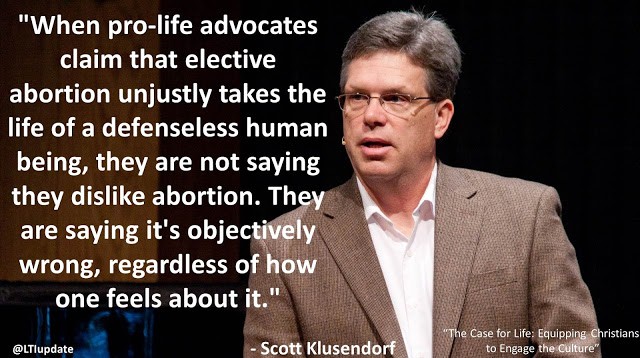
There are three components to this argument that may be attacked by the pro-choice advocate. If one or more of those components are successfully defeated, then the conclusion fails. These three components are addressed throughout the book “The Case for Life” by Scott Klusendorf, but here is a video that gives an overview:

Simply stated, the unborn are human (component #1 is established by science), and it is immoral to take the life of an innocent human (most people agree with component #2 and evidence it in numerous ways), thus it is immoral to take the life of the unborn (the conclusion). This is a valid, logical argument (component #3- modus ponens).

The Options

If the pro-choice advocate wishes to deny its conclusion (“it is immoral to take the life of the unborn”), then he/she must deny that the unborn are human (which would be anti-science), deny that murder is immoral (which would be anti-human), or deny the validity of the argument (which would be illogical). The pro-choice advocate, indeed, has multiple options to choose from in their support of abortion:
A. Be immoral (accept the conclusion)

  1. Be anti-science (deny unborn are human)
  2. Be anti-human (deny immorality of murder)
  3. Be illogical (deny logic and reason)

Every one of those options denies some feature of the world we live in; they violate the reality we all experience. The first violates what we know to be objectively good. The second violates nature. The third violates humanity. And the fourth violates logic.

Of course, none of those options is mutually exclusive (more than one can be chosen), but is any combination of those options really desirable?
I mean, who wants to be immoral? Who wants to be anti-science? Who wants to be anti-human? Who wants to be illogical? And who wants to be more than one of those, much less all four? The reality is that no one really wants to be any of those.

Avoiding The Options?

In an effort to ignore this argument and avoid those options, many abortion advocates will raise emotionally charged issues like financial hardships, career and life ambitions, future potential suffering of the child, the mother’s bodily autonomy, rape, incest, and many others. However, unless what they appeal to can successfully undermine the humanity of the unborn, the immorality of murder, or the validity of logic, the conclusion stands, and the abortion advocate is still stuck with at least one of the undesirable options. Some pro-choice advocates even appeal to the health of the mother to avoid these options; however, when further investigated we find that the conditions they say necessarily “medically indicate” abortion have alternatives (see this thorough analysis of this challenge by Clinton Wilcox of the Life Training Institute: “Are Late-Term Abortions Ever Medically Indicated?“)

For The Love of Truth, Is there Another Option?!

The emotional, financial, and physical difficulties, pain and other challenges are enormous, yet as we contemplate the intellectual and moral sacrifices that must be made, a struggle ensues between the head and the heart. This struggle is not to minimize, invalidate, or deny the difficulties, pain, challenges of these issues; rather it is to recognize the reality of those and the denials of reality that they push us towards. Perhaps abortion is not the only solution and remedy to the difficulties, pain and challenges. As we engage in this struggle, another option that can reconcile the head and the heart, reality and our challenges, does seem to emerge:

  1. None of the above (Be Pro-Life)

True to Reality

Being pro-life is the only moralpro-sciencepro-humanand logical option available. Further, the pro-life position, contrary to the pro-choice position, is the only option that preserves the right of the little woman in the womb to make her own choices and exercise her own bodily autonomy in her life. This is precisely what the pro-choice position aims to do but ironically fails to accomplish every time an abortion is executed. The pro-choice position cannot avoid violating the right to choose of the women in the womb.

Many pro-choice advocates will accuse pro-life advocates at this point of being “anti-woman.” However, I must ask this question: if limiting the liberty of a woman is “anti-woman,” then what is killing a woman before she even has a chance to taste liberty?

The pro-choice position is self-defeating and self-destructs no matter which direction its advocates attempt to argue and no matter which of the previous options is chosen.

True to the Real Challenges

No one has ever claimed that choosing life is easy. In fact, it can be down-right difficult emotionally, financially, and physically. Being on the side of truth is rarely easy. False views must be easier, relatively speaking, than the true view; otherwise, they have no appeal. Those who value truth over increased difficulty and are willing to deal with increased difficulty for the sake of truth have a daunting task on their hands when the difficult situations arise regarding pregnancy and an uncertain future for both parents and child.

For those who are pregnant and are willing to accept difficulty for the sake of truth, numerous options exist to help with the various difficulties that will arise. I go through just a few of them in my post “Providing The Case Against and Solutions for Abortion.” I encourage you to investigate the options and choose which ones best fit your needs and goals. Talk with friends and family, who also value truth, so that they can help share the burdens and carry you through.
For those who have had an abortion and feel the weight of what has happened (whether chosen or coerced), there is healing, there is forgiveness, and there is redemption. I highlighted the “Silent No More Awareness Campaign” in a recent post because of their ministry to post-abortive mothers and families.

They, themselves, have been wounded by abortion and have become “wounded healers” for you. As emphasized by this ministry, the only hope offered through healing, forgiveness, and redemption for the post-abortive mother is obtainable because of the most important event in the history of the world: the Resurrection of Jesus Christ. From the words of the Apostle Paul:

Faithful Thinkers 1

If Christ has not been raised from the dead, there is no forgiveness for any sin, including abortion, and there is no healing from it. The Apostle Paul had committed murder before he met the risen Jesus, yet Paul was granted forgiveness for his sin by Christ. Jesus’ resurrection, as with the pro-life position discussed throughout this post, is not a matter of opinion; this historical event has been established as a real event through the evidence (see “The Risen Jesus and Future Hope” by Gary Habermas). Because of the evidence, you can be confident that Jesus’ Resurrection, and the promises of forgiveness, redemption, and healing are not mere platitudes to give false hope but that they are real and are offered to you by the Creator of life, Himself.

Conclusion- Pro-Life Eternally

No matter where you are, if you were once pro-choice but have now chosen to take the pro-life position, it not only leads to truth and life for the unborn, it leads you to the Giver of Life and eternal Life through Jesus Christ. It is pro-Life to the fullest extent.


Luke Nix holds a bachelor’s degree in Computer Science and works as a Desktop Support Manager for a local precious metal exchange company in Oklahoma.

Original Blog Source: http://bit.ly/2V51JoT

By Brian Chilton

While I am intentionally not one of the political voices of the day, I do find that many times politics crosses over into theology and vice versa. One of the more troubling news I have read is that states like New York and Virginia have either passed or considered passing legislation to permit a baby to be aborted even if it is the day of the child’s birth. I have always been a pro-life advocate. Proponents for abortion have noted that the practice should be allowed in cases where the mother’s life is in danger or the child is a product of rape. However, it is extremely difficult to imagine how even the best of Planned Parenthood’s apologists could defend the blatant murder of a child on the day of its birth.

The core root behind this issue is a theological one. Where does a person find purpose in life? The reality is that without God there is no purpose. If God does not exist, then everything is nothing more than a cosmic accident. This extreme version of abortion shows deep-rooted purposelessness in those who advocate such practices and the ones who participate in such murder in three ways.

  1. Purposelessness in the Theology of Life. If there is no God, then life has no purpose. For one to uphold extreme partial-birth abortion, one must think that the child’s life has no value. Some will claim that the child is nothing more than a clump of cells. This is far more difficult to defend when a child has reached the point of birth. However, for the one who accepts a fair rendering of the atheistic worldview, no life ultimately finds any meaning. Your life doesn’t matter. My life doesn’t matter. No life matters. Atheism leads to bad ends when it comes to upholding the value of life. However, if God does exist, then every life matters, including the child in the womb.
  2. Purposelessness in the Theology of Ethics. I am not a professional political analyst… and I don’t even play one on television. However, it doesn’t take a professional political analyst to know that something is driving this push for abortion. If I were to take a guess, I would say that money is the driving force behind the legislation. How ethical is it to kill an innocent child for the sake of financial security? How ethical is it to sacrifice children for the sake of research? The answer depends on your theological underpinning. If God exists, then everything has a purpose. If God doesn’t exist, then nothing does. Thus, everything is left as a free for all in a godless universe. Even legislature itself loses meaning. Why obey the law of the land if nothing matters? Yet, if God does exist, our lives not only hold great purpose but how we treat one another has immense value especially if God is a loving Being as noted by the apostle John (1 Jn. 4:16).
  3. Purposelessness in the Theology of God. This final point may seem a bit redundant especially since purpose and value demand God’s existence. The point here is that devaluing life’s value comes from a rebellion against God. Atheists like Richard Dawkins claim that they do not have a problem with intelligent design, just the concept of God (see the movie Expelled: No Intelligence Allowed). Why is that? Most likely, the problem is with the thought that we are not the owners of our own domain. We desire freedom to the point that we do not want anyone or anything overseeing us. Human beings do not like the idea that there might be Someone greater than ourselves who will ultimately hold us accountable even if that Someone is a loving Being. Arguments such as, “My body, my decision,” illustrates an inherent desire to be the sole master and commander of one’s body. Yet, if there is a God, then each of us will be held accountable for what we do (Rm. 14:12) which is unsettling for some.

My life, my ministry, and my writings are devoted to providing a defense for the existence of God and for the authenticity of the Christian faith. If I am wrong, then it doesn’t really matter because nothing matters. If I am wrong, then abortion isn’t wrong because nothing is wrong or right. But if I and my Christian apologist colleagues are right, then God does exist, Christ is the Savior, life has value, and abortion is the unjustified murder of innocent children. Not only does each person’s life matter in a world governed by God, but the lives of each child in his or her mother’s womb also holds substantial value as well. The abortion problem is not a political issue, it is a deeply rooted theological one.


Brian G. Chilton is the founder of BellatorChristi.com and is the host of The Bellator Christi Podcast. He received his Master of Divinity in Theology from Liberty University (with high distinction); his Bachelor of Science in Religious Studies and Philosophy from Gardner-Webb University (with honors); and received certification in Christian Apologetics from Biola University. Brian is currently enrolled in the Ph.D. program in Theology and Apologetics at Liberty University and is a member of the Evangelical Theological Society and the Evangelical Philosophical Society. Brian has been in the ministry for over 15 years and serves as the Senior Pastor of Westfield Baptist Church in northwestern North Carolina.

Original Blog Source: http://bit.ly/2TR0wBk

By Robby Hall

Often, people may ask how to show that Buddhism is false or what’s a good argument against Hinduism or the New Age, etc.  But in the end, one doesn’t necessarily have to argue against those worldviews as much as they need to give an argument for the Resurrection of Jesus.

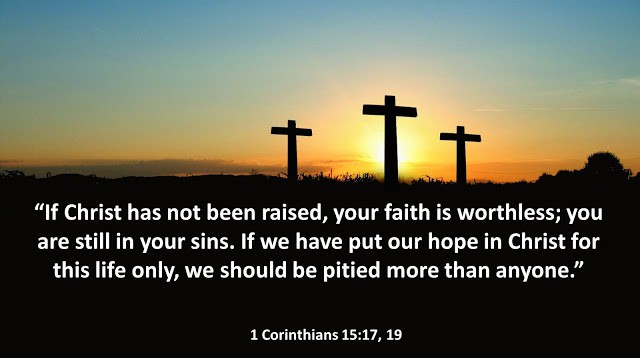
The Resurrection is the central tenet of the Christian faith.  The Apostle Paul stated that:

And if Christ has not been raised, then our preaching is in vain and your faith is in vain.  We are even found to be misrepresenting God because we testified about God that he raised Christ, whom he did not raise if it is true that the dead are not raised.  For if the dead are not raised, not even Christ has been raised.  And if Christ has not been raised, your faith is futile and you are still in your sins.  Then those also who have fallen asleep in Christ have perished.  If in Christ we have hope in this life only, we are of all people most to be pitied.

1 Cor 15:14-19

What this means is that the implications of the resurrection weigh greatly upon the Christian worldview. So what does it mean if Christ was resurrected?

1. God is real

Obviously, if one doesn’t believe in God, a man claiming to be God and rising from the dead would seem to indicate that God does exist.  However, Jesus has stated that even this wouldn’t convince the hardest skeptic.  But this does not diminish the strong evidential nature of the resurrection, it only describes the skeptic’s state of mind.

2. Christianity is True

If we can be sure from the evidence that Jesus is the son of God, he died on a Roman cross for our sins, and rose from the dead, Christianity follows.

3. All other worldviews are false

The law of non-contradiction states that two opposing ideas cannot both be true at the same time and the same way.  The statement “all religions are basically the same” or “all religions are equally true” are patently false.  However, they could all be false, even Christianity.  But, the resurrection would be evidence that the Christian worldview is true and all others would be false given the identity of Jesus being confirmed by the resurrection.

If you can show good, historically reliable evidence for the resurrection (and there is), then you have done most of the work in showing all other worldviews are false and have shown the truth of Christianity as Paul stated so long ago:

But in fact Christ has been raised from the dead, the firstfruits of those who have fallen asleep. 21 For as by a man came death, by a man has come also the resurrection of the dead. 22For as in Adam all die, so also in Christ shall all be made alive. 23But each in his own order: Christ the firstfruits, then at his coming those who belong to Christ. 24Then comes the end, when he delivers the kingdom to God the Father after destroying every rule and every authority and power. 25 For he must reign until he has put all his enemies under his feet. 26 The last enemy to be destroyed is death. 27 For “God has put all things in subjection under his feet.” But when it says, “all things are put in subjection,” it is plain that he is excepted who put all things in subjection under him.28 When all things are subjected to him, then the Son himself will also be subjected to him who put all things in subjection under him, that God may be all in all. 1 Cor 15 20-28.


Robby Hall is in the Secure Access industry for Information Technology.  He has been married for 3 years and has just welcomed his first child, Bridget.  He is graduate of the Cross Examined Instructor’s Academy and leads apologetics small groups at his local church.

Original Blog Source: http://bit.ly/2BwXFGf

[/et_pb_text][/et_pb_column][/et_pb_row][/et_pb_section]

By Tim Stratton

We expect people in positions of authority to have training and experience in their respective fields. For example, I want my pilot to have knowledge of the helicopter in which I am a passenger, just as I want my surgeon to be proficient, and to know what he/she is doing before I go “under the knife!” Guessing, flipping a coin, or relying on luck just doesn’t cut it. We expect people to have knowledge.

This seems to be the expectation of all who are labeled as experts or leaders in our society today, save one… the church! Why, when it comes to Christianity, are many satisfied to merely rely on our emotions or what we arbitrarily think? Is the Christian faith something more than this? Is it something we can actually know is true, rather than simply following an emotion or a “greatest desire?”

Sadly, knowledge of God is not just something unbelievers assume impossible, but many Christians have bought into this lie and are now living that misguided stereotype. Most people in our society think religion isn’t something we can know. That is why people adhering to religion are typically labeled “persons of faith” as opposed to a “person of knowledge.” Should this be the case?

Dallas Willard provides a working definition of knowledge:

“We have knowledge of something when we are representing it as it actually is, on an appropriate basis of thought and experience.”[1]

Basically, Willard is saying that we have knowledge of something when we have proper justification or warrant for our beliefs and that our beliefs regarding it conform to reality. A statement is true when it corresponds to reality, and reality is the way things are. Therefore, knowledge must be aligned with the truth (based on evidence or insight).

Willard notes that rational people are those who base their lives upon knowledge. This is important when considering the faith of a Christian. When one has knowledge of God and the truth of His word, he can easily step out in faith. Acting in faith is not a “blind leap” as society believes. Rather it’s committing to an action for which you may not know the outcome, basing your decisions on evidence and a justified trust in God through knowledge.

Can we have real knowledge of God? A cumulative case of evidence appealing to logic, science, and history pointing toward God’s existence and the truth of Christianity says we can. Moreover, we can also have knowledge of God through a personal relationship with Him, supported by the evidence just mentioned.

With a cumulative case of logical arguments in mind, a Christian should be a person of faith. . . because he or she is primarily a person of knowledge. Christians put their trust in what they know is probably true. This is what William Lane Craig refers to as “reasonable faith.”

I am not proposing that we can know Christian theism is true with 100 percent certainty. However, we can gain knowledge of God with extremely high degrees of certainty. This includes not only knowledge of a powerful and personal Creator of the universe, but also in the particular truth of Christianity through evidential and spiritual means.

In conclusion, Christians aren’t merely people of faith, but people of a faith that is justified by logic, data, and evidence. This is in stark contrast to the blind faith of many atheists based on mere presuppositions and baseless personal opinions. When Christians attain this knowledge of God and Scripture, their faith will grow extremely strong which will be evident in their prayer lives, their Christian walk, and their commitment to fulfilling the Great Commission. Evangelism will quickly transform from something that Christians are scared of into something they eagerly anticipate. This is because when one possesses knowledge, one has things they know to share with others. When Christians share their faith, rooted in knowledge of reality, these evangelical encounters will quickly multiply with awesome results.

Stay reasonable (Isaiah 1:18),

Tim Stratton

Notes

[1] Dallas Willard, Knowing Christ Today: Why We Can Trust Spiritual Knowledge, Harper Collins, New York, NY, 2009. This article was inspired by this book.


Tim Stratton (The FreeThinking Theist) Tim pursued his undergraduate studies at the University of Nebraska-Kearney (B.A. 1997) and after working in full-time ministry for several years went on to attain his graduate degree from Biola University (M.A. 2014). Tim was recently accepted at Northwest University to pursue his Ph.D. in systematic theology with a focus on metaphysics.

Original Blog Source: http://bit.ly/2MS51c4

By Jeremy Linn

We received a great question on our Instagram page this week:

“How do we know that the extra-biblical sources which mention Jesus are trustworthy? Josephus, Tacitus, and the rest weren’t eyewitnesses; they never knew Jesus.”

The questioner here is referring to ancient historical accounts – especially written by the historians Flavius Josephus and Cornelius Tacitus – which mention Jesus and give us some information about him. Josephus describes Jesus as the brother of James in his work Antiquities of the Jews and also provides the most well-known extra-biblical reference to Jesus. Tacitus makes reference to Jesus’ death under Pontius Pilate in his work Annals.

As the questioner stated, Josephus and Tacitus both were not eyewitnesses to the events of Jesus’ life. Josephus was born a few years after the events of Jesus’ life and was mostly involved in Jewish political matters (and not in the early Christian church). Tacitus also lived after Jesus – a few decades later – and focused on the politics and history of Rome (an area not heavily reached by the Christian church at the time).

Since these two historians were not eyewitnesses, how can we know to trust their references to Jesus? There are a few things we need to consider when answering this question:

  1. Ancient accounts of historical events were often written by people who lived after the events happened

In other words, they were not eyewitnesses of the events. Still, in these cases, we can still learn basic facts about the events which took place. For example, the earliest source we have about the events of Alexander the Great was written by a historian who lived around 300 years after the life of Alexander. Even with this time gap, we can consider many facts about Alexander to be reliable and true.

  1. Almost all ancient historical accounts were written within a culture focused on oral tradition

This focus means the details of the events were transmitted verbally within a community that could check the facts of the events with each other. This method of transmitting information becomes powerful when multiple people witness an event, as all the eyewitnesses can work together to reach a reliable account of the events that took place.

This oral focus gives us a primary reason why the writing of historical events tended to happen later – there was little need to immediately preserve events through writing when people were used to preserving events orally within their community. It also explains how a written account written years after a historical event can still be reliable – a reasonably accurate oral tradition could have already solidified by the time the events were written down.

  1. The works of Josephus and Tacitus are generally reliable. 

Tacitus is praised by historians for being a reliable source on the history of ancient Rome. Josephus’ reliability has been called into question because of his tendency to exaggerate and because of a strong bias towards Jews. However, he has provided us with valuable information about historical figures like Herod the Great, and information about the inner workings of Jewish ritual and culture. Overall, Josephus is reliable in providing basic historical facts about the lives of Jews.

Once we establish the general reliability of these authors, we can turn to the reliability of specific historical accounts they wrote, and specific passages within those accounts.

  1. There is no reason to question Tacitus’ reference to Jesus being killed under Pontius Pilate. 

The language used in passage 15.44 – saying that Jesus suffered the extreme penalty under Pontius Pilate, is consistent with other works of Tacitus. There is nothing out of the ordinary noted in this passage which would make us think the text was tampered with. And we even have archaeological evidence for the existence of Pilate – through an inscription found 50 years ago, and a ring found this year.

  1. We can find basic facts about Jesus in the works of Josephus. 

The references to Jesus in Josephus’ Antiquities get a bit more complicated. There is one reference to Jesus as the brother of James, which appears in every copy we have of the Antiquities. The reference doesn’t seem to be out of the ordinary in terms of the flow and style of the writings of Josephus. It is reasonable to consider this passage reliable.

However, in the most well-known reference to Jesus called the Flavius Testimonium, there is some commentary we would not expect Josephus to make based on his other writings and based on the fact he is a Jew. For example, one copy of the Antiquities includes the comment that Jesus was “the Christ,” which would be highly unlikely for him to say (after all, that would make him more of a Christian than a Jew!).

The inclusion of this commentary makes us question the details given in the passage, and brings up the possibility of an error in copying the passage or an intentional change in the passage by readers who lived after Josephus. That doesn’t mean we need to throw out the entire passage – it just means certain details are in question. When we eliminate the questionable details, we can still pull basic facts about Jesus in the passage, such as he was someone who did “marvelous works.”

  1. These references are not the only sources we have on Jesus. 

Let’s say we do throw the references in Tacitus and Josephus out. We still have the letters of Paul, the synoptic gospels, the writings of early Church fathers, and a few other extra-biblical references that provide some information on Jesus. Even the Gnostic gospels from the 2nd Century point us to some very basic facts about Jesus (such as his existence!)

The references in Tacitus and Josephus give us a greater sense of confidence in Jesus’ existence, and some key facts about his life – especially his ability to do things that people considered to be miraculous or at least “wonderous.” The references also point us to his death, an event that most Muslims and some skeptics deny. And through other extra-biblical sources, we can see that early followers revered Jesus highly and elevated him to the status of God.

Again, I didn’t intend for this post to provide the definitive answer for the reliability of extra-biblical references to Jesus. But these six considerations will definitely give you something to think about. No matter how we view the references to Jesus in Josephus and Tacitus, one thing is for sure – we have a wealth of evidence supporting the existence of Jesus and the basic claims that Christians make about his life.


Jeremy is the co-founder of the ministry Twin Cities Apologetics and is an accountant for a law firm in Minneapolis, Minnesota. He’s also going to Bethel Seminary for a graduate degree in a program called Christian Thought (basically Apologetics!). Outside of Apologetics, Jeremy enjoys sports, playing guitar, and making videos. 

Original Blog Source: http://bit.ly/2FZeFc9

By J. Brian Huffling

“Historians are biased and choose what they report. As such, history can’t be known.” That’s a typical objection to the ability to know history. If such objections prove that we can’t know history, then we can’t know that Christianity is true since it is known through history and historical claims. In his prologue, Luke says,

“In as much as many have undertaken to compile a narrative of the things that have been accomplished among us, just as those who from the beginning were eyewitnesses and ministers of the word have delivered them to us, it seemed good to me also, having followed all things closely for some time past, to write an orderly account for you, most excellent Theophilus, that you may have certainty concerning the things you have been taught” (Luke 1:1-4; emphasis added).

The above passage demonstrates that Luke was writing as an historian. Words such as the ones underlined show his desire to write the truth of the events he wanted to convey. So, if history can’t be known, then we can’t know that Christianity is true. Let’s look at a typical objection.

Bias is probably the most popular objection to knowing history. It is claimed by some that historians are biased. It is not always clear what the objection is really getting at, but usually it is something like the historian holds certain views that in some way make his reporting subjective or unfair. For example, an historian may be writing about a religious issue and if he is part of that religion he is likely going to be accused of being biased. The disciples are often said to be biased regarding the events of the life of Jesus, particularly his resurrection. Since they knew him and had a vested interest they must have made up the claims of the resurrection.

Ironically, there are many assumptions (i.e., biases) about the nature of bias. It is more often than not used in a negative way and is equated with subjectivity and falsity. But why should this be the case? Why should the notion of either bias or subjectivity be equated with something being false? People could be biased because of evidence. If the disciples really did see Jesus alive after he was dead, then the reason they were biased was because of evidence and proof. But this bias would not be based on any subjectivity since their knowledge was based on objective and empirical evidence. Further, someone could have a subjective view of something and still be correct. There is nothing about being biased or subjective that guarantees that the belief is false. Such is an assumption in itself.

Consider this popular argument against objectivity:

  1. To be objective one must be free from bias.
  2. No one is free from bias.
  3. Therefore, no one is objective.

This is a valid argument, meaning that the conclusion follows from the premises. But is it sound (i.e., is the argument valid and the premises and conclusion true)? Well, if no one is free from bias that means the one making this argument is not free from bias. But statements like “No one is . . .” is a universal statement that applies to everyone everywhere. But aren’t universal statements objective? What else would ‘objective’ means other than something that is universal and not simply limited to the subjective beliefs of an individual? This whole line of argument is self-defeating. In other words, when using the argument’s criteria, the very argument itself fails. The objector, in this case, is objective in trying to argue that no one is free from bias and that no one is objective. However, the only way to make such universal statements is for the objector to make objective statements. If they were subjective, then they wouldn’t necessarily be universal. If they weren’t universal, then maybe some people aren’t biased. But this contradicts the argument. Assuming the argument holds water because no one really denies that people are biased, it shows that one can be biased and objective. (Note, it is not guaranteed that one is going to be objective and biased, just that it’s logically possible. The objection is thus deflated.)

This raises another question that is rarely asked and usually assumed: What does it mean for something to be ‘objective’? By now it should be clear that it can’t mean free from bias since we’ve just seen that a person can be both biased and objective. So being free from bias is not necessary to be objective (in fact I would agree that everyone is biased in a general sense). So what does it mean? Most people think that it means being detached from a given circumstance so that one can see it as an objective outsider. In his fascinating work Jesus and the Eyewitnesses: The Gospels as Eyewitness Testimony, drawing on other work on this topic (such as Samuel Byrskog’s Story as History—History as Story: The Gospel Tradition in the Context of Ancient Oral History), Richard Bauckham makes the surprising and unfashionable statement:

“A very important point that . . . for Greek and Roman historians, the ideal eyewitness was not the dispassionate observer but one who, as a participant, had been closest to the events and whose direct experience enabled him to understand and interpret the significance of what he had seen” (page 9).

He further notes that many historians wanted someone who was involved in the events in question because that person would have a vested interest. They wanted someone who was involved and really there.

This counters the usual desire or assumed need for detatchment, but it does not say what objectivity is. Objectivity is arriving at conclusions that are based on evidence and principles that have their foundation in external reality. Everyone can use and measure truth claims based on external (objective) reality. Put negatively; it is the opposite of one making conclusions that arise simply out of one’s subjective mind. Such evidence based on reality and the principles that follow is mind-independent. Since reality is objective, that is, everyone can know it (as long as their faculties are working properly), the conclusions based on reality can also be objective. When one uses universal (objective) principles to ascertain the truth of a conclusion, one can be objective. Such principles are the laws of logic (or being). One such law is the law of non-contradiction. It declares that if two statements are mutually exclusive one must be true and the other must be false. For example, Christianity teaches that Jesus died. Islam counters that Jesus did not die. These statements are mutually exclusive—one must be true and the other false since there is no third option. Thus, they are contradictory. (This is contrasted with statements that can both logically be false, such as “Buddhism is true” and “Atheism is true.” Such statements that can both be false are called ‘contrary.’) Regarding this principle and its application to historical objectivity, Maurice Mandelbaum says,

“Our knowledge is objective if, and only if, it is the case that when two persons make contradictory statements concerning the same subject matter, at least one of them must be mistaken” (The Anatomy of Historical Knowledge, 150).

The law of non-contradiction is based in the nature of reality. It is not just a principle of thought, but of being. A tree cannot exist and not exist at the same time in the same sense. That would be a contradiction. Such first principles of thought and arising out of the nature of reality since something can’t simultaneously be and not be. It is not simply a made-up principle. In fact, it is undeniable since to deny it would require using it.

Thus, if one’s conclusions are based on external and objective reality and evidence, and the principles from such reality, those conclusions can be objective. There is, in a sense, an objective apparatus giving us the possibility of being objective. Again, this is contrasted with something arising only from one’s (subjective) mind rather than from external (objective) reality. There is, therefore, nothing about biases that preclude one from making objective historical statements. Biases do not guarantee subjectivity or falsity.

Back to Bauckham’s point regarding bias, it is often the case that people are indeed biased, but biased because of the evidence. They have seen so much evidence, that they are convinced that what they are saying is true. This, however, is not subjective bias or assumption, but rather the careful examination of objective reality and the evidence that all can investigate.

When looking at historical questions, such as the resurrection, one should not base his conclusions on notions such as the alleged bias of the ones making claims. Rather, one should examine the evidence for the claims to discover their veracity. We can recognize bias in every area and by all people. However, that alone is not enough to show that a person’s claim is false. To be good and responsible historians and investigators, we must follow the evidence.

(I would like to thank Norman L. Geisler for his direction regarding my MA thesis topic which was on this issue, as well as Thomas A. Howe to whom my thoughts and work are indebted greatly.)


Original Blog Source: http://bit.ly/2HOROSC

By Ryan Leasure

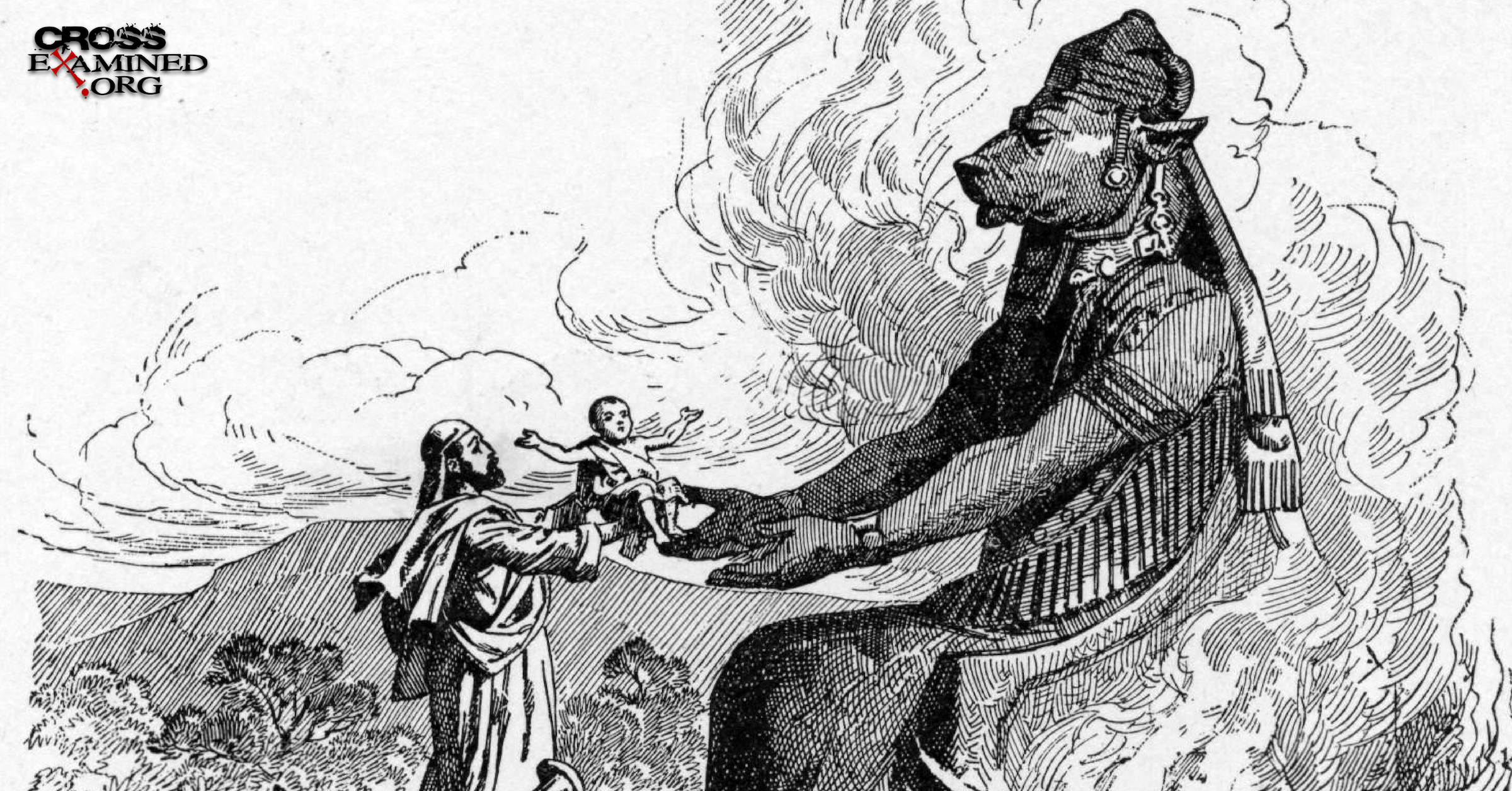
History is filled with barbaric cultures. One of the worst, though, has to be the ancient Canaanites. As was customary in that culture, parents offered their newborn children as sacrifices to their god Molech. Most depictions of Molech include large metal statues of a man with a bull’s head. Usually these statues had outstretched arms to hold the baby sacrifices.

During the sacrificial process, the Canaanites would light a fire inside or around the statue to heat up the statue as hot as they could. Then they would place their newborns into the red-hot arms of Molech and watch the children sizzle to death.

During this gruesome event, the Canaanites would play flutes and bang on drums to drown out the sound of their shrieking children. It’s truly awful stuff. No wonder God ordered the Israelites to destroy them.

Molech in The Bible

The Bible mentions Molech or at least references him about ten times. Here are a couple examples:

“Any Israelite or any foreigner residing in Israel who sacrifices any of his children to Molech is to be put to death. The members of the community are to stone him.” — Leviticus 20:2

“They built high places for Baal in the Valley of Ben Hinnom to sacrifice their sons and daughters to Molech, though I never commanded — nor did it enter my mind — that they should do such a detestable thing and so make Judah sin.” — Jeremiah 32:35

You might wonder why the Israelites would be tempted to sacrifice their children to Molech. As was the case with other ancient gods, Molech offered them some kind of benefit in exchange for their devotion. By offering up their children to be burned on the golden statue, the Canaanites believed Molech would cause them and their future children to prosper.

Our Molech Today

I don’t know a single person who hears about the horrors of Molech and doesn’t cringe at the gruesomeness. Brutally murdering babies in the name of Molech for future benefits is evil in the truest sense of the word.

Yet, at the same time, a large number of people today believe this ancient practice would be fine, so long as the baby was still in the womb. Just yesterday, New York legislators passed a law that allows for abortions up until birth. After the vote, this video circulated the internet showing hundreds of people cheering loudly in favor of this decision. It’s honestly one of the most disgusting scenes I’ve ever witnessed.

What kind of sick and twisted mind does one have to have to applaud the killing of unborn babies? These are babies after all. As I watched the video, I couldn’t help but think about the loud drums drowning out the babies’ screams.

“It’s Not as Bad as You Say It Is”

Since this new law allows women to abort their babies right before they go into labor, a woman can literally kill her baby one day and have people cheer for her, but if she kills her baby less than twenty-four hours later when it’s made it outside her womb, she’ll go to prison. It’s mind-blowing.

And let’s not pretend like the babies don’t feel a thing either. More studies than I can count demonstrate that babies at a very early stage can feel pain, not to mention taste food, hiccup, smile, dream, kick, and bond with their mother. So, when the abortion “doctor” injects the baby’s head with poison, know for sure the baby feels it and dies a horrifying death.

But they say, the law doesn’t allow for “any old abortion.” After all, the law says that only if the woman’s “life and health” are in jeopardy may she have an abortion up until birth.

The problem with this is that “health” could qualify for almost anything. It could mean physical health, but it could also mean psychological, mental, or financial health. In other words, it’s so vague that someone could get a late-term abortion for almost any reason. All the woman needs to say is that the baby would cause too much stress in her life because of added financial responsibilities, and she’s got her ticket to an abortion. Plain and simple.

Unborn Babies in The Old Testament

Though anyone with a first-grade knowledge of biology can see that a newborn and a full-term baby are scientifically the same, Christians have extra motivation to reject abortion because of Scripture’s clear teaching on the issue. Take Exodus 21:22-25 for example:

If people are fighting and hit a pregnant woman and she gives birth prematurely, but there is no serious injury, the offender must be fined whatever the woman’s husband demands and the court allows. But if there is a serious injury, you are to take life for life, eye for eye, tooth for tooth, hand for hand, foot for foot, burn for burn, wound for wound, bruise for bruise.

In short, no one should ever harm an unborn baby. If they do, the law calls for a strict penalty (life for life, eye for eye, etc.).

It’s interesting to note, that according to Old Testament law, accidentally killing someone did not result in “life for life.” Instead, accidental killers were sent to a city of refuge to stay away from the rest of the population (Num. 35:9-15). Meaning, God had an even stricter warning for accidentally killing unborn babies than people outside the womb.

Are you following the logic? If God had strict warnings against accidentally killing unborn babies, he must despise the fact that we kill them intentionally and then celebrate it to boot. So, when the mayor of New York lit up the World Trade Center in pink to celebrate more murder, we can rest assured that God doesn’t take it kindly. I mean, if that’s not a symbolic middle finger to God, I don’t know what is.

The Unborn Jesus

The birth of Jesus is a familiar one. The angel Gabriel appears to Mary and says that she’s going to conceive and give birth to a son. During her pregnancy, she visits her sister Elizabeth who was also pregnant at the time. Luke 1:41-44 reports:

When Elizabeth heard Mary’s greeting, the baby leaped in her womb, and Elizabeth was filled with the Holy Spirit. In a loud voice, she exclaimed: “Blessed are you among women, and blessed is the child you will bear! But why am I so favored, that the mother of my Lord should come to me? As soon as the sound of your greeting reached my ears, the baby in my womb leaped for joy.”

First, we notice that the text refers to the unborn child in Elizabeth’s womb as a baby (Greek, brephos). It’s the same Greek word used to describe children outside the womb (Lk. 18:15). And we see that this same baby was already able to recognize Jesus’ presence. In other words, he’s not just a lump of tissue.

Furthermore, Elizabeth, filled with the Holy Spirit, recognizes that Mary is the “mother of my Lord.” That is, she recognized Mary’s status as a mother despite the fact that Jesus was still in the womb.

While commenting on this text, Christian ethicist John Jefferson Davis writes:

The significant point is that God chose to begin the process of incarnation [in the womb], rather than at some other point, thus affirming the significance of that starting point for human life.1

Davis makes a good point. Since Jesus’ birth was miraculous, God could have chosen to start Jesus’ life at any point. He could have dropped him down from the sky and left him at someone’s doorstep. But instead, God chose to begin Jesus’ life in Mary’s womb demonstrating the value of unborn babies. I think we can all be glad that Mary didn’t have an abortion.

The Irony of Abortion

To date, Americans have slaughtered millions upon millions of unborn babies. Think about all those little innocent, vulnerable people, killed before they were even given a chance. And at the same time, we judge other nations for their less than humane practices. Who are we to talk?

But the greatest amount of irony is that every person in favor of abortion made it out of the womb alive. Every. Single. One. I dare say, they’re all grateful too.

Abortion and The God Molech

Truth is, we aren’t any better than the ancient Canaanites. Instead of sacrificing our children to the god Molech in exchange for future prosperity, we sacrifice our children in exchange for better career paths, financial security, and convenience.

While abortion apologists try to sanitize abortion by using terms like “tissue” instead of “baby” or “end the pregnancy” instead of “killing,” there’s no denying what’s going on when we inject poison into babies’ heads. We’re brutally murdering them. And we’ve done it millions of times. Lord, have mercy on us.


Ryan Leasure holds an M.A. from Furman University and an M.Div. from the Southern Baptist Theological Seminary. He currently serves as a pastor at Grace Bible Church in Moore, SC.

Original Blog Source: http://bit.ly/2RrBrea

By Wintery Knight

Have you ever heard Gary Habermas, Michael Licona or William Lane Craig defend the resurrection of Jesus in a debate by saying that the resurrection is the best explanation for the “minimal facts” about Jesus? The lists of minimal facts that they use are typically agreed to by their opponents during the debates. Minimal facts are the parts of the New Testament that meet a set of strict historical criteria. These are the facts that skeptical historians agree with, totally apart from any religious beliefs.

So what are the criteria that skeptical historians use to derive a list of minimal facts about Jesus?

Dr. Craig explains them in this article.

Excerpt:

The other way, more influential in contemporary New Testament scholarship, is to establish specific facts about Jesus without assuming the general reliability of the Gospels. The key here are the so-called “Criteria of Authenticity” which enable us to establish specific sayings or events in Jesus’ life as historical. Scholars involved in the quest of the historical Jesus have enunciated a number of these criteria for detecting historically authentic features of Jesus, such as dissimilarity to Christian teaching, multiple attestations, linguistic Semitisms, traces of Palestinian milieu, retention of embarrassing material, coherence with other authentic material, and so forth.

It is somewhat misleading to call these “criteria,” for they aim at stating sufficient, not necessary, conditions of historicity. This is easy to see: suppose a saying is multiply attested and dissimilar but not embarrassing. If embarrassment were a necessary condition of authenticity, then the saying would have to be deemed inauthentic, which is wrong-headed, since its multiple attestation and dissimilarity are sufficient for authenticity. Of course, the criteria are defeasible, meaning that they are not infallible guides to authenticity. They might be better called “Indications of Authenticity” or “Signs of Credibility.”

In point of fact, what the criteria really amount to are statements about the effect of certain types of evidence upon the probability of various sayings or events in Jesus’ life. For some saying or event S and evidence of a certain type E, the criteria would state that all things being equal, the probability of S given E is greater than the probability of S on our background knowledge alone. So, for example, all else being equal, the probability of some event or saying is greater given its multiple attestations than it would have been without it.

What are some of the factors that might serve the role of E in increasing the probability of some saying or event S? The following are some of the most important:

(1) Historical congruence: S fits in with known historical facts concerning the context in which S is said to have occurred.

(2) Independent, early attestation: S appears in multiple sources which are near to the time at which S is alleged to have occurred and which depend neither upon each other nor a common source.

(3) Embarrassment: S is awkward or counter-productive for the persons who serve as the source of information for S.

(4) Dissimilarity: S is unlike antecedent Jewish thought-forms and/or unlike subsequent Christian thought-forms.

(5) Semitisms: traces in the narrative of Aramaic or Hebrew linguistic forms.

(6) Coherence: S is consistent with already established facts about Jesus.

For a good discussion of these factors see Robert Stein, “The ‘Criteria’ for Authenticity,” in Gospel Perspectives I, ed. R. T. France and David Wenham (Sheffield, England: JSOT Press, 1980), pp. 225-63.

Notice that these “criteria” do not presuppose the general reliability of the Gospels. Rather they focus on a particular saying or event and give evidence for thinking that specific element of Jesus’ life to be historical, regardless of the general reliability of the document in which the particular saying or event is reported. These same “criteria” are thus applicable to reports of Jesus found in the apocryphal Gospels, or rabbinical writings, or even the Qur’an. Of course, if the Gospels can be shown to be generally reliable documents, so much the better! But the “criteria” do not depend on any such presupposition. They serve to help spot historical kernels even in the midst of historical chaff. Thus we need not concern ourselves with defending the Gospels’ every claim attributed to Jesus in the gospels; the question will be whether we can establish enough about Jesus to make faith in him reasonable.

And you can see Dr. Craig using these criteria to defend minimal facts in his debates. For example, in his debate with Ehrman, he alludes to the criteria when making his case for the empty tomb.

Here, he uses multiple attestations and the criteria of embarrassment:

Among the reasons which have led most scholars to this conclusion are the following:

  1. The empty tomb is also multiply attested by independent, early sources.

Mark’s source didn’t end with the burial, but with the story of the empty tomb, which is tied to the burial story verbally and grammatically. Moreover, Matthew and John have independent sources about the empty tomb; it’s also mentioned in the sermons in the Acts of the Apostles (2.29; 13.36); and it’s implied by Paul in his first letter to the Corinthian church (I Cor. 15.4). Thus, we have again multiple, early, independent attestation of the fact of the empty tomb.

  1. The tomb was discovered empty by women.

In patriarchal Jewish society, the testimony of women was not highly regarded. In fact, the Jewish historian Josephus says that women weren’t even permitted to serve as witnesses in a Jewish court of law. Now in light of this fact, how remarkable it is that it is women who are the discoverers of Jesus’ empty tomb. Any later legendary account would certainly have made male disciples like Peter and John discover the empty tomb. The fact that it is women, rather than men, who are the discoverers of the empty tomb is best explained by the fact that they were the chief witnesses to the fact of the empty tomb, and the Gospel writers faithfully record what, for them, was an awkward and embarrassing fact.

There are actually a few more reasons for believing in the empty tomb that he doesn’t go into in the debate, but you can find them in his written work. For example, in his essay on Gerd Ludemann’s “vision” hypothesis. That essay covers the reasons for all four of his minimal facts.

So, if you are going to talk about the resurrection with a skeptic, you don’t want to invoke the Bible as some sort of inerrant/inspired Holy Book.

Try this approach instead:

  1. Explain the criteria that historians use to get their lists of minimal facts
  2. Explain your list of minimal facts
  3. Defend your list of minimal facts using the criteria
  4. Cite skeptics who admit to each of your minimal facts, to show that they are widely accepted
  5. List some parts of the Bible that don’t pass the criteria (e.g. – guard at the tomb, Matthew earthquake)
  6. Explain why those parts don’t pass the criteria and explain that they are not part of your case
  7. Challenge your opponent to either deny some or all the facts or propose a naturalistic alternative that explains the facts better than the resurrection
  8. Don’t let your opponent attack any of your minimal facts by attacking other parts of the Bible (e.g. – the number of angels being one or two, etc.)

And remember that there is no good case for the resurrection that does not make heavy use of the early creed in 1 Corinthians 15:3-8.

The best essay on the minimal facts criteria that I’ve read is the one by Robert H. Stein in “Contending with Christianity’s Critics“. It’s a good short essay that goes over all the historical criteria that are used to derive the short list of facts from which we infer the conclusion “God raised Jesus from the dead”. That whole book is really very, very good.


Original Blog Source: http://bit.ly/2Tfx7jC