
Tag Archive for: Christianity

By Alisa Childers

When my daughter Dyllan was a toddler, I exercised quite regularly at the YMCA. (And by “exercised,” I mean that I read a book on the stationary bike and pedaled as slowly as possible while I enjoyed an hour of free childcare. Not gonna lie.) One day when I picked her up from the kid’s room, the childcare worker pulled out the unopened granola bar I had put in Dyllan’s bag, handed it to me, and said, “We can’t give this to her because it contains peanuts. We don’t allow anything with peanuts into the childcare area.” I admit I was a bit surprised because it wasn’t something I had given much thought to. But I quickly learned that there was almost nothing parents feared more in 2010 than the dreaded peanut.

Of course, peanut allergies are very real. In their book, The Coddling of the American Mind: How Good Intentions and Bad Ideas Are Setting Up a Generation for Failure, Greg Lukianoff and Jonathan Haidt reported that before the mid-1990s, peanut allergies were extremely rare in American children. However, by 2008, fourteen out of every thousand kids had developed peanut allergies. No one knew why there was such a drastic increase until an authoritative study was released in 2015. It was discovered that many kids were developing peanut allergies because their parents avoided giving them peanuts. The study revealed that introducing peanut products to infants with a high risk for allergies actually reduced their chances of developing a peanut allergy by a whopping 81%. In other words, giving peanut products to infants caused their immune systems to respond and build up a tolerance.

Our kids have amazing bodies that react to bacteria, parasites—and yes, peanuts—with an immune response that teaches their system to adapt and fight off future threats to their health.

In the same way, I believe our kids have spiritual immune systems.

Several years ago,  I was a participant in a study and discussion group about Christianity. This was the class that challenged my faith intellectually and I’ve told that story here. One day, the subject of Adam and Eve came up and it was asked, “Does anyone still believe they were actual people?” I’m a little embarrassed to admit that I was entirely naive when it came to this subject. Even as an adult, I thought the literal existence of Adam and Eve was something all professing Christians believed in. Chalk it up to the Evangelical bubble I grew up in or the fact that most of my life happened before the invention of the internet. But the question threw me because I had no idea how to answer.

Until that moment, I didn’t even know it was a question. I had zero immunity. 

This was simply one of many skeptical claims raised against historic Christianity that snowballed together to send me into a dark time of doubt. I’ve often replayed that moment in my mind and imagined a different scenario. What if I had been aware of this question from childhood? What if I had already thought it through? What if when I read the Genesis account of creation, someone had told me, “Hey, some people don’t think Adam and Eve really existed. Let’s think about what the Bible says about it, what scientific evidence shows, and what that would mean for the gospel.

If my spiritual immune system had been strengthened in this way, hearing this question as an adult would have been no big deal. It wouldn’t have shaken my faith one bit. I would have simply engaged in that conversation intelligently, without fear or doubt.

Other than teaching our kids the basics of the Christian faith, there are many practical steps we can take to help bolster their spiritual immune systems. Here are three to start with:

1. Read the Bible with your kids, and don’t skip the hard stuff. 

By “don’t skip the hard stuff,” I certainly don’t mean you should freak your kids out right before bed by reading about the Levite hacking his concubine to pieces in Judges 19, or Samson getting his eyes gouged out in Judges 16. Obviously, there is an age-appropriate way to introduce biblical stories to our kids. What I mean by “don’t skip the hard stuff,” is that reading stories and accounts that skeptics typically challenge is a great way to inoculate our kids against their false ideas.

For example, when my daughter was about seven, we read through Genesis together.  In chapter 26, we read the story of Isaac lying to the Philistines. He told them his wife Rebekah was his sister, fearing that someone might kill him in order to marry her. I said to my daughter, “Did you know that some people think this story is made up because it’s so similar to what Isaac’s dad Abraham did twice before? What do you think about that?” We had a great conversation about how it would make perfect sense for Isaac to repeat his father’s lie, because there seemed to be no major consequences for doing so. In fact, in both cases, Abraham left richer than he came. We also looked at the biblical theme of sons tending to repeat their father’s sins. After we talked, it all made sense. And now my daughter won’t be caught off-guard should she hear that skeptical claim in the future.

​A great resource to help with this is The Apologetics Study Bible. As you read through the Bible, it footnotes the verses that skeptics typically challenge, and offers intelligent and credible responses you can talk through with your kids!

​2. Expose your kids to atheism.

As a parent, it can be scary to intentionally tell your kids all the reasons why atheists reject Christianity. Based on her experience teaching apologetics to Christian parents,  my friend Natasha Crain noted that many parents don’t want to risk leading their kids astray by introducing atheist arguments. But she rightly points out that all of our kids will inevitably hear these ideas. She wrote:

The only choice you have as a parent is if they’ll hear them first from you—in an environment where they’ll have your guidance readily available—or if they’ll hear them first from nonbelievers—in an environment where they’ll be processing what they hear on their own.

Brett Kunkle compares exposure to atheist ideas with teaching his kids to surf.  In this video, he explains that as a parent, you wouldn’t throw your kid into the ocean to surf big waves before you teach them basics like swimming and how to handle smaller waves. Watch below:

​Getting our kids used to the “smaller waves” of atheism can be a great way to prepare them to encounter the “big waves” when they are out on their own.

3. Expose your kids to false gospels and other religions.

​Just like it’s important to expose our kids to atheist ideas, it’s equally important to expose them to counterfeit gospels—which almost always masquerade as authentic Christianity. It’s been said that the best lies contain the most truth. This is why false gospels can be so tricky to discern. . .they contain so much truth.  They will often emphasize Jesus, use the right lingo, and even appeal to the Bible to back up their claims. Explaining the differences between authentic Christianity and Mormonism, Jehovah’s Witnesses, the prosperity gospel, or progressive Christianity will prepare our kids to interact with their ideas and see through the deceptions they espouse.

Another important step is talking with our kids about what people of other religious faiths believe about God, Jesus, and the nature of reality. Although they agree on some points, every world religion contradicts the others at a fundamental level. Logically, they can’t all be true. This is a great opportunity to expose the contradictions and talk with our kids about why Christianity is true and best explains reality.

Who would have thought that giving a baby a tiny bit of peanut butter could potentially save his life? In the same way, giving our kids tiny bits of anti-Christian ideas and allowing them to process these questions within the safety and guidance of our care could have a lasting impact on their future spiritual lives.

Other practical resources:

For years, Brett Kunkle has offered theological training for teenagers and facilitated trips to Utah to interact with Mormons. When I interviewed him on my podcast, he reported that the impact of these trips has been tremendous in the lives of young people, motivating them to study theology and apologetics on their own. He now offers trips to the Berkeley college campus where Christian kids can share the gospel and interact with atheists and skeptics. Find out more at www.maventruth.com.

Another ministry doing great work in this area is Jonathan Morrow and Impact 360. Every summer, they offer experiences in which Christian teenagers are trained in leadership, apologetics, and theology after which they are given real-world experiences to test their knowledge. They visit Buddhist and Mormon temples, meet atheists, and more. Find out more at www.impact360institute.org and listen to Jonathan’s interview on my podcast.

If you want to be intentional about this, pick up Natasha Crain’s book Talking with Your Kids about God: 30 Conversations Every Christian Parent Must Have, and follow Natasha’s blog for more great tips. Or pick up J. Warner Wallace’s trio of kids’ books (12, and 3) that explore everything from the existence of God to the truthfulness of Christianity.

Recommended resources related to the topic:

Proverbs: Making Your Paths Straight Complete 9-part Series by Frank Turek DVD and Download

So the Next Generation will Know by J. Warner Wallace (Book and Participant’s Guide)

Fearless Generation – Complete DVD Series, Complete mp4 Series (download) by Mike Adams, Frank Turek, and J. Warner Wallace

Jesus, You and the Essentials of Christianity by Frank Turek (INSTRUCTOR Study Guide), (STUDENT Study Guide), and (DVD)      

_____________________________________________________________________________________________________________________________________________________

Alisa Childers is an American singer and songwriter, best known for being in the all-female Christian music group ZOEgirl. She has had a string of top ten radio singles, four studio releases, and received the Dove Award during her time with ZOEgirl. In later years, Alisa found her life-long faith deeply challenged when she started attending what would later identify as a Progressive Christian church. This challenge pushed Alisa toward Christian Apologetics. Today you can read, listen and watch Alisa’s work online as well as purchase her recently published book on Progressive Christianity titled Another Gospel.

Original Blog Source: https://bit.ly/3pDSI7V
 

By Bob Perry

If you’re anything like me, you probably associate the word “myth” with an ancient fairy tale. The Greek and Roman pantheon of gods comes to mind — magical spells, curses, and multi-headed monsters. But myths are more than just old-fashioned fantasies. They serve a purpose. They appeal to our collective imaginations. Myths may be fantastical but, as the Merriam-Webster Dictionary puts it, they “serve to unfold part of the worldview of a people or explain a practice, belief, or natural phenomenon.” They are archetypal stories that help us make sense of the world in which we find ourselves. In other words, there is a connection between myth and reality.

The Power of a Story

C.S. Lewis grew up a voracious reader. In 1916, while waiting for a train near London, he bought a copy of George MacDonald’s Phantastes: A Faerie Romance. The book changed his life, not because it enticed him to believe in fantasies, but because it “baptized his imagination” through the power of story. His appreciation for man’s moral imagination led to a lifetime of reading and writing stories. He later studied ancient Greek and Latin literature, philosophy, and Medieval and Renaissance literature. He taught and lectured on all of those during his 29 years as a professor at Magdalen College, University of Oxford.

Great Minds Don’t Always Think Alike

While he was at Oxford, Lewis became friends with J. R. R. Tolkien. They argued about philosophy, religion, and the existence of God. Both were storytellers. And they argued about how to tell stories too. Tolkien, the author of The Hobbit and Lord of the Rings, believed that myths originated in the mind of God as a way to communicate his truths to the world. Lewis thought that was nonsense. Though he saw myths as beautiful charmers of our imaginations, he thought “they were lies: inventions that contain no objective truth about the world.”*

C.S. Lewis struggled with the relationship between myth, imagination, and reality for years. But it wouldn’t let him go. Finally, in 1929, alone in the quiet of his room at Magdalen College, he succumbed to God’s call. And I do mean succumbed.

The Most Reluctant Convert

Lewis describes his two-step conversion — from atheist to theist to Christian — in his autobiography, Surprised by Joy. He knew mythology. And he was intellectually honest enough to read the Christian Scriptures. Something about them rang true. Ultimately, it was his love for truth and stories that merged in the pages of the Gospels:

“I was … too experienced in literary criticism to regard the Gospels as myths. They had not the mythical taste. And yet the very matter which they set down in their artless, historical fashion . . . was precisely the matter of the great myths. If ever a myth had become fact, had been incarnated, it would be just like this. And nothing else in all literature was just like this …

Myths were like it in one way. Histories were like it in another. But nothing was simply like it … And no person was like the Person it depicted; as real, as recognizable, through all that depth of time, as Plato’s Socrates . . . yet also numinous, lit by a light from beyond the world, a god … But if a god — we are no longer polytheists — then not a god, but God. Here and here only in all time, the myth must have become fact; the Word, flesh; God, Man. This is not ‘a religion,’ nor ‘a philosophy.’ It is the summing up and actuality of them all.”**

The God who became flesh made sense of the two things C. S. Lewis knew and loved the most. He surrendered to the divine call. Lewis entered God’s kingdom kicking and screaming, “the most reluctant convert in all of England.”

Storytellers

C.S. Lewis’s conversion is notorious but it’s not unique. History is littered with the accounts of reluctant converts who were struck by the peculiar force of the Christian myth. He and Tolkien became two of the most famous storytellers to do so.

“Fortified by their faith, they proclaimed for their generation — and ours — a True Myth about the dignity of human life and its relationship to God. Against all expectation, their writings would captivate and inspire countless readers from every culture and every part of the globe … as mythmakers, [their writing] created new worlds … invented new languages, and transported us into realms of brooding darkness and unforgettable beauty.”***

In the end, Tolkien and Lewis rejected the secular myth that had dragged the world through two World Wars and into the empty despair of the postmodern worldview. They were masterful at appealing to our moral imaginations. They connected myth to reality.

The True Myth

The Christian myth is a story of the struggle between good and evil. It’s a story of flawed and rebellious people, heroes, and villains. Ultimately, it’s the most fantastic story of redemption ever told. And its hero is — as my friend Tom Gilson has put it in his book by the same name — simply “too good to be false.” Gilson’s point is that Jesus of Nazareth is the most compelling character in human history for a reason. He stepped into the story he wrote.

Jesus’ life and ministry are recorded and verifiable. The veracity of the accounts of his death and resurrection are as reliable as those of any historical event. But his impact goes beyond the reliable accounts about it. As J. Warner Wallace has so clearly summarized it in his book, Person of Interest, Jesus’ life rocked the world, even for those who never believed in him. He influenced education, literature, music, art, architecture, and science in ways that no mere mortal ever could. We restarted our calendars because of his life. He quite literally changed the world by combining history’s most fascinating character with mythology’s most compelling storyline.

He brought the myth to life.

Heaven Meets Earth

In Jesus, the infinite voluntarily reduced itself to something we could see and understand. The divine put on flesh and bone. The all-powerful became a pain-feeling person who stood for the powerless. The Almighty who spoke the universe into existence took the form of a tiny, vulnerable embryo. The Great Mythical ‘I AM’ became a little boy.

Contemplating that, I was reminded of a talented musician named Rich Mullins. Mullins died tragically in a car wreck in 1997, at age 41. But his music always resonated with me. It was thought-provoking, vulnerable, and real. Rich Mullins was a storyteller. So, it’s not surprising that the same guy who wrote the classic worship song, “Awesome God,” also wrote the little tune I offer you below.

Here, Mullins does with music what C. S. Lewis did with literature. He brings the myth to life. It will never become a classic in the genre, but that’s why I consider Rich Mullins’ “Boy Like Me” to be a Christmas song. Maybe you will too …

Boy Like Me

You was a baby like I was once … You was cryin’ in the early morn’

You was born in a stable, Lord … Reid Memorial is where I was born.

They wrapped You in swaddling clothes … Me they dressed in baby blue.

Well, I was twelve years old in the meeting house, listening to the old men pray,

And I was tryin’ hard to figure out what it was that they was tryin’ to say.

There You were in the temple … They said You weren’t old enough to know the things You knew

Well, did You grow up hungry? Did You grow up fast? 

Did the little girls giggle when You walked past?

Did You wonder what it was that made them laugh?

And did they tell You stories ’bout the saints of old? Stories about their faith?

They say stories like that make a boy grow bold. Stories like that make a man walk straight.

And You was a boy like I was once … But was You a boy like me?

Well, I grew up around Indiana. You grew up around Galilee

And if I ever really do grow up … Lord, I want to grow up and be just like You.

References:

* Joseph Loconte, A Hobbit, A Wardrobe and a Great War (Nashville: Nelson Books, 2015), pp. 130-131.

** C. S. Lewis, Surprised by Joy (New York: Harcourt Brace Jovanovich, 1956), pp. 236.

*** Loconte, p. 138.

Recommended resources related to the topic:

How Can Jesus be the Only Way? (mp4 Download) by Frank Turek

Cold Case Resurrection Set by J. Warner Wallace (books)   

Jesus, You and the Essentials of Christianity by Frank Turek (INSTRUCTOR Study Guide), (STUDENT Study Guide), and (DVD)      

_____________________________________________________________________________________________________________________________________________________

Bob Perry is a Christian apologetics writer, teacher, and speaker who blogs about Christianity and the culture at truehorizon.org. He is a Contributing Writer for the Christian Research Journal and has also been published in Touchstone, and Salvo. Bob is a professional aviator with 37 years of military and commercial flying experience. He has a B.S., Aerospace Engineering from the U. S. Naval Academy, and an M.A., Christian Apologetics from Biola University. He has been married to his high school sweetheart since 1985. They have five grown sons.

Original Blog Source: https://bit.ly/3HAE5IE


By Brian Chilton

A cabin was nestled near the top of a mountaintop in the Great Smoky Mountains of Tennessee. This cabin served as a vacation home for my family and me. The evening was humid and muggy. Thus, we decided to take in a show in Pigeon Forge rather than exploring the beautiful hills of eastern Tennessee. On this evening, I would suffer an emotional and spiritual panic attack. The catalyst of the event was various reports of institutional abuse. One report discussed alleged cases of rape that went unreported. Other reports mentioned accusations of abuse from a person who would be the last person one would suspect of such behaviors.

Admittedly, I have suffered from bouts of anxiety in the past. Normally, I can sense when a bout of anxiety is about to commence. But in this case, it was as if I felt an overwhelming case of sorrow and distress. After requesting prayer on social media, I was blessed by the numerous supporters offering their prayers and encouragement. Many friends contacted me directly, whereas many others offered support online. It was heartwarming to see how many people truly cared. But this event left me curious as to why I would suffer such distress while on vacation of all places.

It was not until a few days afterward that I realized that the pain I had previously suffered in the pastorate was still unresolved. I still didn’t understand why I felt the way I did. Drs. David and Marybeth Baggett reached out to me. I spoke to them about my feelings and what I believed to be the culprit. Marybeth suggested two books for me to consider reading. The first was entitled Something’s Not Right: Decoding the Hidden Tactics of Abuse and Freeing Yourself from its Power by Wade Mullen. The other was Redeeming Power: Understanding Authority and Abuse in the Church by Diane Langberg.

Mullen’s book truly spoke to me. He mentioned a field of sociological research known as impression management. Canadian sociologist Erving Goffman described impression management as the “process of creating, influencing, or manipulating an image held by an audience.”[1] Impression management especially becomes abusive and unethical when people are put on display to hide underlying problems that should not be hidden.[2] Mullen further notes that “the chief desire of abusive individuals is to attain or retain power—most often the kind of power gained and held through deception.”[3] Because of this, churches can become a breeding ground for abusers to thrive.

But why do religious institutions allow such abuse to transpire? Mullen offers a reason for this as well. He says that many institutions unknowingly permit systems that are conducive for abuse because of image. If people were to know the problems that a place faced, then others may not want to come and take part of what the institution offered.[4] As I read Mullen’s opening chapter, I began to realize two things. First, I came to the realization that I had suffered a form of abuse. Speaking with numerous individuals who were concerned with my well-being, I met many who admitted that they were victims of various forms of abuse. They faced similar emotional and spiritual bouts, some of which were full-blown cases of PTSD. Their professed experiences were eerily reminiscent of my own. Second, I came to realize that institutional abuse, identified as impression management, was far more widespread than I ever considered.

The first step in healing is to first diagnose the source of pain. I cannot say that I am fully healed from the abuse that I encountered. But I do believe that I have taken the first step. Perhaps God permitted me to have this emotional episode to bring me to the place of genuine recovery. Whatever the case, I also believe that many others are facing the same issues but do not understand where their emotional and spiritual hurts derive.

So, where do we go from here? I will occasionally update you on my progress from time to time. But there are two suggestions I would make for the here and now. First, become grounded in theology and apologetics. As my good friend Jerry Bogacz said, apologetics becomes an anchor keeping one stable during times of emotional distress. While it is not understood why I endured some of the things that I have in ministry, all the while understanding my own faults[5]—the goodness of God is a constant wellspring of hope and a constant source of comfort.

Second, cases of institutional abuse must be exposed and corrected. We can no longer stand idly by while innocent people are harmed by abusers hiding behind crosses and policies. The prophet Isaiah writes, “Learn to do what is good. Pursue justice. Correct the oppressor. Defend the rights of the fatherless. Plead the widow’s cause” (Isaiah 1:17).[6] Also, consider that Jesus told the Church of Ephesus that they must “Remember how far you have fallen; repent, and do the works you did at first. Otherwise, I will come to you and remove your lampstand from its place, unless you repent” (Rev. 2:5). While I have had an enigmatic relationship with the church throughout my life, I still love Christ’s Bride. If the problems of abuse in the American Church are not corrected, we should not be surprised if Jesus may eventually remove the lampstand from the Church of America. Be on the lookout for future posts as I discover more truths on my pathway to recovery. Continue to deepen your love for God and be kind to one another.

Notes

[1] Erving Goffman, The Presentation of Self in Everyday Life (New York, NY: Anchor, 2008); Wade Mullen, Something’s Not Right: Decoding the Hidden Tactics of Abuse and Freeing Yourself from its Power (Carol Stream, IL: Tyndale Momentum, 2020), 9.

[2] Mullen, 12.

[3] Ibid., 15.

[4] Mullen calls this “dark secrets…facts a person or an organization knows and conceals because if they were revealed, they could damage the image of that person or organization.” Ibid, 17.

[5] By no means am I claiming that I was sinless in all my previous encounters.

[6] Unless otherwise noted, all quoted Scripture comes from the Christian Standard Bible (Nashville, TN: Holman, 2020).

_____________________________________________________________________________________________________________________________________________________

Brian G. Chilton is the founder of BellatorChristi.com, the host of The Bellator Christi Podcast, the author of the Layman’s Manual on Christian Apologetics, and a Ph.D. Candidate of the Theology and Apologetics program at Liberty University. He received his Master of Divinity in Theology from Liberty University (with high distinction); his Bachelor of Science in Religious Studies and Philosophy from Gardner-Webb University (with honors); and received certification in Christian Apologetics from Biola University. Brian is a member of the Evangelical Theological Society and the Evangelical Philosophical Society. Brian has served in pastoral ministry for nearly 20 years and currently serves as a clinical chaplain and a Senior Contributor for MoralApologetics.com.

Original Blog Source: https://cutt.ly/7Pxh7LB


By Ryan Leasure

This article is part four in a nine-part series on how we got the Bible. Part 1 looked at biblical inspiration and inerrancy. Part 2 considered the development of the Old Testament. And Part 3 investigated the Old Testament canon and the Apocrypha.

In this article, we transition to the New Testament canon. Specifically, I want to answer two questions. First, would the first-century Christians have expected new Scripture in addition to the Old Testament? And second, what attributes did the church look for in canonical texts?

Would the First-Century Church have Expected New Scripture?

Biblical scholar Harry Gamble once remarked, “There is no intimation at all that the early church entertained the idea of Christian scriptures… Therefore, the NT as we think of it was utterly remote from the minds of the first generation of Christian believers.”1. What are we to make of Gamble’s assertion? Was he right? Did the early church assume that God was done inspiring Scripture after the close of the Old Testament? I believe we have good reason to reject Gamble’s claims. Let me give you three reasons why.2

1. First-century Jews regarded the Old Testament story as Incomplete

Several texts from the Gospels and Acts demonstrate that first-century Jews expected God to do something in their generation. Not only were they on the look-out for the Messiah (Luke 2:38; 2:25; John 1:41; 4:25), they expected God to usher in his kingdom and overthrow their oppressors (Acts 1:6; see Dan 2:31-45). Second Temple period (intertestamental) texts also confirm this same expectation (Tob 14:5-7; Bar 3:6-8). As N. T. Wright notes, “The great story of the Hebrew scriptures was therefore inevitably read in the Second Temple period as a story in search of a conclusion.”3

The close of the Old Testament also gives the impression that the Jews expected a Davidic King to rise up among their ranks. Keep in mind, according to Jewish ordering, Chronicles was the final book of the Old Testament. And that book starts off with a lengthy genealogy centered around King David (1 Chron 1-3). It’s no coincidence that the start of the New Testament picks up right where the Old Testament left off with a genealogy focusing on the Son of David (Matt 1). It’s as if the Gospel of Matthew brings the story of the Old Testament to its necessary fulfillment.

2. God’s Pattern of Bringing New Word-Revelation after his Acts of Redemption

According to the Old Testament pattern, God typically gives revelation deposits after his redemptive acts. We see this sequential pattern most clearly in the Exodus. God redeemed his people out of Egypt. He then followed up that redemption with Scriptural installments at Sinai to interpret his saving acts. Given this history, it’s not inconceivable that the early church would have expected more written revelation following Jesus’ act of redemption.

3. The Old Testament Predicted that the Future Messianic Age would Include Verbal Communication

Not only did the Old Testament predict a future messianic age, it predicted that communication would accompany the Messiah. Deuteronomy 18:18 predicts “I will raise up for them a prophet like you from among their brothers. And I will put my words in his mouth, and he shall speak to them all that I command him.” Isaiah 61:1-2  says of the Messiah that “The Spirit of the LORD God . . . has anointed me to bring good news to the poor . . . to proclaim liberty to the captives . . . to proclaim the year of the Lord’s favor.” And of this Messianic age, we read, “out of Zion shall go the law, and the word of the LORD from Jerusalem” (Isa 2:2-3).

In sum, those living after the close of the Old Testament recognized that the story was incomplete, that God typically gave word-revelation following his redemptive acts, and that the Old Testament anticipated a verbal Messianic age.

What Attributes did the Early Church Look for in a Canonical Text?

Now that we’ve established the early church’s expectation for more biblical texts, we must now ask what attributes they would have looked for in those new biblical texts. In the remaining space, I will consider three of these attributes—apostolic authority, marks of inspiration, and universal reception.4 Let’s consider each canonical attribute in turn.

Apostolic Authority

Going back to the New Testament, the apostles recognized that they were “ministers of the New Covenant” (2 Cor 3:6), and that the church was “built on the foundation of the apostles and prophets (Eph 2:20). They also recognized that Jesus had sent them out as the guarantors and transmitters of his message to the world (John 20:21). For these reasons, the early church only received texts that could be traced back to an apostle.

Therefore, from an early time, the church received the four Gospels, Acts, and Paul’s letters. Of course, Paul makes his apostolic authority known in his letters, but the Gospels make no such claim. How then did they receive apostolic status at such an early stage in the church?

Critics argue that since the authors don’t mention their names in the body of the text, the Gospels must have been originally anonymous. It was only after some time that the church added titles to give these anonymous works some needed credibility. Yet, the critics’ assertions lack evidence. All the earliest manuscripts with titles list Matthew, Mark, Luke, and John as the authors. Additionally, numerous church fathers state unequivocally that Mark wrote his Gospel based on Peter’s eyewitness testimony, and that Matthew, Luke, and John all wrote their respective Gospels.

That said, why did the church receive Mark and Luke if they weren’t apostles themselves? It’s because of their close association with the apostles. That is to say, books with apostolic authority were not limited to books that were written by the apostles. Rather, books that came from apostolic circles also came with apostolic authority. Notice Tertullian’s comment about Gospel authorship: “Of the apostles, therefore, John and Matthew first install faith into us; whilst of apostolic men, Luke and Mark renew it afterwards.”5 Tertullian affirms that Mark and Luke were “apostolic men” by nature of their close association with the apostles Peter and Paul.

This close proximity to the apostles also explain why Hebrews made its way into the canon. The author indicates he knew Timothy (Heb 13:23) and that the Gospel message “was declared at first by the Lord, and it was attested to us by those who heard” (Heb 2:3). These two texts combined indicate that the author walked in apostolic circles (probably Pauline), and therefore, his book was apostolic.

Jesus’ family (James and Jude) also received quasi-apostolic status as well based on their relationship to the Lord. We don’t know as much about Jude, but we know James became a prominent leader in the Jerusalem church and later martyr for his Christian faith.

At the same time, the church rejected books from non-apostolic sources. Commenting on the so-called Gospel of Peter, church father Serapion declared, “We receive both Peter and the other apostles as Christ, but the writers which falsely bear their names we reject.6 Serapion asserted that the church should reject the heretical Gospel of Peter and all others that falsely bear the apostles’ names (Thomas, Philip, etc.).

The Muratorian Fragment makes a similar comment around AD 180. It notes, “There is said to be another letter in Paul’s name to the Laodiceans, and another to the Alexandrines, both forged in accordance with Marcion’s heresy, and many others which cannot be received into the catholic church, since it is not fitting that poison should be mixed with honey.”7 Again, the church rejected all forgeries. The fragment also notes that the beloved Shepherd of Hermes should not receive canonical status because it was written “quite recently, in our own times.” In other words, someone wrote this book after all the apostles had died out.

Marks of Inspiration

Second, the church looked for books that possessed marks of inspiration. If a book came from God, one would expect it to reflect God’s nature and other previously inspired texts. The text, therefore, should reflect the beauty and excellence of God (Psalm 19:7-10). As Jerome once remarked about a New Testament text, it is a “document which has in it so much the beauty of the Gospel,” which is the “mark of its inspiration.”8

Moreover, the text will be accompanied with transformative power. In other words, the text isn’t just words on a page. The text is “living and active” (Heb 4:12). Justin Martyr remarked, “For they possess a terrible power in themselves, and are sufficient to inspire those who turn aside from the path of rectitude with awe; while the sweetest rest is afforded to those who make a diligent practice of them.”9 Irenaeus also asserted that the Gospels are always “breathing out immortality on every side and vivifying men afresh.”10 That is to say, the early church recognized that certain texts brought about salvation and good works in the life of the church.

Not only will the text possess a certain beauty and power, it will be harmonious with other authoritative Scripture. For this reason, the church rejected books like 2 Maccabees which suggests we can offer sacrifices and prayers for the dead (2 Macc 12:43-46). They also rejected gnostic texts (Gospel of Philip, Gospel of Truth, Gospel of Peter, etc.) because they undermined the entire Old Testament altogether. And they rejected the Gospel of Thomas which has Jesus saying, “Look, I will guide her (Mary) to make her male, so that she too may become a living spirit resembling you males. For every female who makes herself male will enter the kingdom of Heaven”—a clear repudiation of Genesis 1-2.

Thus, as Irenaeus remarked, “All Scripture, which has been given to us by God, shall be found by us perfectly consistent.”11. And as Justin Martyr declared, “I am entirely convinced that no Scripture contradicts another.”12

In short, the church only received texts which bore the marks of divine inspiration. These marks included a certain beauty, power, and harmony, indicating that God was their ultimate author.

Universal Reception

Finally, only books that were universally received by the church obtained canonical status. This means that books like 1 Enoch, which only a few small churches received, did not receive authoritative status. After all, Jesus says, “My sheep hear my voice, and I know them, and they follow me” (John 10:27). Therefore, we could expect the universal church to come to some sort of consensus when it came to their Scriptural texts. And this is exactly what we find in the early church.

From as early as the second century, the church recognized a core group of canonical books which included the four Gospels, Acts, Paul’s letters, Hebrews, 1 John, 1 Peter, and Revelation. This consensus is reflected in several church Fathers (Irenaeus, Origen, Clement of Alexandria, Tertullian) as well as the Muratorian Canon. By the fourth century, the remaining fringes of the canon were universally recognizes as reflected in Eusebius (AD 325), Athanasius (AD 367), and the Councils of Hippo (AD 393) and Carthage (AD 397).

A Canonical Grid

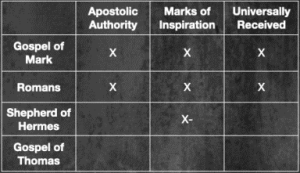
As one considers the three canonical attributes, it becomes clear that the early church filtered books through a sort of canonical grid to help them recognize authoritative texts. Only books possessing all three attributes achieved canonical status. Consider the following chart. Notice how both Mark and Romans possess all three attributes while the Gospel of Thomas possesses none. Also notice that the Shepherd of Hermes partially possesses one of the attributes insofar that it is an orthodox text. That said, it lacks the other two attributes:

Recommended resources related to the topic:

Cold-Case Christianity: A Homicide Detective Investigates the Claims of the Gospels by J. Warner Wallace (Book)

Why We Know the New Testament Writers Told the Truth by Frank Turek (mp4 Download)

The Top Ten Reasons We Know the NT Writers Told the Truth mp3 by Frank Turek

Counter Culture Christian: Is the Bible True? by Frank Turek (Mp3), (Mp4), and (DVD)

______________________________________________________________________________________________________________________________________________

Ryan Leasure holds a Master of Arts from Furman University and a Masters of Divinity from the Southern Baptist Theological Seminary. Currently, he’s a Doctor of Ministry candidate at the Southern Baptist Theological Seminary. He also serves as a pastor at Grace Bible Church in Moore, SC.

Original Blog Source: https://cutt.ly/1Ouq929


Are you a Christian who is struggling with doubts about your faith? A non-Christian seeker who has sincere questions about the Christian faith? Or have you recently lost your faith and want to explore whether your reasons for loss-of-faith were really rational? Have you ever wished that you could jump on a Zoom call and talk 1-on-1 with a leading Christian scholar who could help you navigate the minefield of arguments for and against Christianity, and help you think about your questions and doubts honestly and critically? This is now no longer something you need to wish for. This month, I launched a new ministry, TalkAboutDoubts.com. I have assembled a team of Christian scholars (some of whom are among the leaders in the world in their fields) who are willing to take one-on-one calls with people with sincere doubts about Christianity. Simply visit the website and fill out the submission form. Your inquiry will be automatically sent to the scholar with expertise most relevant to the subject of your doubts. They will then get in touch directly with you to schedule a live 1-on-1 Zoom call to discuss your doubts and questions in confidence. There is absolutely nothing for you to lose: Even if you still remain unpersuaded, at least you will be able to say that you gave the best arguments for Christianity a fair shake. If you have no need of this service yourself, please consider sharing it on social media or with your anyone in your life who may benefit from this resource. Here is a short interview I did with Tim Hull (of “Dealing with Deconstruction”) on this exciting new project.

Recommended resources related to the topic:

When Reason Isn’t the Reason for Unbelief by Dr. Frank Turek DVD and Mp4

Counter Culture Christian: Is There Truth in Religion? (DVD) by Frank Turek

______________________________________________________________________________________________________________________________________________

Dr. Jonathan McLatchie is a Christian writer, international speaker, and debater. He holds a Bachelor’s degree (with Honors) in forensic biology, a Masters’s (M.Res) degree in evolutionary biology, a second Master’s degree in medical and molecular bioscience, and a Ph.D. in evolutionary biology. Currently, he is an assistant professor of biology at Sattler College in Boston, Massachusetts. Dr. McLatchie is a contributor to various apologetics websites and is the founder of the Apologetics Academy (Apologetics-Academy.org), a ministry that seeks to equip and train Christians to persuasively defend the faith through regular online webinars, as well as assist Christians who are wrestling with doubts. Dr. McLatchie has participated in more than thirty moderated debates around the world with representatives of atheism, Islam, and other alternative worldview perspectives. He has spoken internationally in Europe, North America, and South Africa promoting an intelligent, reflective, and evidence-based Christian faith.


By Al Serrato

Atheists who feel certain that there is no God are staking out a rather interesting position. As a corollary of their position, they are of course also convinced that those who believe in God are engaging in a form of wishful thinking, that their desire to believe in a “cosmic judge” of good and evil clouds their thinking, preventing them from following where “the science” actually leads, as they believe they have done. Indeed, many believe that religion is no more than the opiate of the masses. But a bit of careful consideration will lead to quite the opposite conclusion. Holding to atheism may have some superficial appeal, as the theist must concede that it is not possible to directly see or experience God. But pretending to know with certainty that there is no God, no supreme and perfect being, is itself an act of wishful thinking. Granted, completely eliminating doubt as to God’s existence is not possible, nor can we know fully or with certainty God’s character or attributes. But being certain he’s not there? That’s a decisive conclusion to draw.

What reasons or evidence do atheists provide in support of their conclusion? Most no doubt rely on their belief in Darwinian evolution as a satisfactory alternative explanation for how life appeared on this planet. Others might point to the existence of evil in the world and contend that an all-powerful and all-loving God would not allow evil to exist. Since evil does exist, God doesn’t. Still, others will attack the claims of theists, arguing for instance what they take to be contradictions in the resurrection accounts and concluding that all religion is just so much wishful thinking. But “knowing” that there is no God requires much more than any of these rationales could provide. In order to be entirely certain that there is no God, that in other words nowhere in the universe can God be found, one would have to have access to, well, the entire universe. Given the size and scope of the visible universe, this is quite a task. Add to that any aspects or dimensions that may elude our senses and the task becomes even more insurmountable.

Here is the odd thing about such a quest. In order to really satisfy oneself that the universe is devoid of God, the searcher must attain complete knowledge of the universe, for any lack of knowledge could relate to the very place that God is present. Moreover, since an all-powerful God would theoretically precede and transcend this universe, one would have to have the capability to examine anything that exists beyond the universe, a task beyond the reach of science. In short, then, one must become omniscient – possess total and complete knowledge of all places and all things for only then could they know with the certainty atheism connotes that we are not in fact creatures of an intelligent and powerful creator but the products of mindless evolution.

Ironically, of course, at this point, the searcher would possess the very attributes of God. Proving the truth of atheism is, in the end, a futile quest, for one would need to be godlike to prove that God doesn’t exist.

Now to this conclusion some might object, arguing that by this reasoning, no one could be certain that unicorns or tooth fairies do not exist, since there is no way to prove these negatives either. But such a contention would miss the point. First, while there are no good reasons to believe in the existence of such mythical creatures, there are by contrast many logically compelling reasons to conclude that an uncaused first cause is necessary to explain that which we see around us. There are arguments from the design inherent in nature and the fine-tuning seen in the universe, as well as by the existence of evil. Each individual argument is logically sound and combined they are, to most who have considered them, sufficient warrant to believe that a Supreme Being must exist.

Moreover, the stakes involved are completely different. Being wrong about whether a unicorn can be found somewhere does not bring with it the same consequences as the question of whether there is a perfect being out there who created us. The former is simply a matter of intellectual curiosity. But the latter carries with it much weightier questions regarding who we are, why we are here, and most importantly, whether anything is expected of us by the One who brought us into being.

Weighty questions, worthy of our careful consideration.

Recommended resources related to the topic:

I Don’t Have Enough Faith to Be an Atheist (Paperback), and (Sermon) by Norman Geisler and Frank Turek 

Stealing From God by Dr. Frank Turek (Book, 10-Part DVD Set, STUDENT Study Guide, TEACHER Study Guide)

Tactics: A Game Plan for Discussing Your Christian Convictions by Greg Koukl (Book)

Fearless Faith by Mike Adams, Frank Turek, and J. Warner Wallace (Complete DVD Series)

Defending the Faith on Campus by Frank Turek (DVD Set, mp4 Download set, and Complete Package)

So the Next Generation will Know by J. Warner Wallace (Book and Participant’s Guide)

__________________________________________________________________________________________________________________________________________________

Al Serrato earned his law degree from the University of California at Berkeley in 1985. He began his career as an FBI special agent before becoming a prosecutor in California, where he continues to work. An introduction to CS Lewis’ works sparked his interest in Apologetics, which he has pursued for the past three decades. He got his start writing Apologetics with J. Warner Wallace and Pleaseconvinceme.com.


By Erik Manning

While reading the gospels, you’ll notice similarities between the characters portrayed across the different stories. Parallels between the gospels concerning character depictions are unlikely to be the result of mere chance. And these correspondences seem so casual and subtle that it’s unlikely they were designed that way. Philosopher Tim McGrew calls these ‘artless similarities.’

In an earlier video, we saw this kind of unity of character with Jesus between John and the Synoptics. But let me give another example with two somewhat lesser-known characters in the gospels — Mary and Martha. We find their stories in both Luke and John. For this evidence, I’m drawing from Peter J. Williams’ excellent book Can We Trust the Gospels?

Mary And Martha in Luke

As we read Luke 10 and John 11, we see that the two stories are very different. The majority of John 11 is about Jesus raising Mary and Martha’s brother Lazarus from the dead. With no obvious link to John, Luke gives the following story:

“As Jesus and his disciples were on their way, he came to a village where a woman named Martha opened her home to him. She had a sister called Mary, who sat at the Lord’s feet listening to what he said. But Martha was distracted by all the preparations that had to be made. She came to him and asked, “Lord, don’t you care that my sister has left me to do the work by myself? Tell her to help me!” “Martha, Martha,” the Lord answered, “you are worried and upset about many things, but few things are needed—or indeed only one. Mary has chosen what is better, and it will not be taken away from her.”

(Luke 10:38–42

If John and Luke knew each other’s gospels, clearly they could’ve simply copied the names, but they obviously didn’t copy their completely different stories. Both gospels give us a glimpse of two characters who are in stark contrast: Martha is a hard worker and stressed out about practical matters. Mary sits and listens to Jesus’s teaching while ignoring her sister’s worries over entertaining their guests. Both sisters have different personality types: one is proactive and practical, while the other is introspective and thoughtful.

Mary And Martha in John

The same two women are seen in John’s gospel after their brother has died. Jesus visits them in Bethany, their hometown. Martha went straight to Jesus as soon as she heard he got there, while Mary remained seated at home (John 11:20). Right off the bat, we see a coincidence in the kinds of responses. Both Luke and John describe Mary as sitting while Martha is in action. In both accounts, Martha is the welcoming committee. She isn’t afraid to get a little fussy with Jesus for not coming sooner, just as she got upset when she wanted Jesus to rebuke her sister for not helping with the meal preparation in Luke. (John 11:21)

The fidgety Martha then tells her sister that Jesus is calling her after meeting Jesus. (John 11:28) Mary gets up and rushes to Jesus. Those with her think she’s going to the tomb to weep. (John 11:31) Unlike Martha, Mary “fell at his feet.” (John 11:32) Remember that she was at Jesus’ feet in Luke. Jesus sees her weeping (John 11:33), we don’t have a record of where Martha weeps.

Mary also seems to be perplexed with Jesus for not coming earlier, but Jesus doesn’t even talk to her. Jesus gets deeply emotional when he sees Mary crying with the others and asks where Lazarus is buried. Jesus seems to be especially moved by Mary’s tears. At the tomb, Jesus himself weeps and commands the stone to be moved. At this point, the ever-practical Martha blurts out, “Lord, by this time there will be a bad odor, for he has been dead there four days.” (John 11:39) She obviously fails to realize that Jesus is about to raise Lazarus from the dead.

Then in chapter 12, Martha is once again seen as serving. (Jn 12:2) Mary pours costly perfume on Jesus’ feet. (Jn 12:3) She’s once again at Jesus’ feet. As Jesus had to defend Mary to Martha for her right priorities, he also had to defend her to Judas and the rest of the disciples. Judas (and perhaps the other disciples) said the ointment should’ve been sold and given to the poor instead of being wasted on Jesus’ feet.

The Same Mary and Martha

Although these two stories are completely different, they both describe the two women in complementary ways. The physical matter of Mary “sitting” and placing herself at Jesus’ feet and Martha’s practical concern illustrates this. Likewise, Martha appears to be more active in both stories. It seems clear from this that both Luke and John are talking about actual people, showing that the Gospel accounts are shaped by eyewitness testimony.

Additionally, there are some practical insights here for the believer. In both accounts, Jesus shows love for his friends. He’s direct when they’re out of line, but commends them when they do what’s right. Jesus also jumps to his friends’ defense when they’re being misunderstood. He weeps with them when they weep and is willing to put himself in harm’s way to help them. As you may recall, the high priest plotted to kill Jesus after Jesus raised their brother from the dead. (John 11:53)

Lydia McGrew sums these points up well in her book The Eye of the Beholder:

“Jesus’ interactions are always with specific people, never abstractions…His friendships in all four Gospels show us something more than a gifted, focused communicator; they show us a man who felt human affection for specific people, as we do ourselves.”  p. 398

Recommended resources related to the topic:

Cold-Case Christianity: A Homicide Detective Investigates the Claims of the Gospels by J. Warner Wallace (Book)

The New Testament: Too Embarrassing to Be False by Frank Turek (MP3) and (DVD)

Why We Know the New Testament Writers Told the Truth by Frank Turek (mp4 Download)

The Top Ten Reasons We Know the NT Writers Told the Truth mp3 by Frank Turek

Counter Culture Christian: Is the Bible True? by Frank Turek (Mp3), (Mp4), and (DVD)        

__________________________________________________________________________________________________________________________________________________

Erik Manning is a Reasonable Faith Chapter Director located in Cedar Rapids, Iowa. He’s a former freelance baseball writer and the co-owner of a vintage and handmade decor business with his wife, Dawn. He is passionate about the intersection of apologetics and evangelism.

Original Blog Source: https://cutt.ly/JUw4fu0


By Brian Chilton

Have you ever heard the phrase, “God will not place more on you than you can endure.” Another way of phrasing the statement is by saying “God will not place more on you than you can bear.” Christians are known for such platitudes. These cliches are well-intentioned as they do not come from malice. Rather, they come from an attempt to condense Christian truths into short, memorable memes or Twitter-worthy statements. But is it true that God will not place more on us than we can bear/endure?

A careful reading of Scripture shows this not to be the case. For instance, Paul writes to the Church of Corinth,

“We don’t want you to be unaware, brothers and sisters, of our affliction that took place in Asia. We were completely overwhelmed—beyond our strength—so that we even despaired of life itself. Indeed, we felt that we had received the sentence of death, so that we would not trust in ourselves but in God who raises the dead. 10 He has delivered us from such a terrible death, and he will deliver us. We have put our hope in him that he will deliver us again 11 while you join in helping us by your prayers. Then many will give thanks on our behalf for the gift that came to us through the prayers of many” (2 Cor. 1:8-11).[1]

Did you catch the phrase in verse 8, “We were completely overwhelmed—beyond our strength.” From the passage of Scripture, it can be adduced that Paul and his companions were allowed to be tested in a manner that was beyond their ability to handle. This counters the thought behind the aforementioned platitude. It appears that the benevolent God of creation does allow his children to endure hardships that exceed their ability to stand for three reasons.

Affliction Provides the Ability to Comfort (1:3-4, 6-7)

Back in verses 3-4, Paul writes, “Blessed be the God and Father of our Lord Jesus Christ, the Father of mercies and the God of all comfort. He comforts us in all our affliction, so that we may be able to comfort those who are in any kind of affliction, through the comfort we ourselves receive from God” (2 Cor. 1:3-4). He continues by saying, “If we are afflicted, it is for your comfort and salvation. If we are comforted, it is for your comfort, which produces in you patient endurance of the same sufferings that we suffer. And our hope for you is firm, because we know that as you share in the sufferings, so you will also share in the comfort” (2 Cor. 1:6-7). Paul says that their afflictions serve as an example to others. By their suffering and affliction, they are better able to minister to the suffering and afflicted.

Paul denotes a truth that was foreign to the Greco-Roman world in that suffering is not always a bad thing. David Garland writes,

“Suffering comes for anyone who preaches the gospel in a world twisted by sin and roused by hostility to God. If God’s apostle experienced so much distress in carrying out his commission, then we can see that God does not promise prosperity or instant gratification even to the most devoted of Christ’s followers.[2]

Roman philosophy presented a different view of their gods. Roman philosopher Cicero believed that the gods produced health, wealth, and security, certainly not affliction.[3] Oddly, many modern Christian circles resemble Roman philosophy more than Christian theology.

Since God is the epitome of the Good, he holds good reasons for permitting afflictions, even those that overwhelm us. Later, the faithful child of God will realize that they were only able to minister to those in need because of, not despite, the afflictions they were allowed to endure. The late Dr. Randy Kilby used to say at Fruitland Baptist Bible Institute, “You have to get under the spout where the glory comes out.” By that, he noted that the child of God can only spiritually give what they have been given. Thus, the comfort they receive from God during times of affliction can be used to minister to others in need.

Affliction Portrays God’s Strength (1:5)

Furthermore, Paul holds that overwhelming affliction demonstrates God’s strength working through the believer. Paul writes, “For just as the sufferings of Christ overflow to us, so also through Christ our comfort overflows” (1:5). God may allow a person to experience overwhelming problems so that God’s strength is shown through that person. Paul held out hope that as the sufferings of Christ overflow to us, so also the blessings of God will overflow. Paul noted to the Roman Church that “I consider that the sufferings of this present time are not worth comparing with the glory that is going to be revealed in us” (Rom. 8:18). That is to say, faithfully enduring hardships while remaining faithful to Christ produces a wealth of rewards that will be fully demonstrated in heaven.

It is often thought that the most important Christians in heaven are those who have the fattest wallets, the fanciest suits, and the biggest homes. However, God’s kingdom is an upside-down kingdom as fully illustrated in Jesus’s Parable of the Rich Man and Lazarus (Luke 16:19-31). On the one hand, the story holds that the man faithful man named Lazarus—though he was poor, downtrodden, and abused by the world—would be greatly rewarded in eternity. On the other hand, a rich man who had everything that money could buy but who neither had any love and compassion for his fellow man nor God landed in the most precarious of eternal circumstances.

But why did a good God design the world in this manner? Paul later answers the question in 2 Corinthians. In chapter 12, he describes an instance where he pleaded with the Lord to remove a thorn in his flesh. He begged the Lord three times to remove his affliction. However, the Lord responded by saying, “My grace is sufficient for you, for my power is perfected in weakness” (2 Cor. 12:9). Consider why God chose Israel. The Hebrew people were not mighty like the Egyptians or Philistines. However, through Israel, God’s power was exhibited to the world (Gen. 12:1-3). Bethlehem Ephrathah was chosen as the birthplace of the Messiah even though it was a small and minute town on the edge of nowhere (Micah 5:2). As the prophet Zechariah noted, “‘Not by strength or by might, but by my Spirit,’ says the Lord of Armies” (Zech. 4:6). Overwhelming affliction may be used by God to demonstrate his power through his vessel to others as an evangelistic tool.

Affliction Promotes Divine Trust (1:8-11)

Finally, affliction promotes divine faith and trust in the Sovereign God. Verse 9 is critical in understanding the passage. Paul denotes that “we felt that we had received the sentence of death, so that we would not trust in ourselves but in God who raises the dead” (1:9). If a person relied only on one’s strength, where is the need for faith in God? For example, with great practice, a person can become a pool shark. They can run the table on their adversaries. The person trusts in one’s skill set to help the person succeed in the game. However, overwhelming affliction creates a dire need to trust One higher. Since enduring hardships with trust in God produces the fruit of endurance, proven character, and divine hope (Rom. 5:30); it is actually a good thing that God allows us to face overwhelming situations where one’s trust must be placed in the God of creation. Certainly, it will not seem like a good thing while enduring the circumstance. But when God comes through as only God can, then trust is developed. Trust is crucial in healthy relationships. It must be remembered that through the process God is still working out everything for the good of those who love and trust him (Rom. 8:28). The endgame is the most important. Just as parents teach their children hard lessons to help them grow, so God must teach and train us to be the people he desires us to be by permitting hardships in our lives.

Conclusion

I must admit, I have used the phrase “God will not place more on us than we can bear” in my early days as a pastor. While at the time it was thought that the statement was positive and encouraging, it does not necessarily mesh with the teachings of Scripture. In some circles, it is believed that God only provides riches, health, and blessings for his children. Ironically, such belief systems find a home more in the camp of Roman philosophy rather than Christian philosophy. The goodness of the Anselmian God—that which nothing greater can be conceived—may require him to place his children in circumstances that are far beyond what they may endure to produce future blessings that would have only come through their trials of fire. Through the trials of Joseph, God led him to success in Egypt which would eventually be used to save his family and nation from certain doom as a famine ravaged through their land. Through the heartaches and despair of Job, he encountered God in a personal fashion and was eventually blessed double from what he previously owned. Through the horrific execution of Jesus, salvation was offered to the world, and death was defeated. With this in mind, the words of one of my mentors ring true. When facing overwhelming trials, rather than asking, “What are you doing to me, God?” we should rather ask, “What are you doing for me, God?” Therefore, rather than saying, “God will not place more on us than we can endure,” perhaps we would be better served in saying, “God will not place more on us than he can endure.”

Notes

[1] Unless otherwise noted, all quoted Scripture comes from the Christian Standard Bible (Nashville, TN: Holman, 2007, 2020).

[2] David E. Garland, 2 Corinthians, New American Commentary, vol. 29 (Nashville: B&H, 1999), 62.

[3] See Cicero, De Natura Deorum 3.36, 87.

Recommended resources related to the topic:

How to Interpret Your Bible by Dr. Frank Turek DVD Complete Series, INSTRUCTOR Study Guide, and STUDENT Study Guide

How Philosophy Can Help Your Theology by Richard Howe (MP3 Set), (mp4 Download Set), and (DVD Set

__________________________________________________________________________________________________________________________________________________

Brian G. Chilton is the founder of BellatorChristi.com, the host of The Bellator Christi Podcast, and the author of the Layman’s Manual on Christian Apologetics. Brian is a Ph.D. Candidate of the Theology and Apologetics program at Liberty University. He received his Master of Divinity in Theology from Liberty University (with high distinction); his Bachelor of Science in Religious Studies and Philosophy from Gardner-Webb University (with honors); and received certification in Christian Apologetics from Biola University. Brian is enrolled in the Ph.D. program in Theology and Apologetics at Liberty University and is a member of the Evangelical Theological Society and the Evangelical Philosophical Society. Brian has served in pastoral ministry for nearly 20 years. He currently serves as a clinical chaplain. 

Original Blog Source: https://cutt.ly/GY44dRU


By Ryan Leasure

This is part three of a nine-part series on how we got our Bible. Part one addressed the inspiration and inerrancy of Scripture. Part two explained the formation and preservation of the Old Testament text. This post will address issues surrounding the Old Testament canon and the Apocrypha.

Canon

Before going any further, we must first establish what we mean when we say “canon.” We are not, of course, referring to the weapons of bygone eras. Rather, canon refers to an ancient measuring stick cut from a reed-like plant which was used as an infallible standard—much like a yardstick. The term was later applied to the biblical texts that the church received in its collection of authoritative books.

The Tanakh

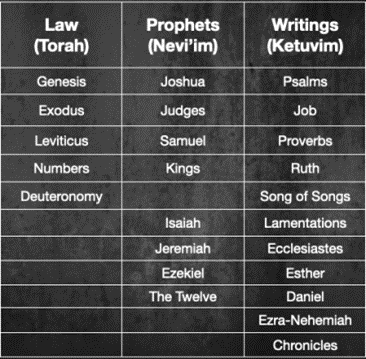
The Jewish order of the Old Testament was and is radically different from how we typically order our books. From an early time, it appears that the Jews had a threefold division of the Hebrew canon. This threefold division is often referred to as the Tanakh based on the three divisions—Torah (Law), Nevi’im (Prophets), and Ketuvim (Writings). This final division could sometimes be called “the Psalms” since Psalms was the first and largest book among the writings and was often representative of the whole. Also, note that Jews combined several books. So while their canon contains the same content as our protestant Bibles, their Bible only has twenty-four books instead of thirty-nine. Consider the breakdown below from Genesis to Chronicles:

Bible table

The Septuagint (250-150 BC)

After Alexander the Great Hellenized the known world, Jewish scholars realized they needed to translate the Hebrew scriptures into Greek so that more people could read them. Legend has it that seventy-two Jewish translators (six from each of the twelve tribes), over the course of seventy-two days, each translated the text from Hebrew to Greek independently, and all seventy-two translations came out the exact same. The translation, therefore, came to be known as the Septuagint (from the Latin septuaginta meaning “seventy”) and is often represented by the Roman numerals LXX.

A couple of points are worth noting about the Septuagint. First, this translation changed the order of the books to the order that we are more familiar with today. That is to say, it changed from the threefold division of the Tenakh to our current order of law, history, poetry, major prophets, and minor prophets. Furthermore, the Septuagint also included the Apocrypha.

The Apocrypha

The Apocrypha consists of a dozen or so Jewish books written during the intertestamental period. These books contain history, poetry, wisdom literature, and prophecy. Probably most famous among the Apocrypha are the first and Second Maccabees. These books detail the Jewish rebellions and reclamation of the temple from the Syrians. While these works contain much historical value, they also contain disputable material. This is especially true of second Maccabees which teaches that saints in heaven intercede for people on earth (15:11-16) and that prayers and sacrifices can be offered for the dead (12:39-46). Roman Catholics us this last text to justify belief in purgatory and the practice of indulgences.

Tobit, another Apocryphal book, contains a fanciful story about a devout Jewish man in exile who is blinded by bird droppings in his sleep. His wife Sarah, also had troubles of her own. A demon had killed seven of her previous husbands on her wedding night. So God sent the angel Raphael to help Tobit and Sarah conquer the demon. Ultimately, they use a fish heart and liver to drive out the demon from the wedding chamber. Finally, Tobit’s son rubs fish gall on Tobit’s eyes to heal his blindness. This story is entirely fanciful.

Another book, known as Judith, describes God’s deliverance of the Jewish people. In this story, Judith seduces an Assyrian king only to cut off his head during his drunken stupor. We have no evidence that this story ever occurred. Moreover, this book erroneously states that Nebuchadnezzar was king of Assyria, not Babylon.

Other Apocryphal books include Sirach (wisdom literature similar to Proverbs), Baruch (not written by Baruch), Wisdom of Solomon (not written by Solomon), and additions to Daniel (Susanna and Bel and the Dragon).

Why The Bible should not Include the Apocrypha

You are probably familiar with the Protestant/Catholic/Orthodox debates over whether the Apocrypha belongs in our modern Bibles. In the remaining space, I’d like to offer five reasons why I don’t believe the Bible should include the Apocrypha.

1. The Apocrypha Acknowledges that Prophets Weren’t Speaking during its Time

Consider the following texts from 1 Maccabees:

So there was great distress in Israel, the worst since the time when the prophets ceased to appear among them (1 Macc. 9:27).

The Jews and their priests have resolved that Simon should be their leader and high priest forever, until a trustworthy prophet should arise (1 Macc. 14:41).

And laid up the stones in the mountain of the temple in a convenient place, until there should come a prophet to show what should be done with them (1 Macc. 4:46).

Notice how all three of these verses indicate God was not speaking through prophets during their time.

2. Jews Never Accepted the Apocrypha as Scripture

Consider the following quotation from first-century Jewish historian Josephus:

From the death of Moses to the time of Artaxerxes, who was king of Persia after Xerxes, the prophets who followed Moses have written down in thirteen books the things that were done in their days. The remaining four books contain hymns to God and principles of life for human beings. From Artaxerxes to our own time a detailed record has been made, but this has not been thought worthy of equal credit with the earlier records because there has not been since then the exact succession of prophets.1

Josephus indicates that after the time of Artaxerxes (465-424 BC), Jews continued to write books (the Apocrypha), but these books were not on par with Scripture, because the prophets had stopped speaking.

Moreover, the Babylonian Talmud, which is a sacred collection of Rabbinical traditions, notes that “after the latter prophets Haggai, Zechariah, and Malachi had died, the Holy Spirit departed from Israel” (Yoma 98). In other words, special revelation ceased after the time of these prophets. Therefore, we should not consider the Apocrypha as Scripture since it followed after these prophets.

Finally, around the year AD 90, a council of Jewish leaders gathered at Jamnia to figure out how to reconstruct Judaism after the fall of Jerusalem and the temple. As they discussed their sacred books, they merely reaffirmed the universal practice of all Jews that the Apocrypha did not belong in their Bible.

3. The New Testament Never Refers to the Apocrypha as Scripture

The New Testament authors quote from the Old Testament hundreds of times. Often they preface their quotes with phrases such as “it is written” or “Scripture says.” Consider the following examples:

As it is written: None is righteous, no, not one (Rom 3:10).

Scripture says, They will look on him whom they have pierced (John 19:37).”

Therefore, as the Holy Spirit says, Today, if you hear his voice, do not harden your hearts as in the rebellion (Heb 3:7-8).

Never once do the New Testament authors do something similar with an Apocryphal text. This omission is telling considering the fact that the New Testament authors usually quoted from the Septuagint which contained the Apocrypha. Meaning, the New Testament authors were well aware of the Apocryphal texts. They simply never refer to them as Scripture.

4. Jesus Affirmed the Three-Fold Division of the Tanakh

Two quotations from Luke indicate that Jesus believed in a closed Old Testament Canon that did not include the Apocrypha. Consider Luke 24:44:

Then he said to them, ‘These are my words that I spoke to you while I was still with you, that everything written about me in the Law of Moses and the Prophets and the Psalms must be fulfilled.

In this text, Jesus makes a clear affirmation of the threefold division of the Old Testament—Apocrypha not included. Also consider Luke 11:51:

From the blood of Abel to the blood of Zechariah, who perished between the altar and the sanctuary. Yes, I tell you, it will be required of this generation.

By speaking of Abel (the first biblical martyr) and Zechariah (the last biblical martyr), Jesus indicates that the Old Testament canon concluded with Chronicles (traditional order of the Tanakh). It is worth noting that several martyrs died in the Maccabees. Jesus doesn’t mention them because he didn’t consider Maccabees as part of his Bible.

5. The Catholic Church didn’t Grant Authority to the Apocrypha until Later

The earliest Old Testament canonical list from a Christian comes from Melito of Sardis (AD 170). His canon leaves out the Apocrypha. Origen’s canonical list in the mid-third century also leaves out the Apocrypha. Additionally, Athanasius, Cyril of Jerusalem, Gregory of Nazianzus, and the Council of Laodicea leave the Apocrypha out of their canon.

Sometime in the fourth century though, the Apocrypha started to gain acceptance in some circles as demonstrated by some of the canonical lists (St. Augustine and the Council of Hippo) and biblical manuscripts (Codex Sinaiticus and Vaticanus). Of course, St. Augustine also persuaded his friend Jerome to include the Apocrypha in the Latin Vulgate in AD 404. That said, Jerome prefaced the Apocryphal writings by stating:

Therefore as the church indeed reads Judith, Tobit, and the books of Maccabees, but does not receive them among the canonical books, so let it also read these two volumes for the edification of the people but not for establishing the authority of ecclesiastical dogmas.2

Jerome made a clear delineation between Scriptural texts and the Apocrypha. Scripture established church doctrine. The Apocrypha was for mere edification alone.

For the next thousand years, the Catholic Church was hardly unified on the Apocrypha. William of Ockham, influential medieval theologian, echoed Jerome’s sentiments when he wrote that apocryphal texts “are read for the edification of the people, but not for the establishment of doctrine.3 Even Cardinal Cajetan, a chief opponent of the Protestant Reformers and appointee of Pope Leo remarked:

The Latin church is greatly indebted to Jerome on account of his separation of the canonical from the uncanonical books. . . . those books and any others there may be like them in the Canon of the Bible are not canonical in the sense of establishing point of faith; yet they can be called canonical for the edification of the faithful.4

Despite being far from unified, the Council of Trent official granted canonical status to the Apocryphal text in what can only be seen as a counter-Reformation move.

Moving On to the New

The next post will transition to the New Testament. Specifically, the post will address two key question. First, would the early church have expected more Scriptural books? And second, what clues tipped off the early church that certain books were authoritative Scripture while others were not?

Recommended resources related to the topic:

Cold-Case Christianity: A Homicide Detective Investigates the Claims of the Gospels by J. Warner Wallace (Book)

Why We Know the New Testament Writers Told the Truth by Frank Turek (mp4 Download)

The Top Ten Reasons We Know the NT Writers Told the Truth mp3 by Frank Turek

Counter Culture Christian: Is the Bible True? by Frank Turek (Mp3), (Mp4), and (DVD)

______________________________________________________________________________________________________________________________________________

Ryan Leasure holds a Master of Arts from Furman University and a Masters of Divinity from the Southern Baptist Theological Seminary. Currently, he’s a Doctor of Ministry candidate at the Southern Baptist Theological Seminary. He also serves as a pastor at Grace Bible Church in Moore, SC.

Original Blog Source: https://cutt.ly/NY40j0n


By Tony Williams

Evil, or some derivation of it, is one of the more popular reasons people cite when they walk away from believing in God or choose not to believe in Him in the first place. The most popular atheists who have most recently driven the conversation on why one should not believe in God talk about the existence of evil in the world as a reason no god, and certainly no good god, could possibly exist.

The argument essentially says that: first – bad things happen, second – a good god would not allow bad things to happen, and third – therefore there must be no god at all. But how do these philosophers identify what evil is? What is their objective source to label evil, evil?

I would ask you to consider one simple idea that may change the way you see evil; You can’t know what is evil unless you first know what is good. In other words, there can’t be wrong without right. This is common sense, but it must be pointed out to bring the thought all the way to its conclusion.

Rust is a bad thing when it develops on your vehicle. If you were to see a spot of rust on your car, you would not be excited. Rust is corruption of what was originally made to serve a good purpose. Without perfections, there can be no imperfections. Without good, there can be no evil.

In atheism, there can be no objective evil or objective good. There is, at most, what can be thought of as an agreement among the majority of current humans that certain behaviors like murder, theft and adultery are bad because they somehow lower our odds of survival. Ultimately, these standards can change with time, and we certainly see that taking place on a regular basis in the 21st century.

The biblical story, on the other hand, says that “good” is how the world was originally ordered by a perfect God to be, and it was corrupted by evil that sought to go against the order that God established. That doesn’t apply just to morality (murder, theft, etc.) in the Bible. It indicates that all creation was affected by this “fall”. The physical world has fallen into disrepair and death in all the forms of natural evil that we see today (natural disasters, diseases, etc.).

The narrative of the Old and New Testaments is the story of a perfectly ordered creation falling into decay and death as a result of the choice by the first humans to defy God. In order to save the broken from their brokenness and be reconciled to Himself, God sent His Son to die for the sins of all mankind because only God Himself could bring things back into the order that He had set in place at the beginning.

One of my pastors used to use the popular Southern Illinois phrase, “you can’t get there from here” when examining bad ideas. The idea that evil disproves God is turned on its head when one thinks the thought to its conclusion. Like you can’t have shadows without light, you can’t have objective evil without objective good. The best explanation available for a source for objective good is described in the Old and New Testaments of the Bible; God is Good!

Recommended resources related to the topic:

If God, Why Evil? (DVD Set), (MP3 Set), and (mp4 Download Set) by Frank Turek

Why Doesn’t God Intervene More? (DVD Set), (MP3 Set), and (mp4 Download Set) by Frank Turek

Why does God allow Bad Things to Happen to Good People? (DVD) and (mp4 Download) by Frank Turek

__________________________________________________________________________________________________________________________________________________

Tony Williams is currently serving in his 20th year as a police officer in a city in Southern Illinois. He has been studying apologetics in his spare time for two decades, since a crisis of faith led him to the discovery of vast and ever-increasing evidence for his faith. Tony received a bachelor’s degree in University Studies from Southern Illinois University in 2019. His career in law enforcement has provided valuable insight into the concepts of truth, evidence, confession, testimony, cultural competency, morality, and most of all, the compelling need for Christ in the lives of the lost. Tony plans to pursue postgraduate studies in apologetics in the near future to sharpen his understanding of the various facets of the field of study.

Original Blog Source: https://bit.ly/3GISt18