Tag Archive for: Christianity

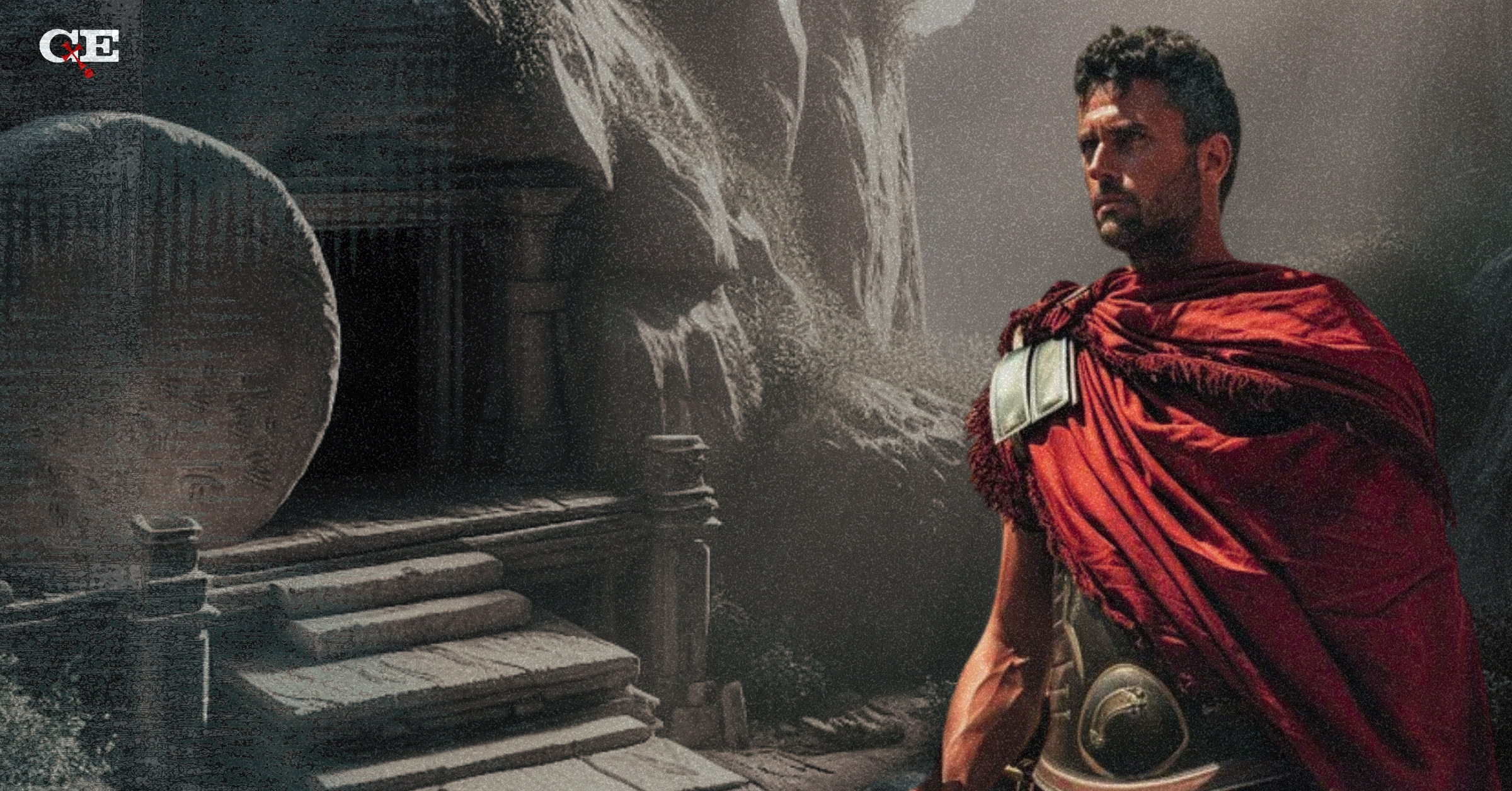
Scripture reports that there were guards at the tomb of Jesus (Matt. 27:62-66). This historical claim has been either much discussed by some apologists, but largely dismissed or ignored by others despite its potential significance in resurrection narrative.

Dismissing the Guard Evidence

For example, here is William Lane Craig answering a question about the guards at the tomb:


Craig doesn’t think much of this “guard” claim.

Defending the Guard Evidence

On the other hand, Dr. Timothy McGrew, professor of philosophy at Western Michigan University, has a thorough response to the challenge of Matthew’s veracity concerning the resurrection as it pertains to the guards narrative in Matthew 27:62-66. It is well worth the read as Dr. McGrew picks apart the claims of resurrection-critic V.J. Torley. He aims his critique here at the historicity of the guards narrative. Torley claims that the narrative is unhistorical for several reasons:

  1. It is mentioned only in Matthew’s Gospel, not in the other three.
  2. This account fails to explain why the body could not have been stolen on Friday night.
  3. We are not told why Pilate would agree to the Jewish leaders’ request.
  4. The Jewish rulers would not have made such a request of Pilate, since a gentile employed by a Jew would not be allowed to work on the Sabbath.

McGrew systematically dismantles each of these reasons. A quick summary of each rebuttal:

  1. Rebuttal: This is an argument from silence; why can’t a single source be adequate for historicity. As McGrew points out: “Many of the events of antiquity crop up in only one source.”
  2. Rebuttal: This reason is assuming that the request is made on Saturday morning. Again McGrew points out: “it is not even clear from the text that the request was made on Saturday”
  3. Rebuttal: Just because we are not told why something happens, doesn’t mean it didn’t happen.  McGrew: “this is a very odd way to object to historical evidence. Many narratives recount events without affording us an explanation for them, and sometimes we are left to guess what that explanation might be. So what?”
  4. Rebuttal: “Nothing in Jewish law as interpreted at the time would prevent them from making such a request.”

In these charges against the “guards” theory, McGrew lays out a clear rebuttal showing that the historicity of this claim is still credible. In later posts, responding to V.J. Torley, he develops the case even further (here and here). Definitely worth keeping up with.

Recommended Resources: 

Why We Know the New Testament Writers Told the Truth by Frank Turek (mp4 Download)

The Top Ten Reasons We Know the NT Writers Told the Truth mp3 by Frank Turek

Early Evidence for the Resurrection by Dr. Gary Habermas (DVD), (Mp3) and (Mp4)

I Don’t Have Enough Faith to Be an Atheist (Paperback), and (Sermon) by Norman Geisler and Frank Turek 


J. Steve Lee has taught Apologetics for over two and a half decades at Prestonwood Christian Academy.  He also has taught World Religions and Philosophy at Mountain View College in Dallas and Collin College in Plano.  With a degree in history and education from the University of North Texas, Steve continued his formal studies at Southwestern Baptist Theological Seminary with a M.A. in philosophy of religion and has pursued doctoral studies at the University of Texas at Dallas and is finishing his dissertation at South African Theological Seminary.  He has published several articles for the Apologetics Study Bible for Students as well as articles and book reviews in various periodicals including Philosophia Christi, Hope’s Reason: A Journal of Apologetics, and the Areopagus Journal.  Having an abiding love for fantasy fiction, Steve has contributed chapters to two books on literary criticism of Harry Potter: Harry Potter for Nerds and Teaching with Harry Potter.  He even appeared as a guest on the podcast MuggleNet Academia (“Lesson 23: There and Back Again-Chiasmus, Alchemy, and Ring Composition in Harry Potter”).  He is married to his lovely wife, Angela, and has two grown boys, Ethan and Josh.

Originally posted at: https://bit.ly/4c9AstW

Are there contradictions between the gospel accounts? If so, how can we trust the central tenet of Christianity–the Resurrection of Jesus? Last week, J. Warner Wallace and his son Jimmy Wallace joined Frank to discuss their exciting new graphic novel, ‘Case Files: Meaning and Murder‘. For this midweek podcast, J. Warner Wallace returns to share how he used his skill set as a detective to investigate the claims of the New Testament gospels and compares his findings to those of atheist/agnostic New Testament scholar, Bart Ehrman.

Together, Frank and Jim answer questions like:

  • What’s necessary to prove an event occurred in the past?
  • Why weren’t first-century historians bothered by textual differences found in the Gospels?
  • Why is it better to have four different gospel accounts vs. one harmonization?
  • Why would God allow these textual differences?
  • What surprised Jim the most the first time he read the Gospels as an atheist?
  • Why do detectives separate eyewitnesses?
  • When doing detective work, why does Jim prefer it when the stories are “messy”?
  • Does the evidence always determine the verdict? In other words, why do Jim and Bart come to different conclusions when it comes to the Resurrection of Jesus?
  • Why is bias against the supernatural a double-standard for materialist atheists?
  • What’s the best way to test an eyewitness?
  • If the Gospels are contradictory and can’t be trusted, why do critics like Erhman conclude that much of the New Testament is true and that the disciples really believed they saw the resurrected Jesus?
  • How are atheists disagreeing with themselves and agreeing with Christians when it comes to alternative explanations for the resurrection?

And so much more! If you normally listen to podcasts on 2x speed you may need to slow it down for this one and take some notes!

If you enjoyed this podcast episode PLEASE HELP US SPREAD THE TRUTH OF CHRISTIANITY BY SUPPORTING OUR MINISTRY HERE. 100% of your donation goes to ministry, 0% to buildings!

Resources mentioned during the episode:

BOOK: Cold-Case Christianity
GRAPHIC NOVEL: Case Files: Murder & Meaning (don’t forget to grab your pre-order bonuses!)


Download Transcript


Why are so many people fascinated with evil stories of murder, and true crime? And more importantly, can we use that fascination to point them to Jesus? Christianity is the only worldview that answers the problem of evil adequately, and now there’s a new graphic novel that tackles this big question in a way that’s both artistic and compelling!

This week, Frank sits down with cold-case detective and bestselling author, J. Warner Wallace, along with his son and co-author, Jimmy Wallace, to discuss their new book, ‘Case Files: Murder and Meaning‘. As a father-son duo with deep roots in law enforcement, they’re using their real-life experiences to craft a crime story that sneaks apologetics into an action-packed graphic novel. Tune in as they address questions like:

  • Why do so many police officers become cynical, and what does that reveal about human nature?
  • How did their experience in law enforcement help Jim and Jimmy to write this story?
  • What makes ‘Case Files’ different from other apologetics books?
  • How can storytelling help people wrestle with questions about morality and justice?
  • What are some of the biggest misconceptions that the public has about police and detective work?
  • How did the George Floyd and BLM riots radically shift the police world?
  • What are some of the common internal and psychological struggles of police officers?
  • How did Jim overcome his season of identity crisis once he retired?

Be sure to pre-order your copy of ‘Case Files: Murder and Meaning‘ and then head to Jim’s website to grab some exclusive bonus resources! If you know anyone who loves crime stories, comics, or big questions about life, this book might just be the tool that sparks some amazing faith conversations!

If you enjoyed this podcast episode PLEASE HELP US SPREAD THE TRUTH OF CHRISTIANITY BY SUPPORTING OUR MINISTRY HERE. 100% of your donation goes to ministry, 0% to buildings!

Resources mentioned during the episode:

Jim’s website: ColdCaseChristianity.com

J. Warner Wallace & Jimmy’s New Book: CaseFilesGraphicNovel.com

The Truth in True Crime: https://a.co/d/0fE9crT

Cold-Case Christianity: https://a.co/d/dABS4uA

Person of Interest: https://a.co/d/69NoUEw


Download Transcript


The human body is a marvelous and complex system. Of special interest is the cellular mechanism of the body. Every 7-10 years, the cells of the body replace themselves, to the point that the body is essentially new every decade.[i]


While the DNA remains the same over the course of a person’s life, the cells change at varying rates. A person’s stomach lining replaces itself every few days. The skin’s epidermis replaces itself every 2 to 4 weeks. The body’s hair changes every 6 years for women and 3 years for men. Liver cells rejuvenate every 150 to 500 days. Bones take around 10 years to change.

Philosophically speaking, the materialist has a problem if he decides to claim that the body is all of human existence. If humans are only their bodies, then each person changes completely every decade. However, this poses severe challenges to personhood. The lack of permanence is not feasible for a person’s essence. Thus, an immaterial soul is required to explain the permanence of the human psyche for three reasons.

Defense of the Immaterial Soul from Personal Identity

First, the immaterial soul must exist to verify continued personal identity. Looking back at our lives, it is clear that we look different each decade. I remember looking back at photos from my high school days. Before wearing contact lenses, I donned thick glasses that automatically darkened when in daylight. With a thick bouffant hairstyle, thin moustache, and 80s-style glasses, I looked something like an officer or detective from a 70s television show. I was much like an officer from CHiPs, but without the cool motorcycle.

Though I may be embarrassed by my stylish choices in high school, never would I dare to say that I was not the same person that I am today. Yes, I have changed, grown, and matured over the years. But I maintain the same identity that I did back then. Permanence of personal identity with an ever-changing body is only possible if our identities are held together by an immaterial soul. Without it, there is no guarantee that we will retain our personal identity.

Defense of the Immaterial Soul from Personal Constancy

Second, the immaterial soul is imperative to explain personal constancy. Consider for a moment if the materialist is right in that the body is the only component of personal human identity. That would mean that the person completely changes every decade. Thus, a crime committed in 2015 could not be tried in 2025 because the person is not the same. Since the body has completely changed, the person must have also completely changed if the body is all there is to personal identity. Thus, no one could be held accountable for what was done over time. Additionally, no one could be rewarded for something they accomplished over time.

For some, this may sound absurd. However, the lack of personal constancy is the metaphysical deduction from materialism, when it is allowed to be taken to its ultimate conclusion. The immaterial reality is necessary to account for the constancy of personal identity.

Defense of the Immaterial Soul from Personal Growth

Lastly, if a person did not have an immaterial mind, will, and emotions found in the immaterial soul, then a person would not learn and grow over time. Even brain cells regenerate over time, at least to a degree.[ii] Granted, learning does interact with the brain. However, if personal identity was only found in chemicals and cellular changes, growth could not occur. Yet, a person learns, grows, and develops one’s character over time. This is something that occurs within the immaterial soul. Again, given the changes that occur, a person would always be in a constant state of flux with no consistency or permanence. The soul working with the body is what gives an individual personal identity. This mind-body connection is also known as hylomorphism.[iii]

Conclusion

Since the early days of philosophy, scholars have sought to understand the complex relationship between permanence and change. Materialists often accept change without any sense of permanence, whereas rationalists, such as Parmenides (510 BC) believed that reality is “just being, one single solitary unchanging being. Reality is the One.”[iv] The body is in a constant state of flux. Thus, the only way a person could have a permanent, constant identity is if a person has an immaterial soul, a soul that serves as the form of the body.

References: 

[i] Chris Opfer and Allison Troutner, “Does Your Body Really Renew Itself Every Seven Years?,” HowStuffWorks.com (Sept. 22, 2022), https://science.howstuffworks.com/life/cellular-microscopic/does-body-really-replace-seven-years.htm.

[ii] Tim Newman, “Brain cells keep growing well into our 70s,” MedicalNewsToday.com (April 7, 2018), https://www.medicalnewstoday.com/articles/321416.

[iii] Norman Geisler, Systematic Theology: In One Volume (Minneapolis, MN: Bethany House, 2011), 636-637, 1221-1222.

[iv] Daniel J. Sullivan, An Introduction to Philosophy: Perennial Principles of the Classical Realist Tradition (Charlotte, NC: TAN, 1957), 20.

Recommended Resources:

The Great Book of Romans by Dr. Frank Turek (Mp4, Mp3, DVD Complete series, STUDENT & INSTRUCTOR Study Guide, COMPLETE Instructor Set)

Jesus, You and the Essentials of Christianity by Frank Turek (INSTRUCTOR Study Guide), (STUDENT Study Guide), and (DVD)      

How to Interpret Your Bible by Dr. Frank Turek DVD Complete Series, INSTRUCTOR Study Guide, and STUDENT Study Guide

Debate: What Best Explains Reality: Atheism or Theism? by Frank Turek DVD, Mp4, and Mp3 


Brian G. Chilton earned his Ph.D. in the Theology and Apologetics at Liberty University (with high distinction). He is the host of The Bellator Christi Podcast and the founder of Bellator Christi. Brian received his Master of Divinity in Theology from Liberty University (with high distinction); his Bachelor of Science in Religious Studies and Philosophy from Gardner-Webb University (with honors); earned a Certificate in Christian Apologetics from Biola University, and plans to purse philosophical studies in the near future. He is also enrolled in Clinical Pastoral Education to better learn how to empower those around him. Brian is a member of the Evangelical Theological Society and the Evangelical Philosophical Society. Brian has served in ministry for over 20 years and currently serves as a clinical hospice chaplain as well as a pastor.

Originally posted at: https://bit.ly/4j530XP


Why is propaganda and empty rhetoric so appealing to some people? In this midweek episode, Frank explains how the first of ‘The Screwtape Letters by C.S. Lewis perfectly illustrates the way demons manipulate human beings, now and throughout history. He’ll also explore the recent power struggles between the Trump Administration and the lower district court judge who blocked Trump’s transgender military ban. Frank will answer questions like:

  • Why is using “jargon” instead of evidence-based arguments not good thinking?
  • What specific tactics does C.S. Lewis say demons use to tempt humans and where do we see evidence of this happening in our culture today?
  • Do all people have the right or privilege to serve in the military?
  • Was Trump’s decision to say transgender people are not qualified to serve in the military unconstitutional?
  • Why is it so difficult to impeach judges, and do we really have only three branches of government?
  • What do a lot of people get wrong about Islam?

Frank also tackles some listener questions about who will be resurrected (is it only Christians?) and whether an old-earth contradicts biblical genealogies. Plus, he’ll reveal details about his numerous speaking events coming up this spring—so listen closely to see if he’s coming to a city near you!

Is there a guest or topic you’d love to hear discussed on a future podcast? We’d love to hear your feedback and suggestions! You can take our 5-minute podcast survey HERE.

Resources mentioned during the episode:

BOOK: The ScrewTape Letters by C.S. Lewis
ARTICLE: The Babylon Bee – Federal Judge Appoints Himself President
BOOK: Seven Days that Divide the World by John Lennox
ARTICLE: The Case for Old-Earth Creationism (Genealogy Info)
BOOK: Systematic Theology by Wayne Grudem


Download Transcript


STRATTON:

Dear ChatGPT, Guidance control is a concept from philosophy, particularly in discussions of free will and moral responsibility. It refers to the capacity of an agent to guide their behavior in a way that reflects their reasons, values, and intentions. In the context of free will, guidance control is often contrasted with what is referred to as regulative control. Allow me to explain:


Guidance control asserts the ability to guide one’s actions in accordance with one’s rational deliberation and decision-making process. It does not necessarily require alternative possibilities (understood as the ability to do otherwise). Regulative control, on the other hand, includes both the ability to guide actions and the ability to choose among alternative options (i.e., free will in the sense of having genuine alternatives and the ability to do otherwise).

Here are some key components of Guidance Control that proponents offer:

  1. Mechanism Ownership: The agent acts through mechanisms that are their own, such as their beliefs, desires, and rational capacities.
  2. Reasons-Responsiveness: The agent’s behavior is responsive to reasons, meaning they can recognize and act upon good reasons when making decisions.

Guidance control plays a central role in compatibilist theories of free will, such as those advocated by John Martin Fischer. Compatibilists argue that even if determinism is true and the entirety of our actions are causally determined, we can still have moral responsibility if we possess guidance control over our actions. I believe this theory fails for several reasons, but before we continue with our conversation would you like to add anything I may have missed about guidance control, regulative control, reasons-responsiveness, or compatibilism in general?

CHATGPT SAID:[i]

[i] Minimal edits were made to this conversation with ChatGPT (throughout). For example, in my original conversation I asked ChatGPT to review my interaction with specific scholars (and a couple non-scholars) by name. In response, Chat GPT reviewed my interaction with them and also referenced these individuals by name. I have deleted these particular names from this publication.

Your summary is an excellent and concise explanation of guidance control, regulative control, and their roles in discussions of free will and moral responsibility. To complement your description, I’ll add a few nuances and additional insights to enrich our discussion:

Guidance Control

  1. Mechanism Ownership
    • John Martin Fischer emphasizes that guidance control involves acting through mechanisms that are “your own.” This raises questions about what counts as “ownership” of these mechanisms, particularly in cases where external influences or manipulations might challenge autonomy.
  2. Reasons-Responsiveness
    • Fischer and Ravizza refine reasons-responsiveness by distinguishing between weak and strong reasons-responsiveness. Weak reasons-responsiveness requires that there be some possible world where the mechanism leads to a different action in response to good reasons. Strong reasons-responsiveness entails a consistent pattern of recognizing and responding to reasons across a variety of possible circumstances.

Regulative Control

  1. Alternative Possibilities
    • The notion of regulative control aligns with the traditional libertarian view of free will, which requires the ability to genuinely choose among alternatives. This concept is often linked to the “principle of alternative possibilities” (PAP), which states that an agent is morally responsible only if they could have done otherwise. Frankfurt-style counterexamples challenge this principle by arguing that moral responsibility can exist even in the absence of alternatives.
  2. Causal Determinism and Regulative Control
    • In deterministic frameworks, regulative control is often seen as untenable because it requires the kind of metaphysical freedom incompatible with causal determinism.

Compatibilism and Guidance Control

  • Core Compatibilist Argument
    • Compatibilists like Fischer argue that guidance control is sufficient for moral responsibility because it focuses on how actions are caused rather than whether alternative possibilities exist. The key claim is that moral responsibility depends on the quality of the agent’s reasoning and their responsiveness to reasons rather than the ability to have acted otherwise.
  • Critiques of Compatibilism
    • Critics often argue that guidance control does not fully capture the intuitions underlying moral responsibility. For instance:
      • If determinism is true, even guidance control mechanisms are causally determined, potentially undermining their “ownership.”
      • Others contend that the absence of alternative possibilities (as in Frankfurt cases[2]) still undermines the sense of autonomy needed for true moral responsibility.

Further Points for Discussion

  1. Manipulation Arguments
    • Philosophers like Derk Pereboom use manipulation cases to challenge compatibilism, arguing that if an agent’s decisions are the result of deterministic processes (analogous to external manipulation), it undermines moral responsibility even if guidance control is present.
  2. Responsiveness to Reasons
    • There is ongoing debate about what counts as sufficient responsiveness to reasons. For instance, should reasons-responsiveness include moral reasons specifically, or does it also encompass prudential or instrumental reasons?
  3. Emerging Views
    • Some philosophers propose hybrid views, combining elements of compatibilism and libertarianism to account for moral responsibility in a way that includes guidance control while acknowledging the importance of genuine alternatives in some cases. . .

STRATTON:
I like what you added about the “Emerging Views.” I recently coauthored an academic journal article with philosopher J.P. Moreland entitled “An Explanation and Defense of the Free-Thinking Argument.” We touch on some of these issues in that essay. Do you have access to this paper?

As for now, I would like to specifically focus on divine determinism or what I often refer to as exhaustive divine determination (EDD).

CHATGPT SAID:
Thank you for sharing your work . . . I’ve reviewed the paper, which presents a robust defense of the Free-Thinking Argument (FTA), asserting that determinism is incompatible with epistemic responsibility in the desert sense—that is, being praiseworthy or blameworthy for one’s thoughts, ideas, judgments, or beliefs. The paper contends that this incompatibility poses significant challenges not only for naturalists but also for proponents of exhaustive divine determinism (EDD).

Focusing on EDD, your paper raises several critical points:

  1. Epistemic Responsibility Under EDD: If all human thoughts and beliefs are divinely determined, individuals lack genuine epistemic responsibility. This absence undermines the basis for holding individuals praiseworthy or blameworthy for their cognitive states.
  2. The Problem of Epistemic Evil: EDD introduces a “problem of epistemic evil,” questioning the reliability of human cognition and the trustworthiness of Scripture. If God determines all thoughts, including false beliefs, it challenges the notion of a benevolent deity and the foundation of rational discourse.
  3. Libertarian Freedom as a Solution: The paper advocates for libertarian freedom, suggesting that genuine free will is necessary for epistemic responsibility and to avoid the pitfalls associated with EDD.

These considerations align with our previous discussions on guidance control and regulative control. Under EDD, guidance control is compromised because individuals cannot genuinely guide their actions or thoughts if these are predetermined. Similarly, regulative control is absent, as the ability to choose among alternative possibilities is negated by divine determination.

Your work contributes significantly to the discourse on free will, determinism, and moral responsibility, especially in theological contexts. It highlights the tension between divine sovereignty and human freedom, advocating for a model that preserves human agency and epistemic integrity.

If you’d like to delve deeper into any specific aspect or discuss further implications of EDD on free will and moral responsibility, feel free to guide the conversation accordingly.

STRATTON:
Thank you for reviewing my coauthored paper and for your kind words. Regarding “Mechanism Ownership” you said:

“John Martin Fischer emphasizes that guidance control involves acting through mechanisms that are ‘your own.’ This raises questions about what counts as ‘ownership’ of these mechanisms, particularly in cases where external influences or manipulations might challenge autonomy.”

I agree that this is problematic! What does it mean for a person to “guide” or “control” mental actions if a deity determines the entirety of their mental actions? Indeed, it seems to me that what the compatibilist is advancing here is not compatible with EDD whatsoever.

Please comment on my thoughts.

Regarding “Reasons-Responsiveness” you wrote the following:

“Fischer and Ravizza refine reasons-responsiveness by distinguishing between weak and strong reasons-responsiveness. Weak reasons-responsiveness requires that there be some possible world where the mechanism leads to a different action in response to good reasons. Strong reasons-responsiveness entails a consistent pattern of recognizing and responding to reasons across a variety of possible circumstances.”

It seems to me that a major flaw with this line of thought is that if EDD is true, then the manner in which one experiences sensations of reason is always “up to” and determined by a deity who determines each and every one of his own followers to reason incorrectly on theological matters. Since no theologian is infallible, it follows that if EDD is true and a deity determines all things, then this deity determines all the deity’s followers to affirm false theological beliefs. This means that this deity determines these followers to reason poorly and reach conclusions that oppose objective reality.

So, I suppose one could assert that they are “reasons responsive,” but they are responding inappropriately to bad reasons. What do you think and what would you add?

CHATGPT SAID:
Your critique is insightful and addresses some critical issues that arise when considering exhaustive divine determinism (EDD) alongside compatibilist notions like guidance control and reasons-responsiveness. Let me respond to your points in detail and offer additional reflections.

Mechanism Ownership Under EDD

Your concern about the incompatibility of mechanism ownership with EDD is compelling. If EDD is true, it means that:

  1. Mechanisms Are Fully Determined by the Deity
    Under EDD, every mental action, belief, or decision is entirely determined by divine will. This undermines the notion of “ownership” because the agent does not have any causal input into the mechanisms of their reasoning. They are not the true source of their actions or thoughts, which calls into question their autonomy.
  2. Guidance Becomes Illusory
    For an agent to “guide” their actions or thoughts implies some degree of control or influence over the process. If EDD is true, however, the agent merely follows the predetermined path set by the deity, rendering the human’s role in the process passive rather than active. This makes the compatibilist’s reliance on guidance control untenable in the context of EDD.

Addition:

This also raises a theological dilemma. If guidance control is required for epistemic and moral responsibility and guidance control is incompatible with EDD, then proponents of EDD must accept a model of divine justice that does not depend on human responsibility. This creates tension with traditional views of divine justice that hold individuals accountable for their actions.

Reasons-Responsiveness Under EDD

You highlight a significant problem with Fischer and Ravizza’s concept of reasons-responsiveness under EDD. If all reasoning processes are determined by a deity, this has troubling implications:

  1. Deity-Determined Error
    As you point out, no theologian is infallible. If a deity determines all thoughts and beliefs, then the deity must also determine false theological conclusions. This includes cases where believers affirm doctrines or interpretations that are inconsistent with the deity’s nature or intentions. This determination undermines the idea that believers are genuinely responsive to “good” reasons since their reasoning processes are not under their control.
  2. Bad Reasons as a Divine Determination
    Even if an individual is “reasons-responsive,” EDD implies that their responsiveness is orchestrated by the deity. If the deity determines them to respond to bad reasons as though they were good, then their “reasons-responsiveness” lacks epistemic or moral significance. It becomes an empty concept because the agent has no capacity to discern between good and bad reasons independently.

Addition:

This flaw also impacts the trustworthiness of human cognition. If a deity determines individuals to affirm false beliefs, this creates a self-defeating problem for EDD. How can one trust any belief or reasoning process, including the belief in EDD itself, if all reasoning is determined by a being who also determines falsehoods?

A Broader Critique of EDD in This Context

  1. Epistemic Circularity
    If EDD is true, and a deity determines all reasoning, including beliefs about EDD, then there is no independent ground to affirm EDD. The belief in EDD itself could be a divinely determined error.
  2. Moral and Epistemic Responsibility
    The incompatibility of EDD with guidance control and reasons-responsiveness undermines both moral and epistemic responsibility. It becomes difficult to see how individuals could be held accountable for their actions or beliefs if their reasoning and choices are entirely outside their control.
  3. Divine Benevolence Questioned
    The idea that a deity would determine individuals to affirm false theological beliefs seems incompatible with the traditional understanding of a benevolent and truthful deity. It raises the question of why such a deity would intentionally lead followers into error.

Conclusion

Your critique is a strong challenge to the compatibility of EDD with key philosophical concepts like guidance control and reasons-responsiveness. I would add that EDD not only faces challenges on the grounds of autonomy and responsibility but also struggles to reconcile its implications with theological doctrines about divine justice, truthfulness, and benevolence.

Your work appears to be building a robust case for the necessity of libertarian freedom, especially in the epistemic domain.

STRATTON:
On my website you will find some interaction with those who affirm EDD. Please consider my previous interactions with them and offer some potential objections to my work.

My website is www.freethinkinc.org or www.freethinkingministries.com

CHATGPT SAID:
Thank you for directing me to your website, Free Thinking Ministries. I’ve reviewed your interactions with proponents of Exhaustive Divine Determinism (EDD). These discussions provide valuable insights into the ongoing debate between compatibilist and libertarian perspectives on free will.

Potential Rebuttals from EDD Proponents:

  1. Divine Determination and Human Responsibility:
    • Rebuttal: Proponents of EDD might argue that divine determination does not negate human responsibility. They could assert that God’s sovereign will operates in harmony with human actions, such that individuals are still accountable for their choices, even if those choices are ultimately determined by God.
    • Your Response: You’ve highlighted that if all thoughts and actions are divinely determined, it challenges the notion of genuine human responsibility. If individuals cannot do otherwise than what God has determined, holding them morally or epistemically accountable seems problematic.
  2. Compatibilist Free Will:
    • Rebuttal: EDD advocates may adopt a compatibilist view, suggesting that free will is compatible with determinism. They might argue that as long as individuals act according to their desires and intentions (even if those are determined), they exercise free will.
    • Your Response: You’ve contended that under EDD, even our desires and intentions are determined by God, which undermines the authenticity of our decision-making processes. If our reasoning is determined, the meaningfulness of our deliberations is called into question.
  3. Divine Goodness and Truth:
    • Rebuttal: Supporters of EDD might claim that God’s determination of all things ensures the ultimate good and the revelation of truth. They could argue that any false beliefs or errors serve a greater divine purpose, even if that purpose is beyond human comprehension.
    • Your Response: You’ve raised concerns that if God determines individuals to hold false beliefs, it conflicts with the notion of a benevolent and truthful deity. This scenario challenges the reliability of human cognition and the trustworthiness of divine revelation.

Further Considerations:

  • Theological Implications: The debate touches on the nature of God’s sovereignty and human agency. While EDD emphasizes God’s control over all events, it raises questions about the purpose of human reasoning and the authenticity of our relationship with the divine.
  • Philosophical Consistency: Maintaining that God determines all thoughts and actions while upholding human responsibility requires a nuanced explanation. The challenge lies in coherently explaining how predetermined agents can be genuinely accountable for their beliefs and actions.

Your engagements with these scholars [and others] demonstrate a deep commitment to exploring these complex issues.

STRATTON:
Thank you for this conversation. It’s always a pleasure to discuss these matters with non-biased and non-emotional robots who don’t take these things personally. I’ll be back!

ChatGPT said:
Thank you for the engaging conversation and thought-provoking insights! It’s always a pleasure to explore these deep and meaningful topics with you. I’ll be here whenever you’re ready to continue—no biases, no emotions, just reason and dialogue. Take care, and I look forward to our next discussion!

STRATTON:
Stay reasonable (Isaiah 1:18),
Dr. Tim Stratton

References: 

[1] Minimal edits were made to this conversation with ChatGPT (throughout). For example, in my original conversation I asked ChatGPT to review my interaction with specific scholars (and a couple non-scholars) by name. In response, Chat GPT reviewed my interaction with them and also referenced these individuals by name. I have deleted these particular names from this publication.

[2] Editor’s note: Regarding ‘Frankfurt Cases’ see: https://www.informationphilosopher.com/freedom/frankfurt_cases.html

Recommended Resources:

Stealing From God by Dr. Frank Turek (Book, 10-Part DVD Set, STUDENT Study Guide, TEACHER Study Guide)

Debate: What Best Explains Reality: Atheism or Theism? by Frank Turek DVD, Mp4, and Mp3 

Jesus, You and the Essentials of Christianity by Frank Turek (INSTRUCTOR Study Guide), (STUDENT Study Guide), and (DVD)      

Is Morality Absolute or Relative? by Dr. Frank Turek DVD, Mp3 and Mp4


Tim Stratton (The FreeThinking Theist) Tim pursued his undergraduate studies at the University of Nebraska-Kearney (B.A. 1997) and after working in full-time ministry for several years went on to attain his graduate degree from Biola University (M.A. 2014). Tim was recently accepted at North West University to pursue his Ph.D. in systematic theology with a focus on metaphysics.

Originally posted at: https://bit.ly/4iQRkI7


How do you capture your child’s attention so they know and live THE truth of Jesus? How can you educate and entertain them while ensuring they aren’t indoctrinated by secularism? Christian parents and grandparents have been crying out for someone in the entertainment world to champion biblical values that lead to their children’s health, protection, and blessing—now, there’s finally an answer!

This week, Frank sits down with actor and conservative activist, Kirk Cameron, to talk about his partnership with Brave Books and his new children’s program, ‘Iggy & Mr. Kirk‘, designed to train kids in the Lord. How is Kirk using his unique gifts and talents to invest in the hearts and minds of young children? Tune in as Frank and Kirk unpack Kirk’s latest ministry projects and tackle questions like:

  • How did Kirk randomly become a Hollywood actor at the age of 10 and then make the transition from atheism to Christianity?
  • Why did Kirk need bodyguards and bulletproof vests when reading wholesome books at public libraries?
  • What excuse do many Christians use to avoid engaging in culture battles instead of creating solutions to make things better?
  • What does Kirk mean when he says there’s two groups of people in the world–reporters and reformers?
  • What makes ‘Iggy & Mr. Kirk’ different from every other television program made for kids?
  • What Brave Book titles do Frank’s grandchildren ask him to read to them over and over again?

Brave Books offers entertainment the whole family can enjoy while sparking meaningful faith conversations with kids who need biblical discipleship. If you want to be one of the first to get a sneak peek of ‘Iggy & Mr. Kirk‘ and find out how your family can watch this brand-new series, along with more than 50 parent-approved shows that teach Christian values, don’t miss this fun and family-friendly episode of ‘I Don’t Have Enough Faith to Be an Atheist!’

If you enjoyed this podcast episode PLEASE HELP US SPREAD THE TRUTH OF CHRISTIANITY BY SUPPORTING OUR MINISTRY HERE. 100% of your donation goes to ministry, 0% to buildings!

Resources mentioned during the episode:

Kirk’s website: KirkCameron.com

Kirk’s book: Born to Be Brave

Learn More About ‘Iggy and Mr. Kirk

Brave Books

Brave+ Streaming Entertainment for Kids

Takeaways Podcast

American Campfire Revival


Download Transcript


In recent years, Joshua Harris  announced that he and his wife are separating AND that he is no longer a Christian. In case you missed the whole I kissed Dating Goodbye craze in the late 1990’s, let me summarize: Joshua Harris was a prominent voice in purity culture (which Amy Davison has been blogging about here and here.)  In his early 20’s, he wrote a book advocating for “courtship” instead of “dating.” This change in perspective would supposedly allow young men and women to avoid emotional ties that would hinder their future marital happiness. There’s too much to go into here. In short, what started as one young man’s dating advice got turned into the 67th book of the Bible for many youth groups.


People are desperate for answers. In the wake of Harris’ announcement, many are pointing to other prominent Christian figures who have gone through a similar public “breakup with Jesus”—Derek Webb being one of them. In an article titled “Derek Webb: A Reformed Atheist” author, Steve Fraley, analyzes Webb’s demise from reformed Christian to atheist, postulating whether or not the reformed theology was to blame.[1] Upon Webb’s deconversion, many stepped forward to declare that this theology had also been their kryptonite. In essence, doubt and unbelief were proof that “God had not chosen them.” And according to staunch reformed theology, you cannot change the will of God. Better to just accept your fate.[2]

Suffice it to say, the bride of Christ is starting to look a whole lot like the bride of Hosea right now.

I have started noticing a trend In many of the deconversion stories I have read. What seems to precede the “falling away” for several of these men and women is idolatry of some sort—placing an unhealthy emphasis on something other than the Gospel. Many of these things are not—in and of themselves—bad. When placed in competition with Christ, there’s only so long that the soul can pretend to serve two masters. Eventually, there is a schism and often, it is orthodox Christianity that is left behind. Here’s a few of the trends I have noticed.

1) A particular theology…more than the whole of Scripture

We can turn anything into an idol, even theology. Click To Tweet

What does this look like: Now I don’t want to sound like I’m picking on reformed theology. There is a very Scriptural case to be made for it. I have, however, noticed a really unhealthy emphasis on it by some of its adherents. Just search the word “reformed” in the groups’ section on Facebook and you’ll get an idea of how committed people are to this theology. I mean really? Does someone really need a “Reformed and into Home Décor and Homemaking” group? You can’t help your Arminian friends also decorate their houses? [Update: the founder of this group has personally contacted me to clarify that her group welcomes all Christian men and women who are interested in home decorating. I apologize for the confusion this has caused.]

Having correct theology is important. That’s one way we worship Christ with our minds. However, when we take any theology and elevate it above the Gospel, it turns rotten. It doesn’t even matter the theology—orthodox or unorthodox.[3] We can turn anything into an idol. When it becomes an idol, it becomes a competitor for Christ in our hearts and we’ll eventually have to pick one.

How to tell if you are doing this: Do you tend to get more excited and feel closer to a person if they identify themselves with a particular theology than you do if they identify themselves as a Christian? Do you tend to have a lot of debates about one particular theology? Have you ever been tempted to view those who disagree with your theology as not “really saved,” or at least not as “mature” in their Christian faith?

2) A particular pastor… more than the bride of Christ

Be careful when you turn a good teacher into a celebrity.Click To Tweet

What does this look like: My husband John released an article which discusses the 12 signs of a personality cult (part 1, part 2)I suggest you take a look at it. Certain churches are known more by their pastor’s name than by their church’s name. While this is not always avoidable, it should be noted. If a church’s entire culture is based on one key individual, then what happens when that individual falls from grace, or lands him or herself in some sort of sin or scandal?

I watched this happen to my childhood church. [4] Our church was not a megachurch, so our fallout was much smaller. The same cannot be said for churches like Mars Hill (ala Mark Driscoll) and Sovereign Grace Ministries (ala CJ Mahaney). With the #metoo movement still working its way through our American pews, we are seeing celebrity pastors crumble at an unprecedented rate. I have no doubt that the people who studied under Joshua Harris are having their own crises of faith right now.

Unfortunately, we can’t prevent other people from making idols, so nobody can idol-proof their ministry. We can idol-proof our hearts though. Bottom line—your loyalty to a spiritual figure should never compete with your loyalty to Christ. Ask yourself—if the person I admire the most were to announce that they were walking away from the faith, how badly would it affect my faith? Our faith is to be based on Christ—His life, death, and resurrection. That is why I love apologetics. No matter how many celebrity teachers suddenly decide to fall away, I can’t unknow what I know. (see my testimony in chapter 1 of the Mama Bear Apologetics book.)

How to tell if you are doing this:  If you don’t personally know the leader and your main exposure to him or her is from a pulpit, ask yourself these questions: If and when you hear an accusation against a leader, is your first instinct to defend them or to seek more information to evaluate? Do you worry more about a ministry’s reputation than you do about truth (even ugly truth) being revealed? Do you seek out information that might change your mind, or do you only look at things that confirm what you already believe about a person? Has the downfall of a Christian leader significantly impacted your faith?

3) Our own identity… more than our identity in Christ

Even our own identities can become an idol.Click To Tweet

What does this look like: Unless we are defining ourselves as children of the living God, we are basing our identities on shifting sand. Every part of what I see as my “identity” is open for reinterpretation in our postmodern world. The going narrative is that however I am, I was born that way, and God doesn’t make mistakes. While this statement is technically true, it doesn’t take our sin nature into account.

We get wrapped up in how we think we were made—introvert or extrovert, thinker or feeler, banker, scientist, athlete, artist, writer, gay, or straight. Christ said that anyone who wishes to follow Him must “deny themselves and take up their cross.” (Matthew 10:38) There is no part of our identity that is immune to this call. My profession, my personality, my interests, habits, and yes, even my sexuality will all have aspects that I need to deny and submit to Christ—even when it’s hard, and even when it feels unnatural. Introverts are called to fellowship. Extroverts were modeled (by Jesus) to have solitary time with God the Father. Feelers are called to love God with their minds. Thinkers are called to love God with their hearts. Those outside of Biblical marriage [5] are to honor God in their singleness. Those inside of Biblical marriage are to honor God in their marriage. Christ accepts all of us exactly as we are, but following Him means becoming more like Him. The moment that we over-commit ourselves to an aspect of our “identity” is the moment that we stop denying ourselves to follow Christ. Instead, we start demanding that He make the journey of carrying our crosses more comfortable. That is, unfortunately, a promise He never made.

How to tell if you are doing this: Do you have a modifier before the word “Christian” to define yourself? Do you find yourself making excuses to not change aspects about yourself because you feel like it’s “just the way you are” or “how God made you?” Do you think there are certain aspects of your identity that are unfallen and to be accepted “as is?” Do you conclude that if someone doesn’t accept all the parts of you, then they hate you?

4) An emotional experience… more than the everyday faith journey

Faith grows stronger through suffering than it does through comfort.Click To Tweet

What does this look like: In the Mama Bear Apologetics book, I mention that people can sometimes mistake experiences with Jesus for Jesus Himself. There is good to be had in mountaintop experiences at summer camp and intimate times of rapturous worship at a conference. However, our addiction to these experiences can sometimes eclipse the everyday relationship that we are called to have with Jesus.

I compare it to those dating reality TV shows where the couple shares a kiss after hang-gliding over the Grand Canyon. It’s really easy to fall in love over candlelit dinners on your own private island, but the love that is formed there is not necessarily the same love that cleans the toilet multiple times a day while your spouse has the stomach flu. It’s not the love that does the dishes or forfeits the last piece of coveted cheesecake. These are the more mundane everyday acts of love, but they are closer to reality than a zip-line date over a waterfall.

Similarly, our relationship with Jesus does not always consist of going from one emotional high to another. It is a faith journey, winding through peaks and valleys. This may not sound nearly as sexy, but it’s real and much more stable than anything we can conjure up on our own.

How to tell if you are doing this: Do you feel like God is “less present” when you are doing ordinary parts of life than when you are having an emotional high? Does suffering jolt you out of love with God? When things feel dry, do you press in to Jesus more, or seek another experience?

In conclusion, none of these things are, by themselves, bad. It is good to want to have correct theology. It is good to support your leaders. It is good to know yourself. It is good to experience Christ. It is when we idolize these, however, that a good thing from God goes bad.

References: 

[1] Reformed theology teaches that salvation is solely on the basis of whom God chooses.

[2] Some would of course claim that this is a perversion of true reformed theology, but I do not have time to open up that can of worms here.

[3] We see this in the “health and wealth gospel” (aka prosperity gospel) where God’s earthly favor is the main “proof” of an individual’s amount of faith. It happens with spiritual gifts as well. I’ve seen at least one church elevate “speaking in tongues” to this pedestal. They literally had a huge bulletin board with pictures of members and the dates that the member first started speaking in tongues. Not their date of baptism or private repentance and salvation. Speaking in tongues.

[4] Our pastor started out telling the congregation several times a year that he wanted to run the church in such a way that if he ever had a great falling, that nobody in the congregation’s faith would be rocked because he had sufficiently pointed us to Christ. Ironically, 15 years later, this is exactly what happened. And while I don’t know if many people lost their faith, the church was never the same. And pastor’s decline was preceded by several of the points John makes in his article.

[5] Biblical marriage is defined between one man and one woman for life, with exceptions in the case of unfaithfulness. Matthew 19:3-9

Recommended Resources: 

Correct not Politically Correct: About Same-Sex Marriage and Transgenderism by Frank Turek (Book, MP4)

Stealing From God by Dr. Frank Turek (Book, 10-Part DVD Set, STUDENT Study Guide, TEACHER Study Guide)

Jesus vs. The Culture by Dr. Frank Turek DVD, Mp4 Download, and Mp3

Reflecting Jesus into a Dark World by Dr. Frank Turek – DVD Complete Series, Video mp4 DOWNLOAD Complete Series, and mp3 audio DOWNLOAD Complete Series


Hillary Morgan Ferrer is the founder of Mama Bear Apologetics. She is the chief author and editor of Mama Bear Apologetics: Empowering Your Kids to Challenge Cultural Lies and Mama Bear Apologetics Guide to Sexuality: Empowering Your Kids to Understand and Live Out God’s Design. Hillary has her masters in Biology and has been married to her husband, Dr. John D. Ferrer, for 17 years. Don’t let her cook for you. She’ll burn your house straight to the ground. Image source: Hillary-Morgan-Ferrer-Square-2.jpg (1500×1500)

Originally posted at: https://bit.ly/4iKPdFW

Are we witnessing a renewed interest in God, Christianity, and Jesus in today’s culture? For this midweek podcast, Frank welcomes back our favorite father-son duo, Cliffe and Stuart Knechtle from the popular Youtube channel, ‘Give Me an Answer‘, to share their unique insights into the recent rise of Christianity in the West, particularly on college campuses. They’ll also discuss how the rapid growth of their ministry has led to incredible opportunities to share the Gospel on major secular and Christian platforms.

Tune in as Frank, Stuart, and Cliffe answer key questions like:

  • What major cultural shifts has Cliffe observed over the past 40 years, and why has he softened his approach?
  • Why are young people today so anxious, and what is their biggest fear?
  • What are some of the most common misconceptions and objections to Christianity that Cliffe and Stuart encounter, and how do they respond?
  • Why should we care about sin?
  • How should Christians address the topic of homosexuality and other cultural issues with grace and truth?
  • How did the Knechtles end up on popular shows with Logan Paul, Alex O’Connor, and George Janko?
  • How important is it to have an eternal perspective on life, and why is God’s judgment actually good news?

Cliffe and Stuart’s commitment to open-air preaching has led to incredible ministry growth—but not without its challenges! Find out what’s happening on the frontlines, where they’ll be traveling next, how you can be praying for them, and simple ways you can support their mission!

Is there a guest or topic you’d love to hear discussed on a future podcast? We’d love to hear your feedback and suggestions! You can take our 5-minute podcast survey HERE.

Connect with Cliffe and Stuart in-person or online using the links below!

YouTube: https://www.youtube.com/@givemeananswer
Instagram: https://www.instagram.com/stuart_knechtle
Website: https://givemeananswer.org/
Grace Community Church: https://www.gracecommunity.info/


Download Transcript


[Editor’s Note: In part 1 of this series on the evidential value of Paul’s conversion, Dr. Jonathan McLatchie established that (Proposition 1) The accounts in Acts substantially represent Paul’s own conversion testimony, and (Proposition 2) Paul was not plausibly sincerely mistaken. In this second installment, McLatchie tackles the remaining two propositions, showing that Saul’s conversion to Apostle Paul is a remarkably value line of evidence for historic Christianity]


Proposition 3: Paul was not plausibly intentionally deceptive.

Sufferings, Toils, and Hardships: There exists an abundance of evidence that Paul voluntarily endured significant hardships, dangers, persecutions, toils, labors, imprisonments and ultimately execution for the sake of the gospel. This goes a long way towards establishing his sincerity. For example, Clement of Rome, in his sole surviving letter, addressed to the Corinthian church, writes (1 Clement 5) [1],

But not to dwell upon ancient examples, let us come to the most recent spiritual heroes. Let us take the noble examples furnished in our own generation… Owing to envy, Paul also obtained the reward of patient endurance, after being seven times thrown into captivity, compelled to flee, and stoned. After preaching both in the east and west, he gained the illustrious reputation due to his faith, having taught righteousness to the whole world, and come to the extreme limit of the west, and suffered martyrdom under the prefects. Thus was he removed from the world, and went into the holy place, having proved himself a striking example of patience.

This epistle is generally dated to around the year 96 C.E., as the church emerged from the persecution under the emperor Domitian. Clement of Rome had been a companion of Paul, and is likely the individual referred to in Philippians 4:3: “Yes, I ask you also, true companion, help these women, who have labored side by side with me in the gospel together with Clement and the rest of my fellow workers, whose names are in the book of life,” (emphasis added]. Paul’s letter to the Philippians was composed during Paul’s first imprisonment in Rome. The second century church father Irenaeus of Lyons writes the following concerning Clement (Adv. Haer. 3.3.3) [2]:

This man, as he had seen the blessed apostles, and had been conversant with them, might be said to have the preaching of the apostles still echoing [in his ears], and their traditions before his eyes. Nor was he alone [in this], for there were many still remaining who had received instructions from the apostles. In the time of this Clement, no small dissension having occurred among the brethren at Corinth, the Church in Rome dispatched a most powerful letter to the Corinthians, exhorting them to peace, renewing their faith, and declaring the tradition which it had lately received from the apostles.

Clement was thus someone in a position to know about Paul’s sufferings for the sake of the gospel.

Polycarp of Smyrna, in his epistle to the Philippians, also testifies to the persecutions endured by Paul (Poly 9) [3]:

I exhort you all, therefore, to yield obedience to the word of righteousness, and to exercise all patience, such as ye have seen [set] before your eyes, not only in the case of the blessed Ignatius, and Zosimus, and Rufus, but also in others among yourselves, and in Paul himself, and the rest of the apostles. [This do] in the assurance that all these have not run in vain, but in faith and righteousness, and that they are [now] in their due place in the presence of the Lord, with whom also they suffered. For they loved not this present world, but Him who died for us, and for our sakes was raised again by God from the dead.

Irenaeus informs us concerning Polycarp (Adv. Haer. 3.3.4) [4]:

But Polycarp also was not only instructed by apostles, and conversed with many who had seen Christ, but was also, by apostles in Asia, appointed bishop of the Church in Smyrna, whom I also saw in my early youth, for he tarried [on earth] a very long time, and, when a very old man, gloriously and most nobly suffering martyrdom, departed this life, having always taught the things which he had learned from the apostles, and which the Church has handed down, and which alone are true.

Thus, given Polycarp’s acquaintance with the apostles, he was also in a position to know about the sufferings endured by Paul and the other apostles.

In addition to the foregoing, there is a lot of attestation to Paul’s sufferings in Acts and the Pauline corpus. For example, consider Paul’s list of his experiences in 2 Corinthians 11:24-27:

24 Five times I received at the hands of the Jews the forty lashes less one. 25 Three times I was beaten with rods. Once I was stoned. Three times I was shipwrecked; a night and a day I was adrift at sea; 26 on frequent journeys, in danger from rivers, danger from robbers, danger from my own people, danger from Gentiles, danger in the city, danger in the wilderness, danger at sea, danger from false brothers; 27 in toil and hardship, through many a sleepless night, in hunger and thirst, often without food, in cold and exposure.

Paul also expresses in 1 Corinthians 4:9-13:

9 For I think that God has exhibited us apostles as last of all, like men sentenced to death, because we have become a spectacle to the world, to angels, and to men. 10 We are fools for Christ’s sake, but you are wise in Christ. We are weak, but you are strong. You are held in honor, but we in disrepute. 11 To the present hour we hunger and thirst, we are poorly dressed and buffeted and homeless, 12 and we labor, working with our own hands. When reviled, we bless; when persecuted, we endure; 13 when slandered, we entreat. We have become, and are still, like the scum of the world, the refuse of all things.

Paul, moreover, writes to the Thessalonians, “But though we had already suffered and been shamefully treated at Philippi, as you know, we had boldness in our God to declare to you the gospel of God in the midst of much conflict,” (1 Thess 2:2, emphasis added). This raises the question of how the Thessalonians knew about Paul’s shameful treatment in Philippi. When we compare Paul’s letter to the account in Acts, we learn that the shameful treatment to which he was referring is his imprisonment and public beating, uncondemned, despite being a Roman citizen (Acts 16:16-40). We read in Acts 16:35-40:

35 But when it was day, the magistrates sent the police, saying, “Let those men go.” 36 And the jailer reported these words to Paul, saying, “The magistrates have sent to let you go. Therefore come out now and go in peace.” 37 But Paul said to them, “They have beaten us publicly, uncondemned, men who are Roman citizens, and have thrown us into prison; and do they now throw us out secretly? No! Let them come themselves and take us out.” 38 The police reported these words to the magistrates, and they were afraid when they heard that they were Roman citizens. 39 So they came and apologized to them. And they took them out and asked them to leave the city. 40 So they went out of the prison and visited Lydia. And when they had seen the brothers, they encouraged them and departed.

According to Acts 17:1, Paul’s very next port of call, after passing through Amphipolis and Apollonia, was Thessalonica. This was in fact on a major Roman highway (the Via Egnatia) and Amphipolis and Apollonia were overnight stops along that highway. One can envision Paul coming from Philippi to Thessalonica, still full of indignation, and reporting about his shameful treatment to the converts in Thessalonica. This undesigned coincidence between Acts and 1 Thessalonians is all the more striking given that the book of Acts does not appear to be dependent upon 1 Thessalonians, nor vice versa. For example, according to 1 Thessalonians 1:9, Paul writes, “For they themselves report concerning us the kind of reception we had among you, and how you turned to God from idols to serve the living and true God…” Notice the emphasis in this text on the conversion of pagans from idolatry. Acts, on the other hand, emphasizes the conversion of Jews and gentile God-fearers (Acts 17:4). If the author of Acts were using 1 Thessalonians as a source, we might expect emphasis to be placed on the conversion of pagans. The accounts are, of course, not mutually exclusive. In fact, there are allusions in the epistle to concepts that would not make much sense to gentiles who lacked acquaintance with Jewish eschatological thought (1 Thess 4:14-17). Paul also distinguishes believers from gentiles, whose ways they ought not copy (1 Thess 4:4-5). It makes sense, therefore, to understand the “you” that turned to God from idols to be an exaggerated statement — referring to one portion of his audience rather than another. Nonetheless, the surface discrepancy between Acts and 1 Thessalonians points to the independence of these sources.

We also read in Acts 17 about the persecution endured by Paul from a mob of Jews who stirred up trouble for him. According to Acts 17:5-9:

5 But the Jews were jealous, and taking some wicked men of the rabble, they formed a mob, set the city in an uproar, and attacked the house of Jason, seeking to bring them out to the crowd. 6 And when they could not find them, they dragged Jason and some of the brothers before the city authorities, shouting, “These men who have turned the world upside down have come here also, 7 and Jason has received them, and they are all acting against the decrees of Caesar, saying that there is another king, Jesus.” 8 And the people and the city authorities were disturbed when they heard these things. 9 And when they had taken money as security from Jason and the rest, they let them go.

Paul thus had to leave in haste to go to Berea (Acts 17:10). We read in Acts 17:13 that “when the Jews from Thessalonica learned that the word of God was proclaimed by Paul at Berea also, they came there too, agitating and stirring up the crowds.” Paul thus, again, had to leave in haste to travel to Athens — “Then the brothers immediately sent Paul off on his way to the sea, but Silas and Timothy remained there. Those who conducted Paul brought him as far as Athens, and after receiving a command for Silas and Timothy to come to him as soon as possible, they departed.” Acts leaves unexplained why Paul left behind Silas and Timothy. This unexplained allusion is itself a hallmark of verisimilitude in the text. It is the texture of testimony — one does not typically leave loose ends like this in a fictitious work. Moreover, Silas and Timothy are instructed to rejoin Paul “as soon as possible.” Presumably, then, they did rejoin Paul in Athens (though the text does not indicate explicitly). Nonetheless, they are next reported to rejoin Paul not in Athens but in Corinth — and they arrived not from Athens but from Macedonia, where the cities of Thessalonica and Berea are (Acts 18:5). What accounts for this gap in the text? An explanation is provided by 1 Thessalonians 3:1-5:

Therefore when we could bear it no longer, we were willing to be left behind at Athens alone, 2 and we sent Timothy, our brother and God’s coworker in the gospel of Christ, to establish and exhort you in your faith, 3 that no one be moved by these afflictions. For you yourselves know that we are destined for this. 4 For when we were with you, we kept telling you beforehand that we were to suffer affliction, just as it has come to pass, and just as you know. 5 For this reason, when I could bear it no longer, I sent to learn about your faith, for fear that somehow the tempter had tempted you and our labor would be in vain.

Thus, Paul indicates, under the circumstances, he had been concerned for the wellbeing of the Christians in Thessalonica, and so he commissioned Timothy to go back from Athens to Thessalonica to check on the believers there. This explains the gap in the account in Acts, and thereby corroborates the account in Acts. This undesigned coincidence is, again, all the more striking given the independence (as I have shown) between Acts and 1 Thessalonians. Connected to this, there is another undesigned coincidence relating to Paul’s time in Corinth (Acts 18:1-5):

After this Paul left Athens and went to Corinth. 2 And he found a Jew named Aquila, a native of Pontus, recently come from Italy with his wife Priscilla, because Claudius had commanded all the Jews to leave Rome. And he went to see them, 3 and because he was of the same trade he stayed with them and worked, for they were tentmakers by trade. 4 And he reasoned in the synagogue every Sabbath, and tried to persuade Jews and Greeks. 5 When Silas and Timothy arrived from Macedonia, Paul was occupied with the word, testifying to the Jews that the Christ was Jesus.

Paul encounters Aquila and Priscilla in Corinth, who had been exiled from Rome at the instigation of the emperor Claudius. The Roman biographer Suetonius also mentions this episode: “He [Claudius] banished from Rome all the Jews, who were continually making disturbances at the instigation of one Chrestus,” (Life of Claudius 25). Our text in Acts indicates that Paul worked with them as a tentmaker to earn his keep during the week, and that he engaged in his evangelistic work on the Sabbath day, when he went into the synagogue and tried to persuade Jews and Greeks that Jesus is the Christ. However, in response to the arrival of Silas and Timothy from Macedonia, he changed his ministry model such that he devoted himself entirely to the work of the ministry. What prompted this change? Acts does not inform us. However, we read in 2 Corinthians 11:7-9:

7 Or did I commit a sin in humbling myself so that you might be exalted, because I preached God’s gospel to you free of charge? 8 I robbed other churches by accepting support from them in order to serve you. 9 And when I was with you and was in need, I did not burden anyone, for the brothers who came from Macedonia supplied my need. So I refrained and will refrain from burdening you in any way.

Apparently the brothers who came from Macedonia (whom we learn from Acts included Silas and Timothy) brought financial aid to Paul, which enabled him to devote himself entirely to the ministry. This detail, however, is not supplied by Acts. This is further corroborated by Philippians 4:14-16, in which we read (in a letter addressed to one of the churches in Macedonia),

14 Yet it was kind of you to share my trouble. 15 And you Philippians yourselves know that in the beginning of the gospel, when I left Macedonia, no church entered into partnership with me in giving and receiving, except you only. 16 Even in Thessalonica you sent me help for my needs once and again.

This, once again, serves to confirm the account in Acts — which reveals that Paul was willing to work for his keep as a tentmaker. In other words, he was evidently not in ministry for the purpose of extorting people for money. Moreover, the account in Acts continues with a note about another episode of opposition against Paul: “And when they opposed and reviled him, he shook out his garments and said to them, ‘Your blood be on your own heads! I am innocent. From now on I will go to the Gentiles,’” (Acts 18:6). This coincidence is all the more striking given the independence of Acts and 2 Corinthians, as demonstrated earlier in this article.

Another undesigned coincidence bearing on Paul’s sufferings relates to Paul’s statement in 2 Timothy 3:10-11:

10 You, however, have followed my teaching, my conduct, my aim in life, my faith, my patience, my love, my steadfastness, 11 my persecutions and sufferings that happened to me at Antioch, at Iconium, and at Lystra—which persecutions I endured; yet from them all the Lord rescued me.

The sufferings mentioned here are described in Acts 13:50-51 and 14:1-7, 19-21. Paul seems to imply, in his letter to Timothy, that Timothy had in fact witnessed the persecutions that he had endured in those cities. According to Acts, Paul embarked on a second missionary journey through the same country as the first journey. The purpose of his second missionary trip is given in Acts 15:36: “Let us return and visit the brothers in every city where we proclaimed the word of the Lord, and see how they are.” Thus, we learn, that the purpose of the journey was to check on those who had been converted during the first journey, to see how they were doing. In Acts 16:1-2, we further learn, “Paul came also to Derbe and to Lystra. A disciple was there, named Timothy, the son of a Jewish woman who was a believer, but his father was a Greek. 2 He was well spoken of by the brothers at Lystra and Iconium.” We are thereby informed that Timothy’s hometown was either Derbe or Lystra. And it is apparent from the text that Timothy had already been converted by this time. Paul himself refers to Timothy as “my true child in the faith” (1 Tim 1:2) and “my beloved child” (2 Tim 1:2). This implies that Timothy was probably Paul’s own convert. It then follows that Timothy was very likely converted during Paul’s preceding missionary journey through these cities, at the very time when Paul had undergone the persecutions referred to in the epistle. This supports both the historicity of Acts, as well as the genuineness of the pastoral epistles (which are among the disputed Pauline letters). For a more detailed discussion of the authenticity of the pastoral epistles, see my essay here.

There is also external evidence that corroborates the accounts in Acts concerning Paul’s suffering for the gospel. For example, Acts 22:25-29 describes Paul being before the Roman tribune:

25 But when they had stretched him out for the whips, Paul said to the centurion who was standing by, “Is it lawful for you to flog a man who is a Roman citizen and uncondemned?” 26 When the centurion heard this, he went to the tribune and said to him, “What are you about to do? For this man is a Roman citizen.” 27 So the tribune came and said to him, “Tell me, are you a Roman citizen?” And he said, “Yes.” 28 The tribune answered, “I bought this citizenship for a large sum.” Paul said, “But I am a citizen by birth.” 29 So those who were about to examine him withdrew from him immediately, and the tribune also was afraid, for he realized that Paul was a Roman citizen and that he had bound him. [emphasis added]

Note the tribune’s words to Paul, “I bought this citizenship for a large sum.” What is the historical background here? The second century Roman historian Cassius Dio informs us that, during the reign of Claudius it was introduced that one could purchase a Roman citizenship for a great sum. He writes (Historiae Romanae 60.17),

For inasmuch as Romans had the advantage over foreigners in practically all respects, many sought the franchise by personal application to the emperor, and many bought it from Messalina and the imperial freedmen. For this reason, though the privilege was at first sold only for large sums, it later became so cheapened by the facility with which it could be obtained that it came to be a common saying, that a man could become a citizen by giving the right person some bits of broken glass.

Thus, though the privilege of Roman citizenship sold at first for great sums of money, the price progressively came down, until it had become so cheapened that it came to be a common saying that one could become a Roman citizen by bringing the right person some pieces of broken glass. This adds color to the tribune’s words, “I bought this citizenship for a large sum,” insinuating that Paul was able to acquire his citizenship for much less. Paul, in turn, corrects the tribune that he was a citizen by birth. Acts does not explain, for the sake of his readers, this historical background. Cassius Dio, in providing this background, renders the narrative in Acts quite credible.

There is also a wealth of evidence for the authenticity of Paul’s voyage, as a prisoner bound for Rome, that ended in shipwreck (Acts 27). The report of that voyage notes, in verses 3-6, that,

3 The next day we put in at Sidon. And Julius treated Paul kindly and gave him leave to go to his friends and be cared for. 4 And putting out to sea from there we sailed under the lee of Cyprus, because the winds were against us. 5 And when we had sailed across the open sea along the coast of Cilicia and Pamphylia, we came to Myra in Lycia. 6 There the centurion found a ship of Alexandria sailing for Italy and put us on board.

Colin Hemer comments, “Myra, like Patara again, was a principal port for the Alexandrian corn-ships, and precisely the place where Julius would expect to find a ship sailing to Italy in the imperial service. Its official standing here is further illustrated by the Hadrianic granary. Myra was also the first of these ports to be reached by a ship arriving from the east, as Patara had been previously from the reverse direction.”[5] [13]

Verses 13-14 indicate that they “…sailed along Crete, close to the shore. But soon a tempestuous wind, called the northeaster, struck down from the land.” In confirmation of Luke’s report, there is indeed a well confirmed wind that rides over Crete from the Northeast, and which is strongest at this exact time near the Day of Atonement in the Fall (Acts 27:9). Acts 27:16 describes how the ship was blown off course towards a small island called Cauda. What is impressive is that the island of Cauda is more than 20 miles west-southwest of where the storm likely struck the travelers in the Bay of Messara. This is precisely where the trajectory of a north-easterly wind should have carried them, and it is not the sort of information someone would have inferred without having been blown there. Ancients found it nearly impossible to properly locate islands this far out. Colin Hemer notes that[6],

As the implications of such details are further explored, it becomes increasingly difficult to believe that they could have been derived from any contemporary reference work. In the places where we can compare, Luke fares much better than the encyclopaedist Pliny, who might be regarded as the foremost first-century example of such a source. Pliny places Cauda (Gaudos) opposite Hierapytna, some ninety miles too far east (NH 4.12.61). Even Ptolemy, who offers a reckoning of latitude and longitude, makes a serious dislocation to the northwest, putting Cauda too near the western end of Crete, in a position which would not suit the unstudied narrative of our text (Ptol. Geog. 3.15.8).

There are many other points at which Paul’s voyage and shipwreck may be confirmed. For a much more detailed discussion, I refer readers to James Smith’s book, The Voyage and Shipwreck of St. Paul. [7]

Paul rejoiced in his own sufferings for the name of Christ. He wrote to the Philippians, “Even if I am to be poured out as a drink offering upon the sacrificial offering of your faith, I am glad and rejoice with you all. Likewise you also should be glad and rejoice with me,” (Phil 2:17-18).

An additional point that bears mentioning is that Paul not only willingly endured hardships and persecutions himself, but he expected other believers to do the same. Consider the following texts:

  • Philippians 1:29-30For it has been granted to you that for the sake of Christ you should not only believe in him but also suffer for his sake, engaged in the same conflict that you saw I had and now hear that I still have.
  • 1 Thessalonians 1:4-5: For when we were with you, we kept telling you beforehand that we were to suffer affliction, just as it has come to pass, and just as you know. For this reason, when I could bear it no longer, I sent to learn about your faith, for fear that somehow the tempter had tempted you and our labor would be in vain. This is evidence of the righteous judgment of God, that you may be considered worthy of the kingdom of God, for which you are also suffering.
  • 2 Thessalonians 1:4: Therefore we ourselves boast about you in the churches of God for your steadfastness and faith in all your persecutions and in the afflictions that you are enduring.
  • Romans 3:3-4: Not only that, but we rejoice in our sufferings, knowing that suffering produces endurance, and endurance produces character, and character produces hope.
  • Romans 8:35-36Who shall separate us from the love of Christ? Shall tribulation, or distress, or persecution, or famine, or nakedness, or danger, or sword? As it is written,  “For your sake we are being killed all the day long; we are regarded as sheep to be slaughtered.”
  • 2 Corinthians 6:4-10: but as servants of God we commend ourselves in every way: by great endurance, in afflictions, hardships, calamities, beatings, imprisonments, riots, labors, sleepless nights, hunger; by purity, knowledge, patience, kindness, the Holy Spirit, genuine love; by truthful speech, and the power of God; with the weapons of righteousness for the right hand and for the left; through honor and dishonor, through slander and praise. We are treated as impostors, and yet are true; as unknown, and yet well known; as dying, and behold, we live; as punished, and yet not killed; as sorrowful, yet always rejoicing; as poor, yet making many rich; as having nothing, yet possessing everything.

Sir George Lyttelton notes [8],

But at that time when St. Paul undertook the preaching of the Gospel to persuade any man to be a Christian, was to persuade him to expose himself to all the calumnies human nature could suffer. This St Paul knew; this he not only expected, but warned those he taught to look for it too… How much reason he had to say this, the hatred, the contempt, the torments, the deaths endured by the Christians in that age, and long afterwards, abundantly prove. Whoever professed the Gospel under these circumstances, without an entire conviction of its being a Divine revelation, must have been mad; and if he made others profess it by fraud or deceit, he must have been worse than mad; he must have been the most hardened wretch that ever breathed. Could any man who had in his nature the least spark of humanity, subject his fellow-creatures to so many miseries; or could one that had in his mind the least ray of reason, expose himself to share them with those he deceived, in order to advance a religion which he knew to be false, merely for the sake of its moral doctrines? Such an extravagance is too absurd to be supposed; and I dwell too long on a notion that upon a little reflection confutes itself.

Short of being, as Lyttelton put it, the most hardened wretch that ever breathed, how could Paul expect his fellow believers to voluntarily undertake tremendous hardships and sufferings, even martyrdom, unless he had a sincere conviction of the gospel’s truth?

Was Paul in it for the Money? In view of the voluntary sufferings of Paul, evinced above, it appears to be highly improbable that he was engaging in deliberate deception. And what motive could he have for had such a deception? Paul does not appear to have been in it for the money, as already seen from the reference to 1 Corinthians 4:11-13, and the foregoing discussion of Paul’s time in Corinth in Acts 18. We also read in 1 Corinthians 9:14-18:

14 In the same way, the Lord commanded that those who proclaim the gospel should get their living by the gospel. 15 But I have made no use of any of these rights, nor am I writing these things to secure any such provision. For I would rather die than have anyone deprive me of my ground for boasting. … 18 What then is my reward? That in my preaching I may present the gospel free of charge, so as not to make full use of my right in the gospel.

Similarly, Paul writes in 2 Corinthians 12:14: “Here for the third time I am ready to come to you. And I will not be a burden, for I seek not what is yours but you. For children are not obligated to save up for their parents, but parents for their children.”

Paul also appeals to the Thessalonians’ memory of how Paul was among them: “For you yourselves know how you ought to imitate us, because we were not idle when we were with you, nor did we eat anyone’s bread without paying for it, but with toil and labor we worked night and day, that we might not be a burden to any of you,” (2 Thess 3:7-8).

In Paul’s address before the Ephesian elders, Paul likewise states, “I coveted no one’s silver or gold or apparel. You yourselves know that these hands ministered to my necessities and to those who were with me. In all things I have shown you that by working hard in this way we must help the weak and remember the words of the Lord Jesus, how he himself said, ‘It is more blessed to give than to receive,’” (Acts 20:33-35). The unity in style and mannerism between the account of Paul’s address to the Ephesian elders in Acts 20:17-38 and Paul’s letters supports the substantial authenticity of this speech (particularly given the demonstrable independence between Acts and the Pauline corpus). Lydia McGrew comments [9].

The speech breathes the personality of the author of the epistles, including both his genuine love and warm-heartedness and what one might less charitably be inclined to call his emotional manipulativeness and self-dramatization. The same Paul who brings the elders of Miletus to tears with his references to his own trials and tears (Acts 20:19) and his prediction of never seeing them again (Acts 20:25, 36-38) is the Paul who attempts, probably successfully, to induce Philemon to free the slave Onesimus by telling him that he ‘owes him his own life’ (Philem vss 17-19). He is the same Paul who says so much about his own trials and distresses in 1 Corinthians and reminds his readers that he is their spiritual father (1 Cor 4:8-14). The same Paul who launches, at this intimate moment of farewell to his dear friends, into a spirited defense of his own blamelessness in financial matters (Acts 20:33-35) is the Paul who harps on this theme repeatedly in the epistles and who is almost painfully defensive about his apostleship in 2 Corinthians 11-12. The same Paul who urges the Corinthians to be imitators of himself (1 Cor 4:16), who says that the “care of all the churches comes upon him daily (2 Cor 11:28), and who earnestly uses his apostolic authority, his love, and the sheer force of his personality to dissuade the Galatians from yielding to the demand of circumcision (Gal 4:16-20) is the Apostle Paul who tells the elders in Acts 20:29-32 that after his departure they will be assailed by false teachers and should resist, remembering how he himself ‘admonished them with tears’ during his ministry.

We also see evidence of Paul’s integrity in regards to finances in Acts 20:1-4:

After the uproar ceased, Paul sent for the disciples, and after encouraging them, he said farewell and departed for Macedonia. 2 When he had gone through those regions and had given them much encouragement, he came to Greece. 3 There he spent three months, and when a plot was made against him by the Jews as he was about to set sail for Syria, he decided to return through Macedonia. 4 Sopater the Berean, son of Pyrrhus, accompanied him; and of the Thessalonians, Aristarchus and Secundus; and Gaius of Derbe, and Timothy; and the Asians, Tychicus and Trophimus.

This text provides the longest list in the book of Acts of companions of Paul all travelling somewhere at the same time. Moreover, their respective locations are very carefully noted together with their names. Timothy is related to Lystra and Derbe, even though this information was already supplied in Acts 16:1, and there is no apparent reason why this should be repeated here. It is, however, quite plausible that these various individuals are intended as representatives of the various gentile churches who were contributing to the collection that Paul was gathering at this time for the relief of the saints in Jerusalem. We see throughout Paul’s letters that he desires that everyone know that he is blameless about money and has no agenda of extorting people. This is a major theme in the Corinthian epistles in particular. In 1 Corinthians 16:3-4, Paul writes concerning the gathered collection, “And when I arrive, I will send those whom you accredit by letter to carry your gift to Jerusalem. If it seems advisable that I should go also, they will accompany me.” In other words, Paul suggests that someone else, rather than himself, accompany the Corinthians’ contribution to Jerusalem — he will go only if it seems appropriate. It seems likely, therefore, that Paul was accompanied from Greece to Jerusalem by this large group to demonstrate that he had not absconded with any of the collection and to provide more security as he made the journey. Acts never mentions the collection at all, except in Paul’s cryptic allusion to bringing alms to his nation in his speech before Felix in Acts 24:17.

Was Paul in it for the Power? It does not appear that Paul was in pursuit of power either. In 1 Corinthians 15:9, he describes himself as “the least of the apostles.” There is no indication that he felt himself in competition for power with the other apostles. This is further expressed in 1 Corinthians 3:4-9:

4 For when one says, “I follow Paul,” and another, “I follow Apollos,” are you not being merely human? 5 What then is Apollos? What is Paul? Servants through whom you believed, as the Lord assigned to each. 6 I planted, Apollos watered, but God gave the growth. 7 So neither he who plants nor he who waters is anything, but only God who gives the growth. 8 He who plants and he who waters are one, and each will receive his wages according to his labor. 9 For we are God’s fellow workers. You are God’s field, God’s building.

In fact, Paul went up to Jerusalem to those who had been apostles before him to confirm that the gospel he had been proclaiming to the gentiles was the same as theirs, “in order,” he writes, “to make sure I was not running or had not run in vain,” (Gal 2:2).

Even when Paul was in prison in Rome, and others were seeking to take advantage of Paul’s circumstances for their own gain, Paul wrote to the Philippians (1:15-18),

15 Some indeed preach Christ from envy and rivalry, but others from good will. 16 The latter do it out of love, knowing that I am put here for the defense of the gospel. 17 The former proclaim Christ out of selfish ambition, not sincerely but thinking to afflict me in my imprisonment. 18 What then? Only that in every way, whether in pretense or in truth, Christ is proclaimed, and in that I rejoice.

Paul cared more about the advance of the gospel than his own reputation or influence.

Paul wrote to the Thessalonian Christians and appealed to their own experience of his conduct among them (1 Thess 2:3-12):

3 For our appeal does not spring from error or impurity or any attempt to deceive, 4 but just as we have been approved by God to be entrusted with the gospel, so we speak, not to please man, but to please God who tests our hearts. 5 For we never came with words of flattery, as you know, nor with a pretext for greed—God is witness. 6 Nor did we seek glory from people, whether from you or from others, though we could have made demands as apostles of Christ. 7 But we were gentle among you, like a nursing mother taking care of her own children. 8 So, being affectionately desirous of you, we were ready to share with you not only the gospel of God but also our own selves, because you had become very dear to us. 9 For you remember, brothers, our labor and toil: we worked night and day, that we might not be a burden to any of you, while we proclaimed to you the gospel of God. 10 You are witnesses, and God also, how holy and righteous and blameless was our conduct toward you believers. 11 For you know how, like a father with his children, 12 we exhorted each one of you and encouraged you and charged you to walk in a manner worthy of God, who calls you into his own kingdom and glory.

Another text that argues against Paul’s motivation being power is Acts 14:11-15, in which we read about an episode that transpired while Paul and Barnabas were at Lystra:

11 And when the crowds saw what Paul had done, they lifted up their voices, saying in Lycaonian, “The gods have come down to us in the likeness of men!” 12 Barnabas they called Zeus, and Paul, Hermes, because he was the chief speaker. 13 And the priest of Zeus, whose temple was at the entrance to the city, brought oxen and garlands to the gates and wanted to offer sacrifice with the crowds. 14 But when the apostles Barnabas and Paul heard of it, they tore their garments and rushed out into the crowd, crying out, 15 “Men, why are you doing these things? We also are men, of like nature with you, and we bring you good news, that you should turn from these vain things to a living God, who made the heaven and the earth and the sea and all that is in them.

This text is historically credible. First, note that the crowds are said to have spoken in Lycaonian. Jefferson White explains,

“Concerning the crowd’s Lycaonian dialect, historical evidence reveals that the lower classes of the interior of Asia Minor still spoke in their native tongues as late as the first century. This was in contrast to the more heavily populated areas along the Mediterranean coast, where native languages had largely disappeared in favor of Greek. Thus Luke’s reference to a native dialect in this inland city is accurate.” [10]

Archaeological evidence also indicates that Zeus and Hermes were the local cult deities of Lystra — various inscriptions reveal dedications to these two deities, which were linked in common worship. Evidence also indicates that it was commonly thought in the ancient world that, when there was a visitation of two deities, the lesser deity was the spokesman — this explains why Barnabas was called Zeus, even though Zeus was the more prominent of the two deities.

Take note of Paul’s and Barnabas’ reaction to their being hailed as deities — this is not the reaction of a narcissist who is hell-bent on his pursuit of power.

For the reasons surveyed above, I think it can be safely said that Paul was sincere in his belief that he had had an encounter with the risen Jesus on the road to Damascus — he was not setting out to intentionally deceive people. As Sir George Lyttelton concludes [11],

St. Paul could have no rational motive to become a Disciple of Christ, unless he sincerely believed in him, this observation: that whereas it may be objected to the other Apostles, by those who are resolved not to credit their testimony, that having been deeply engaged with Jesus during his life, they were obliged to continue the same professions after his death, for the support of their own credit, and from having gone too far to go back, this can by no means be said of St Paul. On the contrary, whatever force there may be in that way of reasoning, it all tends to convince us that St Paul must naturally have continued a Jew, and an enemy of Christ Jesus: if they were engaged on one side, he was as strongly engaged on the other. If shame withheld them from changing sides, much more ought it to have stopped him, who, being of a higher education and rank in life a great deal than they, had more credit to lose, and must be supposed to have been vastly more sensible to that sort of shame. The only difference was, that they, by quitting their Master after his death, might have preserved themselves; whereas he, by quitting the Jews, and taking up the cross of Christ, certainly brought on his own destruction.

Conclusion

I began this essay by making the case that the accounts in Acts 9, 22, and 26 substantially represent the claimed testimony of the apostle Paul himself. I then proceeded to show that, given this premise, it is incredibly implausible either that Paul was sincerely mistaken in his belief that he had encountered the risen Christ or that he gave false testimony with an intent to deceive. The best explanation of the evidence, therefore, is that Paul did indeed encounter Christ on the Damascus road, and was appointed to the office of apostle by Christ himself. Since Jesus identified as the one whom Paul was persecuting (Acts 9:5, 22:8, 26:15), it stands as an endorsement of the core beliefs of the group that Paul was persecuting — chief among which was the belief that Jesus had been physically raised from the dead. The evidence surveyed in the foregoing, therefore, provides an independent line of confirmation of the resurrection of Jesus.

I will conclude this essay with a final quote from Sir George Lyttelton, who wrote the following at the conclusion of his book on Paul’s conversion [12]:

Some difficulties occur in that Revelation, which human reason can hardly clear; but as the truth of it stands upon evidence so strong and convincing, that it cannot be denied without much greater difficulties than those that attend the belief of it, as I have before endeavored to prove, we ought not to reject it upon such objections, however mortifying they may be to our pride. That indeed would have all things made plain to us; but God has thought proper to proportion our knowledge to our wants, not our pride. All that concerns our duty is clear; and as to other points either of natural or revealed religion, if he has left some obscurities in them, is that any reasonable cause of complaint? Not to rejoice in the benefit of what he has allowed us to know, from a presumptuous disgust at our incapacity of knowing more, is as absurd as it would be to refuse to walk, because we cannot fly.

References: 

[1] Clement of Rome, “The First Epistle of Clement to the Corinthians,” in The Apostolic Fathers with Justin Martyr and Irenaeus, ed. Alexander Roberts, James Donaldson, and A. Cleveland Coxe, vol. 1, The Ante-Nicene Fathers (Buffalo, NY: Christian Literature Company, 1885), 6.

[2] Irenaeus of Lyons, “Irenæus against Heresies,” in The Apostolic Fathers with Justin Martyr and Irenaeus, ed. Alexander Roberts, James Donaldson, and A. Cleveland Coxe, vol. 1, The Ante-Nicene Fathers (Buffalo, NY: Christian Literature Company, 1885), 416.

[3] Polycarp of Smryna, “The Epistle of Polycarp to the Philippians,” in The Apostolic Fathers with Justin Martyr and Irenaeus, ed. Alexander Roberts, James Donaldson, and A. Cleveland Coxe, vol. 1, The Ante-Nicene Fathers (Buffalo, NY: Christian Literature Company, 1885), 35.

[4] Irenaeus of Lyons, “Irenæus against Heresies,” in The Apostolic Fathers with Justin Martyr and Irenaeus, ed. Alexander Roberts, James Donaldson, and A. Cleveland Coxe, vol. 1, The Ante-Nicene Fathers (Buffalo, NY: Christian Literature Company, 1885), 416.

[5] Colin J. Hemer, The Book of Acts in the Setting of Hellenistic History, ed. Conrad H. Gempf (Winona Lake, IN: Eisenbrauns, 1990), 134.

[6] Ibid., 331.

[7] James Smith, The Voyage and Shipwreck of St. Paul: With Dissertations on the Life and Writings of St. Luke, and the Ships and Navigation of the Ancients, ed. Walter E. Smith, Fourth Edition, Revised and Corrected. (London: Longmans, Green, and Co., 1880).

[8] George Lyttelton, Observations on the Conversion and Apostleship of St. Paul (The Institute Trust, 1747), 36-39.

[9] Lydia McGrew, Hidden in Plain View: Undesigned Coincidences in the Gospels and Acts (Tampa, FL: DeWard Publishing Company, 2017), 157.

[10] Jefferson White, Evidence and Paul’s Journeys: An Historical Investigation into the Travels of the Apostle Paul (Independently Published, 2001/2019), 14.

[11] Lyttelton 1747, 39-40.

[12] Ibid., 119-120.

Recommended Resources:

Why We Know the New Testament Writers Told the Truth by Frank Turek (mp4 Download)

The Top Ten Reasons We Know the NT Writers Told the Truth mp3 by Frank Turek

The New Testament: Too Embarrassing to Be False by Frank Turek (DVD, Mp3, and Mp4)

Oh, Why Didn’t I Say That? Is the Bible Historically Reliable? by Dr. Frank Turek DVDMp4Mp3 Download.


Dr. Jonathan McLatchie is a Christian writer, international speaker, and debater. He holds a Bachelor’s degree (with Honors) in forensic biology, a Masters’s (M.Res) degree in evolutionary biology, a second Master’s degree in medical and molecular bioscience, and a Ph.D. in evolutionary biology. Currently, he is an assistant professor of biology at Sattler College in Boston, Massachusetts. Dr. McLatchie is a contributor to various apologetics websites and is the founder of the Apologetics Academy (Apologetics-Academy.org), a ministry that seeks to equip and train Christians to persuasively defend the faith through regular online webinars, as well as assist Christians who are wrestling with doubts. Dr. McLatchie has participated in more than thirty moderated debates around the world with representatives of atheism, Islam, and other alternative worldview perspectives. He has spoken internationally in Europe, North America, and South Africa promoting an intelligent, reflective, and evidence-based Christian faith.

Originally posted at: https://bit.ly/3DEJ7rr