Tag Archive for: Christianity

By Timothy Fox

Are Christianity and Islam different paths to the same God? Is Jesus really divine or just another prophet? Which is the true word of God, the Koran or the Bible? In No God But One: Allah or Jesus? (NGBO), Nabeel Qureshi explores many of the most common questions involving Islam and Christianity to show “the differences between Islam and Christianity have great implications, and that the evidence of history strongly supports the Christian claims” (11).

But this book is not merely academic; it’s personal. Nabeel calls NGBO a “summary of fifteen years of research that wrenched my heart and transformed my life.” The content and tone will be familiar to anyone who read his first book,Seeking Allah, Finding Jesus (SAFJ), which chronicles his journey from a devout Muslim to follower of Christ. While Nabeel says that book is “the heart of my story, detailing the relationships, emotions, and spiritual struggles in my search for God,” NGBO is “the mind of my story, examining the religions and their claims” (11).

Another similarity with SAFJ is the use of personal experiences to frame deep theological issues, making NGBO both engaging and easy to read. As I read his previous book, Answering Jihad (read my review here), I was amazed at how Nabeel approached such a difficult topic with great sensitivity, clarity, and brevity. The same goes for his latest. A lesser writer could have used four times the amount pages to convey the same information but Nabeel makes his points simply and with ease, moving briskly from one topic to the next while still providing a thorough response.

Content

NGBO is divided into two main sections, each framed around a key question. The first is “Are Islam and Christianity Really All That Different?” Nabeel discusses five points of contention between the religions: sharia vs. the gospel, Allah’s unity vs. the Trinity, Jesus vs. Muhammad, the Koran vs. the Bible, and Jihad vs. the Crusades. But again, this is not just scoring points in a religious sparring match; it’s the result of a lifetime of careful study: “A decade of experiences as a Christian contrasted with my first twenty-two years of life as a Muslim leaves me no alternative conclusion: Christianity is very different from Islam” (169).

After establishing the vast differences between the religions, the second question is “Can We Know Whether Islam or Christianity Is True?” The case for Christianity rests on three facts: Jesus’ death, resurrection, and deity. Nabeel states “If all three are true, we have good reason to accept the Christian message” (173). To establish the truthfulness of Islam, he focuses on its holy book and prophet: “If we can determine that the Koran is the word of God, or if we can determine that Muhammad is a messenger of God, then we have good reason to accept Islam” (175). Nabeel explores these five points by using the historical method and interacting with the works of leading scholars.

But what if you are already a committed Christian and have no interest in Islam? This book is still important for you as the objections to Christianity that Nabeel answers are not unique to Muslims. Many a skeptic has questioned the reliability of the New Testament or accused the concept of the Trinity of being incoherent. And don’t forget that Nabeel began as a critic of Christianity and raised all of these objections himself.

Conclusion

NBGO ends with a third, deeply personal question: “Is it worth sacrificing everything for the truth?” Because accepting the truth comes with a price. Here in America, we think changing religions is as simple as switching political parties. However, “Leaving Islam can cost you everything: family, friends, job, everything you have ever known and maybe even life itself” (349). Nabeel learned this firsthand, as did Fatima, a young Saudi woman whose courageous and heartbreaking story sets the tone for the entire book.

No, Christianity and Islam are not two paths to the same God. They present radically different views of God and salvation and only one can be true. So who is God, Allah or Jesus? Nabeel concludes:

“There is no God but one, and He is Father, Spirit, and Son. There is no God but one, and He is Jesus” (349).


Resources for Greater Impact:

By Natasha Crain

In the last couple of years, I’ve had the opportunity to speak at several Christian conferences and churches on the importance of parents teaching their kids apologetics (how to make a case for and defend the truth of the Christian faith). When I speak, I often begin by asking the following two questions.

First, I ask parents, “How many of you have come here already knowing that our world is becoming very secular and that your child’s faith is likely to be challenged in some way because of it?”

One hundred percent of the hands go up…every time.

Second, I ask parents, “How many of you would go to the next step of saying you’re confident that you know specifically what those big faith challenges are, how to effectively address them with your kids, and how that translates into parenting responsibilities on a day-to-day basis?”

Zero percent of the hands go up…every time.

As I’ve blogged about Christian parenting for the last four years, I’ve had the opportunity to hear from hundreds of parents. This gap between 1) knowing our secular world will influence our kids’ faith and 2) understanding what exactly that means for parents, is nearly universal. And it often leads to fear and frustration—parents know there’s a problem but they don’t know the solution.

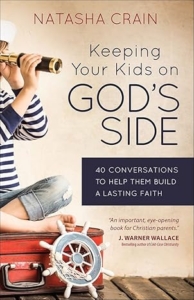
It’s that gap that led me to write Keeping Your Kids on God’s Side: 40 Conversations to Help Them Build a Lasting Faith(released in March). I wanted to help parents identify and understand 40 of the most important faith challenges they need to discuss with their kids so those challenges no longer feel ambiguous and unmanageable. But even once parents gain this critical understanding, the question remains: How does this translate into parental responsibilities?

Here are five key things to consider.

  1. Parents must commit to continually deepening their understanding of Christianity.

In a secular world, kids will frequently encounter challenges to their faith—especially from vocal atheists. Atheists are often well prepared to lay out their arguments against God and Christianity in particular. Unfortunately, many Christian parents are not equally prepared to teach their kids the case for the truth of Christianity and how to defend their beliefs. Questions like the following are critically important for kids to understand today, but few parents are equipped to proactively address them: What evidence is there for the existence of God? Why would a good God allow evil and suffering? How can a loving God send people to hell? Is faith in God the opposite of reason? What are the historical facts of the resurrection that nearly every scholar agrees on? How can Christians believe miracles are even possible? How do we know the Bible we have today says what the authors originally wrote? Does the Bible support slavery, rape, and human sacrifice (as skeptics allege)?

In the past, when society was at least more nominally Christian, parents may have been able to avoid addressing the more difficult questions of faith with their kids (not that they should have!). But today’s challenges require much more from faithful Christian parents. We must learn what the big challenges are, equip ourselves to engage with them, and commit to continually deepening our understanding of our faith so we can guide our kids accordingly.

      2. Parents must intentionally make “spiritual space” in their home.

It’s not enough to deepen your own understanding of Christianity, of course. Somehow you have to transfer that understanding to your kids, and that transfer requires carefully set aside time. The kinds of faith conversations we need to be having with our kids today (like the questions listed in point 1) are simply not going to happen in a meaningful way unless you make spiritual space for them. By spiritual space, I mean dedicated time for your family to engage together in growing your understanding of and relationship with God. There’s no reason such a time shouldn’t be scheduled just like all the other (less important) activities in your life. If you’re not currently doing this, start with just 30 minutes per week. That’s reasonable for any family, and you can always work up from there.

  1. Parents must study the Bible with their kids. Really.

Even if you know Bible study is important, statistics show you’re probably not doing it: Fewer than 1 in 10 Christian families study the Bible together in a given week. If your kids perceive that you’ve effectively relegated the Bible to the backburner of relevancy, they’ll have little reason to see it as the authoritative book Christians claim it to be. It’s absolutely pointless to talk about the Bible being God’s Word if you’re not treating it as such.

Meanwhile, the Bible is a favorite attack point of skeptics and our kids will have ample opportunity to hear how it’s an ancient, irrelevant book filled with inaccuracies and contradictions. If you’re not regularly studying the Bible with your kids, there’s a good chance they’ll eventually stop caring what it has to say. (See my article, Don’t Expect Your Kids to Care What the Bible Says Unless You’ve Given Them Reason to Believe It’s True, for more on this.)

  1. Parents must proactively and regularly ask their kids what questions they have about faith.

In a secular world, where kids are constantly hearing competing worldviews, questions are guaranteed to continually arise. But there are many reasons kids may never actually ask them—they have too many other things going on, they’re afraid of your reaction, or they are simply not interested enough to bring them up.

In our house, we’ve implemented a scheduled “questions night” to help with this. You can read about how to start your own in my article, How to Get Your Kids to Ask More Questions about Their Faith.

  1. Parents must ask their kids the tough questions they don’t think to ask.

If you regularly encourage your kids to ask questions about faith (see point 4), you’ll have lots of great conversations. But many questions that are important for kids to understand in preparation for the secular world they’ll encounter are ones that might never cross their mind to ask. For example, most kids don’t think to ask how we know the Bible we have today says what the authors originally wrote. But that doesn’t mean they won’t almost certainly encounter skeptics who tell them the Bible is completely untrustworthy for that reason. Just as we don’t wait for our kids to ask questions about World War II before deciding when what, and how to teach them about it, we shouldn’t wait until our kids encounter challenges before we address them. They’ll undoubtedly hear about these topics from skeptics at some point, so there’s no reason they shouldn’t hear about them from us first.

Greater Impact Resources: 


Natasha Crain is a blogger, author, and national speaker who is passionate about equipping Christian parents to raise their kids with an understanding of how to make a case for and defend their faith in an increasingly secular world. She is the author of two apologetics books for parents: Talking with Your Kids about God (2017) and Keeping Your Kids on God’s Side (2016). Natasha has an MBA in marketing and statistics from UCLA and a certificate in Christian apologetics from Biola University. A former marketing executive and adjunct professor, she lives in Southern California with her husband and three children.

Original Blog Source: http://bit.ly/2AKrp2J

By Tim Stratton

Sunday morning I awoke to horrific news on my Facebook feed: an Islamic terrorist brutally gunned down over fifty of our fellow human beings at a gay nightclub in Orlando, Florida. This broke my heart and made me extremely angry! I cannot imagine the sorrow, pain, and anguish the friends and family members of the deceased victims are currently experiencing. This was an objectively evil act – it was wrong!

As soon as I read the headlines and processed the fact that evil has once again reared its ugly head, I told my wife what was going to happen next. Like clockwork, people were going to insist that “religion is the problem,” or that “guns are the problem.” The statements made on social media over the past few hours have validated my prediction. In this article I will examine both of these statements and offer a third option that must be considered if we are to extinguish terror, hate, and evil.

“Religion is the Problem!”

Since 9-11, many atheists have pontificated, “Religion is what’s wrong in the world today.” They conclude that since Muslims were behind the terror attacks on September the 11th, 2001, and Islam is a religion, then religion is to blame for the terror in the world today. This attempt at an argument can be written in the following syllogism:

1- Islam is responsible for the 9-11 terror attacks.
2- Islam is a religion.
3- Therefore, religion is responsible for the 9-11 terror attacks.

This argument fails as it commits the logical fallacy of composition. This error involves an assumption that what is true about one part of something must be applied to all, or other parts of it. In this case, the atheist assumes that since one particular religion affirms terror, then all religions affirm terror.

If one were to allow this argument to pass, then we could jump to all kinds of crazy conclusions. For example, according to several reports I read following the terror attack in Orlando, the terrorist was a registered Democrat. If one allows the above argument to pass, then the following argument would suffice as well:

1- The terrorist responsible for murdering homosexuals in the gay nightclub was a registered Democrat.
2- Hillary Clinton and Barak Obama are Democrats.
3- Therefore, Hillary Clinton and Barak Obama are responsible for the murders of homosexuals in the gay nightclub.

Obviously this is ridiculous and such reasoning is incoherent. Reasonable people will reject such “conclusions.” Thus, a reasonable person will reject the so-called “conclusion” that, “religion is the problem with the world today.” This is explicitly demonstrated when surveying other religions and world views.

Take the religion of Christianity, for example. A necessary condition for one to be a legitimate Christian is that they desire, and strive, to follow the teachings of Jesus Christ. The teachings of Jesus are clearly contradictory to the teachings of Muhammad and Islam. Sure, the two religions share some overlapping beliefs: Christians and Muslims all agree, for example, that the universe began to exist and was caused and created by an enormously powerful Intelligent Designer, but they begin to part ways soon after. The final teachings from both of these religions are quite different with Muhammad commanding Muslims to kill all infidels (non-Muslims) in the Quran, and Jesus commanding his followers to love all people, from their neighbors (Mark 12:31) to their enemies (Matthew 5:44), in the Bible. Moreover, according to Islam, those in the LGB community are to be executed. According to Jesus, however, although homosexual acts go against God’s plan, the ones committing these homosexual acts are to be loved!

Let me repeat myself: According to the law of Christ found in the New Testament, homosexual acts are sinful, but homosexuals are to be LOVED! Click here for more!

“Guns are the Problem!”

Many others in America today see horrendous headlines of Islamic terror and immediately jump to the hasty conclusion that guns are the real problem. The error with this line of thinking is that it does not take into consideration all of the other means by which evil people can accomplish their evil plans. After all, the Nazis used poisonous gas to kill millions of Jews, the Ku Klux Klan used rope to hang African Americans, Timothy McVeigh used fertilizer to kill 168 people, and Islamic terrorists killed thousands of Americans on 9-11 without firing a single bullet.

If one thinks banning guns is going to stop hate crimes, then, to be consistent, they must also strive to ban all gas, rope, fertilizer, and airplanes too. This is obviously ridiculous as well, as the real problem does not lie within the tools that an evil man uses to accomplish his evil desires, but the desires of the evil man. If all guns, rope, fertilizer, and airplanes were banished from the face of the earth, these evil men would continue to find ways to accomplish their hateful plans. This is a much bigger problem.

Ideas are the Problem!

These evil desires typically stem from previously held ideas. The way one thinks directly leads to the way one acts, and the way one believes directly influences the way he behaves. You see, the problem is not all religions, all guns, all rope, all fertilizer, or all airplanes. The problem is ALLbeliefs, thoughts, and ideas that do not correspond to reality.

Ideas have consequences, and ideas that do not correspond to reality have painful consequences. These underlying ideas are referred to as one’s worldview. A worldview is a foundational set of beliefs that ultimately influence all other beliefs built upon this foundation.

Consider the worldview (or idea) of atheism. It is vitally important to understand what consistent atheism logically implies: If God does not exist, then there is nothing objectively good, bad, right, wrong, fair, or evil with anything! Watch this short video to understand exactly why this is true. It logically follows that if naturalistic atheism is true, then there is nothing really wrong with the Islamic terrorist shooting homosexuals at the gay nightclub in Orlando this past weekend. Moreover, if naturalistic atheism is true, this Muslim had no choice in the matter, as the laws of physics and chemistry forced this poor terrorist to believe and behave exactly as he did. It was simply not his fault.

To make matters worse for atheists, history is not on their side. This past century has provided evidence as to the consequences of following atheistic ideas, as the nations governed according to these ideals usually end in suffering and mass human slaughter. The atrocities committed in the name of atheism by Stalin, Pol Pot, Mao, and arguably Hitler being influenced by naturalism’s “survival of the fittest,” has caused devastating collisions with the reality of morality; human suffering and death followed on a massive scale.

If naturalistic atheism were true, then there would be nothing really wrong, bad, or evil with any action and there would be no ability to make moral choices. Couple that with the historical fact that communistic governments officially adopting atheism (or being influenced by it) make all murders under the umbrella of “religion” pale in comparison. Why would anyone want to hold to an incoherent worldview like atheism over the ideas of Jesus teaching all people to love all people? Can you imagine a world where everyone loves everyone? That sounds like heaven to me — maybe Jesus was on to something!

So, if you are keeping score, here is a quick recap: In regards to the terrorist attacks at the gay nightclub in Orlando, Florida this past weekend, here is what each worldview affirms; or rather, here are the consequences that follow from each set of ideas:

1- Consistent Islam: this attack was GOOD as Muhammad’s final commands were to kill the infidels (Take five minutes to understand by clicking here).

2- Consistent Atheism: there was NOTHING objectively WRONG with these attacks. In fact, on naturalistic atheism it is unavoidable. Terrorists are therefore not responsible for their actions.

3- Consistent Christianity: this attack was objectively WRONG and EVIL! According to the law of Christ, all humans are commanded to love all humans (even the ones we disagree with). According to Jesus, we are to love everyone from our neighbors to our enemies. Thus, one who consistently follows the teachings of Jesus will demonstrate love to all people (even the ones he disagrees with)!

Is there a best choice option? Yes there is. The one supported by all of the evidence and the same one commanding us to love!

Bottom line: If you agree that these Islamic terror attacks against homosexuals at the gay nightclub were objectively wrong and evil, then, to be logically consistent, you must reject atheism, Islam, or any other view that disagrees with the teachings of Jesus Christ. If you think terror and persecution against the homosexual community is objectively wrong, then you ought to be a Christ follower!

Stay reasonable (Philippians 4:5) and love one another (John 13:34-35),

Tim Stratton


Notes

To learn more about Islamic terror and Jihad, begin by reading this article by Timothy Fox reviewing the book of the former Muslim, Nabeel Qureshi, Answering Jihad: A Better Way Forward.

Original article: http://freethinkingministries.com/islamic-terror-homosexuality-the-consequences-of-ideas/

By Natasha Crain

I received the following blog comment this week, packed with statements that your kids are likely to hear (and possibly come to believe) about the nature of truth. I wanted to reply to the commenter right here in a blog post because I feel there is so much that is important for everyone to understand about what he is saying.

I’m going to include the full comment below so you can read it in its unbroken entirety, then I’ll break it down part-by-part. If you have older kids, I encourage you to read them this letter and use it as a discussion starter.

For context, this person is responding to an atheist who had commented on a post previously and is encouraging him to stay strong in the midst of Christian claims.

You are really brave defending your stance against a bunch of evangelical Christians banging on you. I myself am not an atheist. If I have to put a label on myself, I would choose agnostic theist. I believe in God or a higher power, but I don’t have an absolute certainty of his or her nature.

 My belief is rational to [a] certain extent. The rest is on faith. However, unlike Christians, my spiritual path is highly personal and subjective. I will never say that “you’d better believe what I believe or you will suffer eternal consequences”. Christians, whichever denominations, like to intimidate me which [sic] this “Jesus is the high way” tactic even though I never initiate any religious conversation with them. However, I have survived as a gay, Vietnamese, and non-Abrahamic-faith person, and my life is pretty good so far. I know you may not like to hear this. I feel connected to God with contemplation, prayer, and compassion practice. When I have a child, I will not raise him or her as an atheist or a believer. I will do my best to raise him as a person who has a higher sense of empathy and compassion. If he chooses to be a Christian, Buddhist, Wiccan, Pagan, etc., I will support his decision. I believe that God is like an ocean, and different spiritual paths are like rivers. I am not the one who decides which river is the best to reach the ocean…

Keep your stance and keep searching truth…your truth. Not mine and definitely not these Christians’.

My Response: An Open Letter to a Relativist

Dear Minh,

Thank you for being willing to honestly share your spiritual journey in the comments section of my blog. It’s clear that spirituality is an important topic for you, as it is for me. With that in mind, I’d like to respond to several of the points you make.

You said: I myself am not an atheist. If I have to put a label on myself, I would choose agnostic theist. I believe in God or a higher power, but I don’t have an absolute certainty of his or her nature.

From what you’re saying here, it sounds like you are “agnostic” about what kind of God or higher power exists because you haven’t found anything pointing to that Being’s nature with absolute certainty. However, it’s important that we’re honest with ourselves about this desire for absolute certainty. There’s pretty much nothing in life we know with “absolute certainty.” For example, do you know with absolute certainty that you are a real person and that everything you experience is not just an illusion? No, but you have good reason to believe you really exist and you live accordingly. We claim to know things all the time that we can’t be absolutely certain about. When the preponderance of evidence points toward something being true, we go ahead and say we know it.

The question I would leave you to consider, therefore, is this: If you discovered that a preponderance of evidence pointed to a specific religion being the one true revelation of God to humans, would you accept it as truth? Or do you require a level of certainty that you don’t require of anything else in your life?

If you require a unique level of certainty in spiritual matters, then I would suggest perhaps you don’t want to find truth. If you are open to considering the weight of the evidence for the possible objective truth of a specific religion, then I would invite you to begin that investigation in earnest. If you would like to learn about the evidence for Christianity specifically, I will recommend a great starting book at the end of this letter.

You said: My belief is rational to a certain extent. The rest is on faith. However, unlike Christians, my spiritual path is highly personal and subjective.

It sounds as though you are suggesting that a highly personal and subjective spiritual path is a better way than an objective one, such as in Christianity. However, it’s important to realize (if that’s indeed what you are implying) that by claiming this, YOU are making an objective statement–that a highly personal and subjective spiritual path is best for everyone! That’s a contradiction.

You said: I will never say that “you’d better believe what I believe or you will suffer eternal consequences”.

If you’re an agnostic theist, then you presumably don’t believe there are eternal consequences for your beliefs, so of course, you will never say that. But what you are really saying here is that it’s wrong (and probably arrogant) for Christians to suggest to others that they have objective knowledge that beliefs have eternal consequences. Here’s the problem: What if Christianity is true? What if there are eternal consequences for what you believe? Would it be more loving for Christians to tell others about that, or to stay silent in the fear that the truth might bother you? Whether you believe Christianity is true or not, it’s not logical to suggest it’s a bad thing for Christians to warn other people about what they believe to be eternal consequences. When a person truly believes something horrible will happen to another person unless they warn them about it (think of someone about to get hit by a bus), the logical and loving action is to warn them. I would hope you would do the same if that were your belief.

You said: Christians, whichever denominations, like to intimidate me which this “Jesus is the high way” tactic even though I never initiate any religious conversation with them.

We really need to stop here and better define the nature of intimidation; there is a huge difference between an intimidating delivery of a message, an intimidating message, and feeling intimidated.

If a Christian has gotten in your face, waving a Bible in the air and shouted angrily at you, “Jesus is the only way!” then they have delivered a message in an intimidating way. And I apologize if you have been the recipient of any such graceless delivery. That is not how Jesus would speak.

An intimidating message is one that is frightening in and of itself. Is the message that Jesus is the only way to God frightening? If so, I encourage you to really dig deep and understand why it would be frightening to you if there was really just one objective truth. The gospel is good news…Jesus died so that our sins can be forgiven and we can be reconciled to our wonderful Creator.

Finally, a person can feel intimidated even if someone does not deliver a message in an intimidating way and doesn’t even deliver an intimidating message. There is nothing inherently intimidating about saying that Jesus is the only way to God! But if in response to that, you feel intimidated, then it’s worth digging within to understand why the notion of one objective truth is so challenging to you personally.

You said: However, I have survived as a gay, Vietnamese, and non-Abrahamic-faith person, and my life is pretty good so far. I know you may not like to hear this.

Minh, the test of truth should never be whether or not our lives are “pretty good.” A person can believe the world is flat (a wrong belief about reality) while having an amazing life from an earthly perspective. It’s not about survival and circumstances; it’s about having good reason to know that what you believe is an accurate picture of reality.

You said: I feel connected to God with contemplation, prayer, and compassion practice.

But why put so much trust in your feelings? Our feelings can’t be the final arbiter of truth. If I tell you I feel connected to Jesus as God’s son, who represents the only way to God, you wouldn’t believe I’m right. So there has to be something objective–evidence outside of your and my personal experiences–to help us determine what is actually true.

You said: When I have a child, I will not raise him or her as an atheist or a believer. I will do my best to raise him as a person who has a higher sense of empathy and compassion.

Why are empathy and compassion the most important values? Why are they “higher” in value or truth than whether or not God exists? If God doesn’t exist, and the world is only material, then there is no basis for objective morality; there is nothing morally good or bad because there is no moral authority. Empathy and compassion are morally equivalent to killing people if we are just molecules in motion. To be sure, I’m not suggesting that most atheists would ever think killing a person is OK. But, in a world with no God (a moral authority), at best you could say that killing people is not good in your opinion, and therefore you won’t do it. Atheists can be “good without God,” but they have no objective basis from which to call anything good. Similarly, if you don’t believe in a God who has revealed anything of His nature, you have no objective basis from which to refer to empathy and compassion as “higher” values.

You said: If he chooses to be a Christian, Buddhist, Wiccan, Pagan, etc, I will support his decision.

If by “support” you mean you will continue to love him dearly, regardless of what he believes, then I agree wholeheartedly. But if by “support” you mean you will accept whatever he believes as an equally valid picture of truth, then once again this is a contradiction. At the end of your whole comment, you advise fellow readers to not search for the truth of Christianity. Clearly, if your son believed Christianity is true, you would not feel that view is as valid as yours. Thus, you are willing to claim that at least some views are objectively wrong.

You said: I believe that God is like an ocean, and different spiritual paths are like rivers.

If you study where all these “rivers” are actually leading, you’ll see that they make logically incompatible truth claims; they aren’t even claiming to run to the same ocean. As a simple example, in Judaism, Jesus is not the Messiah. He is simply a man. In Christianity, Jesus is the Messiah and is God Himself. These claims cannot both be true. They contradict each other and cannot point to the same truth.

You said: I am not the one who decides which river is the best to reach the ocean.

If God exists, as you and I both believe, then you are correct: We are not the ones who decide which river is the best to reach the ocean. GOD IS! Ironically, by stating that you are not the one to decide what is best, so you, therefore, choose to believe that all paths are fine, you ARE making a claim of what is best. God, and God alone determines which “river” flows to Him. The question is, has He revealed which river that is, and if so, which revelation is correct? Christians believe He has revealed that river as Jesus. We are not claiming to have decided that on your behalf, which I think is a misunderstanding that flows throughout your comment. We are simply claiming that the river that runs to God has already been decided by God and are sharing what we believe He has revealed.

You said: Keep your stance and keep searching truth, your truth. Not mine and definitely not these Christians’.

After all you wrote about the equally valid paths to God, it’s hard not to see the irony in how you’re advising others to definitely not search for the truth of “these Christians.” Are all paths valid except Christianity? You champion relative, subjective truth, but in doing so, you are making an objective claim that all paths are equally valid (except, notably, Christianity).

The bottom line is this: Truth is not what we like the best, what makes us most comfortable, what costs us the least, or what makes us happiest. It’s what accurately matches reality. I encourage you to consider the actual evidence for the truth of various worldviews, including, of course, Christianity. If you honestly and openly do so, I am confident you will see that there is a good reason to believe that Christianity is the uniquely true revelation of God. An excellent book that examines this evidence from the perspective of a detective is Cold-Case Christianity: A Homicide Detective Investigates the Claims of the Gospels.

 I wish you the best and hope that there is some food for thought here.

For anyone wanting to better understand the nature of objective truth, whether or not all religions can point to the same truth, why Christians can claim to “know” Christianity is true, and how common sense and personal experience are or are not helpful in determining truth, please check out my new book, Keeping Your Kids on God’s Side: 40 Conversations to Help Them Build a Lasting Faith. It’s available from your local Barnes & Noble and Christian book retailers, as well as ChristianBook.com, BarnesandNoble.com, and Amazon.com.


Natasha Crain is a blogger, author, and national speaker who is passionate about equipping Christian parents to raise their kids with an understanding of how to make a case for and defend their faith in an increasingly secular world. She is the author of two apologetics books for parents: Talking with Your Kids about God (2017) and Keeping Your Kids on God’s Side (2016). Natasha has an MBA in marketing and statistics from UCLA and a certificate in Christian apologetics from Biola University. A former marketing executive and adjunct professor, she lives in Southern California with her husband and three children.

Original Blog Source: http://bit.ly/2Clbys2

By Billy Dyer

One reason I believe in Christianity is because it speaks of reality closer than any other worldview. This isn’t the only or even the main reason, but it is one of the reasons. Even if Christianity is not true (I do not doubt Christianity) I am convinced that atheism is wholly false. That is because atheism contradicts the real world at every turn. I try to point this out to skeptics all the time, and I’ve learned a lot about how to deal with people. Here are four observations I’ve made about our culture.

  1. Understand our culture is hypocritically skeptical about history

    Have you ever noticed that modern man is very skeptical about what happened in history? Of course, he isn’t skeptical at all about the information we have in the Present. As if the present is some sort of infallible guide to truth. To our culture, it seems as if the present contains the whole field of vision for truth. That is, if we believe it today then it must be true. Furthermore, they have the snobbery of believing that ancient man has nothing to teach us. But what I find most interesting is that this skepticism about history only goes back so far. Once you get back to the pre-historic days then somehow history becomes a matter of science, and we all know science is infallible. Therefore, the study of dinosaurs is reliable, but the study of the early church are ransacked with an error.

  2. Realize they have a strong distrust of ancient text

    Modern man just cannot stomach the concept that the Bible has been copied. If it has been copied then assuredly it has to have been corrupted many times over. Admittedly this is a difficult topic to address not due to the evidence being in their favor but because of time. That is, we simply do not have the time, during those moments of objection, to sit down and teach them about textual criticism. At the same time, though, we can use their faith in science to our aide. They do call textual criticism a science. Therefore, we can ask the skeptic, “why should you doubt the science of textual criticism if their data findings conclude that the Biblical text has been preserved?”.

  3. Any sense of sin is virtually lacking

    The Apostles went into the world of pagans to preach the Gospel. It was full of mystical religions which worshipped the dead, conjured up spirits, had ancestor worship, idol worship, gross immorality, etc… But at least they had a concept of moral obligations. That is why the Gospel was called “good news.” For the pagans finally understood they could be truly forgiven for what they knew they had done wrong. I know it may seem weird to think about, but please think about it for a minute. A person can be highly immoral in the Christian sense yet still have an understanding of a moral code. I’ve noticed this in my study on gangs. They are very wicked people. In fact, if women want to enter the gang, they have to allow themselves to be raped by all the members as an initiation rite. Men sometimes have to kill an innocent person or allow themselves to be brutally beaten to show their loyalty. As wicked as this may be they still have a moral code. There are a set of rules that they still abide by. In our day and age, America is forsaking the concept that morals even exist. As apologists, we don’t even have grounds to start on to talk about sin. We have to convince the world that sin, in any sense of the term, even exists first. They do not want to know if they can be acquitted for sin but whether God can be acquitted for creating such a world as this. 

  4. We must learn the language of our audience

    Not too many Bible students have had the opportunity to study this out, so I am just going to mention it here. But the New Testament authors actually took words from the contemporary culture and redefined them to fit what they were teaching. I think this is brilliant because it builds a bridge of understanding. That is, we can take a concept that they do understand simply help show them the fuller truth of the nugget they seem to already agree with. This is why I try to stay away from using Christian-Eze language when talking to non-church going people. That is a language that is virtually only understood by Church people (atonement, propitiation, justification, sanctification). Don’t get me wrong. We shouldn’t ignore the concepts. I am only imploring you to speak of the concepts using words that make sense to your audience. If you cannot translate your theology into the common man’s vernacular, then you are too confused about theology to teach it. So instead of saying God “justifies” us, we can say God acquits us. When speaking of “God’s wrath” I often use the illustration of a bounty hunter. We are criminals who are being tracked down by the bounty hunter known as God’s wrath, and He always catches his victim. But God has provided a means of payment to satisfy this bounty hunter, and it is only through Jesus. Another word to stay away from is “faith” When our culture hears faith they think of a blind leap in the dark or believing in spite of the evidence. Instead, I like the word trust because our audience understands it and it actually better defines the Greek word.

If you keep these four things in mind, it will help you to know your audience and present the case for Christ better.

For more articles like 4 Pieces of Wisdom from a Street Level Apologist visit Billy’s website: Dyerthoughts.com 

Billy Dyer is a CrossExamined Instructor Academy Graduate.

By Brian Chilton

This past Sunday, the third episode of Morgan Freeman’s show The Story of God as aired on the National Geographic Channel. The third episode dealt with how God is understood to be in various cultures and religions. Again, I am profoundly surprised at how well this show has been made. The show has not attacked any particular worldview, as I feared that it would. Rather, the show has taken a fairly neutral position while evaluating some major topics. This episode was no different. The third episode dealt with the issue “Who is God?” This article will seek to answer 7 questions that were raised during the show from a Christian perspective.

  1. Is there one God or several gods?

By sheer necessity, there is only one ultimate uncaused cause. If there were several gods or goddesses, one would have to ask “How did such a number of gods arise?” It seems to me that one would be forced to accept a first uncaused cause. While it is possible to accept a multiplicity of gods and goddesses, it makes better sense to accept that only one God exists. Why? Well, I think Thomas Aquinas answers this well. Aquinas states,

 “When the existence of a cause is demonstrated from an effect, this effect takes the place of the definition of the cause in proof of the cause’s existence. This is especially the case in regard to God, because, in order to prove the existence of anything, it is necessary to accept as a middle term the meaning of the word, and not its essence, for the question of its essence follows on the question of its existence. Now the names given to God are derived from His effects; consequently, in demonstrating the existence of God from His effects, we make take for the middle term the meaning of the word ‘God.’”[1]

From sheer necessity, only one God must exist. Thus, God could manifest himself in several ways, but in the end, there is but only one God.

  1. How does one connect to God?

If by connecting, one means relating to God, then one can connect with God in various ways. Morgan Freeman is right when he notes that it is sometimes difficult to relate to a transcendent God. However, God has given us means to relate to him. One way people connect with God is through prayer. Prayer is a means by which we can communicate with God and a way that God communicates with us.[2] Another way a person connects to God is through the written Word of God. The Scriptures are God’s revelation to all humanity. A third way a person can connect with God is through the intellect. A person can connect with God by learning more about God. Fourth, a person can connect with God through nature. As the psalmist notes, “the heavens declare the glory of God, and the sky above proclaims his handiwork” (Psalm 19:1).[3] Lastly, a person can ultimately connect with God through a relationship with Christ. When one receives Christ, the Bible tells us that the believer is filled with the Holy Spirit of God (John 14:15ff).

  1. Has God revealed himself to several people throughout the world?

There is but only one ultimate truth. However, this is not to say that God has not been trying to reveal himself to various peoples throughout the world. Solomon writes that God “has made everything beautiful in its time. Also, he has put eternity into man’s heart, yet so that he cannot find out what God has done from the beginning to the end” (Ecclesiastes 3:11). So, I am not saying that all religions are the same. Such is not logically possible. However, I feel it is quite possible that God has been trying to reveal himself throughout all of history. Ultimately, the full revelation came through Jesus of Nazareth, the “only begotten Son of God” (John 3:16).

  1. How do we know what’s divine?

Only God is truly divine in the purest sense. However, human beings are made in the image of God (Genesis 1-2). Thus, human beings bear the mark of divinity (although we are not divine). But in fact, all things bear the mark of God in reality because “All things were made through him, and without him was not anything made that was made” (John 1:3). So, only one person is truly divine (God), yet all things bear the imprint of the divine as God created all things.

  1. Can we imagine God?

In a way, yes. In a way, no. I think Norman Geisler puts it best. Geisler notes that “Although God can be apprehended, He cannot be comprehended.[4] Paul writes, “For we know in part and we prophesy in part, but when the perfect comes, the partial will pass away” (1 Corinthians 13:9). Thus, we cannot say that we know everything about God. If we could, we would be God.

  1. Does God indwell us?

We all bear the image of God (Genesis 1:26). However, God indwells each person who receives Christ as Savior. This person is known as the Holy Spirit.

  1. Can we experience God?

Yes! Absolutely we can! We experience the blessings of God every day. However, the only way to fully experience God is through a relationship with Christ Jesus. See also the answer to the second question.[5]

Much more could be said about God. In reality, the third episode of Freeman’s documentary as well as this article has focused more upon how humanity knows God. Such a knowledge of God is called revelation. God has revealed himself both through natural revelation (available to all) and special revelation (delivered to those of faith). If a person has not experienced God, it is highly advised that the person seek God and ask God to reveal himself.

Notes

[1] Thomas Aquinas, Summa Theologica I.2.2., in Thomas Aquinas, Summa of the Summa, Peter Kreeft, ed., Fathers of the Dominican Province, trans (San Francisco: Ignatius Press, 1990), 59.

[2] Some individuals have argued that God does not communicate with a person through prayer. With all due respect, I have found such arguments greatly lacking. God has spoken to a vast array of individuals in the Bible through the means of prayer (e.g. Habakkuk, Job, Elijah, Isaiah, and so on). To claim that God cannot speak to a person in prayer discredits the power and personal nature of God. However, I agree that one should always “test the spirits” (1 John 4:1) to ensure that one is truly hearing from God.

[3] Unless otherwise noted, all Scripture comes from the English Standard Version (Wheaton: Crossway, 2001).

[4] Norman Geisler, Systematic Theology: In One Volume (Minneapolis: Bethany House, 2011), 529.

[5] Also, check out the discipleship program Experiencing God by Henry Blackaby, Richard Blackaby, and Claude V. King.


Brian G. Chilton is the founder of BellatorChristi.com and is the host of The Bellator Christi Podcast. He received his Master of Divinity in Theology from Liberty University (with high distinction); his Bachelor of Science in Religious Studies and Philosophy from Gardner-Webb University (with honors); and received certification in Christian Apologetics from Biola University. Brian is currently enrolled in the Ph.D. program in Theology and Apologetics at Liberty University. Brian has been in the ministry for over 15 years and serves as a pastor in northwestern North Carolina.
Original Blog Source: http://bit.ly/2x7KBnT

By Brian Chilton

For the previous couple of weeks, we have looked into the veritability of the empty tomb hypothesis; that is, that the tomb of Jesus was literally found empty on the first Easter Sunday morning. We have already confirmed historically that the tomb was found empty due to the burial practices of the first-century Jews and also due to the numerous times that Romans allowed clemency for the families to bury the victims of crucifixion especially during the days of Emperor Tiberius (things radically changed in this regard with Emperor Caligula). We have also noted the failure of alternate viewpoints in explaining away the empty tomb. In this article, we will conclude our research as we investigate the biblical and theological arguments for the empty tomb. The biblical argument will ask the question, “Did the early church really believe that the tomb was found empty the first Easter Sunday?” The theological argument will weigh how much Christian theology revolves around the empty tomb hypothesis. Why would the early church value these important attributes of Jesus if the tomb still held the body of Jesus?

The Biblical Argument for Accepting the Empty Tomb Hypothesis

Did the early church believe that the tomb was empty? Scholars hold that strewn throughout the pages of the New Testament are ancient traditions. These ancient traditions predate the writing of the New Testament and represent the beliefs of the earliest church. Gary Habermas notes that some of the passages considered to be ancient traditions in addition to 1 Corinthians 15:3-7 “receiving scholarly attention are 1 Corinthians 11:26…Acts, especially 2:22-36, 4:8-10, 5:29-32, 10:39-43, 13:28-31, 17:1-3, 30-31; Romans 4:25; Philippians 2:8; 1 Timothy 2:6; [and] 1 Peter 3:18.”[1] In addition to these passages, Habermas also notes that “Matthew 27:26-56; Mark 15:20-47; Luke 23:26-56; [and] John 19:16-42”[2] represent ancient traditions that date to the time of the earliest church. Licona adds Romans 6:4 to the forum.[3] Of the numerous traditions listed, the paper will evaluate only two that pertain most directly to the empty tomb: the original ending of Mark’s Gospel (Mark 16:1-8),[4] and 1 Corinthians 15:3-7.

Scholarly consensus along with evidence in the earliest manuscripts indicates that Mark’s Gospel ended at Mark 16:8. Whereas Mark 16:1-8 does not enjoy the consensus that some of the other traditions hold, Licona notes that there “appear to be close similarities between the four-line formula in 1 Corinthians 15:3-5 and other passages such as Mark 15:37-16:7 and Acts 13:28-31.”[5] If Licona is correct, then one can argue that Mark 16:1-7 holds nearly the same force, being an early tradition, that 1 Corinthians 15:3-7 seemingly enjoys. Seeing 1 Corinthians 15:3-7 enjoys strong consensus that the text relates a tradition that dates back to the earliest church, a fact that will be addressed later in this section.

Nevertheless, Mark 16:1-7 provides evidence that Mark believed that Jesus’ tomb was found empty on the first Easter Sunday. Mark notes that the women “went to the tomb” (Mark 16:2). The women wondered who would roll away the large stone from the tomb (Mark 16:3). The women noticed that “the stone had been rolled back—it was very large” (Mark 16:4). The women “entered the tomb” (Mark 16:5). The women had an angelophany where an angel announced they sought “Jesus of Nazareth, who was crucified. He has risen; he is not here. See the place where they laid him” (Mark 16:6). The women left the tomb with great fear (Mark 16:7). Review the information provided in the text. The women came to the tomb, acknowledging that Jesus was indeed buried in a tomb. The women entered the tomb expecting to see the body of Jesus. The women had an angelophany in the tomb where it was announced that Jesus had risen, noting that the tomb was empty. The women left with great fear because the tomb was empty. Thus, Mark’s original ending demands the existence of an empty tomb. It was noted earlier that 1 Corinthians 15:3-7 holds universal scholarly consensus as being an ancient tradition. Does 1 Corinthians 15:3-7 afford any insight to the existence of an empty tomb?

1 Corinthians 15:3-7 is a tradition that Paul received from the church “within five years of Jesus’ crucifixion and from the disciples themselves.”[6] Thus, 1 Corinthians 15:3-7 is of great historical value. The tradition also allows for the empty tomb hypothesis. The tradition notes that “Christ died for our sins in accordance with the Scriptures, that he was buried, that he was raised on the third day in accordance with the Scriptures, and that he appeared to Cephas, then to the twelve” (1 Corinthians 15:3b-5). The structure of the tradition assumes that the tomb of Jesus was empty. Craig notes that the reference to the burial of Jesus in 1 Corinthians 15:3-7 makes “it very difficult to regard Jesus’ burial in the tomb as unhistorical, given the age of the tradition (AD 30-6), for there was not sufficient time for legend concerning the burial to significantly accrue.”[7] It notes that Jesus physically died. Jesus was physically buried. Jesus physically raised from death. Jesus physically appeared to the disciples, demanding that the previous place of burial was left empty. Therefore, the empty tomb holds biblical support with early church traditions demonstrating that the early church believed that Jesus’ tomb was empty. So, what theological value does this hold?

The Theological Argument for Accepting the Empty Tomb Hypothesis

Thus far, the paper has evaluated the evidence for the empty tomb hypothesis. William Lane Craig notes that the evidence for the empty tomb “is so compelling that even a number of Jewish scholars, such as Pinchas Lapide and Geza Vermes, have declared themselves convinced on the basis of the evidence that Jesus’ tomb was found empty.”[8]However, one must ask, what value does the empty tomb hypothesis hold for the overall scope of Christian theology?

First, the empty tomb serves to demonstrate the divine nature of Christ. The empty tomb serves as evidence for the resurrection. The resurrection serves as evidence of Jesus’ deity. Millard Erickson denotes that “to Jews of Jesus’ time, his resurrection would have signified divinity, we must ask about the evidence for it.”[9] Norman Geisler states that “while the empty tomb in and of itself is not proof of the resurrection, it is an indispensable prerequisite to the evidences (the physical appearances of Jesus).”[10]

Also, the empty tomb provides evidence that God will fulfill the teachings and promises given through Christ, especially that Christ will one day return. Perhaps Paul says it best when he notes that “if Christ has not been raised, your faith is futile and you are still in your sins” (1 Corinthians 15:17).

Theologically, the entire basis of the Christian faith rests upon the resurrection of Christ. If Christ has been raised from the dead, then the Christian faith is verified. Furthermore, if Christ was raised from the dead, then obviously one clearly concludes that the tomb which housed his body was emptied of his physical presence.

Conclusion

The empty tomb hypothesis holds great weight historically, biblically, and theologically. Secular naturalism does not offer any appropriate alternatives. If one is to follow the evidence where it leads, one must note that the disciples encountered an empty tomb on the first Easter Sunday. While it is impossible to know anything with absolute certainty, it is highly probable that Jesus’ tomb was found empty on the first Easter Sunday. Yet, the empty tomb did not transform the disciples. The encounters the disciples had with the risen Jesus empowered the disciples with great courage and boldness. The empty tomb serves as a reminder that Christ has been raised from death and that each person can have an encounter with the risen Jesus by simply calling upon his name. The empty tomb also reminds humanity that Jesus came, Jesus left, and one day Jesus will return.

Visit Brian’s Website: BellatorChristi.com

 Copyright, March 28, 2016. Brian Chilton.


  Notes

[1] Gary Habermas, The Risen Jesus & Future Hope (Lanham, MD: Rowman & Littlefield, 2003), 39, 65n.

[2] Ibid., 39, 66n.

[3] Licona, The Resurrection of Jesus: A New Historiographical Approach, 222.

[4] While the ending of Mark is not listed among the early traditions, scholars generally hold to the primacy of Mark’s Gospel as it represents the earliest of the Gospels. Thus Mark represents the earliest tradition in the Gospel narratives.

[5] Licona, The Resurrection of Jesus: A New Historiographical Approach, 321.

[6] Gary R. Habermas and Michael R. Licona, The Case for the Resurrection of Jesus (Grand Rapids: Kregel, 2004), 53.

[7] Davis, Kendall, and O’Collins, eds. The Resurrection, 253.

[8] William Lane Craig, Reasonable Faith: Christian Truth and Apologetics, 3rd ed (Wheaton: Crossway, 2008), 371.

[9] Millard J. Erickson, Christian Theology, 2nd ed (Grand Rapids: Baker Academic, 1998), 710.

[10] Norman L. Geisler, Systematic Theology: In One Volume (Minneapolis: Bethany House, 2011), 1512.

Bibliography

Bird, Michael, F., et. al. How God Became Jesus: The Real Origins of Belief in Jesus’ Divine Nature—A Response to Bart Ehrman. Grand Rapids: Zondervan, 2014.

Craig, William Lane. Reasonable Faith: Christian Truth and Apologetics, 3rd Edition. Wheaton: Crossway, 2008.

Davis, Stephen; Daniel Kendall, SJ; and Gerald O’Collins, SJ, eds. The Resurrection. Oxford, UK: Oxford University Press, 2004.

Ehrman, Bart. How Jesus Became God: The Exaltation of a Jewish Preacher from Galilee. New York: HarperOne, 2014.

Erickson, Millard J. Christian Theology. Second Edition. Grand Rapids: Baker Academic, 1998.

Elwell, Walter A., and Barry J. Beitzel. Baker Encyclopedia of the Bible. Grand Rapids: Baker Book House, 1988.

Geisler, Norman L. Baker Encyclopedia of Christian Apologetics. Baker Reference Library. Grand Rapids: Baker Books, 1999.

_______________., and Frank Turek. I Don’t Have Enough Faith to Be an Atheist. Wheaton: Crossway, 2004.

_______________. Systematic Theology: In One Volume. Minneapolis: Bethany House, 2011.

Habermas, Gary R. The Historical Jesus: Ancient Evidence for the Life of Christ. Joplin, MO: College Press, 2011.

_______________., and Michael R. Licona. The Case for the Resurrection of Jesus. Grand Rapids: Kregel, 2004.

_______________. The Risen Jesus & Future Hope. Lanham, MD: Rowman & Littlefield, 2003.

Kreeft, Peter, and Ronald K. Tacelli. Handbook of Christian Apologetics: Hundreds of Answers to Crucial Questions. Downers Grove: IVP Academic, 1994.

Licona, Michael R. The Resurrection of Jesus: A New Historiographical Approach. Downers Grove: IVP Academic, 2010.

Meyers, Eric M. “Secondary Burials in Palestine.” The Biblical Archaeologist 33 (1970): 2-29. In N. T. Wright. The Resurrection of the Son of God. Volume 3. Christian Origins and the Question of God. Minneapolis: Fortress Press, 2003.

Miller, Richard C. “Mark’s Empty Tomb and Other Translation Fables in Classical Antiquity.” Journal Of Biblical Literature 129, 4 (2010): 759-776. Accessed November 6, 2015. ATLA Religion Database with ATLASerials, EBSCOhost.

Smith, Daniel A. “Revisiting the Empty Tomb: The Post-mortem Vindication of Jesus in Mark and Q.” Novum Testamentum 45, 2 (2003): 123-137. Accessed November 6, 2015. ATLA Religion Database with ATLASerials, EBSCOhost.

Wallace, J. Warner. Cold-case Christianity: A Homicide Detective Investigates the Claims of the Gospels. Colorado Springs: David C. Cook, 2013.

Wright, N. T. The Resurrection of the Son of God. Volume 3. Christian Origins and the Question of God. Minneapolis: Fortress Press, 2003.


By Brian Chilton

The previous section examined the arguments posed against the empty tomb hypothesis. The blog demonstrated in the first article that the arguments against the empty tomb hypothesis fail greatly. This article will provide a historical argument for the empty tomb hypothesis. If the Gospels are correct in that the tomb was truly empty on the first Easter Sunday, then one would expect to find that the ancient burial practices of first-century Judaism would match the type of burial that is presented in the Christian tradition. Did people in first-century Palestine bury their dead tombs like the “new tomb…cut in the rock” (Matthew 27:60)?

The canonical Gospels’ account of Jesus’ burial indeed matches the burial practices of first-century Palestine. Elwell and Beitzel denote that “Bodies were buried in tombs, that is, natural caves or rock-hewn sepulchers, such as that belonging to Joseph of Arimathea where the body of Jesus was laid (Mt. 27:59, 60), as well as in shallow graves covered with rock heaps serving both to mark them and to prevent desecration of the body by animals.”[1] Thus, even if Jesus had been buried in a shallow grave, the practices of the time did not readily allow easy access to predators. Yet, as it was noted earlier, it is highly unlikely that the Gospel writers would invent Joseph of Arimathea. Therefore, it is highly unlikely that the Evangelists would invent the empty tomb especially due to the use of a rock-hewn tombs at the time.

N. T. Wright notes that “the burial so carefully described in the gospels was, as we would expect in first-century Palestinian Judaism, the initial stage of a two-stage burial.”[2]Families would bury their dead in a rock-hewn tomb. The families would prepare the body with spices. Then after a year, the family would return to gather the bones of the departed and place them in a family ossuary.[3] Why did they conduct this practice? Wright, paraphrasing Eric M. Meyers work, notes that “secondary burial…reflects a belief in a continuing nephesh, [sic] enabling the bones to provide ‘at least a shadow of their strength in life’, with the mortal remains constituting ‘the very essence of that person in death.’”[4]Since the Evangelists’ description of the burial of Jesus matches the practices of first-century Palestinian Judaism, the empty tomb hypothesis again strengthens. But, would Pilate have granted the body of Jesus to Joseph of Arimathea?

JamesOssuary-1-
This ossuary holds an inscription that it is the burial box belonging to James, the brother of Jesus–traditionally held to be the writer of the Epistle of James and early leader of the church.

History demonstrates that the Romans often granted clemency under certain circumstances. Craig Evans notes that Septimius Vegetus, governor of Egypt; Pliny the Younger, governor of Bithynia in Asia Minor; and an inscription from Ephesus all demonstrate that Roman officials often provided various acts of clemency towards various condemned individuals.[5] Evans goes on to say,

 This mercy at times extended to those who had been crucified. Clemency sometimes was occasioned by a holiday, whether Roman or a local non-Roman holiday, or simply out of political expediency, whatever the motivation. We actually have evidence that Roman justice not only allowed for the executed to be buried, but it even encouraged it in some instances.[6]

Therefore, one will find that history provides ample evidence that not only did Palestinian Jews bury in accordance to the method prescribed by the Evangelists, but also that the Romans provided clemency for the body of the condemned to be given to the family to bury. If one remembers that the crucifixion of Jesus occurred during Passover when the bodies of the condemned were not to be allowed to remain on the cross (John 19:31), then the empty tomb hypothesis gains further merit.

This section has reviewed the historical data that confirms the empty tomb hypothesis. However, one must also query whether evidence exists that the early church believed that Jesus’ was placed in a tomb and that the tomb was found empty on the following Sunday. That topic will be evaluated in the forthcoming article next week.

Visit Brian’s Website: BellatorChristi.com

Copyright, March 21, 2016. Brian Chilton.


Notes

[1] Walter A. Elwell and Barry J. Beitzel, Baker Encyclopedia of the Bible (Grand Rapids: Baker Book House, 1988), 386.

[2] Wright, The Resurrection of the Son of God, 707.

[3] Ossuaries were burial boxes where the bones of several family members could be kept after their bodies had mostly decomposed.

[4] Eric M. Meyers, “Secondary Burials in Palestine,” The Biblical Archaeologist 33 (1970): 15, 26, in Wright, The Resurrection of the Son of God, 91.

[5] Craig Evans, “Getting the Burial Traditions and Evidences Right,” in How God Became Jesus: The Real Origins of Belief in Jesus’ Divine Nature—A Response to Bart Ehrman (Grand Rapids: Zondervan, 2014), 75.

[6] Ibid., 75-76.

Bibliography

Bird, Michael, F., et. al. How God Became Jesus: The Real Origins of Belief in Jesus’ Divine Nature—A Response to Bart Ehrman. Grand Rapids: Zondervan, 2014.

Craig, William Lane. Reasonable Faith: Christian Truth and Apologetics, 3rd Edition. Wheaton: Crossway, 2008.

Davis, Stephen; Daniel Kendall, SJ; and Gerald O’Collins, SJ, eds. The Resurrection. Oxford, UK: Oxford University Press, 2004.

Ehrman, Bart. How Jesus Became God: The Exaltation of a Jewish Preacher from Galilee. New York: HarperOne, 2014.

Erickson, Millard J. Christian Theology. Second Edition. Grand Rapids: Baker Academic, 1998.

Elwell, Walter A., and Barry J. Beitzel. Baker Encyclopedia of the Bible. Grand Rapids: Baker Book House, 1988.

Geisler, Norman L. Baker Encyclopedia of Christian Apologetics. Baker Reference Library. Grand Rapids: Baker Books, 1999.

_______________., and Frank Turek. I Don’t Have Enough Faith to Be an Atheist. Wheaton: Crossway, 2004.

_______________. Systematic Theology: In One Volume. Minneapolis: Bethany House, 2011.

Habermas, Gary R. The Historical Jesus: Ancient Evidence for the Life of Christ. Joplin, MO: College Press, 2011.

_______________., and Michael R. Licona. The Case for the Resurrection of Jesus. Grand Rapids: Kregel, 2004.

_______________. The Risen Jesus & Future Hope. Lanham, MD: Rowman & Littlefield, 2003.

Kreeft, Peter, and Ronald K. Tacelli. Handbook of Christian Apologetics: Hundreds of Answers to Crucial Questions. Downers Grove: IVP Academic, 1994.

Licona, Michael R. The Resurrection of Jesus: A New Historiographical Approach. Downers Grove: IVP Academic, 2010.

Meyers, Eric M. “Secondary Burials in Palestine.” The Biblical Archaeologist 33 (1970): 2-29. In N. T. Wright. The Resurrection of the Son of God. Volume 3. Christian Origins and the Question of God. Minneapolis: Fortress Press, 2003.

Miller, Richard C. “Mark’s Empty Tomb and Other Translation Fables in Classical Antiquity.” Journal Of Biblical Literature 129, 4 (2010): 759-776. Accessed November 6, 2015. ATLA Religion Database with ATLASerials, EBSCOhost.

Smith, Daniel A. “Revisiting the Empty Tomb: The Post-mortem Vindication of Jesus in Mark and Q.” Novum Testamentum 45, 2 (2003): 123-137. Accessed November 6, 2015. ATLA Religion Database with ATLASerials, EBSCOhost.

Wallace, J. Warner. Cold-case Christianity: A Homicide Detective Investigates the Claims of the Gospels. Colorado Springs: David C. Cook, 2013.

Wright, N. T. The Resurrection of the Son of God. Volume 3. Christian Origins and the Question of God. Minneapolis: Fortress Press, 2003.

By Brian Chilton

I recently read Gregory E. Ganssle’s book Thinking about God: First Steps in Philosophy. In his book, Ganssle provides 5 particular views pertaining to morality. As one examine these views, it becomes clear that one view of morality stands above and beyond the value of the other moral opinions. Many of these lesser viewpoints have invaded the mindset of many modern individuals. However, it becomes clear that only one is valid. So, what are the five views of morality?

The Error Theory

Ganssle describes the error theory as one that “holds that there are no moral facts. This theory denies them altogether.”[1] This theory holds that it is factually wrong to claim any form of morality. Thus, one could not say whether it is wrong or not to torture an animal or person. The error theory, while held by some philosophers, could be attributed to some Eastern religions which claim that good and evil are just illusions and not real.

From the outset, one should be able to deduce the great problems found in the error theory. For instance, the one who claims that the error theory is correct will dismiss such a theory the moment the advocate claims some form of an act (i.e. racial discrimination, the Holocaust, terrorist acts, etc.) as wrong. Thus, the error theory collapses upon itself as most everyone will acknowledge the existence of good and bad behaviors.

Individual Relativism

Individual relativism is best explained by the classic phrase, “What’s good for you may not be good for me.” That is, individual relativism is the belief that the individual sets forth his or her own morality. Thus, one person cannot tell another person what is right or wrong according to this theory as each person must decide good from bad themselves.

Upon careful examination, anyone can see the great problem with this theory. For example, if person A (we’ll call him Adam) is driving along and person B (we’ll call him Bob) steals Adam’s car, Adam may say, “Hey, that’s not right.” But according to individual relativism, Bob would be justified in saying, “Hey man, it’s not right for you but it is for me!” However, we all know that it is morally wrong for anyone to steal another person’s car. A judge in a court of law will let Bob know quickly about the failures of his philosophy when sentencing him to jail time.

Why do so many jump on board with this philosophy? I think Ganssle is correct in saying that “I…think that people do not want other people to tell them what to do and that people do not want to tell others what to do. If morals are individually relative, then no one can tell you that something is wrong.”[2] Passivity, however, do not justify wrong thinking. Neither does a prideful heart. Individual relativism implodes the moment the individual relativist is a victim to an immoral act.

Cultural Relativism

Cultural relativists try to correct the problems of individual relativism while maintaining to the idea of moral relativism. The cultural relativist does so by claiming that morality is set by the cultural mores of an area. That is, “What is right or wrong is determined by one’s culture or society.”[3] While cultural relativism holds more of a base than does individual relativism, the theory still holds a major flaw.

Most people are horrified by the ruthless brutality of Adolf Hitler, Joseph Stalin, Pol Pot, and extremist terror groups. However, if one accepts cultural relativism, then there is no basis for condemning such actions. For Hitler, he felt that he was doing the right thing according to his flawed moral viewpoint. Yet, cultural relativists hold no ground to condemn beheadings, gas chambers, and mass bombings if each culture establishes their own moral code. The cultural relativist begins to think more objectively than relative in such cases, as they should.

The Evolutionary Theory of Morality

The fourth theory is called the evolutionary theory of morality. According to this theory, it is held that treating other people in good ways rather than bad helped the human species to survive. Thus, the theory holds that morality falls in line with Darwin’s “survival of the fittest” philosophy. However, it is apparent that the theory holds some flaws.

Ganssle rightly notes that the evolutionary theory of morality “does not explain morality.”[4] Setting aside one’s acceptance or rejection of the evolutionary theory, this moral theory does nothing to define morality. For the evolutionary theorist, morality coincides with a survival of the human species. This brings us to another flaw. Many societies have sought to destroy other groups of human beings. Catastrophic wars do not seem to help the human race survive. Rather than helping the species survive, war often threatens human existence. Wars are fought with both sides thinking they are correct. Therefore this theory tends to find itself in a form of cultural relativism which we have already denounced.

So where does this leave us? It leaves us with the final theory of morality which appears to be the clear choice.

Objective Morality

Thankfully with the failures of the first four models, a fifth option exists. There is the objective morality theory. Norman Geisler defines objective morality as the following:

“Morality deals with what is right, as opposed to wrong. It is an obligation, that for which a person is accountable.

An absolute moral obligation is:

an objective (not subjective) moral duty—a duty for all persons.

an eternal (not temporal) obligation—a duty at all times.

a universal (not local) obligation—a duty for all places.

An absolute duty is one that is binding on all persons at all times in all places.”[5]

Thus, objective moralists view morality as a transcendent reality which applies to all individuals and societies. An objective moral is held by all people. This seems to be the case. While different tribes and societies hold different outlooks on peripheral matters of morality, the core morals are the same especially among those of their own tribe. It is wrong to murder. It is wrong to steal. It is wrong to commit adultery. And so on. Even so, we can conclude that objective morality is the correct viewpoint. Furthermore, we can deduce as did Norman Geisler in that

“Moral absolutes are unavoidable. Even those who deny them use them. The reasons for rejecting them are often based on a misunderstanding or misapplication of the moral absolute, not on a real rejection of it. That is, moral values are absolute, even if our understanding of them or the circumstances in which they should be applied are not.”[6]

Objective morals, thus, point towards the necessity of an objective law (or moral) giver. That objective lawgiver is none other than God.

 Sources Cited

 Ganssle, Gregory E. Thinking about God: First Steps in Philosophy. Downers Grove: InterVarsity Press, 2004.

Geisler, Norman L. Baker Encyclopedia of Christian Apologetics. Baker Reference Library. Grand Rapids: Baker Books, 1999.

Notes 

 [1] Gregory E. Ganssle, Thinking about God: First Steps in Philosophy (Downers Grove: InterVarsity Press, 2004), 90.

[2] Ibid., 92.

[3] Ibid., 92.

[4] Ibid., 95.

[5] Norman L. Geisler, Baker Encyclopedia of Christian Apologetics, Baker Reference Library (Grand Rapids, MI: Baker Books, 1999), 501.

[6] Ibid., 502.


Brian G. Chilton is the founder of BellatorChristi.com and is the host of The Bellator Christi Podcast. He received his Master of Divinity in Theology from Liberty University (with high distinction); his Bachelor of Science in Religious Studies and Philosophy from Gardner-Webb University (with honors); and received certification in Christian Apologetics from Biola University. Brian is currently enrolled in the Ph.D. program in Theology and Apologetics at Liberty University. Brian has been in the ministry for over 15 years and serves as a pastor in northwestern North Carolina.

Original Blog Source: http://bit.ly/2zMlpEP

By Timothy Fox

We at FreeThinking Ministries are dedicated to answering the biggest objections to Christianity. We respect sincere skeptics and seekers and understand that everyone has doubts. We do, too, at times. If there’s a certain obstacle that is keeping you from the faith, we want to help remove it. Responding to objections is mandatory to the Christ-follower: “always being prepared to make a defense to anyone who asks you for a reason for the hope that is in you, yet do it with gentleness and respect” (1 Peter 3:15). Many times, it’s that last part that makes all the difference: “do it with gentleness and respect.” We don’t ever want to come across as arrogant or disrespectful, but we do what we do because we think that Christianity is true and we want you to think so also.

But this series, Stuff Atheists Say, isn’t about the good objections; it’s about the bad ones. Things that need to go away for good. Many things skeptics and atheists say aren’t really arguments; they’re meant to mock and ridicule, to smugly derail a conversation and make you feel stupid in the process. You know, the kind of thing you find on social media or hear from a certain famous British comedian.

So we’re going through the worst of the worst and ending them once and for all. But enough talk. Let’s get started:

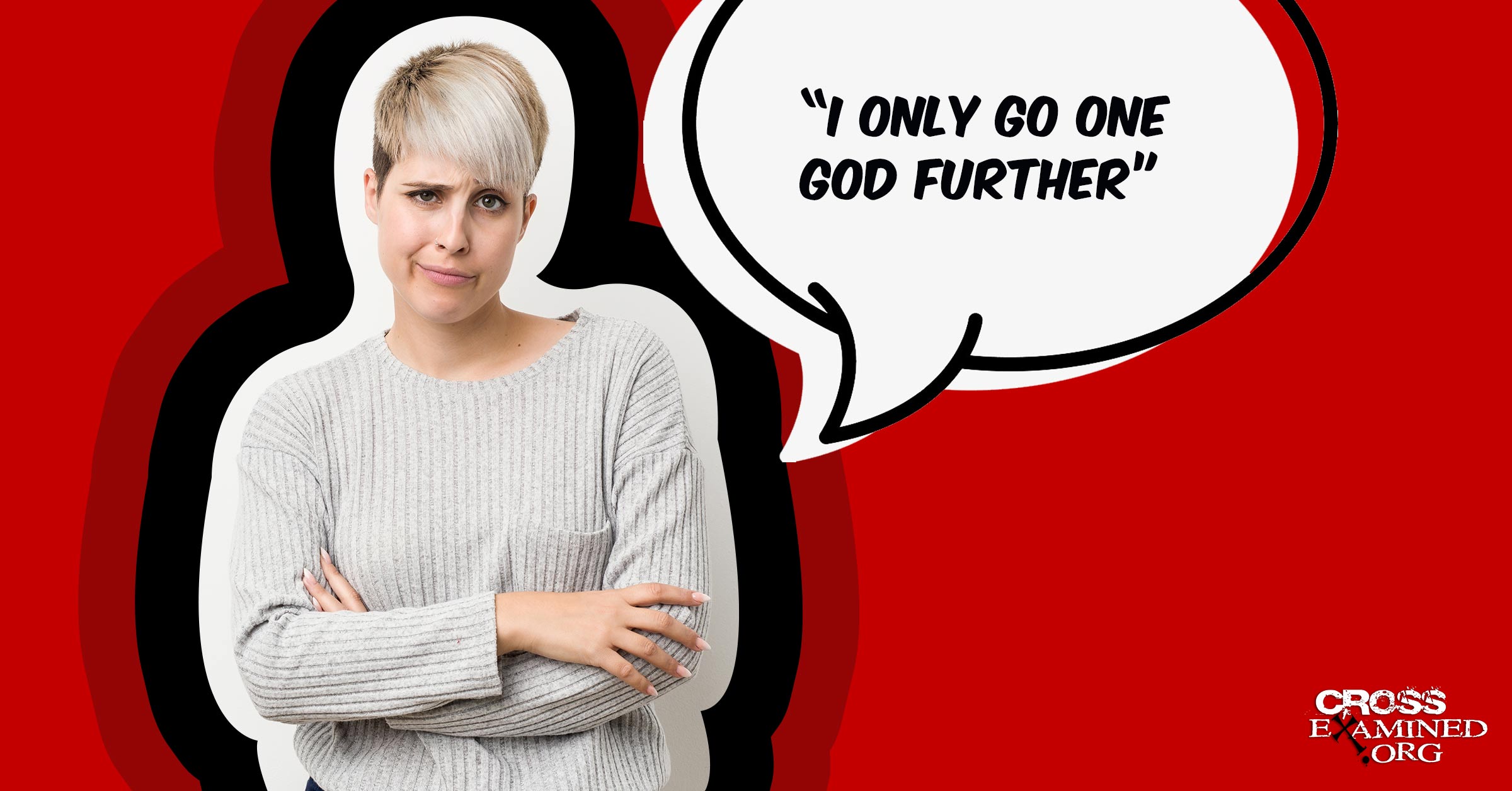
Bad “argument” #1: You’re almost an atheist

This “argument” goes like this: “You believe in one god and deny thousands of other gods. I just go one god further and deny the existence of all of them. So you’re almost an atheist.”

Or you may hear it worded like this: “You’re an atheist towards thousands of other gods; I’m an atheist towards all of them.”

The first thing you need to notice is that this is not an argument against the existence of God. It offers no evidence and puts forth no objection. This statement is about you. What you think and believe, how you label yourself. But it is not about God and whether or not He actually exists.

Second, theist and atheist are specific terms. Regarding the second phrasing of the slogan, you can’t be theist towards some gods and atheist towards others. That’s not how the words work. It’s like saying someone who doesn’t eat chicken is a vegetarian towards chicken. Ever heard anyone say that? Me neither.

To believe in at least one god makes you some form of a theist; to believe in no gods at all makes you an atheist. By definition. There are no degrees or percentages of theism, that if I believe in one god, I’m less theist than someone who believes in two. The difference isn’t between one or many; it’s between zero and one. Let’s look at an analogy that will further show how ridiculous this statement is:

How many women do you think there are in the world? Let’s just say one billion. Out of those one billion women, I’m only married to one of them. So does that mean I’m almost single? No, that’s stupid. Married is married and single is single. Whether I’m married to one or twenty women, it doesn’t matter. I’m married. It’s binary: 1 or 0. Sure, if it’s the night before my wedding, you could say I’m almost married if you mean that I will be married soon. But that’s in regard to time, not degrees of married-ness. And that’s not what the argument is trying to do. It’s making a fraction or a percentage of theism as if that’s meaningful in the discussion, which it isn’t. It’s ridiculous. So don’t fall for it.

Conclusion

Yes, I only believe in one God, but that’s because I think the God of the Bible is the one true God who exists. I’m not picking gods randomly from a hat, as if one is just as reasonable as another. I believe in a creator God, a personal First Cause who designed life, the universe, and everything and is the standard of objective morals and values. I believe Jesus of Nazareth rose from the dead, vindicating His claims to be God and placing his seal of approval on the Old Testament as well as the men who would go on and write the New.

In case you haven’t gotten it yet, let me make it perfectly clear: I am not almost an atheist. I am a Christian theist.

Please understand that I’m not calling atheists stupid. I’m saying some things atheists say are stupid, such as the “almost an atheist” slogan. It needs to die.

Visit Timothy Fox’s website: Free Thinking Ministries