
Tag Archive for: Christianity

By Luke Nix

Introduction

Those who follow this blog are aware that I not only defend “mere” Christianity, but I also defend specifics in the Christian worldview. As I have written before, I believe that if a Christian is defending an incorrect detail of their worldview to a skeptic, that skeptic can easily use that incorrect detail as an excuse to reject the entire worldview (even though this is not logically reasonable). Over the last few years of interacting with fellow Christians regarding the details of our worldview, one of the doctrines that are not discussed explicitly very often, but other debates directly affect, is the doctrine of the Image of God. I have noticed that some positions in the other debates imply different views of the Image of God, and these different views of the Image of God can be used to test the positions in the other debates. But before I get into those debates, we need to know why this Judeo-Christian doctrine is so important in the first place.

What Is At Stake?

The Image of God provides the grounding for several essential characteristics of humans that set us apart from the animal kingdom. Without appropriate grounding for these characteristics, a worldview cannot explain these characteristics, thus it is forced to deny that they even exist…with dire consequences, as we shall see. What are these characteristics, though? While the Image of God grounds several characteristics, I want to examine four of them today:

  • Intrinsic Value
  • Free Will
  • Moral Responsibility
  • The Ability to Reason
 Intrinsic Value

It is common today to think that a person’s value is based upon their race, sex, age, religion, intelligence, economic status, physical ability, entertainment ability, or a whole host of other “useful” things to a society. All of these, though, are relative and fleeting. Anytime that one of those are different (between persons or even in the same person at different times in their lives) their value goes up, down, or disappears. Intrinsic value is value that is not based on any of those accidental characteristics. Intrinsic value is value that is objective, found outside the societies, groups, or other individuals who are judging a person’s worth. This is an objective value that people possess simply in virtue of being human.

No human is intrinsically more or less valuable than another. This concept provides the ground for the idea of “equal rights” regardless of sex, race, age, ability, or status. If you are a human, you are intrinsically valuable, period. Since animals do not possess the Image of God, they do not possess such intrinsic value; they are valuable based upon whatever someone else needs them to accomplish. Animal value is relative and subjective, but human value is objective. If someone violates (harms) an intrinsically valuable thing, it is a moral evil. Specifically, an attack on a possessor of the Image of God is a direct attack on God Himself. If humans do not possess the Image of God, no act against us for any reason is evil. In fact, if humans do not possess the Image of God, it is permissible (if not obligatory) that humans be treated no different than any other animal (and vice versa). Just as a house fly may be killed because it is irritating us, so may a human be killed because he or she is irritating us, and if a human’s life is to be protected by the law, then so should the life of every animal be protected by the law also.

Free Will

When I say “free will” I am talking about the ability to choose to do something other than what we actually do, given the same circumstances (called “libertarian” free will). For instance, you have a choice to continue reading this post or not. Sure, some things will influence that choice, but ultimately you are choosing whether to accept those influences and act upon them or not; the circumstances (or your desires) do not determine your choice, though they do influence your choice. What allows us to do this is the fact that we are “agents” or “souls.” These (and we) are beings that exist independent of physical reality, thus we are not 100% governed by its laws (though our bodies are, which many of our decisions require us to take into account). Because an agent is not physical, it must have a non-physical source- the Image of God provides that source for humans. If humans do not possess the Image of God, then we do not possess free will and all our “choices” are determined by something else, not us.

The animals do not possess the Image of God, thus they do not possess free will. They are beholden to their environment for their behavior. Their surroundings are what determine how they act. The fact that humans have free will means that humans are capable of choosing how to act towards one another, nothing or no one else makes the choice for us, we are responsible.

Moral Responsibility

Taking the two previous characteristics provided by the Image of God, we discover that humans have moral responsibility. If humans are not intrinsically valuable, then no act committed against them is evil. If humans do not have the ability to choose to do otherwise, then they cannot be held responsible for such an evil act. Thus both intrinsic value AND free will are necessary for moral responsibility. This makes us moral beings. Something that animals are not. If an animal kills another animal, we do not call it “murder” because “murder” is “killing” plus a moral element. Animals do not possess intrinsic value (so the killing is not a violation of God’s Image) and animals are not morally responsible beings. On the other hand, man is both intrinsically valuable AND a moral being, so if a human kills another human it is a moral act based on the Image of God in both the victim and the killer. And the morality of that act must be justified by the Moral Law that God has written on the hearts of every human (via His Image) and in His further revelation of Scripture.

This means that if humans wish to hold other humans morally responsible for their actions, the Image of God is necessary on two accounts. Without the Image of God, there is no ground for moral responsibility, no ground for reward or punishment. In fact, if either intrinsic value or free will are missing from the equation, moral responsibility (and reward and punishment) cannot do not make sense; they are meaningless.

The Ability to Reason

Often times it is difficult to distinguish between what is true and what is practical because the two do not always seem to align. What is practical is derived from what allows us to survive and thrive in any given environment. We act and react, according to what stimulates our senses, with those two purposes as the end goal. This is the mode of operation of a creature that not only does not possess free will but also one that does not possess reliable reasoning faculties. If our ability to reason is grounded in a process or object that is focused on survival, then that is exactly what it will do, and the misalignments between what is practical and what is true will never be detected. We are forced to conflate truth with practicality, on this view, because as the environment changes, what is necessary for survival also changes (think of living in Saudi Arabia vs. living in the United States).

On the other hand, if our reasoning faculties are grounded in something that is essentially concerned with what is true, then that faculty can be trusted to be able to detect the difference between a belief that is merely practical for an environment and one that is true (independent of the environment). The Image of God provides this grounding in the Creator, who IS omniscient and desires that humans come to know what is true and not just what is practical for their given environment. In being made in the Image of God, humans not only possess the ability to freely choose among options, we have a reliable tool to identify which option is the correct option. Thus this makes our moral responsibility even more binding.*

The Origin and Current Status of the Image of God

Because all four of those characteristics are tied to the Image of God, it is important that in our defense of the Christian worldview, and specifics within the worldview, that we consistently hold and defend a specific view regarding its origin and status.

Testing Origins Views Via The Image of God

Regarding its origin, some people believe that the Image of God came about by natural processes- it is a functional distinction between us and the animals based upon our evolution from the lower species. This view is most commonly found in the origin position called “theistic evolution” or “evolutionary creationism” (but not all of them hold this view of the Image of God; I’ll address that important distinction in a minute). This cannot be the way the Image of God appeared because it is merely a difference in degree of development between animal and human rather than a difference in ontological essence (“kind”). A difference in degree is not an ontological difference, but the Image of God, in order to be an ontological ground for the four characteristics I described above (and the many others I didn’t), must be an ontological difference. If one holds that the Image of God is not a difference in kind, then all the implications of the above-described characteristics’ absences are actually the reality- human intrinsic value does not exist, free will does not exist, moral responsibility does not exist, and the ability to reason does not exist.

While I do not defend common descent of humans with any animal (I’m not an evolutionary creationist), I must understand that not every evolutionary creationist holds to this view of the Image of God because of its dire philosophical and theological (biblical) implications. These theistic evolutionists hold, just as much as any creationist (young-earth or old-earth), that the Image of God appeared suddenly in history (as a special creative work of God) and that sudden appearance is evident in the fossil and archaeological record.

Where things get difficult, though, is that many naturalists insist that all features of humans appear gradually in the fossil and archaeological records. If that is true, then even the Image of God appears gradually. That would imply that the Image of God is merely a difference in degree and not in kind. So, if a Christian theistic evolutionist wishes to maintain common descent of humans with prior animals (and they wish to avoid the implications of merely a functional Image of God), then they must reject the interpretation of the historical records that naturalists offer regarding the Image’s features appearing gradually (descending from “lower” species).

What is really interesting is that the more that the data is reinterpreted to be consistent with an ontological Image of God (a sudden appearance), the more the line is blurred for the theistic evolutionist between the sudden appearance of the Image of God and the sudden appearance of humans. Perhaps a persuasive case for the rejection of common descent between humans and animals (and the acceptance of humans as a special creation of God independent of His other creations) is found in our defense of the proper view of the Image of God and its endowments (e.g. intrinsic value, free will, moral responsibility, and the ability to reason) upon humans. Our maintaining the proper view of the Image of God helps us to test and guide our view of human origins. If this has intrigued you, I highly recommend reading the book “Who Was Adam” by biochemist Dr. Fazale Rana to see the scientific evidence for the sudden appearance of the Image of God (and humans) in the scientific record.

One More Thing- Abortion and Active Euthanasia
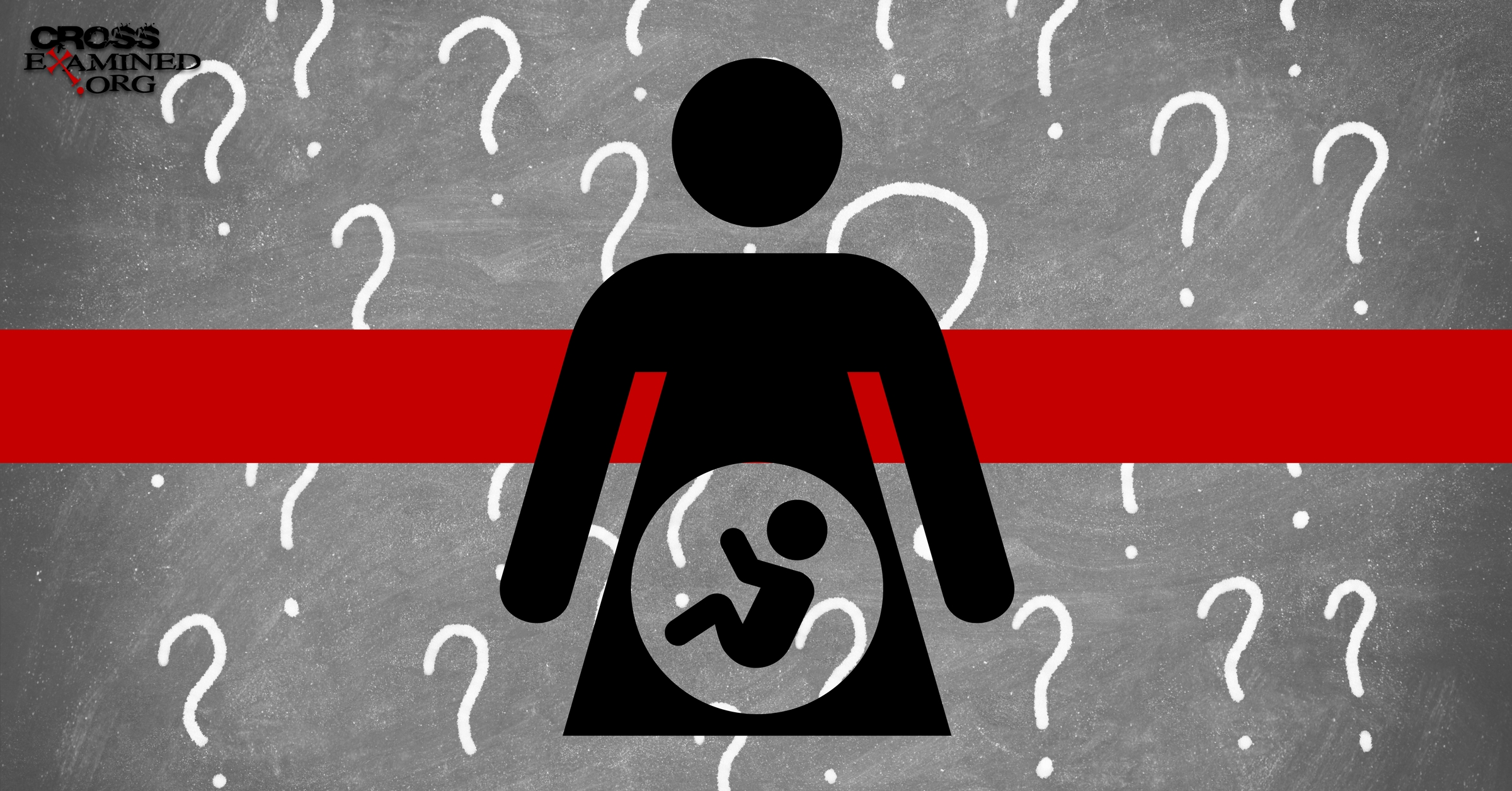
Before I leave the origins debate, though, I do want to bring up one more implication for holding that the Image of God is merely a difference in the degree of development. If you are familiar with some of the more common defenses for abortion, you will know that one of the reasons offered to deny the unborn intrinsic value (and the intrinsic right to life) is the degree of their development. (Now, I have to be extremely careful not to equivocate on the term “degree of development,” because if the terms do mean the same thing in both the common descent view and the abortion view, then we have a serious problem.) Simply put, the argument for abortion from the degree of development points to the lack of certain features in the unborn that a fully developed human being possesses. The pro-abortion advocate uses this lack of development to conclude that the unborn are not really human, thus do not possess intrinsic value (which means that killing the unborn is perfectly acceptable).

In the book “The Case For Life,” pro-life apologist Scott Klusendorf points out that the “degree of development” argument, applied consistently, also removes intrinsic value (thus justifies intentionally killing) from those living with health issues, including physical handicaps, degenerative diseases, mental disorders and others. If the Image of God is merely a matter of degree of development, then any human who manifests cognitive, creative, or physical limitations akin to those of our pre-human ancestors (on the theistic evolutionary view), they too necessarily lack the Image of God. This would include the unborn (abortion would be morally permissible) and the born (active euthanasia would be morally permissible).

This is one more way that we can use the proper view of the Image of God to test our view of human origins. Unfortunately, it can also be used in the opposite direction to justify abortion and active euthanasia- which is one more reason why maintaining the proper view of the Image of God is so important. We must hold to the proper view of the Image of God to guard against such logically fallacious and morally reprehensible (sinful) views from entering our worldview (even if we insist on maintaining the belief in the common descent of the physical human body).

Testing The Current Status of the Image of God

In the on-going debate about how God’s sovereignty and man’s free will work together, some Christians have opted to deny that man has free will at all by positing that the Image of God was destroyed at the Fall of Adam and Eve. However, when the implications I described above are explained, the Christian usually quickly changes their position, but in many cases the change holds that the Image of God was damaged specifically in a way to destroy human free will but maintain the other traits. While this may seem like an acceptable position, it poses a severe problem.

If intrinsic value does exist, but free will does not, then punishment is a moral evil because it is a violation of (attack against) the intrinsically valuable human, created in the Image of God, who did not have a choice to not commit the crime against another intrinsically valuable human, created in the Image of God. This means that if free will does not exist, God’s punishment of those who commit sin is His attacking Himself- a moral evil. However, we know from the Bible that God cannot sin, that He cannot deny Himself, that a house brought against itself cannot stand, and that God does punish the wicked. If a Christian is to maintain the doctrine of eternal conscious punishment (or even the heterodox view of annihilationism), yet deny free will, then they are saying that God is sinning in virtue of His immoral attack against a creature created in His Image.

Some have attempted to say that God can do whatever He wants. However, this then enters into the debate about God and morality. A common objection to God’s existence comes in the form of the Euthyphro dilemma. This poses the question, “Is God good because He says what is good, or because He is subject to good.” The dilemma is that if the first option is selected then morality is subjective and arbitrary (not objective) because God could simply change His mind about what is good, while if the second option is selected then God is not the highest being, thus He cannot be God. If it is not obvious, the attempted escape from the implication of denying free will but affirming intrinsic value fails because it is the first option of the dilemma- morality is then arbitrary and subjective, thus there is no objective standard by which God can judge, which adds another level of problems because without objective morality, nothing is evil, even an act that attacks a bearer of the Image of God (so, murder, abortion, rape, and every other “sin” is not objectively evil- it is merely God’s opinion at the moment that they are or are not)- moral responsibility essentially was destroyed if free will was also.

The only way to avoid this implication is to affirm that man’s free will is still intact regardless of how we view the effects of the Fall of Adam and Eve. Because of that, we can use the proper view of the current status of the Image of God (intact) to test our views regarding the coexistence of God’s sovereignty and man’s free will.

Conclusion

The Image of God is an important doctrine of Christianity. It provides the ontological grounding for intrinsic value, free will, moral responsibility, and the ability to reason. Without these characteristics in place in humans, Christianity is, at worst, false, and at best unknowable and indefensible. So, it is important that as we defend the truth of the Christian worldview that we do not also defend a scientific or theological position that either asserts or implies that the Image of God is not ontological or was damaged in a way to destroy free will. If we do, then we are defending contradictory claims, and the unbeliever can use that as a reason (because they are made in the Image of God) to freely choose to reject the truth of the Christian worldview.

Recommended Books for More on this Topic

*Of course, mere observation of reality and reason do not always lead to the correct conclusion. The Image of God also provides the Moral Law that is written on all humans’ hearts (since all humans are made in the Image of God). Further, God has given us His special revelation that gives us explicit moral codes. But He did not just give us a book without establishing that it was divinely inspired by the Source of the Image of God. The Bible contains numerous claims about reality, and especially history when no human was present to observe the events (thus eliminating any reasonable natural explanation [e.g. that the author saw it or guessed it). Dr. Hugh Ross explains these in his numerous books on the scientific evidence for the inspiration and authority of the Bible. So, there are two additional tools that solidify man’s moral responsibility and the fact that all men “are without excuse” (Romans 1:20).

Original Blog Source: http://bit.ly/2q1OxlG

By 

Previously we looked at some of the arguments and assumptions made to assert that the unborn either are not humans or are not “persons”.

But now we’ll look at another kind of objection. Some pro-choice advocates know that the unborn are biologically human from fertilization. However, they’ll argue that while the unborn are humans biologically, they are not full-fledged humans in a “morally relevant” sense. While they may be a member of the species Homo Sapiens, they should not be considered a member of the human community until they fulfill certain criteria, or reach a certain stage of development.

In my previous entry, I looked at why we can’t use the immediately exercisable capacity for consciousness or the ability to feel pain as criteria for acceptance into the human community.

Remember that the right to life is a categorical property; you either have it or you don’t. As such, it can’t be tied to a property that comes in degrees (such as consciousness).

A natural right, like the right to live or to defend yourself, should not be confused with legal rights, such as the right to vote or drive. A natural right is a right that every human has by virtue of our common human nature, whereas a legal right is a right that the government grants based on our common status as citizens. These rights are gained through maturity or ability. When we say that an embryo is no morally different than you or me, we recognize that they have obvious differences. An embryo can no more drive a car than a toddler should be trusted to vote for president. However, the right to life is an intrinsic right shared by all humans, regardless of their maturity level or instrumental value to society.

So if not at fertilization, when should our natural rights be attributed to us? There are several stages along human development that are offered, but none of those stages succeed as an appropriate line to draw between a state of having no natural rights and a state of acquiring natural human rights. Let’s look at those.

1) Implantation/Quickening.

Once the mother’s egg is fertilized by the father’s sperm, both egg and sperm cease to exist and conception has occurred, bringing into existence a new, unique human individual. It takes about a week for the zygote to be propelled down the fallopian tube (via hair-like structures called cilia) and implant in the uterus.

The important thing to take note of is the fact that the entity that implants is the same entity that was conceived just a week ago. There is no grounds for considering the implanted embryo as a member of the human community, but not that same entity before it implanted itself there. Embryologists consistently agree that the embryo from fertilization is a living, human organism.

Doctor Bernard Nathanson [1] argues that at the moment of implantation, the unborn “establishes its presence to the rest of us by transmitting its own signals — by producing hormones — approximately one week after fertilization and as soon as it burrows into the alien uterine wall.” For Nathanson implantation is significant because prior to this time the unborn “has the genetic structure but is incomplete, lacking the essential element that produces life: an interface with the human community and communication of the fact that it is there.” [2]

Francis Beckwith notes that there are two flaws with this argument. First, you are who you are regardless of whether anyone notices you’re there. Being noticed does not change one’s nature. One interacts with a human being, one does not make a being human by interaction.  Second, this does not explain humans conceived through IVF in a petri dish. Just as there is no difference between a Bill Clinton in a possible world who pumps gas in Little Rock, and the Bill Clinton in the actual world who is the former president of the United States, there is no essential difference between an embryo in a petri dish and an embryo implanted in the womb.

Quickening is the point in pregnancy at which the fetus’ movements can first be felt by the pregnant woman. I have grouped it here because the objection to this criterion is essentially similar to the objection for implantation. Aside from showing that the entity is the same living human organism before it quickened, one’s nature does not change once they have been noticed.

Additionally, if movement is necessary for full-fledged humanity, then this argument proves too much. This would disqualify the paralyzed from full-fledged humanity.

2) Viability.

Viability is the point in a pregnancy after which the unborn fetus can realistically survive outside the womb. Currently, viability is considered to be at about 24 weeks’ gestation, although some babies have been born at 21 weeks and survived.

A major flaw with this argument is that it’s arbitrary. Fifty years ago, viability was considered to be at 28 or 29 weeks’ gestation. So one would have to argue that an unborn child is a full-fledged human at 24 weeks now, but fifty years ago that same child would not have been a full-fledged human. Viability is a moving target that changes as technology improves.

Also, Siamese twins depend on each other for their survival but both are considered to be persons. People on life support are also completely dependent on the machine for their survival, but if viability were necessary then we could kill them for any reason even if they have a good chance of recovery. It simply makes no sense to use viability as your criterion for establishing basic human rights.

3) Birth.

There is nothing “mystical” about birth that suddenly bestows upon an entity “humanity” or “personhood.” As I mentioned in my previous article, an eight-inch journey down the birth canal does not change the nature or value of the entity.

Many pro-choice people believe abortion should remain legal because of bodily rights arguments, and if they are right, then birth would be the sensible place to draw the line. After birth we would be obligated to keep you alive, but not before. This argument will be addressed in my next article.

4) After birth.

Some pro-choice philosophers (e.g. Michael Tooley and Peter Singer) support infanticide because there is no morally relevant difference between a child inside the womb and a child outside the womb. They are correct, even if their conclusion is repugnant to our moral intuitions. They are simply being consistent and allowing the pro-choice position to lead to its natural conclusion. I’ll plan on writing more on “after-birth abortion” in the future, but essentially the entity outside the womb is the same one inside the womb.

There simply isn’t any reason for these criteria to suddenly establish value or change the nature of the unborn. We know that the unborn are human from fertilization. As there is no morally relevant difference between a zygote, embryo, fetus, or toddler (or later stages of development), then all humans should be protected, even very young ones.

[1] Doctor Nathanson is a former abortionist and founder of NARAL, who later converted to the pro-life position.
[2] Dr. Bernard Nathanson (with Richard Ostling), Aborting America, (New York: Doubleday, 1979), p. 216, as quoted in Francis J. Beckwith, Defending Life: A Moral and Legal Case Against Abortion Choice, (Cambridge University Press: Cambridge, New York, 2007), p. 73.

Original Blog Source: http://bit.ly/2pUNPJH


By Brian Chilton

When I left the ministry due to my skepticism, one of the factors involved in my departure concerned the reliability of the New Testament documents and the resurrection of Jesus. The folks from the Jesus Seminar had me second-guessing whether I could trust what the New Testament said and if I could truly accept the literal bodily resurrection of Jesus of Nazareth. In July of 2005, my life changed. I entered the Lifeway Christian Bookstore in Winston-Salem, North Carolina and read three books that changed my life more than any other book outside the Bible. I discovered Lee Strobel’s The Case for Christ, Josh McDowell’s The New Evidence that Demands a Verdict, and McDowell’s A Ready Defense. I discovered that there are many reasons for accepting the resurrection of Jesus of Nazareth as a historical fact.

Through the years, the evidence has increasingly mounted for the historicity of Jesus’s resurrection. This article will provide 10 of the most fascinating arguments for the resurrection of Jesus of Nazareth. This list is not exhaustive and my dealings with each argument is extremely brief. Nevertheless, I hope this list will provide a starting point for you to consider the authenticity of Jesus’s resurrection.

  1. The First Eyewitnesses were Women. The first eyewitnesses of the resurrection were women. All the Gospels note that the first individuals to discover the tomb empty were women. Matthew notes that “After the Sabbath, as the first day of the week was dawning, Mary Magdalene and the other Mary went to view the tomb…The angel told the women, ‘Don’t be afraid, because I know you are looking for Jesus who was crucified. He is not here. For he has risen, just as he said. Come and see the play where he lay” (Matthew 28:1, 5-6).[1] Women were not held in high esteem. In Greco-Roman culture, a woman’s testimony was not admissible in court. In Jewish circles, it took the testimony of two women to equate that of one man. If one were to invent a story, the last people one would place as the first witnesses would have been women, unless it were otherwise true.
  2. Minimal Facts Concerning the Resurrection. Gary Habermas has popularized the so-called minimal facts argument for the resurrection. The minimal facts are those things that are accepted by nearly all New Testament scholars. The minimal facts are “1. Jesus died by crucifixion. 2. Jesus’ disciples believed that he rose and appeared to them. 3. The church persecutor Paul was suddenly changed. 4. The skeptic James, brother of Jesus, was suddenly changed. 5. The tomb was empty.” [2] These facts are nearly universally accepted by New Testament scholars, including liberals.
  3. Transformation of the Early Disciples. As noted in the minimal facts, James, the brother of Jesus, was changed from a skeptic to a believer because of the resurrection. James along with his brothers did not believe in Jesus during Jesus’s early ministry (see John 7:5). However, Jesus appeared to James (1 Corinthians 15:3-9) and James became a leader in the early Jerusalem church. His death is recorded by Josephus.[3] Paul is another example of one who was completely transformed by the resurrection of Jesus. Paul had been a persecutor of the church. After witnessing the risen Jesus, Paul became a proclaimer for the church.
  4. Embarrassing Details of the Resurrection. Historically speaking, embarrassing details add veracity to a historical claim. The fact that women were the first witnesses, that a member of the Sanhedrin (the same Sanhedrin that executed Jesus) had to give Jesus a proper burial, and that the disciples were fearful and fled all serve as embarrassing factors for the resurrection account.
  5. Willingness to Die for What Was Known. Many people will die for what they believe to be true. But no one will die for something they erroneously invented. The disciples knew if they were telling the truth. Yet, one finds that the disciples were willing to die for what they knew to be true. Stephen died by stoning (Acts 7:54-60), James of Zebedee died by the sword at the hands of Herod (Acts 12:2), James the brother of Jesus died,[4] and Peter and Paul died at the hands of Nero.[5]
  6. Documentary Evidence. The documentary evidence for the resurrection of Jesus is quite good. The historian seeks to find how many primary and secondary sources[6] can be gathered for an event to determine the event’s historicity. Concerning primary sources, the resurrection has Matthew’s account, John’s account, and Paul’s account in 1 Corinthians 15, including the additional references by James (if one accepts that James wrote the letter attributed to him) and Jude. The following are secondary sources for the resurrection: Luke, Mark, Clement of Rome, and to a lesser degree Ignatius and Irenaeus.
  7. Circumstantial Evidence. Douglas Groothius notes that circumstantial evidence for the historicity of the resurrection is “namely, the practice of the early church in observing baptism, the Lord’s Supper, and Sunday worship.”[7] Baptism is based upon the analogy of Jesus’s death, burial, and resurrection. The Lord’s Supper is a symbol of Christ’s sacrificial death. In addition, it is quite odd that faithful Jews would move their worship from a Friday evening into Saturday to a Sunday morning unless something major had occurred on a Sunday morning. The major Sunday morning event was Jesus’s resurrection.
  8. The Missing Motive. J. Warner Wallace has noted in his lectures and books that when a conspiracy is formed, three motivating factors are behinds such a move—power, greed, and/or lust.[8] The disciples would hold no power behind claiming the resurrection as history. They were running around while often being threatened by the Jewish and Roman authorities. As far as greed, they taught that one should not desire earthly possessions, but spiritual ones. Lust was not a factor, either. They taught celibacy before marriage and marital fidelity after marriage. In fact, N. T. Wright notes in his classic book, The Resurrection of the Son of God, that the disciples had no theological motivation behind claiming that Jesus had risen from the dead as they were anticipating a military hero and a final resurrection at the end of time. What motivating factors existed for these disciples to invent such a story? None! The only reason the disciples taught the resurrection of Jesus was because Jesus’s resurrection had occurred.
  9. Enemy Attestation of the Resurrection. Historically speaking, if one holds enemy attestation to an event, then the event is strengthened. When one considers the claims of the authorities that the disciples had stolen the body of Jesus (Matthew 28:11-15), the testimony of the resurrection is strengthened. The early belief that the disciples had stolen the body of Jesus is strengthened by the discovery of the Nazareth Inscription that orders capital punishment for anyone who steals a body from a tomb.[9] In addition, several refences to Jesus and his resurrection include citations from Josephus,[10] Tacitus,[11] and Suetonius[12] among others (including the Babylonian Talmud).
  10. Multiple Post-Resurrection Eyewitnesses. Finally, there is multiple eyewitness testimony pertaining to the resurrection of Jesus. Several people had seen Jesus alive for a period of 40 days. The eyewitnesses include Mary Magdalene (John 20:10-18), the women at the tomb accompanying Mary (Matthew 28:1-10), the Roman guards (Matthew 28:4), the Eleven disciples (John 21), the two men on the road to Emmaus (Luke 24:13-35), an indeterminate number of disciples (Matthew 28:16-20); over five-hundred disciples (1 Corinthains 15:6), to James (1 Corinthians 15:7) and to Paul (1 Corinthians 15:8-9). I am certain that there were many other witnesses that are unnamed.

Conclusion:

Many other evidences could be given for the resurrection of Jesus. Thinking about the methods of history, one must understand that there is a reason why American accept the first President of the United States as George Washington and not Spongebob Squarepants. History backs up the claim that Washington was the first President. In like manner, history backs up the reality of Jesus’s resurrection. Now the question is this: what will you do with such information? Some will try to ignore the event. Some will try to dismiss it. Others will acknowledge the factual nature of the event and worship Jesus as the risen Lord. It is my prayer that you will do the latter.

 Notes

[1] Unless otherwise noted, all quoted Scripture comes from the Christian Standard Bible (Nashville: Holman, 2017).

[2] Gary R. Habermas and Michael R. Licona, The Case for the Resurrection of Jesus (Grand Rapids: Kregel, 2004), 48-50, 64-69.

[3] Josephus, Antiquities XX.200.

[4] Ibid.

[5] Eusebius, Church History XXV.5.

[6] Primary sources are documents written by eyewitnesses. Secondary sources are documents written by individuals who know eyewitnesses. For instance, my grandfather was an eyewitness to the biggest naval battle in World War II history. From the information my dad gathered from him, he would be a secondary source, whereas my grandfather would have been a primary source.

[7] Douglas Groothius, Christian Apologetics: A Comprehensive Case for Biblical Faith (Downers Grove; Nottingham, UK: IVP Academic; Apollos, 2011), 553-554.

[8] See J. Warner Wallace, “Rapid Response: I Think the Disciples Lied About the Resurrection,” Cold-case Christianity.com (October 17, 2016), retrieved April 11, 2017, http://coldcasechristianity.com/2016/rapid-response-i-think-the-disciples-lied-about-the-resurrection/.

[9] See http://www.biblearchaeology.org/post/2009/07/22/The-Nazareth-Inscription-Proof-of-the-Resurrection-of-Christ.aspx#Article.

[10] Josephus, Antiquities XX.9.1.

[11] Tacitus, Annals XV.

[12] Suetonius, Lives of the Caesars-Claudius 25 and Suetonius, Lives of the Caesars-Nero 16.

Original Blog Source: http://bit.ly/2ppUPKK


By Evan Minton
In my book “Inference To The One True God”, I gave an argument for a while only the God of the Bible can be the God proven to exist by The Moral and Ontological Arguments. The Argument here is that the Moral and Ontological Arguments prove the existence of a being that is morally perfect. Given that the Moral Argument and the Ontological Argument are logically valid, and the premises of both of these arguments are true, it follows that a necessarily existent, morally perfect, omnipotent, omniscient, omnipresent, personal being exists.
Now, in order to be a morally perfect being, this being would have to exist as more than one person. If God is not a trinity then God is not love. This is because love requires three things: someone to love, someone to do the loving, and a relationship going on between the lover and the Beloved. If these three things are not present then love is not present. But before any human beings were created, God was all by himself. So if God was all by himself, who was there to love? God had no one to love! Given that God had no one to love, God couldn’t be love or loving until he created the first human beings or Angels or any persons other than himself. But in that case God could not be maximally great or be the the standard of morality, for in order to be maximally great and in order to be the standard of morality, God would have to be morally perfect, which he could not be if God were only a single person. But the Moral and Ontological Argument established the existence of a being who is indeed morally perfect and ergo maximally great. So how does one resolve this dilemma? The doctrine of the Trinity provides the answer. If God is a trinity, then God can be an intrinsically loving being, because if God is a trinity then all of the necessary requirements for love are present. You have a lover, you have a beloved, and you have a relationship between them. The Father loves the Son and the Son loves the Father. The Holy Spirit is the spirit of love. This is why I said in my book that only the trinitarian concept of God is compatible with the God demonstrated to exist by the Moral and Ontological Arguments. But the real kicker is that only Christianity has a God who is a trinity. Therefore the Moral and Ontological Arguments demonstrate the truth of Christianity.
However, I have recently encountered one objection to this philosophical argument for the Triune nature of the God of the Moral and Ontological Arguments. The objector argues that God was omnipotent even before he created the universe and he did not have an apparent outlet to display his power. The objector is arguing that according to my logic, we would have to argue that God could not be omnipotent without a physical universe. Why? Because without a physical universe, God would not be able to display any acts of power because God would be the only thing that could exist and God cannot cause any effects on himself. This would imply that either God is Not omnipotent, or he doesn’t need an outlet to display his power. In a similar way, we must conclude that if my logic is sound, then God really is not perfectly loving, or we must conclude that having other people to love is not necessary for God to be loving, and therefore God doesn’t have to be a trinity in order to be loving from eternity past.
God is omnipotent and did not have an outlet for that until he created the universe. There is a parallel there with God’s love.
Is this a good objection? I don’t think so. Let’s think about God’s omnipotence for a moment. Omnipotence is a modal property meaning that a being who is omnipotent has the ability to do anything that is logically possible. God can create out of nothing, God can make ax heads float in water, God can make a virgin pregnant, God can raise people from the dead, it cetera. It is a modal a tribute and just simply means that you have the ability to do anything that does not violate the laws of logic. Given that comma I don’t see why God would have to have a physical Universe in order to have the property of omnipotence. Omnipotence does not mean that you will do everything that is logically possible, it just means that if you are omnipotent you can do anything that is logically possible. It doesn’t mean that you will do everything that you are able to do, just that you are able to do it.
Love is different. Unlike the property of being powerful, Love Is not just pure potentiality. A person who is stranded on a desert island with no other people around may have the potential to be loving. It may be in his nature to be kind and compassionate and selfless and so on. Nevertheless if there are no other people around, he will never have the ability to express these attributes. This person will forever just have a loving potentiality, but will never have actual love. If God were only one person, then before he created any other beings, he would be like a machine that is turned off. This “Love Machine” would have the ability to be loving, but he would never actually be expressing that love. It seems very intuitively clear to me that a being who is constantly expressing love is a greater being than one who merely has the potential to be perfectly loving. But in order to be a being who is constantly expressing love and is not merely a being of potential love, this being would have to be a trinity.
In conclusion, this objector has not succeeded in showing that my Arguments for the Triune nature of the maximally great being of the Ontological Argument, and the being who is the standard of morality of the Moral Argument fail.
Original Blog Source: http://bit.ly/2n04ISN

By Brian Chilton

A few weeks back, I was troubled to hear about a Word of Faith congregation in Spindale, North Carolina, that was guilty of abusing its members. Reports included young children being punched by the leadership while being called Satanists. Jane Whaley and her husband are at the center of these accusations. The full report can be accessed at http://wspa.com/2017/02/27/spindale-church-accused-of-abuse-responds-to-accusations/.

(c) WSPA News 7
wspa.com

Unfortunately, cultic churches abound. Just last night, a guest pastor from the Philippines spoke about particular cults in his land. He noted that one cult did not allow the congregants to open their Bibles as everything had to be interpreted by the leadership. Churches like these are identified as cultic churches as contrasted with authentic churches. Authentic churches are the body of Christ. They are the assemblies of baptized believers who fully adopt biblical principles and have the freedom to grow and develop in their relationship with Christ.

Cultic churches are aberrations of the authentic church. Cultic church lead by power-plays and draconian control over their members. Cultic churches are distinguished from cults in that their theology may be close to orthodoxy (right beliefs)—however, upon further investigation most cultic churches border on heresy. In contrast, cults are completely separated from Christian orthodoxy in their beliefs. However, cultic churches are not authentic churches due to questionable orthopraxy (right practice). Their actions do not represent the loving precepts found in God’s Word. So, how does one know that a church has the characteristics of a cultic church? Consider the following 10 signs of cultic churches.

1. Biblical orthodoxy is held in low-esteem. Most cultic churches are merely one step removed from being a full-blown cult. Biblical doctrine and theology are dismissed in favor of elevated levels of emotionalism. While there is nothing inherently wrong with emotionalism, the loss of biblical integrity develops into some downright bizarre practices. Orthodoxy affects orthopraxy. In authentic churches, biblical orthodoxy is both taught and practiced.

2. Personal interpretations are held to an equal or higher view than biblical truth. Recently, I interviewed cult expert, Michael Boehm. Boehm noted that many trained cult leaders can twist most Christians into knots by pulling various quotes from the Bible. Without proper training, cult and cultic leaders will make biblical connections that do not exist. Thus, the leader’s interpretation is given an equal, if not higher, standing than clear biblical precepts. In authentic churches, biblical truth is given greater weight then personal opinions.

3. Members are not allowed to grow intellectually. In cultic churches and with cultic leaders, intellect is dismissed. Members are discouraged from learning philosophy, history, science, systematic theology, or about anything with which the leader(s) is/are not familiar. Much of this anti-intellectualism comes by the leader being threatened with information that would show a potential weakness in the leader’s philosophy or theology. To show superiority, the cultic leader maintains a domineering attitude to show his/her supposed intellectual and/or spiritual superiority. In authentic churches, all members are encouraged to grow spiritually, emotionally, and intellectually.

4. Members are not allowed to ask questions of the leadership. In cultic churches, questions are condemned. Most likely, cultic leaders do not want to expose any weakness on their part. Thus, questions are restricted and shown to be a sin. The leader may show that to question him or her is like questioning God because the cultic leader has assumed a delusional godlike stature. In authentic churches, questions are the means of growth. The leader and leadership are transparent. People who have nothing to hide are transparent.

5. Traditions are equated to commandments. While all churches have favored traditions, cultic churches elevate their traditions to the level of the Ten Commandments. Jesus combated the Pharisees over this very issue. Jesus said to the Pharisees in reply to a question pertaining to their traditions,

But you say, ‘Whoever tells his father or mother, ‘Whatever benefit you might have received from me is a gift committed to the temple,’ he does not have to honor his father.’ In this way, you have nullified the word of God because of your tradition. Hypocrites! Isaiah prophesied correctly about you when he said: This people honors me with their lips, but their heart is far from me. They worship me in vain, teaching as doctrines human commands(Matthew 15:5-9).[1]

In contrast, authentic churches—while they have traditions they love—will place biblical commands over personal desires. This is not to say that changing traditions is easy. But if an assembly sets an exorbitant and stringent set of traditions as a prerequisite for a person’s attendance to their church, then it is likely that the assembly is leaning towards a cultic code of conduct.

6. Members are required to follow harsh, legalistic rules. The sixth sign flows forth from the 5th. Members are required to follow a harsh set of rules. In places like the Word of Faith Fellowship, leaders determined where their members could live and even how a husband and wife could be intimate. Authentic churches…well…don’t. Authentic, Bible-based churches will promote members to live a holy lifestyle originating from biblical ethics. But, leaders realize that people are free to make their own decisions and are not dictatorial (1 Peter 5:1-5).

7. Outsiders are viewed with skepticism, evangelism is avoided. The seventh, eighth, and ninth signs are complementary. Since cultic leaders seek complete control of their members, outsiders are viewed with great skepticism. Potential members may be allowed in slowly and with great reservation. Cultic churches are not committed to the Great Commission. Evangelism is avoided. Cultic churches are committed to power and control. Authentic churches are committed to the gospel. Authentic Christian leaders have a passion to see souls come to Christ. Thus, healthy churches are mission-minded churches.

8. Exiting the church is difficult and may be met with threats. Since the cultic church is about power and control, cultic leaders do everything in their power to keep control over their members. Therefore, if a person attempts to leave, the leader(s) will emotionally, spiritually, financially, or even physically threaten the member. In stark contrast, authentic churches realize that their ministry may not suit everyone’s taste. Thus, while authentic churches seek to keep its members, threats are never employed. Remember, Jesus allowed Judas to betray him, fully knowing what Judas was planning.

9. Cultic churches are opaque. A strong sign on the spectrum of authenticity is transparency. Authentic churches are transparent as they have nothing to hide. This includes every aspect of ministry including financial matters. Cultic churches are almost always opaque and secretive. Cultic leaders do not want the general public to know what they are doing. The more secretive a movement, the more cause for concern. Jesus publicly taught, publicly performed miracles, was publicly crucified, publicly resurrected, was publicly seen alive after his resurrection, and publicly ascended into heaven.

10. The church desires its membership to become more like themselves than like Christ. The final sign of a cultic church deals with the end goal. What do the leaders desire? Cultic leaders want to make their members more like themselves. Authentic churches desire people to become more like Christ. If Christ is the Son of God, then he is the perfect example for one to model. When leaders become cultic, they desire people to become like themselves so that they can exert more power and control. Coercive and manipulative measures are used. Jesus, by contrast, allows people to come to him fully knowing what is expected of them. Concerning cultic leaders, Jesus warned those who abusively used people in his day, saying, “Woe to you, scribes and Pharisees, hypocrites! You travel over land and sea to make one convert, and when he becomes one, you make him twice as fit for hell as you are” (Matthew 23:15)!

Conclusion

This article is not an attack against the church. The church is a blessing. Many good, Bible-based, churches exist and are thriving. A person needs to find a place where he or she can attend, grow, develop, and serve. However, we must realize that there are many places that claim to be churches, but do not possess characteristics that are honoring to the Lord. In Revelation, Jesus addressed seven churches (Rev. 2-3). Some of the churches were good, like Philadelphia. Others were bad, like Laodicea. Some places that call themselves churches are more in the realm of cultic than Christian. Be watchful! John warns that we should “not believe every spirit, but test the spirits to see if they are from God, because many false prophets have gone out into the world” (1 John 4:1). My prayer is that multiple Bible-based churches will grow and expand, while cultic churches will diminish and cease. If you are in a cultic church, for the good of yourself and your loved ones, leave! Find a good, Bible-based church in your area. A good church family is a great blessing and worth the effort to find.


Post-note: Jonny Scaramanga argues that there should not be a distinction made between authentic churches and cultic churches. While I agree with Scaramanga that all churches need to examine their practices to ensure that they are not abusive, I fully disagree with him in saying that there are not distinctions between the two. The patterns of the two are quite different. Scaramanga is writing from a bias against Christianity in general as he left Christian fundamentalism for, what appears to be, atheism. The distinctions that have been discussed in this article are not only found between the authentic and cultic churches of today, but are clearly observable in the leadership style of Jesus as opposed to the extreme Pharisees and cultic leaders of his day. Scaramanga’s article can be read at http://www.patheos.com/blogs/leavingfundamentalism/2016/05/23/stop-calling-abusive-churches-cults/.

Original Blog Source: http://bit.ly/2oM9kIy


By Natasha Crain

Today I’m starting a blog series called, “Bad Secular Wisdom.” If you’re not familiar with the term, a blog series is where an author writes multiple posts on a related subject. I’m not normally a fan of such series because I think they get old fast, but in this case there are so many interesting and important topics for Christian parents that fall under the umbrella of “Bad Secular Wisdom,” I’m excited to do it. I’ll be posting once per month in the series, with remaining posts on other subjects.

The reason this series is so important is that our world is filled with bad secular wisdom…little pieces of a godless worldview that spread like a virus and infect the minds of young people before they even realize it. They sound good, but are harmful narratives that kids too often attach to their Christian worldview without understanding the great inconsistencies. My hope is that this series will inspire you to challenge your kids to think critically about each of the subjects we cover.

For the first post, we’re going to tackle the illogical idea that how we live is more important than what we believe.

Is How We Live More Important Than What We Believe?

I first came across the phrase “how we live is more important than what we believe” on a chalkboard outside of a coffee shop last year. I shook my head, thinking the baristas should stick to coffee making. Since then, however, I’ve seen the idea pop up in all kinds of places.

One well-known person who actively promotes this notion is Gretta Vosper. Vosper is a United Church of Canada minister…who’s also an atheist.

In 2015, a review committee from her denomination found that she was “not suitable” to continue in her role because she doesn’t believe in God (a shocking committee conclusion, I know). But Vosper’s congregation has insisted on keeping her as pastor, despite the fact she no longer preaches about Christianity.

If that sounds hard to believe, this quote from one loyal church member will help you understand the mentality of the congregation: “It’s not about coming to hear that I’m a sinner. That is so yuck. This fulfills my need to feel upbeat. The services are more happy and joyful, more interested in community and justice.”

Vosper has authored several books, including one called, With or Without God: Why the Way We Live is More Important Than What We Believe. On her website, she emphasizes, “We’re not going to stop trying to make the world a better place. We hope you don’t either.”

Vosper and her church community are clearly committed to living lives that benefit the Earth and those who live on it. They’re presumably doing many good things for society, and that’s commendable. But is Vosper’s claim true, that how we live is more important than what we believe?

As we’ll see in this post, this is bad secular wisdom.

It’s not consistent with atheism or Christianity!

Inconsistent with Atheism

Saying how we live is more important than what we believe presumes there is some way all people should live. No one has an objective basis for claiming that, however, if God doesn’t exist—should implies a moral obligation. But if humans are nothing more than a bunch of molecules in motion, to whom would we be morally obliged? To other molecules in motion? Clearly not. In a world without God, no one can prescribe a way of living for anyone else because there’s no moral authority, and, therefore, no objective basis for doing so. How a person “should” live can only be a matter of opinion.

An atheist who chooses a life of crime because he or she doesn’t believe there’s any moral significance to our existence is living more consistently within the atheistic worldview than one who claims all people should live in a particular way.

Inconsistent with Christianity

The Bible says that what you believe about Jesus has eternal significance:

  • John 3:16: “For God so loved the world that he gave his one and only Son, that whoever believes in him shall not perish but have eternal life.”
  • Romans 10:9: “If you declare with your mouth, ‘Jesus is Lord,’ and believe in your heart that God raised him from the dead, you will be saved.”
  • And John 14:6 says Jesus is the only way to God: “I am the way and the truth and the life. No one comes to the Father except through me.”

From a Christian perspective, how you live cannot be more important than what you believe—what you believe determines where you will spend eternity. To be clear, however, that doesn’t mean the way in which a Christian lives his or her life doesn’t matter. The Bible says that “faith by itself, if it is not accompanied by action, is dead” (James 2:17).

A genuine love for God results in a life of good works for God’s glory. Belief and action go hand-in-hand.

Furthermore, only Christians and other theists have an objective basis for determining what it means to do “good” works in the first place. In a godless world, there’s no objective moral standard by which works can even be called good.

The Bottom Line

Anyone, regardless of what they believe about God, can do good things with their life. Christians, atheists, and people with all kinds of other beliefs help the homeless, give money to charities, participate in environmental causes, fight child abuse, advocate for crime victims, and much more. For atheists, doing things like these that Christians and other theists would call good is a matter of preference…one as morally legitimate as a life of crime. While some atheists, like Vosper, might say all people should live to make the world a better place, that’s an objective claim that’s inconsistent with an atheistic worldview. “How you live is more important than what you believe” is a belief itself, and ironically determines how a person lives.

While the lives of atheists and Christians sometimes look similar in the good works they do, the Bible is clear that those similarities don’t make believing in Jesus any less important.

Belief matters…in an eternally significant way.

Original Blog Source: http://bit.ly/2oM0gDt


By Brian Chilton

Throughout the New Testament, one will find early creeds, formulations, and hymns that predate the New Testament itself. These texts are often called “proto-New Testament texts.” Proto-New Testament texts date back to the earliest church from those who were eyewitnesses of Jesus himself. 1 Corinthians 15:3-8 is perhaps the most popular of the proto-New Testament texts as it bears heavily on the post-resurrection appearances of Jesus. Concerning 1 Corinthians 15:3-8, Roy Ciampa and Brian Rosner write,

Early church in Turkey attributed to St. Peter.

Paul had used the language of “receiving” and “passing on” traditions in 11:23 with respect to the Lord’s Supper. The information about the gospel had been passed on as being of first importance. While the expression could mean “at first” (and Paul undoubtedly shared this with the Corinthians very early on in his ministry among them), the nearly unanimous preference of English translations (first in importance) is probably correct.

The fact that he had received this information about Christ does not contradict his point in Galatians 1:12 that he received his gospel “by revelation from Jesus Christ.” While the basic gospel message was received by revelation from the Lord, the formulation he used in preaching the gospel included elements that had been passed on to him by those who were Christians before him, perhaps including the fact that Christ died for our sins and that it was according to the Scriptures, that his resurrection took place on the third day and that that was also according to the Scriptures, and the information about the witnesses to Christ’s resurrection.[1]

So, what can we learn about the earliest church from the proto-New Testament texts? In the next two sections, I will provide a listing of the more popular—and generally accepted—proto-New Testament creeds and hymns. In conclusion, I will examine the implications of these texts as it pertains to the beliefs of the earliest church.

Creeds

  1. Romans 1:3-4 “concerning his Son, Jesus Christ our Lord, who was a descendant of David according to the flesh and was appointed to be the powerful Son of God according to the Spirit of holiness by the resurrection of the dead.”[2]
  2. Romans 10:9 “If you confess with your mouth, ‘Jesus is Lord,’ and believe in your heart that God raised him from the dead, you will be saved.”
  3. 1 Corinthians 11:23-29 “For I received from the Lord what I also passed on to you: On the night when he was betrayed, the Lord Jesus took bread, and when he had given thanks, broke it, and said, ‘This is my body, which is for you. Do this in remembrance of me.’ In the same way, also he took the cup, after supper, and said, ‘This cup is the new covenant in my blood. Do this, as often as you drink it, in remembrance of me.’ For as often as you eat this bread and drink the cup, you proclaim the Lord’s death until he comes.”
  4. 1 Corinthians 15:3-8 “For I passed on to you as most important what I also received: that Christ died for our sins according to the Scriptures and that he appeared to Cephas, then to the Twelve. Then he appeared to over five hundred brothers and sisters at one time; most of them are still alive, but some have fallen asleep. Then he appeared to James, then to all the apostles. Last of all, as to one born at the wrong time, he also appeared to me.”
  5. 2 Corinthians 4:5 “For we are not proclaiming ourselves but Jesus Christ as Lord, and ourselves as your servants for Jesus’s sake.”
  6. 1 Timothy 3:16 “And most certainly, the mystery of godliness is great: He was manifested in the flesh, vindicated in the Spirit, seen by angels, preached among the nations, believed on in the world, taken up in glory.”
  7. 2 Timothy 2:8 “Remember Jesus Christ, risen from the dead and descended from David, according to my gospel.”
  8. 2 Timothy 2:11-13 “This saying is trustworthy: For if we died with him, we will also live with him; if we endure, we will also reign with him; if we deny him, he will also deny us; if we are faithless, he remains faithful, for he cannot deny himself.”
  9. 1 John 4:2-3 “This is how you know the Spirit of God: Every spirit that confesses that Jesus is Lord has come in the flesh is from God, but every spirit that does not confess Jesus is not from God. This is the spirit of the antichrist, which you have heard is coming; even now it is already in the world.”

Hymns

  1. Philippians 2:5-11 “Adopt the same attitude as that of Christ Jesus, who, existing in the form of God, did not consider equality with God as something to be exploited. Instead, he emptied himself by assuming the form of a servant, taking on the likeness of humanity. And when he had come as a man, he humbled himself by becoming obedient to the point of death—even to death on a cross. For this reason, God highly exalted him and gave him the name that is above every name, so that at the name of Jesus every knee will bow—in heaven and on earth—and every tongue will confess that Jesus Christ is Lord, to the glory of God the Father.”
  2. Colossians 1:15-20 “He is the image of the invisible God, the firstborn over all creation. For everything was created by him, in heaven and on earth, the visible and the invisible, whether thrones or dominions or rulers or authorities—all things have been created through him and for him. He is before all things, and by him, all things hold together. He is the head of the body, the church; he is the beginning, the firstborn from the dead so that he might come to have first place in everything. For God was pleased to have all his fullness dwell in him, and through him to reconcile everything to himself, whether things on earth or things in heaven, by making peace through his blood, shed on the cross.”
    (c) Telegraph. Archaeologists at possibly one of the oldest Christian churches in Jordan, possibly dating just past the time of Christ.


  3. Hebrews 1:1-3 “Long ago God spoke to the fathers by the prophets at different times and in different ways. In these last days, he has spoken to us by his Son. God has appointed him heir of all things and made the universe through him. The Son is the radiance of God’s glory and the exact expression of his nature, sustaining all things by his powerful word. After making purification for sins, he sat down at the right hand of the Majesty on high.”
  4. 1 Peter 2:21-25 “For you were called to this, because Christ also suffered for you, leaving you an example, that you should follow in his steps. He did not commit sin, and no deceit was found in his mouth; when he was insulted, he did not insult in return; when he suffered, he did not threaten but entrusted himself to the one who judges justly. He himself bore our sins in his body on the tree; so that, having died to sins, we might live for righteousness. By his wounds, you have been healed. For you were like sheep going astray, but you have now returned to the Shepherd and Overseer of your souls.”

Conclusion

What can one gather from the aforementioned proto-New Testament texts? In stark contrast to what many liberal theologians purport—that is, that the divinity and miracles of Jesus were late inventions, the following three observations are made. Frankly, it is startling how much emphasis the church placed on these three truths.

  1. From the earliest times of the church, Jesus was believed to have physically risen from the dead. The resurrection of Jesus comprised one of the more important aspects of the early church. There was no doubt in the earliest church that Jesus had in fact risen physically from the dead. The acceptance of Jesus’ resurrection was made as an essential aspect of a disciple’s faith in Jesus. Thus, the resurrection was not a late invention. Rather, it was an accepted and established the fact by the earliest Christians.
  2. From the earliest times of the church, Jesus was believed to be the divine Son of God. Just as the resurrection was not a late invention, neither was the accepted divine nature of Jesus as the Son of God. I was quite startled at the force behind the statements found in the hymns of Colossians 1:15-20 and Hebrews 1:1-3. Even the statement “Jesus is Lord” points to the divine nature of Jesus. The Septuagint translated the personal name of God (“YHWH”) as the Greek equivalent to “adonai,” which was “kurios.” To proclaim “Iesous es kurion” (“Jesus is Lord”) was to equivocate Jesus’ identity with that of the Father. Jesus’ divine nature was not a late invention. It was one of the earliest accepted tenants of the church.
  3. From the earliest times of the church, Jesus was believed to be the exclusive way to salvation. The earliest church did not promote universalism—the idea that everyone would eventually be in heaven. Neither was the earliest church inclusivists—the idea that there are multiple ways to heaven. Rather, the earliest church accepted the fact that since Jesus was the Messiah, the Son of the Living God; then, he was the exclusive way to the Father.

Historians, apologists, theologians, and laity alike can learn a great deal from the proto-New Testament texts. This article has provided only a sample of the early texts found in the New Testament. The article has not even considered the great wealth of proto-New Testament texts found in the four canonical Gospels. Our New Testament is a trustworthy source for information about Jesus of Nazareth as its basis is found in the earliest church, whom had been given their message from Jesus himself.


Brian G. Chilton is the founder of BellatorChristi.com and is the host of The Bellator Christi Podcast. He received his Master of Divinity in Theology from Liberty University (with high distinction); his Bachelor of Science in Religious Studies and Philosophy from Gardner-Webb University (with honors); and received certification in Christian Apologetics from Biola University. Brian is currently enrolled in the Ph.D. program in Theology and Apologetics at Liberty University. Brian has been in the ministry for over 15 years and serves as a pastor in northwestern North Carolina.

Original Blog Source: http://bit.ly/2mN1KRy

By

Examining atheism from the vantage point of Christianity motivates a Christian to ask two questions. First, “what would I gain if I convert to atheism?” Second, “is there any value to the benefits stockpiled from atheism?”

Unholy Benefits Atheims

What would I gain if I convert to atheism?

Thankfully, the “Creed” penned by the English poet and music journalist Steve Turner reflects the panoramic voice of an atheist whose godless worldview mandates an embrace of relativism:

We believe in Marxfreudanddarwin

We believe everything is OK

as long as you don’t hurt anyone

to the best of your definition of hurt,

and to the best of your knowledge.

We believe in sex before, during, and after marriage.

We believe in the therapy of sin.

We believe that adultery is fun.

We believe that sodomy’s OK.

We believe that taboos are taboo.

We believe that everything’s getting better

despite evidence to the contrary.

The evidence must be investigated

And you can prove anything with evidence.

We believe there’s something in horoscopes UFO’s and bent spoons.

Jesus was a good man just like Buddha, Mohammed, and ourselves.

He was a good moral teacher though we think

His good morals were bad.

We believe that all religions are basically the same –

at least the one that we read was.

They all believe in love and goodness.

They only differ on matters of creation,

sin, heaven, hell, God, and salvation.

We believe that after death comes the Nothing

Because when you ask the dead what happens

they say nothing.

If death is not the end, if the dead have lied, then it’s compulsory heaven for all

excepting perhaps

Hitler, Stalin, and Genghis Kahn

We believe in Masters and Johnson

What’s selected is average.

What’s average is normal.

What’s normal is good.

We believe in total disarmament.

We believe there are direct links between warfare and bloodshed.

Americans should beat their guns into tractors

and the Russians would be sure to follow.

We believe that man is essentially good.

It’s only his behavior that lets him down.

This is the fault of society.

Society is the fault of conditions.

Conditions are the fault of society.

We believe that each man must find the truth that

is right for him.

Reality will adapt accordingly.

The universe will readjust.

History will alter.

We believe that there is no absolute truth

excepting the truth

that there is no absolute truth.

We believe in the rejection of creeds,

And the flowering of individual thought.

Postscript:

If chance be

the Father of all flesh,

disaster is his rainbow in the sky

and when you hear:

State of Emergency!

Sniper Kills Ten!

Troops on Rampage!

Whites go Looting!

It is but the sound of man

worshipping his maker.

The benefit an atheist accrues is predicated on an assumption that atheism sets him free.

If I’m an atheist, I’d be liberated from religious demands. I no longer need to love and worship God.

If I do not love God, I’d not be shackled to a morally pure life required by Christianity. As Friedrich Nietzsche thought, if God does not exist, everything is permitted. I am my own god.

Decisions abhorrent to a well meaning Christian would be desirable to an atheist. An atheist can abort his / her unborn child. Gaining wealth by hook or by crook cannot be condemned by moral relativism. Fraud and bribery are acceptable. If anyone impedes his pursuit, he can bulldoze them, figuratively and literally. Thanks to atheism.

Pleasure in all forms is acceptable to an atheist, for atheism is sufficiently undergirded by the relativistic paradigm. An atheist is free to practice adultery, polygamy, homosexuality, child sex and what not. Thanks to the power of subjective moral values.

This is not it.

An atheist could also live a depressing life, for he would suffer a constant existential struggle.

This metaphysical struggle is between moral relativism and the law of the land, which is fundamentally predicated on objective moral values (you shall not kill, you shall not steal, you cannot rape etc.).

Although moral relativism prescriptively allows an atheist to gain wealth through unholy means, the law of the land legislates various stipulations that stifles and could imprison him for gaining wealth through unholy means. So he should painfully ponder over the wisdom behind the law of the land not being predicated on moral relativism!!

Jeffrey Dahmer, an American serial killer, expressed this struggle, “If a person doesn’t think there is a God to be accountable to, then—then what’s the point of trying to modify your behavior to keep it within acceptable ranges? That’s how I thought anyway. I always believed the theory of evolution as truth, that we all just came from the slime. When we, when we died, you know, that was it, there is nothing…” (Jeffrey Dahmer, in an interview with Stone Phillips, Dateline NBC, Nov. 29, 1994.).

Is there any value to the benefits stockpiled from atheism?

Atheists who wholly experience the unholy pleasures of this material world is destined to become weary of pleasure so to doom themselves into the darkened dungeons of meaninglessness.

Edward Young, in his work “Night Thoughts” ridiculed pleasure, “Sure as night follows day, Death treads in Pleasure’s footsteps round the world, When Pleasure treads the paths which Reason shuns.” And wasn’t it G.K Chesterton who said, “Meaninglessness does not come from being weary of pain. Meaninglessness comes from being weary of pleasure.”?

The author of Ecclesiastes pronounced the meaninglessness of pleasure, “I said to myself, “Come now, I will test you with pleasure to find out what is good.” But that also proved to be meaningless. “Laughter,” I said, “is madness. And what does pleasure accomplish?” I tried cheering myself with wine, and embracing folly—my mind still guiding me with wisdom. I wanted to see what was good for people to do under the heavens during the few days of their lives.

I undertook great projects: I built houses for myself and planted vineyards…I amassed silver and gold for myself…I acquired male and female singers, and a harem as well—the delights of a man’s heart. I became greater by far than anyone in Jerusalem before me. In all this my wisdom stayed with me.

I denied myself nothing my eyes desired; I refused my heart no pleasure. My heart took delight in all my labor, and this was the reward for all my toil. Yet when I surveyed all that my hands had done and what I had toiled to achieve, everything was meaningless, a chasing after the wind; nothing was gained under the sun.” (Ecclesiastes 2: 1-11, NIV).

So atheism does not set anyone free instead it imprisons its devotees to meaninglessness. Atheism offers perishable benefits, not enduring benefits.

What about those atheists who have lost faith in God because of the problem of evil and suffering? If you’re one of those atheists, please read the book of Habakkuk in the Bible.

The author of Habakkuk complains to God about evil, injustice and God’s apparent inactivity. But after hearing God’s response, he wholeheartedly proclaimed, “Though the cherry trees don’t blossom and the strawberries don’t ripen, Though the apples are worm-eaten and the wheat fields stunted, Though the sheep pens are sheepless and the cattle barns empty, I’m singing joyful praise to God. I’m turning cartwheels of joy to my Savior God. Counting on God’s Rule to prevail, I take heart and gain strength.  I run like a deer. I feel like I’m king of the mountain!” (Habakkuk 3: 17-19, MSG).

To conclude, yes, atheism offers a plethora of unholy benefits. But unholy benefits cannot enrich life.

There’s a God. HE desires that we love HIM. When we love God truly and wholly, we don’t gain pleasure from anything the material world has to offer. We find pleasure in enjoying God’s presence and the peace HE offers us through the good and the bad days of our lives. Because we love HIM, we long to be with HIM forever – even beyond this earthly life.

So let’s echo the words of the author of Ecclesiastes, who after having considered everything the material world has to offer, finds meaning in God alone, “Now all has been heard; here is the conclusion of the matter: Fear God and keep his commandments, for this is the duty of all mankind. For God will bring every deed into judgment, including every hidden thing, whether it is good or evil.” (Ecclesiastes 12: 13-14, NIV).

Original Blog Source: http://bit.ly/2nxaiun


By Adam Tucker

Unless you live under a rock, you’re no doubt familiar with the New York Times bestselling book The Shack by William P. Young that has also recently been released as a big-budget feature film. Much has been said and will continue to be said, regarding the alleged merits of The Shack as well as its reported theological (and perhaps even heretical) shortcomings. The reader can avail himself of these two articles HERE and HERE as examples of the controversy surrounding this work of “Christian fiction.” For now, I’m not interested in whether or not Christians should read The Shack or whether or not it teaches ideas contrary to historic Christianity. Rather, I want to discuss a trend that is very troubling to me which I see surrounding this debate amongst my own Christian friends.

For many years now emotion has trumped the intellect for both Christian and non-Christian alike. Christian stories/testimonies that elicit particular emotions are used over and over to draw out particular responses in people (not that that is necessarily always a bad thing). Sadly, it is often only when these emotions are stirred that someone thinks God is actually working through a particular missionary, ministry, or church. Our feelings have become the arbiter of truth, and more times than not, it is the missionary, ministry, or church that makes the most emotional impact that gets the most encouragement and support (whether verbal, prayer, or financial support). Make no mistake, we are emotional beings, but we are not merely emotional beings. We are in fact rational beings with intellects and wills, and this, I would argue, is what it means to be made in the image of God. The trend about which I am concerned is the way otherwise discerning and grounded believers, who obviously love God and desire to see others come to Christ, so easily celebrate emotionalism at the expense of the necessary, and biblical, art and science of critical thinking. The reactions I am seeing to The Shack simply serve to illustrate this point. After all, it was Jesus Himself who commanded us to love God with all of our minds (Matt. 22:37). Yet it seems too many Christians ignore this part of Jesus’ imperative.

Afraid to Grow Up

In a 2014 INTERVIEW at a church in England, The Shack author Young relayed his past life struggles, sins, and restorations. It was a very moving testimony, and no doubt God has used his past experiences for His glory and has done a work in Young’s life. But Young went on to say, “Do I understand [the success of] The Shack…this is all God’s sense of humor as far as I’m concerned. I don’t understand the purposes of God, and I don’t want to know. It took me 50 years to become a child. I’m not going back to being an adult. It’s too much work.” This is a case-in-point regarding the above mentioned trend of emotionalism. Millions upon millions of people have read The Shack and have been impacted. Because the author is a professing Christian who also has an emotionally moving testimony many Christians simply assume that this is a work of God, and that God is using The Shack in a major way for His glory. Even Young admits this when he says it’s “all God’s sense of humor.” But millions upon millions have been impacted by many other popular books that most Christians would likely classify as heresy, unorthodox, or worse. How does Young, or anyone else, know that The Shack’s success is a work of God rather than something being used by the enemy to weaken the life of believers and confuse unbelievers? Well, according to Young, he doesn’t know that because He says he doesn’t want to “understand the purposes of God.” He claims to be a “child” because it’s too much work to be an adult.

Here’s the problem. According to the Apostle Paul, we are not to be children in our thinking. We are certainly to be children when it comes to our complete dependence upon God for salvation (Matt. 18:3), but Paul says when he became a man he put aside childish thinking (1 Cor. 13:11). In fact, in 1 Cor. 14:20 he says, “Brothers, don’t be childish in your thinking, but be infants in regard to evil and adult in your thinking.” Neither success, emotional impact, nor even God’s ability to use something for His glory are adequate tests for truth. The fact is, everyone has a testimony, and God even used adultery in the life of King David to bring about the Messiah (and surely no Christian would advocate committing adultery because God can use it for His glory)! There are countless Mormons, Jehovah’s Witnesses, Muslims, Hindus, New Age gurus, and even atheists who could share, and have shared, life-changing and emotionally wrenching testimonies about how their beliefs have positively impacted their lives. But virtually no orthodox Christian would claim these belief systems are true simply because their followers have a testimony. Why are these same Christians so quick to believe and celebrate most any emotionally charged thing a Christian says just because he claims God is the source? We are commanded to test the spirits (1 These. 5:21; 1 John 4:1). Lest we forget, “For Satan disguises himself as an angel of light. So it is no great thing if his servants also disguise themselves as servants of righteousness” (2 Cor. 11:14-15).

The Necessity of Doctrine

How do we “test the spirits” as it were? How do we know whether any successful and emotionally charged story/testimony or circumstance is actually from God? Paul says in 1 Tim. 4:16, “Pay close attention to your life and your teaching [i.e. doctrine]; persevere in these things, for by doing this you will save both yourself and your hearers.” In other words, if a teaching/doctrine does not line up with the teaching of the Bible then it must be abandoned. When one is led by emotionalism, however, his ability to discern right doctrine becomes clouded.

For instance, in the blog linked above, My Response to Those in the Church Boycotting the Shack, author Michele Perry, a former missionary, says, “You see the Gospel isn’t a doctrine. The right doctrine alone will not get you saved.…The Gospel is a Person and it is a relationship with that Person.” While it is true that doctrine alone will not save, it is false that “the Gospel isn’t a doctrine.” The Gospel is not a Person [Jesus]. The Gospel is about Jesus and our trust in His death and resurrection as payment for our sin as Paul lays out in 1 Cor. 15:1-8. The Gospel is most certainly a doctrine! Believing the Gospel entails one having further doctrines correct. For instance, is Paul referring to the Jesus of Mormonism, the Jesus of Arianism (a.k.a. Jehovah’s Witnesses), or the Jesus of historic Christianity? If he’s referring to Jesus as God (i.e. the Jesus of Christianity), are we to hold to modalism, tri-theism, partialism, or the historic Christian doctrine of the Trinity? Why does any of that matter and what does that mean for the nature of God? All of these questions are of extreme importance and we ignore these doctrines to our own detriment. To once again quote Jesus, “Therefore I told you that you will die in your sins. For if you do not believe that I am He, you will die in your sins” (John 8:24). Who is He? The answer to that is a doctrinal issue.

We cannot feel or emote our way through these issues. We must actually think about them. That requires intense study and work. One has to actually think and act like an adult in order to wrestle with these questions. In other words, we must do just as Paul says and “[hold] to the faithful message as taught, so that he will be able both to encourage with sound teaching and to refute those who contradict it” (Titus 1:9). I would encourage readers to also ponder Eph. 4:13-14; 1 Timothy 4 and 2 Timothy 4 among other scriptures.

Yet Michele goes on to say, “To imply we can know God through an intellectual doctrine apart from experience, that my friends is a blasphemy far greater than a parable that seeks to make His heart, goodness and love known to those who have ears and hearts able to receive it.” Once again, if she means to “know” God in the salvific sense then I agree. Being in right relationship with God is much more than knowing “an intellectual doctrine,” but it is not less than that. We cannot know God in any sense if we do not believe the right things about Him in the first place! And what exactly are we supposed to “experience” beyond this knowledge of God? There is zero scriptural support for this experiential emotionalism. How do we know our “experience” isn’t demonic influence or simply the result of the tacos we ate last night? Why does my experience supersede the experience of the Mormon, etc.?

We’re right back to the absolutely essential need of thinking rightly about God. That just IS a doctrinal issue that requires much work, study, and critical thinking. And if experience is so important, why are my own experiences ignored or dismissed when I talk about how amazing thinking deeply about the nature of God can be? Digging into philosophical issues regarding the divine nature and attributes of God that we’re able to know via human reason (Rom. 1:20) is astoundingly eye-opening. It has enriched my worship and devotional life. It has helped my struggles with sin. And it is vital to our ability to properly understand the Scriptures.

On What Will Our Focus Be?

Why aren’t we celebrating the early church fathers and defenders of the faith? Why aren’t we writing blogs about the merits of the work of the early creed writers that helped us think more clearly about God? Why is someone like Thomas Aquinas, arguably the most brilliant Christian thinker to ever live besides Jesus and the inspired biblical authors, not a household name? Why aren’t Christians more often making modern day Christian philosophers and theologians New York Times bestsellers? Why aren’t churches celebrating and encouraging their bright minded congregants to pursue further study at seminary and welcoming with open arms what these bright minds can offer to the local body of believers? Why are the emotionally driven ministries the ones who receive 90% of the financial support as opposed to the seminaries and other institutions who are supposedly training the next generation of Christian leaders and influencing the intellectual life of the church? Why do we focus on pet doctrines like the age of the earth (which is a recent debate compared to most of church history) and then celebrate emotionalism elsewhere? Why can we pack out auditoriums when a Christian music group entertains us, a popular fiction writer shares his story, or a man recalls his moving testimony of his alleged visit to heaven, but we struggle to get more than a handful of believers to show up for evangelism training (that involves more than sharing your testimony) or a conference on defending the faith? Why are so many Christians afraid to be adults and think?

I know, I know. Those things don’t pull at the heart strings and they require effort to think about. Those things are for others to deal with in their ivory towers and don’t affect you. That’s not your grandma’s Christianity, and that’s not what your pastor or favorite Christian fiction author said to focus on. That’s fine. You’re free to continue to “feel” your way through the Christian life, but don’t pretend like you are doing the body of Christ any favors or offering God the worship He is due. Will you continue to withhold your mind from the whole-being worship Jesus commanded? What we feel should be judged in light of what we know and measured in the context of reality. Our will should follow our intellect, not the other way around. God is the one who said, “Come now let us reason together…” (Is. 1:18). Do with that invitation what you will.

Original Blog Source: http://bit.ly/2nkzaWx


By Ronald Cram

William Lane Craig is famous for resurrecting and defending the Kalam Cosmological Argument (KCA). The argument appeals to both philosophical and scientific evidence for the beginning of the universe. If the Kalam is sound, it seems to prove the existence of God.

The question is raised: Is the argument sound given our modern, scientific understanding of cosmology? In this essay I will review and examine the premises of the Kalam to see if we have good reason to affirm them as probably true. The standard form of the KCA goes as follows:

1. Whatever begins to exist has a cause.
2. The universe began to exist.
3. Therefore, the universe has a cause.

We can add the following steps:

4. The universe (all space, time, and matter) cannot cause itself.
5. The cause of the universe must be spaceless, timeless, immaterial, and uncaused.
6. This uncaused, immaterial and timeless cause of the universe is what everyone means by God.
7. Therefore, God exists.

The argument is valid, but are the premises true? Science uses Bayesian probability theory to assign a probability to a hypothesis. I will follow that procedure for each of the premises.

Step #1

All science is based on cause and effect relationships. Zero evidence exists that this premise is false and so this premise has never faced any serious or informed challenges. In our daily experience, objects do not pop into existence uncaused.

Scientists have proposed a number of possible causes of the Big Bang including colliding branes in string theory, false vacuum in inflationary theory, and quantum fluctuations in quantum mechanics. Each of these ideas propose a “universe generator” of some type that must exist prior to our Big Bang. Scientists recognize that the Big Bang must have a cause.

Some have attempted to claim that quantum fluctuations are uncaused, but this claim is untrue. Quantum fluctuations are caused by the energy in the vacuum. While no one can predict where quantum fluctuations will appear, the number of fluctuations within a given volume and time are quite predictable.

Others have proposed that while things within the universe need a cause to begin to exist, we have no reason to believe the universe as a whole needs a cause. This is special pleading of the most irrational type. If objects within the universe need a cause (when the atoms and molecules already exist), then it is even more true that the universe as a whole needs a cause to exist because an extra step is required (the creation of matter, energy, space and time). A Bayesian probability can be assigned to this premise of 99+%.

Step #2

This is more complicated. Stated simply, the standard cosmology is that the universe is 13.8 billion years old. This means the universe began to exist 13.8 billion years ago. While it is true that theorists are working on models for a past eternal universe, a Bayesian probability can be assigned to this premise of 98%.

For those who are not interested in cosmology, you may skip to the discussion of the third premise. For those interested in cosmology and a defense of this Bayesian probability, read on.

William Lane Craig often refers to BGV theorem in his debates with atheists. (The theorem is often misunderstood to be a singularity theorem. It is not. It is an incompleteness theorem. But it is completely compatible with the singularity theorems.) BGV theorem states that any universe which is on average expanding throughout its history cannot be eternal into the past but must have had a beginning. This is an extremely robust theorem. Within a classical spacetime, BGV theorem does not depend upon any particular energy condition (low energy, high energy) nor does it depend on any particular solution to Einstein’s equations. The fact the theorem is so robust makes it very difficult to evade. It applies to multiverse theories and cyclic universe theories. Any past eternal cosmological theory must evade BGV theorem.

In his debate with William Lane Craig, Sean Carroll referred to his paper titled “What if time really exists?” and its Quantum Eternity Theorem.

In Carroll’s post-debate reflections, he writes:

“Indeed, I quoted a stronger theorem, the “Quantum Eternity Theorem” (QET) — under conventional quantum mechanics, any universe with a non-zero energy and a time-independent Hamiltonian will necessarily last forever toward both the past and the future. For convenience I quoted my own paper as a reference, although I’m surely not the first to figure it out; it’s a fairly trivial result once you think about it.” (Click here)

The QET is not a “stronger theorem” in any sense. Most cosmologists believe our universe has zero net energy. So any model built on a non-zero energy is extremely unlikely. Also, the theorem has the requirement of “under conventional quantum mechanics.” But a beginning necessarily requires something other than conventional quantum mechanics. There’s nothing to prevent a beginning of our conventional quantum mechanics. In reality, Carroll’s QET is not at all helpful to his argument. Aron Wall provides a cosmologist’s assessment of Carroll’s claims and his use of QET (click here).

Proposed Models

Some models have been proposed than can evade BGV theorem. We will look at a few of these theories in greater detail.

A. The first of these is the Aguirre-Gratton model supported by Sean Carroll in his debate with Craig. Obviously, Carroll thinks this model is the strongest possible, the most likely to be true, or he wouldn’t have used it to support his position that the universe may be past eternal. But what is the Bayesian probability this model describes our universe?

In the Abstract of his paper “Eternal inflation and its implications,” Alan Guth writes:

“Although inflation is generically eternal into the future, it is not eternal into the past: it can be proven under reasonable assumptions that the inflating region [our universe] must be incomplete in past directions [have a beginning], so some physics other than inflation is needed to describe the past boundary of the inflating region.”

On page 14 of the same paper Guth writes:

“If the universe can be eternal into the future, is it possible that it is also eternal into the past? Here I will describe a recent theorem [43] which shows, under plausible assumptions, that the answer to this question is no.”

According to Guth, under “reasonable assumptions” and “plausible assumptions” the BGV theorem cannot be avoided. On page 16, Guth discusses the Aguirre-Gratton model with its reversal of the arrow of time and explains that this model does evade BGV theorem. The natural conclusion is that the Aguirre-Gratton model does not have reasonable or plausible assumptions. Aguirre and Gratton have not put forward any plausible mechanisms that might cause the arrow of time to reverse and no reversal of time has ever been observed.

Remember this is the best model that Sean Carroll had to represent his view that the universe is past-eternal. A Bayesian probability that the Aguirre-Gratton model applies to our universe is <1%.

B. Cosmology from Quantum Potential Model – Because the BGV theorem applies to classical spacetimes, another way to evade the theorem is to appeal to the uncertainty of quantum mechanics. One example is the paper “Cosmology from Quantum Potential.”

However, this cosmological model has serious problems. A recent paper titled “Perturbative Instability of Cosmology from Quantum Potential” has the following Abstract:

“Apart from its debatable correctness, we examine the perturbative stability of the recently proposed cosmology from quantum potential. We find that the proposed quantum corrections invoke additional parameters which apparently introduce perturbative instability to the Universe.”

Our universe is stable. This model does not produce a universe like the one we observe. The Bayesian probability of this model being correct is less than the Aguirre-Gratton model and is <1%.

C. Emergent Universe Models – This class of models successfully evade BGV theorem. The idea is that a “cosmic egg” that exists forever until it breaks open to produce an expanding universe. Proponents of these ideas include Ellis, Barrow, Campo, Wu, and Graham.

Mithani and Vilenkin show that this class of models can collapse quantum mechanically, and therefore cannot have an eternal past.

A Bayesian probability of Emergent Universe Models being correct is <1%.


Side Note: What About Guth?weird-guth-sign

Someone may mention the photo of Alan Guth holding a sign at the Carroll/Craig debate that read [The universe is] very likely eternal but nobody knows.” Why would Guth pose holding that sign when all of his scientific papers say the universe had a beginning? Some assumed Guth was going to publish a new paper that explained his change of view, but it’s been three years and no paper has been published supporting a change in the science.

Perhaps Guth posed for that picture just as a favor to Carroll.


In order to defeat premise #2, skeptics must be able to show that a past-eternal universe is more likely than a universe of a finite age. While a number of past-eternal models have been proposed, the cosmological community has rejected all of them as highly unlikely. A Bayesian probability can be assigned to premise (2) of 98%.

Step #3

The third step of the argument is the rational conclusion of the first two premises. A Bayesian probability can be assigned to this conclusion of 98%.

Step #4

The fourth premise – “The universe cannot cause itself” – seems non-controversial. However, cosmologists (driven by their dislike of the way a beginning of the universe points to creation by God) have proposed ideas attempting to challenge this premise. Lawrence Krauss’s book, A Universe from Nothing, was one of the first of these proposals to get a wide audience. The idea, first proposed by Edward Tryon, is that the universe is a quantum fluctuation. Physicist Don Page pointed out that Krauss’s idea is not really “from nothing” because quantum fluctuations require a quantum field (which is something). Since the quantum field must exist before the Big Bang, this is not a universe from nothing at all.

Alexander Vilenkin modified Tryon’s idea referring to the origin of the universe as a “quantum nucleation” that happened before the existence of any matter, energy, time or space. In order words, the quantum nucleation happened in the absence of a quantum field. Not only is this logically incoherent as things happening before time require time, but this idea is problematic for most physicists because the theory makes an untestable claim. Scientifically untestable claims are not scientific. The probability the universe can cause itself is <1%.

Step #5

“The cause of the universe must be spaceless, timeless, immaterial, and uncaused” is mostly non-controversial. If the universe is defined as “all matter, energy, space and time” and the universe cannot create itself, then it follows that the cause of the universe must be spaceless, timeless and immaterial. Some may argue that the cause does not necessarily have to be uncaused. But if a contingent being of finite age were the creator, that being would not be the ultimate answer.

The real Creator would be the one who created the intermediate being. An infinite causal regress is a logical absurdity and has been rejected by philosophers since the time of Aristotle. A Bayesian probability can be assigned to this premise of 99%.

Step #6

“This uncaused, immaterial and timeless cause of the universe is what everyone means by God” is largely uncontroversial. A Bayesian probability can be assigned to this premise of 99%.

Step #7

“Therefore God exists” is a rational conclusion. A Bayesian probability can be assigned to this conclusion of >95%.

Whether this God is the God of the Bible or some other God is a separate question and requires additional evidence and reasoning.

Original Blog Source: http://bit.ly/2mJ8ZFg