
Tag Archive for: Christianity

By Evan Minton

Why does anything at all exist? Why isn’t there just nothing? This is the first philosophical question I ever remember asking myself. I remember lying in bed at night when I was about 6 years old, and I asked and pondered this very question. I thought to myself “Everything must have been made by God. If God didn’t exist, then nothing else would exist either. Since everything exists, God must exist. But what if God didn’t exist either? Then nothing else would exist.” It was only 15 years later that I discovered that my childlike insight was actually developed into a sophisticated philosophical argument for the existence of God long before I was even born. In fact, I had even forgotten that moment of reflection when I was a small child until I started reading about the argument as an adult. Then I remembered.

The argument is called “The Contingency Argument For God’s Existence”. Sometimes it’s referred to as “The Leibnizian Cosmological Argument”, the reason why it is called that is that the argument was first formulated by the mathematician Gottfried Wilhelm Leibniz. The argument’s premises are:

1: Everything that exists has an explanation of its existence (either in the necessity of its own nature or in an external cause).

2: If the universe has an explanation of its existence, that explanation is God.

3: The universe exists.

4: Therefore, The universe has an explanation of its existence.

5: Therefore, the explanation of the universe’s existence is God.

Now, this is a logically airtight argument. So if the atheist wants to deny the conclusion, he has to say that one of the three premises is false. Let’s examine the premises to see what reasons can be given for affirming them.

Premise 1: Everything That Exists Has An Explanation Of Its Existence (Either In The Necessity Of Its Own Nature Or In An External Cause). 

*Types Of Explanations – There are 2 types of explanations for why something exists. X was either caused to exist by something that exists outside of and prior to X or X exists out of a necessity of its own nature (I.e its non-existence is impossible and it depends on nothing outside of itself to bring it into or keep it in existence). Something was either caused to exist by something else or it exists out of logical necessity.

*This Premise Is Self-Evident – We all intuitively know that whatever exists has some sort of explanation as to why it exists. Imagine you were walking in the forest with a friend and found a ball lying on the ground. You would naturally wonder how the ball came to be there. If your friend said to you “Don’t worry about it. The Ball just exists inexplicably” you would either think he was crazy or was joking around. Either way, you’d never take seriously the notion that the ball just existed there with no explanation for why it existed or how it came to be there.

Whatever it is we think about, whether it be cars, trucks, chairs, tables, people, houses, trees, balloons, mountains, planets, galaxies, etc. we know that they must have some explanation for their existence. Nothing exists for no reason. Even little children know this. Why else would they ask Mom and Dad “Where do babies come from?” They know that they have an explanation for their existence. They know that they don’t exist inexplicably.

*Objection: Does God Have An Explanation Of His Existence?

Critics of this argument frequently object to this premise by saying that if everything that exists must have an explanation for why it exists, then God must have an explanation for His existence. If God exists, then the premise applies to Him as well. However, that would demean God as it would mean something existed outside of God Himself which brought Him into existence. In other words, God would have a Creator and we would have a Heavenly Grandfather. Now, if we make God an exception to premise 1, the skeptic would rightly accuse us of special pleading. And moreover, he could ask that if we’re allowed to make God an exception to premise 1, why not exempt the universe?

This objection does not succeed. Read the first premise again. “Everything that exists has an explanation of its existence (either in the necessity of its own nature or in an external cause)”. We would agree that God’s greatness would be diminished if he had anexternal cause for His existence. But that’s not the only type of explanation there is. One category of existence-explanation is necessary existence. What the Christian Apologist would say in response is that God does indeed have an explanation for His existence, but that explanation is that He exists by the necessity of His own nature. If God exists, He cannot not exist. His non-existence is logically impossible.

So premise 1 certainly seems to be true. What about premise 2? Is premise 2 true?

Premise 2: If The Universe Has An Explanation Of Its Existence, That Explanation Is God.

At first, this premise may seem like a huge logical leap. But it actually makes sense when you think about it. In order to have caused the universe to come into being, the cause of the universe must be beyond the universe, beyond space and time. And therefore cannot be a material, spatial, or temporal type of thing. Whatever caused the universe to come into being must be a spaceless, immaterial, uncaused, powerful, personal Creator. Why is that?

The cause must be

Spaceless — because it brought space into existence. If the cause is responsible for space’s existence, it cannot be inside of space. It cannot exist inside of something that doesn’t exist yet. Just as the builder of your house could not have existed inside your house, so the cause could not have existed inside of space.

Immaterial – The cause’s non-spatiality entails immateriality. How? Because material objects cannot exist unless space exists. Material objects occupy spatial dimensions. If there is no space, matter cannot exist. This means that because the cause is non-spatial, it is therefore non-material.

Supernatural – “Nature” and “The universe” are synonyms. Since the cause is beyond nature (given that its the explanation why nature exists), it follows that the cause is supernatural. After all, that’s what phenomenon transcendent to nature is. Supernatural, that which transcends the natural.

Powerful – Whatever is able to create and/or sustain the entire physical cosmos must have enormous power.

Uncaused – Given that the cause of the universe is a necesarilly existent being, it must therefore be uncaused. Necesarry existence presupposes eternal existence.

Personal – This is an entailment of the cause’s immateriality. There are two types of things recognized by philosophers that are immaterial: abstract objects (such as numbers, sets, or other mathematical entities) or unembodied minds. Philosophers realize that abstract objects if they exist, they exist as non-physical entities. However, abstract objects cannot produce any effects. That’s part of what it means to be abstract. The number 3 isn’t going to be producing any effects anytime soon. Given that abstract objects are causally impotent, it, therefore, follows that an unembodied mind is the cause of the universe’ beginning.

This sounds an awful lot like God to me. Now, we don’t have to call this cause “God” if that makes the atheist feel uncomfortable. We could just call it “The non-spatial, immaterial, unimaginably powerful, necesarilly existent Mind behind the universe”. But to avoid getting out of breath, I prefer to label this explanation “God”.

Moreover, even if the universe were beginningless, it would still be the case that it needs a cause that has the aforementioned properties. Leibniz’ argument doesn’t depend on proving that the universe had a beginning. As long as the universe is not a necessarily existent thing, then it needs a non-spatial, non-material, powerful, uncreated Mind to be the explanation for why it exists. For The Contingency Argument to succeed, all that needs to be true is that the universe is contingent.

3: The Universe Exists.

The truth of this premise is overwhelmingly obvious to anyone with even a small shred of sanity. No defense of this premise needs to be given.

Of course, if someone wanted to resort to some crazy idea like solipsism (the view that you are the only thing that exists, and the entire universe and everything you experience are projections of your own mind), that doesn’t get you out of this premise. In this case, one could just say that YOU are the universe.

4: Therefore, The Universe Has An Explanation Of Its Existence.

This follows logically from premises 1 and 3.

5: Therefore, The Explanation Of The Existence Of The Universe Is God.

This follows logically from premises 2 and 4.

*Objection: “Well, Maybe The Universe Doesn’t Need To Have An External Explanation For Its Existence. Maybe The Universe Exists By A Necessity Of Its Own Nature.”

This is one way an atheist could escape the conclusion of this argument. Perhaps premise 2 of this argument is false. The atheist could say “Well, granted. God or a being remarkably similar to God must be the explanation of the universe’s existence provided the assumption that the universe requires an external cause. But maybe that assumption is wrong. Maybe the explanation for the universe’s existence is that exists by a nature of its own existence.”

In order to save premise 2 and ergo the argument’s conclusion, we’ll need to show that the universe does require an external cause for its existence. There are some pretty clear reasons why we wouldn’t want to embrace this alternative. As we think about this big ole world we live in, none of the things that it consists of seem to exist necessarily. It seems like all of these things didn’t have to exist. It seems like they could have failed to exist.

But, you might say, perhaps the matter that these things are made of exists necessarily? Perhaps that although the galaxies, stars, planets, people, etc. and everything in the universe doesn’t exist necesarilly, the material stuff these things are made of exists necesarilly.

This proposal just simply doesn’t work. Allow me to explain why. You see, according to physicists, matter consists of teensy weensy particles called “quarks.” Everything in our world are just different arrangements of these quarks. But it seems to me that one could ask why a different collection of quarks could not have existed in the stead of this one? Are we expected to believe that every single quark in existence cannot possibly fail to exist? Does the skeptic want us to buy into the notion that all of the quarks in the universe have to exist?

“Okay, well maybe quarks aren’t necessarily existent. But maybe the particles of which the quarks are composed exist necessarily.” This suggestion won’t work because quarks aren’t composed of anything! They just are the basic units of matter. So if a quark doesn’t exist, the matter doesn’t exist.

It seems obvious to me that the existence of a different collection of quarks comprising everything of the cosmos was possible, but in that case, it follows that a different universe could have existed, and if a different universe could have existed, then it follows that our universe isn’t necessarily existent.

To see the point, think of your house. Could your house have been made of candy? Now, I’m not asking if you could have had a different house (one made of candy) in the stead of the one you actually live in. I’m asking if the very house you’re currently living in ifthat house could have been composed of candy. Obviously not. If it did, then it would not be the same house. It would be a different house.

Similarly, a cosmos comrpised of different quarks would be a different cosmos. Even if the said quarks were arranged in such a way as to resemble our universe identically, it still wouldn’t be the same universe because the quarks comrprising it would be different quarks. It follows from this that the universe does not exist by a necessity of its own nature.

Moreover, we have powerful scientific evidence that not only could the universe have failed to exist, but there was a time when it actually did not in fact exist. The Big Bang Theory has a lot of scientific evidence in its favor. A Big Bang beginning is a logical entailment of the expansion of the universe which is itself an entailment of the empirically verified “red shift” of distant galaxies, and moreover, The Big Bang is the only explanation for the abundance of light elements in the universe. Moreover, the universe is running out of usable energy over time, and if the universe had existed from eternity past, it would have run out of usable energy by now. Yet the universe has not run out of usable energy by now. This means that the universe cannot be eternal in the past, but must have an absolute beginning. Since the universe had an absolute beginning, it cannot exist by a necessity of its own nature. Why? Because necessary existence entails beginningless existence. It something cannot possibly not exist, then it could not have had a beginning to its existence. Since if it had a beginning to its existence, that would mean there was a time that it did not exist.

Conclusion

Given the truth of the 3 premises, the conclusion follows: God is the explanation for why the universe exists.


Original Blog Source: http://bit.ly/2te1kFa


By Brian Chilton

We have been engaged in a series of articles discussing the authorship of the books of the New Testament. In this article, we consider the Third Gospel, the Gospel of Luke. Who wrote the Gospel? What clues do we have from the internal and external evidence, the date, and the location and audience?

Proposed Author by Tradition:       Traditionally, Luke is proposed as the author of the Third Gospel. Luke was a physician and an associate of Paul the apostle (Col. 4:14; Philemon 24).

Internal Evidence:    Internally, a few distinctive markers are found. First and most noticeably, the author of the Third Gospel writes to one “Theophilus” (Acts 1:3)[1] and seeks to provide an “orderly sequence” (Acts 1:3) of the life of Jesus, after having had “carefully investigated everything from the very first” (1:3) according to what the “original eyewitnesses and servants of the word handed down” (Acts 1:2). From this information, one can gather that the author was not an eyewitness of the events of Jesus’s life. But, the author had access to those who had.

Second, the author of the Third Gospel also authored the book of Acts. The level of detail and precision, writing style, the similar address to Theophilus, as well as the connective clause in the first of Acts connects the two works to the same author.[2]

Third, the level of Greek used in both the Third Gospel and the book of Acts is highly advanced. Having taken biblical Greek courses, I have found that a person learns first from the Gospel of Mark and John before tackling the Gospel of Luke. Due to the high degree of Greek employed in the Third Gospel and the book of Acts, one can deduce that the author is quite advanced in his education.

Fourth, the author focuses on Jesus’s ministry to the Gentiles and to the outcasts of society. The Sermon on the Plain is preserved in the Third Gospel. There the author notes that people came to hear Jesus from all around. The author notes that many of the people who heard Jesus were Gentiles from the region of Tyre and Sidon (Luke 6:17).

Fifth, the author describes medical matters far more and to a greater degree than the other Gospels. In Luke 4:38, Luke is sure to note that Simon Peter’s mother-in-law suffered from a high fever. In Luke 14:2, the author describes a man’s body that had “swollen with fluid.” Such details indicate a man who has an eye for medical matters.

Sixth, because of the author’s involvement with the book of Acts, one can deduct from the “we passages” that the author was a close associate of the apostle Paul. For instance, the author of Acts writes that “When it was decided that we were to sail to Italy, they handed over Paul and some other prisoners to a centurion named Julius, of the Imperial Regiment” (Acts 27:1).

Finally, the author had access to a great wealth of Jesus’s teachings that are not found in the other Gospels. For instance, it is only in the Gospel of Luke that one reads the Parable of the Good Samaritan and the Parable of the Lost Son. The author would have needed to have access to multiple eyewitnesses to be able to possess such knowledge and to be able to construct the orderly account that he did.

All in all, the internal evidence strongly points to someone of the caliber of Luke, the physician. Luke would hold the educational background, the eyewitness access, the resources, and the training needed to construct both the Third Gospel and the book of Acts. So far as I am concerned, I do not believe there are any other contenders. Why choose a non-eyewitness who was a Gentile[3] for the author if it had not been so?

External Evidence:   Externally, the early church is unanimous that Dr. Luke wrote the Third Gospel and the book of Acts. Irenaeus (c. 130-202) writes, “Luke also, the companion of Paul, recorded in a book the Gospel preached by him.”[4] Often, Irenaeus will add “Luke also, the follower and disciple of the apostles”[5] before quoting Luke’s Gospel. Justin Martyr (c. 100-165), before quoting from the Gospel of Luke and the other Gospels, notes that “the apostles, in the memoirs composed by them, which are called Gospels, have thus delivered unto us what was enjoined upon them.”[6] Since the Gospel of Luke was written by a Gentile, Marcion, the ancient heretic, only allowed an abbreviated form of Luke’s Gospel in his canon. Irenaus notes that “Marcion, mutilating that according to Luke, is proved to be a blasphemer of the only existing God, from those [passages] which he still retains.”[7] From the evidence by the early church, Dr. Luke is the only valid candidate for authorship of the Third Gospel.

Date:               Seeing that Acts ends with the imprisonment of Paul (c. 64 AD), the Gospel of Luke must have been written at some time in the early 60s AD.

Location and Audience:       Luke-Acts comprises about 60% of the New Testament’s content. Luke writes to the influential Theophilus, a man of great standing and prominent status. Theophilus may have supplied the resources for Luke and Acts to have been written. The cost to produce a book the size of Luke would have been around $6,000 according to modern U.S. currency. Acts would have cost nearly the same. The entire product of Luke-Acts would have cost somewhere in the ballpark of $12,000. Thus, a man with the means of Theophilus was used by God to fund the ancient two-volume work we find in the Gospel of Luke and the Acts of the Apostles which was written and compiled by a man with Dr. Luke’s resources and educational background.

Luke had a Gentile audience in mind. But the location of Luke’s composition is a bit of a mystery. The best and most probable locations of Luke’s composition include Caesarea, Achaia, Decapolis, Asia Minor, and Rome. My guess is that Luke was finalized in Rome.

Conclusion:    From the internal evidence, one discovers that the author of the Third Gospel must have been quite educated and knowledgeable concerning medicinal matters. The style of writing was quite exquisite, noting that a man of profound knowledge compiled the Gospel. The association that the Third Gospel holds with the book of Acts illustrates the association that the author had with the apostle Paul due to the “we passages” in Acts.

The external evidence unanimously holds Dr. Luke as the author of Luke-Acts. No other contenders exist. Luke’s involvement with the Gospel of Luke-Acts is documented by Justin Martyr, Irenaeus, Papias, and others.

The date of the Gospel must be in the early 60s due to the necessity of Acts being completed by AD 64. Thus, Luke-Acts is certainly early enough to have contained eyewitness testimony.

Luke-Acts is written for an influential man named Theophilus from whom Luke may have received funding for this writing endeavor. Theophilus may have been a new convert and was financially able to affront the funds and materials necessary to Luke. Luke, himself, would have been a man of great means, as well.

Compiling all the information we have before us, Dr. Luke—the physician and co-worker with the apostle Paul—is the only viable candidate for the authorship of the two-volume work known as Luke-Acts.

Notes

[1] Unless otherwise noted, all quoted Scripture comes from the Christian Standard Bible (Nashville: Holman, 2017).

[2] Acts begins with the words, “I wrote the first narrative, Theophilus, about all that Jesus began to do and teach” (Acts 1:1).

[3] Luke is named among those who were uncircumcised in Colossians 4:11. Only Aristarchus, Mark, and Justus were the circumcised co-workers of Paul. Dr. Luke is listed in verse 14.

[4] Irenaeus of Lyons, “Irenæus against Heresies” 3.1.1., in The Apostolic Fathers with Justin Martyr and Irenaeus, ed. Alexander Roberts, James Donaldson, and A. Cleveland Coxe, vol. 1, The Ante-Nicene Fathers (Buffalo, NY: Christian Literature Company, 1885), 414.

[5] Irenaeus of Lyons, “Irenæus against Heresies,” 3.10.1., 423.

[6] Justin Martyr, “The First Apology of Justin” 66, in The Apostolic Fathers with Justin Martyr and Irenaeus, ed. Alexander Roberts, James Donaldson, and A. Cleveland Coxe, vol. 1, The Ante-Nicene Fathers (Buffalo, NY: Christian Literature Company, 1885), 185.

[7] Irenaeus of Lyons, “Irenæus against Heresies,” 3.11.7, 428.

Original Blog Source: http://bit.ly/2swXAjm


By

The question, “Does God love Satan?” seemingly yields diametrically conflicting answers from conservative Christian theologians. Some assert that God cannot love Satan. In contrast, others claim that God loves Satan. So does God love Satan or not? 

Answers to the question, “Does God love Satan?” cause further complications. If God does not love Satan, how could God be maximally and perfectly good? (If God does not love one being, then HE cannot be maximally and perfectly good.) Moreover, if God hates Satan for being evil, does HE also hate all those humans who reject and slander HIM? If God hates those who reject and slander HIM, HIS love is conditional. But isn’t God’s love unconditional?

The answer, “God loves Satan,” is also riddled with complications. If God loves Satan, how could a good God love the evil Satan? Could there be a semblance of evil in God because HE loves the evil Satan? Furthermore, if God loves Satan, should we also love Satan?

God Cannot Love Satan

Christian Q&A website, Gotquestions.org affirms that God cannot love Satan, “No, God does not love Satan, and neither should we. God cannot love that which is evil and unholy, and Satan embodies all of that. He is the enemy (1 Peter 5:8); the evil one (Matthew 6:13); the father of lies and a murderer (John 8:44); the accuser of God’s people (Revelation 12:10); the tempter (1 Thessalonians 3:5); proud, wicked and violent (Isaiah 14:12-15); a deceiver (Acts 13:10); a schemer (Ephesians 6:11); a thief (Luke 8:12); and many more evil things. He is, in fact, everything that God hates. The heart of Satan is fixed and confirmed in his hatred of God, his judgment is final, and his destruction is sure. Revelation 20 describes God’s future plan for Satan, and love for Satan has no part in it.”1

God Loves Satan

Dr. William Lane Craig claims that God loves Satan, “I feel no awkwardness whatever in affirming that God most certainly does love Satan. Indeed, what I should find awkward would be affirming that He does not! God is a perfectly loving being, whose love is not based on a person’s performance. Satan is a person, indeed, on the traditional conception an angelic person of unparalleled beauty and perfection among creatures. How could God not love him? The fact that that person is now fallen and unspeakably evil does not imply that God ceases to love him, any more than He ceased to love us when we fell and became enemies of God (Romans 5.10).”2

(Dr. Craig’s claim was in response to this question, “…Is it not true then that His love for all includes the Devil? For if it were not the case then there would be at least one eternally damned being whom God does not love or loves less, i.e., He is not all-loving or the greatest conceivably loving being.”)

Is Satan Totally Evil?

In his blog, Tough Questions Answered, Bill Pratt quotes Dr. Norm Geisler to contend that Satan is not totally evil, “Many people mistakenly believe that while God is totally good, Satan, or the Devil, is totally evil. They are polar opposites of each other.

This idea, however, is false. Satan, while being totally evil in a moral sense, is not totally evil in a metaphysical sense. Theologian Norm Geisler explains the distinction in his book If God, Why Evil?: A New Way to Think About the Question. Geisler writes:

The Bible speaks about Satan as “the evil one” (1 John 5:19) who is a liar by his very nature (John 8:44). Surely there is no good in Satan – is he not totally evil? Yes, he is completely evil in a moral sense, but not in a metaphysical sense. Just like fallen humans still have God’s image, even so Satan has the remnants of good that God gave to him as a created angel.

For example, Satan has good insofar as he is a creature of God, insofar as he has intelligence, and power, and free will. Of course, he uses all these God-given good powers to do evil; he is ever, always, irretrievably bent on evil. But this is only to say he is totally depraved morally, not that he is totally deprived of all creaturely good metaphysically.” (Emphasis Mine).3

Understanding God’s Love For Satan

The assertions, “God loves Satan” and “God hates Satan” need not be construed as being diametrically opposite or absolutely conflicting. Both these assertions could be true in a particular sense – the metaphysical or the moral.

Since Satan retains a remnant of the goodness of God’s creations from a metaphysical sense, we could reasonably sustain the notion that God loves Satan. In other words, God loves Satan only from a metaphysical sense.

But Satan is morally depraved. God cannot love the consequential deeds of a morally depraved being. So from this sense – the moral sense – the notion that God hates Satan (his evil deeds) could be sustained.

Significantly, an absolute denial of God’s love for Satan cannot be sustained. Just one reason may be sufficient to corroborate this assertion. If God hates Satan absolutely or totally, then should God not hate all those who reject and slander HIM?

But the Bible clearly teaches that God loved us when we were sinners (Romans 5:8). Therefore, if God loves a sinful, rebellious and slanderous man, on what grounds could God not love Satan? While it is true that both Satan and those men and women who rebel, reject, and slander God are doomed to an eternal damnation, the judgment of God need not violate HIS love for those who disbelieve and abuse HIM.

God’s judgment is contingent on the exercise of free will in the case of Satan and the unbelieving mankind. But God’s love for HIS creation is not contingent on HIS judgment. It is contingent on the goodness of HIS creation (God created all things good). Moreover, as it has already been asserted, neither Satan nor the unbelieving mankind is totally evil, for they still retain their creational goodness in the metaphysical sense. (The unbelieving humans could be morally good in certain or most instances. Satan too could, arguably, be morally good in certain situations, albeit in a passive sense, when he does no harm to his followers – not from the perspective of eternity, but from a worldly perspective.)

To conclude, the understanding that God loves Satan could only be sustained if the entailing complications could be resolved. These are the complications. If God loves Satan, then “how could a good God love the evil Satan?” Could there be a semblance of evil in God because HE loves the evil Satan? Furthermore, if God loves Satan, should we also love Satan?

How could a good God love the evil Satan? Satan is morally depraved and irretrievably bent on evil, but this is from a moral sense. However, Satan does retain a remnant of the goodness of God’s creations (intelligence, power, free will etc.). If Satan retains even a remnant of the metaphysical goodness of God’s creation, there is enough latitude for God to love Satan. So an absolute assertion that God hates Satan cannot be sustained. Therefore we could reasonably affirm that God loves Satan from the metaphysical sense and yet assert that God hates Satan from the moral sense.

Could there be a semblance of evil in God because HE loves the evil Satan? A maximally good and perfect being cannot be evil in the sense of both the metaphysical and the moral. If God loves Satan from a moral sense, then an argument that God could be evil may be valid. However, God’s love for Satan is from a metaphysical sense (not from a moral sense), hence there cannot be a remote semblance of evil in God.

Does God’s love for Satan imply that we should love Satan? The Bible mandates us to stand against the evil schemes of Satan and his entourage (Ephesians 6: 11). Moreover, Satan works against God’s people, so Christians cannot love Satan.

Notes

1https://www.gotquestions.org/does-God-love-Satan.html last accessed on 18th June 2017.

2http://www.reasonablefaith.org/does-god-love-the-devil last accessed on 18th June 2017.

3http://www.toughquestionsanswered.org/2015/03/02/is-satan-totally-evil/, last accessed on 18th June 2017.


Original Blog Source: http://bit.ly/2thjJBO

By

In our backyard we used to have a beautiful lime tree.

One day I noticed that a thorny vine of some kind had started growing around it. It looked enough like the rest of the tree that I figured it was just another stage of growth. A quick Google search told me thorns often grow around citrus trees, so I didn’t think much more about it.

Then, within a couple of months, the thorns took over the tree and it began to die. A gardener looked at it and said these particular thorns weren’t part of the tree at all. It turns out they were a foreign invader.

Had the foreign invader looked more foreign, I would have realized the need to uproot it immediately. But because it shared surface-level similarities with the tree, I was fooled into thinking it was all the same thing.

I often write here about the threat hostile atheists pose to kids’ faith today. But atheism is not the only threat. In fact, there’s a particular threat that can be even more dangerous because it less obviously requires attention. It’s like the thorny plant that gradually killed my lime tree because I didn’t even realize it was foreign.

That threat is called progressive Christianity.

What is Progressive Christianity?

It can be hard to define progressive Christianity because it’s an umbrella term for a lot of different beliefs. But I think my friend and fellow blogger, Alisa Childers (who was once part of a progressive Christian church) hit the nail on the head when she summarized it this way in a recent post:

  • A lowered view of the Bible
  • Feelings are emphasized over facts
  • Essential Christian doctrines are open for reinterpretation
  • Historic terms are redefined
  • The heart of the gospel message shifts from sin and redemption to social justice

Here’s the danger. To the untrained ear, the progressive Christian message can sound a lot like biblical Christianity. There’s talk of God, Jesus, the Bible, love, and compassion. If a child has never learned to think more deeply about theology and what the Bible actually teaches, they can easily mistake progressive Christianity for biblical Christianity.

And progressive Christianity often teaches an incomplete or false gospel.

Exhibit A: There’s a blog called Unfundamentalist Parenting that promotes parenting according to progressive Christian views. This Easter, the blog featured a guest post by a Children’s Pastor at a progressive Christian church. In her post, The Trouble with Easter: How To (and not to) Talk to Kids about Easter, the author expressed how difficult Easter is because she doesn’t want to teach the kids in her spiritual care that:

  • Jesus died for you/your sins (this is “psychologically damaging”)
  • God intended for Jesus to die (this is “confusing and jarring”)
  • Jesus died to save them from God’s judgment (“an atonement theology of inborn corruption in need of redemption has no place in a conversation with kids about Easter”)

The whole article literally made my heart hurt.

Views like these are thorny, foreign invaders in the church.

Why Progressive Christians Don’t Like Apologetics

The Unfundamentalist Parenting blog recently featured another post that caught my eye: Why Your Children Do NOT Need Apologetics. (If you’re not familiar with the term, apologetics is the study of why there’s good reason to believe Christianity is true.) The post is filled with misunderstandings, but my purpose here is not to rebut it. Instead, I want to highlight why progressive Christians don’t like apologetics…and why that shows just how important the study of apologetics actually is.

The author bemoans the fact that apologetics “confines faith as doctrine,” explaining:

Our faith is a dynamic experience that shifts and evolves for us and especially for a child growing leaps and bounds in their development. We cannot capture that experience and box it into a set of propositions to memorize and defend—that limits and denies the realities of the human experience.”

This statement says so much. The author is confused between the objective, unchanging truth of God and the subjective, changing experiences we have as we relate to God throughout our lives.

God and the truth He has revealed do not shift and evolve.

Our experiences shift and evolve, but that has nothing to do with what is true.

Teaching kids apologetics isn’t about putting their experiences in a “box.” To the contrary, apologetics is about stepping outside personal experience and examining what reason there is to believe Christianity is true regardless of our feelings.

If kids are only developing a faith based on “shifting and evolving” experiences, they have no way of knowing if their faith is well placed. I could have faith that a mouse will fly out of a tree right now, but that would be a bad thing to have faith in.

Faith, in and of itself, is no virtue.

It’s only as solid as the object of the faith.

The question is, how can we be confident that Jesus, as the object of Christian faith, is “solid”?

Apologetics.

Progressive Christians don’t like apologetics because it challenges them to think of biblical teachings in a category of objective truth—something we’re not free to change just because we happen to “experience” it in varied ways.

Two plus two equals four whether I experience difficulty with that or not.

Experience cannot be elevated over objective truth.

Progressive Christianity is Just One More Reason Your Kids and the Church at Large Desperately Need Apologetics

The study of apologetics is desperately needed for all Christians today, both for engaging with the secular world and, less obviously, for engaging with groups that teach an unbiblical version of Christianity.

But, for some reason, the church is still largely blind to this need.

Cold-Case homicide detective, apologist, and author J. Warner Wallace sees this all the time. He speaks nearly every week at churches and conferences across the country on the reliability of the Gospels, the reasonable inference of the resurrection, and the evidence for God’s existence. Wallace has the opportunity to engage with the spectrum of believers in a way that few others do.

What he’s found has been disappointing at best.

In his new book, Forensic Faith, Wallace says, “In many of these churches, the people I meet aren’t really interested in Christian ‘apologetics’…In fact, most are still completely unfamiliar with the word, and some even reject the value of such an effort. On more than one occasion, I’ve heard a well-meaning believer say something akin to, ‘Well, that’s nice, but I don’t really need any evidence. I just believe Christianity is true.”

In other words, Christians are largely unprepared to make the case for what they believe and many in the church still deny the need to be prepared in the first place.

The church is asleep.

And while the church sleeps, the secular world marches on, becoming increasingly hostile to the truth of Christianity, and thorny foreign invaders continue to grow within.

For that reason, I don’t think there’s a more important book for the church right now than Forensic Faith. In it, Wallace powerfully makes the case for the importance of apologetics for every Christian. It’s a wake up call to the sleeping church.

For those new to apologetics, it’s a perfect place to start. Wallace motivates you to take your Christian case-making duty seriously and shows you, step-by-step, what to do once you’ve accepted that duty.

For those who already understand the importance of apologetics, it’s the ultimate resource to share with fellow believers who need the understanding you have. It’s the book you can give to your small group members, pastors, children’s ministry leaders, and friends.

I pray this fantastic book will truly sweep through the church.

As Christian parents, we must continually be vigilant. Threats to our kids’ faith aren’t always as obvious as the freeway billboards proclaiming “There is No God.” Providing kids with a foundation of apologetics, however, will give them the training of a discerning gardener ready to identify and uproot any kind of invader that shouldn’t exist alongside biblical truth.

Original Blog Source: http://bit.ly/2szavjS


By Luke Nix

Introduction

A month or so ago, I came across an interesting challenge to Christianity. A skeptic told me that religion was an exercise in avoiding truth- a willful delusion. He observed that many Christians (and religious people, in general) tend to believe the claims of their “holy” books over what has been discovered about nature, history, or the very nature of reality. He noticed that many religious people have a precommitment to a particular understanding of the world and no amount of evidence provided will persuade them otherwise. He, as an intellectual, does not want to make this same mistake. In this post, I want to explore the possibility that he is making the same mistake based upon the philosophical foundations of the claim he makes for rejecting religion, and Christianity specifically.

Missing Philosophical Foundations

While several things did strike me as dissonant about his claim, one of the first things that I noticed about the language the skeptic chose was that his naturalistic worldview could not provide any such grounding for the claim. I am specifically referring to his references to the will and ability to reason.

The Missing Will and Intentionality

First, if naturalism is true then any specific event is the cumulative result of the events prior to it, governed by laws of nature. Not only does this apply to any specific event, it applies to all events in the history of the universe all the way back to the big bang. On this view, ultimately, the laws of physics and the initial conditions of the universe fatalistically determined every event that would take place. This includes every “willful” “decision” that humans would make. Ultimately, there are no true decisions being made, no person is “willfully” denying anything; they are merely reacting to the events prior to their “decisions.” The claim that anyone is doing anything “willfully” does not make sense in a naturalistic world. So, the naturalist cannot actually claim an intentional anything and be speaking accurately about reality.

The Missing Ability to Reason Reliably

Second, an assumption of the claim is that it is possible for people to reason reliably and accurately (but have just chosen not to). If naturalism is true, then the brains responsible for reasoning and the senses responsible for sensing the environment are not focused on true inferences or true observations but on survival. Alvin Plantinga spends an entire book on this very topic that I have recently read and reviewed. However, I’d like to reinforce Plantinga’s conclusion, that if naturalism is true then we cannot trust our brains to reason towards truth, with some evidence from the real world. If naturalism is true, there is no such thing as free agency (see paragraph above). This means that everything that we believe about the intentionality of others is false. We intend to get up in the morning, to eat, to walk, to drive, to work, to organize, to engineer, to account, to create, to relate, to think, and numerous other things. If evolution has produced brains that believe that we actually do these things intentionally, then our brains survived for their ability to produce a majority of beliefs that are false yet highly practical in the environment.

The Over-Abundance of “Useful Fictions”

What makes this so powerful is that intentionality is merely one all-encompassing belief about reality that, if false, demonstrates that our brains are unreliable when it comes to inferring truth about reality, yet we have evidence that our brains have survived and that we do believe these false notions. With every additional false notion that is brought to the table of evidence (the concept of design, the concept of purpose, the concept of value, the concept of progress [all four require true intentionality, even value grounded in purpose], objective morality, moral and creative responsibility, reward and punishment, and even the existence of God- just to name a few more), the conclusion that Plantinga argued philosophically becomes even more certain evidentially.

But some naturalists attempt to escape this conclusion by saying that these are merely “useful fictions.” I find this to be an astounding concession. When we are discussing the ability to discover truth, “useful fictions” is actually an oxymoron. This becomes painfully apparent when one considers how deeply grounded in and encompassing of our beliefs about reality these fictions truly are. And yet, we still believe them because the fictions are useful. Useful for survival, but obviously not for their truth-value, for if it were for their truth-value, we would not believe them. Any naturalist who grants that “useful fictions” are believed fall prey to this devastating argument. And what is even more devastating than all our beliefs being based in fiction? The fact that we have near-certainty that no belief will ever be believed for its truth-value. For the naturalist, this brings annihilation to the only source they thought they had for truth: science. Science depends upon the reliability of our senses and our brains to infer true things about reality, and if they can never be reasonably expected to produce such, then science has no place to begin or go regarding the search for what is true. Science is merely another “useful fiction” that we falsely believe for its survival value.

Conclusion

The skeptic who raises such a challenge fundamentally contradicts their worldview when they claim that someone is “willfully avoiding truth.” And the evidence closely approaches 100% that they should be speaking that claim to a mirror: it is all-but-certain that they are the ones with the willful delusion, possessing faith despite the evidence–a blind faith. Based upon the weight of the evidence and the logical contradiction within the worldview, any skeptic, who raises this challenge out of concern for the pursuit of truth, should abandon their naturalism and the idea that our brains are the result of unguided processes otherwise they fall victim to the very evil they wish to escape.

For more information on this argument against naturalism I highly recommend:

Original Blog Source: http://bit.ly/2sc7V3P


By Brian Chilton

Over the course of the new few weeks, we will discuss the reasons for accepting the traditional viewpoints for New Testament authorship. We will begin with the Gospel of Matthew today and will then move towards the other three Gospels before looking at some of the letters in Revelation.

The New Testament begins with the Gospel of Matthew. But, what do we know about the origin of the First Gospel? In a world where traditional scholarship is often questioned and too often disregarded, several theories exist as to whom the author of the First Gospel may be. Traditionally, the church has ascribed the First Gospel to the apostle known as Matthew. But, what evidence do we find about the author of the first book in the New Testament?

Internal Evidence

When we discuss internal evidence, we are speaking of the evidence that we find within the book in question. What clues do we find about the author of the First Gospel from the text? Like the other three Gospels, the First Gospel is anonymous.

First, we find that the author of the First Gospel is thoroughly entrenched in Judaism. The author often quotes the Hebrew Bible (otherwise known as the Old Testament). He parallels the life of Jesus with the great prophets of Judaism. Additionally, he makes every effort to show that Jesus is the fulfillment of messianic prophecy. In many ways, the author of the First Gospel focuses on the Jewish aspects of the faith, even describing some areas such as Jesus’s exclusion clause for divorce. The writer of the First Gospel also focuses quite a bit more on Jesus’s messages than do some of the other Gospel writers.

Second, the author focuses on Jesus’s work within Galilee and does not so much focus on Jesus’s work with Gentiles as does Luke. Thus, the evangelist is mostly concerned with Jesus’s ministry to the Jews.

Finally, the author of the First Gospel adds financial details only found in the First Gospel. For instance, only the First Gospel records the incidence where those who collected the temple tax “approached Peter and said, “Doesn’t your teacher pay the temple tax” (Matthew 17:24)?[1]

From all the details considered with the internal evidence (one who is thoroughly Jewish in scope of the messages presented by Jesus, one who focuses on the prophetic fulfillment of Jesus, one who focuses on the ministry of Jesus to Jews, and one who focuses on financial matters especially in the area of taxes), Matthew best fits as the author of the First Gospel. Matthew was a tax collector before accepting Jesus as Savior and his role as an apostle. Thus, Matthew’s knowledge of shorthand to take notes as well as finances would far excel most others.

External Evidence

When we speak of external evidence, we are addressing information we have about a document’s authorship from outside the document. What do others say about the author of the First Gospel?

The early church is unanimous in their acceptance of Matthew as the writer of the First Gospel. Papias, Irenaeus, Pantaenus, and Origen all report Matthew as the writer of the First Gospel. Papias (c. AD 60-130) writes, “Matthew put together the oracles [of the Lord] in the Hebrew language, and each one interpreted them as best he could.”[2] While we do not have a Hebrew or Aramaic edition of Matthew’s Gospel, there are reports that one may have existed in the early church.[3] Regardless, one should not be surprised that Matthew, who would need to have great knowledge of Greek in the business world, originally wrote his Gospel in Hebrew or Aramaic, only to revise the Gospel in Greek. Even if his Gospel were written in Greek by another, even say an amanuensis,[4] this would not negate Matthew’s authorship. Craig Evans recently recorded a video where he claims that Matthew may have come about in phases.[5]

Pantaenus also confirmed that Matthew was the author of the First Gospel. The great church historian, Eusebius of Caesarea, writes that Pantaenus, a church leader in the late 2nd to possibly early 3rd century, came across the Hebrew version of Matthew’s Gospel. Eusebius notes that Pantaenus was “a man highly distinguished for his learning, had charge of the school of the faithful in Alexandria.[6] The following is Eusebius’s report of Pantaenus’s encounter with the Hebrew edition of Matthew’s Gospel:

“It is reported that among persons there who knew of Christ, he found the Gospel according to Matthew, which had anticipated his own arrival. For Bartholomew, one of the apostles, had preached to them, and left with them the writing of Matthew in the Hebrew language,6 which they had preserved till that time.”[7]

With the addition of Origen and Irenaeus’s acceptance of Matthew writing the First Gospel, one is hard-pressed to dismiss their claims.

In addition, scholars acknowledge that Matthew’s name was associated with the First Gospel from the earliest times. The writers of the CSB Study Bible denote that “the title that ascribes this Gospel to Matthew appears in the earliest manuscripts and is possibly original. Titles became necessary to distinguish one Gospel from another when the four Gospels began to circulate as a single collection.”[8]

Date and Location of Writing

It is certainly reasonable to accept that Matthew was written in the 50s due to the reasonable assumption that Acts was finished before AD 64, with Luke coming before Acts, and Matthew writing his Gospel before Luke’s. Scholars generally hold that Matthew composed his Gospel in or around Antioch of Syria.

Conclusion

Some may argue that a disciple like Matthew would not borrow material from Mark, if in fact it is true that Matthew did borrow material from Mark’s Gospel. However, when one considers that Matthew followed Jesus long after most of the apostles, and that Matthew was not an inner-circle disciple, then it stands to reason that Matthew would borrow material from Mark’s Gospel if it is true that Mark relayed information from Simon Peter—who was both an early apostle and inner-circle disciple.

While some will still disagree, it seems strange to me to ascribe the First Gospel to Matthew of all people, especially when the First Gospel was used as a church manual in many cases. Matthew was a tax-collector. Tax-collectors were held in slightly higher esteem than pond scum…but not by much. So, why ascribe the First Gospel to a tax-collector unless there was at least some merit to the claim?

In my humble opinion, I believe the First Gospel came to us in three phases. First, the apostle Matthew wrote the teachings of Jesus in Aramaic. Then, Matthew added the miracles and deeds of Jesus to his Aramaic and/or Hebrew edition of his Gospel adding his eyewitness testimony and the testimony of Simon Peter as found in Mark’s Gospel. Finally, either Matthew himself or a highly trained scribe translated the Gospel in Greek.

Notes

[1] Unless otherwise noted, all quoted Scripture comes from the Christian Standard Bible (Nashville: Holman, 2017).

[2] Papias, “Fragments of Papias,” in The Apostolic Fathers with Justin Martyr and Irenaeus, ed. Alexander Roberts, James Donaldson, and A. Cleveland Coxe, vol. 1, The Ante-Nicene Fathers (Buffalo, NY: Christian Literature Company, 1885), 155.

[3] I believe it is Jerome who reports seeing a Hebraic Gospel of Matthew. But is this the same? We cannot know for sure.

[4] That is, a scribe who writes down the words that are dictated to oneself. Some amanuenses were given freedom to add their own expressions to a degree.

[5] Video recorded for Faith Life. I could not find the link. I will post the link if I am able to find it.

[6] Eusebius of Caesaria, “The Church History of Eusebius,” in Eusebius: Church History, Life of Constantine the Great, and Oration in Praise of Constantine, ed. Philip Schaff and Henry Wace, trans. Arthur Cushman McGiffert, vol. 1, A Select Library of the Nicene and Post-Nicene Fathers of the Christian Church, Second Series (New York: Christian Literature Company, 1890), 224.

[7] Eusebius of Caesaria, “The Church History of Eusebius,” in Eusebius: Church History, Life of Constantine the Great, and Oration in Praise of Constantine, ed. Philip Schaff and Henry Wace, trans. Arthur Cushman McGiffert, vol. 1, A Select Library of the Nicene and Post-Nicene Fathers of the Christian Church, Second Series (New York: Christian Literature Company, 1890), 225.

[8] “Introduction to Matthew,” CSB Study Bible (Nashville: Holman, 2017), 1494.

Original Blog Source: http://bit.ly/2rapy3W


By Brian Chilton

Skeptics, such as Gerd Ludemann, charged Paul for being the actual founder of Christianity. Such ideas come from either a belief that Jesus never addressed difficult topics, or a belief that Paul was too radical in his teachings for it to have come from Jesus. Both views are inherently wrong. A closer examination of the New Testament reveals that Jesus and Paul are found to be in close alignment in their theological moorings. Evidence suggests that Paul often quoted Jesus in his epistles. Craig Blomberg, in his book The Historical Reliability of the New Testament, reveals six areas where Jesus and Paul’s theology are closely aligned. So was Paul the founder of Christianity? Let’s examine the evidence.

Jesus and Paul express the same views on justification. The kingdom of God is central to the Synoptic Gospels appearing more than 100 times.[1] In contrast, the term only appears a mere 14 times in the letters of Paul. The central theme of Paul’s letters is on justification by faith. However, noting the misunderstanding that the Greco-Roman world would have with the kingdom of God and the close-alignment that Paul’s justification by faith has with the teachings of Jesus, then one begins to see a marvelous parallel. Jesus says four times that a person’s faith has saved, or healed them. For instance, at a dinner one evening, Jesus was approached by a woman who anointed him with expensive oil from an alabaster jar. The Pharisees were critical of Jesus’s allowance of this sinful woman to touch him. After angering the Pharisees by telling the woman that her sins were forgiven, Jesus said to the woman, “Your faith has saved you. Go in peace” (Luke 7:50).[2] The Jesus tradition predates the writing of Paul’s epistles, therefore, one can postulate that Paul learned his theology on justification from Jesus.

Jesus and Paul express the same views on the law. For full treatment on this issue, I would direct the reader to Blomberg’s work. Nevertheless, one should note that neither Jesus nor Paul called for the overthrow of the law (e.g., Jesus’s Sermon on the Mount in Matthew 5:17-20). Thus, neither advocated antinomianism.[3] Jesus noted that the greatest commandments were to love God with all one’s being and to love one’s neighbor as oneself (Matt. 22:36-40). Paul reiterated the second in Galatians 5:14.[4]

Jesus and Paul express the same views on concern for Gentiles. Paul emphasized the church’s ministry to Gentiles. It was Paul who wanted the church to rid its requirement of Gentile converts to perform circumcision. In Galatians 1-4, Paul charges the Judaizers with not promoting a true gospel. While Jesus’s ministry was largely to Jews, it must be remembered that his emphasis was due to his location and not his final focus. Like Paul, Jesus envisioned his church expanding past Israel. Jesus commended the Roman centurion for his amazing faith (Matt. 8:10-12) and took time to heal a Syrophoenician woman’s daughter, even with a tongue-in-cheek life lesson. Jesus’s feeding of the 4,000 was among a largely Gentile crowd. Also, Jesus’s Great Commission to the church commanded the church to take the message to all nations (Matt. 28:19). Thus, Paul is not inventing a new concept for the church to be pro-Gentile, but rather expounds upon the idea set forth by Jesus himself.

Jesus and Paul express the same views about women. Paul gives an extraordinary view of women in his letter to the Galatians. Paul writes, “There is no Jew or Greek, slave or free, male and female; since you are all one in Christ Jesus” (Gal. 3:28). Paul also allowed women to pray and prophesy in public (1 Cor. 11:2-16).[5] Jesus shared the same elevated status for women. Jesus commended Mary for receiving theological training as the men (Lk. 10:38-42). Blomberg notes that “Jesus affirmed the woman at the well to such a degree that she became an evangelist o her own people (John 4:4-42).”[6] Therefore, Paul did not invent a new doctrine in his acceptance of women. He continued what he had learned from Jesus and the early Jesus traditions.

Jesus and Paul express the same views on Christology. Some skeptics believe that Paul elevated the status of Jesus to a new level—the level of the divine. Shows such as PBS’s special From Jesus to Christ hold that Paul elevated the status of Jesus to a new level and one that Jesus himself did not accept. Is this true? Not at all! Again, Paul learned his Christology from Jesus and the early church. Two of the loftiest claims of Jesus’s divinity in Paul’s letters are found in Philippians 2:6-11 and Colossians 1:15-20. However, further investigation shows that the two passages are not original to Paul. They are in fact pre-New Testament hymns that most likely date to within 3-5 years of Jesus’s crucifixion and resurrection. Thus, Paul is relaying information that is original to the early church. Even still, one must note the examples of divine status that Jesus gave himself. The “I am” statements in John’s Gospel relate to the divine name of God (Yahweh means “I am what I am”). Jesus’s favorite title for himself is “Son of Man.” The Son of Man title holds a direct correlation to Daniel’s Son of Man who approaches the Ancient of Day. Thus, the name Son of Man relates Jesus to the divine. Paul is not inventing Jesus’s divine nature. Rather, he is continuing the teaching found in the earliest church—that which was found from Jesus himself.

Jesus and Paul express the same views on discipleship. Jesus often noted that discipleship was costly. Jesus taught that discipleship required one to die to oneself in order to find salvation in Christ (Matt. 10:39 and Lk. 17:33). Jesus taught that if one were to follow him, that person must take up their cross and follow him (Matt. 16:24). Paul, in like manner, teaches that the disciple is baptized into Christ’s death (Rom. 6:3-6), that sharing the cup of blessing was also to share the blood of Christ (1 Cor. 10:16-21), and that we die to the self as we live in Christ (Eph. 1-2). Again, Paul is not formulating a new doctrine, but promoting one that originated with Christ.

Conclusion

Was Paul the founder of Christianity? In a short answer, no. Paul was heavily influential with the development of the church. However, Paul did not create a movement. Neither did Paul change the church. Rather, Paul drew from the ideas of Jesus who was the true founder of Christianity. Craig Blomberg, the man who inspired this article, wrote quite succinctly, “Paul may have been the ‘second founder’ of Christianity but only by building on and in submission to the true founder—Jesus of Nazareth.”[7] A closer examination of the New Testament reveals that Paul certainly built upon the ideas of Jesus, but he did not invent them. Paul was a disciple of the true founder of Christianity—Jesus of Nazareth.

Notes

[1] Craig Blomberg, The Historical Reliability of the New Testament: Countering the Challenges to Evangelical Christian Beliefs (Nashville: B&H Academic, 2016), 440.

[2] Unless otherwise noted, all quoted Scripture comes from the Christian Standard Bible (Nashville: Holman, 2017).

[3] That is, the abolition of the law and moral principles.

[4] “For the whole law is fulfilled in one statement: Love your neighbor as yourself” (Galatians 5:14, CSB).

[5] The issue of head coverings was probably a cultural one. Thus, we do not have the space to cover the topic here.

[6] Blomberg, 449.

[7] Blomberg, 460.

Original Blog Source: http://bit.ly/2qJSICI


By Natasha Crain

There’s a new hero in town. He’s thought to be all-powerful, always right, and everyone’s best friend. If anyone says something that could possibly be construed as being opposed to this hero, they are to be quickly shamed and put in their place. You see, if the world wants to move forward productively and intelligently—or so the story goes—they must get in line behind this hero.

He is today’s “way and truth.”

His name is science.

And tens of thousands of people marched for him last weekend in the “March for Science.”

If it sounds funny to give human attributes to the concept of science, don’t blame me. I’m only talking about science in the same kind of terms that the secular world effectively does.

To be sure, this hero isn’t actually new. He’s been promoted as such for a few centuries. But his popularity is skyrocketing today. He’s become a mainstream idol and he’s literally being paraded as a replacement for God.

In this post, we’ll look at how the secular world has turned science into an idol, and how we can teach kids not to bow to it.

To be clear: This post is about combating the idol of science…not science itself. In fact, if you read this and conclude that I’m opposed to science because I used the words combat and science in the same post, it’s a good sign you’ve fallen prey to the very mentality I’m describing.

Understanding How the Secular World Has Turned Science into an Idol

Before we can understand how to combat the idol of science, we have to understand how the secular world has created the idol in the first place. Here’s the basic strategy.

1. Proclaim that science is the only reliable way to determine what’s true about our world.

The Huffington Post featured an article with “19 of the Cutest and Funniest Kids from the March for Science.” One picture shows a boy holding up a sign that says, “Make America Think Again” and is wearing a shirt that says, “In Science We Trust.”

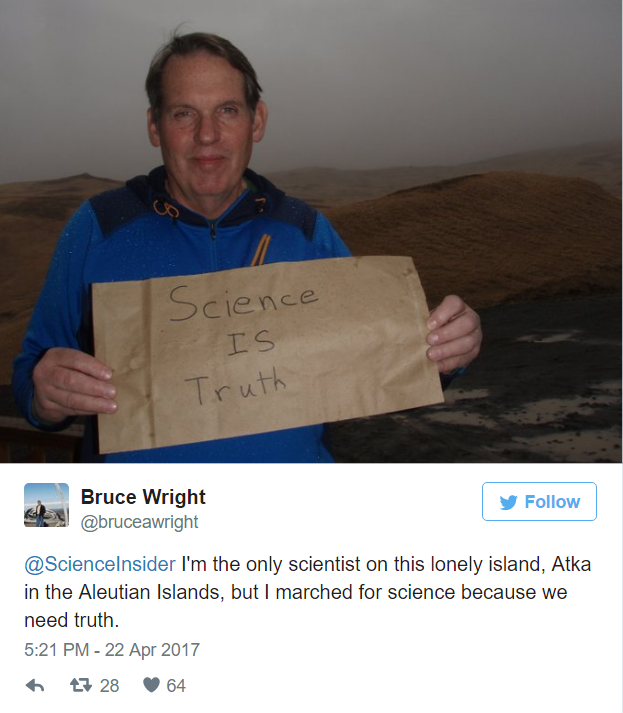
One man bluntly stated that science is truth:

Similar examples abound.

This idea—that science is the only trustworthy way of learning about our world—is the key philosophical starting point for those who want to replace God with an idol of science. (Note that this was exactly the thinking behind the ridiculous Scientific American article on the resurrection that I critiqued in my last blog post.)

If you can convince the masses that “science” is synonymous with truth, it’s quickly implied that no other sources of truth are necessary. Who needs the Bible when we can figure everything out in test tubes?

2. Promote a false dichotomy between “science” and theism so people feel they have to make a choice.

With point 1 firmly in place, people are ready to start believing that science and theism (belief in a personal God) are a trade-off. You pick one as your source of truth. But don’t think for a minute the choices are being hailed as equally viable. Those who pick God are to feel ashamed for being backward and unscientific. After all, it’s assumed they rejected science.

So choose science and join others who made the obvious choice for truth at the cool kids’ table.

That’s the message.

3. Use the word science in a such a variety of ways that people stop trying to clarify what exactly is meant by “science” in any particular context and accept whatever is claimed in its name.

March organizers said they were doing it to encourage “scientists, educators, and advocates, as well as social service workers, artists, trade workers, business people, our elderly population, and families to come together for science.”

Sounds pretty harmless, right? As one 8-year-old said, “Trees make oxygen. It helps us breathe. Who doesn’t like that?” Other kids held up similar non-controversial posters that said, “I love my microscope”; “Future scientist”; and “Science: Experiment, Learn, Fail, Repeat”; and “Science Matters.”

There’s basically no one who would have a problem with any of those statements. In fact, you might even begin feeling a wee bit silly for ever casting a skeptical eye on the March in the first place. But that’s precisely the problem. Non-controversial statements are a smokescreen for the myriad other pieces of secular worldview being promoted under the umbrella term “science.”

If the March was only about science as a field of study, as these examples would imply, no one would need to march at all.

People march because they want something.

They want you to believe something or do something. And if you take a survey of the statements made by marchers, it’s clear they are using the word science interchangeably to mean a variety of things:

  • A field of study (as in, science is the systematic study of the natural world)
  • Scientists (the people who engage in that field of study)
  • Findings of scientific research
  • Interpretation of the findings of scientific research
  • Consensus on the interpretation of the findings of scientific research
  • Policy decisions that in any way touch on any of the above

It’s an effective strategy that you can see everywhere in media today. Establish that science is the only reliable way to gain knowledge about the world, convince people they need to choose science or God, then smuggle in whatever you want to put forward as truth under the generic label of “science” and make everyone think disagreement is for the uneducated fools who didn’t make the smart choice.

Don’t believe it for a minute.

The Art of Raising Kids Who Won’t Bow to the Science Idol

As Christian parents, we must help our kids understand science as nothing more and nothing less than what it is: an extremely important field of study that can give and has given us a wealth of knowledge about the workings of God’s creation.

We can modify the three points above to see what our kids really should know.

1. Scientific research is one (important) way to determine the truth about our world.

Scientific research reveals the mechanics of the universe at a level of detail far beyond what God has revealed to us in the Bible. There’s no verse in the Bible, for example, that states the force of gravity. Science complements our knowledge of God because it reveals the workings of the world He created. Christians need the field of science as much as those with any other beliefs.

But science can say nothing about the ultimate meaning or purpose of our universe, or where all those laws of nature came from in the first place. You can study how a marble maze works, and describe those actions and mechanisms fully, but that doesn’t answer the questions of how the maze came together, why it’s there, and what we should do with it.

To answer these kinds of questions about the universe, we need the input of the One who created it. In that way, the Bible complements science.

2. There need never be a choice between science and God.

Far from being polar opposites, science needs God.

The goal of science, broadly, is to discover the order of the universe. But the feasibility of that goal depends on the assumption that the workings of our natural world can be discovered. We often take that for granted, but we shouldn’t.

Our universe is both understandable and logical. These characteristics allow us to do science in the first place. If the universe was just a hodgepodge of chaotic events, ungoverned by structured laws, science would be a hopeless task.

But why is the world intelligible rather than chaotic?

If the universe is truly the product of unguided evolutionary forces, as atheists claim, there’s no reason to expect that an elegant ordering of nature would happen on its own. But if the universe is the product of intelligence, as Christians and other theists claim, we would expect it to be orderly—a reflection of its rational designer.

Much more could be said on this, but the bottom line is that there is no trade-off between science and God. It’s a false dichotomy. You can pretend you’re “choosing” science, but your choice has no legs to stand on its own. You need God and science.

3. Thoughtful conversations about “science” must be nuanced enough to determine which meaning of science we’re talking about.

Let’s revisit the various meanings of science to see just a few questions that could be asked about any statement like, “Science says X.”

  • A field of study: Science, as a field of study, can say nothing. Only people say things. So, no, science doesn’t say X.
  • Scientists: Which scientists? Which field are they in? What are their credentials for speaking on this particular subject? What is the context for what they said? Who disagrees? Why do they disagree?
  • Findings of specific scientific research: How was the study designed? What was being tested? What was assumed? Who conducted it?
  • Interpretation of the findings of scientific research: What have prior studies on the subject found? What further research is needed to understand or test these findings? Is there a reason to believe this particular study is authoritative in some way? Where is the line between the findings of the study and what people are saying should be done with those findings?
  • Consensus on the interpretation of the findings of scientific research: When consensus is claimed, who is included in that consensus? How is consensus measured? Who has determined that consensus has been reached? What reasons do we have for believing the consensus?
  • Policy decisions that in any way touch on any of the above: The questions here are literally endless. Even if 100 percent of people agreed about the interpretation of 100 percent of scientific findings, there could be endless (legitimate) discussion on what the best policy measures should be based on those findings.

“Science says X” is an authoritative statement built on a foundation of hundreds of assumed answers to questions like these. What happens when we get tricked into believing that anything labeled science is authoritative?

This.

This is from Bill Nye’s new Netflix show, Bill Nye Saves the World, in which he “educates” the public on science issues.

This is being promoted as science.

I apologize for posting something of such a graphic nature, but this needs to be seen to be believed.


Incredible.

So, to the little boy who said, “Trees make oxygen. It helps us breathe. Who doesn’t like that?” the answer is no one.

Absolutely no one.

But that’s not the science the secular world wants us all to “like.” That science is an idol made by hands of people who want God off His throne.

Do not bow down.


 Original Blog Source: http://bit.ly/2rRhlAU

By Evan Minton

In chapter 8 of my book Inference To The One True God, in my blog post “The Minimal Facts Case For Jesus’ Resurrection PART 1” and in my blog post “A Quick Case For Jesus’ Resurrection”, I make the case that we know many people had experiences of the risen Jesus appearing to them because the creed cited in 1 Corinthians 15 dates back so early, well within the lifetimes of the eyewitnesses (i.e it dates to 5 years after Jesus’ death), that anyone curious about whether or not Paul was telling the truth could have traveled over to Jerusalem and interviewed the people mentioned in the creed to see if they really did believe Jesus appeared to them. If Paul were lying about these people and they really hadn’t seen Jesus, the cat would have been out of the bag and the resurrection would have been exposed as a falsehood. Given how fragile a faux resurrection would be in this case, the best explanation is that the twelve disciples, James, and 500 people actually did have postmortem Jesus experiences.

On two different occasions, people have read my argument for the historicity of the postmortem appearances and have responded with the following rebuttal: “Paul is writing his letters to churches far removed in distance from where the events are said to have occurred. It would be highly unlikely anyone from his church in Corinth would travel to Israel and seek out these apparent witnesses.” The argument is that Jerusalem and Corinth were so far that it would have been very difficult for Paul’s readers to trek all the way over to Jerusalem in order to interview the people Paul was talking about. It was too inconvenient for them, so most probably never did it and never would have done it. So the they-could-have-checked-it-out argument fails. Is this true? Was Paul’s resurrection eyewitness list really protected from falsification due to large travel distance?

I don’t think this is a successful argument. There are 3 reasons why the resurrection claims could have been checked out.

1: The Corinthians Had An Invested Interest In Knowing If It Was True

The reason why Paul was even mentioning the list of resurrection appearances in 1 Corinthians 15 is because  we see in the context of the passage that there were people denying that Christ had risen from the dead, implicitly at least, because they were denying the bodily resurrection in general. They were denying that anyone would rise from the dead. Paul said if the dead are not raised then Christ isn’t raised either if Christ isn’t raised, our faith is useless and our sins remain unatoned for (1 Corinthians 15:12-14), but fortunately, Christ has been raised (verse 20). Paul argued for this by listing the various postmortem appearances of Christ in verses 3-8 via the creed he had received earlier. Now, given that the Corinthians were skeptical of the resurrection, wouldn’t they have an invested interest in knowing whether Paul was telling the truth? Of course! And given that they had an invested interest if they didn’t take Paul at his word, wouldn’t they have traveled to Jerusalem to talk to the people mentioned in the creed even if it was a rather long journey? While it might have indeed taken them a while to get there, it wasn’t impossible for them to arrive in Jerusalem. It’s not like they were traveling to New York or anything. It was certainly feasible for them to go to Jerusalem to interview the witnesses in the creed even if it wasn’t a hop, skip, and a jump from their church.

And given that this was a topic of immense interest to them, it would be difficult to argue that they wouldn’t have. Besides, we know that Paul traveled to Jerusalem to Corinth. Why wouldn’t the Corinthians travel from Corinth to Jerusalem?

2: The Resurrection Occurred During Festival Time

Moreover, the resurrection was during a festival time. The witnesses would have been from all over the place, seen the appearances, and gone back home. It’s very likely some of the 500 that Jesus appeared to were from the city of Corinth. It very well could have been the case that there were some Jewish eyewitnesses to the resurrection of Christ living in the very midst of Paul’s readers. In that case, the Corinthian resurrection doubters wouldn’t have had to travel very far at all. There were likely witnesses in their own backyard.

It was certainly the case that those reading Corinthians included Jews who may have traveled to Jerusalem for Passover. This would provide an opportunity to verify Paul’s assertion.

3: Mail From Snails 

It is also the case that even if no one physically visited the twelve disciples and James, that they could have gotten verification via correspondence, i.e snail mail. The Corinthian resurrection doubters could have written letters to the disciples asking them “Hey yo, Pete mah BOIII! It’s ya boi Zechariah from Corinth. My homie Paul sent me a letter saying Jesus appeared to you after He died. This true, bro?” (first-century folks totally talked like this). And Peter, John, or whichever of the eyewitnesses received the letter, could have sent a reply saying either “He is risen! He is risen indeed!” or “What? Who told you this? I haven’t seen Jesus sent they crucified him.”

Conclusion 

Given these 3 reasons, I think it is still the case that having the 1 Corinthians 15 creed dating within the lives of all the eyewitnesses provides good grounds for concluding that these postmortem sightings occurred. If they didn’t, the eyewitnesses could have talked to these people themselves, by either journeying over to Jerusalem despite it being a long journey, because they had a highly invested interest in knowing whether they occurred. Or they could have had postmortem witnesses in their own midst that they could have talked to, or they could have at least gotten verification or falsification via correspondence. Any of these scenarios would have either falsified the resurrection if it didn’t occur or vindicate it if it did occur.


 Original Blog Sourcehttp://bit.ly/2s3304I

By Tim Stratton
Question

Dear Tim,In your article The Omnibenevolence of God you pointed out that on the Islamic view, Allah is quite similar to some Calvinistic views of God. Regarding this view, you said: “God is not all-loving, and whatever Allah does is simply called “good,” even if it is really hateful.”

I agree with you, but an atheist recently objected to your statement with the following:

This sounds like the Christian view point too. If God is the standard of ‘good’ then whatever God does is by definition good. By that argument then hatefulness would by definition be ‘good’. What makes benevolence inherently ‘good’ if you’re getting the standard of ‘good’ from God? By that argument, if God is benevolent then benevolence is good, but if it turns out God is hateful then one has to call ‘hatefulness’ good rather than benevolence. Unless you’re saying that benevolence is inherently good, apart from God, and therefore benevolence is a necessary trait of an ‘all-good’ God. But that would mean God has these traits because he is good, and their goodness stands apart from his possession of them – they’d be good irrespective even of God’s existence.

He went on to claim that the ‘zombie argument’ dismissing the Euthryphro dilemma (I think referring to the article written by Timothy Fox) fails and thus the Euthyphro dilemma “isn’t actually so dead after all.” How would you respond to this atheist’s argument?

– Melissa

Tim’s Response

This is a good question and one that I have been considering for a while. Thank you for sending it my way, Melissa. I believe the atheist’s objection might be a problem for Calvinists to deal with (Check out Sakr’s “Calvinism and Euthyphro’s Horns”); however, the article I wrote was based on a Molinist perspective. The atheist failed to grasp this distinction and seems to conflate Christianity with Calvinism — a move I adamantly oppose! His response, unfortunately, missed the main point of the entire article, and thus, goes on to attack a straw man. This can be seen when we first understand what God is like.

God’s Nature is LOVE

The main thing to consider is that God’s nature is perfectly loving, just as He is perfectly powerful and perfectly knowledgeable. One is free to assert that these properties are not “good” (call these whatever you would like); however, if God does possess love for all people, then my argument stands.

Not only does the Bible specifically say that “God is love” (1 John 4:8), but the fact that God loves all persons is implied in verses such as John 3:16, 1 Timothy 2:4, and 2 Peter 3:9. Moreover, if Jesus’ commands reflect the nature of God, then it is rational to infer that God loves all people (even those who consider God to be an enemy). It would be quite odd for God to command humans to love all people (from our neighbors to our enemies) if God Himself did not possess this love for all people. In fact, this perfect love is specifically referred to in Matthew 5:48:

Be perfect, therefore, as your heavenly Father is perfect.

Jesus even provides the parable of the Good Samaritan (Luke 10:25-37) to demonstrate the love we ought to have for those who despise us. Jesus makes it clear that we ought to go out of our way — even if it inconveniences us — to make it possible for even our enemies to thrive and flourish. Scripture is replete with data affirming the perfect love of God. In fact, I have argued that we can infer God’s universal love and desire for all to be saved from the first book of the Bible. With this in mind, the main thing to grasp is that God is omni-loving! That is to say, God genuinely loves ALL people!

This raises another question…

What is love?

Besides the title of a catchy 90s pop song the Bible is clear what love is in 1 Corinthians 13:

4 Love is patient and kind; love does not envy or boast; it is not arrogant 5 or rude. It does not insist on its own way; it is not irritable or resentful; 6 it does not rejoice at wrongdoing, but rejoices with the truth. 7 Love bears all things, believes all things, hopes all things, endures all things. 8 Love never ends. . .

The Bible goes on to clarify what maximal love is willing to do in John 15:

13 Greater love has no one than this, that someone lay down his life for his friends.

The Bible reveals that God loves all people and that all people are called to love all people too. In fact, we can surmise that this is the objective purpose of human existence given Christ’s greatest two commands! Consider Matthew 5:44; 22:37-39:

1- Love God first!
2- Everybody love everybody (from your neighbors to your enemies)!

Moreover, the Bible seems to describe genuine love as desiring the best for another person even if it comes at a cost to the one who loves the other person. Not only is this biblical — it is self-evident and intuitively obvious! With this in mind, we can summarize love as a genuine desire for the best of another person and a willingness to self-sacrifice (even one’s own life if need-be) to ensure this other person can flourish by achieving the best possible life.

It is important to note that my “omnibenevolent article” referenced in the objection was written primarily with certain Calvinistic theologians in mind, like Arthur Pink and Matt Slick, who deny that God loves and desires the best for all people. The objection above, however, is written from an atheistic perspective hoping that the Moral Argument for the existence of God will fall prey to one of the horns of the Euthyphro dilemma. Be that as it may, my point is immune to this objection as it stands strong by merely pointing out that God is essentially loving and is ALL-loving. One is free to argue that loving people is not a “good” thing or not. However, even if it is not good to love (as crazy as that sounds), the point remains: God loves all people — His nature is love!

Now that we have an understanding of God’s loving nature, and we know what love is, now we can contemplate the meaning of life.

The Objective Purpose of the Human Existence

Your life has objective meaning! You might not know this yet, or perhaps you subjectively disagree, but this changes nothing. The fact of the matter remains that God created humanity on purpose and for the specific purpose to know, love, and enjoy a relationship with Him and all people for eternity. This is why you exist. This is the objective purpose for which we were all created.

God created a world filled with creatures who can enjoy a true love relationship with Him (which is the ultimate eternal flourishing). This is the objective purpose of human life — to love and be loved by God and all people for eternity. It is vital to grasp this truth: God created each and every one of us on purpose and for the specific purpose to be in a full-flourishing/true-love relationship with Him for eternity.

If God desires to create a world in which true love can be attained, He must provide His creatures with genuine freedom (libertarian free will) so that it is possible for humanity to experience genuine love relationships with God and others. With this freedom in mind, humans are free to approximate to the objective purpose of life — LOVE — or not.

To help understand why God’s goal in creating humanity grounds objective purpose, consider the following argument:

1. If a truth corresponds to reality, it is objectively true [apart from human opinion].
2. If God created humanity for a purpose, then this purpose is a truth that corresponds to reality.
3. Therefore, if God created humanity for a purpose, then this purpose is objectively true.
4. God created humanity (on purpose and) for a purpose.
5. Therefore, God’s purpose for creating humanity is objectively true (apart from human opinion).

For a more detailed argument click here.

What is “Good”?

Once we grasp the objective purpose of human existence we can understand what it means for humans to be “good.” When we approximate to our objective purpose (which is true apart from human opinion) it is objectively “good.” To a degree that a thing approximates to its objective purpose, to that same degree it is “good.” To a degree that something misses the mark (the goal) of its objective purpose to that same degree it is sinful (“bad”). That is to say, something is objectively good when it helps to achieve or corresponds to the objective purpose of its existence.

Since God by His nature is love (even if love is not a “good”), He created a world where genuine love is possibly attained. God created humanity on purpose and for the specific purpose to love Him and to be loved by Him (and all people) perfectly into the eternal future. This also leads to ultimate and eternal human flourishing. One is free to call eternal human flourishing “good,” “shmigood,” or whatever they would like.

To do anything other than love all persons (from each person of the Trinity to all humans) is to miss the mark (sin). Since free will is required for love, and if free will is really free (and not some word game), it follows that one can freely choose to approximate to the objective purpose of his or her existence (what we call “good”) — or not.

Conclusion

God is all-loving by nature. It is irrelevant if one wants to argue if love is “good” or “bad.” I am not making a case that loving all people is “good” or “bad” so my case simply avoids Euthyphro’s horns. I am simply pointing out the way things are (the definition of reality). God is love!

God is “good” in the sense that He always freely acts consistently with His perfectly loving plan for humanity. God also sets the standard that we humans strive for as “the goal.” Humans are “good” when we freely choose to approximate to the objective purpose in which we were created. We are “bad” or morally sinful when we freely choose to “miss the mark” or fail to miss the goal we were created to attain.

The choice is up to you!

Stay reasonable (Philippians 4:5),

Tim Stratton


Original Blog Source: http://bit.ly/2snBRXz