
Tag Archive for: Calvinism

[Editor’s Note: in November 2025, at the Evangelical Philosophical Society meeting in Boston Massachusetts, Tim Stratton and Phil Kallberg presented a coauthored essay, “Is Divine Determinism a Different Gospel?”. You can see it here or listen to here. The provocative essay – critiquing a major brand of historic Christian thought: Calvinism – evoked some controversy. Phil responds here to one of the critiques.]

I’m inspired to write this both for the accusations of “straw manning” that came from Tim’s and my essay at the 2025 EPS, and due to examples that I have seen. While no one accused me of this directly (all the interactions I had with people in relation to the essay were positive, even when they were pushing back), I heard through the grapevine that some people were complaining that Tim and I were straw manning Calvinists and other divine determinists. Additionally, I did see examples of people straw manning Calvinists in response to Tim and my essay. I’m pretty confident that Tim and I didn’t do this, but some other people have. And further “straw manning,” is one of those accusations that gets tossed around pretty liberally these days so this whole thing will be instructive and useful elsewhere. So let me explain.

What is the Straw Man Fallacy?       


The straw man fallacy is when you deliberately misrepresent your opponent’s position to make it easier to argue against. It’s why from time to time you hear internet atheists complain that people believe in the “sky daddy” instead of critiquing the Kalam Cosmological argument. If you want some good non-philosophical examples of this just watch any Democrat and/or Republican talk about the other side. The reason for the name is that it’s obviously easier to attack a man made of straw than it is a real man. Now it’s important to notice what this is not. The straw man fallacy is not when you are ignorant of your opponent’s position and/or just get something wrong. Nor is it when there is a disagreement about what the entailments of that view are, i.e., “I think physicalism and naturalism necessarily lead to an amoral universe.” There are physicalists and naturalists who disagree and argue for a real objective morality. I think they are being inconsistent and will argue as such. They disagree and will argue against me. I’m not “straw manning” them by arguing “this is what follows from your view.” I’m only doing that if I claim that they are moral nihilists. I don’t claim that they are, rather my claim is that they should be moral nihilists or else they are inconsistent.

An Example in Atheism


So, to carry the example further, suppose I’m arguing against an atheist who argues that morality is just an illusion caused by evolutionary adaptation, like the late Micheal Ruse. An atheist who believes in objective morality (they do exist) might want to accuse me of straw manning him as “You claimed atheists don’t believe in morality, but I do.” But this is a misunderstanding of the straw man fallacy. If I’m arguing against Micheal Ruse, and he really did think that (he did), then there is no straw man here. The other atheist is free to disagree with Ruse and then he and I can discuss and argue about what he actually does think, and if a belief in objective morality is a reasonable, plausible, or even a possible outlook on atheism (it is on some variants and not on others). The point here is that if I can cite someone in group B who really does claim X, then it’s not straw manning if I argue against X, even if other people in group B reject X. At that point I should just be happy that those other people in the group have seen the light by rejecting X and they should be happy that they have an ally in arguing against X. At the worst my criticisms just don’t apply to those other people.

Now it is possible (but it’s unlikely) for someone to do the above in a very dishonest way where the error becomes something like straw manning. I could claim that all atheists follow the philosophy of Nietzsche and Marx (I wouldn’t. This is obviously wrong but just go with it for the example). Then I offer critiques of Marx and Nietzsche and claim that I have defeated atheism. An atheist who rejects Marx and Nietzsche would rightly take offense. If I knowingly do this that is straw manning. If I do this out of ignorance (I’m naive enough to think that Marx and Nietzsche are the authority on all things atheism) then that is a problem, but it’s not straw manning. It’s me not knowing what I’m talking about.

An Example from Politics 

Or for a political analogy, I might argue, “You shouldn’t vote for a Democrat as they support trans-surgery for minors and that’s wrong.” It is true that there are Democrats who support this. But not all Democrats do, so if you are one of the Democrats who don’t support such things did I straw man you with that argument? Since I can point to Democrats who do support such things this is not a straw man, but the moment I start claiming that you have that view then it is. It’s still a poor argument as it’s uncareful and doesn’t appreciate the nuance that many Democrats think and support different things, but it’s not a straw man.

And of course, it’s possible for people to make arguments like that in bad faith wherein they attribute minority and/or fringe views of the group to the whole. I suspect if we could ask all the self-described Democrats, “Do you support sex-change operations for 8-year-olds?” the majority of them would say no. So given this, if the above exchange happens, and you tell me, “well I’m a Democrat and I think such things are barbaric” then my response should be something like, “Good I’m glad you are with me on this.” If at that point I insist that since you are a Democrat you must support sex change operations for 8-year-olds, then I am straw manning you (and I’m being an obstinate fool).

So, straw manning is when you deliberately misrepresent someone or something to make it easier to argue against it. It is not when you misrepresent things due to ignorance or a mistake. Nor is it when you have a disagreement about the entailments of the viewpoint. If you make a mistake or speak out of ignorance and are given correction but continue in the initial error, then that becomes straw manning.

What about Calvinism?  

      
So, if you call yourself a Calvinist or some other type of divine determinist and also don’t think that God determines everything then it’s pretty likely that Tim and my criticisms just don’t apply to you. I strongly suspect that if you and I sat down to hash it all out I’d end up claiming that you are, in some way, being inconsistent as it seems to me Calvinism and other variants of divine determinism just naturally lead to the problems that Tim and I point to. But if you reject those problems then I say, “Great!” We agree on that point and I’m happy to have any ally in claiming things like it’s ridiculous to believe that God demonstrates love for people by condemning them to hell (for example). If you and I disagree about what is entailed by your theological and philosophical system and we are both being honest (or at least trying to be) then no one is straw manning anyone. We just have a philosophical or theological disagreement.

This is an area where I saw the “anti-Calvinists” (for lack of a better name) commit this fallacy. A significant amount of them claimed things like Calvinists don’t believe in the Bible. Now this is plainly not what any Calvinist claims. Further it’s the opposite of what every single one that I’ve read and talked to claims. When I attempted to drill down where those “anti-Calvinists” were getting this from it turned out that they thought that the theological system of Calvinism undermines the Scriptures and our ability to know and trust them (this argument sounds awfully familiar). I agree with that critique, but that’s an implication of the view, not the view itself. Hence those “anti-Calvinists” are straw manning Calvinists as they are attributing to them a view that is flatly denied. Now I think that is denied on pain of a contradiction or inconsistency, but we still need to give Calvinists credit for denying the claim that they don’t believe in the Bible. It’s not reasonable, fair, or good practice to do otherwise.

Naturally this has many implications in a lot of other areas as “straw manning” is one of those phrases that just gets constantly thrown around now. And some people do indeed do this in a malicious way. But I’ve found that much of the time people are simply confusing a disagreement about what logically follows from a view with straw manning. For now, I’ll just avoid getting into specific examples of people who do straw man in a malicious way. It’s not worth the time it would take, as it would probably just alienate people.

So, the point here is if someone is knowingly and maliciously misrepresenting you, that is straw manning. It’s not only a logical fallacy, it’s a moral wrong. But if someone is just ignorant of what you think, genuinely doesn’t understand your view, or disagrees with you on the implications of your view, that’s not straw manning.

Recommended Resources:

How Philosophy Can Help Your Theology by Richard Howe (MP3 Set), (mp4 Download Set), and (DVD Set

Jesus, You and the Essentials of Christianity by Frank Turek (INSTRUCTOR Study Guide), (STUDENT Study Guide), and (DVD)     

The Great Book of Romans by Dr. Frank Turek (Mp4, Mp3, DVD Complete series, STUDENT & INSTRUCTOR Study Guide, COMPLETE Instructor Set)

How to Interpret Your Bible by Dr. Frank Turek DVD Complete Series, INSTRUCTOR Study Guide, and STUDENT Study Guide


Phil Kallberg Host of “The Examined Life” podcast is a proud follower of Christ, Phil Kallberg has an MA in Philosophy from Holy Apostles College and Seminary where he wrote a thesis on the Modal Ontological Argument for God’s existence. He greatly enjoys a good story, follows politics far more than is warranted, and makes use of a PlayStation for breaks from all the work of raising children and doing philosophy. Before studying philosophy Phil spent time in the military, worked several jobs in different fields, and thanks to his love of stories got a bachelor’s degree in English. Phil lives in Missouri with his wife, son and daughter. He may be reached for comment at theexaminedlifewithphil@gmail.com


Originally posted at:
https://bit.ly/4qUzEPe
Is faith in God a personal choice, or is it something that God forces on people against their will? Misinterpretations of Romans 9 have led many Calvinists to read this narrative into the Scriptures, but what are they missing and what does the context of Romans 9 actually reveal about its intended meaning?

For this midweek podcast, Frank revisits the discussion surrounding the issues of election and the sovereignty of God. Can you have love without free will? Did God only die for some people? Does God allow us to make some choices but not others? Is there anything that God can’t do? And what are some of the bad theological and moral implications of five point Calvinism? All this and more will be discussed in this eye-opening midweek podcast episode.

To view the entire VIDEO PODCAST be sure to join our CrossExamined private community. It’s the perfect place to jump into some great discussions with like-minded Christians while simultaneously providing financial support for our ministry.

You can also SUPPORT THE PODCAST HERE.

Resources mentioned during the episode:

Podcast episode with Leighton Flowers: Free Will or Calvinism: Which Should You Choose?

Leighton Flowers interview: UNMASKING the MYTH of Calvinism in ROMANS 9

YouTube channel: Soteriology 101 with Dr. Leighton Flowers

Debate: Leighton Flowers VS James White – Does John 6:44 Teach Unconditional Election?


Download Transcript


By RYAN LEASURE

At Grace Bible Church, we have a statement of faith that all members must affirm. It’s a fine statement of faith (though a little long if you ask me). And it provides a nice summary of basic Christian belief. That said, not all doctrines are created equal. Some doctrines are absolutely essential while others are less important. How, then, should Christians “contend for the faith that was once for all delivered to the saints” (Jude 3) without contending for too much or too little?

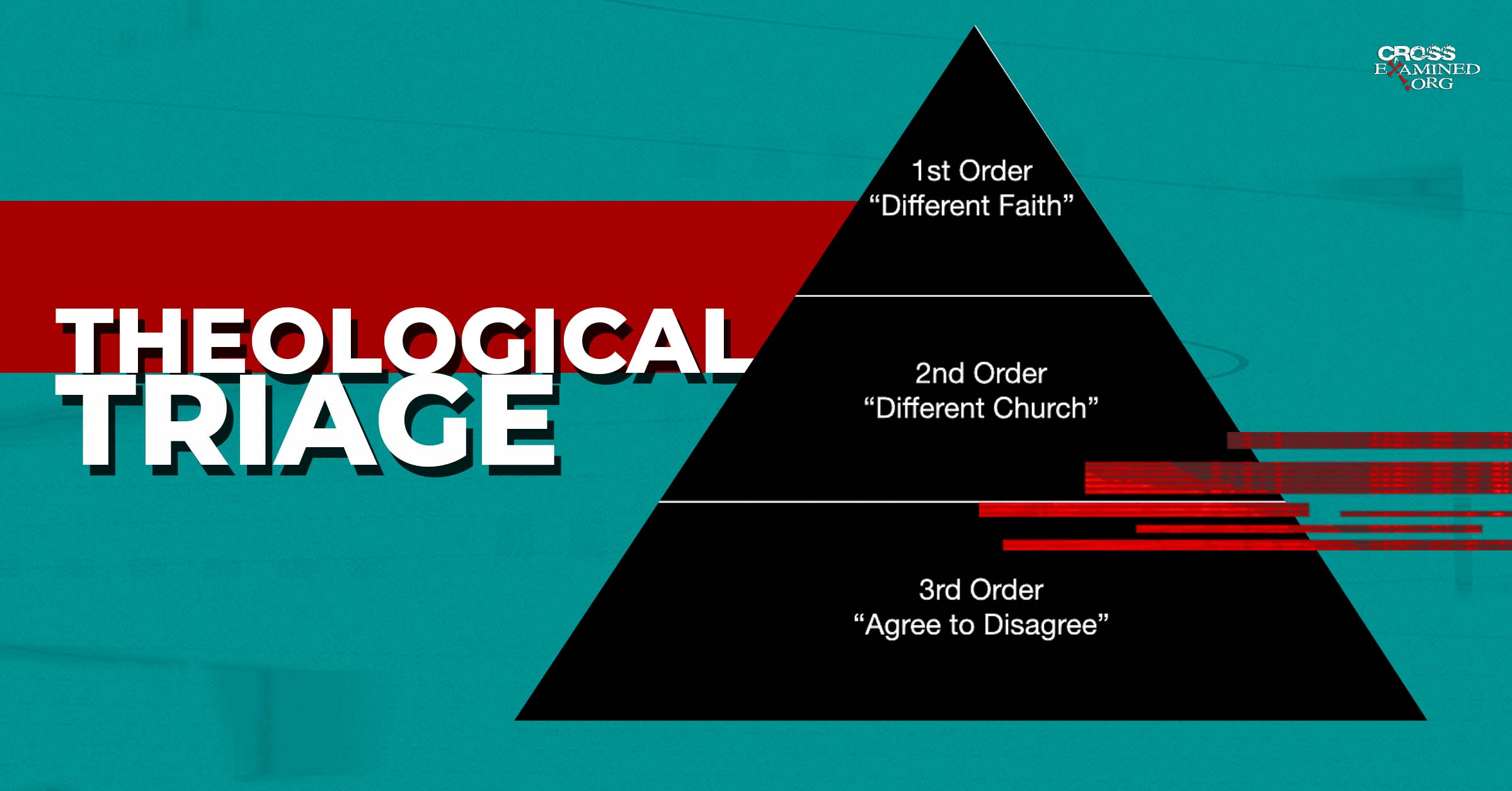
In other words, how do we know which doctrines are worth fighting for and which ones are not? To help with these matters, we have adopted what Al Mohler once dubbed a “Theological Triage.”

Theological Triage

The word “triage” comes from a French word which means “to sort.” And if you’ve ever been to an emergency room, you’re familiar with the sorting process that takes place. If someone shows up with the sniffles, they’re most likely put at the back of the line. If someone shows up holding their decapitated leg, they’re put up front.

Doing theological triage follows a similar principle. As Christians, we must think through doctrine and decide which doctrines get sorted to the front (first-order issues) and which ones get pushed to the back (third-order issues).

At every membership class, I explain this concept and teach newcomers which doctrines are essential and which ones we can agree to disagree on. Let’s consider the three categories in turn.

First-Order Doctrines

First-order doctrines are the absolute essential doctrines to the Christian faith. These are doctrines that every true believer should affirm without hesitation. These doctrines include:

  • God is a Trinity
  • God is the creator of all things
  • Jesus Christ is the Son of God
  • Jesus is both God and man
  • Humans are made in God’s image
  • All humans are sinners and they must repent of their sin
  • Jesus died on a cross for our sins and rose again from the dead
  • People are saved by grace alone through faith alone in Christ alone
  • The Bible is God’s inspired word
  • Jesus is coming back to judge the living and the dead

You get the idea. These beliefs are so fundamental to the faith that if someone were to deny them, we would say that person belongs to a different faith system altogether.

Second-Order Doctrines

Second-order doctrines are not essential doctrines of the Christian faith, but they are essential for church membership. That is to say, even though people may disagree with us on these issues, we would not call into question their standing with God. We may think they’re wrong and think they should reconsider their views. But we would not question their faith altogether. That said, if people are going to be part of the same church, they need to agree on these second-order issues:

  • The recipients of baptism
  • Women Pastors
  • Revelatory gifts (speaking in tongues or prophecy)

Our statement of faith is clear on the first two points. We baptize believers and believe God has ordained for qualified men to serve as pastors. Our statement of faith doesn’t speak to revelatory gifts in the same way. So one could technically classify it as a third-order doctrine. But I suspect if someone felt strongly about publicly prophesying or speaking in tongues before the church, they would feel compelled to go to a different church where those types of practices were more accepted.

Third-Order Doctrines

Third-order doctrines are not essential to the Christian faith, nor are they essential for church membership. That is to say, church members are free to disagree on these matters. This does not mean, however, that these doctrines are unimportant (we can think of less important beliefs). It does not mean that we should not study the Scriptures to try and make sense of them as best as we can. What it does mean is that we are not going to divide over these issues.

Now sadly, it’s these third-order issues that have led to more church splits than anything else. But at Grace Bible Church, we are committed to remaining unified around the main things while allowing charitable disagreement around the not-so-main things. These third-tier doctrines include:

  • Calvinism vs. Arminianism
  • Age of the Earth
  • Millennial or tribulation views

Our statement of faith does not take a hard stand on any of these issues. Therefore, one does not need to affirm Calvinism or Arminianism in order to be a member in good standing at Grace Bible Church. In fact, our church leadership has disagreements on these matters! The same goes for one’s understanding of the age of the earth and the millennium. Good faithful Christians throughout history have disagreed on these matters which leads us to believe the issues aren’t as clear as the first and second-order doctrines.

What we encourage, then, is for each member to act charitably towards others with whom they disagree. We should never ridicule someone or call their faith into question because they land in a different place on one of these third-tier issues. We can agree to disagree or even study the topic together with the hopes of learning from one another. Let’s remember, though we’re all trying to get it right, none of us are infallible.

Dividing Over Doctrine

Placing doctrines in their proper tiers allows the church “to contend for the faith that was once for all delivered to the saints” (Jude 3). It protects the church from contending too much or too little.

Liberals have historically contended for too little. They have tended to press first-tier doctrines down to the third tier. They’ve adopted an “agree to disagree” mentality when it comes to important matters such as Christ’s bodily resurrection from the dead! On the flip side, fundamentalists have historically contended for too much. They have pushed third-tier issues up to the first tier and have divided over less-than-critical matters.

Doing theological triage protects us from both of these errors.

Recommended resources related to the topic:

Legislating Morality (mp4 download),  (DVD Set), (MP3 Set), (PowerPoint download), and (PowerPoint CD) by Frank Turek

Legislating Morality: Is it Wise? Is it Legal? Is it Possible? by Frank Turek (Book)

____________________________________________________________________________________________________________________________________________________

Ryan Leasure holds a Master of Arts from Furman University and a Masters of Divinity from the Southern Baptist Theological Seminary. Currently, he’s a Doctor of Ministry candidate at the Southern Baptist Theological Seminary. He also serves as a pastor at Grace Bible Church in Moore, SC.


By Spencer Toy

I’ve recently been listening to a number of the Reformed critiques of Andy Stanley and the defense of him that Frank Turek posted here at Cross Examined. While I believe that some of these criticisms have merit, I believe there is a major problem with the Presuppositional Apologetic method and would like to pose that problem to all those who would consider themselves to be Presuppositionalists.

Before I begin, let me state clearly that while I am not a Calvinist or a Presuppositionalist it is my honest desire to know the truth as God has revealed it in Scripture and follow the evidence wherever it leads. I know I am not always right and will respond to correction if I can be shown to be in error. I also do not want to misrepresent the views of Calvinists/Presuppositionalists in any way. I encourage anyone who disagrees with me to express their disagreement.

That being said, It is my understanding that according to the Calvinistic interpretation of Scripture, human reasoning is so totally depraved that any effort to understand or believe the Gospel is futile. Unless and until the Holy Spirit regenerates the reprobate mind, a person will continue to suppress the truth regardless of how well it is articulated or argued for.

In addition, the Calvinistic view of God’s sovereignty entails that God causally ordains all things that come to pass. There is no sense in which God merely “permits” things to occur. Everything that comes to pass, to include the unbelief of the reprobate, comes to pass because in so happening God will bring the most glory to Himself.

Here in lies a problem I don’t believe the Presuppositionalist will be able to get out of. Obviously, I understand that the Calvinist believes that God ordains means as well as ends. He has not revealed the content of His Divine Decree to us and therefore we are only accountable to what He has revealed in Scripture (i.e. preaching the Gospel to everyone since we are commanded to and we do not know the identities of the elect). Still, while an understanding of this may lead to a Calvinist carefully weighing the decisions he makes in the future, he still must acknowledge that all events in the past have occurred the way they did due to the Sovereign Decree of God.

This being said, I would like you to consider someone like Dr. Frank Turek who is not a Calvinist and uses the Classical Apologetics method. Based on the admission of Reformed theologians themselves, it seems to me that a Calvinist has to believe that ultimately the reason that Dr. Turek is in error regarding God’s Sovereignty and the proper apologetic method is because God has not granted it to him to understand these things. Just as the reprobate man’s fallen reason can never lead him to God, neither can Dr. Turek’s reason lead him to the truth of Reformed theology unless and until the Holy Spirit grants it to him to understand it. If Dr. Turek persists in his error, he does so only because God has sovereignly determined before the foundation of the world that he would be in error, for through Dr. Turek’s theological errors God will bring the most glory to Himself. 

To illustrate this, consider this quote that Dr. James White made on his program The Dividing Line (September 8th, 2016). Speaking to fellow Calvinists with regards to addressing those who do not embrace Calvinism/Presuppositional Apologetics, White said, “You don’t know what their level of knowledge is, and you don’t know what God’s purpose is having not yet given to them an understanding of His Sovereignty. It’s up to God.”

Now once again, I’m sure that Calvinists will quickly respond, “But we don’t know the content of God’s Sovereign Decree! It is our responsibility to preach the truth through a proper exegesis of Scripture in hopes that God will use it as a means by which He will reveal the truth to Dr. Turek and others who do not embrace the truth of Reformed theology and Presuppositional Apologetics!”

Yes and I believe I understand that response, but I’d like to illustrate the problems of this response with a hypothetical dialogue between a Classical Apologist (CA) and a Presuppostional Apologist (PA). I understand that not every Presuppositional Apologist will give answers exactly like the ones I list here, but I have based all the hypothetical answers on statements made by Presuppositionalists in defense of their theology and methodology.

CA: “How do you know that the conclusions you’ve drawn about Reformed theology and Presuppositional Apologetics are correct?”

PA: “Because a proper exegesis of Scripture inevitably leads one to accept Reformed theology and its implications. I am prepared to demonstrate this directly from the pages of God’s Word.”

CA: “But I’m using the exact same Scriptures as you are and I don’t draw the same conclusions as you. How do you know that your exegesis of Scripture is correct?”

PA: “Like I said, I can demonstrate it. When you read the passages of Scripture in context with the proper historical and grammatical understanding, you’ll see that Reformed theology necessarily follows.”

CA: “In other words, you can REASON from the text. The words of Scripture clearly do not interpret themselves. If that were the case we wouldn’t be having this discussion. You and I disagree about what the implications of Scripture are and therefore you have to attempt to demonstrate that your view is true by engaging in reasoning. Didn’t you say that our reasoning capabilities are fallen and that we should never place human reasoning above God’s Divine Revelation?”

PA: “Of course our human reasoning is fallen. That’s why the Holy Spirit has to reveal the truth to us. I can know that my exegesis is correct because I begin epistemologically with God. Having put my faith in God thanks to the Holy Spirit’s regeneration, I can be confident that God has revealed the truth to me.”

CA: “But tell me this. Hypothetically speaking let’s say that God wanted you to be in error about some aspect of theology. He still elected to save you, but He knew that if you believed and taught this theological error to others, somehow in the grand scheme of His Divine Decree He would bring the most glory to Himself. Would it be possible for you to reach the truth assuming that God had decreed for you to remain in error?”

PA: “Well no. God’s Divine Decree cannot be resisted. Everything that happens in the universe ultimately occurs according to God’s decree in order that He might glorify Himself.”

CA: “But if that’s the case how could you ever confidently know that anything you believe is true? I suspect you’ll say because God has revealed it to you, but that would just be arguing in a circle. You just admitted that if God wants someone to be in error then they will certainly be in error, including me and including you! How can you know that what God has revealed to you isn’t an error so that He can bring more glory to Himself by your being incorrect?”

I have asked this question to Calvinists before and never received an answer with any more substance than, “You just don’t understand Calvinism!” or “It’s more diamond shaped than that!”

This I think truly exposes the fatal flaw of the Calvinist’s embrace of Divine determinism. As William Lane Craig has stated, once a person embraces determinism of any sort a strange vertigo sets in. One very well may believe true things, but only because they’ve already been determined to believe those things just as much as their opponents have been determined to believe false things. In such a system, nothing can be rationally affirmed.

I know that there is more to be discussed, but I don’t believe it is helpful at this point to simply appeal to the Scriptures that a Calvinist would use to defend their view of Divine determinism. Doing so would presume that you are engaging in proper exegesis, which can’t be the case if you are relying on fallen reasoning capabilities and can’t be rationally affirmed if you are relying on God to have revealed the truth to you. Simply put, it is impossible to begin epistemologically outside oneself. Unless we assume that our reasoning capabilities are generally reliable, arguments about any topic can’t go anywhere.


Resources for Greater Impact

IDHEFTBAA DVD angled CLEAR

WHY I STILL DON’T HAVE ENOUGH FAITH TO BE AN ATHEIST (DVD)

IDHEFTBAA laying down book

I DON’T HAVE ENOUGH FAITH TO BE AN ATHEIST (BOOK)