Tag Archive for: beginning of the universe

By Al Serrato

In the beginning, was… not the Word …. but the singularity event occurring in absolute nothingness and timelessness that spontaneously created all we see in the universe around us.  So said physicist Stephen Hawking anyway, in his popular book The Grand Design, where he explained that spontaneous creation is the reason why there is something rather than nothing. It is not necessary to invoke God; he concluded, “to light the fuse to set the universe going.” “All it takes is gravity and the existence of, well, multiple other universes.” 

Soundbites like these can be disturbing for people of faith. More to the point, they can provide false comfort to those who prefer to suppress their innate knowledge of God. In a recent conversation with a skeptic who had heard of but not read the book, I was quickly confronted with a typical line of argument – reliance on the expert. “Look,” my friend said, “neither one of us can hold a candle to someone with the accomplishments and intellect of Hawking, so if it’s good enough for him….” The smile on his face told me the conversation was over before it began. After all, a response like this leaves little room for further discussion and no room for debate.

So what is the believer to do? Does recognition of one’s limitations, and a proper sense of humility, make it a fool’s errand to pit oneself against a world-renowned physicist such as Dr. Hawking? Or is there a way to appropriately examine and perhaps even challenge the reasoning of such an expert?

There is indeed a way. Thousands of times a year in courtrooms across America, expert witnesses take the stand to provide opinions to jurors on topics that are beyond the knowledge of the average person.  But these opinions and conclusions can be, and often times are, rejected. The first step is to carefully consider the assumptions underlying the opinion, which oftentimes are not well thought out or are perhaps just incorrect. For example, a psychiatrist may conclude that the defendant she examined is suffering from a particular mental illness, but that opinion may be based upon the untested assertions of the defendant which if false – if the defendant is malingering and trying to fool the examiner – could easily lead to a mistaken conclusion.  An accident reconstruction expert can conclude that one party was the cause of an accident by making incorrect assumptions about conditions he did not observe leading up to the accident. In short, despite being “qualified” to offer an opinion, even the impressive credentials of a physicist like Hawking do not give the expert a free pass. The expert’s opinions, like all evidence presented in court, must be carefully examined.

What is the mistaken assumption underlying Hawking’s approach?  Simply this: you cannot use science to prove what occurred prior to, and outside of, the universe.  Though many invoke the term “science” as a club, using it to convey that their position is somehow unassailable, science is not a book of wisdom. It does not contain the answer to all of life’s questions as if it were an encyclopedia of all there is, or was, or ever will be. It is instead a method for using our senses, and reason, to learn how and why things occur or why they are the way they are.  Implicit in science is testability. The scientist’s hypothesis must be subject to repetition and testing so that others can confirm that the methodology is sound and the conclusions logically justified.

When it comes to examining the origins of the universe, there is a starting point some 14.6 billion years ago before which there was neither time nor space. There was the complete absence of anything. Science cannot reach back beyond that point. If there are indeed a multitude of other pre-existing universes that in no way intersect with our own, which are therefore undetectable to us, how can a scientist simply assume they exist? If our universe needed a pre-existing “law” of gravity to light the fuse, how can one assume that such a law appeared without the need for a creator, for a “lawgiver?” For his conclusions to be testable, Hawking would have to first demonstrate what conditions existed “before” time and space came into existence. If we sprang from another universe, how can science prove that such a place, beyond the reach of any of our sensing equipment, exists? In short, if his conclusions are correct, there is no way for anyone to know. Hawking has moved from science to speculation at this point. He has moved from physics, wherein his expertise lies, to philosophy, where it does not.

Positing a multiverse or a pre-existing law of gravity may provide an alternative to God as the “uncaused cause,” but it also demonstrates that even skeptics share that powerful sense that most people have that you just can’t get something from nothing, that before a thing can exist there must exist before it an adequate source. Moreover, believing in a multiverse or law of gravity cannot explain the really interesting questions we also ponder, that have little to do with physical creation and impersonal laws: how did life emergence from nonlife? What is the source of the information coded into DNA that is capable of producing not just life but consciousness and intelligence? The physical world does not provide examples of intelligence and language, so what can explain the information-rich “blueprints” that we know of as DNA? Why are there “laws” of nature, and why are order and design built into things if there is no designer? Why do we all recognize concepts like beauty, truth, and morality?

There is a certain hubris in asserting that God is unnecessary. Consider an analogy: a programmer writes a computer simulation in which a virtual soldier is given artificial intelligence, and a set of missions to perform.  If the soldier uses its intelligence to begin inquiring as to the nature of the computer in which he is housed, what information would that provide him about the programmer? Only such information as the programmer wanted his creation to know. Regardless of how clever this soldier became, he could never know what the programmer wished to accomplish with the program, or what motivated him to write it unless the programmer gave him that information.  What stunning arrogance it would be for the soldier to nonetheless conclude from his inquiry that he self-assembled, that he knows the sum total of what occurred before he became conscious, and most strikingly that there was no programmer at all.

This, too, is Hawking’s problem.  As a scientist, he no doubts understood that theories must be tested in some fashion to give them scientific weight. How can a theory about multiple universes which do not intersect in any fashion with our own ever be tested? How can he demonstrate that gravity was not first created by someone immensely powerful and completely outside of our physical reality?

Why then write a “science” book that is itself a foray outside of science, setting out to prove something that science cannot prove? The Bible warns that the wisdom of the world is folly to God.  Perhaps this is what it means.

Recommended resources related to the topic:

How Old is the Universe? (DVD), (Mp3), and (Mp4 Download) by Dr. Frank Turek 

God’s Crime Scene: Cold-Case…Evidence for a Divinely Created Universe (Paperback), (Mp4 Download), and (DVD Set) by J. Warner Wallace

God’s Crime Scene: The Case for God’s Existence from the Appearance of Design (mp4 Download Set) by J. Warner Wallace 

God’s Crime Scene: The Case for God’s Existence from the Appearance of Design in Biology DVD Set by J. Warner Wallace 

What is God Like? Look to the Heavens by Dr. Frank Turek (DVD and Mp4

I Don’t Have Enough Faith to Be an Atheist (Paperback), and (Sermon) by Norman Geisler and Frank Turek 


Al Serrato earned his law degree from the University of California at Berkeley in 1985. He began his career as an FBI special agent before becoming a prosecutor in California, where he continues to work. An introduction to CS Lewis’ works sparked his interest in Apologetics, which he has pursued for the past three decades. He got his start writing Apologetics with J. Warner Wallace and Pleaseconvinceme.com.
 Ryan Leasure 

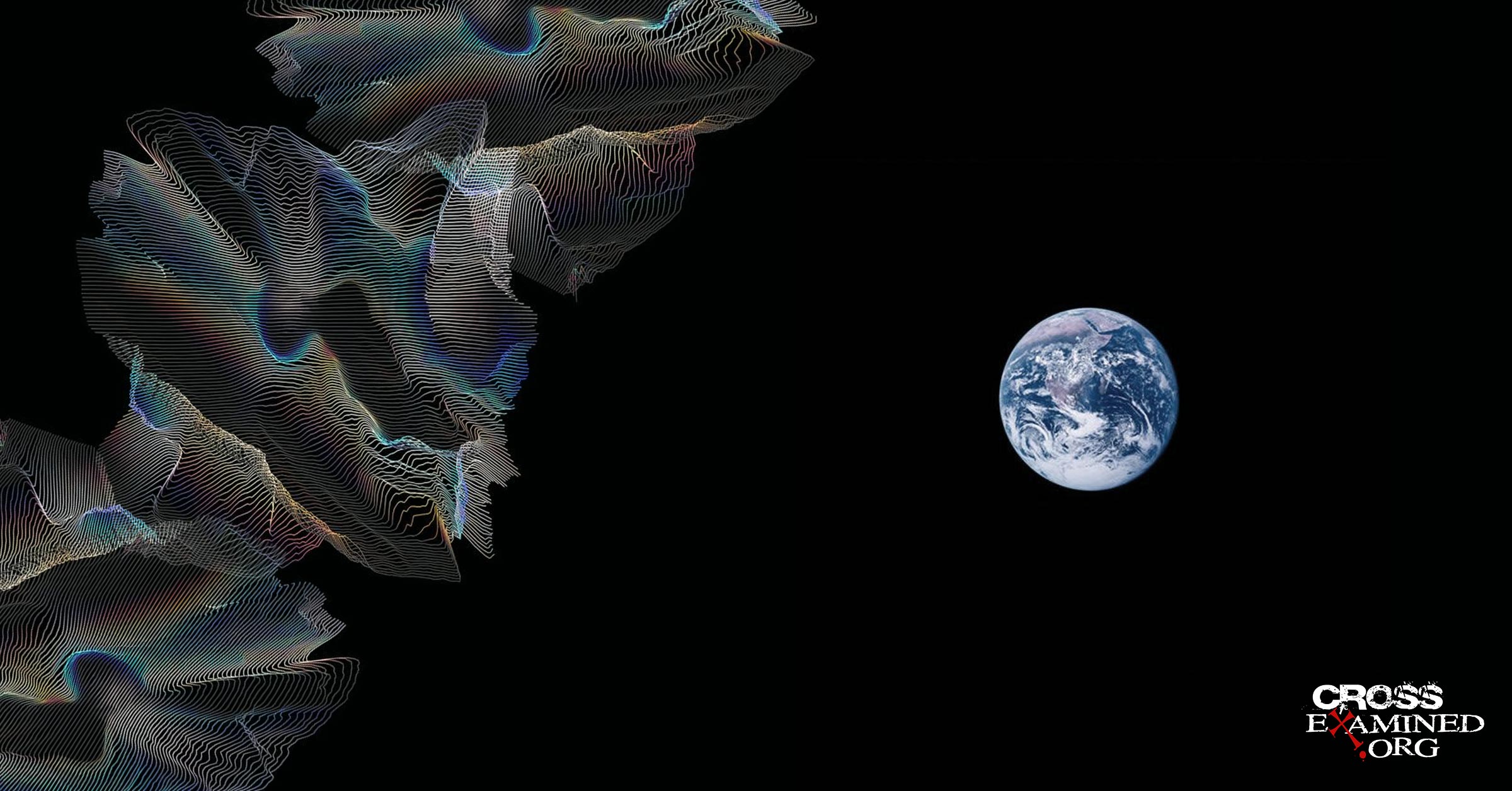
In his book Pale Blue Dot, the late astronomer Carl Sagan had this to say about the above photograph taken aboard Voyager I:

Because of the reflection of sunlight… Earth seems to be sitting in a beam of light as if there were some special significance to this small world. But it’s just an accident of geometry and optics… Our posturings, our imagined self-importance, the delusion that we have some privileged position in the Universe, are challenged by this point of pale light. Our planet is a lonely speck in the great enveloping cosmic dark. In our obscurity, in all this vastness, there is no hint that help will come from elsewhere to save us from ourselves.

Sagan reiterates what is commonly known as the Copernican Principle, or the Principle of Mediocrity. It’s the idea that earth and by extension human beings aren’t significant in the grand scheme of things. We’re just a random speck of dust revolving around an average star in the corner of an average galaxy.

Sagan was so confident of his view that he predicted the Milky Way galaxy probably contains as many as a million advanced civilizations. But is this a reasonable conclusion? I think it’s unlikely. In fact, the more we learn about the requirements for habitability, the less probable life in other places becomes. To demonstrate this claim, I want to highlight seven different habitability requirements — or habitable zones — that are necessary for advanced life to exist in the universe. As far as we know, the earth is the only planet to meet all the requirements.

The Right Kind Of Galaxy

The Right Kind Of Galaxy

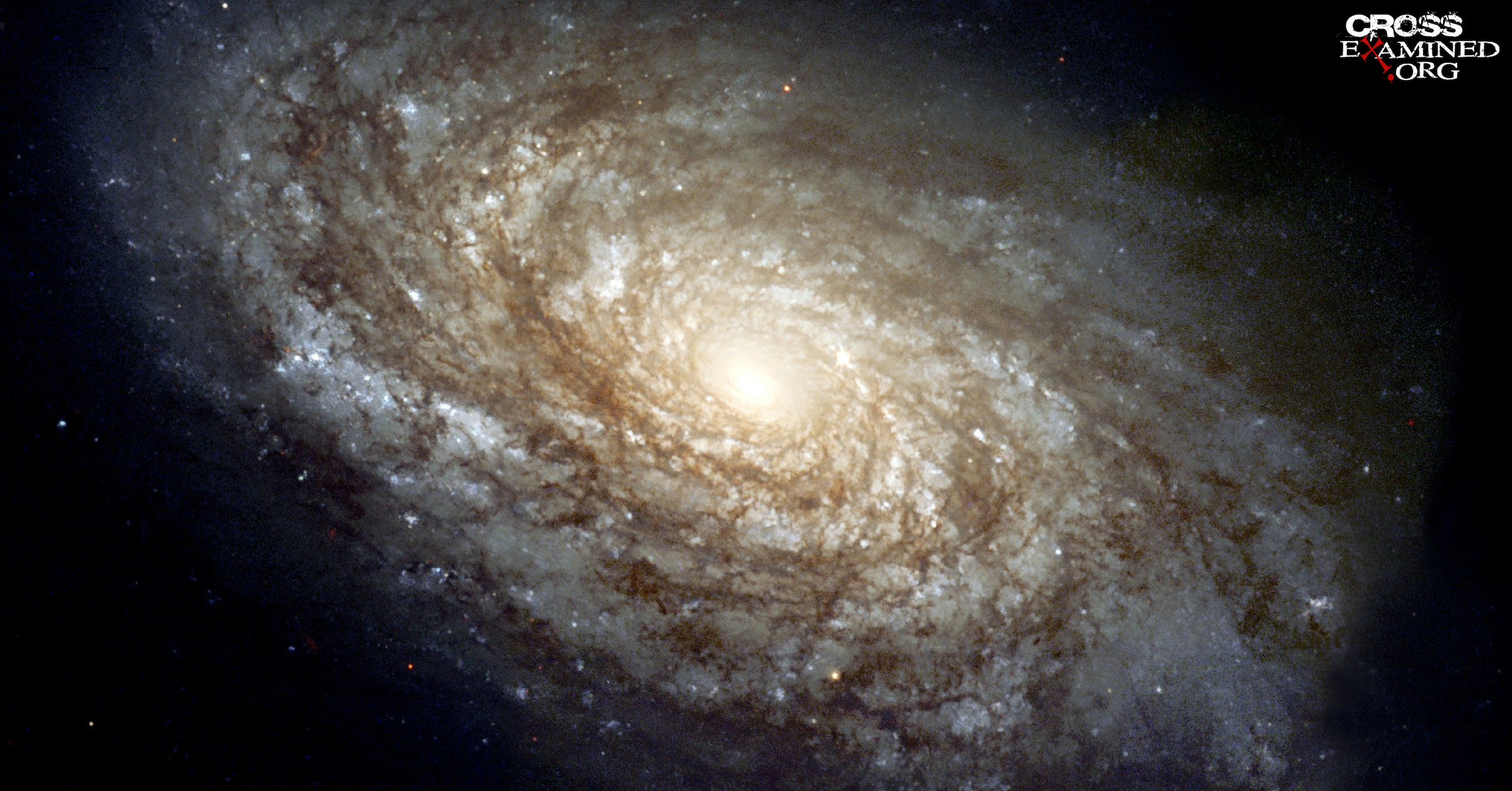
Astronomers have placed galaxies into three categories — spiral, elliptical, and irregular. Of these three, only spiral galaxies can support life. Elliptical galaxies contain mostly ancient stars that lack necessary resources — like heavy elements — that life needs. Additionally, because of the shape of elliptical galaxies, and the close proximity of the stars, stable planetary orbits are impossible.

Similarly, irregular galaxies lack the necessary qualities for habitability. For starters, their irregular shape leads to chaotic stellar and planetary orbits which result in planets colliding or brushing too closely to ultra-violet emitting stars. Additionally, large irregular galaxies possess active nuclei which spew too much deadly radiation for life to exist. Conversely, small irregular galaxies lack the necessary heavy elements for habitability.

Only spiral galaxies can support life. And not just any spiral galaxy, but one that possesses the right size and structure that can yield heavy elements and protect a host planet from deadly radiation and gravitational disruptions along the spiral arms. It just so happens that the Milky Way meets these necessary requirements.

The Right Location In That Galaxy

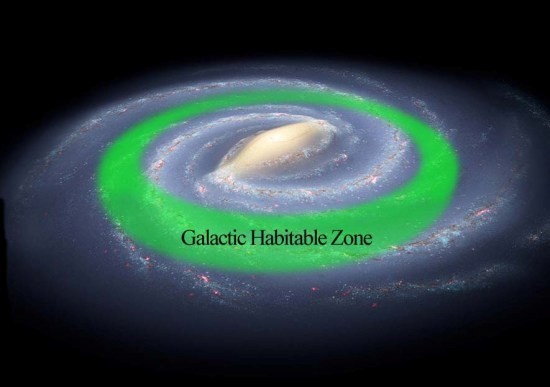
Not only is the right kind of spiral galaxy necessary for habitability, but the location inside that galaxy is also just as important. And that location is close to the mid-plane of the galaxy about halfway between the galactic nucleus and the external edge.

If the earth’s solar system was closer to the nucleus, it would face the onslaught of radiation and overwhelming gravitational force from the galactic black hole nucleus. Moreover, this territory inside the galactic habitable zone contains trillions of comets, which combined with the erratic gravitational forces would inevitably lead to several comet collisions and wipe out any existing population. Conversely, stars located towards the outer galactic edge can only host small terrestrial planets that are too small to retain an atmosphere or sustain plate tectonics.

This galactic habitable zone is usually represented by a thin ring that circles around the Milky Way galaxy. Only stars that land on this narrow ring can realistically sustain life. Furthermore, our solar system is located in a safe place between the Sagittarius and Perseus spiral arms. Spiral arms are dangerous places with fluctuating radiation and erratic orbits. And as many astronomers have pointed out, this relatively gas and dust free environment proves to be the ideal location for viewing the universe and making further discoveries.

The Right Kind Of Star

The Right Kind Of Star

In addition to being in the right location of the galaxy, the star must possess the right qualities to support life. Of the stars located in the galactic habitable zone, about 3 percent of them have the right qualities for any kind of life to survive. In fact, to emit a sufficient level of ultra-violet radiation, the host star must be virtually identical to the sun. Larger stars than our sun give off extreme variations of UV radiations, as do smaller stars than the sun. Our sun is also metal-rich compared to most stars making it possible to host planets like earth.

While it’s true that the sun is an average star (a yellow dwarf) as far as size goes, its average quality is essential for life. In addition to emitting erratic levels of UV radiation, larger stars burn their fuel faster and have shorter life spans — too short to host advanced life. On the other hand, smaller stars, like red dwarfs, give off such low levels of energy that a planet would have to orbit extremely close to it. This close proximity inevitably leads to tidal locking where one side of the planet bakes in unending misery while the opposite side remains frozen in perpetual darkness.

The Right Distance From The Star

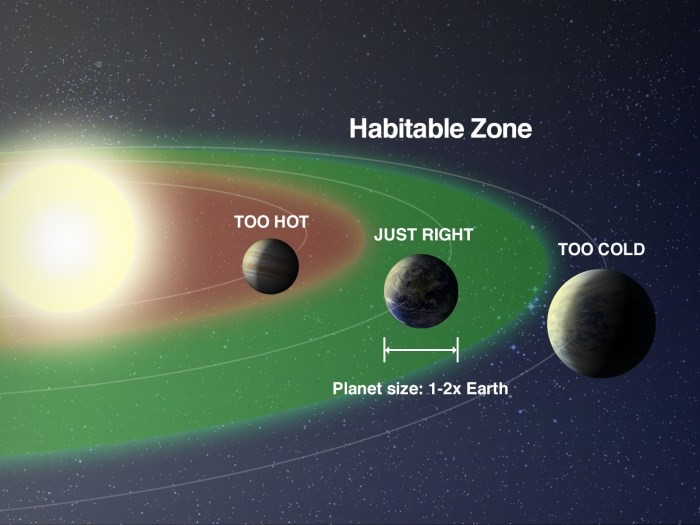
Next, for habitability to be possible, a planet must maintain liquid water. And this is only possible for planets that are the right distance from their host star. For example, if the earth were slightly closer to the sun, all water would evaporate. If it was slightly further away, all water would freeze. Furthermore, for water to remain, the planet must have the appropriate level of atmospheric pressure.

The planet must also receive the right amount of UV radiation, and much of this depends on its distance from that star. If it receives too little, vitamin D levels would be too low to produce strong bones, prevent cancer, and maintains healthy immune systems. On the flip side, if UV radiation were stronger, most if not all would suffer from skin cancer and bad eyesight.

Additionally, a planet must be the right distance from its host star for photosynthesis to occur. While some life-forms could exist without photosynthesis, large-bodied warm-blooded animals could not.

The proper distance also impacts its rotation rate. As I mentioned earlier, a planet that is close to its host star experiences tidal locking, meaning it does not rotate due to the intense gravitational force. This results in one side of the planet enduring an onslaught of heat and radiation while the opposite side remains perpetually in the cold dark. This kind of planet could not sustain life as it could not have liquid water. Conversely, if the earth rotated faster, we’d experience extreme temperatures and atmospheric winds that would make life virtually impossible.

The Right Kind Of Neighbors

While the other planets in our solar system aren’t suitable for life, they still serve a purpose in contributing to the earth’s own habitability. For starters, larger planets such as Jupiter and Saturn serve as earth’s bodyguards against comets or asteroid bombardments. Due to their size and relative force of gravity, these large gas giants act like giant vacuum cleaners for potentially dangerous collisions. Even smaller planets like Venus and Mars offer protection despite their limited gravity. Mars, for example, stands between us and an asteroid belt and has taken a few hits for us over the years.

Additionally, these other planets have contributed to important scientific discoveries. Johannes Kepler formulated his famous laws of planetary motion by observing these other planets. One of these discoveries was that planetary orbits are not circles but ellipses. And these discoveries served foundational for Newton’s laws of motion and gravity, which became the foundation for Einstein’s General Theory of Relativity.

The Right Kind Of Moon

Of the dozens of moons in our solar system, the moon if fifty times larger than any other moon compared to the mass of its host planet. Moreover, the moon orbits more closely to earth than any other large satellite yet discovered.

The size and proximity of the moon stabilize the earth’s rotation on its axis around 23.5 degrees. If the moon were smaller, like the Martian moons, the tilt would wobble about 30 degrees like Mars. The results of an unstable title would be catastrophic. If the North Pole, for example, were leaning more sunward during the summer, most of the Northern Hemisphere would experience months of scorching heat and perpetual daylight. Then in the winter months of the year, any survivors would experience extremely cold dark winters that would make Antarctica feel mild by comparison.

With no tilt, the earth would not experience seasons and rain distribution across the planet. The result would be large swaths of arid land uninhabitable for life.

It’s also worth noting that earth is the only place in our solar system where a perfect solar eclipse is possible. This phenomenon is possible because while the moon is four hundred times smaller than the sun, it is four hundred times closer making them both appear the exact same size from our vantage point. This phenomenon is highly coincidental if the earth is just a “pale blue dot.”

The Right Kind Of Planet

Finally, the right planet is also necessary for habitability. For example, life could not survive on a gas planet, but one made of rock. Additionally, this planet must have liquid water. But if the planet was perfectly smooth, the entire planet would be submerged in water. Fortunately, the earth has continents, mountain ranges, and valleys which allow for life to exist simultaneously with oceans and lakes. And this is made possible by plate tectonics. Yes, plate tectonics can be dangerous, but without them, life could not exist. And earth is the only planet in our solar system with plate tectonics.

A planet must also maintain a powerful, stable magnetic field. Without this protective fence, the earth’s atmosphere would eventually float away towards the sun making it impossible to sustain life. Of course, to maintain the right magnetic field requires the right internal composition of a rocky planet. Specifically, it requires a liquid iron outer core and a solid iron inner core.

Additionally, the planet must also have the right kind of atmosphere. In particular, the ozone shield is necessary for protecting a planet from receiving too much harmful radiation. Currently, earth’s ozone layer absorbs about 98 percent of the sun’s harmful UV radiation while allowing the beneficial radiation to pass through to earth’s surface. In this sense, the ozone layer acts as a shield or a type of sunscreen protecting us from too much of the sun’s radiation but allowing just enough beneficial for life.

Just A Pale Blue Dot?

So many are the requirements necessary for habitability that extraterrestrial life seems improbable. Back in the 1960s, when Sagan’s theory began to pick up steam, scientists launched the search for extraterrestrial intelligence (SETI). When the search began, scientists were convinced we would find advanced life on the moon or Mars. Now the search is more modest. They hope to find some kind of lower life form to an obscure moon orbiting Saturn that may or may not contain liquid water. In other words, the hundreds of millions of dollars invested in SETI have been spent to no avail.

Additionally, this search raises some important questions. If life really exists all over the universe, why haven’t they found us yet? After all, are we so conceited to think that we are the most advanced civilization? Surely, if millions of other civilizations exist, some of them would have greater capabilities than us.

Furthermore, good scientific theories are always falsifiable. But isn’t this theory unfalsifiable? At what point will those who say the universe is teeming with life say they were wrong? After sixty years of searching, they’re still saying, “Just give us more time. We’ll find it.” And they could keep saying it for a thousand years. In the end, the search for extraterrestrial life seems like a fools errand. So many are the conditions necessary for habitability. Earth appears to be pretty special after all.

Recommended resources related to the topic:

God’s Crime Scene: Cold-Case…Evidence for a Divinely Created Universe (Paperback), (Mp4 Download), and (DVD Set) by J. Warner Wallace

God’s Crime Scene: The Case for God’s Existence from the Appearance of Design (mp4 Download Set) by J. Warner Wallace 

God’s Crime Scene: The Case for God’s Existence from the Appearance of Design in Biology DVD Set by J. Warner Wallace 

What is God Like? Look to the Heavens by Dr. Frank Turek (DVD and Mp4

I Don’t Have Enough Faith to Be an Atheist (Paperback), and (Sermon) by Norman Geisler 


Ryan Leasure holds a Master of Arts from Furman University and a Masters of Divinity from the Southern Baptist Theological Seminary. Presently, he’s working on a Doctor of Ministry degree from the Southern Baptist Theological Seminary. He also serves as a pastor at Grace Bible Church in Moore, SC.

Original Blog Source: https://bit.ly/3e7HgtE

By Ryan Leasure

One of my favorite arguments for God’s existence is the Kalam Cosmological Argument. While this argument has historical roots, contemporary Christian philosopher William Lane Craig has popularized it more recently. The argument goes like this:

  1. Everything that begins to exist has a cause.
  2. The universe began to exist.
  3. Therefore, the universe has a cause.

This is a logically airtight argument. That is, if we can demonstrate that both premise (1) and (2) are true, the conclusion (3) necessarily follows as true. Let’s consider the premises in turn.

(1) Everything That Begins To Exist Has A Cause.

This first premise seems intuitively obvious. To reject it, one would have to posit that something can come from nothing. But that view has to be the height of absurdity. Nothing can’t produce anything. After all, our own experiences and scientific observations tell us that things just don’t pop into existence uncaused. None of us, for example, have ever experienced a new Corvette popping into existence in our driveways, as nice as that would be. Additionally, if things can pop into existence uncaused, then it remains inexplicable as to why this doesn’t happen all the time.

As one might imagine, most embrace this premise, although a few have sought to refute it over the years. Quentin Smith, for example, suggests that “the most reasonable belief is that we came from nothing, by nothing, and for nothing.”1 But I must confess, I’m not sure I understand how this is possible. How did we come from nothing? How did nothing have the capability of causing anything at all?

If prior to the existence of the universe, nothing existed – including space, time, matter, or God – how did the universe come to be? People, like Quentin Smith, must violate everything we know about the cause and effect relationship in our universe to adopt this position. Even the great skeptic David Hume once remarked, “I never asserted so absurd a proposition as that anything might arise without a cause.”2

To get around this metaphysical impossibility, skeptic Lawrence Krauss suggests that the universe came into being from nothing. But then he goes on to explain that “nothing” is really a quantum vacuum of fluctuating energy. And as many have already pointed out, Krauss equivocates on the word nothing. After all, a quantum vacuum of fluctuating energy isn’t no-thing. It’s something. One still needs to explain how this vacuum came to be.

Additionally, others have adopted the position that premise (1) is true for all things inside the universe, but it’s not necessarily true of the universe itself. The problem with this view is that it commits the taxicab fallacy. That is to say, it adopts the standard cause and effect principle when it’s convenient but then hops off — like one would a taxi — once it gets to its desired destination. Not only is this view logically inconsistent, it assumes that the causal principle is only true of the material world. But the cause and effect principle is a metaphysical principle, in that it’s true for all reality. Being cannot come from nonbeing.

Finally, the last objection to premise (1) usually comes in the form of a question: “Who caused God?” But this misunderstands the premise. The premise doesn’t state that “whatever exists has a cause.” Rather it states that “whatever begins to exist has a cause.” And theists have maintained that God has never had a beginning. He exists eternally by necessity. If he doesn’t, then he’s not God. This is what we mean when we say “God.” If he owes his existence to an external cause, that external cause would be God. So asking the question, “who caused God?” doesn’t help the skeptic get around premise (1). Theists have maintained for millennia now, that God is necessarily eternal. And to ask, “what caused him?” misunderstands our position.

(2) The Universe Began To Exist.

Since it’s difficult to disprove premise (1), many skeptics set their sights on premise (2) which asserts that the universe began to exist. In a previous post, I laid out scientific evidence which suggests the universe is not eternal. In this post, however, I want to focus on the philosophical reasons for rejecting a past-eternal universe.

To get around premise (2), the skeptic must maintain that the physical universe has existed for all eternity and has thus existed for an infinite number of moments. However, while we use infinity in mathematical or theoretical worlds, infinity, in reality, is impossible as it results in all sorts of logical absurdities.

Think, for example, about a meter stick that you divide in halves forever. Could you divide the meter stick in half an infinite number of times? How do you know the point at which you cross the threshold of a natural number to infinity? And if you reach infinity, isn’t it true that you could subdivide the meter stick one more time?

Perhaps the most famous example demonstrating the absurdity of infinity, in reality, is David Hilbert’s thought experiment — Hilbert’s Hotel. Hilbert told us to imagine a hotel with an infinite number of rooms. Additionally, he said to imagine that all the rooms are occupied so that not a single room is vacant. Now, suppose a guest comes to the check-in desk and asks for a room. The manager says, “yes, of course, you can have a room.” He then proceeds to move the person in room #1 to room #2, and the person in room #2 to room #3, and the person in room #3 to room #4, and so forth to infinity. He then takes the new guest and places them in the vacant room #1. But remember, before the guest showed up, the infinite number of rooms were already occupied.

Now, Hilbert says to suppose an infinite number of guests show up to a fully occupied hotel asking for a room. “Of course, the manager says.” He then proceeds to move the person in room #1 to room #2, and the person in room #2 to room #4, and the person in room #3 to room #6, and so forth to infinity, always putting the previous occupants in a room number twice their original one. Because all the former occupants now reside in even-numbered rooms, the infinite number of new guests all go into the odd-numbered rooms. Remember, though, before the infinite number of guests arrived, all the infinite number of rooms were occupied.

In the first example, we already had an infinite number of guests, but we were able to add one more. So, the equation would look something like this: infinity + 1 = infinity. In the second example, we had an infinite number of guests already staying in the hotel before adding another infinite number of guests. This equation would look like this: infinity + infinity = infinity. Despite adding a different amount to infinity in both equations, we still ended up with the same sum of infinity. The mathematical impossibility of such a hotel demonstrates the absurdity of an actual infinity in reality.

Consider another example. The medieval philosopher al-Ghazali asks us to imagine both Jupiter and Saturn orbiting the sun from eternity past. If for every time Saturn orbits the sun, Jupiter orbits it 2.5 times, which planet has orbited the sun more times? Well, if both planets have been orbiting from eternity past, the answer is that they’ve both orbited the sun the same amount — infinity. But doesn’t that seem absurd? In fact, we know that the higher the number of orbits, the greater the discrepancy that exists between the two. But if Saturn has orbited an infinite number of times, even though Jupiter has been orbiting 2.5 times for every Saturn orbit, they’ve both orbited the sun the same amount.

These illustrations help demonstrate that an actual infinite number, in reality, is impossible. And if an actual infinity is impossible, the universe could not exist for an infinite number of moments.

These absurdities raise another significant problem for the person who wants to reject premise (2). And that problem is that it’s impossible to traverse the infinite. Put another way; if the universe has existed for an infinite number of days, we could never arrive at today because that would mean infinity came to an end. But infinity can’t come to an end. That’s what it means to be infinity.

Or think about it another way. Before we can arrive at today, yesterday would have to occur, and the day before that, and the day before that, and so on to infinity. But how does one know when we’ve reached infinity in the past? There’s no point at which we could start counting the days backward to today. That would be like counting all the negative numbers from infinity back to zero.

Interestingly, many skeptics acknowledge our universe isn’t past eternal based on the scientific evidence. A lot of these same skeptics, however, attempt to get around this problem by suggesting an eternal multiverse. But the absurdity of infinity still applies to a multiverse. It’s impossible to traverse an infinite number of points in any physical universe, even one beyond our ability to detect. So, the skeptic still faces the same problem.

In sum, since it’s absurd to suggest that the universe has existed for an infinite number of moments, the universe must have begun to exist a finite time ago.

(3) Therefore, The Universe Has A Cause.

Since whatever begins to exist has a cause (1), and the universe began to exist (2), it follows necessarily that the universe has a cause (3). Based on this argument, what can we know about the nature of this cause?

First, whatever caused the universe must come from outside the universe itself. That is to say, it must transcend the natural world.

Meaning, this cause must be spaceless, timeless, and immaterial since space, time, and matter all came into existence at the beginning of the universe. Especially relevant to this argument is that the cause is timeless and, therefore, never had a beginning. Now, the skeptic might object that a past eternal cause faces the same dilemma of a past eternal universe. But he would be mistaken because the cause of the universe exists outside of, or independent of, time. That is to say, this cause existed in a timeless state and thus hasn’t traversed over an infinite number of points.

The cause must also be personal. We reach this conclusion based on the fact that there are only two possibilities for a spaceless, timeless, and immaterial entity — either an abstract object like a number or an unembodied mind. But abstract objects don’t possess causal power. They can’t do anything. This leaves a conscious mind who made a free will choice to create as the best explanation.

Finally, based on the size and complexity of our universe, this spaceless, timeless, immaterial, personal being must be all-powerful and extremely intelligent. And this being is what theists refer to as God.

Recommended resources related to the topic:

How Old is the Universe? (DVD), (Mp3), and (Mp4 Download) by Dr. Frank Turek 

God’s Crime Scene: Cold-Case…Evidence for a Divinely Created Universe (Paperback), (Mp4 Download), and (DVD Set) by J. Warner Wallace

God’s Crime Scene: The Case for God’s Existence from the Appearance of Design (mp4 Download Set) by J. Warner Wallace 

God’s Crime Scene: The Case for God’s Existence from the Appearance of Design in Biology DVD Set by J. Warner Wallace 

What is God Like? Look to the Heavens by Dr. Frank Turek (DVD and Mp4)


Ryan Leasure holds a Master of Arts from Furman University and a Masters of Divinity from the Southern Baptist Theological Seminary. Presently, he’s working on a Doctor of Ministry degree from the Southern Baptist Theological Seminary. He also serves as a pastor at Grace Bible Church in Moore, SC.

Original Blog Source: http://bit.ly/2SLyGqu

By Brian Chilton

Turn on the Discovery Channel or the Science Channel, and you may find interesting theories pertaining to how the universe came to be. Some propose that an eternal multiverse gave rise to our modern universe. Others will hold that eternal wiggling dimensions or planes collide to form universes. In 2003, three theoretical physicists discovered a theorem that dispelled the idea of an infinite regress of physical past eternal universes—infinite regress describes an eternal chain of events from the past. Arvind Borde, Alan Guth, and Alexander Vilenkin developed the theorem based on the well-established fact that anything traveling on a geodesic (shortest point between two points on a curvature) through space-time becomes what is known as redshifted (when light or electromagnetic radiation from an object is increased in wavelength, shifting to the red end of the spectrum, or moving away from the observer).[1] The physicists argue,

“Our argument shows that null and timelike geodesics are, in general, past-incomplete in inationary models, whether or not energy conditions hold, provided only that the averaged expansion condition > 0 holds along these past-directed geodesics. This is a stronger conclusion than the one arrived at in previous work in that we have shown under reasonable assumptions that almost all causal geodesics, when extended to the past of an arbitrary point, reach the boundary of the inating region of spacetime in a nite proper time (finite affine length, in the null case).”[2]

While the language is quite technical, the theorem provides three unintentional helps for the Christian theist.

  1. The BGV Theorem pinpoints the need for the beginning of our physical universe. First, the theorem agrees that our universe had a beginning. Ideas of an eternal, self-existing universe is growing quickly out of favor in the scientific community at least at this stage. Our universe, the laws of physics found in our universe, and time itself had a beginning at what scientists call the
  2. The BGV Theorem pinpoints the need for a beginning of all physical universe. The BGV theorem is especially helpful in noting that not only does our universe require a beginning point, but all physical universes require a singularity. Any physical universe including the theoretical multiverse must have an initial starting point. Thus, while it could be that a multiverse exists, a multiverse does not get around the need for a starting point which leads to the third point that needs to be considered.
  3. The BGV Theorem assists cosmological argumentation for God’s existence. The BGV theorem does not prove God’s existence. But, it does indicate the necessity for something beyond the scope of the physical world to account for the existence of any physical thing. Experimental particle physicist Michael Strauss argued,

“As an experimental physicist, I tend to draw conclusions based on what is known observationally and experimentally rather than on conjecture or speculation. So what are the facts about the origin of our universe? The equations of general relativity suggest that the universe had an actual beginning of space, time, matter, and energy and the BGV theorem along with the expansion of the universe would require that this universe had an actual beginning of the expansion.  Other ideas about the origin of the universe like those proposed by Lawrence Krauss or Sean Carroll do not have real scientific evidence to back them up. They are conjecture.”[3]

Oddly, while Christian theists are accused of holding no evidence for their beliefs, Strauss seems to indicate that the exact opposite holds true. Cosmological arguments like the Kalam are strengthened by the BGV theorem. With the BGV theorem and other mounting evidence supporting the claim, one holds good reasons for believing in a transcendent God who brought forth everything that exists into existence.

Notes

[1] Bruce L. Gordon and William A. Dembski, The Nature of Nature: Examining the Role of Naturalism in Science (Intercollegiate Studies Institute 2011), pg. 498.

[2] A. Borde, A. Guth, and A. Vilenkin, Inationary space-times are not past-completePhysicsReview 90 151301 (2003): 3.

[3] Michael Strauss, “The Significance of the BGV Theorem,” MichaelGStrauss.com (January 28, 2017) http://www.michaelgstrauss.com/2017/01/the-significance-of-bgv-theorem.html, retrieved October 15, 2018.


Brian G. Chilton is the founder of BellatorChristi.com and is the host of The Bellator Christi Podcast. He received his Master of Divinity in Theology from Liberty University (with high distinction); his Bachelor of Science in Religious Studies and Philosophy from Gardner-Webb University (with honors); and received certification in Christian Apologetics from Biola University. Brian is currently enrolled in the Ph.D. program in Theology and Apologetics at Liberty University and is a member of the Evangelical Theological Society. Brian has been in the ministry for over 15 years and serves as the Senior Pastor of Westfield Baptist Church in northwestern North Carolina.

Original Blog Source: http://bit.ly/2AOqMVM