Tag Archive for: atheism

By Luke Nix

Most of the time, I’m not too fond of using the term “religion”. I normally prefer to use “worldview” because it is more clear about what all a belief-system entails. However, for this post, I will use the term common for the question posed in the title: Can religion be tested for truth?

Many years ago, I would not have even thought to ask if religion can be tested for truth. I never thought much about it, because the obvious answer to me seemed to be “Yes”. Apparently, though, many people are questioning whether religion can be tested for truth today. Some even say that religion can’t be tested, thus such a term as “true religion” is an oxymoron. A common slogan that I hear is, “You can’t put God in a test tube”. I thought that I might take a few minutes to break this down and form some kind of defense for the idea that religion can be tested.

Just to get us started, I want to give a basic definition of “religion”. I want to go with “a series of beliefs and practices”. If we further define “beliefs”, we find that beliefs are a series of propositions about reality that one trusts accurately reflect reality. If someone were to say, “I believe A”, they are saying that they trust that A accurately reflects reality.

Some people have stated to me that a person can have a religion that has nothing to do with reality. I beg to differ. If a necessary part of religion is a trust that a proposition accurately reflects reality (belief), then religion must have something to do with reality. What’s really great about most religions of the world is that they tend to not just make claims about how we should live (practice), but they make claims about reality- propositions that are claimed to accurately reflect our world. This makes it quite easy to test the religions of the world for truth.

It seems to me, though, that people have forgotten that “religion” includes beliefs. They tend to think that “religion” is merely a series of practices or routines. In this context, the claim that religion cannot be tested for truth makes a little bit more sense…but not much. No, practices don’t have a direct “truth value”, but they do have a “moral value”, and “moral value” is determined by propositions about reality being true. The “truth value” of practices are indirect, but that is not to minimize their “truth value”. The “direct” vs. “indirect” distinction comes into play when we are trying to figure out the “truth value”. For beliefs, the “truth value” can be found directly by testing it against reality. To find the “truth value” of a practice, we must test the “truth value” of the beliefs that necessarily lead to the practice.

A while back, I wrote an article about right beliefs being required before right action (practices) can be performed (here). However, I think that I would have to adjust and nuance that position a bit. If one does not have the true beliefs, they can still perform right actions. However, I would say that right action is useless without right intention (which is derived also indirectly, from beliefs). Notice that I did not say that it is “wrong”, just “useless”. Of course, “useless” implies a purpose. So, if a religion posited no purpose, then practices could be neither useless nor useful- they would just “be”. Whether or not actions possess a “use value” depends upon purpose existing (a proposition that contains truth value), and that can be derived by testing the truth values of propositions of a religion that claims purpose does, in fact, exist.

That purpose exists, is not enough, though. We would need to determine what the purpose actually is before we could determine right intention, which would lead to useful action. Not only must an action be right, but it must also be useful to possess a positive truth value. It is possible to have a right action that is useless to the purpose.

In order for us to know that our actions are the true actions that we should be performing, we need to know if the basis of those actions accurately reflect reality. We can know if the bases are true by testing them against reality. If our bases (beliefs) do not accurately reflect reality, then we must adjust them to accurately reflect reality. When we have accurate beliefs that inform accurate practices, then we have an indication of the true or correct religion.

Any religion that makes claims about reality is subject to being tested. Whatever is responsible for this universe has (un?)wittingly handed itself to humanity in a test tube. If what is responsible for the universe is an intelligent Being, then It has given us the tools to discover It. We can even test the identity of the intelligent Being if different religions claim different things about the creation (reality) created by its intelligent Being. If there is no intelligent Being responsible for the universe, that is testable also. We just need to gather the claims about reality from the different religions and put them to the test.

Check out this post from Bill Pratt: Can Science Test for the Supernatural?*

This post from J.W. Wartick: Can We Evaluate Worldview? How to Navigate the Sea of Ideas

And this post from Wintery Knight: Ground Zero: Why truth matters for preventing another 9/11-style attack

Other Related Posts

Can We Be Good Without God?

Can You Trust Your Senses and Reasoning?

Nature vs. Scripture

Great Websites For Testing Christianity Against Reality

Reasons to Believe

Reasonable Faith

Risen Jesus

Stand to Reason

Apologetics 315

Notes

*Thanks to Greg West at The Poached Egg for finding this article.


Original Blog Source: http://bit.ly/2iCZxmL

By Luke Nix

The Ultimate Game of Chess

As a Christian, I come across many challenges to my worldview. Some challenges come from those in other worldviews; others come from other Christians. One of the most common challenges from outside is to God’s existence. One argument observes all the evil and suffering in the world and asks how a good God could allow it. Many Christians also struggle with this very issue. They know that God exists, but they see suffering in their own lives and wonder why God is allowing so much. Because of this, some question whether God is even there, or if they’re not willing to go that far if God is even good. This was articulated to me very clearly not too long ago: “The story of Job is just a chess game between God and Satan, and my life is no different.”

Dealing with Suffering

Before I get deep into how Christianity deals with suffering and evil in the world, I want to make one thing clear. Every worldview MUST deal with the existence of what we call “evil” or “suffering”. We cannot escape its existence simply by dismissing the existence of God; neither can we ignore the fact that suffering does exist. All worldviews are faced with this challenge and must offer a coherent explanation. I believe that it is only in the Christian worldview (properly understood) that suffering and evil makes sense.

Our Purpose And The Purpose of Suffering

If Christianity is true, God has created each individual with many purposes. One of those purposes is to become more like Christ. By this, we mean that we are to exhibit the fruits of the Spirit as listed in Galatians 5:22-23 (love, joy, peace, forbearance, kindness, goodness, faithfulness, gentleness and self-control). The more our hearts and lives reflect these, the more we will be like God. The more we are like God, the more personal and intimate we will be able to be with Him when we live with Him eternally (heaven).

If the man was already like all this, there would be no need for him to experience life. Yet we are not. Most people will recognize that going through tough times makes them stronger- they come out with more wisdom, patience or love. Many times we can be “on top of the world” and something will happen that forces us into a position of humility. Depending on the person, this is likely to be seen (down the road) as a positive experience that has increased their character. As parents, we guide our kids. Sometimes that guidance requires punishment, which can cause suffering. Kids also hurt themselves by doing certain things that we tell them not to. We tend not to see the consequences as “wrong” or “evil” because they are teaching the child something important about reality (such as gravity or blunt solid objects). We allow them to hurt themselves and even inflict a certain level of suffering on them to grow their understanding of the physical world and increase their character.

God is no different. Like a parent, He is more concerned with our character than our comfort. Our kids’ being mean and hateful to another child for their own gain does little to prepare them for adulthood. Likewise, our comfort here is not going to make us more like God. Our comfort here is not going to do anything good for us in eternity.

The challenge of evil and suffering from a non-believer tends to hold only if there is an inconsistency between a good God and evil. For the believer, the challenge tends to come from a personal experience that is incredibly painful. If a believer is going to spend eternity with God, it would be best for that person to become more like that God. Since man is not like God, it is good that God forms him to be that way. Since suffering is a way for God to develop a person’s character, then suffering is good. There is no incompatibility between a good God and suffering. It also follows that the suffering will develop the character to be more intimate with God in eternity.

What About Other People?

Now, I have been challenged on this response by both Christian and non-Christian. The challenge asks why other people must suffer in order for my character to be made more like God. The simple answer is that God is making them more like Him also. Their character is being molded at the same time that yours is. If God were to only develop the character of a single person per event, there would be MUCH more evil and suffering than there presently is. Imagine how many people are affected by a single sickness or loss of a job. God is not inefficient in His development of the character of people. The fact that a single event causes so many to suffer is evidence that God is minimizing the number of these events. If only one person suffered as the result of a particular event, many more of those events would have to occur to achieve the same amount of character development. God maximizes the impact of a single event so that more do not need to occur.

God’s History

I want to point out a few stories in scripture that show that God does not prevent suffering for His people. This is to show that what I have presented here is completely compatible with the Christian God. I also want to point out the attitude of those affected. This is to show those, who are going through suffering, the attitude that God’s people should have during the suffering.

The first example I wish to give is that of the three Hebrew children who refused to bow before the king’s statue. The king threatened to throw them into a furnace where they would be burned alive. Their attitude is recorded in Daniel 3:17-18 “If the God we serve exists, then He can rescue us from the furnace of blazing fire, and He can rescue us from the power of you, the king. But even if He does not rescue us, we want you as king to know that we will not serve your gods or worship the gold statue you set up.” Those familiar with the story know that the three were delivered. The attitude that they had was that they knew God had the power to deliver them and even prevent the suffering in the first place. They made clear that just because they knew that God could do not mean that He necessarily would– they were satisfied with whatever was God’s will when they obeyed Him.

For the second example, I want to look at the story specifically brought up at the beginning of this post- Job. We learn that Job lost all his family (save his wife), wealth, health, and his livelihood. His attitude is recorded in Job 1:21b “The Lord gave and the Lord has taken away. May the name of the Lord be praised”. After going through the profound discussions recorded in the book of Job, God restored him. We see countless testimonies of those who have found solace in suffering by reading Job’s story. God had a purpose for the suffering that Job went through. If the story of Job represents just a “game” and a nefarious and evil one, at that, then this evil game has had some pretty good consequences. If we are to acknowledge that God is in control and knows what He is doing (which is what Christianity affirms about God), then there was nothing evil about what happened to Job- God knew the good that would result. The preservation of Job’s story allows you to experience God’s comfort, but you have to willing to accept, as Job did, that the Lord has an ultimate plan for your suffering.

The final example I want to present is Jesus Christ Himself. Right before He was arrested to face trial and execution He prayed “Father, everything is possible for you. Please take this cup of suffering away from Me. Yet, I want your will, not mine.” (Mark 14:35) We all know that the “cup of suffering” was not taken away. Jesus was tried and crucified. His attitude was that even in the face of torture and death that the Father’s will be done. The greatest of all good was accomplished by this evil and suffering. The fact that I can even write this post to you explaining why God allows us to suffer is because of the fact that He did not withhold suffering from Jesus Christ. The suffering and death that Jesus experienced was the penalty that had to be paid so that we could even have the option to spend eternity with Him. Thus becoming more like Christ becomes important, and suffering has an ultimate purpose.

In all these examples, we see that God does not have a history of withholding suffering. He brought them through it. We also see people who knew for certain who their God is and what He is capable of. They knew that He had a purpose that goes far beyond their suffering at the time. They were willing to suffer for that purpose. Jesus was even willing to suffer for all humanity to have the option to live eternally in God’s presence and experience Him on a personal level.

Conclusion

To the atheist, I would be more likely to question God’s goodness if suffering did NOT exist in my life. I would also think that God’s use of suffering was gratuitous if fewer people were affected by the events in life. The fact that suffering does exist is powerful evidence that God exists, and the fact that a single event can have such a reach is evidence that this God is being quite care-full of how much is allowed. That care is further evidence of his love for us and desires to have a personal relationship with us. We just have to be willing to understand that the purpose of suffering is not evil, but good. When we realize this, we can understand the love behind the sacrifice that Jesus Christ made. I ask that you think carefully about this and consider dedicating your life to Jesus Christ and becoming more like Him.

To the Christian who is in much pain right now, there is much suffering that happens in all our lives. It is inevitable. I experience it; you experience it. Sometimes we will experience pain from the same event. How we deal with it depends on what we see as our purpose in life. If you believe that Christianity is true, you can take comfort in knowing that the suffering you are experiencing is to make you more patient, more humble, more loving, and much more. When these attributes characterize your heart, you will be able to experience God’s presence like never before, and you will be setting up to experience Him so much more deeply in eternity. God never desired for us to go through this life alone. That is why the Church exists. Many fellow Christians have gone through or are going through the same pain that you are. I ask that you seek these people out. Allow them to minister to you and let God comfort you through them. As Paul stated to the Romans (8:18) “I consider that the present suffering is not worth comparing to the glory that will be revealed in us”. The suffering is worth it. You just need to be willing to accept that God’s will in your experience is to make you and others around you more like Him.


Original Blog Source: http://bit.ly/2hrwlzd

By Evan Minton

In any debate or argument, it’s very important that you understand the terminology that your opponent is using and that your opponent understands the terminology that you’re using. If you don’t define your terms, you’ll just end up talking past each other and you’ll end up attacking straw men. As the philosopher, Voltaire put it: “Define your terms or we shall be like two ships passing in the night.”[1]

Often, you’ll hear atheists and anti-theists say things like “Christians don’t believe in science” or “Christians are anti-science!” or “You can believe in God or you can believe in science, but not both.” or “You can believe in The Bible or you can believe in science, but not both.” Atheists claim to be the champions of science and they deride Christians and Christianity for being opponents to science. But, in order to respond to the secularist’s claims, one has to ask a very important question: “What do you mean by that?” It’s one of the questions of The Colombo Tactic, a debate tactic talked about in Greg Koukl’s Tactics: A Game Plan For Discussing Your Christian Convictions. 

What do you mean by that? What do you mean by “science”? What definition are you ascribing to that term? Because how the secularist is defining “science” will determine whether or not I agree with his claims. In my experience debating atheists on the internet and in real life, I have found that “science” can mean many different things to many different people, and when they claim “Christianity and science don’t mix” or “God and Science don’t go together” or “You can believe in The Bible or believe in science, but not both”, while all of the atheists are using the same words and are phrasing their arguments the same way, they don’t actually all mean to convey the same message.

It is the object of this blog post to look at the various definitions of “science” and talk about whether or not Christianity (and Christians by extension) are truly “Anti-Science”.

Definition 1: Science = Science Is The Only Way To Know Truth. 

Some people confuse “science” with a philosophy called “scientism.” Scientism asserts that the only way to know what is true and what is not is through the scientific method. If you haven’t reached a conclusion through the scientific method, the conclusion can only be believed on blind faith or superstition. Scientism means that it can’t be known through science, it simply cannot be known.

If this is the definition of “science” that the skeptic says is incompatible with Christianity, then I would agree. Scientism and Christianity do not go hand in hand, for Christianity asserts that there are various roads to discovering the truth. For example, Romans 8:16 says that the way in which we know we are children of God is through the inner witness of The Holy Spirit. Hebrews 11:1 says “Now faith is confidence in what we hope for and assurance of things we do not see.”[2] We can know that we’re truly born again by The Holy Spirit witnessing to our hearts, telling us so. We can have confidence that God will always keep His promises by having faith in Him. Faith in Him is the evidence of what we do not see. What do we not see? His promises being fulfilled. We will see them in the future (e.g our entrance into Heaven because we placed our faith in Christ, Jesus’ return), but we don’t see them now. We trust that God will do what He says. Neither of these avenues to knowledge are through scientific means. The first is through spiritual, the second is through faith. One cannot be a Christian and believe that science is the only way to know truth.

On theological grounds, we must reject scientism. Since some atheists take scientism to be the same as science, they see a rejection of scientism as a rejection of science.

Of course, I would reject scientism even if I were not a Christian or even a theist at all. Why? Because the philosophy of scientism is logically self-refuting. A self-refuting claim is one that is refuted merely by asserting it. Such as examples would be “I can’t speak a word in English” spoken in English, or “My parents had no kids that lived” or “Everything I say is a lie”. If someone said to you “My parents had no kids that lived”, you would say “Well, that can’t be true. At least if they’re really your parents, since you’re alive.” If someone said “Everything I say is a lie”, you would know that if this statement is true, it’s false. If it’s true, at least one thing this person says is true, so not everything is a lie. But, if the statement is false, then it also isn’t true that everything he says is a lie since not everything he says is a lie. Either way, the statement cannot be affirmed without being undermined. If it’s true, it’s false, and if it’s false, it’s false.

Scientism is self-refuting in the same way. When someone says “Science is the only way to know truth”, I ask them “How did you come to that conclusion?” (another example of The Combo Tactic). How did you come to the conclusion that science is the only way to know truth? Did you come to that conclusion using the scientific method? How could the scientific method even be used to test that statement? What procedures would be involved in testing, scientifically, the claim “Truth can only be known through science”? The statement “Truth can only be known through science” is a philosophical statement, not a scientific one. It cannot be tested using the scientific method, and therefore, it collapses under its own criteria.

1: Truth can only be known through scientific testing.

2: Scientism cannot be known through scientific testing.

3: Therefore, scientism cannot be known.

For this reason alone, even atheists should reject scientism, at least if they want to remain logical. Are Christianity and Science opposites? Only if you’re using “science” as a synonym for “scientism”. But, by that definition, science and logic are opposites as well.

Definition 2: Science = An Old Earth and Darwinian Macro-Evolution 

I’ve come to learn that one big reason Christians are labeled anti-science, why Christianity is seen as being undermined by science, and why belief in God and belief in science are seen as incompatible, is because many Christians reject the scientific consensus regarding the age of the universe and the validity of Darwinian macroevolution. Being anti-evolution is seen as being anti-science.

Now, first of all, there are many, many Christians who accept the various dating methods and agree that the Earth is 4.5 billion years old and that the universe is around 14 billion years old.[3] There are also Christians who accept Darwin’s theory of large-scale evolution and believe that that was the process God used to bring about all of life.[4] Where I stand on this issue: I don’t know. I am definitely an old earther of some sorts.

So, even given this definition of “Science”, it would only follow that some Christians are anti-science, but certainly not all. On this definition of “science”, only a portion would be anti-science. This charge wouldn’t affect Francis Collins, Deborah Haarsma, N.T Wright, Peter Enns, or others. They would not be opposed to science under this definition of the word.

Would The Bible be opposed to science? Well, this would depend on whether concordism is true or whether accommodationism is true. Does The Bible actually intend to teach us how old the universe is and the precise method and order God brought everything into being? If The Bible’s goal isn’t to convey cosmology or biology to us, but instead used the scientific understanding of its initial recipients (ancient Jews) to get theological and moral truths across, then even if we find scientific nonsense in The Bible, that would be no grounds for disavowing biblical inerrancy or concluding that scripture isn’t inspired. So which is it, concordism or accomodationism? Richard Bushey wrote an article he wrote making the case that God never intended to teach His readers science: see “Why The Biblical Flat Earth Model Doesn’t Flatten Christianity”. 

For further reading, see “Hermeneutics 101 – Part 3: Understanding The Cultural Context”  and my blog post “Why Did God Write A Book?” 

There are many interpretations of Genesis that are compatible with an old earth and even evolution. For a treatment of The Day-Age View, I recommend reading Hugh Ross’ “A Matter Of Days”, for The Functional Ontological Interpretation of Genesis, read John Walton’s books “The Lost World Of Genesis One” and “The Lost World Of Adam and Eve”. Deborah and Loren Haarsma’s book “Origins: Christian Perspectives On Creation, Evolution, And Intelligent Design” is also a source I’d recommend.

Is God incompatible with evolution? No. Christians have always held that God can work through natural processes as well as through miracles. If a man goes into surgery, and people pray that the surgery goes well and it does, they don’t say “Well, God didn’t do it. It was the surgeon and his skills”. They would say something like “God guided the surgeons’ hands so that they wouldn’t screw up” or, if one is a Molinist, “God placed just these surgeons in these circumstances knowing that they would perform the surgery successfully”. For some reason, a lot of Christians just don’t apply that same reasoning to evolution. Evolution no more replaces God as an explanation for the existence of the animal kingdom than a vacuum replaces a maid as the explanation for why the floor is clean. Evolution doesn’t replace God as an explanation for why life exists any more than an oven replaces a chef as the explanation for how dinner was cooked. Evolution doesn’t replace God as an explanation for life any more than a surgeon replaces Him as an explanation for why a surgery went well.

Is evolution incompatible with the epistemological justification of God’s existence? I don’t see why that would be so. Biological design arguments aren’t the only arguments for God’s existence, you know. There’s The Kalam Cosmological ArgumentThe Cosmic Fine-Tuning Argument, The Local Fine-Tuning ArgumentThe Moral ArgumentThe Ontological Argument, The Argument From Desire, The Argument From Science’s DoabilityThe Transcendental Argument, and there’s plenty of historical evidence indicating that Jesus of Nazareth died on the cross and rose from the dead (see herehere, and here). All of these arguments are, in my judgment, sound, and none of them depend on the truth or falsehood of Darwin’s theory. One can concede evolution and all of these arguments would still need dealing with.

I’d like to point out though, that just because one is opposed to a scientific theory, that doesn’t mean one is anti-science. That would be like saying that because a Christian disagrees with a particular interpretation of a passage of The Bible that he’s therefore “Anti-Bible”.

Definition 3: Science as defined As Philosophical Naturalism.

If what one means by “science” is the philosophical worldview called Naturalism (i.e nothing exists but the natural, physical world), then Christianity is definitely incompatible and opposed to “science”. There’s no such thing as a naturalistic Christianity. Naturalism rules out anything supernatural, by definition. It doesn’t allow for God, angels, or demons, and since it doesn’t allow for God, it doesn’t allow for miracles, and since it doesn’t allow for miracles, it doesn’t allow for a bodily resurrection.

Christians, Christianity, The Bible, God, all of these are anti-science if science is used as a synonym for atheism.

Definition 4 and 5: Science = (A) Knowledge or a system of knowledge covering general truths or the operation of general laws especially as obtained and tested through scientific method. (B) Such knowledge or such a system of knowledge concerned with the physical world and its phenomena: natural science.

This is one of the definitions that Merriam-Webster’s dictionary gives. It defines science as “such knowledge or such a system of knowledge concerned with the physical world and its phenomena :natural science”[5]  Definitely not opposed to this. I speak for myself and many others when I say that learning things about the universe is a good thing. I am very pro-science under this definition of the word, and many other Christians are as well. Some Christians are scientists themselves. In fact, historically, the scientists who made the most groundbreaking discoveries and ergo were remembered for generations held to the Christian worldview. Do names such as Isaac Newton, Blaise Pascal, Michael Faraday, Robert Boyle, and Johannes Kepler ring a bell?  Modern day examples would include Francis Collins, who worked with the team that successfully mapped the human genome in its entirety. Under Marriam-Webster’s number 3, we can say that Christians are not anti-science. Christians have actually made great contributions to science.

I love learning science. I can’t get enough of it, to be honest with you. I initially dove into scientific research as part of my apologetics training (i.e to learn how to defend the Cosmological and Fine-Tuning Arguments), but as I learned more and more, I actually became interested in learning science for the sake of science itself. In fact, if I hope to some day buy all the seasons of How The Universe Works and Neil DeGrasse Tyson’s show Cosmos: A Space-Time Oddysee on DVD. I greatly enjoyed those programs.

I find the information in scientific books, journals, and TV programs fascinating. Not only that, but I consider it a form of worship. Jesus said to love God with all of our minds (Matthew 22:37). To learn how creation ticks is one way to pay this intellectual homage Jesus was talking about. When I hear scientists on TV talk about what goes on inside of a star, I cannot help but think “What an awesome God I serve! He made that!”. When I hear of astronomers describe the conditions on Saturn’s moon Titan, even if I never open my mouth, I at least inwardly praise God for making such a fascinating system. Even with evolution, If I fall off this fence I’ve been sitting on, I would say alongside Charles Kingsley, an Anglican Priest, and a friend of Darwin: “We knew of old that God was so wise that He could make all things; but behold, God is so much wiser than that, that He can make all things make themselves.”[6]  I believe God loves science, and I believe it makes Him happy the more we learn about this big, beautiful world He created. When the Higgs-Bozon (a.k.a The God Particle) was discovered, I saw a meme that was captioned “‘Hey scientists, thanks for finding my particle’ – God” and although it was intended to be humorous, I personally think it reflected the truth. When Higgs first predicted that such a particle existed, I can imagine the Father turning to The Son and saying giddily “This particle We created, they’re close to finding out about it!” I like to think of it as like a father giving his children a large jig-saw puzzle, then he sits back and watches in gladness as His children piece together more and more, getting a fuller picture the more pieces they successfully fit together.

When I use the word science, I never use definitions 1-3. I always use 4 and 5: “(A) Knowledge or a system of knowledge covering general truths or the operation of general laws especially as obtained and tested through scientific method. (B) Such knowledge or such a system of knowledge concerned with the physical world and its phenomena: natural science.” Christians, Christianity, The Bible, God, none of these are incompatible or opposed to science by these meanings of the word. And if you’ll click the link in Footnote number 5, I think you’ll find the Christian worldview isn’t incompatible with any of the other 3 definitions Marriam-Webster gives either. It is certainly incompatible with some of the definitions secularists often ascribe to it.

Conclusion

“Christians are opposed to science!”, “God and Science and mutually exclusive”, “You can believe The Bible or science, but not both.”. To my Christian readers, when you hear these statements, you need to first understand what they mean by the word “science”. Do they mean “Scientism”? Do they mean acceptance of an old earth and evolution? Do they mean it as a synonym for atheism? Or do they use it to mean an investigation into how the universe works? Depending on what they mean by it will determine what kind of response you should give. Not getting a definition out of them will likely result in you and the atheist talking past each other. Does he mean the same thing as you do when he says the word “science”? Find out. Ask the question “What do you mean by science?”

Footnotes 

[1] Or at least he’s been attributed as saying this. It is uncertain whether he ever did.

[2] I don’t believe that Hebrews 11:1 is teaching blind faith. Fideists will use the verse this way, but I really don’t think that’s what the verse is actually saying. For one thing, the context of this verse includes examples of people who had very strong evidence for God’s existence (e.g Abraham, Moses) and praises them for their great faith. Hebrews 11 is a sort of “Faith Hall Of Fame”. Faith is a synonym for trust. To have faith in God means to have trust in God. You can trust in God while having evidence for His existence. Inversely, you can have evidence for God’s existence and not trust Him at all (cf. James 2:19).

[3] Most of the Christian Apologists I’ve learned from over the years are Old Earth Creationists, such as Lee Strobel, William Lane Craig, Hugh Ross, Frank Turek, Norman Geisler, J. Warner Wallace, Sean McDowell, and Neil Mammen. While they reject evolution, they do agree that the universe and Earth are billions of years old, and would agree that young earth creationism defies sound science. For those interested in this position, I suggest Reasons.org. Also, see my blog posts on this on the “The Creation Controversy” page.

[4] These Christians call themselves Evolutionary Creationists. For those interested in investigating this position, I suggest BioLogos.org.

[5] https://www.merriam-webster.com/dictionary/science

[6] Charles Kingsley, The Natural Theology Of The Future, 1871


Original Blog Source: http://bit.ly/2yXQsPo

By Timothy Fox

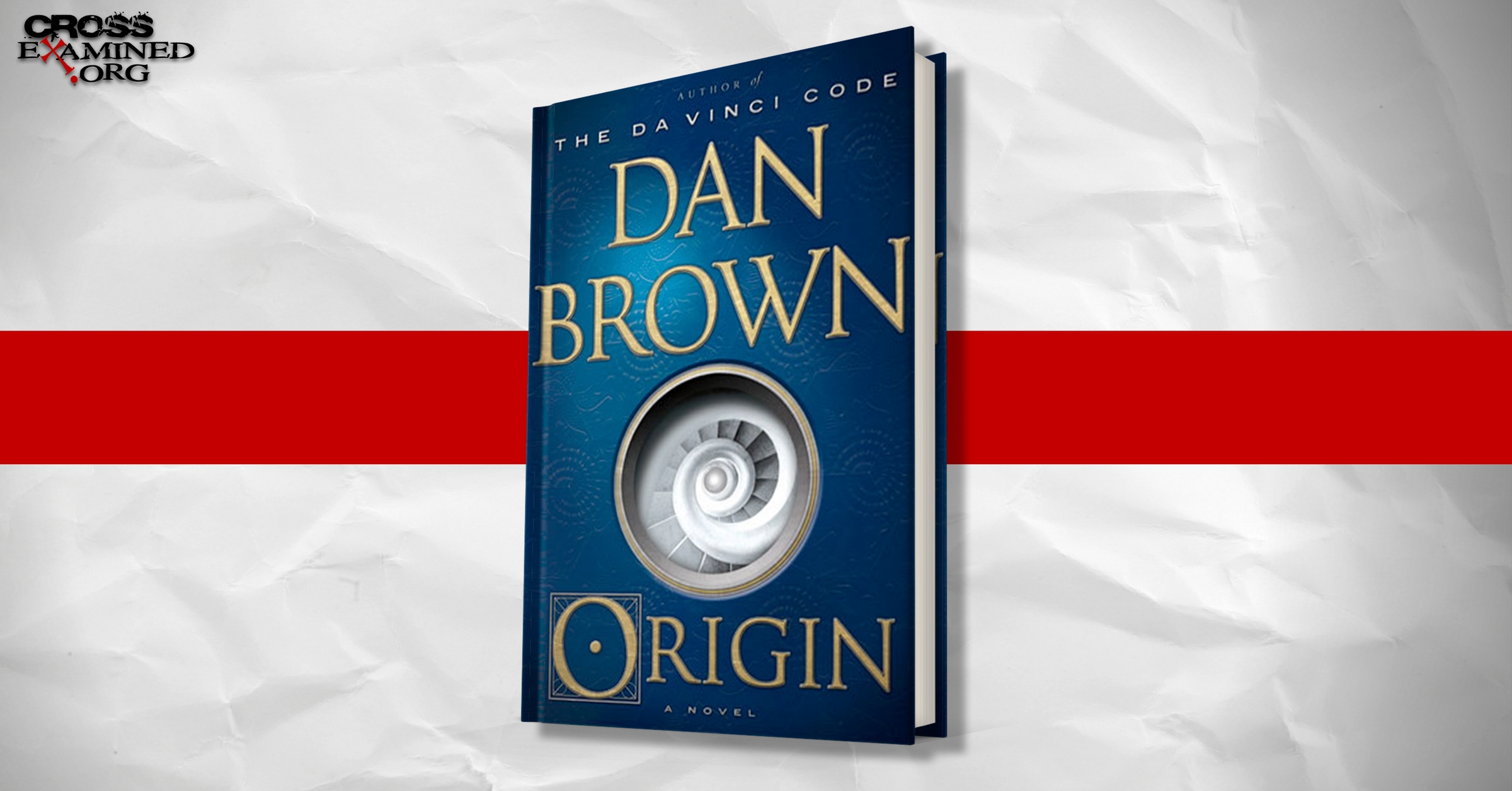
“Where do we come from?” and “Where are we going?” These are the two big questions Dan Brown explores in his latest novel, Origin (Doubleday, 2017). (Minor spoilers ahead.) This is the fifth book in the series starring Harvard professor, Robert Langdon, the most famous being The Da Vinci Code. While many of them have explored religion – mostly Christianity – his later books feature science more prominently. A major theme in this book, however, is science versus religion. Can science explain away the superstitions of religion, or even take the place of religion in people’s lives? This is the hope of computer scientist, Edmond Kirsch.

Kirsch is a vocal, New Atheist-type who would make Richard Dawkins proud. He believes he has made a discovery that will rock the major religions, answering two major questions that humanity has always pondered: “Where do we come from?” and “Where are we going?” Without getting too spoilery, Kirsch “proves” that life arose naturally on Earth without any supernatural intervention. Thus, he has squeezed God out of an explanatory gap, making his existence that much less necessary.

But that got me thinking. Suppose God really was unnecessary for the origin of life. After “Where do we come from?”, are there any other questions that science must answer to eradicate the need for God? I thought of a few:

Why is the universe here?

After Kirsch’s presentation showed that the laws of physics alone are sufficient for creating life, Professor Langdon ponders: “If the laws of physics are so powerful that they can create life… who created the laws?!” (p. 420). This question is huge. It’s one thing to explain where life came from. But what about the universe itself? Why is there something rather than nothing?[1] If life naturally arose from the primordial ooze, where did the ooze come from?

How did consciousness arise?

So Kirsch proved that life can naturally arise from non-life. But at what point in the evolutionary process did life become conscious? How does the mind form from purely naturalistic processes? What are the components of consciousness? Honestly, I think this is a far bigger (and more interesting) problem than the origin of life.

Is morality real?

On the news following Kirsh’s presentation, a viewer response reads “RELIGION CANNOT CLAIM MORALITY AS ITS OWN… I AM A GOOD PERSON BECAUSE I AM A GOOD PERSON! GOD HAS NOTHING TO DO WITH IT!” (p. 418 – emphasis and CAPS original). But if God has nothing to do with morality, then how do we define good and evil? Is there a real and objective moral standard that is binding upon all people across all time or is it merely a social construct?

Did Jesus Christ rise from the dead?

This goes beyond basic theism into Christianity. If Jesus did rise from the dead, we get a two-for-one: Christianity is true, and, thus, God exists. To kill Christianity, you must simply disprove the resurrection of Jesus Christ. So if Jesus did not rise from the dead, then:

  • How did the belief in the resurrection begin in Jerusalem, the same place where Jesus was publicly executed and then buried?
  • Why did many of Christ’s followers – including his disciples and former persecutor of Christians, Saul of Tarsus – claim to have a genuine experience of the risen Christ?
  • Why were these same followers willing to suffer and die for a belief they would have known was false?

Yes, Origin is just a fictional work that cannot possibly explore every question regarding God’s existence. But still, above are just a few that need to be fully explained before we can proclaim “God is dead.” Even if a real-life Edmond Kirsch can someday prove that life originated naturally on Earth, the universe still requires a First Cause that is outside of time and space. I’m highly skeptical that consciousness can arise naturally from matter. A moral law requires a Moral Lawgiver. And if Jesus Christ rose from the dead, it vindicated all of his teachings, including the authority of the Bible, the message of his followers, and, of course, the existence of God.

I’m sorry, Edmond, but God’s death has been greatly exaggerated.

Notes

[1] This is briefly addressed by a quote from Stephen Hawking: “It is not necessary to invoke God to set the universe going. Spontaneous creation is the reason there is something rather than nothing” (p. 418). But if the universe can spontaneously create itself, why not other things, like food in my refrigerator, money in my pocket, or hair on my head?


Original Blog Source: http://bit.ly/2z3WpuH

For the past three years I have been helping my father update his classic book Evidence that Demands a Verdict. There is no doubt that the evidence for Christianity has grown substantially since the book first released in 1972.

Since I have been working on this book people have been increasingly asking me, “What do you think is the most powerful evidence for the Christian faith?” While I do think the historical evidence for the resurrection of Jesus, the textual evidence for the reliability of the Bible, and the scientific evidence for a designer are persuasive, these are not the most powerful evidences.

So, what is it? At the beginning of Evidence, my father and are clear that we believe there is a more powerful apologetic—a clear, simple presentation of the claims of Christ and who he is, in the power of the Holy Spirit. Here is how my father explains it in the introduction:

For my (Josh’s) philosophical apologetics course at Talbot Theological Seminary, everyone had to write a paper on “The Best Defense of Christianity.” I found myself constantly putting it off and avoiding writing it, not because I didn’t have the material but because I felt I was at odds with what the professor was expecting (an expectation based on the ream of my lecture notes from his class).

Finally, I decided to voice my convictions. I began my paper with the sentence, “Some people say the best offense is a good defense, but I say to you that the best defense is a good offense.” I proceeded by explaining that I felt the best defense of Christianity is a “clear, simple presentation of the claims of Christ and who he is, in the power of the Holy Spirit.”

Then I wrote out the “Four Spiritual Laws” and recorded my testimony of how, on December 19, 1959, at 8:30 p.m., during my second year at the university, I placed my trust in Christ as Savior and Lord. I concluded the paper with a presentation of the evidence for the resurrection.

The professor must have agreed with my approach that the best defense of Christianity is a clear and compelling presentation of the gospel, for he gave me an A.

William Tyndale was right in saying that “a ploughboy with the Bible would know more of God that the most learned ecclesiastic who ignored it.” In other words, an Arkansas farm boy sharing the gospel can be more effective in the long run than a Harvard scholar with his intellectual arguments.

Although it may surprise some people, since my father is known for presenting “evidences” for the faith, he has always lived by this principle. I have seen him present the evidence for Christianity on countless occasions, but his goal is always to bring it back to the gospel. After all, it is the gospel that has the power to set people free.

We hope you enjoy the updated Evidence. But just remember: It’s not the evidence alonethat changes lives. Apologetics is one critical tool God can use to draw people to Him. We are to be ready with an answer for our faith (see 1 Peter 3:15). But when it is all said and done, the most powerful apologetic is a clear and compelling presentation of the gospel in the power of the Holy Spirit.


Sean McDowell, Ph.D. is a professor of Christian Apologetics at Biola University, best-selling author, popular speaker, part-time high school teacher, and the Resident Scholar for Summit Ministries, California. Follow him on Twitter: @sean_mcdowell and his blog: seanmcdowell.org.

By Al Serrato

Christians are all hypocrites!

How often do apologists for the faith encounter that objection? Yes, there are hypocrites in the church, at least in the sense that none of us can actually and fully live up to what the Christian faith commands.  But more significantly, hypocrisy isn’t about simply failing to live up to the rules; it’s about being duplicitous about it. It’s about celebrating the things we shouldn’t do, about not properly regretting the sins that we commit.  This prevalence of hypocrisy – and the recognition that it is wrong – are actually more consistent with the existence of God than with atheism.

Hypocrisy is not a modern phenomenon. Jesus himself condemned it repeatedly in addressing the religious leaders of his day. They sought power and influence by using their elevated status to suppress and burden people. I would venture to say that every culture in the world, and throughout all periods of time, has recognized, and reviled, hypocrites.  The root of the word provides some explanation: the Greek word from which it derives meant a “stage actor,” a person who is not what he appears to be.  In modern usage it carries, of course, a very negative connotation: “a person who pretends to have virtues, moral or religious beliefs, principles, etc., that he or she does not actually possess, especially a person whose actions belie stated beliefs” or “a person who feigns some desirable or publicly approved attitude, especially one whose private life, opinions, or statements belie his or her public statements.”

So, hypocrisy is not simply failing to live up to a set of expectations; that is inherent in human nature. No, hypocrisy involves something more calculated: a desire to exploit this feigned persona in order to accomplish some other purpose. It is, at its core, deception.

If secular humanism is true, and man is simply an accidental product of evolution, then it stands to reason that those traits which provide the most survival potential would be favored. The basis of hypocrisy is not difficult to understand. Like any form of deception, it confers an advantage on the one who employs it. By promoting virtue, but secretly not bound by it, the hypocrite can – at least in the short run – profit by his behavior. Virtue, of course, involves self-discipline and often self-denial. It is the process of saying no to what I want at present because I recognize that simply wanting it is not a sufficient reason, that competing interests are at stake that must be considered.  But why must they be considered? If the man is the measure of all things, and I am a man, why can I not decide that what is in my immediate best interest is what I should pursue?  Over time, shouldn’t it be the case that we would simply recognize that we all act in our own self-interest? There is, therefore, nothing to revile about hypocrisy, just as we don’t condemn the lion for devouring its prey. It is simply in the “nature” of things.

But virtue persists, as does the recognition that it is a better way – a more noble way – in which to live.  Virtue manifests itself in acts of self-sacrifice, altruism, and concern for others.  While these things tend to benefit a society, they confer little, if any, immediate reward to the one who does them. This, of course, is what makes such conduct virtuous, and worthy of our admiration and respect.  They are difficult to do.

Over time, then, the survival advantage hypocrisy provides should make hypocrisy a staple in society. And since it confers an advantage, it would be valued… and accepted as something that everyone does.  But that is not how we view it. Deep down, we know that such behavior is wrong and worthy of condemnation.  It is wrong because it is inconsistent with truth and honesty, and the way things “ought” to be. And if we are impacted by a hypocrite, we feel it viscerally. It makes us angry.

To borrow from CS Lewis, when we consider hypocrisy, it is hard not to see that it appears to be a law of behavior.  It is not a descriptive law, as in the law of gravity, which describes how a rock will fall if released from a height. It is instead a moral law – a law that says we should not act that way, that acting that way is “wrong” on a very basic level.

But natural selection cannot explain moral laws.  It may explain the evolution of preferences and opinions, perhaps, but not laws that all cultures and all people seem to intuitively recognize.  But if there is a God, by contrast, it begins to make sense. Having left his law written into the fabric of our minds, we should expect to have some sense of right and wrong.  Because this eternal God grounds truth in a transcendental and unchanging way, it makes sense too that this love of virtue is itself timeless and without boundary.

So, the next time you encounter the challenge, it might be worth reminding the skeptic where the hypocrisy challenge actually leads.


Original Blog Source: http://bit.ly/2wwunD6

By Natasha Crain

This weekend I had the wonderful opportunity to speak at the ReTHINK Student Apologetics Conference (there are more of these conferences coming—be sure to check out the link and learn about them!). I always enjoy talking to parents after speaking and this weekend was no exception. One thing I realized this time was that at every event where I’ve spoken in the last couple of years, there have been parents who share with me afterward that their child has recently said they no longer believe in God. Sometimes the kids are very young, other times they’re well into their adult years. But the question parents bring to me is always the same: “What should I say to them?”

After having a couple of long conversations with parents about this over the weekend, I wanted to write this post for others who may be struggling with the same thing. While this is, of course, a complex topic, these are 10 of the most important things I think you can say to a child of any age when they say they don’t believe in God anymore. For what it’s worth, this isn’t some kind of theoretical exercise for me. One of my own young kids periodically struggles with this because God can’t be physically seen. We have several of these conversations regularly.

  1. “Thank you for sharing this with me.”

There’s no doubt it sends panic into a Christian parent’s heart to hear the words, “I don’t believe in God anymore” or “I’m not sure if I believe in God anymore.” But how we respond to our child at a time of spiritual crisis (whether they consider it a crisis or not) is critical. If our reaction is fearful, angry, panicked or condemning, we quickly let our kids know that expressing their doubts is not OK. As parents, we need to be the safest place in our children’s lives to have conversations about God or they’ll find another place to go—likely a place where you wouldn’t want to find them.

Simply saying, “Thank you for sharing this with me” lets them know you are happy they came to you, that you want to talk with them about their feelings, and that expressing doubt in your home is welcome. To be clear, that doesn’t imply you’re happy about the doubt itself, but that you’re happy to be a safe place for these conversations.

  1. “How have you come to that conclusion?”

Because we love our kids so much and want to quickly bring them back to truth, there’s a temptation to immediately start offering a response with reasons to believe in God. But imagine for a moment that you go to the doctor when you don’t feel well and the doctor starts prescribing medicine for a wide range of illnesses without first asking you questions or running tests. That, of course, would be crazy. In the same way, if we don’t know the source of our kids’ doubts and how they’ve come to their conclusions about God, we can’t have meaningful conversations to specifically address their concerns. Use this question to get the conversation going and ask as many follow up questions as needed to be confident that you truly understand what has led them to doubt God’s existence.

  1. “How long have you felt this way?”

This is a helpful diagnostic question because it lets you know the depth of the doubt. In some cases, doubt comes as a knee jerk reaction to a specific event—for example, experiencing an unanswered prayer. When there is a single, proximate source of doubt, it can be easier to untangle because you can address that concern directly. However, if it turns out your child has been doubting for years and you simply didn’t know until the day he or she verbalized it, there’s much more history you’ll need to dig into.

  1. “If I could give you good evidence to show that God exists, would you want to be convinced He exists?”

This is another helpful diagnostic question because it gives you a window into the heart of your child. Sometimes doubt comes from not wanting to believe—and the reasons for not wanting to believe in God can be many. If a child says they wouldn’t want God to exist, it’s likely a sign that either 1) they have a misunderstanding of who God is (and wouldn’t want that God to exist), or 2) are engaged in behaviors they know aren’t godly and would rather live according to their own will. If a child admits that they wouldn’t want God to exist, the most important conversation you can have is getting to the bottom of why that’s the case. Only then will you know where to take the discussion next.

For those who do want God to exist but are doubting, go on to the next pieces of conversation.

  1. “Having doubt is normal and nothing to be ashamed of.”

One of the most difficult aspects of having doubt about our faith is feeling that we’re somehow abnormal—that if we experience doubt, we’re not a “real” Christian. But doubt is actually a normal part of faith. When we don’t have certainty about something, there is always room for doubt. For example, we can be confident that an airplane will safely deliver us to our destination, but we can’t be certain of that, so some doubt should necessarily exist. Even John the Baptist experienced doubt about Jesus being the Messiah when circumstances got tough and he was in prison (see Luke 7:18-30).

Sharing with your child that doubt is normal can put them at ease for further conversation. Rather than feeling something is wrong with them (or wrong with God!) because they’re doubting, they can feel hopeful that the doubt can be resolved.

  1. “Fortunately, God hasn’t left us to just guess whether or not He’s there. He’s given us plenty of evidence.”

If you haven’t had some deeper conversations about faith with your kids, there’s a good chance they’ve never heard the idea that there could actually be evidence for His existence. In the minds of many kids (and adults), believing in God is simply a blind choice—not something that is rooted in tangible evidence. Kids have to know this is not the case. Emphasize that they may not yet know the evidence, but that it exists and you want to lead them through it. This simultaneously takes the pressure off of them to make a decision about God they may have thought was rooted only in their own feelings and sets you up to suggest the following point.

  1. “Let’s study the evidence for God’s existence together.”

If you read the last point and thought, “That’s great, but I have no idea what to say…” have no fear. You don’t have to be a professional apologist (someone who knows how to make a case for and defend the truth of Christianity) to have this conversation. More than a lecture, kids need you to come alongside them.

There is an incredible new resource out this month to help you and your kids learn together. J. Warner Wallace and his wife Susie have released God’s Crime Scene for Kids, which is a book targeted at kids ages 8-12 and follows the topics of the adult book God’s Crime SceneIn the kids’ version, the Wallaces use a mystery around a box found in a grandmother’s attic to demonstrate how we can look at the evidence in the universe to draw conclusions about the existence of God. It’s engaging, clear, and unlike anything else available for this age group. There’s even a website with free videos and worksheets.

For what it’s worth, I had the opportunity to endorse it, which I enthusiastically did. Here’s what I said: “God’s Crime Scene is my go-to recommendation for anyone who wants to learn about the evidence for God’s existence. I was thrilled to hear that a kid’s version was coming out, but honestly wondered how Det. Wallace was going to translate some of the more challenging scientific and philosophical concepts into material for 8- to 12-year-olds. Now that I’ve read it, I’m blown away. This is brilliant! There’s nothing else like it, and I’ll be recommending it for years to come.”

If your kids are younger, the kids’ version would still be helpful for you to read and get ideas for how to talk about the evidence at your kids’ level. If your kids are older, they may already be ready to work through the adult version with you. If your kids are out of the house, they may not be willing to study anything together, but you can study and discuss with them as the opportunity arises.

  1. “If God didn’t exist, this is what reality would look like.”

In my experience with skeptics who have come to my blog over the years, many have dumped the idea of God without considering the necessary worldview implications of a world without Him—many of which run very contrary to our most basic intuitions. This led me to devote the final six chapters in Talking with Your Kids about God to helping parents show their kids “The Difference God Makes.” For example:

  • What is the meaning of life? (There is no objective meaning in a world without God.)
  • Do we really have free will? (There is little reason to believe we actually have free will in a world without God.)
  • What should we do with our lives? (There can be no should—no moral obligations—in a world without God.)
  • What is our responsibility to other people? (There are no objective responsibilities to others in a world without God.)
  • How should we make sense of evil? (There can be no objective right or wrong in a world without God—moral evil cannot exist.)

Why does biblical hope matter? (There is no ultimate hope in a world without God.)

When we show our kids the necessary implications of an atheistic world, it can help them see how the evidence for God is the best explanation for all the evidence we have.

  1. “What questions do you have about God?”

This is a question that should run alongside all the other points, and on an ongoing basis—whether your kids have doubts right now or not! The best way to avoid a spiritual crisis later is by facilitating conversations around kids’ questions regularly. For ideas on how to do incorporate an ongoing “questions night” in your family’s life, see my post How to Get Your Kids to Ask More Questions about Their Faith. As you work through the prior points with kids who are already doubting, more questions will surely arise. Make it a way of life to continually give them a forum for addressing whatever faith questions are on their mind.

  1. I love you and God loves you.

Ultimately, regardless of how all the prior conversations go, kids need to know we love them and that God loves them through their questions. In reality, some kids will struggle for years. But knowing that their doubts will never separate them from our love builds a relationship that will foster these important conversations for a lifetime.


Original Blog Source: http://bit.ly/2fHeLpC

By Brian Chilton

The psalmist David wrote, “The fool says in his heart, ‘There’s no God.’ They are corrupt; they do vile deeds. There is no one who does good” (Psalm 14:1, CSB). The psalmist claims that it is irrational for one to deny God’s existence whether it be by atheism or by alternative worldviews. Atheism has become popular in recent years. But, the pressing question is, why? Normally, people become atheists for four major reasons. I was influenced by some of these reasons to become a theist-leaning-agnostic for a period of time. While the atheist will claim to be a “free-thinker,” he or she is often imprisoned by emotionalism rather than reason.

  1. The person desires moral independence. Often the person who becomes an atheist or agnostic wishes to make one’s decisions without anyone telling them otherwise, including God. The person metaphorically wants one’s cake and to eat it, too. The person desires moral independence. One wants to have as much sex, take as many drugs, drink as much alcohol, make as much money (even if it hurts another), without any need for guilt. If there is no God, then the person is free to choose their own morals. By claiming that morality is up to the person, the person claims absolute independence.

Unfortunately for the skeptic, humans are built with a moral code within them. The moral law is transcendent. People realize it is wrong to hurt others unnecessarily. Ironically, the skeptic’s worldview collapses the moment he or she begins to speak about social justice. Social justice means nothing if there is no transcendent morality. Transcendent morality cannot exist if there is no transcendent reality known as God.

  1. The person holds emotive reasoning. That is to say, the skeptic bases one’s decisions on emotions rather than reason and logic. When God does not rescue them from a bad choice, the skeptic becomes angry with God and leaves the faith (if he or she was in an organized religion) or refuses to come to faith (if one was not part of an organized religion). Emotive thinking is especially found in the claim that a good, loving God cannot coexist with a created world full of evil (e.g., the claims of Neil deGrasse Tyson). The skeptic may have been hurt by Christians in church and desired to get back at them by becoming an atheist. The choice is based on emotion rather than reasoning.

The trouble with this mindset is that it does not always consider all the facts. As I have entered doctoral studies, I have read authors who eschew a person “flaming” others. Flaming is the act of blowing up emotionally and irrationally bombarding another without considering all the facts in the discussion, an act that has only increased in recent years. Alvin Plantinga, William Lane Craig, and many others have answered that a good, powerful, and loving God can coexist with a creation that is evil so long as such a God has good reasons for allowing it.

  1. The person desires global unity. That is, the person becomes an atheist, or at least agnostic because one does not want to tell a person of another faith that he or she is wrong. Some skeptics think that they can solve the world’s problems by holding that no religion is true, except their religion of atheism. The skeptic holds that their skepticism will unite people together globally rather than causing a divide. I am not a combative person. As such, this reason led me into agnosticism, at least to the idea that all religions could be true. People who hold this notion desire the love of people rather than the love of God.

Unfortunately, global unity is impossible as it pertains to religious views because all world religions and worldviews hold major differences. In addition, many have the notion that differences in religion cannot be discussed peacefully. However, if Christianity is true, then discussing these issues rise dramatically in importance. Unity should be sought by all believers, but it should not come by sacrificing truth. In reality, all worldviews hold major differences. Each worldview should be tested. It was my investigation and devotion to truth that God used to bring me back to faith. I then understood that Christianity holds good reasons for its authenticity.

  1. The person desires intellectual neutrality. As mentioned earlier, some do not test their beliefs. When the person’s beliefs are challenged, they are left without answers and hold that their previous worldview must not be true. This is the reason why many have left the church. Again, I had the same problem in the early 2000s. My faith was challenged by the Jesus Seminar. I had no way to answer their claims, thereby leaving me defenseless. None of my mentors could provide an answer to their claims. Thus, I naturally assumed that Christianity was false or at least deeply flawed.

A simple investigation using The Case for Christ by Lee Strobel and The New Evidence that Demands a Verdict by Josh McDowell launched me into the realm of Christian apologetics. I realized that Christianity does hold merit.

These are the four major reasons that individuals become atheists. Nearly all the reasons that people become skeptics are found in these four. Thankfully, answers are found in Jesus of Nazareth.

Video: William Lane Craig gives more reasons as to why people become atheists.

Check out Wintery Knight’s take on this issue and on the impact of these reasons upon former Christian, now an atheist, Dan Barker at http://bit.ly/2vqAnii


Brian Chilton is the founder of BellatorChristi.com and is the host of The Bellator Christi Podcast. He received his Master of Divinity in Theology from Liberty University (with high distinction); his Bachelor of Science in Religious Studies and Philosophy from Gardner-Webb University (with honors); and received certification in Christian Apologetics from Biola University. Brian is in the Ph.D. program in Theology and Apologetics at Liberty University. Brian is a full member of the International Society of Christian Apologetics and the Christian Apologetics Alliance. Brian has been in the ministry for over 14 years and serves as the pastor of Huntsville Baptist Church in Yadkinville, North Carolina.

Original Blog Source: http://bit.ly/2xI7Ftu

By Luke Nix

Introduction

A few years ago I listened to the podcast “The Word Nerds“. This podcast helped me gain an appreciation for the power of the English language. In my conversations with people, I have noticed the power of the words themselves. Using the wrong word can cause needless arguments; using a less specific word can cause confusion, and many other effects (I just checked Dictionary.com to make sure I used the right one there) come from using the wrong word.

In righting using the wrong word can cause the affect of people thanking your just dumb. How many times did you have to reread that last sentence before you figured out what I was trying to say? This is probably just more of a lazy-spelling issue, but I had to put it out their.

Defining terms is extremely important in conversations. In normal language, certain words have an accepted definition that is assumed based on the context. If these words did not exist, then you wouldn’t be able to read this post and understand it. However, many words have slightly different meanings to different people. Let’s take the word “period”. I can think of three different definitions right off the top of my head. Most of us can figure that one out pretty quickly.

Words in Debates

Now, let’s take the word “science”. How many definitions for this are you aware of? I pick this one because I was at a debate between William Dembski and Michael Ruse in 2009. The topic was “Is Intelligent Design Science?” I was quite perturbed to see that they were each defining “Intelligent Design” the same, but they were not defining “Science” the same. In order for such a debate to have been fruitful, all the terms in the question up for debate needed to be agreed upon. For example, using his own definition of “science”, Michael Ruse made a compelling case that could not be refuted- as long as William Dembski accepted Ruse’s definition; however, since Dembski did not accept Ruse’s definition, and instead used his own then Ruse’s position could easily be undermined. The same happend when Dembski used his definition of “science” and Ruse refuted him.

Let us examine a more recent debate: William Lane Craig vs. Sam Harris. One of the words that was not clearly defined and accepted by both participants was “objective”. Sam Harris clarified that he was only arguing for a “universal” morality (one that only exists as long as conscious minds exist- he’s referring to humans), while Craig was arguing for morality that exists regardless of whether or not conscious minds exist- he’s also referring to humans. The fact that they were each using different definitions of “objective” caused much confusion for those who did not pick up on the distinction or its significance for the debate (even though Craig pointed out both in his first rebuttal).

Since the purpose of debates is to convince based upon agreed upon information, neither debate accomplish what they had the potential to accomplish. The definitions of “science” (in the first example) and “objective” in the second needed to be debated and agreed upon before any questions containing the words could be debated.

This is quite important when one is discussing religious, political, and other worldview ideas with someone who is opposed. Words that some people take to be universally defined across all wordviews are in for a huge surprise. Many words are not. “God” means one thing to the Christian and means another to the Buddhist or Muslim (Craig mentioned this also in his debate with Harris, but the point was ignored). “Empirical” means one thing to the scientist and means another to the historian.

The Power of Words

Speech is one of the communication methods that God has endowed strictly upon the human race. Speech is performed through many languages which all have numerous words (English alone claims nearly one million words). The power of speech lies in its ability to portray the unseen and the unmeasurable, along with the seen and measurable. It is used to communicate our thoughts, visions, and emotions to other humans. Each word corresponds to something and everything has a corresponding word (for the most part). However, the relationship of words to “things” is not one-to-one. One word may have several definitions (take the word “set” in English; according to Dictionary.com it has 119 definitions), and one definition may correspond to several words (synonyms).

However, the real power of words comes not in just the basic definitions, but in:

  1. The contexts that they alone are used- such as “annihilate” vs “demolish”, synonyms of one another, but not usually used interchangeably. “Demolish” tends to refer to the destruction of a building, and “annihilation” tends to refer to the destruction of a foe or enemy (in philosophy and theology it has an even stronger implication of the cessation of existence).
  2. The level of emotion– “dislike” vs “hate”, synonyms of one another, but “hate” is stronger than “dislike”3. The precision of the description- “break” vs “shatter”, synonyms of one another, but “shatter” paints a more accurate picture of how an object disassembled than “break”
  3. The level of power– “mean” vs “ruthless”, synonyms of one another, but “ruthless” is stronger than “mean”
  4. Intentionality– “push” vs “shove”, synonyms of one another, but “shove” indicates a mischievous “push”6. Size– “hill” vs “mountain”, synonyms, but mountains are larger than hills and on, and on…

Precision of Communication

When precisely defined words are cleverly combined into phrases, sentences, and paragraphs, they can communicate something so vividly, that reader or listener will have a precise understanding in their mind of the concept that was in the mind of the communicator.

Speech has been given to humans to communicate with each other. Different studies have been conducted that have concluded that talking with someone about thoughts in the mind help that person emotionally- which can lead to a more healthy and productive life. With the words of our language, we can precisely describe to people what is on our minds, and they can understand it. The larger vocabulary one utilizes, the more precisely they can describe their inner-most feelings.

There are many books on communication, and how intimately it is related to one’s relationships with friends, family, co-workers, etc. Precise and honest communication allows for fewer “unknowns” between the speaker and the listener. As the level of “unknowns” decreases, the personal connection between the two becomes stronger. Strong communication leads to strong and trusting relationships.

More Words

Many of you already are aware that many times a word may not exist in your vocabulary (or even in the language) that describes precisely what you want to communicate. We are all aware of adjectives and adverbs- those little words that describe (or add precision) other words. As the words mentioned above, adjectives and adverbs have many levels and nuances that will assist us in our description of a specific word (and thus, our thought).

Of course, overuse of these can be really, really, really, really bad and do more to confuse the listener (or reader). That last sentence is almost painful to hear (or read). As you have already figured out, “devastating” could easily replace “really, really, really, really, bad”. Depending on my intended meaning of “bad” I could also have used “frustrating” or “confusing”. Notice, though, that each of those words have their own nuances. One may be chosen over the other, depending on the context.

Other times, thoughts exist that can’t be quickly communicated with a word and some descriptors. We have to futher qualify them with complete sentences. When this is necessary, don’t take the easy way out by ignoring it, just do it. Most questions that someone asks about your point of view will be a “clarifying” question. This is a good time to use these descriptive words to further clarify what you are attempting to communicate.

More Clarification Is Sometimes Necessary

The more precisely we can communicate our thoughts, the more likely we will be to have our point of view understood. Now, “understood” is not synonymous with “accepted” (notice that I specifically stated what “understood” does not mean).

I recently came across a very good example of this advice being taken. A couple years ago, I was working my way through the book “Thrilled to Death” by Archibald Hart. Hart uses the term “anhedonia” a lot because that is the primary topic of the book. At the beginning of the book Hart clearly defines “anhedonia”. He starts by making it clear that there is a “clinical” definition, but he is not using it in that strict sense. He then goes on to describe what exactly he means. This was provided as an answer to his peers who would notice immediately if he were using the word incorrectly. By providing an exact definition of his term, Hart avoided much confusion and possible dismissal of his ideas. In both debates referred to above, if such a courtesy were provided by both parties (it can’t just be one-sided), confusion could have been avoided. Instead, both proceeded with different definitions of their respective words, and debates that were already difficult to follow for some people just increased in difficulty level.

A while back I read the book “No Free Lunch” by William Dembski (chapter 4.9). In it he provided a critique of one of his views from a peer. He went through the critique and responded. (I checked for the other scholar’s further responses and found them here if you are curious). I was quite annoyed by this exchange. The glaring fact that both of them were trying to more specifically define their terms, while the other person complained that they were doing such a thing was unmistakable! We can’t expect to be able to specifically define our terms yet not allow someone else to do the same, and on the flip-side, we can’t demand that the other specifically define their terms while we do not reciprocate said demand.

Another example of this is in the scientific community of biologists. “Evolution” is a broad term. Some want it split into two different terms: “microevolution” and “macro-evolution”. Each one clearly defines a level of evolution in the biological realm. I think that this is quite useful because the separate terms allow scholars (and laymen) to know exactly which type the other is discussing and can engage with less ambiguity. I addressed this issue in more detail here. Sometimes it is necessary to create new words to communicate a newly discovered distinction.

Conclusion

To finally conclude this, words have objective meanings. The fact that they have multiple possible meanings indicates that defining terms is extremely important if we wish for our conversations and debates to be productive. If this is not allowed, then the risk of holding a “strawman” understanding of the other person’s view is increased. When “strawmen” are believed, frustration abounds for both sides. In the future, when someone asks us to clarify our terms, we should patiently oblige them. Most of the time, they are not trying to be devious, they are simply trying to understand. They also ask with the expectation that we are not being devious. We must not abuse language to the point of demanding a different term in the absence of a distinction in definitions, but on the other extreme, we must not demand the same term in the presence of a distinction in definitions.

Over the last several years, I have written many other posts on the importance of clear communication to help keep worldview discussions and debates productive. Here are some of the recommended ones:

Related Posts:

Is Theism Well-Defined Enough to be Scientifically Testable?

Atheism: A Lack of Belief in God

What Is Faith?

Is Faith Emotional or Logical?

Philosophy of Science, Circumstantial Evidence, and Creation

Deconstructionism, The Constitution, and Biblical Interpretation

The Difference Between What A View Asserts and Implies


Original Blog Source: http://bit.ly/2hB3RpP

By Aaron Brake

In Luke 13:1-5 we have Jesus’ clearest teaching on the problem of evil:[1]

Now there were some present at that time who told Jesus about the Galileans whose blood Pilate had mixed with their sacrifices. Jesus answered, “Do you think that these Galileans were worse sinners than all the other Galileans because they suffered this way? I tell you, no! But unless you repent, you too will all perish. Or those eighteen who died when the tower in Siloam fell on them—do you think they were more guilty than all the others living in Jerusalem? I tell you, no! But unless you repent, you too will all perish.

Not only is this Jesus’ clearest teaching on the problem of evil but we see Him addressing both moral and natural evil in His response. Notice that Jesus is first questioned regarding an example of what we would call moral evil: the murder of some Galileans by Pilate. In providing an answer, Jesus Himself introduces an example of natural evil: the falling of the tower of Siloam which killed eighteen.

How did Jesus answer the problem of evil presented to Him? His answer is short and to the point: “They weren’t worse sinners, they were just sinners. And unless you repent, you’ll die too.”

D.A. Carson in his book How Long, O Lord? provides several important insights into this passage. It would behoove us as Christians to reflect deeply on these points.

First, Jesus takes it for granted that the wages of sin is death (Rom. 6:23):

Jesus does not assume that those who suffered under Pilate, or those who were killed in the collapse of the tower, did not deserve their fate. Indeed, the fact that he can tell those contemporaries that unless they repent they too will perish shows that Jesus assumes that all death is in one way or another the result of sin, and therefore deserved.[2]

Second, because death is what we all deserve, it is only God’s mercy that keeps us alive:

Jesus does insist that death by such means is no evidence whatsoever that those who suffer in this way are any more wicked than those who escape such a fate. The assumption seems to be that all deserve to die. If some die under a barbarous governor, and others in a tragic accident, it is not more than they deserve. But that does not mean that others deserve any less. Rather, the implication is that it is only God’s mercy that has kept them alive. There is certainly no moral superiority on their part.[3]

Third, wars and natural disasters are always calls to repentance, and the fact that we question God’s goodness in times of calamity is a reflection of our own depravity and rebellion:

Jesus treats wars and natural disasters not as agenda items in a discussion of the mysterious ways of God, but as incentives to repentance. It is as if he is saying that God uses disaster as a megaphone to call attention to our guilt and destination, to the imminence of his righteous judgment if he sees no repentance. This is an argument developed at great length in Amos 4. Disaster is a call to repentance. Jesus might have added (as he does elsewhere) that peace and tranquility, which we do not deserve, show us God’s goodness and forbearance.

It is a mark of our lostness that we invert these two. We think we deserve the times of blessing and prosperity, and that the times of war and disaster are not only unfair but come perilously close to calling into question God’s goodness or his power—even, perhaps, his very existence. Jesus simply did not see it that way.[4]

Dr. Clay Jones in his class on Why God Allows Evil entertainingly replays the dialogue from Luke 13 like this:[5]

Questioner: Jesus, we have the problem of evil here, the great problem of the ages. People are being killed Jesus. What have you got to say?

Jesus: They weren’t worse sinners, they were just sinners, and unless you repent you’ll die too. Next?

Questioner: Whoa! Jesus, hold on for a minute here! This is the PROBLEM OF EVIL! The question of the ages! Philosophers have debated this forever! People are dying here Jesus! What have you got to say???

Jesus: They weren’t worse sinners, they were just sinners, and unless you repent you’ll die too. Next?

Questioner: No, Jesus, don’t you get it?!? Let me put it to you this way. You see, if God were all-loving, He would want to prevent evil. If God were all-powerful, He could prevent evil…

Jesus: They weren’t worse sinners, they were just sinners, and unless you repent you’ll die too. Next?

Jesus’ answer to the problem of evil is that all fallen, unregenerate sinners born in Adam are worthy of death. Whether we die by murder, accident, or disease isn’t anything more than we deserve. It is only by God’s grace that anyone is saved and it is only by God’s mercy that anyone is kept alive.

What implications does this have for Christian apologetics? At least three:

First, it means that Christian apologists need to take the consequences of sin and reality of human depravity seriously when addressing the problem of evil. Many Christians simply pay lip service to what the Bible has to say about these topics. It’s no wonder then we are often at a loss for words when someone asks, “Why do bad things happen to good people?” A completely biblical, though partial, rejoinder is this: no one is good but God alone! Bad things don’t happen to good people because no one is good. Jesus raised no qualms about our naturally born status as sinners before God, the universal corruption and guilt of humankind, or our need for repentance. He introduced these very issues Himself in addressing the problem of evil. He took it for granted that the wages of sin is death. Christian apologists should do likewise.

Second, when addressing the problem of evil, Christian apologists need to present a theodicy whichminimally includes the biblical teaching of original sin and human depravity. Why God allows evil won’t make sense unless we have the problem of sin clearly before us. J.I. Packer stated,

The subject of sin is vital knowledge…If you have not learned about sin, you cannot understand yourself, or your fellow-men, or the world you live in, or the Christian faith. And you will not be able to make head or tail of the Bible. For the Bible is an exposition of God’s answer to the problem of human sin and unless you have that problem clearly before you, you will keep missing the point of what it says.[6]

The same is true for the problem of evil. The subject of sin is essential because in raising the problem of evil, the skeptic must put forth an anthropodicy (justification of man) by arguing that man is “basically good” and God is unjust for allowing the suffering and evil He does. In response, the theist must show these assumptions to be false, and in their place put forth a theodicy (justification of God) which includes evidencing the depths of human depravity and arguing that God has morally sufficient reasons for allowing the evil that He does. Until we clearly articulate and defend the gravity of sin, as well as the universal corruption and guilt of humankind, many of our answers to the problem of evil will largely remain unpersuasive.[7]

Third, the present moral and natural evils we experience are appropriate segues into our need to practice and preach repentance in light of the final eschatological judgment. Those who experience such evils are not any more deserving. Rather, these disasters serve as warnings to all of us that finaldisaster awaits everyone who remains hardhearted and unrepentant:

So when disaster strikes, let us not wring our hands over the mysterious ways of God but encourage everyone to reflect on their sinful and doomed state in hopes that some will escape the Final Disaster that awaits the ultimately unrepentant.[8]

Notes

[1] I am indebted to Dr. Clay Jones for most of the material and insight presented here, as well as pointing me to the following passage by D.A. Carson.

[2] D.A. Carson, How Long, O Lord?: Reflections on Suffering and Evil (Grand Rapids, MI: Baker, 2006), 61.

[3] Ibid.

[4] Ibid.

[5] This is a loose reconstruction with some additions of my own.

[6] J.I. Packer, God’s Words, 71.

[7] For more on these first two points, I highly recommend reading Clay Jones, “We Don’t Take Human Evil Seriously so We Don’t Understand Why We Suffer” found at http://www.clayjones.net/wp-content/uploads/2011/06/Human-Evil-and-Suffering.pdf.

[8] Clay Jones, “Disaster Is Always a Call to Repentance!” found at http://www.clayjones.net/2011/11/disaster-is-always-a-call-to-repentance.


Original Blog Source: http://bit.ly/2fOEhK1