
Tag Archive for: apologetics

By Jonathan McLatchie

The principle of undesignedness was first identified by the famed Christian philosopher William Paley (1743-1805), in his book Horae Paulinae. Therein, he highlighted example after example of undesigned integrations between the epistles of Paul and the Acts of the Apostles. The principle of undesignedness refers to cases where two or more sources dovetail with each other in a manner that cannot be attributed to the design of the author. In 1850, J.J. Blunt published his book Undesigned Scriptural Coincidences, in which he took Paley’s argument further, documenting examples in the Old Testament, as well as between the gospels, and between the gospels, Acts, and Josephus. The principle of undesignedness is a forgotten but brilliant argument which can be used to corroborate Biblical history. In this article, I want to consider a few examples of undesigned coincidences in the Old Testament. In a subsequent article, I will discuss examples of undesigned coincidences in the New Testament.

Why Does Ahithophel Turn on David?

2 Samuel 15 details the story of King David’s son Absalom conspiring against his own Father. In verses 7-12, we read,

And at the end of four years Absalom said to the king, “Please let me go and pay my vow, which I have vowed to the Lord, in Hebron. For your servant vowed a vow while I lived at Geshur in Aram, saying, ‘If the Lord will indeed bring me back to Jerusalem, then I will offer worship to the Lord.’” The king said to him, “Go in peace.” So he arose and went to Hebron. But Absalom sent secret messengers throughout all the tribes of Israel, saying, “As soon as you hear the sound of the trumpet, then say, ‘Absalom is king at Hebron!’” With Absalom went two hundred men from Jerusalem who were invited guests, and they went in their innocence and knew nothing. And while Absalom was offering the sacrifices, he sent for Ahithophel the Gilonite, David’s counselor, from his city Giloh. And the conspiracy grew strong, and the people with Absalom kept increasing.

In verse 12, Absalom sends for Ahithophel, David’s counselor. Who is this man, Ahithophel? According to 2 Samuel 16:23:

Now in those days the counsel that Ahithophel gave was as if one consulted the word of God; so was all the counsel of Ahithophel esteemed, both by David and by Absalom.

Ahithophel, then, was the most trusted adviser to King David. Why, then, did Absalom count on Ahithophel to join him in conspiring against the King?

In 2 Samuel 23, in a completely unrelated part of the text, we have an important clue. Verses 24-39 list the thirty-seven body guards of King David. In verse 39, we have a familiar name – Uriah the Hittite, the husband of Bathsheba. Another individual mentioned is Eliam the son of Ahithophel the Gilonite (verse 34). This means that Ahithophel’s son was a colleague of Uriah the Hittite.

It gets even more interesting when we look over at 2 Samuel 11, in which we read of David’s adultery with Bathsheba and his murder of her husband, Uriah the Hittite. Here is what we read in verses 2-3:

It happened, late one afternoon, when David arose from his couch and was walking on the roof of the king’s house, that he saw from the roof a woman bathing; and the woman was very beautiful. And David sent and inquired about the woman. And one said, “Is not this Bathsheba, the daughter of Eliam, the wife of Uriah the Hittite?

Thus, it appears that Bathsheba was the granddaughter of Ahithophel, David’s counselor, and her father Eliam himself was among the King’s body guards along with Bathsheba’s husband Uriah. This then explains why Absalom in chapter 15 expected Ahithophel to be ready to conspire against King David and why Ahithophel joined Absalom’s rebellion. He wanted revenge on David for what he had done to Bathsheba and Uriah.

But it gets even more interesting. Flip over to chapter 16 and verses 20-22:

Then Absalom said to Ahithophel, “Give your counsel. What shall we do?” Ahithophel said to Absalom, “Go in to your father’s concubines, whom he has left to keep the house, and all Israel will hear that you have made yourself a stench to your father, and the hands of all who are with you will be strengthened.” So they pitched a tent for Absalom on the roof. And Absalom went in to his father’s concubines in the sight of all Israel.

Why do they pitch a tent for Absalom on the roof so that he can sleep with his father’s concubines? It was on the roof that David’s eye first caught Bathsheba bathing, resulting in his adulterous affair and his murder of her husband Uriah. Her grandfather Ahithophel then seeks revenge, and so encourages Absalom to sleep with his father’s concubines on the roof of the palace.

Now, note that it was only by putting together different, seemingly unrelated, parts of the text that we were able to arrive at these explanations. Nowhere in Scripture is it explicitly spelled out that Ahithophel was the grandfather of Bathsheba. Rather, one has to do detective work in order to see beneath the surface what exactly is going on here.

This is not the sort of pattern that one might expect in stories of myth and legend. Rather, it is the hallmark of truth.

Example #2: Hezekiah’s Treasury

For our second example, turn over to Isaiah 38, in which we read of King Hezekiah’s illness and recovery. In Isaiah 39, we have an account of envoys coming from Babylon to congratulate King Hezekiah on his recovery. There is a parallel account of those events in 2 Kings 20 which appear to be textually dependent on Isaiah (or vice versa). Here is the account in Isaiah 39:1-2:

At that time Merodach-baladan the son of Baladan, king of Babylon, sent envoys with letters and a present to Hezekiah, for he heard that he had been sick and had recovered. And Hezekiah welcomed them gladly. And he showed them his treasure house, the silver, the gold, the spices, the precious oil, his whole armory, all that was found in his storehouses. There was nothing in his house or in all his realm that Hezekiah did not show them.

Thus, we learn, King Hezekiah proudly showed the Babylonian envoys his great riches in his treasure house. Hezekiah’s pride brings upon him a prophecy of judgment. In verses 3-7, we read:

Then Isaiah the prophet came to King Hezekiah, and said to him, “What did these men say? And from where did they come to you?” Hezekiah said, “They have come to me from a far country, from Babylon.” He said, “What have they seen in your house?” Hezekiah answered, “They have seen all that is in my house. There is nothing in my storehouses that I did not show them.” Then Isaiah said to Hezekiah, “Hear the word of the Lord of hosts: Behold, the days are coming, when all that is in your house, and that which your fathers have stored up till this day, shall be carried to Babylon. Nothing shall be left, says the Lord. And some of your own sons, who will come from you, whom you will father, shall be taken away, and they shall be eunuchs in the palace of the king of Babylon.

King Hezekiah selfishly is relieved at the prophecy, thinking to himself that at least “There will be peace and security in my days” (verse 8).

Both the account of this event that we read in Isaiah and that in 2 Kings imply that Hezekiah fell ill at the time of the invasion by Sennacherib of Judah and before the outcome of that invasion. In both accounts, God promises Hezekiah that he will live and that God will deliver the city from the Assyrians (Isaiah 38:6; 2 Kings 20:6). Thus, the envoys arrived from Babylon after his recovery, and after the danger from Assyria had been averted.

Now let’s consider another text in 2 Kings 18:13-16:

In the fourteenth year of King Hezekiah, Sennacherib king of Assyria came up against all the fortified cities of Judah and took them. And Hezekiah king of Judah sent to the king of Assyria at Lachish, saying, “I have done wrong; withdraw from me. Whatever you impose on me I will bear.” And the king of Assyria required of Hezekiah king of Judah three hundred talents of silver and thirty talents of gold. And Hezekiah gave him all the silver that was found in the house of the Lord and in the treasuries of the king’s house. At that time Hezekiah stripped the gold from the doors of the temple of the Lord and from the doorposts that Hezekiah king of Judah had overlaid and gave it to the king of Assyria.

Wait a minute. So Hezekiah has just made this humiliating tribute to the king of Assyria, having had to offer him “all of the silver that was found in the house of the Lord and in the treasures of the king’s house” and even being reduced to stripping the gold from the doors of the temple and from the doorposts. How then was he able not long after this humiliation to show all of his riches of his treasury to the Babylonian envoys? One could write it off as a contradiction, or we could dig deeper to find the solution – and in so-doing uncover another remarkable undesigned coincidence.

For the solution, let us now turn to 2 Chronicles. 2 Chronicles contains the account of the destruction of Sennacherib’s army by the miraculous intervention of the angel of the Lord (which is also found in Isaiah and 2 Kings albeit in different wording and terminology from the account in 2 Chronicles). After these events, 2 Chronicles throws in a unique detail in 32:23:

And many brought gifts to the Lord to Jerusalem and precious things to Hezekiah king of Judah, so that he was exalted in the sight of all nations from that time onward.

Therein lies our answer. This explains how Hezekiah came to have a full treasury to show off to the Babylonian envoys by the time the Babylonians learned of his recovery. No mention is made of the humiliating tribute to the Assyrians in 2 Chronicles. 2 Kings does mention the humiliating tribute and him showing off his treasury shortly thereafter to the Babylonian envoys, but makes no mention of the gifts that replenished the treasury. Isaiah makes no mention of the tribute or the gifts but mentions his display of his great wealth.

This undesigned coincidence corroborates the historical veracity of these events and also strongly suggests that one of our authors (i.e. either Isaiah or the author of 2 Kings) had access to the court of Hezekiah, and thus knew about the visit of the Babylonian envoys.

Example #3: The Uniformity of Expressive Silence

Another sort of undesignedness can sometimes arise when we examine cases where information is assumed by the author although not explicitly spelled out – this may be called the uniformity of expressive silence – repeated omissions that have a meaning. Here, I give an example of this from the book of Genesis.

Genesis 24 narrates the story of Abraham’s servant’s journey to the city of Nahor in Mesopotamia in search of a wife for Isaac. He encounters “Rebekah, who was born to Bethuel the son of Milcah, the wife of Nahor, Abraham’s brother,” who “came out with her water jar on her shoulder.” Abraham’s servant requests a drink of water from the jar. Rebekah gives him some water and also some for his camels to drink. In verses 22-28, we read what happened next:

When the camels had finished drinking, the man took a gold ring weighing a half shekel, and two bracelets for her arms weighing ten gold shekels, and said, “Please tell me whose daughter you are. Is there room in your father’s house for us to spend the night?” She said to him, “I am the daughter of Bethuel the son of Milcah, whom she bore to Nahor.” She added, “We have plenty of both straw and fodder, and room to spend the night.” The man bowed his head and worshiped the Lord and said, “Blessed be the Lord, the God of my master Abraham, who has not forsaken his steadfast love and his faithfulness toward my master. As for me, the Lord has led me in the way to the house of my master’s kinsmen.” Then the young woman ran and told her mother’s household about these things.

The point to which I wish to draw attention is the consistent insignificance of Bethuel throughout the narrative. Bethuel was the father of Rebekah, and thus it is reasonable to expect that the terms of a marriage contract would be stipulated by him. Indeed, in the case of Laban in Genesis 29 in regards to his disposing of a daughter in marriage – a daughter who, like Rebecca, had brothers (see Genesis 31:1) – the active party throughout the account is the father, Laban.

Contrast this with the case of Bethuel in our current text in Genesis 24. Abraham’s servant had asked her, “Please tell me whose daughter you are. Is there room in your father’s house for us to spend the night?” (verse 23). We are then told, however, that “the young woman ran and told her mother’s household about these things,” (Genesis 24:28). Notice we are not told that she ran to her father’s household (as Rachel did in Genesis 29:12 after meeting Jacob), but rather she ran to her mother’s household. Verse 29 further informs us, “Rebekah had a brother whose name was Laban. Laban ran out toward the man, to the spring.”

After having been invited into the house by Laban, the servant explains the purpose of his visit (verses 34-49). In verse 50, we read, “Then Laban and Bethuel answered and said…” The mention of Bethuel constitutes the only proof that he was alive at the time of this incident. It is agreed that the servant may “take her and go, and let her be the wife of your master’s son, as the Lord has spoken” (verse 51).

The servant then gives gifts, we are told, “to Rebekah” and “to her brother and to her mother,” (verse 53). Curiously, no gifts are given to Bethuel, it would seem. In verse 55, we read, “Her brother and her mother said, ‘Let the young woman remain with us a while, at least ten days; after that she may go.’” It would seem expected that such a proposal would be made by her father. Instead, it is made by her mother and brother. After inquiring of Rebekah, it is decided that she would leave with the servant after all (verses 58-61).

Abraham’s son Isaac marries Rebekah, and together they have a son called Jacob (Genesis 25:26). After Jacob deceives his father Isaac into blessing him rather than Esau, the eldest (Genesis 27), Rebekah counsels Jacob to flee because Esau planned to kill him,  Along his journey, he encounters some shepherds and asks them “Do you know Laban the son of Nahor?” (Genesis 29:5). This is strange, because Laban was the son of Bethuel and only the grandson of Nahor. Yet, again, we see Bethuel passed over as an individual considered of no importance among his own family. Bethuel’s own son, therefore, is identified by the name of his grandfather rather than his father.

We cannot state the specific circumstances surrounding Bethuel or explain exactly why he was a man considered of no note. Who knows? Perhaps he was considered incapable of managing his own affairs due to age or imbecility. Whatever the reason, Scripture does not tell us. However, the lack of concurrence in a positive fact but silent presumption of that same fact suggests that the author knew something more than we do about the circumstances than he discloses in his account thereof. It is the sort of pattern we expect in real history, but not the sort of pattern we should expect from works of fiction.

Conclusion

Many further examples could be given in the Old Testament, but I hope that these three examples suffice to show how this argument can be wielded to corroborate Biblical history. In part 2, we will consider examples of undesigned coincidences in the New Testament.

Recommended resources related to the topic:

Stealing From God by Dr. Frank Turek (Book, 10-Part DVD Set, STUDENT Study Guide, TEACHER Study Guide)

How Philosophy Can Help Your Theology by Richard Howe (DVD Set, Mp3, and Mp4)   

_____________________________________________________________________________________________________________________________________________________

Dr. Jonathan McLatchie is a Christian writer, international speaker, and debater. He holds a Bachelor’s degree (with Honors) in forensic biology, a Masters’s (M.Res) degree in evolutionary biology, a second Master’s degree in medical and molecular bioscience, and a Ph.D. in evolutionary biology. Currently, he is an assistant professor of biology at Sattler College in Boston, Massachusetts. Dr. McLatchie is a contributor to various apologetics websites and is the founder of the Apologetics Academy (Apologetics-Academy.org), a ministry that seeks to equip and train Christians to persuasively defend the faith through regular online webinars, as well as assist Christians who are wrestling with doubts. Dr. McLatchie has participated in more than thirty moderated debates around the world with representatives of atheism, Islam, and other alternative worldview perspectives. He has spoken internationally in Europe, North America, and South Africa promoting an intelligent, reflective, and evidence-based Christian faith.

Original Blog Source: https://bit.ly/3PRQqMQ
Why believe in Christianity? Why believe that God exists? Aren’t there reasons NOT to believe in God? Reasons like:

  • Evolution
  • Evil
  • Divine hiddenness

For centuries, skeptics have disputed the claims of Christianity―such as the belief in an eternal God and the resurrection of Jesus Christ―arguing that they simply cannot be accepted by reasonable individuals. Furthermore, efforts to demonstrate the evidence and rational basis for Christianity through apologetics are often deemed too simplistic to be taken seriously in intellectual circles. And miracles? Ha! They’ll say anything is more probable than a miracle, even the idea that Jesus had an identical twin!

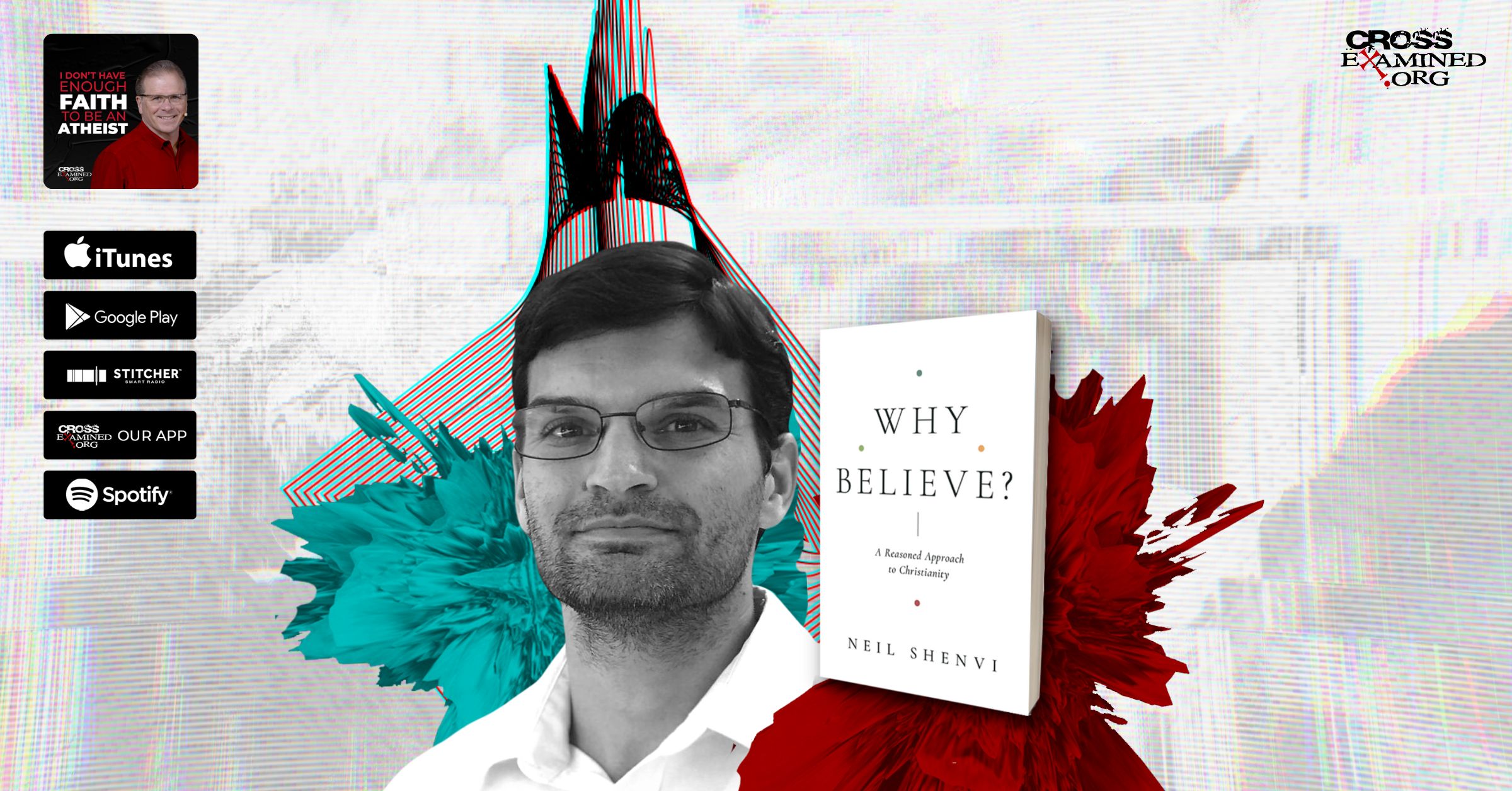
In his new book, Why Believe: A Reasoned Approach to Christianity, apologist and theoretical chemist turned homeschool dad, Dr. Neil Shenvi, engages in some of the best contemporary arguments against Christianity. He presents compelling evidence for the identity of Jesus as portrayed in the Gospels, his death and resurrection, the existence of God, and the unique message of the gospel. As you’ll discover in this podcast episode, Neil is no “uneducated Christian” and responds to some of the most common objections to Christianity with precision, clarity, and grace.

Neil also talks with Frank about his college days at UC Berkeley and Princeton, where he came to faith during a class nicknamed “The Faith Buster,” taught using Bart Ehrman’s textbook and other liberal religious scholarship. Talk about a miracle; you won’t believe his testimony!

Neil’s website: https://shenviapologetics.com/
Follow Neil on Twitter: https://twitter.com/NeilShenvi

If you would like to submit a question to be answered on the show, please email your question to Hello@Crossexamined.org.

Subscribe on Apple Podcast: http://bit.ly/CrossExamined_Podcast Rate and review! Thanks!!!
Subscribe on Google Play: https://cutt.ly/0E2eua9
Subscribe on Spotify: http://bit.ly/CrossExaminedOfficial_Podcast
Subscribe on Stitcher: http://bit.ly/CE_Podcast_Stitcher


Download Transcript


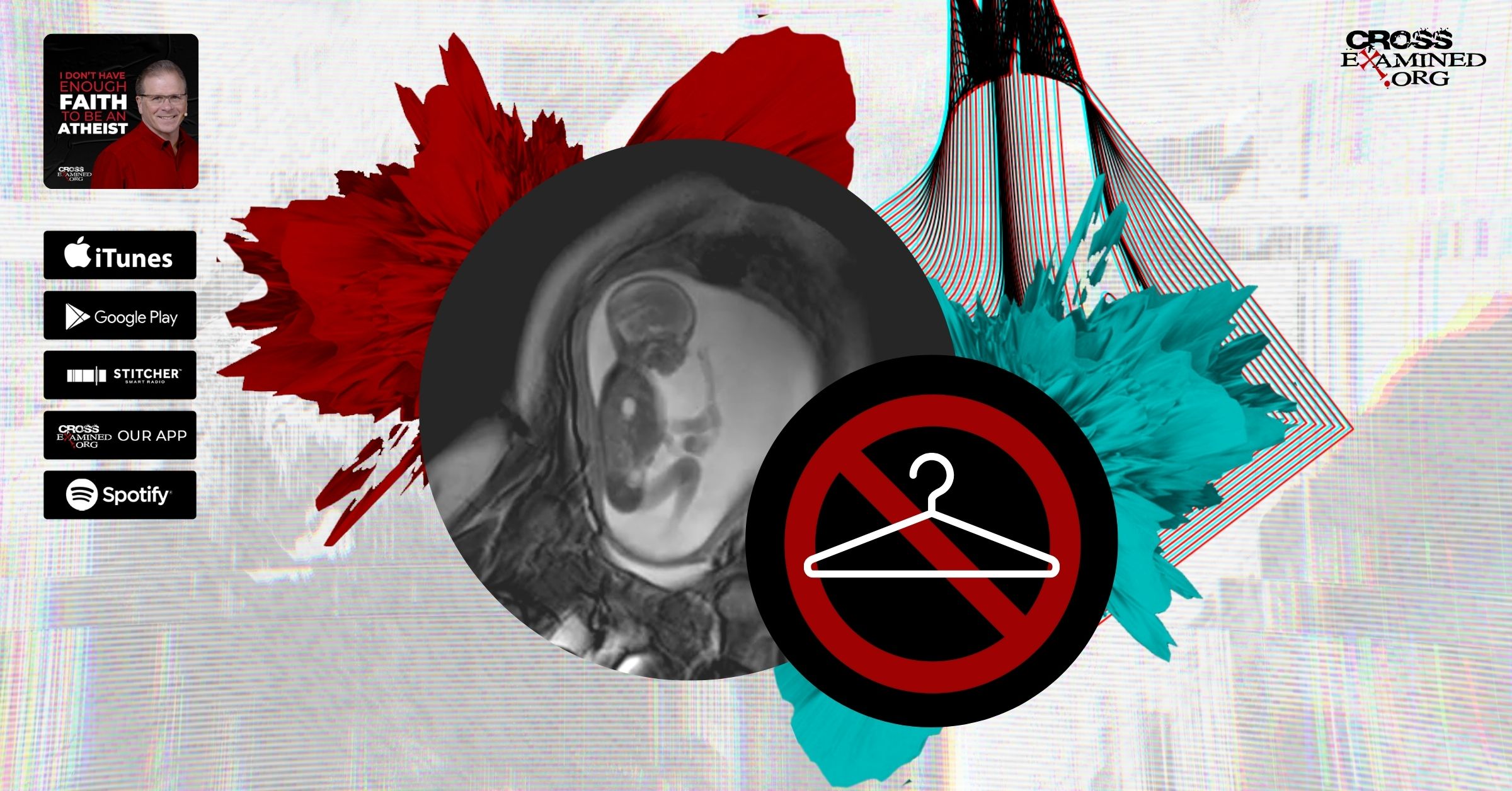
If God made humans in His image, does that also mean we have the right to “play God” whenever we want? Many atheists and pro-choice advocates criticize God’s morality when He (ironically) “plays” God by taking life prematurely in the Old Testament. But they don’t bat an eye when advocating for abortion and call it a “moral right.” It doesn’t make sense! However, what about capital punishment? It seems like pro-lifers who support the death penalty are also contradicting themselves. What’s the difference?

In this episode of ‘I Don’t Have Enough Faith to Be An Atheist’, Frank continues the discussion from last week on how to answer some of the most common abortion arguments, including a discussion on Numbers 5:27-28, which many people mistakenly cite as an example that God is not pro-life, and the important difference between vaccines and abortions when people declare “my body, my choice”!

Frank also answers listener questions, including those on Mormonism, near-death experiences (NDEs), and whether or not it’s a good idea to use fictional and unbiblical stories as a bridge to the Gospel.

If you would like to submit a question to be answered on the show, please email your question to Hello@Crossexamined.org.

Subscribe on Apple Podcast: http://bit.ly/CrossExamined_Podcast Rate and review! Thanks!!!
Subscribe on Google Play: https://cutt.ly/0E2eua9
Subscribe on Spotify: http://bit.ly/CrossExaminedOfficial_Podcast
Subscribe on Stitcher: http://bit.ly/CE_Podcast_Stitcher


Download Transcript


By Brian Chilton

Recently, Curtis Evelo (Bellator Christi Podcast co-host) told me about a conversation he had with an individual about biblical interpretation. Apparently, the individual held that the wine that Jesus miraculously brought forth out of water in John 4 was merely unfermented grape juice. When asked why he held this view, he contended that to hold that the wine held fermented content was to argue that Jesus was a sinner because wine is said to be a mocker in Proverbs 20:1. Curtis asked him what this had to do with Jesus’s miraculous transformation of water into wine. The unnamed individual then said that he used the law of first mention. According to the law of first mention, the interpreter first examines the initial place where the term or doctrine is taught in the Scripture. Then, the initial usage of the term and/or doctrine serves as a guideline for interpreting other subsequent passages that teach on the issue.

Let me first say that in all my biblical hermeneutics courses, I have never heard of the law of first mention. I have had some world-class instructors who can read the Bible in its original languages without a translation in hand. To my knowledge, they never mentioned such a law of biblical interpretation. There is simply no good reason to follow the law of first mention for the following reasons. As an aside, the issue concerning the Christian’s use of alcohol is a highly controversial topic. We simply do not have space to deal with the ethical ramifications of alcohol use. For the purposes of this article, we are merely examining the efficacy of the law of first mention, or the lack thereof.

The Law of First Mention Fails to Engage the Individual Text

The first problem with the law of first mention is that the tactic fails to consider the literal interpretation of each biblical text. Considering the topic at hand, earlier texts really do nothing to assist the interpreter with engaging whether a historical event occurred or not. Earlier teachings may assist with understanding the thought process behind a text in question. But it cannot overrule other factors such as social practice and norms, extra-biblical historical events, word studies, and other social matters that come into play. Furthermore, the historical context of the first mention must also be an issue of investigation, as one must remember that the modern interpreter is separated from the biblical times by at least 2,000 years—more like 4–6,000 years from the Old Testament eras. Additionally, the writings of Scripture are not necessarily in chronological order. So, determining when something was first uttered may be far more complex than originally held.

The Law of First Mention Fails to Accommodate Theological Complexities

Second, the law of first mention does not consider the theological complexities found in Scripture. Without considering various theological issues, one may adopt all kinds of absurdities. For instance, the first two instances where wine is mentioned in the Bible come in the book of Genesis. The first reference is in Genesis 9:21, where it is said of Noah that “He drank some of the wine, became drunk, and uncovered himself inside the tent” (Gen. 9:21) [1]. Does this then imply that each believer should drink wine, become drunk, and uncover oneself? Certainly not! Obviously, this is not what Curtis’s friend was trying to imply.

The second mention is no better for his cause, for it says, “Melchizedek, king of Salem, brought out bread and wine; he was a priest to God Most High” (Gen. 14:18). This is of no help when trying to understand whether Jesus’s wine was fermented or not. Thus, as one can tell, the law of first mention fails to account for the theological complexities of the text. The first instance serves as a warning of a life that strayed from God, whereas the second shows the gift that Melchizedek gave to Abraham, which may have included fermented wine.

Does this then indicate that everyone should drink wine? Of course not! Because other texts serve as warnings, exhorting individuals to avoid drunkenness (i.e., Prov. 23:20; Isa. 5:22; Gal. 5:19–21; Eph. 5:18). Yet this shows the ineptitude of the law of first mention when used alone. The law of first mention would seem to indicate that everyone should drink wine and get drunk if the case of Noah is used; but as the specified texts suggest, this is not the case.

Finally, the law of first mention fails to account for the gradual betterment of each subsequent covenant. If one accepts the law of first mention, then the old covenants are inherently better than the newer covenants. However, the new covenant in Christ is superior to all previous covenants. The writer of Hebrews states, “By saying a new covenant, he has declared that the first is obsolete. And what is obsolete and growing old is about to pass away” (Heb. 8:13). Not only does the author note that the new covenant is better than the covenants of old, but he also proclaims that the new has made the old obsolete. Therefore, this poses a major difficulty for the law of first mention, as it shows that there may be times when the new supersedes the old. Yes, the new covenant is indeed built upon concepts found in previous covenants. However, the new covenant does not require animal sacrifices, rituals, or the keeping of certain holidays. Rather, it is built upon the sacrifice of Christ himself. The believer is no longer under the law of old. He or she is under the law of grace. The new covenant’s supersession of the old creates a cataclysmic problem for the law of first mention.

The Law of First Mention is Based on a Logical Fallacy

Finally, the law of first mention is seemingly built upon a logical fallacy known as the fallacy of antiquity or the fallacy of tradition. The fallacy of antiquity is a false belief that holds that something must be better if it is older. This is the opposite of what is known as the fallacy of novelty, which holds that something must be better if it is new.

Suppose a person argues that original video games are better than modern video games. If this were so in all cases, then the paddle game Pong would be better than recent sports games, since it is the very first video game developed. However, Pong can in no way match the complexities and graphics found in modern games. For instance, being a football fan, I love the Madden football series. There is no comparison between Pong and the Madden series, as Madden adds realistic graphics, color commentary, and the opportunity to call numerous plays. In contrast, Pong allows you to move a white bar on a black screen to toss a white ball to an opponent who repeats the process. It could be that some aspects of older games are better than newer games. [2] But it is a hard sale to claim that all older games are better than all newer ones.

Another misconception people hold is that times were always better in the 50s and 60s than in modern times. However, one often does not consider the racial tensions of the 50s. If a person was black and lived in some sectors of the South, then the 50s were exponentially worse than modern times. Thus, this view shows the difficulties associated with an appeal to antiquity. The reality is that such a claim is not always true. The law of first things appears to be guilty of the same fallacy. Accepting the first mention of an issue in the Bible as the linchpin for all future references is nothing more than adopting the fallacy of antiquity.

Conclusion

The law of first mention fails as a proper hermeneutic on several fronts. First, it does not adequately handle the hermeneutical complexities of each passage at hand. Second, it fails to examine the theological intricacies throughout the totality of Scripture, especially when concerned with the supremacy of the new covenant over the old. Finally, the law of first mention is built upon the logical fallacy known as the appeal to antiquity. With all this noted, one may still find some benefits in studying the first place where an idea or word is used in Scripture. Some have found it beneficial to examine the first time that the term “light” is used in Genesis. Nevertheless, such a practice should never be used in isolation. It should always accompany linguistic, historical, and theological depths to find authorial intent. The goal of biblical interpretation is to understand what the author is trying to communicate to his/her reader. As such, the law of first mention does not assist in this endeavor and can lead to absurdities if pressed too far.

Footnotes

[1] Unless otherwise noted, all quoted Scripture comes from the Christian Standard Bible (Nashville, TN: Holman, 2020).

[2] One case being where old hockey games would allow you to shove a player into his team’s bench and allowed you to shatter the glass if you were to hit the puck just right. But does this indicate that the overall game is better? Probably not.

Recommended resources related to the topic:

How to Interpret Your Bible by Dr. Frank Turek DVD Complete Series, INSTRUCTOR Study Guide, and STUDENT Study Guide

How Philosophy Can Help Your Theology by Richard Howe (MP3 Set), (mp4 Download Set), and (DVD Set

_____________________________________________________________________________________________________________________________________________________

Brian G. Chilton is the founder of BellatorChristi.com and is the host of The Bellator Christi Podcast. He received his Master of Divinity in Theology from Liberty University (with high distinction); his Bachelor of Science in Religious Studies and Philosophy from Gardner-Webb University (with honors); and received certification in Christian Apologetics from Biola University. Brian is currently enrolled in the Ph.D. program in Theology and Apologetics at Liberty University. Brian has been in the ministry for over 15 years and serves as a pastor in northwestern North Carolina.

Original Blog Source: https://bit.ly/3bo21og


Have you ever found yourself at a loss for words when confronted by a zealous pro-choice advocate? Or maybe when a friend or co-worker started sharing their thoughts and opinions on abortion you couldn’t think of the right thing to say, so instead of speaking up you just kept silent? Now more than ever we need to effectively make the case for life, but sometimes the task is difficult because abortion is not intellectually complex–it is emotionally complex.

Last week, Frank talked about the historic overturning of Roe vs. Wade. This week, he takes the discussion one step further and answers the most common abortion arguments, such as:

  1. Theocracy and the separation of church and state.
  2. Don’t impose your morals on me!
  3. The law can’t change hearts.
  4. An unborn child is not developed or viable.
  5. The baby is unwanted and will live in poor conditions.
  6. It’s my body, my choice!
  7. Don’t like abortion? Don’t have one!
  8. What about the cases of rape and incest?
  9. Back-alley abortions.
  10. God kills babies in the Old Testament.

Be sure to grab a pen and some paper, because you’ll want to take some notes!

Resources mentioned in this episode:

If you would like to submit a question to be answered on the show, please email your question to Hello@Crossexamined.org.

Subscribe on Apple Podcast: http://bit.ly/CrossExamined_Podcast Rate and review! Thanks!!!
Subscribe on Google Play: https://cutt.ly/0E2eua9
Subscribe on Spotify: http://bit.ly/CrossExaminedOfficial_Podcast
Subscribe on Stitcher: http://bit.ly/CE_Podcast_Stitcher


Download Transcript


By Erik Manning

How did Jesus see himself? As we learn about Jesus’ Jewish context in the first century, we find that he made some staggering claims. First of all, Jesus spoke constantly about God’s kingdom. The phrase kingdom of God or kingdom of heaven appears more than 100 times in the Gospels. Jesus begins his ministry in Mark by saying, “The time is fulfilled, and the kingdom of God is near.” (Mark 1:15)

Okay, so what’s the big deal about that? And what does Jesus mean when he says the kingdom of God is “near”? Jesus was assuming that his audience would pick up on the ideas he was laying down. When a first century Jew heard the phrase “the kingdom of God,” their minds likely turned to a very specific prophecy in Daniel 2. Let’s provide some context before reading the prophecy. Daniel 2 describes King Nebuchadnezzar’s dream of an impressive statue crafted from four precious metals. As the dream unfolds, a large mountain grows from a mysterious stone, destroying the statue.

JESUS AND THE KINGDOM OF GOD

Let’s read the prophecy. Daniel 2:31-35 says:

“You, O king, were watching and behold, there was a single great statue; that statue, which was large and of extraordinary radiance, was standing in front of you, and its appearance was awesome. The head of that statue was made of fine gold, its chest and arms of silver, its belly and its thighs of bronze, its legs of iron, and its feet partly of iron and partly of clay. You continued watching until a stone was broken off without hands, and it struck the statue on its feet of iron and clay, and crushed them. Then the iron, the clay, the bronze, the silver, and the gold were crushed to pieces all at the same time, and they were like chaff from the summer threshing floors; and the wind carried them away so that not a trace of them was found. But the stone that struck the statue became a great mountain and filled the entire earth.”

The four parts of the statue represent four pagan empires, beginning with the Babylonians. Nebuchadnezzar is told by Daniel that he is the head of gold. Additionally, he tells him that a second kingdom inferior to Babylon will follow after him, symbolized by silver, and a third kingdom by bronze. Eventually, a fourth kingdom emerges that is initially strong like iron, but gradually weakens, as if it were a mixture of iron and clay. Note that the fifth kingdom — God’s kingdom — occurs during the time of the fourth kingdom (Daniel 2.26-43).

Here’s Daniel 2:44-45:

And in the days of those kings the God of heaven will set up a kingdom which will never be destroyed, and that kingdom will not be left for another people; it will crush and put an end to all these kingdoms, but it will itself endure forever. Just as you saw that a stone was broken off from the mountain without hands, and that it crushed the iron, the bronze, the clay, the silver, and the gold, the great God has made known to the king what will take place in the future; so the dream is certain and its interpretation is trustworthy.”

Daniel explains that the four majestic beasts refer to four kings who arise from the earth. (7:17) After the appearance of four beasts, a heavenly “son of man” appears who seems to share divine honors. Then Daniel 7:9, 13-14 says: “I kept looking until thrones were set up, And the Ancient of Days took His seat; His garment was white as snow, And the hair of His head like pure wool. His throne was ablaze with flames, Its wheels were a burning fire….“I kept looking in the night visions, And behold, with the clouds of heaven One like a son of man was coming, And He came up to the Ancient of Days And was presented before Him. And to Him was given dominion, Honor, and a kingdom, So that all the peoples, nations, and populations of all languages Might serve Him. His dominion is an everlasting dominion Which will not pass away; And His kingdom is one Which will not be destroyed.”

This Son of Man is the king of the fifth kingdom, God’s eternal kingdom. Think about what Jesus is saying in the Gospels. He speaks of God’s kingdom. Then he declares that he is the Son of Man, the ruler of the kingdom that would come during the Roman Empire. An attentive first century Jew would understand that he is claiming he is the long-awaited Messiah who will end the reign of these beastly kingdoms on earth.

JESUS, THE “CUT OFF” MESSIAH

Jesus applies one more prophecy in Daniel to himself. According to him, the Son of Man must be handed over to the authorities and put to death. (Mark 8.31-32) Where does Jesus get this idea from? In a rather bizarre passage, Daniel 9 describes the Messiah being executed. Here’s Daniel 9:24-27:

“Seventy weeks have been decreed for your people and your holy city, to finish the wrongdoing, to make an end of sin, to make atonement for guilt, to bring in everlasting righteousness, to seal up vision and prophecy, and to anoint the Most Holy Place. So you are to know and understand that from the issuing of a decree to restore and rebuild Jerusalem, until Messiah the Prince, there will be seven weeks and sixty-two weeks; it will be built again, with streets and moat, even in times of distress. Then after the sixty-two weeks, the Messiah will be cut off and have nothing, and the people of the prince who is to come will destroy the city and the sanctuary. And its end will come with a flood; even to the end there will be war; desolations are determined. And he will confirm a covenant with the many for one week, but in the middle of the week he will put a stop to sacrifice and grain offering; and on the wing of abominations will come the one who makes desolate, until a complete destruction, one that is decreed, gushes forth on the one who makes desolate.”

There has been much ink spilled over this very difficult section of Scripture. For this video, I’m choosing to limit myself to three reasons why the passage has been interpreted as referring not only to the work of the Messiah, but when he would arrive. In the prophecy, 490 years, or about 70 weeks of time, will pass between Jerusalem’s restoration and the coming of the Messiah. The phrase cut off implies that this Messiah will die. Jesus treats the Son of Man in Daniel 7 and the Messiah in Daniel 9 as one person. Additionally, the prophecy links the death of the Messiah with the destruction of the city and sanctuary, meaning Jerusalem and the Temple . As a result, animal sacrifices will cease. Jesus himself mentions the abomination of desolation coming during his Olivet Discourse and predicts that Jerusalem and the Temple will be destroyed. Let’s now look at the dates for this astonishing prediction.

 JESUS CAME RIGHT ON TIME

Many commentators believe that the “sending forth of the word to restore and rebuild Jerusalem” happened when the Persian King Artaxerxes commanded the Temple to be rebuilt in 457 BC. (Ezra 7) From there there’s the seventy weeks of years, which equals 490 years. That’s 33 AD, that’s the year many scholars believe Jesus was crucified! This is when Daniel says Messiah will be cut off. And then by 70 AD the city and sanctuary were destroyed.

You don’t have to trust my math. Let’s look at what the Jewish historian Josephus had to say: “We are convinced…that Daniel spoke with God, for he did not only prophesy about future events, as did the other prophets, but he also determined the time at which these would come to pass.” (Antiquities 10.267-68)

And here’s the French mathematician Blaise Pascal. (You know…the guy who came up with probability theory): “One must be bold to predict the same thing in so many ways. It was necessary that the four idolatrous or pagan monarchies, the end of the kingdom of Judah, and the seventy weeks, should happen at the same time, and all this before the second temple was destroyed.” (Pensees 11.709)

Scholars debate the exact dates of this prophecy, but regardless of how one calculates them, the 490 years between the restoration of Jerusalem and the coming of the Messiah occurred before the Temple was destroyed in 70 AD. The prophecy of Daniel has to be fulfilled in the first century.

Summing up, this background from Daniel gives us a glimpse into what many Jewish people in the first century longed for. Their hope was in the coming of God’s kingdom and the messianic Son of Man. Furthermore, this data explains why Josephus, writing after the destruction of the Temple, is so surprised by Daniel’s predictions. It also explains why a first-century Jew like Jesus could describe his own coming death-along with the destruction of Jerusalem and the Temple-as the fulfillment of biblical prophecy. Daniel did more than prophesy that the Messiah would come; he also predicted when he would come, what would happen to him, and what would happen to Jerusalem and its Temple. And it came to pass. During the first century. 2,000 years ago. Jesus of Nazareth, the proclaimer of God’s Kingdom and the Son of Man’s coming, was crucified 490 years after Jerusalem was restored by King Artaxerxes. This is rather stunning. The fulfillment of the prophecy goes to show that Jesus wasn’t a liar or a lunatic. He’s the long-awaited Messiah who came just when Daniel predicted.

Recommended resources related to the topic:

Counter Culture Christian: Is the Bible True? by Frank Turek (Mp3), (Mp4), and (DVD)       

Jesus, You and the Essentials of Christianity by Frank Turek (INSTRUCTOR Study Guide), (STUDENT Study Guide), and (DVD)     

_____________________________________________________________________________________________________________________________________________________

Erik is a Reasonable Faith Chapter Director located in Cedar Rapids, Iowa. He’s a former freelance baseball writer and the co-owner of a vintage and handmade decor business with his wife, Dawn. He is passionate about the intersection of apologetics and evangelism.

Original blog source: https://bit.ly/3LEzW9e 


After 49 years and 63 million dead, the Supreme Court finally overturned Roe v. Wade. Do you have a constitutional right to a dead baby? Finally, the Supreme Court has answered properly… NO.

However, despite this good news, there is still much work to do, as now the decision goes back to the individual states. As Christians and concerned citizens, what do we do now? In this episode of I Don’t Have Enough Faith to Be an Atheist, Frank addresses the following questions:

  1. What did the Supreme Court actually do and what does the constitution say?
  2. What does this decision tell us about the importance of voting for pro-life presidents?
  3. Have Christians set up a theocracy?
  4. What about my body, my choice?
  5. How to make the case for life!
  6. Oh, and what would Satan actually say about the Supreme Court decision? The Babylon Bee’s microphones were in Satan’s press conference after Roe v. Wade went down.

Politicians and citizens on both sides of this issue can no longer hide behind the excuse, “Well, the life issue doesn’t really matter because the Supreme Court has tied our hands.”

Well, they just untied them. We must make a case for our position, and we need to do it now.

Resources mentioned in this episode:

Why Does God Allow Evil? Online PREMIUM course with Dr. Clay Jones

Legislating Morality by Norman Geisler and Frank Turek

The Ethics of Abortion Self-Paced Course with Scott Klusendorf

The Case for Life with Scott Klusendorf

Subscribe on Apple Podcast: http://bit.ly/CrossExamined_Podcast Rate and review! Thanks!!!
Subscribe on Google Play: https://cutt.ly/0E2eua9
Subscribe on Spotify: http://bit.ly/CrossExaminedOfficial_Podcast
Subscribe on Stitcher: http://bit.ly/CE_Podcast_Stitcher


Download Transcript


By Alisa Childers

This article is in response to this piece from The Gospel Coalition. As a past TGC contributor, as an act of good faith, I did express my concerns directly to TGC before posting my article here.

**Update** The Gospel Coalition was gracious to publish a condensed version of my article on their site.

No, Martin Luther Was Not a Deconstructionist. And neither was Jesus.

Many years ago, my Christian beliefs were challenged intellectually by a progressive Christian pastor. It threw me into deconstruction that took several years to fully come out of. I would find out later that he himself had already deconstructed and had hoped to propel his congregation into deconstruction so he could convert them to progressive Christianity. He was very good at it. In fact, he was almost totally successful. A few of us came back around to a historically Christian understanding of the gospel, but most did not.

Because of this, when “deconstruction stories” started popping up in my social media newsfeed, along with hashtags like #exvangelical and #deconstruction, I paid attention. I’ve been following along… seeking to understand what people mean by those words.

I witnessed a hashtag turn into a movement.

As of today, there are 293,026 posts on Instagram utilizing the hashtag #deconstruction. The vast majority are from people who have either deconverted from Christianity, become progressive Christians, embraced same-sex marriage and relationships, rejected core historic doctrines of the faith,and/or are on a mission to crush the white Christian patriarchy. There are a few photos of deconstructed clothing (apparently this is a thing?) and a scant few sneaky posts from evangelicals attempting (mostly unsuccessfully) to convince the deconstructors that Jesus is the way. A plethora of insults, mockery, and anger are hurled at the church, along with memes stating, “I regret saving myself for marriage,” and “Good morning! It’s a great day to leave your nonaffirming church.”

Online, there are countless deconstruction therapy and counseling sites which will facilitate your deconstruction and reconstruct you with mindfulness or the contemplative practices of progressive Christian favorites like Richard Rohr. There are conferences you can attend, one for which I personally paid good money (for research purposes) to be taught how to break free from toxic religion, reject Christian dogma, and learn to embrace what basically added up to warmed-over Buddhism.

Phil Drysdale, a deconstructed Christian and deconstruction researcher asked people on Instagram to name the accounts that have helped them through their deconstructions. A quick scroll reveals that the leaders and guides the vast majority are looking to are accounts/people like Lisa Gungor, Audrey Assad, God is Grey, Jesus Unfollower, Your Favorite Heretics, Jo Luehmann, The Naked Pastor, and a plethora of others dedicated to providing a space for Christians to examine, reinterpret and/or abandon their beliefs. None of these accounts are encouraging Christians to look to Scripture as the authority for truth.

My Kingdom for a Definition

In my book, Another Gospel: A Lifelong Christian Seeks Truth in Response to Progressive Christianity, which chronicles my own deconstruction journey, I define deconstruction this way:

In the context of faith, deconstruction is the process of systematically dissecting and often rejecting the beliefs you grew up with. Sometimes the Christian will deconstruct all the way into atheism. Some remain there, but others experience a reconstruction. But the type of faith they end up embracing almost never resembles the Christianity they formerly knew.

I would add that it rarely retains any vestiges of actual Christianity.

Over the past year or so, it has become common for Christian leaders to begin to refer to deconstruction as something potentially positive. I get it. When I first heard that take, I thought, “Hmmm. That could work. Just deconstruct the false beliefs and line up what you believe with Scripture.” I was operating from the foundational belief that objective truth exists and can be known. But as I continued to study the movement, this understanding of deconstruction became untenable.

That’s because the way the word is most often used in the deconstruction movement has little to do with objective truth, and everything to do with tearing down whatever doctrine someone believes is morally wrong. Take, for example, Melissa Stewart, a former Christian now agnostic/atheist with a TikTok following of over 200k. She describes how lonely and isolated she felt during her own deconstruction, and how discovering the #exvangelical hashtag opened up a whole new world of voices who related with what she was going through. Her TikTok platform now gives her the opportunity to create that type of space for others. In an interview on the Exvangelical Podcast, she commented on the deconstruction/exvangelical online space:

My biggest experiences with it were people talking about what they went through—their stories—and it was very personal and it focused on the human beings who have come out of this, rather than on whether a certain kind of theology is right or wrong. 

In my experience studying this movement, I think she nails it on the head. Deconstruction is not about getting your theology right. It’s built upon a postmodern-ish embrace of moral relativism. For example, if your church says a woman can’t be a pastor, the virtuous thing to do would be to leave that church and deconstruct out of that toxic and oppressive doctrine. Deconstructionists do not regard Scripture as being the final authority for morality and theology—they appeal primarily to science, culture, psychology, sociology, and history.

A Life of Its Own

Now, the narrative is evolving. I’m seeing more and more posts, including the previously mentioned Gospel Coalition article, that portray Martin Luther and even Jesus himself as deconstructionists. This, in my view, is inherently irresponsible. If deconstruction means nothing more than changing your mind, or correcting bad ideas, then I can say I deconstructed by switching from AT&T to Verizon. Martin Luther was trying to reform the church to get back to Scripture. This is most certainly not what the deconstructionists are doing. In most cases, the Bible is the first thing to go. And when people put Jesus in the deconstruction camp…it’s unclear whether they mean he deconstructed his own views or he deconstructed the views of others. Either way, it’s seriously problematic. Deconstruction is not an appropriate term to use in these contexts.

It’s as if all of the sudden no one knows what the word means anymore, and they are somehow trying to redeem it or co-opt it to represent something like changing your mind or reforming your faith. Some in the deconstruction movement will argue that the current iteration of deconstruction is not to be conflated with the postmodern philosophy of Jacque Derrida, who is often referred to as the “Father of Deconstruction.” But I’m not convinced. Ultimately, Derrida didn’t believe that words could be pinned down to singular meanings. James Lindsay and Helen Pluckrose put it like this: “For Derrida, the speaker’s meaning has no more authority than the hearer’s interpretation and thus intention cannot outweigh impact.”[i]

Of course, for Derrida deconstruction had to do with text and words, not necessarily the dismantling of one’s faith. But it’s only a short jump from deconstructing the text of the Bible (which, I would argue, is typically the first stop on the path to deconstruction as it is manifesting today) to the complete unraveling of one’s orthodox Christian beliefs.

Here’s the irony. If we attempt to completely detach current deconstruction from Derrida and define it subjectively, we are literally deconstructing the word “deconstruction” a la Derrida. Why are we trying to co-opt a word and spin it into a positive? And if the meaning of the word deconstruction signifies any number of different things, at best we will be equivocating. At worst, we will have bought into the assumptions of postmodernism  hook, line and sinker.

Matt Chandler is Right

Recent comments by Matt Chandler have made the rounds in which he characterized deconstruction as “the sexy thing to do,” hitting on the almost trendy type of cool factor the word now carries. Aside from giving the deconstructionists endless opportunities to make him the butt of their “Matt Chandler thinks I’m sexy!” jokes and memes, his comments (along with the recent comments by John Cooper of Skillet) have revealed that many Christians are using this one word in profoundly different ways. For example, Relevant magazine claims Chandler and Cooper have a “fundamental misunderstanding” of deconstruction. I disagree. I admit I’ve had a few quibbles with points Matt Chandler has made in recent years. But on this I think he understands something they don’t. He links deconstruction with the postmodernism of Derrida, and in a subsequent Instagram post, commented, “Deconstruction doesn’t mean doubt or theological wrestle or struggling through church hurt.” (All things he said he’s been through and has tons of mercy for.) I think he’s dead right.

We are Christians, and we should be deriving our vocabulary and categories from Scripture.  I see nowhere in the Bible where anything like the current movement of deconstruction is promoted or condoned. I propose we leave it with Derrida and instead use biblical words and categories like doubt, reformation, discernment, and even sometimes, (gasp!) apostasy.

Let’s save deconstruction for what it presents itself to be. Here are some characteristics to look for if you think you might be deconstructing:

1.     Some type of moral relativism is assumed, whether explicitly or implicitly. If Scripture is your authority, you are not deconstructing. That doesn’t mean you’re not struggling deeply with doubt, seeking healing from church abuse, or have profound confusion over what it means to be a Christian.

2.     You are detaching from the body of Christ and seeking only the community of others who are also in deconstruction. If you are working through your doubts and questions in community with other believers, or at least have the intention of doing so, you are not deconstructing. Sometimes this will mean leaving an unbiblical church environment for a time, with the goal of finding a healthy one.

3.     You are looking to non-Christian religious philosophies, history, or sociology—rather than Scripture— to determine authentic Christianity. Not that things like history and sociology are without merit, but if you are honestly seeking to derive your religious beliefs from Scripture, you are not deconstructing.

This doesn’t mean there’s no hope if you find yourself in actual deconstruction. Ten years ago, I found myself spiraling into deconstruction, and God in his unfathomable mercy and faithfulness led me out.

Let’s not Deconstruct Deconstruction

As Christians, we tend to protest when progressives and secularists take words and phrases like “love,” “tolerance,’ “biblical inspiration,” and “incarnation” and change the definitions to suit their preferences. Let’s not do the same with deconstruction.

Deconstruction has taken on a life of its own, and now is the time to be extremely careful to define our words accurately. After all, if the word means everything, then it means nothing, yet it carries the potential to suck unsuspecting Christians into a very dangerous vortex of ideas from which they might not return.

Recommended resources related to the topic:

Jesus, You and the Essentials of Christianity by Frank Turek (INSTRUCTOR Study Guide), (STUDENT Study Guide), and (DVD)      

How Philosophy Can Help Your Theology by Richard Howe (DVD Set, Mp3, and Mp4)   

_____________________________________________________________________________________________________________________________________________________

Alisa Childers is an American singer and songwriter, best known for being in the all-female Christian music group ZOEgirl. She has had a string of top ten radio singles, four studio releases, and received the Dove Award during her time with ZOEgirl. In later years, Alisa found her life-long faith deeply challenged when she started attending what would later identify as a Progressive Christian church. This challenge pushed Alisa toward Christian Apologetics. Today you can read, listen and watch Alisa’s work online as well as purchase her recently published book on Progressive Christianity titled Another Gospel.

Original Blog Source: https://bit.ly/3Olk2Cd


By Bob Perry

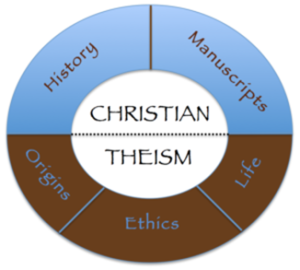
Being able to make the case for the truth of Christianity means you have to understand it yourself. There are plenty of resources out there that can help you do that. I always try to share the best ones I know about. But right now, I want to offer you a visual tool as a way to simplify the “big picture.” This diagram helps categorize the facts supporting Christian Theism. It’s a way to organize the evidence for Christianity in your mind’s eye. Diagram

Confident Christianity

Last year, I developed this model into a book-length summary of the evidence for Christian theism. It is available now in both paperback and Kindle formats. You can order it here:

Confident Christianity Book

This book doesn’t make any claims about the theological nuances that are required to understand Christianity in detail. And it doesn’t address denominational differences between Christians. It is a simple summary of the evidence for “Mere Christianity” that we find in the real world. It’s a challenge to skeptics who may have dismissed Christianity as just another blindly-followed religious myth. And it’s an easy-to-read distillation of that evidence for Christians who may never have been exposed to all of it in one place. My goal in writing this book was to provide a basic, “big picture” overview for those who may have never been exposed to apologetics.

What Is Theism?

There are many different views of God. But they fall into three basic categories:

  1. Pantheism— the idea that all of reality actually is Hinduism is an example of a pantheistic religion. Pantheism makes no distinction between God and nature. The entire physical universe is a manifestation of God. Rocks are god. Trees are god. You are god. God is not a person. God is everything.
  2. Deism— the idea that God is separate from the physical world but does not interact with it. God is like “The Force” in Star Wars — a powerful entity who creates the world and then steps back to watch his handiwork. There is no revelation from this God. There are no miracles. God has no further contact with his creation.
  3. Theism— this is a view that there is a creator God who not only forms the physical universe but also stays involved with it. Christianity, Judaism, and Islam are theistic religions.

Christianity is a theistic religion. That means we should have evidence for some kind of theistic God who is separate from, but involved in, the universe. This is a God who created, sustains, and interacts with the world. Our diagram is a summary of the evidence for that kind of God.

First Things First – God Exists

I’ve summarized the case for God’s existence into three basic categories: OriginsEthics, and Life. Here’s what I mean:

If this God exists, we must have evidence for the type of God who is a personal, moral agent. In order to create the physical universe, that God must exist outside of that universe. That means God can’t be part of the matter, energy, space, or time that makes up our world. He must be transcendent and non-physical. But it doesn’t stop there. Theism requires that God is also able to act within the universe he created.

These three foundational categories (origins, ethics, and life) contain all the evidence that explains things we know about our universe:

  • It is a universe in which we all recognize that real, moral truths exist and that they are constantly being violated
  • It is an actual, physical thing that came into existence sometime in the finite past
  • Whatever/whoever caused the beginning of the universe could not have been a part of the physical universe itself
  • It is designed to allow for, and to sustain, the existence of living things
  • Some of those living things are personal beings who have moral, mental, and physical attributes

Obviously, there is a lot to each of these topics and I will provide resources to support each of them, but the takeaway is simply that our claim to believe that there is a God is not based on some kind of wishful thinking or irrational hope. It is based on evidence — concrete evidence about the way the world actually is.

Since we have evidence that there is a God and that this God’s attributes must be consistent with the evidence listed above, it follows that one of the theistic religions must be true. In order to determine which of the theistic religions is true, we need more specific information.

Specific Evidence For Christianity

The blue categories at the top of the diagram are what allow us to differentiate Christianity from the other theistic religions. Here, we look at data from archaeology and history. We can also compare the manuscript evidence from each of those religions in order to identify which of them is true. This is where the strength of the case for Christianity shines. No other religion even comes close to having the amount of evidence to support it:

  • The existence of its primary historical figure — Jesus of Nazareth
  • The archaeological relics that correlate to its story from the very beginning
  • A world-changing event — the Resurrection — that is central to its claims
  • The number of manuscripts that verify Christianity’s authenticity and reliability

That’s the case for Christian Theism in a nutshell. We can be confident that our faith is justified, not because it makes us feel good about ourselves, or because it “works for us,” but because it is actually true!

Now for the hard part.

The Ultimate Apologetic

If you aren’t already familiar with the information above, it won’t seep into your brain through osmosis. You have to be dedicated to familiarizing yourself with it. In the posts that follow, I will give you resources — videos, articles, and books — to help fill in the details of each of these categories of evidence. But remember, you don’t have to become a biblical scholar and master every subject listed above in order to prepare yourself and those you love to use them. Remember, the purpose of True Horizon is to look at the world with a view from 35,000 feet.

You simply have to understand the basics and be willing to go find answers. In the meantime, here are some fundamental things to understand about what this all means and how to use it:

  1. Knowing “facts” gives you confidence to engage with others but, in the cultural climate we live in, citing facts will rarely convince others to change their minds.
  2. Your attitude may go further than your evidence in compelling others to consider what you’re saying.
  3. Asking questions is almost always more effective than making statements.
  4. Telling your story s vastly more interesting than regurgitating practiced arguments.

Finally, always remember that you are not meant to convince people to agree with you. That’s not your job. The Holy Spirit is the one who leads them to the truth. You are not the one who saves them. That’s Jesus’ job.

Your mission is simple: know and speak the truth. “Always be prepared to give a reason for the hope you have” (1 Peter 3:15). You are only meant to train those in your little corner of the world to be prepared to engage people in a winsome way.

That’s your “job.” And when you’ve done it, relax … and let God do His.

Recommended resources related to the topic:

I Don’t Have Enough Faith to Be an Atheist (Paperback), and (Sermon) by Norman Geisler and Frank Turek 

Stealing From God by Dr. Frank Turek (Book, 10-Part DVD Set, STUDENT Study Guide, TEACHER Study Guide)

Defending the Faith on Campus by Frank Turek (DVD Set, mp4 Download set, and Complete Package)

_____________________________________________________________________________________________________________________________________________________

Bob Perry is a Christian apologetics writer, teacher, and speaker who blogs about Christianity and the culture at truehorizon.org. He is a Contributing Writer for the Christian Research Journal and has also been published in Touchstone, and Salvo. Bob is a professional aviator with 37 years of military and commercial flying experience. He has a B.S., Aerospace Engineering from the U. S. Naval Academy, and an M.A., Christian Apologetics from Biola University. He has been married to his high school sweetheart since 1985. They have five grown sons.

Original Blog Source: https://bit.ly/3OvYYZk


Are you ready to laugh and think your way through a timely update of a classic tale?

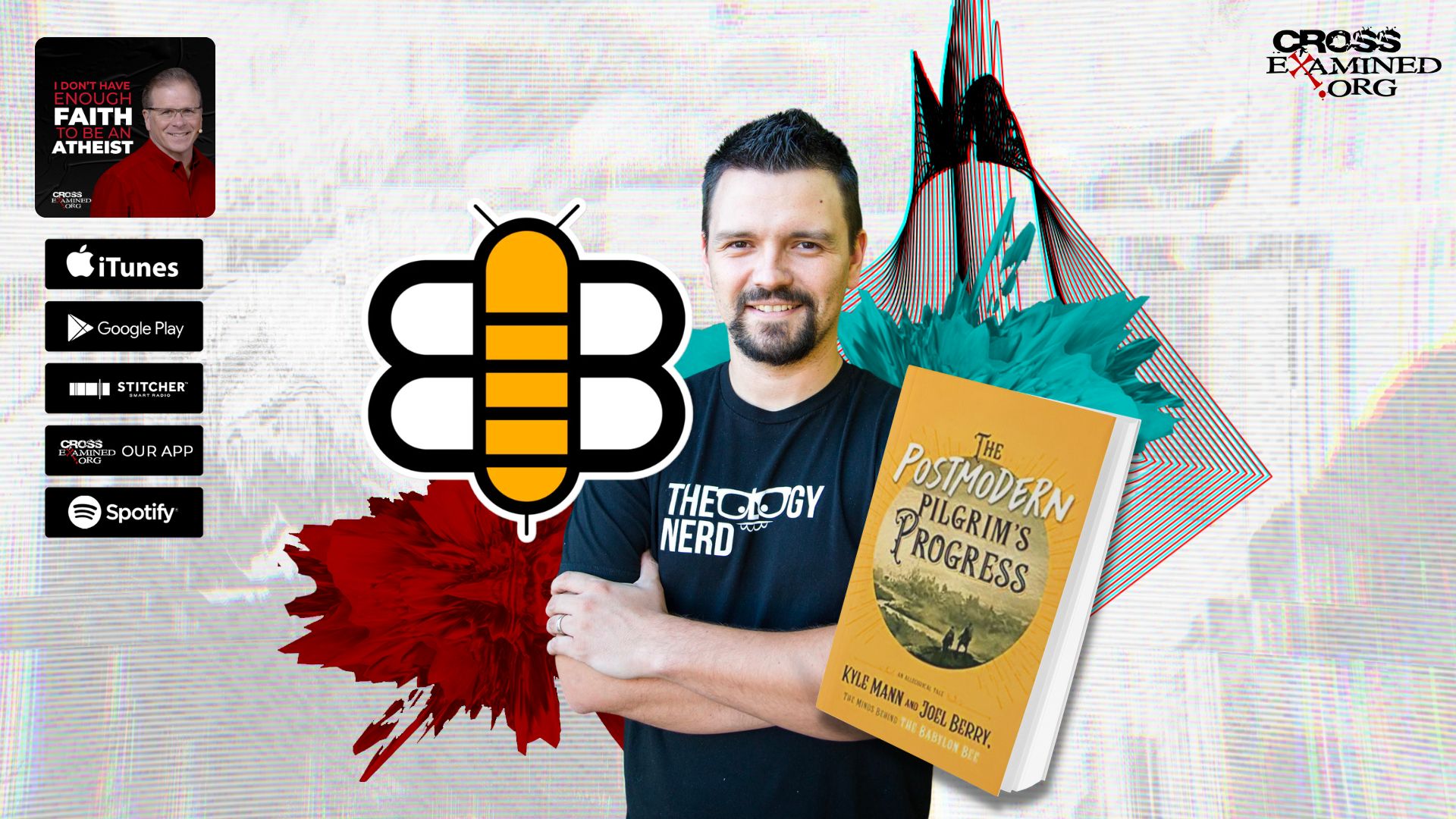
Kyle Mann, editor-in-chief of The Babylon Bee, joins Frank to discuss his new book, The Postmodern Pilgrim’s Progress (co-authored with Joel Berry). Part novel and part “sci-fi fantasy allegory”, The Postmodern Pilgrim’s Progress is a modern-day version of John Bunyan’s classic book and tackles subject matter that is unique to our culture today–including the prosperity gospel, deconstruction, humanism, evolution, skepticism, abortion, and more.

Here’s a short excerpt from the beginning of the book:

“On this journey, Ryan will learn something, which is more than most people who go on journeys can say. When he wakes up, he won’t remember the dream, but he will be a changed man. He will be made new somehow, even if he can’t explain exactly how. This will be the first in many thousands of dreams, interactions, moments, and strange coincidences that lead him to a moment every created being was created for: reconciliation with the Creator.”

In this episode, Frank and Kyle also talk about how The Babylon Bee got started, and the controversy surrounding their recent Twitter censorship. You don’t want to miss it!

If you would like to submit a question to be answered on the show, please email your question to Hello@Crossexamined.org.

Subscribe on Apple Podcast: http://bit.ly/CrossExamined_Podcast Rate and review! Thanks!!!
Subscribe on Google Play: https://cutt.ly/0E2eua9
Subscribe on Spotify: http://bit.ly/CrossExaminedOfficial_Podcast
Subscribe on Stitcher: http://bit.ly/CE_Podcast_Stitcher


Download Transcript