

Tag Archive for: Al Serrato

By Al Serrato

“Let me see if I understand,” I said to my daughter’s high school biology teacher. “The human eye is the evolutionary product of a light-sensitive spot on the skin. Is that right?”

“Right,” she said.

“And by evolution, you mean a mindless, random process that didn’t really have an end in mind. In other words, there was no “designer” for the eye or the body for that matter. Am I getting that right?”

“Right again,” she replied.

But how could an undirected process produce such highly functional complexity, I wondered aloud. She gave me a look that said, “you really don’t have the time or, probably, the background to understand, so do we really have to go there?”

We did, and I persisted, trying another tack that I had been wondering about for a while.

“Okay, well let me ask you just a few questions” I countered. “Would you agree that evolution as you understand it is a gradual process of adaptation over time, where changes that are advantageous accumulate?”

“Yes,” came her quick reply.

“Would you agree that over time these gradual adaptations would lead to the development of complex systems, such as organ systems?”

“Yes, that makes sense,” she said.

“Would you also agree,” I pressed, “that, generally speaking, the more complex the system, the longer it would take for these gradual adaptations to evolve so that a complex system would take longer to evolve than a less complex system?”

“Yes.” The response was a bit slower, more thoughtful.

Shifting gears a bit, I asked, “In the field of human biology, would you agree that generally speaking, the human female reproductive system is considerably more complex than its male counterpart?”

“I’m not sure what you mean,” she queried.

“Well,” I started, “the male half of the equation involves dividing cells to get to 23 chromosomes and providing a, uh, delivery mechanism. The female system involves the production of eggs, the delivery of the eggs to a specific location, the means for implantation, and if that occurs, the creation of a placenta that is fine-tuned to support the development of the life that is growing. The whole system must work in conjunction with the woman’s body, provide for correction of any mistakes occurring to minimize miscarriages, screen the fetus from harmful substances in the woman’s blood, connect the fetus to the mother by means of a two-way umbilical cord, and provide a method for the baby to be safely delivered into the world. More amazingly, the two systems must somehow recognize each other and work together, so that the 23 chromosomes from each half form a single cell that has the complete instructions for a new human life to begin. This seems like a pretty complex, interconnected, and interdependent system requiring multiple components to work just right. And yet it does work right millions and millions of times.”

“I suppose there’s something to that, but” she hesitated, “what’s your point?” Her tone matched her more serious expression.
“Just this,” I responded. “What exactly were all those men doing generation after generation waiting for the first fully functional female to evolve?”

She stared at me, no doubt wondering whether I was trying to mock her. But, though my question was of course facetious, I wanted to know where my logic was flawed. After all, the premises seem valid. If designed, it makes perfect sense that God could create a system in which some parts are more complex than others, and still have them work together for a purpose. But how could mammalian sexual reproduction – involving separate male and female individuals -ever evolve simultaneously? I wanted to know where that very first human male and very first human female came from. She took a deep breath and began her answer…. and it didn’t have anything to do with God.

“Well, it didn’t work that way,” she said. “Evolution occurred gradually, over time, as the predecessors to humans slowly began to change.”

“Fair enough,” I responded. “So, tell me about that first pair of monkeys, the very first male and female monkey from which you say we evolved.”

“Well,” she began, formulating her thoughts, “it didn’t work that way.” I gave her a quizzical look and she continued. “Those predecessors also evolved slowly, over time, from still more primitive forms of life.”

I was patient. “Like what?” I asked. I don’t think anyone had pressed her for answers like this, but after all I wasn’t worried about getting a grade. My daughter, on the other hand, probably wouldn’t be too thrilled about dad’s efforts at higher learning. Luckily, she wasn’t nearby.

In answer, the teacher started to explain that monkeys had evolved from still lower forms of life. It was a long process with smaller animals making adaptations, adding features, becoming larger. It all sounded quite vague and fuzzy, as she painted the picture of a planet teeming with life of various kinds, widely dispersed, and being driven by this engine of evolution.
I tried to stay on track with her. Then she made the jump that I was expecting – she started talking about life emerging from the primitive seas. Single-celled life forms that began to replicate and pass their DNA on to the next generation. She paused when she saw me starting to shake my head.

“Wait a sec,” I said. “You’re getting ahead of me, or perhaps more precisely, you’re moving back too far. I’ll grant you that life first began in the seas, but even if I grant you the ‘primordial soup’ theory, you’re still making quite a jump. What I want to focus on are the first male and female land mammals. If we wind the clock back, there must be a point on the early Earth in which there are no mammals walking the land. None whatsoever. Whatever life exists, it hasn’t yet evolved to sexually reproducing, warm-blooded mammals. Before that point, maybe there’s life in the sea, but the land is barren; after that point, the land begins to get populated. You with me?”

She nodded.

“I’d like to know what model science has to explain how that first began. That first couple.”

She was still formulating an answer, so I pressed on. “I can understand that once you have thousands of fully functioning mammals that over time they may begin to change, especially if subjected to some environmental challenge. That makes perfect sense, whether it is directed by the genes, as I believe was designed into them, or whether it’s a random process. But tell me how the first pair appeared on the land.”

I was hoping to get an answer, because I had been wondering for a while how Darwinists made sense of that rather large step, from single-celled asexually reproducing life to complex, sexually producing mammals. But it was not to be. “Coach.” We both looked in the direction of the voice. The bio teacher was also a coach, and someone was trying to get her attention. She smiled and said, “Let’s continue this later.” Was that a look of relief that crossed her features? Probably, I eventually decided. We never did finish the conversation.

Perhaps Darwinists have a plausible model for this transition, but I have yet to hear it. Instead, what I have heard is always along the lines of what’s recounted above – vague and fuzzy references to a planet teeming with evolving life, and then a jump to the oceans, where DNA first appears. But this jump appears to be a “just so” story, with a vague promise that someday science will make it all clear, will discover these missing links that just “must be there.” But common sense, and reason, tell me that when those original sexually reproducing mammals first appeared on Earth, they were able to reproduce in that fashion immediately, making use of an incredibly complex and interdependent system, a system that has all the hallmarks of design. And a system that couldn’t take long periods of time to evolve because, unless it’s working properly and completely on day one, there won’t be a next-generation upon which evolution could act.

Perhaps, like Frank Turek puts it, I just don’t have enough faith to be an atheist. Until I do, then, I guess I’ll just keep believing that the incredible complexity of life is what it appears to be – the telltale sign of an intelligent designer that set it all in motion for a purpose. After all, every time I see a complex, highly organized, interdependent system – like a watch or a plane or a car – I don’t struggle trying to figure out how it assembled itself. So, why do people struggle so hard when it comes to something even more complex – like life?

Why indeed.

Recommended resources related to the topic:

Science Doesn’t Say Anything, Scientists Do by Dr. Frank Turek (DVD, Mp3, and Mp4)

Oh, Why Didn’t I Say That? Does Science Disprove God? by Dr. Frank Turek (DVD and Mp4)

Stealing From God by Dr. Frank Turek (Book)

Answering Stephen Hawking & Other Atheists MP3 and DVD by Dr. Frank Turek 

God’s Crime Scene: The Case for God’s Existence from the Appearance of Design (mp4 Download Set) by J. Warner Wallace 

God’s Crime Scene: The Case for God’s Existence from the Appearance of Design in Biology DVD Set by J. Warner Wallace


__________________________________________________________________________________________________________________________________________________

Al Serrato earned his law degree from the University of California at Berkeley in 1985. He began his career as an FBI special agent before becoming a prosecutor in California, where he continues to work. An introduction to CS Lewis’ works sparked his interest in Apologetics, which he has pursued for the past three decades. He got his start writing Apologetics with J. Warner Wallace and Pleaseconvinceme.com. 


By Al Serrato 

With each passing year, science is providing more evidence that the universe is exquisitely fine-tuned to support human life. Change any one of dozens of scientific parameters by even a small amount and life on Planet Earth would never have arisen. These findings provide strong support for the Christian argument that behind this universe lies an all-powerful, super-intelligent Designer who set this all in motion.

Many atheists try to sidestep the problem these scientific discoveries create for their worldview. Darwinism, after all, made belief in the possibility that life simply arose from inert matter a bit more respectable, so discoveries that make this seem unlikely, indeed implausible, cannot be ignored for long. After decades of Darwinism giving them false solace, atheists face a serious problem making sense of these discoveries, which challenge the wisdom of believing in random self-assembly over a long period of time as an adequate explanation for the magnificent complexity of the life we find on Earth.

A favorite way to dodge the issue goes something like this: there’s nothing particularly noteworthy about fine-tuning in the universe because, had it not been so, we would not be here to make any observations. We simply happened to arise because we just happen to be in a universe – probably one of an infinite number – that can support our form of life.

This is a clever argument because it makes the extraordinary nature of the universe seem, well, ordinary and in fact predictable. But the argument does not survive scrutiny, because it deliberately misses the point of the fine-tuning argument. It assumes that there is no designer, then asks to make sense of this fine-tuning we see all around. It does this by assuming that other universes exist, and with enough such universes, the existence of our particular universe, with its unique characteristics, becomes inevitable. But there is no evidence – at present anyway – that we inhabit one of a limitless number of other universes. In fact, since these other universes are separate and apart from ours, there is no way to even test for their existence, no way to establish whether they are there or not. The existence of this infinite number of alternative universes, this “multi-verse,” is assumed so that our presence in this one can be viewed as “no big deal.” It is apparent that the skeptic is assuming the conclusion he wishes to reach. Instead, the question we are trying to answer is whether such fine-tuning can truly be an accident – a true “billion to one shot” – or whether, by contrast, this evidence of design is the result of, well, a Designer. Because our existence is the result of the coinciding of hundreds of highly improbable events, basic probability theory tells us that to determine the cumulative probability requires that we multiply these probabilities. Increase the number of “just so” parameters and life becomes incredibly unlikely to have arisen by chance.

Some examples might help make the point. The Apollo 11 mission successfully landed men on the moon and returned them safely to Earth. Imagine that on his return, someone asked Neil Armstrong to comment on the stunning success of the mission. If he thought like the new atheists, he might have said: “There was nothing amazing about the mission’s success. After all, if something failed, I wouldn’t be here to discuss the effectiveness of the mission.” Such an answer is ludicrous; it simply avoids the question of what the odds were that each of hundreds of systems would work as designed. That such novel technology achieved its goals is a tribute to the intelligence and workmanship of its designers. To say that Armstrong just happened to live in the universe in which his mission succeeded is, in reality, to say nothing at all.

To this, the atheist will likely respond: your example is flawed, because we already know that the Apollo mission was designed by an intelligence, and we don’t know that about the universe. But this too misses the point. The Apollo mission was fine-tuned for success. If the universe shows signs of similar fine-tuning, then we can logically conclude that it too bears the marks of an intelligent designer.

Which leads me to a different example: a condemned man stands before a firing squad, awaiting the crack of rifles that will precede his demise. The signal is given, he hears the shots and feels the bullets whizzing nearby, but not a single round strikes him. He has survived the execution and is here to comment on the probability of so unlikely an event. Imagine if he answered: “there was nothing special about this execution. After all, I wouldn’t be here to comment on it if it had been otherwise.” But this too would be so much nonsense. The question is whether we can infer from this result that each of the marksmen just happened to miss, or whether the better inference would be that missing was “designed,” that the marksmen were following a plan to miss.

Following the evidence where it leads should cause skeptics to question their deeply held beliefs. But if they do, the odds are in their favor that they will eventually find the truth – the universe is exquisitely fine-tuned to support life because it was designed that way.

Recommended resources related to the topic:

God’s Crime Scene: The Case for God’s Existence from the Appearance of Design (mp4 Download Set) by J. Warner Wallace

What is God Like? Look to the Heavens by Dr. Frank Turek (DVD and Mp4)

I Don’t Have Enough Faith to Be an Atheist (Paperback), and (Sermon) by Norman Geisler and Frank Turek

God’s Crime Scene: Cold-Case…Evidence for a Divinely Created Universe (Paperback), (Mp4 Download), and (DVD Set) by J. Warner Wallace

God’s Crime Scene: The Case for God’s Existence from the Appearance of Design in Biology DVD Set by J. Warner Wallace


____________________________________________________________________________________________________________________________________

Al Serrato earned his law degree from the University of California at Berkeley in 1985. He began his career as an FBI special agent before becoming a prosecutor in California, where he continues to work. An introduction to CS Lewis’ works sparked his interest in Apologetics, which he has pursued for the past three decades. He got his start writing Apologetics with J. Warner Wallace and Pleaseconvinceme.com.

 

By Al Serrato

Many atheists today hold the view that faith and reason are opposites.  They view Christians as believing in God “despite the evidence” instead of because of it, and as long as they hold that view, they will not be open to considering the evidence for God’s existence.  In my last post, I discussed the importance of precision in language, so as to convey the correct notion that reason underlies faith, as it underlies all sound thinking.  Skeptics who realize that there is nothing irrational about “having faith” may eventually be open to considering the evidence for the God of the Bible.   

As a picture paints a thousand words, good analogies can go a long way toward making intellectual concepts like this clear.  They can help the listener see that they do in fact rely on “faith” all the time.   Because no one can know all things with complete certainty, a decision to believe that something is true – that it describes the way things really are – is a decision that relies on faith.  We all do it, often intuitively and without much thought because it is simply the way our minds work.
 
Since the specific question at issue when considering God’s existence is whether “someone” is there, analogies that make that point can be helpful.  Of course, the easiest way to know someone is there is to actually see the person.  That would constitute direct evidence.  But you can also know someone is there by deduction or inference.  The footsteps you see in the sand are pretty powerful indicators that someone was recently walking by.  Mail-in your mailbox did not spontaneously appear.  Or imagine being a police officer coming upon the scene of a burglary; you will strongly suspect someone is inside if you see the broken front door lock and hear movement inside. You may be wrong, but it would be rational for you to conclude that someone is there.  If you bring in a police dog that moves to a particular closet in the house, you can be quite sure that someone is behind the door.  Despite lacking direct or conclusive knowledge, you would not dismiss these conclusions as being based “on faith,” but would instead recognize that you are employing reason to form conclusions about things you cannot directly see.

Now at this point, the atheist may say “Okay that makes some sense. I can deduce ‘someone is there’ from circumstantial evidence, but I already know that people exist, so it is no surprise that a particular person might be on the beach, or delivering mail, or hiding in the house.  Now you want me to believe in a God that no one has any direct experience with?”  Yes, in fact, I do.  

While certainly different in magnitude, the universe – like the sand on the beach or the contents of the mailbox – is a canvas upon which evidence of God’s existence can be seen. Ponder for a moment the exquisite order and complexity of the universe, the information embedded in life, the existence of consciousness, morality, music, and math – all these bear witness to the Designer’s hand. They are discrete bits of evidence upon which a comprehensive circumstantial case can be built. Science, in other words, can provide the tools, and furnish the support, for a well-ground belief in the need for a transcendent Creator.

The scientific community is already embarked upon a similar exercise, in the hunt for extraterrestrial intelligence. All around the globe, radio telescopes are probing the distant reaches of space, hoping to pick up the telltale signals of intelligent life. Frequency ranges have been devoted to this pursuit by international agreement, so as to increase the chance that signal pollution from Earth-bound sources does not interfere. Hundreds of thousands of dollars have been committed to this effort to find what no one definitively can say exists – life in the cosmos. The effort is called SETI – the Search for Extra Terrestrial Intelligence.

These are not religious fundamentalists at work; they are highly educated and trained scientists who know what so many in academia refuse to acknowledge – that reason can be employed to conclude that “something is out there.” What are these scientists hoping to find? Because they believe they can distinguish random noise – things naturally occurring – from signals that are specified and complex, they believe they can see the blueprint of intelligence in signals that are not random but instead designed to convey information. They look primarily for mathematical equations, trusting that universal laws will be knowable to any sentient being and will be a means to communicate, even if our spoken languages are different. NASA did something similar with its deep space probes Pioneer and Voyager; information encoded in the universal language of math and music even now hurtle further into the abyss, awaiting, perhaps, discovery by some advanced intelligence.

Now, let’s suppose that these scientists begin receiving a coded message. With effort, they eventually decode the language, finding that it consists of four letters. These four letters are arranged into billions of lines of code, which the scientists ultimately realize constitute a blueprint to build an extremely complex machine – a self-replicating machine with thousands of interdependent parts that must assemble themselves, correct errors as they occur and continue functioning in harmony decade after decade. What if scientists could begin working with this code to make changes and to alter the natural order of things? Would this not be enough to convince even the most skeptical that “something” highly intelligent and incredibly powerful was out there? That we are not alone?

So why aren’t more people convinced. After all, we already are the recipients of such directed intelligence. The four-letter language that codes billions of lines of instructions to build a complex machine is, of course, DNA. In short, while the scientific community remains largely materialistic, that façade is starting to crack, as more is learned about the incredibly information-rich nature of DNA, as well as the fine-tuned nature of the laws of the universe. Such information, and such laws, are not random. While some continue to insist that DNA evolved from lifeless matter, they have no mechanism to explain the beginning of DNA. Even the earliest single celled life form required such massive amounts of information that self-assembly is simply implausible.

We all know it intuitively: information requires a source. This alone does not prove the God of the Bible. But knowing that “something” is out there is not a matter of “faith.” Reason itself demands it.

There are none so blind as those who, despite the evidence, continue to refuse to see.

Recommended resources related to the topic:

God’s Crime Scene: The Case for God’s Existence from the Appearance of Design (mp4 Download Set) by J. Warner Wallace 

God’s Crime Scene: The Case for God’s Existence from the Appearance of Design in Biology DVD Set by J. Warner Wallace 

What is God Like? Look to the Heavens by Dr. Frank Turek (DVD and Mp4

I Don’t Have Enough Faith to Be an Atheist (Paperback), and (Sermon) by Norman Geisler and Frank Turek


Al Serrato earned his law degree from the University of California at Berkeley in 1985. He began his career as an FBI special agent before becoming a prosecutor in California, where he continues to work. An introduction to CS Lewis’ works sparked his interest in Apologetics, which he has pursued for the past three decades. He got his start writing Apologetics with J. Warner Wallace and Pleaseconvinceme.com.

By Al Serrato

Sitting in traffic the other day, I saw once again the bumper sticker “Got Faith?”   It’s catchy, in a way, and in this age of sound bites, I can guess why people find it useful.  Perhaps it’s a good discussion generator, a way to invite a question or a response. But Christians should be careful to understand the unintended effect words like “faith” have on those whose worldview is intentionally secular.  

When we borrow from the famous milk commercial for a slogan, we risk reducing faith to a commodity – like milk.  Yes, we need it, and we can acquire it, and if we do, others things in life may go better, like the way cookies taste better with milk.  But is faith a commodity that we can acquire? Or is it something that all of us already have? Something we already make use of?

I recently talked to an atheist friend about these ideas.  She told me that in her view, faith and reason are opposites. Faith, she said, means accepting things you can’t understand or explain, and reason, by contrast, is the opposite, accepting only those things you can understand and explain.  With this view of the world, she will never be open to considering God, because by her definition to try to do so would be unreasonable. Those who “got faith” may be comforted, but they have nothing to tell her. Indeed, when she thinks about it, she feels a bit sorry for the “faithful,” because they’ve stuck their heads in the sand. They may feel safe and warm, she accepts, but the price of “not seeing things the way they really are” is just too high.

A more productive approach might be to let the secularist see that she is using “faith” as well, and to consider whose faith is more rationally based.  The first step, of course, is to clarify this misunderstanding about what “faith” actually means. I would suggest a definition of “faith” as the act of trusting in something that you cannot know with complete certainty.  It contains an action part – trusting – and a standard of proof part, for lack of a better term – the degree of certainty you attach to your conclusion.  Contrary to my secular friend’s view, the opposite of faith is not reason, it is disbelief.  In other words, to lack faith in something is to believe that what is posited is not in fact true, that it does not conform to the way things actually are. I don’t have “faith” that positive thinking will always allow me to achieve my goals. It doesn’t hurt to practice positive thinking, of course, but I do not actively trust that things actually work that way. In some instances, to lack faith would mean to go even further, to believe that the opposite is probably true. I lack faith in my ability to leap over a tall building because I know the opposite to actually be true.

Reason, by contrast, is not an act of trusting; it is act of thinking, a process by which we arrive at conclusions based upon evaluating evidence that we receive through our senses.  It can be inductive or deductive; it can be sound or fallacious.  But in the end, it is simply a tool that we have access to through the use of our minds, much like the tool of vision, hearing, or language acquisition. These things are simply available to any human being with a normally functioning mind.  The opposite of reason is not faith, it is irrationality. If I conclude, for instance, that a set of feathered wings will allow me to take flight, I am proceeding irrationally because the available evidence establishes that this simply cannot work, however much “trust” I wish to place in what I am attempting.

Far from being opposites, then, reason and faith coexist in a continuum, in which knowledge moves from things that are definitely known through observable evidence (trust with high certainty) to things that are not definitely known but highly likely to be true (trust with less certainty) to matters that are entirely speculative and can be taken only “on faith” (trust with little or nothing to support).   So faith in God, like any other conclusion a person reaches, is always the product of reason, because reason is simply the only way anyone can arrive at a conclusion.  What distinguishes sound faith from foolish faith is the strength of the evidence that supports the conclusion and the validity of the reasoning process that was used.

Let’s apply this approach to a real-world example, say a wife wondering whether her husband is worthy of her trust.  Because she cannot be with him all the time, she cannot know for certain whether he is cheating on her.  But she is not totally without evidence, either.  You would not say to her that she simply has “faith,” as if she has no reasons whatsoever for her beliefs.  Instead, you would view that situation as a continuum of knowledge.  In other words, her “faith” can be soundly based on available evidence – as in the situation where through long term observation and knowledge of the character, belief system and conduct of her husband, she can be confident in placing her trust.  Or her “faith” can be foolish – as in the situation where the husband claims to be true but has shown through prior behavior and through comments that he is not likely to withstand the temptation to stray.   This example shows two things: one, that faith is something we all use, even without necessarily thinking about it, because as limited beings we cannot know everything with certainty; and two, that the certitude of one’s faith depends on the facts and rationale that support the faith.  In this example, the one rests her faith on logic and reason, while the other holds it in spite of logic and reason.

Faith and reason are not inherently in conflict, as many secularists seem to believe. While faith requires a step beyond what can be known with complete certainty, it is not irrational to take that step, depending on the strength of the evidence to support it. Thoughtful and intelligent people throughout the ages have found no conflict in accepting that God exists and placing their trust in him.

As believers, we need to prepare ourselves to show others today that this is still the case.

Recommended resources related to the topic:

Forensic Faith for Kids by J. Warner Wallace and Susie Wallace (Book)

Defending the Faith on Campus by Frank Turek DVD and Mp4  This is part of the complete package promote one or the other

Defending the Faith on Campus Complete Package by Frank Turek DVD

I Don’t Have Enough Faith to Be an Atheist (Paperback), and (Sermon) by Norman Geisler and Frank Turek 


Al Serrato earned his law degree from the University of California at Berkeley in 1985. He began his career as an FBI special agent before becoming a prosecutor in California, where he continues to work. An introduction to CS Lewis’ works sparked his interest in Apologetics, which he has pursued for the past three decades. He got his start writing Apologetics with J. Warner Wallace and Pleaseconvinceme.com.

By Al Serrato

It is difficult to overstate the importance of the discovery of the Big Bang. After all, even without sophisticated philosophical arguments, most people intuitively recognize that all things that come into existence must have some preceding cause sufficient to the task. But when science, or more specifically physics, supports the Christian worldview by affirming the need for a creator, one would think that many skeptics would begin to accept that Christianity is not the enemy of science.  Instead, the atheist will sometimes resort to ridicule to challenge the reasonableness of believing in an omnipotent creator. For example, one skeptic compared belief in God to the thinking of primitive Norsemen attributing thunderbolts to the “god” Thor. Not understanding how thunderstorms formed, and in search of an explanation, such men came up with a mythical character to fill the role. Can’t we see, the skeptic will argue, that positing God as the creator of the universe is no different – we’re just substituting one fictitious being for another, aren’t we? Why not just admit that we just don’t know what preceded the Big Bang and wait for science to solve the problem?

This argument is clever because it puts the believer on the defensive. The implied critique goes something like this: people in earlier times with no knowledge of weather science resorted to something they could understand when they assumed that a personal agent directly caused the lightning they were seeing. In the same way, modern believers who likewise lack knowledge of as yet undiscovered scientific theories are also guilty of ignorance when they rush to assume that a personal agent – here, God – is the explanation. As in past times, they contend, resorting to this “god of the gaps” is just filler until science comes up with the correct answer.

But a moment’s reflection will demonstrate that this line of argument misses the point. Sometimes events occur as the result of purely impersonal natural laws, such as when lightning triggers a forest fire. Other times, by contrast, personal agents cause events, like when someone intentionally or inadvertently sets a fire. In either setting, science may provide the explanation for why combustion occurred, but this does not address whether a personal agent was the original cause. To do that, we must use reason to assess the available evidence to reach a logical conclusion as to what in the particular instance set the events into motion.

Since primitive human beings had no scientific knowledge, it is understandable that they might attribute a powerful event like a thunderstorm to a personal source. Not comprehending that a thunderstorm arises in response to predictable conditions in the atmosphere, and how the resulting movement of air masses generates electrical energy, their minds naturally sought a reason. And since thunderstorms are frightening events, it was natural for them to conclude that someone very powerful was perhaps expressing anger or displeasure. But Christians are not imagining a creator when they consider the explanation necessary to make sense of the evidence we have for the cause of the universe. This evidence includes not just that the universe came into existence from absolute nothingness at a specific point in the past, as science demonstrates, but also the characteristics of the universe: the exquisite fine-tuning and order we see and more importantly the fact that from this mix of matter and energy life, consciousness and intelligence emerged. Using reason, it is indeed quite proper, and quite supportable, to infer that something immensely intelligent and immensely powerful set these things into motion. That the Creator used natural laws to run things is why we have science in the first place; using our senses and our ability to reason, we use the scientific method to learn about these laws. But developing increased understanding of the laws of nature does not eliminate the need to find the source of these laws.

What, then, of the skeptic’s challenge that because we cannot show how God created the universe – what precise steps he took – it is illegitimate to infer that He in fact did so? Why not accept the argument that there is never a need to resort to the “god of the gaps” to explain things, that we should instead simply wait for further scientific discoveries? I submit the answer is because for many things we find around us, the relevant question is not exactly how something works, but is instead by whom was it made? Did it come into being by the work of impersonal forces, such as the contours of the walls of the Grand Canyon, or was it chiseled into existence by an intelligence source, such as the sculptor who gave us Mr. Rushmore? I cannot begin to imagine how that artist could “see” the faces that eventually emerged from his chiseling, but I am right to conclude that time and random chance did not make those changes.

There are countless other examples. I am using a computer to write this essay, yet I know next to nothing about how programming, hard drives and BIOS’s work. This lack of knowledge is completely irrelevant to the question of whether the computer came about on its own, through strictly impersonal laws, or is instead the manifestation of the work of some intelligence. If I see alphabet cereal strewn about the kitchen table, the conclusion I draw as to how that happened will be different if I see groupings that spell out a particular message to me. Again, while I may lack an answer as to how the letters came to be arranged in that particular location at that time, I can indeed conclude that an intelligent, personal source was behind it. This insistence then that attributing a personal source to the origin of the universe is fallacious “god of the gaps” thinking is itself an illogical move. It simply does not take complete knowledge of the “how” to ascertain with adequate reliability that there was indeed a “who” behind it.

As Christians, we unapologetically call that Creator by the name he provided for us. Jesus isn’t a mythical figure from the ancient past. He isn’t a creation of the imagination trotted out to explain physical laws of nature. No, he was a real man who walked the earth, who lived at a particular time and place in history and so impacted the lives of those around him that some sought to kill him and others, a small but growing group of followers with adherents twenty centuries later, changed the trajectory of world history. We need not rely solely upon reason to conclude that an intelligent personal source brought the universe into existence, because first through the prophets and then through the life and teaching of Jesus of Nazareth, He took the time to tell us about himself.
In the end, science and the Christian worldview are not in conflict. It is the one who insists despite the evidence that there is no God – and ultimately no one to whom we will one day be called to account – that is persisting in ignorance. 

Recommended resources related to the topic:

How Old is the Universe? (DVD), (Mp3), and (Mp4 Download) by Dr. Frank Turek 

God’s Crime Scene: Cold-Case…Evidence for a Divinely Created Universe (Paperback), (Mp4 Download), and (DVD Set) by J. Warner Wallace

God’s Crime Scene: The Case for God’s Existence from the Appearance of Design (mp4 Download Set) by J. Warner Wallace 

God’s Crime Scene: The Case for God’s Existence from the Appearance of Design in Biology DVD Set by J. Warner Wallace 

What is God Like? Look to the Heavens by Dr. Frank Turek (DVD and Mp4

I Don’t Have Enough Faith to Be an Atheist (Paperback), and (Sermon) by Norman Geisler and Frank Turek 


Al Serrato earned his law degree from the University of California at Berkeley in 1985. He began his career as an FBI special agent before becoming a prosecutor in California, where he continues to work. An introduction to CS Lewis’ works sparked his interest in Apologetics, which he has pursued for the past three decades. He got his start writing Apologetics with J. Warner Wallace and Pleaseconvinceme.com.

By Al Serrato

 “The fool has said in his heart, “There is no God.” If this passage from Psalms is correct, then many people today – including numerous scientists and other well-educated folks – are fools, for they insist that God does not exist. While name-calling is never productive, is there a way in which one might conclude that a person who denies God’s existence is indeed a “fool,” and not merely someone with whom we disagree?

Well, let’s begin with a look at the definition of “fool,” which includes “a person who has been tricked or deceived into appearing or acting silly or stupid.” Now, sometimes we trick ourselves and thereby make fools of ourselves. We might insist that a steady diet of fast food isn’t the reason that our clothes no longer fit the way they used to. On other occasions, it may be that we are misled. That tanning solution that promised to save you hours in the sun as left you looking a bit too orange to venture out in public. But whatever the source of our being misled, I think most would agree that a person who holds views that are inconsistent and contradictory has allowed himself to be deceived. Imagine a person proudly proclaiming that the prime rib he is about to eat is an important part of his vegetarian diet or the person who says that the only medicine that can save him is the one with no active ingredients. A person who proudly expresses views that are so in conflict has fooled himself, whereas a thoughtful observer would see things as they truly are.

Now, of course, some contradictions are not as obvious as the examples I just provided. Why, then, is it a contradiction to insist there is no God? It doesn’t appear to be contradictory – at first glance, anyway. For the answer to that question, we are indebted to St. Anselm of Canterbury, who lived and pondered these questions some ten centuries ago. I can’t do justice to Anselm’s argument in this brief piece, but perhaps some concepts borrowed from Anselm may help make the point.

The first avenue of inquiry requires consideration of just what it is that the human mind is capable of doing. We need to think about what “thinking” actually entails. Anyone who has seen a baby develop realizes that the human mind comes pre-programmed with an “operating system” of sorts. This system allows us to acquire language, to use reason, to recognize concepts such as fairness and truth and beauty, and other intangible things. It allows us to organize creation into categories, and perhaps most amazingly, to make use of the imagination. This ability for abstract thought lends itself to what we experience in an “I get that now” moment when a problem that has been puzzling us all of a sudden makes sense. We all use these systems of thought naturally and intuitively; they are part and parcel of the normally operating human mind. Of course, there is no other way since we could never use reason, for instance, to prove the validity or usefulness of reason.

One aspect of this ability for abstract thought is the ability to conceptualize or to place things into understandable categories. Food, for instance, can encompass a million different things, but to qualify as food, the object in question must be edible and serve to nourish, and not poison, us. We can call an ash tray food, but the underlying thing is not a matter of what we call it, but of what it consists. A tree trunk in the woods can function as a “chair,” but the surface of a swimming pool cannot.

So, with this observation in view, let’s turn to the question of God. Let’s consider for a moment, not what a definition of God might be, but what the conception of God is. What is it that we are struggling to grasp when we use that term? Anselm’s definition was simply this – God is that being a greater than which cannot be conceived. Whatever attributes God would have – omnipotence, omnipresence, perfect goodness, etcetera – if you can conceive of a being with all those attributes plus an additional one, then the latter being, the being with the greater attributes, would be God. So, imagine two beings then – each with exhaustive, infinite powers. Both beings have every possible attribute of perfection that can be conjured up in the human mind until one reaches the attribute of necessary existence. As I make use of my imagination and my ability to reason to flesh out what I am thinking about when I consider God, I realize that one of these two superlative beings has the attribute of necessary existence – it is not possible for this being to not exist. The other being, on the other hand, lacks this attribute. This latter being may or may not exist, or he may come into existence at some point and go out of existence and some other point. Now, as I compare these two conceptions, I immediately and clearly can see that the former – the one with necessary existence – would be the greater of the two. Consequently, to fully conceive of God, we must be conceiving of a Being who can’t not exist, whose existence must always have been and will always continue to be. Anything else –anything less – simply cannot fit the conception of God.

So, what does that prove? Maybe this conception of God is imaginary and, consequently of no value. Not so, Anselm would contend. And here’s why: the mind is not capable of conceptualizing something that does not in fact exist, that does not relate to something real. Now, this premise is a bit harder to get one’s mind around. The normal response to this part of the argument is that we create imaginary things all the time, from unicorns to tooth fairies to Jedi Knights. These things aren’t “real,” even though we can conjure them up in our fantasies. But each of these things, while imaginary, is the combining of things that are real: a horse and a horn; a person with wings and unusual powers; a warrior with special abilities and unusual weapons. And, and most importantly, neither a unicorn nor a tooth fairy nor a Jedi Knight would possess the attribute of necessary existence. If a unicorn did exist, it would have to consist of a horse with a single horn in its head; but its existence could have occurred briefly in the distant past, or could arise in the distant future or could not occur at all. We can fully conceptualize such a creature – we can place it in its proper category mentally – even if the creature does not presently exist. This is so because the conceptualization of these things does not require that them to actually exist in the here and now. For God, by contrast, the only way to properly conceptualize Him is as a necessarily existent being. If you are not seeing Him that way, says Anselm, you are not yet thinking about God, but about something lesser.

This foray into philosophy can be difficult. Fortunately, there are many other proofs for God’s existence, ones much easier with which to grapple, but this one stands out for its elegance. For if it has merit, then God has embedded within us the means to find Him in the one place we have exclusive and special access to: in the recesses or our very minds, there for us to uncover with a bit of critical thinking.

Getting back then to the initial question, if Anselm is right, the fool who denies God is saying something like, “I believe that the Being who must necessarily exist does not exist.” A rather foolish thing to say, when you see it clearly.

The Bible says that God has written His law on our hearts. Perhaps if we probe a bit deeper still, we can also begin to see in its depths the first faint scratching of His signature.

Recommended resources related to the topic:

I Don’t Have Enough Faith to Be an Atheist (Paperback), and (Sermon) by Norman Geisler and Frank Turek 

Stealing From God by Dr. Frank Turek (Book)

Tactics: A Game Plan for Discussing Your Christian Convictions by Greg Koukl (Book)

Defending the Faith on Campus by Frank Turek (DVD Set, mp4 Download set and Complete Package)

So the Next Generation will Know by J. Warner Wallace (Book and Participant’s Guide)

Fearless Faith by Mike Adams, Frank Turek and J. Warner Wallace (Complete DVD Series)


Al Serrato earned his law degree from the University of California at Berkeley in 1985. He began his career as an FBI special agent before becoming a prosecutor in California, where he continues to work. An introduction to CS Lewis’ works sparked his interest in Apologetics, which he has pursued for the past three decades. He got his start writing Apologetics with J. Warner Wallace and Pleaseconvinceme.com. 
By Al Serrato

In the beginning, was… not the Word …. but the singularity event occurring in absolute nothingness and timelessness that spontaneously created all we see in the universe around us.  So said physicist Stephen Hawking anyway, in his popular book The Grand Design, where he explained that spontaneous creation is the reason why there is something rather than nothing. It is not necessary to invoke God; he concluded, “to light the fuse to set the universe going.” “All it takes is gravity and the existence of, well, multiple other universes.” 

Soundbites like these can be disturbing for people of faith. More to the point, they can provide false comfort to those who prefer to suppress their innate knowledge of God. In a recent conversation with a skeptic who had heard of but not read the book, I was quickly confronted with a typical line of argument – reliance on the expert. “Look,” my friend said, “neither one of us can hold a candle to someone with the accomplishments and intellect of Hawking, so if it’s good enough for him….” The smile on his face told me the conversation was over before it began. After all, a response like this leaves little room for further discussion and no room for debate.

So what is the believer to do? Does recognition of one’s limitations, and a proper sense of humility, make it a fool’s errand to pit oneself against a world-renowned physicist such as Dr. Hawking? Or is there a way to appropriately examine and perhaps even challenge the reasoning of such an expert?

There is indeed a way. Thousands of times a year in courtrooms across America, expert witnesses take the stand to provide opinions to jurors on topics that are beyond the knowledge of the average person.  But these opinions and conclusions can be, and often times are, rejected. The first step is to carefully consider the assumptions underlying the opinion, which oftentimes are not well thought out or are perhaps just incorrect. For example, a psychiatrist may conclude that the defendant she examined is suffering from a particular mental illness, but that opinion may be based upon the untested assertions of the defendant which if false – if the defendant is malingering and trying to fool the examiner – could easily lead to a mistaken conclusion.  An accident reconstruction expert can conclude that one party was the cause of an accident by making incorrect assumptions about conditions he did not observe leading up to the accident. In short, despite being “qualified” to offer an opinion, even the impressive credentials of a physicist like Hawking do not give the expert a free pass. The expert’s opinions, like all evidence presented in court, must be carefully examined.

What is the mistaken assumption underlying Hawking’s approach?  Simply this: you cannot use science to prove what occurred prior to, and outside of, the universe.  Though many invoke the term “science” as a club, using it to convey that their position is somehow unassailable, science is not a book of wisdom. It does not contain the answer to all of life’s questions as if it were an encyclopedia of all there is, or was, or ever will be. It is instead a method for using our senses, and reason, to learn how and why things occur or why they are the way they are.  Implicit in science is testability. The scientist’s hypothesis must be subject to repetition and testing so that others can confirm that the methodology is sound and the conclusions logically justified.

When it comes to examining the origins of the universe, there is a starting point some 14.6 billion years ago before which there was neither time nor space. There was the complete absence of anything. Science cannot reach back beyond that point. If there are indeed a multitude of other pre-existing universes that in no way intersect with our own, which are therefore undetectable to us, how can a scientist simply assume they exist? If our universe needed a pre-existing “law” of gravity to light the fuse, how can one assume that such a law appeared without the need for a creator, for a “lawgiver?” For his conclusions to be testable, Hawking would have to first demonstrate what conditions existed “before” time and space came into existence. If we sprang from another universe, how can science prove that such a place, beyond the reach of any of our sensing equipment, exists? In short, if his conclusions are correct, there is no way for anyone to know. Hawking has moved from science to speculation at this point. He has moved from physics, wherein his expertise lies, to philosophy, where it does not.

Positing a multiverse or a pre-existing law of gravity may provide an alternative to God as the “uncaused cause,” but it also demonstrates that even skeptics share that powerful sense that most people have that you just can’t get something from nothing, that before a thing can exist there must exist before it an adequate source. Moreover, believing in a multiverse or law of gravity cannot explain the really interesting questions we also ponder, that have little to do with physical creation and impersonal laws: how did life emergence from nonlife? What is the source of the information coded into DNA that is capable of producing not just life but consciousness and intelligence? The physical world does not provide examples of intelligence and language, so what can explain the information-rich “blueprints” that we know of as DNA? Why are there “laws” of nature, and why are order and design built into things if there is no designer? Why do we all recognize concepts like beauty, truth, and morality?

There is a certain hubris in asserting that God is unnecessary. Consider an analogy: a programmer writes a computer simulation in which a virtual soldier is given artificial intelligence, and a set of missions to perform.  If the soldier uses its intelligence to begin inquiring as to the nature of the computer in which he is housed, what information would that provide him about the programmer? Only such information as the programmer wanted his creation to know. Regardless of how clever this soldier became, he could never know what the programmer wished to accomplish with the program, or what motivated him to write it unless the programmer gave him that information.  What stunning arrogance it would be for the soldier to nonetheless conclude from his inquiry that he self-assembled, that he knows the sum total of what occurred before he became conscious, and most strikingly that there was no programmer at all.

This, too, is Hawking’s problem.  As a scientist, he no doubts understood that theories must be tested in some fashion to give them scientific weight. How can a theory about multiple universes which do not intersect in any fashion with our own ever be tested? How can he demonstrate that gravity was not first created by someone immensely powerful and completely outside of our physical reality?

Why then write a “science” book that is itself a foray outside of science, setting out to prove something that science cannot prove? The Bible warns that the wisdom of the world is folly to God.  Perhaps this is what it means.

Recommended resources related to the topic:

How Old is the Universe? (DVD), (Mp3), and (Mp4 Download) by Dr. Frank Turek 

God’s Crime Scene: Cold-Case…Evidence for a Divinely Created Universe (Paperback), (Mp4 Download), and (DVD Set) by J. Warner Wallace

God’s Crime Scene: The Case for God’s Existence from the Appearance of Design (mp4 Download Set) by J. Warner Wallace 

God’s Crime Scene: The Case for God’s Existence from the Appearance of Design in Biology DVD Set by J. Warner Wallace 

What is God Like? Look to the Heavens by Dr. Frank Turek (DVD and Mp4

I Don’t Have Enough Faith to Be an Atheist (Paperback), and (Sermon) by Norman Geisler and Frank Turek 


Al Serrato earned his law degree from the University of California at Berkeley in 1985. He began his career as an FBI special agent before becoming a prosecutor in California, where he continues to work. An introduction to CS Lewis’ works sparked his interest in Apologetics, which he has pursued for the past three decades. He got his start writing Apologetics with J. Warner Wallace and Pleaseconvinceme.com.
By Al Serrato

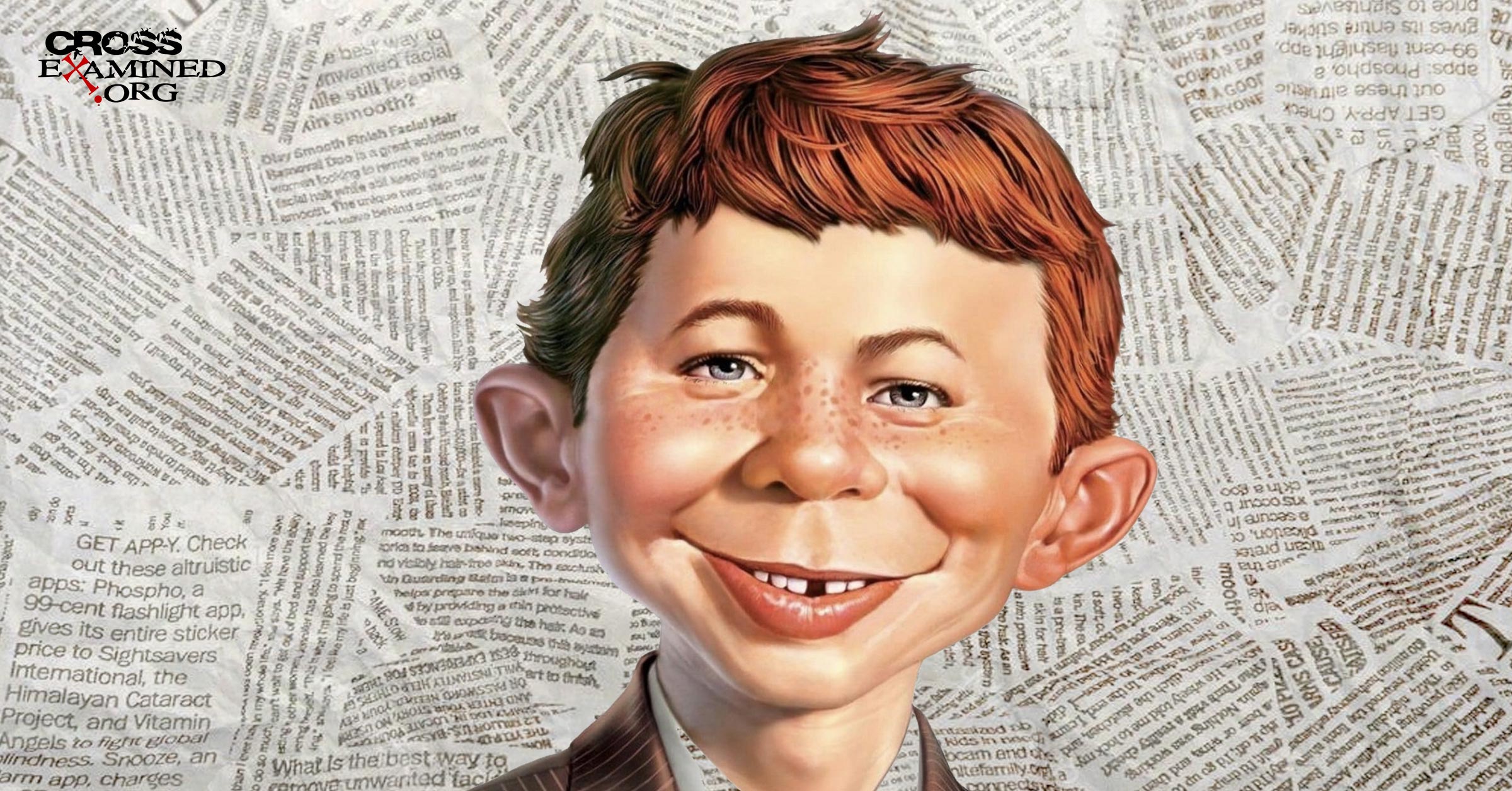
Alfred E. Neumann, the famous face of Mad Magazine for many decades, popularized this slogan. While he wasn’t referring to the question of salvation, this saying does seem to describe the way many people view that question today. Yes, there may be a God; they will concede. But “I’m not worried,” they say. “I’m a good person, after all, and God will judge me accordingly.”

In my last post, I considered one of the ways to address this modern mindset, by making the point that expecting God to grade on a curve may not be a smart bet. This time, I’d like to explore a different approach, by examining what people mean when they say they are “good” and why a God they never bothered to get to know should care.

We can be “good” at things that do not involve others. For instance, we can be good at building sandcastles or doing crossword puzzles. But usually, when we say we are good at something, we mean that our performance is meeting or surpassing expectations. While we might not be aware of it, we are sneaking in a standard against which we judge what we have done. For instance, if we’re talking about sports, we mean we possess the skillset, discipline, and experience necessary to play effectively and to win. If we’re dealing with academics, we mean that we are sufficiently bright, hardworking, and knowledgeable to demonstrate our mastery of the subject on the test or in the class we have taken. If we’re thinking about the work environment, we mean that we know what is expected in our role, and we have the skills, experience, and dedication to accomplish our goals.

In each of these scenarios, we are buying into a game that we know we did not ourselves create. Someone who came before us outlined the parameters of what was expected and set the rules. While new games, new challenges, develop over time, we seem to be built to intuitively look for the rules of the “game” and seek to compete. And while often there is a specific reward we have a mind, a moment’s reflection should demonstrate that we seem to be, by nature, hardwired to try to surpass a standard we know is there.

Pursuing this line of thought to the next step, what else do these ways of “doing good,” of surpassing expectations, have in common? In addition to measuring up to a standard deriving from some preceding standard-setter, they all involve some form of relationship with the one, or the group, that sets the standard. We measure the good based on what performance is expected of us by someone who is in charge and who, in the end, will measure the performance. Whether the ref, the teacher or the boss, if we really want to stand out as good – no, as truly excellent and worthy of praise and a reward – we’d be well advised to find out what the particular judge thinks qualifies as good. An Olympic skater waiting for the judges’ score has in mind a clear understanding of exactly what performance is being measured, and what gaffs or missteps would qualify as a failure. And, the more powerful the judge and the more important the competition or event, the more crucial it is to understand the standard and to get it right. After all, it’s more important for the employee or the prison inmate to understand what good means than the person who is trying to finish a crossword puzzle.

Now, of course, for any particular event or competition we have in mind, the only sure way we can know with certainty what qualifies as good is to get to know the one who will be judging the performance. However, successful in other areas of their lives, the modern secularist simply does not see the point in doing this with the ultimate question – why am I here and who or what put me here? They are not troubled by the apparent disconnect – why does it matter in every other pursuit in life but not to the central pursuit, the most basic and ultimate one regarding origins…and the ultimate destination. The modern secularist doesn’t know anything about the One who, in the end, will judge his performance, the One who is going to say whether all these so-called good works amounted to anything of value. More importantly, they don’t even care. How odd this seems, to be so concerned about being “good” at lesser things and not put any effort into asking the right question about the “whole thing.” No doubt if pressed, they would say that God hasn’t bothered to communicate the standard to them, hasn’t made Himself known in the right way. Perhaps they think that justifies not trying harder to see if this is true.

I suspect most nonbelievers expect that God if he is actually there, will appreciate all the “good deeds” they did over the years and be happy with them. Perhaps they are picturing a sort of cosmic subway station; their many good deeds over the years will act like coins in the gate, allowing it to swing open for them if they’ve guessed wrongly and there really is a judge awaiting their arrival.

Christians, by contrast, know that our good works don’t earn us admission into heaven. But the secularist isn’t thinking that way. When he tells you he is good, he means he expects God to see this as well. You should remind him that by his own standard, he may be in a bit more trouble than he thinks. The coins he is depositing are from a different realm, and they don’t work with the guardian of the gate. It’s actually the wrong currency.

Think of it this way: can I ask the teacher of a different class to give me an A based on the good work I am doing in my class? Can I ask your employer to pay me for the good work I am doing for my employer? Should I expect my friend to give my son an allowance for the chores he performs at my home? If you weren’t doing the work for someone you knew, the way you knew he wanted it, why would you expect to be compensated, let alone rewarded?

Why then should the secularist who knows nothing about God, and cares even less, expect God to recognize any of his works as good?

Recommended resources related to the topic:

Is Original Sin Unfair? (DVD Set), (mp4 Download Set), and (MP3 Set) by Dr. Frank Turek

What About Those Who Have Never Heard the Gospel? mp3 by Richard Howe 

Things that Cannot Negate the Truth of the Gospel CD by Alex McFarland 

Jesus, You and the Essentials of Christianity – Episode 14 Video DOWNLOAD by Frank Turek (DVD)

Is Original Sin Unfair? by Frank Turek (DVD, Mp3, and Mp4)

Reaching Atheists for Christ by Greg Koukl (Mp3)

So the Next Generation will Know by J. Warner Wallace (Book and Participant’s Guide)

How Can Jesus Be the Only Way? (mp4 Download) by Frank Turek


Al Serrato earned his law degree from the University of California at Berkeley in 1985. He began his career as an FBI special agent before becoming a prosecutor in California, where he continues to work. An introduction to CS Lewis’ works sparked his interest in Apologetics, which he has pursued for the past three decades. He got his start writing Apologetics with J. Warner Wallace and Pleaseconvinceme.com.

By Al Serrato

Your son walks in test paper in hand. You glance over and wince, seeing the big “60” in red ink at the top.

“Don’t worry,” he says, “I did good on this test.”

You ignore the faulty grammar. One problem at a time, you think, mulling over in your mind just how long you will ground him.

“No, really,” he persists, “you should have seen the other scores. Mine was really good!”

“Good,” you think out loud, “how can you call a sixty good?”

“Check it out,” he calls out over his shoulder as he walks away, “you’ll see.”

He’s seems confident, and he may have a point, so you call the teacher. After all, without knowing more about the class and the test, how can you really know?

After the call, you head to the family room, where you find your son on the couch, legs propped up while he’s staring at the tube.

“I’ve got good news and bad news,” you begin. “The good news is that you did, indeed, get the highest score in the class. Congratulations. The bad news is that you all flunked!”

What does this little parent’s nightmare have to do with apologetics? Well, the young man in this story bears a pretty strong resemblance to many of the secularists you will encounter today. They have a pretty strong intuitive notion that they’re doing pretty “good” on this little test called life, so if there is a God – and they’re not granting there is, mind you – well, they’re just not that worried about it. After all, they think they’re not doing anything really bad, like killing people or stealing, and more importantly, they’re just like the rest of the “class” – all of their role models, their friends, their acquaintances. Each of them can think of a gazillion others who would be much worse than themselves.

If you are trying to present the Good News of salvation to such a person, you might find them a bit less than interested in hearing what you have to say. Even if you are presenting an intellectually solid case, you may not get much traction. After all, you are in essence offering to tutor him when he thinks he’s already getting an A. Or, more precisely, you’re asking him to study harder, maybe do some extra credit homework, when he thinks he is simply auditing the class, or that everyone passes. He doesn’t need your answers, your solution to the problem, until he first begins to realize that he may well be “flunking” the class. This analogy, and others like it, can be a starting point to get the modern-day secularist thinking about what he may not have thought about before:

Just where did you get this notion that you will be graded on a curve?

The answer, no doubt, is that grading on a curve is particularly common in today’s culture. If it works for school – indeed, if it forms a part of the upbringing of most young people today – then why wouldn’t it also apply to life generally, and to the consideration of not just the next test but life’s ultimate test?

Let’s consider for a moment what lies behind such thinking. Generally, a teacher who grades on a curve is taking into consideration the difficulty of the subject matter and adjusting downward the grading scale.  If most of the class gets a 60 on the test, and if the test is particularly difficult, then what would otherwise be an F might, in fact, become an A.  This downward adjustment in grading seems to be increasingly common these days; it’s called “grade inflation.”  We can also see it in children’s sports, where an increasing number of kids receive trophies simply for showing up; where games that can only be won or lost by totaling up the points earned are no longer being scored; where, in short, young people are given the impression that holding themselves to a standard of excellence is not only unimportant, it isn’t even necessary. The focus has shifted from building skills and judging outcomes to shoring up what are believed to be fragile egos always in need of enhanced self-esteem.

But on a deeper level, this readjustment of what constitutes a “good” outcome has an intuitive appeal to most people.  After all, we are not perfect, so why should we expect ourselves to live up to perfect expectations? Isn’t that just a recipe for disappointment, depression, and despair? Isn’t it better instead to just be happy with ourselves regardless of what we actually accomplish with our time here on Earth?

Now I’m not saying that this way of thinking is always wrong. Being overly focused on success can be detrimental, both to the person who sets unrealistic goals of perfection for himself and for those with whom he collides in his effort to “be the best.” The issue, really, is to figure out which situation is which.

Consider: there are indeed some settings in life in which grade inflation makes no sense, in which a moment’s reflection should make us thankful that it does not.  The Navy runs a nuclear power school for its next generation of officers who will handle one of the most dangerous activities known to man.  If a particular class of students just isn’t up to snuff, flunking them and starting fresh with a new class makes perfect sense.  Similarly, would anyone want to fly with a pilot, or be operated upon by a surgeon, who really didn’t master the subject matter but got an A anyway?  In these areas, even if no one in the class can perform up to what is required, wouldn’t common sense still dictate that grading on a curve would be a very bad idea?

So what kind of class, then, is this thing we call human life, what test will we be taking, and what exactly does the “teacher” expect of us?  The “bad news” of Christianity, of course, is that a perfect God has some pretty high standards.  Far from grading on a curve, we are told that though many are invited, few are chosen.  In short, God is not adjusting downward when we fall short but is instead expecting – no, requiring – us to have a perfect score.  That’s why standing before God trying to impress him with your accomplishments and trumpeting your “goodness” is such a bad idea.  We’re dealing with a schoolmaster who not only is perfection; he also demands it. Any deviation, however trivial in our view, is an eternal offense against Him.

These reflections may make God seem… well, rather horrible. Does he take delight in catching each of our transgressions, like some sadistic teacher who, with rod in hand, is looking for any excuse to beat his students?  That’s how the message of Christianity comes across to an increasing percentage of the population today.

But it is not that way. To understand why, one must consider the underlying philosophy that helps us make sense of God and his attributes of love, justice, and mercy. God maintains all three despite the fact that, to us, these virtues seem to be irreconcilably in conflict. To maintain perfect justice, God cannot simply ignore our transgressions. These transgressions are not “mistakes” on our part; they are instead the use of our wills to think and act in ways that violate His laws. What we call “sin” are not those occasions in which we lack the skills or abilities to do a particular job, or to pass a particular test. No, they are those instances in which we intentionally do wrong, knowing that we are doing wrong because of the conscience that God imbedded within us. The punishment we face – the prospect of eternal separation from God – is a necessary consequence of his justice. He cannot simply accept us “just as we are,” because allowing lawbreakers to escape accountability and punishment for their misdeeds is unjust.

But we need not insist on having things our way. The good news of Christianity is that God, in His perfect love and mercy, provided us a solution. By taking the form of Man, He arranged a method through which justice and mercy could both be satisfied. Jesus, as both God and man, was the only being who could stand before God and not be in need of forgiveness, as he lived a perfect life. He then traded his righteousness for our sin, balancing the books in an eternal transaction that allows us to become pure again. More precisely, by accepting Christ into our hearts and lives, we ask God to do what he will not otherwise do and what we lack the capacity to do – fix the corruption of our will so that we can live in harmony with Him. God will not take away our free will, so he awaits our response to his gift of renewed life in His presence.  He will do a transforming work in us, making us ready and able to reunite with Him. Or, we can continue to shake our fist at God, die in our rebellion, and face eternal separation from him.

Either way, he will respect our choice.

Thankfully for us, we need not fear the final exam. We need not worry about the grading curve. God, the Son, has already taken the test for us and passed with a perfect score.  It is simply for us to place our trust in Him.

Recommended resources related to the topic:

Is Original Sin Unfair? by Frank Turek (DVD, Mp3, and Mp4)

Was Jesus Intolerant? by Frank Turek (DVD and Mp4)

Jesus, You and the Essentials of Christianity – Episode 14 Video DOWNLOAD by Frank Turek (DVD)

What About Those Who Have Never Heard the Gospel? mp3 by Richard Howe 

Reaching Atheists for Christ by Greg Koukl (Mp3)

By Al Serrato

Trying to explain how a good God created Hell can be a daunting task for the Christian apologist. In my last post, I considered the challenge that God could not be “good” if he created a place of “torture.” I tried to make the case that there is a difference between torture – which implies intentional infliction of punishment for the pleasure of doing so – and torment, which is the necessary byproduct of God’s legitimate act of separating Himself from those who have rejected Him, who died while still in rebellion against Him. A related challenge often encountered when discussing the doctrine of Hell is the seeming unfairness in endless punishment for what appears to be brief – in some cases, extremely brief – temporal actions. This challenge can put the Christian apologist on the defensive, trying to justify what seems on its face to be wildly excessive punishment. As I suggested in my last post, providing an intellectual response to such challenges may have limited effectiveness when dealing with someone who is approaching the issue from an emotional standpoint; logical answers don’t often make someone feel better about what is bothering them. But, in my experience, at any rate, I have found that some people insist that no intellectually satisfying answer is possible to a challenge such as this. So here goes…

The assumption underlying the challenge here is that there should be some correlation between how long the offending act took to commit and the punishment that is attached to it. The first step in responding is to recognize that from even a human, temporal perspective, the amount of time a crime takes to commit bears very little relationship to the length of punishment it merits. After all, a person’s life can be snuffed out in the wink of an eye, an act which, if committed with premeditation and deliberation, rightly merits a sentence of life in prison. If a person, consequently, spends 80 years in prison for a shot that took three seconds beginning to end, the math could appear a bit excessive. But, obviously, there is more at play when we consider this issue a bit more deeply. Focusing on the time the act took does not capture the essence or quality of the act that made it worthy of punishment.

Consider for a moment two men, each firing a single shot at his intended victim. The first uses a high powered handgun; the second, a plastic air pistol. Each involves a similar action – expelling a projectile from a pistol – and each takes no more than a few seconds. But the one-act, in that instant, stops a vibrant, beating heart, while the other only momentarily stings. We punish these acts differently because the harm of murder has nothing to do with the time it took to commit. No, while the trial may focus on proving what the shooter did, the reason we pursue the matter so earnestly is based entirely on the harm that was inflicted. The murder victim remains dead, after all, despite the fact that a moment earlier, he had every right to live until the point of his natural death, which may have been decades away. The sting of the pellet, on the other hand, causes no lasting harm and is soon forgotten. In a very real sense, every day of living, of planning, of enjoying the company of loved ones, that was ripped from the deceased amounts to a re-infliction of the harm. Moreover, the agony that is inflicted upon the victim’s family and friends will also last for decades. Indeed, many survivors of violent crime are never the same again, daily suffering from the mental trauma that takes root in the moments after the crime. From the killer’s perspective, the criminal conduct for which he suffers punishment may seem quite limited; he merely pulled a trigger and never felt the pain, physical or emotional, that ensued. But, the harm is anything but limited when viewed from the perspective of the victim or the victim’s family.

But, the challenger will respond, how does this possibly apply to God, and to the question of eternal punishment? God, of course, cannot be victimized. We cannot really harm Him, and I am not suggesting here that He suffers as a result of our conduct. But this misses the point. Christians believe that God provides a path to salvation. We do not need to suffer eternal torment in Hell. We are not chosen at random for such punishment. The issue of fairness is answered by the understanding that God has the right to separate Himself from people who have rejected Him.

That this punishment is eternal is the result of the fact that God is eternal, and he made us for eternity as well. Though our bodies will die, our souls live on. Let’s consider for a moment what this means: while we may have forgotten many, or even most, of the times that we erred, the times that we hurt others, the times that we did not live up to what was expected; He has not. Each of our sins, each of the times that we chose to act or think in a way we knew violated His perfect will, each of those instances may seem to be the distant past to us, but God is not limited by time. As an eternal being, He perceives every moment of our past as an endless, eternal present. Consequently, each of our offenses against Him, however incapable they are of injuring Him, is nonetheless eternally present to Him. How does He maintain the attribute of perfect justice if he does not attach a consequence to wrongdoing? A human judge would not be fair if she did nothing in response to crime; how does a perfectly just God ignore what we have all done?

These are harsh realities, and intellectual understanding does not make them easier to embrace. That is why Christians for 2000 years have also provided the good news. While we merit the separation that follows a life of rebellion, there is a means for salvation, through the life and death of Jesus, a means by which we can obtain forgiveness for our sins. In short, Hell awaits only those who persist in their rebellion, who “die in their sins.” And what does this phrase mean? Well, at the very least, it means that rather than seek the forgiveness offered by Jesus, we have instead chosen to ask God for a trial as to our lives. We have chosen to stand before God, unapologetic, demanding that He accept us just as we are, proud of our lives and our choices. Judge us and find us worthy, we demand. What choice does this leave to a perfectly just judge?

Seeing the issue from a non-temporal perspective places the issue in a different light: what else is there for beings who were created for eternity but who have rejected God’s offer of salvation? Thank God, then, that the eternal Son stands in the gap for us, with the power and the love and the eternal will to receive the punishment that would otherwise await us.

Recommended resources related to the topic:

Hell? The Truth about Eternity (MP3 Set), (DVD Set), and (Mp4 Download Set) by Dr. Frank Turek

Short Answers to Long Questions (DVD) and (mp4 Download) by Dr. Frank Turek

Was Jesus Intolerant? (DVD) and (Mp4 Download) by Dr. Frank Turek