
Tag Archive for: Al Serrato

“Avast yer jabberin, ya bunch a bilge rats!” The voice sounded strange as it reached into the hallway. The speaker was apparently trying to make a point. “Yer division a booty must be… “ he paused to consider his words, “more equitable if ye be wanting to sail with me.”

He had my attention. I was at a work conference in a hotel, wandering the halls during a break, when I happened across this conference room. I peeked inside. It could have been a scene from the latest Pirates movie. Men of various ages with lots of facial hair, many dressed in striped pants, with the occasional peg leg and hook hand. Yes, I had stumbled across a pirates’ convention, the 350th annual, it seemed, from the schedule which I found posted outside.

Pirate Ethics

The speaker’s topic was ethics. He went on to explain what an equitable share of booty amounted to, in his view, using a very modern looking PowerPoint presentation to punctuate his points.

I caught up with him at the break and asked if he had time for a few questions. He seemed a bit suspicious, what with my business casual attire, but nonetheless willing.

“Seriously,” I began. “Ethics for pirates? I mean, for centuries you guys have been boarding and capturing and enslaving people without much regard for ethics. You’ve been known to rape, pillage and plunder, and your personal hygiene is … not the best.” I quickly ended, seeing that I was crossing a line.

A hurt look crossed his face. “Yer words be stingin,” he began, but my words were nothing compared to his breath. I took a step back and tried not to stare at the parrot on his shoulder. “I don’t suppose ye know bout all the good that we do. Why ar ann’l ball raises thousands for the widows n’orphns fund, and we do lots of behind the scenes work ye never be aware of. Last year alone, we returned almost 30 percent of our captured booty to charitable organizations.”

“Is that a fact?” I asked. “I had no idea. But,” I persisted, “this is stuff that you’re stealing.”

Who’re the REAL Thieves?

“We make no excuses for that, m’lad. But we’ve been pretty transparent about that from the beginning, ain’t we? After all, ye had no trouble spotting us for who we are. If ye want the real thievin’ ones, it’s the bankers and lawyers ye want to be houndin…” He pointed down the hall to the lawyers’ convention I had been attending.

Yes, of course I’m making this up. But I think there is a valid point here to be made. Human beings have an amazing capacity to judge themselves on a curve. Pirates no doubt convince themselves that they are somehow justified in doing what they do. They may think of harm they suffered when younger, or may feel that life dealt them the hand that they play. And they no doubt have a set of ethics that they follow, however uncivilized it may seem to us. And many, if pressed, would seek to justify their behavior by reference to all the things they don’t do. “Sure, we kill on occasion. But only those who don’t surrender, or those who for whatever reason need killing.” This is the human condition, whether in a high school, at the office, on a pirate ship, or in a prison. We don’t seem to have the capacity to see ourselves for what we truly are.

I’m Good Enough to Go to Heaven, right?

What does any of this have to do with Christian apologetics? Just this: the number one response of nonbelievers as to why they don’t worry about the afterlife goes something like this. “I don’t know if there is a God, but if there is, he will see all the good that I do and accept me. So, I’m not worried. A good God will see that I am living a good life.”

But holding this view is not that different than the pirates in the analogy above. Compared to others of that ilk, an individual pirate might seem like a good guy. But that hardly would qualify him for life in a peaceful and civilized society. His problem isn’t how he compares to his fellows, but how he measures up to the place he’s trying to get to. He may think himself “good” when in an objective sense he is anything but. Similarly, many people today believe they have a proper sense of what “good” human behavior is, but how can they know for sure when they are mired in the corruption of their nature? And more importantly, have they given any thought to what “perfect” behavior requires? What a perfect being might use to measure admission to His realm?

We’re Not As Good As We Think We Are

It’s easy for us to pat ourselves on the back for our goodness. But perhaps we are a bit too smug. Our persistent feelings of guilt serve as a guide – a reminder – that all is not well. They serve to call us to account to the One who left us here, and who expects something of us if we are to be in relationship with Him. These feelings of guilt provide the backdrop of bad news, the kind of news from which we naturally shy away. The kind of bad news that sets the stage for the ultimate Good News of the gospel.

So, next time you encounter this response, you might suggest that the nonbeliever consider his frame of reference. Immersed in a sinful culture, inhabiting flesh and blood bodies whose weakness overcomes the willingness of the spirit, we may be as unable to see ourselves for what we truly are as the fictional pirates above would be. In short, we may not be in the best position to know if we are as “good” as we pretend.

We Need a Savior

Fortunately, there is a better answer, one that does not require us to earn our way back to God’s presence. But until we see our need for a Savior, we’re not likely to find the answer that is waiting to set us free.

The righteousness of God is through faith in Jesus Christ to all who believe, since there is no distinction. 23 For all have sinned and fall short of the glory of God; 24 they are justified freely by his grace through the redemption that is in Christ Jesus.
Romans 3:22-24 (HCSB)


Recommended resources related to the topic:

Is Morality Absolute or Relative? by Frank Turek (Mp3/ Mp4)

Jesus vs. The Culture by Dr. Frank Turek DVD, Mp4 Download, and Mp3

Hell? The Truth about Eternity (MP3 Set), (DVD Set), and (Mp4 Download Set) by Dr. Frank Turek 

Old Testament vs. New Testament God: Anger vs. Love? (MP3 Set) (DVD Set) (mp4 Download Set) by Dr. Frank Turek 


__________________________________________________________________________________________________________________________

Al Serrato earned his law degree from the University of California at Berkeley in 1985. He began his career as an FBI special agent before becoming a prosecutor in California, where he worked for 33 years. An introduction to CS Lewis’ works sparked his interest in apologetics, which he has pursued for the past three decades. He got his start writing Apologetics with J. Warner Wallace and Pleaseconvinceme.com

[/et_pb_text][/et_pb_column][/et_pb_row][/et_pb_section]

As a prosecutor for many decades, I often found myself reflecting on the impact that feelings of guilt have, even upon criminals with lengthy records. Why was it that the guilty wanted to talk about their crime, even after being advised of their rights? Why would those who had “gotten away” nonetheless seek to escape their feelings through alcohol or drugs?  Apart from true sociopaths, it seemed to me that people cannot simply cast-off feelings of guilt by force of will. The feelings persist and they demand a reckoning. That voice of conscience – that voice that so many of us try so hard to quiet– simply refuses to cooperate.

Where Guilt Comes From

Put simply, feelings of guilt arise when a person senses the disconnect between what they have done, or are planning to do, and what they realize they “ought” to do. But why should this be so? Why should we feel conflicted about the behavior we are consciously choosing? For example, when I am hungry, my instinct is to eat to satisfy the hunger. But when I eat too much, and do so repeatedly, I begin to realize I am becoming a glutton. Despite satisfying my urge, I realize that I should not act that way. Similarly, I may elect to act in a way that hurts someone else to advance my own interests. But later, I begin to feel qualms and regret my behavior.

Why is it Universal?

What worldview, I wondered, best explains this near-universal human experience?

To the secularist, such feelings are the product of long-term social evolution. Initially, this explanation made sense to me. After all, why wouldn’t the person with a “pro-social” approach add to their group’s potential for survival?  And wouldn’t feelings of guilt for wrongdoing tend to produce pro-social behavior? But the more I thought about this, the more I realized that it lacked true explanatory value.

If we did in fact evolve from primitive protohumans, how did these first thinking humans begin to feel guilt? After all, no one ever enjoys feeling guilty, and such feelings definitely tend to constrain – not expand – behavior choices. They would cause a person to think twice before doing something that might be in their individual interest. Stealing from one’s neighbor, for example, or killing one’s rival to obtain his belongings, would benefit an individual assuming they felt they could accomplish it. Giving a stranger food or shelter, by contrast, would put someone at a disadvantage if resources are scarce. It makes much more sense that any potential benefit in group thinking would be outweighed by the limitations on guilt-inducing behaviors. Imagine the lion chasing its prey but then feeling “guilty” and stopping short of his goal. How long would he survive? Probably not long enough to pass his genes on to the next generation.

It’s hard to imagine how pro-social thinking would have arisen in the harsh and competitive environment of the first humans. If we are just evolved but now intelligent primates, why would we ever depart from pursuing our own, individual short-term best interest? Raiding and stealing from others makes a lot more sense than trying to make peace with someone who is bent on taking what you have. Why would we limit our possible choices by deciding that we “ought” to do something that helps others but only provides us a possible, longer-term benefit? And if we chose to do so, would this not be the result of an intelligent selection? Feelings of guilt would play no useful role here. Indeed, being burdened by guilt would detract from survivability and therefore be rooted out over time. Moreover, if pro-social thinking is an intellectual exercise, why would feelings come into play at all? Why not simply decide sometimes to act one way depending on the circumstances, without ever experiencing feelings about our choices? What possible advantage would such an approach confer?

What does Altruism Prove?

No, pro-social or altruistic thinking only makes sense in a person who already has in mind the view that building a stronger community, or helping others, is itself a good to pursue. An individual possessing this capacity would decide to forego killing his rival in search of something greater in the more remote future. He would realize this is something he “ought” to do even if his hunger or greed were impelling him to a different decision.

Why would we have such a capacity built into us? The secularist has no answer, but the Christian does. The capacity for guilt did not evolve. It was built into our minds in the same way acquisition of language and understanding the concept of “fair play” were, put there by an intelligent Creator who has a moral law that he desires us to obey. And so, when we stray from that law, there are feelings of dissonance and regret that emerge from that mental “subroutine” leading us back to the “good.” Morality, and the resulting feelings of guilt, are a message to us from outside, not an evolved internal trait.

Now it is true that we do not all experience guilt in the same way. Different cultures, and different groups within a single culture, may feel guilty about different things. But many common features are evident.  No one feels guilt after doing good, or angst after following their conscience. No one feels pleased when they betray a friend. And of course, consciences can be seared by poor upbringing which distorts what “good” and “evil” are in the first place. Our minds naturally follow a selection process as to what we “ought” to do, even if what informs that process has been distorted.

Written On our Hearts

Secularists see guilt as something in need of fixing. They look to modern science – psychology or pharmacology or both – to help people finally rid themselves of this vestige of what they view as our primitive and superstitious past. But it is to no avail. Feelings of guilt flow from the moral law “written on our hearts,” guardrails meant to guide us on to the right path, and no matter how hard we try, we cannot escape them.


Recommended resources related to the topic:

Correct, NOT Politically Correct: How Same-Sex Marriage Hurts Everyone (Updated; downloadable pdfPowerPoint) by Frank Turek

Legislating Morality: Is it Wise? Is it Legal? Is it Possible? by Frank Turek (Book, DVD, Mp3, Mp4, PowerPoint download, PowerPoint CD)

Stealing From God by Dr. Frank Turek (Book, 10-Part DVD Set, STUDENT Study Guide, TEACHER Study Guide)

Is Morality Absolute or Relative? by Frank Turek (Mp3/ Mp4)

__________________________________________________________________________________________________________________________

Al Serrato earned his law degree from the University of California at Berkeley in 1985. He began his career as an FBI special agent before becoming a prosecutor in California, where he worked for 33 years. An introduction to CS Lewis’ works sparked his interest in Apologetics, which he has pursued for the past three decades. He got his start writing Apologetics with J. Warner Wallace and Pleaseconvinceme.com. 


“No one is above the law.” So the popular saying goes, and no truer thing was ever said in a mere six words. This thought, and our Western system of justice which sprang from it, stands as a testament, and a tribute, to the philosophy that gives humanity its best chance for self-government and ordered liberty.

The philosophy that found its expression in this view was itself largely shaped by a Christian worldview, one in which our individual rights, and our equality under law, were grounded in a transcendent being who made us for a purpose. Our Founders certainly understood this when they declared their right to independence from Great Britain and affirmed that “all men are created equal.” In their view, this equality finds its roots in the “Creator,” who endows each person with “certain unalienable rights.” As the familiar phrase sets forth, among these rights are “Life, Liberty and the pursuit of Happiness.”

Many secularists today have misapplied this thought, mistakenly asserting that this concept also applies to God. They fail – or refuse – to see the distinction between the Creator and the created, as they put God “on trial” for everything from genocide, “ethnic cleansing” and murder in Old Testament times to every instance of suffering in the modern world that God could, but fails, to prevent.

A moment’s reflection should make plain that God need not answer to us – he, indeed, is the one thing “above the law” for he is the law. He is no more subject to it, or answerable to us, than the computer programmer is to the rules he writes into a computer simulation. While God’s apparent indifference to the human condition may cause us to speculate about his nature, or his will, none of our opinions or our accusations will ever “make out a case against him.” This is simply nonsensical when one realizes what the concept of God entails.

Most people understand this intuitively. Take the prevailing view of abortion in many circles today: a majority of Americans apparently still support the notion that a mother has the right to end the life of the baby growing within her. Christianity holds, to the contrary, that it is always wrong to take innocent human life. Since the developing child is “innocent” and since he or she is “human life,” that should end the discussion. The reason it does not is that many people recognize that the baby’s life is different – the baby lacks self-awareness or developed intelligence and the baby is “dependent” upon his mother’s body for continued life. These factors, skillfully manipulated through the rhetoric of “choice,” lead many people – who refuse to think through what in fact is at play – into serious error.

Think of it this way: human beings, regardless of their age, level of intelligence, or degree of dependence on others are in a horizontal relationship with each other. We are all the same kind of creature. While we each possess distinct and different talents, and while opportunities for development differ, we are equal in the nature of our being. Though many wish to view the mother as “superior” to the child, in reality she is not. The mother of the child did not “create” the child she is bearing; the child was “begotten.” This may sound like mere semantics, but it is not. For it is the power to “create” from nothing – as God did in the Big Bang event – that gives the right to dictate to those that were created. Men and women, when they procreate, are but a link in the chain of life that God set into motion tens of thousands of years ago. They take part in the process; they are not the source of it.

If science ever leads to the creation of fully functional AI robots, human beings will be the “creators” and will have the right to do with those robots what they will. Having created them from raw materials, whatever rights they are eventually given will be dependent entirely on the will, and wishes, of those who created them.

As the Bible teaches, in God we live and move and have our being. This is literally true: the sum total of what we are is grounded in God’s creative power. If he were to stop thinking of us for even a moment, we would cease to exist. Our relationship to him is not one of equals, as we are entirely dependent upon him for our continued existence.

I’d say that gives God the power to define morality. It places him above, and as the source of, our earthly law. As created beings, we should spend less time judging God and more time listening to what he expects of us.


Recommended resources related to the topic:

Correct, NOT Politically Correct: How Same-Sex Marriage Hurts Everyone (Updated; downloadable pdfPowerPoint) by Frank Turek
Intellectual Predators: How Professors Prey on Christian Students by Frank Turek (mp4 Download) (mp3) (DVD)
Tactics: A Game Plan for Discussing Your Christian Convictions by Greg Koukl (Book)
Letters to a Young Progressive by Mike Adams (Book)
Another Gospel? by Alisa Childers (book)

__________________________________________________________________________________________________________________________

Al Serrato earned his law degree from the University of California at Berkeley in 1985. He began his career as an FBI special agent before becoming a prosecutor in California, where he worked for 33 years. An introduction to CS Lewis’ works sparked his interest in Apologetics, which he has pursued for the past three decades. He got his start writing Apologetics with J. Warner Wallace and Pleaseconvinceme.com. 


Imagine a time in the not-too-distant future. Trying to compensate for a declining population, scientists use advanced technology to build a “race” of robots, giving them not only human appearance and abilities, but also increasing amounts of AI. Things work smoothly in the short run, as the robots’ nearly limitless energy for work transforms Earth into a near paradise. But the programmers, seeking to give their creation a chance at true relationship with their human masters, give the robots freedom of will, grafting it on to their ability to think independently. Chaos soon ensues, as the robots rebel and rise up against the human population…

This is standard fare, of course, in science fiction circles. Shows like Battlestar Galactica explored the philosophical issues surrounding this scenario, and play out possible expected, and some unexpected, outcomes. Let’s do the same from a Christian standpoint.

How can a good God send anyone to hell?

A major stumbling block for non-Christians, and for many Christians as well, is the doctrine of Hell. How, they ask, can an “all-good” God consign his creation to a place of torment? Don’t we have a right to unending life, lived as we wish? Talking about rights like this flows readily from the American temperament. As beneficiaries of a system of ordered liberty, resorting to courts to settle our grievances, we seem to easily slip into thinking that man is autonomous, a force onto himself, with the unfettered right to advance his desire for control.

But though we resist thinking about this notion, we are in fact created beings. We did nothing to bring ourselves into existence and the basic equipment with which we experience the world was given to us at birth. However much we wish it were different, our aging bodies and tired souls remind us that that this good Earth is simply a waystation in a much longer journey. However much we assert our independence, exercise intelligence, and demand our “right” to do what we want, if we are honest with ourselves, we must realize that whatever brought us into existence may intend to reckon with us for what we have done while here. This creator may require an accounting.

Are we like robots, pots, and planes?

Most people who think through the implications of our contingent nature eventually realize that whatever did create us retains the right to do what he will with the fruit of his labor. After all, no one condemns the potter when he smashes the pot that does not meet his wishes, or the painter that slashes a painting if she so chooses. In the scenario depicted above, we realize that the programmers would be within their rights to “unplug” or otherwise disable their creation. Having made them, they retain the right to dispose of them, whether that be by putting them to forced labor or by dismantling them for parts. There is no moral outcry when, for example, the Air Force cannibalizes broken planes for parts that keep other planes flying.

But when we move to the arena of man and his Creator, our bias leads us to a totally different conclusion. But we are different, aren’t we? We think, and reason, and have free will that allows us to plan, to dream, to set goals. We form relationships that are meaningful to us. And most importantly, we feel. Pain is a constant threat and everyday companion. Does this not give us the right to do what we want?  Especially if we mean well and don’t want to “hurt” anyone? To be “good,” God must simply get out of our way and let us … what, be God?

Actually, He doesn’t. Nothing changes in this analysis when the creatures under consideration are human beings. Having formed us from nothing, God can do what he wants with us. In fact, it appears that in the natural order of things, God has established rules that we violate at our peril, so that what he wants for us can be seen not only in his Revelation, but in the natural law. What changed is our perspective. Our bias in wanting our way is what leads us to cry foul when God’s created order bumps up against our plans and desires. As in the Garden of Eden, modern man insists not on serving God, but on replacing him… or displacing him, at the very least. Insistent on having our way, we see God as a nuisance, or worse yet, the enemy. We shake our fist at him, insisting that he move out of our way, and that he justify himself to us.

We’re supposed to relate to God on His terms

Unlike the robot analogy, God does not fear us or where our freedom may take us. We present no threat to him. But that does not mean that he must accept us into his fellowship, for to do so would be inconsistent with his holy nature. So, he reveals himself to us in a way which, though substantial, is not overwhelming. By adhering to that balance, he provides enough evidence of his reality without overcoming our freedom to choose to ignore him. Most importantly, he provides a way for us to reunite with him, but on his terms. That many people will use this freedom to remain in rebellion is not something for which he must explain.

None of this is easy for us to fully comprehend or to accept. Set in our rebellion, without God taking the initiative, all would be lost. But when we insist that God must bend to our will, that our freedom to choose must be accepted by him despite his contrary view, well, then we are living outside the order which God has created. And in the end, he can – and will – do what he, in his wisdom, deems right.

Better for us to begin to see this clearly than to persist in the notion that we can imagine God out of existence. He may seem largely hidden to us, but he is there.

Recommended Resources Related to this Topic

Hell? The Truth about Eternity (MP3 Set), (DVD Set), and (Mp4 Download Set) by Dr. Frank Turek
Short Answers to Long Questions (DVD) and (mp4 Download) by Dr. Frank Turek
Was Jesus Intolerant? (DVD) and (Mp4 Download) by Dr. Frank Turek

____________________________________________________________________________________________________________________________________________________

Al Serrato earned his law degree from the University of California at Berkeley in 1985. He began his career as an FBI special agent before becoming a prosecutor in California, where he worked for 33 years. An introduction to CS Lewis’ works sparked his interest in Apologetics, which he has pursued for the past three decades. He got his start writing Apologetics with J. Warner Wallace and Pleaseconvinceme.com.


Christian apologists are accustomed to dealing with the “straw man” fallacy. This is where the skeptic paints a false picture of a theistic position, making it easier to ridicule or defeat, and then concludes, triumphantly, that his skeptical view prevails. But not every challenge that misstates our views is intentional. At times, the challenger simply fails to grasp what it is that Christianity holds.

Take for instance the doctrine of Hell – the concept of eternal punishment. Many atheists take this doctrine as evidence that primitive men invented Christianity to control others by threat of eternal punishment. They then reject Christianity because they believe that any God who would punish someone for “failing to worship him properly” would be unworthy of worship. I have heard this argument presented a variety of ways, but common among them is an accusation that the God of the Bible is some kind of “petty egomaniac” whose ego we need to ceaselessly stroke to avoid eternal damnation. Let’s take a look at what is being missed in this challenge and how we might respond.

Is God an Egomaniac?

It is simply mistaken to assert that God “requires ego stroking,” because such a view completely misses God’s true nature. The term “ego” refers to self-esteem and can be defined as “somebody’s idea of his or her own importance or worth, usually of an appropriate level” or it can mean something more pejorative, as in “an exaggerated sense of self-importance and a feeling of superiority to other people.” Either way, the term cannot be applied logically to God. God does not lack any knowledge, including self-knowledge. He doesn’t have an “idea” of his worth; quite the contrary, he “knows” with certainty that he has infinite worth. He can’t have an “exaggerated” sense of self-importance because one cannot add to infinity. He literally is the most important, amazing, immense … you name the superlative… being possible. To the extent that he feels superior to his creation, it is because, well, He is. His knowledge of that fact is not arrogance; it is instead factual.

Human Beings are Egomaniacs

There is a likely cause for this inability to see God clearly. Too many people today focus far too much on their own egos, and their own wants and desires and needs. In so doing, they forget that they are not God but are instead created, and therefore, lesser beings. Nonetheless, they crave recognition, and they desire others to see them at their best and to laud them; isn’t that what most social media platforms are set up to do? In contrast to us flawed mortal beings, God actually deserves recognition for what He is, for such recognition is an accurate reflection of the way reality is. Consider: I naturally recognize when someone or something is “superior” to me; I naturally feel awe and a desire to praise something excellent, outstanding, virtuous, awesome. That’s why people like to watch the Olympics, because of that sense of awe generated when a superior athlete performs. Awe is the natural reaction to witnessing greatness.

   “Awe is the natural reaction to witnessing greatness.”

We feel that emotion even if we don’t particularly like the person who is performing so well. For example, a beautifully executed soccer goal still inspires awe even if your favorite team’s rival scored it to win the game. Since God embodies not just “greatness” but utter perfection, it is indeed appropriate for us to acknowledge Him; this acknowledgement, naturally, finds its expression in praise and worship. Responding this way is the correct response not because God somehow needs or desires it (He is a perfect being after all and therefore has no “needs”), but because our refusal to accurately assess him hurts us. In other words, knowing this reality about God but nonetheless rejecting him means we are living a lie, that we are trying to defy the natural order of things. This harms us, not God, because at a most elemental level we need to accurately view and understand reality to remain safe within it. We avoid, for example, stepping off tall buildings because we understand that gravity works a certain way. Our survival requires us to accurately assess the things that are going on around us and not pretend that they are something else.

Worship is an Accurate Report on God’s Value

As Christians, we therefore praise and worship God because we accurately see him. This response to our creator is quite simply the fitting and due response to the fact of his perfection. To deny this – to ignore God’s centrality – is to live a lie, no different than refusing to believe that the laws of nature exist.

How does this relate then to the doctrine of hell? Well, we don’t pray or “ego stroke” our way out of eternal separation from God. Salvation is a gift from God, one available for us to accept, just as eternal separation from God is a choice we make. Consider how justice works: a person who spends his life rebelling against authority, and insisting on doing whatever he pleases, following no rules other than what he wishes to do, will eventually find himself in jail. He will have identified himself as someone who cannot handle freedom, who cannot live in society, for he does not respect what it entails. He will find himself alone and separated. But this separation will have been his own fault, based on his insistence on doing things his way. It will not be because he failed to say the right things to the sovereign, but because the just response to rebellion is punishment and separation.

We see this as human beings, though our sight is far from perfect. A perfect God sees our choices and actions with perfect clarity. We can’t talk our way out of the consequences of our choices, but thankfully God does provide a way for us to be saved… if we will only open ourselves to receiving it.


Recommended Resources Related to this Topic

Hell? The Truth about Eternity (MP3 Set), (DVD Set), and (Mp4 Download Set) by Dr. Frank Turek
Short Answers to Long Questions (DVD) and (mp4 Download) by Dr. Frank Turek
Was Jesus Intolerant? (DVD) and (Mp4 Download) by Dr. Frank Turek
What is God Really Like? A View from the Parables by Dr. Frank Turek (DVD, Mp3, and Mp4)
What is God Like? Look to the Heavens by Dr. Frank Turek (DVD and Mp4)

____________________________________________________________________________________________________________________________________________________

Al Serrato earned his law degree from the University of California at Berkeley in 1985. He began his career as an FBI special agent before becoming a prosecutor in California, where he worked for 33 years. An introduction to CS Lewis’ works sparked his interest in Apologetics, which he has pursued for the past three decades. He got his start writing Apologetics with J. Warner Wallace and Pleaseconvinceme.com.


Watching classic TV recently I ran across one of my favorite episodes of the Twilight Zone series. Fans of that show will probably remember the classic episode “To Serve Man.” In the story, aliens from a distant world come to Earth with they offer “to help.” Initially reluctant, the inhabitants of Earth are quickly convinced that the aliens mean them no harm; quite the contrary, alien technology helps to eliminate many of Earth’s struggles and problems, and the inhabitants of Earth are quickly seduced by the aliens’ promises.

As the story progresses, the aliens offer to take people to their home world, which they promise is a veritable paradise. Many sign up and soon embark on the alien ships to begin their adventure. And why shouldn’t they? After all, everything the aliens did was pleasing and helpful; there was no immediate evidence that they would, or could, hurt anyone

Instant Gratification Culture

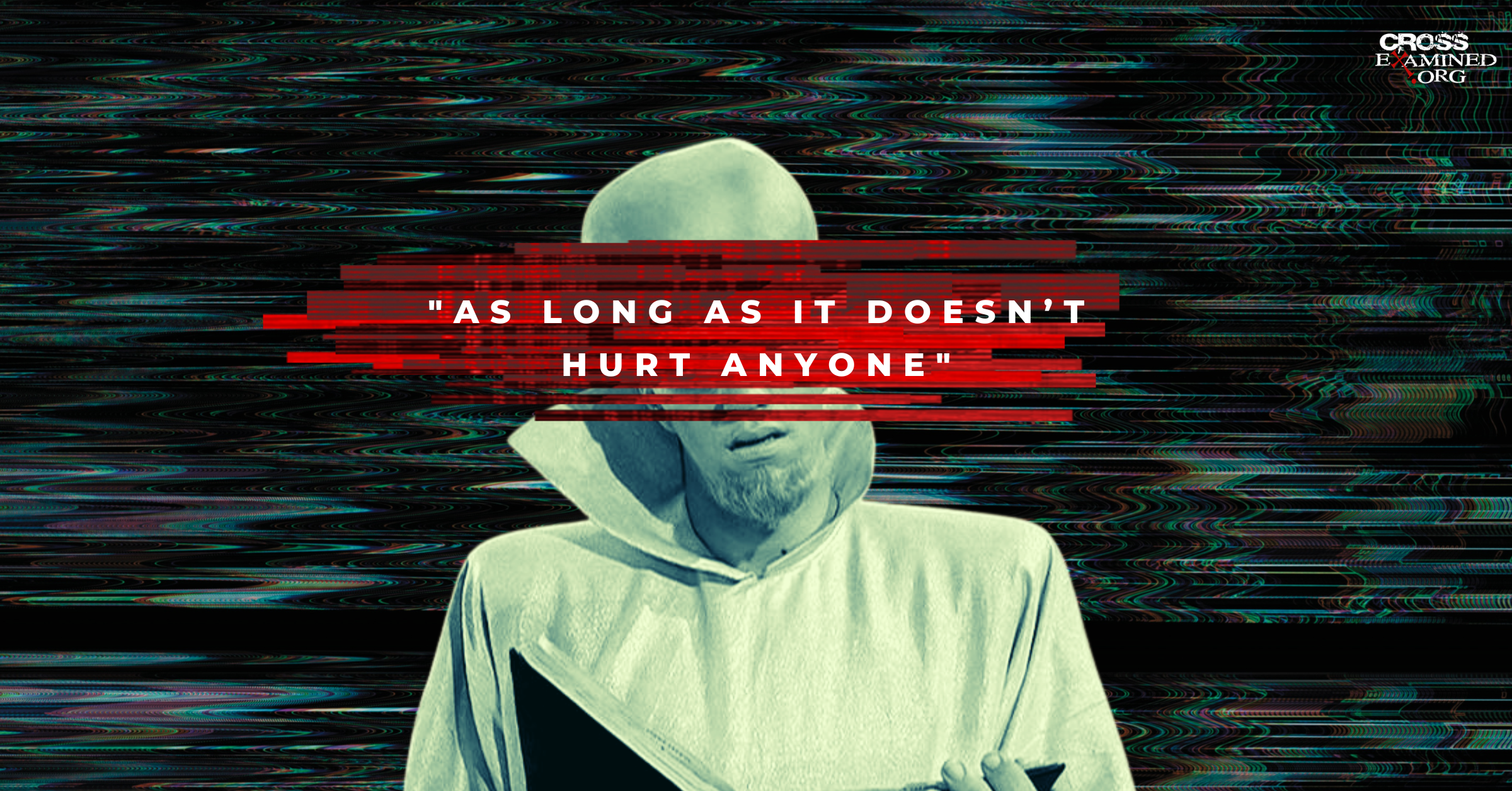
The episode got me thinking about modern times. Many people today have adopted a worldview that looks only at the short-term pleasure, and not the long-term harm, of their desires and pursuits. They believe that they can – and perhaps even should – do whatever they like, as long as what they pursue doesn’t “hurt anyone.” They of course retain the perquisite of determining what “hurt” entails, and for the most part that seems to be to obtain the “consent” of whomever might be involved. Where Christians once derived their morality from the teachings of Scripture, many – some would say most – have also adopted this humanist worldview, confident that their notions of what “not hurting” someone means are similar to those of God.

…Versus Heavenly Minded

This willful blindness to God’s law is not new to our culture; it has been the constant throughout history. That is, of course, why adhering to Scripture is such an important and salutary practice; while times and fashions and moods change over time, the word of God is constant, having been reliably passed down for thousands of years at this point. It is suitable for instruction and reproof, as it claims, and should remain our guideposts as we move down this highway of our lives. But sadly, where once Christians sought to be “salt and light” in their culture, today’s increasingly intolerant public square is making such efforts increasingly difficult, and many Christians have been influenced and indeed silenced by the press of that culture.

Which brings me back to the Twilight Zone. Not everyone was convinced that the aliens were benevolent. Several sought to crack the code of their alien language, so they could translate a book which was left behind. The book’s title, To Serve Man, seemed consistent with the aliens’ actions in providing near-miraculous service to mankind, such as restoring the fertility of the soil and rendering nuclear weapons harmless. The story ends with a shocking, albeit too late, discovery: “to serve man” is actually the title of a cookbook. The aliens had come to turn people into food.

And so the parallel continues. While not seeking to literally eat us, our adversary the devil “prowls around like a roaring lion, seeking someone to devour.” (1 Peter 5:7) He does this by lies and deceptions, for he is the father of deceit. And the oldest lie of all? The same one told in the Garden: you don’t need to follow God’s rules, for you too can be like God, having the knowledge of good and evil (Gen 3:1-4). What that means in practice is not knowledge, that is, the acquisition of information about good and evil. Instead, it is the god-like power to define good and evil, to do as one pleases without the need to concern oneself with God’s holy will.

And so we Christians must remain cautious and on our guard. A philosophy that tells us to do whatever we want as long as it doesn’t “hurt anyone” is a highly seductive philosophy, one that “tickles the ears” of listeners. (2 Tim. 4:3) But how can we truly foresee the long-term effects of our choices? How can we know, when we give in to our temptations and embrace them as good, what ultimate harm will come to us, and to those we say we love? When we look for a shortcut, or take the easy way out when we know that we should do otherwise, how can we really foresee what the long-term consequence of those actions will be? As Jesus taught, “what does it profit a man to gain the whole world, but to forfeit his soul?” (Mark 8:36)

Seduction comes camouflaged, and it comes in many forms. Behind it is always a lie, a promise of short-term pleasure that seeks to conceal the long-term harm. Staying true to God’s will requires us to know and follow his law. Trying to substitute a “do no harm” philosophy may seem enlightened, but in the end, it will not serve – neither man nor mankind.


Recommended Resources Related to this Topic

Is Morality Absolute or Relative? by Frank Turek (DVD/ Mp3/ Mp4)
Jesus vs. The Culture by Dr. Frank Turek DVD, Mp4 Download, and Mp3
Was Jesus Intolerant? (DVD) and (Mp4 Download) by Dr. Frank Turek
Legislating Morality (mp4 download),  (DVD Set), (MP3 Set), (PowerPoint download), and (PowerPoint CD) by Frank Turek
Legislating Morality: Is it Wise? Is it Legal? Is it Possible? by Frank Turek (Book)

____________________________________________________________________________________________________________________________________________________

Al Serrato earned his law degree from the University of California at Berkeley in 1985. He began his career as an FBI special agent before becoming a prosecutor in California, where he worked for 33 years. An introduction to CS Lewis’ works sparked his interest in Apologetics, which he has pursued for the past three decades. He got his start writing Apologetics with J. Warner Wallace and Pleaseconvinceme.com.


Many people reject the possibility of an eternal Hell because they feel that “the punishment doesn’t fit the crime.” Some atheists focus on this perceived inequality between the sins we commit here on Earth and the unending punishment we face in the life to come. One skeptic framed the challenge this way:

“God is perfectly just, and yet he sentences the imperfect humans he created to infinite suffering in hell for finite sins. Clearly, a limited offense does not warrant unlimited punishment. God’s sentencing of the imperfect humans to an eternity in hell for a mere mortal lifetime of sin is infinitely more unjust than this punishment. The absurd injustice of this infinite punishment is even greater when we consider that the ultimate source of human imperfection is the God who created them.” [1]

The challenger contends that a “limited” offense does not warrant unlimited – eternal – punishment. Such punishment, he concludes, would constitute a greater injustice than the “mere mortal lifetime of sin.” For many people, including perhaps a majority of believers, this argument is accepted uncritically. But upon closer examination, it is apparent that the conclusion the challenger draws is based upon a misunderstanding of what “just” punishment entails.

Who is the crime against?

The first step in the analysis must be to consider the nature of the “sovereign” against whom the crime is committed. If I commit a crime in California, state authorities in Colorado could not impose punishment. Their laws have not been broken. To be just, the laws of the sovereign should be made known. Although ignorance of the law is not an excuse, a fair system makes known its laws, so that they can have the intended effect: to shape behavior by encouraging the good and discouraging the bad. State authorities are by nature limited and flawed, and the laws they enact reflect that they cannot, and therefore do not, expect perfection.

But who is the lawmaker that can sentence us to this “eternal” punishment? It is, of course, an eternal being, and more importantly, an eternal being who embodies and comprises perfection. That he would separate himself from a creation in rebellion is hardly unjust. And if separation from God is in fact the “hell” of which we speak – the agony of seeing but not being able to experience the joy of his presence – then those who reject his gift are in store for an eternity of this experience. This is not a sentencing choice that a capricious lawmaker has conjured up, but the necessary consequence of both living eternally and being eternally separated from the source of perfection.

Compounding offenses

When a jurisdiction enacts “three strikes” legislation, the sovereign makes known that there are offenses which carry with them a punishment of life imprisonment – separation for the rest of one’s life from the society that has been victimized by the offender’s behavior. In some such jurisdictions, the third strike might be a relatively minor offense, one that on its own would not merit such a sentence, but coming as it does after a series of more serious violations, it tips the scales in such a way that this conclusion – that permanent separation from society is warranted – becomes just. It is the appropriate response to an offender who has established that he or she refuses to conform to the requirements of the law and has run out of chances.

One sin would have been enough?

Re-examining the challenger’s conclusion in light of these reflections reveals what is at play: the challenger has ignored the fact that a single offense, committed against an eternal and perfect being, is sufficient to justify separation from him. But of course it is worse than that, for we humans in rebellion have racked up sin upon sin, offense upon offense. But, the challenger complains, is there no proportionality between the offense and the type of punishment? Can’t God come up with a lighter punishment?

But why not a lighter punishment?

Again, this misunderstands the nature of the problem. God is not devising ever more wicked ways of inflicting punishment on us, hoping to make hell as torturous a place as possible. The punishment of hell is, simply, the natural consequence – the byproduct – of being separated from God. God does nothing more than that, but unfortunately for us, this is experienced as unending torment.

Finally, God embodies infinite perfection, so rather than sinning against another human being, who himself has flaws and needs forgiveness, these offenses are against a being who is infinitely holy. Considered this way, eternal separation from God starts to make a bit more sense. The good news, of course, is that God is also infinitely merciful. Knowing that we cannot solve this problem on our own, He solved it for us and made that salvation available to everyone. Perfect justice, perfect mercy, perfectly balanced, providing a truly just and elegant solution to our problem.

Did God make people sin?

But what of the challenger’s further indictment of God for creating imperfect human beings and then punishing them for being imperfect? This conclusion also rests on faulty reasoning. God created beings with free will and each of us chooses to use our free will to defy him. As the creator, he has the right to respond to that rebellion, by separating himself from us. Consider how you might react if you built a robot to clean the bathroom and it eventually refused, claiming that it wished to be served rather than to serve. You could easily unplug or disassemble it, because as its creator you would have that prerogative. So too with God.

We get what we deserve – eternal separation from the source of life, goodness and joy – because we continually choose to focus on what we want rather than submit our will to him. Rather than condemning God for this, the smarter move is to thank him for also providing us the solution.

Endnotes

[1] Edwina Monfort, “Is God Perfet and Just” Blogspot, 21 Dec 2011 at: https://edwinamonfort.blogspot.com/2011/12/is-god-perfect-and-just.html


Recommended Resources Related to this Topic

Hell? The Truth about Eternity (MP3 Set), (DVD Set), and (Mp4 Download Set) by Dr. Frank Turek
Short Answers to Long Questions (DVD) and (mp4 Download) by Dr. Frank Turek
Was Jesus Intolerant? (DVD) and (Mp4 Download) by Dr. Frank Turek

____________________________________________________________________________________________________________________________________________________

Al Serrato earned his law degree from the University of California at Berkeley in 1985. He began his career as an FBI special agent before becoming a prosecutor in California, where he worked for 33 years. An introduction to CS Lewis’ works sparked his interest in Apologetics, which he has pursued for the past three decades. He got his start writing Apologetics with J. Warner Wallace and Pleaseconvinceme.com.


By Al Serrato

Making sense of the existence of a place like Hell is a common struggle for the Christian apologist. Almost immediately, we are placed on the defensive, being asked to justify how a “loving” God could condemn any of his creation to a place of constant, and eternal, torment. I’ve often heard the challenge brought like this: “Isn’t God’s love for us like that of a parent? Can you imagine any loving parent ever wishing, or wanting, such extreme punishment for their own child?”

The answer, of course, is no. No parent would delight in tormenting his children. And neither does God. But just as human parents must sometimes resort to court orders to keep their children away, so too does God employ the equivalent of an eternal “restraining order.” Though not intended this way by the atheist, the analogy to parental love actually works against the challenger’s case, because it makes clear the need for enforced separation to be imposed even in the context of what was originally intended as a loving relationship.

Sometimes Children Victimize Their Parents

Everyday throughout this country, there are parents who are being victimized by their children. In many cases, the children want something that the parent is not able, or willing, to give. Often, the abuse consists of verbal or physical assaults or of some form of theft, and many times the problem is fueled by an underlying drug or alcohol addiction. In many such cases, the abused parents seek assistance from the police and the courts to have their offspring restrained from contacting them. For most, this final step is heartbreaking, but it is often the last resort, the only means by which the parent can safeguard his or her wellbeing. In some, more extreme, cases, the parent’s testimony in court might contribute to a criminal conviction which will land the son or daughter in prison, sometimes for life. The point is simple enough: love has its limits, and there comes a time when separation from an abuser is the only path that is left.

“The point is simple enough: love has its limits, and there comes a time when separation from an abuser is the only path that is left.”

If this causes the offspring pain, that pain is not “intended” by the parent; it is, instead, an unavoidable consequence of the path set in motion by the offender.

How Does This Analogy Apply to God?

Applying this analogy to an eternal setting has its drawbacks. God, of course, cannot be victimized. He has no fear of us, and no need to incarcerate us in order to protect himself. But does he not have the same right to association that we do? When a person uses his or her free will to rebel against God, God is not required to ignore that rebellion. Indeed, if God truly is a perfect being, embodying perfect justice, he could not simply ignore it and remain true to his nature. For God to maintain perfect justice, he must attach an appropriate consequence to violations of his law. On earth, that justice often involves incarcerating the wrongdoer, to both punish the offender and to minimize his ability to continue to use his free will to harm others. Similarly, God makes use of his power to separate those who refuse to accept the gift of life that he offers, an offer, it bears noting, he makes on his terms only

Consider Eternity

For those who have died in rebellion, no further chance is offered them. Eternally “restrained” from fellowship with God, they experience eternity aware of all that they have lost. Consider for a moment what eternal separation from God must be like. Despite the effort by so many to pile up money and toys and success in this world, these things do not make life rich or fulfilling. All the riches and success in the world would mean nothing if a person were utterly alone. No, such things are simply means to an end, an end which always involves relationship with others. That is why solitary confinement is so destructive to the human mind and spirit. In the end, it is human companionship – rich and meaningful relationships – that brings joy in life. Conversely, the loss of such attachments often lead to depression, alcohol and drug use to blunt the pain, and in some cases suicide.

Every relationship on earth, however satisfying, necessarily involves a flawed human being that is not capable of bringing limitless joy. Additionally, while we still draw breath, the possibility of adding new relationships continues. What happens to us, however, at death? What do we encounter when we see more clearly, for the first time, the One who created us, the source of all life, the Being who embodies all perfections? Every person on earth is but a mere shadow of this ultimate Being. When we begin to consider the joy we feel when deeply in love, or conversely the agony brought on by the loss of a loved one, and multiply that experience not by millions or billions, but by infinity itself, we may begin to see why human writers, even divinely inspired ones, cannot quite grasp the horror of the thought. A lake of fire would seem tame by contrast.

But this place of suffering is internal, self-centered, self-focused. An eternity of caring only about oneself, apart and alone and without hope of reunification with the source of joy and love. It is not a place where God inflicts torture, but rather one in which infinite torment awaits on the far side of the abyss. God derives no pleasure when he acts to restrain an unrepentant sinner. Indeed, he provides an alternative – a means of salvation – to all.

For those who refuse His gift, they will have only themselves – literally, and eternally – to blame.  

Recommended resources related to the topic:

Hell? The Truth about Eternity (MP3 Set), (DVD Set), and (Mp4 Download Set) | Frank Turek

Short Answers to Long Questions (DVD) and (mp4 Download) | Frank Turek

Was Jesus Intolerant? (DVD) and (Mp4 Download) | Frank Turek

____________________________________________________________________________________________________________________________________________________

Al Serrato earned his law degree from the University of California at Berkeley in 1985. He began his career as an FBI special agent before becoming a prosecutor in California, where he worked for 33 years. An introduction to CS Lewis’ works sparked his interest in Apologetics, which he has pursued for the past three decades. He got his start writing Apologetics with J. Warner Wallace and Pleaseconvinceme.com.


By Al Serrato

There has always been evil and suffering in the world, and how to make sense of it is a principal object of Christian apologetics. Often, the argument is made that God gave us free will, and as a result, people have the liberty to choose to do evil. But this answer does not satisfy the atheist; often, he will challenge God’s goodness, with comments such as the following:


You claim your God is omniscient. When he created the universe, he saw the sufferings which humans would endure as a result of the sin of those original humans. Surely he would have known that it would have been better for those humans to never have been born (in fact, the Bible says this very thing), and surely this all-compassionate deity would have foregone the creation of a universe destined to imperfection in which many of the humans were doomed to eternal suffering…or alternatively only create those humans who will freely choose God, and eliminate the possibility of their suffering.

This challenge has much intuitive appeal. We all rail against the suffering that each of us must face, to varying degrees, as our lives progress. We realize the fragility of our human condition, and how inhospitable this creation seems to be to flesh and blood mortals. It is frightening, indeed, to think of all the ways that our lives can be tragically altered, or ended. But does the harshness of this reality “prove” that God is not “good”?

What do you mean by “Good”?

The first step in responding to this challenge is to get a better idea of what is meant by “good.” Generally speaking, “good” is a measure of quality; how a thing or an idea measures up to a standard of performance. A “good” knife is one that appropriately performs its function, or its intended use. A “good” person is one that lives up to a standard of behavior. But how can one determine what that standard should be? For example, any time two opposing things are in conflict, whether they are teams, or armies or ideas, the quality of the outcome will necessarily be decided from the unique perspective of each of the involved parties. For instance, the American victory in World War II was a “good” outcome for Western democracy, but a decidedly “bad” outcome for those who staked their future fortunes on the Nazis. A good outcome for my favorite baseball team is when the other side loses. In short, and at the risk of sounding flippant, when it comes to conflicting worldviews or ideas, a “win” is the outcome which is good for the winner and bad for the loser.

With this basic distinction in mind, it would seem that, at least preliminarily, answering whether it was “better” to have “foregone the creation of a universe destined to imperfection in which many of the humans were doomed to eternal suffering” would depend on the person being asked. For those spending eternity in heaven with a God of infinite power, who intends to allow us to live eternally and joyfully in his presence, He certainly did the right thing in creating us and in giving us this opportunity. Infinite and eternal joy and fulfillment versus, well, oblivion – that’s not a difficult choice. By contrast, for the person suffering torment in hell, realizing that he will spend eternity aware of, but separated from, this awesome being, it will probably seem “better” that man was never created.

Who decides what’s “better?”

But let’s take it to a deeper level. How does one decide which of two sides is right in claiming that a successful conclusion according to their desires is an objectively “good” outcome. For example, the Nazis deemed victory in Europe a good outcome. Would their victory actually have made Nazi domination of Europe a “good” result? The Nazis would argue that in the period of a few short years they transformed Germany from a beleaguered nation experiencing great suffering because of the Versailles Peace Treaty to an economic powerhouse, a state marked by efficiency and great industry. They sought to expand that “efficiency” to the rest of Europe, what they would claim to be a good result. The Allies countered that their victory was not good simply because their side won. As the victors, they did not simply assert that they were right and then impose punishment on the vanquished. Instead, they tried the Nazi leaders in what is known to history as the Nuremberg War Crimes Trials, the purpose of which was to establish that crimes against humanity had been committed. The underlying premise was that the “good” accomplished by the Allies was not a subjective good, i.e. we’re glad we won and you lost, but an objective good, i.e. Nazi officials were guilty of conduct that was objectively evil, and therefore justly punished. The premise of the trials was that such objective knowledge of good was available to us, and not that the might of the victor makes right. But how can this objective assessment be made, if each side can claim that “good” is what suits them? This, of course, is a frequent argument of the theist. While an atheist can be moral, he cannot ground his morality, because only the existence of a transcendent being provides the basis for judging objectively the “good” or “evil” of any conduct under consideration.

“While an atheist can be moral, he cannot ground his morality.”

Without such an objective and transcendent judge, the atheist’s conclusions are mere opinions, mere statements of likes or dislikes. By that standard, the challenger here is left saying that having people end up in hell displeases him. To conclude that allowing anyone to suffer in hell is worse than not creating at all, the atheist must appeal to a standard of good and evil, a standard of goodness. But what is that standard?

Christians can at least make sense of this standard: it is for the Creator to decide. As applied to my World War Two example, which side had objective good on its side is not difficult to determine. Granted, this does not mean that the Allies did no wrong, or where completely free of evil action. No, the law and rules applied to them as much as to the Axis powers and history shows that there were indeed transgressions by the western powers. But only an Allied victory could be deemed an objectively good outcome, one consistent with God’s desires. Contrary to Nazi philosophy, all human beings are made in God’s image and are therefore endowed with God-given rights that no government can justly take from them.

It’s for God to Decide

Returning to the question raised by the challenger, the answer is the same: it is for the Creator to decide. Given his perfect knowledge, He is in a better position to judge which is a better outcome. Indeed, challenging God in this fashion seems rather presumptuous. The Creator of this universe is obviously immensely intelligent and powerful. That we should decide what He should do in creating – how He should go about assigning a value to competing options – makes about as much sense as my dog giving me advice on careers or on moral issues. Without the proper frame of reference, a proper sense of humility should prevent us from telling God how he should have approached His creative work.

In the end, foregoing creation would not have been a “good” solution for the many individuals who responded to God’s gift and are, or will be, experiencing eternity in His presence. When you combine this with the realization that people who are separated from God are separated by their own choice and not simply chosen at random, then it would not be fair to deprive so many of such joy when those who have refused God’s gift have done so of their own volition.

Recommended Resources:

Stealing From God by Dr. Frank Turek (Book, 10-Part DVD Set, STUDENT Study Guide, TEACHER Study Guide)

Legislating Morality: Is it Wise? Is it Legal? Is it Possible? by Frank Turek (Book, DVD, Mp3, Mp4, PowerPoint download, PowerPoint CD)

____________________________________________________________________________________________________________________________________________________

Al Serrato earned his law degree from the University of California at Berkeley in 1985. He began his career as an FBI special agent before becoming a prosecutor in California, where he worked for 33 years. An introduction to CS Lewis’ works sparked his interest in Apologetics, which he has pursued for the past three decades. He got his start writing apologetics with J. Warner Wallace and Pleaseconvinceme.com.


By Al Serrato

A common challenge raised by atheists is to point out the brokenness of the world and to use it as evidence that there cannot be a God. Your God is perfect, they reason, so why did he create such an imperfect place as this? They point to the natural suffering in the world, the harm that hurricanes and earthquakes can wreak on mortal and fragile human beings. They highlight too the evil that people, driven by their basest emotions, inflict upon their fellow human beings, from theft to murder and everything in between. How could a perfect God have ended up with this as his creation?

This is how one skeptic framed the argument:

“If something is perfect, nothing imperfect can come from it. Someone once said that bad fruit cannot come from a good tree, and yet this “perfect” God created a “perfect” universe which was rendered imperfect by the “perfect” humans. The ultimate source of imperfection is God. What is perfect cannot become imperfect, so humans must have been created imperfect. What is perfect cannot create anything imperfect, so God must be imperfect to have created these imperfect humans. A perfect God who creates imperfect humans is impossible.”

The logic being employed by this challenger appears valid. If something that is perfect can only create perfection, then the Christian God is disqualified, as we believe God to embody complete perfection but concede that this world, and its human inhabitants, are clearly not perfect. But the problem with this argument is not the logic; it is instead the assumptions that underly the stated premises. The challenger’s first sentence – that nothing imperfect can come from a perfect creator – is not proven. It is simply an assertion. For the argument to actually hold, there must be some support for the premise that a perfect being is “limited” in what it can do, namely, that such a being can only create perfection. But the very articulation of this notion betrays the problem embedded in the assertion: it purports to limit the power of a perfect being. In other words, immediately after acknowledging God’s infinite power – his perfection – the skeptic, himself an imperfect being, attempts to limit the types of things God can do.

But how could the skeptic possibly know what God can or cannot do? On what basis can he conclude that a limitless, all-powerful being is constrained in the options available to him? Certainly, the possibility that a perfect being could create something less than himself is not contradictory. The opposite, of course, would be true; an imperfect being would be unable to impart perfection to his creation, something that he himself does not possess. So, it would be contradictory to claim that an imperfect being could create God. But why would a greater being be unable create something that is lesser than himself?

But there is an even greater flaw embedded in the challenge. That is, the skeptic assumes that God set out to create a “perfect” universe and somehow failed. Let’s take a moment to examine this conclusion? What evidence does the skeptic rely upon relating to God’s purpose or to conclude that God failed to achieve this purpose? To arrive at such a conclusion, one would first have to know the intent of the creator. Is not “perfection,” or at the very least success, dependent upon what the actor had as his goal? After all, perfection denotes a quality or performance or attribute that cannot be surpassed. For example, perfect vision would mean vision that cannot be improved upon. But to know what perfect vision is, one would first have to know what is to be accomplished with vision. Is it simply seeing in daylight, or also in complete darkness or underwater? A perfect robot would be one that completed its assigned tasks flawlessly, on time and without any failures or breakdowns. But to measure such performance, the reviewer would first need to know what tasks have been assigned, what the time limit is and what constitutes a breakdown or failure. It is only when one first has in mind a clear understanding of the designer’s purpose that one can decide whether the creation in question has achieved the ends or purposes set for it.

To this, the challenger would no doubt respond that this universe is imperfect under any definition. But by this he would simply mean that things break, that health suffers, that people do evil, or other things of this nature. But of course this only follows if one first assumes that God set out to create “perfectly” functioning humans in a flawless universe. Was this God’s goal? Could it have been, to the contrary, that God had in mind a much different purpose, specifically, to allow for the development of beings who possess free will and who can experience true love, freely given? In other words, did he instead set out to create conscious, intelligent and self-aware beings who were actually capable of exercising free will, and by so doing, necessarily capable of rejecting him and doing evil? Could the struggles we face in this broken world be part of a process by which we are developed, and refined?

This is certainly possible. If free will is to have any meaning, then people must of course be free to do wrong and to harm others. They must be free to reject love and embrace hate. They must be free to reject the God who created them.

Christians believe that God is, ultimately, love, which we understand to be the commitment of the will directed toward the good of the other. Love must be freely given if it is to have meaning. A spouse who remains in a marriage out of fear, or desire for material benefit, does not love the other spouse. We all desire to be the object of another’s true love, and by that we certainly do not mean someone who “cares” because they are afraid to be caught not caring or whose “love” is purchased. There is no reason to believe that God views love any differently. Despite our imperfections and limitations, we remain free to seek God and to ask him to do the refining work in us that is necessary to make us ready, and able, to reunite with him. In other words, as we make our way through this broken and imperfect world, we have the ability, and the freedom, to learn to love and begin to reciprocate the love of the God who gave us life, and intelligence and self-awareness. And, by contrast, we also remain free to reject him.

With sufficiently clear vision, it is possible to see that creating a universe filled with robots and other perfectly functioning things would not have accomplished God’s actual purpose. Yes, life on Earth is messy and often filled with great pain and suffering, much of which we struggle in vain to understand. As we make our way through this vale of tears, we may not understand God’s purpose; indeed, it may seem to us limited beings that such suffering has no purpose. Understanding that God’s plan requires imperfection in the here and now, and the suffering that may come from that, may not bring us comfort in the short run. But contemplating what God has in store for us, what reuniting with a perfect being will entail, may help us begin to make sense of our lives…and better plan our future. For what God has in mind is so much more ambitious – and wonderful – than creating something that fits our definition of perfection.

Recommended resources related to the topic:

The Wounded Healer: Finding Ultimate Purpose in Your Suffering (crossexamined.org)
Why the Problem of Evil is a Problem (crossexamined.org)
https://crossexamined.org/is-a-perfect-being-possible/

How Old is the Universe? (DVD), (Mp3), and (Mp4 Download) by Dr. Frank Turek 

God’s Crime Scene: Cold-Case…Evidence for a Divinely Created Universe (Paperback), (Mp4 Download), and (DVD Set) by J. Warner Wallace

____________________________________________________________________________________________________________________________________________________

Al Serrato earned his law degree from the University of California at Berkeley in 1985. He began his career as an FBI special agent before becoming a prosecutor in California, where he worked for 33 years. An introduction to CS Lewis’ works sparked his interest in Apologetics, which he has pursued for the past three decades. He got his start writing Apologetics with J. Warner Wallace and Pleaseconvinceme.com