By Ryan Leasure
This article is part four in a nine-part series on how we got the Bible. Part 1 looked at biblical inspiration and inerrancy. Part 2 considered the development of the Old Testament. And Part 3 investigated the Old Testament canon and the Apocrypha.
In this article, we transition to the New Testament canon. Specifically, I want to answer two questions. First, would the first-century Christians have expected new Scripture in addition to the Old Testament? And second, what attributes did the church look for in canonical texts?
Would the First-Century Church have Expected New Scripture?
Biblical scholar Harry Gamble once remarked, “There is no intimation at all that the early church entertained the idea of Christian scriptures… Therefore, the NT as we think of it was utterly remote from the minds of the first generation of Christian believers.”1. What are we to make of Gamble’s assertion? Was he right? Did the early church assume that God was done inspiring Scripture after the close of the Old Testament? I believe we have good reason to reject Gamble’s claims. Let me give you three reasons why.2
1. First-century Jews regarded the Old Testament story as Incomplete
Several texts from the Gospels and Acts demonstrate that first-century Jews expected God to do something in their generation. Not only were they on the look-out for the Messiah (Luke 2:38; 2:25; John 1:41; 4:25), they expected God to usher in his kingdom and overthrow their oppressors (Acts 1:6; see Dan 2:31-45). Second Temple period (intertestamental) texts also confirm this same expectation (Tob 14:5-7; Bar 3:6-8). As N. T. Wright notes, “The great story of the Hebrew scriptures was therefore inevitably read in the Second Temple period as a story in search of a conclusion.”3
The close of the Old Testament also gives the impression that the Jews expected a Davidic King to rise up among their ranks. Keep in mind, according to Jewish ordering, Chronicles was the final book of the Old Testament. And that book starts off with a lengthy genealogy centered around King David (1 Chron 1-3). It’s no coincidence that the start of the New Testament picks up right where the Old Testament left off with a genealogy focusing on the Son of David (Matt 1). It’s as if the Gospel of Matthew brings the story of the Old Testament to its necessary fulfillment.
2. God’s Pattern of Bringing New Word-Revelation after his Acts of Redemption
According to the Old Testament pattern, God typically gives revelation deposits after his redemptive acts. We see this sequential pattern most clearly in the Exodus. God redeemed his people out of Egypt. He then followed up that redemption with Scriptural installments at Sinai to interpret his saving acts. Given this history, it’s not inconceivable that the early church would have expected more written revelation following Jesus’ act of redemption.
3. The Old Testament Predicted that the Future Messianic Age would Include Verbal Communication
Not only did the Old Testament predict a future messianic age, it predicted that communication would accompany the Messiah. Deuteronomy 18:18 predicts “I will raise up for them a prophet like you from among their brothers. And I will put my words in his mouth, and he shall speak to them all that I command him.” Isaiah 61:1-2 says of the Messiah that “The Spirit of the LORD God . . . has anointed me to bring good news to the poor . . . to proclaim liberty to the captives . . . to proclaim the year of the Lord’s favor.” And of this Messianic age, we read, “out of Zion shall go the law, and the word of the LORD from Jerusalem” (Isa 2:2-3).
In sum, those living after the close of the Old Testament recognized that the story was incomplete, that God typically gave word-revelation following his redemptive acts, and that the Old Testament anticipated a verbal Messianic age.
What Attributes did the Early Church Look for in a Canonical Text?
Now that we’ve established the early church’s expectation for more biblical texts, we must now ask what attributes they would have looked for in those new biblical texts. In the remaining space, I will consider three of these attributes—apostolic authority, marks of inspiration, and universal reception.4 Let’s consider each canonical attribute in turn.
Apostolic Authority
Going back to the New Testament, the apostles recognized that they were “ministers of the New Covenant” (2 Cor 3:6), and that the church was “built on the foundation of the apostles and prophets (Eph 2:20). They also recognized that Jesus had sent them out as the guarantors and transmitters of his message to the world (John 20:21). For these reasons, the early church only received texts that could be traced back to an apostle.
Therefore, from an early time, the church received the four Gospels, Acts, and Paul’s letters. Of course, Paul makes his apostolic authority known in his letters, but the Gospels make no such claim. How then did they receive apostolic status at such an early stage in the church?
Critics argue that since the authors don’t mention their names in the body of the text, the Gospels must have been originally anonymous. It was only after some time that the church added titles to give these anonymous works some needed credibility. Yet, the critics’ assertions lack evidence. All the earliest manuscripts with titles list Matthew, Mark, Luke, and John as the authors. Additionally, numerous church fathers state unequivocally that Mark wrote his Gospel based on Peter’s eyewitness testimony, and that Matthew, Luke, and John all wrote their respective Gospels.
That said, why did the church receive Mark and Luke if they weren’t apostles themselves? It’s because of their close association with the apostles. That is to say, books with apostolic authority were not limited to books that were written by the apostles. Rather, books that came from apostolic circles also came with apostolic authority. Notice Tertullian’s comment about Gospel authorship: “Of the apostles, therefore, John and Matthew first install faith into us; whilst of apostolic men, Luke and Mark renew it afterwards.”5 Tertullian affirms that Mark and Luke were “apostolic men” by nature of their close association with the apostles Peter and Paul.
This close proximity to the apostles also explain why Hebrews made its way into the canon. The author indicates he knew Timothy (Heb 13:23) and that the Gospel message “was declared at first by the Lord, and it was attested to us by those who heard” (Heb 2:3). These two texts combined indicate that the author walked in apostolic circles (probably Pauline), and therefore, his book was apostolic.
Jesus’ family (James and Jude) also received quasi-apostolic status as well based on their relationship to the Lord. We don’t know as much about Jude, but we know James became a prominent leader in the Jerusalem church and later martyr for his Christian faith.
At the same time, the church rejected books from non-apostolic sources. Commenting on the so-called Gospel of Peter, church father Serapion declared, “We receive both Peter and the other apostles as Christ, but the writers which falsely bear their names we reject.“6 Serapion asserted that the church should reject the heretical Gospel of Peter and all others that falsely bear the apostles’ names (Thomas, Philip, etc.).
The Muratorian Fragment makes a similar comment around AD 180. It notes, “There is said to be another letter in Paul’s name to the Laodiceans, and another to the Alexandrines, both forged in accordance with Marcion’s heresy, and many others which cannot be received into the catholic church, since it is not fitting that poison should be mixed with honey.”7 Again, the church rejected all forgeries. The fragment also notes that the beloved Shepherd of Hermes should not receive canonical status because it was written “quite recently, in our own times.” In other words, someone wrote this book after all the apostles had died out.
Marks of Inspiration
Second, the church looked for books that possessed marks of inspiration. If a book came from God, one would expect it to reflect God’s nature and other previously inspired texts. The text, therefore, should reflect the beauty and excellence of God (Psalm 19:7-10). As Jerome once remarked about a New Testament text, it is a “document which has in it so much the beauty of the Gospel,” which is the “mark of its inspiration.”8
Moreover, the text will be accompanied with transformative power. In other words, the text isn’t just words on a page. The text is “living and active” (Heb 4:12). Justin Martyr remarked, “For they possess a terrible power in themselves, and are sufficient to inspire those who turn aside from the path of rectitude with awe; while the sweetest rest is afforded to those who make a diligent practice of them.”9 Irenaeus also asserted that the Gospels are always “breathing out immortality on every side and vivifying men afresh.”10 That is to say, the early church recognized that certain texts brought about salvation and good works in the life of the church.
Not only will the text possess a certain beauty and power, it will be harmonious with other authoritative Scripture. For this reason, the church rejected books like 2 Maccabees which suggests we can offer sacrifices and prayers for the dead (2 Macc 12:43-46). They also rejected gnostic texts (Gospel of Philip, Gospel of Truth, Gospel of Peter, etc.) because they undermined the entire Old Testament altogether. And they rejected the Gospel of Thomas which has Jesus saying, “Look, I will guide her (Mary) to make her male, so that she too may become a living spirit resembling you males. For every female who makes herself male will enter the kingdom of Heaven”—a clear repudiation of Genesis 1-2.
Thus, as Irenaeus remarked, “All Scripture, which has been given to us by God, shall be found by us perfectly consistent.”11. And as Justin Martyr declared, “I am entirely convinced that no Scripture contradicts another.”12
In short, the church only received texts which bore the marks of divine inspiration. These marks included a certain beauty, power, and harmony, indicating that God was their ultimate author.
Universal Reception
Finally, only books that were universally received by the church obtained canonical status. This means that books like 1 Enoch, which only a few small churches received, did not receive authoritative status. After all, Jesus says, “My sheep hear my voice, and I know them, and they follow me” (John 10:27). Therefore, we could expect the universal church to come to some sort of consensus when it came to their Scriptural texts. And this is exactly what we find in the early church.
From as early as the second century, the church recognized a core group of canonical books which included the four Gospels, Acts, Paul’s letters, Hebrews, 1 John, 1 Peter, and Revelation. This consensus is reflected in several church Fathers (Irenaeus, Origen, Clement of Alexandria, Tertullian) as well as the Muratorian Canon. By the fourth century, the remaining fringes of the canon were universally recognizes as reflected in Eusebius (AD 325), Athanasius (AD 367), and the Councils of Hippo (AD 393) and Carthage (AD 397).
A Canonical Grid
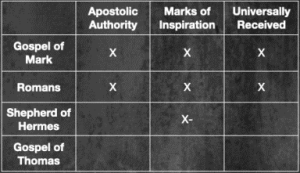
As one considers the three canonical attributes, it becomes clear that the early church filtered books through a sort of canonical grid to help them recognize authoritative texts. Only books possessing all three attributes achieved canonical status. Consider the following chart. Notice how both Mark and Romans possess all three attributes while the Gospel of Thomas possesses none. Also notice that the Shepherd of Hermes partially possesses one of the attributes insofar that it is an orthodox text. That said, it lacks the other two attributes:
Recommended resources related to the topic:
Cold-Case Christianity: A Homicide Detective Investigates the Claims of the Gospels by J. Warner Wallace (Book)
Why We Know the New Testament Writers Told the Truth by Frank Turek (mp4 Download)
The Top Ten Reasons We Know the NT Writers Told the Truth mp3 by Frank Turek
Counter Culture Christian: Is the Bible True? by Frank Turek (Mp3), (Mp4), and (DVD)
______________________________________________________________________________________________________________________________________________
Ryan Leasure holds a Master of Arts from Furman University and a Masters of Divinity from the Southern Baptist Theological Seminary. Currently, he’s a Doctor of Ministry candidate at the Southern Baptist Theological Seminary. He also serves as a pastor at Grace Bible Church in Moore, SC.
Original Blog Source: https://cutt.ly/1Ouq929

If God, Why Evil?
PodcastIf God is all-good and all-powerful, why doesn’t He stop evil? Maybe it’s because an all-good and all-powerful God doesn’t actually exist! That’s what some atheists will claim. In this show, Frank addresses that claim and these questions:
This show offers one of the most profound insights that Frank learned while lamenting the fact that so much evil seems pointless. Why, for example, does a baby die when the entire church prays he won’t? What possible good can come out of a baby dying? Listen for the answer to that and several other perplexing questions.
Subscribe on Apple Podcast: http://bit.ly/CrossExamined_Podcast Rate and review! Thanks!!!
Subscribe on Google Play: https://cutt.ly/0E2eua9
Subscribe on Spotify: http://bit.ly/CrossExaminedOfficial_Podcast
Subscribe on Stitcher: http://bit.ly/CE_Podcast_Stitcher
Cómo enseñar a tus hijos a identificar un falso evangelio
EspañolBy Alisa Childers
When my daughter was little, I made her quinoa, oat, and flax seed waffles, and she loved them. It wasn’t until we were visiting family in California that she experienced the hotel breakfast bar and exclaimed out loud, “Mom, these waffles are SO MUCH BETTER THAN YOURS!” The charade was over. Dry, grainy, fake waffles would no longer be tolerated. She had now tasted the real thing, and would never again be fooled by a fake.
Likewise, one of the most effective ways to teach our children to spot a false gospel is to make sure they are well-versed in the true gospel . That way, when they encounter a false version of Christianity, they will immediately recognize it. Here are some ways to teach our children to spot a false gospel:
Teach them to love the truth
One of the most common ways that young Christians are deceived with bad ideas is through the vehicle of relativism. Relativism is the belief that absolute truth does not exist or cannot be known. “What is true for you is true for you” or “There is no such thing as truth” are common expressions thrown at Christians to shut down their ideas and make them feel like moral censors/criticizers for simply claiming to know the truth.
However, Christianity is a belief system that stands or falls on the basis that truth is absolute. God either exists or he doesn’t. Jesus either rose from the dead or he didn’t. In fact, Jesus claimed to be Truth itself: “I am the way, the truth, and the life” (John 14:6). The stakes are that high!
Teaching our children to base their beliefs on what is true, not what feels right , will help prevent them from walking away when their faith no longer “feels right.”
Teach them to be biblically cultured
From the beginning, false ideas about God were passed off as “Christian.” False teachers often twisted Scripture to deceive followers of Jesus into believing their teachings. Even today, some of the most misleading ideas are those marketed as “biblical.”
The only way to know for sure whether an idea is biblical or not is to actually know what the Bible says. There is nothing wrong with buying a good children’s devotional book or a cartoon of a Bible character to supplement our devotions, but nothing can replace reading the actual Bible with our children.
This will help prevent them from falling into misquotes and misrepresentations because they will know the reality.
Teach them to identify the essentials of the gospel
One of the ways Christians can be deceived into believing a false gospel is when they confuse non-essential doctrines with essential doctrines. The thinking goes something like this: If Christians can’t even agree on how predestination works, why can’t we just agree to disagree about the resurrection?
Essential doctrines are beliefs that directly affect someone’s salvation. The virgin birth, the deity of Jesus, the atonement, the resurrection, the second coming, and the final judgment are all examples of essential doctrines of the gospel. These are fundamental topics that we cannot simply agree to disagree about.
Teaching our children to recognize the difference between core and non-core beliefs will help them avoid confusion about what matters most.
Teach them to define their terms
One telltale sign of a false gospel is the redefinition of terms. For example, someone might imply that telling people they might not go to heaven is “unloving.” But this only works if they have redefined the word love to mean making someone feel good by endorsing all their beliefs and behaviors. But according to the Bible, that is not love at all.
First Corinthians 13 tells us that “love is patient and kind” (verse 4). But it also “does not rejoice at evil but at the truth” (verse 6 [author’s error in verse]). To love someone means to tell them the truth, even when it’s unpleasant. So telling someone about the possibility of an eternity apart from God is actually the most loving thing you can do .
Teaching our children to define their terms biblically will help protect them from being “pigged in” by words that are redefined according to cultural norms.
Teach them to appreciate the beauty of the gospel
The apostle Paul wrote that when he preached the gospel, it had a fragrance. To some, it smelled of life and peace. To others, it reeked of death. [1] I imagine it all came down to whether or not someone truly believed they were a sinner. If one does not recognize their own sinfulness, the Father’s message demanding Jesus’ sacrifice on the cross would seem unnecessary—even immoral. However, if someone knows they have sinned against a holy God and deserve death, Jesus’ atoning work suddenly becomes the most beautiful cure imaginable.
We live in a culture that inundates our children with messages that they are perfect just the way they are and that they should follow their hearts. But these “positive messages” soften their own sinfulness and can make them vulnerable to imitations/counterfeits of the cross akin to “cosmic child abuse.”
As parents, we know that most ideas are learned, not taught. It is useless to teach our children all the right things if we ourselves do not practice those ideas. This involves repenting when we are wrong. It involves reading the Bible and praying with them. And just as my daughter will never again be fooled by imposter waffles, our children will not settle for false gospels because they will be so well acquainted with the real one .
Grades
[1] 2 Corinthians 2:15-16
Recommended resources in Spanish:
Stealing from God ( Paperback ), ( Teacher Study Guide ), and ( Student Study Guide ) by Dr. Frank Turek
Why I Don’t Have Enough Faith to Be an Atheist ( Complete DVD Series ), ( Teacher’s Workbook ), and ( Student’s Handbook ) by Dr. Frank Turek
_____________________________________________________________________________________________________________________________________________________
Alisa Childers is an American singer and songwriter, best known for being part of the all-female Christian music group ZOEgirl. She has had one top ten radio single, four studio releases, and received a Dove Award during her time with ZOEgirl. Years later, Alisa experienced a profound challenge to her lifelong faith when she began attending what would later be identified as a progressive Christian church. This challenge pushed Alisa towards Christian Apologetics. You can currently read, listen to, and watch Alisa’s work online, as well as purchase her recently released book on progressive Christianity, titled Another Gospel.
Original Blog : https://cutt.ly/YO9CxmL
Translated by Jennifer Chavez
Edited by Gustavo Camarillo
4 Questions to Show that Christianity is True
PodcastWith so many people skeptical about God and the Bible, how can you actually show Christianity is true? In this podcast, Frank will show you how by summarizing the case he normally gives in his “I Don’t Have Enough Faith to Be an Atheist” presentation.
The 4 questions that must be answered are these:
In just 48 minutes, Frank provides evidence to show that the answer to these 4 questions is “Yes.”
For a more complete presentation, get the book. For a visual presentation, see the Cross Examined YouTube channel.
Subscribe on Apple Podcast: http://bit.ly/CrossExamined_Podcast Rate and review! Thanks!!!
Subscribe on Google Play: https://cutt.ly/0E2eua9
Subscribe on Spotify: http://bit.ly/CrossExaminedOfficial_Podcast
Subscribe on Stitcher: http://bit.ly/CE_Podcast_Stitcher
10 Reasons Why Socialism Fails
PodcastWhat is socialism and why doesn’t it work? In this special podcast, Frank shows that socialism doesn’t work because it ignores economics 101 in ten ways. It ignores basic truths about:
Frank also addresses the claim that since early Christians lived in a communal way in the book of Acts shouldn’t we?
All of these topics are covered in much more depth in the new online course: Jesus vs. the Culture: Who do you Trust? available at CrossExamined.org.
Subscribe on Apple Podcast: http://bit.ly/CrossExamined_Podcast Rate and review! Thanks!!!
Subscribe on Google Play: https://cutt.ly/0E2eua9
Subscribe on Spotify: http://bit.ly/CrossExaminedOfficial_Podcast
Subscribe on Stitcher: http://bit.ly/CE_Podcast_Stitcher
Valentine’s Day Special: Why Love is Not a Feeling
PodcastIn this special show done on Valentine’s day, Frank unpacks the difference between “being in love” and loving someone. Too many people think that once the feeling of “being in love” is gone that the relationship is over and they need to find someone else. But if we blindly followed our fleeting feelings we would blow up our lives and the lives of those around us. Love actually seeks what is best for the loved one and vows to behave in a loving way. Marriage vows are not about feelings but behaviors. Frank shares from C.S. Lewis and the Bible to help us develop better relationships rather than follow fleeting feelings.
Subscribe on Apple Podcast: http://bit.ly/CrossExamined_Podcast Rate and review! Thanks!!!
Subscribe on Google Play: https://cutt.ly/0E2eua9
Subscribe on Spotify: http://bit.ly/CrossExaminedOfficial_Podcast
Subscribe on Stitcher: http://bit.ly/CE_Podcast_Stitcher
Should Christians Have Blind Faith?
2. Does God Exist?, Theology and Christian ApologeticsBy Levi Dade
A few months ago, I sat with a close friend in one of the booths of our university’s coffee shop. My friend, whom I will call Tom, is an atheist. Tom is a genuine truth-seeker, and he would be a Christian if he thought Christianity was “actually true.” During our conversation, we found ourselves discussing the topic of faith. After probing his views of the world and his justifications for them, he said something that surprised me.
“At the end of the day, I guess we all have to have faith in something.”
I wanted clarity on what he meant by that statement, so I responded, “Do you mean blind faith?”
“Yeah, I guess it is blind faith.”
The Difference Between Faith and Blind Faith
Notice something in this brief exchange: there is a distinction between faith and blind faith. To be clear, blind faith is believing something without reason to believe it. It can also be defined as an unquestioning belief in something, even when it is unreasonable or wrong.
Tom made the distinction between faith and blind faith. This distinction implies that faith is not always blind. If it were inherently blind faith, there would be no point in making the distinction. However, as you read this, even if you have not noticed, you already know faith is not inherently blind.
For example, as a seven-year-old child, did you doubt your parents or guardians would protect you? Probably not.
Why?
Not simply because they’re your parents, but because for the entirety of your childhood, your parents showed you that they would protect you. From the past experiences of them always giving you this protection, you realized you can always have faith that they would always protect you. Notice what came first: the proof (or reason) that your parents would protect you came first. After the proof came your faith in them.
Suppose you met your parents for the first time on your seventh birthday. Would you have faith that they would protect you? Probably not. They would be strangers! You wouldn’t have that faith in them because they hadn’t shown you that you can trust them to protect.
Consider it this way: A man can propose to his girlfriend only after she has shown him that she would be a good, faithful wife. In showing him this, he can have the faith necessary to ask her to be his wife.[1]
When proof (or evidence) allows someone to have faith in something or someone else, it is called evidential faith (or informed faith). Evidential faith is the opposite of blind faith.
As you can see from the examples, faith is not always blind.
This raises an interesting question: Are Christians supposed to embrace blind faith or evidential faith?
A better way to ask this question is to ask: “With what kind of faith does Scripture teach Christians to live?”
Informed Faith Leads to Life in Jesus
In John 20:30-31, John explains the purpose of his Gospel:
Now Jesus did many other signs in the presence of the disciples, which are not written in this book; but these are written so that you may believe that Jesus is the Christ, the Son of God, and that by believing you may have life in his name.
John 20:30-31 (emphasis added)
John’s eyewitness statements of Jesus’s miracles were intended to serve as proof that Jesus is “the Messiah, the Son of God.” The implication of Jesus being the Messiah is that we would put our faith in him and “have life in His name.”
If we are to have blind faith, why would Jesus give us evidence that proves He is the Messiah? After all, blind faith asserts that evidence is not necessary.
In other words, Jesus did not want people to have blind faith, so He provided proof (miracles) to show them who He is. Faith comes after Jesus shows us who He is. Romans 10:17 communicates the same idea: “So faith comes from hearing, and hearing through the word of Christ.”
Just as children can have confidence in trustworthy parents after their past experiences of protection and care, so too others can have faith in Jesus after He showed them who He is and that He is the Messiah.
Informed Faith Allows us to Share why we have Hope in Jesus
… but in your hearts honor Christ the Lord as holy, always being prepared to make a defense to anyone who asks you for a reason for the hope that is in you; yet do it with gentleness and respect…
1 Peter 3:15-16 (emphasis added)
While faith is not explicitly mentioned in this passage, it is clear that Peter is talking about our faith when he refers to the “hope that is in you.” The content gives us an idea of what kind of faith we should have. It is not only a suggestion to have an informed faith; this verse commands it!
We are to know why we have faith in Jesus so that we can share not only our faith but the reason for our faith as well.
It is as if Peter knew someone being told to “just have faith” was not going to magically answer their questions or doubts, so under the inspiration of the Holy Spirit, he wrote the command to share the reason behind our faith. This assumes we have a reason. So, not only is it a “good thing” to know why we have faith in Jesus, it is a command to do so (even for practical, evangelistic purposes!).
Informed Faith Allows us to Love God Deeply
And you shall love the Lord your God with all your heart and with all your soul and with all your mind and with all your strength.
Mark 12:30 (emphasis added)
Again, we are commanded to use our minds as a form of loving God. Loving God doesn’t only come from our heart; it comes from every facet of our lives, including how we think and reason. Knowing God intellectually allows you to know about Him on a deeper level. When you know about someone on a deeper level, you can love them on a deeper level as well.
When we do not know much about God, how can we expect to love God much?
In a past article called “Loving God with Your Mind: How God Wants Your Brain Too,” I explain it this way:
In short, loving God with the mind is to allow the mind and heart to work together in a way that produces a deeper knowledge of God. This knowledge in turn leads to a more intimate relationship with God where God is loved both intellectually and emotionally.[2]
Using Our Brains for God’s Glory
Based on these passages alone, we clearly see that an informed faith is biblical. Simply put, biblical faith is believing in something with good reason to believe it’s true.
We serve a logical God (Isaiah 1:18), and He wants us to use our brains as well as our hearts. After all, He created us and our brains, so why not use them for His glory? An evidential (biblical) faith allows you to know why Christianity is true. Knowing the truth of our beliefs is important in a world where so many things try to get you to put your identity in them rather than in Christ.
In his book, Love Your God with all Your Mind, J. P. Moreland articulates the essence of faith’s relationship to reason: “By contrast with the modern misunderstanding, biblically, faith is a power or skill to act in accordance with the nature of the kingdom of God, a trust in what we have reason to believe is true. Understood in this way, we see that faith is built on reason.”[3]
May we all embrace this biblical, informed faith, which will help us stay grounded intellectually and spiritually, keeping our identity in Christ, and our eyes fixed on Him forever.
Amen.
Notes
[1] Adapted from Frank Turek, “belief that” versus “belief in” illustration.
[2] Levi Dade, “Loving God With Your Mind: How God Wants Your Brain Too,” The Rebelution, https://www.therebelution.com/blog/2021/06/loving-god-with-your-mind-how-god-wants-your-brain-too/
[3] J. P. Moreland, Love Your God With all Your Mind (NavPress: Colorado Springs) 2012, 19.
Recommended resources related to the topic:
I Don’t Have Enough Faith to Be an Atheist (Paperback), and (Sermon) by Norman Geisler and Frank Turek
Stealing From God by Dr. Frank Turek (Book, 10-Part DVD Set, STUDENT Study Guide, TEACHER Study Guide)
Tactics: A Game Plan for Discussing Your Christian Convictions by Greg Koukl (Book)
_____________________________________________________________________________________________________________________________________________________
Levi Dade is from North Mississippi and is a junior Biblical Studies & Theology major here at Ouachita Baptist University. Levi writes apologetics material for The Rebelution blog and for CORE Leadership, an online ministry that provides free online courses to young adults and youth for the purpose of having a deeper knowledge and love for God. Levi is also a photographer for his university, and he started his photography business, Dade Photography when he was in high school in 2017. You can typically find Levi reading a book, kayak fishing, hiking, writing, taking photos for his school’s yearbook, or struggling to decide which one of these activities he should do!
Original Blog Source: https://cutt.ly/kO3nIY2
Faithfully Different and 4 False Beliefs
PodcastWhat are four major false beliefs that many people in our culture believe and are now creeping into the church? Beliefs that are so pervasive, you might not even recognize that you believe them!
Natasha Crain joins Frank to reveal those four false beliefs and to unpack her very practical new book, 𝙁𝙖𝙞𝙩𝙝𝙛𝙪𝙡𝙡𝙮 𝘿𝙞𝙛𝙛𝙚𝙧𝙚𝙣𝙩: 𝙍𝙚𝙜𝙖𝙞𝙣𝙞𝙣𝙜 𝘽𝙞𝙗𝙡𝙞𝙘𝙖𝙡 𝘾𝙡𝙖𝙧𝙞𝙩𝙮 𝙞𝙣 𝙖 𝙎𝙚𝙘𝙪𝙡𝙖𝙧 𝘾𝙪𝙡𝙩𝙪𝙧𝙚. Frank and Natasha have a wide-ranging discussion that will help you think, believe, and live biblically in a culture that is becoming more anti-Christian. Check out more of Natasha’s work at NatashaCrain.com.
Subscribe on Apple Podcast: http://bit.ly/CrossExamined_Podcast Rate and review! Thanks!!!
Subscribe on Google Play: https://cutt.ly/0E2eua9
Subscribe on Spotify: http://bit.ly/CrossExaminedOfficial_Podcast
Subscribe on Stitcher: http://bit.ly/CE_Podcast_Stitcher
Rob Bell y la Biblia: ¿Libro humano o de inspiración divina?
EspañolPor Alisa Childers
Permítanme empezar diciendo que me gusta Rob Bell. (No pensaste que iba a decir eso, ¿verdad?) Como parte de una investigación que estoy haciendo sobre el Cristianismo Progresista, he pasado bastante tiempo con él últimamente, —escuchando conferencias, entrevistas y leyendo sus libros. De todos los autores progresistas que estoy leyendo actualmente (Rachel Held Evans, Richard Rohr, Brian McLaren, Steve Chalke y Pete Enns, entre otros), Bell es el que más me gusta. Esto no significa que esté de acuerdo con mucho de lo que dice, pero es elocuente, claro, fascinante y parece una persona genuinamente agradable.
Hace poco leí el libro de Bell, What Is the Bible? How an Ancient Library of Poems, Letters, and Stories Can Transform the Way You Think and Feel About Everything (¿Qué es la Biblia? Cómo una antigua biblioteca de poemas, cartas, e historias pueden transformar tu forma de pensar y sentir en todos los aspectos) (Ese es un título muy bueno.) Con capítulos como “Moisés y su humedad”, “Ollas humeantes” e “Y la grasa inmovilizó la espada”, la creatividad y el entusiasmo de Bell por su trabajo son palpables.
Una de las cosas en las que destaca es en la narración de historias y en la aportación de datos contextuales que ayudan al lector a comprender el panorama general de la Biblia. A veces lo hace de forma que termino sonriendo y afirmando con la cabeza. Otras veces acabo jalándome los cabellos y discutiendo con mi computadora (porque lo leí en Kindle). En ocasiones, el “panorama general” que pintó era totalmente ajeno a la Biblia.
He aprendido que cuando leo a Rob Bell, siempre debo cuestionar sus premisas. Es brillante en la construcción de una interpretación deslumbrante y convincente en torno a una premisa falsa. Antes de que te des cuenta de lo que ha sucedido, has saltado por un arco iris completamente diferente, cosechando baratijas de una olla de oro totalmente distinta, —que puede que no contenga oro real.
Aquí hay un ejemplo.
En un capítulo titulado “Lo humano y lo divino”, Bell señala que la Biblia fue escrita por humanos. Lo repite a menudo a lo largo del libro e incluso afirma en la introducción que “la Biblia es un libro sobre lo que significa ser humano”. (p. 4) Señala que “cuando empiezas ahí, [ entendiendo que la Biblia fue escrita por humanos] y te adentras en la humanidad de esta biblioteca de libros, puede que encuentres lo divino.” (p.183) En este punto, la mayoría de la gente seguirá leyendo como si nada. Pero a esto me refiero: es una premisa falsa. Me explico.
Una de las claves del pensamiento crítico es cuestionar siempre las premisas. Alguien puede presentar un argumento que es lógicamente válido, pero que sigue siendo erróneo. Observa este argumento:
Premisa 1: Todas las razas de ganado tienen rayas moradas.
Premisa 2: La vaca Jersey es una raza de ganado.
Conclusión: Las vacas Jersey tienen rayas moradas.
¿Las vacas de Jersey tienen rayas moradas? Por supuesto que no. Pero, aunque la conclusión sea falsa, ésta consideró correctamente las premisas, así que técnicamente, el argumento es válido. Por eso las premisas son tan importantes. Veamos la premisa de Bell.
¿La Biblia fue escrita por humanos?
Es cierto que la Biblia fue escrita por humanos. Pero esa no es toda la historia, y por lo tanto no debe ser nuestro punto de partida como sugiere Bell. Esta es una visión torcida de cómo se escribió la Biblia. Dios ciertamente usó a muchas personas diferentes que vivieron en varias culturas y períodos de tiempo para redactar las palabras de la Escritura, pero como dice Pablo en 2 Timoteo 3:16 LBLA, “Toda Escritura es inspirada por Dios, y útil para enseñar, para reprender, para corregir, para instruir en justicia”.
La palabra griega traducida como “inspirada por Dios” no significa “inspirada” de la misma manera que un poeta es inspirado por su musa, o como un bailarín que se desempeña con inspiración. Significa ” exhalado por Dios”. Al referirse a las profecías del Antiguo Testamento, el apóstol Pedro escribió: “ pues ninguna profecía fue dada jamás por un acto de voluntad humana, sino que hombres inspirados por el Espíritu Santo hablaron de parte de Dios”. (2 Pedro 1:21 LBLA)
Jesús dijo que cuando David escribió las Escrituras, estaba “hablando por el Espíritu”, y afirmó una y otra vez que creía que las Escrituras eran la mismísima Palabra de Dios: inspiradas, con autoridad e históricamente confiables.
¿Se equivocan Pablo, Pedro y Jesús? La premisa de Bell sugiere que sí. Su punto de partida es desechar la doctrina de la inspiración divina, o al menos la interpretación tradicional de la misma. Hay un breve capítulo en el que todo gira alrededor de la palabra “inspirada”, pintando su significado con la más tosca de las brochas. Al explicar que el uso que hace Pablo del griego theopneustos, (respirado por Dios), escribe que Pablo simplemente quería decir: “Son libros, pero son más que libros”. (p. 286) Compara esto con ser inspirado por una canción o al tener “algo bueno, de esperanza, verdadero, reconfortante, sanador o genuino” es soplado hacia ti. (p. 286)
Al final del capítulo, hace una distinción importante pero sutil. Escribe: “La Biblia está inspirada, de la misma manera en que tú eres inspirado… No eres más que un humilde saco de huesos y piel que tropieza, y sin embargo la fuerza creadora divina, infinita y eterna del universo ha soplado en ti”. Cuando compara eso con la forma en que la Biblia está inspirada, escribe que esta “Biblioteca de libros. . .ha sido soplada hacia. . .” (p. 287) Esto puede no parecer tan controvertido, salvo que implica que los libros fueron primero escritos y luego inspirados.
La Biblia enseña que los propios escritores de las Escrituras fueron ” impulsados por el Espíritu Santo” para escribir las palabras ” exhaladas por Dios”… Dios no tomó lo que ya habían escrito para convertirlo en algo inspirador.
¿Qué está en juego?
Si el punto de partida de Bell es que la Biblia es esencialmente una invención humana, no es de extrañar que no considere los acontecimientos ahí registrados cómo históricamente fiables.
Al exponer la idea de que la Biblia fue escrita por seres humanos (¿estás viendo hacia dónde se dirige?), Bell se pregunta por qué María y los discípulos no reconocieron a Jesús resucitado cuando lo vieron por primera vez. Casualmente menciona entre paréntesis:
¿Observas lo que hizo ahí? Simplemente asume que sus lectores son demasiado inteligentes como para pensar que la resurrección de Jesús fue un hecho “literal” (contrario a lo que prácticamente todos los cristianos creyentes en la Biblia han afirmado durante los últimos 2.000 años). No se toma la molestia de exponer ese argumento (bíblico o de otro tipo) ni siquiera señala las ramificaciones teológicas por haberlo cambiado. Y así, sin más, —derriba una doctrina cristiana esencial con nada más que una ocurrencia entre paréntesis. Pudo hacerlo porque ya había hecho creer al lector que la Biblia es un libro sobre lo que significa ser humano.
En este punto, Bell se ha posicionado a sí mismo (y al lector) por encima de las Escrituras como la máxima autoridad y juez de la verdad. Y lo consigue en unos pocos párrafos bien escritos, fascinantes e ingeniosos.
Tengo algunos puntos de acuerdo con Bell. Por ejemplo, escribe que la Biblia debe leerse “literalmente”. Es decir, leerla según su género y su contexto cultural. No podría estar más de acuerdo. Sin embargo, casi inmediatamente explica esto para señalar que cada vez que hay algo “extremo” (como Elías siendo arrebatado al cielo), debemos tomarlo como una pista de que probablemente no es histórico. (p. 80) Su premisa fundamental de que la Biblia es más humana que divina seguramente empañara cualquier punto bueno que haga.
¿Es la Biblia un libro esencialmente humano? Jesús, Pablo y Pedro no lo creían, —y prefiero creer lo mismo que ellos.
Recursos recomendados en Español:
Robándole a Dios (tapa blanda), (Guía de estudio para el profesor) y (Guía de estudio del estudiante) por el Dr. Frank Turek
Por qué no tengo suficiente fe para ser un ateo (serie de DVD completa), (Manual de trabajo del profesor) y (Manual del estudiante) del Dr. Frank Turek
______________________________________________________________________________________________________________________________________________
Alisa Childers es una cantante y compositora estadounidense, más conocida por formar parte del grupo femenino de música cristiana ZOEgirl. Ha tenido una lista de los diez mejores sencillos de la radio, cuatro lanzamientos de estudio y recibió el premio Dove durante su tiempo con ZOEgirl. Años más tarde, Alisa experimentó un profundo desafío a su fe de toda la vida cuando empezó a asistir a lo que más tarde se identificaría como una iglesia cristiana progresista. Este desafío empujó a Alisa hacia la Apologética Cristiana. Actualmente se puede leer, escuchar y ver el trabajo de Alisa en línea, así como adquirir su libro recientemente publicado sobre el cristianismo progresista, titulado Another Gospel.
Blog Original: https://cutt.ly/FOy2Fvc
Traducido por Jennifer Chavez
Editado por Gustavo Camarillo
How We Got Our Bible: New Testament Canonical Grid
4. Is the NT True?, Theology and Christian ApologeticsBy Ryan Leasure
This article is part four in a nine-part series on how we got the Bible. Part 1 looked at biblical inspiration and inerrancy. Part 2 considered the development of the Old Testament. And Part 3 investigated the Old Testament canon and the Apocrypha.
In this article, we transition to the New Testament canon. Specifically, I want to answer two questions. First, would the first-century Christians have expected new Scripture in addition to the Old Testament? And second, what attributes did the church look for in canonical texts?
Would the First-Century Church have Expected New Scripture?
Biblical scholar Harry Gamble once remarked, “There is no intimation at all that the early church entertained the idea of Christian scriptures… Therefore, the NT as we think of it was utterly remote from the minds of the first generation of Christian believers.”1. What are we to make of Gamble’s assertion? Was he right? Did the early church assume that God was done inspiring Scripture after the close of the Old Testament? I believe we have good reason to reject Gamble’s claims. Let me give you three reasons why.2
1. First-century Jews regarded the Old Testament story as Incomplete
Several texts from the Gospels and Acts demonstrate that first-century Jews expected God to do something in their generation. Not only were they on the look-out for the Messiah (Luke 2:38; 2:25; John 1:41; 4:25), they expected God to usher in his kingdom and overthrow their oppressors (Acts 1:6; see Dan 2:31-45). Second Temple period (intertestamental) texts also confirm this same expectation (Tob 14:5-7; Bar 3:6-8). As N. T. Wright notes, “The great story of the Hebrew scriptures was therefore inevitably read in the Second Temple period as a story in search of a conclusion.”3
The close of the Old Testament also gives the impression that the Jews expected a Davidic King to rise up among their ranks. Keep in mind, according to Jewish ordering, Chronicles was the final book of the Old Testament. And that book starts off with a lengthy genealogy centered around King David (1 Chron 1-3). It’s no coincidence that the start of the New Testament picks up right where the Old Testament left off with a genealogy focusing on the Son of David (Matt 1). It’s as if the Gospel of Matthew brings the story of the Old Testament to its necessary fulfillment.
2. God’s Pattern of Bringing New Word-Revelation after his Acts of Redemption
According to the Old Testament pattern, God typically gives revelation deposits after his redemptive acts. We see this sequential pattern most clearly in the Exodus. God redeemed his people out of Egypt. He then followed up that redemption with Scriptural installments at Sinai to interpret his saving acts. Given this history, it’s not inconceivable that the early church would have expected more written revelation following Jesus’ act of redemption.
3. The Old Testament Predicted that the Future Messianic Age would Include Verbal Communication
Not only did the Old Testament predict a future messianic age, it predicted that communication would accompany the Messiah. Deuteronomy 18:18 predicts “I will raise up for them a prophet like you from among their brothers. And I will put my words in his mouth, and he shall speak to them all that I command him.” Isaiah 61:1-2 says of the Messiah that “The Spirit of the LORD God . . . has anointed me to bring good news to the poor . . . to proclaim liberty to the captives . . . to proclaim the year of the Lord’s favor.” And of this Messianic age, we read, “out of Zion shall go the law, and the word of the LORD from Jerusalem” (Isa 2:2-3).
In sum, those living after the close of the Old Testament recognized that the story was incomplete, that God typically gave word-revelation following his redemptive acts, and that the Old Testament anticipated a verbal Messianic age.
What Attributes did the Early Church Look for in a Canonical Text?
Now that we’ve established the early church’s expectation for more biblical texts, we must now ask what attributes they would have looked for in those new biblical texts. In the remaining space, I will consider three of these attributes—apostolic authority, marks of inspiration, and universal reception.4 Let’s consider each canonical attribute in turn.
Apostolic Authority
Going back to the New Testament, the apostles recognized that they were “ministers of the New Covenant” (2 Cor 3:6), and that the church was “built on the foundation of the apostles and prophets (Eph 2:20). They also recognized that Jesus had sent them out as the guarantors and transmitters of his message to the world (John 20:21). For these reasons, the early church only received texts that could be traced back to an apostle.
Therefore, from an early time, the church received the four Gospels, Acts, and Paul’s letters. Of course, Paul makes his apostolic authority known in his letters, but the Gospels make no such claim. How then did they receive apostolic status at such an early stage in the church?
Critics argue that since the authors don’t mention their names in the body of the text, the Gospels must have been originally anonymous. It was only after some time that the church added titles to give these anonymous works some needed credibility. Yet, the critics’ assertions lack evidence. All the earliest manuscripts with titles list Matthew, Mark, Luke, and John as the authors. Additionally, numerous church fathers state unequivocally that Mark wrote his Gospel based on Peter’s eyewitness testimony, and that Matthew, Luke, and John all wrote their respective Gospels.
That said, why did the church receive Mark and Luke if they weren’t apostles themselves? It’s because of their close association with the apostles. That is to say, books with apostolic authority were not limited to books that were written by the apostles. Rather, books that came from apostolic circles also came with apostolic authority. Notice Tertullian’s comment about Gospel authorship: “Of the apostles, therefore, John and Matthew first install faith into us; whilst of apostolic men, Luke and Mark renew it afterwards.”5 Tertullian affirms that Mark and Luke were “apostolic men” by nature of their close association with the apostles Peter and Paul.
This close proximity to the apostles also explain why Hebrews made its way into the canon. The author indicates he knew Timothy (Heb 13:23) and that the Gospel message “was declared at first by the Lord, and it was attested to us by those who heard” (Heb 2:3). These two texts combined indicate that the author walked in apostolic circles (probably Pauline), and therefore, his book was apostolic.
Jesus’ family (James and Jude) also received quasi-apostolic status as well based on their relationship to the Lord. We don’t know as much about Jude, but we know James became a prominent leader in the Jerusalem church and later martyr for his Christian faith.
At the same time, the church rejected books from non-apostolic sources. Commenting on the so-called Gospel of Peter, church father Serapion declared, “We receive both Peter and the other apostles as Christ, but the writers which falsely bear their names we reject.“6 Serapion asserted that the church should reject the heretical Gospel of Peter and all others that falsely bear the apostles’ names (Thomas, Philip, etc.).
The Muratorian Fragment makes a similar comment around AD 180. It notes, “There is said to be another letter in Paul’s name to the Laodiceans, and another to the Alexandrines, both forged in accordance with Marcion’s heresy, and many others which cannot be received into the catholic church, since it is not fitting that poison should be mixed with honey.”7 Again, the church rejected all forgeries. The fragment also notes that the beloved Shepherd of Hermes should not receive canonical status because it was written “quite recently, in our own times.” In other words, someone wrote this book after all the apostles had died out.
Marks of Inspiration
Second, the church looked for books that possessed marks of inspiration. If a book came from God, one would expect it to reflect God’s nature and other previously inspired texts. The text, therefore, should reflect the beauty and excellence of God (Psalm 19:7-10). As Jerome once remarked about a New Testament text, it is a “document which has in it so much the beauty of the Gospel,” which is the “mark of its inspiration.”8
Moreover, the text will be accompanied with transformative power. In other words, the text isn’t just words on a page. The text is “living and active” (Heb 4:12). Justin Martyr remarked, “For they possess a terrible power in themselves, and are sufficient to inspire those who turn aside from the path of rectitude with awe; while the sweetest rest is afforded to those who make a diligent practice of them.”9 Irenaeus also asserted that the Gospels are always “breathing out immortality on every side and vivifying men afresh.”10 That is to say, the early church recognized that certain texts brought about salvation and good works in the life of the church.
Not only will the text possess a certain beauty and power, it will be harmonious with other authoritative Scripture. For this reason, the church rejected books like 2 Maccabees which suggests we can offer sacrifices and prayers for the dead (2 Macc 12:43-46). They also rejected gnostic texts (Gospel of Philip, Gospel of Truth, Gospel of Peter, etc.) because they undermined the entire Old Testament altogether. And they rejected the Gospel of Thomas which has Jesus saying, “Look, I will guide her (Mary) to make her male, so that she too may become a living spirit resembling you males. For every female who makes herself male will enter the kingdom of Heaven”—a clear repudiation of Genesis 1-2.
Thus, as Irenaeus remarked, “All Scripture, which has been given to us by God, shall be found by us perfectly consistent.”11. And as Justin Martyr declared, “I am entirely convinced that no Scripture contradicts another.”12
In short, the church only received texts which bore the marks of divine inspiration. These marks included a certain beauty, power, and harmony, indicating that God was their ultimate author.
Universal Reception
Finally, only books that were universally received by the church obtained canonical status. This means that books like 1 Enoch, which only a few small churches received, did not receive authoritative status. After all, Jesus says, “My sheep hear my voice, and I know them, and they follow me” (John 10:27). Therefore, we could expect the universal church to come to some sort of consensus when it came to their Scriptural texts. And this is exactly what we find in the early church.
From as early as the second century, the church recognized a core group of canonical books which included the four Gospels, Acts, Paul’s letters, Hebrews, 1 John, 1 Peter, and Revelation. This consensus is reflected in several church Fathers (Irenaeus, Origen, Clement of Alexandria, Tertullian) as well as the Muratorian Canon. By the fourth century, the remaining fringes of the canon were universally recognizes as reflected in Eusebius (AD 325), Athanasius (AD 367), and the Councils of Hippo (AD 393) and Carthage (AD 397).
A Canonical Grid
As one considers the three canonical attributes, it becomes clear that the early church filtered books through a sort of canonical grid to help them recognize authoritative texts. Only books possessing all three attributes achieved canonical status. Consider the following chart. Notice how both Mark and Romans possess all three attributes while the Gospel of Thomas possesses none. Also notice that the Shepherd of Hermes partially possesses one of the attributes insofar that it is an orthodox text. That said, it lacks the other two attributes:
Recommended resources related to the topic:
Cold-Case Christianity: A Homicide Detective Investigates the Claims of the Gospels by J. Warner Wallace (Book)
Why We Know the New Testament Writers Told the Truth by Frank Turek (mp4 Download)
The Top Ten Reasons We Know the NT Writers Told the Truth mp3 by Frank Turek
Counter Culture Christian: Is the Bible True? by Frank Turek (Mp3), (Mp4), and (DVD)
______________________________________________________________________________________________________________________________________________
Ryan Leasure holds a Master of Arts from Furman University and a Masters of Divinity from the Southern Baptist Theological Seminary. Currently, he’s a Doctor of Ministry candidate at the Southern Baptist Theological Seminary. He also serves as a pastor at Grace Bible Church in Moore, SC.
Original Blog Source: https://cutt.ly/1Ouq929
9 Things That Science Will Never Explain
PodcastWith all our technological advances, won’t science one day answer all of our questions and give us all of our knowledge? Saying God did something doesn’t get us anywhere. That’s God of the gaps reasoning! We just have to give science more time to figure everything out. After all, we get all our knowledge from science. It’s at least the most reliable form of knowledge. So just be patient.
Actually, despite appearances, none of that is true. Science is wonderful and it has made our lives better in many ways. But there are limits to what it can do that may not be obvious in our culture. Join Frank as he reveals 9 Things That Science Will Never Explain. No matter how much science advances or how long we wait, science will never be able to explain these 9 things. In fact, you can’t do science without these 9 things!
Subscribe on Apple Podcast: http://bit.ly/CrossExamined_Podcast Rate and review! Thanks!!!
Subscribe on Google Play: https://cutt.ly/0E2eua9
Subscribe on Spotify: http://bit.ly/CrossExaminedOfficial_Podcast
Subscribe on Stitcher: http://bit.ly/CE_Podcast_Stitcher