Part 1/3
Scott Symington
Medical Physicist, Department of Radiation Oncology, Allegiance Health
Initial draft September 1999, current version April 2015
Abstract
You are fast approaching an “orange” light, within just moments you naturally use viewpoints including physics, history, observation and ethics to arrive at a conclusion to either stop, or pass through. Similarly, most choices in life are best visualized when multiple valid viewpoints, or sources of knowledge, are turned on the subject. The question then arises: what, if any, interplay occurs between differing sources of knowledge, particularly ones as influential as science and theology? While the scholarship appears to diverge into the full range of possibilities, when recognizing accurate points, yet specificity of application in each proffered path, a clear direction emerges to a singular reality of the interaction. If two sources of knowledge are valid, providing unique, useful, and accurate information, and if these sources do interact, the sources will be in concord, even if coming from different viewpoints because each valid source will view the same reality. However, if one or both fields disallow proof, or if lack of data or influential-external factors are involved with the viewers (people), then the interaction will likely display both concord and conflict in a complex contextualized history. Yet, this complex history will trend over time, as the knowledge bases grow in accuracy, conforming towards the reality of the mutually supportive relationship between two valid sources. This paper will progress though: an illustration and definitions, a flowchart displaying our progress through each intersection of possible relationships, thought-provoking examples, and an explanation of relationship between science and theology that has the successful predictive model and demonstrative trend-line.
Part 1. Introduction
One of the earliest memories I have involves a pretty good story. I was on a class field trip and so young that the eight of us were all holding hands with each other, during the entire time at a museum. We sat down in a circle, still holding hands, with myself at one end, the teacher in the middle, and the last student at the other end holding the hand of the museum worker, who was reading us a story.
Almost immediately I lost interest in the story and noticed that there was an open electrical outlet on the wall next to me. Within moments I went through the basic scientific method:
1) Observation or problem: if I jam my fingers into that open outlet, will the shock just get me, or will it make it all the way to that museum reader?
2) Hypothesis: my past history did show that even touching the metal prongs of a night light will shock me, and I heard stories of others touching sticks to electric fences and getting shocked, and, and my mom gave a brief physics lesson noting electricity can travel through some things, so it may make it through a line of connected people. I included views from science, personal history, even ethics, but failed to place much weight on ethics.
3) Test and Data: so, I jammed my fingers into the open-ended wires in the outlet, and sure enough, the back-straightening jolt instantly went through the line of us and terminated with the unsuspecting museum employee.
4) Analysis: my hypothesis was correct and totally worth the effort.
Since childhood, we naturally and efficiently integrate different sources of knowledge when facing a problem to solve, or decision to make. On your way home tonight, you may find yourself fast approaching a traffic light that is “orange”, within just moments you naturally use viewpoints including physics (you don’t actually do a napkin calculation, but consider momentum and road friction); history, you consider occurrences yourself or others have had; observation, check for any nearby police officers; and ethics, wondering if you may put others at risk of injury, to arrive at a conclusion to either stop, or pass through.
Similarly, many choices in life are best visualized when multiple valid viewpoints, or sources of knowledge, are turned on the subject. The question then naturally arises: what, if any, interplay occurs between differing sources of knowledge, particularly ones as influential as science and theology. While the scholarship appears to diverge into the full range of possibilities, considering this vast scholarship on the issue provides two unexpected and significant features: a) each proffered path contains accurate points, and b) each currently proffered theory is restricted to only being applicable to a specific subset of the relationship between science and theology. Taken together, these two unexpected features leads one directly to a singular reality of the interaction between science and theology.
This paper will progress though: an illustration and definitions, a flowchart displaying our progress through each intersection of possible relationships, thought-provoking examples, and an explanation of the relationship between science and theology that has the successful predictive model and demonstrative trend-line.
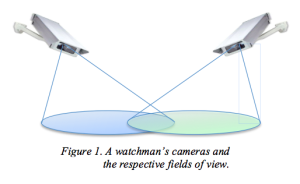
Part 2. An Illustration and Definitions
2.1 The Night Watchman of the Universe
Imagine yourself as the night watchman of the house of the universe. You are required to stay in the office of life, which gives only a marginal view of the rest of the house. But you have cameras, labeled: physics, philosophy, mathematics, theology, history, and others, which monitor different areas of the house through the respective unique points of view. While each camera sends back its own view and information, you can combine all the views at your terminal in the office, in order to have the most comprehensive possible coverage of the house.
Now and then you notice that some important large areas and some difficult corners cannot be fully illuminated by a camera. Therefore, you simply turn other cameras towards the same area. Even though the cameras will view the area from different points of view, they each still view the same thing and together cooperatively illuminate difficult areas. That is a good system, and the watchman can feel secure of being aware of as much as is possible.
Science and theology are not friends or foes, but different fields of study, or methods to gain knowledge about reality. If both the science cam and theology cam turn to the same aspect of the universe or reality, they together provide a wider field of vision, and not only more knowledge, but also a very productive way to verify or discredit the accuracy each of the points of view provide. Or maybe these two different camera views shouldn’t, or can’t intersect?
2.2 Definitions
Walking out of an Ann Arbor bookstore, I couldn’t stop reading an article by Stephen Jay Gould, “Dorothy, It’s Really Oz!” The narrow-sightedness displayed by the Harvard professor so captured my thoughts, that my focus became similarly constricted, and the myopic article was almost the last thing to pass through the mind of this myopic pedestrian.
Returning to the article, after almost being removed from the gene pool by inappropriate selective attention, I wrote a response article and realized something was wrong with our culture’s mechanism for naturally selecting out faulty ideas. That was over a decade ago, and while my article has evolved to incorporate new discoveries that bolster my position, SOMA, the faulty idea promoted by Gould, NOMA, may not have evolved, but certainly dominates the mental landscape where science and theology meet.
The late professor, author, and scientist was extremely intelligent, and Gould’s accomplishments may be longer than this article, while mine could be stated in a breath. But Gould was simply wrong, due to significant misconceptions of the concepts involved.
Considering the consistent miscommunication surrounding science and theology, it will be helpful to start with definitions of the key terms.
- Science: “(A) systematic enterprise that builds and organizes knowledge in the form of testable explanations and predictions about the universe.”[1]
- Theology: An approach that builds and organizes knowledge from the study of areas relating to God, and knowledge provided by a divine authority.
Of course, a lot of details should be unpacked from these simple definitions, but simple is a nice place to start and to refer back to when these terms are used. The definition of science, provided by Wikipedia above, is a good one as it entails the most important component of science – the approach or scientific method. Yes, science can be defined as the search for causes, or in many other related ways, and the conceptions of science have changed over time with no agreed upon definition even now. Still, the basis for the great success of science is its approach to that search. The science camera provides its view of an issue by starting with a problem or question to answer, then developing a hypothesis, or model, which explains in detail how we think the world may work, next the explanations and predictions of the model can be tested. This testable model approach provides data, which if analyzed appropriately, allows us to follow the evidence into knowledge about reality.
Now science, however you define it, cannot claim exclusive rights on this approach, as it is the same approach each of us use naturally every day, even since childhood, as displayed with my shocking example, but science makes it an enterprise.
Some people choose to add to the definition of science, such as science applying only to issues testable by observation and repeatable experiment. Those are very good tests. On the other hand, such restrictions would render much of human experience outside the limits of scientific inquiry, including past events like the Big Bang, and some of the greatest endeavors in science, which were or still are based on inference to the best explanation. If one chooses to make the definition of science more restrictive, that person only shrinks the circle of what science is able to view or add knowledge within. Gould agrees with me here, and harshly notes the claim that “[The belief that an idea] must be dubious because the process has not been directly observed – smacks of absurdity and only reveals ignorance about the nature of science. Good science integrates observation with inference.”[2] The flexibility or diversity with which some define science impacts the breadth of the viewpoint, and the circle of knowledge the “science” viewpoint will circumscribe and will impact what people will perceive in the interaction between science and theology. However, the reality of the relationship between science, however, defined, and theology will only be impacted in the amount of interaction, not the specific way these two sources of knowledge will relate to each other. Bottom-line, science is a method of obtaining information about reality, and as such provides a circle of knowledge that can or cannot interact with the circle of knowledge provided by other views, including theology.
Most people seem to approach this issue as the relationship between “science and religion,” but “religion” is too convoluted as it involves how people organize around a theology, and includes more than will be covered here. “Theology” was chosen for specificity and simplicity. You could just define it as “the study of God.” The definition used here is more in-line with the definition of “science” as – bottom-line – both are approaches to learn things about reality. Some may want to add to this definition too, but the simple definitions provided above, with the focus on approaches and the knowledge encircled by these approaches, is what is meant in this paper when those terms are used.
[1] Wikipedia, http://en.wikipedia.org/wiki/Science.
[2] Stephen J Gould, “Dorothy, It’s Really Oz”, Time 154 (1999), Viewpoint. http://www.arn.org/docs/kansas/gouldks823.htm.
Part 3. A Flowchart
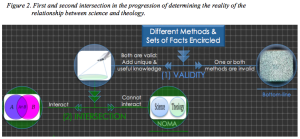
To begin, mutually exclusive theologies must be considered separately in their respective relationships with science, as the mutually exclusive relationships will obviously differ. Thomas Dixon, et al., supports this by noting that this study cannot progress in isolation from the reality of religious pluralism, and implied in Dixon’s point is the recognition of the law of non-contradiction as applied to the pluralism.[1]
[1] Thomas Dixon, Geoffrey Cantor, and Stephen Pumphrey, Science and Religion: New Historical Perspectives, Cambridge University Press (2010), 41.
3.1 First Intersection: Validity
The first point of intersection, when considering how two sources of knowledge relate to each other, is determining whether both sources are valid, or if one or both sources are not valid. The term “valid” is used here to mean a source of knowledge that provides unique and accurate knowledge about reality. Both science and theology are certainly valid in this sense, which I do not except anyone to accept without evidence, but will be evident in examples provided shortly.
An example, however, going the other route, would be the relationship between mathematics and astrology. Astrology is not a valid source of knowledge. This source does not provide accurate knowledge about reality. If an invalid source of knowledge does happen to interact with a valid source, then the interaction will either be one of non-interaction, unimportant interaction, a conflict where the two sources interact, or only insignificant or apparent concord. If not at a point of complete knowledge, then there can be apparent concord, but likely the trend over time will be increasing conflict as the quantity and quality of knowledge grows. For example, here is an intersection between mathematics and astrology from a challenge I posted to a claim supporting astrology:
Test it. Each week, have someone cut out all the horoscopes from the week before, but remove the labels “Capricorn”, “Gemini”, or whatever, and pick the one that precisely described your week. Did you pick your sign? Do this over a year and see how many you got right. Just picking the horoscopes out of a hat will result in ~10% of the time getting your sign, so how much more than 10% did you get? How accurate is your horoscope really? The more you do this test, the more your results are likely to conform to just randomly picking your horoscope blindly out of a hat. I am sure it is not “OMG so accurate!” as claimed in the article.
There is a bottom-line: if a source of knowledge, or the camera and circle of knowledge it provides, as illustrated with the watchman example, is not a valid source for knowledge about reality – turn that camera off. Such a camera only provides noise, and only interferes and is detrimental to the likelihood of making decisions that are best for you.
If, on the other hand, both sources of knowledge, or cameras, do provide valid views of reality, then we come to a second point of intersection: either these two sources do or do not interact.
3.2 Second Intersection: Interaction
With an understanding of the terms “science” and “theology” as they are used in this paper, we now proceed to how these terms interact. Some like to think that science and theology can’t play nice together, or further, cannot play together at all. Conversely, I believe there will be a day when little science and theology ideas and models will join hands as symbiotic [1] siblings and will be judged not by their point of view, but by the validity and productive output of their content. No offense in mutating Dr. King’s famous lines, actually, he would likely agree with the above thesis. And, in fact, science and theology have already been engaging in a mutually beneficial and supportive relationship, which, after explaining the NOMA and SOMA models, will be demonstrated with one of science’s greatest areas of discovery.
3.2.1 NOMA
An eminent paleontologist, the late Stephen Jay Gould, provided a good description of a very common thought regarding science and theology, in his article presented in Time. Gould was responding to the Kansas Board of Education’s consideration of removing the Big Bang theory and evolution from the state’s science curriculum. Gould correctly stated that such a move would limit the students’ view of reality to what the Board decides. This was a clear demonstration of religious people shutting off their science cam, and trying to force others to a similarly restricted view of the universe. Weak thinking.
Gould then spends the rest of his article supporting his declaration that “these two great tools of human understanding (science and religion) operate in complimentary (not contrary) fashion.”[2] The professor is close to hitting upon a rock-solid point, but then displays the fault-line in his reasoning by adding that science and religion work together “in their totally separate realms (my emphasis): science as an inquiry about the factual state (again, italics mine) of the natural world, religion as a search for spiritual meaning, and ethical values.”[3] In other words, in the science circle are contained all facts and truth about reality, while in the religion circle are “spiritual meaning and ethical values”. Sounds weak.
Yet, W.T. Stace, a philosopher of religion also thinks the two fields are independent, each consistent and complete in its own domain.[4] The U.S. National Academy of Science supports the independence view also with its statement:
Science and religion are based on different aspects of human experience. In science, explanations must be based on evidence drawn from examining the natural world. Scientifically based observations or experiments that conflict with an explanation eventually must lead to modification or even abandonment of that explanation. Religious faith, in contrast, does not depend on empirical evidence, is not necessarily modified in the face of conflicting evidence, and typically involves supernatural forces or entities. Because they are not a part of nature, supernatural entities cannot be investigated by science. In this sense, science and religion are separate and address aspects of human understanding in different ways. Attempts to put science and religion against each other create controversy where none needs to exist.[5]
The statement above not only depends on the logical fallacy of a strawman argument, but also glosses over the interaction by claiming religious faith “typically” involves supernatural entities, and this is not always the case as certainly theology makes claims about the natural world where science would interact.
Aside from the errors involved in the statement given above, there is something even more fundamentally faulty: does reality neatly separate itself, like high school subjects during my tenure as a student? So if we want facts about reality, then we must look in the science circle, while whatever Gould meant by “spiritual meaning” separates itself out, and lands only in the theology field of view?
Believers in NOMA, including other scientists and some contemporary theologians, for example, Wittgenstein and Randall and possibly Sam Harris, believe these two fields of study address fundamentally separate forms of knowledge and aspects of life, and are too diverse to intersect, or accept some form of the non-intersecting models, and (excluding some like Dawkins and possibly Bill Nye “The Science Guy”) typically have no problem with those who want to use their theology camera, but expect those who do to keep that camera turned away from the area encompassed by science. Never the twain shall meet. This view, labeled “Non-Overlapping Magisterial” (NOMA) is illustrated below.

[1] I heard this term used by John Clayton of the Does God Exist? organization in the 1990’s in relation to the relationship.
[2] Gould, “Dorothy, It’s Really Oz.”
[3] Gould, “Dorothy, It’s Really Oz.”
[4] W. T. Stace, Time and Eternity: an Essay in the Philosophy of Religion (Princeton University Press, Princeton, NJ, 1952).
[5] National Academy of Sciences, Institute of Medicine, Science, Evolution, and Creationism, National Academies Press, Washington (2008), 12.
In the years since Gould’s article, his NOMA belief has become the dominant popular understanding (or possibly the conflict model). Nevertheless, the popular belief is not always the one founded on reality. NOMA is valid, if and only if the following conditions are met:
NOMA is accurate, if and only if:
- No area of life (or reality) can be addressed by both science and theology.
- Theology cannot provide a testable, falsifiable scientific model.
- Theology cannot add accurate knowledge to the “factual state of the natural world,” or to any area contained in the circle encompassed by science, and vice-versa with science into the theology circle.
- Neither field can provide support, or denial, or interact with any knowledge encompassed by the other circle of knowledge.
NOMA artificially creates separate and unequal “magisteria,” or circles of knowledge. Both the religious people Gould chided in his article, and interestingly enough, Gould himself, based their positions on the misconception of “faith” as they conflate “faith” with a specific subset of faith, often referred to as “blind faith” or belief without supportive reasons, and incorrectly assumed knowledge about reality in the theology circle does not involve reasons, facts, supportive evidence, claims about the natural world, or testable models. So both sides in that Board of Education debate wanted to keep the two fields of study from mixing. I never knew Gould, and cannot claim he turned off his theology camera in his personal life, but he certainly disregarded it when trying to gain a picture of the “factual state of nature,” and thought it impossible for both cameras to point to the same area of reality and each provide the same, accurate, factual information.
And as far as scientism, the belief that all that can be known about our universe will be gained through science, not much space will be spent on this belief here, other writings have shredded this idea, maybe a century ago now. Briefly, you have to step outside the science circle to believe in scientism. One cannot prove through science that scientism is true – that is a philosophical claim. Proponents would have to know enough about reality to claim all that can be known will be made known through science. That is a bold claim without the evidence to rationally believe it. Even before beginning to utilize science, one must start with philosophical assumptions of realism, laws of logic, etc., and if you have to rely on philosophy to even do science, then science is not the all-in-all. Scientism is an invalid belief.
The night watchman described earlier is a person, and when people are involved, even the best system can fail. A watchman may decide to shut-off, or not pay attention to a camera, but disregarding a camera is only warranted if it fails to provide a unique point of view unattainable by the other cameras, and accurate information. Otherwise, that careless watchman self-inhibits the view, creating a blind spot.
People, acting as a watchman, may try to justify turning off the history cam because they don’t like to focus on the past, or the mathematics cam, claiming the wiring is bad. I have spoken to historians and mathematicians, and while they may be past-centered and wired differently, respectively, the view each provides is necessary to have a comprehensive understanding of reality. Stephen Hawking, and other physicists have openly declared their belief that the philosophy cam provides no new information not already provided by science. However, had their philosophy cam been turned on, then those physicists would have watched themselves step outside the circle of science and step right into the circle of philosophy; because their claim is a philosophical one – a bad one – and the philosophy camera would have shed light on that bad philosophy. Reality doesn’t disjoint itself to always fall neatly into one discipline or the other but instead is best determined when all possible cameras provide their views of the area (or subject in reality), allowing for diverse study and multiplied validation.
3.2.2 SOMA
The model I proposed in 1999, in response to Gould’s article, is called Symbiotic Overlapping Magisteria (SOMA), where different approaches to the study of reality, whether science, theology, philosophy, mathematics, history, and other fields, all have areas of life they may exclusively contain, but also have many areas of knowledge that can be simultaneously viewed by multiple fields, providing mutually beneficial and supportive interaction, which biologists would call a symbiotic relationship. This idea, as opposed to NOMA, is valid if and only if the following conditions are met:
SOMA is accurate, if and only if:
- There is an area(s) of life that can be addressed by both science and theology.
- Theology adds accurate knowledge to the “factual state of the natural world,” or to any area contained in the circle encompassed by science, and vice-versa with science into the theology circle.
- In that intersection of the circles, inaccurate interpretations or understandings in the science or theology views can be called into question by the other, and areas of knowledge can also be confirmed by the two independent approaches.
- Theology can provide a testable, falsifiable, scientific model.

Only one example is needed to invalidate NOMA, and meet the criteria of SOMA, and that knock-out-shot example is found right from the start – the beginning. The study of the beginning of the universe is saturated with Nobel Prizes, top-rate scientists, some of the greatest discoveries of modern science, and claims from every worldview belief system and theology. The science and theology cams have both been focused directly on this issue, and what has been found in the intersection of these views?
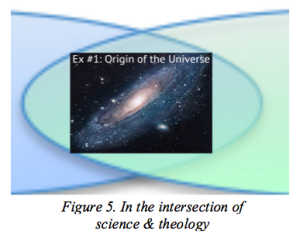
3.2.3 One Example: A Knock-Out Shot
We exist, unless you are a first-year philosophy student or an obsessive Matrix fan, the existence of ourselves and the universe can be taken as a given, or a properly basic belief. If we exist, then our existence leaves only two possibilities: either our universe had a beginning, or it did not have a beginning. Those are the only two options. Simple.
So we have the first step in the basic scientific method, problem/question: Did our universe have a beginning? This question of origins is also one of the core or “big questions” in life and worldview beliefs. Also very useful, the different worldviews and science took the second step in the scientific method by providing their respective hypotheses or models, and divide clearly between these two options. Let’s consider what each model predicted before the evidence came in.
Christian theology will be focused upon since much of the scholarship regarding the interaction of theology and science concerns Christian theology, yet the reader may take any other theology and do the same comparisons that follow. As far as theology, the biblical model, millennia before modern science brought its tests, not only predicted the universe had a beginning but also provided the gold-standard that science seeks in its models – predictions that were unable to be known unless the model is on to something unique. Such as:
(1) The universe, and all that is a part of the universe, had a beginning (Genesis 1:1, compound use of Hebrew words “shamayim” (heaven) with “aretz” (earth), refers to everything of the entire universe; John 1:3, everything aside from God was created, was caused, and has a beginning).
(2) Time itself had a beginning (Genesis 1:1; Hebrews 1:10; Jude 1:25).
(3) Space and time began together (Genesis 1:1; use of “bārāʾ” refers to divine creating something new out of what was not in existence before, and this happened at “the beginning”).
(4)-(5) The universe came from not anything visible or of this universe (Gen. 1:1; Heb.
11:3; John 1:3).
(6) The universe follows fixed laws (Jeremiah 33:25-6).
(7) The cause of the universe is given very specific properties, some of which include: uncaused, and outside of, or beyond space, time, matter and all nature.
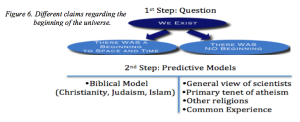
There are more, but these will do for now. As for the other models, possibly all theology models not tied to the Bible, predicted an uncaused, eternal universe, some with variations like an eternally cycling universe. Those in the scientific community generally accepted an eternal universe, as well as atheists in general; consider the first affirmation of Humanist Manifesto I.[1] If your worldview belief’s model is not provided, then add it on one-side or the other, beginning or no beginning.
3rd Step: Test the Models
It is important to keep in mind the Bible is not a scientific text, meaning its stated purpose is more of a love letter from God, explaining our situation, and giving Basic Instructions Before Leaving Earth. Therefore, care must be taken in not extrapolating beyond what the Bible is providing to make a claim in the area of science. Nonetheless, theologies, the biblical model included, make claims about the natural world, and when these are clear and specific, like the ones above, then these claims are simultaneously in both the domain of theology and of science. William Lane Craig echoes this idea: “When religions make claims about the natural world, they intersect the domain of science and are, in effect, making predictions which scientific investigation can either verify or falsify.”[2]
This is already not looking good for NOMA, if the theologically produced models are testable/falsifiable, NOMA is no mas, as these theologically elucidated areas are also in the realm of science. And it only gets worse for NOMA fans. Let’s look at the tests and analyses.
The evidence is in, and includes: some of the greatest discoveries of modern science, multiple Nobel Prize winners, Einstein’s field equations of General Relativity, Hubble’s telescope, Hawking’s space-time theorem, the microwave background radiation and ripples, and great quotes, such as Alexander Vilenkin’s noting, “It is said that an argument is what convinces reasonable men and a proof is what it takes to convince even an unreasonable man. With the proof now in place, cosmologists can no longer hide behind the possibility of a past-eternal universe. There is no escape, they have to face the problem of a cosmic beginning.”[3]
People have attempted the myriad of ways to get around the universe having a beginning in the finite past, typically I would provide a survey and the recognized refutations of those ideas, but for this discussion will leave that to the reader’s discretion. To not believe in the beginning of the universe, one would have to go against ALL the evidence. When one side of the argument has ALL the evidential support, and the other side has NONE, then even a graduate from Ohio State University can figure out what that means (I am a University of Michigan fan, whose football enjoyment has been greatly abused by that team to the south).
What science now knows:
(1) The universe and all that is a part of the universe had a beginning nearly 14
billion years ago.
(2)-(3) Time itself had a beginning and is linked with the universe, physicists and
astronomers use the phrase “space-time fabric” of the universe.
(4)-(5) There was nothing, not anything of our natural universe, then a super dense, super hot, the universe came into existence, and was so dense and hot that no light was able to be released until almost 400,000 years later.
6) The universe began expanding and cooling following fixed laws of nature.
7) Discoveries lead to specific properties of the cause of the universe.
Look again at the biblical model’s predictions. The phenomenal match between the biblical description and what modern science discovered has not been lost on those scientists involved.
- Astronomer Sir Frederick Hoyle was confronted with the points mentioned above about the beginning of the universe, but he believed the universe was eternal and ridiculed the idea of a beginning as “scientific Genesis.” He called the theory the “Big Bang” in his disbelief. The name stuck. Hoyle later remarked, “there is a good deal of cosmology in the Bible.”[4]
- Robert Jastrow, founder of NASA’s Goddard Institute of Space Studies said: “…astronomical evidence leads to a biblical view of the origin of the world…. the essential element in the astronomical and biblical accounts of Genesis is the same.”[5]
- Nobel Prize winners Penzias and Wilson add respectively: “The best data we have (concerning the Big Bang) are exactly what I would have predicted had I had nothing to go on but the five books of Moses, the Psalms and the Bible as a whole.”[6] And, “Certainly there was something that set it all off…. I can’t think of a better theory of the origin of the universe to match Genesis.”[7]
Mathematical physicist Frank Tipler sums up one of the conclusions: “From the perspective of the latest physical theories, Christianity is not a mere religion, but an experimentally testable science.”[8]
[1] Raymond B. Bragg, Humanist Manifesto I, American Humanist Organization,
http://americanhumanist.org/Humanism/Humanist_Manifesto_I (1933).
[2] William Lane Craig, “What is the Relation between Science and Christianity”, Reasonable Faith,
http://www.reasonablefaith.org/what-is-the-relation-between-science-and-religion (2014).
[3] Alexander Vilenkin, Many Worlds in One (New York: Hill and Wang, 2006), 176.
[4] Fred Hoyle, The Nature of the Universe, second edition (Oxford: Basil Blackwell, 1952), 109.
[5] Robert Jastrow, God and the Astronomers (1992), 14.
[6] Arno Penzias, interview in New York Times on March 12, 1978.
[7] Robert Wilson, interview with Fred Heeren,
Show Me God: What the Message from Space Is Telling Us About God (Day Star Publications, 2000), 157.
[8] Frank J. Tipler, The Physics Of Christianity (New York, Doubleday, 2007), Preface.
4th Step: Analysis & Conclusion
It is simply false to claim theology doesn’t make factual claims about the natural world. For example, the world religions make various and conflicting claims about the origin and nature of the universe and humanity. Therefore, the idea of non-interacting fields of science and theology, and NOMA, is falsified.
Theologies have produced scientifically testable models. The theological approach utilizing the Bible provided accurate factual knowledge about the natural world and did so in an area science also addresses. NOMA is double-falsified.
And from that point, science supported theology in that it exposes inaccurate theologies, and adjudicates between mutually exclusive ideas. Other theologies, Hinduism, Buddhism, etc., predicted an uncaused, eternal universe; the worldview of atheism predicted the same; science and common thought even into the 1950’s held to the eternal universe. Therefore, science can support, deny, or interact with the subject(s) encompassed by the theology circle of knowledge. This triple-falsification invalidates NOMA and demonstrates the symbiotic relationship of SOMA precisely.
Just as science provides maintenance for theology, the reverse also occurs. While not attempting to be a science textbook, the theological text does account for properties in nature that can be tested. While all reasonable options need to be explored, just think if researchers gave more credence to the biblical model of the beginning, more time and effort could have been directed correctly, instead of focusing on faulty conceptions that science and other belief systems held even through Einstein’s time. Further examples are discussed in section 3.3.5.
We started at the beginning of the universe, and what is the next logical question? What was the cause of the universe? And again we find the same trail of evidence supporting SOMA and disproving NOMA. Because this paper is not focused on covering all the intersections, the cause of the universe and fine-tuning will not be covered here, but astronomer Robert Jastrow’s revelation is fitting: “For the scientist who has lived by his faith in the power of reason, the story ends like a bad dream. He has scaled the mountain of ignorance; he is about to conquer the highest peak; as he pulls himself over the final rock, he is greeted by a band of theologians who have been sitting there for centuries.”[2]
[1] Robert Jastrow, God and the Astronomers (1992), 106-107.
[2] Robert Jastrow, God and the Astronomers (1992), 106-107.
3.2.4 Relationship Described by Set Theory
What has been shown above can be described in basic set theory, and the Venn diagrams we experienced in elementary school. Set theory was originally developed and utilized in mathematics, so if my application or memory of set theory runs afoul, I would appreciate corrective comments to make the explanation more accurate and robust. A set is a collection of things or elements, for example, a set A includes all even numbers 1-10, while set B contains even numbers 6-20, which would be written as: A = {2, 4, 6, 8, 10}, B = {6, 8, 10, 12, 14, 16, 18, 20}. Sets can even contain other sets, for example, if set A and B are both elements of set R, (written as A∈R and B∈R), then: R = {A, B} = {2, 4, 6, 8, 10, 12, 14, 16, 18, 20}. A union of sets means that you combine all the elements in the union, or joining of the sets, so the union of A and B would be: A È B ={2, 4, 6, 8, 10, 12, 14, 16, 18, 20}. The intersection of sets means all of the elements that are in common between the sets. For example, the intersection of sets A and B would be A ∩ B = {6, 8, 10}. This can be illustrated with a Venn diagram.
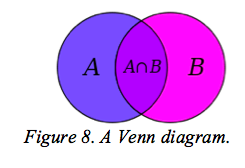
As applied to the relationship between science and theology, let the knowledge obtainable through science be set S, the knowledge obtainable through theology be set T, and all the knowledge about reality be set R. So set S will include elements such as S = {helical structure of DNA, Maxwell’s equations, optics, black holes, the beginning of the universe, … }. Set T will include elements such as: T = {does God exist, what is God like, has this being communicated with us, objective morality, free will, inherent value/purpose of life, claimed historical events, after-life, NDEs, claims about numerous aspects of life, the beginning of the universe, … }. There are other sets or approaches that bring knowledge about reality, including (Ph)ilosophy = {laws of logic, realism, ethics, logical fallacies, deductive reasoning, inferential reasoning, … }, (H)istory, (M)athematics, (P)sychology, etc. Set R will include knowledge gained about reality from every set, including S and T, R = {S, T, Ph, H, M, P, …}.
For NOMA to be true, there can be no element (e) that is factual knowledge about reality, which can be found within (T)heology. Further, there can be no e that is found in both S and T; S ∩ T = Æ, these two sets must be disjoint.
But there are multiple elements, e’s = such as facts about the beginning and cause of the universe, which are found in the intersection: S ∩ T = {all matter, energy, and space had a beginning, time had a beginning, the cause is able to produce matter and energy from no “natural” thing ontologically prior, the universe follows fixed laws, … }. Formally, if e = the fact that the universe had a beginning, then S ∩ T = {e : e ∈ S ∧ e ∈ T }. Therefore, NOMA is false.
SOMA accurately describes the relationship between science and Christian theology. Notice how similar figure eight from Wikipedia is to my SOMA diagram, figure four. And, in that area of intersection, you could picture not just the Big Bang, but many other areas of knowledge to further establish this idea. For example, a psychology professor at a prominent university on the U.S. west coast, whose lectures were often overflowing with unregistered students and other professors, was once asked what was the key to a “good and happy life.” The professor responded that the most succinct and accurate prescription he had ever encountered for a healthy life was given by Jesus in the Sermon on the Mount (Matthew 5: 1-12). P ∩ T = {e : e ∈ P ∧ e ∈ T }. The professor did not want his identity given due to possible repercussions for his theological statement, so you can take this example or leave it. But before you leave it, read the biblical passage yourself to consider the subject.
Additionally, the Bible has been scoured with the finest-toothed historical combs, due to the massive number of specific historical data provided. Critics have claimed numerous errors as had been found in any comparable writing. The accepted belief in historical studies was that there was not even writing during Moses’ time, the Davidic tunnel was a myth and excavation seemed to verify the inaccuracy, the Hittite people never existed, the alleged researcher Luke must have gotten many facts wrong in his gospel account. Further study revealed: the biblical account of writing during Moses’ time was correct, the Davidic tunnel was found and is a tourist attraction today, and thousands of artifacts now bring a wealth of information about the Hittites.
Regarding the reliability of Luke, and the biblical account in general, archeologists have targeted the biblical source as no other, and their results have been declared by top researchers in the field. William F. Albright, who is respected as possibly the top archeologist of this century, stated: “There can be no doubt that archeology has confirmed the substantial historicity of Old Testament tradition.”[1] Sir William Ramsay, considered one of the greatest archeologists to have ever lived, serves as another source. His schooling led him to believe that the scripture records were unreliable, but he had to consider biblical writings of Luke for a study of Asia Minor. His belief was completely reversed and he became a Christian through overwhelming evidence uncovered during his studies. Ramsay declared:
I began with a mind unfavorable to it (the truth of the biblical record), for the ingenuity and apparent completeness of the Tubingen theory (a theory that rejected the reliability of Luke’s writings) had at one time quite convinced me. It did not then lie in my line of life to investigate the subject minutely; but more recently I found myself brought into contact with the Book of Acts (a book in the Bible that was written by Luke, who wrote one-quarter of the New Testament) as an authority for the topography, antiquities, and society of Asia Minor. It was gradually borne upon me that in various details the narrative showed the marvelous truth… I gradually came to find it a useful ally in some obscure and difficult investigations.[2]
Then after 30 years of study, regarding Luke’s ability as a historian, Ramsay declared that “Luke is a historian of the first rank; not merely are his statements of fact trustworthy . . . this author should be placed along with the very greatest of historians.” And to reinforce the check-ability aspect, Ramsay affirms: “Luke’s history is unsurpassed in respect of its trustworthiness.”[3] H ∩ T = {e : e ∈ H ∧ e ∈ T }.
If two sources of knowledge are valid, and if both view the same subject, then the views will show the same thing. And if a specific theology has a concordance in the intersection with science, or in other ways is demonstrated to be a valid source of knowledge about reality, then one would expect to see the same type of interactions with other valid sources of knowledge, such as philosophy, history, archeology, etc. Conversely, contradictory theologies to a valid one would likely demonstrate a trend in the opposite direction in the interaction with other valid methodologies for gaining knowledge. The biblical model again was and is the focus of most scholarly writings on the interaction, but the same comparisons can be done with other theologies and is left to the reader and other researcher’s discretion.
Bottom-line
The belief that science and theology cannot interact is mistaken. However, one can show that these fields of study have very different sources of data, and contain much in their respective circles of knowledge that is independent from the other’s circle – so the NOMA view is applicable, but only in this limited way. Keep this in mind (a model concerning the relationship between science and theology being partially accurate, but only applicable to a limited scope), as it will recur in other proposed models.
First, it has been demonstrated that indeed there are facts or knowledge about reality that can be cooperatively illuminated by both the theology and science cameras, or approaches, and fit simultaneously in both circles of added knowledge.
Second, both theology and science benefit from corrective and corroborative support from each other, and other fields of view, such as history, philosophy, etc. Theology provided a number of contradictory views about the beginning and cause of the universe, as noted in the predictions step, and science helped eliminate inaccurate viewpoints and provide support for the correct view(s). While benefitting from phenomenal verification regarding the beginning of the universe, Christian theology also obtained corrective support. The Aristotelian view about the earth being at the center of the universe was accepted by the culture and many in the church of Galileo’s time. While the account of Galileo’s trials has often been portrayed erroneously in many presentations I have witnessed, the church leadership, particularly a cardinal who got his ego tweaked by Galileo, did buy into the faulty idea and used a biblical passage to try to support it. Science provided knowledge about our solar system, which led to further research into the biblical passage and exposed faulty extrapolations from it made by some in the church.
Third, some theologies do not provide testable/falsifiable models, and some do. The ones that do can be checked throughout the history of discovery, in every field of knowledge. Trends are important indicators. You see trends in your grades, the economy, your health, and other areas, and trends speak loudly. If a theological or scientific view is valid, as time goes on, new discoveries and confirmation between different fields of study will increase, or the opposite, if the view is not true. Although over what time frame will the accurate trend arise? Who knows, as it depends on a number of factors, but we do have a considerable history of the development of knowledge and equally significant trends have emerged. Check for your self, the relationship between specific theologies and science, history, philosophy, and other fields do have demonstrative inclinations. More about the SOMA model later.
As scholars began rejecting the NOMA model, the recognition of the interaction and the modern dialogue between religion and science grew in popularity with Ian Barbour‘s 1966 book Issues in Science and Religion. Since that time, the study of the relationship has grown into a serious academic field, with academic chairs in the subject area, and dedicated academic journals, Zygon: Journal of Religion & Science, Perspectives on Science and Christian Faith, and Theology and Science. Articles are also found in mainstream science journals such as American Journal of Physics, Nature, and Science.
Institutions interested in the intersection between science and religion include the Center for Theology and the Natural Sciences, the Institute on Religion in an Age of Science, the Ian Ramsey Centre, and the Faraday Institute. Numerous scholarly works are available, as are numerous societies for promoting this dialogue, for example, the European Society for the Study of Science and Theology, the Science and Religion Forum, the Berkeley Center for Theology and Natural Science, and so on. Very significant on-going conferences sponsored by the Berkeley Center and the Vatican Observatory, in which prominent scientists like Stephen Hawking and Paul Davies have joined with prominent theologians like John Polkinghorne and Wolfhart Pannenberg to discuss the interactions and implications. The Templeton Foundation has awarded its million dollar Templeton Award in Science and Religion to integrative thinkers like the aforementioned Paul Davies, John Polkinghorne, and George Ellis for their work in science and religion. The dialogue between science and theology is so significant that both Cambridge University and Oxford University have established chairs in science and theology. The interaction between these two sources of knowledge has been the source of consistent and substantial scholarship.
With the NOMA model’s exposed limited applicability, and failures, and the movement of scholarship into the interaction models, what type of interaction has been found? This is the topic of part 2 of this series, which eliminates two other popular thoughts on either extreme.
[1] William F. Albright, Archaeology and the Religion of Israel (Baltimore: Johns
Hopkins Press, 1942), 176, as cited by McDowell, New Evidence that Demands a Verdict (Nashville: Thomas Nelson, 1999), 98.
[2] Sir William M. Ramsay, The Bearing of Recent Discovery on the Trustworthiness of the New Testament (London: Hodder and Stoughton, 1915), 222, as cited by McDowell, NE, 63.
[3] Ramsay, BRDTNT, (1915), 222.

After Debate, Atheist and Christian Defend Free Speech Against Gay Activists
College Events, Culture CrossExamined, DebatesOn April 16, I, Frank Turek, debated atheist Michael Shermer at Stony Brook University on the question: “What Better Explains Morality: God or Science?” Following the debate, the Graduate Queer Alliance at Stony Brook wrote a letter to the editor of the school newspaper wanting an apology from the university for allowing me to speak because I expressed my opposition to homosexual behavior and same sex marriage. They also want shut down all future debate on such topics claiming that opposition is “hate speech.” Dr. Shermer and I decided to issue a joint response to their false assertions and totalitarian demands. Here it is.
By Dr. Michael Shermer & Dr. Frank Turek
It’s not often that an atheist and a Christian, who have just had a debate on campus, can be brought into agreement by a group in the audience. But the Graduate Queer Alliance (GQA) at Stony Brook University has managed to do that. Their letter to the editor on April 30 was so full of false assertions and totalitarian demands that we, Dr. Michael Shermer (an atheist) and Dr. Frank Turek (a Christian), felt compelled to write this letter together in response.
The central assertion of the GQA is that anyone who expresses a negative opinion of same sex marriage or homosexual behavior is guilty of “hate speech” and should be barred from speaking at Stony Brook University. The GQA says this while also claiming to believe “that a university should provide an open forum for controversial ideas to be discussed and debated.” We both wonder how the GQA can hold these two contradictory opinions at the same time. After all, they say they are for the debate of controversial issues, but apparently only if both debaters hold the same position and that position agrees with the GQA. Some debate!
How is disagreement over controversial moral and political issues “hate speech?” If it is then GQA’s position is “hate speech” because it disagrees with people who believe marriage should be defined in other ways. Calling people names or characterizing their arguments as “hate speech” is not good public discourse designed to discover the truth; it is bullying—the very thing GQA should be against.
To demonstrate the oversensitivity of the GQA, you should know that our debate was not even about same sex marriage or homosexuality. Our debate was about whether God or Science better explains morality. As you can see for yourself in the debate here, Dr. Turek never mentioned homosexuality or same sex marriage in his prepared opening statement. Dr. Shermer brought up those issues in his opening statement as examples of what he believes to be moral progress (hence the title of this book, The Moral Arc). Dr. Turek expressed disagreement with Dr. Shermer’s point only when Dr. Shermer pressed him to comment during the cross-examination period. (Imagine, a debate where the debaters disagree!)
The true motives of the GQA are revealed by what is not in the letter: the arguments made by Dr. Shermer in support of same sex marriage, arguments he made with great passion that elicited equal passion—on both sides of the issue—from the audience. If those in the GQA are so interested in advancing their position through sound reason and science—which was Dr. Shermer’s point—why would they not highlight the arguments offered in support of it? Instead, the GQA seems to think they have a right not to hear an opposing opinion lest they be challenged!
It’s a shame that those in GQA appear so uninterested in evidence. Unfortunately for them, as the late Christopher Hitchens put it (and Dr. Shermer elevated to a principle, “Hitchens’ Dictum”, in one of his Scientific American columns ), “What can be asserted without evidence, can also be dismissed without evidence.” Instead of citing evidence, GQA attempted to smear the character of one of the debaters and now tries to silence all future debate by simply declaring that the major issues of our day have all been decided in their favor. Don’t bother debating anything. We know what’s right and you have no right to express your wrong opinion!
What’s also problematic is that none of the derogatory assertions about Dr. Turek made by the GQA are true. For example, contrary to the GQA:
Finally, on the issue of tolerance, it appears that GQA only wants to tolerate ideas they agree with. That’s not tolerance. That’s totalitarianism. You can only tolerate ideas you disagree with. Moreover, you will never learn and grow (the essence of a university) if you hear only one side of any issue. As Dr. Shermer points out in The Moral Arc by quoting same sex marriage advocate Jonathan Rauch: “Good ideas outcompete bad ideas in the marketplace of free exchange.” Now that’s a good idea rooted in the very foundation of a free society.
Unfortunately, GQA is expressing a totalitarian impulse to silence all opinions that dissent from their own. As a free people, we must not adopt such an unlearned, intolerant and unconstitutional position. This atheist and Christian agree with same sex marriage advocate Andrew Sullivan who wrote against this totalitarian impulse this way: “If this is the gay rights movement today—hounding our opponents with a fanaticism more like the religious right than anyone else—then count me out. If we are about intimidating the free speech of others, we are no better than the anti-gay bullies who came before us.”
The Wisdom Chronicle
Wisdom ChronicleThe Wisdom Chronicle is designed to bring nuggets of wisdom from the dozens of books I read every year. I endeavor to share the best of what I have gleaned. The determination of relevance lies with you. Blessings, J. Whiddon
–Wernher van Braun (1912-1977) Director of NASA
—Russian proverb
It behooves us, then, to humble ourselves before the offended Power, to confess our national sins, and to pray for clemency and forgiveness.”
— Written in anguish over the ravages of civil war by President Abraham Lincoln on March 31, 1863 while declaring a National Day of Fasting.
A lot of voices and volumes today tell us how to live. Motivational and self-help books flood the marketplace. But there is only one book that tells us how to die.”
Excerpt From: O. S. Hawkins. “The Joshua Code.”
Ultimately, political correctness boldly asks us to commit intellectual suicide by assenting to what we actually do not believe. It asks us to buy into the fashionable definition of Jesus to make Him and His teachings more palatable, in an expedient way to “relate” to a wider world.
Jesus, however, calls us to be salt and light, not chameleons.”
Excerpt From: Battaglia, Joe. “The Politically Incorrect Jesus.”
Cameras of the Watchman: The Reality of the Relationship between Science and Theology (part 3/3)
Philosophy of ScienceScott Symington
3.3.4 Complex / Contextual
A couple that really loves each other, may still have a history of ups and downs, especially relationships susceptible to psychological and other influences. Marriage counselors will often hear, “It’s complex”, in reference to how the relationship is going.
Historians of science and religion have come to see this too. John Hedley Brooke had a serious impact on scholarship, when he and his colleagues produced work that led to a new consensus in the scholarship. Brooke looked beyond the intellectual points to the sociological, political, and cultural factors involved. Dixon, Cantor, and Pumfrey in their work, Science and Religion: New Historical Perspectives, and Lindberg and Numbers, follow on from Brooke and developed further the idea that the complex relationship is contextualized, and displays diverse interactions based upon a number of influential, environmental and contextual factors.
Therefore, people working out of the science or theology perspective will have conflicts with the other field, but these speak only to other influential factors being involved, and not necessarily to the reality of the relationship. If a specific theological field were invalid, then the conflicts would likely, over time, rise to the level of defeaters, or at least would display the trend towards the conflict model. If a specific theology were valid, there would almost certainly still be conflict, being closed-off from proof and open to the external factors on the people involved. But in contrast to the trend of invalid models, over time, the trend would show occasional conflicts, but an overall rise towards agreement and examples of mutually supporting each other.
So while the conflicts between science and Christian theology may be the exception, these are very good opportunities to investigate to help decide if the conflicts are real and the predicted trend will be towards further conflict and invalidation of the source of knowledge, or only apparent conflicts brought on by the complex factors, and will predictably become examples of mutual support in the trend towards concordance.
One aspect of the mutual support, are examples of seeming conflict that turned into supportive corrections, such as the aforementioned biblical correction of inaccurate historical claims (see section 3.2.4), and of scientific claims regarding the beginning and cause of the universe. Also, faulty biblical extrapolations have been corrected by scientific discoveries, such as in the case of the Galileo affair, in which Galileo himself said those opposing him simply based their position on an inaccurate interpretation/extrapolation. Notice in these cases, the conflict arose between the people involved and their personal interpretations of data from nature or extrapolations from scripture (going beyond what was actually stated), which is to be expected whenever people are involved.
You own land, which a neighbor’s herd of sheep crosses over and grazes on periodically. You ask if you can see this herd, and know previously this neighbor is honest and reliable, and she says her herd always stays together and only consists of eight sheep. As you approach where the herd is currently grazing, you see ten sheep.
Apparent conflict exists between the two sources of information, your observation and the word of your neighbor. But then again, as you move in closer you notice two of the sheep are running in circles around the rest, and closer still, you realize those two are actually sheep dogs. Apparent conflict resolved by mutual support provided by one field to the other.
Let’s consider several common, current antagonistic subjects. First, many in science, and many who accept Christian theology, think that the Big Bang models of the beginning of the universe conflict with biblical theology. This is very interesting considering the history of thought concerning the beginning of the universe, covered in section 3.2.3, involved scientists recognizing the Big Bang models were “scientific Genesis”, while the real conflict was between those who believed the universe was eternal and the discoveries of modern science. Yet, now many who accept Christian theology claim the Earth and Universe must be relatively young, around 10,000 years old, compared to the 4.5 billion and almost 14 billion year age science provides for the Earth and Universe respectively. These dates certainly conflict.
However, as noted earlier, areas of conflict are good opportunities to test the relationship model and determine if it is an example of the apparent conflict, which will occur in valid fields of study with incomplete knowledge and susceptible viewers of that knowledge, or an example of real conflict, which over time will grow in support and number and trend toward the conflict models. The age of the Earth example is apparent conflict, and an excellent example of symbiosis between science and theology. Biblical theology accumulates bad interpretation or extrapolation leftovers over time, such as an idea promoted by a bishop in the 17th century that one could use genealogies in the Bible to determine the age of the Earth. Bishop Ussher even declared the time of day creation began, which should have waved the red flag warning of something that needs to be checked. Instead the idea was liked by enough, or the right people, to be added as a commentary in the King James Bible, which many people then took as established fact, instead of following the biblical command to “examine everything carefully”[1] concerning things being taught, and realizing the claim was based on five assumptions, which are all easily proven false. Therefore, there is no age of the Earth given, nor any way to determine the age without serious and unsupported steps beyond what the Bible provides. There are actually five assumptions that must all be correct in order to extrapolate a date with reasonable accuracy, and all five assumptions are mistaken. This faulty extrapolation polluted Christian theology, and like the clownfish which cleans up leftover waste on sea anemones, the conflict with science has led many in Christian theology to re-evaluate and discard the extrapolation. Many still accept the young earth idea, but as science and Christian theology advance the knowledge bases further, the accurate view of reality will continue to be made clear.
Richard Dawkins and Daniel Dennett claim evolution is unguided, so there is an apparent conflict with any theology claiming God’s guidance was involved. But is this conflict just apparent, or is it real? If you read Dawkins’ The Blind Watchmaker, where he makes this claim, check how he tries to defend the claim. Dawkins only gives support to show that it is not impossible, or not astronomically improbable that natural selection could lead to complex biological features, but no evidence showing arrival at the life we have was not guided, as science does not even have the tools to determine if God was involved or not. Dawkins also ignores the good arguments for intelligent guidance of the process. So Dawkins and Dennett’s claim – that it all happened by unguided process – is mistaken. The claim is simply philosophical gloss added onto the science involved with evolution.
Even when considering amazing work in the origin of life from non-life, at every end we find examples of proof-in-principle, meaning it is shown that certain building blocks or steps in the origin of life are possible, but not that guidance was not also involved. This was publicly highlighted at the international ISSOL conference in 2002 on the origin of life. Biochemist and attendee, Fuz Rana, recalled that after a presentation by James Ferris, where Ferris triumphantly declared that clays in the environment were shown, by his team, to be able to provide an important step in the origin of life, a top-level origin of life researcher, Robert Shapiro, stunned the audience during the question-and-answer period by dismissing the team’s decades worth of work as offering little insight into chemical evolution, and instead provided elegant proof of intelligent design![2] Think about it: Ferris’ team, with massive expenditure of the brightest minds in the field, money, top-level equipment, and voluminous processes required to produce, in a precisely controlled lab, the results sought, showed how an important step could have happened. What follows from that? That the origin of life did happen like that, and without intelligent guidance – of course not. Shapiro realized that whatever led to the actual, full origin of life from non-life, must have been more intelligent and better funded than the Ferris team! Results in the diverse areas of study in the origin of life research have similar findings: proof-in-principle, but all reached with massive intelligence and investment involved, and absolutely no evidence that intelligent guidance was not involved.
Those who declare they don’t need to believe in God because of evolution, or they don’t believe in evolution because they believe in God, are simply making a false dichotomy, and display a lack of understanding of the concepts involved. It is not a zero-sum game, so they are making “Much to-do about nothing”, which was the title of the talk I gave on “Darwin Day” at the University of Michigan. While there have been theologians and Christians since Darwin’s time that were fine with evolution being the method God used, many other Christians have had a problem with evolution, yet there have always been Christians on both sides of the issue because while the Bible notes God did perform special acts in creation, it doesn’t preclude evolution. If there were, then, at most, inerrancy would be in question, but none of the support provided for the biblical model would be, as that verification exists independently. And as far as science, there is nothing in the science circle, or in the theories or evidence of evolution demonstrating that the process precludes any guidance.
Those who claim evolution does preclude any special guidance have stepped outside of the science circle because such a claim is a philosophical add-on, and not something shown by science. As Alvin Platinga elucidates in his book, Where the Conflict Really Lies: Science, Religion, and Naturalism (2011), ask a person making such a claim: “How do you know that there is no guidance? How could you possibly determine that?” Such a claim is philosophical gloss, as science is incapable of determining no intelligent guidance was involved in perhaps: fine-tuning the initial conditions, preserving specific populations or gene expressions over others, increasing the probabilities involved with certain favored mutations, or even special one-time acts.[3]
Another serious area of conflict is found in evolutionary psychology. Some writings in this field of study have claimed that beliefs in God are simply evolutionary responses to lack of control and fear felt, or like Freud thought, for want of a father figure that is strong and benevolent. There is no conflict so far, as maybe such an instinct has evolved, and if God does exist, then maybe this is one mechanism used to help us accept and trust him. When someone tries to add to the claim that this belief in God is only caused by evolution, and there is no actual God to believe in, then there is a conflict with theology. However, again this is only an apparent conflict, as again, such a claim is only a philosophical add-on, without evidence. The evolutionary psychologist has to step outside of the science circle (as the science circle does not have the radius to include disproof of God, only some specific theological claims) and into the philosophy circle to make such a claim. If one turns on their philosophy cam, then they will be enlightened to the fact that such a claim is mistaken. Even if such belief in God were partially, or entirely caused by evolutionary means, it simply does not follow that God does not exist, as that has to be determined by the evidence in all applicable fields of study. Evolutionary psychology is not applicable as it does not have the tools to gain evidence in whether God exists or not, the most it could do is if it were shown that no God exists, then evolutionary psychology could show how such a false belief arose.
One more subject of primary discord, miraculous events and supernatural entities, could be a defeater to most, if not all theologies, if science showed that miracles are impossible and the supernatural does not exist. Then again, these topics are covered here because they are samples of only superficial conflict. Some have argued that miraculous events are not part of reality because they would be violating fixed natural laws as uncovered in the science circle. The question ultimately goes back to whether there is an intelligent cause that created the universe out of nothing. If so, then do you think any miraculous event after that would be a problem? It would be like asking a person who could build a car from the ground-up if that person was able to change the spark plugs. But when addressing the conflict directly, each of these natural laws, which describe how things act in nature, is only applicable to a closed system. Those claiming the impossibility of violating natural laws of science are assuming without scientific evidence or backing (actually against the evidence as we shall soon see) that the natural universe is entirely and always a closed system. Natural laws do not say anything about a situation when something outside the natural system interacts with it, and since science does not support the assumption of a naturally closed system, nothing in science goes against miraculous events because natural laws would not be violated.
Science could be used to demonstrate that a miraculous event would be beyond our typical experience and exceedingly rare – but that is the point – for a theology to establish itself as having a source beyond humanity would require something beyond what humanity can provide for verification.
Some may argue that is true for classical physics, but what about quantum mechanics? Platinga covers this topic well as he correctly notes that events in the quantum world aren’t fixed in the same way as classical mechanics, but instead have a probability of occurring this way or that, and in that probability is significant room for an intelligent agent to guide or utilize the probabilities to produce events that are otherwise miraculous (occurring even against massive odds against it, or even if phenomenally rare). There is a probability, which is exceedingly small but can be calculated, that all the matter and energy in a room become oriented in a way that causes a small volume around a person to become a temperature that would freeze the person solid in an instant. While thankfully this is unlikely enough to never need worry about it, it is possible in the quantum understanding. Again, the only way to rule out miracles would be to assume at the start that theism is not true, which is not anywhere in the realm of science to determine.
Similarly, while the belief that science only studies the natural world may work as a restrictive, but generally true characteristic, the theory of naturalism or materialism, that the physical matter and energy and space and time of our universe is all there is, was, or ever will be (as Carl Sagan famously put it) – has already been proven false. By some of the most amazing discoveries in modern science, we have found that the entire universe, and all material and nature that makes up the universe, had a beginning, and is therefore contingent, or dependent on something beyond itself for its existence. If the cause is outside of, or beyond nature, that is supernatural, or hyper-natural if one doesn’t like the other associations with the word supernatural, Either way, we know that the cause of the universe is beyond nature, so claiming supernatural entities do not exist, not only is outside of science’s ability to prove, but also comes with scientific support.
In the examples regarding the age of the universe, evolution, evolutionary psychology, miracles and the supernatural, once one removes the unsupported, philosophical add-on claims regarding the non-existence of God, the conflict is shown to be only apparent and caused by faulty reasoning by the people making such an ontological claim.
So conflicts do exist, and there are other examples, but as was the case in even the most noted area of disagreement, the conflicts are apparent. And while there may be some conflicts that cannot be resolved, when one looks at the trend through time, it is reasonable to expect that with further knowledge these too will be resolved into the trend toward concordance. Yet more will arise as the relationship is complex.
The complex-contextual model does take into account the relevance of other factors, and does explain why we have both concordance and some conflict. Nevertheless, this model, like NOMA and COMA, has restricted applicability. The complexity/contextual models apply to events in the history of the interactions between science and theology, but do not describe the reality of the relationship between these two sources. The reality of the relationship is determined by the validity of the two sources, and if these sources interact.
This was recognized by Dixon, Cantor, and Pumphrey in noting: “the personal dimensions of both scientific and religious activities ought to be taken more seriously. There is a sense in which we need to read abstract discussions of theology and science more as personal statements than as assertions about the relationship between two independent systems of thought.”[4] In other words, personal statements are influenced by the influential factors those authors discussed previously, which leads to the complex and contextual history, yet these personal statements do not speak to the actual relationship between the two independent sources of knowledge.
If the two sources are valid, and if these sources interact, then both sources will be in agreement with the reality provided by each – as each is viewing the same reality – but until all the knowledge is in, and humanity is free of external-influential factors (i.e., cultural, political, psychological), there may be apparent conflict, or confrontation between the people involved. So the history, or series of specific events in the interactions, can be described by the complexity/contextual models. Yet, regardless of the history, whether it be all conflict, or all agreement, or a mixture (which is most likely, and is what we see), the reality of the relationship between two valid sources of knowledge does not change. And it is the reality of the relationship that we want most to know, because that determines what theology is valid and worthy of founding our thoughts, actions, responses, goals, priorities, and direction in life upon.
Bottom-line
While very useful in explaining why specific times show conflict and other times concord between science and theology, complex/contextual theories do not address what the actual relationship is between science and specific theologies, and therefore, cannot explain one of the most significant pieces of evidence in the relationship – trend-lines.
3.3.5 SOMA
While the scholarship appears to diverge into the full range of possibilities, when recognizing accurate points and restricted applicability in each proffered path, a clear direction emerges to a singular reality of the interaction.
The flowchart began by assuming for the moment that science and a specific theology (or any two sources of knowledge) are valid. Next, it was shown that science and theology do interact, therefore NOMA is a false model. Because we do not have complete knowledge, neither field allows proof, and external-influential factors are involved, the two sources will not necessarily be in complete agreement where they intersect, and in fact will likely show concord and conflict in different contexts. COMA doesn’t apply. While the history may be complex, if both fields are valid, then the history of interactions conform to a trend over time – toward mutual support and agreement in a symbiotic relationship – which would be the reality of the relationship and is entirely described by the SOMA model. The complex/contextual models are not capable of explaining either the trend, or the actual relationship between the two sources of knowledge. SOMA incorporates or explains the accurate aspects of each alternative model, and extends the explanatory scope and power to be applicable to the full and actual relationship between science and specific theologies.
This model is a predictive one, which means the reader does not have to rely on what this paper has gone-on about to this point, and can simply allow discoveries over time to either support or invalidate the SOMA model.
SOMA predicts:
Predictions 1, 2, and 3
Predictions one through three have been discussed, but the remaining predictions could be detailed further. As far as prediction three, the relationship, being complex, could swing to seemingly total conflict, or total concord, but it seems unlikely. Most likely would be that emotional, social, and cultural influences will push for both discord and concord in different people, at different times, leading the relationship to appear to have conflict and concord regardless of what whether there is true contradiction or agreement.
Prediction 4
Prediction four entails the symbiotic nature of the relationship, which means that even if both fields are valid, being in a complex relationship will bring conflict, thereby creating an environment where each field of study is in a position to do things for the other field that each cannot do for itself (such as one field validating data in the other, correcting bad interpretations of data or extrapolations of the other, etc.). William Lane Craig provided a good summary, along with examples, in his online article: What is the Relation between Science and Christianity.[5] Some of the examples will be presented below as they differ from previous ones used in this paper.
[1] 1 Thessalonians 5:21.
[2] Fazale Rana, Creating Life in the Lab, (Grand Rapids, MI: Baker Books, 2011), 154-6.
[3] Alvin, Platinga, Where the Conflict Really Lies: Science, Religion, and Naturalism (2011).
[4] Thomas Dixon, Geoffrey Cantor, and Stephen Pumphrey, Science and Religion: New Historical Perspectives, Cambridge University Press (2010), 41.
[5] William Lane Craig, “What is the Relation between Science and Christianity”, Reasonable Faith, <http://www.reasonablefaith.org/what-is-the-relation-between-science-and-religion> (2014).
The following is a handful of examples of mutual support that will occur between two valid sources of knowledge, specifically science and theology in this case:
4a. Religion[1] furnishes the conceptual framework in which science can flourish.
4b. Science can both falsify and verify claims of religion.
4c. Multiple layers of checks add reliability to a field, and extends the overall circle of knowledge.
4d. Religion can help to adjudicate between scientific theories.
4e. Science can establish a premise in an argument for a conclusion having religious significance.
The clownfish and the sea anemone provide a biological example of symbiosis. The clownfish swims within the sea anemone without being stung, which provides protection from predators, which do get stung, and simultaneously create water circulation beneficial to the anemone. The clownfish also cleans away fish and algae remains within the anemone, which again is mutually beneficial. Similarly theology tends to accumulate bad interpretations of data or extrapolation leftovers over time (as is also true of science), and the other field, can expose and even help clear away some of this worthless accumulation. A valid theology, like the clownfish, can interact within the science circle without getting actually “stung”, while contradictory theologies can be damaged or even ended, when interacting within the science circle. Each field can also provide food (for thought) that stimulates or compliments the other field, and promotes the circulation of ideas.
4a. Religion furnishes the conceptual framework in which science can flourish.
Craig supplies:
Science is not something that is natural to mankind. As science writer Loren Eiseley has emphasized, science is “an invented cultural institution” which requires a “unique soil” in order to flourish.[2] Although glimmerings of science appeared among the ancient Greeks and Chinese, modern science is the child of European civilization. Why is this so? It is due to the unique contribution of the Christian faith to Western culture. As Eiseley states, “it is the Christian world which finally gave birth in a clear, articulate fashion to the experimental method of science itself.”[3] In contrast to pantheistic or animistic religions, Christianity does not view the world as divine or as indwelt by spirits, but rather as the natural product of a transcendent Creator who designed and brought it into being. Thus, the world is a rational place which is open to exploration and discovery.
Furthermore, the whole scientific enterprise is based on certain assumptions which cannot be proved scientifically, but which are guaranteed by the Christian world view; for example: the laws of logic, the orderly nature of the external world, the reliability of our cognitive faculties in knowing the world, and the objectivity of the moral values used in science. I want to emphasize that science could not even exist without these assumptions, and yet these assumptions cannot be proved scientifically. They are philosophical assumptions which, interestingly, are part and parcel of a Christian world view.
4b. Science can both falsify and verify claims of religion. This is important because people often are more drawn to what they want to believe, whether or not it is founded on truth. Combined with that psychological influence, humanity has vast imagination, therefore, science is very useful as it can impose limits of reality onto the overgrowth of imagination beyond what is based on truth.
An example of science verifying a theological claim(s) was already given in the NOMA section, involving the beginning of the universe, and physicists John Barrow and Frank Tipler explained this verification of the biblical claim of creation ex nihilo (out of nothing): “At this singularity, space and time came into existence; literally nothing existed before the singularity, so, if the Universe originated at such a singularity, we would truly have a creation ex nihilo (out of nothing).”[4]
Here is a bold prediction: it is possible, but not necessarily the case, that science can even support the claim that there is a divine authority as the source a specific theology draws upon. Again, “proof” will not be reached, but when combining what science, history and a specific theology offers on a subject(s), it is possible that the most reasonable explanation will be that there is a divine authority, or at least an intelligent agent beyond humanity involved. Whether this is the case is another opportunity for further study, yet we have already covered something significant with the predictions the biblical model made concerning specifics about the beginning and cause of the universe. If one does not believe the biblical knowledge is beyond humanity’s ability to produce, then that person should be able to provide other comparable examples throughout all of human history, of anything ever produced by man, covering a handful (and there are more that can be added) of clear, specific predictions, made thousands of years in advance of modern science, in clear contradiction with all contemporary and current competitor theories, and then only be proven accurate by modern science discoveries over three-thousand years later. If there is not another example that reaches such a level, then this is at least absolutely unique, and worthy of further study.
4c. Multiple layers of checks add reliability to a field, and extends the overall circle of knowledge. Providing independent checks from other sources of knowledge is obviously useful in building the reliability of something, which one source brings into its circle of knowledge.
Furthermore, our overall circle of knowledge, which is a combination of all fields of study, is expanded by each valid field. As noted previously, if one wants to learn quantum mechanics, theology is not the place to look. What may be less obvious to some is how theology expands the view of what someone in the science circle is restricted from viewing. Craig provides a common reflection from physicist David Park, “As to why there is spacetime, that appears to be a perfectly good scientific question, but nobody knows how to answer it.”[5] Why is there something rather than nothing? Such a question arises naturally at the edge of the scientific circle, yet answers lie beyond.
That is frustrating to Park as a watchman, the science cam just doesn’t provide a good view in that area of reality, yet the same theology cam that views the beginning cooperatively with science, also extends into that area science cannot. Theists typically accept a God that is a necessary being, the uncaused, first cause, whose non-existence is not possible, and who created the contingent space, time, matter and energy of our universe. Science and philosophy have anticipated such an uncaused cause, but science had just assumed it was the universe itself. Now that the universe has been shown to have a beginning, and therefore is contingent or dependent upon something else, the theist has the explanatory resources to provide Park and other watchmen a potential view of the ultimate explanation.
A valid theology can also provide the same benefit to other valid areas of study. For example, philosophy can provide that there is no objective morality without a transcendent authority, and theology can provide support for the reality of that authoritative grounding. Political views set down in the Declaration of Independence hold that: “We hold these truths to be self-evident, that all men are created equal, that they are endowed by their Creator with certain unalienable Rights . . .” Theology provides the grounding or basis for this political stance, because if there is no Creator, then there are no inherent, unalienable rights, as without a transcendent authority, “rights” just become subjective opinions of people, and the King of England had a different opinion at that time.
4d. Religion can help to adjudicate between scientific theories. Craig writes of this benefit, and while I think it is true, such adjudication certainly wouldn’t carry much weight until the specific theology establishes itself as a valid and productive source. For example, when most accepted that the universe had always existed, and someone brought the idea of a beginning to Sir Frederick Hoyle, it is not entirely surprising he ridiculed it as “scientific Genesis.” Unless Hoyle did studies of biblical theology, he wouldn’t be aware of other areas where biblical statements regarding the natural world demonstrate accuracy. However, after the scientific findings regarding the beginning, properties of the cause, and fine-tuning of the universe have been made public, the biblical model has warrant, and therefore weight in possibly adjudicating between other theories in science.
Craig provides a specific example in two possible ways scientists can interpret the mathematics in the Special Theory of Relativity. Craig notes: “The Einsteinian and the Lorentzian interpretations are empirically equivalent; there is no experiment you could perform to decide between them.[6] But I want to argue that if God exists, then Lorentz was right.”[7] And then Craig provides the argument from theology and applies it to the science discussion to augment one theory over another.
[1] Craig chose to use “religion” as opposed to my choice of “theology”, which in this case is warranted as “religion” may be defined as the organization and activity people place around a theology, and as such, is involved in the mutually supportive examples.
[2] Loren Eiseley, “Francis Bacon,” in The Horizon Book of Makers of Modern Thought (New York: American Heritage Publishing, 1972), 95-96, as cited in Craig.
[3] Loren Eiseley, Darwin’s Century (Garden City, N. Y.: Doubleday, 1958), p. 62. I am indebted for the Eiseley references to Nancy Pearcy and Charles Thaxton, The Soul of Science (Wheaton, Ill.: Crossway Books, 1994), as cited in Craig.
[4] John Barrow and Frank Tipler, The Anthropic Cosmological Principle (Oxford: Clarendon Press, 1986), 442, as cited in Craig.
[5] David Park, The Image of Eternity (Amherst: University of Massachusetts Press, 1980), 84, as cited in Craig.
[6] Craig added: “Actually, this statement bears qualification; for as a result of the Aspect experiments verifying the predictions of quantum mechanics with respect to Bell’s Theorem, we now have substantial empirical grounds for affirming relations of absolute simultaneity between distant events, thus vindicating the Lorentzian interpretation.
[7] William Lane Craig, “What is the Relation between Science and Christianity”, Reasonable Faith, <http://www.reasonablefaith.org/what-is-the-relation-between-science-and-religion> (2014).
4e. Science can establish a premise in an argument for a conclusion having theological significance. There are many examples of this, and two common ones are provided here. A version of the Cosmological argument goes as follows:
Premise 1. Everything that begins to exist has a transcendent cause.
Premise 2. The universe began to exist.
Conclusion. Therefore, the universe has a transcendent cause.
Premise two is supported by modern science discoveries of the beginning of the universe.
The Fine-Tuning argument:
Premise 1. The fine-tuning of the universe is the result of necessity, chance, or design.
Premise 2. It is not the result of necessity or chance.
Conclusion. Therefore, it is the result of design.
Premise two has received tremendous evidential support from science, and mathematics.
Prediction 5
While it may be difficult to establish the amount of time needed to ensure a reliable trend-line, it seems we have had enough discoveries in multiple fields of study to establish a positively rising trend-line of evidence for Christian theology with multiple valid fields of study. These trend-lines can be difficult to quantify, and therefore, may have higher uncertainty bars due to the qualitative aspects, but the trend remains clear. Especially clear is the trend in the fine-tuning evidence, due to it being quantitative enough that a graph can be produced rather easily.
You can track in the scientific literature this trend of increasing established examples of fine-tuned features. While chemist Lawrence Joseph Henderson, in the 1913 book The Fitness of the Environment, was one of the earlier researchers noting the fine-tuning, the tracking of these examples really began in the late 1980s, and the examples have grown from that point. Numerous scientists and works were involved, some samples include Barrow and Tipler’s The Anthropic Cosmological Principle, Gribbon and Rees’ Cosmic Coincidences, and Paul Davies Cosmic Jackpot: Why Our Universe is Just Right for Life. A listing of examples is provided by one who stands in both the science and theology circles often; Hugh Ross is an astronomer, who through his study of astronomy and theology is now also a pastor, and provides the list at the link in the footnote.[1] Attempts to refute examples has consistently led to finding an even stronger example of fine-tuning, or has led to refining the probabilities involved. If not for an overload of physics projects at work (or simple laziness), this graph could be updated further, as physicist Luke Barnes, not a theist as far as I am aware, noted that the number of fine-tuning examples in the universe was around 200 in 2011.[2] And, on average, following the scientific literature will provide a new example every month or so.
[1] Hugh Ross, Reasons to Believe, RTB Design Compendium (2009), http://www.reasons.org/links/hugh/research-notes
[2] Luke A. Barnes, The Fine-Tuning of the Universe for Intelligent Life, Cornell University Library, 2011.
Each of these findings adds to the verification of premise two in the fine-tuning argument, which has implications in theology. Similar graphs can be produced in other fields, and is an opportunity of further study.
Prediction 6
If a specific theology provides a valid viewpoint of reality, then interactions with other valid fields through time will produce similar trends. In the interaction between history, archeology and the biblical account, the vast majority of apparent conflict has been resolved into phenomenal agreement between the three fields of study, to the point that it would be difficult to find other sources more valuable than the Bible in directing researchers to new discoveries. Examples were noted in the NOMA section of the paper where set theory was discussed.
Prediction 7
And of course, opposite trends will exist for invalid theologies, or where theologies are mutually exclusive with a valid one. The information is available in other sources, but needs to be organized and updated. Some examples include: 1) nature theologies, which ascribe divinity to things that are a part of nature, such as the storm and fertility deity, Baal, have been progressively discredited as we learn more about nature; 2) pantheist religions, which posit that all of nature is united as divinity, runs counter to modern science discoveries of the universe having a beginning, meaning nature is contingent, or depends on another cause for its existence; 3) the Book of Mormon has numerous claimed revelations concerning the Americas that are historically testable, and these have been roundly falsified; 4) even atheist worldview core beliefs, such as naturalism or materialism, have serious conflicts as knowledge increases within the circle of science and demonstrates that all of nature had a beginning and therefore a cause beyond nature. Platinga further details conflicts between science and naturalism in his book, Where the Conflict Really Lies. This is yet another opportunity for further study, which the SOMA model instigates.
Arguments for the different models are useful, to a point, but at some point the models have to “put up, or shut up”, as the verification of predictions will continually flow and deepen the pile of evidence surrounding the accurate model.
Bottom-line
If either science or a specific theology were false sources of knowledge about reality, then the concordance and mutual support between the fields would be the exception, and overall a trend would develop through time and increased knowledge, which would conform to the pure conflict model relationship. And this is what we do see between science and most theologies. On the other hand, if both sources of knowledge are valid, then the trend would conform over time towards concordance and mutual support. The points in the SOMA model apply to the relationship between any two or more valid sources of knowledge, which reside in the same context as science and theology, and the specific conflicts, supports, trends and relationships espoused in this paper between science and Christianity or other theologies, and the predictions of the SOMA model itself can be dynamically tested by following the evidence as it grows in the involved fields of study.
This new model and paper focused upon the relationship between science and Christian theology, which should not be surprising when considering most scholarship in this area, and therefore available data also involves Christian theology. However, this does instigate much further study, as any good model should. Other theologies and worldview beliefs (i.e., atheism, Hinduism, agnosticism, Islam, etc.) should be equally considered and analyzed as was done in this paper. Other questions arise: how much can the trends be displayed and quantified between specific theologies and other fields of study? Over what time frame is enough to demonstrate a significant and reliable trend? How are the predictions of the SOMA model faring? The positives of integrating fields of study were discussed, what about the negatives? When and how would the reality of the SOMA model apply to one’s decision-making process?
As watchman of our house of the universe, we can choose to turn off or ignore a camera, if not liking or trusting what it shows. This is beneficial if the view is invalid as it is only noise, but if that camera is valid, providing an accurate view, then we will have purposefully created a blind spot. And if that blind spot is in the area where worldview beliefs are determined, then so many of our thoughts, responses, goals, priorities and directions in life will be impacted. The significance of the topic of this paper, unfortunately, may be experienced by many who created a blind spot, and from that un-illuminated area of the house allowed disastrous consequences to gain entrance.
References
Baker, Joseph. “Public perceptions of incompatability between science and religion,” Public Understanding of Science, 21 (3), 2012: 340-353.
Barbour, Ian. When Science Meets Religion. San Francisco: Harper, 2000.
Barbour, Ian. Religion and Science: Historical and Contemporary Issues. San Francisco: Harper, 1997.
Barrow, John and Frank Tipler. The Anthropic Cosmological Principle. Oxford: Clarendon Press, 1986.
Brooke, John H. Science and Religion: Some Historical Perspectives. Cambridge University Press, 1991.
Craig, William Lane. “What is the Relation between Science and Christianity”, Reasonable Faith, (Retrieved 3/2/2015).
Dalai Lama. “The Universe in a Single Atom: The Convergence of Science and Spirituality.” Broadway, 2005.
Dawkins, Richard. The God Delusion. Boston: Houghton Mifflin, 2006.
Dixon, Thomas, Geoffrey Cantor, and Stephen Pumphrey. Science and Religion: New Historical Perspectives, Cambridge University Press, 2010.
Ecklund, Elaine Howard. Science vs. Religion: What Scientists Really Think. New York, NY: Oxford University Press, 2010.
Ecklund, Elaine Howard, and Jerry Z. Park. “Conflict Between Religion and Science Among Academic Scientists?”. Journal for the Scientific Study of Religion 48 (2), 2009.
Ferngren, Gary, ed. Science & Religion: A Historical Introduction. Baltimore: Johns Hopkins University Press, 2002.
Gould, Stephen J. “Dorothy, It’s Really Oz”, Time 154, 1999.
Harrison, Peter. The Cambridge Companion to Science and Religion. Cambridge, 2010.
Hoyle, Fred. The Nature of the Universe, second edition. Oxford: Basil Blackwell, 1952.
Jastrow, Robert. God and the Astronomers. W. W. Norton & Co. Inc., 1992.
Larson, Edward J., and Larry Witham. “Scientists are still keeping the faith”. Nature Vol. 386, 1997: 435 – 436.
Larson, Edward J., and Larry Witham. “Leading scientists still reject God”. Nature, Vol. 394, No. 6691, 1998.
McDowell, Josh. New Evidence that Demands a Verdict. Nashville: Thomas Nelson, 1999.
National Academy of Sciences, Institute of Medicine. Science, Evolution, and Creationism. National Academies Press, Washington, 2008.
Norris, Pippa, and Ronald Inglehart. Sacred and Secular: Religion and Politics Worldwide, second ed. Cambridge University Press, 2011.
Numbers, Ronald, ed. Galileo Goes To Jail and Other Myths About Science and Religion. Harvard University Press, 2009.
Platinga, Alvin. Where the Conflict Really Lies: Science, Religion, and Naturalism. Oxford University Press, 2011.
The Pew Forum. “Science in America: Religious Belief and Public Attitudes”. 18 December 2007.
Polkinghorne, John. Science and Theology. SPCK/Fortress Press, 1998.
Polkinghorne, John, and Philip Clayton, ed. The Oxford Handbook of Religion and Science. Oxford University Press, 2006.
Principe, Lawrence M. Science and Religion. The Teaching Company, 2006.
Richardson, Mark, and Wesley Wildman, ed. Religion & Science: History, Method, Dialogue. Routledge, 1996.
Ross, Hugn. RTB Design Compendium. Reasons to Believe (Retrieved 3/2/2015).
Russel, C.A., and Gary B. Ferngren, ed. Science & Religion: A Historical Introduction. Johns Hopkins University Press, 2002.
Stace, W. T. Time and Eternity: an Essay in the Philosophy of Religion. Princeton University Press, Princeton, NJ, 1952.
Stenger, Victor J. God and the folly of faith: the incompatibility of science and religion. Amherst, N.Y.: Prometheus Books, 2012.
Stump, J.B., and Alan G. Padgett, eds. The Blackwell Companion to Science and Christianity. Malden, MA: Wiley-Blackwell, 2012.
Tipler, Frank J. The Physics Of Christianity. New York, Doubleday, 2007.
Tyson, Neil deGrasse. Natural History Magazine, October 1999.
Vilenkin, Alexander. Many Worlds in One. New York: Hill and Wang, 2006.
Cameras of the Watchman: The Reality of the Relationship between Science and Theology (part 2/3)
CrossExamined, Philosophy of ScienceScott Symington
3.3 Third Intersection: 4 Types of Interaction
Any two valid forms of knowledge (as defined previously), for example, physics and mathematics, science and philosophy, history and archeology, theology and science, theology and history, either can or do not interact. If two valid sources do interact, then there is a continuum of agreement upon which this interaction would lie, and four distinct types of interaction on this continuum, all of which, except one, have been addressed in the literature.[1]
[1] The kinds of interactions were categorized, according to theologian and physicist John Polkinghorne as: (1) conflict between the disciplines, (2) independence of the disciplines, (3) dialogue between the disciplines where they overlap and (4) integration of both into one field. John Polkinghorne, Science and Theology (SPCK/Fortress Press, 1998), 20-22. Theologians Ian Barbour and John Haught provide similar categorizations. More can be found by theologian and biochemist Arthur Peacocke, with reference links provided by Wikipedia.
3.3.1 COMA
If the two sources of knowledge are valid, do interact, and if there was complete knowledge, meaning all the possible data was in and was accurate, if we had a sort of God’s-eye-view, then wherever the two sources viewed the same subject (intersected), there would be complete concord. William Dembski gave a lecture regarding information content in biological molecules, and during the interesting talk, NOMA was brought up. Dembski supplied his idea: if a theology is accurate to reality, then all knowledge in science and theology will agree in a Completely Overlapping Magisteria model (COMA). Great acronym. Some have used the “all knowledge is God’s knowledge” phrase. While I agree to some extent, I noted in the Q and A that his model is from God’s perspective, while the relationship in question involves science and theology as tools or viewpoints from humanity’s application and perspective. And currently, we do not have complete knowledge, therefore we have not, reached COMA.
In addition, there are areas in the knowledge encircled by science that are outside of the area encircled by theology, and vice-versa. The Bible does not provide: “And on the sixth day God synthesized deoxyribose nucleic acid, but the polymerization of complex proteins, enzymatically catalyzed by . . .” If I want to learn about electric and magnetic dynamics, I will not be looking in the Bible (or anywhere in the theology circle), but instead will look within the science circle, and perhaps the intersection with the mathematics circle, where Maxwell’s work is located. Similarly, I don’t count on science to explain why there is something rather than nothing, or about the ontology of objective morality. If I want to stand upon truth regarding how to have a relationship with God, and assurance of the best outcome for me and loved ones, especially eternally, then I will look in theology (and also into science, philosophy, history, etc., to determine which worldviews stand on rock, and which on sand).
Polkinghorne adds that while there will be a consonance between the answers science and a specific theology give if both accurately provide answers to a fundamental unity of reality, still, “neither science nor theology should make the mistake of supposing that it can answer the other’s proper questions.”[1]
After presenting the SOMA model to get his opinion, Dembski, acting out what I had expected after a couple of previous conversations and interaction with some of his work, showed humility and quick, focused thought, by avoiding a defensive stance for his idea (with the better acronym), and instead agreed the SOMA model is right, and then provided two excellent supports, which I still have to buy the mp3 of the conference in order to retrieve and add his examples to this paper.
Bottom-line
COMA is accurate if you are talking about a God’s eye view of science and theology, and only in the areas of intersection. Therefore, the applicability of this model, like NOMA, has a limited scope.
[1] John Polkinghorne and Philip Clayton (ed.), The Oxford Handbook of Religion and Science (Oxford University Press, 2006), 57.
3.3.2 Proof
Science does not accept things as “proven”. And as far as the Christian God, and therefore the biblical model, proof is also not the goal. God does not seek propositional knowledge, or just believing that he exists, but instead purposes for a relationship of love and trust. Gaining redemption and a saving relationship with God is by grace, a gift we would be incapable of earning, so it is not part of the biblical model that we can plug in our wisdom, and by our intelligence solve an equation and prove that God exists. If that were how we gain eternal relationship with God, then heaven would look a cast shot in Leonard’s and Sheldon’s room in The Big Bang Theory.
There can be enough evidence to convince, but not compel belief. Therefore, just less than “proof” would be an upper limit on the continuum of this relationship between two fields that disallow proof.
3.3.3 Conflict
At the opposite end of the continuum of agreement, are the conflict models. Cornell University’s Andrew Dickson White published a book entitled, A History of the Warfare of Science with Theology in Christendom. The metaphor of “warfare” to describe the relations between science and the Christian faith became very common at the end of the 19th and first half of the 20th century in Western culture, even with Christians. John William Draper followed along with White in arguing continuous conflict through history, methodologically, factually and politically. Conflict examples included claims that the biblical worldview hindered the progress of science, churches relying on prayer instead of using lightening rods, and the Galileo affair. Contemporary scientists and speakers such as Richard Dawkins, Steven Weinberg, Carl Sagan, Jerry Coyne, Daniel Dennett, Neil deGrasse Tyson, Richard Shermer, as well as many theist “creationists” also promote the idea. The conflict thesis remains popular in the public perception, and is fostered in popular media, such as seen, for example, in outspoken atheist, and creator of Family Guy, Seth MacFarlane’s work.
However, most contemporary historians of science reject the conflict thesis.[[1]][[2]][[3]][[4]] Much of the scholarship that served as a basis for the conflict thesis has been discredited as inaccurate or misrepresented. For example, modern historians of science such as J.L. Heilbron, Alistair Cameron Crombie, David Lindberg, Edward Grant, Thomas Goldstein, Ted Davis, Charles Thaxton and Nancy Pearcey posit that not only is the idea of Christian theology stunting science an inaccurate understanding, but Christianity actually has a sustained history of preserving and fostering education and science.
The Johns Hopkins University Drew Professor of the Humanities, Lawrence M. Principe, states that even current-day conflict is limited to religious and science extremists, over only very few topics, and that the flow of ideas between scientific and theological thought has been more the norm.[5]
Gary Ferngren, a Historian of Science, adds: “If Galileo and the Scopes trial come to mind as examples of conflict, they were the exceptions rather than the rule.”[6] And then, of course, are all the examples of concordance, dialogue, and mutual support between science and theology.
While a better understanding of the history of science has moved scholars away from the conflict model of the relationship, nevertheless, some forms of conflict do exist. Because there are mutually exclusive theologies, which mean that only one at most can be accurate to reality wherever theologies contradict, one should expect conflict between science (or other valid methods of study, such as history) and most theologies (at least those that are testable). This is precisely what we do see, which will be left to the reader to look into further as the subject and evidence are voluminous and will not be covered here.
What about Christian theology, which has been the focus of most of the scholarship concerning science and theology interaction, and the focus of this paper? Conflict situations have in the past, do currently, and will in the future occur. While the conflicts may be the exception, and there are established examples of mutual support, as noted previously, the specific conflicts have to be taken into account in an interaction model that has sufficient explanatory scope.
Bottom-line
While the conflict model has been discredited, there are examples of conflict, therefore, conflict exists, but is applicable only to a limited extent.
Even if two sources of knowledge are valid, and show areas of agreement and mutual support, if one or both fields disallow proof, or if we are not at the point of complete and accurate knowledge, or if influential-external factors are involved, which is certainly the case when people are dealing with such serious and personal concerns as theology brings, then there will likely also be conflicts between even two valid fields.
This is getting complex! And brings us to the last potential model, which combined with the others funnels us toward the new model that contains the accurate points of the former ones, and expands the explanatory scope to allow for dynamic testing as new discoveries keep coming.
[1] C.A. Russel, and Gary B. Ferngren, ed., Science & Religion: A Historical Introduction (Johns Hopkins University Press, 2002), 7 “The conflict thesis, at least in its simple form, is now widely perceived as a wholly inadequate intellectual framework within which to construct a sensible and realistic historiography of Western science.”
[2] Steven Shapin, The Scientific Revolution (University of Chicago Press, 1996), 195. “In the late Victorian period it was common to write about the ‘warfare between science and religion’ and to presume that the two bodies of culture must always have been in conflict. However, it is a very long time since these attitudes have been held by historians of science.”
[3] John H. Brooke, Science and Religion: Some Historical Perspectives (Cambridge University Press, 1991), 42. “In its traditional forms, the conflict thesis has been largely discredited.”
[4] Gary Ferngren, ed., Science & Religion: A Historical Introduction (Johns Hopkins University Press, 2002), x “… while [John Hedley] Brooke‘s view [of a complexity thesis rather than an historical conflict thesis] has gained widespread acceptance among professional historians of science, the traditional view remains strong elsewhere, not least in the popular mind.”
[5] Lawrence M. Principe, Science and Religion (The Teaching Company, 2006), as noted in Wikipedia: relationship between religion and science.
[6] Gary Ferngren, ed., Science & Religion: A Historical Introduction (Baltimore: Johns Hopkins University Press, 2002), Introduction, p. ix.
Cameras of the Watchman: The Reality of the Relationship between Science and Theology
CrossExamined, Philosophy of SciencePart 1/3
Scott Symington
Medical Physicist, Department of Radiation Oncology, Allegiance Health
Initial draft September 1999, current version April 2015
Abstract
You are fast approaching an “orange” light, within just moments you naturally use viewpoints including physics, history, observation and ethics to arrive at a conclusion to either stop, or pass through. Similarly, most choices in life are best visualized when multiple valid viewpoints, or sources of knowledge, are turned on the subject. The question then arises: what, if any, interplay occurs between differing sources of knowledge, particularly ones as influential as science and theology? While the scholarship appears to diverge into the full range of possibilities, when recognizing accurate points, yet specificity of application in each proffered path, a clear direction emerges to a singular reality of the interaction. If two sources of knowledge are valid, providing unique, useful, and accurate information, and if these sources do interact, the sources will be in concord, even if coming from different viewpoints because each valid source will view the same reality. However, if one or both fields disallow proof, or if lack of data or influential-external factors are involved with the viewers (people), then the interaction will likely display both concord and conflict in a complex contextualized history. Yet, this complex history will trend over time, as the knowledge bases grow in accuracy, conforming towards the reality of the mutually supportive relationship between two valid sources. This paper will progress though: an illustration and definitions, a flowchart displaying our progress through each intersection of possible relationships, thought-provoking examples, and an explanation of relationship between science and theology that has the successful predictive model and demonstrative trend-line.
Part 1. Introduction
One of the earliest memories I have involves a pretty good story. I was on a class field trip and so young that the eight of us were all holding hands with each other, during the entire time at a museum. We sat down in a circle, still holding hands, with myself at one end, the teacher in the middle, and the last student at the other end holding the hand of the museum worker, who was reading us a story.
Almost immediately I lost interest in the story and noticed that there was an open electrical outlet on the wall next to me. Within moments I went through the basic scientific method:
1) Observation or problem: if I jam my fingers into that open outlet, will the shock just get me, or will it make it all the way to that museum reader?
2) Hypothesis: my past history did show that even touching the metal prongs of a night light will shock me, and I heard stories of others touching sticks to electric fences and getting shocked, and, and my mom gave a brief physics lesson noting electricity can travel through some things, so it may make it through a line of connected people. I included views from science, personal history, even ethics, but failed to place much weight on ethics.
3) Test and Data: so, I jammed my fingers into the open-ended wires in the outlet, and sure enough, the back-straightening jolt instantly went through the line of us and terminated with the unsuspecting museum employee.
4) Analysis: my hypothesis was correct and totally worth the effort.
Since childhood, we naturally and efficiently integrate different sources of knowledge when facing a problem to solve, or decision to make. On your way home tonight, you may find yourself fast approaching a traffic light that is “orange”, within just moments you naturally use viewpoints including physics (you don’t actually do a napkin calculation, but consider momentum and road friction); history, you consider occurrences yourself or others have had; observation, check for any nearby police officers; and ethics, wondering if you may put others at risk of injury, to arrive at a conclusion to either stop, or pass through.
Similarly, many choices in life are best visualized when multiple valid viewpoints, or sources of knowledge, are turned on the subject. The question then naturally arises: what, if any, interplay occurs between differing sources of knowledge, particularly ones as influential as science and theology. While the scholarship appears to diverge into the full range of possibilities, considering this vast scholarship on the issue provides two unexpected and significant features: a) each proffered path contains accurate points, and b) each currently proffered theory is restricted to only being applicable to a specific subset of the relationship between science and theology. Taken together, these two unexpected features leads one directly to a singular reality of the interaction between science and theology.
This paper will progress though: an illustration and definitions, a flowchart displaying our progress through each intersection of possible relationships, thought-provoking examples, and an explanation of the relationship between science and theology that has the successful predictive model and demonstrative trend-line.
Part 2. An Illustration and Definitions
2.1 The Night Watchman of the Universe
Imagine yourself as the night watchman of the house of the universe. You are required to stay in the office of life, which gives only a marginal view of the rest of the house. But you have cameras, labeled: physics, philosophy, mathematics, theology, history, and others, which monitor different areas of the house through the respective unique points of view. While each camera sends back its own view and information, you can combine all the views at your terminal in the office, in order to have the most comprehensive possible coverage of the house.
Now and then you notice that some important large areas and some difficult corners cannot be fully illuminated by a camera. Therefore, you simply turn other cameras towards the same area. Even though the cameras will view the area from different points of view, they each still view the same thing and together cooperatively illuminate difficult areas. That is a good system, and the watchman can feel secure of being aware of as much as is possible.
Science and theology are not friends or foes, but different fields of study, or methods to gain knowledge about reality. If both the science cam and theology cam turn to the same aspect of the universe or reality, they together provide a wider field of vision, and not only more knowledge, but also a very productive way to verify or discredit the accuracy each of the points of view provide. Or maybe these two different camera views shouldn’t, or can’t intersect?
2.2 Definitions
Walking out of an Ann Arbor bookstore, I couldn’t stop reading an article by Stephen Jay Gould, “Dorothy, It’s Really Oz!” The narrow-sightedness displayed by the Harvard professor so captured my thoughts, that my focus became similarly constricted, and the myopic article was almost the last thing to pass through the mind of this myopic pedestrian.
Returning to the article, after almost being removed from the gene pool by inappropriate selective attention, I wrote a response article and realized something was wrong with our culture’s mechanism for naturally selecting out faulty ideas. That was over a decade ago, and while my article has evolved to incorporate new discoveries that bolster my position, SOMA, the faulty idea promoted by Gould, NOMA, may not have evolved, but certainly dominates the mental landscape where science and theology meet.
The late professor, author, and scientist was extremely intelligent, and Gould’s accomplishments may be longer than this article, while mine could be stated in a breath. But Gould was simply wrong, due to significant misconceptions of the concepts involved.
Considering the consistent miscommunication surrounding science and theology, it will be helpful to start with definitions of the key terms.
Of course, a lot of details should be unpacked from these simple definitions, but simple is a nice place to start and to refer back to when these terms are used. The definition of science, provided by Wikipedia above, is a good one as it entails the most important component of science – the approach or scientific method. Yes, science can be defined as the search for causes, or in many other related ways, and the conceptions of science have changed over time with no agreed upon definition even now. Still, the basis for the great success of science is its approach to that search. The science camera provides its view of an issue by starting with a problem or question to answer, then developing a hypothesis, or model, which explains in detail how we think the world may work, next the explanations and predictions of the model can be tested. This testable model approach provides data, which if analyzed appropriately, allows us to follow the evidence into knowledge about reality.
Now science, however you define it, cannot claim exclusive rights on this approach, as it is the same approach each of us use naturally every day, even since childhood, as displayed with my shocking example, but science makes it an enterprise.
Some people choose to add to the definition of science, such as science applying only to issues testable by observation and repeatable experiment. Those are very good tests. On the other hand, such restrictions would render much of human experience outside the limits of scientific inquiry, including past events like the Big Bang, and some of the greatest endeavors in science, which were or still are based on inference to the best explanation. If one chooses to make the definition of science more restrictive, that person only shrinks the circle of what science is able to view or add knowledge within. Gould agrees with me here, and harshly notes the claim that “[The belief that an idea] must be dubious because the process has not been directly observed – smacks of absurdity and only reveals ignorance about the nature of science. Good science integrates observation with inference.”[2] The flexibility or diversity with which some define science impacts the breadth of the viewpoint, and the circle of knowledge the “science” viewpoint will circumscribe and will impact what people will perceive in the interaction between science and theology. However, the reality of the relationship between science, however, defined, and theology will only be impacted in the amount of interaction, not the specific way these two sources of knowledge will relate to each other. Bottom-line, science is a method of obtaining information about reality, and as such provides a circle of knowledge that can or cannot interact with the circle of knowledge provided by other views, including theology.
Most people seem to approach this issue as the relationship between “science and religion,” but “religion” is too convoluted as it involves how people organize around a theology, and includes more than will be covered here. “Theology” was chosen for specificity and simplicity. You could just define it as “the study of God.” The definition used here is more in-line with the definition of “science” as – bottom-line – both are approaches to learn things about reality. Some may want to add to this definition too, but the simple definitions provided above, with the focus on approaches and the knowledge encircled by these approaches, is what is meant in this paper when those terms are used.
[1] Wikipedia, http://en.wikipedia.org/wiki/Science.
[2] Stephen J Gould, “Dorothy, It’s Really Oz”, Time 154 (1999), Viewpoint. http://www.arn.org/docs/kansas/gouldks823.htm.
Part 3. A Flowchart
To begin, mutually exclusive theologies must be considered separately in their respective relationships with science, as the mutually exclusive relationships will obviously differ. Thomas Dixon, et al., supports this by noting that this study cannot progress in isolation from the reality of religious pluralism, and implied in Dixon’s point is the recognition of the law of non-contradiction as applied to the pluralism.[1]
[1] Thomas Dixon, Geoffrey Cantor, and Stephen Pumphrey, Science and Religion: New Historical Perspectives, Cambridge University Press (2010), 41.
3.1 First Intersection: Validity
The first point of intersection, when considering how two sources of knowledge relate to each other, is determining whether both sources are valid, or if one or both sources are not valid. The term “valid” is used here to mean a source of knowledge that provides unique and accurate knowledge about reality. Both science and theology are certainly valid in this sense, which I do not except anyone to accept without evidence, but will be evident in examples provided shortly.
An example, however, going the other route, would be the relationship between mathematics and astrology. Astrology is not a valid source of knowledge. This source does not provide accurate knowledge about reality. If an invalid source of knowledge does happen to interact with a valid source, then the interaction will either be one of non-interaction, unimportant interaction, a conflict where the two sources interact, or only insignificant or apparent concord. If not at a point of complete knowledge, then there can be apparent concord, but likely the trend over time will be increasing conflict as the quantity and quality of knowledge grows. For example, here is an intersection between mathematics and astrology from a challenge I posted to a claim supporting astrology:
Test it. Each week, have someone cut out all the horoscopes from the week before, but remove the labels “Capricorn”, “Gemini”, or whatever, and pick the one that precisely described your week. Did you pick your sign? Do this over a year and see how many you got right. Just picking the horoscopes out of a hat will result in ~10% of the time getting your sign, so how much more than 10% did you get? How accurate is your horoscope really? The more you do this test, the more your results are likely to conform to just randomly picking your horoscope blindly out of a hat. I am sure it is not “OMG so accurate!” as claimed in the article.
There is a bottom-line: if a source of knowledge, or the camera and circle of knowledge it provides, as illustrated with the watchman example, is not a valid source for knowledge about reality – turn that camera off. Such a camera only provides noise, and only interferes and is detrimental to the likelihood of making decisions that are best for you.
If, on the other hand, both sources of knowledge, or cameras, do provide valid views of reality, then we come to a second point of intersection: either these two sources do or do not interact.
3.2 Second Intersection: Interaction
With an understanding of the terms “science” and “theology” as they are used in this paper, we now proceed to how these terms interact. Some like to think that science and theology can’t play nice together, or further, cannot play together at all. Conversely, I believe there will be a day when little science and theology ideas and models will join hands as symbiotic [1] siblings and will be judged not by their point of view, but by the validity and productive output of their content. No offense in mutating Dr. King’s famous lines, actually, he would likely agree with the above thesis. And, in fact, science and theology have already been engaging in a mutually beneficial and supportive relationship, which, after explaining the NOMA and SOMA models, will be demonstrated with one of science’s greatest areas of discovery.
3.2.1 NOMA
An eminent paleontologist, the late Stephen Jay Gould, provided a good description of a very common thought regarding science and theology, in his article presented in Time. Gould was responding to the Kansas Board of Education’s consideration of removing the Big Bang theory and evolution from the state’s science curriculum. Gould correctly stated that such a move would limit the students’ view of reality to what the Board decides. This was a clear demonstration of religious people shutting off their science cam, and trying to force others to a similarly restricted view of the universe. Weak thinking.
Gould then spends the rest of his article supporting his declaration that “these two great tools of human understanding (science and religion) operate in complimentary (not contrary) fashion.”[2] The professor is close to hitting upon a rock-solid point, but then displays the fault-line in his reasoning by adding that science and religion work together “in their totally separate realms (my emphasis): science as an inquiry about the factual state (again, italics mine) of the natural world, religion as a search for spiritual meaning, and ethical values.”[3] In other words, in the science circle are contained all facts and truth about reality, while in the religion circle are “spiritual meaning and ethical values”. Sounds weak.
Yet, W.T. Stace, a philosopher of religion also thinks the two fields are independent, each consistent and complete in its own domain.[4] The U.S. National Academy of Science supports the independence view also with its statement:
Science and religion are based on different aspects of human experience. In science, explanations must be based on evidence drawn from examining the natural world. Scientifically based observations or experiments that conflict with an explanation eventually must lead to modification or even abandonment of that explanation. Religious faith, in contrast, does not depend on empirical evidence, is not necessarily modified in the face of conflicting evidence, and typically involves supernatural forces or entities. Because they are not a part of nature, supernatural entities cannot be investigated by science. In this sense, science and religion are separate and address aspects of human understanding in different ways. Attempts to put science and religion against each other create controversy where none needs to exist.[5]
The statement above not only depends on the logical fallacy of a strawman argument, but also glosses over the interaction by claiming religious faith “typically” involves supernatural entities, and this is not always the case as certainly theology makes claims about the natural world where science would interact.
Aside from the errors involved in the statement given above, there is something even more fundamentally faulty: does reality neatly separate itself, like high school subjects during my tenure as a student? So if we want facts about reality, then we must look in the science circle, while whatever Gould meant by “spiritual meaning” separates itself out, and lands only in the theology field of view?
Believers in NOMA, including other scientists and some contemporary theologians, for example, Wittgenstein and Randall and possibly Sam Harris, believe these two fields of study address fundamentally separate forms of knowledge and aspects of life, and are too diverse to intersect, or accept some form of the non-intersecting models, and (excluding some like Dawkins and possibly Bill Nye “The Science Guy”) typically have no problem with those who want to use their theology camera, but expect those who do to keep that camera turned away from the area encompassed by science. Never the twain shall meet. This view, labeled “Non-Overlapping Magisterial” (NOMA) is illustrated below.
[1] I heard this term used by John Clayton of the Does God Exist? organization in the 1990’s in relation to the relationship.
[2] Gould, “Dorothy, It’s Really Oz.”
[3] Gould, “Dorothy, It’s Really Oz.”
[4] W. T. Stace, Time and Eternity: an Essay in the Philosophy of Religion (Princeton University Press, Princeton, NJ, 1952).
[5] National Academy of Sciences, Institute of Medicine, Science, Evolution, and Creationism, National Academies Press, Washington (2008), 12.
In the years since Gould’s article, his NOMA belief has become the dominant popular understanding (or possibly the conflict model). Nevertheless, the popular belief is not always the one founded on reality. NOMA is valid, if and only if the following conditions are met:
NOMA is accurate, if and only if:
NOMA artificially creates separate and unequal “magisteria,” or circles of knowledge. Both the religious people Gould chided in his article, and interestingly enough, Gould himself, based their positions on the misconception of “faith” as they conflate “faith” with a specific subset of faith, often referred to as “blind faith” or belief without supportive reasons, and incorrectly assumed knowledge about reality in the theology circle does not involve reasons, facts, supportive evidence, claims about the natural world, or testable models. So both sides in that Board of Education debate wanted to keep the two fields of study from mixing. I never knew Gould, and cannot claim he turned off his theology camera in his personal life, but he certainly disregarded it when trying to gain a picture of the “factual state of nature,” and thought it impossible for both cameras to point to the same area of reality and each provide the same, accurate, factual information.
And as far as scientism, the belief that all that can be known about our universe will be gained through science, not much space will be spent on this belief here, other writings have shredded this idea, maybe a century ago now. Briefly, you have to step outside the science circle to believe in scientism. One cannot prove through science that scientism is true – that is a philosophical claim. Proponents would have to know enough about reality to claim all that can be known will be made known through science. That is a bold claim without the evidence to rationally believe it. Even before beginning to utilize science, one must start with philosophical assumptions of realism, laws of logic, etc., and if you have to rely on philosophy to even do science, then science is not the all-in-all. Scientism is an invalid belief.
The night watchman described earlier is a person, and when people are involved, even the best system can fail. A watchman may decide to shut-off, or not pay attention to a camera, but disregarding a camera is only warranted if it fails to provide a unique point of view unattainable by the other cameras, and accurate information. Otherwise, that careless watchman self-inhibits the view, creating a blind spot.
People, acting as a watchman, may try to justify turning off the history cam because they don’t like to focus on the past, or the mathematics cam, claiming the wiring is bad. I have spoken to historians and mathematicians, and while they may be past-centered and wired differently, respectively, the view each provides is necessary to have a comprehensive understanding of reality. Stephen Hawking, and other physicists have openly declared their belief that the philosophy cam provides no new information not already provided by science. However, had their philosophy cam been turned on, then those physicists would have watched themselves step outside the circle of science and step right into the circle of philosophy; because their claim is a philosophical one – a bad one – and the philosophy camera would have shed light on that bad philosophy. Reality doesn’t disjoint itself to always fall neatly into one discipline or the other but instead is best determined when all possible cameras provide their views of the area (or subject in reality), allowing for diverse study and multiplied validation.
3.2.2 SOMA
The model I proposed in 1999, in response to Gould’s article, is called Symbiotic Overlapping Magisteria (SOMA), where different approaches to the study of reality, whether science, theology, philosophy, mathematics, history, and other fields, all have areas of life they may exclusively contain, but also have many areas of knowledge that can be simultaneously viewed by multiple fields, providing mutually beneficial and supportive interaction, which biologists would call a symbiotic relationship. This idea, as opposed to NOMA, is valid if and only if the following conditions are met:
SOMA is accurate, if and only if:
Only one example is needed to invalidate NOMA, and meet the criteria of SOMA, and that knock-out-shot example is found right from the start – the beginning. The study of the beginning of the universe is saturated with Nobel Prizes, top-rate scientists, some of the greatest discoveries of modern science, and claims from every worldview belief system and theology. The science and theology cams have both been focused directly on this issue, and what has been found in the intersection of these views?
3.2.3 One Example: A Knock-Out Shot
We exist, unless you are a first-year philosophy student or an obsessive Matrix fan, the existence of ourselves and the universe can be taken as a given, or a properly basic belief. If we exist, then our existence leaves only two possibilities: either our universe had a beginning, or it did not have a beginning. Those are the only two options. Simple.
So we have the first step in the basic scientific method, problem/question: Did our universe have a beginning? This question of origins is also one of the core or “big questions” in life and worldview beliefs. Also very useful, the different worldviews and science took the second step in the scientific method by providing their respective hypotheses or models, and divide clearly between these two options. Let’s consider what each model predicted before the evidence came in.
Christian theology will be focused upon since much of the scholarship regarding the interaction of theology and science concerns Christian theology, yet the reader may take any other theology and do the same comparisons that follow. As far as theology, the biblical model, millennia before modern science brought its tests, not only predicted the universe had a beginning but also provided the gold-standard that science seeks in its models – predictions that were unable to be known unless the model is on to something unique. Such as:
(1) The universe, and all that is a part of the universe, had a beginning (Genesis 1:1, compound use of Hebrew words “shamayim” (heaven) with “aretz” (earth), refers to everything of the entire universe; John 1:3, everything aside from God was created, was caused, and has a beginning).
(2) Time itself had a beginning (Genesis 1:1; Hebrews 1:10; Jude 1:25).
(3) Space and time began together (Genesis 1:1; use of “bārāʾ” refers to divine creating something new out of what was not in existence before, and this happened at “the beginning”).
(4)-(5) The universe came from not anything visible or of this universe (Gen. 1:1; Heb.
11:3; John 1:3).
(6) The universe follows fixed laws (Jeremiah 33:25-6).
(7) The cause of the universe is given very specific properties, some of which include: uncaused, and outside of, or beyond space, time, matter and all nature.
There are more, but these will do for now. As for the other models, possibly all theology models not tied to the Bible, predicted an uncaused, eternal universe, some with variations like an eternally cycling universe. Those in the scientific community generally accepted an eternal universe, as well as atheists in general; consider the first affirmation of Humanist Manifesto I.[1] If your worldview belief’s model is not provided, then add it on one-side or the other, beginning or no beginning.
3rd Step: Test the Models
It is important to keep in mind the Bible is not a scientific text, meaning its stated purpose is more of a love letter from God, explaining our situation, and giving Basic Instructions Before Leaving Earth. Therefore, care must be taken in not extrapolating beyond what the Bible is providing to make a claim in the area of science. Nonetheless, theologies, the biblical model included, make claims about the natural world, and when these are clear and specific, like the ones above, then these claims are simultaneously in both the domain of theology and of science. William Lane Craig echoes this idea: “When religions make claims about the natural world, they intersect the domain of science and are, in effect, making predictions which scientific investigation can either verify or falsify.”[2]
This is already not looking good for NOMA, if the theologically produced models are testable/falsifiable, NOMA is no mas, as these theologically elucidated areas are also in the realm of science. And it only gets worse for NOMA fans. Let’s look at the tests and analyses.
The evidence is in, and includes: some of the greatest discoveries of modern science, multiple Nobel Prize winners, Einstein’s field equations of General Relativity, Hubble’s telescope, Hawking’s space-time theorem, the microwave background radiation and ripples, and great quotes, such as Alexander Vilenkin’s noting, “It is said that an argument is what convinces reasonable men and a proof is what it takes to convince even an unreasonable man. With the proof now in place, cosmologists can no longer hide behind the possibility of a past-eternal universe. There is no escape, they have to face the problem of a cosmic beginning.”[3]
People have attempted the myriad of ways to get around the universe having a beginning in the finite past, typically I would provide a survey and the recognized refutations of those ideas, but for this discussion will leave that to the reader’s discretion. To not believe in the beginning of the universe, one would have to go against ALL the evidence. When one side of the argument has ALL the evidential support, and the other side has NONE, then even a graduate from Ohio State University can figure out what that means (I am a University of Michigan fan, whose football enjoyment has been greatly abused by that team to the south).
What science now knows:
(1) The universe and all that is a part of the universe had a beginning nearly 14
billion years ago.
(2)-(3) Time itself had a beginning and is linked with the universe, physicists and
astronomers use the phrase “space-time fabric” of the universe.
(4)-(5) There was nothing, not anything of our natural universe, then a super dense, super hot, the universe came into existence, and was so dense and hot that no light was able to be released until almost 400,000 years later.
6) The universe began expanding and cooling following fixed laws of nature.
7) Discoveries lead to specific properties of the cause of the universe.
Look again at the biblical model’s predictions. The phenomenal match between the biblical description and what modern science discovered has not been lost on those scientists involved.
Mathematical physicist Frank Tipler sums up one of the conclusions: “From the perspective of the latest physical theories, Christianity is not a mere religion, but an experimentally testable science.”[8]
[1] Raymond B. Bragg, Humanist Manifesto I, American Humanist Organization,
http://americanhumanist.org/Humanism/Humanist_Manifesto_I (1933).
[2] William Lane Craig, “What is the Relation between Science and Christianity”, Reasonable Faith,
http://www.reasonablefaith.org/what-is-the-relation-between-science-and-religion (2014).
[3] Alexander Vilenkin, Many Worlds in One (New York: Hill and Wang, 2006), 176.
[4] Fred Hoyle, The Nature of the Universe, second edition (Oxford: Basil Blackwell, 1952), 109.
[5] Robert Jastrow, God and the Astronomers (1992), 14.
[6] Arno Penzias, interview in New York Times on March 12, 1978.
[7] Robert Wilson, interview with Fred Heeren, Show Me God: What the Message from Space Is Telling Us About God (Day Star Publications, 2000), 157.
[8] Frank J. Tipler, The Physics Of Christianity (New York, Doubleday, 2007), Preface.
4th Step: Analysis & Conclusion
It is simply false to claim theology doesn’t make factual claims about the natural world. For example, the world religions make various and conflicting claims about the origin and nature of the universe and humanity. Therefore, the idea of non-interacting fields of science and theology, and NOMA, is falsified.
Theologies have produced scientifically testable models. The theological approach utilizing the Bible provided accurate factual knowledge about the natural world and did so in an area science also addresses. NOMA is double-falsified.
And from that point, science supported theology in that it exposes inaccurate theologies, and adjudicates between mutually exclusive ideas. Other theologies, Hinduism, Buddhism, etc., predicted an uncaused, eternal universe; the worldview of atheism predicted the same; science and common thought even into the 1950’s held to the eternal universe. Therefore, science can support, deny, or interact with the subject(s) encompassed by the theology circle of knowledge. This triple-falsification invalidates NOMA and demonstrates the symbiotic relationship of SOMA precisely.
Just as science provides maintenance for theology, the reverse also occurs. While not attempting to be a science textbook, the theological text does account for properties in nature that can be tested. While all reasonable options need to be explored, just think if researchers gave more credence to the biblical model of the beginning, more time and effort could have been directed correctly, instead of focusing on faulty conceptions that science and other belief systems held even through Einstein’s time. Further examples are discussed in section 3.3.5.
We started at the beginning of the universe, and what is the next logical question? What was the cause of the universe? And again we find the same trail of evidence supporting SOMA and disproving NOMA. Because this paper is not focused on covering all the intersections, the cause of the universe and fine-tuning will not be covered here, but astronomer Robert Jastrow’s revelation is fitting: “For the scientist who has lived by his faith in the power of reason, the story ends like a bad dream. He has scaled the mountain of ignorance; he is about to conquer the highest peak; as he pulls himself over the final rock, he is greeted by a band of theologians who have been sitting there for centuries.”[2]
[1] Robert Jastrow, God and the Astronomers (1992), 106-107.
[2] Robert Jastrow, God and the Astronomers (1992), 106-107.
3.2.4 Relationship Described by Set Theory
What has been shown above can be described in basic set theory, and the Venn diagrams we experienced in elementary school. Set theory was originally developed and utilized in mathematics, so if my application or memory of set theory runs afoul, I would appreciate corrective comments to make the explanation more accurate and robust. A set is a collection of things or elements, for example, a set A includes all even numbers 1-10, while set B contains even numbers 6-20, which would be written as: A = {2, 4, 6, 8, 10}, B = {6, 8, 10, 12, 14, 16, 18, 20}. Sets can even contain other sets, for example, if set A and B are both elements of set R, (written as A∈R and B∈R), then: R = {A, B} = {2, 4, 6, 8, 10, 12, 14, 16, 18, 20}. A union of sets means that you combine all the elements in the union, or joining of the sets, so the union of A and B would be: A È B ={2, 4, 6, 8, 10, 12, 14, 16, 18, 20}. The intersection of sets means all of the elements that are in common between the sets. For example, the intersection of sets A and B would be A ∩ B = {6, 8, 10}. This can be illustrated with a Venn diagram.
As applied to the relationship between science and theology, let the knowledge obtainable through science be set S, the knowledge obtainable through theology be set T, and all the knowledge about reality be set R. So set S will include elements such as S = {helical structure of DNA, Maxwell’s equations, optics, black holes, the beginning of the universe, … }. Set T will include elements such as: T = {does God exist, what is God like, has this being communicated with us, objective morality, free will, inherent value/purpose of life, claimed historical events, after-life, NDEs, claims about numerous aspects of life, the beginning of the universe, … }. There are other sets or approaches that bring knowledge about reality, including (Ph)ilosophy = {laws of logic, realism, ethics, logical fallacies, deductive reasoning, inferential reasoning, … }, (H)istory, (M)athematics, (P)sychology, etc. Set R will include knowledge gained about reality from every set, including S and T, R = {S, T, Ph, H, M, P, …}.
For NOMA to be true, there can be no element (e) that is factual knowledge about reality, which can be found within (T)heology. Further, there can be no e that is found in both S and T; S ∩ T = Æ, these two sets must be disjoint.
But there are multiple elements, e’s = such as facts about the beginning and cause of the universe, which are found in the intersection: S ∩ T = {all matter, energy, and space had a beginning, time had a beginning, the cause is able to produce matter and energy from no “natural” thing ontologically prior, the universe follows fixed laws, … }. Formally, if e = the fact that the universe had a beginning, then S ∩ T = {e : e ∈ S ∧ e ∈ T }. Therefore, NOMA is false.
SOMA accurately describes the relationship between science and Christian theology. Notice how similar figure eight from Wikipedia is to my SOMA diagram, figure four. And, in that area of intersection, you could picture not just the Big Bang, but many other areas of knowledge to further establish this idea. For example, a psychology professor at a prominent university on the U.S. west coast, whose lectures were often overflowing with unregistered students and other professors, was once asked what was the key to a “good and happy life.” The professor responded that the most succinct and accurate prescription he had ever encountered for a healthy life was given by Jesus in the Sermon on the Mount (Matthew 5: 1-12). P ∩ T = {e : e ∈ P ∧ e ∈ T }. The professor did not want his identity given due to possible repercussions for his theological statement, so you can take this example or leave it. But before you leave it, read the biblical passage yourself to consider the subject.
Additionally, the Bible has been scoured with the finest-toothed historical combs, due to the massive number of specific historical data provided. Critics have claimed numerous errors as had been found in any comparable writing. The accepted belief in historical studies was that there was not even writing during Moses’ time, the Davidic tunnel was a myth and excavation seemed to verify the inaccuracy, the Hittite people never existed, the alleged researcher Luke must have gotten many facts wrong in his gospel account. Further study revealed: the biblical account of writing during Moses’ time was correct, the Davidic tunnel was found and is a tourist attraction today, and thousands of artifacts now bring a wealth of information about the Hittites.
Regarding the reliability of Luke, and the biblical account in general, archeologists have targeted the biblical source as no other, and their results have been declared by top researchers in the field. William F. Albright, who is respected as possibly the top archeologist of this century, stated: “There can be no doubt that archeology has confirmed the substantial historicity of Old Testament tradition.”[1] Sir William Ramsay, considered one of the greatest archeologists to have ever lived, serves as another source. His schooling led him to believe that the scripture records were unreliable, but he had to consider biblical writings of Luke for a study of Asia Minor. His belief was completely reversed and he became a Christian through overwhelming evidence uncovered during his studies. Ramsay declared:
I began with a mind unfavorable to it (the truth of the biblical record), for the ingenuity and apparent completeness of the Tubingen theory (a theory that rejected the reliability of Luke’s writings) had at one time quite convinced me. It did not then lie in my line of life to investigate the subject minutely; but more recently I found myself brought into contact with the Book of Acts (a book in the Bible that was written by Luke, who wrote one-quarter of the New Testament) as an authority for the topography, antiquities, and society of Asia Minor. It was gradually borne upon me that in various details the narrative showed the marvelous truth… I gradually came to find it a useful ally in some obscure and difficult investigations.[2]
Then after 30 years of study, regarding Luke’s ability as a historian, Ramsay declared that “Luke is a historian of the first rank; not merely are his statements of fact trustworthy . . . this author should be placed along with the very greatest of historians.” And to reinforce the check-ability aspect, Ramsay affirms: “Luke’s history is unsurpassed in respect of its trustworthiness.”[3] H ∩ T = {e : e ∈ H ∧ e ∈ T }.
If two sources of knowledge are valid, and if both view the same subject, then the views will show the same thing. And if a specific theology has a concordance in the intersection with science, or in other ways is demonstrated to be a valid source of knowledge about reality, then one would expect to see the same type of interactions with other valid sources of knowledge, such as philosophy, history, archeology, etc. Conversely, contradictory theologies to a valid one would likely demonstrate a trend in the opposite direction in the interaction with other valid methodologies for gaining knowledge. The biblical model again was and is the focus of most scholarly writings on the interaction, but the same comparisons can be done with other theologies and is left to the reader and other researcher’s discretion.
Bottom-line
The belief that science and theology cannot interact is mistaken. However, one can show that these fields of study have very different sources of data, and contain much in their respective circles of knowledge that is independent from the other’s circle – so the NOMA view is applicable, but only in this limited way. Keep this in mind (a model concerning the relationship between science and theology being partially accurate, but only applicable to a limited scope), as it will recur in other proposed models.
First, it has been demonstrated that indeed there are facts or knowledge about reality that can be cooperatively illuminated by both the theology and science cameras, or approaches, and fit simultaneously in both circles of added knowledge.
Second, both theology and science benefit from corrective and corroborative support from each other, and other fields of view, such as history, philosophy, etc. Theology provided a number of contradictory views about the beginning and cause of the universe, as noted in the predictions step, and science helped eliminate inaccurate viewpoints and provide support for the correct view(s). While benefitting from phenomenal verification regarding the beginning of the universe, Christian theology also obtained corrective support. The Aristotelian view about the earth being at the center of the universe was accepted by the culture and many in the church of Galileo’s time. While the account of Galileo’s trials has often been portrayed erroneously in many presentations I have witnessed, the church leadership, particularly a cardinal who got his ego tweaked by Galileo, did buy into the faulty idea and used a biblical passage to try to support it. Science provided knowledge about our solar system, which led to further research into the biblical passage and exposed faulty extrapolations from it made by some in the church.
Third, some theologies do not provide testable/falsifiable models, and some do. The ones that do can be checked throughout the history of discovery, in every field of knowledge. Trends are important indicators. You see trends in your grades, the economy, your health, and other areas, and trends speak loudly. If a theological or scientific view is valid, as time goes on, new discoveries and confirmation between different fields of study will increase, or the opposite, if the view is not true. Although over what time frame will the accurate trend arise? Who knows, as it depends on a number of factors, but we do have a considerable history of the development of knowledge and equally significant trends have emerged. Check for your self, the relationship between specific theologies and science, history, philosophy, and other fields do have demonstrative inclinations. More about the SOMA model later.
As scholars began rejecting the NOMA model, the recognition of the interaction and the modern dialogue between religion and science grew in popularity with Ian Barbour‘s 1966 book Issues in Science and Religion. Since that time, the study of the relationship has grown into a serious academic field, with academic chairs in the subject area, and dedicated academic journals, Zygon: Journal of Religion & Science, Perspectives on Science and Christian Faith, and Theology and Science. Articles are also found in mainstream science journals such as American Journal of Physics, Nature, and Science.
Institutions interested in the intersection between science and religion include the Center for Theology and the Natural Sciences, the Institute on Religion in an Age of Science, the Ian Ramsey Centre, and the Faraday Institute. Numerous scholarly works are available, as are numerous societies for promoting this dialogue, for example, the European Society for the Study of Science and Theology, the Science and Religion Forum, the Berkeley Center for Theology and Natural Science, and so on. Very significant on-going conferences sponsored by the Berkeley Center and the Vatican Observatory, in which prominent scientists like Stephen Hawking and Paul Davies have joined with prominent theologians like John Polkinghorne and Wolfhart Pannenberg to discuss the interactions and implications. The Templeton Foundation has awarded its million dollar Templeton Award in Science and Religion to integrative thinkers like the aforementioned Paul Davies, John Polkinghorne, and George Ellis for their work in science and religion. The dialogue between science and theology is so significant that both Cambridge University and Oxford University have established chairs in science and theology. The interaction between these two sources of knowledge has been the source of consistent and substantial scholarship.
With the NOMA model’s exposed limited applicability, and failures, and the movement of scholarship into the interaction models, what type of interaction has been found? This is the topic of part 2 of this series, which eliminates two other popular thoughts on either extreme.
[1] William F. Albright, Archaeology and the Religion of Israel (Baltimore: Johns
Hopkins Press, 1942), 176, as cited by McDowell, New Evidence that Demands a Verdict (Nashville: Thomas Nelson, 1999), 98.
[2] Sir William M. Ramsay, The Bearing of Recent Discovery on the Trustworthiness of the New Testament (London: Hodder and Stoughton, 1915), 222, as cited by McDowell, NE, 63.
[3] Ramsay, BRDTNT, (1915), 222.
The Wisdom Chronicle
Wisdom ChronicleThe Wisdom Chronicle is designed to bring nuggets of wisdom from the dozens of books I read every year. I endeavor to share the best of what I have gleaned. The determination of relevance lies with you. Blessings, J. Whiddon
What is arguably the most important way of looking at a city, as a public space shared not just with your pals but with an enormously varied group of strangers, gets lost.
In Google’s world, public space is just something that stands between your house and the well-reviewed restaurant that you are dying to get to.” Expedience trumps all.”
Excerpt From: Carr, Nicholas. “The Glass Cage: Automation and Us.”
Jesus summed it up in one thought—probably the most important rule in the world: “Do unto others as you would have others do unto you.”
Excerpt From: Carnegie, Dale. “How To Win Friends & Influence People.”
Excerpt From: Lee, Richard. “In God We Still Trust: A 365-Day Devotional
Excerpt From: “Coach K’s Key Words for Success”
Excerpt From: Mansfield, Stephen. “Then Darkness Fled.”
Your job is to deliberately procrastinate on tasks that are of low value so that you have more time for tasks that can make a big difference in your life and work. Continually review your duties and responsibilities to identify time-consuming tasks and activities that you can abandon with no real loss. This is an ongoing responsibility for you that never ends.”
Excerpt From: Tracy, Brian. “Eat That Frog!.”
Excerpt From: Turek, Frank. “Stealing from God.”
The Wisdom Chronicle
Wisdom ChronicleThe Wisdom Chronicle is designed to bring nuggets of wisdom from the dozens of books I read every year. I endeavor to share the best of what I have gleaned. The determination of relevance lies with you. Blessings, J. Whiddon
Excerpt From: Mansfield, Stephen. “Then Darkness Fled.”
Excerpt From: Charles R. Swindoll. “Wisdom for the Way.”
—Booker T. Washington
Excerpt From: Tracy, Brian. “Eat That Frog!.”
Excerpt From: Dobson, James. “Your Legacy.”
The Declaration of Independence, for instance, identified the source of all authority and rights as “Their Creator” and then clearly stated that individual human rights are God-given, not manmade. Therefore, the argument continues, no king or established religion would ever stand in the way of human liberty or dignity—an assertion uniquely Judeo-Christian and key to the republic we have today.”
Excerpt From: Lee, Richard. “In God We Still Trust: A 365-Day Devotional.”
— JOHN JAY, FIRST CHIEF JUSTICE OF THE SUPREME COURT
¿Es cierto que obtenemos toda la verdad de la ciencia?
EspañolPodcast: Play in new window
Subscribe: Apple Podcasts | Spotify | Amazon Music | Android | iHeartRadio | Email | TuneIn | RSS
¿Es cierto que obtenemos toda la verdad de la ciencia? Cuando alguien afirma que “todo lo que sabemos que es verdad lo obtenemos meramente de la ciencia” nuestro deber es aclarar que este no es el caso pues, esa misma declaración no es científica. Tu no puedes ir a un laboratorio y probar esa declaración, pues es una afirmación filosófica.
La mayoría de la cosas que sabemos no son de naturaleza científica de hecho las leyes de la lógica que utilizamos para aprender todo lo demás no son científicas son metafísicas ni siquiera podríamos practicar la ciencia sin la filosofía, la ciencia está cimentada en la filosofía, la ciencia está fundamentada en estos principios metafísicos de las leyes de la lógica, causa y efecto, la uniformidad, aparte de muchas otras cosas y todos estos principios metafísicos los tienes que utilizar para poder hacer ciencia, así que la idea de que toda verdad proviene de la ciencia por más maravillosa que sea la ciencia, es simplemente un planteamiento erróneo, porque la ciencia en sí depende de estos conocimientos y principios metafísicos.
No podemos obtener verdades éticas de la ciencia. No podrías hablar de las cosas más importantes en nuestras vidas como relaciones personales, pues nosotros conocemos a nuestras esposo(a)s y a nuestros familiares no por medio de la ciencia, los conocemos por que interactuamos con ellos.
A Dios no lo conocemos por medio de la ciencia tampoco, pero las afirmaciones y argumentación científica tal vez nos ayude a mostrar que existe un ser más allá del mundo que lo ha creado y lo preserva , pero no lo conocemos a Él directamente por medio de la ciencia, lo conocemos por medio de lo que Él a hecho, y realizado. Así que podemos concluir y estar seguros de que no toda la verdad proviene de la ciencia, solo obtenemos algunas verdades por medio de la ciencia.
Así que la próxima vez que un materialista o naturalista trate de utilizar esta objeción puedes estar seguro de que este no es el caso, la ciencia nos informa de verdades dentro de sus limitaciones, acordémonos que la ciencia es descriptiva no prescriptiva, la moralidad y las leyes de la naturaleza no son dictadas por la ciencia solo descritas por ella.
Si quieres escuchar a dos apologistas discutir este tema con mas profundidad dale click al enlace: ¿Es la ciencia el único camino a la verdad?
La Verificalidad es un Distintivo Cristiano
EspañolEl cristianismo es único entre las cosmovisiones teístas. Algunos sistemas religiosos están basados únicamente en las declaraciones proverbiales y doctrinales de sus fundadores. Los dichos sabios de Buda, por ejemplo, forman la base para el budismo. De manera similar, las declaraciones de L. Ronald Hubbard forman la base de la Cienciología. Pero en estos dos ejemplos, las declaraciones de los líderes de estas cosmovisiones existen de manera independiente a cualquier evento histórico. En otras palabras, estos sistemas se sostienen sobre la base de ideas y conceptos, y no sobre afirmaciones acerca de un evento histórico en particular. Mientras que el cristianismo hace sus propias afirmaciones ideológicas y conceptuales, estas declaraciones están íntimamente conectadas a un singular evento que las valida: la Resurrección de Jesucristo. ¿Por qué deberías creer lo que dijo Jesús en lugar de la enseñanza de Buda o Hubbard? La autoridad de Jesús está basada en más que simplemente la fuerza de una idea; fue establecida por la verificabilidad de un evento. Cuando Jesús resucitó de entre los muertos, Él estableció su autoridad como Dios, y su Resurrección nos proporciona con un importante distintivo cristiano. Al igual que otros eventos históricos, la Resurrección puede ser examinada por su fiabilidad, y es esta verificabilidad del cristianismo lo separa de cualquier otro sistema religioso.
Si te dijera que ayer tuve una visión de parte de Dios, en la que Él me reveló una serie de ideas y conceptos importantes ¿cómo podrías verificar (o falsificar) mi afirmación? Las visiones personales y las declaraciones de sabiduría son difíciles de validar evidentemente (por medio de alguna evidencia. Tú tienes dos opciones: aceptar mi historia o rechazarla, pero en cualquier caso tendrías que hacerlo sin una investigación evidencial. ¿Qué pasaría si, por el contrario, te dijera que he sido visitado por Dios físicamente? ¿Y si te dijera que Dios vino a mí en la forma de un hombre y, en presencia de mis amigos, realizó varios milagros? ¿Y si te dijera que Él movió árboles de una lado para otro y creó una casa de muñecas para mis niñas de la nada? Este tipo de afirmaciones son categóricamente diferentes a afirmaciones sobre ideas y conceptos. Estas afirmaciones están relacionadas a eventos históricos ocurridos en mi patio trasero en presencia de testigos. Como tales, pueden ser investigadas de manera forense e histórica. Pueden ser verificadas de una manera en que las afirmaciones conceptuales no pueden serlo. Esta es la naturaleza de las afirmaciones cristianas. El cristianismo está establecido sobre la base de un evento histórico. Nosotros podemos investigar este evento como cualquier otro evento en la historia (incluyendo casos abiertos de homicidios antiguos). La verificabilidad es un distintivo Judeo-Cristiano.
Podrías preguntarte “Hey, espera un minuto, el cristianismo no es el único sistema teísta basado en un hecho histórico. ¿Qué pasa con sistemas como el mormonismo o el islam?”. Mientras que el mormonismo, por ejemplo, también está basado en una afirmación histórica sobre el pasado (en este caso, la afirmación sobre eventos aquí que sucedieron aquí en el continente norteamericano en el transcurso de mil años), estas afirmaciones son demostrablemente falsas. De hecho, el mismo proceso de cuatro pasos que utilicé en mi libro Cold-Case Christianity para verificar los relatos de los Evangelios del Nuevo Testamento, rápidamente falsifica las afirmaciones del mormonismo. El atributo distintivo del cristianismo no es simplemente que es verificable, sino también que una investigación intensa de sus declaraciones confirma realmente su verdad. El cristianismo es ambos verificable y verificado. Es verdadero. El mormonismo es verificable, pero falso. No pasa la prueba que podemos someterlo para establecer su autenticidad. Mientras que no soy un experto en islam, mis amigos, Abdu Murray y Nabeel Qureshi, examinaron el islam como yo examiné el mormonismo y llegaron la misma conclusión sobre sus afirmaciones históricas. El cristianismo sigue siendo el único sistema religioso: (1) Arraigado en un acontecimiento histórico y (2) verificado por examinación crítica.
A menudo he dicho que no soy un cristiano porque funciona para mí. Hay muchos días en los que la vida cristiana es la vida más difícil que pude haber elegido seguir. Esta requiere que piense en los demás primero, que recuerde mi lugar verdadero con respecto a un Dios Santo y a negar mis deseos egoístas. Tampoco soy cristiano porque me crié en un hogar cristiano. Yo no estaba rodeado de cristianos practicantes de niño. No me volví cristiano porque estaba tratando de solucionar un problema o porque tenía la esperanza del cielo o el miedo del infierno. Ninguna de estas cosas me animaba. Tenia una vida grandiosa antes de convertirme en cristiano. Hoy soy un cristiano porque he investigado la fiabilidad de los relatos de los Evangelios y llegué a la conclusión de que el cristianismo era verdadero. En realidad es así de simple. Soy un cristiano por las mismas razones por las que no soy mormón. Uno de los sistemas puede ser demostrado como verdadero, y el otro solo como falso.
Si la verificabilidad evidencial es verdaderamente un distintivo cristiano ¿no debería esto hacernos vivir de manera diferente que a los que se adhieren y practican otros sistemas religiosos? ¿No deberíamos nosotros, como Cristianos, ser el grupo que sabe porqué nuestras creencias son verdaderas y el grupo que está más dispuesto a defender lo que creemos? ¿No deberíamos ser el grupo más interesado en presentar un caso sólido a favor de nuestras creencias metafísicas? ¿Por qué entonces estamos tan a menudo desinteresados en la evidencia? Llegó la hora de dejar que esta naturaleza evidencial distintiva del cristianismo resulte distintivamente en creyentes evidenciales. La naturaleza del cristianismo, enraizada en la Resurrección, nos permite la oportunidad de investigar y defender sus afirmaciones. Como Cristianos, debemos ser excepcionalmente reflexivos y cuidadosos, razonables y evidenciales en nuestras creencias, porque la verificabilidad es sin duda un distintivo cristiano.
J. Warner Wallace es autor de Cold-Case Christianity, tiene una trayectoria de más de 25 años como policía y detective, posee un Master en Teología por el Seminario Teológico Golden Gate Baptist y es profesor adjunto de Apologética en la universidad de BIOLA.
Blog Original: http://bit.ly/2OgHgts
Traducido por José Giménez Chilavert
The Wisdom Chronicle
Wisdom ChronicleThe Wisdom Chronicle is designed to bring nuggets of wisdom from the dozens of books I read every year. I endeavor to share the best of what I have gleaned. The determination of relevance lies with you. Blessings, J. Whiddon
Excerpt From: Carr, Nicholas. “The Glass Cage: Automation and Us.”
The big change will come when a computer starts pulling the trigger. Fully automated, computer-controlled killing machines—what the military calls lethal autonomous robots, or LARs—are technologically feasible today, and have been for quite some time. Environmental sensors can scan a battlefield with high-definition precision, automatic firing mechanisms are in wide use, and codes to control the shooting of a gun or the launch of a missile aren’t hard to write. To a computer, a decision to fire a weapon isn’t really any different from a decision to trade a stock or direct an email message into a spam folder. An algorithm is an algorithm.
Excerpt From: Carr, Nicholas. “The Glass Cage: Automation and Us.”
“The nation that forgot God has never been allowed to endure.”
— G. Washington
“It is not our duty to leave wealth to our children, but it is our duty to leave liberty to them.”
— John Dickinson, Signer, Declaration of Independence
“If men will not be governed by God, then they must be governed by tyrants.”
— William Penn
Excerpt From: Molly Guptill Manning. “When Books Went to War.”
For Roosevelt knew, as all leaders know, that the royal road to a person’s heart is to talk about the things he or she treasures most.”
Excerpt From: Carnegie, Dale. “How To Win Friends & Influence People.”
Excerpt From: Lee, Richard. “In God We Still Trust: A 365-Day Devotional.”
Excerpt From: Molly Guptill Manning. “When Books Went to War.”
— Bob Shank
Excerpt From: Mansfield, Stephen. “Then Darkness Fled.”