By Natasha Crain
A mom left a comment on one of my older posts the other day that said, “It sounds like you are teaching your kids to question the Bible. We should never teach our kids to question the Bible!”
To that I say…Of course we should.
Let’s not get confused, however, by what it means to “question” the Bible. To ask questions about something doesn’t mean to doubt it by default. Neither default acceptance nor default rejection is the response of a critical thinker.
To encourage our kids to question the Bible means to encourage them to examine it fully so they can determine its truth value for themselves.
This is a spiritual process so sorely lacking in most kids’ (and adults’) lives today.
Our kids learn a selection of key Bible stories throughout their childhood, but what do they learn about the Bible–why they should even believe those stories?
Typically, next to nothing.
Yet, parents and church leaders spend years preaching to kids from the Bible, assuming those kids should and will accept it at face value. It takes just a few skeptics to throw darts at that face value before kids make the point of this “atheist pig”:
Don’t expect your kids to care what the Bible says unless you’ve taken the time to help them understand why there’s good reason to believe it’s true.
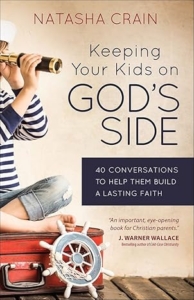
In Keeping Your Kids on God’s Side, I wrote 8 chapters to help you do just that. Of course, there are many other possible topics to address on the Bible’s veracity, but I selected these because they are the most pertinent and the most frequently attacked by skeptics.
Here’s an overview of these 8 key questions you should be teaching your kids to ask of the Bible.
1. How were the books in the Bible selected?
Skeptics claim: In the first centuries after Jesus, there were many rival versions of Christianity, but the representative writings were suppressed by those in power. Our New Testament books represent the version of Christianity that happened to win over time. The winning books weren’t picked until some 300 years after Jesus’ death, and they won because they found political favor at the time.
Kids need to understand: That there were many early Christian writings, how the early church leaders sifted through those writings over time, and how the books of our Bible today were eventually deemed authoritative.
This is explained in Chapter 25 of my book.
2. Why were books left out of the Bible?
Skeptics claim: There are many “gospels” missing from the Bible which give equally valid but completely different views of Jesus than the one we have. If these books had made it into the Bible, Christianity would mean something very different today.
Kids need to understand: Why the mere existence of dozens of early Christian writings that never made it into the Bible says absolutely nothing. The question they need to be able to confidently answer is whether or not any of those writings can legitimately claim spiritual authority by way of connection to Jesus and His apostles.
This is explained in Chapter 26 of my book.
3. How do we know we can trust the Bible’s authors?
Skeptics claim: The gospels were written decades after Jesus lived by anonymous authors based on growing legends and unreliable oral history.
Kids need to understand: Why we can be confident that the gospels are based on reliable, eyewitness testimony.
This is explained in Chapter 27 of my book.
4. How do we know the Bible we have today says what the authors originally wrote?
Skeptics claim: The Bible has been copied, edited, copied, edited, copied, edited, etc. so many times since the original authors wrote their content that we have no way of even knowing what the books we have should say. (See the quote on the image at the top of this post from one actor making this claim.)
Kids need to understand: Why thousands of copies of early manuscripts and hundreds of thousands of differences between them actually don’t undermine what we know about Christianity.
This is explained in Chapter 28 of my book.
5. Does the Bible have errors and contradictions?
Skeptics claim: The Bible is filled with hundreds of errors and contradictions, clearly demonstrating it’s not the Word of God. (See bibviz.com as one example of this claim.)
Kids need to understand: How to evaluate alleged errors and contradictions (with special consideration of the alleged contradictions in the Gospels).
This is explained in Chapter 29 of my book.
6. Does the Bible support slavery?
Skeptics claim: God’s laws about slavery in the Old Testament show that, far from being a perfect moral Being, He actually supported this terrible institution–even sex slavery (see Exodus 21:7-11).
Kids need to understand: The issue of slavery in the Old Testament is very complex and requires an appropriate understanding of biblical context, culture, and history.
This is explained in Chapter 30 of my book.
7. Does the Bible support rape?
Skeptics claim: The Bible approves of rape.
Kids need to understand: The meaning of biblical laws on rape (Deuteronomy 22:23-29) and the biblical context for three key passages often used to support skeptics’ claims in this area (treatment of female war captives, treatment of the Midianite virgins, and treatment of the women of Jabesh-gilead).
This is explained in Chapter 31 of my book.
8. Does the Bible support human sacrifice?
Skeptics claim: God may explicitly condemn human sacrifice in the Bible, but He violates His own prohibition multiple times.
Kids need to understand: The theological background of God’s command for Abraham to sacrifice Isaac, the nature of child sacrifices of kings, Jepthah’s vow, the consecration of firstborn males, and Jesus’ death on the cross.
This is explained in Chapter 32 of my book.
So should you teach your kids to ask these and other questions about the Bible? Absolutely. If you don’t, skeptics will. And soon your kids won’t care what the Bible says any more than the “atheist pig”.
Keeping Your Kids on God’s Side is available from your local Barnes & Noble and Christian book retailers, as well as ChristianBook.com, BarnesandNoble.com, and Amazon.com.
For more articles like Don’t Expect Your Kids to Care What the Bible Says Unless You’ve Given Them Reason to Believe It’s True visit Natasha’s site ChristianMomThoughts.com

The Wisdom Chronicle
Wisdom ChronicleThe Wisdom Chronicle is designed to bring nuggets of wisdom from the dozens of books I read every year. I endeavor to share the best of what I have gleaned. The determination of relevance lies with you. Blessings, J. Whiddon
“You know why it’s called horse sense—they don’t bet on people.”
“Ask an atheist who’s just had a great meal if he believes there’s a cook.”
“A protest march is like a tantrum only better organized.”
“Beware of those who fall at your feet. They may be reaching for the corner of the rug.”
“Some people want to check govt. spending and some people want to spend govt. checks.”
Excerpt From: Reagan, Ronald. “The Notes.”
Celebration of the new over the old easily translates into celebration of the young over the old, of young people over old people. The cult of youth, the celebration of youth for youth’s sake, is more pervasive in the United States than in any other country I have visited. In American cities, I often see billboards promoting plastic surgeons who promise to make you look younger. I have rarely seen such billboards in the United Kingdom or Germany or Switzerland.
When the culture values youth over maturity, the authority of parents is undermined. Young people easily overestimate the importance of youth culture and underestimate the culture of earlier generations. “Why should we have to read Shakespeare?” is a common refrain I hear from American students. “He is so totally irrelevant to, like, everything.
[Modern] “Progress” means, in the final analysis, taking away from man what ennobles him in order to sell him cheaply what debases him.”
Excerpt From: Sax, Leonard. “The Collapse of Parenting.”
What’s more, many of us don’t have a firm grasp of the laws of chance. A classic example: On the first day of class, a math professor asks his students to go home, flip a coin 200 times, and record the sequence of heads and tails. He then warns, “Don’t fake the data, because I’ll know.” Invariably some students choose to fake flipping the coin and make up the results. The professor then amazes the class by identifying the fakers. How? Because those faking the data will record lots of alternations between heads and tails and include no long streaks of one or the other in the erroneous belief that this looks “more random.” Their sequence will resemble this: HTHTHHTHTTHTHT.
But in a truly random sequence of 200 coin tosses, a run of six or seven straight heads or tails is extremely likely: HTTTTTHHTTTHHHHHH.
Counterintuitive? Most of us think the probability of getting six heads or tails in a row is really remote. That’s true if we flip the coin only 6 times, but it’s not true if we flip it 200 times. The chances of flipping 10 heads in a row when you flip the coin only 10 times are very low, about 1 in 1,024. Flip the coin 710 times and the chances of seeing at least one run of 10 straight heads is 50 percent, or one in two.” Excerpt From: Tobias Moskowitz & L. Jon Wertheim. “Scorecasting.”
975. THAT’S EASY! “In the Moscow circus a beautiful woman lion tamer would have a fierce lion come to her meekly, put his paws around her and nuzzle her with affection. The crowd thundered its approval. All except an Armenian who declared, “What’s so great about that? Anybody can do that.” The ringmaster challenged him, “Would you like to try it?” The Armenian’s reply came back: “Yes, but first get that lion out of there.”
Excerpt From: Hodgin, Michael. “1001 Humorous Illustrations for Public Speaking.”
“We have been the recipients of the choicest bounties of Heaven; we have been preserved these many years in peace and prosperity; we have grown in numbers, wealth, and power as no other nation has ever grown. But we have forgotten God. We have forgotten the gracious hand which preserved us in peace and multiplied and enriched and strengthened us, and we have vainly imagined, in the deceitfulness of our hearts, that all these blessings were produced by some superior wisdom and virtue of our own. Intoxicated with unbroken success, we have become too self-sufficient to feel the necessity of redeeming and preserving grace, too proud to pray to the God that made us.
It behooves us, then, to humble ourselves before the offended Power, to confess our national sins, and to pray for clemency and forgiveness.”
Excerpt From: Lee, Richard. “In God We Still Trust: A 365-Day Devotional.”
“God permitted the Nazis to murder six million Jews because it is a fundamental tenet of Judaism that God gives people moral freedom. Human beings are as free to build gas chambers as they are to build hospitals.
God constructed a world in which people choose to do good or evil. To construct one in which people could do only good, God would have to destroy the world in which we now live and create something entirely different.
We live in a world in which people can do unbelievably beautiful or unbelievably horrible things to other people. And if those horrible acts argue against the existence of God, then the beautiful acts must argue for God’s existence.
If one is to abandon faith in anything after the Holocaust, it would be far more rational to abandon faith in the inherent goodness of mankind. To abandon faith in God while retaining faith in humanity may be emotionally satisfying, but it is not logically compelling. God never built a gas chamber, and He has told us not to. Humans who loathed this God built the gas chambers—to destroy the people who revealed this God to mankind.”
Excerpt From: Prager, Dennis. “Think a Second Time.”
The mousetrap that one buys at the hardware store generally has a wooden platform to which all the other parts are attached. It also has a spring with extended ends, one of which presses against the platform, the other against a metal part called the hammer, which actually does the job of squashing the mouse. When one presses the hammer down, it has to be stabilized in that position until the mouse comes along, and that is the job of the holding bar. The end of the holding bar itself has to be stabilized, so it is placed into a metal piece called the catch.
If one piece of the trap is missing, then it won’t perform at all.
Here’s the problem: according to Darwin, each piece of the mousetrap must be useful in and of itself in performing its function. If the purpose of a mousetrap is to catch mice, then what good is a block of wood (platform) or an isolated spring?
This same line of thinking concerning the mousetrap can be applied to the eye. What good is a retina by itself? Or, ocular muscles without a lens? As an irreducibly complex system, the eye must come as a package deal or it wouldn’t be useful. Yet, according to Darwin the eye could not come as a package. If it did, it would violate the very criteria he established for his theory (that living structures had to be capable of evolving in small incremental steps; Darwin said that if a big jump in evolution occurred such that a complex structure “came as a package,” that would be evidence of a miraculous act of the Deity).”
Excerpt From: Moreland, J.P. “Love Your God with All Your Mind (15th anniversary repack).”
The Constitution Is My Speech Permit
Legislating Morality, Culture & PoliticsMy former attorneys at the Alliance Defending Freedom (ADF) recently filed a lawsuit they never should have had to file. In the suit, they are representing a Christian student group at North Carolina State University (NCSU). At issue is an NCSU policy requiring a permit for any kind of student speech or communication anywhere on campus. This policy is a direct affront to the First Amendment, which is the only permit needed to speak on a public university campus.
The policy itself is outrageous. To make matters worse, NCSU only selectively enforces the policy as they did against the plaintiffs, Grace Christian Life, which is a registered student organization. Elevating audacity to a Zen art form, petty university officials told these Christians that they needed a permit to speak with other students in, of all places, the student union.
The controversy began in September of 2015 when NCSU officials demanded members of Grace Christian Life stop approaching other students in the Talley Student Union to engage in religious discussions or even to simply invite them to attend Grace Christian Life events. So the group cooperated and obtained a permit to set up a table in the student union in January.
When Grace Christian Life set up its “approved” table they were told that they could speak with other students either from a) behind the table or b) anywhere in the room. However, when the students left the table on the permitted date, a member of the Student Involvement Office approached them and told them they must stick with option “a” and remain behind the table.
The legally insurmountable problem for NCSU is that the university has not placed the same restriction on any other group. Grace Christian Life members observed and wisely documented other groups freely speaking with other students and handing out literature. These groups have done so either without a permit or outside of the area reserved by their permit. The suit alleges that the groups have done so in full view of the very same officials that stopped Grace Christian Life from engaging in their First Amendment protected activity.
NCSU claims authority to do this under University Regulation 07.25.12, which requires a permit for speech the policy defines as “any distribution of leaflets, brochures, or other written material, or oral speech to a passersby (sic)….” Furthermore, the policy specifies that any person “wishing to conduct any form of solicitation on University premises must have the written permission of Student Involvement in advance.”
The NCSU policy is so broad that it makes no distinction between commercial and non-commercial speech such as the religious speech at issue in the case at hand. To borrow a phrase from the late Justice Scalia, if this policy is narrowly tailored it is by the standards of Omar the Tentmaker rather than Versace.
The NCSU speech permit controversy is just the latest in a seemingly endless string of embarrassing episodes on our nation’s campuses. Each episode is just another pathetic re-run with precisely the same plot:
A university policy says ones thing. The Constitution says another. The university maintains that their handbook trumps the Constitution. The court rules that the Constitution trumps the handbook. In the wake of an embarrassing defeat brought on by willfully uneducable educators, the public is left footing the bill for attorney fees and damages.
To make matters worse, this incident never could have taken place at the University of North Carolina-Chapel Hill (UNC-CH). After years of trampling the First Amendment, UNC-CH got rid of all of its unconstitutional policies – thus earning a “green light” rating from the Foundation for Individual Rights in Education (FIRE). The people at FIRE only give these ratings to schools without any policies that threaten free speech. Sadly, only 22 of our nation’s universities have earned that “green light” distinction.
It is a sad irony that a progressive campus like UNC-CH now shows greater tolerance for Christian speech than a more conservative university like NCSU. For that reason alone, alumni should demand that NCSU administrators stop defending the indefensible and tarnishing the school’s reputation.
After years of reporting on campus free speech cases, I have come to realize that most college administrators need to be sent back to high school to take basic civics. Those who still don’t get it need to be schooled in a court of law.
Dr. Mike Adams is a Professor of Criminology at the University of North Carolina at Wilmington, and author of several books including Letters to a Young Progressive: How to Avoid Wasting Your Life Protesting Things You Don’t Understand.
This column was originally published at TownHall.com: http://bit.ly/2DRJQV8
The Wisdom Chronicle
Wisdom ChronicleThe Wisdom Chronicle is designed to bring nuggets of wisdom from the dozens of books I read every year. I endeavor to share the best of what I have gleaned. The determination of relevance lies with you. Blessings, J. Whiddon
“That’s a complicated order, sir,” said the bewildered waiter. “It might be a bit difficult.”
The guest replied, “Oh, but that’s what you gave me yesterday!”
Excerpt From: Hodgin, Michael. “1001 Humorous Illustrations for Public Speaking.”
It’s tough to be a parent in a culture that constantly undermines parental authority. Two generations ago, American parents and teachers had much greater authority. In that era, American parents and teachers taught right and wrong in no uncertain terms. Do unto others as you would have them do unto you. Love your neighbor as yourself. Those were commands, not suggestions.
Today, most American parents and teachers no longer act with such authority. They do not command. Instead, they ask, “How would you feel if someone did that to you?” The command has been replaced by a question.”
Excerpt From: Sax, Leonard. “The Collapse of Parenting.”
“On the whole, the only enemy which Republicanism has to fear in this Country is in the Spirit of faction and anarchy. If this will not permit the ends of Government to be attained under it—if it engenders disorders in the community, all regular & orderly minds will wish for change—and the demagogues who have produced the disorder will make it for their own aggrandizement. This is the old Story.
If I were disposed to promote Monarchy and overthrow the State Governments, I would mount the hobby horse of popularity—I would cry out usurpation—danger to liberty etc. etc.—I would endeavor to prostrate the National Government—raise a ferment—and then “ride in the Whirlwind and direct the Storm.”
— Wall Street Journal 3-9-16
Excerpt From: Belsky, Gary. “Why Smart People Make Big Money Mistakes and How to Correct Them.”
— Friedrich Hayek, “The Road to Serfdom” (1944)
Excerpt From: Tobias Moskowitz & L. Jon Wertheim. “Scorecasting.”
— Dave Berry
Excerpt From: Moreland, J.P. “Love Your God with All Your Mind (15th anniversary repack).”
– 42% of college grads never read another book after college.
– 80% of US families did not buy or read a book last year.
– Reading one hour per day in your chosen field will make you an international expert in 7 years. (robertbrewer.org)
1: Hedonism, If this life is all one has, then it is quite logical to live a life devoted to self-gratification.
2: Utopianism. Idealistic people who believe that this life is all there is reject hedonism. But they may embrace a far more dangerous ideology—utopianism, the desire to make heaven on earth. Hence the attraction of utopianism to so many twentieth-century radicals who have rejected Judaism and Christianity.
In light of the hells on earth that secular Utopians have produced, it is clear just how important the deferring of Utopia to a future world is. Had people like the Bolsheviks and millions of other secular radicals not tried to create heaven on earth, they would not have created hell here.
3: Despair. In light of the great physical and emotional pain that so many people experience, what is more, likely to induce despondency than believing that this life is all there is? The malaise felt by so many people living in modern Western society is not traceable to material deprivation but, at least in part, to the despair induced by secularism and its belief that this world is all there is. That is why peasants with religious faith are probably happier than affluent people who have no faith (and why more affluent secularists, not the poor, are generally the ones who start radical revolutions).”
Excerpt From: Prager, Dennis. “Think a Second Time.”
4 Pieces of Wisdom from a Street Level Apologist
Theology and Christian ApologeticsBy Billy Dyer
One reason I believe in Christianity is because it speaks of reality closer than any other worldview. This isn’t the only or even the main reason, but it is one of the reasons. Even if Christianity is not true (I do not doubt Christianity) I am convinced that atheism is wholly false. That is because atheism contradicts the real world at every turn. I try to point this out to skeptics all the time, and I’ve learned a lot about how to deal with people. Here are four observations I’ve made about our culture.
Have you ever noticed that modern man is very skeptical about what happened in history? Of course, he isn’t skeptical at all about the information we have in the Present. As if the present is some sort of infallible guide to truth. To our culture, it seems as if the present contains the whole field of vision for truth. That is, if we believe it today then it must be true. Furthermore, they have the snobbery of believing that ancient man has nothing to teach us. But what I find most interesting is that this skepticism about history only goes back so far. Once you get back to the pre-historic days then somehow history becomes a matter of science, and we all know science is infallible. Therefore, the study of dinosaurs is reliable, but the study of the early church are ransacked with an error.
Modern man just cannot stomach the concept that the Bible has been copied. If it has been copied then assuredly it has to have been corrupted many times over. Admittedly this is a difficult topic to address not due to the evidence being in their favor but because of time. That is, we simply do not have the time, during those moments of objection, to sit down and teach them about textual criticism. At the same time, though, we can use their faith in science to our aide. They do call textual criticism a science. Therefore, we can ask the skeptic, “why should you doubt the science of textual criticism if their data findings conclude that the Biblical text has been preserved?”.
The Apostles went into the world of pagans to preach the Gospel. It was full of mystical religions which worshipped the dead, conjured up spirits, had ancestor worship, idol worship, gross immorality, etc… But at least they had a concept of moral obligations. That is why the Gospel was called “good news.” For the pagans finally understood they could be truly forgiven for what they knew they had done wrong. I know it may seem weird to think about, but please think about it for a minute. A person can be highly immoral in the Christian sense yet still have an understanding of a moral code. I’ve noticed this in my study on gangs. They are very wicked people. In fact, if women want to enter the gang, they have to allow themselves to be raped by all the members as an initiation rite. Men sometimes have to kill an innocent person or allow themselves to be brutally beaten to show their loyalty. As wicked as this may be they still have a moral code. There are a set of rules that they still abide by. In our day and age, America is forsaking the concept that morals even exist. As apologists, we don’t even have grounds to start on to talk about sin. We have to convince the world that sin, in any sense of the term, even exists first. They do not want to know if they can be acquitted for sin but whether God can be acquitted for creating such a world as this.
Not too many Bible students have had the opportunity to study this out, so I am just going to mention it here. But the New Testament authors actually took words from the contemporary culture and redefined them to fit what they were teaching. I think this is brilliant because it builds a bridge of understanding. That is, we can take a concept that they do understand simply help show them the fuller truth of the nugget they seem to already agree with. This is why I try to stay away from using Christian-Eze language when talking to non-church going people. That is a language that is virtually only understood by Church people (atonement, propitiation, justification, sanctification). Don’t get me wrong. We shouldn’t ignore the concepts. I am only imploring you to speak of the concepts using words that make sense to your audience. If you cannot translate your theology into the common man’s vernacular, then you are too confused about theology to teach it. So instead of saying God “justifies” us, we can say God acquits us. When speaking of “God’s wrath” I often use the illustration of a bounty hunter. We are criminals who are being tracked down by the bounty hunter known as God’s wrath, and He always catches his victim. But God has provided a means of payment to satisfy this bounty hunter, and it is only through Jesus. Another word to stay away from is “faith” When our culture hears faith they think of a blind leap in the dark or believing in spite of the evidence. Instead, I like the word trust because our audience understands it and it actually better defines the Greek word.
If you keep these four things in mind, it will help you to know your audience and present the case for Christ better.
For more articles like 4 Pieces of Wisdom from a Street Level Apologist visit Billy’s website: Dyerthoughts.com
Billy Dyer is a CrossExamined Instructor Academy Graduate.
What Exactly is a Biblical Miracle? 3 Key Things Your Kids Should Understand
3. Are Miracles Possible?, Apologetics for ParentsBy Natasha Crain
A few weeks ago in our family worship time, we were studying the story of Jesus feeding the 5,000 (Matthew 14). After we finished the story, I asked what I thought was a pretty straightforward question: “So, how did Jesus feed 5,000 people with just a few loaves of bread and a couple of fish?”
Kenna responded, “He must have cut the bread and fish into little tiny pieces to feed that many people!”
It was such a simple and logical answer, but it said so much about her young understanding of miracles. A million coloring pages of Jesus walking on water (which I’m pretty sure is the count coming home from Sunday school in the last couple of years) won’t teach our kids some basic concepts central to the understanding of biblical miracles.
Here are three key things our kids need to understand about the nature and purpose of miracles in the Bible.
1. Miracles are supernatural.
One of the most common pejorative statements I see atheists make is that Christians believe someone can walk on water, a dead man can come back to life, animals can talk, and so on. The underlying assumption is that Christians foolishly believe these things are possible within the bounds of our natural world and its laws when clearly we should see that they aren’t.
This is not a correct understanding of biblical miracles. Christians do NOT believe that miracles are naturally possible, just as atheists do not. We agree! The point of difference is that Christians believe miracles are possible on a supernatural level, and atheists don’t believe a supernatural level even exists.
I realize this distinction sounds a little theoretical, but it’s very important and actually quite simple to explain to kids in a practical sense. I told my kids (age 4) that if Jesus merely chopped the bread into 5,000 pieces, that would be something anyone can do because that is how our world works (when you chop many times, it makes many pieces). What Jesus did was a miracle because it was something that can’t be explained by how we know our world works; food doesn’t suddenly appear out of nowhere! Jesus could do miracles because He had the power of God, and anything is possible for God. God is not limited by how our world works.
2. Miracles proved who Jesus was.
This is the million dollar point that I don’t think I really understood the significance of until a couple of years ago when I started reading apologetics.
Jesus needed to do something while He was on earth to provide evidence (yes, evidence!) that He truly was the son of God. Think about it – He was making bold claims of divinity; how could people know that what He said was true?
Jesus didn’t just tell people to have “faith” that what He was saying was true. He used miracles – acts not possible by someone without God’s power – to prove it. Jesus understood the need for evidence to legitimize His claims. The resurrection was the ultimate miracle that proved to His followers that He was who He said He was.
To demonstrate this to my kids, I put on a mini-act where I told them I was God. I claimed that I wanted them to eat cookies every day because it’s good for them and that they needed to listen because I was God. They laughed and said they didn’t believe me because I’m not God! I told them over and over that I’m God. After a while, we talked about what it would have been like for Jesus’ friends to hear Him say He was the son of God. They had to have a way of knowing He wasn’t just a regular person saying that (like mommy was in the cookie example). Jesus did things only God could do to prove He really was God.
3. Miracles are still historical events.
The disciple Thomas did not believe that the other disciples had seen a resurrected Jesus. He said, “Unless I see the nail marks in his hands and put my finger where the nails were, and put my hand into his side, I will not believe” (John 20:25).
When the resurrected Jesus appeared to Thomas, Thomas exclaimed, “My Lord and my God!”
Jesus replied, “Because you have seen me, you have believed; blessed are those who have not seen and yet have believed.”
This is an incredibly rich passage for Christians. Even though miracles are outside of our scientific understanding and laws, they are observable by witnesses and have natural/historical outcomes. The apostles historically observed the miracle of the resurrection, which led to a conviction so strong that they were willing to die for their beliefs. Their willingness to die was undoubtedly based in large part on their knowledge that they had witnessed the resurrection miracle.
We demonstrated this to our kids by talking about how difficult life was for the apostles after Jesus died. The miracles He did were so amazing that the apostles had no doubt that Jesus was God and they were willing to do whatever it took – endure beatings, jail, and death – to tell the whole world about Him. Today we know about Jesus in large part because of what the apostles did after witnessing His miracles!
As always, I’d love to hear your thoughts – what else should kids know about miracles?
For more articles like What Exactly is a Biblical Miracle? 3 Key Things Your Kids Should Understand visit Natasha’s website at ChristianMomThoughts.com
Natasha Crain is a blogger, author, and national speaker who is passionate about equipping Christian parents to raise their kids with an understanding of how to make a case for and defend their faith in an increasingly secular world. She is the author of two apologetics books for parents: Talking with Your Kids about God (2017) and Keeping Your Kids on God’s Side (2016). Natasha has an MBA in marketing and statistics from UCLA and a certificate in Christian apologetics from Biola University. A former marketing executive and adjunct professor, she lives in Southern California with her husband and three children.
Original Blog Source: http://bit.ly/2QcW15h
The Wisdom Chronicle
Wisdom ChronicleThe Wisdom Chronicle is designed to bring nuggets of wisdom from the dozens of books I read every year. I endeavor to share the best of what I have gleaned. The determination of relevance lies with you. Blessings, J. Whiddon
-C. Seidman
Excerpt From: Marx, Jeffrey. “Season of Life.”
From: Dictionary.com
Thank God my son answered, “Because it’s against the Ten Commandments.” If all our children did, we could look to the future with far greater optimism. I would like all young people to think that stealing is wrong. But I would sooner trust those who also believe that God thinks it is wrong.”
Excerpt From: Prager, Dennis. “Think a Second Time.”
More than 50 years ago, Johns Hopkins sociologist James Coleman asked American teenagers this question: “Let’s say that you had always wanted to belong to a particular club in school, and then finally you were asked to join. But then you found out that your parents didn’t approve of the group.” Would you still join? In that era, the majority of American teenagers responded No. They would not join the club if their parents did not approve. In that era, for most kids, the opinion of parents mattered more than the good regard of same-age peers.”
Excerpt From: Sax, Leonard. “The Collapse of Parenting.”
Liberty is therefore a marathon and not a sprint, and the task of freedom requires vigilance and perseverance if freedom is to be sustained. If the revolution’s winning of freedom was a matter of eight years and the Constitution’s ordering of freedom was completed in thirteen years, the challenge of sustaining freedom is the task of centuries and countless generations, including our own.”
Excerpt From: Guinness, Os. “A Free People’s Suicide.”
Excerpt From: Kemp, Jeff. “Facing the Blitz.”
— Poet Henry van Dyke
Don’t Expect Your Kids to Care What the Bible Says Unless You’ve Given Them Reason to Believe It’s True
Apologetics for Parents, Theology and Christian ApologeticsBy Natasha Crain
A mom left a comment on one of my older posts the other day that said, “It sounds like you are teaching your kids to question the Bible. We should never teach our kids to question the Bible!”
To that I say…Of course we should.
Let’s not get confused, however, by what it means to “question” the Bible. To ask questions about something doesn’t mean to doubt it by default. Neither default acceptance nor default rejection is the response of a critical thinker.
To encourage our kids to question the Bible means to encourage them to examine it fully so they can determine its truth value for themselves.
This is a spiritual process so sorely lacking in most kids’ (and adults’) lives today.
Our kids learn a selection of key Bible stories throughout their childhood, but what do they learn about the Bible–why they should even believe those stories?
Typically, next to nothing.
Yet, parents and church leaders spend years preaching to kids from the Bible, assuming those kids should and will accept it at face value. It takes just a few skeptics to throw darts at that face value before kids make the point of this “atheist pig”:
Don’t expect your kids to care what the Bible says unless you’ve taken the time to help them understand why there’s good reason to believe it’s true.
In Keeping Your Kids on God’s Side, I wrote 8 chapters to help you do just that. Of course, there are many other possible topics to address on the Bible’s veracity, but I selected these because they are the most pertinent and the most frequently attacked by skeptics.
Here’s an overview of these 8 key questions you should be teaching your kids to ask of the Bible.
1. How were the books in the Bible selected?
Skeptics claim: In the first centuries after Jesus, there were many rival versions of Christianity, but the representative writings were suppressed by those in power. Our New Testament books represent the version of Christianity that happened to win over time. The winning books weren’t picked until some 300 years after Jesus’ death, and they won because they found political favor at the time.
Kids need to understand: That there were many early Christian writings, how the early church leaders sifted through those writings over time, and how the books of our Bible today were eventually deemed authoritative.
This is explained in Chapter 25 of my book.
2. Why were books left out of the Bible?
Skeptics claim: There are many “gospels” missing from the Bible which give equally valid but completely different views of Jesus than the one we have. If these books had made it into the Bible, Christianity would mean something very different today.
Kids need to understand: Why the mere existence of dozens of early Christian writings that never made it into the Bible says absolutely nothing. The question they need to be able to confidently answer is whether or not any of those writings can legitimately claim spiritual authority by way of connection to Jesus and His apostles.
This is explained in Chapter 26 of my book.
3. How do we know we can trust the Bible’s authors?
Skeptics claim: The gospels were written decades after Jesus lived by anonymous authors based on growing legends and unreliable oral history.
Kids need to understand: Why we can be confident that the gospels are based on reliable, eyewitness testimony.
This is explained in Chapter 27 of my book.
4. How do we know the Bible we have today says what the authors originally wrote?
Skeptics claim: The Bible has been copied, edited, copied, edited, copied, edited, etc. so many times since the original authors wrote their content that we have no way of even knowing what the books we have should say. (See the quote on the image at the top of this post from one actor making this claim.)
Kids need to understand: Why thousands of copies of early manuscripts and hundreds of thousands of differences between them actually don’t undermine what we know about Christianity.
This is explained in Chapter 28 of my book.
5. Does the Bible have errors and contradictions?
Skeptics claim: The Bible is filled with hundreds of errors and contradictions, clearly demonstrating it’s not the Word of God. (See bibviz.com as one example of this claim.)
Kids need to understand: How to evaluate alleged errors and contradictions (with special consideration of the alleged contradictions in the Gospels).
This is explained in Chapter 29 of my book.
6. Does the Bible support slavery?
Skeptics claim: God’s laws about slavery in the Old Testament show that, far from being a perfect moral Being, He actually supported this terrible institution–even sex slavery (see Exodus 21:7-11).
Kids need to understand: The issue of slavery in the Old Testament is very complex and requires an appropriate understanding of biblical context, culture, and history.
This is explained in Chapter 30 of my book.
7. Does the Bible support rape?
Skeptics claim: The Bible approves of rape.
Kids need to understand: The meaning of biblical laws on rape (Deuteronomy 22:23-29) and the biblical context for three key passages often used to support skeptics’ claims in this area (treatment of female war captives, treatment of the Midianite virgins, and treatment of the women of Jabesh-gilead).
This is explained in Chapter 31 of my book.
8. Does the Bible support human sacrifice?
Skeptics claim: God may explicitly condemn human sacrifice in the Bible, but He violates His own prohibition multiple times.
Kids need to understand: The theological background of God’s command for Abraham to sacrifice Isaac, the nature of child sacrifices of kings, Jepthah’s vow, the consecration of firstborn males, and Jesus’ death on the cross.
This is explained in Chapter 32 of my book.
So should you teach your kids to ask these and other questions about the Bible? Absolutely. If you don’t, skeptics will. And soon your kids won’t care what the Bible says any more than the “atheist pig”.
Keeping Your Kids on God’s Side is available from your local Barnes & Noble and Christian book retailers, as well as ChristianBook.com, BarnesandNoble.com, and Amazon.com.
For more articles like Don’t Expect Your Kids to Care What the Bible Says Unless You’ve Given Them Reason to Believe It’s True visit Natasha’s site ChristianMomThoughts.com
7 Questions from “Who is God”
Theology and Christian ApologeticsBy Brian Chilton
This past Sunday, the third episode of Morgan Freeman’s show The Story of God as aired on the National Geographic Channel. The third episode dealt with how God is understood to be in various cultures and religions. Again, I am profoundly surprised at how well this show has been made. The show has not attacked any particular worldview, as I feared that it would. Rather, the show has taken a fairly neutral position while evaluating some major topics. This episode was no different. The third episode dealt with the issue “Who is God?” This article will seek to answer 7 questions that were raised during the show from a Christian perspective.
By sheer necessity, there is only one ultimate uncaused cause. If there were several gods or goddesses, one would have to ask “How did such a number of gods arise?” It seems to me that one would be forced to accept a first uncaused cause. While it is possible to accept a multiplicity of gods and goddesses, it makes better sense to accept that only one God exists. Why? Well, I think Thomas Aquinas answers this well. Aquinas states,
From sheer necessity, only one God must exist. Thus, God could manifest himself in several ways, but in the end, there is but only one God.
If by connecting, one means relating to God, then one can connect with God in various ways. Morgan Freeman is right when he notes that it is sometimes difficult to relate to a transcendent God. However, God has given us means to relate to him. One way people connect with God is through prayer. Prayer is a means by which we can communicate with God and a way that God communicates with us.[2] Another way a person connects to God is through the written Word of God. The Scriptures are God’s revelation to all humanity. A third way a person can connect with God is through the intellect. A person can connect with God by learning more about God. Fourth, a person can connect with God through nature. As the psalmist notes, “the heavens declare the glory of God, and the sky above proclaims his handiwork” (Psalm 19:1).[3] Lastly, a person can ultimately connect with God through a relationship with Christ. When one receives Christ, the Bible tells us that the believer is filled with the Holy Spirit of God (John 14:15ff).
There is but only one ultimate truth. However, this is not to say that God has not been trying to reveal himself to various peoples throughout the world. Solomon writes that God “has made everything beautiful in its time. Also, he has put eternity into man’s heart, yet so that he cannot find out what God has done from the beginning to the end” (Ecclesiastes 3:11). So, I am not saying that all religions are the same. Such is not logically possible. However, I feel it is quite possible that God has been trying to reveal himself throughout all of history. Ultimately, the full revelation came through Jesus of Nazareth, the “only begotten Son of God” (John 3:16).
Only God is truly divine in the purest sense. However, human beings are made in the image of God (Genesis 1-2). Thus, human beings bear the mark of divinity (although we are not divine). But in fact, all things bear the mark of God in reality because “All things were made through him, and without him was not anything made that was made” (John 1:3). So, only one person is truly divine (God), yet all things bear the imprint of the divine as God created all things.
In a way, yes. In a way, no. I think Norman Geisler puts it best. Geisler notes that “Although God can be apprehended, He cannot be comprehended.”[4] Paul writes, “For we know in part and we prophesy in part, but when the perfect comes, the partial will pass away” (1 Corinthians 13:9). Thus, we cannot say that we know everything about God. If we could, we would be God.
We all bear the image of God (Genesis 1:26). However, God indwells each person who receives Christ as Savior. This person is known as the Holy Spirit.
Yes! Absolutely we can! We experience the blessings of God every day. However, the only way to fully experience God is through a relationship with Christ Jesus. See also the answer to the second question.[5]
Much more could be said about God. In reality, the third episode of Freeman’s documentary as well as this article has focused more upon how humanity knows God. Such a knowledge of God is called revelation. God has revealed himself both through natural revelation (available to all) and special revelation (delivered to those of faith). If a person has not experienced God, it is highly advised that the person seek God and ask God to reveal himself.
Notes
[1] Thomas Aquinas, Summa Theologica I.2.2., in Thomas Aquinas, Summa of the Summa, Peter Kreeft, ed., Fathers of the Dominican Province, trans (San Francisco: Ignatius Press, 1990), 59.
[2] Some individuals have argued that God does not communicate with a person through prayer. With all due respect, I have found such arguments greatly lacking. God has spoken to a vast array of individuals in the Bible through the means of prayer (e.g. Habakkuk, Job, Elijah, Isaiah, and so on). To claim that God cannot speak to a person in prayer discredits the power and personal nature of God. However, I agree that one should always “test the spirits” (1 John 4:1) to ensure that one is truly hearing from God.
[3] Unless otherwise noted, all Scripture comes from the English Standard Version (Wheaton: Crossway, 2001).
[4] Norman Geisler, Systematic Theology: In One Volume (Minneapolis: Bethany House, 2011), 529.
[5] Also, check out the discipleship program Experiencing God by Henry Blackaby, Richard Blackaby, and Claude V. King.
The Law of Identity & the Human Soul
CrossExaminedBy Tim Stratton
Do humans survive the death of their bodies? As a pastor, I have officiated several funerals over the past few years and I have attended many recently. This topic is always sure to come up while talking to the surviving relatives. Questions such as these are regularly asked: Will we see our loved one again? Although the body of our loved one has died, does their soul continue to exist?
The vast majority of humanity has believed in the soul throughout the centuries; however, many advocates of scientism (the presupposition that science is the only way to know reality) have caused much doubt regarding the existence of the soul today. It is important to remember that if the human soul does exist, it is something that, like God, cannot be discovered by science. The scientific method is only applicable to things in the natural universe, and science is impotent to test, discover, or explain things such as the laws of logic, mathematics, self-introspection, objective morality, the order of science itself, and anything outside of or transcending the natural universe. [1] These kinds of things would be other than nature and this is what philosophers refer to as “supernatural.”
I have come to the conclusion that after examining all of the data, we can confidently proclaim the human soul does exist. In fact, The Freethinking Argument deductively proves that not only do humans possess libertarian free will and that naturalism is false, but it also proves that the human soul does exist! This counts as evidence demonstrating the existence of the soul; however, I am often asked for more, and independent, evidence.
The Logical Law of Identity
There are other reasons to think we are more than just bodies and brains. JP Moreland provides a powerful philosophical case regarding the logical law of identity. He says, “If I have the property of being possibly disembodied, but my body does not have the property of being possibly disembodied, it logically follows that I am not my body.”[2] That is to say, if it is not logically incoherent to conceive of the idea that I could exist apart from my body, then it logically follows that I am something other than my body.
According to the laws of logic, there is a property that I have that my body does not, and therefore, my body and I are not identical. My body and I are not the same thing. That is to say, I am not my body.[3] This thing that I call, “I,” is something other than my body (or brain) and it is what I refer to as the soul.
To illustrate, think about this: suppose water is H2O and they are identical. Is there anything that could possibly happen to water that could not happen to H2O? No. Whatever temperature forces water to boil, will necessarily force H2O to boil, because they are identical.[4]
Here is the point: even if life after death is false, I am at least possibly the kind of thing that logically could exist after my body dies. It is not a logically incoherent concept. Therefore, if I am the kind of thing that could (at least possibly) exist disembodied, then, logically, I cannot be my brain or body.
Moreover, I am possibly disembrainable (after all, near-death experiences could possibly be true), but my brain is not possibly disembrainable. This proves I am not my brain because there is something true of me which is not true of my brain. Namely, I am the sort of thing that could survive death (even if I do not), but the brain cannot logically survive its destruction. Moreland provides a deductive syllogism to summarize his case:[5]
Conclusion
It makes sense to conclude, along with the Nobel Prize winning neurologist, Sir John Eccles, that I am a soul who uses a body and brain. This argument for the existence of the soul, along with the Freethinking Argument (and others), provides good reason to conclude that the Apostle Paul knew what he was talking about: “… we are confident and satisfied to be out of the body and at home with the Lord” (2 Corinthians 5:8).
Do we survive the death of our bodies? You better believe it!
Stay reasonable (Philippians 4:5),
Tim Stratton
For more articles like The Law of Identity & the Human Soul visit Tim’s website Freethinkingministries.com
NOTES
[1] William Lane Craig in debate vs. Peter Atkins, http://www.youtube.com/watch?v=8U_NS9WsJ08 (Accessed 9-11-12)
[2] JP Moreland “In Defense of the Soul,” Biola University lecture on CD
[3] Ibid.
[4] Ibid.
[5] J.P. Moreland’s syllogism is found in, The Soul: How We Know It’s Real and Why It Matters (Chicago: Moody Publishers, 2014), 125-26
Randy Everist provides a detailed defense of this argument here and here. Be sure to check it out!
Why 99 out of 10 Millennials Leave The Church?
Apologetics for Parents, Culture CrossExaminedBy Michael Sherrard
As the scintillating Richard G. Howe says, “three out of two people are bad at fractions.” Fewer, I imagine, are good at statistics. Statistics are useful and powerful in telling a story but are often misleading. In fact, statistics can be used to tell any story you want depending on how the questions are asked and the findings presented. And so goes it with the mass exodus of young adults leaving the church. We want to know why. Polls then are taken, findings are presented, and the blogopshere runs wild with them. Thus we find our social media filled with articles telling us the five reasons millennials have forsaken God. And this is fine. Do not misunderstand my point here. I only want to add one thought to this discussion, and it is this. People never give you the real reason they leave church.
When people leave the church, the reasons they offer either make themselves look good or the church look bad. Sometimes this is accomplished in the same reason. No one, though, ever offers their affair with fantasy football and their Sunday morning sport shows as a reason. No one ever tells you how they were not invited to a baby shower and let bitterness harbor in their heart for two years as they slowly removed themselves from the fellowship. And no one ever offers their lifestyle of sinful indulgence as the reason for abandoning the bride of Christ.
Excuse my boldness, but I think the leading factor in why millennials are leaving the church is sexual sin. This will never show up on a poll. I will be glad to find myself wrong about this. But I hear all too often the same story from youth ministers. The norm for youth groups across the country is to have all of their upperclassmen actively engaged in sex, or pornography, or both. It is rare, youth ministers tell me, to find a male high school student that has not had sex or been exposed to pornography. And it is nearly as rare to find a female upperclassmen that is still a virgin or abstaining from “not all the way” sexual activity. The message youth ministers want parents to hear is that they need to assume that their sons and daughters are playing with sex because they all are. In a culture that praises the self and is drowning in sexual sin, it is easy to see why millennials have lost the wonder of God and grown tired of His church.
Intellect is not driving teenagers out of the church. Their hearts are abandoning God long before their minds. It is right to equip teenagers with the reasons for Christian faith. But there is something that ought come before the cosmological argument. The greatest lesson the church needs in apologetics is holiness. Seeking to dispel blind faith is a waste of time if we are going to turn a blind eye to sin. Our response to sociological research will not result in our desired end without an acknowledgment of the problem of sexual sin in the church. For there is no way to make church relevant to people who have no interest in surrendering their lives. Or, I suppose there is a way, but it is not biblical. We could to contort our churches to affirm and facilitate self-centered and lustful desires of rebellious hypocritical pseudo-believers. But I don’t think that would be a good idea.
Holiness is the relevance of Christianity. For in it comes rest and peace and freedom, what we are seeking in sexual rebellion. Sin cannot be ignored. It always robs. It always kills. It always destroys. Two years of “harmless” sexual exploring will result in fifteen years of consequences. Sin’s darkness cannot withstand God’s light, but the ramifications of sin are long felt after forgiveness is embraced. Let us, therefore, lead our youngsters into greener pastures. Let us cause them to lie down in the freedom of God’s ways. Let us not look at the pretense of their rebellion. Rather, let us pray and preach and teach and allow God’s light to shine into their darkening hearts and show them what they actually need. Let us stitch their wounds and not just cover them.
Healing comes by recognizing the need for a doctor. It comes by recognizing you are sick. Many millennials have been sold the lie that sickness does not come from sexual sin. And truth be told, they are being sold the exact opposite, that health comes from the surrounding of your will to your sexuality. This lie has caused many teenagers to lay down their arms and sleep with the enemy. But actions do not merely remain actions. They condition the way we think. Thus marks sin’s slippery slope. Once sin enters your life, it spreads. It distorts the way we think and feel. And so, many teenagers now find the church to be not merely irrelevant, but immoral. They have embraced the lie that freedom comes in sex thereby making the church an oppressor. An exodus is only natural at this point. We must confront this.
We confront sin’s ruin, first, by surrendering our lives to God’s ways. Our lives must be marked by holiness if we are to lead others into it. “Neither coercion nor reward shape human behavior as much as a motivated attempt to resemble a specific person” (Ogden, Discipleship Essentials, p. 11). When teenagers see in us the value of surrendering to God’s ways, they will desire it as well. I wonder, how many teenagers have tasted the goodness of God through the holy lifetyle of an adult? I imagine it is a more common experience for teenagers to develop a distaste for church because of rampant hypocrisy than it is for them to crave the fruit seen falling from the tree of the righteous.
Second, we love teenagers. We take an interest in their lives. We build bridges of communication with them. We do not stand on a street corner and scream for their repentance. They are an abandoned generation. They have been left on their own to navigate a vast seas of choices. We thought google would be enough and accordingly withdrew our leadership from them. But we cannot isolate them. We cannot create a greater chasm by yelling at their sin. We must embrace them. They must feel our warmth and closeness.
In humility being armed with knowledge of God and his will, let us seek to restore an abandoned generation ravaged by sin’s folly. Let us gently invade their lives. They are a passionate army ready to change the world. They are not apathetic as many were in the previous generation. They desire truth, truth that will make this world better. They will go if we send them. But sexual sin is blocking the road of many. Therefore, let us help them remove the greatest obstacle in their path, and in so doing, see life abound in their midst and spread to every corner of this world.
*Ogden, Greg. Discipleship Essentials: A Guide to Building Your Life in Christ. Downers Grove, IL: InterVarsity, 2007. Print.
Michael C. Sherrard is a pastor, author of Relational Apologetics, and the Director of Ratio Christi College Prep. RCCP is an organization that seeks to equip the church for effective evangelism by teaching high school students apologetics, fundamental Christian doctrine, and biblical evangelism.
For more articles like Why 99 out of 10 Millennials Leave The Church? visit Michael’s website at MichaelCSherrard.com