
On Undesigned Coincidences: A Reply to Dan McClellan

Dan McClellan, a Biblical scholar with a specialty in the Hebrew Bible, and popular social media content creator, recently responded to a clip of my friend and colleague, Wesley Huff, on undesigned coincidences as a marker of historicity in the gospel accounts. Wesley Huff subsequently posted a statement on his community page on YouTube, linking to my previous response to John Nelson, which deals with many of the same concerns raised by McClellan. This prompted McClellan to publish another video offering a rebuttal to my engagement with Nelson’s (and by extension his) concerns in my essay. I do not know why the critics of undesigned coincidences always seem to want to engage with those examples pertaining to the feeding of the five thousand. Literally every critical treatment of the topic thus far has focused on those. There are plenty of other undesigned coincidences, both between the gospels and between Acts and Paul’s letters, many of which are stronger than those examples. Nevertheless, here I offer a reply to McClellan’s video engagement with my article.
Some General Observations
Before turning to the specific points raised by McClellan, I will offer some general observations. One of the most powerful tools in persuasion, irrespective of the credibility of what you are saying, is confidence. Assertions delivered with certainty and rhetorical force can often sound very convincing to an untrained audience. For the uninitiated, confidence is very easily, and subconsciously, taken as a proxy for competence. If something is stated with enough conviction and firmness, it can feel well supported, even if someone specializing in the relevant subject-matter would immediately detect major problems with the arguments being delivered. Such is the case with Dan McClellan. To the trained ear, McClellan’s content reveals him to be out of his depth when dealing with the field of New Testament studies. Nonetheless, he delivers his comments with such assertiveness that his audience often assumes that he knows what he is talking about. They thus do not carefully examine McClellan’s statements through a critical lens. Put less kindly, McClellan gets a free pass to talk nonsense.
One major red flag that would have been immediately evident to anyone acquainted with the field is McClellan’s insinuation that Michael Alter’s book, The Hypothesis of Undesigned Coincidences (2024) is a serious scholarly engagement with the topic. Anyone familiar with Michael Alter’s previous work up to and including this volume knows that he is more of a crank than a scholar. To his credit, McClellan has since corrected his prior claim that Alter’s book was a peer-reviewed publication. But nonetheless his recommendation of Michael Alter as being a scholar worthy of serious engagement reveals that he is out of his depth on the field of New Testament. Another serious error was his statement that John Nelson is a “Christian apologist” (he has since corrected himself on this as well).
McClellan is also hypocritical. He accuses Wesley Huff of being condescending towards him and insinuating that he is incompetent while he does the exact same thing towards me. Moreover, he shows great concern for who has what academic credentials when it comes to his critics such as myself or Lydia McGrew, but then appeals to someone like Michael Alter, who has none of the credentials McClellan demands of his critics. Indeed, before his retirement, Alter was a public school teacher in Miami, Florida, where he taught social studies, biology, and physical education. Now, I am not someone who cares what degrees someone has or does not have. I only bring this up to underscore the hypocrisy of McClellan’s approach.
McClellan also attacks my scientific reputation, making a sweeping claim that my “approach to biology is profoundly misguided.” McClellan gives no specific examples of what he has in mind, nor does he even refer to specific scientists who have engaged with my work. This is highly disingenuous as, without specifics, there is no way for me to defend myself against this attack on my professional reputation. Moreover, he makes a grossly false claim about me when he asserts that I have “explicitly in debates said, ‘Yes, I’m presupposing this, that, and the other,’” and that I do “not seem concerned for the dogmas that [I am] just arbitrarily asserting.” I literally have no idea what he is referring to here. I am well established as a card-carrying evidentialist, who disdains presuppositionalism. I challenge McClellan to cite one example of those debates in which I allegedly say, “I’m presupposing this, that, and the other.” Of course, he won’t since no such examples exist. I seek to establish my conclusions with facts and evidence. McClellan may disagree with my evaluation of the data, and that is fine. But let us not misconstrue what my positions and arguments are.
Finally, I will note that I agree with McClellan, over Huff, that there is presently no detailed treatment in the academic literature (by which I mean the peer-reviewed literature) of the subject of undesigned coincidences, either favorable to or critical of, the argument. This I regard as a deficit of the scholarly literature rather than of the argument itself, but nonetheless that is the current state of play. Perhaps I or others will correct this in the future. There are, however, scholars who utilize the argument in their academic publications, though it is incidental to their own work. Luuk van de Weghe is a recent example.[i] Van de Weghe’s book, Living Footnotes in the Gospel of Luke even contains a chapter in which he documents for comparison instances of undesigned coincidences between eyewitness accounts of Anne Frank’s imprisonment in Auschwitz (see especially pages 166-167).
Does Lydia McGrew Set Aside the Apparatus of Critical Scholarship?
Now, let us turn to the actual substance of McClellan’s critique. McClellan makes a false claim regarding Lydia McGrew’s book, Hidden in Plain View (2017). McClellan claims that McGrew explicitly says that she has no interest in engaging with critical scholarship. Here is the relevant quote in context:
I am suggesting that the reader consider the question of the historical reliability of the Gospels and Acts from a new angle. Instead of getting involved in the specifics of alleged contradictions and proposed resolutions to them (not a bad enterprise in itself), instead of tackling these books from the perspectives of source and redaction criticism with the assumption that they represent multiple redactors, layers, and “developments,” instead of thinking and speaking of Jesus or Paul as if they are literary characters in fictional works, I suggest that the reader take seriously the hypothesis that they are what they appear to be prima facie and what they were traditionally taken by Christians to be—historical memoirs of real people and events, written by those in a position to know about these people and events, either direct eyewitnesses or friends and associates of eyewitnesses, who were trying to be truthful. I suggest that we take this hypothesis for a test drive while setting aside the apparatus of critical scholarship. Suppose that these were such memoirs. What might they look like? How does the occurrence of coincidences that appear casual and unrehearsed between and among these documents support that hypothesis? When all you have is a hammer, everything looks like a nail. I suggest that we expand our toolkit.
When read in context, McGrew’s intended meaning becomes apparent. She does not want to get distracted from the book’s thesis by being sidetracked onto discussions of such things as alleged contradictions in the gospels and proposed harmonizations (she covers this in fact in her more recent book, The Mirror or the Mask: Liberating the Gospels from Literary Devices). Similarly, she doesn’t want to devote a portion of her book to having to deal with various scholarly perspectives on source and redaction criticism. Rather, McGrew chooses in her book to unabashedly appeal directly to the common-sensical reader by looking at the accounts in the gospels and Acts, and asking the sorts of questions given at the end of the paragraph quoted above. In her book, McGrew was trying to appeal to a particular audience–one capable of seeing the direct appeal of undesigned coincidences. For that purpose, and for the length of the book, taking a significant detour to discuss all of those theories (which are addressed in plenty of other books) would bog down the argument. Hidden in Plain View is also intended to be a popular-level book, not an academic treatment.
One may add, however, that the book does show awareness of theories such as the two-source-hypothesis, etc, and has various comments along the way that show how undesigned coincidences open up new avenues of approaching the synoptic puzzle. Thus, the book is by no means uninformed about contemporary scholarship. McGrew has also discussed these subjects in more detail elsewhere.
Elisha’s Feeding of the One Hundred
McClellan sees a parallel between Jesus’ feeding of the five thousand and Elisha’s feeding of the one hundred in 2 Kings 4:42-44. I agree that there are striking parallels between the two accounts. In my previous essay, I pointed out that the mere fact that there exists parallel features of the accounts does not imply that Jesus’ feeding of the five thousand is fictitious, particularly since, as I have argued, there are strong reasons to think the accounts are historical. A plausible alternative interpretation of the parallel features is that Jesus himself purposed to present himself as a prophet greater than Elisha, and therefore intentionally performed a similar, though much greater, miracle, in the anticipation that those observing the sign would notice the parallels and recognize Jesus as being greater than the prophets of old. The evangelists then highlighted parallel features in order to draw the attention of their readers to them.
McClellan dismisses this scenario as “a pretty silly argument” that would “get you laughed out of an academic conference.” McClellan provides no explanation as to why he considers this explanation to be so implausible. He merely asserts it without argument. I asked a couple of other scholars if they could understand McClellan’s dismissal of this approach, and neither were able to.
Crowds at Passover
McClellan maintains that the “coming and going” crowds in Mark 6:31 were present because of Jesus, rather than for some broader reason. I do not dispute that the crowds were likely interacting with Jesus; indeed, this best explains why Jesus and his disciples had no leisure even to eat, a point that coheres well with the similar language about Jesus and the disciples not being able to eat in Mark 3:20, as McClellan rightly observes. Nevertheless, as I argued in my previous essay, it does not seem to me the most probable reading that the crowds were present primarily because of Jesus. If that were the case, Jesus’ suggestion that they withdraw to a deserted place makes little sense.
Any adequate account must explain both (1) the statement that people “recognized” (ἐπέγνωσαν) Jesus (Mk 6:33) and (2) the persistent problem of crowds “coming and going,” such that Jesus and his disciples lacked even basic leisure (Mk 6:31). McClellan is correct to infer that Jesus was interacting with the crowds, but this does not entail that Jesus was the sole—or even primary—reason for their presence. Peter J. Williams notes, “In Mark, the fact that Jesus moved locations indicates that it was not a mere increase in traffic for a few hours, but a more prolonged increase in movement of people such as normally occurred only at the time of festivals.”[ii]
It seems most likely to me that this scene took place in Capernaum during a period when the town experienced an influx of transient crowds. At the same time, local residents could readily direct visitors to the location where Jesus was known to stay, resulting in sustained interaction with him. On this reading, the crowd pressure arises from the convergence of increased regional movement and Jesus’ recognizable presence in a known location. This accounts for why Jesus was engaged by the crowds and makes sense of the decision to withdraw by boat rather than simply retreat indoors.
The Green Grass
In my previous essay, I argued that the claim that Mark, in referring to the green grass (Mk 6:39), intended an allusion to Psalm 23, is bad historical methodology, since one could literally identify a symbolic reason for any alternative detail (I gave some proposals for symbolic interpretations of the counterfactual where Mark had stated that the people sat down on the brown grass).
McClellan responds,
Now I think a good reason to draw this conclusion is because otherwise the detail plays no role in the narrative and plays no role in a literary sense. Why mention that the grass was green? John doesn’t even mention the grass is green. Why would Mark mention it’s green if there’s not some kind of connection being intentionally made? You don’t just say, ‘Oh, there’s green grass,’ when you’re writing down a narrative, even if the grass was green. It’s a pointless thing to highlight, unless you’re trying to create a literary allusion to something, which the overwhelming majority of scholars agree is what is going on when it comes to Mark’s reference to the green grass.
McClellan’s objection presumes that people telling the truth never mention irrelevant or unnecessary details, whereas in point of fact, they do this all the time – including elsewhere throughout the gospels and Acts. Furthermore, as noted in my previous article, giving an explanation for one side of the undesigned coincidence does not explain how it fits together, in an apparently incidental manner, with the other source. Thus, McClellan’s connection of the allusion to the green grass in Mark 6:39 does not account for its dovetailing with the reference to the Passover being at hand in John 6:4.
McClellan responds to this latter point by stating,
So it doesn’t fit together with John. This is begging the question. You have to already presuppose that the argument is true for Mark to fit together so well with John…If you’re taking John’s reference to this being near Passover as fitting well with Mark, you’re already presupposing that your argument is correct because nothing in Mark indicates that this is near Passover.
McClellan merely asserts this without providing any explanation as to why he does not think the allusion to the green grass in Mark 6:39 fits well with the Passover being at hand, as indicated by John 6:4. Moreover, his claim that the argument begs the question suggests to me that he does not understand the principle of inference to the best explanation. McClellan’s objection is akin to saying that deer tracks in the woods do not fit with deer unless you’re begging the question and already assuming there are deer in the woods. The whole point of the undesigned coincidence is that Mark does not explicitly indicate that the Passover was at hand. But his casual mention that the grass was green fits well with the time of year on which the Passover fell (around March time), a detail supplied uniquely by John. This is best explained on the hypothesis of the mutual historicity of John’s and Mark’s accounts.
McClellan also makes another ill-founded claim. He asserts, “the synoptic gospels only have Jesus running a roughly one-year ministry that culminates in the Passover. Only John has a multiple year ministry where you can have a Passover in the middle of the story.” While the synoptics only explicitly mention a single Passover, it is a very weak argument from silence to say that the Synoptics thereby represent Jesus as having had a single year ministry. Moreover, as James Hastings et al. explain,
Indications of a ministry of more than a single year are found in the Synoptics; e.g. Mk 2:23 (harvest) 6:39 (spring; ‘green grass’), for the length of the journeys of 6:56–10:32 shows that the spring of 6:39 could not be that of the Crucifixion. Thus Mk. implies at least a two years’ ministry. In Lk. also we see traces of three periods in the ministry: (1) 3:21–4:30, preaching in the wilderness of Judæa and in Nazareth and Galilee, briefly recorded; (2) 4:31–9:50, preaching in Galilee and the North, related at length; (3) 9:51-end, preaching in Central Palestine as far as Jerusalem. Ramsay (op. cit. p. 212) takes each of these periods as corresponding roughly to one year.[iii]
Thus, contra McClellan, even from the synoptic gospels there is reason to think that Jesus’ ministry spanned more than one year.
Contradictions?
The Location
McClellan asserts that Mark contradicts Luke on the location of the event, since, while Luke indicates that the feeding of the five thousand took place in Bethsaida, Mark says that, following the event, Jesus directed the disciples to head in a boat in the direction of Bethsaida. McClellan, however, fails to inform his viewers of my detailed discussion of this in my article, to which he is supposed to be responding. Since McClellan failed to engage (or even take note of) my previous discussion, I will repeat here what I wrote there. Readers should refer to the map below when reading the discussion that follows.
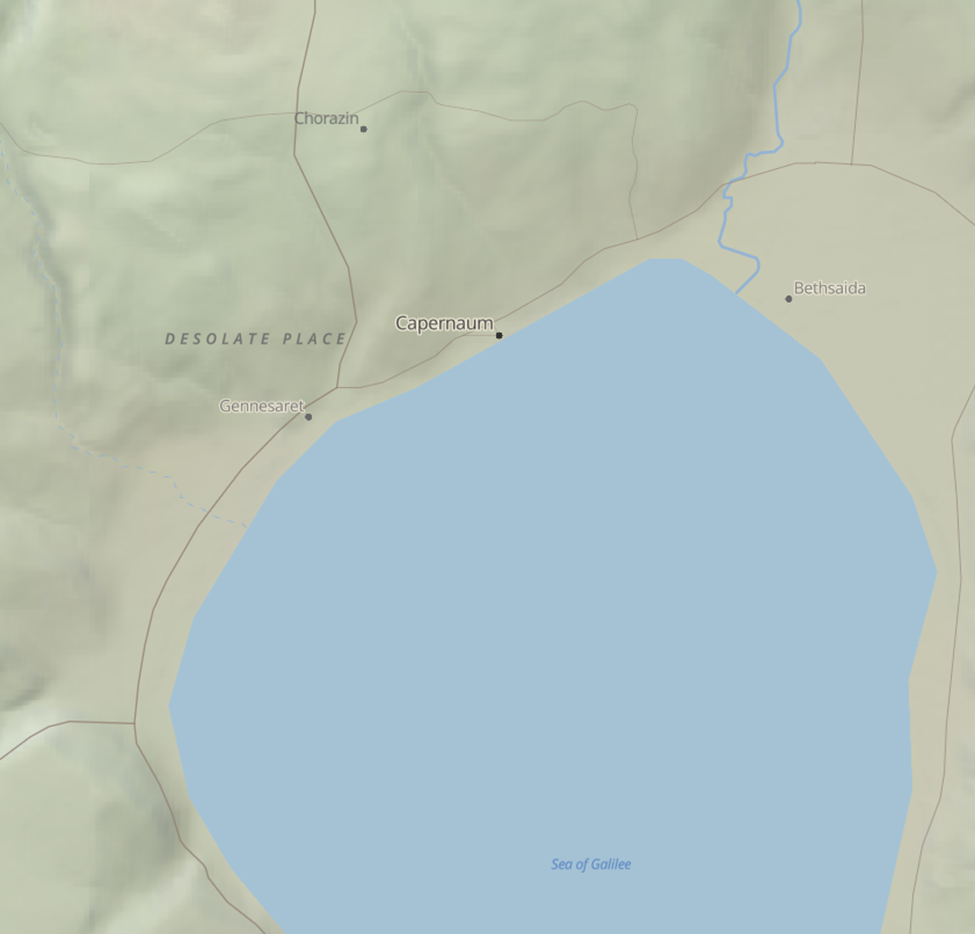
There is, in fact, evidence that is internal to Mark’s gospel itself that suggest the feeding of the five thousand took place on the northeast side of the Sea of Galilee (as opposed to the northwest side). Mark indicates that the disciples did not even have leisure to eat before the feeding, because there were “many coming and going” (Mark 6:31), and that they got into the boat to get away from the crowds. This fits well with the indication in John 6:4 that the feast of Passover was at hand (in particular, if Jesus and the disciples were in or near Capernaum, which was a major center). If they departed Capernaum by boat, it is not implausible that they ended up in the vicinity of Bethsaida (going along the top of the Sea of Galilee), which is what is indicated by Luke 9:10. Mark, in fact, explicitly says that they landed at Gennesaret when they had crossed over (Mark 6:53)! Gennesaret is geographically very close to Capernaum. Thus, this actually, far from contradicting, confirms the idea of which direction they were going. If they were really crossing over “to Bethsaida” as if to land at or near Bethsaida, they could not have landed at Gennesaret (see the map above)! Moreover, as Cyndi Parker observes, “Matthew and Mark both state that the disciples struggled to reach their destination because the wind was against them (Matt 14:24; Mark 6:48). Since weather systems typically come from the Mediterranean Sea, the fierce wind causing the terrifying storm was likely coming from the west. This small detail suggests the disciples were traveling from the eastern side of the Sea of Galilee to the western side, further supporting the suggestion that the miracle took place in Gaulanitis. . .” (Bethsaida is in the province of Gaulanitis, east of the Jordan River).[iv]
In view of these considerations, the language of Mark 6:45 must be interpreted within the context of these indicators. I discussed this in my previous article, but McClellan fails to engage with these observations at all.
The Shore or a Mountain?
McClellan asserts that, whereas in John, Jesus sees the crowd when he has gone up onto a mountain (Jn 6:3-5), whereas in Mark, Jesus sees the crowd upon going ashore (Mk 6:34) and in fact Mark makes no reference to Jesus and the disciples going up a mountain, though Mark does allude to Jesus later going up the mountain to pray after having sent the disciples away in a boat (Mk 6:46). Once again, McClellan fails to engage with my discussion of this in the essay to which he is supposed to be responding. As I pointed out previously, the three synoptic gospels indicate that Jesus interacted with the crowd prior to the feeding miracle. Indeed, Mark, speaking of the crowd that had followed Jesus, says that Jesus “had compassion on them, because they were like sheep without a shepherd. And he began to teach them many things” (Mk 6:34). In Matthew’s account, we read that “he had compassion on them and healed their sick” (Mt 14:14). In Luke, it mentions both that Jesus “spoke to them of the kingdom of God” and that he “cured those who had need of healing” (Lk 9:11). Thus, we are to picture Jesus having been with the crowd for some time prior to the feeding event. In the synoptics, we are told that when it was getting late, they discussed where to find food for the crowd of people. John, however, does not mention the earlier part of the day. It seems, then, that the crowds converged on him while He had slipped away with His disciples. John’s emphasis, though, is on the feeding through the miraculous multiplication of loaves and fish. The accounts, therefore, in fact fit together quite well.
Narrative Incongruity?
McClellan claims that there exists narrative incongruity in the account in Luke, since, though the feeding of the five thousand is set in Bethsaida according to Luke 9:10, the twelve say to Jesus, “Send the crowd away to go into the surrounding villages and countryside to find lodging and get provisions, for we are here in an desolate place.” As I argued in my previous article, the stated location of Bethsaida is very likely being used in a regional sense (in like-manner to how someone might say they live in a major city while technically living in a suburb of that city). This is the most natural way of reading Luke’s account. McClellan responds to this by stating, “We have no evidence for this. This is just an assertion that makes sense of our demand to have them all harmonized.” McClellan however fails to inform his viewers of any of the points I raised in support of the plausibility of this reading. As I noted previously, are we really to envision Luke becoming fatigued and forgetting what he just wrote two verses earlier? This is an extremely uncharitable way of reading Luke.
It must also be borne in mind that we are talking about a crowd of five thousand men, besides women and children (Mt 14:21) here. It is not at all obvious, therefore, that such a crowd, if it were in or nearby the city, would not need to go to the surrounding villages and countryside to find food, particularly given that the day was drawing to a close (Lk 9:12).
Why would Luke change the location?
In my previous essay, I had noted that the redaction critics never provide any explanation as to why Luke would have intentionally changed the location of the event to Bethsaida. McClellan postulates a frankly bizarre explanation that Matthew invented Jesus’ pronouncement of the woes over Bethsaida (Mt 11:21) on the basis of the healing of the blind man in Bethsaida in Mark’s gospel (Mk 8:22-26). Then Luke deliberately moved the feeding of the five thousand event to Bethsaida on the basis of the woes in Matthew. There is no way to describe this proposal other than preposterous. First, Jesus tells the blind man in Mark 8:26, “Do not even enter the village,” which aligns well with Jesus’ habit of instructing people not to publicize his miracles or his Messianic identity. So, it seems unlikely that this miracle is the basis of Jesus’ pronouncement of the woes over Bethsaida for not believing in spite of the “mighty works” performed there (Mt 11:21). Second, if Matthew invented pronouncement on the basis of this miracle from Bethsaida, why also include the city of Chorazin (which actually is mentioned prior to Bethsaida) in the pronouncement? None of the gospels mention Jesus performing miracles in Chorazin. Third, the reference to Bethsaida in Luke 9:10 is very incidental. Luke does not make an explicit connection between the feeding of the five thousand and the pronouncement of the woes (which are given in Luke 10:13). Luke might also be expected, on this hypothesis, to locate a public miracle in Chorazin in addition to Bethsaida, though he does not do so.
Confusion About Independence
One of the most bizarre claims made by McClellan is that “The stronger your case for independence gets, the less strong your case for historicity gets.” It is difficult to overstate how absurd this statement is. Independent attestation makes an historical event more plausible, not less. In what possible Universe is having more independence damaging to a case for historicity?
McClellan continues,
And like McGrew, McLatchie would like you to believe that contradictions only prove the account is historical because it means they are not colluding. And this is one of the things that I pointed out that nobody seems to be willing to address. Nobody thinks that the gospel authors all sat down in a room together and colluded on hammering out their narratives. They were literarily dependent on other narratives as sources, but they changed them as they pleased in order to serve their own interests and their own rhetorical goals. So they’re all already independent. We know that they are relying to differing degrees on earlier accounts, but that is not collusion, and that is not a lack of independence. So, pointing out that discrepancies prove their independence only serves the critical perspective. It does not mean that therefore everything is historical.
I agree that nobody believes this, nor did I allege that anyone did. So, if there is any straw-manning going on, it is on the part of McClellan. By independence, I mean to say that the evangelists are not wholly dependent upon each other. In other words, they had independent access to the facts. This is evidenced in part by the discrepancies that exist between the accounts. These discrepancies can be quite plausibly harmonized (as discussed previously), but they indicate that the authors are not simply copying, and deriving details from, each other’s account. McClellan wants to say that the evangelists purposefully redacted each other’s work. But these discrepancies concern details about which there is no plausible motive for changing the other account(s). For what motive could there be for Luke to intentionally change the location of the event to Bethsaida? Or for John to change the place where Jesus first saw the crowd when he had gone up a mountain? Or for John to change the apparent sequence in which Jesus went up on a mountain by himself and sent the disciples away in a boat? Other differences in the account that point to factual independence include:
Only John mentions the boy, and that they were barley loaves (Jn 6:9), which fits with the time of year, being near the Passover.
- Only John mentions that it was Andrew who brought the boy forward (Jn 6:8).
- Only John mentions the other name of the Sea of Galilee (the Sea of Tiberius), a name that we can confirm from other sources (Jn 6:1).
- Only John records how far the disciples had rowed when they saw Jesus coming towards him, which is given as an imprecise measurement of twenty-five or thirty stadia, or about three or four miles (Jn 6:19).
- Matthew and Luke both mention that Jesus healed people (Mt 14:14; Lk 6:11), a detail not supplied by Mark.
- Only Mark mentions that the disciples landed at Gennesaret (Mk 6:53). This fits with the account in John, which says that they set off for Capernaum (Jn 6:17).
McClellan also appears to be ignorant of how independence and dependence are not binary categories. A source can have obtained some details from another while also having their own access to the facts that is independent of the source on which they are reliant for other details. Generally when critics refer to the synoptic puzzle (or even Johannine familiarity with the synoptic gospels) in order to hand wave away undesigned coincidences between the gospels, they have failed to understand this important nuance.
The Ur-Source Theory
Towards the end of his response to me, McClellan returns to a point that he had emphasized in his previous video engaging with Wesley Huff. He asserts that,
Even if we do accept these arguments for undesigned coincidences, all it means is that they were relying on a single pre-existing tradition of some kind, whether oral tradition or some kind of written text. That’s all it means. You cannot get from undesigned coincidences to these all happened exactly as the text states without just inserting dogmas and arguing from assertion and just arbitrarily insisting well this is what must have happened.
The argument is normally articulated in terms of the oral tradition that many scholars believe lies behind the gospel accounts (although this in principle could be written sources alternatively). The objection is that undesigned coincidences could be just as well explained by the gospel authors incompletely remembering the oral tradition, or incompletely copying from a common ur-source that contained both parts of the coincidence. However, there is no independent evidence for such an ur-source, either in terms of documentary evidence or written testimony to its existence. It is therefore ad hoc — that is, invoked simply for the purpose of avoiding the most obvious explanation that the gospel documents are grounded in true history. The oral tradition alternative has its own problems (which also applies to the ur-source hypothesis) which I will now discuss.
For one thing, there is no evidence for the type of oral tradition of gospel stories that would be needed to adequately explain most undesigned coincidences. Consider the example relating to the involvement of Philip in the account of the feeding of the five thousand in John 6:5, which is explained by Philip’s hometown being in Bethsaida (John 12:21) and the feeding of the five thousand taking place in Bethsaida (Luke 9:10. It seems very unlikely that Christians, across geographical areas, would have known the hometown of Philip as being in Bethsaida. Indeed, such an assumption would lead us to conclude that virtually any randomly selected adult Christian residing in Pisidian Antioch could have listed the hometowns of Bartholomew, Judas (not Iscariot), and every other member of the twelve. Indeed, on this hypothesis, it appears that one would have to suggest that almost any detailed piece of information contained in the gospels was widely known in the Christian community and widely known extremely early, before the gospels were even written. This seems to me very unlikely.
Michael Bird, in his book The Gospel of the Lord: How the Early Church Wrote the Story of Jesus, puts it like this:
I regard the evidence surveyed as constituting moderate grounds for identifying a conserving force in the transmission of the Jesus tradition, since the gaps in our knowledge are too vast to assert otherwise. At the end of the day most of what is said about the formation of the Jesus tradition is based on a priori assumptions, circumstantial evidence, inference, hypothesis, analogy, conjecture, and sheer guesswork.[v]
A “conserving force” hardly means that everybody knew what town Philip was from already, long before John mentioned it.
Moreover, Luke himself seems to have regarded Theophilus as gaining information from his gospel. Based upon Luke’s introduction itself, we would infer that Theophilus apparently did not already know all of the things found in Luke’s Gospel. Luke wrote it to give him additional information. This also seems to be implied by John 20:30-31.
There are also many undesigned coincidences involving multiple different incidents. An example of this is Luke’s listing of the women who followed Jesus from Galilee, including Chuza the wife of Herod’s household manager (Luke 8:1-3) explaining Matthew’s report of Herod speaking to his servants about Jesus, presumably in the privacy of his own palace, in Matthew 14:1-2. On the ur-source hypothesis, the ur-source would presumably have to include both stories, yet oral stories would typically be stories of a given pericope. If there were multiple circulating traditions containing between them both of the relevant stories, then the undesigned coincidence would still exist between the multiple circulating traditions, and the problem the hypothesis sought to address still remains.
The ur-source hypothesis also fails to explain the coincidence involving John’s mention of Jesus’ approach into Bethany happening six days before Passover, a detail particular to John’s gospel (for the details see my essay here). Notice that Mark 11 telescopes the account such that it is masked that Jesus in fact arrived in Bethany the day before the triumphal entry into Jerusalem and only the morning after sent his disciples to fetch the colt. The passages relevant to the coincidence also span a few chapters in Mark (from Mark 11:1 to 14:1). Furthermore, the setting of the Olivet discourse in Mark 13 in the evening is not explicitly stated, but may be inferred from the fact that the mount of olives is midway between Jerusalem (where Jesus had been all day) and Bethany (where Jesus’ accommodation was for the night). Furthermore, there is a minor discrepancy between John and Mark concerning whether the anointing at Bethany took place before (Jn 12:1-8) or after (Mk 14:3-9) the triumphal entry. I believe this is most plausibly a Markan sandwich, a technique used frequently in Mark where one story is interrupted by another and then resumed. But the fact that it appears, at least on first blush, to be a discrepancy between Mark and John is yet further evidence that the narratives are factually independent of one another, nor are they both drawing from a common underlying ur-source. In view of all of the above considerations, the view that this coincidence is explicable by some sort of ur-source theory seems wildly implausible.
I have only given here a few examples in order to illustrate the deficiencies of the ur-source theory as an explanation of undesigned coincidences between the gospels. But similar shortcomings apply across the board.
Of course, such theories are even more wildly implausible when it comes to accounting for undesigned coincidences between Acts and the epistles of Paul. Lydia McGrew has herself addressed the ur-source explanation here and here.
Conclusion
As with previous critics of the argument from undesigned coincidences, Dan McClellan’s engagement ultimately has the effect of once again underscoring the argument’s robustness rather than undermining it. In my opinion, it would be more productive for the purpose of moving the conversation forward if critics were to turn their attention to other instances of undesigned coincidences, especially those between Acts and Paul’s epistles, rather than repeatedly revisiting the feeding of the five thousand, a case that has by now been discussed quite exhaustively.
References:
[i] Luuk van de Weghe, Living Footnotes in the Gospel of Luke: Luke’s Reliance on Eyewitness Sources (Pickwick Publications, an imprint of Wipf and Stock Publishers), Kindle Edition.
[ii] Peter J. Williams, Can We Trust the Gospels? (Wheaton, IL: Crossway, 2018), 92.
[iii] James Hastings et al., Dictionary of the Bible (New York: Charles Scribner’s Sons, 1909), 134.
[iv] Cyndi Parker, “Crossing to ‘The Other Side’ of the Sea of Galilee,” in Lexham Geographic Commentary on the Gospels, ed. Barry J. Beitzel and Kristopher A. Lyle, Lexham Geographic Commentary (Bellingham, WA: Lexham Press, 2016), 162.
[v] Michael F. Bird, The Gospel of the Lord: How the Early Church Wrote the Story of Jesus (Grand Rapids, MI; Cambridge, U.K.: William B. Eerdmans Publishing Company, 2014), 66–67.
Recommended Resources:
Why We Know the New Testament Writers Told the Truth by Frank Turek (mp4 Download)
Early Evidence for the Resurrection by Dr. Gary Habermas (DVD), (Mp3) and (Mp4)
The New Testament: Too Embarrassing to Be False by Frank Turek (DVD, Mp3, and Mp4)
Debate: What Best Explains Reality: Atheism or Theism? by Frank Turek DVD, Mp4, and Mp3
Dr. Jonathan McLatchie is a Christian writer, international speaker, and debater. He holds a Bachelor’s degree (with Honors) in forensic biology, a Masters’s (M.Res) degree in evolutionary biology, a second Master’s degree in medical and molecular bioscience, and a Ph.D. in evolutionary biology. Currently, he is an assistant professor of biology at Sattler College in Boston, Massachusetts. Dr. McLatchie is a contributor to various apologetics websites and is the founder of the Apologetics Academy (Apologetics-Academy.org), a ministry that seeks to equip and train Christians to persuasively defend the faith through regular online webinars, as well as assist Christians who are wrestling with doubts. Dr. McLatchie has participated in more than thirty moderated debates around the world with representatives of atheism, Islam, and other alternative worldview perspectives. He has spoken internationally in Europe, North America, and South Africa promoting an intelligent, reflective, and evidence-based Christian faith.
Originally posted at: https://bit.ly/4rLhjFU