
Genderbread Person Part 2: Gender Expression (And maybe how we got to where we are now?)
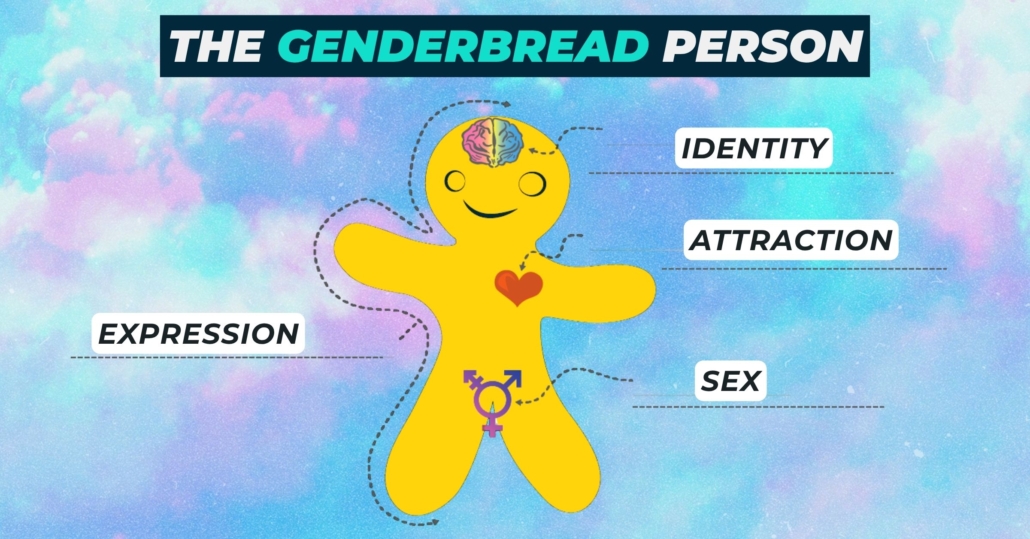
In our previous blog, we introduced you to the Genderbread curriculum, a teaching guide that tells kids as young as kindergarten how to think of sex and gender as a really confusing, multi-variable continuum where the two are mostly unrelated to each other. While I want to give parents the tools for how to think through and discuss these topics with their kids, today we are going to take a bit of a historical detour.
Why? Because sometimes the key to understanding and fixing where we went wrong is to identify how we got there in the first place. What were the causal factors that might have contributed? When we identify those, we can hopefully avoid repeating the mistakes of the past and return to a healthier approach. In today’s blog, that means a healthier approach to gender norms.
Sometimes the key to understanding and fixing where we went wrong is to identify how we got here. When we identify the causal factors, we can hopefully avoid repeating the mistakes of the past and return to a healthier approach. Share on X
As I studied this aspect of the curriculum, I had some genuine “aha” moments that at this point are just theories. So let’s be clear: I am not stating verified research here. I am trying to connect the dots. These are more observations than they are conclusions, and I welcome your thoughts. Agree? Disagree? Partially agree? Are there any aspects you think I might be leaving out? We’re going full interactive on this one.
Review of the Genderbread Curriculum
In the genderbread worksheet, intended to help educators teach children about gender and sexuality, the author states,
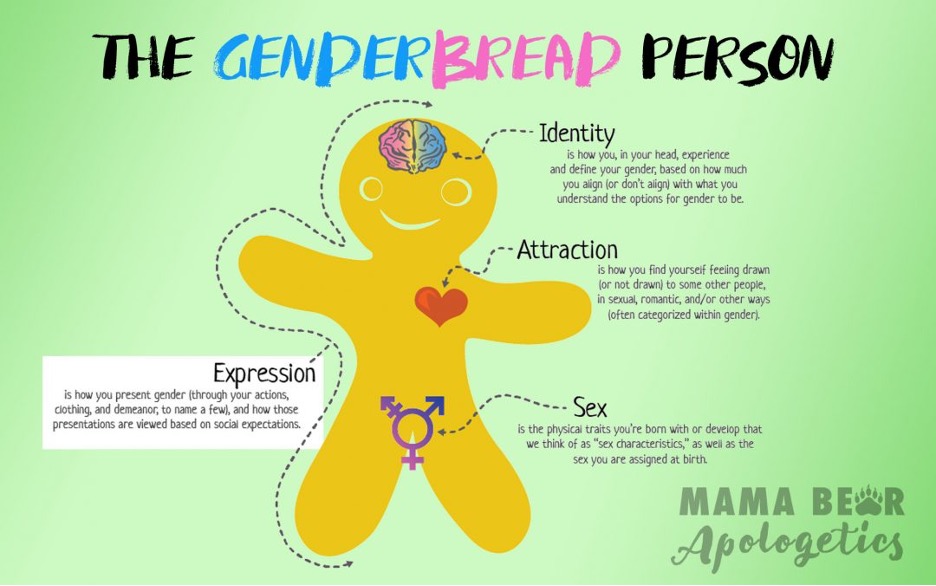
“Gender is best understood when broken up into three parts: gender identity (which is how, in your head, you define and understand your gender based on the options for gender you know to exist), gender expression (the ways you demonstrate your gender through your dress, actions, and demeanor), and biological sex (the physical parts of your body that we think of as either male or female).” [1]
In our previous discussion, we talked about identity. Today, we are going to dissect the “gender expression” part of the curriculum.
“Gender expression can be thought of as the aspects of masculinity and femininity you display in your clothing, grooming, speech, actions, demeanor, and more. As examples, masculine dress might be considered baggy, unprimed, or functional. Feminine dress is form-fitting, colorful, and frivolous.” [2]
My first thought: This is a really schizophrenic view of gender
I mean, whatever happened to just being a good, ol’ fashioned Tom-boy (a girl who had more traditionally masculine interests and energy levels and hated wearing dresses)? Why do we have to separate our genders based on fashion and grooming? When I was a teenage girl, we called that our “mood.” What mood am I in? Am I in a cargo pants and Doc Martens mood, or a slip-dress and sandals mood? If I had to wrestle with being told I had different gender expressions on different days… good grief. I would have grown up so confused.
My second thought: ohhhh… I think I get it now.
If I had finished my thought above, it would have sounded like this: “Why can’t we just have tom-boys and uh… and… uhhh… and……….uhhhhhhhh, Oh. I think I see the problem now.”
What about the boys? When I was growing up, what options did they have except being a Mr. T chain-wearing, tyrannosaurus rex loving, G.I. Joe backpacking, rough and tumble boy? They didn’t. Sure, there were boys that didn’t fit the stereotype, but they were often relegated to the sidelines in terms of status (i.e., band nerds, etc.). They didn’t fit the mold, so they lost punches on their man-card, whether or not it was stated verbally or not. (Often, it was “stated” physically in the form of bullying.)
This was, and is, a problem. Girls could be girly girls or tom-boys and were affirmed in their womanhood for both roles. We looked up to the girl athletes, artists, and intellectuals equally. But the boys could be rough-and-tumble boys . . . or sissies. Thems the options. These “Jane-girls,” as I’ve heard them called, are guys who might be a tad more on the soft-spoken, artistic, sensitive side of the spectrum. Where did they get to fit into society’s gender norms while maintaining the same level of masculinity that the jocks had? They didn’t unless they created their own little subculture (which high schools are full of). I suspect the seeds of our current gender schism may have started there.
Girls could be girly girls or tom-boys and were affirmed in their womanhood for both roles. But the boys could be rough-and-tumble boys…or sissies. Friends, this is NOT okay. Share on X
In my parents’ generation, boys were boys, men were men, girls were girls, and women were women. No ifs, ands, or buts. Even the girls’ softball team wore dresses to school every day. Everyone was equally shoved into a gender-conforming stereotype. You fit in—or you became a pariah. (I think of Eugene from the first Grease movie.) But that all started to change in the 80’s with third-wave feminism.
What exactly went wrong?
It was pretty awesome to be a girl in the 80’s as opposed to previous decades. Previously, boys and girls were equally (and sometimes forcefully) smooshed into their gender stereotype box. Starting with third-wave feminism, all that changed. We girls were told early on that we could be a.n.y.t.h.i.n.g. we wanted to be. Dream big! Play sports! Wear pants! Wear sneakers! Home Ec is optional! (No complaining from me yet. Except for the shoulder pads in the 80’s. It was like a weird mix between businesswoman and football player.) Girls had all the freedom of expression in the world. But the boys . . . nope. They were still shoehorned into their stereotype—or mocked mercilessly if they failed to conform.
Can we all just take a deep breath and recognize how incredibly unfair this was for little boys who loved to dance, or paint, or sing . . . or shower on a regular basis? To be treated like they were less of a boy, and later less of a man?
Where we tried to make it right
My husband disagrees with this point, so I encourage discussion in the comments.
I think we tried to fix this inequality by creating a new category, but it was too little, too late. The category I’m referring to is “metrosexual.” The metrosexual movement was for guys who liked to groom themselves, shower, and wear nice clothes, but who didn’t self-identify as homosexual. These guys were often artistic, musicians, and philosophers who loved craft brew, specialty coffees, and beard grooming products. They put the man in manicure. The metrosexual movement made it acceptable to be refined and artistic, without sacrificing one’s perceived masculinity. (Just look at all the youth pastors and worship leaders who adopted the “skinny jeans.”)
Thinking back with the perspective I’m having right this minute, this was probably a really healthy movement. It was the first step we’d ever taken in allowing guys to express themselves in a legitimately masculine way that would have otherwise be seen as feminine (i.e. tighter, colorful, sometimes frivolous clothes, grooming products, softer speech, etc.). [3]
But for some, this movement might have come too late. We still had boys who had grown into their sexuality without this category into which they could legitimately express themselves without being marginalized. In hindsight, I really wish we’d started something like this at a younger age, which we are now . . . sorta. But even this movement is starting to take an unhealthy turn.[4] Instead of teaching little boys that their masculinity can be expressed in a variety of different ways, we are instead telling them that it’s okay to be feminine! NO! Stop it! We need to be emphasizing their masculinity in all ways that God has created them!
Instead of teaching little boys that their masculinity can be expressed in a variety of different ways, we are instead telling them that it’s okay to be feminine! How confusing for their sexual identity! Share on X
The fact is, there is a spectrum of gender expression. Not all women express their femininity in the same way, but it doesn’t make them any less of a woman. Not all men express their masculinity in the same way, but it doesn’t make them any less of a man. When we created a rigid box of feminine and masculine, we had to have known that there would be people who rebelled against it. How did we not realize this?
The fact is, there is a spectrum of gender expression, but it doesn’t change who we fundamentally are at our core. Share on X
When a person is backing away from some ideology—in this case, rigid gender stereotypes—they often back into something worse. In our society right now, people have backed into an outright denial of gender as an objective fact about a person and turned it into this messy, fluid, confusing, daily-changing spectrum that will leave even the strongest of kids confused about who they really are.
Parents, I cannot stress enough how damaging this can be to your child’s sense of self. I’d like to give you all the steps to address this with your kids right here, right now. But honestly, there is someone who has already done it and has done it way better than I. So (with permission), I am reposting her article right after this one. It is by Sue Bohlin and it is titled Raising Gender Healthy Kids.
In the meantime, I realize that this blog isn’t the regular format that we usually do. But I would really like your thoughts on what I’ve discussed here. Do you think this is a fair account of how we’ve gotten to where we are? (I am certain it isn’t a complete account), but it should help us have a little compassion on those who—a generation after the advent of third-wave feminism—are legitimately confused and probably legitimately angry.) I hope this brings light and helps explain why we have seen the crusade against gender and sexuality that we are witnessing today. The generation of boys who were labeled as sissies for defying their gender stereotype has grown up, and they are making sure that what happened to them doesn’t happen to anyone else.
The generation of boys who were labeled as sissies for defying their gender stereotype has grown up, and they are making sure that what happened to them doesn’t happen to anyone else. #sexualidentity. Share on X
So what am I really trying to say here?
In summary…
1 – As long as girls and boys were equally forced to abide by gender stereotypes, there was room for equal “oppression”, (if you even want to call it that) and there weren’t as many major problems. Society still functioned fairly well regarding gender identity with people fulfilling their assumed roles.
2 – It has always been the case that some girls have more masculine behaviors – i.e. tom-boys. For the most part, society didn’t have a huge problem with this. It has always been the case that some boys had more feminine behaviors, but these behaviors have not, in general, been encouraged or admired. Masculine girls were tom-boys. Feminine boys were considered to be sissies or even labeled homosexuals, even if they didn’t as yet self-identify as such. It was just a matter of time.
3 – There has been no male counterpart to feminism. Women were told to enter all the male-dominated spheres, and men were told to just get out of the way without providing other avenues for them to go. Rather, in schools, boys are told to act more like girls–sit still, don’t move, work in teams, don’t compete, be more in touch with your feelings.
4 – When third-wave feminism came out, the girls were liberated in their gender expression, and femininity was allowed to be fully expressed across the entire gamut, but masculinity was not.
5 – Instead of opening up the box to allow a larger gamut of masculine expression, alternate expressions of masculinity were deemed “feminine,” which has left a generation of boys gender-confused.
6 – Instead of broadening the gamut of masculine expression, we have tossed the baby out with the bathwater and changed the words “sex” and “gender” from synonyms and made them into two separate aspects of identity. Let’s be real, the word “gender” was basically introduced so that we didn’t have to say the word “sex” over and over again. That word has too much baggage to discuss with a room full of 6th graders.
7 – Now, according to the Gender-identity revolutionaries, man/male and woman/female are no longer synonyms. Sex is your biology and gender is your identification, as if those two could be separated. It has removed the gender aspect of biological sex from the realm of objective reality to subjective identification.
Instead of broadening the gamut of masculine expression, we have tossed the baby out with the bathwater and changed the words ‘sex’ and ‘gender’ from synonyms and made them into two separate aspects of identity. Share on X
Let’s be real, the word ‘gender’ was basically introduced so that we didn’t have to say the word ‘sex’ over and over again. That word has too much baggage to discuss with a room full of 6th graders. Share on X
Put all of these together, and does the current sexual identity crisis start to make a little more sense? We can sit back and critique what we think is right or wrong, but as Dennis Prager often says, “Clarity over agreement.” We may not agree, but maybe we can get a little more clarity on how we got here.
References:
[1] The Safe Zone Project, “Genderbread Person: Guided Discussion,” “Gender Bread Lecture 2.0—Instructor,” example lecture section (2014), p. 2.
[2] Safe Zone Project 2014, pg. 2.
[3] [Editor’s Note: I’m Hillary’s husband, and in case you’re curious, I tend to see the metrosexual fad as a boundary-testing effort to “test the waters” for bigger launch into LGBTQ activism later. It proved to be a societal stepping stone toward normalizing gay marriage, and opening the floodgates for water LGBTQ activism. I don’t see it is a “moderate” alternative for stretching the category of “masculine” to be more inclusive of different men. I see it more as a forced and artificial fashion trend attempting to ease society closer to the bigger goal, of anti-normativity (i.e., queer theory, LGBTQIA+ , PRIDE, radical individualism, moral irrealism, intersectionalism, critical theory, etc.).
[4] [Editor’s Note: See endnote 3. I predicted that the Metrosexual is trying to blur the men/women binary. Hillary understands it to be an “unhealthy turn,” but I don’t think there was any turning involved. It was just an unhealthy, albeit predictable, destination for the Metrosexual fad/movement.]
Recommended Resources:
Correct not Politically Correct: About Same-Sex Marriage and Transgenderism by Frank Turek (Book, MP4) Stealing From God by Dr. Frank Turek (Book, 10-Part DVD Set, STUDENT Study Guide, TEACHER Study Guide)
Is Morality Absolute or Relative? by Dr. Frank Turek Mp3 and Mp4
Legislating Morality (mp4 download), (MP3 Set), (PowerPoint download), and (PowerPoint CD) by Frank Turek
Does Jesus Trump Your Politics by Dr. Frank Turek (mp4 download)
Hillary Morgan Ferrer is the founder and President of Mama Bear Apologetics. She feels a burden for providing accessible apologetics resources for busy moms. She is the chief author and editor of the bestselling books Mama Bear Apologetics: Empowering Your Kids to Challenge Cultural Lies,Mama Bear Apologetics Guide to Sexuality: Empowering Your Kids to Understand and Live Out God’s Design, and the soon to be released Honest Prayers for Mama Bears. Hillary has her master’s degree in biology and loves helping moms to discern truths and lies in both science and culture. She and her husband, John, have been married for 16 years and minister together as an apologetics team. She can never sneak up on anybody because of her chronic hiccups, which you can hear occasionally on the podcast and in interviews.
Originally posted at: https://bit.ly/4wTEwXZ