You have seen it on social media or even books. Someone gambling his head that faith impedes the progression of science. Faith, they say, is believing something without evidence or in spite of, and science relies on evidence to reach at truth. This gives the false impression that the majority of scientist are atheist, or at least non theist. It’s even considered conventional wisdom for many (maybe you thought it too).


But in reality… this is just plain doodoo.

Faith vs. Science?

First, because it starts with a false definition of faith like the one mentioned above. Pistis, the Greek word for faith, means trust and is the word used in the Bible. Trust cannot be conceived without reasonable justification. The biblical faith doesn’t shy away from doubt. Doubt and faith aren’t mutually exclusive.

Second, if you start with scientism or naturalism as your worldview, by default you will reject any argument or evidence that points to the existence of the supernatural.[1] There is no objectivity there. It’s just closed minded.

Third, this is not just factually wrong. The opposite is factually true.

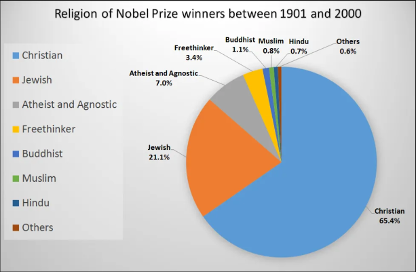
Pie Chart distributing the religion of nobel prize winners between 1901 and 2000.
Source: https://commons.wikimedia.org/wiki/File:Religion_of_Nobel_Prize_winners.png

[This Chart depicts the] “Distribution of Nobel Prizes by religion between 1901–2000, the data tooks [sic] from Baruch A. Shalev, 100 Years of Nobel Prizes (2003), Atlantic Publishers & Distributors, p.59 and p.57: between 1901 and 2000 reveals that 654 Laureates belong to 28 different religion. Most 65.4% have identified Christianity in its various forms as their religious preference. Overall, Christians have won a total of 78.3% of all the Nobel Prizes in Peace, 72.5% in Chemistry, 65.3% in Physics, 62% in Medicine, 54% in Economics and 49.5% of all Literature awards.


Atheists, agnostics, and freethinkers comprise 10.5% of total Nobel Prize winners; but in the category of Literature, these preferences rise sharply to about 35%. A striking fact involving religion is the high number of Laureates of the Jewish faith — over 20% of total Nobel Prizes (138); including: 17% in Chemistry, 26% in Medicine and Physics, 40% in Economics and 11% in Peace and Literature each. The numbers are especially startling in light of the fact that only some 14 million people (0.2% of the world’s population) are Jewish. By contrast, only 5 Nobel Laureates have been of the Muslim faith-0.8% of total number of Nobel prizes awarded — from a population base of about 1.2 billion (20% of the world‘s population).”[2]

Before We Proceed

Before getting into the cognitive-dissonance-inducing quotes, let me make some caveats.

  • The experts quoted here have different religious beliefs and affiliations.
  • This list does not prove the existence of any God or truthfulness of any particular religion any [given] scientist professes.
  • This also does not disprove atheism or any non-theist worldview, since, as mentioned at the beginning, there is a small percentage of non-theists that were and are Nobel prize winners.
  • This list does not prove the opposite, namely, that the majority of scientist in these fields are religious. It might be the case that religious people are a minority.
  • Finally, it just disproves the false assumption that faith in God and the supernatural impedes the progression of science (when in fact, it gave birth to science, but that might be a future post) or that science and faith are incompatible.

The list will be divided by fields for easy search with their respective sources. The experts range from different nationalities and times with no specific order. This list only composes the fields of chemistry, physics and medicine. Literature, economics and peace are not included. Without further ado, enjoy the quotes.

Chemistry

  1. “God did create the universe about 13.7 billion years ago, and of necessity has involved Himself with His creation ever since. The purpose of this universe is something that only God knows for sure, but it is increasingly clear to modern science that the universe was exquisitely fine-tuned to enable human life. We are somehow critically involved in His purpose.”
    — Richard Smalley. Chemist.
    — Nobel Prize: For the discovery of fullerenes.
    — Source: Remarks by Richard Smalley at 2005 Alumni Banquet, Hope College.
  2. “Well, we are supposed to love the Lord our God with all our heart with all our mind and with all our strength. But that is separate from loving our neighbor as ourselves. It means that nature is God’s creation. So we should love nature and understand nature the best we can in order to show our love for the creator.”
    — John B. Goodenough. Materials scientist, a solid-state physicist.
    — Nobel Prize: For the development of lithium-ion batteries
    — Source: Transcript of an interview with John B. Goodenough.
  3. “God is Truth. There is no incompatibility between science and religion. Both are seeking the same truth. Science shows that God exists.”
    — Dereck Barton. Organic chemist.
    — Nobel Prize: For his contribution to the development of the conformational analysis as an essential part of organic chemistry.
    — Source: Barton, as cited in Margenau and Varghese 1997, Cosmos, Bios, Theos: Scientists Reflect on Science, God, and the Origins of the Universe, Life, and Homo sapiens, 144.
  4. “I think only an idiot can be an atheist. We must admit that there exists an incomprehensible power or force with limitless foresight and knowledge that started the whole universe going in the first place.”
    — Christian Anfinsen. Biochemist.
    — Nobel Prize: For his work on ribonuclease, especially concerning the connection between the amino acid sequence and the biologically active conformation.
    — Source: Anfinsen, as cited in Margenau and Varghese, ‘Cosmos, Bios, Theos’, 1997, 139.
  5. “Certainly science, especially physics and chemistry, is a very important part of my identity. But I also consider myself a religious person, and in two senses: one, based on my liberal Jewish upbringing which I have passed on to my children; the other, a kind of nondenominational deism which springs from my awe of the world of our experiences and is heightened by my identity as a scientist. It also includes a conviction that science alone is an insufficient guide to life, leaving many deep questions unanswered and needs unfulfilled.”
    — Walter Kohn. Physicist.
    — Nobel Prize: For his work on the development of the density functional theory.
    — Source: Reflections of a Physicist after an Encounter with the Vatican and Pope John Paul II (April 20, 2001, University of California, Santa Barbara)

Physics

  1. “This much I can say with definiteness — namely, that there is no scientific basis for the denial of religion — nor is there in my judgment any excuse for a conflict between science and religion, for their fields are entirely different. Men who know very little of science and men who know very little of religion do indeed get to quarreling, and the onlookers imagine that there is a conflict between science and religion, whereas the conflict is only between two different species of ignorance.”
    — Robert A. Millikan. Experimental physicist.
    — Nobel prize: for his work on the elementary charge of electricity and on the photoelectric effect.
    — Source: Autobiography (1950). Chapter 21: “The Two Supreme Elements in Human Progress”. p 279.
  2. “If we count the galaxies of the universe or demonstrate the existence of elementary particles, in an analog way we can’t probably have proof of the existence of God. But as a researcher, I’m deeply moved by the order and beauty I find in the cosmos and the interior of material things. As an observer of nature, I can’t help thinking there is a higher order. The idea that all this is the result of fortune or pure statistic diversity for me is completely unacceptable.”
    — Carlo Rubbia. Physicist and director of the European Organization for Nuclear Research (CERN)
    — Nobel Prize: For work leading to the discovery of the W and Z particles at CERN.
    — Source: C. Rubbia, Neue Zürcher Zeitung, March 1993.
  3. “Science, with its experiments and logic, tries to understand the order or structure of the universe. Religion, with its theological inspiration and reflection, tries to understand the purpose or meaning of the universe. These two are cross-related. Purpose implies structure, and structure ought somehow to be interpretable in terms of purpose.”
    — Charles H. Townes. Physicist.
    — Nobel Prize: 
    For fundamental work in the field of quantum electronics.
    — Source: “Logic and Uncertainties in Science and Religion,” in Science and the Future of Mankind: Science for Man and Man for Science, pp. 296–309.
  4. “As we conquer peak after peak we see in front of us regions full of interest and beauty, but we do not see our goal, we do not see the horizon; in the distance tower still higher peaks, which will yield to those who ascend them still wider prospects, and deepen the feeling, the truth of which is emphasized by every advance in science, that ‘Great are the Works of the Lord’.”
    — Joseph John Thomson. Physicist
    — Nobel Prize: For the discovery of the electron.
    — Source: Thomson 1909, Nature, vol. 81, p. 257
  5. “If there are a bunch of fruit trees, one can say that whoever created these fruit trees wanted some apples. In other words, by looking at the order in the world, we can infer purpose and from purpose we begin to get some knowledge of the Creator, the Planner of all this. This is, then, how I look at God. I look at God through the works of God’s hands and from those works imply intentions. From these intentions, I receive an impression of the Almighty.”
    — Arno Penzias. Physics.
    — Nobel Prize: For the discovery of the cosmic background radiation which substantiated Big Bang theory.
    — Source: Penzias, as cited in ‘The God I Believe in’, Joshua O. Haberman editor, New York, Maxwell Macmillan International, 1994, 184
  6. “One way to learn the mind of the Creator is to study His creation. We must pay God the compliment of studying His work of art and this should apply to all realms of human thought. A refusal to use our intelligence honestly is an act of contempt for Him who gave us that intelligence.”
    Ernest Thomas Sinton Walton. Physicist.
    — Nobel Prize: for his pioneering work on the transmutation of atomic nuclei by artificially accelerated atomic particles
    — Source: V. J. McBrierty (2003): Ernest Thomas Sinton Walton, The Irish Scientist, 1903–1995, Trinity College Dublin Press.
  7. “Can a good scientist believe in God? I think the answer is: Yes. In the first place, a scientist, more than other scholars, spends his time observing nature. It is his task to help to unravel the mysteries of nature. He comes to marvel at these mysteries. Hence, it is not hard for a scientist to admire the greatness of the creator of nature. From this it is only a step to adore God.”
    Victor Franz Hess. Physicist
    — Nobel Prize: 
    For the discovery of cosmic rays.
    — Source:
     The American Weekly. “My Faith”. November 3, 1946.
  8. “The book of nature which we have to read is written by the finger of God.”
    Michael Faraday. Scientist.
    — Nobel Prize: 
    For establishing the existence of the magnetic field, discovered electrolysis, diamagnetism, electromagnetic induction and benzene.
    — Source: Seeger, Raymond. 1983. “Faraday, Sandemanian,” in The Journal of the American Scientific Affiliation, 35 (June 1983): 101.
  9. “Both religion and science require a belief in God. For believers, God is in the beginning, and for physicists He is at the end of all considerations… To the former He is the foundation, to the latter, the crown of the edifice of every generalized world view.”
    Max Planck. Physicist. Founder of quantum physics.
    — Nobel Prize: In recognition of the services he rendered to the advancement of Physics by his discovery of energy quanta.
    — Source: Scientific Autobiography and Other Papers as translated by F. Gaynor (1949), p. 184 — Religion and Natural Science (1937)
  10. “In view of such harmony in the cosmos which I, with my limited human mind, am able to recognize, there are yet people who say there is no God. But what makes me really angry is that they quote me for support of such views.”
    Albert Einstein. Physicist.
    — Nobel Prize: for his services to Theoretical Physics, and especially for his discovery of the law of the photoelectric effect.
    — Source: Statement to German anti-Nazi diplomat and author Prince Hubertus zu Lowenstein around 1941, as quoted in his book Towards the Further Shore : An Autobiography (1968) — Attributed in posthumous publications.
  11. “Overpoweringly strong proofs of intelligent and benevolent design lie all around us; and if ever perplexities, whether metaphysical or scientific, turn us away from them for a time, they come back upon us with irresistible force, showing to us through Nature the influence of a free will, and teaching us that all living things depend on one ever-acting Creator and Ruler.”
    William Lord Kelvin. Physicist and mathematician. Founder of Thermodynamics and Energetics
    — Nobel Prize: his achievements in thermodynamics.
    — Source: Address of Sir William Thomson, Knt., LL.D., F.R.S, President,” in Report of the Forty-First Meeting of the British Association for the Advancement of Science, held at Edinburgh in August 1871, pages lxxxiv-cv., 100–101.
  12. “I believe in God, who can respond to prayers, to whom we can give trust and without whom life on this earth would be without meaning (a tale told by an idiot). I believe that God has revealed Himself to us in many ways and through many men and women, and that for us here in the West the clearest revelation is through Jesus and those that have followed him.”
    Nevill Francis Mott. Physicist.
    — Nobel Prize: For his work on the electronic structure of magnetic and disordered systems, especially amorphous semiconductors.
    — Source: Mott, as cited in Nevill Mott: Reminiscences and Appreciations, E.A. Davis — editor, London, Taylor & Francis Ltd, 1998, 329.
  13. “I believe in God. In fact, I believe in a personal God who acts in and interacts with the creation. I believe that the observations about the orderliness of the physical universe, and the apparently exceptional fine-tuning of the conditions of the universe for the development of life suggest that an intelligent Creator is responsible. I believe in God because of a personal faith, a faith that is consistent with what I know about science.”
    William D. Phillips. Physicist.
    — Nobel Prize: For development of methods to cool and trap atoms with laser light.
    — Source: Phillips, William D. 2002b. A letter to the compiler T. Dimitrov. May 19.
  14. “Those who say that the study of science makes a man an atheist, must be rather silly people.”
    Max Born, Physicist.
    — Nobel Prize: For his fundamental research in quantum mechanics, especially for his statistical interpretation of the wavefunction.
    — Source: Frederick E. Trinklein, The God of Science (Grand Rapids, MI: Eerdmans, 1971), 64.
  15. [When asked if he believed in God as a natural scientist] “Naturally, yes. I grew up as a strict Catholic, and I think that I benefited from that.”
    Peter Grünberg. Physicist.
    — Nobel Prize: For his discovery with Albert Fert of giant magnetoresistance.
    — Source: Cicero: Magazin für Politische Kultur, December 2007.
  16. “For myself, faith begins with the realization that a supreme intelligence brought the universe into being and created man. It is not difficult for me to have this faith, for it is incontrovertible that where there is a plan there is intelligence. An orderly, unfolding universe testifies to the truth of the most majestic statement ever uttered: ‘In the beginning God. . . ”
    — Arthur Compton. Physicist.
    — Nobel Prize: for his discovery of the effect named after him.
    — Source: “Why I Believe in Immortality,” This Week, (Sunday supplement to the New Orleans’ The Sunday Item-Tribune; April 12, 1936), 5 ff. Reprinted in Christian Science Sentinel, 62: 32, (August 6, 1960), 1411.
  17. “In the history of science, ever since the famous trial of Galileo, it has repeatedly been claimed that scientific truth cannot be reconciled with the religious interpretation of the world. Although I am now convinced that scientific truth is unassailable in its own field, I have never found it possible to dismiss the content of religious thinking as simply part of an outmoded phase in the consciousness of mankind, a part we shall have to give up from now on. Thus in the course of my life I have repeatedly been compelled to ponder on the relationship of these two regions of thought, for I have never been able to doubt the reality of that to which they point.”
    — Werner Karl Heisenberg. Theoretical physicist.
    — Nobel Prize: For the creation of quantum mechanics.
    — Source: Heisenberg, Scientific and Religious Truth (1973)
  18. “It seems to me that when confronted with the marvels of life and the universe, one must ask why and not just how. The only possible answers are religious. . . I find a need for God in the universe and my own life.”
    — Arthur L. Schawlo. Physicist.
    — Nobel Prize: for their contribution to the development of laser spectroscopy.
    — Source: H. Margenau, Cosmos, Bios, Theos: Scientist Reflect on Science, God, and the Origins of the Universe, Life, and Homo Sapiens (1992).
  19. “I think both science and religion are necessary to understand our relation to the Universe. In principle, Science tells us how everything works, although there are many unsolved problems and I guess there always will be. But science raises questions that it can never answer. Why did the big bang eventually lead to conscious beings who question the purpose of life and the existence of the Universe? This is where religion is necessary.”
    — Antony Hewish. Radio astronomer
    — Nobel Prize: For their pioneering research in radio astrophysics: Ryle for his observations and inventions, in particular of the aperture synthesis technique, and Hewish for his decisive role in the discovery of pulsars.
    — Source: Antony Hewish, “A letter to the compiler T. Dimitrov. May 27” (2002).

Medicine

  1. “I have said for years that speculations about the origin of life lead to no useful purpose as even the simplest living system is far too complex to be understood in terms of the extremely primitive chemistry scientists have used in their attempts to explain the unexplainable that happened billions of years ago. God cannot be explained away by such naive thoughts.”
    — Ernst Boris Chain. Biochemist.
    — Nobel Prize: for the discovery of penicillin and its curative effect in various infectious diseases.
    — Source: Chain, as cited in The Life of Ernst Chain: Penicillin and Beyond by Ronald W. Clark, London, Weidenfeld & Nicolson, 1985, 147–148.
  2. “Only the scientist manages to understand something of that mysterious language that God has written in Nature; and it has only been given to him to unravel the marvelous work of Creation in order to render to the Absolute the most pleasant and accepted cult, that of studying his portentous works, in order to know, admire and revere him in and through them.” [Translated by me from Spanish to English]
    — Santiago Ramon y Cajal. Neuroscientist, pathologist, and histologist.
    — Nobel Prize: In recognition of his work on the structure of the nervous system.
    — Source: Reglas y consejos sobre la investigación científica. Los tónicos de la voluntad.
  3. “…[N]o scientific discovery was so fraught with significance as the revelation of the law of love by Jesus the Crucified. For this law is, in fact, that of the survival of human societies.”
    — Alexis Carrell. Surgeon and biologist.
    — Nobel Prize: For his work on vascular suture and the transplantation of blood vessels and organs
    — Source: Reflections on Life, 1952, Chap. 3, Part 6
  4. “Science and religion are very much alike. Both are imaginative and creative aspects of the human mind. The appearance of a conflict is a result of ignorance. We come to exist through a divine act. That divine guidance is a theme throughout our life; at our death the brain goes, but that divine guidance and love continues. Each of us is a unique, conscious being, a divine creation. It is the religious view. It is the only view consistent with all the evidence.”
    — Sir John Carew Eccles. Neurophysiologist and philosopher.
    — Nobel Prize: For his discoveries concerning the ionic mechanisms involved in excitation and inhibition in the peripheral and central portions of the nerve cell membrane.
    — Source: The Intellectuals Speak Out About God: A Handbook for the Christian Student in a Secular Society (1984). p 50.
  5. “Is the Church inimical to science? Growing up as a Catholic and a scientist — I don’t see it. One truth is revealed truth, the other is scientific truth. If you really believe that creation is good, there can be no harm in studying science. The more we learn about creation — the way it emerged — it just adds to the glory of God. Personally, I’ve never seen a conflict.”
    — Joseph Murray. Professor of Surgery at Harvard Medical School; chief plastic surgeon at Children’s Hospital Medical Center, Boston.
    — Nobel Prize: For work that “proved to a doubting world that it was possible to transplant organs to save the lives of dying patients.”
    — Source: National Catholic Register (December 1–7, 1996) (Murray, as cited in Meyer 1996)
  6. “When it comes to the origin of life there are only two possibilities: creation or spontaneous generation. There is no third way. Spontaneous generation was disproved one hundred years ago, but that leads us to only one other conclusion, that of supernatural creation. We cannot accept that on philosophical grounds; therefore, we choose to believe the impossible: that life arose spontaneously by chance!”
    — George Wald. Professor of Biology at Harvard University (1948–1977).
    — Nobel Prize: For his work on the biochemistry of vision.
    — Source: George Wald, 1954, “The Origin of Life,” Scientific American, 191 [2]: 48. [It should be noted he was an atheist when he said this. He later become a deist.]
  7. “This day relenting God Hath placed within my hand A wondrous thing; and God Be praised. At His command, Seeking His secret deeds With tears and toiling breath, I find thy cunning seeds, O million-murdering Death. I know this little thing A myriad men will save. O Death, where is thy sting? Thy victory, O Grave?”
    — Ronald Ross. Professor of Tropical Medicine at Liverpool University (1902–1912); Vice President of the Royal Society (1911–1913).
    Nobel Prize: For his remarkable work on malaria. This poem was written on August 20, 1897, the same day he made his landmark discovery that malaria is transmitted to people by Anopheles mosquitoes.
    — Source: Ronald Ross, Memoirs, London, John Murray, 1923, 226.

Hopefully, these quotes are sufficient to convince you that such conflict is nonexistent. Therefore, keep believing. Keep inquiring.

Am I missing someone? If you know any Lauret scientist in any of these categories that is not in the list, but you think it should, comment his/her name with title, why it was given the prize and a verified quote with source.

Some information presented in this list was collected form the free eBook 50 Nobel Laureates and Other Great Scientists Who Believe In God. This eBook includes the field of literature, economics and peace.

References:

[1] Editor’s Note: “Scientism” is the idea that science is the sole arbiter of knowledge, everything is else is subjective opinion, fiction, or foolishness. “Naturalism” is the idea that the only thing/s that exist is nature; there is no supernatural realm.

[2] https://commons.wikimedia.org/wiki/File:Religion_of_Nobel_Prize_winners.png

Recommended Resources:

Why Science Needs God by Dr. Frank Turek (DVD and Mp4)

Science Doesn’t Say Anything, Scientists Do by Dr. Frank Turek (DVD, Mp3, and Mp4)

Oh, Why Didn’t I Say That? Does Science Disprove God? by Dr. Frank Turek (DVD and Mp4)

I Don’t Have Enough Faith to Be an Atheist (Paperback), and (Sermon) by Norman Geisler and Frank Turek 


Miguel Rodriguez is the founder of Smart Faith, a platform dedicated to helping Christians defend their faith with clarity and confidence. After experiencing a miraculous healing at 14, he developed a passion for knowing God through study and teaching. He now serves as the Director of Christian Education and a Bible teacher at his local church while also working as a freelance email marketer. Living in Orlando, Florida, with his wife and two daughters, Miguel seeks to equip believers with practical and intellectual tools to strengthen their faith. Through Smart Faith, he provides apologetics and self-improvement content to help Christians live with wisdom and integrity.

Originally posted at: https://bit.ly/3Zuhby7

Human beings have wondered about God for millennia. The Bible explains this by saying that God “set eternity in the human heart.”[1] How can, limited, finite human beings wonder about the supreme being? Some say that we are not alone in this quest and that God has revealed himself to us. That he has bridged the infinite chasm between creature and creator so that finite creatures can know him. Other say that God, if he exists at all, is too hidden and has not done a good job in making his existence evident.

My contention here is that, not only is God not hidden, but there is evidence for his existence that we cannot dismiss because it is right “in front” of us, every moment, every second, every day and in every aspect of our lives.[2]

The Orchestra of Existence

When attempting such a massive undertaking (wondering about God), let us start with ourselves: humanity. This is not our starting point because of some (empty) humanism that says that humans are the most valuable beings or the center of the universe. We are just starting with humans because it is our natural starting point since we are, after all, humans.

There are many things that we know about ourselves as individuals and as humankind. The first is that we exist. We also know, however, that we do not need to exist. Our existence is a gift, if not just an accident.[3] Either way, it was possible that we did not exist. In fact, humans who have not yet been conceived do not exist yet. This is true of us as individuals but is also true about humankind. Humans did not need to exist and in fact, some people would argue that it would have been better if that was not the case. Human beings are just another species who might disappear from the face of the earth. There is nothing in our humanity or in ourselves that implies that we must exist.

The same is true of pretty much everything around us. It is true of whatever you are using to read this, of whatever building you are in or will get to, whatever clothes you may have, whatever animals there are on the earth. In fact, it is true of the whole earth, of all the stars, galaxies and even of the whole universe. The bottom line is we live in a universe that does not have to exist.

One might ask then, if every existing thing did not have to exist, how does anything exist at all? No matter how many of the finest instruments capable of producing the most beautiful melodies you stack on a stage, no sound will come out of them unless something makes them play. In the same way, if you stack all the things that may exist, you could not get the actual existence of anything unless something makes them be.

The conclusion is that, while most things exist because something outside themselves gave it existence, there is a being who exists by virtue of its own nature; its nature is existence. This is the musician playing the instruments, it is the source of the existence of everything else: God.

The Perfect God

I want to offer some insight into my last conclusion. We normally just use words like “be” and “existence” just to say that something “is there” or that it is real, not imaginary. Saying that God’s nature is existence, however, implies something more than that. In created beings, nature actually limits what a thing can be. For example, the blueprint of a house limits how the house is. It delimits (and limits) where a building block or a column must be in other for a particular house to be the house in the blueprint. In a human, human nature permits rationality but limits us so we cannot fly. The dog nature allows Fido to run but does not allow him to think abstractly.

This is not the case with God. Since God’s nature is just existence itself, it is not limited by anything. Therefore, God is the wholly perfect and supreme being. He possesses all perfections to the highest possible degree. There is no aspect in which He could be more perfect.

Imperfect Reflections of the Perfect God

Since every being owes its being ultimately to God and comes from God, every good aspect of a thing, is an imperfect reflection, of a perfection in God. Taken again, for example, existence (in the regular sense of being real). As we covered at the beginning, humans (and the rest of the universe) do not need to exist, still we do exist. And this is an imperfect reflection of the perfect God in at least to ways.

First, the fact that we exist implies that something other than us made us exist. Our existence is really not an accident, it is a gift. And as we have seen, in order for us to exist, ultimately there must be something that exist necessarily, which is God. Second, just as how the music stops when an orchestra stops playing the instruments, our existence would finish if God were to cease to keep us in existence. It turns out that our existence is not just a one-time gift given at creation, but an ongoing gift that God has not repented of.

This dependent quality of existence is only one example. The same pattern applies to every other good we observe around us. When we see the love of a mother, the strength of a father, the beauty in a sunset, the intelligence in a scientist, justice in a judge, loyalty in a dog, wisdom in a teacher, freedom in a flying bird, grandeur in nature . . . every true, beautiful, and good aspect of anything we see in the world, even in its most amazing expressions, is but an imperfect and finite reflection of the perfect and infinite God.

We may begin by noticing a good quality in a thing in the world.[4] Since that thing, however, is not infinite, the perfection it displays must exist fully in an unlimited being (God), who has it by virtue of his own nature. The quality only belongs fully and naturally to the source, while everything else can only reflect that quality in an imperfect way.

Conclusion

We began our inquiry on our natural starting point: our experience as finite beings. Now, we arrive at the natural stopping point: God, the supreme and wholly perfect being who is the source of all that is. As Paul reminds us, “God’s invisible qualities—his eternal power and divine nature—have been clearly seen, being understood from what has been made.”[5] We can conclude that God is not hidden from us. Every good, true, and beautiful aspect of the world proclaims the perfect being who created and sustains all of creation.

References: 

[1] Ecclesiastes 3:11, New International Version.

[2] Joseph Owens, An Elementary Christian Metaphysics (Notre Dame, IN: University of Notre Dame Press, 1963).

[3] I mean “accidental” not in a metaphysical sense, but as an event that happens by chance or without an apparent deliberate cause.

[4] Things do not truly have bad qualities. What we often call a “bad quality” is actually a lack or a distortion of some good that should be present according to the thing’s nature. For example, we can think of violence as the absence of proper order or restraint in power that a human being should have. Therefore, even in this sense the same reasoning applies. The absence itself reminds us of the perfection that only God possesses completely without deficiency, distortion, or limit.

[5] Romans 1:20, New International Version.

Recommended Resources: 

Debate: What Best Explains Reality: Atheism or Theism? by Frank Turek DVD, Mp4, and Mp3 

Why Science Needs God by Dr. Frank Turek (DVD and Mp4)

Oh, Why Didn’t I Say That? Does Science Disprove God? by Dr. Frank Turek (DVD and Mp4)

Stealing From God by Dr. Frank Turek (Book, 10-Part DVD Set, STUDENT Study Guide, TEACHER Study Guide)


Diego Fallas earned his bachelor’s degree in mechanical engineering. During his studies, he became passionate about Christian apologetics. He quickly found himself immersed in the field as he started taking seminary courses in apologetics and became a Reasonable Faith chapter director. Today, he is the Director of Operations for CrossExamined.org, and teaches and speaks in Latin America. Diego is the co-host of the weekly Livestream show Piensalo Bien and is currently completing his M.A. in philosophy from Southern Evangelical Seminary.

Human beings are rational animals, according to Aristotle. As animals, human beings are sensible beings who have sensations and movements (in contrast to plants, which are living beings without true sensation and self-initiated movement). But human beings are not just any kind of animal. We have a special quality that separates us from animals, plants and the rest of the material world, which is that we have a rational soul.

Furthermore, leaving Aristotle aside (as we shall see later), this doesn’t mean that human beings are the summit of all that exists. God, who is infinite and intellect in its fullest form can alone claim his proper place at the top of the summit (although, technically speaking, He is the foundation) of all that exists. Still, since human beings are rational animals, but are also finite, it is natural (and by that I literally mean that it is part of human nature), to ask questions.

Why Metaphysics Matters

Now, human beings can and do ask questions about a lot of topics. But there are some questions that matter most not because of their necessarily immediate practical implication, but because of the effect their answers have on the questions that do possess an immediate practical implication. That is, we cannot properly begin to understand secondary matters until we first understand primary matters. And one of the most basic primary questions to answer is “what is (or are) the first principle of reality?”.

Metaphysics deals with these types of primary questions and its importance is by now evident. The results of every other discipline depend on resolving fundamental metaphysical questions. The Christian (let alone the trained Christian philosopher) can’t escape this reality. Simply put, a wrong move in metaphysics will affect doctrines about God, creation, and salvation.

This fact of metaphysics has become evident to me in the modern debate about divine simplicity. Dr. William Lane Craig rejects the Thomistic understanding of the doctrine of divine simplicity and this means his conception of God is different (very different) than that of an existential Thomist, and proper logic mandates that both conceptions of God cannot be correct. Dr. Craig says, “Deny the real distinction between essence and existence, and the nerve of Thomism is cut.[1]”  This claim strikes me as plainly true. I’m not talking about whether we should deny the real distinction between essence and existence (that’s a whole separate matter), but he is correct in that if we do so, the nerve of Thomism is cut, and with it, the Thomistic understanding of God must be denied.

This important matter, the distinction between essence and existence, is the central focus of this blog and my aim is to show how different views of this distinction lead to a different understanding of God, raising the stakes for the Christian (and the Christian philosopher) to ensure that his metaphysics is correct.

In this regard, human beings face a monumental task. Humans, as rational animals, must wrestle with the fact that they can ask questions beyond even their own limitations. For example, as any Christian should affirm, human beings (who only have a human essence) are contingent beings to whom existence owes nothing to make them exist necessarily, want to properly explain existence as a principle and its relationship with essences in general. Despite this limitation, we will see that even in this brief essay there is much that can be said in this regard.

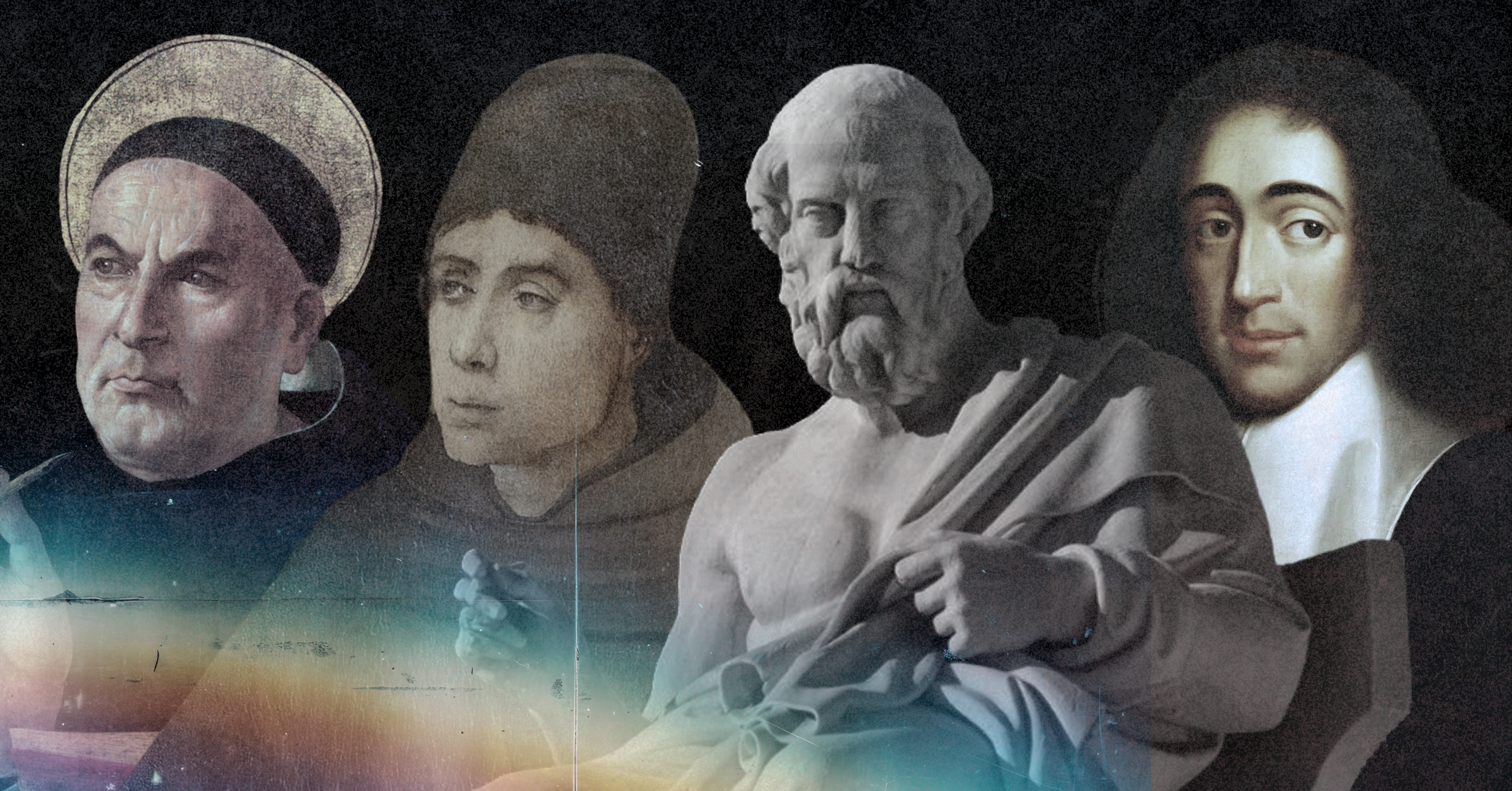
Four Philosophers, Four Visions and Their Implications

Aquinas: Let’s start our brief analysis with none other than Thomas Aquinas. He maintained that there is a real distinction between essence and existence. This means that he believed that essence and existence are real and distinct principles that together constitute the being of a thing. A thing’s essence is what it is, and existence is that it is. Following Dr. Richard Howe’s use of human beings to illustrate this, essence is what makes you human; existence is what makes you a being.[2]

The only exception to this rule is God, in whom essence and existence are identical, and this has several implications. First, he is unique and totally distinct from everything else that exists. He alone is existence; everything else just has existence. Second, as existence itself, God is the only necessary being. Every other being is contingent and depends on God for its existence. Third, God’s omnipotence is evident in His ability to bring things into existence from nothing (creatio ex nihilo). Between existence and non-existence, there’s an infinite metaphysical chasm that only an infinite cause can bridge.

Scotus: Aquinas’ view of God, stemming from his real distinction between essence and existence, can be contrasted with that of John Duns Scotus. Scotus maintained that every essence has some degree of being, according to its (proportional) intrinsic perfection. This implies that the distance between any finite being and nothingness is not infinite. As a result, God’s omnipotence is primarily expressed not in sustaining beings in existence, but in freely determining which essences are actualized in reality. In other words, for Scotus, God’s power, is primarily evident in freely determining what comes to be, rather than in directly causing the act of being itself. It is worth noting that Aquinas integrates both perspectives, affirming divine volition alongside God’s continuous causal role in sustaining creatures in existence.

Plato: On the other hand, Plato did not conceive of existence as an act received from God. Plato believed that the forms—eternal, unchanging, immaterial, and universal realities—are the highest level of reality, while the material world is just an imperfect reflection of them. As such, Plato’s god is really a craftsman-like figure who does not create things (let alone via creation ex nihilo), he merely imposes order on pre-existing chaotic matter in accordance with the forms. He works with what already exists; he does not make things to be or define what they are. There’s no doubt that Plato’s God is a “smaller” God than that of Aquinas.

Spinoza: Benedict Spinoza’s views are also important to mention. He denied the distinction between essence and existence because he maintained that only one substance exists. The implications of this view are profound. If everything that exists is the same substance, that means that everything that exists collapses into a single substance. As a result, God is identical with nature. There is really no distinction between God and everything else, leading directly to pantheism.

It is evident that this view is incompatible with the metaphysical commitments required by Christianity. We need not delve into the implications of this view for divine omnipotence or the necessity of creation. Suffice it to say that since this view denies the distinction between God and His creation, this implies that you, I, and all human beings are part of the same divine nature. This position plainly contradicts Scripture —and, indeed, everyday experience.

Conclusion

There’s much more that could be said about this, and many other important philosophers throughout history could be cited. However, this brief analysis shows that one’s metaphysical conclusions can strongly influence one’s theology. Every Christian should desire to know God and reality as they truly are. To do so properly, one’s metaphysics must be correct. Therefore, we as Christians, must make sure to get our metaphysics right.

References: 

[1] William Lane Craig and Bishop Robert Barron, Bishop Barron & William Lane Craig Symposium, Part 1: Divine Simplicity, Reasonable Faith, accessed February 21, 2025,
https://www.reasonablefaith.org/videos/lectures/bishop-barron-william-lane-craig-symposium-part-1-divine-simplicity

Symposium, Part 1: Divine Simplicity. Reasonable Faith. Accessed February 21, 2025.
https://www.reasonablefaith.org/videos/lectures/bishop-barron-william-lane-craig-symposium-part-1-divine-simplicity

Gilson, Étienne. Being and Some Philosophers. Toronto: Pontifical Institute of Mediaeval Studies, 1952.

———.Craig, William Lane, and Bishop Robert Barron. Bishop Barron & William Lane Craig

[2] Aquinas on Existence and the Essence-Existence Distinction,” Southern Evangelical Seminary, accessed February 21, 2025, https://ses.edu/aquinas-on-existence-and-the-essence-existence-distinction/

———.Aquinas on Existence and the Essence-Existence Distinction.” Southern Evangelical
Seminary. Accessed February 21, 2025
https://www.reasonablefaith.org/videos/lectures/bishop-barron-william-lane-craig-
symposium-part-1-divine-simplicity

Recommended Resources:

How Philosophy Can Help Your Theology by Richard Howe (DVD Set, Mp3, and Mp4)   

What is God Really Like? A View from the Parables by Dr. Frank Turek (DVD, Mp3, and Mp4)

What is God Like? Look to the Heavens by Dr. Frank Turek (DVD and Mp4)

Your Most Important Thinking Skill by Dr. Frank Turek DVD, (mp4) download


Diego Fallas earned his bachelor’s degree in mechanical engineering. During his studies, he became passionate about Christian apologetics. He quickly found himself immersed in the field as he started taking seminary courses in apologetics and became a Reasonable Faith chapter director. Today, he is the Director of Operations for CrossExamined.org, and teaches and speaks in Latin America. Diego is the co-host of the weekly Livestream show Piensalo Bien and is currently completing his M.A. in philosophy from Southern Evangelical Seminary.

John 1:1 is one of the most important verses in the Gospel of St. John to understand grammatically in English but more importantly in Greek.

“In the Beginning was the word and the word was with God and the Word was God” (John 1:1)

Εν αρχή ἧν ὁ λόγος και ὁ λόγος ἧν προς τον θεόν και θεός ἧν ὁ λόγος[i][ii]

The reason is this verse is always under attack by various non-Christian religious groups and even faiths who claim to be Christian but, do not accept Jesus Christ as God the Son (The second person of the Trinity). The two words I want to focus on is “God” and “Word” or Θεός ἧν ὁ Λόγος (Theos hēn hŏ logos). What I am going to focus on is the grammatical construct of John 1:1 and a bit of the history behind ὁ λόγος (hŏ logos).

John 1:1 and Genesis 1:1

In Ancient Greek literature there is no difference in meaning between the two-word adverbial Phrase Ἐν ἀρχη (en arkē) and the three-word adverbial phrase Ἐν τη ἀρχη (en tē archē) but Ἐν ἀρχη is used more frequently. Ἐν ἀρχη parallels Genesis 1:1 Ἐν ἀρχη ἐπιοησεν ὁ Θεος (en arkē hŏ theos), “In the beginning God created.”[iii]

The Historical Background of Hŏ Logos

John may have written his gospel in Ephesus the birthplace of Greek philosopher Heraclitus who lived around 500 B.C. He taught that λογος (logos) was eternal, and it could be compared to fire and gives life to everything in the universe; and this was taught well into the first century.[iv]

Λόγος word

The Greek Term λόγος is found in a number of different English words like logic, logical, prologue, epilogue etc. It can also have a number of different senses like, word, reason, cause, reasoning etc.

Λόγος is associated with “spoken Word” but λόγος in John 1:1 does not mean “word” in the sense of a word found in a dictionary. The Greek term for word is λέξις (lexeis) which is where we get our English word lexicon from. The ὁ λόγος in John 1:1 in a person.[v]

John was writing to a Hellenized audience, so he places Jesus as the ὁ λόγος he did this in the most integral spot, at the beginning of his gospel.[vi]


The Grammatical Construct of John 1:1

The combination of Προς (prŏs) plus the accusative Τον Θεόν (tŏn theon) means “with God.” This is similar in force to how Paul writes: ἐν μορφῃ Θεού ἰσα Θεῳ (en morfē isa theō), which translates as, “In the form of God, equal with God” (Phil. 2:6).

Προς Τον Θεόν (prŏs tŏn theon) literally means “With the God.” The use of the article Τον (tŏn) “the” before a noun identifies that noun. And in this case “the God” means “God the Father.” By reiterating the conjunction και (kai) in και Θεός ἧν ὁ λόγος (kai theos hēn hŏ logos) John is placing emphasis on this instance of ὁ λόγος. He describes in his gospel, in addition to being from eternity with Θεός, is also Himself Θεός.[vii]

The word order is reversed in English, in English it reads “and the word was God” but in Greek it reads, “And God was the Word.”


Θεός ἧν ὁ λόγος (
Theos hēn hŏ logos)

In John 1:1 this clause has two nouns. One noun is Θεος (theos) and the other is λόγος (logos). Λογος has an article, ὁ λόγος which means it is an articular noun and Θεος has no article so it is called an anarthrous noun. The articular noun is identified by the definite article “ὁ” as the subject. And the rest of the clause is the predicate.[viii]

So, between the predicate noun and a linking verb, ἧν (hēn; “was”), the linking verb connects the subject, ὁ λόγος, to the predicate noun, Θεός. Θεός adjectivally describes ὁ λόγος. In essence ὁ λόγος was with all the attributes, essence, nature, and qualities of Θεός. [Everything true of God is true of the Logos.][ix]

This article is not intended to be a full comprehensive explanation due to the how in depth this subject can go. John was very intentional about describing Jesus as God the Son, the second person of the Trinity.

References: 

[i] Editor’s note: The Greek transliterates as: “en arkē hēn ho logos kai ho logos hēn pros ton theon kai theos hēn ho logos.” – Transliterations are included throughout, in text, for those of you who don’t read Greek.]

[ii] Editor’s Note: If the translation were to preserve the Greek word order, it would look something like this: “And the word was with [the] God and God was the word.” This phrasing creates a chiasm – inverting the word order between the two parallel lines: Word-God, and God-Word. Additionally, the definite article, ὁ (pronounced hŏ), which is typically unnecessary in Greek except for emphasis or clarity, translates as “the” and is used here for “the God” in the first phrase then “the Word” in the second phrase. The Chiasm, being inverted parallelism, indicates that this verse is intended as poetry – still literally true, but expressed with an eye for beauty, memorability, and maybe even lyricality. Heightening that poetic structure is the shift of the definite article from “the God” to “The Word.” The one and only God is the same being as singular Logos, “The Word.” The author most definitely wanted to draw attention to the strict identity between God and Logos. The Word is God.” – JDF]

[iii] “Philemon, Zachariou Greek Pronunciation John 1:1.” YouTube. YouTube, n.d. Accessed November 20, 2024. https://www.youtube.com/watch?v=7IkIgSpCgtM

[iv] Ibid., see also, Jean Bollack, “Ch. 17 The Heraclitean Logos,” in The Art of Reading: From Homer to Paul Celan, C. Porter and S. Tarrow with B. King, trans; C. Koenig, L. Muellner, G. Nagy, and S. Pollock, eds. Hellenic Studies Series 73 (Washington, DC: Center for Hellenic Studies, 2016), accessed 23 Jan 2025 at: https://chs.harvard.edu/chapter/17-the-heraclitean-logos/.

[v] Ibid.

[vi] Ibid.

[vii] Ibid.

[viii] Ibid.

[ix] Editor’s Note: JDF.

Recommended Resources:

Jesus, You and the Essentials of Christianity by Frank Turek (INSTRUCTOR Study Guide), (STUDENT Study Guide), and (DVD)      

How to Interpret Your Bible by Dr. Frank Turek DVD Complete Series, INSTRUCTOR Study Guide, and STUDENT Study Guide

Can All Religions Be True? mp3 by Frank Turek

How Philosophy Can Help Your Theology by Richard Howe (DVD Set, Mp3, and Mp4)   


Seattle native Justin Angelos brings a passion for evangelism and discipleship along with theology and apologetics. He has studied at Biola University and Liberty University and recently earned a Master of Arts in Apologetics from Biola University. Justin focuses on providing help for those who suffer from emotional and anxiety issues. He currently resides in Salt Lake City, Utah.

Originally posted at: https://bit.ly/3EtdlxB

In presenting apologetics there are certain points I focus on in order to systematically examine the evidence for the truth of Christianity.  While there are many other areas of interest and concern for the apologist, these areas are essential in determining the veracity of the Christian religion.


These main features of Christianity include:

  1. The existence of God
  2. The reliability of the Bible
  3. The divine claims of Jesus
  4. the evidence for the resurrection of Jesus.

I organize these four points in the form of a question, which can possibly be answered yes or no, in order to be objective in the analysis. I’d like to focus on point #1 by asking the question: “Does God Exist?”

Does God Exist?

Obviously, if God doesn’t exist then Christianity cannot be true.  It is pretty fundamental. There are dozens and dozens of arguments for God’s existence, but there are three powerful arguments for theism that are the most popular.  If you can just remember GOD’s name you can remember these three arguments:

G = Good and evil

O = Origins of the universe

D = Design of the universe

The ‘g’ in God’s name stands for good and evil.  The fact that there exists objective moral truth is evidence for God.  Check out this video titled “The Moral Argument” for a quick introduction.  The ‘o’ in God’s name stands origins of the universe.  This video, titled “The Kalam Cosmological Argument” provides evidence for the origins of the universe that deduces that existence of God.  There are many versions of the cosmological argument, but the kalam version argues from the beginning of the universe to the existence of God.  The ‘d’ in God’s name stands for design of the universe.  This video shows how design is the best explanation for the fine-tuning for life in the universe.

Good and Evil

The first of these arguments for God is from morality. The Moral Argument (or the argument from good and evil) can be summarized as such:

P1: If God doesn’t exist, objective moral truth does not exist.

P2: Objective moral truths does exist.

C: So, God exists.

Origins of the Universe

The second argument is from the first cause of the universe. The Kalam Cosmological Argument (or the argument from the origins of the universe) can be summarized:

P1: Whatever begins to exist has a cause.

P2: The universe began to exist.

C: So, the universe has a cause

Design of the Universe

The third of these arguments deals with the amazing design we see in the universe. The Fine-tuning Argument (or the argument from the design of the universe) can be summarized:

P1: The fine-tuning for life in the universe is either due to chance, necessity, or design.

P2: It is not due to chance or necessity.

C: So, it is due to design.

Check out this page for a complete presentation of these three arguments for God’s existence which provides a summary of each argument along with links to other articles and videos for the existence of God.

Recommended Resources:

I Don’t Have Enough Faith to Be an Atheist (Paperback), and (Sermon) by Norman Geisler and Frank Turek 

Macro Evolution? I Don’t Have Enough Faith to be a Darwinist (DVD Set), (MP3 Set) and (mp4 Download Set) by Dr. Frank Turek

Oh, Why Didn’t I Say That? Does Science Disprove God? by Dr. Frank Turek (DVD and Mp4)

Stealing From God by Dr. Frank Turek (Book, 10-Part DVD Set, STUDENT Study Guide, TEACHER Study Guide)


Steve Lee has taught Apologetics for over two and a half decades at Prestonwood Christian Academy.  He also has taught World Religions and Philosophy at Mountain View College in Dallas and Collin College in Plano.  With a degree in history and education from the University of North Texas, Steve continued his formal studies at Southwestern Baptist Theological Seminary with a M.A. in philosophy of religion and has pursued doctoral studies at the University of Texas at Dallas and is finishing his dissertation at South African Theological Seminary.  He has published several articles for the Apologetics Study Bible for Students as well as articles and book reviews in various periodicals including Philosophia Christi, Hope’s Reason: A Journal of Apologetics, and the Areopagus Journal.  Having an abiding love for fantasy fiction, Steve has contributed chapters to two books on literary criticism of Harry Potter: Harry Potter for Nerds and Teaching with Harry Potter.  He even appeared as a guest on the podcast MuggleNet Academia (“Lesson 23: There and Back Again-Chiasmus, Alchemy, and Ring Composition in Harry Potter”).  He is married to his lovely wife, Angela, and has two grown boys, Ethan and Josh.

Originally Posted Here: https://bit.ly/3VSB3cO

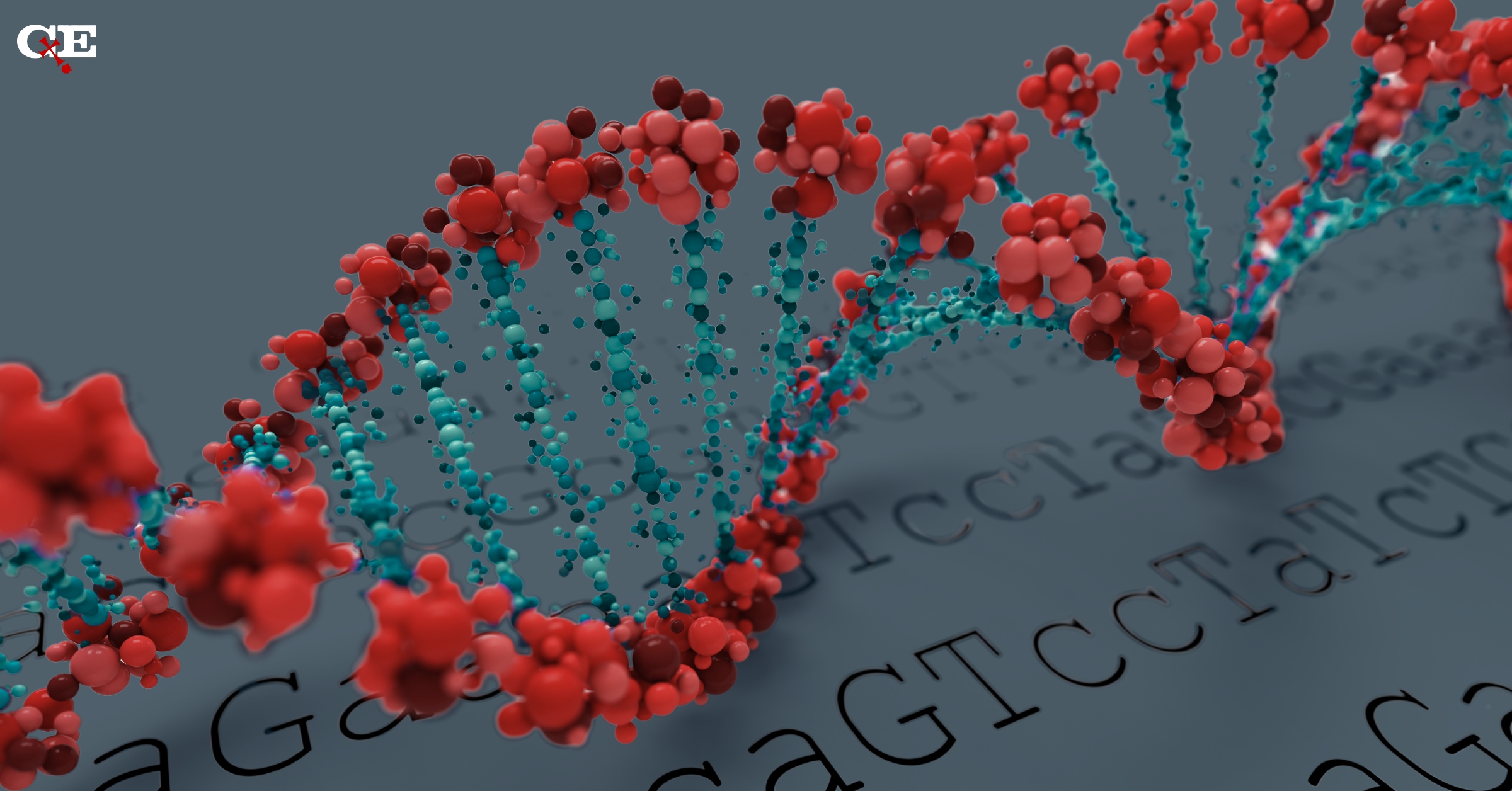
The DNA replisome is one of the most remarkable molecular machines, involving a complex of different proteins, each of which is very specifically crafted to fulfill its role in the process of replicating the genome in preparation for cell division. The rate of DNA replication has been measured at a whopping 749 nucleotides per second[1] and the error rate for accurate polymerases is believed to be in the range of 10-7 and 10-7, based on studies of E. coli and bacteriophage DNA replication.[2]

One of the best animations of this incredible process is this one by Australian animator Drew Berry. It is difficult to look at an animation such as this (which is drastically over-simplified) and not come away with the strong intuition that such an intricately choreographed machine is the product of masterful engineering. Stable and functional protein structures are astronomically rare in combinatorial sequence space, and DNA replication requires many of them. But not just any old stably folding proteins will do. These proteins have to be crafted very particularly in order to perform their respective jobs. Indeed, when one focuses on specific proteins, it takes the design intuition to new heights. For example, see these beautiful animations of topoisomerasehelicase, and DNA polymerase. One paper summarizes the engineering prowess of DNA replication thus [3]:

Synthesis of all genomic DNA involves the highly coordinated action of multiple polypeptides. These proteins assemble two new DNA chains at a remarkable pace, approaching 1000 nucleotides (nt) per second in E. coli. If the DNA duplex were 1 m in diameter, then the following statements would roughly describe E. coli replication. The fork would move at approximately 600km/hr (375 mph), and the replication machinery would be about the size of a FedEx delivery truck. Replicating the E. coli genome would be a 40 min, 400 km (250 mile) trip for two such machines, which would, on average make an error only once every 170 km (106 miles). The mechanical prowess of this complex is even more impressive given that it synthesizes two chains simultaneously as it moves. Although one strand is synthesized in the same direction as the fork is moving, the other chain (the lagging strand) is synthesized in a piecemeal fashion (as Okazaki fragments) and in the opposite direction of overall fork movement. As a result, about once a second one delivery person (i.e. polymerase active site) associated with the truck must take a detour, coming off and then rejoining its template DNA strand, to synthesize the 0.2km (0.13 mile) fragments.[3]

Irreducible Complexity on Steroids

DNA replication is an example of what we might call “irreducible complexity on steroids.” Genome duplication is a prerequisite of differential survival, which is necessary for the process of natural selection to even work. Thus, one can hardly appeal to natural selection to account for the origins of DNA replication without assuming the existence of the very thing one is attempting to explain. It is difficult to envision a viable replication system that is simpler than the DNA replisome shown in the animation above. Though the RNA world scenario (which maintains that RNA-based life predates life based on DNA and proteins) is a popular hypothesis, problems abound for this scenario, as has been discussed many times in various other publications (e.g., Meyer, Signature in the Cell, Ch. 14). For example, one of the foremost challenges is the inherent instability of RNA (being single-stranded, and possessing an additional 2’ OH group, rendering it prone to hydrolysis). RNA polymers are therefore extremely unlikely to have survived in the early earth environment for long enough to be of much value. Second, when RNA forms complementary base pairs to fold back on itself, part of the molecule no longer presents an exposed strand that can serve as a template for copying. Thus, there is a physical limitation on the capability of RNA to self-replicate.

A further reason why the DNA replication machinery exhibits irreducible complexity on steroids is that, by being so primitive, it is far more difficult to envision any kind of co-optation scenario than it would be for a system that arose much later, such as bacterial flagella. With the flagellum, one can at least point to alternative functions that might be performed by a number of the flagellar components (such as the Type-III Secretion System). However, with DNA replication, it is unclear what other systems any of the components might be co-opted from – since any other system would need to have arisen after the origins of DNA replication.

An even more striking enigma is that, across the three domains of life, the key enzymes (in particular, the replicative polymerases) are not homologous, which has led to the suggestion that DNA replication may have arisen more than once independently.[4] This observation sits more comfortably on a design paradigm than on one committed to naturalism.

Which Components Are Essential for DNA Replication?

What protein components that are involved in DNA replication are indispensable for function? First, there is the DNA polymerase that actually performs the copying of each strand. Without it, no replication would take place at all. But, the DNA polymerase is unable to begin replication without the presence of a free 3’ OH (hydroxyl) group. Thus, another enzyme — a form of RNA polymerase called a primase — creates a short RNA fragment (called a primer) from which the DNA polymerase can extend (unlike DNA polymerase, the primase does not require the presence of a free 3’ OH group). Thus, in the absence of the primase enzyme, no RNA primers would be laid down on either the leading or lagging strand, and DNA replication would be unable to commence. Furthermore, the DNA polymerase itself has to be attached to the DNA by a ring-shaped protein known as a sliding clamp (which prevents it from falling off the DNA template strand). But, the sliding clamp cannot directly attach to the DNA on its own. Instead, a protein complex called the clamp loader mediates the loading of the sliding clamp onto the DNA at the replication fork, utilizing the energy from ATP hydrolysis to open the sliding clamp ring and load it onto the DNA. In the absence of the sliding clamp or clamp loader, the DNA polymerase would frequently fall off the DNA template, rendering it extremely inefficient.

Of course, the replication process cannot begin unless the DNA double helix is unzipped, and this is accomplished by the enzyme helicase, which breaks the hydrogen bonds along the DNA molecule, thereby opening up and exposing the two strands for replication by the polymerase. In its absence, the DNA polymerase will stall, unable to separate the strands that lie ahead.

Even with the helicase enzyme separating the two strands, the strands are likely to reanneal during the copying process. Enter the single-stranded binding proteins which bind to the exposed DNA strands, preventing them from re-annealing during copying. Without them, the DNA strands would bind together again before they were able to be copied.

The topoisomerase enzymes are necessary for removing supercoils that are induced by the torsional stress. They do so by cutting one strand, passing the other strand through the gap, and then resealing the break. In the absence of the topoisomerase enzymes, the DNA would eventually break, thereby hindering the DNA replication process.

Because of the anti-parallel nature of DNA (and the fact that the DNA polymerase can only replicate in a 5’ to 3’ direction), one strand, the lagging strand, has to be replicated backwards (in order for the replication fork to move in a single direction). This is done discontinuously in small sections. RNA primers are laid down by primase, and from those are synthesized short fragments of DNA known as Okazaki fragments. The RNA primers are then removed and replaced with DNA, and the Okazaki fragments are stitched together by the enzyme ligase. We have already discussed the necessity of the primase enzyme for synthesizing RNA primers. It may be added that, in the absence of the RNA excision enzymes (which remove the RNA primers), the RNA fragments would remain covalently attached to the newly replicated fragments of DNA. Moreover, in the absence of ligase (which links the Okazaki fragments together), the newly replicated strands would remain as fragments.

If the removal of any of the aforementioned components would render the DNA replication machinery non-functional, how could such a system come about through an undirected Darwinian step-wise pathway, preserving selective utility at every step along the way? Whatever process produced the DNA replisome had to know where the target was. Such a cause would have to be teleological in nature.

A Paradigm of Design

The DNA replication machinery represents one of the most extraordinary examples of nanotechnology found in the cell. In any other realm of experience, such a complex and delicate arrangement of parts would be immediately recognized as reflecting conscious intent — that is, as being the product of a mind. Why should such an inference be disallowed when examining biological systems? For more detail on this fascinating molecular machine, see my interview on it from last summer on ID the Future. I also published an earlier series (more than a decade ago) exploring the various protein components in more detail. You can find these here:

If you enjoyed the animation by Drew Berry linked at the beginning of this article, here is a more detailed animation, produced by Oxford University Press. Here is a second animation which reveals how the DNA polymerases are coupled so that they can move in the same direction.

References: 

[1] McCarthy D, Minner C, Bernstein H, Bernstein C. DNA elongation rates and growing point distributions of wild-type phage T4 and a DNA-delay amber mutant. J Mol Biol. 1976 Oct 5;106(4):963-81.

[2] Schaaper RM. Base selection, proofreading, and mismatch repair during DNA replication in Escherichia coli. J Biol Chem.1993 Nov 15;268(32):23762-5.

[3] Baker TA, Bell SP. Polymerases and the replisome: machines within machines. Cell. 1998 Feb 6;92(3):295-305.

[4] Leipe DD, Aravind L, Koonin EV. Did DNA replication evolve twice independently? Nucleic Acids Res. 1999 Sep 1;27(17):3389-401; and Brown JR, Doolittle WF. Archaea and the prokaryote-to-eukaryote transition. Microbiol Mol Biol Rev. 1997 Dec;61(4):456-502.

Recommended Resources:

Why Science Needs God by Dr. Frank Turek (DVD and Mp4)

Science Doesn’t Say Anything, Scientists Do by Dr. Frank Turek (DVD, Mp3, and Mp4)

Oh, Why Didn’t I Say That? Does Science Disprove God? by Dr. Frank Turek (DVD and Mp4)

I Don’t Have Enough Faith to Be an Atheist (Paperback), and (Sermon) by Norman Geisler and Frank Turek


Dr. Jonathan McLatchie is a Christian writer, international speaker, and debater. He holds a Bachelor’s degree (with Honors) in forensic biology, a Masters’s (M.Res) degree in evolutionary biology, a second Master’s degree in medical and molecular bioscience, and a Ph.D. in evolutionary biology. Currently, he is an assistant professor of biology at Sattler College in Boston, Massachusetts. Dr. McLatchie is a contributor to various apologetics websites and is the founder of the Apologetics Academy (Apologetics-Academy.org), a ministry that seeks to equip and train Christians to persuasively defend the faith through regular online webinars, as well as assist Christians who are wrestling with doubts. Dr. McLatchie has participated in more than thirty moderated debates around the world with representatives of atheism, Islam, and other alternative worldview perspectives. He has spoken internationally in Europe, North America, and South Africa promoting an intelligent, reflective, and evidence-based Christian faith.

This article was originally published on March 21st, 2024, at Evolution News & Science Today.

And republished at: https://bit.ly/4f6pp5q

Recently, someone asked me to comment on an article, published in 2017, by John Danaher, a lecturer in the Law School at the University of Galway, Ireland. He is widely published on legal and moral philosophy, as well as philosophy of religion. In his article, Danaher alleges that proponents of intelligent design (ID) are religiously motivated. He also asserts that the argument for ID from irreducible complexity has conceptual problems, and that systems that we deem to be irreducibly complex can be adequately explained by co-optation of components performing other roles in the cell. In two articles, I will address his concerns about our supposed religious motives, and then tackle his specific objections to irreducible complexity.

Do We Have Religious Motives?

Danaher opens his essay by reminiscing about his days as a student when he first encountered ID.

When I was a student, well over a decade ago now, intelligent design was all the rage. It was the latest religiously-inspired threat to Darwinism (though it tried to hide its religious origins). It argued that Darwinism could never account for certain forms of adaptation that we see in the natural world.

What made intelligent design different from its forebears was its seeming scientific sophistication. Proponents of intelligent design were often well-qualified scientists and mathematicians, and they dressed up their arguments with the latest findings from microbiology and abstruse applications of probability theory. My sense is that the fad for intelligent design has faded in the intervening years, though I have no doubt that it still has its proponents.

These paragraphs betray the fact that the author is quite out of touch with the literature on ID.

Stronger than Ever

First, ID has come a long way since the early 2000s. Far from having faded, it is now stronger than ever, having more academic proponents (and many more peer-reviewed publications) than at any time in its history. Its arguments are far more developed and sophisticated than in the early 2000s and this trend is likely to continue.

Second, it is unclear in what sense Danaher refers to the “religious origins” of ID. It is certainly true that having a religious perspective, predisposing one towards theism, creates a plausibility structure that opens one’s mind to the possibility of there being measurable evidence of design in the universe, including in living organisms. Thus, being independently persuaded of the truth of a theistic religion (in my case, Christianity) is positively relevant to one’s assessment of the prior probability (or, intrinsic plausibility) of ID. However, even if one is not persuaded of theistic religion, the evidence of design in the natural world is, in my opinion, sufficient to overwhelm even a very low prior. Indeed, the cosmological evidence that our universe has a finite history; the fine-tuning of the laws and constants of our universe; the prior environmental fitness of nature for complex life; the optimization of the universe for scientific discovery and technology; and the biological evidence of design all point univocally and convergently in the direction of a cosmic creator. Thus, ID has attracted support from scholars who are not themselves adherents of any religion, including Michael Denton, David Berlinski, and Steve Fuller. Paleontologist and frequent Evolution News contributor Günter Bechly, though a Christian believer now, was not sympathetic to Christianity when he first came to be persuaded of ID.

Misguided on Many Levels

Later in the essay, Danaher further remarks,

The claim is not that God must have created the bacterial flagellum but, rather, that an intelligent designer did. For tactical reasons, proponents of intelligent design liked to hide their religious motivations, trying to claim that their theory was scientific, not religious in nature. This was largely done in order to get around certain legal prohibitions on the teaching of religion under US constitutional law. I’m not too interested in that here though. I view the intelligent design movement as a religious one, and hence the arguments they proffer as on a par with pretty much all design arguments.

These comments are misguided on many levels.

First, the claim that we ID proponents are not clear about our personal religious persuasions is patently false. Speaking for myself, I have been very clear that I am a Christian theist, though my grounds for being persuaded of that conclusion are wholly independent of the science of ID. And I am by no means unusual. Virtually every leading ID proponent — from Michael Behe to William Dembski to Stephen Meyer to Phillip Johnson to David Klinghoffer to Casey Luskin to Brian Miller to Ann Gauger and many others — has been totally open about his or her personal religious beliefs. In the world of intelligent design, no one is hiding anything about religious beliefs, including those who lack religious beliefs.

Second, ID is a scientific argument, and when evaluating a scientific argument, the motives of its proponents are irrelevant. As Casey Luskin writes,

[I]n science, the motives or personal religious beliefs of scientists don’t matter; only the evidence matters. For example, the great scientists Johannes Kepler and Isaac Newton were inspired to their scientific work by their religious convictions that God would create an orderly, rational universe with comprehensible physical laws that governed the motion of the planets. They turned out to be right — not because of their religious beliefs — but because the scientific evidence validated their hypotheses. (At least, Newton was thought to be right until Einstein came along.) Their personal religious beliefs, motives, or affiliations did nothing to change the fact that their scientific theories had inestimable scientific merit that helped form the foundation for modern science.

To attack an idea because of the alleged religious motives of its proponents is to commit the genetic fallacy, and that is exactly what Danaher has done here.

Third, ID is not a religious argument. Though ID provides strong evidence for a broadly theistic perspective, the argument itself is grounded in the scientific method. ID does not aid in evaluating the merits of one particular religious tradition over another. ID does not even technically commit one to theism, though I would contend that God is the best candidate for the identity of the designer (as Stephen Meyer argues in his recent book, Return of the God Hypothesis). Thus, ID rightly attracts people of all religious persuasions and none (including Orthodox Jews, Muslims, and agnostics). This is important because it shows that ID is not about supporting one particular religion. We, therefore, strive to be honest about the limitations of ID while being careful not to overstate what the scientific evidence alone can tell us.

What About Evolution?

Finally, if Danaher wants to scrutinize the religious motives of ID proponents, we have to consider what such a line of attack would do to evolution. Casey Luskin has documented (see here or here) the extensive anti-religious beliefs, motives, and affiliations of many leading evolution-advocates. While I (and Luskin) would maintain that evolution is science, one must ask what would happen to evolution if the religious (or anti-religious) beliefs of its proponents suddenly became relevant to assessing its merits.

“Teach the Controversy”

Danaher’s statement that the claim that ID is scientific and not religious “was largely done in order to get around certain legal prohibitions on the teaching of religion under US constitutional law” is historically incorrect. Discovery Institute (the leading organization funding research into, and promoting the public understanding of, ID) does not support attempts to legally protect the teaching of ID in public schools. In fact, since Discovery Institute’s earliest involvement in major public education debates in the U.S. (in Ohio in 2002), it has not supported mandating the teaching of ID in public schools. This is not because we feel that ID is unconstitutional. ID, much like the Big Bang in cosmology, may be friendly to a broadly theistic perspective. However, this does not make the idea itself a religious one, just as the Big Bang theory is not a religious idea. Thus, there is nothing intrinsic to ID that would render it unconstitutional under the First Amendment (see here or here for legal discussions). However, attempts to legislatively protect the teaching of ID tend to politicize the theory, and we believe that the merits of ID ought to be debated in the scientific journals, not in the courtroom. Rather, Discovery Institute advocates a “teach the controversy” model, where the strengths and weaknesses of scientific theories (including evolution) are presented and discussed. All of this is stated clearly and openly on our Science Education Policy page:

As a matter of public policy, Discovery Institute opposes any effort to require the teaching of intelligent design by school districts or state boards of education. Attempts to require teaching about intelligent design only politicize the theory and will hinder fair and open discussion of the merits of the theory among scholars and within the scientific community. Furthermore, most teachers at the present time do not know enough about intelligent design to teach about it accurately and objectively.       


Instead of recommending teaching about intelligent design in public K-12 schools, Discovery Institute seeks to increase the coverage of evolution in curriculum. It believes that evolution should be fully and completely presented to students, and they should learn more about evolutionary theory, including its unresolved issues. In other words, evolution should be taught as a scientific theory that is open to critical scrutiny, not as a sacred dogma that can’t be questioned.

Thus, Danaher is ill-informed about Discovery Institute’s long-standing education policy. In a second article, I shall address his specific concerns regarding the argument from irreducible complexity.

Recommended Resources:

Science Doesn’t Say Anything, Scientists Do by Dr. Frank Turek (DVD, Mp3 and Mp4)

Oh, Why Didn’t I Say That? Does Science Disprove God? by Dr. Frank Turek (DVD and Mp4)

Stealing From God by Dr. Frank Turek (Book, 10-Part DVD Set, STUDENT Study Guide, TEACHER Study Guide)

Macro Evolution? I Don’t Have Enough Faith to be a Darwinist (DVD Set), (MP3 Set) and (mp4 Download Set) by Dr. Frank Turek


Dr. Jonathan McLatchie is a Christian writer, international speaker, and debater. He holds a Bachelor’s degree (with Honors) in forensic biology, a Masters’s (M.Res) degree in evolutionary biology, a second Master’s degree in medical and molecular bioscience, and a Ph.D. in evolutionary biology. Currently, he is an assistant professor of biology at Sattler College in Boston, Massachusetts. Dr. McLatchie is a contributor to various apologetics websites and is the founder of the Apologetics Academy (Apologetics-Academy.org), a ministry that seeks to equip and train Christians to persuasively defend the faith through regular online webinars, as well as assist Christians who are wrestling with doubts. Dr. McLatchie has participated in more than thirty moderated debates around the world with representatives of atheism, Islam, and other alternative worldview perspectives. He has spoken internationally in Europe, North America, and South Africa promoting an intelligent, reflective, and evidence-based Christian faith.

Originally published here: https://bit.ly/3zZJM4R

More than two years ago, I participated in a debate in Oxford, England, with atheist YouTuber Alex O’Connor (who goes by the online alias Cosmic Skeptic). The subject was “Why I Am / Am Not a Christian,” which was quite broad. Given the short time constraints of the debate and the breadth of the topic, we were regrettably unable to pursue an explication of our differences with the depth that I would prefer. Nonetheless, I very much appreciated my interaction that evening with O’Connor, including the dinner we enjoyed together before the event. I have long viewed O’Connor as one of the more philosophically nuanced atheist thinkers, and I have valued our ongoing private discussions subsequent to our initial public dialogue. My positive argument in the debate concerned the evidence for Jesus’s resurrection, while O’Connor focused on moral critiques of the Bible. In his portion of the cross-examination, O’Connor chose to focus on the issue of slavery in the Old Testament. The last of the texts we discussed was Numbers 31:15-18, which was interpreted by O’Connor to endorse sexual slavery. At the time, this was not an issue that I had researched with great depth, though I recognized it as a difficult text. My preparation for the debate had largely been on the evidences for New Testament reliability, and its epistemic relevance to developing a robust case for the resurrection. I therefore acknowledged it as a difficult text without offering any detailed response. Earlier this week, Alex O’Connor uploaded the clip from our debate, in which this text was discussed, to his Cosmic Clips spin-off channel. I therefore thought it an appropriate time to publish an article offering my current perspective on this difficult text.

What Does the Text Actually Say?  

Here is the passage under discussion:

“Have you allowed all the women to live?” he [Moses] asked them. 16 “They were the ones who followed Balaam’s advice and enticed the Israelites to be unfaithful to the Lord in the Peor incident, so that a plague struck the Lord’s people. 17 Now kill all the boys. And kill every woman who has slept with a man, 18 but save for yourselves every girl who has never slept with a man” (Numbers 31:15-18; NIV).

The first thing to note about this text is that it is not technically God who gives the instructions. Thus, on the worst case scenario, one may interpret this text as being descriptive of Moses’s command, rather than it being an act endorsed by God. Nonetheless, even supposing (as I think is more likely) that Moses’s instruction carries with it God’s approval, I do not believe it to be as problematic as it might appear on first impression. O’Connor believes that this text gives permission to the Hebrew soldiers to rape Midianite war captives. Such an interpretation, however, would fly in the face of every piece of clear moral legislation on sexual relations that we have in the Hebrew Bible. For example, in Deuteronomy 22:23-27:

“If there is a betrothed virgin, and a man meets her in the city and lies with her, 24 then you shall bring them both out to the gate of that city, and you shall stone them to death with stones, the young woman because she did not cry for help though she was in the city, and the man because he violated his neighbor’s wife. So you shall purge the evil from your midst. 25 “But if in the open country a man meets a young woman who is betrothed, and the man seizes her and lies with her, then only the man who lay with her shall die. 26 But you shall do nothing to the young woman; she has committed no offense punishable by death. For this case is like that of a man attacking and murdering his neighbor, 27 because he met her in the open country, and though the betrothed young woman cried for help there was no one to rescue her” (Deuteronomy 22:23-27; emphasis added).

According to this text, the crime of rape is so serious that it is punishable by death. If the woman failed to scream for help when she was in the city and could be heard, the Jewish law viewed the situation as consensual sex rather than rape, since the woman could have cried out for someone to rescue her but didn’t. Thus, both parties were guilty. If the sexual assault took place in a rural area, however, where the woman had no chance of being heard, the Jewish law gave the woman the benefit of the doubt and she was not to be considered culpable.

What about P.O.W’s?

One might object here that women captured in war were not afforded the same rights as women belonging to the people of Israel, and thus this consideration offers little help with regards to the text of our study. However, the previous chapter in Deuteronomy concerns the rights of women who are captured in war (Deut 21:10-14):

“When you go out to war against your enemies, and the LORD your God gives them into your hand and you take them captive, 11 and you see among the captives a beautiful woman, and you desire to take her to be your wife, 12 and you bring her home to your house, she shall shave her head and pare her nails. 13 And she shall take off the clothes in which she was captured and shall remain in your house and lament her father and her mother a full month. After that you may go in to her and be her husband, and she shall be your wife. 14 But if you no longer delight in her, you shall let her go where she wants. But you shall not sell her for money, nor shall you treat her as a slave, since you have humiliated her” (Deuteronomy 21:10-14; emphasis added).

Therefore, while the Hebrew soldiers were permitted to marry female war captives, they were not permitted to rape them or treat them as slaves. The woman was also to have a month to mourn the loss of her kin prior to getting married. Daniel Block notes, “This monthlong quarantine expresses respect for the woman’s ties to her family of origin and her own psychological and emotional health, providing a cushion from the shock of being torn from her own family.[i]

Indeed, as John Wenham comments, “In a world where there are wars, and therefore prisoners of war, such regulations in fact set a high standard of conduct.”[ii] Furthermore, by becoming part of the people of Israel (and possessing full status as a wife), the women would be delivered from pagan idolatry and exposed instead to Israelite religion concerning the true God, thereby having opportunity to attain salvation.

War Context

The historical context of the war against the Midianites is also important to bear in mind as we evaluate our text. Numbers 31:16 indicates that the Midianite women “were the ones who followed Balaam’s advice and enticed the Israelites to be unfaithful to the Lord in the Peor incident, so that a plague struck the Lord’s people.” This is an allusion to Numbers 25:1-9, in which we read of an occasion where the Midianites devised a plot to entice Israel into pagan worship involving making sacrifices to Baal and ritual sex. According to Moses, the Midianite women were among those who “enticed the Israelites to be unfaithful to the Lord” (Num 31:16). Thus, the women who were permitted to live and marry into Israel (that is, those who had not known man by lying with him) were presumably those who had not been involved in enticing the men of Israel into sexual impurity.

What the Text Doesn’t Say

Another consideration, often overlooked in discussions of our text, is that we are not informed what happened to young woman who were brought into the Israelite camp but who did not wish to marry the men who had just slaughtered their kin. We can hypothesize that they were forced into it anyway, but we can equally hypothesize that they were allowed to make themselves useful as virgins until such a time as someone more suitable presented himself. This is simply not stated or even intimated in the text. Thus, if there were women who were averse to being married to an interested Israelite soldier, we just do not know what happened. Moreover, even if on occasion something bad happened — and there is no reason to deny that sometimes it may have — it is not something we are told was done by command of God.

In conclusion, though Numbers 31:13-18 is undoubtedly a difficult text, especially from the vantage point of our twenty-first century western culture, the text becomes, upon closer inspection, significantly less problematic than it appears at first impression. The Pentateuch outlined the rights of female war captives, and they were not allowed to be treated as a slave or sex object. The Pentateuch also takes a very negative view of rape. Most likely, the women who were spared were not involved in enticing Israel into sexual impurity during the incident at Peor. Finally, we are not informed by the text what the arrangements were for women who did not wish to marry an interested Israelite soldier, and so any suggestion of what may have happened is mere conjecture.

Footnotes:

[i] Daniel I. Block, The NIV Application Commentary: Deuteronomy, ed. Terry Muck (Grand Rapids, MI: Zondervan, 2012), 496.

[ii] John W. Wenham, The Goodness of God (Downers Grove, IL: InterVarsity, 1974), 96.

Recommended resources related to the topic:

Is Morality Absolute or Relative? by Dr. Frank Turek Mp3 and Mp4

If God, Why Evil? (DVD Set), (MP3 Set), and (mp4 Download Set) by Frank Turek

Is Morality Absolute or Relative? (Mp3), (Mp4), and (DVD) by Frank Turek

Why Doesn’t God Intervene More? (DVD Set), (MP3 Set), and (mp4 Download Set) by Frank Turek

Why does God allow Bad Things to Happen to Good People? (DVD) and (mp4 Download) by Frank Turek


Dr. Jonathan McLatchie is a Christian writer, international speaker, and debater. He holds a Bachelor’s degree (with Honors) in forensic biology, a Masters’s (M.Res) degree in evolutionary biology, a second Master’s degree in medical and molecular bioscience, and a Ph.D. in evolutionary biology. Currently, he is an assistant professor of biology at Sattler College in Boston, Massachusetts. Dr. McLatchie is a contributor to various apologetics websites and is the founder of the Apologetics Academy (Apologetics-Academy.org), a ministry that seeks to equip and train Christians to persuasively defend the faith through regular online webinars, as well as assist Christians who are wrestling with doubts. Dr. McLatchie has participated in more than thirty moderated debates around the world with representatives of atheism, Islam, and other alternative worldview perspectives. He has spoken internationally in Europe, North America, and South Africa promoting an intelligent, reflective, and evidence-based Christian faith.

Originally published at: https://bit.ly/3wutuzg


Most atheists I have encountered demonstrate an amazing “faith” in the power of science. They will often accuse believers of wishful thinking – or outright foolishness – when believers conclude that an intelligent being is the only reasonable inference to draw from the evidence of design that surrounds us. They do this because they have come to believe that only through “science” can anything be known, and that science will someday answer all of life’s mysteries. That is what’s called “scientism.” There is no need for a God, they assure themselves, because “science” has not provided for one.

Is Science the Only Way to Know?

The flaw in this thinking is the assumption that science is the only way one can know something. This is flawed on many levels. Science, broadly speaking, is a method of examining and assessing the physical world around us, using instrumentation and methodology to achieve repeatable results so as to confirm or negate a hypothesis. It is, therefore, an endless process of knowledge acquisition, but only in the physical realm. We employ it because we are first convinced that reality is fixed, and that repeatability is possible. But that is a philosophical belief, not something that science has itself proven.[1] If we didn’t already “know” this there would be no point in attempting to conduct experiments in the first place.

Can Science Handle Moral Values?

Moreover, science does not attempt to provide knowledge as to good and evil, for it is simply incapable of doing so. After all, Nazi scientists were making use of science, but we would hardly accept that what they were doing was good. Indeed, we would not look to the scientific method at all for answers to such questions.

Can Science Address Anything Besides Physical Nature?

Finally, since science is limited to the physical realm, it cannot be used to assess the transcendent. What existed before “time” began can no more be measured by science than can the morality of a decision to use science to achieve a particular end.

What Other Options Do we have?

There are other ways to obtain knowledge besides experimental science, especially in areas where testing and repeatability are not possible. We do this all the time in the study of history, or when we make use of abductive reasoning to arrive at the best explanation from the available evidence. One example often used in courtrooms involves rain: clothing gets wet when we walk in the rain, and we rightly infer that it is raining outside when someone walks into a building wearing a raincoat that is dripping wet. We use abductive reasoning intuitively and we take as a given that our sense of reasoning operates correctly to allow us to reach valid conclusions. This is so even though we cannot use reason (or science) to prove the validity of reason. Simply put, if I try to use reason to prove that reason is valid, I have to presuppose the validity of the very thing – reason – that I am trying to prove. No, reason is a starting point, a given that we must all utilize if we are to discuss – to think – at all.

Christians are not imagining a creator when they look at the evidence of the universe. Quite the contrary: modern science is unlocking more and more of the secrets of the universe and finding that it is incredibly fined tuned to support the existence of life. Mathematical formulae can model what is occurring in nature with remarkable precision, amounting to a “language” scientists use to understand reality. Medical science has peered into the complexity of life, and the billions of lines of a computer-like code – found in DNA – that directs the building of proteins and ultimately structures that allow the vast variety of life we see on Earth. Whenever we see signs of something that is designed and operating according to a finely tuned set of instructions, we quite properly infer that there is an intelligence behind it. For something as massive and breathtaking as this universe, populated as it is with intelligent life, that something must itself be immensely intelligent and immensely powerful. Science certainly addresses this physical domain; it seeks to answer the question how things occur? And science performs a valuable function. But science as a tool for discovering processes cannot explain what first set in motion the forces that it is examining; what the designer sought to accomplish with the laws of nature; and what the ultimate meaning and purpose of life really is. Science addresses the “how” of whatever already exists, but not the “why.”

If Nature were a Note

Consider: imagine a scientist examining the mail he receives every day. Over time, he learns everything there is to know about the type of paper that is used, how the paper was formed, the type of ink, its place of manufacture and its ingredients. Imagine further that he determines how the letters are grouped to form words. Seeking knowledge of this type is laudable. But if the scientist concludes that since he knows all there is to know about ink and letters and envelopes, that there is no need for a letter-sender, then he has done something worse than making a blind leap of faith – he has closed his mind to the obvious reality of what he is examining. Indeed, the only way the scientist can learn the point of it all, the meaning of the message, is to read what was written, for in it is embedded information, something that simply cannot arise through random or blind processes.

As Christians, we bear witness to a personal God, not because we are grasping at myths, but because we believe the evidence of Jesus’s life, death and resurrection are sufficient for us to know him in a personal way. In other words, we personalize the source of what physicists describe as the creation event not by myth or wishful thinking but by a combination of abductive reasoning – a creator is the best explanation – and specific revelation – he is the God described in the Bible.

In the end, science and the Christian worldview are not in conflict. It is the one who insists despite the evidence that there is no God – and ultimately no one to whom we will one day be called to answer – that is persisting in ignorance.

References: 

[1] Editors Note: The fixity, repeatability, and knowability of nature are preconditions for science. One can’t do science without them. That is, one must assume such a framework before one can use the scientific method to discover facts about the natural world. Since these sorts of things have to be assumed beforehand they are, properly speaking, the domain of philosophy, namely philosophy of science.

Recommended resources related to the topic:

Why Science Needs God by Dr. Frank Turek (DVD and Mp4)

Science Doesn’t Say Anything, Scientists Do by Dr. Frank Turek (DVD, Mp3, and Mp4)

Oh, Why Didn’t I Say That? Does Science Disprove God? by Dr. Frank Turek (DVD and Mp4)

Stealing From God by Dr. Frank Turek (Book, 10-Part DVD Set, STUDENT Study Guide, TEACHER Study Guide)


Al Serrato earned his law degree from the University of California at Berkeley in 1985. He began his career as an FBI special agent before becoming a prosecutor in California, where he worked for 33 years. An introduction to CS Lewis’ works sparked his interest in Apologetics, which he has pursued for the past three decades. He got his start writing Apologetics with J. Warner Wallace and Pleaseconvinceme.com.


By Jonathan McLatchie

The ear is responsible for two of our most fundamental senses — hearing and equilibrium — the receptors for which are all found inside the inner ear. For an incredible animation of how hearing works, I recommend this YouTube video.

Here, I will describe the anatomy of the ear and the biological basis of the sense of hearing. The information below can be found in any good anatomy and physiology textbook. You can also find a good discussion of this subject in Chapter 11 of Your Designed Body, by Steve Laufmann and Howard Glicksman. It might be helpful to refer to the illustration of the ear below as you read the description that follows. [1]

The Outer Ear

The outer ear is comprised of the auricle and ear canal. The auricle is composed of skin-covered cartilage. In dogs (who have movable ears), the auricle can serve as a funnel for sound waves. In humans, on the other hand, its absence would not negatively affect our hearing.

Skin containing ceruminous glands lines the ear canal (also called the external auditory meatus). The ear canal is a tube-like structure that extends from the outer ear to the middle ear. It is responsible for directing sound waves into the ear, which then travel through the ear canal and arrive at the eardrum (tympanic membrane) in the middle ear. The eardrum vibrates in response to these sound waves, and these vibrations are transmitted to the middle ear bones.

The Middle Ear

The middle ear is a cavity in the temporal bone that is filled with air. The tympanic membrane (popularly called the eardrum) is a thin, flexible membrane that separates the outer ear from the middle ear, and is stretched across the end of the ear canal. When sound waves enter the ear canal, they strike the eardrum, causing it to vibrate. Behind the eardrum, there are three small bones known as the ossicles — namely, the malleus (hammer), incus (anvil), and stapes (stirrup). The ossicles form a chain and are connected to each other. When the eardrum vibrates in response to waves, it causes the malleus to move, which, in turn, moves the incus and stapes. This mechanical linkage helps amplify the vibrations and transmits them from the eardrum to the inner ear.

The middle ear is also connected to the nasopharynx (back of the throat) through a tube called the eustachian tube. This tube helps to equalize air pressure on both sides of the eardrum. This is essential to maintain equilibrium of air pressure between the middle ear and external atmospheric pressure, to allow the eardrum to properly vibrate.

The Inner Ear

The inner ear is also a cavity within the temporal bone, and is also called the bony labyrinth. It is lined with a membrane called the membranous labyrinth. Between the bone and membrane is a fluid called perilymph, and within the membranous structures of the inner ear is a fluid called endolymph. Three of these structures (the utricle, saccule, and semicircular canals) are concerned with equilibrium. The other (the cochlea) relates to hearing.

The cochlea’s appearance is like the shell of a snail. The inside of the cochlea is partitioned into three canals, filled with fluid. The uppermost canal is called the scala vestibuli, and it is filled with perilymph (a fluid similar to cerebrospinal fluid). Sound vibrations travel through the cochlea and arrive at the scala tympani. The middle canal is called the scala media (otherwise known as the cochlear duct), and it is separated from the scala vestibuli by Reissner’s membrane, and from the scala tympani by the basilar membrane. The scala media contains endolymph and is where the sensory cells of the cochlea (known as hair cells) are located. These hair cells are of course not in fact hair, but, rather, are specialized microvilli that are responsible for converting sound vibrations into electrical signals that can be interpreted by the brain. Situated above the hair cells is the tectorial membrane which, as we shall see, is crucial for hearing.

The Sense of Hearing

The process of hearing begins with the production of sound waves, which are pressure fluctuations that are propagated through air. These waves are funneled into the ear canal by the pinna (the external part of the ear). The ear canal carries the sound waves to the eardrum (tympanic membrane), which causes it to vibrate. These vibrations are then transmitted to the malleus, incus, and stapes, which amplify the vibrations. The stapes is connected to the oval window, a membrane-covered opening to the inner ear. Vibration of the stapes bone against the oval window creates pressure waves in the fluid-filled cochlea. As the pressure waves pass through the fluid in the cochlea, they cause vibration of the basilar membrane. This results in the bending of hair cells against the tectorial membrane, which in turn triggers the release of neurotransmitters that convert mechanical vibrations into electrical signals. These electrical signals are transmitted to the brain by the auditory nerve, where they are interpreted as sound by the auditory areas in the temporal lobes of the cerebral cortex.

The auditory nerve fibers carrying information from one ear partially cross to the opposite side at a structure in the brainstem, known as the trapezoid body. This means that signals from both ears are sent to both sides of the brain. This plays an important role in sound localization and spatial processing, allowing the brain to compare the timing and intensity of signals from both ears, helping us to determine the direction of a source of sound. Impulses arriving from each inner ear are counted and compared by the auditory areas, to determine the direction of a sound. If there are more impulses coming from the right cochlea than from the left one, the brain projects the sound to the right, and vice versa.

The neurons of the auditory cortex are organized in a manner similar to a piano keyboard — being arranged from low to high pitch. The brain is also able to detect volume, rhythm, and tempo, as well as timbre, which is a quality of tone (a guitar playing a middle C and a piano playing the same note at the same volume will sound different due to the unique timbre of each instrument).

A Masterpiece of Engineering

The anatomy of hearing described above is of course the system found in humans and other terrestrial mammals. Many other organisms have less advanced hearing systems. For example, fish lack external ears and have structures called otoliths that detect vibrations and changes in water pressure. Reptiles, birds, and amphibians also often lack an external ear and have a single middle ear bone instead of the three found in mammals. And most invertebrates (such as crustaceans and mollusks) lack ears and a sense of hearing altogether. Typically, claims that the sense of hearing evolved by natural selection focus on these as intermediate stages. The incus, malleus, and stapes are thought to have arisen from three reptilian bones associated with the jaw — the quadrate bone, articular bone, and columella respectively.

However, the vertebrate sense of hearing involves several fundamental anatomical features that are common to all vertebrate hearing systems and cannot be removed without severely compromising (or completely eliminating) the ability to hear. For example, the cochlea (which contains the hair cells) is a critical component for transducing sound vibrations into electrical signals that the brain can interpret. Indeed, the leading cause of hearing loss is damage to the hair cells. Furthermore, the auditory nerve, which carries electrical signals from the hair cells in the cochlea to the brain, is crucial for transmitting auditory information to the central nervous system. In injuries or infections (such as meningitis) where the auditory nerve is damaged, the result can be a complete and permanent loss of hearing in that ear. The eardrum (tympanic membrane), which vibrates in response to sound waves, transmitting these vibrations to the middle ear ossicles, is also an essential aspect of the sense of hearing. If the eardrum is damaged or perforated, the consequence can be deafness. A minimum of one middle ear ossicle appears to be essential for hearing as well. Another crucial feature of the auditory system is the oval window, the membrane-covered opening between the middle and inner ear, located at the base of the stapes bone. Vibrations transmitted by the ossicles are transferred to the fluid within the cochlea through the oval window.

Thus, several different structural components are necessary for the vertebrate sense of hearing. It strains credulity to suppose that an unguided process of random variation sifted by natural selection could assemble such a delicately arranged system. It instead points to a cause with foresight.

Footnotes: 

[1] Image credit: Blausen.com staff (2014). “Medical gallery of Blausen Medical 2014”. WikiJournal of Medicine 1 (2). DOI:10.15347/wjm/2014.010. ISSN 2002-4436., CC BY 3.0 https://creativecommons.org/licenses/by/3.0, via Wikimedia Commons.


Recommended resources related to the topic:

Science Doesn’t Say Anything, Scientists Do by Dr. Frank Turek (DVD, Mp3 and Mp4)

Oh, Why Didn’t I Say That? Does Science Disprove God? by Dr. Frank Turek (DVD and Mp4)

Stealing From God by Dr. Frank Turek (Book, 10-Part DVD Set, STUDENT Study Guide, TEACHER Study Guide

Why Science Needs God by Dr. Frank Turek (DVD and Mp4)

___________________________________________________________________________________________________________________________________________________

Dr. Jonathan McLatchie is a Christian writer, international speaker, and debater. He holds a Bachelor’s degree (with Honors) in forensic biology, a Masters’s (M.Res) degree in evolutionary biology, a second Master’s degree in medical and molecular bioscience, and a Ph.D. in evolutionary biology. Currently, he is an assistant professor of biology at Sattler College in Boston, Massachusetts. Dr. McLatchie is a contributor to various apologetics websites and is the founder of the Apologetics Academy (Apologetics-Academy.org), a ministry that seeks to equip and train Christians to persuasively defend the faith through regular online webinars, as well as assist Christians who are wrestling with doubts. Dr. McLatchie has participated in more than thirty moderated debates around the world with representatives of atheism, Islam, and other alternative worldview perspectives. He has spoken internationally in Europe, North America, and South Africa promoting an intelligent, reflective, and evidence-based Christian faith.

Originally posted at: Evolution News & Science Today