By Al Serrato

Superstition is as old as man. An incomplete picture of why things work the way they do fuels the imagination to conjure up hidden forces at work behind the scenes. Pull back the curtain and perhaps one will find an “all-powerful” being at work pulling the strings. Accessing – and eventually perhaps cajoling or influencing that being – can easily become the basis for a religious belief system.

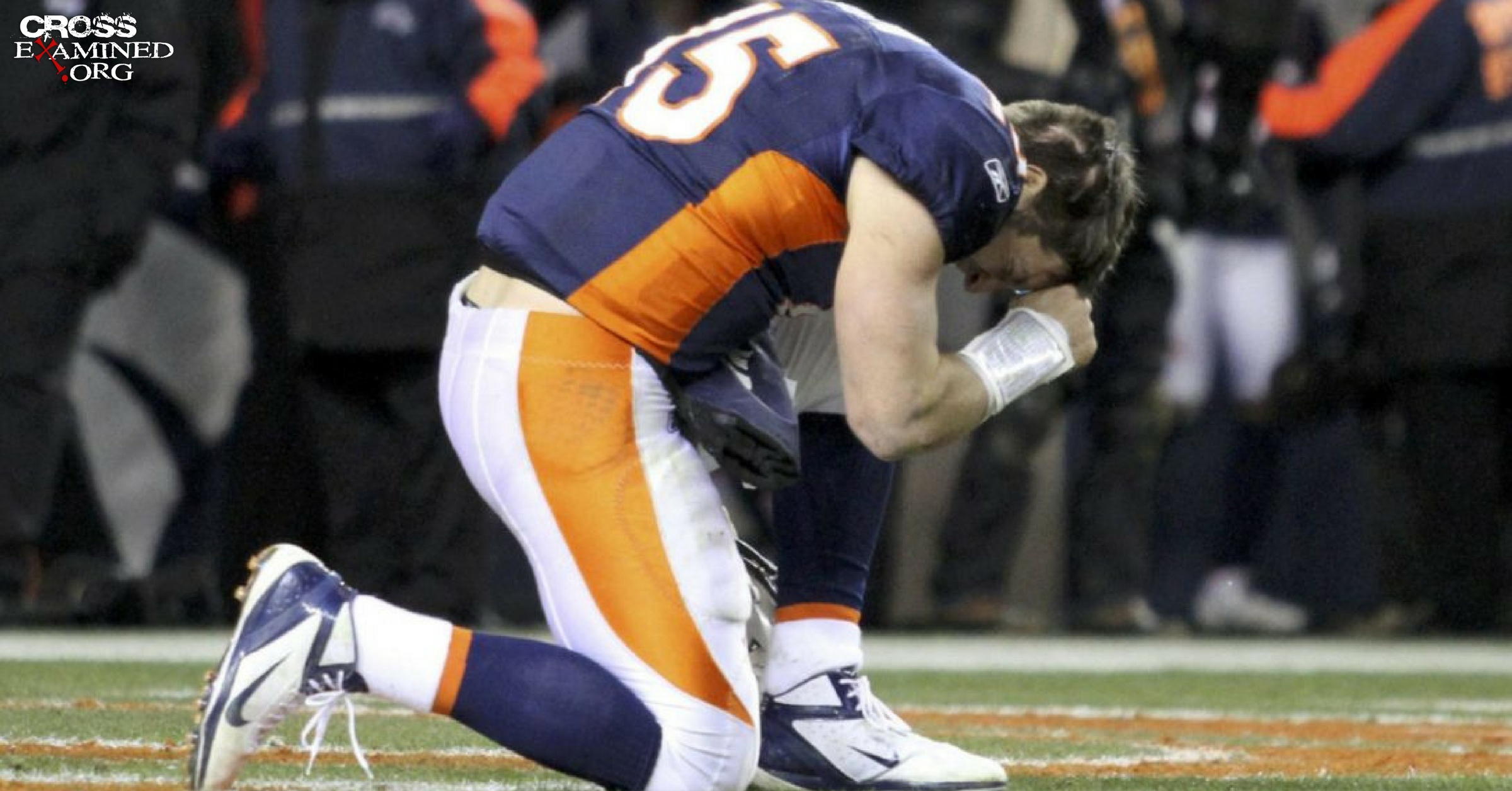
Does Christianity fall into this same category? Some unbelievers, observing the behavior of professional athletes, might believe that superstition is at play. Praying and acknowledging one’s deity, they assume, is a way of seeking to influence the outcome of the contest. For some, it seems like a cheap – and silly – trick.

But this is not what Christian players are doing when they acknowledge God, nor is it what a mature devotion to Christianity would include.

Some non-believers who consider this behavior will ask themselves a very basic question: will becoming a Christian “improve” my life? Is it a ticket to greater wealth and prosperity, better relationships, a future filled with every type of goodness and blessing? For many, this seems too good to be true, but they pursue it hoping for the best; for others, it appears to be a shell game or cheap con, and they reject it without ever considering what it really entails.

The nutshell answer is: probably yes. In most cases for most people, developing a relationship with God in which you accept His gift and then living a life that reflects His will, as best you can achieve it, will improve your life in some important and significant ways. But having a “better” life is a by-product of belief and not the main point of devoting one’s life to Jesus.

If prosperity or other rewards become the main point, Christianity begins to be marketed as a product, a method of achieving some desirable end. A person identifies a need in his or her life and Christianity fills that need, the way any product might do. But this is not the message of Christianity. The Bible is not a “how to” manual on achieving financial or worldly success. It does not promise riches in the here and now, nor an end to all hardship… nor a victory in every football contest. Quite the opposite, in fact, as the early fathers of the church, and their followers could have attested. (Except of course for the football part.)

In short, Christianity tells the story of man’s broken relationship with his Creator. It claims to speak the truth about the nature of God and of this broken relationship and what is needed to fix it. The Old Testament provides the backdrop as God prepares a people to serve as the vehicle for redemption. Jesus comes – not to make my life profitable or more fulfilling in some modern sense or to help me nail down a spot in the Super Bowl- but to fulfill the ancient prophecies, to give His life as ransom for us, and to thereby restoring our relationship with the Father.

Christianity should be assessed on its merits – are its claims true? – not on what it can achieve for you. The Apostle Paul said as much when he said that we are to be pitied as fools if Christ did not rise from the dead. Everything rests on that truth claim. Once we see that Christ did rise, and we place our trust in Him, He will do a work in us and will eventually welcome us into His Kingdom. But Paul himself remained physically afflicted, and there is no reason to believe that by following Christ, our problems will disappear.

We will, however, look at them differently, and by living Biblical values, we will probably have a better life than we might otherwise have had – and certainly a more fulfilling one.


Original Blog Post: http://bit.ly/2ABUIBT


By Evan Minton

The Jewish historian Flavius Josephus was born in A.D 37. In about A.D 90, he wrote his book “Antiquities Of The Jews” in which he writes a history of the Jewish people. In this work, he mentions several individuals who appear in The New Testament such as Jesus, James’, the brother of Jesus, Caiaphas, King Herod the Great, and John The Baptist, among several others. With regards to John The Baptist, Josephus says that King Herod (Antipas) killed him, just as The New Testament does. Josephus writes “Now some of the Jews thought that the destruction of Herod’s army came from God, and was a very just punishment for what he did against John called the Baptist. For Herod had him killed, although he was a good man and had urged the Jews to exert themselves to virtue, both as to justice toward one another and reverence towards God, and having done so join together in washing. …. And when others massed about him, for they were very greatly moved by his words, Herod, who feared that such strong influence over the people might carry to a revolt — for they seemed ready to do anything he should advise — believed it much better to move now than later have it raise a rebellion and engage him in actions he would regret. And so John, out of Herod’s suspiciousness, was sent in chains to Machaerus, the fort previously mentioned, and there put to death; but it was the opinion of the Jews that out of retribution for John God willed the destruction of the army so as to afflict Herod.” (Antiquities 18.5.2 116-119)

Josephus said that the reason Herod killed John The Baptist was that Herod feared that John might lead a rebellion against him, and ergo overthrow him. However, this is not what The Bible says. Read Matthew’s account of John’s death in chapter 14. Matthew says that the reason Herod had John killed was that John was speaking out against Herod Antipas’ marriage because it was unlawful under The Old Testament law. Herodias had divorced her husband and married Herod Antipas. Now, this would have been fine if Herod’s brother had died, but since he was still alive, this was considered adultery. Matthew 14 says that it wasn’t Herod’s idea to have John killed, but that he was instead backed into a corner by promising Herodias’ daughter Salome that if she danced for him, he would give her anything she asked for. She danced, and, at the nudging of her mother, asked for John The Baptist’s head delivered on a platter.

So which is it? Who’s right? Is Josephus right or is Matthew right? Well, we might say; “Well, since The Bible is God’s word, it cannot err. So we must conclude that it was Matthew who is right and Josephus who is wrong”. Of course, this answer won’t suffice for the non-believer who doesn’t believe that The Bible is inspired.

Luke 8, I believe, provides us with the answer. Didn’t you ever wonder how would Matthew have gotten this information in the first place? After all, this happened in the privacy of Herod’s home. None of the disciples were there. Jesus wasn’t there. How did Matthew know what was going on behind closed doors? Luke 8:1-3 says “After this, Jesus traveled about from one town and village to another, proclaiming the good news of the kingdom of God. The Twelve were with him, and also some women who had been cured of evil spirits and diseases: Mary (called Magdalene) from whom seven demons had come out; Joanna the wife of Chuza, the manager of Herod’s household; Susanna; and many others. These women were helping to support them out of their own means.” (emphasis mine)

Luke tells us that one of Jesus’ followers had a family member who was the manager of Herod’s household. This would provide a plausible explanation for how Matthew could have known what was happening at Herod’s birthday party. Chuza told Joanna about this incident, and then Joanna told Jesus and the disciples. Matthew would then have this information to later record in his gospel.

What we can conclude, then, is that Matthew is right because he had better source information than Josephus! Matthew was actually told by someone who had a family member who worked for Herod Antipas why Herod Antipas had John The Baptist killed. Josephus was only speculating on Herod Antipas’ motive based on what appeared to be the case to him.

Now, one may object “But couldn’t Luke have simply made this Joanna person up simply to give us an explanation for how they knew about Herod’s motives?” My answer: No. It’s unlikely that Luke made up Joanna or lied about her husband working for Herod Antipas simply to answer the question of how they knew Herod Antipas’ motive. For one thing, this small detail isn’t mentioned in the context of Herod Antipas’ party. Herod Antipas’ party isn’t even mentioned in Luke 7, 8, or 9. If Luke provided this small detail simply to solve the problem, why didn’t he do it in the context of the party? Moreover, scholars have made good arguments that Luke’s gospel was written sometime in the 50s’ A.D when all of the eyewitnesses were still around and could have corrected Luke if he were making this up. Though it’s beyond the scope of this blog post to get into dating arguments. Thirdly, this is what New Testament scholars Tim and Lydia McGrew would call “Undesigned Coincidences”. An undesigned coincidence is when one gospel says something that raises a question, but another gospel mentions an incidental little detail that answers it. From what I recall, Luke never talks about Herod Antipas’ banquet. Matthew does, but Luke doesn’t. Matthew raised a question (i.e “how would he have known what went on at Antipas’ place?”) but Luke answered it (i.e “One of Jesus’ followers had a husband who was his household manager”).


Evan Minton is a Christian Apologist and blogger at Cerebral Faith (www.cerebralfaith.blogspot.com). He is the author of “Inference To The One True God” and “A Hellacious Doctrine”. He has engaged in several debates which can be viewed on Cerebral Faith’s “My Debates” section. Mr. Minton lives in South Carolina, USA.

Original Blog Source: http://bit.ly/2AOjnEe

By Brian Chilton

Mark Lowry wrote a beautiful song called Mary, Did You Know. The song features questions that Mark would ask Mary if he had the chance. One of the lines inquires, “Mary, did you know . . . that when you kissed your little baby, you’ve kissed the face of God?”. We are in the season of Advent which anticipates the arrival of Christmas. Although the date of Christ’s birth is debated among scholars, Christmas is a time when we celebrate the birth of Christ, no matter the actual date.

Throughout the millennia, Christians have recognized that Jesus is the incarnate Son of God. However, may have sought to dispute the claim, holding that Jesus was merely a good man but not God. Groups like Jehovah Witnesses translate their own versions of Scripture, attempting to write off the divine claims made about Christ. Yet, it is impossible not to see the multiple divine attributes of Jesus throughout the pages of Scripture.

A thorough examination of Scripture indicates that Jesus holds multiple divine attributes normally ascribed to God. At least ten Messianic divine attributes are found in Scripture.[1]

  1. The Messiah holds the divine attribute of life (Jn. 1:4; 14:6).

The divine attribute of life describes the ability to provide life, even eternal life. This kind of life can only be given by one who oneself is eternal.

  • “In him was life, and that life was the light of men” (Jn. 1:4).[2]
  • “Jesus told him, “I am the way, the truth, and the life. No one comes to the Father except through me. If you know me, you will also know my Father. From now on you do know him and have seen him” (Jn. 14:6).
  1. The Messiah holds the divine attribute of self-existence (Jn. 5:26; Heb. 7:16).

This means that Christ was uncreated and exists by himself alone, an attribute that only God could hold.

  • “For just as the Father has life in himself, so also he has granted to the Son to have life in himself” (Jn. 5:26).
  • “. . . who did not become a priest based on a legal regulation about physical descent but based on the power of an indestructible life” (Heb. 7:16).
  1. The Messiah holds the divine attribute of immutability (Heb. 13:8).

Immutability means that one is unchangeable. While finite beings can and do change, a necessary infinite being does not.

  • “Jesus Christ is the same yesterday, today, and forever” (Heb. 13:8).
  1. The Messiah holds the divine attribute of truth (Jn. 14:6; Rev. 3:7).

Titus 1:2 notes that God cannot lie. It is not that God chooses not to lie, but rather that he cannot because it goes against his nature. To claim that God is truth means that God’s essence is sheer truth and possesses no falsehood. Scripture notes that Jesus holds this attribute.

  • “Jesus told him, “I am the way, the truth, and the life. No one comes to the Father except through me. If you know me, you will also know my Father. From now on you do know him and have seen him” (Jn. 14:6).
  • “Write to the angel of the church in Philadelphia: Thus says the Holy One, the true one, the one who has the key of David, who opens and no one will close, and who closes and no one opens” (Rev. 3:7).
  1. The Messiah holds the divine attribute of love (1 Jn. 3:16).

God is understood to be omnibenevolent; that is, all-loving. In God, there is no hate if he can be said to be absolute love. Theologians understand that God’s wrath is rooted in God’s love and his holiness. Scripture notes that Jesus holds the divine attribute of love.

  • “This is how we have come to know love: He laid down his life for us. We should also lay down our lives for our brothers and sisters” (1 Jn. 3:16). See also John 3:16.
  1. The Messiah holds the divine attribute of holiness (Lk. 1:35; Jn. 6:69; Heb. 7:26).

God is absolutely holy. Absolute holiness is an all-encompassing purity, in which no evil is possessed. In other words, God is the absolute good. Scripture claims that Jesus holds this divine attribute of holiness which is necessary if he is to redeem humanity from their sin.

  • “The angel replied to her: “The Holy Spirit will come upon you, and the power of the Most High will overshadow you. Therefore, the holy one to be born will be called the Son of God” (Lk. 1:35).
  • “We have come to believe and know that you are the Holy One of God” (Jn. 6:69).
  • “For this is the kind of high priest we need: holy, innocent, undefiled, separated from sinners, and exalted above the heavens” (Heb. 7:26).
  1. The Messiah holds the divine attribute of eternity as seen in this passage and in Jn. 1:1.

God is understood to be eternal. He has no beginning and no end. The Messiah is said to hold the same eternal attribute.

  • “Bethlehem Ephrathah, you are small among the clans of Judah; one will come from you to be ruler over Israel for me. His origin is from antiquity, from ancient times” (Mic. 5:2).
  • “In the beginning was the Word, and the Word was with God, and the Word was God” (Jn. 1:1).
  1. The Messiah holds the divine attribute of omnipresence (Mt. 28:20; Eph. 1:23).

Omnipresence is the divine ability of God to be everywhere at all times. While Jesus did become monopresent during his time on earth, he is said to have the divine attribute of omnipresence in his eternal state.

  • “And remember, I am with you always, to the end of the age” (Mt. 28:20).
  • “And he subjected everything under his feet and appointed him as head over everything for the church, which is his body, the fullness of the one who fills all things in every way” (Eph. 1:22-23).
  1. The Messiah holds the divine attribute of omniscience (Mt. 9:4; Jn. 2:24, 25; Acts 1:24; 1 Cor. 4:5; Col. 2:3).

Omniscience is the divine attribute of God to know all things. This is an extremely deep concept as God knows all things that could be by his natural knowledge, all things that will be by his free knowledge, and all things that would be by his middle knowledge. Jesus is omniscient.

  • “Perceiving their thoughts, Jesus said, “Why are you thinking evil things in your hearts?” (Mt. 9:4-5).
  • “Jesus, however, would not entrust himself to them, since he knew them all and because he did not need anyone to testify about man; for he himself knew what was in man” (Jn. 2:24-25).
  • Then they prayed, “You, Lord, know everyone’s hearts; show which of these two you have chosen to take the place in this apostolic ministry that Judas left to go where he belongs” (Acts 1:24-25).
  • So don’t judge anything prematurely, before the Lord comes, who will both bring to light what is hidden in darkness and reveal the intentions of the hearts. And then praise will come to each one from God” (1 Cor. 4:5).
  • “In him are hidden all the treasures of wisdom and knowledge” (Col. 2:3).
  1. The Messiah holds the divine attribute of omnipotence (Mt. 28:18; Rev. 1:8).

Omnipotence is the divine attribute of God that indicates God’s complete power. God has complete authority and ultimate strength. Jesus holds the same attribute.

  • “All authority has been given to me in heaven and on earth” (Mt. 28:18).
  • “I am the Alpha and the Omega,” says the Lord God, “the one who is, who was, and who is to come, the Almighty” (Rev. 1:8).

As I have learned from several of my professors at Liberty University, biblical theology must shape our systematic theology. From Scripture, one can clearly see that Jesus is God incarnate. It is unquestionable. That is why I hold that one must accept the divine aspect of Jesus to truly be part of the orthodox Christian faith.

Gary Habermas Explains the High Christology of the Early Historical NT Texts

Lee Strobel on Jesus’s Self-Identification with God

Notes

[1] Many of these references were found in Augustus Hopkins Strong, Systematic Theology (Philadelphia: American Baptist Publication Society, 1907), 309.

[2] Unless otherwise noted, all Scripture comes from the Christian Standard Bible (Nashville: Holman, 2017).


Brian G. Chilton is the founder of BellatorChristi.com and is the host of The Bellator Christi Podcast. He received his Master of Divinity in Theology from Liberty University (with high distinction); his Bachelor of Science in Religious Studies and Philosophy from Gardner-Webb University (with honors); and received certification in Christian Apologetics from Biola University. Brian is currently enrolled in the Ph.D. program in Theology and Apologetics at Liberty University. Brian has been in the ministry for over 15 years and serves as a pastor in northwestern North Carolina.

Original Blog Source: http://bit.ly/2kMBy9n

By Jacobus Erasmus

Question

Dear Dr. Erasmus,

Tim Stratton shared your post, Objections to the Existence of the Soul, to the UK Apologetics and Evangelism Facebook group, of which I am a member. In that group, there is a very knowledgeable Christian who does not seem to believe in the existence of a soul yet says he is not a strict materialist or physicalist. I’m sending you a discussion he had with Lenny Esposito in which Lenny posted about atheism’s weakness regarding the lack of a soul and he took exception to it (click here).

So whilst I am a dualist, I do not know how to respond to his assertions. If you have time, I’d love to hear your thoughts.

Kind regards,

David

Jacobus’s Response

Thank you for the email, David. When trying to come to a conclusion about the existence of the soul, the Christian must explore the issue from three perspectives, namely, from (1) a theological perspective (what does the Bible say about the soul?), (2) a philosophical perspective (are there good philosophical arguments for/against the soul?), and (3) a scientific perspective (what does science say about the mind?).

Now, your friend seems to address the theological perspective only and does not engage with any philosophical arguments in favour of the soul. He also fails to recognise that most philosophers of mind agree that science (or neuroscience) cannot address the physicalism-dualism debate. Since science studies the physical, it cannot, by its nature, disprove the immaterial. Moreover, both the physicalist and the dualist agree that there is a strong correlation between the mind and the brain. Thus, the fact that Alzheimer’s disease affects the mind in no way supports physicalism; a correlation relationship is not an identity relationship.

It seems, then, that Jocelyn is more concerned about whether Scripture teaches that humans have souls. He thinks that the Bible does not teach or imply that we have souls. How does he arrive at this conclusion? Simply by analysing the various meanings of the Hebrew and Greek words for “soul” and “spirit”. The problem with this approach is that is confuses words with concepts. The same concept may be expressed in various ways with various words. For example, the concept of the Trinity is expressed in the Bible even though the Bible does not use the exact words “the Trinity”. Hence, we are not merely interested in the meaning of the word for “spirit” but we are mainly interested in whether the concept of dualism is explicit or implicit in Scripture.

Now, it seems that the concept that human beings comprise both material and immaterial parts (or are made up of matter/body and spirit/soul) is made clear throughout the Bible:

First, souls do exist because God Himself is a soul or spirit and so too are the angelic beings. Thus, the existence of souls is not impossible according to Scripture.

Second, in 1 Samuel 28, Saul instructs a medium to call the deceased Samuel from Sheol so that Saul could talk to him. Interestingly, the medium does as she is told, and Saul speaks with Samuel’s spirit.

Third, Paul believed that we, as human beings, can exist without our bodies. For example, Paul writes:

“So we are always of good courage. We know that while we are at home in the body we are away from the Lord, for we walk by faith, not by sight. Yes, we are of good courage, and we would rather be away from the body and at home with the Lord” (2 Corinthians 5:6-8 ESV).

“…as it is my eager expectation and hope that I will not be at all ashamed, but that with full courage now as always Christ will be honored in my body, whether by life or by death. For to me to live is Christ, and to die is gain. If I am to live in the flesh, that means fruitful labor for me. Yet which I shall choose I cannot tell” (Philippians 1:20-22 ESV).

“I know a man in Christ who fourteen years ago was caught up to the third heaven—whether in the body or out of the body I do not know, God knows. And I know that this man was caught up into paradise—whether in the body or out of the body I do not know, God knows— and he heard things that cannot be told, which man may not utter.” (2 Corinthians 12:2-4)

Fourth, while on the cross, Jesus said to the thief beside him, “Truly, I say to you, today you will be with me in paradise” (Luke 23:43). Jesus could not have meant that the thief’s body was going to be in paradise, since a grave is no paradise. Rather, Jesus must have meant that the theif’s soul/spirit will experience joy once his body dies.

Fifth, the disciples believed that spirits exist because they thought that Jesus was a spirit when they saw him walking on water (Matthew 14:26; Mark 6:49).

Sixth, Jesus distinguished between the body and soul and treated them as two different parts of a human: “And do not fear those who kill the body but cannot kill the soul. Rather fear him who can destroy both soul and body in hell”
(Matthew 10:28).

Finally, Jesus’ human body obviously had a soul/spirit, since it was animated with Jesus’ spirit. Consequently, according to Scripture, a human can comprise both matter/body and soul/spirit.

It is very difficult to align the above passages with monism or physicalism. These passages, I believe, clearly imply the concept of dualism.

Kind regards,

Jacobus Erasmus, Ph.D

Postdoctoral researcher

www.JacobusErasmus.com

https://www.facebook.com/DrJacobusErasmus


Original Blog Source: http://bit.ly/2nJ1x2z


By Evan Minton

1 Peter 3:15 says to “Always be ready to give a defense to anyone who asks you to give a reason for the hope that you have, yet do so with gentleness and respect” and 2 Corinthians 10:5 says “We demolish argument and every pretension that sets itself up against the knowledge of God, and we take every thought captive to make it obedient to Christ.” These two verses are the primary verses that make Christian Apologetics a precedent for the follower of Christ. We are to give the unbelievers reasons to believe Christianity is true and we are to demolish every argument that tries to show it isn’t. However, being a good apologist is more than just knowing the right answers to peoples’ objections and questions, and knowing how to make a case for Christianity. To be a good apologist, you must know more than “If this person says X, then I’ll respond with Y”. Giving a defense to anyone who asks is not like giving the answer to a mathematical equation.

Being a good apologist means being a good communicator, and that involves utilizing certain skills. Not everyone has these skills, but thankfully, if you know what skills you need, you can train yourself in these areas. Now, what are these skills you need?

The Accordion Tactic
You can learn the evidence for The Minimal Facts Case For Jesus’ Resurrection, or the evidence behind the premises of The Kalam Cosmological Argument, and you may even be able to do a good talk on this at your church. But can you relay these arguments in 5 minutes or less? In evangelism encounters, sometimes that’s all the time we have to talk with this person. Or even we do have more time to talk to them, not everyone wants to listen to your monologue for 45 minutes. If you want it to be a dialogue, you need to be able to compress your presentation of the arguments for God’s existence and the resurrection to 5 minutes or less. This skill comes in handy not just in one on one evangelism, but even in internet conversations. With some people, if a comment becomes way too lengthy, they’ll lose interest and comment ‘TL;DR” which means “Too long, didn’t read”.

This isn’t easy. I’ve struggled with brevity my entire apologetics career, but this is a practice that I keep practicing and practicing on. I do believe I’m getting better. With regards to my 6 favorite arguments, I can expand them like an accordion to do a 45-minute talk, or I can compress them to explain an argument to a friend in the time it takes to listen to a song. Compare my treatment of The Kalam Cosmological Argument, Fine-Tuning Argument, Local Fine-Tuning Argument, etc. in my book Inference To The One True God: Why I Believe In Jesus Instead Of Other Gods with my treatment of them in part 6 and part 7of my blog series on the problem of evil. The former is when my apologetic accordion is expanded. The latter is when my apologetic accordion is contracted. Learn this skill of playing the apologetic accordion and you’ll be able to defend the faith no matter how much or how little time you’re allotted. Oh, and, having a monkey wearing a fez isn’t required. Don’t worry about that.

Learn To Listen
At the National Conference On Christian Apologetics, Dr. Ray Civero gave a talk called “Turning Skeptics Into Seekers”. In this talk, one of his points is that we need to listen to what the other person is saying, and we need to listen not merely to respond to the argument, but to understand the argument. Listen to understand, don’t listen to respond. If you’re not paying attention to what the non-Christian is saying regarding his objections to Christianity, you will most likely (1) Attack a straw man in your response, (2) give the unbeliever the impression that you don’t care what he has to say, (3) Give the unbeliever that you just like to listen to yourself talk, and (4) turn him off to anything you have to say. (5) You will be like two ships passing in the night. In other words, you’ll be talking past each other.

Be like Ray Civero’s character Ike The Investigator. Ike doesn’t listen to anticipate. Ike listens to understand. Ike doesn’t listen to his opponent’s position trying to find some way to tear it apart. Ike listens to understand where the other person is coming from, to understand what the other person is actually saying.

Jesus said, “Do unto others as you would have them do unto you” (Luke 6:31). I can’t tell you how often I’ve been frustrated with a non-Christian when I’ve explained something over and over, as clearly and concisely as I possibly could, mustering all of my effort to get them to understand what it was that I was actually saying, just to have them attack a straw man for the umpteenth time in their response to me. For example, there have been conversations where I bent over backwards trying to get the non-Christian to realize that The Minimal Facts Case For Jesus’ Resurrection isn’t question-begging, it doesn’t “cite The Bible to prove The Bible”, but instead treats The New Testament documents like a historian would treat any document claiming to be telling history (e.g A letter written by George Washington, a biography of Abraham Lincoln, Josephus’ writings). Christian and Non-Christian historians alike arrive at the minimal facts by applying the standard historical methodology to the text (e.g the principle of multiple attestation, the principle of embarrassment). It isn’t a circular argument.

Yet, no matter how I strain to get the other person to see the point, they still just don’t get it. If he wants to disagree with my arguments, that’s fine. If he wants to say he doesn’t think the resurrection is the best inference to the minimal facts, that’s fine. I don’t loathe debate, I loathe having to repeat myself and draw a hundred maps with the result of the other person still not understanding the argument. Why don’t they understand the argument? I can only guess that they’re simply skimming my comments. They’re too eager to respond to my comment so they don’t stop and actually try to understand what it is that I’m actually saying.

I think we’ve all been guilty of this at least a few times, Christian and non-Christian alike. However, we need to guard against it. James 1:19 says “Be quick to listen, slow to speak, and slow to become angry.” If we’re to obey the golden rule and James 1:19, and if we’re to have a fruitful dialogue, then we need to be good listeners.

Have The Patience Of A Saint
There are jobs where having a short fuse is a handicap inherent to the job itself: being a cop, being a lawyer, working in retail, and being a Christian Apologist. Because in all of these, you’re going to come against people who will really try your patience. You need to have a pretty long fuse or else you’ll fail the task you’re trying to do.

If you’re going to be a Christian Apologist, you need to have thick skin, because there will be people who ridicule you, demean you, insult you, and slander you. It can be tempting to respond in kind, but The Bible tells us “Always be ready to give a defense to anyone who asks you to give a reason for the hope that you have, yet do so with gentleness and respect” (1 Peter 3:15, emphasis mine). I know of some apologists (won’t name names) who obey the first half of this verse, but not the second. They give a defense for the hope they have alright, but they make total donkeys out of themselves while doing it. If you don’t give a defense with gentleness and respect, you have failed to fully obey 1 Peter 3:15.

2 Timothy 2:24-26 says “The Lord’s servant must not quarrel, but be gentle towards all, able to teach, patient, in gentleness correcting those who oppose him: perhaps God may give them repentance leading to a full knowledge of the truth, and they may recover themselves out of the devil’s snare, having been taken captive by him to his will.”

Conclusion 
These are a few of the most important skills you need to master to be a good Christian Apologist. Simply having the answers is not enough. That would be like saying you can be a police officer if you have a uniform, a badge, and a gun. While those definitely are necessary conditions to being a cop, they are not sufficient conditions. Likewise, being well read in the apologetic literature is a necessary condition to being an apologist, but not a sufficient condition. You need people skills!

Suggested reading:
“The Open Minded Christian: How To Deal Charitably With Fellow Sinners” – by Richard Bushey
“Tactics: A Game Plan For Defending Your Christian Convictions” by Greg Koukl
“Arguing With Friends: Keeping Your Friends And Your Convictions” by Paul Buller


Evan Minton is a Christian Apologist and blogger at Cerebral Faith (www.cerebralfaith.blogspot.com). He is the author of “Inference To The One True God” and “A Hellacious Doctrine”. He has engaged in several debates which can be viewed on Cerebral Faith’s “My Debates” section. Mr. Minton lives in South Carolina, USA.

Original Blog Source: http://bit.ly/2AsAA82

People trying to discover the truth about God would be wise to take a hard look at Jesus before looking anywhere else. While that may sound like a bold assertion in and of itself, it really isn’t when you consider Jesus is the one religious leader who is most frequently mentioned by religious groups, whether or not they happen to be Christian. Every major religious movement considers Jesus to be an important religious figure. Every movement makes some effort to account for His existence and teaching. This ought to give seekers a reason to pause and consider the life of Jesus seriously.

Judaism
While we recognize Judaism pre-existed (and gave birth to) Christianity, Judaism has also had over two-thousand years to consider and respond to the claims of Christ. Much has been written about Jesus from a Jewish perspective, most interestingly by those early Jews who described Jesus in the centuries immediately following His life. Ancient Jewish believers (as recorded by the Talmud and the Toledot Yeshu) described Jesus in the following way:

READ MORE

By Timothy Fox

“The God of the Old Testament is arguably the most unpleasant character in all fiction: jealous and proud of it; a petty, unjust, unforgiving control-freak; a vindictive, bloodthirsty ethnic cleanser; a misogynistic, homophobic, racist, infanticidal, genocidal, filicidal, pestilential, megalomaniacal, sadomasochistic, capriciously malevolent bully.”

– Richard Dawkins, The God Delusion

Christians maintain that God is all-good, all-loving, and the ultimate standard of morality. However, many atheists hold the opposite view of God, evidenced by Dawkins’ infamous rant above. They claim that God is a moral monster who committed or commanded many immoral actions in the Bible, especially in the Old Testament.

The purpose of this series, God Behaving Badly? is to respond to these claims. But before examining any specific instances of God’s supposed immoral behavior, we first need to define what we mean by immoral.

Objective vs. Subjective Morality

For an action to be called immoral, it must be contrary to some moral code. So what is this moral code that the atheist is accusing God of breaking? If it is his own personal opinion on how people should act, then who cares what the atheist thinks? It’s tantamount to him saying “I don’t like what God did in the Old Testament.” Well, so what? That’s your opinion.

This is known as subjective morality, meaning that every person, or group of people, decides for him- or herself what is right or wrong. I have my moral code, you have your moral code, and there’s no way of judging between them. But is that really how morality works? No. There are certain actions that are really right or wrong for everyone. For example, it is truly good to love and care for a little child and it is truly evil to harm and abuse her. This applies to all people at all times. And this is what is known as objective morality.

Grand Moral Authority

But where does this moral code come from and why must we follow it? We know that human laws come from a human authority, like a ruler or government. And an objective moral law that binds every human being across all of the time requires a grand moral authority who rules over everyone and everything: God.

God is the ultimate standard of right and wrong. Behaviors that align with God’s nature or commands are good and actions that contradict them are evil. This is how we determine right and wrong. So for an atheist to accuse someone of performing a truly immoral act, he is actually providing evidence for God’s existence.

Conclusion

To complain that God has committed immoral acts is also to admit there is an objective moral law. But God is the best explanation of objective morality. Therefore, calling certain actions truly immoral actually provides evidence for God’s existence.

However, a skeptic may instead argue that God has done things in the Old Testament that contradict his all-loving, morally perfect nature. Then we must examine the actual act or command and see if God had a morally-admissible reason for it. The one cited most often is the destruction of the Canaanites, which will be the subject of my next article.


This is an edited version of an article that first appeared on The Mentionables blog.

Original Blog Source: http://bit.ly/2AA2dwp

By Al Serrato

In a recent post, I addressed the issue of whether Christ’s death constituted a sacrifice. For many skeptics, Christ’s death, resurrection, and atonement for our sins constitute a major stumbling block. In response to that post, one challenger commented that he could not understand

“why the death of Jesus was that big a deal. He had 6 hours of agony. A terrible way to go, but how many people have similar experiences? And the atheist supposedly bound for hell will experience this kind of agony continually.”

To understand why this challenge lacks substance, one must take a moment to unpack the assumptions embedded within it. The challenger assumes that the process of physical death – more specifically, the manner, length and painfulness of that process – is what “caused” salvation. Noting, correctly, that many human beings have experienced far greater suffering, the skeptic concludes that this sacrifice is not, as he put it, a “big deal.” His conclusion flows from his premise, lending the challenge an appearance of legitimacy, but his premise is in need of more careful examination. Perhaps he has not taken the time to consider actual Christian beliefs, or perhaps he is simply engaging in the straw man fallacy, in which a person intentionally misstates his opponent’s position in order to more easily “defeat” it. Either way, to a careful thinker, the challenge falls flat.

This conclusion should not really come as a surprise. Countless intellectuals have considered the claims of Christianity and have embraced them as true. Many, such as the writer CS Lewis, became believers after many years of committed atheism. That none of these thinkers would find merit in this rather obvious challenge speaks to the fact that he is simply missing the point. None of these believers – nor for that matter the very first followers of Christ – concluded that Jesus won some kind of perverted contest for the “greatest suffering before being murdered,” somehow entitling him to the prize of being “the Savior.”

No, something much different is at play, something that challenges the limits of our philosophy, and of our intellects, to fully grasp. Jesus took the form of man and, during his life on Earth, he emptied himself of key aspects of his divinity. In that form, he experienced temptation – the kind of temptation that demonstrates the existence of free will; the kind of free will that makes expressions of love real and not the product of coercion or control. He did not need to suffer death at all, certainly not death on a cross. He had the means to escape the trap that was being laid for him. But, as he said, no one took his life; he lay it down for his people. By so doing, he stood before the Father to accept that wrath that justice demanded, for the intentional rebellion in which man was engaged. He had no price to pay for himself; his slate was clean before the Father. And because he too was God, he could absorb that wrath not just for one other man, or for a group of men, but for all who ever lived, or would live – infinite power absorbing for all time the infinite wrath of a perfect being.

The challenger to my post concluded:

No—I disagree that God has balanced perfect justice and perfect mercy. Justice is getting what you deserve. Mercy is getting LESS than what you deserve. Take your pick. And you imagine that God has an infinite wrath? Wow—the dude needs some therapy!”

But this actually proves my point. The challenger is correct: in human terms, it appears contradictory for one to be perfectly just while being perfectly merciful; indeed, how can God give those in rebellion what they deserve while also giving them what they don’t deserve? (Ironically, this challenge actually speaks to the divine origin of these early Christian beliefs: who could have – who would have – come up with a system like this if it weren’t true when adhering to it only promised persecution?) To answer this challenge, one must move from abstract considerations to more specific, factual ones.

  • What do humans “deserve?” They deserve punishment for their rebellion;
  • What is a just punishment for rebellion? Separation from God;
  • How long should that separation endure? For the life of the beings in question (i.e. an eternity in that place of separation, i.e. hell);
  • How can humans beings be given something less than they deserve? By having someone else pay the price for their rebellion;
  • Who can pay that price? Only a man who himself does not owe the same price.

Yes, Christ pays the price. We don’t deserve what he does for us; it is an act of mercy. Justice is satisfied because punishment has been meted out – directly to those who refuse Christ’s gift and remain in their rebellion; indirectly – through Jesus – for those who accept his gift. Jesus has the power and the willingness to absorb God’s just wrath, and having lived as a man, he also has the standing before God to enter the transaction. We need only accept his gift, at which point he will begin the process of refining us – perfecting us – so that we can rejoin with Him and with the Father.

This solution to man’s predicament, available freely for all, elegantly gives us the means to attain what we do not deserve – mercy – while not sacrificing God’s perfect justice.


Original Blog Source: http://bit.ly/2BC2Pzj

By

Introduction

A few months ago, an article on Lifehacker with some financial advice caught my attention. In today’s materialistic (financially speaking, not philosophically speaking) society, resentment towards those who spend more than we do is a real problem. Whether the source of the money is hard work, financial responsibility, a gift, a stroke of luck, a “cush” job, credit, something else, or a combination of any number of those things, there is a tendency for these people to be resented by others based upon their choices with money. While this may seem like something that is far removed from any apologetic topic, it really is not. This resentment is a feature of the fallen human condition, and any worldview that claims to be true must be able to explain its existence and have a solution for it, if it really is such a problem in the first place. Lifehacker is definitely not a religious site, and while I do not pretend to know the worldview of the author, generally there is at least an attempt by the authors to answer questions from within the secular worldview. So I was interested to see how the author would attempt to address this issue. I will start with looking at what is offered in the article and provide a practical critique, then I will offer an alternative that has greater explanatory power and practical usage. I would encourage the reader to check out the article before continuing. It can be read here: How to Deal With Resentment When Your Friends Make More Money Than You

What Solutions Did Lifehacker Offer?

While all the ideas in the article are good bandages, they do not address the cause of the problem. Since they do not address the cause, the resentment will return again and again. The solutions offered are good in the sense that they will last temporarily, but they will not fix the problem in the long term.

The first solution offered is to repeatedly “forgive” the other person for their ignorance of the resentful person’s situation. This will get frustrating over time because the resented person is never made aware of how they have “offended” the resentful person and will never be provided the opportunity to change (not that they have actually done anything immoral that requires a change, anyway, so communicating such is likely to be challenged and cause two-way resentment).

The second suggestion is that the resentful person replaces the negative story in their head, about the resented person’s situation and how they can spend more, with a more positive story about that person’s situation. The problem with this is that all that is being suggested is to replace one speculation with another speculation. The author encourages the reader to tell themselves whatever they have to (true or not) to make them feel good about the person they resent rather than feel resentful toward them. Unless the resentful person habitually lies to themselves for practical reasons or is used to believing useful fictions, this will not last long either. A person can only believe something they know to be false for so long before they finally reject it and lose any “benefit” from believing it.

The third idea offered is merely a more systematic way of “keeping up with the Joneses.” The goal is to be able to spend the way the other person does so that the resentful person is their materialistic equal. This too will not fix any issues with resentment for the object of the resentment will just change from the one person, who is now their equal, to the next person who spends even more. The resentment is not removed, it is displaced temporarily only to return and be targeted at another person. Ironically, in this “solution” resentment is self-perpetuating and never-ending.

The failure of all of these solutions indicates the failure of the explanation (worldview) that they are grounded in. Thus an alternative worldview (with a viable solution) is necessary.

What Is The Source?

While the author did not explicitly say that the resentful person is the problem, she did imply it in her focus on changing the person feeling the resentment. While I do believe that she is generally correct about the location of the problem, the specific identification of the problem is incorrect, thus so are the offered solutions based on that incorrect problem (this is how the secular worldview fails the test of practicality).

Temporary vs. Permanent

The author did get very close to the cause by suggesting that the resentful person ask a question of themselves: “What do I have to gain from being resentful.” But that was the wrong question. The right question is “Why am I so resentful?” Interestingly, the answer is universal to all humanity but was not identified by the author because the wrong question was asked. The cause of the problem is a lack of contentment and gratitude. If we learn to be content and grateful for what we have, rather than focusing on what we do not have, we can be satisfied with our own situation and not be constantly comparing it to that of others. Without comparison, resentment has no grounding point.

However, several worldviews would grant that the lack of contentment and gratitude is the source of the problem of resentment. For instance, Christianity, New Age and Eastern worldviews tend to grant this. However, I believe that there is an important distinction that separates Christianity from the rest. While other worldviews can only provide a temporary solution (even to the correctly identified problem), Christianity offers the only permanent solution. But what is it? The Apostle Paul told the Phillippians the missing component (“the secret”): Christ (Phil. 4:11-13).

“I have learned to be content whatever the circumstances. I know what it is to be in need, and I know what it is to have plenty. I have learned the secret of being content in any and every situation, whether well fed or hungry, whether living in plenty or in want. I can do all this through him who gives me strength.”- Philippians 4:11-13 #God #Christ #Bible #Contentment #Money #Struggles #Sky

But how can Christ be the missing component? Being discontent and ungrateful is the natural, default position of the human heart, and the heart cannot change itself, no matter how hard or how long it tries to deny what it is (another useful fiction similar to the one I described above). Thus the temporary effect that will necessarily result, even in other worldviews that accurately identify the problem, is that people will attempt to change their heart apart from something outside themselves that has the causal power to accomplish the change.

Contentment

Paul expounds on this in his letter to the Romans (8:18): when we are focused on Christ, we are focused not on the temporary, physical things of this universe (such as money and things) but on the permanent, eternal life beyond this universe. When we are concerned with what is permanent and everlasting, it is easy to be content with whatever we have that is temporary and finite. It is only the focus on Christ and the everlasting life beyond this universe that He offers to us that will ultimately allow us to overcome materialistic resentment- “I have learned the secret of being content in any and every situation, whether well fed or hungry, whether living in plenty or in want. I can do everything through Him, who gives me strength” (Phil. 4:12b-13). And while we are focused on Christ, He can change our heart.

It is not merely enough to be focused on something outside this universe (such as Nirvana or Moksha in the Eastern worldviews) because our focus will fade and no permanent change can take place. It takes a causal agent, who is also the object of our focus (Christ), to change our heart. Please do not mistake “focus” for an eastern-style “meditation;” the focus I speak of is not just a mental exercise but a complete surrender and dedication of our lives to Jesus Christ.

Gratitude

We also must recognize that “every good and perfect gift comes from the Father” (James 1:17). Giving thanks (gratitude) only makes sense if we have been provided something by someone other than ourselves. It is this second necessary solution to resentment that can only make sense if Christianity is true. God is the source of the temporary and finite things we have been given. So even though money and other temporary things are not our focus, we must still be grateful for them. This removes the focus on a second level- from what we do not have to what we do have. And with our lives surrendered and dedicated to Christ, we are free to search for ways to use what (little or much) God has given us for eternal purposes, not just the temporary purposes of this life. I think that financial guru Dave Ramsey puts it quite succinctly in his popular book “The Total Money Makeover”:

Quote from Dave Ramsey- "Unless you have had a heart-level Total Money Makeover somewhere, sometime in your life, you are still doing something with money to impress others, and that has to change before you can get on a real plan to fiscal fitness. The Bible states, 'Godliness with contentment is great gain' (1 Tim 6:6 NKJV)." #Resentment #Contentment #Gratitude #Money #Finances #Bible

Conclusion

Considering the fact that God has given all people the intuition that resentment is evil (or at least undesirable) and He has given us a mind that can reliably solve problems, it is no surprise that even secular solutions can get some things right. However, they will never be complete without the whole of reality in view. The solution must include Christ. The solution to financial resentment can only take place through a renewed life in Christ. No other worldview can come even close to competing with Christianity’s solution offered to financial resentment. If you are struggling with financial resentment and are tired of struggling to rely on yourself to fix a problem you, as a human, do not have the ability to fix, Jesus is the only hope for a solution to your problem. He extends the invitation: “Come to me, all you who are weary and heavy laden, and I will give you rest” (Matt 11:28).


Original Blog Source: http://bit.ly/2qwSQHi

By Jacobus Erasmus

In a recent blog post, Professor Keith Parsons offers three reasons for why (he thinks) the soul does not exist. (You might recall that Parsons debated William Lane Craig in 1998). Since Parsons’ objections to substance dualism (for simplicity, I will hereafter refer to substance dualism simply as ‘dualism’) seem rather common among lay atheists, his objections are worth evaluating. Let us, then, evaluate Parsons’ blog post.

The Burden of Proof

Before offering his three objections to dualism, Parsons argues that the burden of proof falls on the dualist. According to Parsons, the non-dualist (i.e, the person who believes the soul does not exist, such as the physicalist or property dualist) does not have to defend their position because ‘the burden of proof falls entirely on those who support the existence of spiritual souls.’ Why does Parsons think this? Well, for two reasons. First, he argues that, since the brain can perform mental functions, one’s default position should be to assume that souls do not exist. He writes,

Well, first, let us consider what, I presume, is known to everyone: We know that certain configurations of matter–those configurations we refer to as ‘human beings,’ for instance–are capable of performing mental functions. They think, feel, perceive, imagine, desire, will, believe, and so forth. If, then, certain configurations of matter can perform mental functions and possess mental properties, the parsimonious, spontaneous, and natural assumption would be that matter, when organized in suitable ways, can perform mental functions and possess mental properties.

It seems perverse to make the opposite assumption, namely that material beings cannot think, and that therefore their mental functions and properties must be due to the operation of something non-physical, a soul perhaps. … Therefore, the burden of proof should be on those who say that matter is incapable of mental functions or of possessing mental properties, and that these must instead be due to something non-material.There are several problems with this argument. In the first place, Parsons first assumes non-dualism in order to argue that one should first assume non-dualism, and this is viciously circular (I use the term ‘non-dualism’ as an umbrella term to refer to all views that claim that the soul does not exist, such as physicalism, materialism, and property dualism). When Parsons claims that it is the brain that can ‘think, feel, perceive, … and possess mental properties’, he is simply describing non-dualism. Dualism, on the other hand, states that it is the soul (or the immaterial mind or self), and not the brain, that feels, perceives, has mental properties, etc. Thus, Parsons first assumes non-dualism, and then he concludes on the basis of this assumption that one should first assume non-dualism (what a messy argument!)In the second place, it is simply false that everyone ‘knows’ that brains can feel, believe, have mental properties, etc. What everyone seems to know is that there is a correlation between one’s brain and one’s mental life. For example, when one recalls a memory, electrical activity occurs in certain regions of the brain. However, this correlation relation is different to an identity relation; that the brain correlates to the mind does not imply that the brain just is the mind. Furthermore, I have a deep intuition that I am not just physical stuff, that I am more than my body, that my mind is not identical to my brain. Most people I have spoken to share this intuition. Hence, contra Parsons, not everybody thinks (or ‘knows’) that non-dualism is true. Indeed, if dualism seems intuitive to most people, then dualism should be the default starting position.

Parsons’ second reason for why the burden of proof falls on the dualist is that neuroscience (supposedly) presupposes the following principle:

  • The brain is sufficient for all mental activity.

Parsons explains,

The second reason for putting the burden of proof on the soul-theorist is that, surely, by now, the heuristic assumptions of neuroscience have gained some degree of authority. As I mentioned earlier, a regulative assumption of all the sciences that study mind and brain is that the brain is sufficient for all mental activity. … When a program of inquiry has produced hard, reproducible, and important results, as has neuroscience, then this would warrant prima facie acceptance of the heuristic principles that have guided such research. The burden of proof should therefore fall on those who reject the assumption of the sufficiency of the brain and instead invoke non-physical entities.

Unfortunately, Parsons’ argument above is misleading. To make such a bold claim as ‘neuroscience presupposes (A)’, one must provide some evidence for the claim. Parsons does not do this. He does not reference any neuroscientist that explicitly states that (A) is the heuristic principle of neuroscience. Nor does he reference any study that supports his argument above. Nor does Parsons interact with the recent scholarly work that shows that Parsons has got it completely wrong. For example, in their recent paper titled ‘Neuroscience: Dualism in Disguise’, Riccardo Manzotti and Paolo Moderato (2014) persuasively argue ‘that most of current neuroscientists, contrary to often-heralded physicalist credo, embrace dualism … [and, furthermore] that the implicit assumptions adopted by most neuroscientists invariably lead to some sort of dualistic framework’ (Manzotti and Moderato, 2014:81). Contra Parsons, most neuroscientists assume dualism and, thus, according to Parsons’ argument, the burden of proof should fall, not on the dualist, but on the non-dualist.

Therefore, Parsons’ two arguments above fail. It should be noted, moreover, that when it comes to a controversial topic (such as free will, the nature of time, the mind-body problem) the burden of proof falls on those on both sides of the debate. I take this to be obvious, and it would be disingenuous to deny this. Furthermore, I find it odd that Parsons first argues that he, as a non-dualist, does not need to argue for non-dualism, and then goes on to argue for non-dualism. One would expect Parsons to engage instead with the arguments for dualism, which he does not do. This gives the impression that Parsons does not really believe that the burden of proof falls completely on the dualist. Let’s turn now to Parsons’ three objections to dualism.

Objection 1: The Interaction Problem

Parsons’ first move against dualism is to appeal to the interaction problem, which states that it is difficult to see how a non-physical, immaterial entity, such as a soul, can causally interact with a physical entity, such as a brain. Now, Parsons does not describe the interaction problem in any detail. Nevertheless, the interaction problem usually runs similar to the following:

(A1) A soul can interact with a body only if the interaction is in virtue of the transference of motion from the soul to the body.
(A2) Transference of motion from a soul to a body is impossible (because a soul does not have motion).
(A3) Therefore, a soul cannot interact with a body.

The idea behind (A1) is that, in order for some entity A to causally interact with some physical entity B, a transference of motion from A to B must occur through, for example, collision or impact. Now, many philosophers, such as Jonathan Barnes, Joshua Hoffman, and Gary Rosenkrantz, have noted that (A1) presupposes the following erroneous principle:

(A4) For any two objects A and B and some property F, if A causes B to be F, then A is F.

According to (A4), if a soul causes a body to be in motion, then the soul must be in motion. It is, thus, easy to see why (A1) presupposes (A4). Unfortunately, (A4) is demonstrably false. A lump of clay, for example, can be caused to be square by a non-square object, such as a hand or a rolling pin. Or consider the Law of Gravity, according to which two pieces of matter can accelerate toward each other (or gain motion) without motion being transferred from one to the other. Hence, since (A4) is false, (A1) is false.

What does Parsons have to say in response to the above mentioned philosophers? Not much. Parsons concedes that there are (or may be) causal relations in the physical universe that are inexplicable brute facts. However, he argues that

the brute facts of physical theory may be there, but they are down very deep. With soul-theory, the incomprehensibility is right up front and on top. … It matters where you put your brute facts.

This response does not deal with the central issue about (A1) or (A4). In fact, this response is nothing more than an unjustified assertion. Parsons is essentially stating (without defending) the following argument:

(B1) A brute fact that lies at the end of a very long chain of deeply satisfactory explanations is acceptable.
(B2) If soul-body interaction is a brute fact, it does not lie at the end of a very long chain of deeply satisfactory explanations.
(B3) Therefore, it is unacceptable to claim that soul-body interaction is a brute fact.

As noted above, Parsons simply states these premises without defending them. But why, exactly, should it matter where a brute fact is situated in a chain of explanations? And why, if soul-body interaction is a brute fact, would it not be situated at the end of a long chain of satisfactory explanations? Surely such interaction would take place at a very fundamental (perhaps even quantum) level of physical reality, with the chain of explanations running up to a higher level, such as the brain itself. And why think that soul-body interaction must be a brute fact? Parsons does not interact with the dualistic arguments that try explain soul-body interaction (e.g., some argue that both the soul and brain have the property of being (or being able to be) conscious, and soul-body interaction occurs, not as a brute fact, but in virtue of the transference of consciousness from the soul to the brain). Thus, since Parsons does not defend his assertions, it is difficult to see why we should affirm the assertions. Parsons’ first objection to dualism, then, has little (if any) force.

Objection 2: The Self is Not Simple

Parsons’ second objection is that, since dualism entails that the self is a simple substance, and since the self is not a simple substance, dualism is false. In this entire section, Parsons uses the term ‘self’ in different senses: he uses the term at times to denote an immaterial, simple substance, and at other times to denote a person’s traits, abilities, and experiences. Thus, Parsons commits the (sneaky) fallacy of equivocation. Let me explain.

Parsons begins his second objection by claiming,

Soul-theory holds that your soul is you. That is, from the moment you acquire a soul (this bit is murky), that soul is your essential self, and it remains you throughout your life—and after. The soul is therefore a simple, spiritual essence, an abiding self that remains a unified whole throughout the vagaries of your mental being as you go through all the stages of life.

Here Parsons is referring to the fact that dualism entails that the soul is a non-spatial substance that has mental properties. When the dualist claims that the soul is a simple substance, he/she means that the soul is not composed of parts, even though the soul can have properties, traits, abilities, and experiences. Parsons, then, is here using the term ‘self’ to mean ‘non-spatial substance that has mental properties’.

Parsons then goes on to use the term ‘self’ to refer to a set of connected mental properties and personal characteristics that change over time. He writes,

[W]hat I call my ‘self’ seems to be, first, a nexus of fleeting thoughts, feelings, and perceptions. … Then there is my ‘true’ or ‘real’ self, those values, beliefs, and desires that are deep and longstanding and with which I identify. … Then there are certain long-term personality traits that you might carry your whole life. … Further, the self clearly seems to change over time.

We can plainly see that Parsons’ second usage of ‘self’ differs from his first usage. A mind as a simple substance is not identical to the set of properties it has; a mind can be a simple entity (i.e. have no parts) and yet have a complex set of properties that change over time. Nevertheless, Parsons then concludes,

The above considerations point to an even deeper problem. The self is anything but a thing. As noted, the self is defined in complex terms of our experiences, character, propensities, abilities, personalities, narratives, and so forth.

Our discussion above reveals that this conclusion of Parsons’ does not follow from the fact that dualism entails that the soul is a simple substance. After all, a set of mental properties (including experiences, mental abilities, traits, etc.) cannot exist on its own but, rather, something has to posses the set. And that something, claims the dualist, is a non-physical, simple substance. Since Parsons’ second objection commits the fallacy of equivocation, his objection is unsound.

Objection 3: Do Animals Have Souls?

As a final objection to dualism, Parsons asks, ‘If souls are necessary for mental operations, what about the mental operations of animals?’ His point here is this:

Where do we drive the golden spike indicating that from this point brains are insufficient? How do we give a principled and non-arbitrary answer? If no such principled answer is possible, and I submit that none is, the whole rationale for a soul seems to disappear.

Parsons seems to be expecting the dualist to claim that a non-human animal lacks a soul, to which he will respond, ‘Huh! Animals have a mental life and this proves that souls are unnecessary to explain mental life”. Now, I cannot speak for all types of dualists, but Christians have traditionally held that all animals have souls, albeit more primitive souls than humans. One reason for this is that the Bible uses the same term for ‘soul’ or ‘spirit’ when talking about the life of animals in Genesis 1:30, Ecclesiastes 3:21, and Revelation 8:9.

Of course, there can be different levels of souls or degrees of consciousness (God is a more powerful soul than a human soul). Hence, as we move down the animal chain, from apes to insects, we see less and less mental capabilities and degrees of consciousness. The degree of consciousness a dog has, for example, is clearly more than that of a spider. Nevertheless, all living organisms defined as animals have souls and, thus, there is no point at which to ‘drive the golden spike’ (this is why many Christians believe it is plausible that God will resurrect non-human animals with their souls when He creates the new earth). However, the difference between a human soul and a non-human soul is that, unlike the latter, the former is created in God’s image and has a much richer structure. Therefore, I don’t think the Christian dualist faces the difficulty that Parsons perceives.

Conclusion

However interesting, Parsons’ objections to dualism remain unsuccessful. Unfortunately, it does not help his case that he fails to interact with the many arguments in favour of the soul put forward by dualists. But perhaps in a follow up post he will interact with these arguments, in which case we will, once again, be happy to evaluate his interaction.

Resource

Manzotti, R., Moderato, P., 2014. “Neuroscience: Dualism in disguise”. In: Lavazza, A., Robinson, H. (Eds.), Contemporary Dualism: A Defense. Routledge, New York, pp. 81–97.