
Genderbread Person Part 3: Biological Sex
Nothing summarizes our discussion more today than the famous scene from Kindergarten Cop where a little boy respectfully raises his hand to speak and waits to be called upon. His words of wisdom for the class that he so ardently and patiently waited to share? “Boys have a penis. Girls have a vagina.”
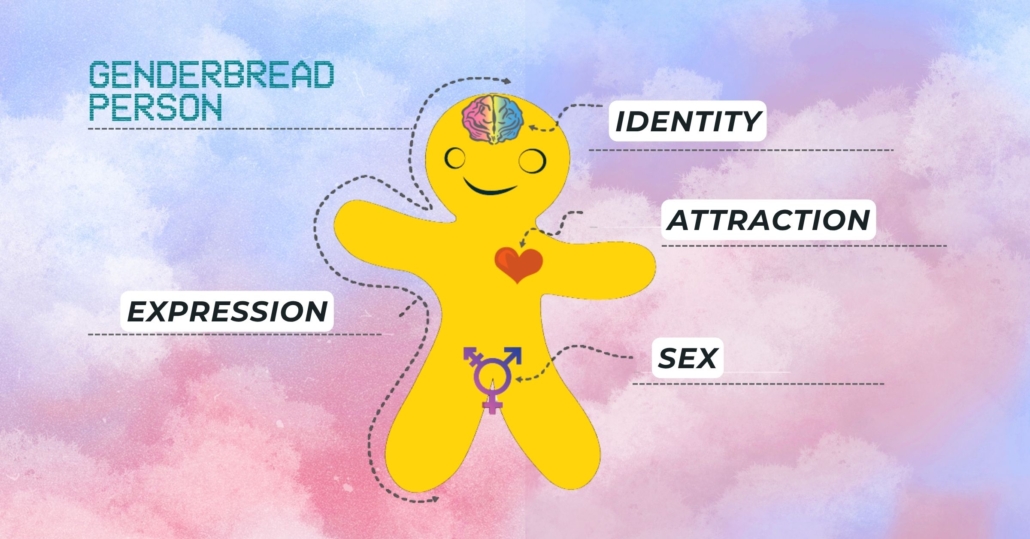
In 1990, this was considered so obvious that it was part of the joke. Fast forward thirty years, and a statement like this could now be prosecuted as hate speech. According to the genderbread person curriculum image, the simple definition of biological sex is:
“. . . the physical traits you are born with or develop that we think of as ‘sex characteristics,’ as well as the sex you are assigned at birth.”
Let’s break this statement down.
Perception or reality?
Within this definition, it is all a matter of perception. The physical traits are those that we think of as “sex characteristics”–not those that objectively correspond to biological sex. Notice this shift in language—it has taken a literal, physiological, scientifically testable statement and reduced it to a perception. If we were to give a drop of blood to a technician and ask them what “sex characteristics” the subject naturally possessed, they could probably get it right 99.999% of the time. [1] The genderbread person’s shift in language—from biological sex being absolute to being subjective—is something that we need to make our kids aware of. (To better understand the concept of objective vs subjective, see the Mama Bear Apologetics book chapter 8).
What exactly do they mean by ‘the sex you were assigned at birth?’ Was there someone flipping a coin? Share on X
Along these same lines, the genderbread curriculum defines biological sex as the “sex that you are assigned at birth,” as if the doctor just flipped a coin and slapped a label on you as male or female. I don’t want to oversimplify this, but this really is a simple concept. For millennia, unless a baby was born with a genetic abnormality (which does happen) assigning a sex was as simple as looking at their nether regions. Unless there is some sort of abnormality, this method of assigning biological sex has, historically, been extremely reliable.
But before we accuse the curriculum of only looking at body parts, I do applaud it for being more comprehensive than the kid in Kindergarten Cop.
“Let’s consider biological sex in the ultra-reductive way society does: being female means having a vagina, ovaries, two X chromosomes, predominant estrogen, and the ability to grow a baby in your abdominal area; being male means having testes, a penis, an XY chromosome configuration, predominant testosterone, and the ability to put a baby in a female’s abdominal area; and being intersex can be any combination of what I just described. . . In reality, biological sex, like gender identity and expression, for most folks, is more nuanced than that.” (emphasis mine)[2]
Is this really ultra reductive?
In some ways, yes. Being female doesn’t necessarily mean that you have these things—like ovaries. There are plenty of women who have either had hysterectomies or cancer that required the removal of the uterus and ovaries. They are no less female than a woman with ovaries and uterus. If I were to tweak this statement to be more accurate, I’d say that “a person possesses the genetic programming for these things, and unless abnormalities or tampering occur, will manifest these characteristics.” It pains me that we have to get this specific, but part of (successfully) engaging in the cultural battle means that we have to use words that cannot be refuted. We must take objective arguments and create objectively true statements. Otherwise, we will haggle forever about nuances, technicalities, and perceptions.
So, what about intersex individuals? Is that the same thing as transgender?
This is a common misconception. Intersex and transgender are not the same thing. Intersex is not based on a person’s perception. Intersex occurs when there is a genetic or physical abnormality in a person’s sexual characteristics. For example, in the 50’s and 60’s, there was a revolutionary new anti-nausea medicine called thalidomide that supposedly helped with morning sickness. Sounds great, right? Until the babies started being born with what used to be called hermaphroditism. Hermaphrodites simultaneously exhibit a modified version of male and female sex organs. They often have underdeveloped versions of both a penis and vagina with a chaotic blend of hormones. I often think about these individuals every time I mark “female” on a survey. I can’t imagine how truly confusing and frustrating that one little question must be for this group every time they fill out a form. This group has a real, legitimate difficulty in that they are truly intersex.
It should be noted that this particular group, the one group that has a legitimate reason to question their sex, is not the group that is championing a redefinition of sex outside of the binary of male and female. According to the Intersex Society of North America’s FAQS page,
“We are trying to make the world a safe place for intersex kids, and we don’t think labeling them with a [third] gender category that in essence doesn’t exist would help them.”
I don’t have quite enough research on all the details of intersex individuals to go more fully into this condition, but please know that this condition is real, confusing, and individuals who were born with it cannot be lumped into the same category as the rest of the LGBTQ+ camp. You can see a list of known sex chromosome abnormalities here.
There is a world of difference between intersex and transgender. Share on X
So how do we prevent our kids from buying into the propaganda?
- Affirm that “truth is that which corresponds to reality” – This is a very simple definition of truth that has proved trustworthy time and again. Ask your kids what happens if they get wrong directions to their friend’s birthday party? Answer: They won’t end up at their friend’s birthday party. The directions didn’t correspond to reality. What about accidentally eating something that they are allergic to? Did the fact that they didn’t perceive an allergen change the results? No. Break out the EpiPen, because truth corresponds to reality. There is an objectively true aspect of sex. There are XX (girls) and (XY) boys. And our perceptions will not change this fact. However. . .
- [Editor’s Note: In later writings from the author, Hillary clarifies that biological sex can be understood by answering this question: If this person’s body was healthy, what kind of reproductive cell would it produce – sperm or egg? If it’s sperm, that’s a male. If it’s eggs, that’s a female. Sexually dimorphic biology has only ever generated two kinds of sex cells in humans; and while XX and XY are strong correlates with egg production and sperm production, respectively, there are many other physiological features that indicate what kind of reproductive cell one produces – including genitals, hip and pelvic size and position, average bone density, relative muscle mass, Adam’s apple, jawline, facial hair, breasts, and more]
- While Abnormalities exist, they do not get to redefine normal – There are a variety of genetic abnormalities that can render the simple XX/XY definition of biological sex more confusing, as discussed above about intersex individuals. We need to be aware that those situations are different than “gender dysphoria” (i.e., thinking that you were born in the wrong body and must change the sexual characteristics of your body to match your internal reality.) There truly is something biological going on with intersex, and especially hermaphroditic individuals. That being said though, abnormalities cannot redefine normal. Otherwise, there is no such thing as “normal.” Science (and especially medicine) as we know it cannot progress without a concept of “normal.” For example, there are some people who are born with 6 fingers, but we will never see textbooks redefining human hands as having anywhere from 5-6 digits. Normal human hands have 5 digits. And abnormalities do not make a person “less than” any more than my bum kidney makes me less than other people. It gives me challenges, but it is not my identity.
- Use the word atypical instead of abnormal – I know I just got done discussing this using the word abnormal, but for kids, atypical might be a better description since many kids automatically assume that “abnormal” means you’re weird. Nobody wants to be abnormal. The word abnormal just means something that deviates from the norm. Like me, I have an “abnormal” kidney, but that doesn’t make me weird. (I’m weird for a whole lot of other reasons). We adults can use this term amongst ourselves, knowing that it is descriptive of “that which exists outside of the normal range.” But yeah, let’s leave that word out when discussing with the kiddos. Kids can be really mean, so let’s not give them ammunition.
- Affirm that they can use the reality of their own bodies to define the truth about their gender – As Nancy Pearcey notes in her book Love Thy Body, “Biology is more than a bit of flesh between the legs.” In a popular TED talk, cardiologist Paula Johnson says, “Every cell has a sex—and what that means is that men and women are different down to the cellular and molecular level. It means that we’re different across all of our organs, from our brains to our hearts, our lungs, our joints.”[3] In other words, no matter what your gender philosophy may be, when you are ill and the doctors put you on the operating table, they still need to know your original biological sex in order to give you the best possible health care.
No matter your gender philosophy, when the doctors put you on the operating table, they still need to know your biological sex in order to give you the best possible health care. Share on X
Stated another way in the Mama Bear Apologetics book, “When our society messes with the definition of truth, it is messing with our kids’ very foundation of reality. If our children no longer feel comfortable using reality as their arbiter of truth, they will be insecure and timid about having any convictions whatsoever.” Our physical bodies are an objective reality. If kids can’t even use their bodies to tell them who they are, how can we expect them to understand themselves in any meaningful, nontransient way? We can’t. Life becomes an ever-shifting reality which can’t be pinned down by anything. That, friends, is a really confusing worldview to expect our kids to live in.
If our children no longer feel comfortable using reality as their arbiter of truth, they will be insecure and timid about having any convictions whatsoever. Share on X
References:
[1] There’s always the possibility of a genetic abnormality or bad technician.
[2] Sam Killermann, A Guide to Gender: The Social Justice Advocate’s Handbook, 2d. ed. (Austin, TX: Impetus Books, 2017), 74.
[3] Hillary Morgan Ferrer, gen. ed., Mama Bear Apologetics: Empowering Your Kids to Challenge Cultural Lies (Eugene, OR: Harvest House, 2019), pg. 70.
Recommended Resources:
Correct not Politically Correct: About Same-Sex Marriage and Transgenderism by Frank Turek (Book, MP4) Stealing From God by Dr. Frank Turek (Book, 10-Part DVD Set, STUDENT Study Guide, TEACHER Study Guide)
Is Morality Absolute or Relative? by Dr. Frank Turek Mp3 and Mp4
Legislating Morality (mp4 download), (MP3 Set), (PowerPoint download), and (PowerPoint CD) by Frank Turek
Does Jesus Trump Your Politics by Dr. Frank Turek (mp4 download)
Hillary Morgan Ferrer is the founder and President of Mama Bear Apologetics. She feels a burden for providing accessible apologetics resources for busy moms. She is the chief author and editor of the bestselling books Mama Bear Apologetics: Empowering Your Kids to Challenge Cultural Lies,Mama Bear Apologetics Guide to Sexuality: Empowering Your Kids to Understand and Live Out God’s Design, and the soon to be released Honest Prayers for Mama Bears. Hillary has her master’s degree in biology and loves helping moms to discern truths and lies in both science and culture. She and her husband, John, have been married for 16 years and minister together as an apologetics team. She can never sneak up on anybody because of her chronic hiccups, which you can hear occasionally on the podcast and in interviews.
Originally posted at: https://mamabearapologetics.com/genderbread-pt-3-bio-sex/