Tag Archive for: Worldviews


What is a worldview, and how does it shape everything you believe and do? This week, Dr. Brady Blevins, Senior Apologist at Watchman Fellowship, joins Frank to talk about his brand new course, ‘Conversations with the Faiths: Worldviews‘, which explores the four major groups of worldviews and equips Christians to evangelize those caught in false ideologies and protect Christian churches against modern heresy. In this episode, Frank and Brady will tackle questions like:

  • What are the four major worldviews and why is understanding their differences so important?
  • What’s the best approach when someone in your life adopts a worldview that isn’t true?
  • Which worldview is taking the lead in our culture today?
  • How do cults and movements like Word of Faith, NAR (the New Apostolic Reformation), and Progressive Christianity subtly twist Scripture and infiltrate the Church?
  • What are the main characteristics of a cult and how do the four functions of math help us spot cults and other false worldviews?
  • What is a great parenting tool that can help kids become more discerning without sounding preachy?

Frank and Brady also examine how some of today’s most popular teachings deviate from biblical Christianity and you’ll hear real-world examples of false teachers and movements that are shaping minds inside and outside the Church. If you want to be equipped to defend truth and help others find it, be sure to check out Brady’s new course: ‘Conversations with the Faiths: Worldviews‘!

If you enjoyed this podcast episode PLEASE HELP US SPREAD THE TRUTH OF CHRISTIANITY BY SUPPORTING OUR MINISTRY HERE. 100% of your donation goes to ministry, 0% to buildings!

Resources mentioned during the episode:

Brady’s website: Watchman Fellowship

Brady’s course: Conversations with the Faiths: Worldviews

Brave Books: BraveBooks.us


Download Transcript


By Mikel del Rosario

You’ve got a worldview. Everyone does.

What’s a worldview? It’s everything you believe about what’s real and what really matters in life. Ronald Nash defines it like this in his book, Worldviews In Conflict:

A worldview is a set of presuppositions (or assumptions) which we hold (either consciously or subconsciously) about the basic makeup of our world.

J.P. Moreland observed that there are three major worldviews dominating the debate in our culture today. Here’s a quick rundown of America’s top three:

  1. Historic Christianity

This is the main version of something called ethical monotheism. This is the idea that God’s real; that God created us and gave us a real moral law. And all people everywhere are obligated to obey the moral law—whether they want to or not. Some things, like loving your parents, are really good. Other things, like hurting a little girl for no reason, are really wrong.

The next two represent the major movements of the opposite camp.

  1. Scientific Naturalism

What’s this? Think X-Men. No matter how out there something might seem (like bending metal just by thinking about it), absolutely everything can be boiled down to physical processes (like a genetic mutation). This view says only the physical world is real. You’re pretty much just your brain. And everything you do is just the result of things like your genetics and how you were raised.

Another key idea: Science is the only way we know things. If you can’t measure something in a lab or use science to prove it, you can’t know it. So you can say you know Advil will help with your headache. But you can’t say you actually know God exists.

  1. Postmodern Relativism

For this one, think Oprah. All truth and reality is relative to you or your community: “That’s true for you but not for me.” It’s supposed to be a feel-good, politically correct worldview where no one’s perspective is ever wrong about anything—especially when it comes to spiritual things (unless you happen to think Christianity is actually true).

Another key idea is words don’t really mean anything. You decide what words mean to you. For example, it doesn’t matter if this post is about worldviews. Maybe to you, this article means I’m giving away iPads to everyone who shares this post on Facebook! I’m not.

Really, I’m not.

These two worldviews agree you can’t know things about stuff you can’t see, touch, taste, hear or smell. This directly challenges historic Christianity which teaches that we can know the truth (John 8:32). J.P. Moreland says: “We are in a struggle for the hearts and minds of the American people against scientific naturalism and postmodern relativism…Our religion is a religion that is based on knowledge.”

So, there you have it. The top three worldviews shaping American culture: Christianity, Naturalism, and Postmodernism. Which one most shapes your views?


Mikel is a Ph.D. student in New Testament Studies at Dallas Theological Seminary, Cultural Engagement Manager at the Hendricks Center, and Adjunct Professor of Apologetics and World Religion at William Jessup University. 

Original Blog Source: http://bit.ly/2LW1rvx

By

Introduction

A few months ago, an article on Lifehacker with some financial advice caught my attention. In today’s materialistic (financially speaking, not philosophically speaking) society, resentment towards those who spend more than we do is a real problem. Whether the source of the money is hard work, financial responsibility, a gift, a stroke of luck, a “cush” job, credit, something else, or a combination of any number of those things, there is a tendency for these people to be resented by others based upon their choices with money. While this may seem like something that is far removed from any apologetic topic, it really is not. This resentment is a feature of the fallen human condition, and any worldview that claims to be true must be able to explain its existence and have a solution for it, if it really is such a problem in the first place. Lifehacker is definitely not a religious site, and while I do not pretend to know the worldview of the author, generally there is at least an attempt by the authors to answer questions from within the secular worldview. So I was interested to see how the author would attempt to address this issue. I will start with looking at what is offered in the article and provide a practical critique, then I will offer an alternative that has greater explanatory power and practical usage. I would encourage the reader to check out the article before continuing. It can be read here: How to Deal With Resentment When Your Friends Make More Money Than You

What Solutions Did Lifehacker Offer?

While all the ideas in the article are good bandages, they do not address the cause of the problem. Since they do not address the cause, the resentment will return again and again. The solutions offered are good in the sense that they will last temporarily, but they will not fix the problem in the long term.

The first solution offered is to repeatedly “forgive” the other person for their ignorance of the resentful person’s situation. This will get frustrating over time because the resented person is never made aware of how they have “offended” the resentful person and will never be provided the opportunity to change (not that they have actually done anything immoral that requires a change, anyway, so communicating such is likely to be challenged and cause two-way resentment).

The second suggestion is that the resentful person replaces the negative story in their head, about the resented person’s situation and how they can spend more, with a more positive story about that person’s situation. The problem with this is that all that is being suggested is to replace one speculation with another speculation. The author encourages the reader to tell themselves whatever they have to (true or not) to make them feel good about the person they resent rather than feel resentful toward them. Unless the resentful person habitually lies to themselves for practical reasons or is used to believing useful fictions, this will not last long either. A person can only believe something they know to be false for so long before they finally reject it and lose any “benefit” from believing it.

The third idea offered is merely a more systematic way of “keeping up with the Joneses.” The goal is to be able to spend the way the other person does so that the resentful person is their materialistic equal. This too will not fix any issues with resentment for the object of the resentment will just change from the one person, who is now their equal, to the next person who spends even more. The resentment is not removed, it is displaced temporarily only to return and be targeted at another person. Ironically, in this “solution” resentment is self-perpetuating and never-ending.

The failure of all of these solutions indicates the failure of the explanation (worldview) that they are grounded in. Thus an alternative worldview (with a viable solution) is necessary.

What Is The Source?

While the author did not explicitly say that the resentful person is the problem, she did imply it in her focus on changing the person feeling the resentment. While I do believe that she is generally correct about the location of the problem, the specific identification of the problem is incorrect, thus so are the offered solutions based on that incorrect problem (this is how the secular worldview fails the test of practicality).

Temporary vs. Permanent

The author did get very close to the cause by suggesting that the resentful person ask a question of themselves: “What do I have to gain from being resentful.” But that was the wrong question. The right question is “Why am I so resentful?” Interestingly, the answer is universal to all humanity but was not identified by the author because the wrong question was asked. The cause of the problem is a lack of contentment and gratitude. If we learn to be content and grateful for what we have, rather than focusing on what we do not have, we can be satisfied with our own situation and not be constantly comparing it to that of others. Without comparison, resentment has no grounding point.

However, several worldviews would grant that the lack of contentment and gratitude is the source of the problem of resentment. For instance, Christianity, New Age and Eastern worldviews tend to grant this. However, I believe that there is an important distinction that separates Christianity from the rest. While other worldviews can only provide a temporary solution (even to the correctly identified problem), Christianity offers the only permanent solution. But what is it? The Apostle Paul told the Phillippians the missing component (“the secret”): Christ (Phil. 4:11-13).

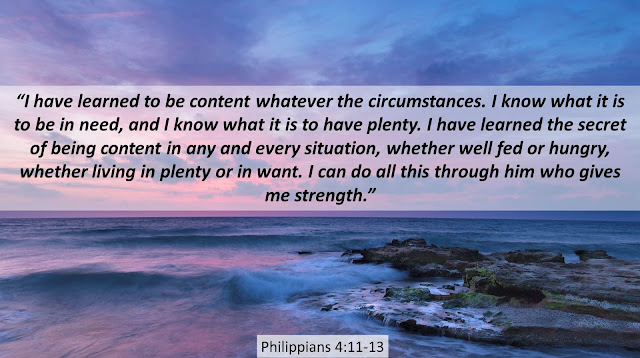
“I have learned to be content whatever the circumstances. I know what it is to be in need, and I know what it is to have plenty. I have learned the secret of being content in any and every situation, whether well fed or hungry, whether living in plenty or in want. I can do all this through him who gives me strength.”- Philippians 4:11-13 #God #Christ #Bible #Contentment #Money #Struggles #Sky

But how can Christ be the missing component? Being discontent and ungrateful is the natural, default position of the human heart, and the heart cannot change itself, no matter how hard or how long it tries to deny what it is (another useful fiction similar to the one I described above). Thus the temporary effect that will necessarily result, even in other worldviews that accurately identify the problem, is that people will attempt to change their heart apart from something outside themselves that has the causal power to accomplish the change.

Contentment

Paul expounds on this in his letter to the Romans (8:18): when we are focused on Christ, we are focused not on the temporary, physical things of this universe (such as money and things) but on the permanent, eternal life beyond this universe. When we are concerned with what is permanent and everlasting, it is easy to be content with whatever we have that is temporary and finite. It is only the focus on Christ and the everlasting life beyond this universe that He offers to us that will ultimately allow us to overcome materialistic resentment- “I have learned the secret of being content in any and every situation, whether well fed or hungry, whether living in plenty or in want. I can do everything through Him, who gives me strength” (Phil. 4:12b-13). And while we are focused on Christ, He can change our heart.

It is not merely enough to be focused on something outside this universe (such as Nirvana or Moksha in the Eastern worldviews) because our focus will fade and no permanent change can take place. It takes a causal agent, who is also the object of our focus (Christ), to change our heart. Please do not mistake “focus” for an eastern-style “meditation;” the focus I speak of is not just a mental exercise but a complete surrender and dedication of our lives to Jesus Christ.

Gratitude

We also must recognize that “every good and perfect gift comes from the Father” (James 1:17). Giving thanks (gratitude) only makes sense if we have been provided something by someone other than ourselves. It is this second necessary solution to resentment that can only make sense if Christianity is true. God is the source of the temporary and finite things we have been given. So even though money and other temporary things are not our focus, we must still be grateful for them. This removes the focus on a second level- from what we do not have to what we do have. And with our lives surrendered and dedicated to Christ, we are free to search for ways to use what (little or much) God has given us for eternal purposes, not just the temporary purposes of this life. I think that financial guru Dave Ramsey puts it quite succinctly in his popular book “The Total Money Makeover”:

Quote from Dave Ramsey- "Unless you have had a heart-level Total Money Makeover somewhere, sometime in your life, you are still doing something with money to impress others, and that has to change before you can get on a real plan to fiscal fitness. The Bible states, 'Godliness with contentment is great gain' (1 Tim 6:6 NKJV)." #Resentment #Contentment #Gratitude #Money #Finances #Bible

Conclusion

Considering the fact that God has given all people the intuition that resentment is evil (or at least undesirable) and He has given us a mind that can reliably solve problems, it is no surprise that even secular solutions can get some things right. However, they will never be complete without the whole of reality in view. The solution must include Christ. The solution to financial resentment can only take place through a renewed life in Christ. No other worldview can come even close to competing with Christianity’s solution offered to financial resentment. If you are struggling with financial resentment and are tired of struggling to rely on yourself to fix a problem you, as a human, do not have the ability to fix, Jesus is the only hope for a solution to your problem. He extends the invitation: “Come to me, all you who are weary and heavy laden, and I will give you rest” (Matt 11:28).


Original Blog Source: http://bit.ly/2qwSQHi

By Luke Nix 

Introduction

In any discussion in which we are defending a particular view, we must present both a positive case and the negative case. The positive case shows the evidence for the view we are defending, while the negative case shows the problems with the alternative being presented. Both are necessary in the overall case. The negative case is necessary because the adherent of the other view needs a logical reason to abandon their view for an alternative. The positive case is necessary because if an adherent is provided a logical reason to abandon their view, the other view being presented may not be the only option. The way that a view is shown to be incorrect is that its claims are put to the test against reality and reason. If the claims are found to not reflect reality or they are not logical, then the view is false. However, the claims of a view can be of (at least) two different types that require a different approach. Today I want to discuss the differences in the assertions and the implications of a view or model. Understanding the differences will help us be more aware of how to properly address them in other views, and the understanding will also assist us in our formation and critique of our own views. This applies to worldviews, scientific models, philosophical theories, and really anything view that makes claims about reality, regardless of which area of reality it is.

Assertions are propositions that a view or model explicitly claims to be true. When we are talking about worldviews, a worldview’s assertions are the collection of propositions that it claims are true about reality. This collection is explicitly stated and defended by the adherents to the particular worldview that makes those claims.

When critiquing a worldview, it is important that we properly understand the assertions of that worldview. If we fail to understand the assertions correctly, then we run the risk of arguing against a misunderstanding of the worldview- a strawman. If we argue against a strawman, then we have not shown the worldview we are attempting to critique as having any issues. Thus our critique has not provided the adherent of that worldview a valid reason to reject it in favor of an alternative. Our critique simply does not apply to the debate at hand, and we sound like some crazy person who has decided to just start telling a story that has no applicability to the discussion at hand. Unless we are willing to take the time to properly understand what a worldview asserts, there is really no point in attempting to argue against it.

Some assertions are essential to the worldview, so if they are shown to be false, the entire worldview falls apart. While other assertions are not so essential to the worldview, and if they are shown to be false, they can either be adjusted or removed altogether. What gets really interesting and often causes great disagreements among adherent to the same worldview is that they do not always agree upon what is essential to the worldview and what is non-essential. For details on this, see my post “Zombies of Christianity.”

Testing the assertions of a worldview or model is a direct way to test for its ability to accurately describe reality (truthfulness). If one of the essential propositions is found to be false, then the whole worldview or model may be rejected and an alternative needs to be found. If an assertion that is non-essential is found to be false, the worldview or model simply needs to be adjusted to accommodate the new data; however, that adjustment must not violate (it must be logically consistent) with the rest of the worldview or model. Sometimes what seems to be a minor adjustment affects the whole worldview or model, but not necessarily to the point of changing the essentials. As long as the essential assertions are not compromised, the main worldview or model remains intact, just with some different details. For those who are committed to a basic worldview (such as mere Christianity), the discovery that they need to adjust the details of their theology, science, or another part of the worldview does not undermine the historic event of the Resurrection of Jesus Christ, so there is no need to be afraid or even resistant to change the detailed assertions of our worldview when the evidence demonstrates a non-essential detail to be incorrect.

What Are Implications?

While attacking the assertions of a worldview or model is a more direct challenge, one can use a more indirect method that is just as powerful. Many critiques of worldviews or models come in the form of critiquing, not the assertions of the view but, the implications. Implications are the collection of propositions that the assertions of a view necessarily leads to when the logic is carried to its end (or just a few steps from the assertion). Implications are not explicitly claimed by the worldview or its adherents, and in some cases, certain implications are not even held by the adherents because the adherents have not worked the logic through to discover them.

Necessary implications can be discovered using the assertions of the view and deductive reasoning. Any sound conclusion that results yet is not explicitly claimed, is an implication of the view. Since implications are necessarily dependent upon the assertions, it is, once again, extremely important to ensure that we properly understand the assertions of a worldview before attempting to deduce its implications.

As I mentioned earlier, implications can be used to critique a worldview indirectly but just as conclusively as testing assertions. If a validly concluded implication is false, then that indicates that one of the premises in the deductive argument is false. If that premise is an assertion of a worldview, then that worldview has been demonstrated logically to be false (as it is currently held- both essentials and non-essentials included). If an adherent wishes to maintain that worldview consistently, the false assertion would either need to be adjusted, so as to not lead to the false implication, or it would need to be removed from the worldview altogether. Of course, this flexibility would only apply to assertions that are not essential. If the false premise is an essential assertion, then the worldview has been completely falsified, and even the basic worldview cannot be believed reasonably, only emotionally- against reason, logic, and evidence.

Now, as I mentioned, not all implications are held by adherents to different worldviews or models. So it is extremely important to understand what an adherent believes. They may very well agree that a particular implication is false, but they may insist that they are being consistent. This is usually an opportunity to get them to go into further details of their worldview or model. If they are correct that they are being consistent with rejecting the implication, then it is likely that there is another assertion (or collection of assertions) that place a nuance on the “false” premise that adjusts it to avoid the implication (see my post “Providing Alternative Explanations“). The newly discovered nuances of the view may also make the implication not one that is necessary but one that is optional, which, of course, the adherent would simply avoid. Now, clarification does not always undermine a false implication; the adherent may simply not understand the deductive argument, or they are more committed to the false assertion than they are committed against the implication- they may be actually willing to accept the implication as true, which would demonstrate that they are actually more committed to a view than committed to truth.

Conclusion

The differences in assertions and implications are important to analyzing and addressing both properly. In our own views, the understanding will help us identify where a view can be flexible to follow the evidence where it leads. This allows us to adjust our own views as necessary and allows us to be more reserved and pointed, where applicable, in our claims of showing an opposing view to be inaccurate (which helps keep discussions cordial and respectful). In my discussions with people about different views, I try to identify if what I’m arguing against is an assertion or an implication; simply saying something like “I know you may not hold to this particular claim, but if you allow me to show you how your view logically leads to it by necessity, you may be able to more clearly see why I reject that view and why I think you should also, based upon your rejection of it.” In the effort to be more careful thinkers, recognition of the distinction between assertions and implications will also help in our effort to be more persuasive presenters and defenders.

Original Blog Source: http://bit.ly/2r59CLN

——————————

By Bryan Chilton

In our last article, we presented the first four of the eight major worldviews. As we noted, this is a revision to a previous article that only listed six. The first article in this series presented the worldviews known as atheism/naturalism, agnosticism, pantheism, and panentheism. This article will provide the last four. To keep from confusion, the last four worldviews will be listed as #1-4 in this article even though they represent #5-8 on our list.

  1. (#5) Polytheism: Several Gods Exist.

The term “polytheism” comes from two Greek terms: “polu” meaning “many” and “theos” as we have already defined as the term for God. In the polytheistic worldview, it is held that many gods and/or goddesses exist. Certainly, aspects of Hinduism meet the worldview. But, Hindus hold that the universal God manifests in various avatars. Polytheism is better represented in pagan religions, Greek and Roman mythologies, as well as Mormonism.[1]

The trouble with polytheism is found in necessary beings. Even if it is possible that there are many universes populated by Mormon men and women, one would be forced to push their existence back to a Prime Necessary Being. As noted earlier, all material, physical universes must hold a starting point. The universe demands an explanation for its existence. According to the BVG theorem, there cannot exist eternal material universes. Therefore, even if there are multiple universes populated by multiple gods and goddesses, those universes and beings become contingent upon the necessity of a transcendent, omnipotent, omniscient, omnibenevolent being we know as God. Because of the concept of Ockham’s Razor,[2] polytheism fails as gods and goddesses are not necessary beings, whereas God is. The Christian apologist will need to use the issue of necessary and contingent beings among other areas as a starting point with polytheists.

  1. (#6) Dualism: God and the Physical World are Irreparably Separated.

Dualism is the belief that the spiritual and physical realms are irreconcilably separated. One must not confuse the dualist worldview with the dual nature of mankind (soul/body). A form of dualism in the human person can be demonstrated biblically.[3] However, the dualist worldview takes the distinction between the soul and body to extreme measures. Dualists will claim that the spiritual dimension is good and the physical dimension is bad. Thus, resurrection is not accepted nor is recreation of the new heaven and new earth presented in Revelation 21. Ancient Gnosticism, Platonism, and New Age philosophies often fit within the dualist paradigm.

The trouble with dualism is twofold. On the one hand, not all spiritual beings are good. Angels are considered spiritual beings. However, Satan and his demonic cohort are certainly not good. Rather, they are the epitome of evil. So, dualism fails to account for the fact that not all spiritual entities are good. On the other hand, dualism fails to account for the historicity of Jesus’ literal bodily resurrection. God, who is Spirit (John 4:24), created the physical world. The grand theme of Scripture is God’s restoration of the world and humanity. This includes the physical world. The Christian apologist will need to describe these distinctions and will want to provide the historicity of Jesus’ resurrection to the dualist.

  1. (#7) Deism: God as a Deadbeat Dad.

Deism is unique in that it takes its name from a Latin word rather than Greek. The Latin term “deus” is the word for “God.” Deism holds much in common with theism. Deists generally accept the existence of a transcendent God who is worthy of worship. The deist also accepts that this God is worthy of praise. The key distinction comes in God’s current involvement with creation. Deists reject the idea that God is immanent. They hold that God created everything at the outset but does not interject or intervene in creation since that time. Think of a wind-up toy. A person winds up the toy and releases it. The toy continues until it winds down without any involvement from the one who wound it. God is presented much like a deadbeat dad—that is, a dad who is uninvolved with his child’s life. Thus, deists reject the miraculous, revelations in any form except for reason, and personal relationships with the divine. Thomas Jefferson, Benjamin Franklin, John Locke are among the more famed deists.

Deism fails if one miraculous claim can be proven. If one miracle can be demonstrated, then deism fails because the miracle serves as evidence of God’s involvement in creation. Craig S. Keener’s two-volume work Miracles: The Credibility of the New Testament Accounts will help the Christian apologist defeat deist claims. Also, the apologist will want to demonstrate the historicity of Jesus’ bodily resurrection as evidence of God’s involvement.

  1. (#8) Monotheism/Theism: God is Omnipotent, Transcendent, and Personal.

Finally, we come to the final worldview. The last worldview is monotheism or theism. Theists hold that one God exists. God is both transcendent (separate from creation) and immanent (works within creation). Thus, God is omnipotent (all-powerful) and omniscient (all-knowing). But, God is also omnibenevolent (all-loving) and omnipresent (in all places). God is beyond the scope of the universe and is not constrained by the laws of nature. Yet, God is also personal and reveals himself to humanity. The three classic religions of Christianity, Judaism, and Islam are considered theistic in scope.

Theism triumphs in many ways. Theism best explains the necessity of God’s being, the creation of the universe, the miraculous, personal revelation, and the substance dualism of humanity. However, one must note that while all Christians are theists, not all theists are Christian. The Christian apologist will want do demonstrate the reliability of the New Testament, then illustrate the reliability of the Old Testament, in addition to providing evidence for the life and resurrection of Jesus of Nazareth. In doing so, the Christian apologist will show that God has ultimately revealed himself in Jesus.

Conclusion

Everyone has a worldview of some sort. The first step in presenting the gospel message comes by understanding where the person’s worldview currently resides. Understanding a person’s worldview comes by listening. Apologetics and evangelism are not a quick process. As Douglas Groothius claims, the Christian worldview is argued as the best hypothesis “carefully, slowly, and piece by piece…this means paying close attention to the components and implications of the Christian worldview, with an eye for detecting false stereotypes and caricatures.”[4] The process takes time, but if a person comes to faith in Christ, it’s worth every moment spent.

  Notes

[1] Mormons hold that God the Father is wed to a divine mother. Jesus is believed to have been the first spirit child. Mormon theology also holds that Mormon men and Mormon women wed in Mormon temples are able to become gods and goddesses of their own celestial universe and will produce their own spirit children.

[2] That is, the simpler explanation is preferred.

[3] See the works of J.P. Moreland, especially his book The Soul, for more information on substance dualism.

[4] Douglas Groothius, Christian Apologetics: A Comprehensive Case for Biblical Faith (Downers Grove; Nottingham, UK: IVP Academic; Apollos), 50.

© 2017. Bellator Christi.


Resources for Greater Impact

IDHEFTBAA book standing w SHadow

I Don’t Have Enough Faith To Be An Atheist (Paperback)

IDHEFTBAA workbooks set

Why I Still Don’t Have Enough Faith to be an Atheist (Set)

By: Brian Chilton

Before the website transferred from pastorbrianchilton.wordpress.com to bellatorchristi.com, I had written an article on the major worldviews across the globe. I presented six major worldviews at the time. While I still think the previous article treated the most major of worldviews, I have come to realize after reading Douglas Groothius’ book, Christian Apologetics: A Comprehensive Case for Biblical Faith, that other major worldviews exist that should be discussed and incorporated into the list.[1] So, let’s revisit the major worldviews in this article. The goal of the article will be to notify the reader of each belief and will show how Christian theism triumphs. In addition, the Christian apologist will need to understand the starting points that must be taken with each worldview.

Worldviews

  1. Atheism/Naturalism: Rejection of God’s Existence, Only the Physical World Exists.

The term “atheist” is taken from the Greek term “a” meaning “no” and “theos” meaning “God.” Placed together, the term means “no God.” The atheist, therefore, is one who does not believe in the existence of God. Atheists are often termed “naturalists” as they only accept the existence of the natural/physical world, thereby rejecting the existence of things like God, spirits, the human soul, angels, and demons. Richard Dawkins and Lawrence Krauss are good examples of atheism.

Atheism holds a problem as it pertains to the immaterial world. Naturalism cannot explain the existence of human consciousness. Even if the consciousness could be shown to derive from material means, naturalism (or materialism) faces a great problem as the human consciousness is a non-material thing. A scanner can see brainwaves, but not mental thoughts and the like. Naturalism holds two additional problems. On the one hand, naturalism cannot answer why anything exists. It has been mathematically demonstrated by the theorem of Borg, Vilenkin, and Guth (i.e., the BVG Theorem) that there cannot be an infinite regress of material worlds. Every material world must have a beginning point. On the other hand, naturalism fails to account for the mounting evidence of near death experiences.[2] Atheism and naturalism hold great problems serving as a cohesive worldview. The Christian apologist will need to demonstrate the reasonability of God’s existence and the means by which naturalism fails.

  1. Agnosticism: God’s Existence is Unknowable.

Agnosticism comes from two terms: “a” the Greek term meaning “no” and “gnosis” the Greek term meaning “knowledge.” The agnostic does not necessarily reject belief in God. The agnostic claims no knowledge on the issue. There are at least two forms of agnosticism. Atheistic agnostics incline to reject belief in God, but are open to the possibility of God’s existence. The atheistic agnostic claims that it is impossible to know whether God exists or not. Bart Ehrman and Neil deGrasse Tyson are examples of atheistic agnostics.

Theistic agnostics are individuals who are inclined to believe in God’s existence. However, they are doubtful whether individuals can know anything about God. The theistic agnostic may either reject divine revelation altogether and claim that no religion is correct, or the theistic agnostic may reject exclusive revelation and will claim that all religions are correct. When I stumbled into my time of personal doubt, I became more of the theistic agnostic (one who claimed to be spiritual but not religious). The Ba’hai religion and Morgan Freeman may be considered examples of theistic agnosticism.

The trouble with agnosticism is with divine revelation. If God can truly be shown to exist, then atheistic agnosticism begins to wane. If one can demonstrate that God has revealed himself to humanity (particularly through Jesus of Nazareth), then theistic agnosticism begins to fade. The Christian apologist will need to understand, first, that agnosticism can cover a wide variety of flavors. Second, the Christian apologist will need to describe the evidence for Jesus of Nazareth’s life, miracles, and resurrection.

  1. Pantheism: The Force is With You.

Pantheism comes from two Greek terms: “pan” meaning “all” and “theos” meaning “God.” Pantheism may look quite a bit like panentheism and even theistic agnosticism. However, generally speaking, pantheism is the belief that God is an impersonal force. Buddhism is the greatest example of pantheism. The Star Wars idea of the “force” is another example of pantheism. Buddhists claim to be agnostic concerning God’s existence. Yet, the Buddhist believes in impersonal forces (i.e., the force behind reincarnation). The goal of such a worldview is to become nothing. In fact, the Buddhist concept of Nirvana means that one has become so enlightened that he or she escapes the wheel of reincarnation and becomes nothing.

The trouble with pantheism is diverse. On the one hand, the pantheist will speak of such forces in such a way that intelligence is necessary. For example, why is there a wheel of reincarnation? Why is it that good behavior elevates one to a higher level and vice versa? On the other hand, pantheists have great trouble in explaining why anything exists at all. Much more could be said on this issue as it pertains to the trouble of pantheism. The Christian apologist will need to describe the internal inconsistencies of pantheism as a starting point as well as note the personal nature of the divine.

  1. Panentheism: Everything is God.

Panentheism comes from three Greek terms: “pan” meaning “all,” “en” meaning “in,” and “theos” meaning “God.” Therefore, panentheism is literally defined as “all in God.” Panentheists hold that God penetrates everything. While the Christian may initially be inclined to agree, one must understand that panentheists believe that everything is God. Thus, the panentheist would agree that Jesus of Nazareth is God. But, the panentheist would also agree that you are God, he is God, everyone is God, and even your kitchen sink is God. The panentheist does not distinguish between the personal God and the physical creation. Hinduism is the greatest example of panentheism.

Panentheism, however, holds issues as it pertains to the world. If the world is God, then why is there so much evil? God is certainly good. So, if everyone is God, then wouldn’t everything be perfect? To accept such a claim, one must have a flawed idea of God’s nature. With the panentheist, the Christian apologist will need to begin by teaching the distinction between the personal divine being of God and the physical, material creation that is the world.

We have investigated the first four of the eight major worldviews. In our next article, we will describe the final four: polytheism, dualism, deism, and monotheism/theism.

Notes

[1] See Douglas Groothius, Christian Apologetics: A Comprehensive Case for Biblical Faith (Downers Grove: IVP Academic, 2011), 50.

[2] Here, I do not mean heavenly or hellish experiences. I am addressing the scientific verification of such events in this world. For instance, if one were to see something that could not have been otherwise seen after one’s death, then this would serve as a verification of the soul’s survival past death. Soul survival discredits naturalism.

© 2017. Bellator Christi.


Resources for Greater Impact

IDHEFTBAA book standing w SHadow

I Don’t Have Enough Faith To Be An Atheist (Paperback)

IDHEFTBAA workbooks set

Why I Still Don’t Have Enough Faith to be an Atheist (Set)


By Natasha Crain

A couple of weeks ago, I started teaching a 5-week “Introduction to Apologetics” class to adults at a local church. In the first session, we talked about the evidence for the existence of God in nature—the origin of the universe, the design of life, and our innate moral knowledge.

During the question time at the end of the first session, one of the men raised his Bible in the air and said, “This was empowering! It gave me even more appreciation for God’s Word!” Other people had similar positive comments. I left feeling like things went great.

A couple of days later, my husband ran into someone from the class and asked what he thought of the first session. The man hesitated, then said, “Honestly? It really shook me. I know others said it was empowering, but it really made me start thinking about things—like all the atheist claims she talked about.”

My husband relayed this conversation to me…and I subsequently went into a funk for several days.

I felt like I totally failed. So many thoughts ran through my head:

How did I mess this up?

What could I have said to better demonstrate how powerful the evidence for God is?

How could one person say this was empowering and another person say it shook his faith to the core?

I must not be a very good apologetics teacher if my class had a negative impact on someone’s faith.

What if my class ultimately becomes the trigger that sends him away from the Lord?

Then, one morning, I woke up and realized something very important: I was having the same fears about apologetics causing a person to question his faith as many parents have about it causing their kids to question their faith. And I always tell those parents they need to promptly conquer their fears and forge ahead for the long-term spiritual benefit of their children.

It was time for me to take my own advice.

Conquering the Fear of Causing Doubt

I’ve received a number of emails and comments over the last couple of years from parents who say they don’t know if they want to get into all this “apologetics stuff” with their kids because they “only want to teach them truth” and don’t want to risk leading them astray by alerting them to all the challenges posed by nonbelievers.

But, as I point out to them, you don’t get to choose whether or not your kids will hear challenges to Christianity. In today’s world, they will hear those challenges! The only choice you have as a parent is if they’ll hear them first from you—in an environment where they’ll have your guidance readily available—or if they’ll hear them first from nonbelievers—in an environment where they’ll be processing what they hear on their own.

I shared a (true) story in a blog post a few months ago that so readily demonstrates the reality of that choice that I have to briefly recount it again. A young Christian I know was taking an undergraduate humanities class. He said that, so far in the semester, he had “learned” the following: Jesus never even claimed to be God in the synoptic Gospels (Matthew, Mark, and Luke), Christianity borrowed ideas from earlier pagan myths, and the church arbitrarily picked which books to include in the Bible according to its own biases.

He noted, “The reactions of other students are of shock and disbelief. Yesterday the professor asked a student how these facts made her feel. She said she was mad and couldn’t wait to go yell at her pastor and parents. The professor egged her on. It was like watching a commander rally up his troops to tear down his enemy.”

The girl in the class was presumably ready to throw out years of Christian upbringing after a couple of months in a single college class.

All because she heard the “other side of the story” for the first time.

This is exactly what happened to the student in my class.

When I teach apologetics, I don’t simply present the case for the truth of Christianity. I acknowledge what skeptics say at every step of the way. I explain why things like the origin of the universe, the apparent design of life, and our innate moral understanding are best explained by the existence of a universe-creating, life-designing, and moral law-giving God—but I also describe the naturalistic (non-God) explanations offered by atheists. It was hearing those alternative claims for the first time that shook my student’s faith.

Parents, please take this to heart: When we explain the claims of skeptics to our kids and it raises questions they might not otherwise have had yet, we’re not damaging their faith…we’re actually strengthening it for the long term, even when that means our efforts may be the very thing that causes their questions now.

Parents make choices with a similar tradeoff all the time. We let doctors give our kids shots that cause temporary discomfort for the good of their long-term health. We take the training wheels off their bikes, knowing they’ll take some falls before becoming a confident rider. We allow them to struggle through difficult homework problems without giving them answers so they’ll better understand the material in the future.

So why do parents fear causing temporary spiritual pain for the good of their kids’ long-termspiritual health when these other examples seem to be no-brainers?

I think the difference is confidence—parents are more confident that they can effectively manage the process of teaching their kids to ride a bike than they are that they can effectively guide their kids’ spiritual development. To overcome that, parents need the confidence of knowing two things: 1) that Christianity really does have compelling answers to secular challenges, and 2) that they personally are equipped to offer those answers.

Gaining both types of confidence is in your control. You just have to commit to deepening your knowledge of Christianity. I didn’t say you have to become an expert. There are plenty of experts you can point your kids to. But you do need to become a well-trained guide.

Make your summer reading really count this year. If you’re just getting started learning about making a case for and defending Christianity, check out my reading plan specifically for parents here (it starts with my book, Keeping Your Kids on God’s Side: 40 Conversations to Help Them Build a Lasting Faith, and takes you through four more books that will round out your core apologetics knowledge). If you’re ready to go to the next level, I have five other reading plans here.

And through all your reading, remember this: Truth has nothing to fear.

 Your willingness to tell your kids what other people believe makes that statement loud and clear.