
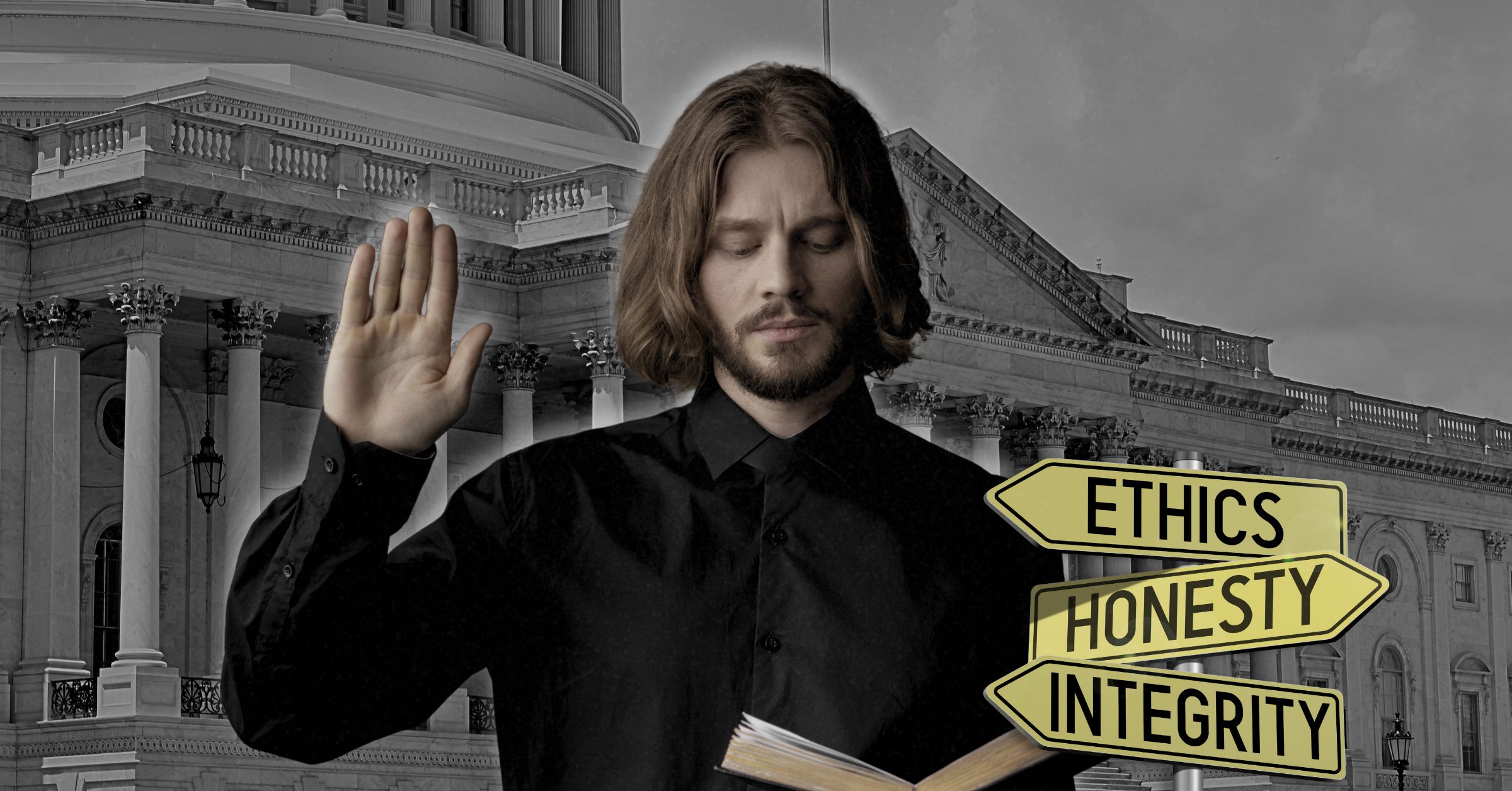
It’s often said that “You shouldn’t legislate morality!” But, as Frank Turek argues ably, “all laws legislate morality.” He’s got a point. Legislating morality is inevitable. The question isn’t whether to legislate morality, but whose morality to legislate.[1] This predicament sets the stage for a genuine power struggle. Whose moral vision should win that tug-of-war? The outcome has yet to be determined on this side of eternity.
Legislating morality is unavoidable. Legislating religion, however, remains undecided.
Historically, the United States has been a majority Christian nation, informed by broadly Christian values, ethics, and worldview. The laws of this land, unsurprisingly, have often reflected a judicious and humanitarian outlook rooted in biblical Christianity. That means a growing recognition of sanctity of human life, the presumption of innocence, and freedom of religion.[2] The first amendment, for example, has firmly protected against forced religion, while fortifying freedom of religion and freedom of conscience, all while preventing any national religion.[3] America was founded, in part, because people rejected force-fed religion. With this in mind, we can readily admit that the United States has had a majority Christian worldview influencing its founding and maturation, without committing to a heavy-handed Church-state merger forcing Christianity on its citizens at the federal level, or confusing the two institutions for each other. Furthermore, that description seems to be the primary meaning of the phrase “Christian Nation.” At minimum, that’s what I’ve always meant by “America is a Christian Nation.” This country has a Christian heritage, lots of Christian citizens, and Christianity has been instrumental in the founding and fortification of this country.
What about Legislating Religion?
That concept of a “Christian nation,” however, has been variously understood and misunderstood over the years especially under the banner of “Christian Nationalism.” At this point another question arises, “What about legislating religion?”
The Majority Left
On the left side of the political spectrum it’s pretty common to hear fear-baiting rhetoric about a forceable Christian takeover. Christians, apparently, are trying to force their religion on people through religiously charged anti-abortion laws (“Keep your rosaries off my ovaries!”), converting public schools into Christian churches with school prayer, and imposing the Bible on courtrooms and congress (through congressional prayer and displaying the Ten Commandments). In this vein, the common phrase, “Christian nationalism”, is thrown around as a left-wing slur indistinguishable from “white nationalism,” “fascism,” or even “neo-nazism.”
For the majority left, especially in legacy media, “Christian Nationalism” isn’t a precise term. Nor was it meant to be. Mudslinging isn’t a precision sport. It’s just meant to smear, degrade, deride, and dismiss the victim. Aiming isn’t important when you’re making a mess. The force of this phrase, “Christian nationalism” is primarily emotive – it feels like theocracy, forced-religion, and heavy-handed Christians trying to “take back America” for rich white men, and their domestic slaves (jobless wives, dependent children, and employees). Of course, that’s a deeply uncharitable understanding of “Christian nationalism.” But, if the goal isn’t truth but power, and the aim isn’t precision but political posturing, then the label “Christian nationalist”, for the majority left, works well as a sweeping generalization lumping every conservative Christian patriot or politician under the same blanketing libel as the most hard-core theocrat, as if Christians generally want to replace the constitution with the Bible so we can start exiling non-believers, stoning gay people, and banning inter-cultural marriage.
It bears repeating that, coming from the majority left, the phrase “Christian Nationalism” is a libelous term meant to disqualify people. It sounds, to them (and to many moderates), like a substitute word for “white nationalism,” “white supremacism,” or even “neo-naziism.” So, anyone who embraces the phrase “Christian Nationalist” is liable to be dismissed and ignored before they have a chance to explain what they mean. The Christian Nationalist can try explain how they aren’t talking about forced religion like the Spanish Inquisition, apartheid-South Africa, or the Salem Witch Trials. But by the end of the explanation, there’s no one left in the lecture hall. The people dispersed as soon as he said he’s a “Christian Nationalist.” That’s the risk Christians run if they toy around with the phrase “Christian Nationalism” without realizing the enormous baggage it carries. Yes, we can encourage Christians to get more involved in politics and encourage politicians to bring Christian values and ethics with them to congress. But to call that “Christian nationalism” is about as naïve as calling people “gay” because they’re happy. People don’t hear that innocent intent when they hear such loaded words.[4]
The Radical Right
On the fringe right wing, however, the phrase “Christian Nationalism” is gaining fashion. Leaving the majority of Christian conservatives in the dust, there is a faction of people who openly promote Christian Nationalism in a more or less “theocratic” sense of the phrase.[5] Doug Wilson, for example, argues that Christianity should be the national religion, as well as the framing worldview and reference point for government.[6] For people to hold public office they would have to be Christian.[7] And certain Old Testament and 1st Century cultural laws would be reinstituted such as repealing women’s right to vote, and reinstituting legal bans on homosexual practice.[8] Some Christian nationalists, in this vein, would go so far as to say that the Constitution should be replaced with the Bible.
From this fringe right wing perspective, one could argue that legislating religion is just as inevitable as legislating morality. In their view, religion is unavoidable and the only question is whole religion to legislate.
Three of the main contenders for that “inevitable religion” status are Christianity, Islam, and what some have called the “Woke Cult” or more charitably, “Progressivism.”[9] History has plenty of examples of Christian Theocracies and Islamic Theocracies, but the third category – Progressivism – might not seem as obvious.[10] Progressivism, might not seem like a “religion” at first. But the word “religion” does not simply refer to a formally established historically rooted belief-system with rituals, worship, theology, and so forth. Rather the first amendment sense of “freedom of religion” has always covered ideology, freedom of thought, and freedom of conscience. In this regard, progressive ideology certainly qualifies. Without parsing out “progressivism” too narrowly, it can include a range of left-wing ideologies including Critical Race Theory (CRT), Diversity Equity and Inclusion teachings (DEI), Anti-normativity and Queer theory, and more. Note, this is not just a question of ethics, but a wider ideology underneath those ethics. Progressivism is a religion in this broad, first amendment sense.
It is not clear, however, that the government will inevitably legislate religion. Ethically charged activity is unavoidable. Religiously charged policy, however, doesn’t have to happen. Sure, progressive ideology can sneak through sometimes, just as Christian, Jewish, libertarian, or conservative ideology, can sneak through too. But it’s still a stretch to call those religious and ideological influences “legislated religion.” The founding fathers never forbid such influence, but rather than giving special preference where one religion could be imposed on the general populace, they wisely installed a restrained sense of natural law. It has only a broad reference to “nature’s God,” and no particular religious trappings (prayer, worship, theology, rituals, etc.). Strictly speaking, a person could interpret “nature’s god” in terms of theism, polytheism, agnosticism, deism, pantheism, panentheism, or even atheism, where “nature’s god” is a personified reference to the mysterious machinations of primordial nature. We cannot safely assume that the Federal Government will necessarily impose a religion on the masses, nor can we use that fear to force Christianity on people under the banner of “Christian Nationalism.”
The Majority Right
The Majority of Christians on the political right-wing are somewhere in between those extremes. They don’t agree with Doug Wilson or any theocratic brands of Christian Nationalism. They might be open to some nuanced sense of “Christian nationalism” but, not if it means granting the libelous use of “Christian Nationalism,” on the left, where any given Christian patriot is labeled a hardline theocrat and lumped in with a motley crew of Conquistadors, Crusaders, and Witch Hunters. This group has the hard job of charting a path forward that avoids extremist errors on both ends. We probably shouldn’t replace the constitution with the Bible, or install a bunch of Old Testament laws in place of the bill of rights. But there is a lot of room to discuss repealing abortion-choice laws, reevaluating the Obergfell decision, and allowing prayer in schools. These ideas can be debated, case by case, without having to jump to any extremist conclusions. There is foolish excess on every side of the political spectrum. It is not enough to guard against “left-wing” errors with no concern for right-wing errors.
Charting a Way Forward
Surely there has to be another option. Right?
Vested parties probably need to have serious public discussion about the intricacies of “Christian Nationalism.” We can initiate this effort at the local level by simply asking, “What do you mean by ‘Christian nationalism’?” We cannot safely assume that everyone is using the phrase in more or less the same way. We need to identify looming errors, uses and misuses, and carefully carve out different senses of the phrase to avoid confusion, especially where people want to exploit that confusion for political purposes. People use smoke grenades only when they’re sneaking something past you. People use blurry confusing language for the same reason, to sneak something past you.
People use smoke grenades only when they’re sneaking something past you. People use blurry confusing language for the same reason, to sneak something past you.
That’s why we need to clarify terms. There might be a time, in the future, when the phrase is redeemed enough to where it’s more helpful than hurtful in public discourse. At present, however, the best way to maintain spiritual integrity and political sensibility, moving forward, is probably to avoid the phrase “Christian National/ism/ist.” Perhaps the phrase can one day be rescued from its baggage on the majority left and extreme right. Maybe one day it will no longer be a trap phrase that gets patriotic Christians to unwittingly imply they’re white supremacists. But as it stands now, the phrase is probably more trouble than it’s worth.
Patriotic Christians, of course, can still celebrate and be thankful for their country. They can assert American Exceptionalism. They can engage in politics, join political action committees, vote, petition, teach, speak, and run for office. They can even affirm Nationalism in the sense of an “America-first” agenda for the nation. In essence, Christians can affirm all sorts of political objectives without adopting the label of “Christian Nationalist.” For 95% of Christians, they lose nothing by shunning or shedding that label. Strategically, shedding the baggage of that phrase is all gain and no loss.
Meanwhile, the phrase “Christian Nationalism” already has a range of popular meanings that many people aren’t aware of, aren’t prepared for, nor are they ready to distinguish between them. “Christian Nationalism” can mean “patriotic Christian,” “a Christian who is a nationalist,” “Christian-influenced government,” “Church-State blurring,” “Church-State Fusion,” “Forced Religion,” “White-Nationalism,” “Anti-1st Amendment,” “European Cultural Christian Theocracy,” “Old Testament Theocracy,” and of course, “Handmaid’s Tale Theocracy.”
Finally, Christian conservatives should be wary against big tent partnerships with self-identified Christian nationalists. I’m not saying it should never happen. But they should weigh the costs involved, recognizing that not everyone who identifies as a “Christian Conservative” is aiming at the same target. Whatever foolishness and evil we might be seeing on the political left, we should be humbly self-aware that human depravity isn’t partisan. There’s foolishness to be found on every political extreme, and even in the center. We need to be independently principled as Christians, not mindless partisans or reactionary populists.
“Do not be overrighteous,
neither be overwise—
why destroy yourself?
Do not be overwicked,
and do not be a fool—
why die before your time?
It is good to grasp the one
and not let go of the other.
Whoever fears God will avoid all extremes”
Ecclesiastes 7:16-18
References:
[1] This is the general thesis of Frank Turek’s Legislating Morality (Eugene, OR: Wipf & Stock, 2003).
[2] Turek 2003, throughout.
[3] Before the first amendment, as many as 11 of the 13 colonies had a state religion even as they had different degrees of tolerance for other denominations and religions. Today, in light of the 1st amendment (at the Federal Level) and the case history over “separation of church state,” no American states have a state religion anymore. See also, Turek 2003.
[4] It would also be like saying, “I’m not that kind of Nazi. I’m the good kind of Nazi.” Good luck with that one. You could be some other kind of Nationalist Socialist – and that’s the literal etymology of Na-Zi – and have nothing to do with the Third Reich, racial supremacism, antisemitism, eugenics, imperialism, or Germany. But as long as you adopt the same ruinous terminology, you’ll be considered discredited from the start. For the record, I think socialism is a bad idea too, whether nationalist or otherwise.
[5] There are several different ways to define “theocracy,” but the common theme between them seems to be “forced religion.” Weak forms of “forced religion,” would be disqualifying people from certain privileges and opportunities – like voting, citizenship, public schooling, public office, etc. – unless they convert to Christianity. Strong forms of “forced religion” would be explicitly punishing (prison, fines/taxes, exile, torture, killing) people unless they convert to Christianity. In the United States, where the first amendment prevents any strict identity between Church and State, it would be a theocratic, or at least potentially theocratic to eliminate the “separation of church and state.” When the institutions of “church” and “state” become so intertwined it’s difficult to tell where “church” ends and “state” begins, the state would be able to do, as Church’s do, and deny people different privileges and opportunities based on their religion. For churches, that would mean denying church leadership denying membership, or refusing to hire non-Christians. For the state, that would (or could) mean denying people voting rights, citizenship rights, or public office, based solely on their not being Christian.
[6] Doug Wilson, Frequently Shouted Questions About Christian Nationalism (Canon Press, 2025). See also, https://midamerica.edu/articles/41/doug-wilson-christian-nationalism-and-the-theonomic-debate, https://www.perplexity.ai/search/outline-douglas-wilson-s-chris-aL7PdXSBQe..ktOVtg5mjA
[7] Ibid.
[8] Ibid.
[9] Islam is a historically and traditionally theocratic religion. Christianity has some theocracy, on a case by case basis, but theocratic unions of Church-State have been less common since about 1500AD. The protestant reformation was a major turn away from heavy-handed Christian statism.
[10] Christianity and Islam are contenders as they are the two largest world religions, and both have a history of imposing religion through governmental means – even if Christian theocracy has been waning since at least around 1500AD, around the start of the Protestant Reformation.
Recommended Resources:
Correct not Politically Correct: About Same-Sex Marriage and Transgenderism by Frank Turek (Book, MP4, )
Legislating Morality: Is it Wise? Is it Legal? Is it Possible? by Frank Turek (Book, DVD, Mp3, Mp4, PowerPoint download, PowerPoint CD)
Is Morality Absolute or Relative? by Frank Turek (Mp3/ Mp4)
Legislating Morality (mp4 download), (DVD Set), (MP3 Set), (PowerPoint download), and (PowerPoint CD) by Frank Turek
Dr. John D. Ferrer is an educator, writer, and graduate of CrossExamined Instructors Academy. Having earned degrees from Southern Evangelical Seminary and Southwestern Baptist Theological Seminary, he’s now active in the pro-life community and in his home church in Pella Iowa. When he’s not helping his wife Hillary Ferrer with her ministry Mama Bear Apologetics, you can usually find John writing, researching, and teaching cultural apologetics.