
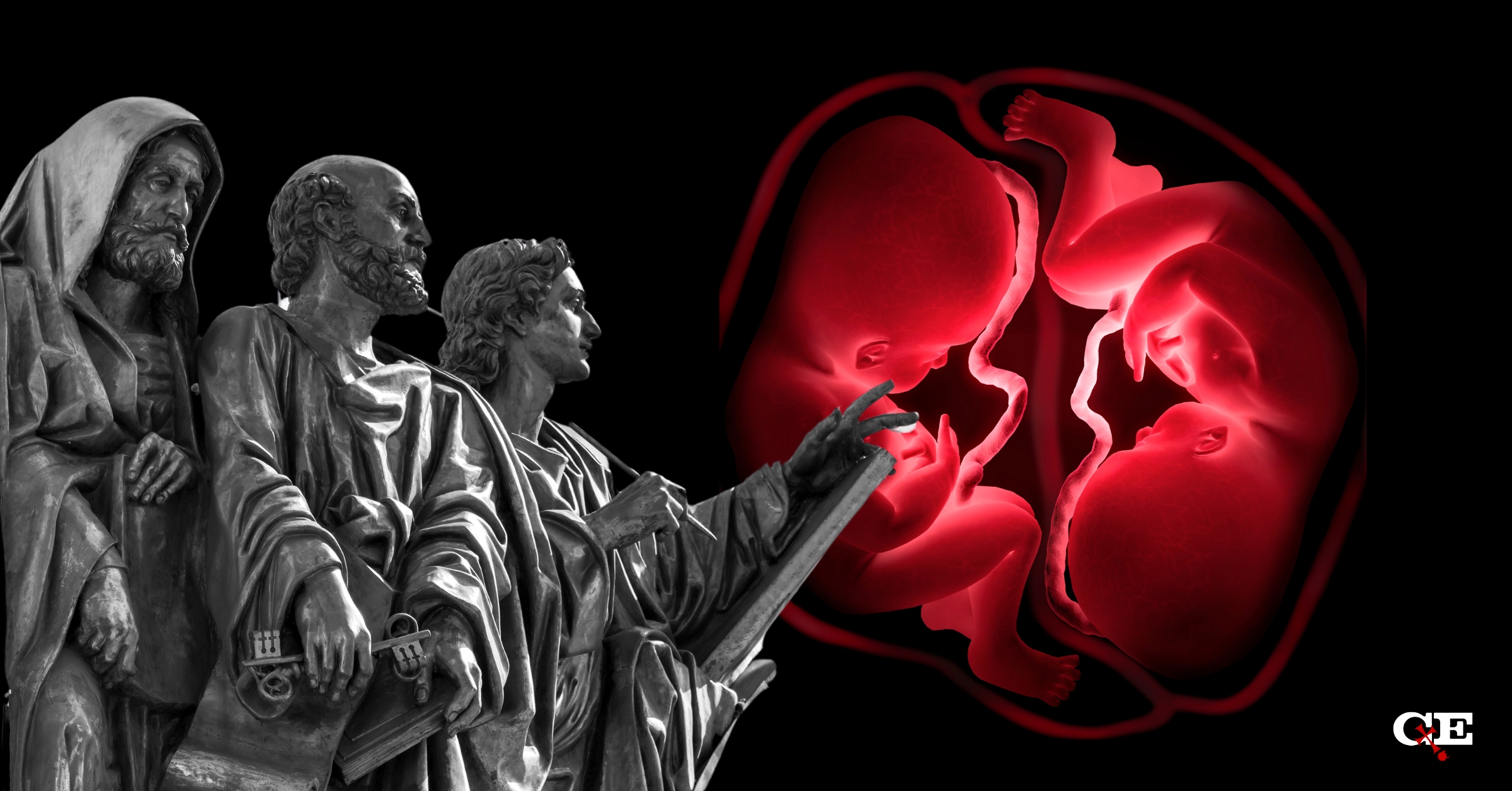
In Part 1 of this series on abortion, we discussed that abortion has been practiced for millennia. It is nothing new although the means of destroying a child in the womb have varied. We also briefly looked at why abortion has been a human preoccupation throughout history. For philosophers like Plato and Aristotle, they firmly believed it was to ensure that the best progeny would be born and eventually be leaders of the state. It was also because they feared possible overpopulation. For these reasons and several others, they thought abortion was justified.
Contrary to these pro-abortion views was the Christian view. Throughout the history of the church, abortion has been viewed as a wicked, sinful act, specifically because it was considered murder (i.e., the unjustified taking of an innocent life). The early church (second through fifth centuries) was known for its condemnation of abortion. From the early Christian document the Epistle of Barnabas to the theologian Augustine, Christianity viewed abortion to be murder, and as such, it should never be performed.
The Epistle of Barnabas
The earliest extant reference to abortion in Christian writing is the Epistle of Barnabas. Most scholars have dated this letter between the late first to early second centuries. The letter was viewed by many church Fathers, like Origen and Clement of Alexandria, as being associated with the Apostle Paul’s colleague Barnabas. Although it is uncertain whether the letter was penned by Barnabas, it was often included in some early copies of the Bible. Jerome, known for the Latin Vulgate translation, commented that it was valuable for instruction and edification but is not canonical.
The Epistle of Barnabas condemns abortion clearly. “Thou shalt not slay the child by procuring an abortion,” it says.[1] “Nor, again,” it continues, “shalt thou destroy it after it is born.” We see here a clear command not only to avoid abortion but not to kill a child by exposure after birth, which is in contradistinction to Aristotle and other Greek philosophers.
Barnabas does not end with this simple command but goes on to explain why abortion and exposure are not permitted. It states, “Thou shalt not withdraw thy hand from thy son, or from thy daughter, but from their infancy thou shalt teach them the fear of the Lord.”[2] In other words, the duty of Christian parents is to raise their children in the instruction of the Lord, not kill them (“withdraw they hand from they son, or from thy daughter”).
Tertullian
One of the earliest church Fathers, Tertullian, lived and wrote in the mid-second to early third centuries. Many of his writings are extant. One of the most well-known is his Apology in which he defends Christians against unfounded accusations from Roman culture.
In a section where he expounds upon the sin of murder, he explains, “Murder being once for all forbidden, we may not destroy even the foetus in the womb, while as yet the human being derives blood from other parts of the body for its sustenance.”[3] Clearly, Tertullian is referring to abortion as his language of the fetus being in the womb when destroyed suggests. And if there is any doubt about his reference, he makes it clearer when he states, “To hinder birth is merely speedier man-killing; nor does it matter whether you take away a life that is born, or destroy one that is coming to the birth. That is a man which is going to be one; you have the fruit already in its seed.”[4]
Athenagoras
Writing at about the same time as Tertullian is Athenagoras. In the midst of Roman persecution under Marcus Aurelius, Athenagoras writes his Apology, also known as A Plea for the Christians. In a similar manner as Tertullian, Athenagoras defends Christians from unfounded accusations, like murder (!).
In part of his response to such a ridiculous idea, Athenagoras asks, “And when we say that these women who use drugs to bring on abortion commit murder, and will have to give an account to God for the abortion, on what principle should we commit murder?”[5] In effect, Athenagoras attempts to undercut the accusation of murder by explaining that Christians do not even practice abortion. How does this undercut the accusation? Because abortion is murder, and the person who commits such an act will have to give an account to God.
He further explains the reason why abortion is murder. He says, “For it does not belong to the same person to regard thy very foetus in the womb as a created being, and therefore an object of God’s care, and when it has passed into life, to kill it.”[6] Furthermore, Christians are “not to expose an infant,” that is to say, give birth to a child and expose it to the elements to die. The reason? “Because those who expose them are chargeable with child-murder, and on the other hand, when it has been reared to destroy it.”[7]
The Didache
Probably the next earliest Christian writing to refer to abortion is the Didache (Greek, “teaching”), also known as The Teaching of the Twelve Apostles. It is unknown when the document was written, but we know it must have been before AD 300 since the church Father Eusebius of Caesarea quoted it in the early fourth century, and it is the basis for some of the fourth century document Apostolic Constitutions.[8] The Didache primarily provides instructions on church practices (like baptism and communion) and moral guidelines.
Considering that the Didache constitutes moral teachings, it is not surprising that it includes instructions on the teaching of children and catechumens. What may be surprising to some, however, is the clear prohibition of abortion. It states, “Thou shalt not murder a child by abortion nor kill that which is begotten.”[9] Note that the command isn’t merely to not kill a child who is born (“begotten”) but specifically a child not born yet (“abortion”). Moreover, it considers such action as murder as all the previous writings.
Augustine
One of the greatest Christian theologians and prolific writers, Augustine, did not leave the subject of abortion untouched. Amid a discussion on marriage, he chastises those who marry for the purpose of having sex only and finding children undesirable.
One reason Augustine chastises this action is because it may result in the conception and birth of unwanted children, who will then be left for dead via exposure. “Having also proceeded so far,” he reasons, “they are betrayed into exposing their children, which are born against their will.” This leads to “[hating] to nourish and [retaining] those whom they were afraid they would beget.” Such an “infliction of cruelty on their offspring so reluctantly begotten,” he continues, “unmasks the sin which they had practised in darkness,” i.e., the sin of marrying for purely sexual gratification.[10] The end result is leaving the child for dead.
But Augustine also argues that the sin of marrying for sexual gratification alone, or “cruel lust” as he refers to it, often results in the practice of abortion. In particular, it entices women to ingest abortifacients. “Sometimes,” opines Augustine,
“this lustful cruelty, or, if you please, cruel lust, resorts to such extravagant methods as to use poisonous drugs to secure barrenness; or else, if unsuccessful in this, to destroy the conceived seed by some means previous to birth, preferring that its offspring should rather perish than receive vitality; or if it was advancing to life within the womb, should be slain before it was born.”[11]
Because of this, those who marry ought to align their desires and passions with God’s intent for marriage: the propagation of children. To do otherwise, opens the gate to the sin of killing a child in the womb (abortion) or even infanticide. Those who practice such things are “flagitious,” Augustine says.[12]
Summary
From Parts 1 and 2 on this brief survey of abortion, we see (1) abortion has been practiced for millennia—it is nothing new and certainly not unique to our modern world, and (2) Christians from the earliest centuries have viewed abortion (and infanticide) as murder, and therefore it is a sin and ought not be practiced. The Christian view of abortion throughout the history of the church is consistent and clear. In Part 3, we will continue the discussion of abortion as it relates to contemporary arguments and objections.
References:
[1] Epistle of Barnabas, XIX, trans. Alexander Roberts and James Donaldson, in The Ante-Nicene Fathers, eds. Alexander Roberts and James Donaldson (Buffalo, NY: The Christian Literature Publishing Company, 1885; reprint, Peabody, MA: Hendrickson Publishers, 2004), 1:148. All references to The Ante-Nicene Fathers hereafter will be ANF.
[2] Barnabas, XIX, in ANF 1:148.
[3] Tertullian, Apology, IX, ANF 3:25.
[4] Ibid.
[5] Athenagoras, Apology, 15, ANF 2:147.
[6] Ibid.
[7] Ibid.
[8] See the good short article on the Didache in the Britannica Encyclopedia here: https://www.britannica.com/topic/Didache
[9] Didache, II, ANF 7:377.
[10] Augustine, “On Marriage and Concupiscence,” I:17; accessed at https://www.newadvent.org/fathers/15071.htm
[11] Ibid.
[12] [Editor’s Note: Flagitious is a 19th century English adjective meaning “criminal, villainous.”]
Recommended Resources:
Correct not Politically Correct: About Same-Sex Marriage and Transgenderism by Frank Turek (Book, MP4 )
Stealing From God by Dr. Frank Turek (Book, 10-Part DVD Set, STUDENT Study Guide, TEACHER Study Guide)
Legislating Morality: Is it Wise? Is it Legal? Is it Possible? by Frank Turek (Book, DVD, Mp3, Mp4, PowerPoint download, PowerPoint CD)
Is Morality Absolute or Relative? by Frank Turek (Mp3/ Mp4)
Peter J. Rasor II is presently the Senior Pastor of Lilburn Christian Church in Lilburn, GA and is an adjunct professor of philosophy at Grand Canyon University (GCU). He previously served as Assistant Professor of Philosophy at GCU (2015-2023). He is co-author of Controversy of the Ages (2017), author of the fantasy novel The Plague of Kosmon: Rise of the Seer, and has a multiple-authored forthcoming book An Introduction to Philosophy: A Christian Guide to the Things that Really Matter (Zondervan; 2025). He holds a ThM in theology and PhD in philosophy from The Southern Baptist Theological Seminary (Louisville, KY) and a MA and MDiv from Cincinnati Christian University.
Originally posted at: https://bit.ly/4hQcZje