Tag Archive for: image of God

Human origin is a fascinating area of research today. With all the different models for the origins of humanity being proposed, I see an increase in the discussions, both scientific and theological. For everyone reading this post, this area of research should be of utmost interest for you as well. Two critical ideas about humanity are at stake depending on which model (or family of models) is true: intrinsic and equal human dignity and value, and the sinfulness of humanity.

The age-old debate about God’s existence has great implications on this area of the debate about human origins. The Judeo-Christian claim that all humans are created in God’s Image and that humans possess a sin nature that will cause them to tend toward the immoral. These paradoxical doctrines together explain both the greatness and wretchedness of humanity that we see every day, throughout history, and expect in the future.

The Image of God

If we are created in the image of God that means that all humans possess intrinsic and equal human dignity and value (Genesis 1:26-28).[i] If this is false, then humans are not valuable in virtue of their being human but in virtue of a myriad of other characteristics and statistics that change in fashion with the culture. One moment a human can be valuable and the next moment they are not. If humans do not have value at any point, that gives justification for their expendability (murder) at the hands of those who have power over them at that point. If humans are not created in the image of God, then there is nothing wrong with humans abusing their power against other humans. Any model of human origins that does not allow for the Image of God in humans places the very lives of every human at risk.

Human Sinfulness

Genesis also records that Adam and Eve sinned against God and with that action brought the sin nature into all future humans (Genesis 3). Humans are not born good or even neutral. This means that the abuse of power described above is not just possible but inevitable. Any model of human origins that does not allow for the Fall or for the transfer of the sin nature (whether through the biological, spiritual, or some combination) denies this element of human psychology, sociology, and history (Genesis 5:1-3; 9:6; James 3:9).

Denying Both?

Any model that does not allow for one or the other already makes human lives less worthy of protection because either it is not worth protecting or there is nothing to necessarily protect against. But if a model denies both, then that is a recipe for disaster. This means that the debate about human origins is not just a scientific question but also a philosophical one, even for the atheist or naturalist. An interesting analysis of the implications of these two characteristics is provided in Os Guinness’ book The Magna Carta of Humanity which I highly recommend, particularly for those involved in human origins discussions and debates. It provides a renewed urgency for the importance of the debate about human origins.

Should Theology Judge Science?

I often hear the claim that many Christians allow their theology to determine their interpretation (and maybe even rejection) of the scientific data. The implication is that we should not allow any knowledge discipline (or at least, theology) other than science in developing our model or that we should at least give precedence to science.

 It is important to recognize at this point the distinction between “science” and the “data of nature.” The discovered data is the raw information that must be accommodated in any model, whereas “science” is the interpretation of that data. That interpretation is fallible, but not necessarily false. There are many sources of truth about human nature, including philosophical, historical, and theological sources; and that information should be recognized and accommodated in any model of human origins if it’s to accurately reflect the natural history of human origins. That’s our best shot at identifying what really happened. Just as the data of nature can judge our interpretation of the data of history and Scripture, the data of history and of Scripture can judge our interpretation of the data of nature in virtue of their being true.

[Editor’s note: While many say science is the only way we can know anything about anything, they are endorsing scientism – which is not itself science, but philosophy. So, it’s self-defeating.] Therefore, we cannot responsibly allow scientism to prevent our discovery of the correct model of human origins. To do so, would be misinformed if not dangerous.

Conclusion

With the work in the field of human origins being done at numerous Christian organizations, the number of possible models and level of detail may seem confusing to many yet exciting to others. But they are important for all of us. I encourage these organizations to continue (or begin) working together to gather all the data that each emphasize in their respective models and adjust those models to reflect the data from others. We need to be careful and respectful of any accusations of heresy, ensuring that our accusations are demonstrably reflective of the model not the Christian, and that we address such accusations with or adjust our models based on the biblical data and logic. It is important that even though we may disagree on details that we present a united front that is based on the data and sound reasoning from that data, not only for the future of humanity, but as a demonstration of the unity and love that Christ prayed for and told us that unbelievers will see. We need to not only demonstrate the truth of these important Christian doctrines (ones that are often under attack and used as excuses to reject Christ) but we need to emphasize our love, respect, cooperation, and dedication to truth that unbelievers often overlook.

References:

[i] Editor’s note: There are at least four main theories in church history regarding the nature of the “imago dei” (Image of God). Some, follow the Socinian tradition, teaching that the Image of God refers to mankind’s dominion and authority over the rest of Creation. Others, including Thomas Aquinas, say it refers to human intellect in the sense of rationality, self-reflection, and reasoning abilities all of which set humanity apart from the rest of the animal world. Others follow Karl Barth’s theory that the imago dei refers to human relationships, where Adam and Eve, can have fellowship, friendship, marriage, family, and therein fulfull their cultural mandate to “be fruitful, multiply, and fill the earth” (Gen. 1:26-28). Still others affirm the reformation view, represented by John Calvin, which treats any combination of God’s shareable attributes – authority, relationship, intellect, etc. – as the “image of God” in man. See, John Ferrer, “Chapter 3: Creation and the Image of God,” in Body Ethic [Dissertation] (Fort Worth, TX: Southwestern Theological Seminary, 2013), 91-110.

While Nix doesn’t go into all this detail in his blog post here, these four theories illustrate different ways Nix’s assertion could hold true. He says, “all humans possess intrinsic and equal human dignity and value” – whether in their nature as relational beings, as rational creatures, as representative authorities, or all of the above. Our equal dignity can trace back to our inherent nature – an unchanging and grounded fact about all human beings, since every human being is in God’s image (Gen 1:26-28; 5:1-3; 9:6; James 3:9).

Recommended resources related to the topic:

Is Original Sin Unfair? by Frank Turek (DVD, Mp3, and Mp4)

Was Jesus Intolerant? by Frank Turek (DVD and Mp4)

Stealing From God by Dr. Frank Turek (Book, 10-Part DVD Set, STUDENT Study Guide, TEACHER Study Guide)

Is Morality Absolute or Relative? by Frank Turek (Mp3/ Mp4)


Luke Nix holds a bachelor’s degree in Computer Science and works as a Desktop Support Manager for a local precious metal exchange company in Oklahoma.

Original Blog Post: https://bit.ly/3xEkXud


Introduction

Human origins is a fascinating area of research today. With all the different models for the origins of humanity being proposed, I see an increase in the discussions, both scientific and theological. For everyone reading this post, this area of research should be of utmost interest for you as well. Two critical ideas about humanity are at stake depending on which model (or family of models) is true: intrinsic and equal human dignity and value, and the sinfulness of humanity.

The age-old debate about God’s existence has great implications on this area of the debate about human origins. The Judeo-Christian claim that all humans are created in God’s Image and that humans possess a sin nature that will cause them to tend toward the immoral. These paradoxical doctrines together explain both the greatness and wretchedness of humanity that we see everyday, throughout history, and expect in the future.

The Image of God

If we are created in the image of God that means that all humans possess intrinsic and equal human dignity and value. If this is false, then humans are not valuable in virtue of their being human but in virtue of a myriad of other characteristics and stati that change in fashionability with the culture. One moment a human can be valuable and the next moment they are not. If humans do not have value at any point, that gives justification for their expendability (murder) at the hands of those who have power over them at that point. If humans are not created in the image of God, then there is nothing wrong with humans abusing their power against other humans. Any model of human origins that does not allow for the Image of God in humans places the very lives of every human at risk.

Human Sinfulness

Genesis also records that Adam and Eve sinned against God and with that action brought the sin nature into all future humans. Humans are not born good or even neutral. This means that the abuse of power described above is not just possible but inevitable. Any model of human origins that does not allow for the Fall or for the transfer of the sin nature (whether through the biological, spiritual, or some combination) denies this element of human psychology, sociology, and history. 

Denying Both?

Any model that does not allow for one or the other already makes human lives less worthy of protection because either it is not worth protecting or there is nothing to necessarily protect against. But if a model denies both, then that is a recipe for disaster. This means that the debate about human origins is not just a scientific question but also a philosophical one, even for the atheist or naturalist. An interesting analysis of the implications of these two characteristics is provided in Os Guinness’ book “The Magna Carta of Humanity” which I highly recommend, particularly for those involved in human origins discussions and debates. It provides a renewed urgency for the importance of the debate about human origins.

Should Theology Judge Science?

I often hear the claim that many Christians allow their theology to determine their interpretation (and maybe even rejection) of the scientific data. The implication is that we should not allow any knowledge discipline (or at least, theology) other than science in developing our model or that we should at least give precedence to science.

It is important to recognize at this point the distinction between “science” and “data of nature.” The data that is discovered is the raw information that must be accommodated in any model, whereas “science” is the interpretation (which is fallible, but not necessarily false) of that data. Because multiple sources of truth (philosophical and historical as described above, and not just the natural data) exist about humans, the data of each must be recognized and accommodated in any model of human origins that claims to accurately reflect the natural history of human origins (what really happened). Just as the data of nature can judge our interpretation of the data of history and Scripture, the data of history and the data of Scripture can judge our interpretation of the data of nature in virtue of their being true.

We cannot allow an epistemic (knowledge) posture of strong or even weak scientism to prevent our discovery of the correct model of human origins. To do so, would be dangerous.

Conclusion

With the work in the field of human origins being done at numerous Christian organizations, the number of possible models and level of detail may seem confusing to many yet exciting to others. But they are important for all of us. I encourage these organizations to continue (or begin) working together to gather all the data that each emphasize in their respective models and adjust those models to reflect the data provided by others. We need to be careful and respectful of any accusations of heresy- ensure that our accusations are demonstrably reflective of the model not the Christian, and that we address such accusations with or adjust our models based on the biblical data and logic. It is important that even though we may disagree on details that we present a united front that is based on the data and sound reasoning from that data, not only for the future of humanity, but as a demonstration of the unity and love that Christ prayed for and told us that unbelievers will see. We need to not only demonstrate the truth of these important Christian doctrines (ones that are often under attack and used as excuses to reject Christ) but we need to emphasize our love, respect, cooperation, and dedication to truth that unbelievers often overlook.

Recommended resources related to the topic:

Science Doesn’t Say Anything, Scientists Do by Dr. Frank Turek (DVD, Mp3 and Mp4)

Oh, Why Didn’t I Say That? Does Science Disprove God? by Dr. Frank Turek (DVD and Mp4)

Is Original Sin Unfair? by Frank Turek (DVD, Mp3, and Mp4)

Stealing From God by Dr. Frank Turek (Book, 10-Part DVD Set, STUDENT Study Guide, TEACHER Study Guide


___________________________________________________________________________________________________________________________________________________

Luke Nix holds a bachelor’s degree in Computer Science and works as a Desktop Support Manager for a local precious metal exchange company in Oklahoma.

Original Blog Source: https://bit.ly/49DBeNf


By Luke Nix

Introduction

Whether humans possess intrinsic value or instrumental value is a debate that often runs parallel to discussions about the true worldview. This debate also often fuels the passion behind worldview discussions because it has implications for ethics and morality, which are directly tied to how people ought to live and how people ought to hold each other responsible to those expectations. Such accountability can take a range of forms from personal and private conversations to legal and very public repercussions. And because one’s politics are an extension of their ethics, the passion associated with politics is also added to the mix.

Because all the emotions that accompany ethical and political discussions can easily cloud the issue, it is important that it is approached more objectively and philosophically, if we are to have a calm and reasonable discussion. Today, I want to take a few minutes to examine the philosophical implications and examine some scientific evidence for one side to assist with bringing calm to this important debate.

Intrinsic Value

If humans are intrinsically valuable, then there are a set of objective (and even absolute) duties that cannot be violated. This view holds that humans possess objective value regardless of their situation, condition, social or economic status, skin color, sex, location, beliefs, or any host of other characteristics that people try to judge others’ value. This allows for objective condemnation and consequences of particular choices and behaviors, which many people do not appreciate, especially if they are accused of committing the atrocities. This view also makes even government and governmental officials responsible to the greater reality of this moral law, which justifies political reform- something that certain rulers and politicians do not appreciate.

Instrumental Value

On the other hand, if humans are merely instrumentally valuable, then treatment of them (regardless of the particular treatment- including murder, rape, torture, or any host of traditionally unthinkable treatments) can only be judged based on their utility towards a particular goal. This view permits the affirmation of the “goodness” of even the most egregious behaviors if a “greater” goal is in view. This view allows for anyone to be able to justify any behavior if they can make their goal sound good or acceptable. There is no objective standard by which to judge the morality of a behavior, only to judge its utility. There is also no objective standard by which to judge a particular goal. Since the goal is subjective, so is the behavior, and no moral judgment is actually permitted. This ultimately reduces to “might makes right:” whoever holds the power to punish holds the power to dictate what is “right” and what is “wrong.” Political reform has no justification other than a differing opinion of someone who may be able to challenge the power of those currently in power. If one holds to this view, they often confuse legality with morality.

The Christian worldview traditionally has held that humans possess intrinsic value in virtue of being created in the Image of God. If this is true, then the first set of implications described above are features of reality that all humans are subject to. Any worldview that cannot justify intrinsic human value is left with the second set of implications described. And, by necessary logical implication, if one wishes to appeal to intrinsic human value, they must justify that appeal by grounding intrinsic human value outside the human race.

Origins of The Image of God

If humans have intrinsic value, it had to come from somewhere (or Someone) outside of the human race. Otherwise, the value that is ascribed to humans is merely subjective and instrumental. As I have described in a previous post (Why Is The Image of God So Important), this discussion is tied to one’s view of human origins. If someone wishes to appeal to intrinsic human value, they must accept some type of connection between humans and an eternally existing, absolute reality that is outside of (and is not) this universe. The only thing that fits this description is the Creator God of the Bible.

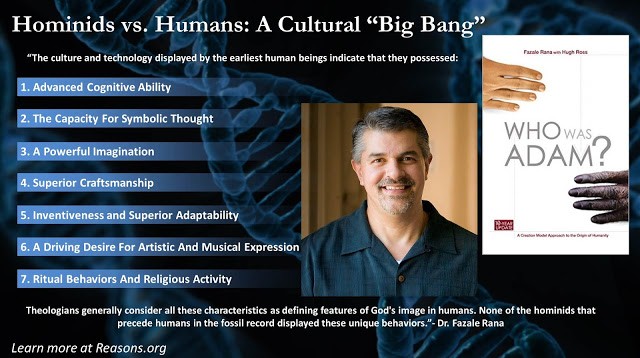
In order to argue for the intrinsic value of humans, Dr. Fazale Rana offers several lines of evidence for the sudden appearance of the Image of God in life’s history (which happens to coincide with the sudden appearance of humans on the scene). He calls this sudden appearance a “cultural big bang”:

luke nix graphic 1

These pieces of evidence include:

Advanced cognitive ability

The capacity for symbolic thought

A powerful imagination

Superior craftsmanship

Inventiveness and superior adaptability

A driving desire for artistic and musical expression

He goes into great detail about the anthropological discoveries of scientists over the years in his book “Who Was Adam.” In the third section of the book, he addresses modern challenges to his conclusions and brings in the latest discoveries over the past decade. The cumulative, scientific case presented in the book for the Image of God coinciding with the appearance of the human race, by extension, is a powerful evidential case for humans possessing intrinsic value.

Conclusion

It is vital to a proper theory of ethics (and even politics) that we know whether humans possess intrinsic value or not. Ultimately, if humans are created in the Image of God, as argued by Dr. Rana, then the idea that humans possess intrinsic value accurately describes the reality of our species. If humans are intrinsically valuable, that serves as the foundation for how we ought to treat one another (ethics) and that further guides how we should govern one another. If humans are not created in the Image of God (do not possess intrinsic value), then all sorts of heinous treatment of them are permissible even by those who wield the most power (governments and politicians).

Recommended resources related to the topic:

Stealing From God by Dr. Frank Turek (Book, 10-Part DVD Set, STUDENT Study Guide, TEACHER Study Guide)

Legislating Morality: Is it Wise? Is it Legal? Is it Possible? by Frank Turek (Book, DVD, Mp3, Mp4, PowerPoint download, PowerPoint CD)

Do Ethics Need God? by Francis Beckwith (Mp3)


Luke Nix holds a bachelor’s degree in Computer Science and works as a Desktop Support Manager for a local precious metal exchange company in Oklahoma.

Original Blog Source: http://bit.ly/2mvkci2

By Evan Minton

Genesis 1 teaches that human beings are created in God’s image, in His likeness. Much debate and speculation over the years have occurred over what exactly that means. It obviously cannot mean that we look like God if for no other reason than that everyone looks different. In my blog post “What Does It Mean To Be Made In God’s Image?” I argued that to be made in God’s image entailed a number of attributes which we have that animals don’t have: rationality, a moral compass, and free will.

Some theologians, however, object to this list. They argue that if this is what it means to be made in God’s image, then that must mean that fetuses, infants, and the severely mentally incapacitated cannot be made in God’s image. The argument goes that if they’re not made in God’s image, then they have no intrinsic value. If they have no intrinsic value, then it would not be evil to kill them, any more than it would be evil to shoot a deer or stomp on a cockroach. Consequently, this position on the imago Dei falls on the horns of a dilemma: either abortion and infanticide are justified, or else this cannot be what constitutes the divine image.

Dr. Michael Heiser made this objection in his book The Unseen Realm. Heiser wrote: “Identifying the nature of the divine image has preoccupied students and pastors for a long time. Chances are you’ve heard a sermon or two on the topic. I’m willing to bet that what you’ve heard is that the image of God is similar to something on this list: •Intelligence •Reasoning ability •Emotions •The ability to commune with God •Self-awareness (sentience) •Language/ communication ability •The presence of a soul or spirit (or both) •The conscience •Free will All those things sound like possibilities, but they’re not. The image of God means none of those things. If it did, then Bible-believers ought to abandon the idea of the sanctity of human life in the womb.”[1]

It’s understandable why some would raise this objection. After all, fetuses cannot reason and neither can infants. Infants don’t know the difference between right and wrong (this is, after all, my primary argument against the reformed doctrine of infant damnation). So if rationality and moral knowledge are what makes the divine image, and fetuses and infants don’t have these, then obviously this must mean they’re not made in God’s image. Since this is absurd, we must reject this view of the imago Dei.

What do we say to this?

First: I Now Believe That These Are Necessary Conditions Of The Divine Image, But Not Sufficient Conditions

Doing some study of John Walton’s “Lost World” books has shown me some surprising insights into how the ancient Israelites would have read Genesis. In The Lost World Of Adam and Eve, Professor Walton explains that to be made “In God’s Image” meant to be God’s representative. Humans represent God on Earth in a similar way in which statues of deities represented those deities in the temples in which those deities were worshipped. Humans are God’s “statues” so to speak, in His “Cosmic Temple” (i.e. the universe, which took 7 days to inaugurate, as was customary of the inauguration of any temple in the ancient near east).[2]

This would explain why angels and demons are never considered by scripture to be divine image bearers. They have rationality, free will, and the moral law written on their hearts, but they are not God’s representatives on Earth. Indeed, angels rarely appear visibly to people, and even when they do, people are often unaware of it (see Hebrews 13:2).

  1. Richard Middleton (Roberts Wesleyan College) agrees with Walton. In, The Liberating Image, Middleton says that the image of God describes“the royal office or calling of human beings as God’s representatives and agents in the world.”Image of God means that humans have been given “power to share in God’s rule or administration of the earth’s resources and creatures.”[3]
    But notice this: in order to be a representative of God, you need to be rational, know the difference between good and evil, and have free will.  If you aren’t an a-rational, a-moral, causally determined creature, you won’t be a very good representative of God on Earth. Having rationality, free will, and moral knowledge are prerequisites to being God’s representative on Earth. So, I don’t recant what I said in “What Does It Mean To Be Made In God’s Image,” I merely admit that my list of essential attributes was incomplete.

For a creature to be created in God’s image, one must
1: Be God’s representative on Earth. 

This means that the creature must be

2: Capable of rational thought.

3: Capable of knowing morally right actions from morally wrong ones.

4: Have free will of the libertarian variety. 

If scholars like Walton, Middleton, and others are right; that being made in God’s image is to be his representative and co-regent in the world, then the mental qualities described simply follow by logical extension.

This, by the way, also answers Heiser’s other reductio ad absurdum; that “If one animal anywhere, at any time, learned anything contrary to instinct, or communicated intelligently (to us or within species), or displayed an emotional response (again to us or other creatures), those items must be ruled out as image bearing.”[4]  Lower animals weren’t cosigned by God to be his representatives on Earth, so even if apes became as smart as the apes in the Planet Of The Apes movie series, it wouldn’t mean that they suddenly gained the image of God. To bear the divine image means to be God’s representative on Earth which requires rationality, free will, and the moral law. But possessing the latter 3 doesn’t entail that you are the former. The latter are simply needed for the former to exist.

Secondly, Babies Don’t Have The Aforementioned Faculties, But They Will In Time.

While babies and fetuses aren’t yet capable of exercising these capacities, they will be eventually, if allowed to grow. They are the sort of creature that has the capacity to gain these abilities. They have the inherent potentiality to be rational, moral agents. A kitten or a baby chimp lacks this potentiality altogether. Even if the cat lives 20 years, it will never be capable of learning the 9 rules of logical inference or knowing that stealing is wrong. A fetus, on the other hand, will.

An imago Dei creature either has these abilities already or at the very least will have them and can have them.

Heiser anticipates this response and says that if you argue that those things are there potentially, then that means that you have only a potential person. The problem with Heiser’s objection is that it acts as a boomerang, coming back to hit him in the face. Heiser understands the image of God in the exact same way as Walton and Middleton do: i.e. as God’s representatives on Earth. As I said above, I don’t disagree with this, but the essential properties of a representative are rationality, morality, and free will. Not only does an unborn child only have the mere potential to have these mental qualities, but even the “status” (Heiser’s own words) to which the mental qualities are prerequisites is but a mere potential. I can’t imagine that an unconscious fetus 3 days after conception can represent God in any meaningful sense. If Heiser is correct that the mere potential to possess abilities entails that fetuses are only potential persons, then is it not the case that the potential to be God’s representative entail the same? How is Heiser’s view of the imago Dei immune to the objection he brings against the mental faculty position? He doesn’t explain.

It will not do though simply point out that Heiser’s proposal (which I don’t disagree with) falls under the same objection.

Conclusion
I don’t think theologians are wrong to say that our unique mental faculties are necessary conditions to the imago Dei, but I think it is wrong to say that they are sufficient conditions. If they were sufficient conditions, then even Satan would bear God’s image. Rather, we need to see the imago Dei as being God’s representatives on Earth. This, of course, presupposes the mental faculties of rationality and so on. This last quality is what humans have that angels and demons do not (or aliens if there are any out there).

Notes

[1] Heiser, Michael S. The Unseen Realm: Recovering the Supernatural Worldview of the Bible (p. 40). Lexham Press. Kindle Edition.

[2] See Walton, John H.. The Lost World of Adam and Eve: Genesis 2-3 and the Human Origins Debate (Kindle Location 1331-1356). InterVarsity Press. Kindle Edition.

[3] The Liberating Image: The Imago Dei in Genesis, March 1, 2005, by J. Richard Middleton, Brazos Press.

[4] Heiser, Michael S. The Unseen Realm: Recovering the Supernatural Worldview of the Bible (p. 41). Lexham Press. Kindle Edition.


Original Blog Source: http://bit.ly/2onLAvF

By Luke Nix

Introduction

Those who follow this blog are aware that I not only defend “mere” Christianity, but I also defend specifics in the Christian worldview. As I have written before, I believe that if a Christian is defending an incorrect detail of their worldview to a skeptic, that skeptic can easily use that incorrect detail as an excuse to reject the entire worldview (even though this is not logically reasonable). Over the last few years of interacting with fellow Christians regarding the details of our worldview, one of the doctrines that are not discussed explicitly very often, but other debates directly affect, is the doctrine of the Image of God. I have noticed that some positions in the other debates imply different views of the Image of God, and these different views of the Image of God can be used to test the positions in the other debates. But before I get into those debates, we need to know why this Judeo-Christian doctrine is so important in the first place.

What Is At Stake?

The Image of God provides the grounding for several essential characteristics of humans that set us apart from the animal kingdom. Without appropriate grounding for these characteristics, a worldview cannot explain these characteristics, thus it is forced to deny that they even exist…with dire consequences, as we shall see. What are these characteristics, though? While the Image of God grounds several characteristics, I want to examine four of them today:

  • Intrinsic Value
  • Free Will
  • Moral Responsibility
  • The Ability to Reason
 Intrinsic Value

It is common today to think that a person’s value is based upon their race, sex, age, religion, intelligence, economic status, physical ability, entertainment ability, or a whole host of other “useful” things to a society. All of these, though, are relative and fleeting. Anytime that one of those are different (between persons or even in the same person at different times in their lives) their value goes up, down, or disappears. Intrinsic value is value that is not based on any of those accidental characteristics. Intrinsic value is value that is objective, found outside the societies, groups, or other individuals who are judging a person’s worth. This is an objective value that people possess simply in virtue of being human.

No human is intrinsically more or less valuable than another. This concept provides the ground for the idea of “equal rights” regardless of sex, race, age, ability, or status. If you are a human, you are intrinsically valuable, period. Since animals do not possess the Image of God, they do not possess such intrinsic value; they are valuable based upon whatever someone else needs them to accomplish. Animal value is relative and subjective, but human value is objective. If someone violates (harms) an intrinsically valuable thing, it is a moral evil. Specifically, an attack on a possessor of the Image of God is a direct attack on God Himself. If humans do not possess the Image of God, no act against us for any reason is evil. In fact, if humans do not possess the Image of God, it is permissible (if not obligatory) that humans be treated no different than any other animal (and vice versa). Just as a house fly may be killed because it is irritating us, so may a human be killed because he or she is irritating us, and if a human’s life is to be protected by the law, then so should the life of every animal be protected by the law also.

Free Will

When I say “free will” I am talking about the ability to choose to do something other than what we actually do, given the same circumstances (called “libertarian” free will). For instance, you have a choice to continue reading this post or not. Sure, some things will influence that choice, but ultimately you are choosing whether to accept those influences and act upon them or not; the circumstances (or your desires) do not determine your choice, though they do influence your choice. What allows us to do this is the fact that we are “agents” or “souls.” These (and we) are beings that exist independent of physical reality, thus we are not 100% governed by its laws (though our bodies are, which many of our decisions require us to take into account). Because an agent is not physical, it must have a non-physical source- the Image of God provides that source for humans. If humans do not possess the Image of God, then we do not possess free will and all our “choices” are determined by something else, not us.

The animals do not possess the Image of God, thus they do not possess free will. They are beholden to their environment for their behavior. Their surroundings are what determine how they act. The fact that humans have free will means that humans are capable of choosing how to act towards one another, nothing or no one else makes the choice for us, we are responsible.

Moral Responsibility

Taking the two previous characteristics provided by the Image of God, we discover that humans have moral responsibility. If humans are not intrinsically valuable, then no act committed against them is evil. If humans do not have the ability to choose to do otherwise, then they cannot be held responsible for such an evil act. Thus both intrinsic value AND free will are necessary for moral responsibility. This makes us moral beings. Something that animals are not. If an animal kills another animal, we do not call it “murder” because “murder” is “killing” plus a moral element. Animals do not possess intrinsic value (so the killing is not a violation of God’s Image) and animals are not morally responsible beings. On the other hand, man is both intrinsically valuable AND a moral being, so if a human kills another human it is a moral act based on the Image of God in both the victim and the killer. And the morality of that act must be justified by the Moral Law that God has written on the hearts of every human (via His Image) and in His further revelation of Scripture.

This means that if humans wish to hold other humans morally responsible for their actions, the Image of God is necessary on two accounts. Without the Image of God, there is no ground for moral responsibility, no ground for reward or punishment. In fact, if either intrinsic value or free will are missing from the equation, moral responsibility (and reward and punishment) cannot do not make sense; they are meaningless.

The Ability to Reason

Often times it is difficult to distinguish between what is true and what is practical because the two do not always seem to align. What is practical is derived from what allows us to survive and thrive in any given environment. We act and react, according to what stimulates our senses, with those two purposes as the end goal. This is the mode of operation of a creature that not only does not possess free will but also one that does not possess reliable reasoning faculties. If our ability to reason is grounded in a process or object that is focused on survival, then that is exactly what it will do, and the misalignments between what is practical and what is true will never be detected. We are forced to conflate truth with practicality, on this view, because as the environment changes, what is necessary for survival also changes (think of living in Saudi Arabia vs. living in the United States).

On the other hand, if our reasoning faculties are grounded in something that is essentially concerned with what is true, then that faculty can be trusted to be able to detect the difference between a belief that is merely practical for an environment and one that is true (independent of the environment). The Image of God provides this grounding in the Creator, who IS omniscient and desires that humans come to know what is true and not just what is practical for their given environment. In being made in the Image of God, humans not only possess the ability to freely choose among options, we have a reliable tool to identify which option is the correct option. Thus this makes our moral responsibility even more binding.*

The Origin and Current Status of the Image of God

Because all four of those characteristics are tied to the Image of God, it is important that in our defense of the Christian worldview, and specifics within the worldview, that we consistently hold and defend a specific view regarding its origin and status.

Testing Origins Views Via The Image of God

Regarding its origin, some people believe that the Image of God came about by natural processes- it is a functional distinction between us and the animals based upon our evolution from the lower species. This view is most commonly found in the origin position called “theistic evolution” or “evolutionary creationism” (but not all of them hold this view of the Image of God; I’ll address that important distinction in a minute). This cannot be the way the Image of God appeared because it is merely a difference in degree of development between animal and human rather than a difference in ontological essence (“kind”). A difference in degree is not an ontological difference, but the Image of God, in order to be an ontological ground for the four characteristics I described above (and the many others I didn’t), must be an ontological difference. If one holds that the Image of God is not a difference in kind, then all the implications of the above-described characteristics’ absences are actually the reality- human intrinsic value does not exist, free will does not exist, moral responsibility does not exist, and the ability to reason does not exist.

While I do not defend common descent of humans with any animal (I’m not an evolutionary creationist), I must understand that not every evolutionary creationist holds to this view of the Image of God because of its dire philosophical and theological (biblical) implications. These theistic evolutionists hold, just as much as any creationist (young-earth or old-earth), that the Image of God appeared suddenly in history (as a special creative work of God) and that sudden appearance is evident in the fossil and archaeological record.

Where things get difficult, though, is that many naturalists insist that all features of humans appear gradually in the fossil and archaeological records. If that is true, then even the Image of God appears gradually. That would imply that the Image of God is merely a difference in degree and not in kind. So, if a Christian theistic evolutionist wishes to maintain common descent of humans with prior animals (and they wish to avoid the implications of merely a functional Image of God), then they must reject the interpretation of the historical records that naturalists offer regarding the Image’s features appearing gradually (descending from “lower” species).

What is really interesting is that the more that the data is reinterpreted to be consistent with an ontological Image of God (a sudden appearance), the more the line is blurred for the theistic evolutionist between the sudden appearance of the Image of God and the sudden appearance of humans. Perhaps a persuasive case for the rejection of common descent between humans and animals (and the acceptance of humans as a special creation of God independent of His other creations) is found in our defense of the proper view of the Image of God and its endowments (e.g. intrinsic value, free will, moral responsibility, and the ability to reason) upon humans. Our maintaining the proper view of the Image of God helps us to test and guide our view of human origins. If this has intrigued you, I highly recommend reading the book “Who Was Adam” by biochemist Dr. Fazale Rana to see the scientific evidence for the sudden appearance of the Image of God (and humans) in the scientific record.

One More Thing- Abortion and Active Euthanasia
Before I leave the origins debate, though, I do want to bring up one more implication for holding that the Image of God is merely a difference in the degree of development. If you are familiar with some of the more common defenses for abortion, you will know that one of the reasons offered to deny the unborn intrinsic value (and the intrinsic right to life) is the degree of their development. (Now, I have to be extremely careful not to equivocate on the term “degree of development,” because if the terms do mean the same thing in both the common descent view and the abortion view, then we have a serious problem.) Simply put, the argument for abortion from the degree of development points to the lack of certain features in the unborn that a fully developed human being possesses. The pro-abortion advocate uses this lack of development to conclude that the unborn are not really human, thus do not possess intrinsic value (which means that killing the unborn is perfectly acceptable).

In the book “The Case For Life,” pro-life apologist Scott Klusendorf points out that the “degree of development” argument, applied consistently, also removes intrinsic value (thus justifies intentionally killing) from those living with health issues, including physical handicaps, degenerative diseases, mental disorders and others. If the Image of God is merely a matter of degree of development, then any human who manifests cognitive, creative, or physical limitations akin to those of our pre-human ancestors (on the theistic evolutionary view), they too necessarily lack the Image of God. This would include the unborn (abortion would be morally permissible) and the born (active euthanasia would be morally permissible).

This is one more way that we can use the proper view of the Image of God to test our view of human origins. Unfortunately, it can also be used in the opposite direction to justify abortion and active euthanasia- which is one more reason why maintaining the proper view of the Image of God is so important. We must hold to the proper view of the Image of God to guard against such logically fallacious and morally reprehensible (sinful) views from entering our worldview (even if we insist on maintaining the belief in the common descent of the physical human body).

Testing The Current Status of the Image of God

In the on-going debate about how God’s sovereignty and man’s free will work together, some Christians have opted to deny that man has free will at all by positing that the Image of God was destroyed at the Fall of Adam and Eve. However, when the implications I described above are explained, the Christian usually quickly changes their position, but in many cases the change holds that the Image of God was damaged specifically in a way to destroy human free will but maintain the other traits. While this may seem like an acceptable position, it poses a severe problem.

If intrinsic value does exist, but free will does not, then punishment is a moral evil because it is a violation of (attack against) the intrinsically valuable human, created in the Image of God, who did not have a choice to not commit the crime against another intrinsically valuable human, created in the Image of God. This means that if free will does not exist, God’s punishment of those who commit sin is His attacking Himself- a moral evil. However, we know from the Bible that God cannot sin, that He cannot deny Himself, that a house brought against itself cannot stand, and that God does punish the wicked. If a Christian is to maintain the doctrine of eternal conscious punishment (or even the heterodox view of annihilationism), yet deny free will, then they are saying that God is sinning in virtue of His immoral attack against a creature created in His Image.

Some have attempted to say that God can do whatever He wants. However, this then enters into the debate about God and morality. A common objection to God’s existence comes in the form of the Euthyphro dilemma. This poses the question, “Is God good because He says what is good, or because He is subject to good.” The dilemma is that if the first option is selected then morality is subjective and arbitrary (not objective) because God could simply change His mind about what is good, while if the second option is selected then God is not the highest being, thus He cannot be God. If it is not obvious, the attempted escape from the implication of denying free will but affirming intrinsic value fails because it is the first option of the dilemma- morality is then arbitrary and subjective, thus there is no objective standard by which God can judge, which adds another level of problems because without objective morality, nothing is evil, even an act that attacks a bearer of the Image of God (so, murder, abortion, rape, and every other “sin” is not objectively evil- it is merely God’s opinion at the moment that they are or are not)- moral responsibility essentially was destroyed if free will was also.

The only way to avoid this implication is to affirm that man’s free will is still intact regardless of how we view the effects of the Fall of Adam and Eve. Because of that, we can use the proper view of the current status of the Image of God (intact) to test our views regarding the coexistence of God’s sovereignty and man’s free will.

Conclusion

The Image of God is an important doctrine of Christianity. It provides the ontological grounding for intrinsic value, free will, moral responsibility, and the ability to reason. Without these characteristics in place in humans, Christianity is, at worst, false, and at best unknowable and indefensible. So, it is important that as we defend the truth of the Christian worldview that we do not also defend a scientific or theological position that either asserts or implies that the Image of God is not ontological or was damaged in a way to destroy free will. If we do, then we are defending contradictory claims, and the unbeliever can use that as a reason (because they are made in the Image of God) to freely choose to reject the truth of the Christian worldview.

Recommended Books for More on this Topic

*Of course, mere observation of reality and reason do not always lead to the correct conclusion. The Image of God also provides the Moral Law that is written on all humans’ hearts (since all humans are made in the Image of God). Further, God has given us His special revelation that gives us explicit moral codes. But He did not just give us a book without establishing that it was divinely inspired by the Source of the Image of God. The Bible contains numerous claims about reality, and especially history when no human was present to observe the events (thus eliminating any reasonable natural explanation [e.g. that the author saw it or guessed it). Dr. Hugh Ross explains these in his numerous books on the scientific evidence for the inspiration and authority of the Bible. So, there are two additional tools that solidify man’s moral responsibility and the fact that all men “are without excuse” (Romans 1:20).

Original Blog Source: http://bit.ly/2q1OxlG