Tag Archive for: Christianity

In the following piece, I will discuss the ongoing controversies surrounding Andy Stanley and the recent Unconditional Conference held at North Point Church — outlining clear departures from the scriptural teachings found in the Bible.

I will spotlight three key concerns to illustrate how Andy Stanley promotes an approach and an ideology contradicting New Testament teachings on homosexuality.

Say it Ain’t So!

As followers of Christ, we strive to align our lives with God’s Word, maintaining unwavering faith in times of discord. It is disheartening to see influential Christian figures like Andy Stanley, who command extensive ministry recognition, endorsing views contrary to biblical Christianity.

Even as I profoundly disagree with the path Andy Stanley and his church are taking, I remain hopeful for him to reconsider his wayward stance as a fellow Christian. My intention is not to provoke empty quarrels or breed negativity but to bring clarity and guidance in navigating through these contentious subjects. I endeavor to deal with this sensitive topic with grace and respect, promoting unity among believers (see Romans 12:16-18; 1 Peter 3:8).

The Apostle Paul, however, cautions the body of Christ, that is, the Church, to “avoid those who instigate division and trigger obstacles against the teachings we follow” (Romans 16:17). Thus, we must engage in these tough conversations, pushing ourselves to think critically and delve deeper into scriptural truths about our identity in Christ and what the Bible teaches about sexual sin.

First, An Unbiblical Presumption About LGBTQ+

Taking this warning to heart, let me address my first concern about what Andy Stanley and several of his leaders within North Point espouse. According to Greg and Lynn McDonald — founders of Embracing the Journey, and the couple who put on the Unconditional Conference at North Point — they don’t declare a theological stance on LGBTQ+ matters. That assessment, however, is not entirely accurate. In fact, they hold to a very unbiblical presumption. These proponents (McDonalds, Andy Stanley, Justin Lee, David Gushee) argue that Christians viewing homosexuality as sinful are misinterpreting biblical text, causing profound harm to LGBTQ+ individuals. Behind this presumption is a deviation from Jesus’s clear teachings on human gender (it’s binary) and marriage (it’s a union only between a man and a woman). See Matthew 19:3-6 and Genesis 2:18-25.

Second, Entangling Alliances

The second entanglement is the invitation and alliance afforded by North Point Church to platform activists, such as David Gushee, a progressive Christian who advocates for same-sex “marriage.” In his book, “Changing Our Mind: A Landmark Call for Inclusion of LGBT Christians,” Gushee boldly declares an error of perspective by early Christians on the moral dimension of homosexuality. He alludes that salvation calls on all, regardless of sexual identity or orientation. This perspective also resonates in the narratives of “gay-Christian” men like Justin Lee and Brian Nietzel (both in same-sex “marriages”), who have been frequent guest speakers at North Point.

Third, Andy Stanley’s Own Teaching

Third, it’s troubling to conceive the teachings from Andy Stanley himself. Stanley loves to say he and his church, North Point, are all about the gospel and sharing the love of Jesus with those far from God. But what does the gospel actually mean if homosexuality and transgenderism, and same-sex “marriage” are not considered a sin? If we can hijack what Jesus taught and throw out whatever we disagree with–the end product is a different gospel altogether.

In a way, Andy Stanley is modifying God’s love to embrace all walks of life, no matter the person’s sexual orientation or gender identity.

In his advocacy for LGBT rights within the church, Andy adopts a practice-oriented perspective. He often shares pastoral anecdotes where he counseled families with sons or daughters who identify as LGBTQ+. As Andy stated in his “I Love My Church” sermon at North Point, “Jesus drew big circles in his ministry.” Suggesting that not loving and affirming LGBTQ+ individuals for who they are is not expressing love in the same capacity that Jesus did.

Compassionate Error Is Still Error

No matter how eloquent or compassionate Andy Stanley tries to make it sound, what God calls sin, is still sin (Romans 1:26-27). We have no right or authority to override the commands of God written down in the Bible. John, the apostle, distinctly writes, “This is how we know that we love the children of God: by loving God and carrying out his commands” (1 John 5:2).

As the church, sanctified, washed, and justified in the Name of the Lord Jesus Christ (1 Corinthians 6:11), we are not to give ourselves over to sinful desires that defile our bodies and bring enmity between us and God. Instead, we are to offer our bodies as members of righteousness. That, my friends, is true love.

Recommended Resources On This Topic

Correct, Not Politically Correct: About Same-Sex Marriage and Transgenderism 2023 Edition by Dr. Frank Turek Book 

You Can’t NOT Legislate Morality mp3 by Frank Turek

Does Love and Tolerance Equal Affirmation? (DVD) (Mp4)  by Dr. Frank Turek

4 P’s & 4 Q’s: Quick Case FOR Natural Marriage & AGAINST Same-Sex Marriage (DVD) by Dr. Frank Turek 


Jason Jimenez is President of STAND STRONG Ministries and author of Challenging Conversations: A Practical Guide to Discuss Controversial Topics in the church. For more info, check out www.standstrongministries.org


Do most Christians have the wrong definition of inerrancy? You may have noticed some pretty significant discrepancies between the different Gospel accounts in the New Testament–discrepancies that skeptic Bart Ehrman didn’t hesitate to point out during past debates with Dr. William Lane Craig, Jimmy Akin, AND today’s guest! Is there a way for Bible believing Christians to harmonize these variations, or should we throw out the concept of Bible inerrancy altogether?

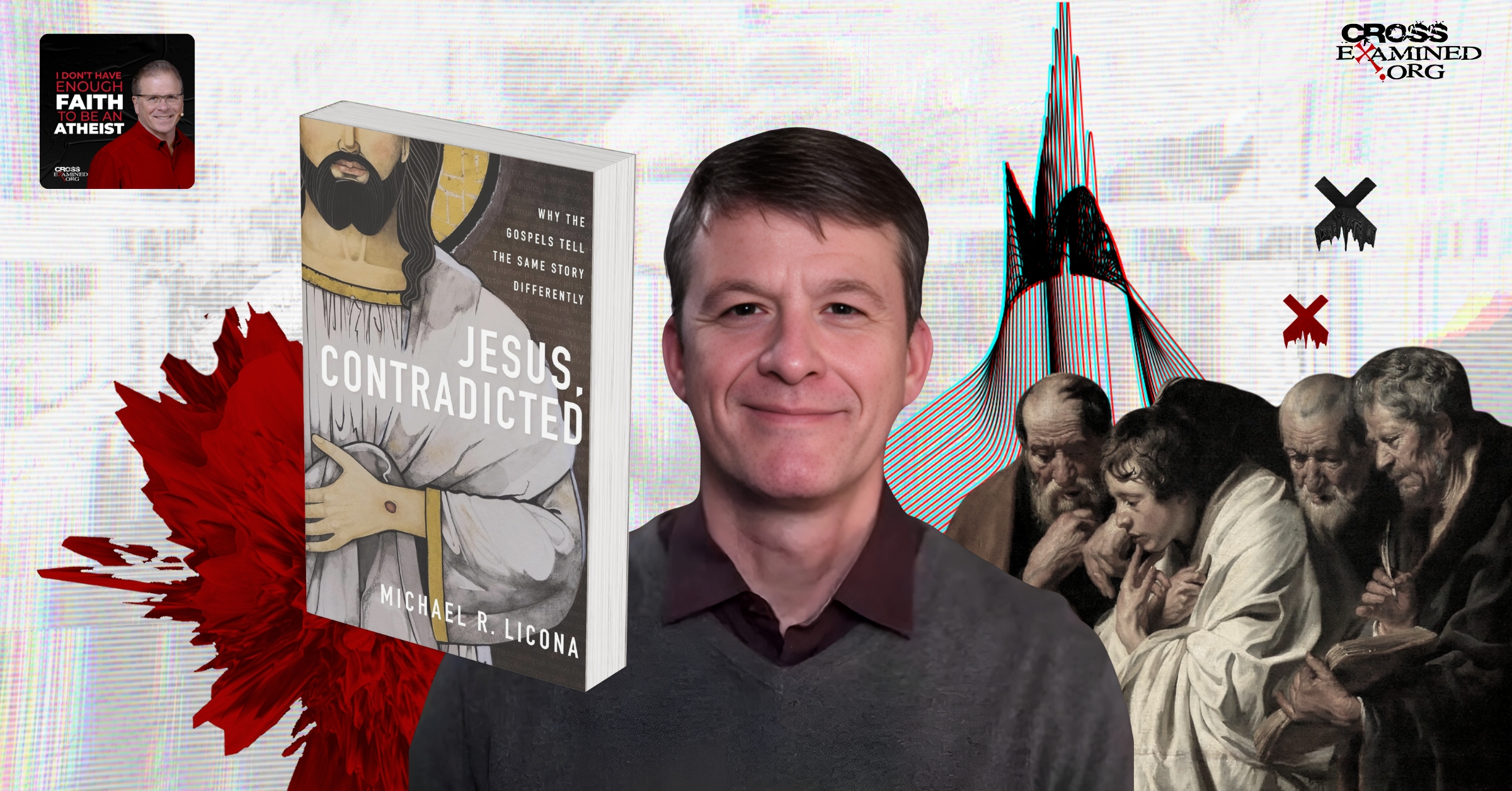
This week, author, Christian apologist, and New Testament scholar, Dr. Mike Licona, sits down with Frank to expose the truth about “errors” in the Bible, specifically tackling some of Bart Ehrman’s objections to the reliability of the New Testament. He’ll also discuss the release of his new book, ‘Jesus, Contradicted: Why the Gospels Tell the Same Story Differently‘, which is a resource aimed to help Christians navigate through textual variances. During the episode, Frank and Mike will answer questions like:

  • What is the true meaning of divine inspiration?
  • What is the Chicago Statement of Inerrancy and what are some of its shortcomings?
  • Did God dictate to the Gospel authors?
  • Are there errors in the original Bible manuscripts?
  • What is literary spotlighting and how does it apply to the Resurrection narratives?

Buckle your seatbelts friends, because this podcast episode is likely going to make you uncomfortable by challenging much of what you’ve been taught (or assumed) about biblical inerrancy. Is it okay that the Bible doesn’t have camera-like accuracy in some places? Listen as Dr. Licona helps us to take a fresh look at the doctrine of inerrancy and then decide for yourself. And be sure to pick up a copy of the book, ‘Jesus, Contradicted‘!

To view the entire VIDEO PODCAST be sure to join our CrossExamined private community. It’s the perfect place to jump into some great discussions with like-minded Christians while simultaneously providing financial support for our ministry.

You can also SUPPORT THE PODCAST HERE.

Mike’s book: Jesus, Contradicted: Why the Gospels Tell the Same Story Differently
DEBATE: Is the Bible Inerrant? (Mike Licona vs. Richard Howe)


Download Transcript


Gospel-centered churches are as important as ever, with powerful worldly forces at work actively competing with Christ for the souls of men.[1]

The world buys our attention and convinces us that purpose exists in tangibles, accolades, relationships, drugs, fame, and money. In the Bible, the book of Romans tells us that all of mankind has sinned and fallen short of the glory of God (Rom 3:23). There is no one exempt from this reality.

At the root, we have a soul problem. The world and all that is within it will never fill the deep void that every human being is born with. Romans goes on to say that the wages for sin is death, but the free gift is eternal life in Christ (Rom 6:23). The only way ultimately to escape the snare of death and darkness is to believe in Jesus as Lord.

May God Increase Our Numbers

If we just focused on Increasing mere church attendance, that doesn’t amount to true revival or changed-lives. An isolated altar call at the end of every worship service is not enough. The Gospel still must be preached. And it’s important for pastors to create space for reflection and response to that message. But the church-body must be devoted to discipleship and spiritual counsel for those who do accept Jesus.

The church has both the opportunity and responsibility to proclaim the Gospel to those around us. As stated, Jesus alone offers abundant life, and he wishes that none should perish. Helping a person see their depravity before Christ is not done by shaming or condemning. Rather, we love someone in word and deed. As trust builds, the floor for gospel conversations greatly expands.

Rather than growing in comfortability, may we grow in boldness. There is nothing more energizing than seeing a person come to saving faith in Christ. Save a seat for your neighbor at church. Seek out your co-worker struggling with loss and pain. Get to know the waiter at your favorite restaurant. Pray that the Lord would give you opportunities to share his Gospel with the people near and far from you.

May God Send More Laborers

Scripture says that the harvest is plentiful, but the laborers are few. Laboring for the gospel means that we will meet persecution. In Matthew chapter ten, Jesus told his disciples that they are sent out as sheep among wolves (Matt 10:16). Satan loves to use the fear of man as a tactic to hold us back from proclaiming Jesus.

The Holy Spirit is our wonderful Helper and Advocate. He gives us wisdom and words to say in moments of sharing with others. Though we will be met with obstacles and even judgment along the way, our confidence rises as our dependence on the Lord deepens.

The Great Commission to share the Gospel is not assigned to a certain group of religious leaders, pastors, or apologists. All believers share in the responsibility to speak truth over a lost and broken world (Matt 28:18-20).

Many Christians say that they feel unprepared to share with someone. Oftentimes, the fear of rejection or unknown outcomes holds us back from simply beginning a conversation. Though it is rarely easy or comfortable, God is incredibly faithful to use our obedience for his glory.

Rather than feeling pressed to have all the answers, a beautiful starting point may be to share your story. Sharing what the Lord has done for you makes it personal and real. Scripture says that there is power in our testimony. The woman at the well is a wonderful example of this (John 4:1-42). She believed that Jesus was the true Messiah because he knew her story and loved her anyway. Shame could no longer hold her back, and her brokenness was being graciously turned to beauty. She immediately left to tell everyone the news!

We will be mocked and made fun of for our belief. Being a Christian is to be in the minority in today’s age. Second Timothy chapter one reminds us to be unashamed for Christ (2 Tim 1:8). The Lord knew we would be afraid at times, and he gave us many passages of scripture to hold onto. He promises to be with us and will never leave nor forsake his children.

May God Make Us One Flock

Romans chapter twelve reminds us that we are many in Christ but one body. The passage goes on to say that we all have different gifts to use because of the grace we have received from God (Rom 12:3-8).

Lasting unity builds and thrives in Christ alone. God uses all different types of people with diverse backgrounds to reach the lost. The church on earth should resemble heaven. We must be unified in our goal to make the name of Jesus known.

Socioeconomic status, gender, occupation, titles, race, and prestige do not have an impact on how the Lord moves. Yet, these issues can lead to great areas of division if we are not careful. Too often, God’s sheep make more noise about their differences than the most important thing they have in common: Jesus.

We often hear stories about people leaving their faith behind because of a horrible incident that took place at church or involving Christian leaders. Though devastating, humans hurt humans, and church can become very messy at times. The moment our worship gatherings and ministry become about anything other than the Gospel of Jesus Christ, pride and sin grows exponentially.

As a body of believers, we see tremendous unity when we focus on Jesus alone. In service projects, ministry events, and worship gatherings, the family of God is enjoyed because of God himself. The moment our eyes and hearts drift, we become chaotic people with misaligned priorities. Being one flock means we focus on the Good Shepherd for wisdom, provision, clarity, and guidance.

There is no one holier than thou. May we serve the Lord in mutual humility and gratitude. Our differences pale in comparison to the tremendous joy of collective reverence to King Jesus. The essential matters of our faith can be the unifying factor for denominations and believers. Even in disagreements on these things, the message of Christ will always be love. Though we may not accept or condone certain belief systems, we must extend love.

Spiritual gifts are a beautiful marker of God’s grace in our lives. Though he does not need us, he chooses to use us in accomplishing his purposes. Unity among the church is experienced as members walk in their individual giftedness.

Acknowledging that where you are weak someone else is strong provides further opportunity for impact. Teamwork in the family of God is a remarkable sight. Prayerfully consider your spiritual gifts according to 1 Corinthians chapter twelve.

Ask the Lord to show you where he would like to use you within the church and within your community. Link arms with those who have similar passions and have gone before you. Seek wisdom from the leaders in your life and grow in amazement as you see God work. He is faithful to do immeasurably more than we could think or imagine as we seek to walk in humble submission to do his will (Eph 3:20). Stay lowly, passionate, and united, Christ followers.

References:

[1] Editor’s note.

Recommended resources related to the topic:

Jesus vs. The Culture by Dr. Frank Turek DVD, Mp4 Download, and Mp3

Reflecting Jesus into a Dark World by Dr. Frank Turek – DVD Complete Series, Video mp4 DOWNLOAD Complete Series, and mp3 audio DOWNLOAD Complete Series

Jesus, You and the Essentials of Christianity by Frank Turek (INSTRUCTOR Study Guide), (STUDENT Study Guide), and (DVD)      

Woman to Woman: Preparing Yourself to Mentor (Book) by Edna Ellison & Tricia Scribner


Annie Brown has joined us as Content Coordinator working with the Truth That Matters team. In this role, Annie will be creating written content meant to edify and equip lay learners and scheduling content channels as needed. In addition to being a student at SES, Annie has a B.S. in Family & Child Development from Liberty University. “I am grateful for the opportunity to serve on the Truth That Matters Team at SES. Using my passion of writing to prayerfully bless others excites me, and I look forward to what the Lord has in store.”

Original posted at: https://bit.ly/3KdACU9 

A recent Huffington Post article about homeschool moms left me flabbergasted. I know, it’s HuffPo. I shouldn’t be surprised anymore, but this article was truly shocking . . . because of the comments of the homeschool parents.

In the article, a curriculum developer is selling her books at homeschool conventions. She calls her trade a “girl-empowerment business.” Homeschool parents were rightly curious about the political slant of a historical curriculum and asked if this particular series was “woke.” The authors of the curriculum, asked “What do you mean by that?” (hat tip to Greg Koukl).[i] Now here is the troubling part. The homeschool parents didn’t know the answer. They knew they didn’t want woke, but they weren’t sure what they were rejecting or didn’t know how best to explain it. One exchange with the curriculum’s presenter went this way:

“I [the author] explain our product, how we use historical women to teach girls about their worth and potential. The mother says: “But is it woke? I mean, I don’t want to teach my daughter about woke.”

“What do you mean, ‘woke’?” I ask. . . She opens her mouth. Half-words and phrases stumble and tumble around. A few talking points from news sources fall out. Finally, she sighs. “I don’t know. Just tell me again what you write.”

How heartbreaking this article was to read! I totally expected our homeschool crowd to get this right, so when they didn’t, I immediately wanted to equip all Christian parents to be able to answer this question. We should strive to always understand the terms we use—especially if we are going to loudly reject it. By defining our terms, we can better learn how to help our kids navigate these muddy cultural waters.

Don’t just label things “Woke” without being able to explain why.

Woke has become an easy catch-all word to label things that are very liberal or progressive, or even just the things we disagree with ideologically. We find it far easier to label things as “woke” to indicate, “Danger! Toxic! Avoid this!”, rather than to take the time to research it for ourselves. But that hasty labeling risks yeeting the baby with the bathwater. And it doesn’t teach people how to chew through their ideological food, swallowing the meat, and spitting out the gristle (i.e., what doesn’t align with biblical Christianity).[ii] You don’t have to go read Mein Kampf or The God Delusion, but if you need to read complicated material, you’ll need to do so wisely, especially if you want to help your family and friends to do the same. If you don’t know why you avoid woke movies or books, they won’t understand how to navigate these concepts for themselves.

The HuffPo article helped us see that the word “woke,” the grammatical aberration that it is, is not going away. We need to know what it means when others use it and learn better questions to ask or terms to use that offer more clarity.

Where did the word Woke come from?

Are you awake yet? Stay awake. These phrases began to circulate generally in the African-American community and gained traction around the time of George Floyd’s death, suggesting that people needed to be aware of racism or to stay vigilant, so they are not harmed or mistreated by racism.[iii] When people described the process of becoming racially aware, they would say they woke up, and people began to use the term woke to imply that they were awake to what is happening and staying on top of the situation.

But the term evolved as the African American community started using woke to describe people that had been awakened to or were conscious of social, economic and racial inequalities, had ‘done the work’, and were educated about social injustice. However, the work produced by some of these scholars and authors often had a significant political slant, and conservatives began using the term as a negative insult. And busy parents, like myself, just adopted the word as a ‘no-no’ and moved on with our lives. We’re trying to survive sports practices, science fairs, and flu season. We don’t have time to pee in private, much less read every book and article that comes our way. Labeling things ‘mark and avoid’ is a survival skill. But it’s important, when you’re not in survival mode, to take a beat and learn what you mean by terms like woke.

What does Woke mean now?

In popular usage today, “woke” tends to mean something that has a left-leaning, liberal, or progressive slant especially regarding race issues. Additional characteristics of wokeism are extreme political correctness, DEI (diversity, equity, inclusion), and cancel culture. Woke resources often view everything through a lens of critical theory which, applied to race, becomes “critical race theory” (CRT).

What is CRT?

Uh oh, another boogeyman buzz word that is hard to define. Critical theory (which includes race theory, queer theory, etc.) basically critiques society by dividing people into oppressor vs. oppressed based on which groups they belong to. People are defined more by their group affiliation rather than seen for who they are as individuals. Humans are seen as naturally good until societal evils warp them. Then the voices of those who have been historically oppressed are given greater authority to speak due to their lived experiences. Experiences are too subjective to use as a foundation for truth, which is why Christians stand on the solid foundation of God’s word, balanced with rational thought, logic, and empirical truths. Considering the experiences of others helps us understand how policies and laws influence lives, which is a critical part of loving our neighbors as ourselves. In practice, however, critical theory creates new oppression as a solution for prior oppression. This dynamic results in less equality and more prejudice.

Leviticus 19:15 “You shall do no injustice in court. You shall not be partial to the poor or defer to the great, but in righteousness shall you judge your neighbor.” (ESV)

While our current zeitgeist of radical empathy would suggest that truly being fair would mean to favor the oppressed in order to right historical mistreatment, the Bible holds a different standard. All humans are made in the image of God, and we want to avoid lenses that strip people of that dignity while conferring greater dignity to others.

How does woke show up in our daily lives?

In practice, woke often means using revisionist history to paint historical figures with a broad brush. It is often profoundly anti-American, sometimes Marxists, and overly critical of western civilization (think 1619 Project). When discussing books or curriculum, woke can mean something that presents only leftist viewpoint or oversimplifies a complex issue by vilifying people of the past unfairly. Some people in the past were straight-up villains, like our favorite whipping-boy Adolf Hitler. But most historical figures were complex, not all good or all bad. We need to treat them as whole persons as much as we can with the information available to us by studying history fully, considering the facts from primary sources as well as commentaries from historians.

Additionally, wokeness is deeply tied to social justice. Radical gender theory and LGBTQIA+ issues would now fall under the inclusion umbrella. Woke resources for children would include materials that separate gender from biological sex and present various parent structures as normal in children’s books, but also might include graphic sexual materials, even depicting homosexual or pedophilic sexual acts. But it’s important to note that not everyone who considers themselves “woke” agrees in supporting these extreme examples.

A Word of Warning

In discussing wokeness, we’re touching on some tangled and complicated issues. We do well to exercise caution and humility. The book of Hebrews offers an important insight here:

Hebrews 5:14 reminds us, “But solid food is for the mature, for those who have their powers of discernment trained by constant practice to distinguish good from evil.”

Our powers of discernment must be trained through constant practice. So, as we grapple with a shifting sense of “wokeness,” ask good questions, always comparing the world’s messages against God’s truths. Seek to understand. Weigh your words with humility and respect. Find common ground where you can, and balance truth with love. “Woke” is a heavy word, with lots of baggage. And it isn’t going away.

So, stay alert my friends.

References: 

[i] Greg Koukl has made famous the “Columbo tactic”, a tool for apologists where they ask probing questions like “What do you mean by that?” to better clarify and assess the situation. See, Greg Koukl, Tactics, 10th Anniversary Edition: A Gameplan for Discussing Your Christian Convictions (Grand Rapids: Zondervan, 2019).

[ii] This concept is called the “Chew and Spit method”, see Hillary Morgan Ferrer, et al., Mama Bear Apologetics: Empowering Your Kids to Challenge Cultural Lies (Eugene, OR: Harvest House, 2019), 47-62.

[iii] Editor’s Note: Historically, the word “woke” originally meant something like “stay alert.” Black Americans in the early 20th century and Jim Crow era would warn each other saying “stay woke,” meaning be on guard against threats of race-based violence, especially where there was an uptick in racial tensions (ex., recent Klan activity, rape-accusations, lynching, police harassment, etc). In recent years, the term reentered public discourse through Black Lives Matter (BLM), and the George Floyd protests in Ferguson Missouri (2014), where the term was resurrected with a similar meaning of “stay alert [to racial violence/injustice].” Arguably, BLM was already adapting the term at that time by infusing it with politically charged notions of social justice, Critical Race Theory, Intersectionality, and Queer Theory. Regardless, the term has since been coopted and adapted by political progressives to cover a wider range of left-leaning issues, but instead of referring to alertness and racism specifically it’s now cast as a kind of “enlightenment” where people are finally able to see – as if waking up from a dreamy delusion – how oppressive power dynamics more or less shape the course of human history and modern society, regarding race, gender, sexuality, marriage and family, economics, politics, environment/climate, etc.

Recommended resources related to the topic:

Was Jesus Intolerant? (DVD) and (Mp4 Download) by Dr. Frank Turek 

Jesus vs. The Culture by Dr. Frank Turek DVD, Mp4 Download, and Mp3

Correct not Politically Correct: About Same-Sex Marriage and Transgenderism by Frank Turek (Book, MP4, )

Legislating Morality: Is it Wise? Is it Legal? Is it Possible? by Frank Turek (Book, DVD, Mp3, Mp4, PowerPoint download, PowerPoint CD)


Jennifer DeFrates is a former English and Social Studies teacher turned homeschool mom and Christian blogger at Heavennotharvard.com and theMamapologist.com. Jennifer is a 2x CIA graduate (the Cross-Examined Instructors Academy) and volunteers with Mama Bear Apologetics. She has a passion for discipleship through apologetics. Her action figure would come with coffee and a stack of books. She is also the reluctant ringleader of a small menagerie in rural Alabama. 


If we live long enough, grief is something that we will all experience at one point or another. Grief is difficult. Some have even said that “grief is a challenging beast.” It impacts each person differently. Grief is a sense of sorrow that one feels when a person experiences a form of loss. More frequently, this loss is associated with those who have had loved ones who passed away. However, grief can also include the loss of a job, friendship, hobby, or position.

As I have dealt with loss in my personal life, I have surprisingly found how beneficial apologetics is when going through times of sorrow. Apologetics—that is, the defense of the Christian faith—may seem like an unlikely ally of bereavement and psychospiritual care, as many associate it with the headier intellectual avenues of the Christian faith. Nonetheless, apologetics can assist one with their grief in three specific ways.

Apologetics Gives Stability Through Times of Grief.

First, apologetics can give stability through times of grief. When a person experiences loss, they may feel as if their world has irreparably changed. And in some ways, it has. The loss of a loved one evokes a sense of what some grief counselors call the “new normal.” That is, it speaks to the continuity of life without the physical presence of the loved one.

While it cannot repair the hurt one feels, apologetics can offer concrete proofs for the Christian faith, which remain intact regardless of the changes of life. For instance, resurrection studies and explorations into near-death experiences have intensified my belief in heaven. These studies assure me that Christ has defeated death and, thereby, assured that life continues into eternity. My theological studies point that the same God who brought victory over death remains the same “yesterday, today, and forever” (Heb. 13:8, CSB). When the world seems as if it has turned upside down, apologetics and theological studies can give a sense of security.

After getting sick on a boat in the Atlantic due to turbulent waters, it was seeing the Oak Island Lighthouse that eventually alleviated my nausea. The lighthouse was like a North Star, a fixed point amid the chaos of the moment. In like manner, apologetics can offer us an anchor in a sea of chaos.

Apologetics Grants Security Though Times of Grief.

Second, apologetics grants security through times of grief. Here, security implies increased faith. The field of apologetics is intended to bolster a person’s faith. The goal of the apologist should be to lead believers to deeper belief, while offering skeptics a reason to believe.

When we lose someone near and dear to us, our world is turned upside-down. We may wonder why God allowed such a thing to happen, thus entering the realm of theodicy (why a loving God allows evil in the world). If left unresolved, a person could suffer emotional doubt.

Even though apologetics cannot guarantee that a person will never suffer emotional doubt, apologetics can equip a person with better tools to deal with emotional doubt when it arises. Coupled with a solid systematic theology, a person can better trust God with the uncertainties of life.

Grief counselor David Kessler once said, “Human beings had rather feel guilty than helpless.” He goes on to say, “The guilt you feel during grief comes from the belief that you could have been there and stopped it from happening. Guilt can be released when you find the compassion for yourself to know that you’re not in control, and maybe never were.”[i] Helplessness is a difficult pill to swallow. I cannot tell you the number of times that I have felt overwhelmed by the helplessness while working in hospice.

Nonetheless, when we know the One in control and that that One is a benevolent, compassionate, and faith friend, then it makes the grief process much easier to process. That does not mean that apologetics affords a comprehensive understanding as to why certain things happen as they do. No one but God Himself could answer that question. But it will spur faith in the One who maintains such comprehensive knowledge.

Apologetics Gifts Serenity Through Times of Grief

Finally, apologetics gifts us with serenity through times of grief, especially for those who have lost loved ones through the passage of death. As previously noted, studies of the resurrection of Jesus assures us that death has been defeated and that an afterlife exists. Studies of near-death experiences highlights what that experience may be like in the intermediate state.[ii]

Coming into hospice with this knowledge opened the door to see certain things through an individual’s passage into eternity that I may have otherwise missed. Nonetheless, when a person loses someone near and dear to them, such studies offer the bereaved a serenity about the afterlife that cannot be obtained in any other fashion. If a person has an assurance of an eternal life in heaven with God through Christ, then even death loses its sting (1 Cor. 15:55).

Conclusion

Grief is a natural emotion that comes with loss. Everyone grieves differently. Some are tearful, whereas others are more Stoic. Some need time with a lot of people, while others need time alone. Grief is something that we will all experience at some point. Yet, as this article has shown, apologetics can assist us during our times of grief. It can give us something concrete to hold to, a North Star to direct us, or a lighthouse to ascertain a sense of security in a turbulent ocean of change. Most importantly, apologetics should bolster our faith in the One who created not only North Star and land upon which the lighthouse stands, but also the sky’s canvas and the ocean itself. In the end, our serenity, security, and stability are not in apologetics, but in the Triune God for whom apologetics encourages us to place our truth.


Footnotes:

[i] David Kessler, Grief.com.

[ii] The “intermediate state” refers to the time between a person’s death and the final resurrection that accompanies the return of Christ.

Recommended resources related to the topic:

If God, Why Evil? (DVD Set), (MP3 Set), and (mp4 Download Set) by Frank Turek

Why Doesn’t God Intervene More? (DVD Set), (MP3 Set), and (mp4 Download Set) by Frank Turek

Why does God allow Bad Things to Happen to Good People? (DVD) and (mp4 Download) by Frank Turek 

Relief From the Worst Pain You’ll Ever Experience (DVD) (MP3) (Mp4 Download) by Gary Habermas 


Brian G. Chilton earned his Ph.D. in the Theology and Apologetics at Liberty University (with high distinction). He is the host of The Bellator Christi Podcast and the founder of Bellator Christi. Brian received his Master of Divinity in Theology from Liberty University (with high distinction); his Bachelor of Science in Religious Studies and Philosophy from Gardner-Webb University (with honors); earned a Certificate in Christian Apologetics from Biola University, and plans to purse philosophical studies in the near future. He is also enrolled in Clinical Pastoral Education to better learn how to empower those around him. Brian is a member of the Evangelical Theological Society and the Evangelical Philosophical Society. Brian has served in ministry for over 20 years and currently serves as a clinical hospice chaplain as well as a pastor.

Original Blog Source: https://bit.ly/3KhC2gi


The debate over abortion remains one of society’s most divisive issues. Pro-life advocates argue for the rights of the unborn, emphasizing the sanctity of life from conception and advocating for policies to protect fetal humans. On the other hand, pro-choice advocates defend the right of individuals to make autonomous decisions about their bodies and reproductive health. Amid these deeply held convictions are discussions about the moral status of the unborn, making it a debate that is both intimate and public, personal and political.

Everyone Has An Equal Right to Life . . . Or Not

In his book, The Case for Life: Equipping Christians to Engage the Culture, pro-life apologist Scott Klusendorf writes, “The question of truth and of human value are driving our national debates on abortion, cloning, and embryonic stem cell research (ESCR).”[1] Klusendorf goes on to say, “The debates are contentious because they involve deep worldview commitments that get to the heart of who and what we are as people. But the debate itself is not complex. Either you believe that each and every human being has an equal right to life or you don’t.”[2]

Klusendorf’s point encapsulates the underlying significance of this pro-life and pro-choice debate. The issue at hand goes beyond mere personal preference or opinion. It delves into fundamental questions about truth, human worth, and the essence of our existence. The complexity arises from the contrasting worldview commitments that shape our perspectives.

From Conception Onward

As Christians, we base our belief on the principle that every human being, starting from the moment of conception, has an equal and undeniable right to life. This belief aligns with the biblical truth that we are fearfully and wonderfully made by our Creator. Therefore, each individual deserves to be loved, protected, and respected from the moment of conception.

When we adopt the perspective from pro-life apologetics, we become active participants in the ongoing national conversations regarding the inherent worth and dignity of every unborn life. Given this moral issue’s sensitive and divisive nature, however, it is essential to approach pro-life apologetics with compassion and respect, striving to engage in constructive dialogue with those who may hold opposing views. By understanding and articulating the pro-life argument utilizing logic, science, and philosophy, you can effectively advocate for protecting innocent lives.[3]

The Case for Life Argument

In his book, “The Case for Life,” Klusendorf lays out a clear argument supporting the pro-life position. The crux of his argument centers around the idea that unborn human life has dignity and intrinsic value, deserving protection from the moment of conception. Klusendorf’s argument is presented in a syllogism (a major premise, minor premise, and conclusion).

  1. Major Premise: It is morally wrong to intentionally kill innocent human beings.
  2. Minor Premise: Abortion intentionally kills innocent human beings.
  3. Conclusion: Therefore, abortion is morally wrong.

Klusendorf’s explains his first premise in terms of the inherent value of human life and the nearly universally acknowledged ethical standard that taking innocent life is wrong. To develop his secondary premise he introduces some biological and philosophical grounding, asserting that human life commences at conception, thus human embryos and fetuses as integral members of the human community. By merging these two premises, Klusendorf reaches the conclusion that abortion – which, by definition, kills and unborn human being – is ethically unjustifiable.

Answering Objections

Klusendorf addresses common objections to this argument, such as claims that the unborn are not “persons” with rights or that women have a right to bodily autonomy that overrides the rights of the unborn. He critiques these objections by asserting that no morally relevant difference between the unborn and those already born would justify killing the former.

In short, Klusendorf’s pro-life argument presents a solid philosophical and moral framework that upholds the equal value of all human life from the moment of conception. Based on this premise, he convincingly concludes that abortion is inherently wrong.

If You’re Pro-Life, You Need This Book

Incorporating Scott Klusendorf’s teachings into pro-life advocacy can help believers engage in meaningful conversations about the value of life from a Christian perspective. By standing up for the dignity of all human beings, including those yet to be born and advocating against abortion, we honor God’s gift of life and promote a culture that cherishes every individual as precious in His sight, thereby safeguarding the sanctity of human life.

References:

[1] Scott Klusendorf, The Case for Life: Equipping Christians To Engage the Culture. 2d ed. (Wheaton, IL: Crossway, 2023), 2.

[2] Klusendorf 2023, 2.

[3] Editor’s Note: “The pro-life argument” refers not to a single line of argument but rather to a broad category of arguments. Klusendorf’s prolife argument is one of the most popular and widely respected, but there are other ways to argue the prolife position. One could focus on debunking abortion-choice claims, or discrediting abortion-choice culture, or exposing problems in abortion-choice policy. Or one could argue that abortion-choice advocates carry the heavier burden of proof, since they are arguing for killing, and have so far failed to resolve that burden of proof. Or one could argue that reasonable doubt regarding the status of the unborn is sufficient cause for provisional protection. There are many ways to argue the pro-life position, even if Klusendorf’s line of argument is one of the best overall arguments to work with.

Recommended Resources On This Topic

The Case for Christian Activism (MP3 Set), (DVD Set), and (mp4 Download Set) by Frank Turek 

Legislating Morality (mp4 download),  (DVD Set), (MP3 Set), (PowerPoint download), and (PowerPoint CD) by Frank Turek

If God, Why Evil? (DVD Set), (MP3 Set), and (mp4 Download Set) by Frank Turek 

Is Morality Absolute or Relative? (Mp3), (Mp4), and (DVD) by Frank Turek


Jason Jimenez is President of STAND STRONG Ministries and author of Challenging Conversations: A Practical Guide to Discuss Controversial Topics in the church. For more info, check out www.standstrongministries.org

Originally posted at: https://bit.ly/44NUeaU


Human origin is a fascinating area of research today. With all the different models for the origins of humanity being proposed, I see an increase in the discussions, both scientific and theological. For everyone reading this post, this area of research should be of utmost interest for you as well. Two critical ideas about humanity are at stake depending on which model (or family of models) is true: intrinsic and equal human dignity and value, and the sinfulness of humanity.

The age-old debate about God’s existence has great implications on this area of the debate about human origins. The Judeo-Christian claim that all humans are created in God’s Image and that humans possess a sin nature that will cause them to tend toward the immoral. These paradoxical doctrines together explain both the greatness and wretchedness of humanity that we see every day, throughout history, and expect in the future.

The Image of God

If we are created in the image of God that means that all humans possess intrinsic and equal human dignity and value (Genesis 1:26-28).[i] If this is false, then humans are not valuable in virtue of their being human but in virtue of a myriad of other characteristics and statistics that change in fashion with the culture. One moment a human can be valuable and the next moment they are not. If humans do not have value at any point, that gives justification for their expendability (murder) at the hands of those who have power over them at that point. If humans are not created in the image of God, then there is nothing wrong with humans abusing their power against other humans. Any model of human origins that does not allow for the Image of God in humans places the very lives of every human at risk.

Human Sinfulness

Genesis also records that Adam and Eve sinned against God and with that action brought the sin nature into all future humans (Genesis 3). Humans are not born good or even neutral. This means that the abuse of power described above is not just possible but inevitable. Any model of human origins that does not allow for the Fall or for the transfer of the sin nature (whether through the biological, spiritual, or some combination) denies this element of human psychology, sociology, and history (Genesis 5:1-3; 9:6; James 3:9).

Denying Both?

Any model that does not allow for one or the other already makes human lives less worthy of protection because either it is not worth protecting or there is nothing to necessarily protect against. But if a model denies both, then that is a recipe for disaster. This means that the debate about human origins is not just a scientific question but also a philosophical one, even for the atheist or naturalist. An interesting analysis of the implications of these two characteristics is provided in Os Guinness’ book The Magna Carta of Humanity which I highly recommend, particularly for those involved in human origins discussions and debates. It provides a renewed urgency for the importance of the debate about human origins.

Should Theology Judge Science?

I often hear the claim that many Christians allow their theology to determine their interpretation (and maybe even rejection) of the scientific data. The implication is that we should not allow any knowledge discipline (or at least, theology) other than science in developing our model or that we should at least give precedence to science.

 It is important to recognize at this point the distinction between “science” and the “data of nature.” The discovered data is the raw information that must be accommodated in any model, whereas “science” is the interpretation of that data. That interpretation is fallible, but not necessarily false. There are many sources of truth about human nature, including philosophical, historical, and theological sources; and that information should be recognized and accommodated in any model of human origins if it’s to accurately reflect the natural history of human origins. That’s our best shot at identifying what really happened. Just as the data of nature can judge our interpretation of the data of history and Scripture, the data of history and of Scripture can judge our interpretation of the data of nature in virtue of their being true.

[Editor’s note: While many say science is the only way we can know anything about anything, they are endorsing scientism – which is not itself science, but philosophy. So, it’s self-defeating.] Therefore, we cannot responsibly allow scientism to prevent our discovery of the correct model of human origins. To do so, would be misinformed if not dangerous.

Conclusion

With the work in the field of human origins being done at numerous Christian organizations, the number of possible models and level of detail may seem confusing to many yet exciting to others. But they are important for all of us. I encourage these organizations to continue (or begin) working together to gather all the data that each emphasize in their respective models and adjust those models to reflect the data from others. We need to be careful and respectful of any accusations of heresy, ensuring that our accusations are demonstrably reflective of the model not the Christian, and that we address such accusations with or adjust our models based on the biblical data and logic. It is important that even though we may disagree on details that we present a united front that is based on the data and sound reasoning from that data, not only for the future of humanity, but as a demonstration of the unity and love that Christ prayed for and told us that unbelievers will see. We need to not only demonstrate the truth of these important Christian doctrines (ones that are often under attack and used as excuses to reject Christ) but we need to emphasize our love, respect, cooperation, and dedication to truth that unbelievers often overlook.

References:

[i] Editor’s note: There are at least four main theories in church history regarding the nature of the “imago dei” (Image of God). Some, follow the Socinian tradition, teaching that the Image of God refers to mankind’s dominion and authority over the rest of Creation. Others, including Thomas Aquinas, say it refers to human intellect in the sense of rationality, self-reflection, and reasoning abilities all of which set humanity apart from the rest of the animal world. Others follow Karl Barth’s theory that the imago dei refers to human relationships, where Adam and Eve, can have fellowship, friendship, marriage, family, and therein fulfull their cultural mandate to “be fruitful, multiply, and fill the earth” (Gen. 1:26-28). Still others affirm the reformation view, represented by John Calvin, which treats any combination of God’s shareable attributes – authority, relationship, intellect, etc. – as the “image of God” in man. See, John Ferrer, “Chapter 3: Creation and the Image of God,” in Body Ethic [Dissertation] (Fort Worth, TX: Southwestern Theological Seminary, 2013), 91-110.

While Nix doesn’t go into all this detail in his blog post here, these four theories illustrate different ways Nix’s assertion could hold true. He says, “all humans possess intrinsic and equal human dignity and value” – whether in their nature as relational beings, as rational creatures, as representative authorities, or all of the above. Our equal dignity can trace back to our inherent nature – an unchanging and grounded fact about all human beings, since every human being is in God’s image (Gen 1:26-28; 5:1-3; 9:6; James 3:9).

Recommended resources related to the topic:

Is Original Sin Unfair? by Frank Turek (DVD, Mp3, and Mp4)

Was Jesus Intolerant? by Frank Turek (DVD and Mp4)

Stealing From God by Dr. Frank Turek (Book, 10-Part DVD Set, STUDENT Study Guide, TEACHER Study Guide)

Is Morality Absolute or Relative? by Frank Turek (Mp3/ Mp4)


Luke Nix holds a bachelor’s degree in Computer Science and works as a Desktop Support Manager for a local precious metal exchange company in Oklahoma.

Original Blog Post: https://bit.ly/3xEkXud


More than two years ago, I participated in a debate in Oxford, England, with atheist YouTuber Alex O’Connor (who goes by the online alias Cosmic Skeptic). The subject was “Why I Am / Am Not a Christian,” which was quite broad. Given the short time constraints of the debate and the breadth of the topic, we were regrettably unable to pursue an explication of our differences with the depth that I would prefer. Nonetheless, I very much appreciated my interaction that evening with O’Connor, including the dinner we enjoyed together before the event. I have long viewed O’Connor as one of the more philosophically nuanced atheist thinkers, and I have valued our ongoing private discussions subsequent to our initial public dialogue. My positive argument in the debate concerned the evidence for Jesus’s resurrection, while O’Connor focused on moral critiques of the Bible. In his portion of the cross-examination, O’Connor chose to focus on the issue of slavery in the Old Testament. The last of the texts we discussed was Numbers 31:15-18, which was interpreted by O’Connor to endorse sexual slavery. At the time, this was not an issue that I had researched with great depth, though I recognized it as a difficult text. My preparation for the debate had largely been on the evidences for New Testament reliability, and its epistemic relevance to developing a robust case for the resurrection. I therefore acknowledged it as a difficult text without offering any detailed response. Earlier this week, Alex O’Connor uploaded the clip from our debate, in which this text was discussed, to his Cosmic Clips spin-off channel. I therefore thought it an appropriate time to publish an article offering my current perspective on this difficult text.

What Does the Text Actually Say?  

Here is the passage under discussion:

“Have you allowed all the women to live?” he [Moses] asked them. 16 “They were the ones who followed Balaam’s advice and enticed the Israelites to be unfaithful to the Lord in the Peor incident, so that a plague struck the Lord’s people. 17 Now kill all the boys. And kill every woman who has slept with a man, 18 but save for yourselves every girl who has never slept with a man” (Numbers 31:15-18; NIV).

The first thing to note about this text is that it is not technically God who gives the instructions. Thus, on the worst case scenario, one may interpret this text as being descriptive of Moses’s command, rather than it being an act endorsed by God. Nonetheless, even supposing (as I think is more likely) that Moses’s instruction carries with it God’s approval, I do not believe it to be as problematic as it might appear on first impression. O’Connor believes that this text gives permission to the Hebrew soldiers to rape Midianite war captives. Such an interpretation, however, would fly in the face of every piece of clear moral legislation on sexual relations that we have in the Hebrew Bible. For example, in Deuteronomy 22:23-27:

“If there is a betrothed virgin, and a man meets her in the city and lies with her, 24 then you shall bring them both out to the gate of that city, and you shall stone them to death with stones, the young woman because she did not cry for help though she was in the city, and the man because he violated his neighbor’s wife. So you shall purge the evil from your midst. 25 “But if in the open country a man meets a young woman who is betrothed, and the man seizes her and lies with her, then only the man who lay with her shall die. 26 But you shall do nothing to the young woman; she has committed no offense punishable by death. For this case is like that of a man attacking and murdering his neighbor, 27 because he met her in the open country, and though the betrothed young woman cried for help there was no one to rescue her” (Deuteronomy 22:23-27; emphasis added).

According to this text, the crime of rape is so serious that it is punishable by death. If the woman failed to scream for help when she was in the city and could be heard, the Jewish law viewed the situation as consensual sex rather than rape, since the woman could have cried out for someone to rescue her but didn’t. Thus, both parties were guilty. If the sexual assault took place in a rural area, however, where the woman had no chance of being heard, the Jewish law gave the woman the benefit of the doubt and she was not to be considered culpable.

What about P.O.W’s?

One might object here that women captured in war were not afforded the same rights as women belonging to the people of Israel, and thus this consideration offers little help with regards to the text of our study. However, the previous chapter in Deuteronomy concerns the rights of women who are captured in war (Deut 21:10-14):

“When you go out to war against your enemies, and the LORD your God gives them into your hand and you take them captive, 11 and you see among the captives a beautiful woman, and you desire to take her to be your wife, 12 and you bring her home to your house, she shall shave her head and pare her nails. 13 And she shall take off the clothes in which she was captured and shall remain in your house and lament her father and her mother a full month. After that you may go in to her and be her husband, and she shall be your wife. 14 But if you no longer delight in her, you shall let her go where she wants. But you shall not sell her for money, nor shall you treat her as a slave, since you have humiliated her” (Deuteronomy 21:10-14; emphasis added).

Therefore, while the Hebrew soldiers were permitted to marry female war captives, they were not permitted to rape them or treat them as slaves. The woman was also to have a month to mourn the loss of her kin prior to getting married. Daniel Block notes, “This monthlong quarantine expresses respect for the woman’s ties to her family of origin and her own psychological and emotional health, providing a cushion from the shock of being torn from her own family.[i]

Indeed, as John Wenham comments, “In a world where there are wars, and therefore prisoners of war, such regulations in fact set a high standard of conduct.”[ii] Furthermore, by becoming part of the people of Israel (and possessing full status as a wife), the women would be delivered from pagan idolatry and exposed instead to Israelite religion concerning the true God, thereby having opportunity to attain salvation.

War Context

The historical context of the war against the Midianites is also important to bear in mind as we evaluate our text. Numbers 31:16 indicates that the Midianite women “were the ones who followed Balaam’s advice and enticed the Israelites to be unfaithful to the Lord in the Peor incident, so that a plague struck the Lord’s people.” This is an allusion to Numbers 25:1-9, in which we read of an occasion where the Midianites devised a plot to entice Israel into pagan worship involving making sacrifices to Baal and ritual sex. According to Moses, the Midianite women were among those who “enticed the Israelites to be unfaithful to the Lord” (Num 31:16). Thus, the women who were permitted to live and marry into Israel (that is, those who had not known man by lying with him) were presumably those who had not been involved in enticing the men of Israel into sexual impurity.

What the Text Doesn’t Say

Another consideration, often overlooked in discussions of our text, is that we are not informed what happened to young woman who were brought into the Israelite camp but who did not wish to marry the men who had just slaughtered their kin. We can hypothesize that they were forced into it anyway, but we can equally hypothesize that they were allowed to make themselves useful as virgins until such a time as someone more suitable presented himself. This is simply not stated or even intimated in the text. Thus, if there were women who were averse to being married to an interested Israelite soldier, we just do not know what happened. Moreover, even if on occasion something bad happened — and there is no reason to deny that sometimes it may have — it is not something we are told was done by command of God.

In conclusion, though Numbers 31:13-18 is undoubtedly a difficult text, especially from the vantage point of our twenty-first century western culture, the text becomes, upon closer inspection, significantly less problematic than it appears at first impression. The Pentateuch outlined the rights of female war captives, and they were not allowed to be treated as a slave or sex object. The Pentateuch also takes a very negative view of rape. Most likely, the women who were spared were not involved in enticing Israel into sexual impurity during the incident at Peor. Finally, we are not informed by the text what the arrangements were for women who did not wish to marry an interested Israelite soldier, and so any suggestion of what may have happened is mere conjecture.

Footnotes:

[i] Daniel I. Block, The NIV Application Commentary: Deuteronomy, ed. Terry Muck (Grand Rapids, MI: Zondervan, 2012), 496.

[ii] John W. Wenham, The Goodness of God (Downers Grove, IL: InterVarsity, 1974), 96.

Recommended resources related to the topic:

Is Morality Absolute or Relative? by Dr. Frank Turek Mp3 and Mp4

If God, Why Evil? (DVD Set), (MP3 Set), and (mp4 Download Set) by Frank Turek

Is Morality Absolute or Relative? (Mp3), (Mp4), and (DVD) by Frank Turek

Why Doesn’t God Intervene More? (DVD Set), (MP3 Set), and (mp4 Download Set) by Frank Turek

Why does God allow Bad Things to Happen to Good People? (DVD) and (mp4 Download) by Frank Turek


Dr. Jonathan McLatchie is a Christian writer, international speaker, and debater. He holds a Bachelor’s degree (with Honors) in forensic biology, a Masters’s (M.Res) degree in evolutionary biology, a second Master’s degree in medical and molecular bioscience, and a Ph.D. in evolutionary biology. Currently, he is an assistant professor of biology at Sattler College in Boston, Massachusetts. Dr. McLatchie is a contributor to various apologetics websites and is the founder of the Apologetics Academy (Apologetics-Academy.org), a ministry that seeks to equip and train Christians to persuasively defend the faith through regular online webinars, as well as assist Christians who are wrestling with doubts. Dr. McLatchie has participated in more than thirty moderated debates around the world with representatives of atheism, Islam, and other alternative worldview perspectives. He has spoken internationally in Europe, North America, and South Africa promoting an intelligent, reflective, and evidence-based Christian faith.

Originally published at: https://bit.ly/3wutuzg


Hope in the Promise

Throughout Scripture, we acknowledge God as a promise-keeper. What he says will happen will always comes to pass in his perfect timing. Because of this truth about God’s heart, believers are drawn to extravagant hope in all circumstances.

Upon sin entering the world in Genesis chapter three, God initiated hope by clothing Adam and Eve immediately following humanity’s downfall. After leading Noah to navigate a worldwide flood, God provided a dove from heaven as hope for a brighter future ahead. In calling Moses to lead the Israelites out of Egypt, God promised the hope of a land flowing with milk and honey on the other side of their trivial journey. Through the prophet Isaiah, God foretold the coming of Christ who alone would provide eternal hope. Ultimate hope is experienced in recognition of the empty tomb. Christ accomplished all that he promised and rose three days after being crucified for all sin, everywhere. We worship a living Savior!

The hope for believers today is that Christ will one day return. John 14:3 says, “And if I go and prepare a place for you, I will come again and will take you to myself, that where I am you may be also.” Christ has a place prepared for his children in eternity. Heaven with our Lord is where suffering and pain are no more. The trials of this life do not join us upon our departure from earth.

Until that day, we have been tremendously blessed with the gift of our Helper. Jesus goes on in John chapter fourteen with the promise of his Holy Spirit. He is there to teach us and allow us to remember all that we have been taught.

The reality is, while we wait for the promise of heaven, we are never waiting without both hope and help. The Spirit of God dwells within a believer’s very being. In moments of desperation, when hope seems lost, the Helper graciously brings truth to mind and restores our vision for brighter days ahead. Hope is a promise that Jesus keeps.

Hope in the Suffering

The book of James is one of many places in Scripture that confirms trials in this life. Following Christ does not exempt us from suffering and hardship. For most, you have already dealt with tragedy. If this is not true for you today, there will be future experiences that test your faith.

Suffering is difficult, but it does not have to be without hope. In fact, James reminds us that perseverance builds in pain. Early into 2023, my sister and brother-in-law were given a heartbreaking diagnosis for their unborn son. At just twenty weeks gestation, an anatomy scan ultrasound indicated that my dear nephew had Spina Bifida. The future development and physical milestones for children with Spina Bifida are incredibly uncertain. As new parents, my sister and her husband could have easily lost all hope. They could have chosen to see their son for his diagnosis and not his beauty. Our family, however, watched in awe as they did just the opposite. With each passing procedure and appointment, they clung to the Lord of Hosts. They recalled the faithfulness of God in their lives and in the lives of those who had gone before them. Hope in Christ was their ultimate comfort. Hope speaks the better word. It illuminates all that is still good in a very hard situation. Fetal surgery, being born at full-term, incredible doctors, and groundbreaking research were just a few markers of hope in their journey. This hope has grown them into remarkable parents, and God wasted not even a second of their most difficult weeks.

A further example of suffering is felt through death and loss of loved ones. Though death is not the end for those who are in Christ, it does not happen without grief and hurt. When losing someone close to us, especially at a young age or through unanticipated tragedy, it can feel impossible to see God’s goodness. Yet, in the quiet moments of remembrance, God, through his Spirit, is faithful to restore our hope and re-fix our gaze towards heaven. Losing someone that knew and trusting Jesus as Lord means that their future is glory. It is an eternity of no more the pain or tears. We can celebrate in such circumstances because of this hope.

Hope in the Waiting

Life is a journey. It is a process of being molded and sanctified to look more like Christ. There are seasons where we wait for God to work in a specific situation. Waiting is not an easy task and can seem to take years off our lives. The good news is that God never stops working. Our hope is that he is for us. The heart of God is not to abandon us in our waiting but to uphold us when we begin to sink. He is not far off when the answers seem to be. The Lord does not run away just because we do not understand. His promise is to never leave us or forsake us. The hope in the waiting is Jesus himself.

Waiting is not a wasted time. To further recall the gospel of John, Jesus says, in chapter fifteen, that as we abide in him, we will bear fruit. Abiding in Jesus means that we remain with him in every season. We are attached to him in both the valley and on the mountain top. Being close to Jesus allows us to enjoy a life of fruit even as we wait.

Worship and abiding are mutual expressions of faith. The Lord is glorified in our pursuit of him. As we seek to know him and walk closely with him, we are used as instruments for his purposes. The unfortunate reality is we are more prone to seek Christ out of our need for something in particular. Our prayer life increases when trials come knocking. Our expressions of worship and gratitude are best observed when provisions have been made and the wait is over.

As we make the decision to abide with Christ even in our waiting, the chemical makeup of our brain begins to shift. Our minds move past the complaints of our present because of the hope-filled promise of our future. In the conclusion of a waiting season, we will have grown in amazing ways by staying with Jesus. He is our hope, and He provides what no other temporary means of comfort ever could.

The ultimate wait for a believer is to be in heaven with Jesus. Heaven should invoke remarkable hope within us. The American dream says that milestones such as college graduation, marriage, and parenthood are what equates to success in this life. Therefore, the desire for all of these things to take place before meeting Jesus face to face can be substantial. Though these are good gifts from the Lord, the Lord himself is the best thing our hearts will ever know. There is a crown of glory that awaits the Christ-follower in heaven (James 1:12). He has set aside an inheritance for his children. The Lord himself calls us co-heirs with Christ the King (Romans 8:17). There is no accomplishment, prize, accolade or celebration that compares to experiencing eternal life because of the sacrifice Jesus made on our behalf.

Our hope is Jesus. He keeps his promises and walks with us through the suffering and waiting. We are never left or forgotten. Hope-filled living is achieved through a relationship with Christ that abides in every season.

Recommended resources related to the topic:

If God, Why Evil? (DVD Set), (MP3 Set), and (mp4 Download Set) by Frank Turek 

Why Doesn’t God Intervene More? (DVD Set), (MP3 Set), and (mp4 Download Set) by Frank Turek

Why does God allow Bad Things to Happen to Good People? (DVD) and (mp4 Download) by Frank Turek 

Relief From the Worst Pain You’ll Ever Experience (DVD) (MP3) (Mp4 Download) by Gary Habermas


Annie Brown has joined us as Content Coordinator working with the Truth That Matters team. In this role, Annie will be creating written content meant to edify and equip lay learners and scheduling content channels as needed. In addition to being a student at SES, Annie has a B.S. in Family & Child Development from Liberty University. “I am grateful for the opportunity to serve on the Truth That Matters Team at SES. Using my passion of writing to prayerfully bless others excites me, and I look forward to what the Lord has in store.”

Original posted at: https://bit.ly/3WQP63V


You’ve been at your job for almost a year. You enjoy your work. You’re planting roots. Soon you’ll qualify for a pay raise and new benefits. Things are looking up. Except, at today’s business meeting, the boss announced a mandatory diversity training[i] for all employees. He made it sound harmless, perfunctory, just a hoop to jump through. No one asked questions. Everyone just nodded. Since you’re new here, you held your questions. You don’t want to cause a stir. Still, something smells fishy. Maybe you’ve heard stories about DEI, SEL, CRT, or Unconscious Bias training.[ii] Maybe you’ve been through this before, and you know what’s coming. But whatever is bothering you, there’s a decision to make. What will you do about this diversity training?

You’ve got options. But before picking one, you should know what you’re up against.

Background Check
On the surface, “diversity training” seems like a great idea. We all agree that racism, sexism, phobia, and bullying are all bad. But everyone has their biases. So with a little coaching maybe we can get along better, become more productive, solve problems, and have a healthier workplace. Not to mention, we might avoid a harassment suit or messy discrimination case down the road.

Diversity training can be incorporated into “leadership training,” “career advancement,” or “onboarding programs.” But the big takeaway is that the workplace (school, or church) needs to get ready for more diversity, and all the challenging opportunity that presents.

Advocates like the US Chamber of Commerce claim diversity training is a “business imperative,” so companies can provide “opportunities for everyone . . .  help[ing] lift communities and strengthen the health, prosperity, and competitiveness of our nation and our society.”[iii] In the past these programs were called “sensitivity training” reflecting a growing awareness of sexism and harassment in the workplace. But today they’re more often about racial and LGBTQ diversity, with a progressive political spin. Some critics have spoken out about the multi-billion dollar diversity training industry, claiming it’s a trojan-virus, packaged in slick and appealing buzzwords, but filled with corruption, extortion, and radical agendas.[iv] More gracious critics argue diversity training just doesn’t work, as anthropologists Frank Dobbin and Alexandra Kalev explain:

“[D]iversity training is likely the most expensive, and least effective, diversity program around. But [corporate, church, and school representatives] persist, worried about the optics of getting rid of training, concerned about litigation, unwilling to take more difficult but consequential steps or [they’re] simply in the thrall of glossy training materials and their purveyors. That colleges and universities in the United States persist in offering training to faculty and students, and even mandate it (29% of all schools require faculty to undergo training), is particularly surprising given that the research on the poor performance of training comes out of academia.” [v]

Compliance Warning
The average employee won’t know all that, or know the latent problems with diversity training, or detect progressive political influence. Most employees won’t raise objections as long as it doesn’t cost them anything. The common practice is “go along, to get along.” In other words, compliance is commonplace.

Christians often behave the same way, thinking they’re being meek and mild just like Jesus. After all, Paul says, “as far as it depends on you, live at peace with everyone” (Rom 12:8). We Christians should be peacemakers. While that’s not exactly compliance, it can look the same.

Even if you eventually decide to partake in the training, there is no option, for mature Christians to be lazy, passive, and compliant. Whether it’s a diversity seminar, critical race training, struggle sessions, LGBTQ sensitivity school, or whatever it is, you’ll be offered a veritable buffet of ideas, and they might even try to force-feed it to you. So, if you’re in the habit of ingesting whatever authorities feed you, then you’re likely to swallow something toxic. Passive compliance isn’t a responsible option.

Is It Really Mandatory?
Fortunately, “mandatory training” isn’t always mandatory. If it’s just suggested, then you don’t have to go. Or it’s mandatory only if you’re at the office. Then you can dodge it by missing work on those days.

Even if the training is optional, however, you may still decide to attend, especially if you want to learn what they’re saying and how to respond to it. It probably won’t be 100% wrong but not 100% right either. You would need discernment, tact, and will-power. And most importantly, make sure to “live not by lies.”[vi] Measure your words. Guard your actions. Sign only what you agree with. Speak only truth. If you’re required to sign a position statement then politely decline unless you agree with it. Your Christian testimony is more valuable than any paper or screen they put in front of you. “Above all else,” Scripture warns, “guard your heart, for everything you do flows from it.” (Prov. 4:23; NIV)

Now, let’s suppose you can’t be “out of the office” on those days but you don’t want to attend. Further, let’s suppose this training will likely conflict with Christianity or your conscience. If a diversity seminar promotes divisiveness rather than diversity, or it stirs up more racism than reconciliation, then you may have valid grounds for a religious exemption. If you’re on good terms with your manager, or higher up, you could request that. They might write an “exception clause” for you. If this diversity training is meant to reduce the risk of discrimination lawsuits, then they might grant a religious exemption, not as a favor but for fear of a discrimination suit.

Your human resources department can probably help you to know your rights here. If not them, then call a lawyer friend, or in extreme cases, call Alliance Defending Freedom (www.ADFlegal.org), the American Center for Law and Justice (www.aclj.org), or the Foundation for Individual Rights and Expression (https://www.thefire.org/).

It Is Mandatory. What Now?
Avoidance, of course, isn’t always an option. Legally speaking, the company has a general right to decide what kind of expectations and values they want among their employees. And there are many creative ways they can obey the law while pressuring you to conform. At this point, your options are more limited. Two extremes are: Quit or Lawyer up.

Quitting your job will work, for avoiding training. But, besides losing the job, you may lose health insurance, friends, advancement opportunities, and ministry influence in the company. Plus, you can be replaced with someone more compliant, surrendering that territory to the same forces you were protesting. Christians need to count the cost. Following Jesus takes a toll. Maybe not your job, but it might cost some convenience, embarrassment, a pay cut, a reprimand, or suspension. “If anyone would come after me,” Jesus said, “let him deny himself and take up his cross and follow me” (Matt 16:24; ESV). Historically, the normal Christian life invites adversity from a world that cares little for Christ (John 1:10-11).

Another extreme option is to “lawyer up.” Christians should be forgiving and not litigious with other Christians (1 Cor 6:7). But that’s a general principle, and between church-members. In a corporate setting, there can be righteous lawsuits. Christians have a general duty beyond their own interests to seek justice for other people (Micah 6:8). And if your company is teaching people to “be less white,”[vii] or that “black people can’t be racist,”[viii] or “white people are sub-human demons”[ix] – as some diversity trainers have said – then legal action might be how a righteous defense rises to the level of egregious offense. But be warned. This option is expensive. And you might not have a case. The diversity training industry is big, with lots of lawyers, lots of money, and even a couple supreme court precedents on their side (Regents v. Bakke, 1978; and Grutter v. Bollinger, 2003). The upcoming Supreme Court case, Students v Harvard College, could roll back some of that. In the meantime, this legal landscape is dicey.

The moderate option is to attend the training. Rarely would mere attendance be sinful. If you have some discernment, take good notes, and act polite, you might be able to make it through the seminar without any trouble and even learn something. If you’re required to attend, and the seminar is somehow immoral, then the moral burden rests heavier on your supervisors than on you.

Four Strategies For Mandatory Diversity Training

If you’re in this boat, and your best option is to attend the seminar, then you still have the choice of how to carry yourself during the training. What will your attitude and strategy be? James Lindsay proposes four ways to conduct yourself here.[x]

  1. Gray Rock: This is passive resistance, the safest option for most people. Present yourself as a boring gray rock, unengaged, uncommunicative, calm, offering only short answers, and limiting exposure. On social media this is called ghosting. As long as you don’t have to say or do something against your conscience, this strategy should work.
  1. Spying/Whistle-blowing – a riskier option is to play along, engaging and cooperating as if you’re compliant but you’re really spying. You’re recording and gathering notes preparing to “blow the whistle.” Spying poses moral dilemmas as you may be acting against your conscience, or saying things that you don’t believe. That’s spiritually dangerous territory. Plus, whenever people do find out you’re the whistle-blower you’ll likely lose your job, or worse. This isn’t a great option unless the diversity training is very egregious, and you really know what you’re doing.
  1. Outright resistance – another risky option is to openly resist. You could refuse to attend, or write a letter to the board, or stage a walk-out, or host a press conference, or things like that. Again, the risk of getting fired is high. Done right, however, it can be very effective, especially if most of the company is involved. Know that the bigger the protest, the harder it will be to pull off, and as tensions escalate you risk looking like the bad guy.
  1. Trolling – This is an accelerationist strategy, where the “troll” gives false information – like jokes, sarcasm, or memes – to illicit responses that derail the event. Quick witted class clowns have been doing this at school for ages. Some people have just the personality, and skill set to pull this off. But it’s an advanced strategy. It can require you to know the material better than the trainer does, so you can exploit holes in their argument and gaps in their evidence. You risk coming off as adolescent, insincere, and rude. For Christians, this isn’t generally a safe strategy, especially if it turns into mocking people or picking fights. Expect to lose your job with this strategy too.

The 5th Strategy: Christian Wisdom

Building on Lindsay’s four strategies, we can add a fifth option. Scripture exhorts Christians to live at peace with everyone as far as we’re able, treating people with the respect and love they deserve as “image bearers” (Gen 1:26-28; Mark 12:31; Rom 12:8). While we won’t agree with evil or lies, we can listen graciously, affirm the good, speaking only when it’s helpful and only what’s true.[xi] Even if the diversity seminar is flooded with bad ideas, Christians can hold fast to the truth so the torrent of confusion doesn’t sweep us away.

At times, Christians may need the Gray Rock strategy (#1). And we should take good notes preparing to blow-the-whistle if it comes that (#2). If the training requires agreeing with lies, foolishness, or evil, then you’ll have to decline – in open resistance (#3). You may even need to point out bad logic, with an innocent question or joke (#4). You can be merciless towards bad ideas, just make sure to be merciful toward, never mocking them. The important thing here is to be a good example of Christ and exercise wisdom throughout. As you watch or listen to a mixture of good and bad ideas, you can chew what they feed you, swallow the good and spit out the bad, so to speak.[xii]

You might not have any great options available. But if you measure your words, guard your heart, and keep the faith, you can stand your ground. May God bless your effort!

REFERENCES:

[i] Besides diversity training, most of this article could apply to other training types that threaten freedom of religion/conscience.

[ii] DEI: Diversity, Equity, and Inclusion. SEL: Social Emotional learning. CRT: Critical Race Theory.  Each of these acronyms is loaded with political and cultural connotations and should not be taken at face value.

[iii] U.S. Chamber of Commerce, “Diversity, Equity, and Inclusion” [Main page] USChamber.com, accessed 2 April 2023 at: https://www.uschamber.com/diversity

[iv] https://newdiscourses.com/2023/03/marxist-roots-dei-session-1-equity/, https://newdiscourses.com/2023/03/marxist-roots-dei-session-2-diversity/, and https://newdiscourses.com/2023/03/marxist-roots-dei-session-3-inclusion/

[v] Frank Dobbin, and Alexandra Kalev, “Why Doesn’t Diversity Training Work? The Challenge for Industry and Academia,” 10, no. 2 (2018), 48 at: https://scholar.harvard.edu/files/dobbin/files/an2018.pdf

[vi] Aleksandr Solzhenitsyn, “Live Not By Lies,” [Essay] (12 Feb 1974). See also, Rod Dreher, Live Not by Lies: A Manual for Christian Dissidents (NY: Sentinel, 2020).

[vii] https://nypost.com/2021/02/23/coca-cola-diversity-training-urged-workers-to-be-less-white/

[viii] https://www.foxnews.com/media/woke-department-defense-equity-chief-writes-anti-white-posts-exhausted-white-folx

[ix] https://www.youtube.com/watch?v=C2tQathSxpg

[x] https://newdiscourses.com/2023/03/fighting-dei-training/

[xi] For example, Neil Shenvi, “DEI Done Right: Disentangling Christian Community From Critical Theory,” ShenviApologetics.com (San Dimas, CA: Life Pacific University, 7 April 2022) at: https://shenviapologetics.com/dei-done-right-disentangling-christian-community-from-critical-theory/

[xii] See, Hillary Ferrer, Mama Bear Apologetics: Empowering Your Kids to Challenge Cultural Lies (Eugene, OR: Harvest House, 2019), 47-62.


Recommended resources related to the topic:

Correct not Politically Correct: About Same-Sex Marriage and Transgenderism by Frank Turek (Book, MP4, )

Legislating Morality (DVD Set), (PowerPoint download), (PowerPoint CD), (MP3 Set) and (DVD mp4 Download Set)

Does Jesus Trump Your Politics by Dr. Frank Turek (mp4 download and DVD)

Jesus vs. The Culture by Dr. Frank Turek DVD, Mp4 Download, and Mp3


Dr. John D. Ferrer (MDiv, Southern Evangelical Seminary; ThM & PhD Southwestern Baptist Seminary) is a teaching fellow with the Equal Rights Institute and ministers full-time with Crossexamined.org.