Tag Archive for: Christianity


How much evidence exists for the martyrdom of the apostles? Did they REALLY die for their faith? Christians often use this argument to defend the credibility of Jesus’ death and resurrection, but could we be overstating the case?

This week, let’s dive into the latest research on Christian martyrdom with one of today’s leading experts on the topic–our good friend Dr. Sean McDowell! A decade ago, his groundbreaking research challenged what we thought we knew about the fate of the apostles. Now, with new discoveries and fresh insights, the second edition of ‘The Fate of the Apostles‘ has been released—offering the most up-to-date investigation into their martyrdom. Join Frank and Sean as they uncover what really happened to the closest followers of Jesus and tackle pressing questions like:

  • What incident spurred Sean to make ‘The Fate of the Apostles’ the topic of his doctoral dissertation?
  • What updates has Sean made to the second edition of his book?
  • Was Peter crucified upside-down and how did this tradition get started?
  • Which apostles does Sean believe have the highest (and lowest) probabilities of being martyred?
  • Is there evidence that any of the apostles recanted their testimony?
  • Is John the only apostle who died from natural causes?
  • If we say martyrdom proves Christianity is true, what about the martyrs of other religions?
  • Is there good reason to believe that Joseph Smith died as a martyr for Mormonism?

Forget ‘Foxe’s Book of Martyrs’—’The Fate of the Apostles‘ is today’s go-to comprehensive resource for studying the martyrdom accounts of the apostles! Tune in as Sean clears up some common misconceptions and shares insights from leading New Testament scholars who both agree and disagree with his findings on this fascinating episode of ‘I Don’t Have Enough Faith to Be an Atheist!’

Is there a guest or topic you’d love to hear discussed on a future podcast? We’d love to hear your feedback and suggestions! You can take our 5-minute podcast survey HERE.

Resources mentioned during the episode:

Sean’s website: SeanMcDowell.org

Sean’s book: The Fate of the Apostles


Download Transcript


An argument for Christianity that seldom receives adequate attention is the conversion of Saul of Tarsus (also known as Paul) on the road to Damascus. There exist three accounts of Paul’s conversion in the book of Acts — in chapters 9, 22, and 26. The argument from Paul’s conversion has been laid out in most detail by Sir George Lyttelton (1709-1773), in his book Observations on the Conversion and Apostleship of St. Paul. The book is now in the public domain, and a free PDF copy can be obtained at this link. So strong and convincing is the argument from Paul’s conversion that Lyttelton wrote at the beginning of his book, addressing his friend Gilbert West [1],


In a late conversation we had together upon the subject of the Christian religion, I told you, that besides all the proofs of it which may be drawn from the prophecies of the Old Testament, from the necessary connection it has with the whole system of the Jewish religion, from the miracles of Christ, and from the evidence given of his resurrection by all the other Apostles; I thought the Conversion and Apostleship of St. Paul alone, duly considered, was of itself a demonstration sufficient to prove Christianity to be a Divine Revelation.

In this essay, I shall lay out in detail why Paul’s Damascus road conversion constitutes powerful evidence of the truth of Christianity.

When evaluating any set of testimonial claims, there exist three broad explanatory categories that might account for why the claim was made — that is, the claimant(s) was / were either lying, sincerely mistaken, or truthful in their testimony. These options are mutually exhaustive. In order, to evaluate those explanations, however, we must first establish what the original claimant(s) alleged. Thus, the argument of this essay will take the following structure:

  • Proposition 1: The accounts in Acts substantially represent Paul’s own conversion testimony.
  • Proposition 2: Paul was not plausibly sincerely mistaken.
  • Proposition 3: Paul was not plausibly intentionally deceptive.
  • Conclusion: Therefore, the best explanation of the evidence is that Paul did indeed encounter Christ on the Damascus road.

I shall now proceed to lay out the evidence for each of these propositions.

Proposition 1: The Accounts in Acts substantially represent Paul’s own conversion testimony.

For economy of space, the present article will take it for granted that Luke was a travelling companion of Paul. I and others have laid out this case in detail elsewhere. For those not familiar with the substantive evidence for this contention, I would suggest the following resources [see endnote 2].[2]

Given that Luke was a travelling companion of Paul — someone who spent a great deal of time with him — he would have been in a strong position to know what Paul’s testimony was. Paul also appears to have repeated his testimony on multiple occasions — it is given three times in the book of Acts, twice being attributed to Paul’s own words — before a Jewish crowd in Jerusalem, to whom he spoke from the steps of the barracks (Acts 22), and later to the governor Festus and King Agrippa (Acts 26). When we consider the evidence for Luke’s meticulousness as an historian and attention to detail (laid out in the aforementioned resources), together with the fact that he was laying his own neck on the line for the gospel (as evidenced by the fact that he was present with Paul during many of Paul’s own sufferings for the sake of the gospel — including his imprisonment in Caesarea Maritima (for at least two years according to Acts 24:27) and later in Rome, as well as Paul’s hearing before the Sanhedrin (Acts 23) and formal trials before governors Felix and Festus in Caesarea. Taken together, this provides a substantial reason to think that Luke very probably provided an accurate representation of Paul’s own testimony.

Paul also implies in his letters that his audiences were familiar with his background and conversion testimony — and, thus, that his testimony was widely known among the churches. Jason Engwer explains the implications of this:

[T]he account [Paul] gave of what he experienced with the risen Christ surely was widely disseminated and often reinforced by the time he died. It would be difficult to get even a large percentage of Christians to accept a change in Paul’s account. It would be even harder to do it with every or almost every Christian. And the larger the change involved, the more difficult it would be to successfully carry out the change.

For example, Paul writes in 1 Corinthians 9:1, “Am I not free? Am I not an apostle? Have I not seen Jesus our Lord?” These are rhetorical questions. He does not take time to explain the circumstances under which he encountered Jesus — it is taken for granted that the Corinthians know the circumstances of which he writes. Likewise, in 1 Corinthians 15:8-9, he writes, “Last of all, as to one untimely born, he [Christ] appeared also to me. For I am the least of the apostles, unworthy to be called an apostle, because I persecuted the church of God.” It again seems implicit that his readers know something of the background. He writes to the Philippians, “If anyone else thinks he has reason for confidence in the flesh, I have more: circumcised on the eighth day, of the people of Israel, of the tribe of Benjamin, a Hebrew of Hebrews; as to the law, a Pharisee; as to zeal, a persecutor of the church; as to righteousness under the law, blameless,” (Phil 3:4-6). Again, it seems implicit that Paul’s audience in Philippi were acquainted, at least to some extent, with the background to which he alludes — particularly in his relation to his having been a former persecutor and Pharisee.

The most striking example is in Galatians 1:11-17, in which Paul writes,

11 For I would have you know, brothers, that the gospel that was preached by me is not man’s gospel. 12 For I did not receive it from any man, nor was I taught it, but I received it through a revelation of Jesus Christ. 13 For you have heard of my former life in Judaism, how I persecuted the church of God violently and tried to destroy it. 14 And I was advancing in Judaism beyond many of my own age among my people, so extremely zealous was I for the traditions of my fathers. 15 But when he who had set me apart before I was born, and who called me by his grace, 16 was pleased to reveal his Son to me, in order that I might preach him among the Gentiles, I did not immediately consult with anyone; 17 nor did I go up to Jerusalem to those who were apostles before me, but I went away into Arabia, and returned again to Damascus.

Take note of Paul’s words in verse 13 — “For you have heard of my former life in Judaism, how I persecuted the church of God violently and tried to destroy it.” Paul’s readers had already heard about Paul’s background as a church persecutor and religious Jew. It is thus quite likely that they knew more about Paul’s conversion that transformed him into Christianity’s most ardent advocate. Observe too Paul’s words in verse 17 — “nor did I go up to Jerusalem to those who were apostles before me, but I went away into Arabia, and returned again to Damascus.” Paul does not take the time to explain to his readers why Damascus was the place to which he returned from Arabia. It is taken for granted that they already know the connection to Damascus — this is where he went immediately upon his conversion (Acts 9:8). William Paley remarks [3],

In this quotation from the epistle, I desire it to be remarked how incidentally it appears, that the affair passed at Damascus. In what may be called the direct part of the account, no mention is made of the place of his conversion at all: a casual expression at the end, and an expression brought in for a different purpose, alone fixes it to have been at Damascus; “I returned again to Damascus.” Nothing can be more like simplicity and undesignedness than this is. It also draws the agreement between the two quotations somewhat closer, to observe, that they both state St. Paul to have preached the gospel immediately upon his call: “And straightway he preached Christ in the synagogues, that he is the Son of God.’ Acts, chap. 9:20. ‘When it pleased God to reveal his Son in me, that I might preach him among the heathen, immediately I conferred not with flesh and blood.” Gal. chap. 1:15.

This casual connection between Galatians and Acts is all the more striking when we consider that these two sources appear to be independent of one another — that is, the author of Acts did not use Galatians as a source, nor vice versa. As Paley observes [4],

Beside the difference observable in the terms and general complexion of these two accounts, “the journey into Arabia,” mentioned in the epistle, and omitted in the history, affords full proof that there existed no correspondence between these writers. If the narrative in the Acts had been made up from the Epistle, it is impossible that this journey should have been passed over in silence; if the Epistle had been composed out of what the author had read of St. Paul’s history in the Acts, it is unaccountable that it should have been inserted.

Indeed, the omission in Acts concerning the journey into Arabia for three years is quite surprising if the author of Acts was using Paul’s letter as a source. The accounts, though, are not mutually exclusive. The phrase “many days”, used by Luke in Acts 9:23 is most probably an idiomatic expression denoting an indefinite period of time. The equivalent phrase in Hebrew is used in 1 Kings 2:38, but the next verse indicates that those “many days” encompassed a three year period. It is also not particularly implausible that Luke simply was not aware of the journey into Arabia, or for some other reason chose not to write about it. Nonetheless, the apparent discrepancy between Acts and Galatians provides internal evidence of independence between the two sources. Paley offers another piece of evidence indicating independence [5]:

The journey to Jerusalem related in the second chapter of the Epistle (“then, fourteen years after, I went up again to Jerusalem”) supplies another example of the same kind. Either this was the journey described in the fifteenth chapter of the Acts, when Paul and Barnabas were sent from Antioch to Jerusalem, to consult the apostles and elders upon the question of the Gentile converts; or it was some journey of which the history does not take notice. If the first opinion be followed, the discrepancy in the two accounts is so considerable, that it is not without difficulty they can be adapted to the same transaction: so that, upon this supposition, there is no place for suspecting that the writers were guided or assisted by each other. If the latter opinion be preferred, we have then a journey to Jerusalem, and a conference with the principal members of the church there, circumstantially related in the Epistle, and entirely omitted in the Acts; and we are at liberty to repeat the observation, which we before made, that the omission of so material a fact in the history is inexplicable, if the historian had read the Epistle; and that the insertion of it in the Epistle, if the writer derived his information from the history, is not less so.

The internal evidence of independence between Acts and Galatians, together with the convergence of details relating to Paul’s conversion (particularly the reference to returning to Damascus) suggest that the accounts in Acts concerning Paul’s conversion are in alignment with Paul’s own testimony.

An additional reason for thinking that Acts and Galatians are independent is that Acts 9:27 indicates that, in Jerusalem, “Barnabas took him [Paul] and brought him to the apostles and declared to them how on the road he had seen the Lord, who spoke to him, and how at Damascus he had preached boldly in the name of Jesus.” Compare this to Galatians 1:18-19: “Then after three years I went up to Jerusalem to visit Cephas and remained with him fifteen days. But I saw none of the other apostles except James the Lord’s brother,” (emphasis added). On the surface, this appears to be a discrepancy. Of course, “the apostles” could be taken to refer to Peter and James (most scholars, including myself, are of the opinion that Galatians 1:19 identifies James the Lord’s brother as an apostle). We could also take it that Paul uses ‘saw’ to mean ‘conversed with’ or ‘met with,’ not that he did not even see any of the other apostles in a meeting, etc. We sometimes use ‘saw’ in this sense ourselves. One could imagine that perhaps Barnabas and Peter decided that they did not want to set Paul down in front of them like a tribunal and question him, so during that time he stayed, let us suppose, in someone’s home, met with James and Peter, and otherwise for those two weeks he was out rabble rousing, as it were, talking and debating with Jews in Jerusalem (Acts 9:28-29), and eventually was rushed away due to a plot to kill him. In any case, the surface tension between these texts adds additional support for the thesis of independence.

It is also of note that, in Galatians 1:18-19, Paul indicates that his visit to Jerusalem was quite brief. One wonders why Paul’s visit to Jerusalem was cut short such that he only remained there fifteen days and reportedly saw none of the other apostles besides Cephas (Simon Peter) and James the Lord’s brother. Acts 9:29 indicates that there was an assassination plot against Paul by the Hellenists such that he needed to leave Jerusalem in haste. This explains the account in Galatians in an undesigned way, such that it serves to corroborate the historicity of both accounts. This further supports that the testimony in Acts concerning Paul’s conversion and the events shortly thereafter reflect Paul’s own testimony. We also read in Acts 22:17 Paul’s statement that “When I had returned to Jerusalem and was praying in the temple, I fell into a trance and saw him saying to me, ‘Make haste and get out of Jerusalem quickly, because they will not accept your testimony about me.’” Paley remarks, “Here we have the general terms of one text so explained by a distant text in the same book, as to bring an indeterminate expression into a close conformity with a specification delivered in another book: a species of consistency not, I think, usually found in fabulous relations.” [6]

A further point, relating to our text in Galatians 1:18-19, is that Paul some verses later indicates that “afterwards I came into the regions of Syria and Cilicia,” (Gal 1:21). The account in Acts 9 indicates that, when the brothers learned of the plot against Paul’s life, “they brought him down to Caesarea and sent him off to Tarsus,” (v. 30). Paley observes that, “if he took his journey by land, it would carry him through Syria into Cilicia; and he would come, after his visit at Jerusalem, ‘into the regions of Syria and Cilicia,’ in the very order in which he mentions them in the epistle.” Caesarea, of course, was a major port city, and so it is plausible that he made at least part of the journey by sea, before perhaps continuing on land. It is also of note that Paul indicates immediately following this statement in Galatians that “I was still unknown in person to the churches of Judea that are in Christ. They only were hearing it said, ‘He who used to persecute us is now preaching the faith he once tried to destroy,” (Galatians 1:22-23). Paley  observes, “Upon which passage I observe, first, that what is here said of the churches of Judea, is spoken in connection with his journey into the regions of Syria and Cilicia. Secondly, that the passage itself has little significancy, and that the connection is inexplicable, unless St. Paul went through Judea (though probably by a hasty journey) at the time that he came into the regions of Syria and Cilicia. Suppose him to have passed by land from Cæsarea to Tarsus, all this, as hath been observed, would be precisely true.” [7]

Finally, it may be noted that Paul’s own account of the plot against his life in Damascus, in 2 Corinthians 11:32-33, dovetails with the account in Acts 9:23-25. Paul writes, “At Damascus, the governor under King Aretas was guarding the city of Damascus in order to seize me, 33 but I was let down in a basket through a window in the wall and escaped his hands.” Compare this with the account in Acts 9:23-25: “When many days had passed, the Jews plotted to kill him, but their plot became known to Saul. They were watching the gates day and night in order to kill him, but his disciples took him by night and let him down through an opening in the wall, lowering him in a basket.” Notice that the account in Acts emphasizes the involvement of the Jews, whereas Paul, in 2 Corinthians, emphasizes the involvement of Aretas IV, the king of the Nabateans (who reigned from 9 B.C. to 40 C.E.). These are not mutually exclusive (presumably, there was a conspiracy involving both parties). Nonetheless, the discrepancy between Acts and 2 Corinthians points to independence, which renders the points of convergence of significant evidential value. Why might Aretas IV be involved in the conspiracy against Paul in Damascus? Aretas IV had significant political influence and authority in the region. Around the time of Paul’s conversion, Aretas IV was ruling Damascus, likely through a governor or ethnarch who was in charge of the Jewish community there. This authority over Damascus was granted to Aretas by the emperor Gaius Caligula. The event in Acts probably occurred around 37 C.E., based on evidence of Nabatean rule in Damascus commencing that year.

There are also additional reasons to believe that Acts and 2 Corinthians are independent of one another. For example, Titus is mentioned throughout 2 Corinthians (2:13; 7:6, 13, 14; 8:6, 16, 23; 12:18), but is nowhere mentioned in Acts. Moreover, the list of Paul’s sufferings in 2 Corinthians 11:23-29 cannot be readily correlated with Acts (though it is by no means mutually exclusive). For example, 2 Corinthians 11:25 indicates that Paul endured three shipwrecks prior to the beginning of Acts 20 (when he wrote 2 Corinthians from Macedonia). Acts does not record any of those shipwrecks, but instead narrates an entirely different one in chapter 27. Furthermore, a major theme in the Corinthian letters, as well as Romans, is the collection being prepared for the relief of the saints in Jerusalem. Though Acts agrees with the implied order of travel, there is no explicit mention in Acts of fundraising as a purpose of Paul’s travels (though there is a cryptic allusion to it in Paul’s speech before Felix, in Acts 24:17: “Now after several years I came to bring alms to my nation and to present offerings”). Taken cumulatively, it seems near certain that Luke did not use 2 Corinthians as a source for the composition of Acts. As Paley notes, “Now if we be satisfied in general concerning these two ancient writings, that the one was not known to the writer of the other, or not consulted by him; then the accordances which may be pointed out between them will admit of no solution so probable, as the attributing of them to truth and reality, as to their common foundation.” [8]

As can be seen from the evidence provided above, several undesigned coincidences relate specifically to the account of Paul’s conversion in Acts 9. This further supports that the narrative concerning Paul’s Damascus road experience accurately represent Paul’s own testimony. When considered in conjunction with the other lines of evidence already considered (that Luke was a travelling companion of Paul and was thus in a position to know Paul’s testimony; Paul repeated his testimony multiple times and implies in his letters that his testimony was already widely known; Luke’s demonstrated meticulousness as an historian; and the fact that Luke was putting his own neck on the line), the evidence may be considered very convincing indeed.

Proposition 2: Paul was not plausibly sincerely mistaken.

Having established that the accounts in Acts concerning Paul’s conversion substantially represent what Paul himself testified to, we are now in a position to evaluate whether the specific set of claims recorded in Acts are the sort about which one might plausibly be sincerely mistaken.

Multisensory Experiences: Paul’s experience is alleged to have been multisensory — involving both a visual and auditory component (Acts 9:3-6, 22:6-10, 26:13-18; 1 Cor 9:1, 15:8). Moreover, it was intersubjective — affecting not only Paul, but also his travelling companions who were purportedly thrown to the ground, having heard the voice though seeing no one (Acts 9:7,  22:9; 26:14). Acts 22:9 indicates that Paul’s travelling companions nonetheless saw the light. Moreover, Paul was blinded by the experience for three days (Acts 9:8-9; 22:11) and later healed by Ananias who received a vision concerning Paul, and Paul a vision concerning Ananias (Acts 9:10-19; 22:12-16).

Miraculous Signs: Furthermore, Paul claims to have performed miracles. In 2 Corinthians 12:12, he writes, “The signs of a true apostle were performed among you with utmost patience, with signs and wonders and mighty works.” Note that this appeal is made to an audience who had in their midst individuals who doubted Paul’s apostolic credentials. It was risky to appeal to such miracles if there were no such convincing miracles to speak of that could be brought to the minds of his critics. There is a similar passage, indicating that Paul performed miracles, in Romans 15:18-19: “For I will not venture to speak of anything except what Christ has accomplished through me to bring the Gentiles to obedience—by word and deed, by the power of signs and wonders, by the power of the Spirit of God—so that from Jerusalem and all the way around to Illyricum I have fulfilled the ministry of the gospel of Christ,” (emphasis added). Though Paul does not indicate what those signs purportedly involved, we read in Acts about the sort of miracles that Paul performed. For example, describing a curse that Paul placed on the magician Elymas (who had opposed Paul and Barnabas, seeking to turn the Proconsul away from the faith), Luke writes in Acts 13:9-12,

9 But Saul, who was also called Paul, filled with the Holy Spirit, looked intently at him 10 and said, “You son of the devil, you enemy of all righteousness, full of all deceit and villainy, will you not stop making crooked the straight paths of the Lord? 11 And now, behold, the hand of the Lord is upon you, and you will be blind and unable to see the sun for a time.” Immediately mist and darkness fell upon him, and he went about seeking people to lead him by the hand. 12 Then the proconsul believed, when he saw what had occurred, for he was astonished at the teaching of the Lord.

Among Paul’s other miraculous signs, he healed a man who had been crippled since birth (Acts 14:8-10), healed many sick (Acts 19:11-12), raised Eutychus from the dead after his fall from the third story of a building (Acts 20:9-12), and healed the father of Publius, who lay sick with fever and dysentery, on Malta (Acts 28:7-9). As I and others have demonstrated at length elsewhere (see the resource list at the beginning of this article), Luke was an incredibly scrupulous historian who had a high regard for historical accuracy. He also valued eyewitness testimony (e.g. Luke 1:2). The most probable source for the alleged miracles in Acts (besides those that he might have witnessed himself) is Paul.

When we consider the content of Paul’s testimony concerning his conversion experience on the Damascus road, together with his purported miracles, it seems to be difficult to account for on the supposition that he was sincerely mistaken — in particular given that he was not already predisposed to expect an appearance from the raised Christ. Paul was a persecutor of the church and a zealous Pharisee. What could have prompted him to so drastically change his mind, and reverse course 180 degrees? Sir George Lyttelton notes that “[Paul’s] mind, far from being disposed to a credulous faith, or a too easy reception of any miracle worked in proof of the Christian religion, appears to have been barred against it by the most obstinate prejudices, as much as any man’s could possibly be; and from hence we may fairly conclude, that nothing less than the irresistible evidence of his own senses, clear from all possibility of doubt, could have overcome his unbelief.” [9]

Though some have attempted to explain Paul’s experience by appeal to temporal lobe epilepsy (TLE), such a hypothesis is hardly credible. For one thing, TLE blindness is incredibly short — typically thirty seconds to ten minutes. Paul’s blindness, by contrast, lasted for three days and was healed on command by Ananias. It is also typical to quickly forget what happened during the seizure. Moreover, the fact that Paul’s companions also purportedly heard a voice and perceived a light and were thrown to the ground is surprising on the TLE hypothesis. The fact that something like scales fell from Paul’s eyes (Acts 9:18) also does not comport well with this explanation.

Internal Discrepancies? Before moving on, a word must be said about a couple of alleged discrepancies between the accounts of Paul’s conversion in Acts. It has been observed that, according to Acts 9:7, “The men who were travelling with him stood speechless, hearing [ἀκούοντες] the voice but seeing no one,” whereas Acts 22:9 indicates that the travelling companions “saw the light but did not hear [οὐκ ἤκουσαν] the voice of the one who was speaking to [Paul].” Though οὐκ ἤκουσαν can be rendered “did not hear,” another legitimate translation is “did not understand” (indeed, it is rendered this way by the ESV, NIV, NASB, and NET, though the KJV translates it “did not hear”). In Luke 6:27-28, Jesus says, “But I say to you who hear [ἀκούουσιν], Love your enemies, do good to those who hate you, bless those who curse you, pray for those who abuse you.” Clearly, here, the meaning of Ἀλλὰ ὑμῖν λέγω τοῖς ἀκούουσιν  is “But I say to you who understand…” Likewise, in Mark 4:33, we read, “With many such parables he spoke the word to them, as they were able to hear [ἀκούειν] it.” Clearly, in context, the verb ακουω means to understand. Acts 26:14 indicates that the voice spoke in the Hebrew language. If Paul’s companions were Greek speakers, this could plausibly account for why they were unable to understand the voice.

Another alleged discrepancy is that, according to Acts 9:7, Paul’s companions “stood speechless,” whereas Acts 26:14 indicates that they were thrown to the ground. Most probably the phrase “stood speechless” is simply an idiomatic expression that means they were stopped dead, without insinuating that they were standing up the whole time.

Having established that Paul was not plausibly sincerely mistaken, only two options remain — either he was intentionally deceptive, or he really did have an encounter with Christ on the road to Damascus. It is to the hypothesis of deception that I now turn. . .

Stay tuned for Part 2. 

References: 

[1] George Lyttelton, Observations on the Conversion and Apostleship of St. Paul (The Institute Trust, 1747), 5.

[2] Three of the [following] books listed are in the public domain — namely, those by William Paley, James Smith, and William Ramsay. For those, I have linked to a free PDF copy. The PDF that I have linked to for Paley contains both his A View of the Evidences of Christianity, as well as his Horae Paulinae, or, the Truth of the Scripture History of St. Paul Evinced. Both are very much worth reading, but the most relevant of those to our discussion here is the latter volume.

[3] William Paley, Horae Paulinae or, the Truth of the Scripture History of St. Paul Evinced (In The Works of William Paley, Vol. II [London; Oxford; Cambridge; Liverpool: Longman and Co., 1838]), 382.

[4] Ibid., 380.

[5] Ibid., 380-381.

[6] Ibid., 293.

[7] Ibid., 383.

[8] Ibid., 359.

[9] George Lyttelton, Observations on the Conversion and Apostleship of St. Paul (The Institute Trust, 1747), 85-86.

Recommended Resources:

Why We Know the New Testament Writers Told the Truth by Frank Turek (mp4 Download)

The Top Ten Reasons We Know the NT Writers Told the Truth mp3 by Frank Turek

The New Testament: Too Embarrassing to Be False by Frank Turek (DVD, Mp3, and Mp4)

Oh, Why Didn’t I Say That? Is the Bible Historically Reliable? by Dr. Frank Turek DVD, Mp4, Mp3 Download.


Dr. Jonathan McLatchie is a Christian writer, international speaker, and debater. He holds a Bachelor’s degree (with Honors) in forensic biology, a Masters’s (M.Res) degree in evolutionary biology, a second Master’s degree in medical and molecular bioscience, and a Ph.D. in evolutionary biology. Currently, he is an assistant professor of biology at Sattler College in Boston, Massachusetts. Dr. McLatchie is a contributor to various apologetics websites and is the founder of the Apologetics Academy (Apologetics-Academy.org), a ministry that seeks to equip and train Christians to persuasively defend the faith through regular online webinars, as well as assist Christians who are wrestling with doubts. Dr. McLatchie has participated in more than thirty moderated debates around the world with representatives of atheism, Islam, and other alternative worldview perspectives. He has spoken internationally in Europe, North America, and South Africa promoting an intelligent, reflective, and evidence-based Christian faith.

Originally posted at: https://bit.ly/3DEJ7rr

 

Why doesn’t God make Himself more obvious? If God truly exists, why wouldn’t He just appear to everyone and settle all doubts once and for all? In a world filled with skepticism, doubt, and unbelief, the “divine hiddenness” of God is one of the most common objections raised against Christianity. But is it really a valid reason to reject His existence? In this solo midweek episode, Frank tackles a listener’s question about God’s hiddenness and explores these questions along the way:

  • Does the hiddenness of God negate the evidence we already have for His existence?
  • What does Scripture reveal about why God may choose to remain unseen?
  • Would seeing the full presence of God actually eliminate doubt and unbelief for some people?
  • How do free will and love relate to divine hiddenness?
  • Why didn’t Jesus parade Himself around publicly post-resurrection so that everyone could see Him?
  • How did so many Pharisee priests come to believe in Jesus?
  • Were the angels ever exposed to the full presence of God?

If you—or someone you know—wrestles with the hiddenness of God, this episode will help you see how His presence can still be known. Don’t miss this thought-provoking discussion on one of the most challenging questions from skeptics!

If you enjoyed this podcast episode PLEASE HELP US SPREAD THE TRUTH OF CHRISTIANITY BY SUPPORTING OUR MINISTRY HERE. 100% of your donation goes to ministry, 0% to buildings!

Resources mentioned during the episode:

Don’t forget to take our podcast survey HERE!
The Screwtape Letters by C.S. Lewis


Download Transcript


[Editor’s Note: In “Why It’s Okay to Doubt Your Faith, part 1” Miguel Rodriguez raised the question of how should we handle our doubts. He proposes we do Christian apologetics. He then defines “apologetics,” and points out how doubt can be a sign of a living faith. Doubt can be healthy. In this second installment, Miguel offers more practical advice on how to turn your doubt and questions into learning and spiritual growth through Christian apologetics].


Some Arguments for the Truth of Christianity

Today, like in Biblical times, apologist makes use of a multidisciplinary knowledge like cosmology, philosophy, ethics, biology, history and more. Some of those popular classical arguments are:

  • The Kalam Cosmological Argument: Seeks to show that the universe is not eternal, that necessarily had to have a beginning.
  • The Fine Tune Argument: Seeks to show that the universe fine tuning of its constants isn’t do by physical necessity nor chance and that it is by design.
  • The Moral Argument: Seeks to show that if objective moral values and duties exist, then God exist.
  • The Ontological Argument: Seeks to show that God exist in basis of what it means to be God as the maximally great being.
  • The Resurrection Argument: Seeks to show that the best explanation of the historical facts of an empty tomb, the postmortem appearances of Jesus and the sudden disciple\’s belief that Jesus rose are better explain by the hypothesis that Jesus rose from the dead.

These are some of the arguments and evidence people use to defend the truth of  Christianity.

Which Christianity Miguel?

There are hundreds of Christian denominations, so that’s a really good point. I’ve defined the term apologetics in “Christian Apologetics.” Now let’s define Christian.

With Christian apologetics we mean to defend only the essentials doctrine of Christianity held by orthodox Christians throughout history. We call these essential doctrines dogmas. Doctrines so foundational that to negate even one of them you will no longer be a Christian. Doctrines like the humanity and deity of Jesus, salvation by grace through faith in Jesus, the resurrection of Jesus Christ, the gospel, human sinfulness and the Trinity. These don’t mean you must never question them or believe them differently. For example, two brothers in Christ believe that salvation was possible by the death and resurrection of Jesus, but they hold different theories to explain how Jesus made this salvation possible. One can accept the penal substitutionary atonement theory while the other the Christus Victor theory. These theories are the doctrines. Doctrines are the explanation and application of the dogmas.

The key here is that the focus of apologetics is the defense of the dogmas – the essentials – not necessarily the different (disputed) doctrines surrounding those dogmas. Apologetics is not the defense of a theological system. Calvinism, Arminianism, Molinism, and other -ism’s can hold to the same dogmas, yet differ greatly on the doctrines that explain and apply those dogmas.[1] Specifically in the doctrine of salvation. The response a Calvinist has for the relationship of God with evil and suffering is not the same as the Arminian.

We all need to believe in the dogmas. We can differ in the expressions of those dogmas.

The following succinct quote sums it up well.

In essentials, unity. In non-essentials, liberty. In all things, charity.

 Although these theological debates are important, these is an intramural issue here. Granting that while in the act of debating you are defending a point that is technically an exercise in apologetics, the term has been coined only in its evangelistic and discipleship contexts with a focus on the dogmas of the faith.

In other words, “Christian apologetics” doesn’t normally refer to defending a denomination. Each denomination has their own liturgy, government and dogma’s expression. You can be Catholic, Pentecostal or Reformed and be united in the essentials of the faith.[2] In short, apologetics is the art of presenting arguments and evidence in favor and defense of mere Christianity.

Pitfalls to Avoid While Learning Apologetics

As I mentioned in the beginning, you are entering into a turbulent but exciting phase in your journey faith. In some sense, you’re going to re-discover your faith. You will appreciate the richness and power of your Christian faith so much that you will start to think you need to be rebaptize.

In this process you will learn new things, but equally important, you will unlearn others. Be patient. Discern judiciously. Don’t rush to adopt a new position because it’s new and shiny and don’t throw out what you know because it appears old to you now. And don’t lose your relationship with your Church.

Humbly share what you have learned with your brothers and sister in Christ but remember there might be some friction sometimes. Don’t be pushy. Be patient. It means nothing how much you know if you don’t have genuine love for others (1 Corinthians 13.2).

Above all else, don’t lose your relationship with God for learning about God. Your endeavor will not be fruitful. Never ever leave behind your devotional reading of Scripture, your praying life or any other spiritual disciplines and you will grow in knowledge and spirit. Now, let’s keep fueling the passion to know why you believe what you believe.

Now you know what apologetics is and is not. You’re fired up and ready to dive in into the classical arguments for the existence of God and Christian evidence. I recommend starting with the book On Guard: Defending Your Faith with Reason and Precision by Dr. William L. Craig to get your feet wet.

If you haven’t already, check the links about the popular classical arguments for God’s existence. Those are gorgeous short videos to start familiarizing with the arguments better. No more being ashamed. No more being terrified of witnessing to others. You’re not going to waste more of your time. You no longer are going to have a blind childish faith. As the apostles you will say “[I don’t] follow cleverly devised tales” (1 Peter 1.16). From now on you will have a smart faith.

References:

[1] Editor’s Note: The original author included “Open Theism” in this list. Since Open Theism is more than just a denominational dispute, it was deleted from the list here. The key reason is that Open Theism treats God’s nature as “open” and thus not fully actualized, that sort of “God” is more like a demigod – subject to time, change, error, spatial limitation, finite knowledge, finite power, growth, subjugation, dependencxe, etc. To my knowledge [John Ferrer] There is no Christian denomination, within the realm of historic and orthodox Christianity, that aligns on Open Theism.

[2] Editor’s note” And people from different denominations can discuss and debate different doctrines. That’s just not, normally, what would is called “Christian apologetics.”

Recommended Resources:

Stealing From God by Dr. Frank Turek (Book, 10-Part DVD Set, STUDENT Study Guide, TEACHER Study Guide)

I Don’t Have Enough Faith to Be an Atheist (Paperback), and (Sermon) by Norman Geisler and Frank Turek

Macro Evolution? I Don’t Have Enough Faith to be a Darwinist (DVD Set), (MP3 Set) and (mp4 Download Set) by Dr. Frank Turek

Defending Absolutes in a Relativistic World (Mp3) by Frank Turek


Miguel Rodriguez is the founder of Smart Faith, a platform dedicated to helping Christians defend their faith with clarity and confidence. After experiencing a miraculous healing at 14, he developed a passion for knowing God through study and teaching. He now serves as the Director of Christian Education and a Bible teacher at his local church while also working as a freelance email marketer. Living in Orlando, Florida, with his wife and two daughters, Miguel seeks to equip believers with practical and intellectual tools to strengthen their faith. Through Smart Faith, he provides apologetics and self-improvement content to help Christians live with wisdom and integrity.

Originally posted at: https://bit.ly/4beIktQ


How much do you know about the history of the Crusades? Were they unprovoked attacks by Christian armies, or was there something deeper at play? In this week’s episode, we’re diving into the facts behind one of history’s most misunderstood events.

In response to your requests from our recent podcast survey, Frank welcomes historian Bill Federer of American Minute to explore the truth about the Crusades. Tune in as Bill unpacks its historical backdrop, revealing why Europe took up arms to blunt the rise and expansion of Islam. During their conversation, Frank and Bill will answer questions like:

  • Did the Crusaders know the Bible?
  • What did the Pope promise the Crusaders?
  • How did Islam originate, and how did it expand so rapidly?
  • Did Christianity spread as a direct result of the Crusades?
  • What would have happened to Europe if the Crusades had never taken place?
  • Were the Crusades an example of Just War?
  • What was Muhammad’s involvement in the slave trade, and what sparked the onset of the Dark Ages?
  • What happened on the crusades that cannot be justified?

If you’ve ever struggled to answer objections about Christianity and the Crusades, you won’t want to miss this episode of ‘I Don’t Have Enough Faith to Be an Atheist’! Bill’s engaging storytelling will bring these historical events to life and offer valuable insights into the series of events that led to each major Crusade. Since there’s only so much we can cover in one episode, be sure to check out Bill’s book, ‘What Every American Needs to Know About the Quran‘, for a deeper dive into the history of Islam and its impact on Western civilization!

Is there a guest or topic you’d love to hear discussed on a future podcast? We’d love to hear your feedback and suggestions! You can take our 5-minute podcast survey HERE.

Resources mentioned during the episode:

Bill’s website: AmericanMinute.com

BOOK: What Every American Needs to Know About the Quran by William Federer

BOOK: Bullies and Saints by John Dickson


Download Transcript


Is it possible that Jesus, the most influential person in history, was just a fictional character? In this midweek podcast, Frank responds to a question from Elijah, a medical student in Ghana, whose evolutionist professor seems unwilling to consider that Jesus existed unless Elijah can provide first century sources from outside of the Bible. What’s the most effective way for Elijah to engage with his teacher’s skepticism? Join Frank as he explores these questions and more, including:

  • How can you respectfully defend your faith in the classroom?
  • What historical and archaeological evidence confirms Jesus’ existence?
  • Are extra-biblical sources more credible than the New Testament writers?
  • What common presuppositions do atheists hold, and how can you respectfully challenge them?
  • Are there any atheist or agnostic New Testament scholars who believe that Jesus never existed?
  • Was Christianity a Roman invention designed to control the masses?
  • What unique characteristics does Jesus hold that we don’t find in any other human being?

Tune in as Frank not only shares the facts, but also gives practical advice on engaging skeptics with confidence, clarity, and respect. This short but content-packed episode is full of valuable resources, so listen closely and be sure to check out the links below!

Is there a guest or topic you’d love to hear discussed on a future podcast? We’d love to hear your feedback and suggestions! You can take our 5-minute podcast survey HERE.

Resources mentioned during the episode:

BOOK: I Don’t Have Enough Faith to Be An Atheist by Frank Turek and Norman Geisler
BOOK: Hollywood Heroes: How Your Favorite Movies Reveal God by Frank & Zach Turek
BOOK: Stealing from God: Why Atheists Need God to Make Their Case by Frank Turek
BOOK: Can Science Explain Everything? by John Lennox
BOOK: God’s Undertaker: Has Science Buried God? by John Lennox
BOOK: Return of the God Hypothesis by Stephen C. Meyer
BOOK: Tactics by Gregory Koukl


Download Transcript


  • “Why is there evil and suffering in this world?”
  • “No one naturally can resurrect from the dead after three days. It’s impossible.”
  • “The Bible was written by fallible men thousands of years ago, how can I be sure that what I have is what was written?”
  • “How can I know that Christianity is the one true religion when there are thousands of other religions?”


Odds are, you don’t have an answer to these sorts of questions, or worse, they seem persuasive . . . compelling.

You feel some sort of shame to admit this. You have been a Christian for some time now but never knew the answers to these fundamental questions. Now you’re second guessing.

And why not? You already tried to ask your parents, your pastor and/or Bible study teacher of your questions and doubts, but their responses was, well, unsatisfactory (to put it mildly).

  • You need to have faith.
  • Don’t worry about those things, in Heaven we will have all our questions answered. Just believe.
  • (My personal favorite) The Bible is not to understand it, it is to obey it.

This is why you are terrified of witnessing. You are scared to death that someone may ask you a question you can’t answer. Sure, you’ve had positive experiences since you were born again, but these doubts are keeping you up at night, slowly eroding your faith. Now you’re starting to doubt even those positive experiences.

What if I’ve believed something that isn’t true? Maybe it’s all a fairy tale! How would I even know?

You don’t just need sleep. You need answers. Fortunately, there are some solid reasonable answers to your tough questions that will revive and bolster your faith. I’d like to show you, in this blog, that contrary to popular belief, faith is compatible with reason and consistent with reality. I’d like to show you the intellectual side of Christianity. Welcome to the exciting discipline of Christian Apologetics!

Apolo-what?

If you are new to the term, let’s get the first misunderstanding out of the way. No, this is not the course husbands should take, or apologizing for being a Christian. The word apologetics comes from the Greek word apologia which means “to give a verbal defense”. It’s a legal term. It was used when someone responded to an objection or accusation in a court. Dr. William Lane Craig, philosopher and theologian defines apologetics as the branch of Christian theology that seeks to provide justifiable reasons to the truth claims of the Christian faith.

Simply put, apologetics responds the question “Why should I believe Christianity is true?” Apologetics is an intellectual tool for evangelism and discipleship. It helps to remove intellectual objections against the faith for unbelievers and helps to intellectually anchor the faith of the believers.

“Apologetics” isn’t a modern made-up word. It appears 8 times in the Bible. In fact, did you even know that we are commanded in the Bible to give a defense of our faith? Of course not! Bet that not even your parents or Sunday school teacher knew this. 1 Peter 3:15 (NVI) commands us as Christians to defend the faith with gentleness and respect: “Always be prepared to give an answer [apologia] to everyone who asks you to give the reason for the hope that you have. But do this with gentleness and respect.”

This is not something for theology nerds or intellectuals in the church. This commandment is for the whole body of Christ. The fact that the church has largely abandoned this duty is a major reason why young people are leaving Christianity.

The 2016 Pew Research study shows that, and I quote,

About half of current religious ‘nones’ who were raised in a religion (49%) indicate that a lack of belief led them to move away from religion. This includes many respondents who mention ‘science’ as the reason they do not believe in religious teachings, including one who said ‘I’m a scientist now, and I don’t believe in miracles.’ Others reference ‘common sense,’ ‘logic’ or a ‘lack of evidence’ — or simply say they do not believe in God.”

Some of the reasons why young people were abandoning their faith given in the study were,

  • Learning about evolution when I went away to college.
  • Rational thought makes religion go out the window.
  • Lack of any sort of scientific or specific evidence of a creator.
  • I’m doing a lot more learning, studying, and kind of making decisions myself rather than listening to someone else.

Check a more recent study of the pew research regarding parents and their teens answering if religion is very important in their lives

When there are religious differences between adults and their 13- to 17-year-old children, however, it’s usually the teens who are less religious than the parents. For instance, far fewer teens (24%) than parents (43%) say that religion is very important in their lives.

Less than one of four teens deems their religion very important in their lives. That’s a tragedy. It shouldn’t be this way since there are, in fact, reasonable responses to such doubts and questions. What if I told you, that doubting and questioning your Christian faith might be a positive phase you’re entering into?

Doubts: Sign of a Maturing Faith?

Rethinking one’s worldview is one of the most mentally turbulent phases in anyone’s journey of faith. This gets to the very core of your being, of who you are. While it can be scary, it can also be (and will be) exciting. Because when you doubt, it can be a sign of a maturing faith.

“Isn’t doubt the opposite of belief?”  Doubt is not the opposite of belief. The opposite of belief is nonbelief.

  • Faith is defined as complete trust or confidence in someone or something.
  • Doubt is the voluntary and transitionary suspension of judgement between decisions.
  • Reason is a cause, explanation, or justification for some belief, act, fact, event, etc.
  • Reason is the mediator between doubt as reflection and faith as trust, and these do not contradict.


“But how do I reason correctly?”
Awesome question! In an interview with Dr. Dallas Willard by John Ortberg in 2010 about doubt and belief in the Christian life, Willard answers:

Knowledge grows not only for doubting your belief and believing your doubts, but also from doubting your doubts and believing your beliefs.” (para. 135).

Use this like some sort of mental filter to see which questions and objections (as well as beliefs) are good ones and which are bad. Bad objections usually commit logical fallacies. Good ones don’t.

For example: Only science can give us truth. Is that a true statement? Because if it is, then its false. This truth was not acquired through the scientific method. This is a self-refuting statement.

Another example: faith is belief without or on in spite of evidence. As you already saw above (and will expand a bit more below), this is not true. This is what is called a strawman. Attacking the concept of faith by replacing the definition of what faith really is with an incorrect one.

As you can see, there is no logical contradiction between doubt and faith by definition.

Permission to Doubt

Let’s talk a bit more about what faith really is. “Now faith is confidence in what we hope for and assurance about what we do not see.” (Hebrews 11:1. NIV. Emphasis added). By this definition, biblical faith entails three components:

  • Understanding the content of the Christian faith,
  • Trust, and
  • Assent of the intellect to the truth of some proposition

You can’t have trust in someone or something you do not understand at all nor agree with. For example, some people would never go on a cruise ship vacation because of their fear that the cruise will sink. They do understand that cruise ships are way much safer than before, but since they watch the movie Titanic, they don’t assent intellectually to it.

Biblical faith is not an irrational blind leap into the darkness. The biblical notion of faith requires you to have confidence and assurance in that which you understand and have good reasons to assent to (in this case, the object of faith is God). Therefore, embrace your doubts. Go ahead, doubt your faith, but also doubt your doubts. Question your questions. See if they hold water.

God Wants You To Think

While doing this you’re transitioning from a childish faith to a mature faith. You’re owning your faith. You will know not only what you believe but why you believe it.

Recommended Resources:

Stealing From God by Dr. Frank Turek (Book, 10-Part DVD Set, STUDENT Study Guide, TEACHER Study Guide)

I Don’t Have Enough Faith to Be an Atheist (Paperback), and (Sermon) by Norman Geisler and Frank Turek 

Macro Evolution? I Don’t Have Enough Faith to be a Darwinist (DVD Set), (MP3 Set) and (mp4 Download Set) by Dr. Frank Turek

Defending Absolutes in a Relativistic World (Mp3) by Frank Turek


Miguel Rodriguez is the founder of Smart Faith, a platform dedicated to helping Christians defend their faith with clarity and confidence. After experiencing a miraculous healing at 14, he developed a passion for knowing God through study and teaching. He now serves as the Director of Christian Education and a Bible teacher at his local church while also working as a freelance email marketer. Living in Orlando, Florida, with his wife and two daughters, Miguel seeks to equip believers with practical and intellectual tools to strengthen their faith. Through Smart Faith, he provides apologetics and self-improvement content to help Christians live with wisdom and integrity.

Originally posted at: https://bit.ly/4beIktQ


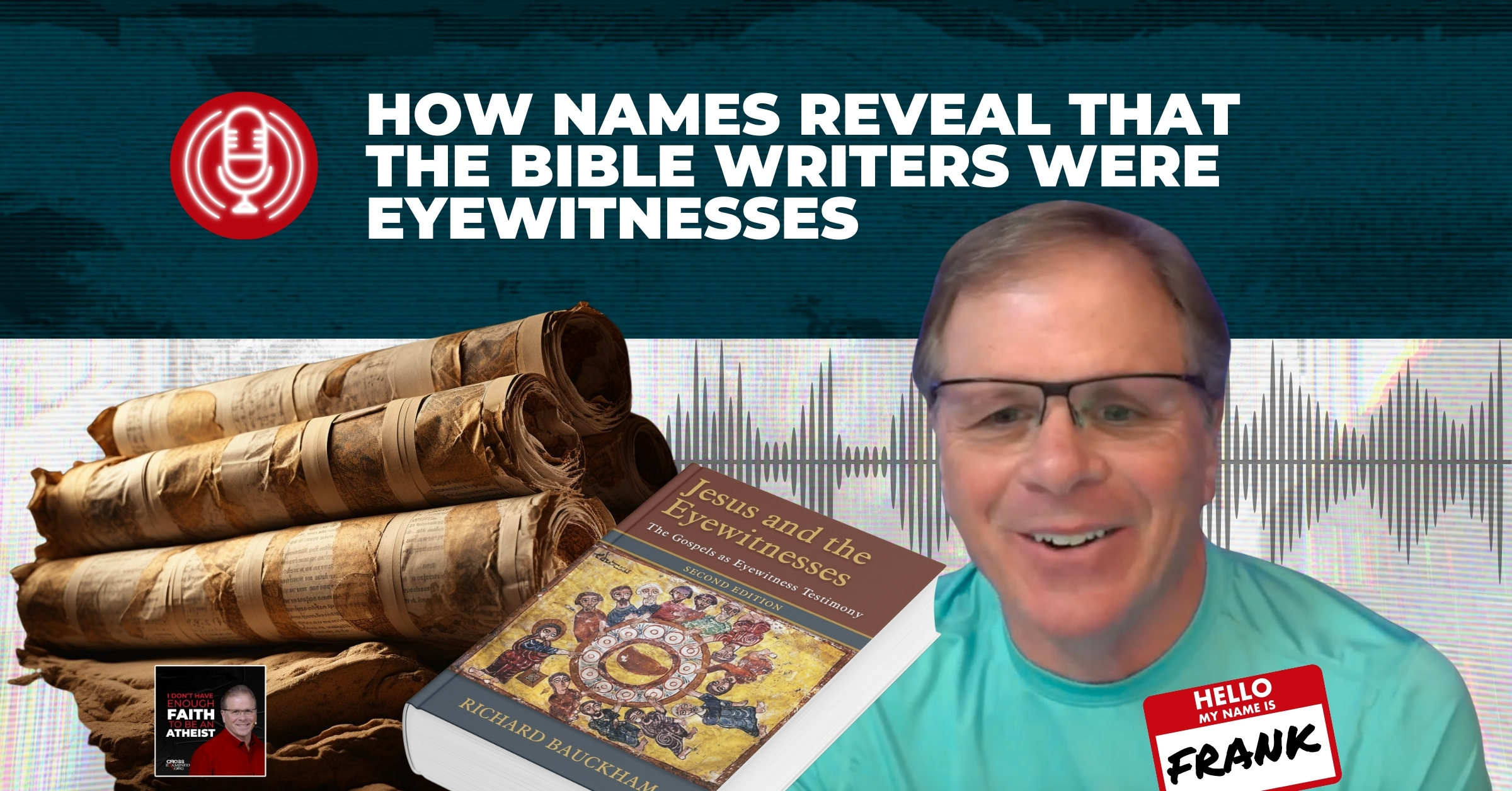
Sorry Aunt Mildred and Uncle Bob–nobody wants to use your names for their children anymore! But what does that have to do with the credibility of the New Testament writers? In this fun and fascinating episode of ‘I Don’t Have Enough Faith to Be an Atheist’, Frank explores why the names we see recorded in ancient history matter and unpacks how these names serve as powerful evidence that the New Testament writers were actual eyewitnesses to the events they described in the Gospels and the book of Acts.

Join Frank as he tackles key questions like:

  • How have name trends changed in the U.S. over the last 100 years, and how does this relate to the reliability of the Scriptures?
  • What is an undesigned coincidence, and what examples of undesigned coincidences do we find in the New Testament?
  • How do scholars know when Paul wrote his letters?
  • Who are the 34 people mentioned in the New Testament that have also been verified by secular sources?
  • What archeological evidence and non-Christian writings corroborate with what we see written in the Gospels?
  • What’s the Spider-Man Fallacy? And should the New Testament be categorized as historical fiction?

You’ll also hear some exciting news about the newest addition to Frank’s family (HINT: it’s a GIRL–FINALLY!) along with the next BIG CrossExamined international trip that is currently in the works! If you or anyone you know has ever struggled to believe that the New Testament is historically credible, this episode might change your mind!

If you enjoyed this podcast episode PLEASE HELP US SPREAD THE TRUTH OF CHRISTIANITY BY SUPPORTING OUR MINISTRY HERE. 100% of your donation goes to ministry, 0% to buildings!

Resources mentioned during the episode:

BOOK: Jesus and the Eyewitnesses by Richard Bauckham
BOOK: Cold Case Christianity (Updated & Expanded Edition) by J. Warner Wallace
NRBTV SERIES: Digging Up the Bible


Download Transcript


In this midweek episode of ‘I Don’t Have Enough Faith to Be an Atheist, Frank tackles some of your listener questions on a wide variety of topics! Tune in as he unpacks the unpardonable sin of blasphemy against the Holy Spirit mentioned in the Gospel of Matthew and other questions like:

  • Should Christians be worried about committing the unforgivable sin?
  • What makes the miracles of Jesus so unique compared to others who claimed to perform miracles, like Joseph Smith?
  • How can we know anything about history and do we need to experience a historical event to know that it really occurred?
  • Should you marry someone just based on love?
  • What does the Bible say about a husband’s responsibility to his family?
  • Do intersex conditions mean there are more than two genders?

From historical reliability to gender ideology and practical wisdom for single Christians—this episode is jam-packed with insights you won’t want to miss. And be sure to check out the list of helpful resources below for more information on some of the topics discussed during the program!

If you enjoyed this podcast episode PLEASE HELP US SPREAD THE TRUTH OF CHRISTIANITY BY SUPPORTING OUR MINISTRY HERE. 100% of your donation goes to ministry, 0% to buildings!

Resources mentioned during the episode:

VIDEO: Mormon Challenges Frank on Biblical Inerrancy
BOOK: Correct, Not Politically Correct
Got Questions: What is the Unpardonable/Unforgivable Sin?
Got Questions: What is Blasphemy Against the Holy Spirit?
Michael Knowles on Jubilee: 1 Conservative vs 25 LGBTQ+ Activists


Download Transcript


If you hang around parents long enough you’ll find that there are certain “mommy moments” that we moms all share. Kid running down the street naked? Check (mostly for boy moms…). An embarrassing family secret shared with the entire elevator by your darling little chatterbox? You betcha.


And it’s practically a Christian mom rite-of-passage that just when we’re about to switch out the light, your little Einstein suddenly goes final-jeopardy-mode with some obscure theological concept. Sure it’s probably a stalling technique, but one of the blessings we have as moms is pointing them back to the truth of Christ, even as we wrestle them into bed.

The thing is, just giving answers is not enough. Someday they’re going to get hit with a challenge and we aren’t going to be there to help. That’s why a vital part of healthy discipleship is equipping our children with the skills to navigate tough questions on their own.

Fair warning, this isn’t a skill that’s learned by letting them go nuts on the family tablet. Depending on the topic they’re looking up, things can go south quickly. That’s why we at Mama Bear love to help you foster the little question-askers in your lives.

First, before we dive in, if you haven’t read Alexa’s blog How to Respond When Your Child Stumps You with a Question, check it out. We, but the flip side of that coin is preparing our kids to not only know how to research, but to research well. (Because the internet will let anyone with a computer create their own blog! We’re looking at you, flat-earthers 😜)

Second, you’re going to have to adjust these to the age and stage of your child. Bigger kids can and should engage with heavier topics. The littles of the group are going to operate in the “observer” role in the beginning, but give them opportunities to practice these skills with increasing regularity under your guidance.

Ready? Let’s take a look at 5 tips to help your child be an information sleuth!

Tip #1 Research takes time

We live in an Instacart culture. With a few clicks we can have the world delivered to our doorstep. The problem with this luxury of convenience is it’s caused our patience and attention spans to atrophy. Often this means that if the answer to our kid’s question isn’t in the tagline of the first Google article, they just give up and move on. (Like the other night… during our homework session…*face palm*)

Our kids need to know that good research involves more than watching a YouTube short; it takes time, effort, and these crazy things called books. This skill is best passed-on by modeling first, especially when they’re little.

When your child asks a question, instead of immediately popping off with the answer, say, “That’s a great question! How do you think we can research this?” #mamabearapologetics #discipleshipClick To Tweet

When they shrug their shoulders, show them how to look up their question on multiple sources: digital and physical. Show them how to navigate popular websites like Got Questions. Grab a few books off your shelf and show them how to use an index (one you could practice with is our latest book Honest Prayers for Mama Bears). And don’t forget to point out the glorious footnotes. Seriously folks, I may sound like your high school librarian, but footnotes are worth their weight in gold! Don’t let your kid miss them!

This training might sound old-fashioned, but it causes our kids to pause and process what they’ve just heard, rather than falling for the nonsensical appeals of impassioned media starlets. So yes, it’s worth the effort.

Tip #2 Find Trusted Christian Sources

No surprises here, but when it comes to seeking answers to biblical questions, we should head to Scripture first. Translations like Life Application Study Bibles, Apologetics Bibles, and Cultural Background Study Bibles, which contain translator and commentary notes, are beyond helpful in these situations. There are also great ministries that have blogs, podcasts, and articles that address the most common questions believers have. (Check out our updated Recommended Resources Guide.)

But not everything that sports the title of “Christian” is solid. (There are supposed “Christian” witches, after all!) Teach your children to “test” their sources by looking at the background of the ministry. Is this organization tested, proven, transparent, and/or backed by leading philosophers, experts, and apologists? Is what’s being said supported in Scripture? Are disagreements over conclusions given charitably and with evidence? Are those behind the ministry trained, and if so, by whom?

Remember: degrees are nice but that doesn’t mean the person holding them will always speak truth. Which is why we test everything, including our pastors and favorite authors. #mamabearapologeticsClick To Tweet

Tip #3 Read Original Sources

A few days ago, I was reading the outraged opinion of a writer who couldn’t believe that NFL kicker Harrison Butker wanted to make wives the servants of their husbands.[1] The problem? That wasn’t what he said, but the only reason I found that out was because I went to the original source: the transcript of the commencement speech. If you don’t want to read it, you can watch the full speech here.

Today, it’s all too common to take a person’s second-hand perception as truth, rather than reading the original source itself. Don’t let your kiddos fall into this trap. Whenever possible, when a question is asked, go to the source. Take into context the setting, the people with whom it was being spoken to, the motivation behind the teaching, and the present application of objective truth principles today. If reading an article, see where the author got their information, especially when bold claims are made. With a little bit of practice, your little one will start to sound like a nerdy version of Tom Cruise, “Show me the sources!!”

Tip #4 Research the Opposition

There’s a pithy saying about what assuming leads to, which I won’t be sharing here because it’s a little sassy. But take it from me that assuming the motivations, conclusions, or intentions of someone who doesn’t agree with you is a quick way to make a fool of yourself. Sadly, our culture has turned this mistake into the standard form of interaction.

Don’t like someone’s views? No biggie: reduce them to a label and then commence destroying them and everyone remotely like them!

You don’t need a WWJD bracelet to know that’s definitely NOT what Jesus would do! As Christians, we understand that big conclusions about life have a history. Learning that history will help us understand why someone believes what they do, but it doesn’t make that conclusion right. Instead, we need to nurture truth-based empathy in our kids, and we do that by hearing what the other side has to say.

As they learn, have your kids reflect on why a person might come to this conclusion. What (if anything) did they share about their background? How did an experience cause them to question or reject a stance? What philosophical stance do they hold that’s shaping how they view evidence? Once our kids can understand what’s motivating the beliefs of another, then we can help them understand the other person while remaining rooted in truth.

Tip #5 Practice How to Respond

Just like a chess player anticipates the moves of their opponent, so we should anticipate the objections of someone who doesn’t share the biblical worldview. Not so we can slam them with our Bible knowledge but to nurture good discussion should the conversation go that route. It’s also helpful for our own spiritual growth, too!

Kids have a natural ability to speak truth (sometimes too good!) but they’re not so great with tact. That’s why practicing how to discuss the topic with others is key to avoiding awkward conversations. How would you respond to Flora Feminist’s who doesn’t think that the unborn have the same right to life as an adult? What would you say to Nihilist Nick when he denies that the universe was made with telos (purpose)? How would you engage with Social Justice Susie as she defends the Marxist concept of oppressed versus oppressors?

We can’t know everything, but acquainting your child with counter-arguments will help them not be phased when their lunch room evangelism encounter doesn’t end like a Christian Hallmark movie (or a scene from God’s Not Dead).

Practice and Repeat!

Mamas, Satan is going to make you feel like training your kids how to research is boring or unimportant. This is a lie. Don’t let social media or YouTube steal your attention from the fruitful harvest growing within your home. Bring up your children in training and instruction of the Lord.

When they are small, show them how you research a topic and check to make sure the sources are valid. As they grow, help them evaluate the resources they’re using. Watch videos of someone who doesn’t agree with you and evaluate the claims being made. Let them see you wrestle with a question. Show them that there is more than just one page on a search engine. Most of all, make the most of as many opportunities as you can to grow in the knowledge of the Lord.

References: 

[1] https://www.kansascity.com/sports/spt-columns-blogs/sam-mcdowell/article288517451.html

Recommended Resources: 

Counter Culture Christian: Is the Bible True? by Frank Turek (Mp3), (Mp4), and (DVD)        

Debate: What Best Explains Reality: Atheism or Theism? by Frank Turek DVD, Mp4, and Mp3 

Jesus, You and the Essentials of Christianity by Frank Turek (INSTRUCTOR Study Guide), (STUDENT Study Guide), and (DVD)      

Early Evidence for the Resurrection by Dr. Gary Habermas (DVD), (Mp3) and (Mp4)


Amy Davison is a former Air Force veteran turned Mama Bear Apologist. She graduated from Southwestern Baptist Theological Seminary with an MA in Christian Apologetics. She and her husband Michael (also former Air Force) have been married for over 17 years and have 4 kids. Amy is the Mama Bear resident expert on sex and sexuality, and she’s especially hoping to have that listed on her Mama Bear business card.

Originally posted at: https://bit.ly/4gAYteb