
Tag Archive for: Al Serrato

By Al Serrato

Making a case for Christianity can be challenging in this secular culture. And what can be more challenging than explaining –no, than defending – the existence of a place of eternal punishment? It’s easy to be placed on the defensive, with an aggressive challenger deriding how a good and loving God could be so vindictive or petty as to subject his children to eternal torture simply because they didn’t “believe” the right things.

But Jesus himself repeatedly spoke of Hell, so however difficult a conversation, it is one we cannot evade. Indeed, in some passages, Jesus likened Hell to the perpetual fires burning in the garbage dump outside Jerusalem, in the place called Gehenna. The Book of Revelation leaves us with the jarring image of the lake of burning fire, a place of perpetual torment.

Is the challenger, right? Is Hell, in fact, some arena of sadism in which a cruel and unloving God derives pleasure by inventing ways to torture his children? Or can we make sense of it, at least intellectually, if not emotionally?

The first step in assessing this issue is to tease out the underlying assumption that is at play. If God actively causes someone to burn eternally, if He inflicts agony upon the souls in Hell, then yes, we would have to concede that this would be torture.  The real issue, then, is whether God does those things to the souls in Hell, or whether those lost souls experience an everlasting torment that is a consequence – and not a separate goal – of the fact that they are in Hell.

An example may help place this in focus. In the Civil War, doctors treated most bullet wounds to an arm or leg by amputating the limb, no doubt an excruciating experience in the days before anesthetics.  But these actions were done not to torture the patient but to accomplish some good purpose – namely, to save him.  The patient no doubt felt tormented, but this was a natural consequence of the necessary action that was taken; it would not be fair to say the doctor had engaged in torture.  On the other hand, if one side had taken perfectly healthy prisoners of war and amputated a limb to inflict pain, either to coerce cooperation or as a method of terror, this would indeed be torture. Similarly, if a modern surgeon decided to amputate without anesthetics, it would be fair to characterize such actions as torture.

With this distinction in mind, we must next consider whether Hell serves a legitimate purpose. Christians contend that God is all good and that whatever He creates must also be good.  Hell is a place – or perhaps more precisely a state – of separation He has created for those deserving of such separation. And who is deserving of separation? Well, if we take God at His word, it is for those who die in rebellion against Him, who, through their thoughts and actions, have asked for that separation. This is intuitively understandable: a parent may seek separation from a rebellious child without wishing to inflict pain upon them. The judge who grants a restraining order, or who imprisons the offspring guilty of elder abuse, accomplishes a purpose that is in no way similar to inflicting torture.

Let’s take this analogy a step further. Imagine that the rebellious offspring insists on living in his parents’ home while refusing to follow any of the rules. Or commits a crime against his parents and is sentenced to prison? The prison sentence is meant to separate the abuser from society, and separating him in this fashion is indeed a form of punishment. But the punishment we speak of is, in essence, the incarceration, the very same act that accomplishes the separation. We do not first separate the wrongdoer from society and then inflict additional punishment; there are no medieval tortures that await the prisoner, no mistreatment that is deliberately inflicted to further the pain the inmate feels, no chain gang to make his daily life unbearable. In a very real sense, the punishment is the product of the incarceration, not an additional purpose.

Now let’s move to the final step. God does not inflict temporal separation or temporal punishment, as in the example of a prison sentence. He is an eternal being, and He made us for eternity as well. And when you grasp that distinction, you can begin to see that forcible separation from God is the absolute worst thing that can befall any soul. There is nothing more to be done, nothing that could increase the pain that such a soul would experience. By the same token, however, there is nothing to be done that would lessen that pain, short of the annihilation of that person. There is no way to make separation from the source of all that is good, more bearable.

Why is this so? Well, consider for a moment of what the pain of separation consists. Do you remember your first love? Or the way you felt when you beheld your first child? Or reuniting with your spouse after a period apart?  Conversely, can you recall the first time you felt lost and alone, or were homesick or the first time you experienced the death of a close loved one? Even for the most hardened of criminals, there are people to whom they are attached, with whom they wish to spend time, even if they are simply fellow inmates. These others have some quality, some attribute, which makes them attractive, makes them desired. That is why solitary confinement is such an extreme form of punishment. We were not meant for isolation; however, hardened and lost a person may appear.

Now magnify these feelings – not by a hundred, a thousand, or even a billion, but by infinity, and by eternity. Why should this be so? Because God is… perfection…absolute, unlimited, infinite perfection, the kind that we as human beings, cannot even begin to fathom.  Start to get the picture?  If the goodness and beauty of the people we love can cause us such torment when we face separation from them, and if that goodness is a mere shadow of the infinite perfection of God, that I shudder to imagine what knowing but not be able to experience God would be like.

Consider finally then the soul in the abyss, facing eternal separation and eternal alone-ness, isolated and embittered, aware of but forcibly separated from the God against whom his rebellion rages? What a human being feels on a limited and temporal basis, such a soul feels magnified an infinity of times. And he is not contemplating separation from a limited and flawed human being, but from the source of all life, all goodness, all joy. Can we even find words to describe what infinite emptiness feels like?

No, God does not actively torture souls in Hell. But he does not change His nature to suit those who shake their fist at Him, who reject the offer He is extending. The separation that He imposes, just though it is, is indeed terrifying.

But it is not torture. It is the nature of things.

Recommended resources related to the topic:

Hell? The Truth about Eternity (MP3 Set), (DVD Set), and (Mp4 Download Set) by Dr. Frank Turek 

Short Answers to Long Questions (DVD) and (mp4 Download) by Dr. Frank Turek 

Was Jesus Intolerant? (DVD) and (Mp4 Download) by Dr. Frank Turek 

By Al Serrato

“I can’t believe in a God who would allow so much evil and suffering in the world.”

Have you encountered this challenge? Most anyone who has tried to defend the Christian worldview surely has. The person bringing this challenge will often claim to be atheist, but when you dig in a bit this challenger is more often someone who knows there is a creator but who is deeply offended by the world, and angry at the God who set all this – the carnage, the anguish, the pain – in motion.

In my last post, I restated the traditional Christian response to this problem of evil.  God did not create the evil that surrounds us because evil is not a thing.  Evil is a departure- a deviation- from the good which God did create, and which God defines.  This answer serves a particular purpose: it shows that the Christian belief system is internally coherent.  For if God did create evil, he could not be the God described in the Bible because an all-powerful, all-good, and all-loving God could not be the creator of evil.

But, the atheist insists, even if I grant that God did not create evil, He created this universe and everything in it.  Isn’t He, therefore, still responsible for all the evil that we see around us?  In other words, if God isn’t guilty of the crime of actually creating evil, is He not still liable as an aider and abettor?

C.S. Lewis wrote about those who put God “in the dock.” It seems a natural human tendency to find fault with the way others have acted or decisions they have made.  As a criminal prosecutor, I found that I would often slip into this kind of thinking too, silently building a case against God, accusing Him in my inner thoughts of not doing things the way He should have, the way I would have.  The created order is filled with so much beauty, so much elegance, so much to admire and to be awed by….yet, we know that something is also very much amiss.  Every beautiful thing God has created has been marred in some way.  Out of every good in the world, there springs forth, weed-like, much that is bad, much that is evil.  Why has God allowed this?

By satisfying the demands of logic, the traditional explanation of the nature of evil helps to make sense of our faith. But notice what it does not attempt to do: it does not seek to defend God, which is, in essence, what this challenge is asking us to take on. Nor does it provide an emotionally satisfying explanation to the one who is suffering, no easy answer to make it all quickly better.

What, then, can the Christian to say in response to this challenge?

Perhaps the answer should begin with the recognition that we need not – that indeed we cannot – defend God.  Yes, God is responsible, ultimately.  It is His creation, His universe, His set of rules to which both conform.  For reasons that make sense to Him, He endowed us with free will, knowing that we would use it in inappropriate ways, in ways that displeased Him and would cause harm to others. True, this answer is not satisfying emotionally. It is instead a logical answer, and while logic has its place, we are not strictly logical beings. We feel, and when we experience evil, we suffer. As beings who love, we grieve when we see those whom we love suffer.

The challenger may argue that a God who allows suffering cannot be loving but is it not the case that suffering may serve a purpose.  We grasp this intuitively: we know that hard work can often lead to much gain; we see that the cure of the physician or surgeon may at first be quite painful; we note the agony of labor that precedes the birth of a child.  Everywhere in nature, we see the source of the expression “no pain, no gain.”  We also know, at a more profound level, that none of this, neither the pain nor the glory, lasts forever. We are on the road to …somewhere…and there are indeed many obstacles, many pitfalls, along the way.

And yet, are we really in a place to put God on trial? With what arrogance would the pot stand in the well to accuse the potter of poor workmanship? How would the robot, constructed to complete a particular job, rightly complain that the tasks to which it is put are not just? That it should instead rule the world into which it was placed.

 At present, we see through darkened and distorted lenses. Free will and suffering. These concepts will never make complete sense to us. But as the created and not the creator, perhaps all we can do is remember that they make sense to Him.

Recommended resources related to the topic:

If God, Why Evil? (DVD Set), (MP3 Set), and (mp4 Download Set) by Frank Turek 

If God Why Evil. Why Natural Disasters (PowerPoint download) by Frank Turek

Why Doesn’t God Intervene More? (DVD Set), (MP3 Set), and (mp4 Download Set) by Frank Turek

Why does God allow Bad Things to Happen to Good People? (DVD) and (mp4 Download) by Frank Turek 

By Al Serrato

One of the most common challenges to the Christian worldview is the problem of evil. We see evil all around us; we need to do little more than pick up a newspaper or watch the nightly news to have our sensibilities assaulted with countless acts of senseless violence and suffering. Many are man-made and some a product of an indifferent Mother Nature; whatever the source, at times, it feels as if the world is awash in wickedness.

How, the challenger entreats, can your good and loving God create such things? Why did he imbue man with such capacity for wickedness? The Christian responds that God did not create evil. No, they claim, evil is the product of man’s twisted free will. How well does this claim hold up?

The challenger seems to have logic on their side. Reduced to a simple syllogism, the challenge goes something like this: 1) God created all things; 2) evil is a thing; 3) therefore, God created evil. Though raised anew in every generation, the challenge itself is not new.  In the 4th century, St. Augustine tackled it, as did St. Thomas Aquinas centuries later. What we call evil, they explained, is in fact a deprivation of the good and is therefore not really a “thing” at all.   Like the “hole” in a donut, it describes what is not there, what is missing. But this does not always satisfy the challenger. Often, they may counter: an all-powerful, all-loving God would not have allowed deprivations any more than he would have created evil.

This response seems to accept the difference between deprivation and a thing and confronts the believer with the same challenge: a good God would never have allowed such deprivations, such departures, from the good.  But this challenge actually misses the point of the distinction that Augustine and Aquinas drew; through sloppy thinking, it continues to view evil as a thing, even though it adopts the language of deprivation. 

Consider: what we see as evil, whether a thought or an act, can only be gauged if we first hold in our minds what the good would be.  For example, using a knife to cut someone is evil when done by the assailant but not by the surgeon.  Setting off an explosion is evil when used to harm others but not when used to carve out a tunnel.  The knife and the cutting; the bomb and the blast – these may be “things’ in a manner of speaking, but any measure of evil in their use depends not on what they are, but on the extent to which their use deviated from God’s perfect will.

We know this intuitively. And because some of us are better at knowing God’s will than others, we may mistakenly call something evil when in truth it is not.  For example, a law prohibiting abortions would be viewed as “evil” by those who believe that a woman has the right to choose; they would view the act of stopping a woman from aborting her unborn child to be a departure from the “good” of free choice. This, of course, would be wrong. It would not be evil at all, but instead good, because such a law would comport with, and not defy God’s will. 

Those who reject Augustine’s approach will insist that these are examples of things – namely acts that are being done: stopping the woman by force of law, setting off the explosive, cutting into a person. They will insist that a good God would not have created them. This misunderstands the point: what constitutes evil is not the action or the thing, but the use to which it is put. God, as the infinite expression and definition of good, is by necessity the ultimate standard of what is good. Consequently, what we describe as evil is, in reality, a rough gauge of the extent to which the thought or act in question departs from God’s nature or will, or at least what we view that nature or will to be.

So, why does God allow evil? Because when he gave us free will, he meant for us to have, well, free will. The opposite of free will would be directed will. Whatever actions we took would be controlled, the way a robot’s or computer’s would be.  In such a world, there would be no abortions, no stabbings, no hidden minefields.  But such a world would not know freedom. God allows evil, even though he never created it, because if He does not allow us to depart from His perfect will, then free will would be an illusion.

Recommended resources related to the topic:

If God, Why Evil? (DVD Set), (MP3 Set), and (mp4 Download Set) by Frank Turek 

If God Why Evil. Why Natural Disasters (PowerPoint download) by Frank Turek

Why Doesn’t God Intervene More? (DVD Set), (MP3 Set), and (mp4 Download Set) by Frank Turek

Why does God allow Bad Things to Happen to Good People? (DVD) and (mp4 Download) by Frank Turek 

by Al Serrato

“Avast yer jabberin, ya bunch a bilge rats!”

The voice sounded strange as it reached into the hallway. The speaker was apparently trying to make a point. “Yer division a booty must be… “he paused to consider his words, “more equitable if ye be wanting to sail with me.”

He had my attention. I was at a work conference in a hotel, wandering the halls during a break when I happened across this conference room. I peeked inside. It could have been a scene from the latest Pirates movie. Men of various ages with lots of facial hair, many dressed in striped pants, with the occasional peg leg and hook hand. Yes, I had stumbled across a pirates’ convention, the 350th annual, it seemed, from the schedule which I found posted outside.

The speaker’s topic was ethics. He went on to explain what an equitable share of booty amounted to, in his view, using a very modern looking PowerPoint presentation to punctuate his points.

I caught up with him at the break and asked if he had time for a few questions. He seemed a bit suspicious, what with my business casual attire, but nonetheless willing.

“Seriously,” I began. “Ethics for pirates? I mean, for centuries you guys have been boarding and capturing and enslaving people without much regard for ethics. You’ve been known to rape, pillage, and plunder, and your personal hygiene is … not the best.” I quickly ended, seeing that I was crossing a line.

A hurt look crossed his face. “Yer words be stingin,” he began, but my words were nothing compared to his breath. I took a step back and tried not to stare at the parrot on his shoulder. “I don’t suppose ye know bout all the good that we do. Why ar ann’l ball raises thousands for the widows n’orphns fund, and we do lots of behind the scenes work ye never be aware of. Last year alone, we returned almost 30 percent of our captured booty to charitable organizations.”

“Is that a fact?” I asked. “I had no idea. But,” I persisted, “this is stuff that you’re stealing.”

“We make no excuses for that, m’lad. But we’ve been pretty transparent about that from the beginning, ain’t we? After all, ye had no trouble spotting us for who we are. If ye want the real thievin’ ones, it’s the bankers and lawyers ye want to be houndin…” He pointed down the hall to the lawyers’ convention I had been attending.

Yes, of course, I’m making this up. But I think there is a valid point here to be made. Human beings have an amazing capacity to judge themselves on a curve. Pirates no doubt convince themselves that they are somehow justified in doing what they do. They may think of the harm they suffered when younger or may feel that life dealt them the hand that they play. And they no doubt have a set of ethics that they follow, however uncivilized it may seem to us. And many, if pressed, would seek to justify their behavior by reference to all the things they don’t do. “Sure, we kill on occasion. But only those who don’t surrender, or those who for whatever reason need killing.” This is the human condition, whether in a high school, at the office, on a pirate ship, or in a prison. We don’t seem to have the capacity to see ourselves for what we truly are.

What does any of this have to do with Christian apologetics? Just this: the number one response of nonbelievers as to why they don’t worry about the afterlife goes something like this. “I don’t know if there is a God, but if there is, he will see all the good that I do and accept me. So, I’m not worried. A good God will see that I am living a good life.”

But holding this view is not that different than the pirates in the analogy above. Compared to others of that ilk, an individual pirate might seem like a good guy. But that hardly would qualify him for life in a peaceful and civilized society. His problem isn’t how he compares to his fellows, but how he measures up to the place he’s trying to get to. He may think himself “good” when in an objective sense he is anything but. Similarly, many people today believe they have a proper sense of what “good” human behavior is, but how can they know for sure when they are mired in the corruption of their nature? And more importantly, have they given any thought to what “perfect” behavior requires? What a perfect being might use to measure admission to His realm?

It’s easy for us to pat ourselves on the back for our goodness. But perhaps we are a bit too smug. Our persistent feelings of guilt serve as a guide – a reminder – that all is not well. They serve to call us to account to the One who left us here, and who expects something of us if we are to be in a relationship with Him. These feelings of guilt provide the backdrop of bad news, the kind of news from which we naturally shy away. The kind of bad news that sets the stage for the ultimate Good News of the gospel.

So, next time you encounter this response, you might suggest that the nonbeliever consider his frame of reference. Immersed in a sinful culture, inhabiting flesh and blood bodies whose weakness overcomes the willingness of the spirit, we may be as unable to see ourselves for what we truly are as the fictional pirates above would be. In short, we may not be in the best position to know if we are as “good” as we pretend.

Fortunately, there is a better answer, one that does not require us to earn our way back to God’s presence. But until we see our need for a Savior, we’re not likely to find the answer that is waiting to set us free.


Original Blog Source: http://bit.ly/2IQpnDE

By Al Serrato

God gave us free will so that we can freely choose Him, for freedom of choice is essential to love. But, the skeptic counters, many people do not believe God is real. Why doesn’t God reveal himself more clearly? This question has considerable surface appeal, as it plays on our intuitive sense of fairness. Despite the vast number of people who believe that the evidence for God’s existence, and for Christ’s deity, is more than sufficient to ground a solid faith, there are always others who say they might believe “if only….” And if God really does want all to be saved, why doesn’t He provide them with that extra level of proof?

Before attempting an answer, it’s worth taking a closer look at what the skeptic is really saying: “I’m not interested in what your evidence shows. It’s not enough to satisfy me. I want my personal standard to be met. Satan knew of God’s existence and still rejected Him. Why can’t I get that level of proof?”

This is an odd challenge, because it ignores the objective nature of “evidence” and instead focuses on the subjective nature of a person’s response to it. It moves from considering what conclusions the evidence might support to considering what more could be added to make the conclusion even stronger. In the criminal courts, it is not uncommon to present a compelling case which, after days of deliberations, results in a “hang” and the need for a retrial. Eleven jurors might be completely convinced as to the truth of the charge, but one juror can insist that he needs more evidence. Now, perhaps that one has found something that no one else could see, despite days of discussion; more likely, the lone juror is unwilling to convict – to follow where the truth leads – for other reasons. If he follows the skeptics’ lead here, that juror might say: “I’ve heard of cases in which there is a confession to the crime and still the jury did not convict, so I am justified in voting not guilty here until I get the kind of evidence that want.”

Like the skeptic in the present challenge, this juror is making a statement, and not an argument. The fact that greater evidence could be produced in support of a claim is a given; it is true for all possible claims at all possible times, because perfect proof is not possible. But this assertion is not an argument that the evidence that was produced is insufficient. In fact, it does not address the weight and convincing force of the evidence at all.

Returning to the original challenge, what is it that would convince the skeptic? The answer: total knowledge of God, the same kind of knowledge Satan may have had. That means the skeptic wants full knowledge of that Being which embodies the ultimate perfections, that Being from whom derives all things good and worthy of praise and apart from whom there is only deprivation and evil for time without end. Full knowledge of that Being would also entail full knowledge of the consequences of accepting or rejecting His offer of life with Him. Satan was some type of spiritual creature; we know little about him, other than that he used his will to oppose God. But we are all human beings, and as such, we have intimate knowledge of man and his nature. Could we really face that level of knowledge? Would it not be apparent to all that the choice to accept God would be coerced and no longer free? Free will would become a mere fiction.

God set the level of evidence of Him in a way that is fitting to our nature. He does not reveal more because what He has revealed is sufficient, which explains perhaps why the vast majority of all who have ever lived have sought in some way for the God they know is there. We are without excuse, the Bible says, for the knowledge of God is written on our very hearts. We may blur that knowledge with the frantic pace of our lives, or silence it with our insistence on having things our way. But what we have been given is enough to ground our faith, if we only use our minds and our ability to reason to assess what has been revealed to us. But for those who choose not to believe, there is freedom to pursue that course, a course marked by self-will and the quest for control.

Yes, the evidence could always be better. But imperfect human beings rely on imperfect knowledge all the time. The evidence we do have is worth considering, and it may well change the course of your life… if only you give it the chance.


Original Blog Source: http://bit.ly/2npnKQO

By Al Serrato

My last post dealt with the belief, common among skeptics, that Christianity is simply a form of superstition. Modern “science-minded” people reject superstitions, and so religious belief holds no interest for them. Historic Christian doctrine is in fact much different, however; while some who claim to be Christian may indeed be superstitious, the faith itself is built not upon fanciful thinking but upon a bedrock of truth.

This distinction, and the importance of pursuing truth can be seen in the following analogy: imagine a person who is suffering from a medical disorder. One day he is fine and the next the disease begins the process of eventually killing him. Initially, he does not know he is afflicted.He “feels” fine. He continues to go about his business, concerned with the problems of everyday life and not suspecting that anything may be different, let alone dreadfully wrong. Eventually, symptoms begin to appear, but they are not particularly troubling to him. After friends insist that he have them checked out, he agrees to see a doctor.This is a big step for him, for he does not “believe” in doctors.He thinks that doctors are often wrong and that they rely too much on pills and not enough on just “living right.” He knows that others really believe in doctors, but he is “sincere” in his belief that doctors do more harm than good, especially when one doesn’t “feel” that anything is wrong. After running a battery of tests, however, the doctor identifies the illness and tells the patient what is wrong.

In addition to understanding the affliction, the doctor also has the means to provide the solution. The patient resists, however, insisting that he feels fine and that he doesn’t need any help. He views the surgery and medicines the doctor offers as “butchery” and “potions.” He sincerely believes that the doctor is practicing voodoo.Ultimately, the patient dies, blissfully unaware of his true condition, content in his belief that he was fine and proud of his refusal to resort to talismanic remedies to fix something he did not believe was wrong.

As this analogy demonstrates, how the patient feels about his situation is not particularly relevant. Nor is the sincerity of his belief. He may feel fine, physically and emotionally, but the issue would be his actual condition, i.e. the truth about his disease. Christianity needs to be assessed on these terms. Either the Biblical claims are true – we are in a world of trouble and only Jesus can save us – or they’re not. If they are true, how we feel about them is of little consequence. And ignoring and rejecting them will, in the end, not succeed.

Now some may object that doctors practice science, and so the analogy is misplaced. The patient was wrong not to rely on science. But science is simply one way of testing and developing knowledge.It is not the only way. Science cannot tell us whether we possess souls and whether these souls are in need of salvation.And science cannot tell us whether improbable past events actually occurred.The only way we can make that assessment is by considering the evidence upon which Christianity is based and becoming familiar with the philosophy that supports its claims.

But we must do so with an open and inquiring mind… for the consequences of ignoring our spiritual illness can be as devastating as the disease was for the unsuspecting patient.


Original Blog Source: http://bit.ly/2A72p1U

By Al Serrato

The fool has said in his heart, “There is no God.” If this passage from Psalms is correct, then many people today are fools, for they insist that God does not exist. But the ranks of non-believers include many scientifically minded and highly intelligent people, not the sort we would normally consider as foolish. So, what makes such a person a “fool,” and not merely someone with whom we disagree?

Well, let’s begin with a look at the definition of “fool,” which includes “a person who has been tricked or deceived into appearing or acting silly or stupid.” Now, sometimes we trick ourselves, and thereby make fools of ourselves. And other times we are misled. But either way most would agree that someone who holds contradictory views has deceived himself. Imagine a person proudly proclaiming that the prime rib he is about to eat is an important part of his vegetarian diet. Or the person who says that the only medicine that can save him is the one with no ingredients.

But sometimes contradictions aren’t as obvious. Why, then, is it a contradiction to insist there is no God? It doesn’t appear to be contradictory – at first glance anyway. For the answer to that question, we are indebted to St. Anselm of Canterbury, who lived and pondered these questions some ten centuries ago. I can’t do justice to Anselm’s argument in this brief piece, but perhaps some concepts borrowed from Anselm may help make the point.

The first requires consideration of just what the mind does. Anyone who has seen a baby develop realizes that the human mind comes preprogrammed with an “operating system” of sorts. This allows us to acquire language, to reason, to recognize concepts such as fairness and truth and beauty, and other intangible things, and to make use of imagination. This ability for abstract thought lends itself to “got it” moments when a problem that has been puzzling us all of a sudden makes sense. We all use these systems intuitively; of course, there is no other way, since we could never use reason, for instance, to prove the validity or usefulness of reason.

One aspect of this ability for abstract thought is the ability to conceptualize. Food, for instance, can encompass a million different things, but to qualify it must be edible and serve to nourish, and not poison, us. We can call an ashtray “food”, but the underlying thing is not a matter of what we call it, but of what it consists.

So, with this observation in view, consider for a moment not what a definition of God might be, but what the conception of God is. What is it that we are struggling to grasp when we use that term? Anselm’s definition was simply this – God is that being a greater than which cannot be conceived. Whatever attributes God would have – omnipotence, omnipresence, perfect goodness, etc. – if you can conceive of a being with all those attributes plus an additional one, then the latter would be God. So, imagine two beings then – each with exhaustive, infinite powers. One of the two has the attribute of necessary existence, while the other may or may not exist. Clearly, the former – the one with necessary existence – would be the greater. Consequently, to fully conceive of God, we must be conceiving of a Being who can’t not exist, whose existence must always have been and will always continue to be. Anything else simply cannot fit the conception of God.

So, what does that prove? Maybe this conception of God is imaginary. Not so, Anselm would contend. And here’s why: the mind is not capable of conceptualizing something that does not correspond to something real. Now, this premise is a bit harder to get one’s mind around. The normal response to this part of the argument is that we create imaginary things all the time, from unicorns to tooth fairies to Jedi Knights. But each of these things, while imaginary, is the combining of things that are real: a horse and a horn; a person with wings and unusual powers; a warrior with special abilities and unusual weapons. And, moreover, neither a unicorn nor a tooth fairy nor a Jedi Knight would possess the attribute of necessary existence. If a unicorn did exist, it would have to consist of a horse with a single horn in its head; but its existence could have occurred briefly in the distant past, or could arise in the distant future or could not occur at all. We can fully conceptualize such a creature without the need that the creature itself actually exist because the conceptualization does not require necessary existence.

This concept of “necessary” existence is not easily grasped at first. Many skeptics will contend that “existence” is not an attribute at all. Imaginary things don’t actually exist, they will say, so they consist of nothing. This line of argument can quickly devolve into an argument over definitions, with the skeptic insisting that it is nonsensical to consider a thing which does not exist. This assumption allows them to defeat Anselm’s argument – they write “necessary existence” out of the set of characteristics of God – but a moment’s reflection should reveal that this comes at too high a price. I can conceive in my mind of many past historical figures whose attributes I can describe in detail but who do not presently exist, for they have passed away. More importantly, every scientific discovery or invention must first begin in the mind of a person who sees the attributes of the thing before it actually takes form. The automobile, for instance, did not create itself; it first appeared in the mind of an inventor who could see what it would consist of if it did exist and then set about adding “existence” to its attributes.

Letting our minds approach the concept of what “God” must be, the only way to conceptualize Him, is as a necessarily existent being. If we are not seeing Him that way – if we are insisting that there may be a God, but then again maybe not, then we are not yet thinking about God, but about something else, something less than God.

This foray into philosophy can be difficult. Fortunately, there are many other proofs for God’s existence, ones much easier with which to grapple, but this one stands out for its elegance. For if it has merit, then God has embedded within us the means to find Him in the one place we have exclusive and special access to our very minds.

If Anselm is right, then the fool who denies God is saying something like “I believe that the Being who must necessarily exist does not exist.” A rather foolish thing to say, when you see it clearly.

The Bible says that God has written his law on our heart. Perhaps if we probe a bit deeper still, we can also begin to see in its depths the first faint scratching of His signature.


Original Blog Source: http://bit.ly/2klEgzC

By Al Serrato

Superstition is as old as man. An incomplete picture of why things work the way they do fuels the imagination to conjure up hidden forces at work behind the scenes. Pull back the curtain and perhaps one will find an “all-powerful” being at work pulling the strings. Accessing – and eventually perhaps cajoling or influencing that being – can easily become the basis for a religious belief system.

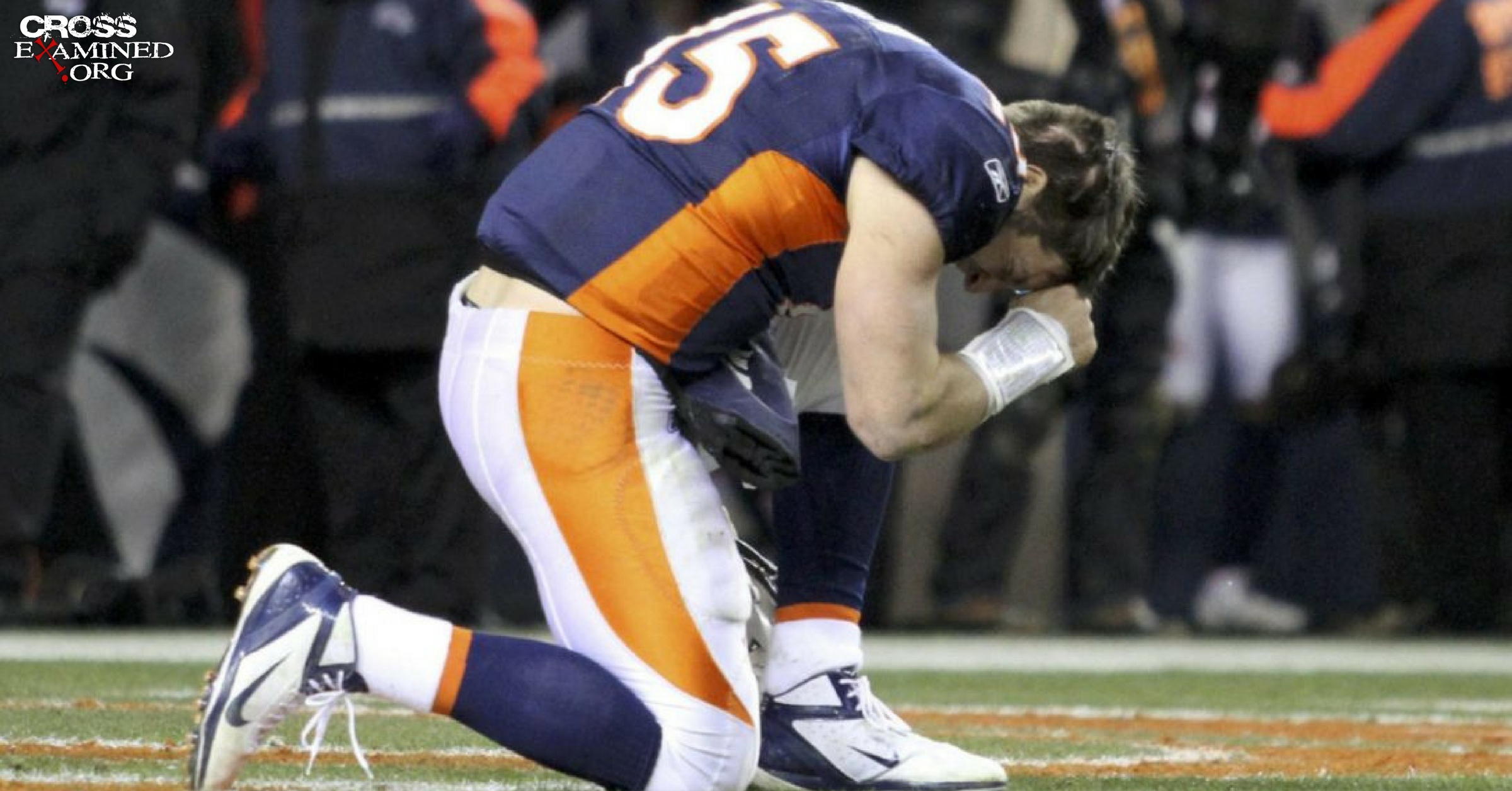
Does Christianity fall into this same category? Some unbelievers, observing the behavior of professional athletes, might believe that superstition is at play. Praying and acknowledging one’s deity, they assume, is a way of seeking to influence the outcome of the contest. For some, it seems like a cheap – and silly – trick.

But this is not what Christian players are doing when they acknowledge God, nor is it what a mature devotion to Christianity would include.

Some non-believers who consider this behavior will ask themselves a very basic question: will becoming a Christian “improve” my life? Is it a ticket to greater wealth and prosperity, better relationships, a future filled with every type of goodness and blessing? For many, this seems too good to be true, but they pursue it hoping for the best; for others, it appears to be a shell game or cheap con, and they reject it without ever considering what it really entails.

The nutshell answer is: probably yes. In most cases for most people, developing a relationship with God in which you accept His gift and then living a life that reflects His will, as best you can achieve it, will improve your life in some important and significant ways. But having a “better” life is a by-product of belief and not the main point of devoting one’s life to Jesus.

If prosperity or other rewards become the main point, Christianity begins to be marketed as a product, a method of achieving some desirable end. A person identifies a need in his or her life and Christianity fills that need, the way any product might do. But this is not the message of Christianity. The Bible is not a “how to” manual on achieving financial or worldly success. It does not promise riches in the here and now, nor an end to all hardship… nor a victory in every football contest. Quite the opposite, in fact, as the early fathers of the church, and their followers could have attested. (Except of course for the football part.)

In short, Christianity tells the story of man’s broken relationship with his Creator. It claims to speak the truth about the nature of God and of this broken relationship and what is needed to fix it. The Old Testament provides the backdrop as God prepares a people to serve as the vehicle for redemption. Jesus comes – not to make my life profitable or more fulfilling in some modern sense or to help me nail down a spot in the Super Bowl- but to fulfill the ancient prophecies, to give His life as ransom for us, and to thereby restoring our relationship with the Father.

Christianity should be assessed on its merits – are its claims true? – not on what it can achieve for you. The Apostle Paul said as much when he said that we are to be pitied as fools if Christ did not rise from the dead. Everything rests on that truth claim. Once we see that Christ did rise, and we place our trust in Him, He will do a work in us and will eventually welcome us into His Kingdom. But Paul himself remained physically afflicted, and there is no reason to believe that by following Christ, our problems will disappear.

We will, however, look at them differently, and by living Biblical values, we will probably have a better life than we might otherwise have had – and certainly a more fulfilling one.


Original Blog Post: http://bit.ly/2ABUIBT


By Al Serrato

To the skeptic, most Christians – certainly most who appear willing to “defend” their faith – may seem a bit one-dimensional, perhaps in some cases fanatical. They seem so convinced of their views, regardless of how bizarre some of these views seem to the unbeliever. Many conclude, then, that the believer is simply biased in favor of what he wants to believe. He has accepted a “bill of goods” without having struggled over where best to place his trust.

But this is not an accurate description of the faith journey of many believers. Indeed, most go through a period of doubt in which they struggle with what they were taught in childhood. That was certainly my experience. Having been raised in the Catholic Church, I was taught doctrines and rituals which were both mysterious and comforting. Until I began law school, though, these beliefs went largely unchallenged, leaving me unprepared to defend what I thought was “the truth.” Encountering highly intelligent people who were not afraid to point out why they viewed my faith as foolish, I began to believe that all religions were pretty much the same – they could provide comfort, but they weren’t really true. Truth, after all, was a relative concept, dependent on one’s point of view and cultural narrative. And science had pretty much shown that there isn’t a need for God. While faith might make a good crutch when bad things happen, it probably did more harm than good in the long run, because it was at odds with reason. These conclusions just happened to coincide with an increasing desire to put the restrictions of Christianity behind me and to put aside whatever feelings of guilt would arise from time to time.

As I look back on it now, I realize that despite my upbringing, I did not actually have a bias to believe in Christianity. My bias, as I was discovering, was to take the path of least resistance. As a practicing Christian, I needed to conform my behavior to something outside myself, depriving me of a certain amount of freedom. Removing the restrictions of religion would allow me to remain “moral” but would also allow me to define morality any way I chose. After all, with no law-giver, there was no reason to comply with rules that I did not make for myself.

Since I knew many believers, I would raise these issues with them, hoping that they could respond to my challenges. Most, unfortunately, would talk about faith as a feeling or remind me that the Church’s teachings were infallible. They would suggest that my skepticism was not pleasing to God and raise the specter of eternal punishment. In short, they were telling me that I was wrong, but not why I was wrong. I would just have to take it “on faith.” They were wrong: I wasn’t persuaded by discussions of how faith would make me “feel” (I already felt good in church) or with threats of hell for failing to follow someone else’s rituals. I also wasn’t satisfied with “infallible teachings.” If in fact the world was broken down into “faith” and “reason” – as my law school friends maintained – then I knew I would side with reason.

I thought this conclusion would satisfy me, but in the end, it did not. Two things continued to nag at me. The first was this concept of truth. As a criminal investigator and then a prosecutor, I had chosen a field in which truth actually mattered. After all, it just wasn’t okay to get a conviction if I had the wrong guy. I became increasingly fascinated with and drawn to the concept of objective truth. From my legal training, I also had developed a strong interest in reason. Concepts such as “the reasonable person” standard and proof beyond a “reasonable doubt” showed that the thinkers who laid the foundation for the orderly society we developed put a great amount of stock in the mind’s ability to reason to a just result. I didn’t know how this applied to religion, and I still suspected that no one religion had the corner on truth, but I made a commitment to myself that I would follow truth where it led. In other words, I realized that I had some strong motivations to ignore the truth, especially when it seemed inconvenient, and I made a promise to myself that I would seek the truth and submit to it, to the best of my ability.

The second problem nagging at me was with the notion that only simpletons adhered to religion. As I learned more about history, I realized that some of the greatest and most powerful thinkers in history grappled with the same questions that troubled me and that they concluded that there is, in fact, a God and that he is the God described in the Bible. These included not just philosophers, but also the scientists who essentially developed what we recognize today as Western science. The more I learned, the more I realized that treating religious belief as an “opiate for the masses” just wouldn’t fly. There was something there, and I wanted to find out what it was.

In sum, then, my journey began with faith and that faith ran into a brick wall that I thought was “reason.” It ended with the realization that the dichotomy between faith and reason was in fact false. The two are in fact compatible. Christianity was never based on wishful thinking, nor is it dependent solely on “faith.” Instead, it was based on specific truth claims about events which occurred in history, and which were verifiable. This evidence supports a conclusion that Jesus rose from the dead, providing a rational basis to place one’s faith in his message of salvation.

Sadly, the nonbeliever accuses those who have taken this journey of having a closed mind. Quite the contrary is true: while my mind is open – to receiving and evaluating new evidence – given what I have seen so far, I am not ambivalent. Can the skeptic say the same?

It is also worth noting that remaining perpetually “on the fence” – unwilling to reach a firm conclusion – brings with it risks as well. In my next post, I will attempt to lay out just what those are.


Original Blog Source: http://bit.ly/2Av6bXX

By Al Serrato

In a recent post, I addressed the issue of whether Christ’s death constituted a sacrifice. For many skeptics, Christ’s death, resurrection, and atonement for our sins constitute a major stumbling block. In response to that post, one challenger commented that he could not understand

“why the death of Jesus was that big a deal. He had 6 hours of agony. A terrible way to go, but how many people have similar experiences? And the atheist supposedly bound for hell will experience this kind of agony continually.”

To understand why this challenge lacks substance, one must take a moment to unpack the assumptions embedded within it. The challenger assumes that the process of physical death – more specifically, the manner, length and painfulness of that process – is what “caused” salvation. Noting, correctly, that many human beings have experienced far greater suffering, the skeptic concludes that this sacrifice is not, as he put it, a “big deal.” His conclusion flows from his premise, lending the challenge an appearance of legitimacy, but his premise is in need of more careful examination. Perhaps he has not taken the time to consider actual Christian beliefs, or perhaps he is simply engaging in the straw man fallacy, in which a person intentionally misstates his opponent’s position in order to more easily “defeat” it. Either way, to a careful thinker, the challenge falls flat.

This conclusion should not really come as a surprise. Countless intellectuals have considered the claims of Christianity and have embraced them as true. Many, such as the writer CS Lewis, became believers after many years of committed atheism. That none of these thinkers would find merit in this rather obvious challenge speaks to the fact that he is simply missing the point. None of these believers – nor for that matter the very first followers of Christ – concluded that Jesus won some kind of perverted contest for the “greatest suffering before being murdered,” somehow entitling him to the prize of being “the Savior.”

No, something much different is at play, something that challenges the limits of our philosophy, and of our intellects, to fully grasp. Jesus took the form of man and, during his life on Earth, he emptied himself of key aspects of his divinity. In that form, he experienced temptation – the kind of temptation that demonstrates the existence of free will; the kind of free will that makes expressions of love real and not the product of coercion or control. He did not need to suffer death at all, certainly not death on a cross. He had the means to escape the trap that was being laid for him. But, as he said, no one took his life; he lay it down for his people. By so doing, he stood before the Father to accept that wrath that justice demanded, for the intentional rebellion in which man was engaged. He had no price to pay for himself; his slate was clean before the Father. And because he too was God, he could absorb that wrath not just for one other man, or for a group of men, but for all who ever lived, or would live – infinite power absorbing for all time the infinite wrath of a perfect being.

The challenger to my post concluded:

No—I disagree that God has balanced perfect justice and perfect mercy. Justice is getting what you deserve. Mercy is getting LESS than what you deserve. Take your pick. And you imagine that God has an infinite wrath? Wow—the dude needs some therapy!”

But this actually proves my point. The challenger is correct: in human terms, it appears contradictory for one to be perfectly just while being perfectly merciful; indeed, how can God give those in rebellion what they deserve while also giving them what they don’t deserve? (Ironically, this challenge actually speaks to the divine origin of these early Christian beliefs: who could have – who would have – come up with a system like this if it weren’t true when adhering to it only promised persecution?) To answer this challenge, one must move from abstract considerations to more specific, factual ones.

  • What do humans “deserve?” They deserve punishment for their rebellion;
  • What is a just punishment for rebellion? Separation from God;
  • How long should that separation endure? For the life of the beings in question (i.e. an eternity in that place of separation, i.e. hell);
  • How can humans beings be given something less than they deserve? By having someone else pay the price for their rebellion;
  • Who can pay that price? Only a man who himself does not owe the same price.

Yes, Christ pays the price. We don’t deserve what he does for us; it is an act of mercy. Justice is satisfied because punishment has been meted out – directly to those who refuse Christ’s gift and remain in their rebellion; indirectly – through Jesus – for those who accept his gift. Jesus has the power and the willingness to absorb God’s just wrath, and having lived as a man, he also has the standing before God to enter the transaction. We need only accept his gift, at which point he will begin the process of refining us – perfecting us – so that we can rejoin with Him and with the Father.

This solution to man’s predicament, available freely for all, elegantly gives us the means to attain what we do not deserve – mercy – while not sacrificing God’s perfect justice.


Original Blog Source: http://bit.ly/2BC2Pzj