By Luke Nix

Introduction

In my late teens and early 20s, I was wrestling with many questions about what I believed. I had several challenges to my Christian faith that ranged from the philosophical to the scientific to the historical. One of the challenges that would not go away, due to some college professors and some friends, was the challenge to the historical Jesus and the gospels. Of all the worldviews one can hold, Christianity can be easily falsified by simply demonstrating that a single person did not actually exist in history: Jesus of Nazareth. Did he really exist in history? If so, what can we really know about him? Does that match was the Bible claims? Was there any evidence that Jesus actually came back to life after being dead? How do we know that the right books were included in the New Testament? Why not the books are known as the “Gnostic Gospels” too?

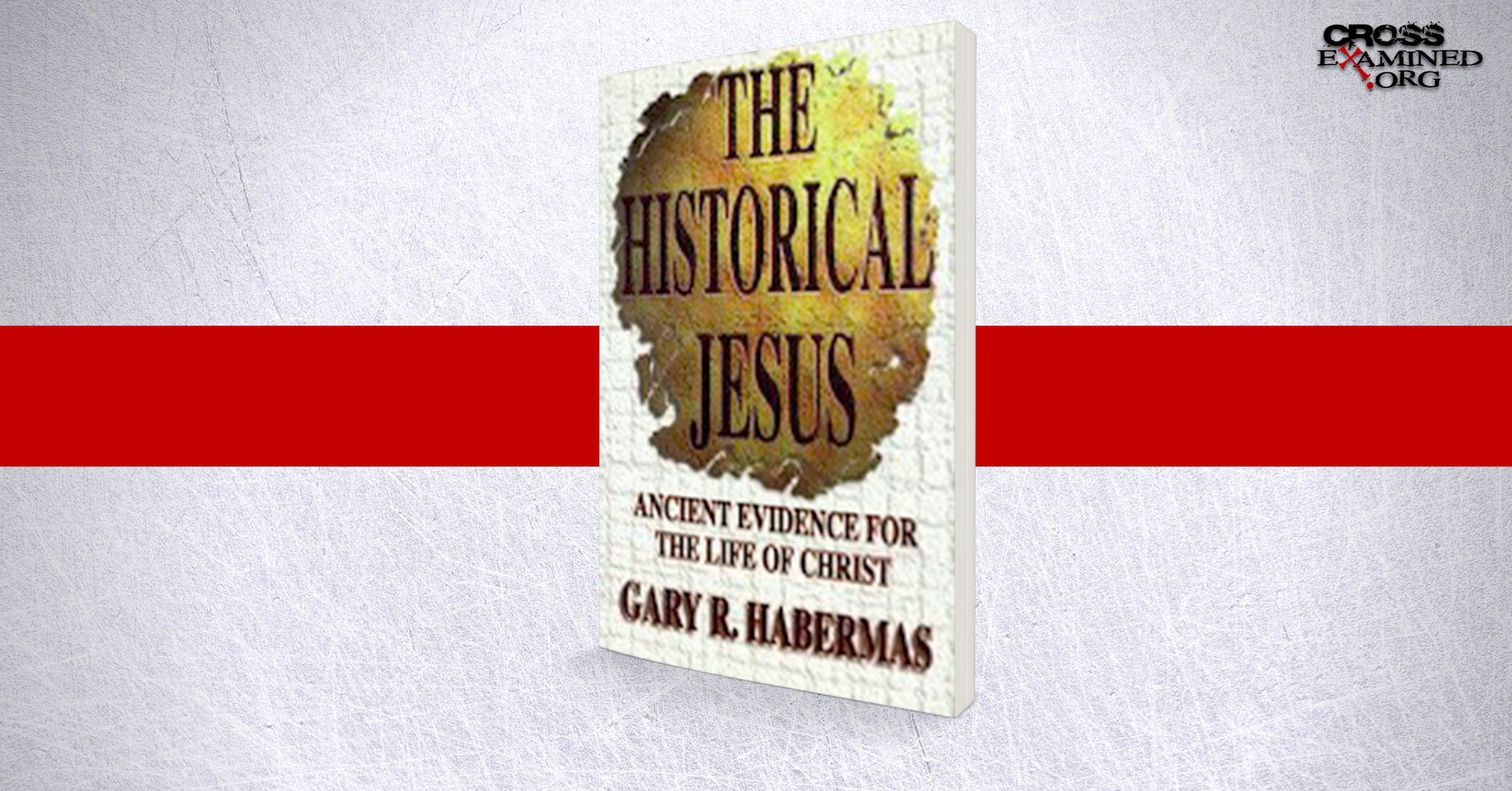
When I was looking for some answers to these questions, I came across the work of Dr. Gary Habermas. The first book of his that I read was the one I present to you today: The Historical Jesus: Ancient Evidence for the Life of Christ. Reading through this book provided the answers to more than just the questions that I was asking but also to questions that I did not know would eventually come too. This was well over a decade ago, and it is time for me to revisit the book and publish a proper review of this most important work. The review will follow my usual chapter-by-chapter summary style and conclude with my thoughts and specific recommendations.

Part 1: Contemporary Challenges to the Historicity of Jesus

Chapter 1: The Modern Quest for the Historical Jesus

In the introductory chapter, Habermas introduces the reader to the historical quest to discover the historical Jesus. He goes over some of the history of the studies, what different scholars proposed at different times regarding Jesus’ historicity and how to handle the different miracle-claims of the New Testament. He describes the popularity of the liberal approaches of the fictitious lives of Jesus and the idea that the gospel accounts were purely mythologies in the eighteenth and nineteenth centuries and the deemphasizing of the historical Jesus in the early twentieth century. He brings the reader “up to speed” by describing the re-emphasis on the necessity of the historical Jesus near the mid-1900s and onto today. While most scholars today recognize that Jesus was a historical figure, there is a small group that still does not. Habermas reminds the reader that the popularity of a particular position does not provide legitimate evidence, in or of itself, for the historicity of Jesus, so this book will examine the evidence that has convinced the majority of scholars that the historical Jesus existed, and it will make the case that the historical Jesus is the Jesus of Christianity.

The historical Jesus Book 2

Chapter 2: Did Jesus Ever Live?

Even though most scholars reject the idea that Jesus never lived, the idea that he did should not be taken for granted in an investigation about the historical Jesus. Habermas addresses the two most common theories to explain the records of the New Testament without Jesus living in history. The first view addressed is that of G.A. Wells, while the second view is more modest and is promoted by Michael Martin.
G.A. Wells dates the gospels in the late first century to early second, and Paul’s letters earlier. He believes that the gospels were too late to contain accurate historical information, so he leans on Paul for historical information of Jesus. He holds that Paul’s writings include very little information about the historical Jesus and concludes that Paul neither knew or cared about the historical Jesus. Wells believes that, at best, Jesus was a much earlier historical figure that legend grew around, and at worst, Jesus was based upon pagan mythologies. Of the many issues with Wells’ view, Habermas address five of them. He provides textual and historical evidence that Wells is incorrect on issues of Paul’s lack of record of and/or concern with historical information about Jesus, the idea that Jesus may have lived prior to the first century AD, Jesus’ connection to pagan mythologies, the late dating of the gospels, and his overall historical methodology.
Recognizing the failure of the more extreme views of G.A. Wells, Michael Martin softens some of the positions to make them more compatible with the textual and historical evidence. For instance, Martin grants that some historical data can be gleaned from the Pauline epistles, but he does not allow for much. He does retain the late dating of the gospels, and he adds that extrabiblical sources either do not contain historical data of the historical Jesus or that the information is inaccurate. Habermas addresses each of these claims briefly as they were either addressed in the section on G.A. Wells or will be covered in greater detail later in the book.
The historical Jesus Book 3

Chapter 3: Limitations on the Historical Jesus

Even though the extreme view that Jesus never existed in history is widely rejected among scholars, many do still believe that what can be known about the Jesus of history is greatly limited. This view is born out in a few different ways. Habermas describes these various attempts to limit historical investigation of the Jesus of history and demonstrates how each of them fails, thus leaving wide open a historical investigation of the life of Jesus as a person that actually existed in the past.

The first view that Habermas addresses is the idea that the gospels record what early Christians believed about Jesus, not necessarily what actually happened. This view removes the gospels from the historical investigation because they would not be claiming to record what actually happened but just what a group of people believed. Habermas explains that this view fails on four accounts. The first is that it removes all historical grounding for the origin of Christianity (from where did the recorded beliefs come?). The second is that without even attempting to investigate the claims of the gospels as historical claims, it rejects them as mythological (how did they come to the conclusion that the gospels recorded beliefs and not events?). The third is that the view assumes that, unique among all historical authors, the early Christians’ records were to not be trusted to be true because they believed their records to be true (how does belief of an event necessitate an incorrect recording of that event?). And fourth, the view holds that due to the few copies of the gospels, we cannot trust that we have what the early Christians originally wrote (given the mountain of copies compared to other ancient writings, how then are we to trust that we know what other ancient writers originally wrote?).

Another optional view is that while the Gospels do record historical events, the only historical events that are correct are ones that are not miraculous. Habermas addresses four ways in which this view fails as well. The first here is that it presumes to reject the miracle claims without even investigating whether they happened or not. Such a priori assertions exhibit neither good scientific investigation nor good historical investigation. The second problem is that the view does not even allow for the investigation of miraculous events because they are miraculous. However, if an event takes place in reality, that it happened can be investigated independently of its source or cause. Third, when the second problem is removed, investigation of Jesus’ being seen after his death and burial is well established, and no naturalistic explanation can account for the event. If no naturalistic explanation can account for an event that has been historically investigated and confirmed happened, then only a non-natural or supernatural explanation (miracle) is possible; thus miraculous events were recorded in the gospels. Fourth, if it can be established that Jesus did rise from the dead (to be investigated later in the book), then his metaphysical (and theological) teachings and actions must be considered relevant to the reader.
The historical Jesus Book 4

Chapter 4: Reinterpretations of the Historical Jesus

Many scholars grant the failures of the views critiqued in the previous chapter, yet they still wish to reject the Christian worldview. So many have attempted to reinterpret the historically established events of Jesus’ life. Habermas investigates these attempts in this fourth chapter.

The majority of these proposed alternate lives of Jesus depend upon the idea that Jesus did not die by crucifixion as recorded in the gospels. Many offers that Jesus merely appeared to be dead and after being removed from the cross and placed in the tomb, he recovered enough to escape and went on to live a secret life. While there are numerous versions of this “swoon” theory, all of them fail on three major accounts. The first is that Roman crucifixion was extremely brutal and would have left Jesus in such horrific condition that he could not escape from a sealed tomb, much less, convince anyone he had “overcome” death. Second, crucifixion caused death by asphyxiation due to the inability to breathe while hanging from the cross when the muscles are relaxed. This means that it was not possible to appear dead on the cross without actually being dead. Third, the Roman executioners ensured Jesus’ death by thrusting the spear into his side and puncturing his heart. Even if faking death on the cross was possible, this final blow would have killed Jesus immediately. Because of these reasons, the swoon theories have all been rejected by scholars.

Even though the failure of this foundation of the alternate lives of Jesus theories is enough to reject those theories, they fail on other accounts as well. These theories, of course, come in many different versions. Some hold that the Gospels and Paul recorded incorrect information and the real events of Jesus post-crucifixion life is unknown, and others hold that Jesus traveled to other places in the world. All of the theories fail for multiple reasons. They contradict already established historical records (the Gospels). They appear late. They have no historical grounds. And the arguments require multiple fallacies to come to their conclusions. Along with those commonly held failures, Habermas also discusses several additional failures that are unique to the various theories. He ends by stating that, because of the incredible list of reasons that these theories fail, they are not taken seriously by historians today, but they needed to be addressed due to their continual recurrence within popular culture.
The historical Jesus Book 5

Chapter 5: The New Gnosticism

One of the more popular challenges in historical Jesus studies comes from the discovery of several texts dated from the mid-to-late second century to the early third century. These are the Gnostic writings, with The Gospel of Thomas probably being the most familiar to the public. Some scholars believe that these text raise a power challenge against orthodox teachings about Jesus due to their traditionally early dating. The Gospel of Thomas is dated as early as AD 140 (all the others are date much later). Supporters of the Gnostic view attempt to date the tradition that is contained within the Gospel of Thomas in the first century, and they contend that due to the early sourcing, it should at least be held on the same authoritative level as the Gospels. Now, the significance of this dating is that, if the dating is correct, then it is possible that there were multiple expressions of Christianity at the time. The competing claim is that the New Testament that we have today is incomplete and that these Gnostic writings are the “lost books” of the Bible that tell a very different story about the historical Jesus. The Gospel of Thomas lacks mention of the crucifixion and Resurrection of Jesus, so the Gnostics claim that these events did not take place (what makes the view incompatible with orthodoxy). They claim that what is known as orthodoxy today merely won a “cultural war” among the different views and is not a reflection of actual events in history.

Having presented this strong challenge of the Gnostic view against the orthodox view of the historical Jesus, Habermas turns to a four-pronged critique of the view. First, even if The Gospel of Thomas is accurately dated early at AD 140 and its tradition is still earlier, the gospels have all been dated a minimum of half a century earlier than even that, which places their source material closer to the events they record than the source material of the Gospel of Thomas. This means that the Gnostic gospels and the Gospels were not co-circulating at the earliest times; the Gospels were present at least fifty years before the Gnostics showed up and (as will be seen later) within only a few years of Jesus’ death. Secondly, Habermas presents four standards of ancient historiography that establish the accuracy of the Gospels’ historical records. This serves to hold authority over later writings that present contradictory stories (the Gnostic writings, in this case).

Thirdly, based upon the testimony present in various books of the New Testament and in the writings of the apostolic fathers, we can see that the canon of Scripture was well established prior to the dates of many of the Gnostic writings. This means that Christians had recognized the earliest writings as accurate and authoritative before the greater body of Gnostic writings (and their contradictory content) were even present. Fourthly, even though the death and Resurrection of Jesus are not mentioned in the Gospel of Thomas, that is not evidence that it did not happen, especially when we have four earlier records that record that they did happen. Interestingly enough, proponents of the Gnostic view hold that the proposed document “Quelle” or “Q”, that is the source for the similarities among the synoptic Gospels, did not contain information of Jesus’ death and crucifixion, but this is speculation as both the existence and content of the document are hotly debated. Even if they were right about the content’s absence, its absence still would not argue against its actually taking place. For these four reasons, scholars generally do not consider Gnosticism a viable alternative view for the historical Jesus; Gnosticism or elements of it is vastly more popular among non-scholars.
The historical Jesus Book 6

Chapter 6: The Jesus Seminar and the Historical Jesus

Another way to dismiss the historical Jesus (as recorded in the gospels) is put forth by people in the Jesus Seminar. The Jesus Seminar tends to see their position as a compromise between those who reject all historicity of the records in the gospels and those who take every word of it historically. Their position begins philosophically with, not just the rejection of the supernatural, but the very incompatibility of the supernatural with reality. Using this filter, they reject all records in the gospels that include any kind of non-natural event, including all experiences with Jesus after his crucifixion; however, they do tend to believe that the events that required no such non-natural mechanism are historically accurate.
Habermas explains that the Jesus Seminar does not really offer as much of a “compromise” position as they like to think. The primary reason for this is before any investigation on their part has begun, they have already ruled out even the possibility of many of the historical events taking place. They have already rejected the only explanation of the events, so they are unable to perform an unbiased investigation of the historical data. With this critique in place, some Seminar scholars have pulled back on some of the extreme conclusions and have opted for agnosticism on the historicity of different non-natural events. These more moderate Seminar scholars offer several naturalistic explanations for the records of the non-natural events; however, Habermas shows how they fail to account for the historical data and/or commit various fallacies. He also demonstrates how their hypotheses are often contradicted by the historical evidence. Ultimately, he concludes that the various positions offered by Jesus Seminar scholars are not historically viable and should be rejected.

The historical Jesus Book 7

Part 2: Historical Data for the Life of Jesus

Chapter 7: Primary Sources: Creeds and Facts

Having surveyed and dismantled the many different attempts to separate the historical Jesus from the Jesus of the gospels, Habermas now turns to an investigation of what can be known about the historical Jesus and early Christian theology apart from the New Testament gospels. He begins by evaluating the creeds, hymns, and traditions that were closest to the death of Jesus. These sources originated prior to the formation of the New Testament and are recorded within it. Several, among many others, can be found in the following passages of the New Testament:

  • 1 John 4:2
  • 2 Timothy 2:8
  • Romans 1:3-4
  • 1 Timothy 3:16
  • Phillippians 2:6
  • Romans 10:9
  • 1 Corinthians 11:23
  • 1 Timothy 6:13
  • 1 Peter 3:18

Taking the reader through the many early sources, Habermas demonstrates over forty different characteristics of Jesus Christ that were both believed by the early Christians and passed down through the centuries to today. In this exercise, Habermas demonstrates that the Jesus of Christianity is indistinguishable from the Jesus believed by the earliest Christians. These orthodox beliefs were not the product of any single or series of events that took place over time; the beliefs appeared early and suddenly.

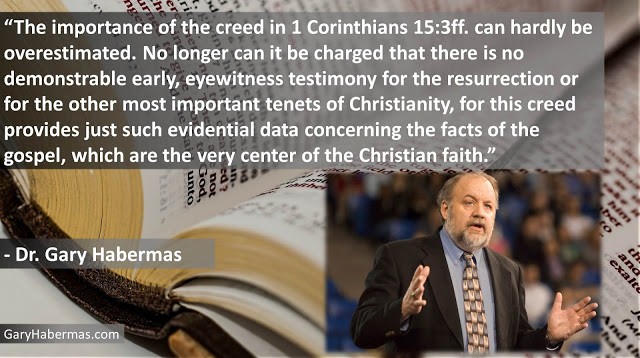
Habermas also spends a considerable portion of the chapter evaluating the creed in 1 Corinthians 15. This creed is often considered to be one of the most important because it ties the beliefs of the earliest Christians to eyewitness testimony of those who walked with Jesus and had experiences of the risen Jesus. Because of this eyewitness connection, this early creed not only opens the door to historical testing of the events surrounding Jesus and the claims that He and the early Christians made, but it compels such testing. Thorough testing has been performed on at least twelve unique claims of the historical Jesus regarding the most important event: the Resurrection. That testing has revealed the facticity of those twelve claims; however, Habermas believes that only four of them are sufficient to establish the historicity of the Resurrection event. He spends a small portion of the chapter explaining this “minimal facts” apologetic, but for those who wish to go deeper into this specific historical event, check out Habermas’ book “The Risen Jesus and Future Hope” along with his many other writings at GaryHabermas.com.
The historical Jesus Book 8

Chapter 8: Archaeological Sources

Archaeology has provided evidence of the historical context surrounding the life of Jesus, has provided corroboration for several of the historical claims within the gospels, and may even provide compelling evidence for the Resurrection of Jesus. One of the most contested (non-miraculous) events recorded in the gospels is that of the census described by Luke. Habermas explains how archaeology has not only helped answer some of the questions this event but has also provided calibration tools for identifying the year of Jesus’ death. Archaeology has also yielded much information about the ancient practice of crucifixion that corroborates reports in the gospels. For instance, the skeleton of “Yohanan,” a crucifixion victim, was discovered in 1968. This particular discovery has provided information regarding the condition of the victim as they were nailed to a cross, the excruciating way a victim was nailed to a cross, many painful events that happened to the body while on the cross, and the ultimate cause of death. This data has given medical and historical researchers ways to test the claims surrounding Jesus’ mode of execution and have found them to be accurate.

Probably the most controversial archaeological find surrounding the historical Jesus is the Shroud of Turin. Tradition has it that this linen is the actual burial cloth of Jesus. Many visual commonalities provide a powerful case for this claim, including the blood stains that are common to victims of a crucifixion and other stains that are unique to Jesus’ crucifixion. The absence of evidence of bodily decomposition suggests that the victim was not in the cloth for long. And some Christians believe that the “scorch” marks that are inconsistent with foreign materials provide evidence of a resurrection. However, carbon dating has seriously challenged the identification of the Shroud with the first century AD, but even these studies have come under scrutiny due to lack of peer review and blind testing, possible contamination, and inconsistency with other pieces of evidence. Habermas explains that even if the Shroud is not that of Jesus, it could still be that of a victim who suffered a remarkably similar fate, thus still providing powerful evidence of the practice of crucifixion. He also explains that if the Shroud is, in fact, the burial cloth of Jesus, archaeologists have powerful tangible evidence not only Jesus’ mode of death but the historical event of His Resurrection as well.

Chapter 9: Ancient Non-Christian Sources

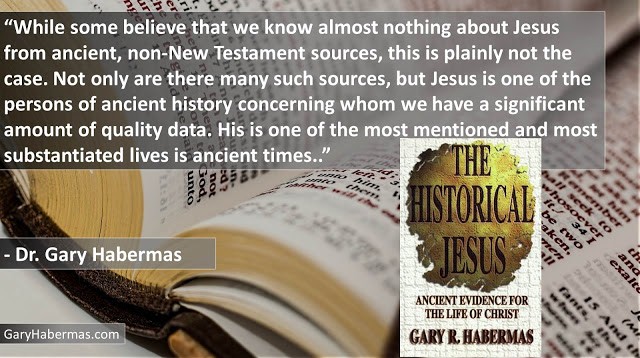
Of all the figures in ancient history, Jesus is the most mentioned. The mentions not only come in ancient Christian writings but also in those of non-Christian sources. Habermas takes the reader through the different ancient historians’ and other writers’ material that mentions Jesus. Tacitus, Suetonius, and Pliny the Younger are just a few. As Habermas describes these writings (and several others) and how they have been preserved in antiquity, he quotes directly from them, highlighting not just the mention of Jesus but also all the information about Jesus’ life, His teachings, and His death that are recorded.

He also discusses the most controversial of them all: Josephus. He quotes the disputed and undisputed texts along with a proposed “original version” of the disputed text that would be more consistent with Josephus’ worldview as a Jewish historian. Habermas takes the undisputed portions along with the proposal to demonstrate several facts recorded by Josephus regarding Jesus. Habermas even cautiously uses Gnostic writings to help support certain claims about the historical Jesus that are found in other non-Christian sources. Habermas concludes from all these ancient non-Christian sources that even if Christian sources (discussed in the next chapter) are disregarded, it is established that the Jesus of the Bible existed in history and many true things can be known about Him.
The historical Jesus Book 9

Chapter 10: Ancient Christian Sources (Non-New Testament)

Of course, the ancient writings of the historical Jesus are not limited to non-Christian sources. Many Christian sources outside the New Testament were also composed and circulated.  These authors included Clement of Rome, Ignatious, Justin Martyr, among others. These early sources give historians an understanding of early Christian doctrine and what the early Church believed about the historical Jesus. Habermas discusses each author that builds a total description of Jesus’ life, teachings, death, and resurrection that echoes the claims of the New Testament. These records indicate that the early Church already believed what was written in the New Testament; they did not wait to see who the “winners” were regarding orthodoxy.

Many people believe that the fact that these writers were Christian made them unjustifiably biased in their beliefs and that makes them unreliable sources. However, because much of their beliefs about the historical Jesus were based upon the material in the New Testament (only one generation removed, in some cases), which was shown to be trustworthy in the previous chapters, these early Christian authors were certainly justified in their beliefs.  Because they were justified in believing what they recorded, their records stand firmly as a testimony of the beliefs of the earliest Christians.

Chapter 11: Summary and Assessment

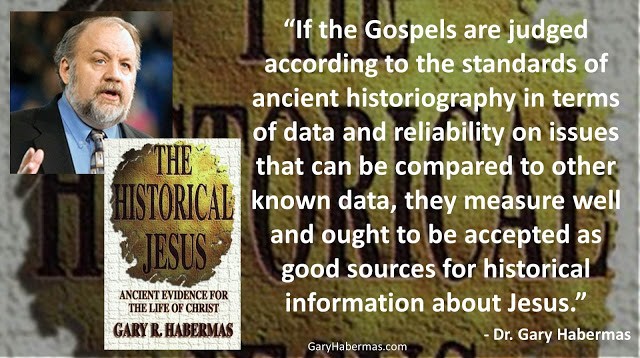
Having concluded a survey of the historical evidence that could speak to the historical Jesus and various challenges to his existence, Habermas succinctly summarizes what can be known from the historical evidence alone. He lists out 129 things that can be known about the historical Jesus relating to His life, work, death, and resurrection. These facts are gathered from 45 different ancient Christian and non-Christian sources. The sheer number of ancient sources that give pertinent information about the life of Jesus is more than enough to conclude by the standards of historiography that the historical Jesus is the same Jesus that is recorded in the Bible. If the Jesus of the Bible is to be separated from the Jesus of history, the entire enterprise of ancient historical studies is called into question.
The historical Jesus Book 10

Reviewer’s Thoughts

The Historical Jesus: Ancient Evidence for the Life of Jesus was an exciting read! I came to the book originally with many questions about what could be truly known about the historical Jesus, but as I read through it, my questions were answered. As my original questions were answered, more questions formulated in my mind that Habermas seemed to almost anticipate. It has been over a decade since my initial read through the book when these questions were answered. It was refreshing and encouraging to read through it again because over the last decade, some curiosities have come up that I had forgotten were addressed in the book. When these come up in conversation, I am now more prepared to “give a reason for the hope that I have” (1 Peter 3:15).

When I first read the book in my early 20s, it was very understandable at that time (it answered my basic questions), yet it is comprehensive and deep enough to have addressed the more nuanced challenges that I have been exposed to over the years. Habermas really made the historical facts come to life for me and give me a more connected feeling to the actual events of history. This not only excited me but gave me a profound sense of satisfaction that my belief is justified true belief, justified by the evidence of history.

If you are having serious doubts about the historical Jesus, you definitely need to get this book. And if your church has a library, it needs to be on the shelf for those who have these deep questions and are honestly looking for answers. For any Christian who regularly discusses the truth of Christianity (that should be all of us), you also need this book. It will give you a resource to always be prepared to answer both the basic and the deeper challenges of those who are skeptical of the historical foundations of our worldview. Nearly two thousand years ago, the Apostle John proclaimed, “The Word (Jesus) became flesh and made his dwelling among us. We have seen his glory, the glory of the one and only Son, who came from the Father, full of grace and truth,” and history bears a fantastic witness to this truth.


Original Blog Source: http://bit.ly/2yMrnWJ

By Brian Chilton

Recently, news agencies filled the airwaves and the internet with the news of Stephen Hawking’s last book to be published and released posthumously. The book released on October 16, 2018, is entitled Brief Answers to the Big Questions. Hawking argues through a series of essays why he didn’t think that God existed, did not think it was possible for God to exist, and did not believe in an afterlife. He appeals to quantum mechanics and the bizarre behavior of quantum particles which seemingly appear to pop into existence from nothing to argue his case. However, it should be noted that quantum particles do not really pop into existence from nothing as philosophically understood to be “no-thing.” Rather, quantum particles derive from a quantum vacuum—a very physical thing with very physical properties and processes. Thus, while admittedly I am not a physicist nor a physicist’s son, Hawking’s claim is not honest with the scientific data.

This causes one to ask, do we have good reasons to believe in God’s existence? I would like to propose ten reasons why we can believe that he does. To be forthright, there are many, many more. These represent some of the more popular reasons to believe that there really is a God who transcends reality and a few that I think stand to reason by the very nature of the way the world works.

  1. Necessity of a First Cause (Cosmological Argument). Physicists Borde, Guth, and Vilenkin discovered a mathematical theorem which dictates that all physical universes, including the theoretical multiverse, must have a required starting point. There was a time when physics (even quantum physics), time, and matter did not exist. How did it come to be? Atheists will argue that it just is. However, the data seems to suggest that an eternal, metaphysical (beyond the physical realm), Mind brought everything to be. That Mind would need to be omnipotent, omnipresent, and omniscient. That Mind is who we know to be God.
  2. Designed Creation (Teleological Argument). Hugh Ross has argued that there are over 180 cosmological constants in the universe so finely tuned that if they were to be changed by the nth degree, life and the universe itself would not exist. Even the theoretical multiverse would need to be designed to such a degree that it would require a designer. I believe wholeheartedly that physicists will eventually find design attributes and constants in the quantum realm if they haven’t already. Design argues for a Designer.
  3. Objective Morality (Moral Argument). Leaving the scientific realm for the philosophical and ethical, objective morality argues for an Objective Lawgiver. God is the best explanation for why objective morality exists. As Brian Manuel, a good friend of mine, said recently, “We can just know certain things to be right and wrong without even being taught.” He is absolutely right! People have an innate sense of morality. That comes from a Moral Lawgiver who we know to be God.
  4. Necessary Being (Ontological Argument). In the end, one only has two options. Either an eternal nothingness (meaning again, “no-thing,” not even quantum particles) brought forth something from absolute nothingness, or an eternal Being brought everything that exists into being. The latter makes far more sense and actually adheres more to the scientific method than the former.
  5. Explanation for Data (Information Argument). Why is there anything at all? Even though the quantum world is a strange place, it still behaves according to certain laws. Why are there quantum particles? Quantum fields? Why do physical processes and procedures exist? One explanation: God. For any data to exist, a programmer must exist. That Programmer must be God himself.
  6. Science and Mathematics. Ironically, the scientific method and mathematics appeal to God’s existence. Scientists hold that the universe operates according to certain laws on a regular basis. The ability to do science itself means that human beings have been given cognitive abilities to observe the universe and, interestingly, have been placed in a position where the universe is observable. One must inadvertently appeal to the divine to even do science and mathematics. To add to this point, the beauty one finds in nature would have no real aesthetic value unless God exists.
  7. Historicity of Jesus’s Resurrection. One of the most historically provable events of ancient history is Jesus’s crucifixion and resurrection. Jesus’s resurrection is quite intriguing because he continuously appealed to God the Father to raise him from the dead. For Jesus to have risen from the dead indicates that the one whom he mentioned did what Jesus claimed he would do. The resurrection of Jesus points to a transcendent reality we call God.
  8. Miracles and Spiritual Encounters. Craig Keener wrote a two-volume work describing the many documented miracles in modern times. While God may not always perform a miracle in every circumstance, a good deal of evidence suggests that God has performed miracles throughout history. Added with the many spiritual encounters people have had with the divine provides an added case that God does indeed exist.
  9. Near-Death Experiences and Consciousness. This is a fascinating area of study. Gary Habermas has noted that there are over 100 medically confirmed cases of near-death experiences where people have died and reported events that happened on this side of eternity which could be corroborated by others. The events described along with experiences of meeting God and the feelings of peace add to the case for God’s existence. Most certainly near-death experiences prove that materialism is a dead philosophy.
  10. Purpose and Meaning. For anything to have purpose and meaning, God must exist. If Hawking is right in that the universe is all there is and there is nothing else, nothing, including his research, has any meaning or value. Meaning, value, and purpose are found only because God exists.

I could certainly list other reasons to believe in God’s existence. But these will suffice for now. Hawking was a man of great intellect. Yet, despite his great mental prowess, it is quite odd that he could never quite see the evidence for God. While he could see, he was quite blind. Hawking said that “religion is a fairy tale for those afraid of the dark.” I believe John Lennox provided a stronger claim by noting that “atheism is a fairy tale for those afraid of the light.”


Brian G. Chilton is the founder of BellatorChristi.com and is the host of The Bellator Christi Podcast. He received his Master of Divinity in Theology from Liberty University (with high distinction); his Bachelor of Science in Religious Studies and Philosophy from Gardner-Webb University (with honors); and received certification in Christian Apologetics from Biola University. Brian is currently enrolled in the Ph.D. program in Theology and Apologetics at Liberty University and is a member of the Evangelical Theological Society and the Evangelical Philosophical Society. Brian has been in the ministry for over 15 years and serves as the Senior Pastor of Westfield Baptist Church in northwestern North Carolina.

Original Blog Source: http://bit.ly/2qcNP6q

By Evan Minton 

When atheists accuse God of being immoral, they usually point to nasty Old Testament accounts like the conquest of Canaan, God sicking two female bears on a group of youths for harassing Elisha, or destroying humanity in a massive flood (Genesis 6-9). In addition to various other considerations regarding these specific incidences, one factor I always bring up is that God does no wrong in ending the life of an individual human being. Why? Because He is the author of life and therefore He can take life as He sees fit. It’s wrong for humans to kill humans because we aren’t the Author Of Life. The Author Of Life can take life. If you didn’t give life, it isn’t yours to take. It is God’s prerogative as God to decide when the date of our death is.

How Skeptics Typically Respond To This

Two common responses from the skeptic are typically raised against this as reductio ad absurdum arguments. First, they’ll say, if giving someone life entails that you have the prerogative to take that life, then this would entail that parents have the right to kill their children since parents gave their children life. Second, they’ll say something like “If a scientist were able to create a living thing in the lab, your logic would entail that the scientist would have the right to kill that living thing.” Professor Utonium could smother the PowerPuff Girls in their sleep. Dr. Frankenstein could kill his monster. Yet we intuitively recoil at such an idea. This suggests that there’s something wrong with the argument.

The Problem With These Responses: The Fallacy Of The False Analogy

The problem with these responses is that it’s an apples-to-oranges comparison. As far as parents and children go, parents only give their offspring life insofar as they come together in sexual union, and the mother allows the child to grow to full term before giving birth. Yet, my mother did not create any of her eggs, and my father didn’t create any of their sperm. Secondly, they wouldn’t exist unless their parents likewise came together in sexual union and so on. Ultimately there would be no sexual reproductive process if the universe weren’t created and finely tuned for life. As I recently told an atheist on Twitter “Parents and having sex and conceiving VS. God creating life is comparing apples to oranges. Create a living, breathing spirit by the word of your mouth; then we’ll talk about whether you can kill it.” The point is that God is the ULTIMATE creator of all things (Genesis 1, John 1:1-3) and sustains everything’s existence moment by moment (Colossians 1:17). While my mother and father certainly participated in my creation, they didn’t and couldn’t have done it apart from the will of God. Eve recognized this when she gave birth to her firstborn son Cain. She said, “With the help of the LORD I have brought forth a man.” (Genesis 4:1)

Regarding the lab creation, again, the major key difference between God taking life and you taking the life of your lab experiment is that God is the supreme Creator of literally everything (as I’ve just said). There wouldn’t be anything if God had decided not to make the universe. Even if you could make life in a lab, you wouldn’t be the ultimate source of life. It reminds me of that joke in which scientists tell God that they create lifelike He can, and when they scoop up a pile of dirt to do so, God responds with “Hey! Hands off! Get your own dirt!”

Is The Argument Ad-Hoc? 

Recently when debating this issue on Twitter, an atheist accused The Author-Of Life argument as being “ad-hoc.” The ad hoc fallacy occurs when you make up an explanation just to save your belief from being refuted. In this case, the Twitter atheist accused me of making up this God-Has-Sovereignty-Over-Life-And-Death position just to avoid the conclusion that God did something wrong in sicking the bears on Elisha’s harassers or exterminating the Canaanites.

However, this charge would only stand if that were my reason for making the proposal, but it isn’t. The church has long held that God is sovereign over life and death precisely because He is the source of all life. This isn’t something I or other contemporary apologists came up with to get God off the hook. Only if this position on God’s sovereignty over life were invented solely with the purpose of answering God-Is-Immoral arguments would the charge of the ad hoc fallacy stand. I asked this person “Can you show me historical evidence that any of the church fathers or the Rabbis that preceded the rise of Christianity held to the view that God has sovereignty over life and death SPECIFICALLY to answer objections like the Elisha bears incident?” He denied that he could and ultimately said that it was unprovable. I told him he ought to refrain from making unprovable assertions in the future.

In Conclusion 

The attempts of the skeptic to make a murderer out of God fail.

“The Lord giveth and The Lord taketh away. Blessed be the name of The Lord!” – Job 21:1 (KJV)


Evan Minton is a Christian Apologist and blogger at Cerebral Faith (www.cerebralfaith.blogspot.com). He is the author of “Inference To The One True God” and “A Hellacious Doctrine.” He has engaged in several debates which can be viewed on Cerebral Faith’s “My Debates” section. Mr. Minton lives in South Carolina, USA.

Original Blog Source: http://bit.ly/2O4YPML

By Natasha Crain 

My friend, Alisa Childers, recently wrote a review of the bestselling book, Girl, Wash Your Face, by Rachel Hollis. It started a firestorm of online discussion about what makes someone a “Christian” author, what responsibility a self-identified Christian author has in promoting ideas consistent with biblical faith, and what harm there can be for Christians reading books that contain nonbiblical ideas.

I personally haven’t read the book, so I’m not going to comment on it specifically. But I will say I was extremely disappointed and saddened to see the kinds of comments supporters of the book wrote:

“It wasn’t meant to be a devotional.”

“She’s not teaching theology.”

“Our job is not to seek people out and hate them.”

“Stop competing! Just imagine what the non-Christians think about the McJudgies! We need to focus inward because the project within ourself is the most important work we will accomplish. Don’t use your blog to bring someone down.”

Unfortunately, such comments are representative of the lack of discernment common in the church today. If Alisa fairly characterized the claims of Hollis’s book, Hollis is promoting ideas that conflict with a biblical worldview. And when there is a concern that millions of women are consuming content from a Christian author that can lead them to embrace unbiblical ideas, we should be raising a warning flag and calling out for discernment in the body of Christ.

It’s not about being a “McJudgey.”

It’s about discerning biblical truth from non-truth…something the Bible consistently tells us to do.

While this post isn’t directly related to parenting (which I normally write about), it’s something that affects parenting. When parents readily incorporate popular but unbiblical ideas into their worldview, those ideas will affect how they raise their kids and the nature of the worldview they pass on.

The following are 10 signs that the Christian authors you’re following may be subtly teaching unbiblical ideas. I say “subtly” because I think most people would spot a problem immediately if a Christian said they didn’t believe in the Trinity. But it’s just as important to identify when less obvious warning signs—like the following—are present.

  1. They say, “I love Jesus but…”

It’s become popular for writers to trumpet that they love Jesus but (fill in the blank). When you see a sentence start this way, be prepared for one of two things to follow.

First, it may be something that the author knows is contrary to what Jesus would have approved of. For example, if you Google “I love Jesus but,” you’ll find a whole industry of shirts, mugs, and other things that say “I love Jesus, but I like to cuss.” Is this really something that glorifies the God you say you love? If you have to use “but” as a contrasting word between loving Jesus and making a statement about what you do and/or say, it’s probably not something to be proud of. When authors do this to be more likable to their audience, it’s often a sign that other unbiblical ideas will follow.

Second, it may be something that isn’t in contrast to loving Jesus at all, but the author wants you to think they’re different than the negative stereotype of Christians. For example, they’ll say something like, “I love Jesus, but I’ll never claim I have all the answers”… implying, of course, that Christians normally claim they have all the answers. Non-believers may think Christians feel this way because Christians believe Christianity is a matter of objective truth, but that doesn’t mean Christians claim to have all answers or that acceptance of objective truth is problematic.

  1. They make it a point to separate a relationship with Jesus from religion.

Unfortunately, the idea that Jesus somehow hates religion has become popular even amongst Christians who otherwise hold biblically solid beliefs. If Jesus truly hated religion, the popularity of this idea wouldn’t be an issue. The problem is that Jesus doesn’t hate religion. He hates false religion. Without writing an entire post on this (there’s a whole chapter in my next book about it), the bottom line is that there’s no need to separate Jesus from religion that is true. Christianity is simply the name for the religion whose set of beliefs center on who Jesus is and that calls us to know, worship, serve and obey Him. In other words, Christianity is a religion centered on a relationship.

When authors start writing negatively about “organized religion” in general, and place that in opposition to their own personal relationship with Jesus, it’s often because they are going to 1) challenge the idea of objective truth (thereby suggesting that uniform religious belief found in “organized religion” is bad) and/or 2) value their personal spiritual insights over God’s revelation to humankind through the Bible (personal experience becomes authority).

True religion glorifies God (James 1:27) and isn’t something Christians should denounce.

  1. There’s a lot of talk about authenticity and messiness.

Authenticity simply means honesty. At first blush, it doesn’t sound like that has anything to do with the Bible, and, if anything, it seems like it should go hand-in-hand with the Bible. However, in practice, authors who emphasize how “messy” their lives are and how “authentic” they are going to be with you about that messiness often use the opportunity to normalize sin.

As with several of these points, this is not always the case. Some authors who speak in these terms use it as an opportunity to point back to God. But I’ve seen it go the other way more often than not, so it makes the list.

  1. They promote the value of questions over the value of answers.

Another approach to “spirituality” that has become trendy is focusing more on raising questions about faith than sharing biblically sound answers. Authors who identify as progressive Christians sometimes go so far as to accuse other Christians of being afraid of questions and look skeptically upon anyone who attempts to answer the questions they raise.

Now, if you’ve read my blog for any amount of time (or my books, for that matter), you know that I’m all about raising tough faith questions with your kids…questions are extremely important. But questions also need to be addressed to the extent we can, given what the Bible tells us.

People who value questions more than answers are often uncomfortable with the idea of objective truth—that there is a truth independent of our personal experience. Everything Jesus taught assumed that there is truth independent of our personal experience and that He is that truth. If an author is uncomfortable with the idea of objective truth, they’re uncomfortable with Jesus.

  1. They confuse uncontroversial statements with moral positions.

One extremely popular author wrote on her Facebook page recently that she wanted to make it very clear where she stands on social issues. Getting “clear” on these things included making a completely uncontroversial statement for any Christian: she “cherishes the humanity of the LGBT community.”

All Christians should cherish the humanity of every community because we are all made in the image of God.

That’s never been a question.

But, of course, she said this implying that anyone who holds to a biblical view of marriage somehow does not cherish the humanity of the LGBT community. It’s a very misleading move to make a statement that no Christian should disagree with in order to suggest it’s something that those who take a different position than the author on a moral issue would disagree with.

  1. They focus almost entirely on Christian action to the exclusion of belief.

Someone recently told me that people in his denomination don’t value apologetics (why there’s good reason to believe Christianity is true) because their apologetics are in their actions. This attitude, effectively, is what you see with many popular Christian authors today, even when they say nothing about apologetics specifically. For them, Christianity is all about what you do in the world; it’s no longer about believing in Jesus as Lord and coming to a saving knowledge of Him. This kind of Christianity is hardly different than secular humanism. It just comes with a fond but relatively mild appreciation for Jesus on top…like a candied cherry on a sundae of good works that can easily be removed.

The Bible is clear that belief matters…in an eternally significant way. For more on this, see my post, Is How We Live More Important Than What We Believe?

  1. They use the word “faith” to mean some kind of unbounded belief system about God.

One bestselling Christian author shared the following quote on social media recently: “Faith is not a belief. Faith is what is left when your beliefs have all been blown to hell.” This, sadly, was met with thousands of likes, loves, and shares. It’s also a biblically inaccurate definition of faith.

The Bible does not present faith as blind belief or as believing in spite of evidence. The Bible repeatedly shows that faith is believing in what you have good reason to believe is true.

 Biblical faith is not the broken pieces that remain when you’ve lost a bunch of other beliefs, as this quote suggests. Any time you see an author promoting an inaccurate idea of faith, it should be a warning flag. In this case, the author is well known for writing books about her struggles with the Bible. It’s not surprising at all that she would share such a quote.

  1. They regularly encourage you to “be true to yourself.”

If you frequently hear from an author that you need to be true to yourself, you can bet they’re on the shaky theological ground. As my 9-year-old daughter said when I asked if she thought people should be true to themselves, “You shouldn’t always be true to yourself, because if you want to be a murderer that would be really wrong.” #basiclogic

Simply put, this kind of “pull yourself up by the bootstraps” secular wisdom is just that…secular. It’s not very inspirational to be more true to yourself. As Christians, we should be inspired to be less like our sinful nature and more like Jesus.

  1. They treat judging others as the ultimate sin.

For many people today, the ultimate sin is judging another. Jesus doesn’t tell us not to judge…He tells us not to hypocritically judge and to judge with right judgment (e.g., John 7:24). Friends, we have to be discerning! Discerning between truth and non-truth doesn’t mean you are spiritually condemning a person, as people so often believe. Only God knows the human heart, and we are surely not called to determine whether someone else is saved. But we sure can and should address what the Bible says about right belief and right action. If you’re following someone who says things like, “Don’t stick around if want to judge others!” “Our job isn’t to judge, it’s to love!” or “This is a judgment-free zone!” steer clear. It likely means something very different than you think.

  1. They make claims about what it means to love others without addressing what it means to love God.

When we follow the greatest commandment—to love God—it informs what it means to follow the second commandment—to love others. It’s not up to us to define the word. There are many authors (who identify themselves as Christians) today who champion unbiblical ideas of what it means to love others, and it’s rooted in ignorance of the commandment to first love God. I saw one such author this week say that Christians are unloving for being opposed to abortion, for example. But when we first love God and understand that we are made in His image and every human, therefore, has extraordinary value, we simply can’t conclude that loving others means allowing them to take the life of another human, no matter the circumstance.

Be vigilant. Test everything. And hold fast to what is good and true.


Natasha Crain runs her Christian apologetics blog for parents, ChristianMomThoughts.com. She obtained her MBA in Marketing and Statistics from UCLA and obtained a Christian apologetic certificate from the University of Biola. She currently resides in California with her husband Bryan along with her three young children.

Original Blog Source: http://bit.ly/2SiVcGq

By Tim Stratton

Complaint:

Dear Tim,

I love you man, but I don’t want my politics and my religion mixed. I look up to you for religious context and commentary because you are an expert in the field. Not politics. That’s just your opinions, and I can get that from every Tom, Dick, and Harry… but not Tim.

– Sean

Tim’s Response:

Thank you for your kind words, Sean. However, in addition to your pleasantries are statements that I encourage you to consider more deeply.

It would be absurd not to have one’s worldview (religion) influence their politics. In fact, one’s worldview ought to do that much (not the other way around). That is to say, if one truly believes that God exists, created humanity on purpose and for a specific purpose and that Jesus revealed how we ought to live, then the laws of politicians will either approximate to the “law above the law” (ultimate reality) or not.

If God does not exist, then humanity was not created on purpose or for a specific purpose. Thus, we would be mere accidents if atheism is true. If humanity is nothing but accidents, then politics are objectively meaningless (along with everything else) as there would be no objective purpose of the existence of humanity (say goodbye to human rights). Thus, on atheism, it would not really be wrong (objectively speaking) if Obama, Trump, Hitler, or Stalin is calling the shots. It is merely one’s irrelevant subjective opinion.

If God exists and Christianity is true, however, then one’s subjective political opinions can be objectively right or objectively wrong.

Politics & Gospel

Additionally, when a Christian claims they do not want their “politics and religion mixed” that is a good indicator that they probably do not understand their own religion for at least two reasons: 1- Jesus got involved in politics. 2- We are commanded to love all people and to share the gospel with the world.

First, consider the fact that Jesus constantly interacted with the Pharisees in the New Testament. The Pharisees were the religious and political rulers of Israel. Matthew 23: 23-24 provides a good example:

23 “Woe to you, teachers of the law and Pharisees, you hypocrites! You give a tenth of your spices—mint, dill, and cumin. But you have neglected the more important matters of the law—justice, mercy, and faithfulness. You should have practiced the latter, without neglecting the former. 24 You blind guides! You strain out a gnat but swallow a camel.”

Think about the “more important matters of the law” and modern-day America. Politicians today are more concerned about the consequences of using plastic drinking straws than placing restrictions on abortion (killing innocent human beings) and actually advocate for it in many cases. What do you think Jesus would say to these politicians? Based on His reaction to the political leaders of Israel, do you think Jesus would worry about hurting the feelings of modern-day politicians or those who vote for them? We must not disregard the “more important matters of the law.”

Second, if a Christian does not take politics seriously, then they probably do not take evangelism seriously. Frank Turek shows a satellite image of the Korean peninsula to make this point (See Why Christians Should Be Involved In Politics).

Notice the stark contrast between the north and south. South Korea is filled with light, activity, and productivity. According to Turek, “it is one of the most Christianized countries in the world.” North Korea, on the other hand, stands in polar contrast to their neighbors south of the border. North Korea is dark and seemingly “dead.” Turek accurately describes it as a big “concentration camp.” What is the difference between North and South Korea? One word: POLITICS!

Many South Koreans have heard the gospel of Jesus Christ because there is political freedom to share the gospel. The communistic government of North Korea, on the other hand, does not allow the gospel to be shared — it is a dictatorship. If you are a Christian, Sean, then you know that the gospel message is the most important information a person could ever have access to or possess. If you truly love all people — as Jesus commanded — then you must desire the people who have never heard the gospel to have access to this eternally vital information. Since politics is keeping millions of souls from hearing the gospel, if you truly love and care for all humans, then you should care about politics.

To not care about politics is to not care about people.

The Lesser of Two Evils

If you believe Christianity (your “religion”) is true, you must “mix” it with politics — at least if you are a consistent Christian and strive to love all people. After all, if Christianity corresponds to reality, then the politicians you support and vote for should strive to correspond to reality too. No politician will do this perfectly, but some political views approximate to reality more than others.

Unless Jesus Christ is running for office, all elections are a vote between the lesser of two evils. As Turek notes, if Billy Graham was running against Hitler, it would still be a vote between the lesser of two evils. Obviously, one who strives to be an objectively good person would do anything possible to keep Hitler and his politics out of office. That would include “mixing” politics with religion and sharing his or her views with as many voters as possible.

Bottom line: You kindly refer to me as an “expert” in my field (theology and metaphysics/ultimate reality). If that is true, then this expertise allows me to intelligently provide insight into things that fall under the umbrella of ultimate reality — like some political issues — as an expert too. That is to say, my political opinions are informed from my knowledge of reality. In fact, if one is trained how to think logically, then thinking logically applies to all aspects of life. This includes both religion and politics.

If one’s religion is true and their political view is also objectively good or right, then one’s religion and politics must be “mixed” . . . independent if they realize it or not.

Stay reasonable (Isaiah 1:18),

Tim Stratton


Tim pursued his undergraduate studies at the University of Nebraska-Kearney (B.A. 1997) and after working in full-time ministry for several years went on to attain his graduate degree from Biola University (M.A. 2014). Tim was recently accepted at North-West University to pursue his Ph.D. in systematic theology with a focus on metaphysics.

Original Blog Source: http://bit.ly/2JgVEkf

By Mikel Del Rosario

Evidence That Demands a Verdict

Growing up, I had a lot of questions about the faith. So I went looking for answers.

One of the first apologetics books I discovered on my dad’s shelf was Josh McDowell’s classic work, Evidence that Demands a Verdict. My dad even arranged for me to meet Josh while I was transitioning to high school. But neither one of us knew I’d eventually meet his son, Sean, during our college days at Biola University.

Today, I’m helping get the word out about the newly expanded and updated Evidence That Demands a Verdict by Josh McDowell and Sean McDowell. I’m especially excited about the new additions to Josh’s classic work.

My Favorite Addition

Probably my favorite addition is an excellent chapter on the martyrdom of the apostles (Chapter 13), summarizing key findings from Sean’s doctoral dissertation at Southern Baptist Theological Seminary. His academic work, The Fate of the Apostles, assessed numerous claims and traditions about the martyrdom of the apostles and I’m happy to see his findings presented for a popular audience here.

The martyrdom of the apostles has been an overlooked, but important area in apologetics. Especially since many apologists, myself included, often make a case for the historicity of the resurrection using an argument based on the disciples’ belief that they saw the risen Jesus. Even I say things like, “The disciples wouldn’t die for a lie” and “Liars make poor martyrs.”

The Martyrdom of the Apostles

But how do we know that certain disciples really died as martyrs? What’s the evidence show? In this post, I’ll share Sean’s answers for four questions I asked him about the whole idea of martyrdom and the apostles:

  1. What’s a martyr?
  2. What makes the apostles different from modern martyrs?
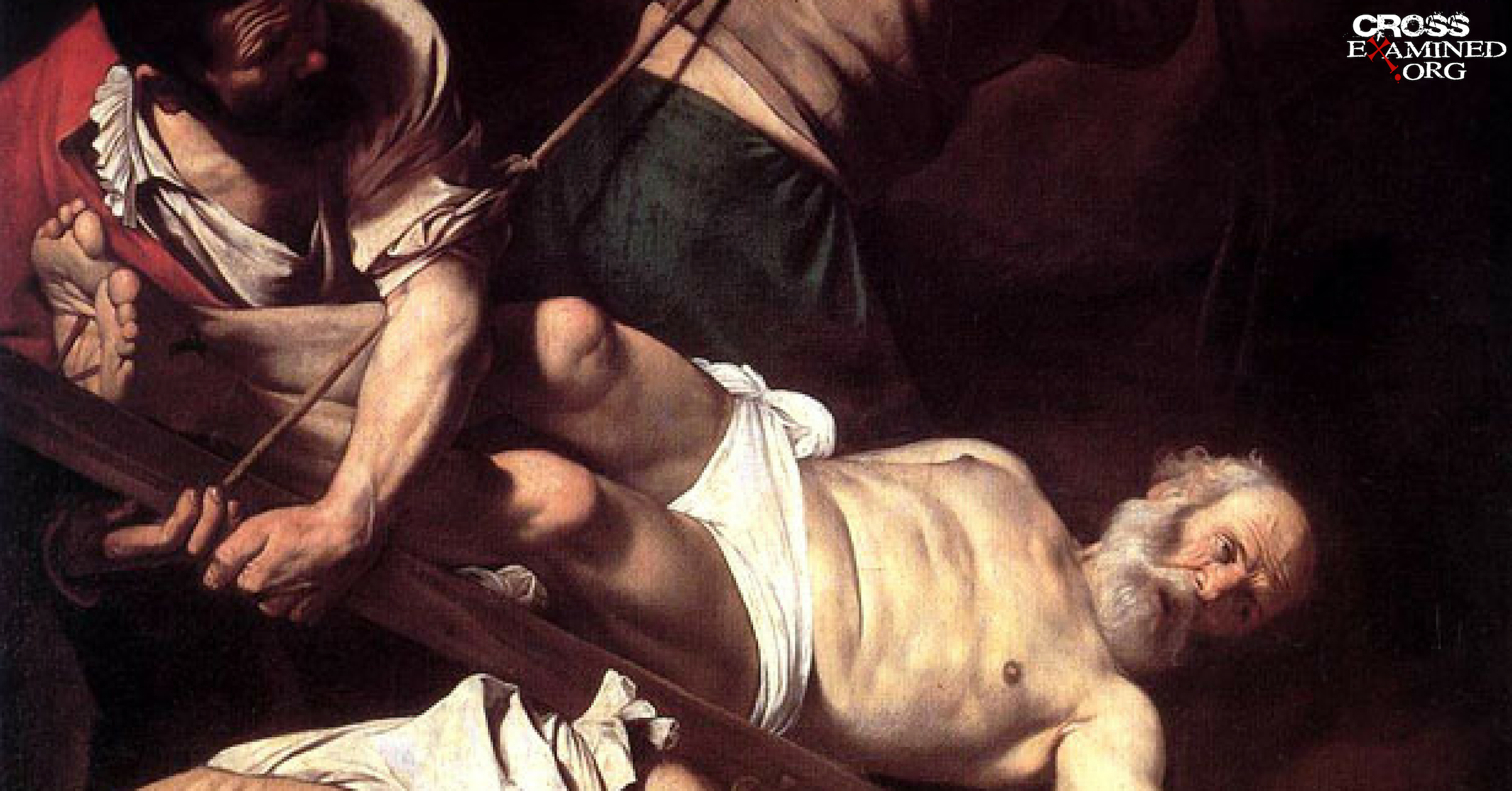
  3. Was the Apostle Peter really martyred by being crucified upside down?
  4. Was the Apostle Paul really martyred by being beheaded?

Before I get to the questions, listen to Sean explain why this chapter is his favorite addition to Evidence that Demands a Verdict as well:

Question 1: What makes the apostles different from modern martyrs?

Sean McDowell:

The apostles were eyewitnesses of the risen Jesus. In 1 Corinthians 15:3-7, we have the earliest account of apostolic belief. It was based on seeing the risen Jesus. That’s repeated in the writings of Paul…Read through Acts and just pay attention to how every single speech focuses on the resurrection.  The apostles say, “We saw the risen Jesus. We were there. We heard him, we touched him, we saw him.”  So their proclamation doesn’t prove that Christianity is true. But it does show they sincerely believe that Jesus rose from the grave. This doesn’t get us all the way to the resurrection, but it’s one pinnacle that shows that these first eyewitnesses really believed it…they all suffered and were willing to die for it. There’s no evidence that any of them recanted, and we have good evidence that some of them actually died as martyrs. That is a night and day difference from a so-called modern-day martyr [who dies for] for something he or she believes.

The apostles were eyewitnesses of the risen Jesus…they all suffered and were willing to die for [their belief].

Question 2: What is a martyr?

Sean McDowell:

A martyr is somebody who’s willing to die, and I would say does [die]…for their belief and proclamation of the Christian faith. When you hear popular arguments for martyrdom, you’ll hear things like, “The apostles refused to recant their belief in Jesus [at the point of death], therefore they really believed it.” Well, Mikel, can I tell you, there are no early sources where, say, Peter is told, “If you just stop proclaiming Jesus, we will not crucify you.”  Those kinds of accounts don’t exist…

[The Jewish historian] Josephus tells us James was put to death roughly in AD 62. Is James a martyr? I would argue that one, the political and the religious factors overlap. So partly James was put to death for political reasons, but it’s also religious reasons.  And we can’t separate those. But I think James qualifies as a martyr. Why?  He was publicly proclaiming a message that was offensive to the Jews, an insult to the Gentiles, about a martyred savior who’d come back from the dead.  He was the leader of the church in Jerusalem, publicly proclaiming this. So if he’s put to death by political and religious forces, you better believe that something tied to his public proclamation of the faith is related to why he put them to death. I think at least he gets the benefit of the doubt there, and thus would qualify at least broadly speaking as a martyr.

Question 3: Was the Apostle Peter really martyred by being crucified upside down?

Sean McDowell:

In John 21, Jesus says to him, “You’ll be taken where you do not want to go. Your hands will be tied, you’ll be dressed by another.” And then in parentheses, the writer of John says, “This is showing how he would die.” Even Bart Ehrman has written, “This was to indicate Peter would die a martyr’s death. If Jesus was the first shepherd, Peter’s the second shepherd who will also lay down his life.” …There’s debate about that. Larry Hurtado says [that] one thing we know for sure about crucifixion is that people were stripped naked for shame. Well, in John 21, “Jesus says to Peter, ‘Somebody else will clothe you.’” So that means, he probably wasn’t being taken to be crucified.  In fact, this author argues that he was burned in the time of Rome described by Tacitus, for the circus that Nero had.

I don’t think we can prove that [but] it doesn’t really matter how he died. What matters is, we have a first-century source, John 21, indicating [Peter] would die as a martyr.  Now, I think there’s good evidence he wasn’t crucified. The earliest record that he was crucified upside down shows up in a book called the Acts of Peter, [at the] end of the second century. Why will Christians say that Peter was crucified upside down?  “Because he didn’t want to be crucified the same way as Jesus.” [But] if you actually read the Acts of Peter, that has nothing to do with it.  It’s making a theological point: The world was turned upside down, and when Peter’s on the cross upside down, he can see the world upside correctly as it is, and his death will help to turn upside right, just as Jesus’s death did.  It’s not until the third and fourth century that church historians take the Acts of Peter as if it’s historical, and then say he was crucified upside down.  So I think at best, we can only say it’s possible. Because there is some precedent of people being crucified upside down. Martin Hengel records this in his book Crucifixion.  But I don’t think we’re historically warranted to say it’s likely or even probable.

Question 4: Was the Apostle Paul really martyred by being beheaded?

Sean McDowell:

For Paul, we have the passage in 2 Timothy that says, “I am being poured out as a drink offering. I fought the good fight, I ran the race.” …but then in 1 Clement 5, there’s a reference to the martyrdom of Paul and the martyrdom of Peter.  And then we have multiple documents in the second century and no contradictory evidence that Paul, in fact, died as a martyr.  Now was he beheaded?  The first explicit document shows up in the Acts of Peter [in the] late 2nd century.  But we know John the Baptist was beheaded.  We know James, son of Zebedee was beheaded.  We know he was a Roman citizen, and that was a common means of death.  So I think we’re very confident he died as a martyr and I would say…it’s reasonable that he was beheaded.

The Evidential Value of the Fate of the Apostles

Skeptics often say, “People die for religious ideas or political causes today. Just because you die for a belief, that doesn’t make it true.” I agree. But what it does mean is that you at least think your beliefs are actually true. As the McDowells observe on page 367:

The willingness of the apostles to suffer and die for their faith does not prove the resurrection is true…But it does show the depth of the apostles’ convictions. They were not liars.

It’s a strongly evidenced historical fact that Jesus’ disciples had real experiences they believed were experiences of the risen Jesus. And they didn’t die for something that somebody told them second or third-hand. They died for their personal testimony that they personally saw the risen Jesus. And they were the only ones to know if they really saw Jesus alive or not!

While there’s no conclusive historical evidence on the details of how exactly Paul or Peter died for their independent testimonies about seeing the risen Jesus, we can be confident that they died as martyrs. Their martyrdom should at least give a person pause and open the door to a fresh conversation on the reasons for the Christian belief in Jesus’ bodily resurrection.

THE TABLE PODCAST

In this episode, Mikel Del Rosario and Dr. Sean McDowell discuss the fate of the Apostles, focusing on the historical evidence of their martyrdom.


Original Blog Source: http://bit.ly/2NKMX2u

By Terrell Clemmons

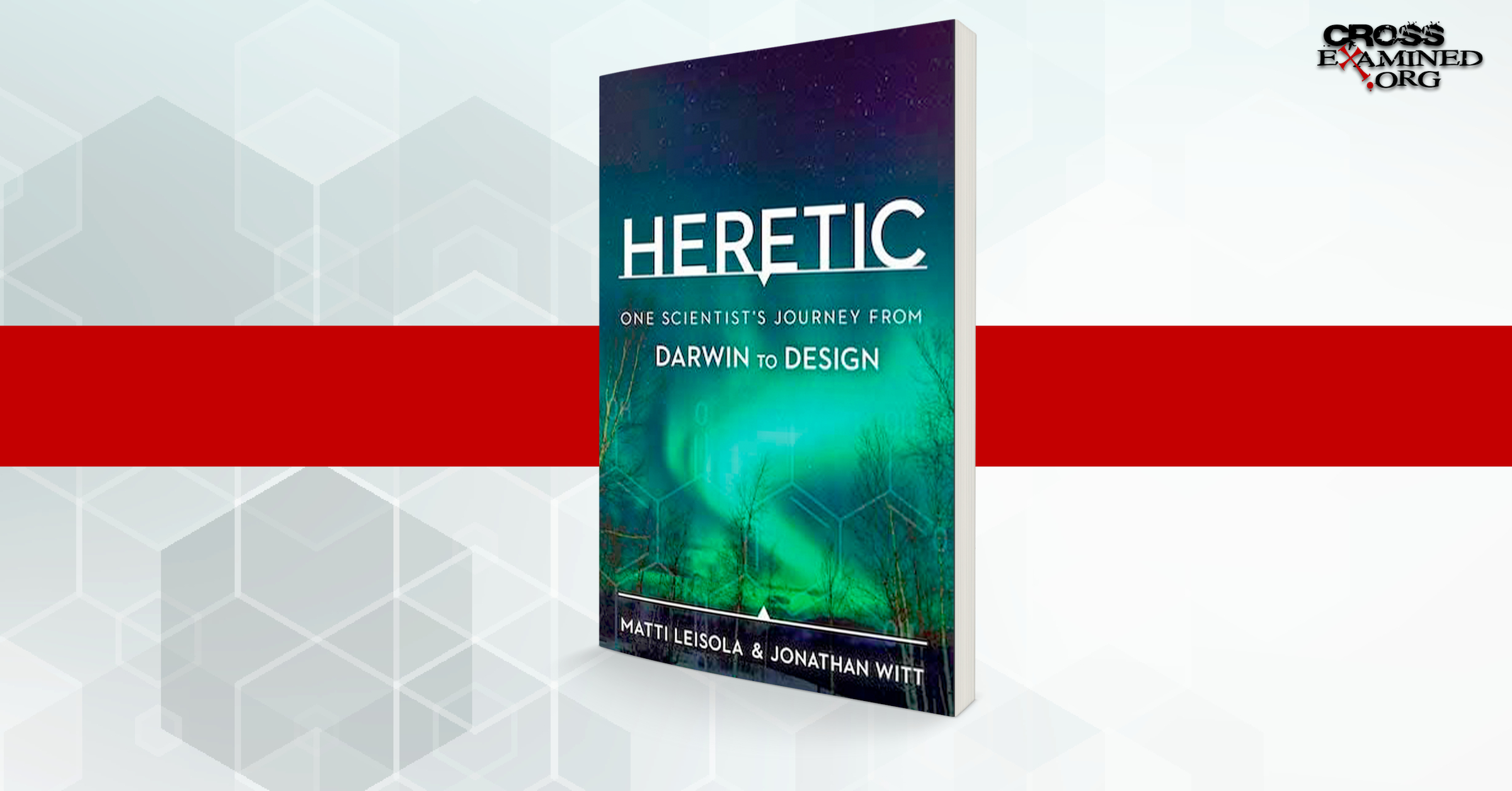
A Review of Heretic: One Scientist’s Journey from Darwin to Design, by Matti Leisola & Jonathan

As a student beginning his scientific studies in 1966, Finnish biochemist Matti Leisola used to laugh at Christians who “placed God in the gaps of scientific knowledge,” as the criticism often went. As he saw it, those people lacked the patience and level-headedness that he possessed.

After hearing Francis Schaeffer speak in 1972, though, he realized his concept of truth was naïve. He bought several of Schaeffer’s books and began to study philosophy, a subject he had previously considered of little value. At some point, he realized the god-of-the-gaps criticism cut both ways since a functional atheist could also insert a pat explanation into any knowledge gap. He also came to see another problem that the god-of-the-gaps criticism obscured: materialists seemed to think the proverbial knowledge gap was ever-shrinking, but in practice, the more scientists learned about the natural world, the more they found new and unexpected mysteries opening up. More important, the materialist argument for allowing only material explanations simply presupposed that only material causes exist. What if that presupposition was wrong?

By the mid-1970s, his doubts had become a conviction. “Scientists have no materialist explanation for the origin and complexity of life,” he wrote. “The confident bluffing of the dogmatic materialists notwithstanding, they weren’t even close.” Experimental science, he concluded, seems to point in a different direction.

A quintessential scientist’s memoir, Heretic: One Scientist’s Journey from Darwin to Design contains Leisola’s reflections on both developments in science (including biology, paleontology, genetics, information theory, and ID) and his “long and painstaking” voyage from the naturalistic evolutionary faith to dissent from Darwin. Heretic also details some of the evasions, hatred, suspicions, contempt, fears, power games, and persecutions that unfortunately mark the life of an open Darwin skeptic. And remarkably, it manages to do so with a subtle wit both sharp enough to poke fun at the contortions of materialism and shrewd enough to note the gravely consequential nature of what’s at stake.

Various chapters focus on experiences in academia (“I long ago had come to see that those bent on intimidation think nothing of shutting down debates and marginalizing scientists while paying lip service to the value of academic freedom”); encounters with publishers and broadcaster bias (“unconscious religiosity is all too common in the science community, and the broadcast media ensure that it’s presented as scientific fact day after day”); and “rationalists” behaving irrationally (“Bullies for Darwin; Actually, Several Bullies for Darwin”).

One especially compelling chapter is “The Church Evolves,” which deals with not only the Finnish Lutheran Church’s abject capitulation to Darwinism but also its active opposition to material that challenges Darwin. Even as literature critical of Darwin was forbidden on pain of punishment within Finland’s Soviet bloc neighbors, inside free Finland, church leaders were willfully suppressing the same information. This chapter speaks of trends to which Christians in America should pay attention.

“Criticism of evolutionary theory is a stressful hobby,” observed one reporter about Leisola. “On the other hand,” Leisola responded, “life as a dissenter is rich and exciting.” For the uncertain, he offers a modest invitation:

Take at least that first step on the journey that I began so many decades ago as a young, slightly arrogant scientist committed to modern evolutionary theory. That first step is a modest one, a step through the door of a paradigm and onto an open path whose end point I was unsure of. The first step was the decision simply to follow the evidence wherever it led.

Science- and truth-lovers might also find a delightful first step in Heretic.

—For more about Matti Leisola, see Minority Reporter: A Finnish Bioengineer Touches the Third Rail by Denyse O’Leary.


Terrell Clemmons is a freelance writer and blogger on apologetics and matters of faith.

This article was originally published at salvomag.com: http://bit.ly/2Ads4sY

By Luke Nix

Introduction

How can you helplessly watch as a child dies from agonizing cancer? Doesn’t the love you feel tell you that that suffering is evil and a God who is all loving and all powerful would rescue that child? How can God be all loving and all powerful if He allows such a child to suffer and die?

This is a challenge that is often raised by atheists to reject the God of the Bible. But today, I am not going to answer the atheist who raises the challenge as an armchair hypothetical that they have never experienced; instead I want to speak to the person who either has experienced this tragedy or is in the middle of it, and it causes them to be skeptical of the goodness and even existence of God.

This Is What Love Feels Like

But could God have a purpose for the pain that you feel? Before I get to that, please watch this tribute to those who have cared for a loved one at the end of their life: This Is What Love Feels Like, by dc Talk, inspired by Toby McKeehan‘s experience:

Knowing Love Through Suffering

Jesus knew the suffering that would take Him to His physical limits, yet He persisted and conquered: This was His love for you as He suffering the torture of crucifixion. If you have been taken to your limits through the suffering of a loved one, you know this love.

Without the suffering of a loved one, we would not know this love for someone else that takes us to our limits (and live to tell of it), what love truly feels like. Without the suffering of a loved one, we would not have the privilege of getting a trace of understanding of the depth of Christ’s love for us that took Him to the end of His physical limits. Caring for a spouse, parent, or child as they leave this world has to be one of the most painful experiences, and we do not escape it unchanged by the suffering it has caused. We are wounded, but we can use those wounds to heal. We can become the wounded healer (see my post “The Wounded Healer: Finding Ultimate Purpose In Your Suffering” for more on this concept). And just as we are alive today to be wounded healers, Jesus conquered death through His bodily resurrection to be the Ultimate Wounded Healer that we point to.

While it is a privilege to experience what this kind of love feels like (though it comes at a great cost, just like it did for Christ), our experience only scratches the surface of the love that Christ has. And our experience is only one person (or maybe a few people in extremely tragic situations) at a time. But Jesus’ love, as He suffered death, was not just for you or just for a few people, it was for every person (John 3:16).

Conclusion

We must not forget that our suffering in this life will come to an end. It is finite, and this finite suffering is not worth comparing to the infinite glory that will one day be revealed in us (Romans 8:18) and can be revealed in others to enjoy with us if we are willing to be used by God to be wounded healers. Do not be discouraged. Our perfect God has a purpose for your suffering. Without Him, your experience is a gratuitous pain with no purpose or meaning. But because God exists and Christ is resurrected from the dead, your experience is both purposeful and meaningful. Through your experience, God has blessed you with a deeper understanding of His love for you, and now He gives you the privilege to speak hope, life, love, meaning, and purpose to the brokenhearted suffering and struggling the same as you are.


Original Blog Source: http://bit.ly/2RFk6Ql

By Brian Chilton

In a recent class at Liberty University, it was noted how 80% of a person’s doubts do not stem from intellectual problems with Christianity, but rather from emotional doubt. Emotional doubt is a problem for every person, but it seems to be a tougher concept for men to combat. The reason is that most men abstain from talking about their emotions. Many will suppress the emotional doubt and ignore it. However, such actions do not eliminate the doubt. Emotional doubt may address issues concerning the loss of a loved one, an unanswered prayer, or frustrations in life for which one blames God.

Interestingly, emotional doubt can be combated by a form of biblical cognitive behavioral therapy (CBT). Some may claim, “Hold up, Brian! You are talking that psychology mumbo-jumbo! What good is cognitive therapy?” Actually, cognitive behavioral therapy is quite a good practice. Paul argues the following:

“Don’t worry about anything, but in everything, through prayer and petition with thanksgiving, present your requests to God. And the peace of God, which surpasses all understanding, will guard your hearts and minds in Christ Jesus. Finally, brothers and sisters, whatever is true, whatever is honorable, whatever is just, whatever is pure, whatever is lovely, whatever is commendable—if there is any moral excellence and if there is anything praiseworthy—dwell on these things” (Php. 4:6-8).[1]

The believer should focus on those things that build up one’s faith and not on worry and fears which cause anxiety. CBT does just that. Using CBT to combat emotional doubt is quite effective. CBT can also combat depression and anxiety. Biblical CBT follows three steps.

  1. Identify your lies. First, recognize the doubts and fears you tell yourself. You may say, “I am going to certainly fail this test even though I have studied hard for it. I am too dumb to pass it.” Realize that the statements do not correspond with reality. If you have studied hard for the test, then you have learned the information which will be on the test. You are certainly not too dumb to learn the material.
  2. Remove your lies by arguing against it and give reasons for your optimism. Second, argue against the lies you are telling yourself with a positive, encouraging case. You may tell yourself that if you fail the test that it would be the worst thing in the world. In this case, remind yourself that you have studied the material and have learned the material quite well. Even if the worst should happen and you fail the test, it is not the end of the world. As bad as it may be, it is not as bad as you’re making it out to be.
  3. Replace your lies with the truth of God’s word. Third and finally, replace your lies with the truth of God’s word. Realize that “I am able to do all things through him (Christ) who strengthens me” (Php. 4:13, brackets mine). Realize that “all things work together for the good of those who love God, who are called according to his purpose” (Rom. 8:28). With these truths in mind, the doubts and anxieties begin to lose their grip.

CBT is a biblical practice that all believers need to practice. For too long, we have allowed the devil to steal our joy and hope. Often, we are our own worst enemies as we feel too frightened to take a chance on something for playing the “what if” game. Stop letting fear and anxiety steal the thunder from the grace that God has given you. Always keep in mind that “God has not given us a spirit of fear, but one of power, love, and sound judgment” (2 Tim. 1:9).


Brian G. Chilton is the founder of BellatorChristi.com and is the host of The Bellator Christi Podcast. He received his Master of Divinity in Theology from Liberty University (with high distinction); his Bachelor of Science in Religious Studies and Philosophy from Gardner-Webb University (with honors); and received certification in Christian Apologetics from Biola University. Brian is currently enrolled in the Ph.D. program in Theology and Apologetics at Liberty University. Brian has been in the ministry for over 15 years and serves as a pastor in northwestern North Carolina.

Original Blog Source: http://bit.ly/2PtiUhm

By Evan Minton 

Some well-meaning but very misinformed Christians discourage the study of philosophy on the basis of a verse in Colossians chapter 2. In Colossians 2:8, the apostle Paul wrote: “See to it that no one takes you captive by philosophy and empty deceit, according to human tradition, according to the elemental spirits[a] of the world, and not according to Christ.” This verse has become the chief proof-text for anti-philosophy Christians. In fact, even the famous reformed preacher John MacArthur argued against philosophy using this text. In The MacArthur Study Bible, he wrote “You know what philosophers are? They’re doodlers with words instead of pencils. They just make a whole lot of verbal squiggles. Colossians 2:8 says this: ‘Beware lest any man spoil you through philosophy.’” Unfortunately, this verse has been majorly misinterpreted.

Keep The Text In Its Context

When you look at the verse in context, what you find is that Paul wasn’t saying “Philosophy is bad”, but rather, he was warning his readers to be on the lookout for bad philosophies.

To really understand what Paul is talking about in this verse, one needs to move beyond the verse itself. One needs to read it in context. That means both the immediate context (the verses before and after it) and its cultural context. Moyer Hubbard of Equip.org writes “Looking now at Colossians and the specific context of chapter 2, we find Paul addressing a local assembly that had been infiltrated by a form of false teaching that threatened to undermine the gospel he preached. Paul does not give us enough information to identify precisely what sect or ‘philosophy’ he is describing. There are some clues, however, that suggest that it was perhaps a syncretistic hybrid of Jewish mystical practices and popular pagan folk-belief: he mentions the observance of special days, including the Sabbath (v.16); visionary experience and the worship of angels (v.18); submission to the “elemental spirits of the world” (v.20);6 and abstinence (vv.21,23). Paul clearly is attacking a peculiar form of religious speculation, but it is impossible to identify it with any of the major schools of philosophy known to us from the Greco-Roman world. In fact, it is important to keep in mind that the Greek word philosophia (and its Latin cognate) had a variety of meanings in this period, and, depending on the context, might be translated ‘religion,’ ‘speculation,’ or ‘investigation.'”[1]

We gain more information on this incorrect philosophy by taking into account how Paul describes it in the 8th verse of Colossians 2: Paul says that it’s founded on “human traditions and the elemental powers of the world, and not on Christ.” The key phrase here is “[based] not on Christ.” Paul was targeting “philosophical” speculations that oppose the truths of Christ.

Moreover, I think the phrase “human traditions,” gives us a clue that this ungodly speculation was Jewish in nature. The phrase “human traditions” appears in only one other place; Mark 7:8, where Jesus condemns the Pharisees as those who reject “the commands of God and hold to human traditions” (cf. Galatians 1:14). Paul uses the term “elemental spirits of the world” similarly in referring to the Galatians’ doing the Torah stuff in Galatians 4:3. As Hubbard commented, “That Paul could refer to this syncretistic Jewish speculation as a ‘philosophy’ is in keeping with how Hellenistic Jews of the period sometimes referred to their faith.”[2] He said that because extra-biblical Jewish writers of the time called their theological beliefs “philosophies”. For example, the Jewish historian Flavius Josephus calls Judaism and its multiple sects as “philosophies”[3] (those sects being the Essenes, Sadducees, and Pharisees)[4]

4 Maccabees refers to Judaism as “our philosophy…teaching temperance, self-control, courage” (5.22‑23). Therefore, it very well could be the case that Colossians 2:8 is referring to Judaism and the Judaisers, employing their terminology when referring to their beliefs. If that is the case, then one cannot use Colossians 2:8 to condemn the study of philosophy as a whole, for Paul is merely warning against philosophical systems that oppose the gospel, in this case; the philosophy of the Judaisers.

Dissing Philosophy Is Logically Self-Refuting

Besides the exegetical fallacies in taking Colossians 2:8, there is a logical problem as well; namely, it’s self-refuting. In any attempt you make to formulate arguments against philosophy, you will be reasoning philosophically about philosophy. Yet if you’re reasoning philosophically about philosophy, you’re engaging in the very thing Paul (allegedly) told us not to do; philosophy! This is why Christians who say “I don’t need philosophy” are frequently met with the retort “Really? That’s a nice philosophy.” and “You shouldn’t do philosophy” with “Is that your philosophy?” Are we to believe that The Holy Spirit would inspire Paul to teach self-refuting…. philosophies?

Conclusion
The Apostle Paul was not anti-philosophy. Those who argue that he was, do so by ripping Colossians 2:8 out of context. Moreover, to say you shouldn’t do philosophy and then proceed to give any arguments for it is self-refuting, as you’re doing philosophy.

I’ll end this blog post with a quote from Dr. William Lane Craig: “the man who claims to have no need for philosophy is the one most apt to be fooled by it”[5]

Notes

[1] “Is Colossians 2:8 A Warning Against Philosophy?” – by Moyer Hubbard, http://www.equip.org/article/is-colossians-28-a-warning-against-philosophy/

[2] ibid.

[3] Flavius Josephus Against Apion 2.47.

[4] Flavius Josephus Antiquities 18.11.

[5] https://www.reasonablefaith.org/writings/question-answer/hawking-and-mlodinow-philosophical-undertakers


Original Blog Source: http://bit.ly/2RFw7oL